Snow removal · Winter
Windrow Clearing in Durham Region: Who Actually Does It, Town by Town
Windrow clearing in Durham Region is the homeowner's job in all five municipalities we serve, and every published exception is an assistance program with an age or disability test, a deadline, and a snow depth most storms never reach.
Gold and Platinum take the whole driveway. See what each membership covers.
Green in summer. Clear in winter.
The short answer
In all five Durham municipalities we serve, the windrow is legally and explicitly the property owner's responsibility. In Oshawa the windrow at the end of your driveway is the property owner's responsibility, and the City clears it only for registered residents aged 65 or over or with a documented disability, and only once the ridge reaches 20 cm. Everyone else either moves it by hand or pays somebody to take it off. Not one of them clears driveway windrows for the general public. Four run an assistance program for seniors and people with disabilities, each with its own application deadline, its own price and its own minimum snow depth. Three of those deadlines fall inside the next seven weeks. Northline Property Care clears that windrow on the same visit as the driveway itself, on Gold and Platinum memberships, in Oshawa, Whitby, Ajax, Pickering and Clarington.
Where every Durham town stands, in one table
These are each municipality's published positions, taken from their own winter maintenance pages in September 2026. Programs change and prices move, so treat the table as a starting point and confirm with the town before you rely on a date.
| Municipality | Clears windrows for everyone? | Assistance program | Minimum windrow depth | Season cost | Key date for 2026 to 27 |
|---|---|---|---|---|---|
| Oshawa | No | Snow Clearing Assistance Program, 65 or over or a documented disability | 20 cm | No fee published | Applications reopen October 1, 2026 |
| Whitby | No | Snow and Windrow Clearing Services, 65 or over or documented inability | 10 cm | No fee charged | Opens September 14, closes November 1, 2026 |
| Ajax | No, and Council has rejected it | A separate seniors snow removal program, not windrow specific | Not published | Not published | Call the Town, 905-683-2951 |
| Pickering | No | Seniors and Persons with Disabilities Snow Clearing | Not published | $0 to $240.69, set by household income | Documents due October 16, 2026 |
| Clarington Bowmanville, Courtice, Newcastle | No | Snow Clearing Program for Seniors and Persons with Disabilities | 15 cm | $107.69 including HST | Applications September 21 to October 31, 2026 |
Sources, in order: the City of Oshawa snow clearing help page, the Town of Whitby snow and windrow clearing page, the Town of Ajax winter roads page, the City of Pickering accessibility snow clearing page and the Municipality of Clarington snow clearing program page.
What a windrow is, and why every plow leaves one
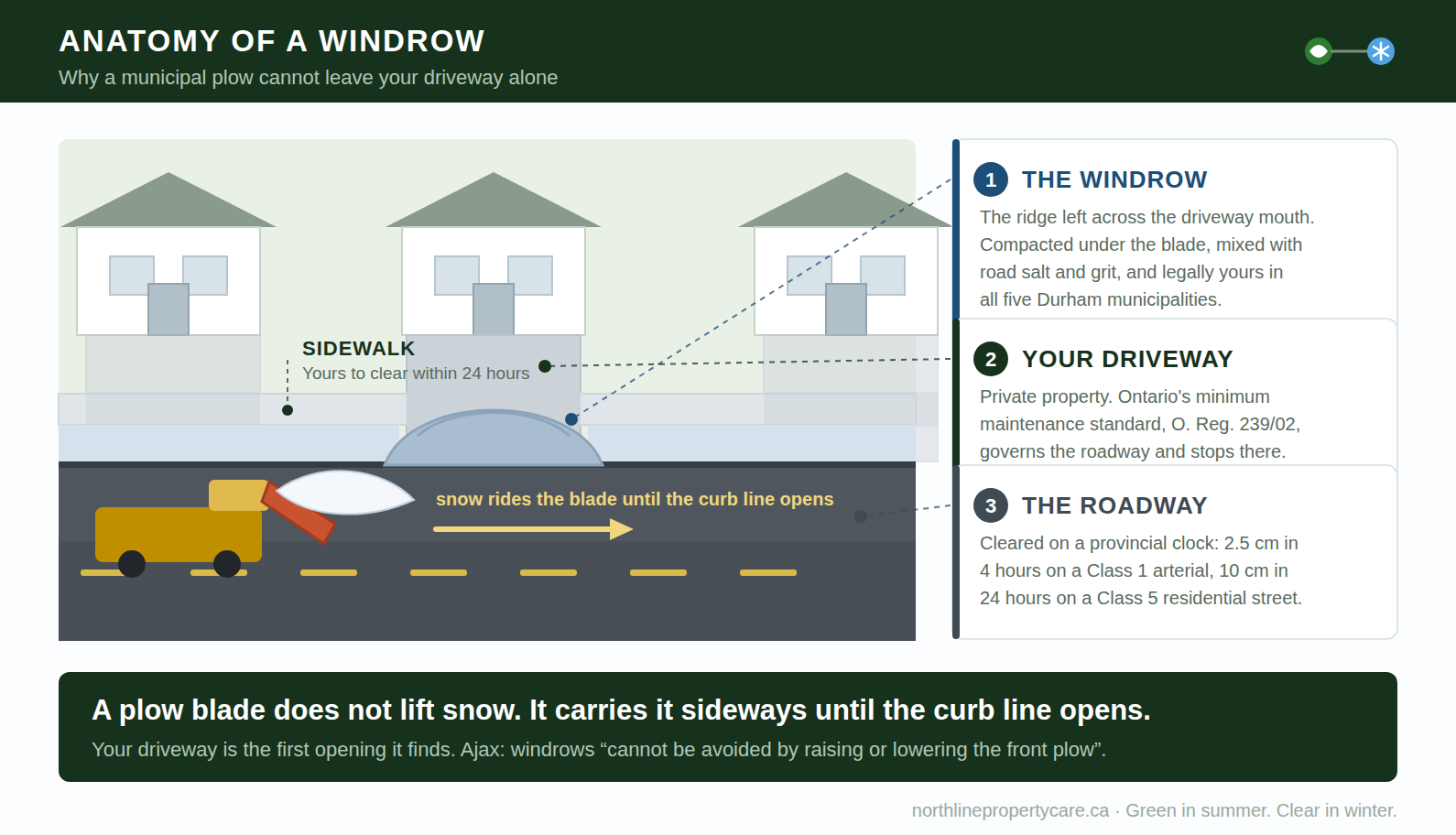
Oshawa defines it plainly on its own website: the windrow is the pile of snow at the bottom of the driveway after a snowplow clears the street. That sentence is doing more work than it looks. It is not describing a mistake, a lazy operator or a plow driver in a hurry. It is describing the only physical outcome a plow blade can produce.
A municipal plow does not pick snow up. It carries snow sideways. The blade sits at an angle and the snow rides along the face of it, building into a rolling mass that travels with the truck until something lets it go. Along a stretch of curb with no openings, that mass just keeps rolling and piles against the snowbank. The moment the truck passes a driveway, the curb line disappears and the accumulated snow spills into the gap. Then the blade picks up more, and the next driveway gets the same treatment.
Ajax puts the consequence in about as blunt a form as a municipality ever does: windrows will always occur when snow is plowed, and they cannot be avoided by raising or lowering the front plow. There is no setting. A plow operator who tried to spare your driveway would simply deposit the same volume forty feet further along, into your neighbour's.
This is why the windrow is dense in a way ordinary snowfall is not. The snow in it has already been compressed under the blade, dragged across pavement, mixed with road salt and grit, and then left in a pile where it sets. Twenty centimetres of fresh snow on your lawn and twenty centimetres of windrow across your apron are not the same material and they do not take the same amount of work. The Canadian Centre for Occupational Health and Safety makes the general point and it is worth reading before the first storm: fresh dry snow is lighter and more manageable than wet, heavily packed or partly melted snow, and a person lifting roughly five kilograms every five seconds is moving sixty kilograms a minute.
That is the real shape of the problem. The windrow is the smallest part of the driveway by area and the largest part of it by effort.
Why no Durham town simply clears them
Every winter this question arrives at every council in the region, and the answer is always the same, for the same reason. The number is enormous.
Pickering's own winter reminders page reports that council examined two ways of doing it and priced both: contracting the work out at roughly $7.4 million a year, or running it in house at roughly $19.8 million in the first year. Council's conclusion was that windrow clearing stays with the resident, and the accessibility program is capped at around 750 applicants. Ajax studied the same question in 2019 and landed on an estimate above $1.8 million a year, with the additional finding that even where equipment was deployed it could clear about eighty per cent of a driveway's width, which means the resident still comes out with a shovel.
Set that against what a town is already doing. Oshawa alone maintains roughly 1,265 lane kilometres of winter road network: over 500 kilometres of primary roads, 765 kilometres of residential roads and about 160 kilometres of sidewalk. Adding every driveway apron in the city to that list is not a scheduling problem. It is a second fleet.
So the position is settled and it is not going to move: the street is a public asset and the town clears it, the driveway is a private asset and you clear it, and the windrow is what happens where the two meet.
The assistance programs, and the deadline you are probably about to miss
If you or a parent qualifies, these are worth the paperwork. The catch is that almost every one of them closes its application window before the first serious storm, which means people discover the program in January and cannot join until the following season.
One thing this table cannot show is where each program stops on the ground. Outside the upper Ajax service level, none of them clears the driveway surface, and none of them clears the private walk between a front door and the driveway. Snow removal for seniors in Oshawa maps all six bands of a frontage against what each municipality publishes, and covers the household rule that disqualifies more applicants than the age rule does.
Ajax is the exception on this list and it is the instructive one. Its staff costed a municipal windrow service in 2019, put a figure of $1.8 million a year on it, and Council received the report without adopting anything. The figures are worked through on the Ajax snow removal cost page.
Oshawa
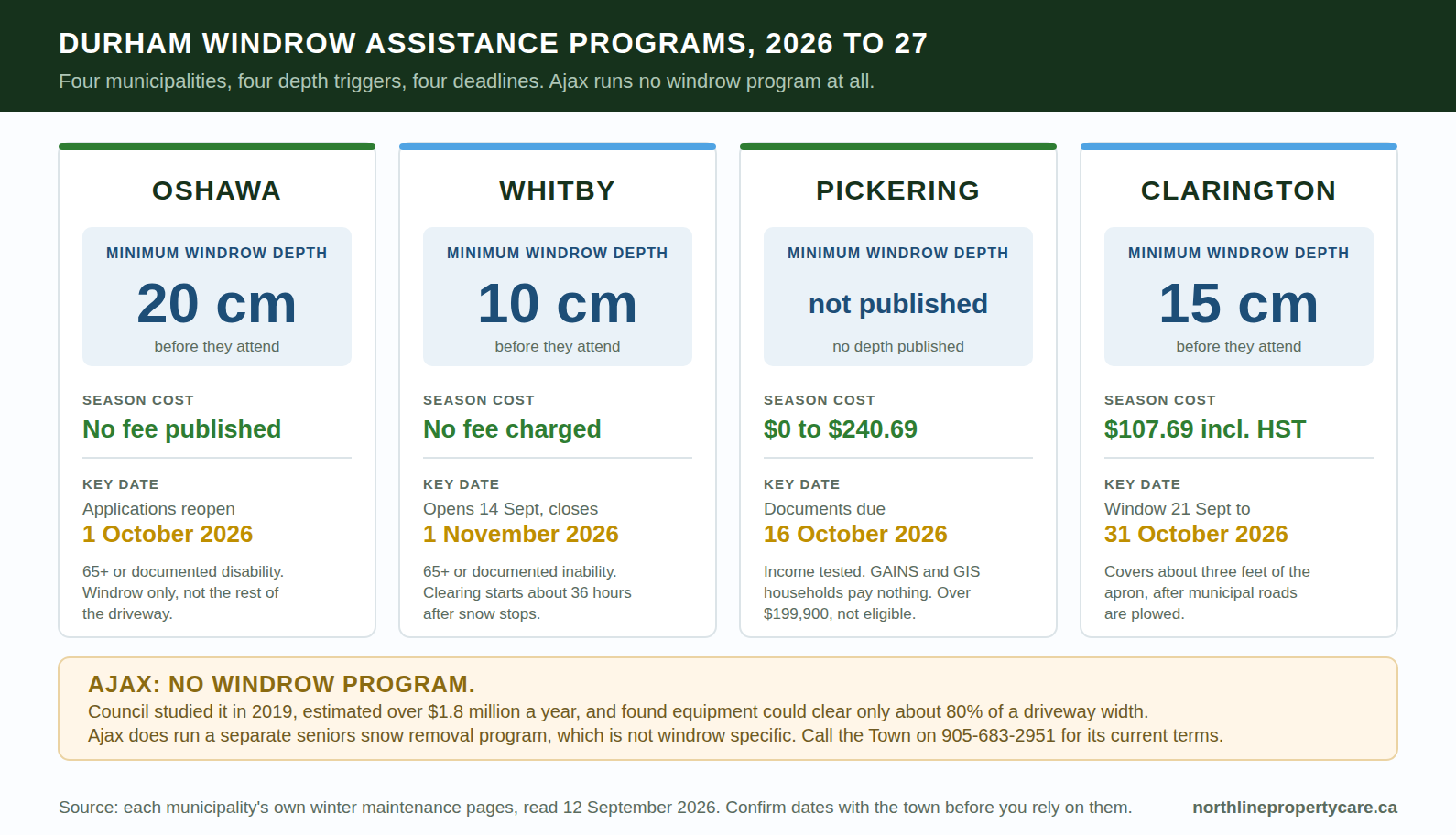
The Snow Clearing Assistance Program covers city sidewalks and driveway windrows for residents aged 65 or over, or with a documented disability, where no non-disabled household member under 65 lives at the property. It has to be a single family dwelling. Proof of disability is accepted in several forms, including an accessible parking permit, a CNIB client card, a CPP disability benefit card or a doctor's note. The service clears the windrow only, not the rest of the driveway, and it only attends when the windrow is at least 20 cm high. Applications and renewals reopen on October 1, 2026.
Whitby
Whitby's program is the most generous in the region on price, because there is no fee at all. Eligibility is 65 or over, or a documented physical inability to clear snow, with nobody under 65 in the household able to help. Clearing begins about 36 hours after the snow stops, at a 5 cm minimum for sidewalks and a 10 cm minimum for windrows. Registration opens September 14, 2026 and the cutoff is firm at November 1, 2026.
Pickering
Pickering's program is income tested, which is unusual and worth knowing about. Households receiving the Guaranteed Income Supplement or GAINS pay nothing. Below $90,997 it is $128.82 including HST, then $186.45, then $240.69 at the top band, and above $199,900 you are not eligible. Applicants must be the registered property owner with taxes current, live in urban Pickering or one of the named hamlets, and not be away more than two consecutive weeks in the season. Post dated cheques and supporting documents are due October 16, 2026.
Clarington
Clarington covers sidewalks plus the windrow to a depth of about three feet of the driveway apron next to the road. Sidewalks are cleared within 24 hours of snowfall ending once accumulation passes 7.5 cm. The windrow is cleared after the municipal roads are done, and only when snow exceeds 15 cm. The season costs $107.69 including HST and the application window is September 21 to October 31, 2026.
Ajax
Ajax runs no universal windrow program and decided against one in 2019, but this page previously said its seniors program was not windrow specific, and on the Town's own 2026 to 2027 application form it plainly is. That form sets two service levels. The upper one, at $360.70 including HST for the season, takes the driveway surface, the ridge at the end of it, the municipal walk and a route to whichever door the applicant names. Level 2 takes the windrow and the municipal sidewalk alone at $41.13 including HST, which is the cheapest windrow clearing available anywhere in Durham Region to a household that qualifies. Service runs after more than 5 centimetres, 24 hours after the snow stops and only once the Town plows have finished the roads, and both fees are footnoted as subject to change on January 1, 2027. The Town remains the only reliable source for the current figure and the eligibility, so call 905-683-2951 rather than trusting anything published second hand, this page included. The eligibility tests, the two conditions and what they mean for a working morning are set out in who plows driveways in Ajax.
If you do not qualify for one of those programs, Northline Property Care clears the windrow at the end of your driveway in Oshawa, Whitby, Ajax, Pickering, Bowmanville, Courtice and Clarington, and it clears at 3 cm, which is below every municipal trigger on this page.
The depth trigger, which is where most of these programs stop
Here is the detail that decides whether one of these programs will actually change your winter, and it is buried in every one of them.
Oshawa attends a windrow at 20 cm. Clarington attends at 15 cm. Whitby attends at 10 cm. Those are not storm totals. They are the height of the windrow itself, measured at your apron, and a plow passing a driveway at speed will heap the street's snow into a ridge noticeably taller than whatever fell. Even so, a large share of Durham storms will not produce a 20 cm windrow.
By our own count of Environment Canada's daily records for Oshawa across eighteen complete winters, the city averages about twelve days a year with 3 cm or more of snow and about twenty-seven with any measurable snow at all, which we set out in detail in our guide to when snow actually starts in Oshawa. Most of those days are small. They are also the days that quietly ruin a Tuesday, because a 12 cm windrow of salted, compacted plow snow across a double driveway is a genuine job and it sits below Oshawa's threshold entirely.
So read the program you are joining as what it is: protection against the worst four or five mornings of the winter, not against the winter. That is a real and valuable thing. It is not the same as having the driveway handled.
What the law says about where that snow can go
Once the windrow is yours, so is the question of where you put it, and this is where a surprising number of otherwise careful homeowners break the law without knowing it.
The province is unambiguous. Section 181 of the Highway Traffic Act reads: No person shall deposit snow or ice on a roadway without permission in writing so to do from the Ministry or the road authority responsible for the maintenance of the road. That is the whole section. It applies to every road in Ontario, and it does not carve out an exception for the snow that a plow put on your property first.
There is a second half to that question, and it is the one that decides whether the pile you build in November is still workable in February. Oshawa sets a measured height limit of 0.9 metre on anything standing inside the sight triangle at the end of a driveway, and that triangle is only three metres along the street line by three metres up the driveway edge. The windrow is the single largest volume of snow that arrives on a frontage all winter, and the apron is exactly where the triangle sits. Where it may lawfully go, how far back from the street line, and what happens to the lawn underneath it in May are set out in where to put snow from your driveway in Oshawa.
Municipalities layer their own rules on top. Whitby's Clean Community By-law 8271-26 states at section 8.6 that no person shall shovel, plow or blow any snow, slush or ice onto or across a highway, a sidewalk or a pedestrian walkway without authorization, and at section 6.1 that owners must clear snow and ice, including a windrow, from any sidewalk within 24 hours of it accumulating. Pickering's Ice and Snow Clearing By-law 6650/06 carries the same prohibition on depositing snow onto a city street, along with the same 24 hour sidewalk rule. Clarington's By-law 93-144 sets the 24 hour sidewalk requirement as well.
Two practical consequences follow, and they are the ones we watch people get wrong every winter:
- The windrow goes onto your property, not back onto the street. Onto the boulevard, onto the lawn, into the snow storage at the edge of the driveway. Not across the road, and not into the intersection.
- Snow thrown back into the roadway refreezes into a hazard with your address attached to it. That is the reason the rule exists. It is not about tidiness.
There is a third one that costs people money later. Piling the windrow against a garage door, a downspout or a gas meter is legal and still a bad idea, because that pile is the last thing on the property to melt and it holds water against whatever it is leaning on for weeks.
Why the road is cleared in hours and your driveway is not
People often read the speed of the municipal response as proof that clearing the windrow would be easy. It is worth understanding why the street moves so fast, because the answer explains precisely why the apron does not.
Ontario sets the municipal standard in O. Reg. 239/02, the Minimum Maintenance Standards for Municipal Highways. Section 4 requires a municipality to deploy resources as soon as practicable once snow depth passes the figure in the table, and then to reduce it below that depth within a set time. Roads are classed by posted speed and traffic volume.
| Class of highway | Snow depth that triggers the standard | Time allowed to clear it |
|---|---|---|
| Class 1 | 2.5 cm | 4 hours |
| Class 2 | 5 cm | 6 hours |
| Class 3 | 8 cm | 12 hours |
| Class 4 | 8 cm | 16 hours |
| Class 5 | 10 cm | 24 hours |
Read that as an operations schedule rather than a legal text and the winter makes sense. A municipality has a clock running on its arterials from the moment 2.5 cm lands, so the arterials go first, every time, in every town. Residential streets sit further down the classes with far longer windows, which is why your street can still be unplowed at 9 AM while Taunton Road has been bare pavement since 5.
And here is the whole point: the regulation says nothing at all about the driveway apron. The standard governs the travelled portion of the roadway. The apron is private property, it falls outside the regulation, and nothing in Ontario law obliges anyone to clear it. The windrow lives in exactly that gap, and it always has.
Who owns the road outside your house, and why it changes your windrow
Durham has two road authorities and most homeowners have never had a reason to notice which one is outside their door. After a storm, it matters.
The Regional Municipality of Durham maintains the Regional road system all year round. Those are the arterials: Simcoe Street, Thornton Road and Bloor Street in Oshawa, Taunton Road, Thickson Road and Brock Street in Whitby, Bayly Street and Salem Road in Ajax, Brock Road, Altona Road and Finch Avenue in Pickering, Courtice Road, Main Street and Bowmanville Avenue in Clarington. Everything else residential is the local municipality's, and the Province holds the 400 series.
If your driveway opens onto a Regional road, three things change. The road is in a higher maintenance class, so it is cleared sooner and more often. The equipment running it is bigger and moving faster. And both of those produce a heavier, denser windrow, delivered earlier in the storm and then topped up on every subsequent pass.
There is a third road authority that nobody expects, and on a townhouse street it is often the one that matters. Where the lane out front is a common element rather than an assumed municipal road, the condominium corporation holds it, and the windrow across your apron was never made by a municipal plow at all. Townhouse snow removal in Oshawa works through the three ownership shapes and what each one changes.
Houses fronting an arterial get the worst windrows in Durham, and they get them first. If that is you, the assistance program depth triggers are far more likely to be met, and a per visit contractor is far more likely to leave you waiting, because everyone on that stretch is calling at the same time.
Timing, and the mistake that doubles the work
The most expensive error in a Durham winter is not skipping a clear. It is clearing at the wrong hour.
The sequence in a typical overnight storm runs like this. Snow falls through the night. Arterials are plowed on the provincial clock while it is still falling. Residential streets are plowed once the snowfall ends or once the crews work down the priority list, which is commonly early morning. Your driveway gets its windrow at that moment, whatever you did to it beforehand.
Which produces the classic Durham scene: someone finishes a driveway at 6 AM, showers, comes back out at 7:15 with the car keys and finds a metre wide ridge of plow snow across the end of it, harder than anything they moved an hour earlier. The work was not wasted, exactly, but the timing turned one job into two.
- If you can wait, wait for the street plow. Clear once, after it passes, and you handle the whole driveway including the windrow in a single go.
- If you cannot wait, clear a car width and leave the rest. Get out, go to work, and deal with the full driveway that evening when the plow has been and gone.
- Do not pile snow on the downwind side of the driveway mouth. It funnels the next windrow deeper into the entrance.
- Cut the corners back on the first clear of the season. A mouth that starts wide stays usable in March. A mouth that starts tight loses a foot on every storm until a car cannot turn into it.
That last one costs nothing at the time and it decides February. By the middle of February the width of your driveway entrance is entirely decided by how generous you were with it in December. The corners you cut back in December are also the corners worth marking, and where a driveway marker goes in Oshawa covers the setback, the height at the street end and the municipal strip that may not take one at all.
The windrow is also the thing that decides which machine a household needs, if it decides to buy one at all. A plow blade has already packed that ridge before you reach it, and Oshawa will not even send a crew to a windrow under its own assistance program until it stands at least 20 centimetres high. Single stage snow throwers are rated by their makers for roughly 22 centimetres of light, unpacked snow. We set the manufacturers' own intake heights against the Durham snowfall record in snow blower against a plow service in Oshawa, and the margin is narrower than almost anybody expects.
What we do about the windrow
We built our winter service around this problem specifically, because in six winters of doing it the windrow is what people actually complain about. Not the driveway. The end of it.
On Gold and Platinum the whole driveway is ours, windrow included, with unlimited visits, no per storm charge and no phone call needed from you. Our target after overnight snow is 7 AM, which is chosen to sit after the residential plow on most storms rather than before it, because clearing your driveway ahead of the plow is exactly the mistake described above.
On Silver we are not plowing your driveway and we say so plainly. What Silver gets is the windrow pass: after every storm we run, we take the city windrow off the end of the driveway, plus four banked full clears a season on request. It exists because a homeowner who is happy to shovel fresh snow is very often not happy to break up a salted ridge left by a truck, and those are two genuinely different jobs.
If you want the reasoning behind those prices rather than the prices alone, we set out the per visit, seasonal and bundled numbers side by side in what snow removal costs in Durham Region. Silver at $129 a month plus HST takes the ridge off the end for you on the daytime route, with the pass in by 5 PM, while Gold at $189 and Platinum at $279 clear the whole driveway on the same trigger, and the rest of that winter scope is set out on the snow removal page. Brooklin is priced on a page of its own rather than off a Whitby list, because the lots there are deeper and a Whitby number prices them wrongly. The by-law that puts the ridge on you in the first place, and the deadline each municipality attaches to it, is set out in the snow removal bylaw in Oshawa.
One honest note to close on. If you or a parent qualifies for a municipal assistance program, join it. It costs nothing in Whitby and $107.69 in Clarington, and no private contractor in this region will beat that. Read the depth trigger before you assume it covers your winter, and then decide whether the days below the threshold are worth handling yourself.
Nobody moves it for an empty house either
A ridge across the mouth of a driveway nobody is using is still the property owner to deal with. It does not melt, the municipal assistance programs exclude a property left standing empty, and an untouched driveway is one of the signs the regional police service names when it tells residents how a house ends up chosen. The rest of what an absence changes is set out in our guide to snowbird snow removal in Durham Region.
Why the ridge is heavier than anything else you move
A windrow is not the snow that fell on your property, and that is why it behaves differently under a shovel. It arrives already compacted under a blade, at the dense end of the range the Government of Ontario publishes for snow, so it starts at a weight that fresh snow only reaches after days of sitting. The arithmetic, in kilograms on a stated driveway, is set out in our guide to snow shovelling in Oshawa.
Questions people actually ask
Can I make the plow driver skip my driveway?
No, and it is not a question of willingness. Ajax states on its own winter roads page that windrows cannot be avoided by raising or lowering the front plow. The snow riding the blade has to be set down somewhere, and a driveway is simply the first gap in the curb line where it can go.
Can I push the windrow back into the road?
No. Section 181 of the Highway Traffic Act prohibits depositing snow or ice on a roadway without written permission from the road authority, and Whitby and Pickering both carry their own by-laws saying the same thing. It also refreezes into a hazard that is traceable to your address.
I am 70 and I live alone. Do I qualify for help?
Very likely, in Oshawa, Whitby, Pickering or Clarington, provided no household member under 65 lives with you and the property is a single family dwelling. Each town has its own proof requirements and its own deadline, and three of the four close before November 1, 2026. Start with your own municipality's page rather than a general search.
Why does my windrow look worse than my neighbour's?
Usually the road class. A driveway on a Regional arterial is plowed sooner, more often and by heavier equipment than one on a residential crescent, so it collects more snow and denser snow. Corner lots and driveways just past a bend also catch more, because that is where the blade sheds its load.
Does salt help with a windrow?
Not much, and not the way people hope. The windrow is already salted from the roadway and it is compacted rather than icy, so salt is working against volume rather than a bond. Salt earns its keep on the thin refrozen layer left behind after the windrow is moved, which is where the actual slip risk sits.
Should I clear the windrow before or after the street is plowed?
After, whenever the morning allows it. Clearing before the plow arrives means doing the entrance twice, and the second time is the hard version. If you have to get out early, open a car width and leave the rest for the evening.
Who wrote this
Andrew owns the business and takes the ridge off the end of the driveway himself, before the household is up. Owner operated, north Oshawa, across the seven Durham towns, fully insured and registered for HST. Six winters of Durham snow clearing are his own record, and a fair share of them were spent at the foot of somebody else's driveway.
Every municipal position above was taken from that municipality's own winter maintenance page, and the law from the province's own published text. None of it came from another contractor.
Before the first storm
Three more things worth reading now
Snow removal in Clarington
The municipality with the most ground in Durham, read from the lakeshore to the moraine, including the windrow program its own rules keep out of rural Clarington.
Read the Clarington guide →When does snow actually start in Oshawa?
The first storm worth clearing lands weeks before most people have booked anything. Here is the month by month shape of a Durham winter.
Read the timeline →What snow removal costs in Durham Region
Per visit, seasonal and bundled, with our own numbers in the tables and the breakeven calculation written out.
Read the numbers →What our winter service actually covers
The 3 cm trigger, the 7 AM target, what Silver gets and does not get, and where the snow goes on your property.
See the service →The work, photographed
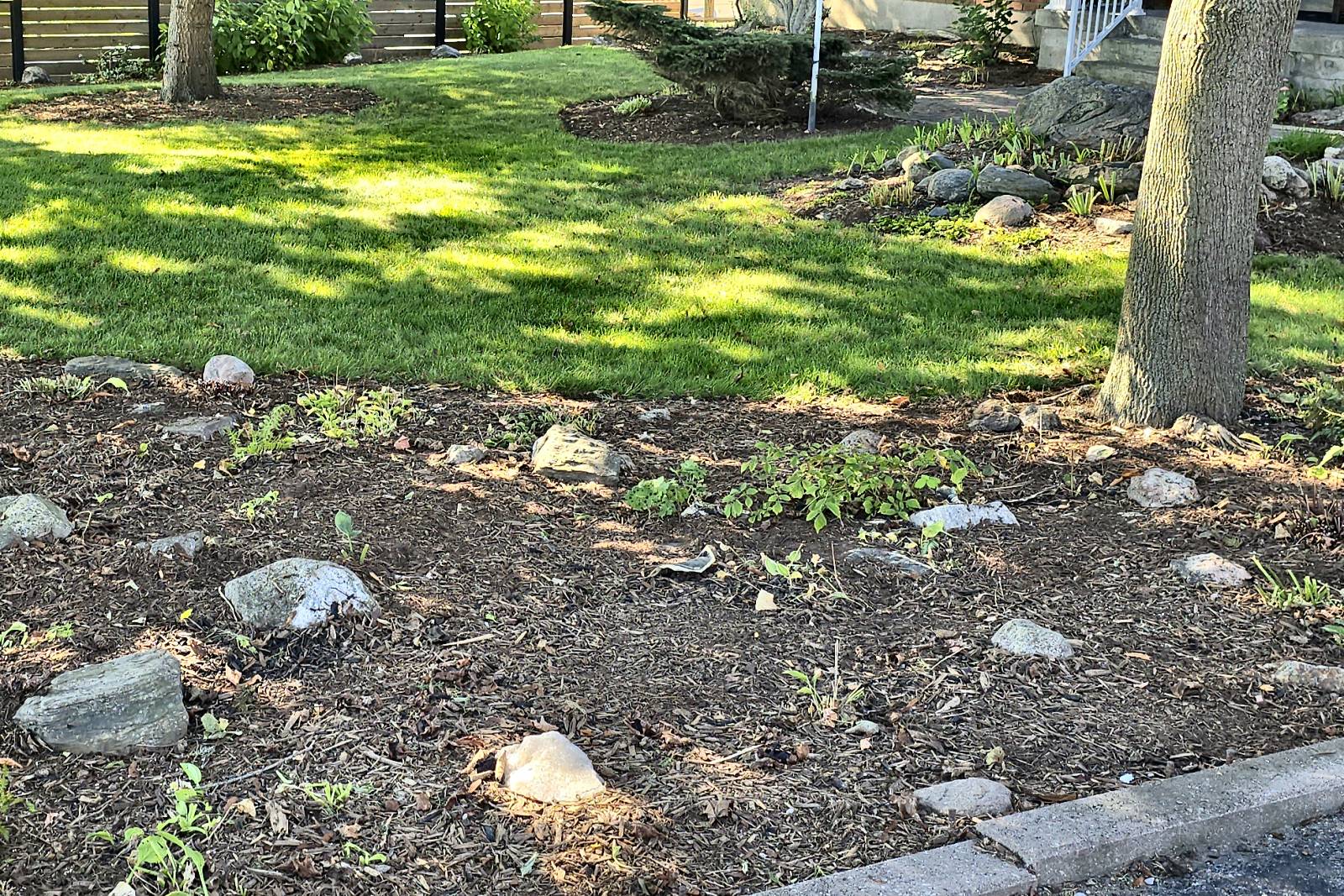
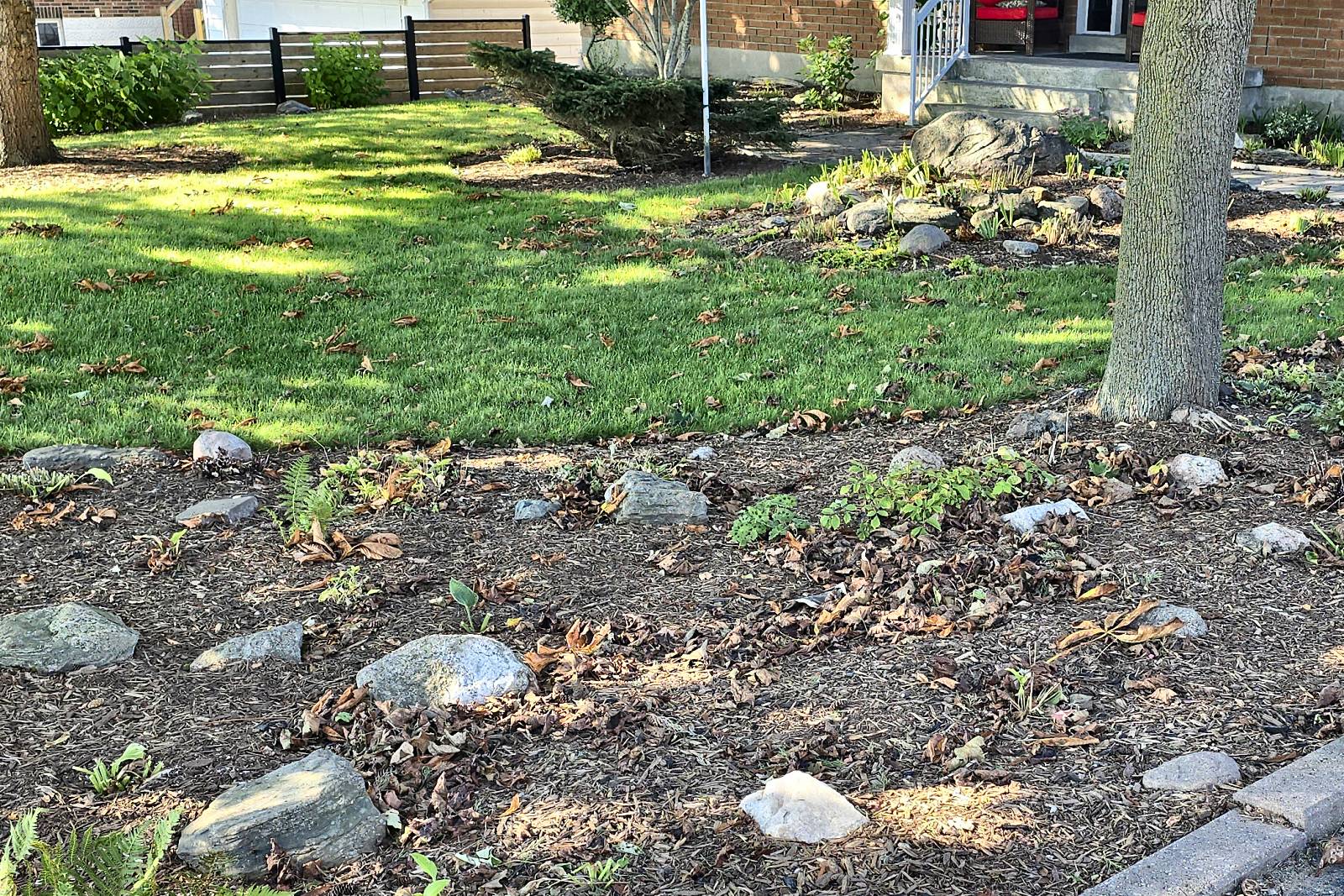
Real Northline properties, before and after, every one of them in Oshawa and every one of them this year. Drag the line to compare.
Andrew answers, October 2026
What happens if it snows all day instead of overnight?
The first pass opens a lane out to the road, the walkway and the steps, so you can get out. Then the whole route gets that same first pass. Then, once the snow stops, we come back for the full clear: full width to the pavement, the windrow off at the road, piles tidied and salt down again. If it looks half done at eight in the morning in heavy snow, that is deliberate and we are already on the way back. There is no extra charge for the second visit.
One of these goes on each page and it is replaced monthly. If the question you have is not here, ask it: 905-244-5779.
Have the ridge taken off your hands for the season
On Gold and Platinum the whole driveway is ours, windrow included, and there is no separate charge after each storm. Send me the address and I will give you a fixed monthly figure the same day.