Snow removal · Pricing
What Snow Removal Actually Costs in Durham Region
What snow removal costs in Durham Region is a question with three different right answers, and the only way to tell which one is yours is a single piece of arithmetic you can do in a minute.
Memberships from $129 a month plus HST. See what each one covers.
Green in summer. Clear in winter.
The short answer, in numerals
Snow removal in Oshawa costs $975 plus HST for a full winter on a standard driveway, which works out to about $81 a clearing against the median of 12 clears in eighteen complete winters of Environment Canada records for Oshawa, and the same twelve clears bought one storm at a time with salting is $1,020 to $2,220. A small driveway is $800 plus HST for the season and a large one is $1,200 plus HST. On a year round membership the same driveway is $189 a month plus HST on Gold, which plows the full driveway to a 7 AM target, or $129 a month plus HST on Silver, which takes the windrow off the end by 5 PM and leaves the rest of the driveway to you.
Ajax is the one municipality in Durham that costed the windrow job in public and then chose not to run it, so the arithmetic there starts somewhere different. The town by town version is on the Ajax snow removal cost page.
Before anything else, one promise about the numbers
Every external figure on this page comes from a municipality, a provincial ministry, a federal agency, a census or a peer reviewed journal. Not one of them comes from a competitor's price page. Where a number is ours, we say so. Where we could not verify something, there is a section near the bottom that says what and why. You should hold every pricing article you read to that standard, including this one.
Start with what public bodies charge, because those prices are published
Four Durham municipalities run winter assistance programs for seniors and residents with disabilities. They are not a competitor and they are not a private quote. They are public price anchors, published, and they tell you what a large organization with municipal buying power charges to do part of this work.
| Municipality | Season cost, 2026 to 27 | What triggers a visit | Application deadline |
|---|---|---|---|
| Whitby | No fee charged | 5 cm for sidewalks, 10 cm for the windrow | November 1 2026 |
| Clarington | $107.69, HST included | Windrow cleared above 15 cm, after the roads are done | October 31 2026 |
| Pickering | $0, $128.82, $186.45 or $240.69 by household income | Not published | October 16 2026 |
| Oshawa | No fee published | Windrow must be at least 20 cm high | Applications reopen October 1 2026 |
If you qualify for one of these programs, join it. No contractor is going to beat free, and Whitby's is free. Eligibility generally turns on being 65 or over, or having a documented disability, with nobody under 65 in the household able to help, in a single family dwelling. The eligibility rules and the paperwork for each town are set out in full here.
Pickering's is the most interesting of the four because it is income tested in four bands, which is unusual, and because the top band at $240.69 tells you something useful: a municipality with its own equipment, its own crews and no profit motive still needs about $240 a season to clear one property's windrows. Any private quote materially below that number for materially more work deserves a question about what is not included.
And read the trigger column, because it is where these programs quietly stop being a substitute for a contract. Oshawa attends when the windrow is at least 20 cm high. Clarington at 15 cm. Those are not storm totals, they are the height of the ridge at your apron, and most Durham storms never build one that big. A municipal program is protection against the worst four or five mornings of a winter. It is not the same thing as having the driveway handled.
The three models, and the one calculation that separates them
Residential snow is sold three ways, and they are not variations on a theme. Which of the three is still open to you depends on the date, and when to book snow removal in Oshawa sets out the deadline on the seasonal one. They allocate weather risk to different people.
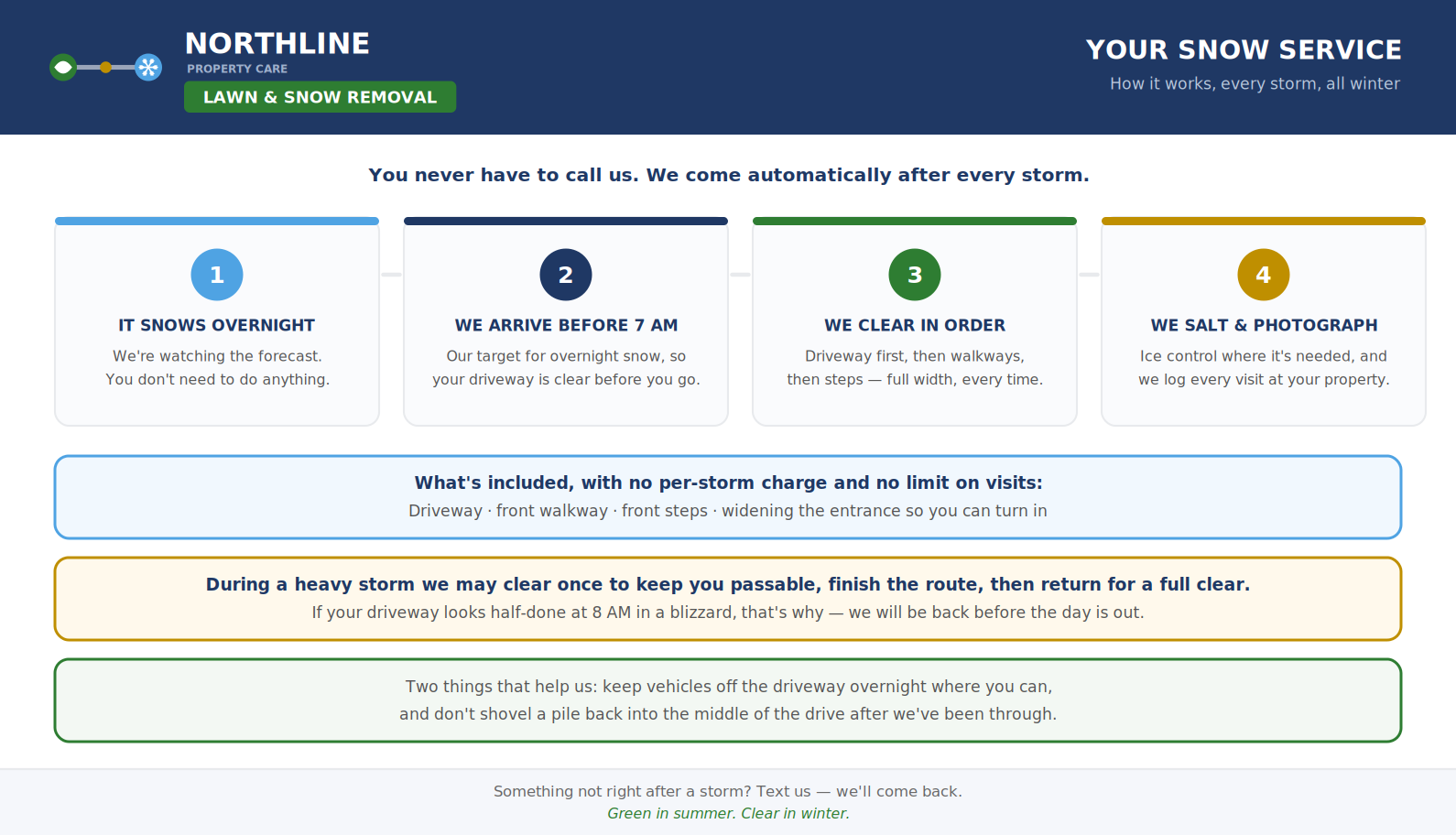
- Per visit. You pay for each clear. You carry all the weather risk. A bad winter costs you a great deal and a mild one costs you almost nothing.
- Seasonal. One price for the season, unlimited clears. The contractor carries all the weather risk. Your number is fixed in October and does not change.
- Monthly membership. A seasonal contract billed in twelve equal payments across the year rather than in one or two lumps. Same risk allocation as seasonal, different cash flow.
The calculation is a division and it takes ten seconds. Take the seasonal price, divide it by the per visit price, and you have the number of clears at which the seasonal deal starts paying.
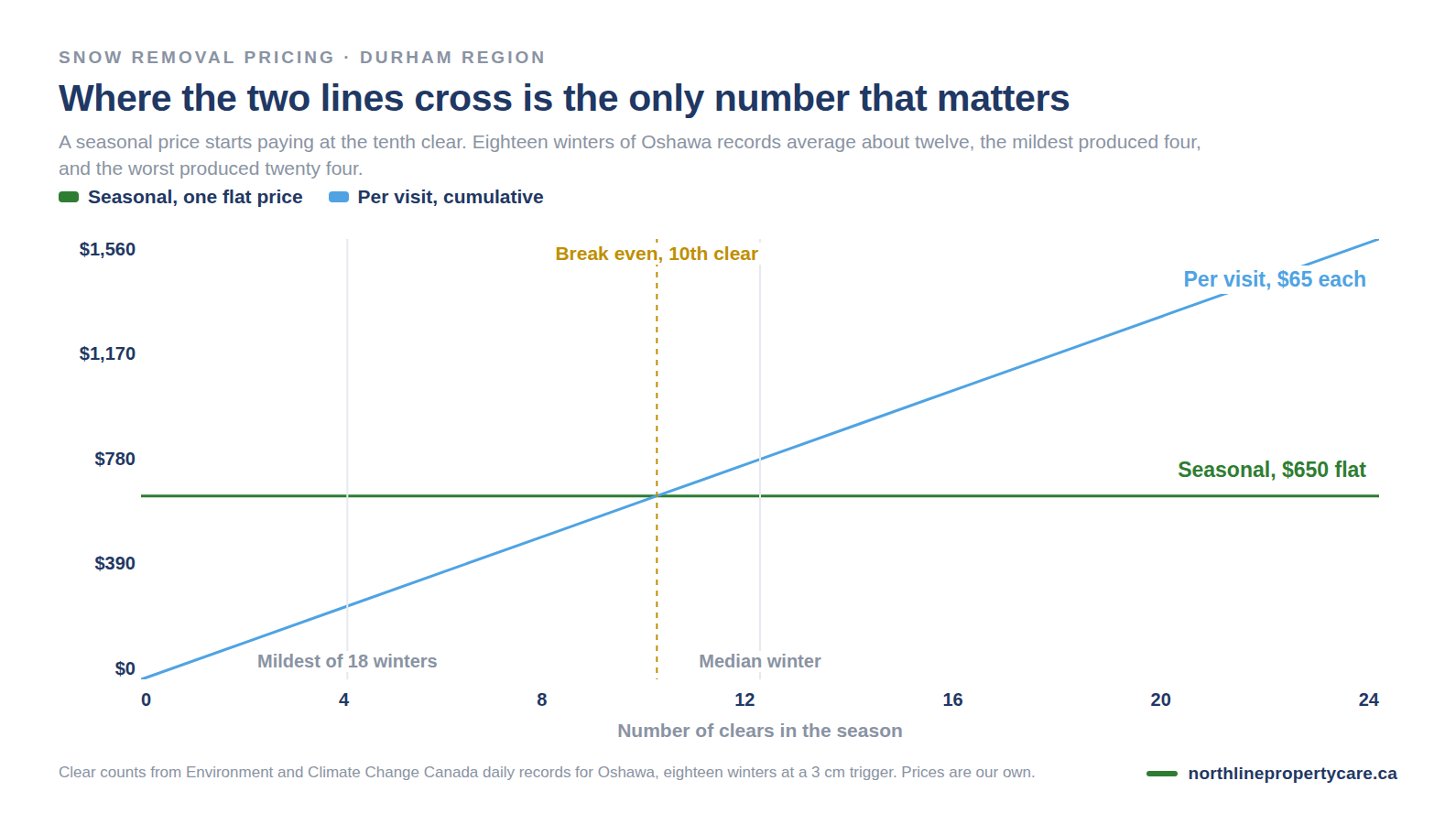
On our own numbers, the seasonal package at $975 standard covers the driveway, the walkway and the salting. Bought a visit at a time the same work is $45 to $95 a clear plus $40 to $90 an application of salt, so an ordinary twelve clear winter passes the season price somewhere around the eighth event.
Now hold that against the weather. Eighteen complete winters of Environment Canada daily records for Oshawa, counted at a 3 cm trigger, give an average of 11.4 clears and a median of 12. The mildest of those winters produced four. The worst produced twenty four.
Which means, plainly: a normal Durham winter lands just past break even and a mild one lands well under it. In a four clear winter you will have paid $975 for roughly $180 to $380 of clearing. That is not a trick, it is what insurance costs in a year you did not need it.
What you are buying is not a number of clears. It is that the price does not move when the weather does. Twenty four mornings in a bad year cost you exactly what four cost you in a good one, and nobody phones you about a surcharge on the twenty fourth.
Anyone who wins your business on the argument that a Durham winter delivers plenty of storms will lose you in a mild February, which is exactly why we will not run that argument.
Our prices, and what each one does and does not do
Snow removal in Oshawa costs $129 a month plus HST on a Northline Silver membership, which clears the windrow at the end of your driveway by 5 PM and does not plow the driveway itself, or $189 a month plus HST on Gold, which plows the whole driveway after every storm with a 7 AM target.
A full season of snow removal in Durham Region costs $189 a month plus HST on a Northline Gold membership, billed in twelve equal payments across the year, and the price is the same in a heavy winter as in a mild one.
A shared driveway in Durham Region costs the same to clear as any other driveway of its size, which is $189 a month plus HST on a Northline Gold membership, or $975 plus HST for a standard property on the seasonal snow package. One household books the work and the two of you settle it between yourselves, because we are not a party to whatever is registered on your title and we will not chase your neighbour for half. We clear the whole surface on one pass when that is what was booked, because coming back for the other half of the same driveway costs you both more than it saves. There is more on how this works on a semi-detached pair in our guide to shared driveway snow removal in Durham Region.
| Tier | Monthly, plus HST | On the card | Driveway cleared? | Morning target |
|---|---|---|---|---|
| Silver | $129 | $145.77 | No. Windrow pass by 5 PM, four banked full clears a season on request | None |
| Gold | $189 | $213.57 | Yes, the whole driveway after every storm | 7 AM target |
| Platinum | $279 | $315.27 | Yes, and sequenced first | 6:30 AM target |
Three things to be clear about, because each of them is a place other quotes get vague.
Silver does not plow your driveway. It never has, and we would rather put that in the first line of a pricing page than explain it to somebody in January. Silver gets the windrow pass by 5 PM on the daytime route.
7 AM is a target, not a promise. A promise about the exact minute the route reaches your house during a storm is a promise nobody in this business can keep, and the ones who make it are the ones who have not run a bad night yet.
All three bill in twelve equal payments on the last day of the month. Not seven, not five, twelve. A winter service billed across the summer is a cash flow choice, and it is the one that keeps the price level. Add ons are separate: a salt only trip is $25 and a windrow return trip is $45. Annual prepay takes 5 per cent off the annual price.
What is actually inside the price, itemized
Why snow removal in Durham Region is expensive
Snow removal in Durham Region is expensive because the price does not buy the clearing. It buys somebody awake, insured and answering the phone at three in the morning on the one night in January when it matters, and it buys that on every night it does not snow as well.
Here is the part that costs us the sale. In a mild winter a seasonal membership is the worse deal, because a season with few storms still costs what the season costs, and you end up paying for clearings that never arrived. We price by the season anyway, because the alternative is a per visit queue, and in a per visit queue the storm decides who waits rather than the schedule.
Liability, which is the biggest line in the price
In 2021 Ontario amended the Occupiers' Liability Act and added section 6.1. It says that no action for personal injury caused by snow or ice may be brought unless, within 60 days of the injury, written notice including the date, time and location is served on or sent by registered mail to one of the people it lists.
Read who it lists. An occupier, and an independent contractor employed by the occupier to remove snow or ice on the premises during the relevant period.
Your snow contractor is a named defendant class in Ontario statute. Not by analogy, not by case law, in the text of the amending Act itself. The 60 day notice is not a bar where the injured person died, and a judge may excuse a late or insufficient notice where there is reasonable excuse and no prejudice to the defence.
That single provision is why commercial general liability insurance on a snow operation costs what it does, and it is the largest single thing standing between a properly insured seasonal price and the cash price offered by a pickup truck with a blade on the front. Landscape Ontario, the industry association rather than any individual company, published in 2023 that the availability, capacity and price of insurance is unstable and that many are being driven out of the sector.
Tax, which makes two quotes non comparable
This one is concrete and almost nobody explains it. A business stays a small supplier and does not have to register for HST until it exceeds $30,000 in revenue over four consecutive calendar quarters.
So an unregistered operator quoting $600 and a registered one quoting $600 plus HST are quoting $600 and $678. The gap is not efficiency. It is thirteen per cent that one of them is collecting for the government and the other is not required to. Northline is an HST registrant, which is why our prices are written as plus HST with the card figure shown beside them.
The truck, and one thing we will not pretend to be certain about
Ontario requires a Commercial Vehicle Operator's Registration for trucks with a registered gross weight or actual weight over 4,500 kg. There is an exemption for pickup trucks under 6,500 kg gross vehicle weight rating that are being used for personal purposes without compensation.
Read that exemption carefully, because we did and it is not as clean as it looks. A pickup being paid to plow is not being used for personal purposes without compensation. Whether the exemption applies to a compensated residential plow truck is a question we could not resolve from the published material, and we are not going to write a confident answer to it here. What we will say is that it is a real cost question and any operator who has never thought about it has not thought about the rest of it either.
Salt, and the quantity that actually does the job
Canada uses about five million tonnes of road salt a year. In Ontario alone, the City of Toronto puts it at three to five million tonnes entering water systems annually.
The published application rates are lower than most people's instincts. Conservation Ontario's guidance gives 28 to 34 grams per square metre for pre-treating and 56 to 67 grams per square metre for de-icing a lot after clearing. The same document notes that at minus one degree, one kilogram of sodium chloride will melt 46 kilograms of ice, taking about five minutes.
Which is worth knowing when somebody quotes you unlimited salting as a premium inclusion. The chemistry is cheap. The reason to limit it is that it is effective in small quantities and damaging in large ones.
Three Ontario public bodies publish three different answers for when salt stops working, and we would rather show you that than pick the one that suits us. Conservation Ontario says effectiveness is significantly reduced below minus seven. The City of Toronto says salt begins to lose effectiveness at minus ten and is ineffective below minus twenty. The Region of Waterloo says it does not work below minus ten.
The salt fact that is repeated wrongly almost everywhere
You will read that road salt is a Schedule 1 toxic substance under Canadian law. It is not, and the real story is better.
Environment and Climate Change Canada assessed road salts and concluded in 2001 that they meet the criteria set out in the Canadian Environmental Protection Act. And then road salts were never added to Schedule 1. Canada published a voluntary Code of Practice in 2004 instead of regulating.
One more honest detail about that Code, since we are the ones bringing it up. It applies to public entities using more than 500 tonnes a year on a five year rolling average. It does not apply to a residential contractor and it does not apply to us. Nobody is auditing the salt on your driveway. That is a reason for an operator to be careful, not a reason to claim a certification that does not exist.
The scale of what the towns themselves are doing
Worth knowing, because it explains why the driveway is never going to be included in your taxes.
Oshawa maintains over 500 km of primary road, 765 km of residential road and about 160 km of sidewalk in winter. Whitby's own snow clearing page now puts the network at over 1,205 lane kilometres of road and 335 km of sidewalk, plus 297 cul de sacs and 122,000 square metres of parking lot. Until October 2, 2026 this page carried 1,140 lane kilometres from a 2020 budget document, and the network has grown since.
Pickering costed the driveway half of the same problem and published both answers. A citywide windrow service came out at $7.4 million a year contracted out, or $19.8 million in the first year with municipal equipment, and the City bought neither. Those figures and the rest of that city's arithmetic sit in what snow removal costs in Pickering.
Whitby publishes the household side of it more plainly than anybody else in Durham. Page 12 of the Town's 2026 adopted budget allocates $6.76 a month of an average household's Town taxes to winter control, $5.95 operating and $0.81 capital, against an average assessment of $503,000. That is $81.12 a year, and it buys the road. The Whitby version of this page, with the by-law and the trigger depths behind that figure, is what snow removal costs in Whitby.
On the money, we are going to be careful rather than impressive. Oshawa's 2026 operating budget shows $17,968,900 for Roads Operations. That is not a snow budget and we are not going to present it as one. Winter control is not a separate line item; it sits inside Roads Operations along with everything else that happens to a road. The budget's own variance note mentions decreased volumes of road salt and increased fleet costs in the same breath as wage increases.
For scale on the other side of the transaction: the 2021 Census recorded 160,785 single detached houses in Durham Region, 66.2 per cent of all households, with an average household size of 2.87. In Oshawa specifically, 37,000 single detached homes, 55.5 per cent of households. That is the number of driveways nobody is coming to clear.
The cost that does not appear on any invoice
There is a reason the assistance programs above exist, and it is not tidiness.
The Canadian Centre for Occupational Health and Safety describes snow shovelling as a strenuous activity comparable to weightlifting while walking on uneven, slippery and unstable ground and wearing heavy duty clothing. Their arithmetic on the load is worth reading twice: a shovel loaded with five kilograms of snow, lifted every five seconds, moves over 70 kilograms in one minute. CCOHS says the effort is hard on the heart and back, and that as with any exercise you should talk to your doctor.
The Canadian medical evidence behind that is more specific than most people realize. A 2017 study in the Canadian Medical Association Journal examined 128,073 hospital admissions and 68,155 deaths from myocardial infarction against snowfall records. Compared with no snow, 20 cm of snowfall was associated with an odds ratio of 1.16 for hospital admission and 1.34 for death among men the following day. The corresponding figures among women were 1.01 and 1.04, and the authors attribute the effect primarily to men.
Twenty centimetres is an ordinary Durham storm. Oshawa averages about two and a half days a year with 10 cm or more of snowfall, and bigger ones happen.
We are not going to turn that into a sales line, and we are not qualified to give anybody medical advice. It is simply the honest answer to why a seasonal contract is worth more to some households than the arithmetic in the break even section suggests, and it is the reason the four municipal programs are aimed at the people they are aimed at.
Buying a machine does not make that cost disappear, which is the part people assume and the evidence does not support. In the largest published snow blower dataset, covering 91,451 emergency department visits across sixteen years, there were 648 deaths and 647 of them were cardiac rather than machine injuries. A snow thrower moves the risk toward fingers and leaves the exertion, the cold and the early hour exactly where they were. The full comparison, including what the manufacturers publish about depth and what five Durham municipalities publish about where the snow may go, is in snow blower against a plow service in Oshawa.
What we could not verify, and what we are not going to claim
Most pricing articles present only what they found. Here is what we went looking for and did not get, because the gaps tell you as much as the figures.
- No Durham Region winter maintenance budget figure exists that we could reach. The Region's own road maintenance page carries no lane kilometres, no plow count, no salt tonnage and no dollar figure.
- No Durham municipality publishes a discrete winter control budget line. Oshawa embeds it inside Roads Operations, and we could not find a standalone snow figure for any of the five.
- No salt tonnage figure for any Durham municipality. None published anywhere we could find.
- No official figure for the size of an average Ontario subdivision driveway. Nothing from any municipality, the province or any agency. That number may simply not exist officially, and every version of it circulating online comes from somebody's estimate.
- No regulator sourced data on snow contractor insurance pricing. We looked for it at the financial services regulator and did not find it. The only material available is association commentary, which is qualitative.
- There is no published Canadian standard for snow and ice management. A standards body scoping review was requested in 2021 and we could not confirm any standard was ever published. If a contractor tells you they meet a Canadian snow and ice standard, ask for its number.
An article that only reports what it found is not showing you its method. This is ours.
Questions people actually ask
Is a seasonal contract cheaper than paying per visit?
It depends entirely on the winter. Break even sits around the tenth clear, and eighteen winters of Oshawa records average about twelve. A normal winter lands just past it and a mild one lands under it. What you buy is a number that does not move.
Why do two quotes for the same driveway differ so much?
Tax is one reason, and it is rarely stated. A business under the $30,000 small supplier threshold does not charge HST, so its quote is thirteen per cent lighter than an identical registered one. That is a smaller business, not a better price.
Should I just join my town's assistance program instead?
If you qualify, yes, and we will say so even though it costs us the sale. Whitby charges nothing. Clarington is $107.69. Pickering runs to $240.69 by income. Nobody beats free.
Does my contractor carry legal exposure if somebody slips?
Yes, by statute. Section 6.1 of the Occupiers' Liability Act names an independent contractor employed to remove snow or ice as a person on whom notice may be served. That is what the insurance is for.
Is road salt a toxic substance under Canadian law?
Not quite, and the wrong version is everywhere. Canada assessed road salts in 2001 as meeting the toxicity criteria, then never added them to Schedule 1, and issued a voluntary Code of Practice in 2004 instead.
How much salt should go on a driveway?
Far less than most people use. Conservation Ontario publishes 28 to 34 grams per square metre to pre-treat and 56 to 67 to de-ice after clearing, and notes one kilogram melts 46 kilograms of ice at minus one degree.
Who wrote this
Andrew owns the truck, quotes the work and plows it. North Oshawa, and the seven Durham towns beyond it, fully insured and an HST registrant. He has six Durham winters of snow work behind him, covering a season paid seasonally that produced four clears and a season that produced more than twenty.
The break even arithmetic on this page runs against us in a mild winter and we published it anyway, because a customer who understands what they bought is the only kind worth having on a fixed local route.
The three things to read before you sign anything
The same arithmetic, done for Oshawa alone
The City opens a residential street at 8 cm and allows itself 16 hours, and every dollar a homeowner spends sits inside that gap. The five Durham windrow programs side by side, and what a season costs per clearing.
Read the Oshawa piece →Who owns the ridge across your driveway
Every Durham town leaves it to the property owner. The assistance programs in full, the depth triggers, the deadlines, and what the Highway Traffic Act says about pushing it back.
Read the rules →How much winter you are actually buying
Thirty years of Environment Canada normals for Oshawa, the five station comparison that puts Durham outside the snow belt, and the province's own severity scores.
Read the timeline →What our winter service actually does
The 3 cm trigger, the order of service after a storm, where the snow goes on your property, and what Silver does not include.
See the service →The work, photographed
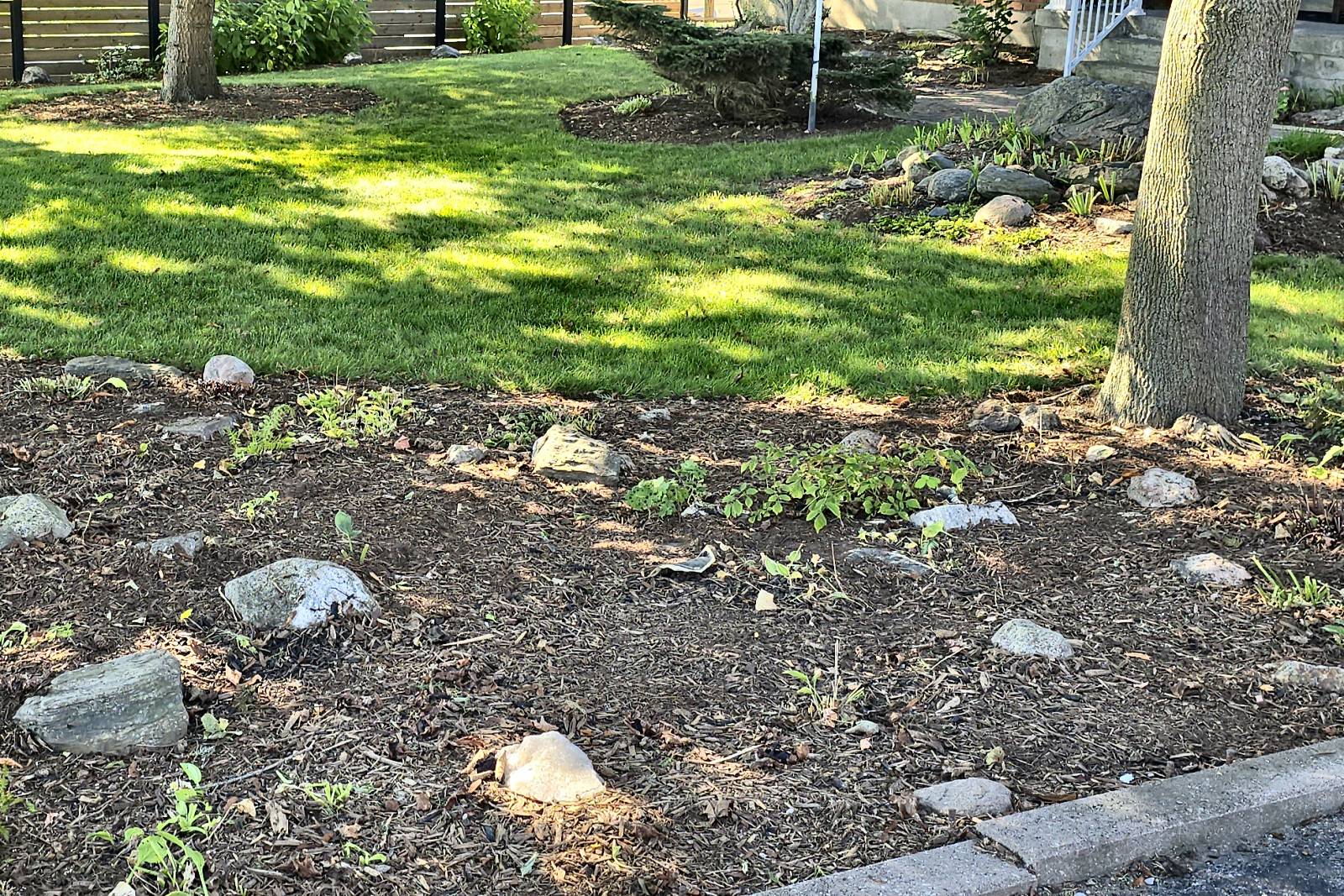
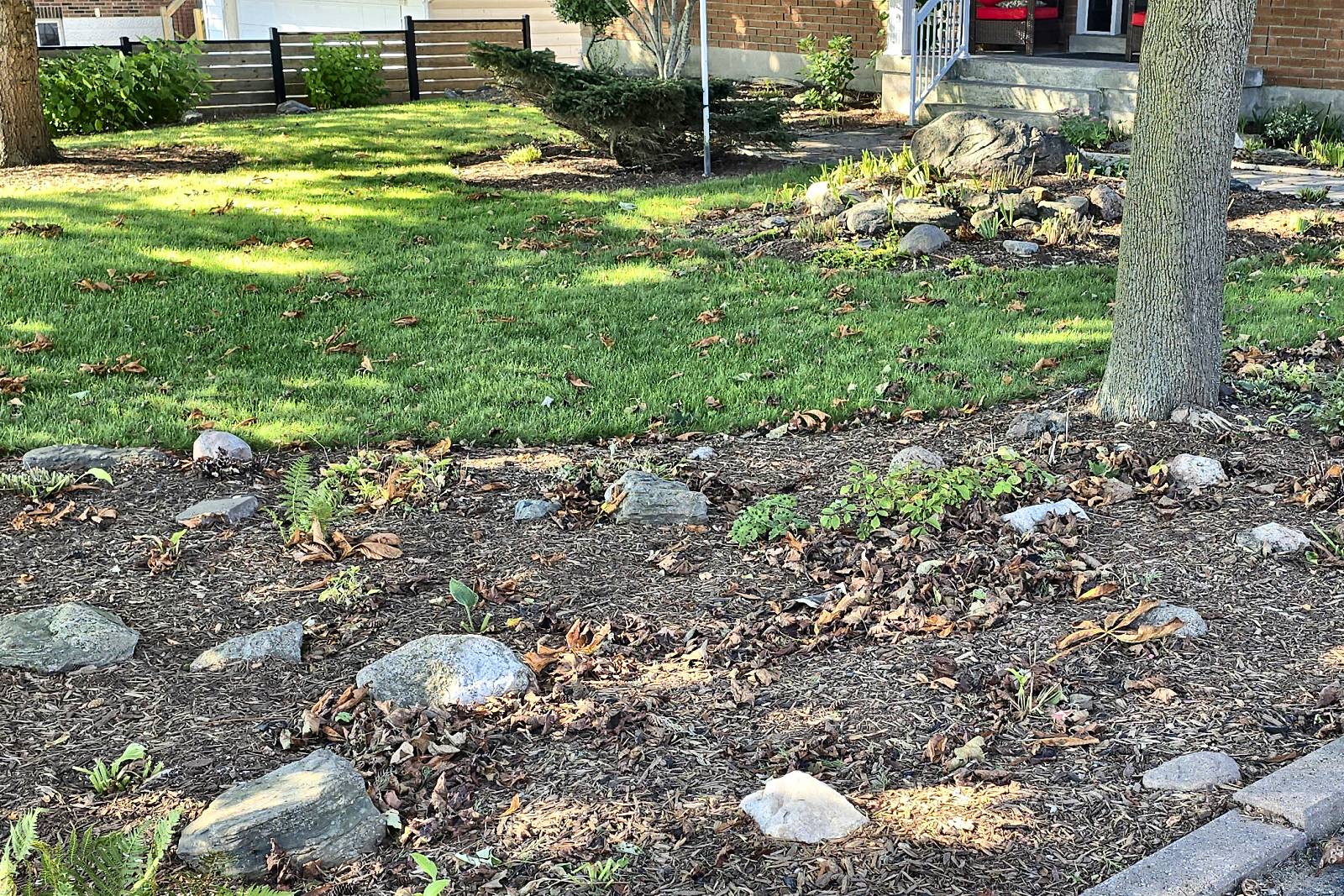
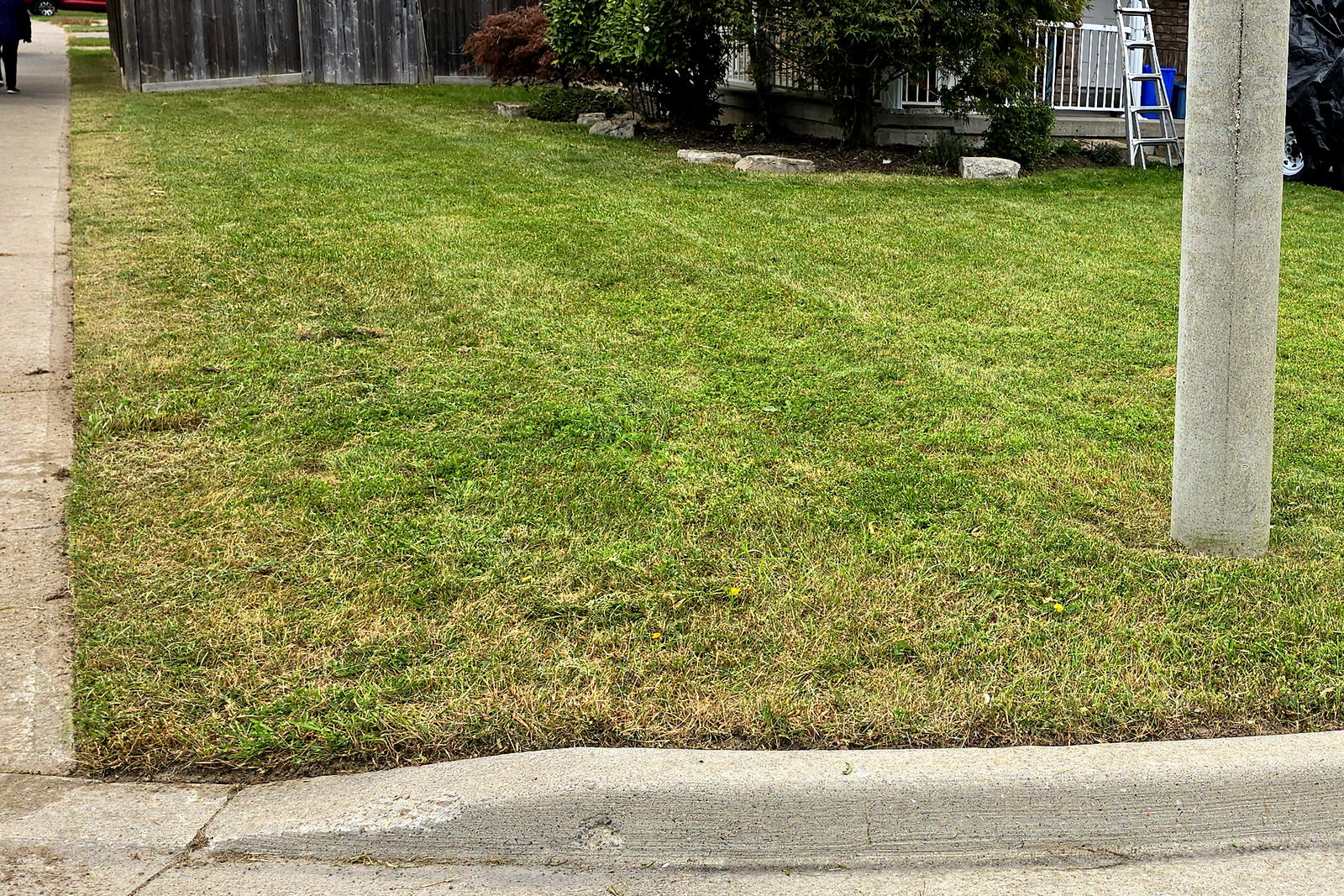
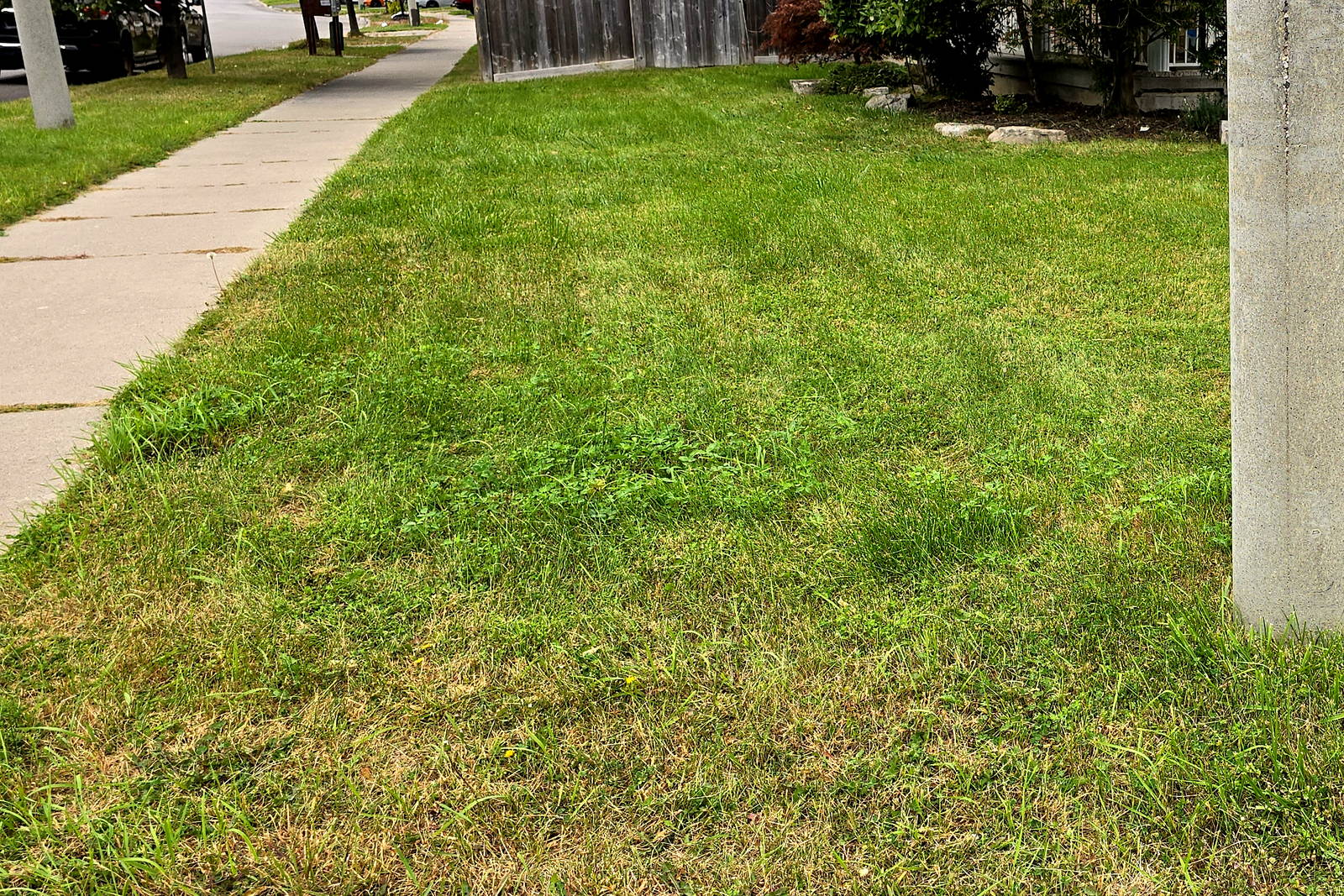
Real Northline properties, before and after, every one of them in Oshawa and every one of them this year. Drag the line to compare.
Andrew answers, October 2026
Why is your season longer than everybody else's?
Because November and April are when the awkward storms happen, and a season that ends on March 31 ends three weeks before the last one. November 1 to May 1 is six months and both ends of it are published, which is the part that matters: a season you can read is a season you can hold me to.
One of these goes on each page and it is replaced monthly. If the question you have is not here, ask it: 905-244-5779.
A real number for your address, not a range off a web page
Driveways differ by size, slope, exposure and where the snow is allowed to go, so the only honest quote is one somebody has looked at. Give me the street number and I will come back with the season total the same day.