Snow removal · Older homeowners
Snow Removal for Seniors in Oshawa, and the Strip No Municipal Program Clears
Snow removal for seniors in Oshawa should start with a question almost nobody asks first, which is whether your own municipality already owes you part of the job. Every town we serve runs an assistance program, the application deadlines are weeks apart, and not one of them clears the walk from your front door.
Want the five programs side by side? See the Durham comparison table.
Green in summer. Clear in winter.
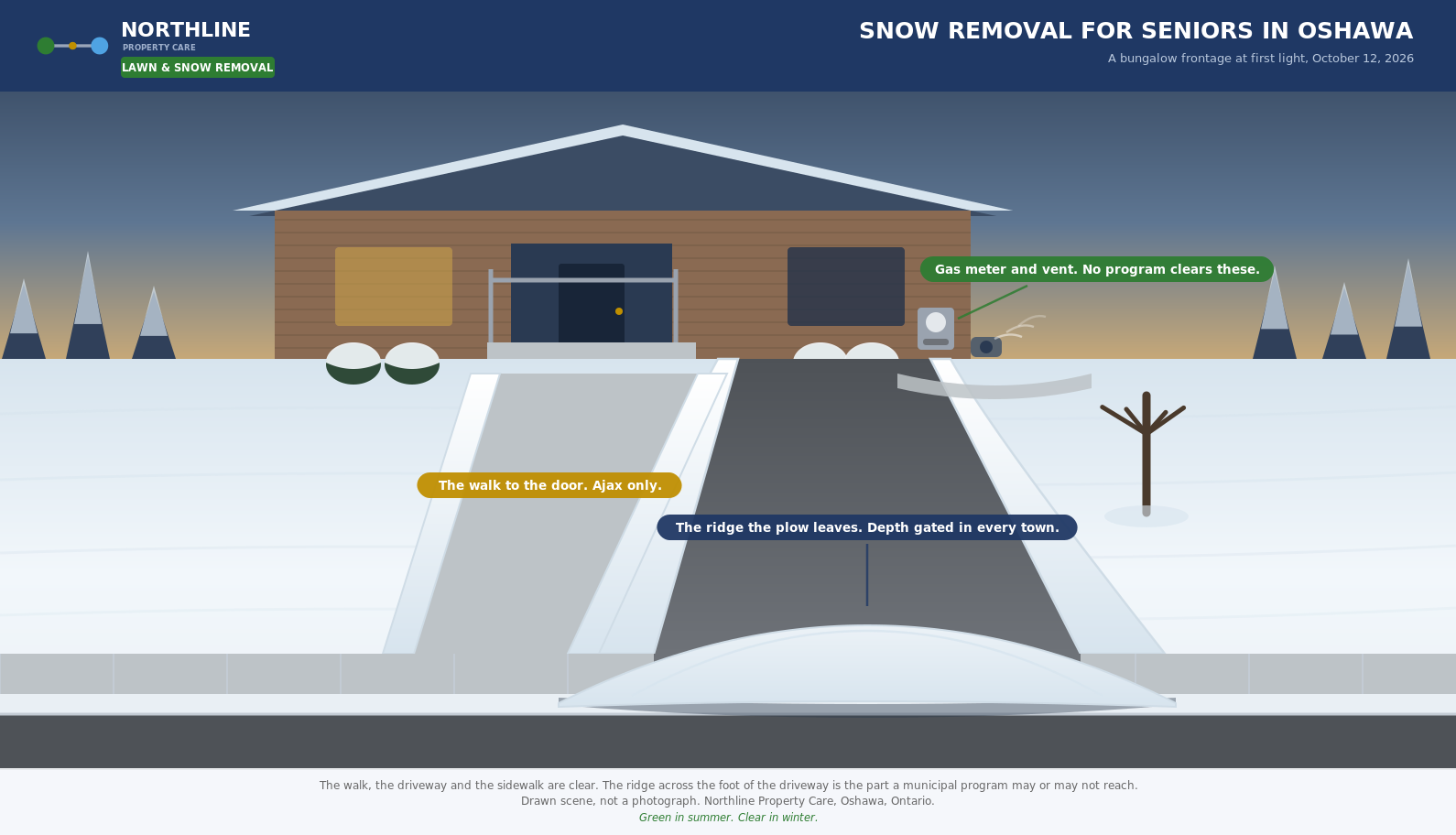
The short answer
Apply to your own municipality first, before you price anything. Oshawa, Whitby, Ajax, Pickering and Clarington every one of them runs a snow clearing assistance program, open to a resident aged 65 or over, or to a resident with a disability on documentation. Whitby charges nothing. Clarington charges $107.69 including tax for the season. Pickering runs a sliding scale from zero to $240.69 by household income. Ajax charges $41.13 for the windrow and the municipal walk, or $360.70 for the driveway as well. Oshawa publishes no fee on any page we could read, which is a gap in the publishing rather than a free service you can rely on.
Then read what each one leaves behind, because that is the half nobody tells you at the counter. The programs clear the municipal sidewalk and the ridge the plow leaves at the end of the driveway. Outside the upper Ajax service level, not one of them clears the driveway surface, and not one of them clears the private walk between your front door and the driveway. Those are the two strips that decide whether you can actually get out of the house.
And watch the dates rather than the service. Pickering closes on October 16, 2026 and caps the program at 750 households with a lottery for the last places. Clarington closes on October 31. Whitby closes on November 1. Oshawa runs to December 18. Ajax publishes no closing date at all.
The deadline is the part that bites, and one of them is this week
Four municipalities in this region close their applications on four different dates and the earliest of them falls four days from the date on this page. Pickering accepts applications from September 11 to October 16, 2026, in person or by mail, with the supporting documents and a post dated cheque due by the same deadline. It states that late applications are considered only if the program has not already reached capacity, and that capacity is 750 households across urban Pickering and the hamlets of Brougham, Claremont, Greenwood and Whitevale. Applicants with proof of a permanent physical or cognitive disability are given priority, and an electronic lottery decides the remaining places if the program is oversubscribed. A lottery is not a queue. Missing the date does not put you at the back of a line, it takes you out of the draw.
Clarington runs from September 21 to October 31, 2026, at $107.69 including HST, and splits its intake in a way that catches people out. Returning customers can renew online through a Be Active account, but new applicants and anybody applying on a temporary disability have to register in person at a community centre after telephoning 905-623-3379, and registration is explicitly not available at Town Hall. Whitby opened on September 14 and closes on November 1, 2026, and asks that an applicant not be away from the property for more than 45 consecutive days during its winter program season.
Oshawa publishes the longest window, October 1 to December 18, 2026, with applications after that date reviewed case by case. It is also the one set of dates we would check by telephone before relying on them. The current city page gives that window, the online application portal states that the form becomes available on September 1 without naming a year, and an older page on the same domain says renewal letters go out in November while the current page says October. Three pages, three timing statements, one city. That is worth knowing before an 83 year old makes a trip downtown.
Ajax is the outlier in both directions. It publishes no application deadline, it is the only municipality here that will clear a full driveway, and it is the only one that has formally decided not to run a general windrow service: a council review put the cost of a town wide program at over $1.8 million a year. Its 2026 to 2027 form prices the windrow and municipal walk at $41.13 and the full service at $360.70, both including HST, and both marked as subject to change on January 1, 2027 with no refunds issued after that date.
A program is a geography, not a service level
The question that decides whether anybody is coming is not how much snow fell, it is which strip of ground the snow fell on. Every one of these programs is defined by place rather than by effort, and the boundaries are published in the municipalities own words. Read your frontage as six bands running from the wall of the house down to the road, and the line falls in a different place on each one.
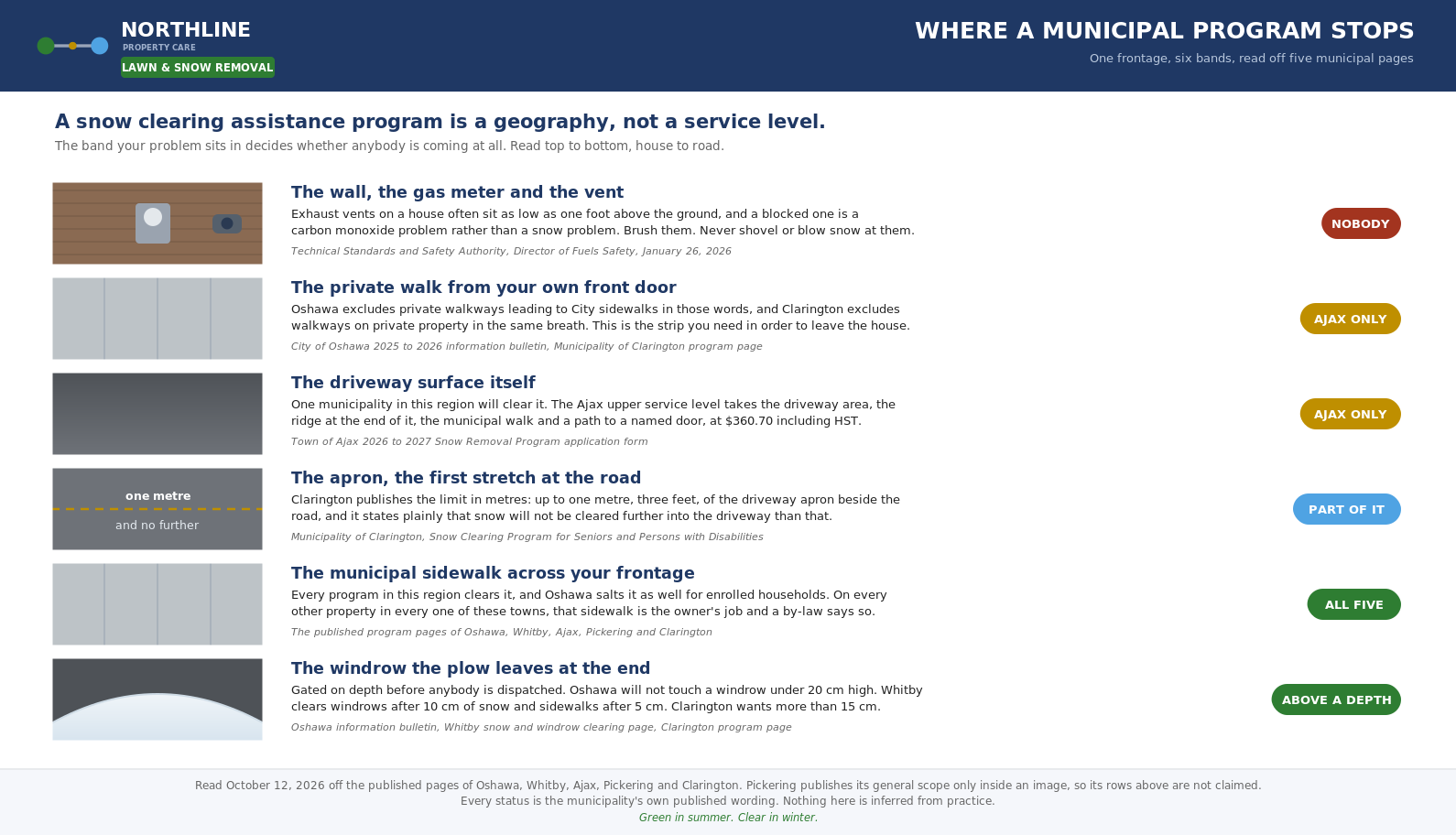
Two of those bands are where older homeowners get caught. Oshawa excludes private walkways leading to City sidewalks, in those words, and Clarington excludes walkways on private property in the same breath. So the strip of concrete between your front door and the driveway, the one you have to cross before anything else in this article matters, is outside every program in this region except the upper Ajax service level. The second is the driveway itself. Clarington publishes its limit in metres and the number is small: up to one metre, three feet, of the driveway apron at the road, and it states plainly that snow will not be cleared any further in than that.
The depth gates are the other surprise, and they explain the complaint we hear most often, which is that somebody signed up and then nobody came. Oshawa will not clear a windrow that is under 20 cm high. Whitby clears sidewalks after at least 5 cm and windrows after at least 10 cm. Clarington wants more than 7.5 cm for the sidewalk and more than 15 cm for the windrow. Set those against what an Oshawa winter actually delivers, which is about eight days a year with 5 cm or more and about two and a half days with 10 cm or more, and the shape of the thing becomes clear. These programs are built for the storm, not for the Tuesday. On most snow days of a Durham winter the program is correctly doing nothing and the frontage is still white.
Timing is the third thing to read before you plan a week around it. Whitby states that program clearing typically begins about 36 hours after the snow stops or the drifting ends, because town roads and sidewalks come first. Clarington starts within 24 hours of the snowfall ending for sidewalks and only after the municipal plows have finished for the windrow. Ajax does not go onto private property until the town has finished the roads, and does not attend at all during freezing rain. Oshawa plans for completion by midnight the day after the snowfall ends and guarantees no schedule, and its own page says in as many words that the program is not a reliable option for a resident who frequently leaves home for appointments. That is an unusually honest sentence for a municipal web page and it should be read as written.
Our own page on who clears the windrow in each Durham municipality carries the full comparison table, with the fee, the depth trigger and the application window for all five towns side by side. There is no sense repeating it here. This page is about what to do with the part the table leaves over.
The by-law does not make an exception for your age
Not one sidewalk clearing by-law in this region contains an exemption for age, for ability or for living alone. The duty attaches to the property and to whoever owns or occupies it, and the penalties are published. In Oshawa the Winter Access By-law 92-2009 requires every owner of a lot to clear snow and ice, including windrows, from the adjacent sidewalk no later than midnight of the first day after the precipitation ends, and section 3.2 adds that if it stays slippery the owner must apply sand or salt as often as necessary. The administrative penalties escalate within one calendar year at $75, then $175, then $275, and a first conviction carries a fine of no less than $300 and no more than $5,000.
Whitby rewrote its law this year and almost nobody in that town knows it yet. The Clean Community By-law 8271-26 was passed on March 9, 2026 and came into force on April 1, 2026, which makes the 2026 to 2027 season the first winter it governs. Three things in it matter to an older homeowner. It binds the owner or the occupant, so a tenant and a landlord are both in scope. Its clock runs 24 hours from the accumulation of snow or ice rather than from the end of the snowfall, which is a shorter and earlier deadline than the Oshawa wording. And its administrative penalties are $355, $500 and $750 by tier, which are by a wide margin the highest published sidewalk snow penalties in Durham Region. Section 6.3 also lets the town clear the sidewalk and recover the cost with a 25 per cent administrative charge on the tax roll.
The other three are shorter to state. Clarington By-law 93-144 binds every owner and occupant of a property, and the clock it sets runs for 24 hours from a fall of snow, of rain, or of hail. The municipality currently publishes a penalty of the cost of the work plus a $50 administrative fee, although the consolidated by-law notes that the section carrying that fee was revoked and replaced in November 2021, so treat the $50 as the figure Clarington publishes rather than a figure confirmed in the operative text. Pickering works from Ice and Snow Clearing By-law 6650/06, 24 hours from the accumulation, with no fine amount published anywhere we could find and a 25 per cent administration fee on any clearing the city has to do. Ajax publishes a fine of $150 for a frontage up to 23 metres, applied automatically to the property taxes, but cites only an unnamed user fees by-law and does not link it.
Then there is the part that only comes up after somebody falls. Ontario added section 6.1 to the Occupiers' Liability Act on January 29, 2021, and it gives a person injured by snow or ice on a premises 60 days to serve written notice, in person or by registered mail, on an occupier or on the snow removal contractor, carrying the date, the time and the location. An occupier who receives that notice has a duty to pass a copy to the contractor. That cuts both ways for an older homeowner and it is covered properly on our page about who is responsible for snow and ice under Ontario law, which goes through the notice provision clause by clause.
What the cold does before you lift anything
The study everybody quotes about snow and heart attacks did not find that older people were at higher risk, and it is worth saying so plainly before quoting anything else. The Canadian work is the 2017 CMAJ paper by Auger and colleagues, which examined every Quebec heart attack admission and death across two long record series, 128,073 of the first and 68,155 of the second. It found that 20 cm of snow on the previous day carried higher odds for men, by 16 per cent for an admission and 34 per cent for a death, with no comparable signal in women. The authors stratified their results by age, including 65 to 74 and 75 and over, and reported no compelling evidence that any age group was more affected. Anybody telling you that paper proves shovelling is more dangerous at 75 has not read past the abstract.
The age specific evidence is a different and smaller literature, and it is about supply rather than danger. Two measurements carry it.
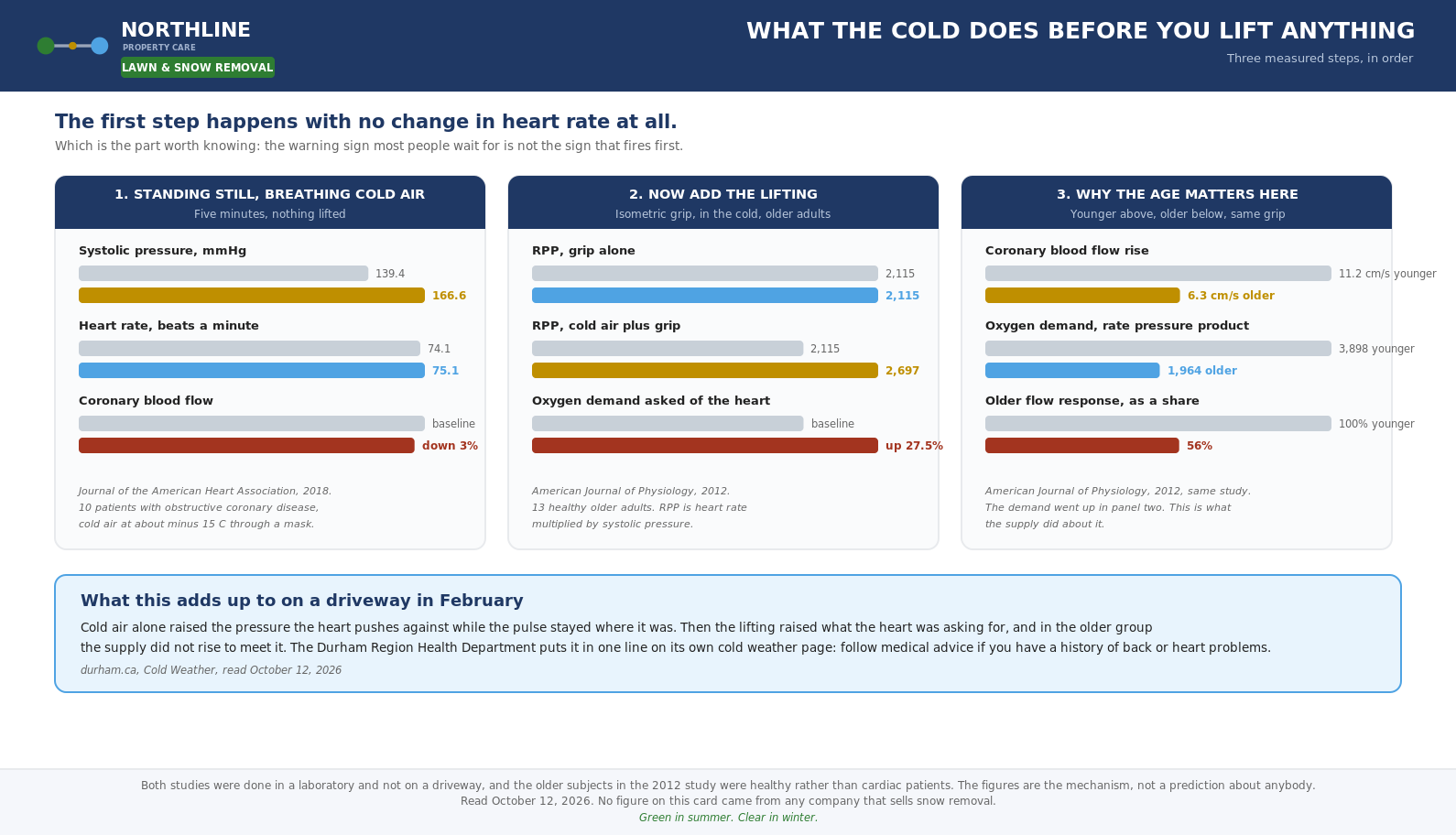
The first was published in the Journal of the American Heart Association in 2018. Forty two patients having a cardiac catheterisation breathed air at about minus 15 degrees Celsius through a mask for five minutes, sitting still and lifting nothing. In the ten patients with obstructive coronary disease, systolic pressure went from 139.4 to 166.6 mmHg while the heart rate moved from 74.1 to 75.1 beats a minute, which is to say it did not move at all. Resistance in the small vessels rose by 17 per cent and coronary blood flow went down by 3 per cent. In the comparison group with unobstructed arteries, flow rose 20 per cent to meet the demand. Cold alone creates the mismatch, and it creates it without the warning sign most people are watching for.
The second was published in the American Journal of Physiology in 2012 and it is the one that is actually about age. Thirteen younger and thirteen healthy older adults did the same two minute isometric handgrip, with and without cold air. In the older group, adding the cold raised the rate pressure product, which is heart rate multiplied by systolic pressure and the standard index of how much oxygen the heart muscle is asking for, from 2,115 to 2,697, a rise of about 28 per cent for the same grip. Their peak coronary blood flow response to that grip was 6.3 cm per second against 11.2 in the younger group, which is 56 per cent of it. Demand up, supply response down. The authors describe it as a possible mismatch between myocardial oxygen supply and demand, in those words, and they were measuring healthy older adults rather than cardiac patients.
Now put a shovel into that. The CMAJ authors describe shovelling as a demanding cardiovascular exercise requiring more than 75 per cent of maximum heart rate, with both static and dynamic components, involving the Valsalva manoeuvre and raised systolic pressure. The American Heart Association scientific statement of 2020 puts it more bluntly, saying snow shovelling can elicit higher rate pressure products than maximal treadmill testing and is often performed by unfit individuals with known or occult coronary disease. The Durham Region Health Department, which is the health unit for this city, tells readers on its own cold weather page to take medical advice first where there is any history of heart trouble or of back trouble, and it adds that a heart condition can worsen for several days after the cold weather itself has passed.
The most direct piece of advice from a Canadian cardiac hospital is also the shortest. The University of Ottawa Heart Institute, in guidance dated January 14, 2026, tells patients with a family history of heart disease or known risk factors to avoid physical overexertion and, in its own words, to arrange for someone else to do the snow removal. It also says to wait one hour after a meal, which is the only number in the piece. If you want the general case rather than the age specific one, our page on snow shovelling in Oshawa covers technique, timing and what the weight of a shovelful actually is.
The ice is the bigger number, and in Ontario it peaks before the deep winter
Falls put far more older Canadians in hospital every winter than hearts do, and the single most useful figure in the national data is that 18 per cent of fall injuries among people 65 and over happened on ice or snow. That comes from the Public Health Agency of Canada surveillance report on falls among older adults, drawing on the 2017 to 2018 Canadian Community Health Survey, in which 5.8 per cent of people 65 and over, about 350,000 of them, reported a serious fall related injury in the previous twelve months. Among those who had fallen, 61 per cent were walking at the time and 39 per cent of the injuries were fractures.
The hospital side of it is larger than most people expect. In 2022 there were 78,076 fall related hospitalisations among Canadians 65 and over outside Quebec, which is 89 per cent of all injury related hospitalisations in that age group, and a hip fracture was involved in 34 per cent of them, some 26,848 admissions. Those stays run about nine days longer than an average stay for the same age group. The outcome data is the part that changes how you think about a driveway. The Public Health Agency reports that almost one quarter of Canadians 40 and over who had a hip fracture died of any cause within twelve months, and by age band that is 14.4 per cent for ages 65 to 79 and 28.6 per cent for 80 and over. An Ontario cohort of 527 hip fracture patients found that of the 399 who came from the community, 237 were living in the community again a year later.
Here is the local timing finding, and it runs against the folklore. A population study of 100,059 hip fracture hospitalisations in Ontario between 2011 and 2015, published in the Canadian Geriatrics Journal, found strong seasonality with peaks in October and December and a smaller peak in May. The lowest month for people 80 and over was February. The authors measured no weather at all and said so, and the most plausible reading of a February trough in the oldest group is that the oldest and frailest simply stop going outside once the winter is obviously here. Which puts the dangerous window at the start: the first hard freeze and the first real snow, in October and December, before anybody has changed how they walk.
One more set of national numbers, because they are about rate rather than count and that is what matters to an individual. Between 2011 and 2023 there were 1,678 cold related deaths in Canada and 722 of them, 43 per cent, were people 65 and over, a rate of 8.9 per million and the highest of any age group. Cold related hospitalisations in the same period ran 2,187 among people 65 and over, a rate of 35.8 per million, again the highest of any age group. Younger adults account for more cold injuries in absolute numbers because they are outside more. Per person, the oldest group carries the most risk, and Health Canada names seniors aged 65 or older, along with people taking certain medications including beta blockers, among those at greater risk of frostbite and hypothermia.
Two things to clear that are not snow on a driveway
The gas meter and the furnace exhaust vent are the two most dangerous things on an Oshawa property in February and no snow program in this region touches either of them. The Technical Standards and Safety Authority, which is the Ontario regulator for fuels safety, put out guidance on January 26, 2026 with one sentence in it that changes how you look at your own house. Its Director of Fuels Safety, Owen Kennedy, said that exhaust vents in particular often extend out of the side of a home as low as one foot above the ground. One foot. That is below the top of an ordinary snow bank, below the height a plow throws, and directly in the path of anything a snow blower is aimed at.
A blocked vent raises the risk of carbon monoxide building up inside the house, and a snow covered gas meter can interfere with its ability to regulate gas pressure. The regulator is specific about method as well as about risk. Use a car brush or a broom and remove the snow gently. Avoid sharp tools. Nothing is to be shovelled, plowed or blown against either the meter or the pipe. Be careful with a snow blower near the meter. Do not kick either of them to knock ice off. And remove icicles from the eaves above, because the drip from them freezes onto the meter and the vent and does the damage the snow did not.
The province adds the context that makes it worth a trip outside in a housecoat. Over 65 per cent of carbon monoxide related injuries and deaths in Ontario occur in the home, according to the government of Ontario carbon monoxide page, which does not state the period that figure covers. The symptoms are headache, nausea, dizziness, confusion and drowsiness, every one of which an older person or the people around them are likely to put down to something else first. Ontario law requires a carbon monoxide alarm near each sleeping area and on every storey in a house with a fuel burning appliance, a fireplace or an attached garage, and from January 1, 2026 those rules widened to cover heated air supplied from outside the unit. Removing the batteries is against the law.
This is the one job on the list that genuinely cannot wait for the route, and it takes about a minute. If somebody is clearing your driveway, whether that is the municipality, a neighbour or us, ask them to brush the meter and the vent while they are there, and then check it yourself after any storm with drifting.
What an Oshawa winter actually asks of you, counted in days
Oshawa averages 101.7 cm of snow a year and about 27 days on which any measurable snow falls, which means the winter asks for a small amount of work very often rather than a large amount rarely. Those are the current Environment and Climate Change Canada normals for the 1991 to 2020 period, and the snowfall record behind them comes from the Oshawa water pollution control plant station, climate identifier 6155878, down at 84 metres near the lake. The same set gives about 7.8 days a year with 5 cm or more, about 2.5 days with 10 cm or more, and a 25 cm day roughly once in twelve years. There are 55 days a year with at least 1 cm of snow on the ground, 130 nights at or below freezing, and 2.8 days of freezing rain or freezing drizzle.
Read those two sets of numbers against each other and the gap in the municipal programs becomes arithmetic rather than opinion. About 27 days bring snow. About 8 of them bring enough to pass the Whitby windrow trigger, and fewer still bring the 20 cm windrow Oshawa requires before it will send anybody. The remaining twenty or so days are days on which there is snow on your walk and nobody is coming, and that is the ordinary case rather than the exception.
Where in Durham Region you live changes the number more than most people realise. The same agency, the same normals period and the same method give Udora, 51 km north northwest of the lakeshore station at 262 metres of elevation, 167.3 cm of snow a year against Oshawa's 101.7, with 97.6 days of snow on the ground against 55.4 and a February snowpack more than twice as deep. If you have moved north from the lake to be nearer family in Brooklin or in the Clarington hamlets, the winter is a meaningfully bigger job than the one you left, and so is the walk to the car.
One correction that every winter article in this country is currently getting wrong, including several that were right last year. Environment and Climate Change Canada retired the numeric criteria for public weather alerts on November 26, 2025 and replaced them with Weather Impact Guides. There is no longer a published centimetre figure that triggers a snowfall warning. The colour of an alert is now set by expected impact crossed with forecast confidence. The detail worth knowing is what the federal agency chose to write into the moderate impact row of its own snow guide, which is injuries due to exertion and falls. The national weather service now describes a snow alert partly in terms of people hurting themselves clearing it.
Where paying somebody fits, and the tier that is wrong for this
If you qualify for your municipality's program, take it, and do not let anybody including us talk you out of it. Whitby charges nothing. Clarington charges $107.69 including tax for a whole season. Pickering charges nothing at all to a household receiving the Guaranteed Income Supplement or the Ontario Guaranteed Annual Income System payment. There is no version of a private service that competes with those numbers and pretending otherwise would be a waste of your time and ours. The honest commercial position is narrow: what is worth paying for is the part the program does not reach, which is the driveway surface, the walk from your door, and a morning rather than an afternoon.
That last one is the thing to be careful about, and it is where the cheapest option is usually the wrong one. The driveway is not plowed on our entry tier, which is $129 a month plus HST. It clears the windrow on a separate daytime pass by 5 p.m. and it carries no salting and no morning target. For a household with a car that only needs to move at the weekend, that is a real and sensible product. For somebody with a dialysis appointment at nine in the morning, a driveway that is clear at five in the afternoon is a driveway that was not there when it was needed, and it should be said at the quote rather than discovered in January. The tier that plows the whole driveway and carries the 7 a.m. target after overnight snow is Gold at $189 a month plus HST. Above it sits Platinum, $279 a month plus HST, which goes first in the sequence on a 6:30 a.m. target, salts automatically with no cap on how often, and takes first choice of service day.
If you would rather not carry a membership at all, the seasonal snow package is one price for the whole winter. By property size that is $800, $975 or $1,200 plus HST, and it covers driveway, walkway and salting without limit, from the measured 3 cm residential trigger. Lots from 0.35 up to one acre, and any property whose driveway runs past 100 ft, price in the Estate band at $1,750 plus HST. From one acre to three the figure is $2,600. Book by November 1, because a morning target is what limits how many properties a route can hold, so it closes when it is full and it does not reopen until the following season.
The argument for a fixed seasonal price is not the number of storms and we will not make it that way. Eighteen complete winters of Environment Canada records at the Oshawa station put the typical winter at about twelve clears once the residential trigger of 3 cm is applied. The spread behind that average runs from as few as four in the mildest season to as many as twenty four in the worst. Anybody who sells you a winter on an average has set you up to feel cheated in a mild February. What a seasonal price actually buys is that the number stops being your problem, and for a household where the alternative to a service is a person of 78 going out with a shovel at six in the morning, that is the whole product.
One more thing that costs us money to say. If what you need is twenty minutes of help a few times a winter and you have a neighbour or a grandchild who would do it, that is a better answer than any of this, and the only thing worth buying in that case is the salt. The provincial guide to programs and services for seniors lists home maintenance including snow shovelling among the community support services, and the route in is Ontario Health atHome on 1-833-515-1234, who will tell you whether you qualify for funded help and what the part cost is if you do not. We could not confirm that any Durham agency is currently running such a service, which is stated below rather than glossed over.
What this page could not confirm
Each figure on this page is attached to the document that produced it. Listed below is everything this page went looking for and did not get. Most pages publish only the half of the method that worked.
- The fee for the City of Oshawa Snow Clearing Assistance Program. No fee figure, and no statement that the program is free, appears on the Oshawa snow clearing pages, the 2025 to 2026 information bulletin, the online application portal or the application form. We will not infer that it is free. Service Oshawa, 905-436-3311, is the way to settle it.
- The general service scope of the Pickering program. What is cleared for a standard property is published only inside an image file and is not available as text anywhere on the city site, so the Pickering rows on the diagram above are deliberately left unclaimed. The only scope sentence we could read applies to condominium properties.
- The by-law number behind the $150 Ajax sidewalk fine. The town publishes the figure and the 24 hour rule, but cites only an unnamed user fees by-law and does not link it, and the property standards by-law section that covers walkways applies to multiple occupancy, commercial and institutional property rather than to single family homes.
- The current Clarington penalty. The consolidated By-law 93-144 records that the section carrying the $50 administrative fee was revoked and replaced in November 2021, and we could not retrieve the replacing by-law. The $50 is what Clarington publishes today, not what we have confirmed in the operative text.
- Whether any registered non profit in Durham Region currently runs a volunteer snow clearing service. The Ontario Health funded regional service directory lists only the five municipal programs and one First Nation housing program for this region. Community Care Durham lists no home maintenance service on its current site, and the older page for one would not load on three attempts.
- Figures for why older adults lose body heat faster. The specific physiology, reduced subcutaneous fat and a blunted shivering response, sits in journals we could not reach, so this page states only what Health Canada and the Durham Region Health Department publish, which is that seniors are at greater risk and that hypothermia begins below a core temperature of 35 degrees Celsius.
- Any Canadian count of snow shovelling injuries or cardiac events. There is no Canadian equivalent of the United States emergency department surveillance figure, and we have deliberately not borrowed the American number and dressed it as a local one.
- Exact monthly hip fracture counts for Ontario. The seasonality study publishes its monthly figures only as a chart, so only the named peak and trough months are quoted here.
Every external figure on this page came from a municipality, a regional government, a provincial ministry, a federal agency, a regulator, a public health body or a peer reviewed journal. Not one came from another property maintenance company, and that is a rule rather than an accident.
Questions older homeowners in Durham Region actually ask
Does the City of Oshawa offer snow removal assistance for seniors?
Yes, and it is called the Snow Clearing Assistance Program. An applicant needs to have reached 65, or to have a disability evidenced by the proof the City asks for each year. They also need to live in the single family dwelling named on the form, and to share that home with nobody who is both under 65 and free of any disability. What it does is clear and salt the City sidewalk at the front of the property and clear the driveway windrow, with service starting after a snowfall of more than 2.5 cm and planned for completion by midnight the day after the snowfall ends. What it does not do is clear the rest of the driveway, clear a private walkway leading to the City sidewalk, or touch a windrow under 20 cm high. The City publishes an application period of October 1 to December 18, 2026, with later applications reviewed case by case. No fee is published on any Oshawa page we could read, which is not the same as the program being free, so call Service Oshawa at 905-436-3311 and ask.
What is the best snow removal for an older homeowner in Durham Region?
The order matters more than the choice. Apply to your own municipality first, because Whitby charges nothing and Clarington charges $107.69 including tax for the season, and no contractor in this region will beat either of those numbers. Then look at what the program leaves behind, which is almost always the driveway itself and the walk from the door, and decide whether that part is worth paying for. If getting out of the house on a weekday morning matters, the thing to buy is a morning target rather than a cheaper visit, because a driveway cleared at four in the afternoon is a driveway you could not use.
I am 72 and my adult son lives with me. Do I still qualify?
Almost certainly not, and this excludes more households than the age rule does. In Oshawa the test is that nobody at the address may be a resident who does not have a disability. Whitby words it as no one under 65 in the home being able to assist with snow clearing. Ajax asks for no able bodied person under 65 at the address. Clarington uses the same test. Pickering is the strictest of the five and states that nobody aged 18 to 65 may live in the home, except a person with a documented permanent physical or cognitive disability. A multigenerational household is outside every one of these programs, whatever the age of the person who owns the house.
If I cannot shovel, can I still be fined for the sidewalk?
Yes. Every sidewalk by-law in this region is written against the owner or the occupant of the property and none of them carries an exemption for age or for ability. In Oshawa the Winter Access By-law 92-2009 requires the owner to clear the adjacent sidewalk by midnight of the first day after the precipitation ends, and the administrative penalties escalate at $75, $175 and $275 within one calendar year. Whitby replaced its framework with the Clean Community By-law 8271-26, in force April 1, 2026, which runs 24 hours from the accumulation rather than from the end of the snowfall and sets penalties of $355, $500 and $750 by tier. Enrolling in your municipal program is the thing that resolves this, because the program clears that sidewalk for you.
When do the applications close for the 2026 to 2027 winter?
They close on four different dates and one of them is days away. Pickering takes applications from September 11 to October 16, 2026, caps the program at 750 households and runs an electronic lottery for the remaining places if it is oversubscribed. Clarington runs September 21 to October 31, 2026. Whitby opened on September 14 and closes on November 1, 2026. Oshawa publishes October 1 to December 18, 2026. Ajax publishes no deadline at all and instead warns that its prices are subject to change on January 1, 2027 with no refunds after that date. Read these off the municipal page before you rely on them, because Oshawa alone currently publishes three different timing statements across three of its own pages.
What does it cost to have somebody clear the whole property instead?
For a standard residential property the seasonal snow package is priced by size at $800, $975 or $1,200 plus HST. Driveway, walkway and salting all sit inside that one figure, from the measured 3 cm residential trigger, with the 7 a.m. target after snow overnight. On a property of 0.35 to 1.0 acre, or with a driveway over 100 ft, the Estate band is $1,750 plus HST for the season. A membership spreads the same winter across twelve equal monthly payments and adds the lawn, and the tier that plows the driveway and carries the 7 a.m. target is Gold at $189 a month plus HST. Book the seasonal route by November 1, because it closes when it is full and it does not reopen that winter.
Who wrote this page, and what was opened to write it
Northline Property Care is owned and operated by Andrew, and the route runs through Oshawa and Whitby, out to Courtice, Bowmanville and the rest of Clarington, and west into Ajax and Pickering. Fully insured. The practical advice above rests on six winters of clearing snow in Durham Region. Those years are his own experience and they are not a claim about how long this company has traded. A good share of the properties on this route belong to people who used to do this themselves and have decided not to, and the questions on this page are their questions rather than invented ones.
The five municipal program pages, the four by-laws, the federal falls surveillance report, the two physiology papers, the regulator guidance on gas meters and the climate normals were each read on October 12, 2026 on the page they are linked to or named from. Where a municipality contradicted itself, both versions are reported rather than the convenient one. If something here turns out to be wrong, or if a deadline moves after this was written, the fastest way to have it corrected is a text message to 905-244-5779.
Read next
The five programs, side by side
Fee, depth trigger and application window for Oshawa, Whitby, Ajax, Pickering and Clarington, in one table you can read in a minute.
Open the comparison →If you are going to shovel anyway
What a shovelful actually weighs, why the evening is the cheapest time to clear, and the technique that keeps the load off your back.
Read the shovelling guide →The Oshawa by-law in plain words
What the Winter Access By-law requires, by when, and what the escalating penalties look like if a frontage is left.
Read the by-law page →The work, photographed
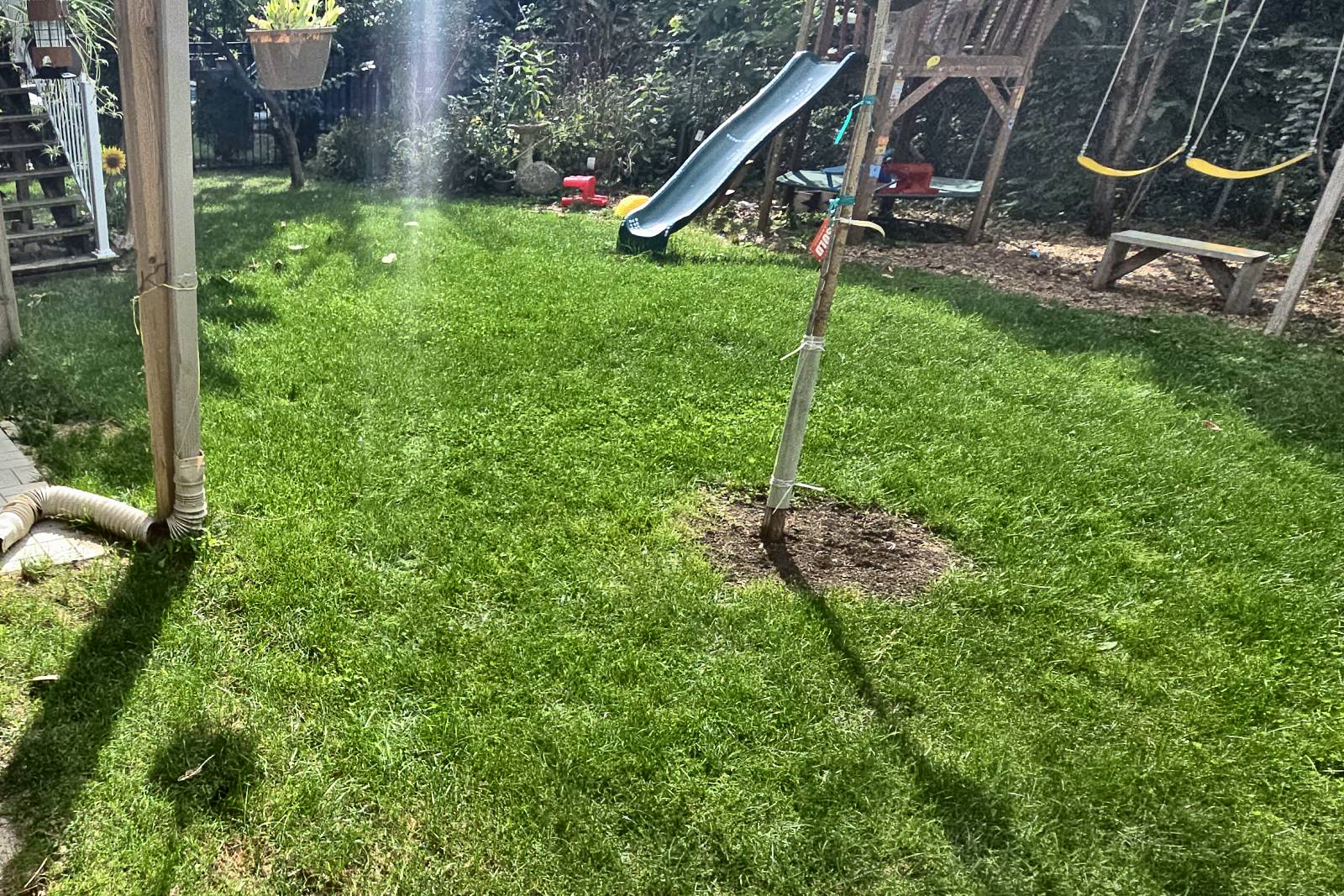
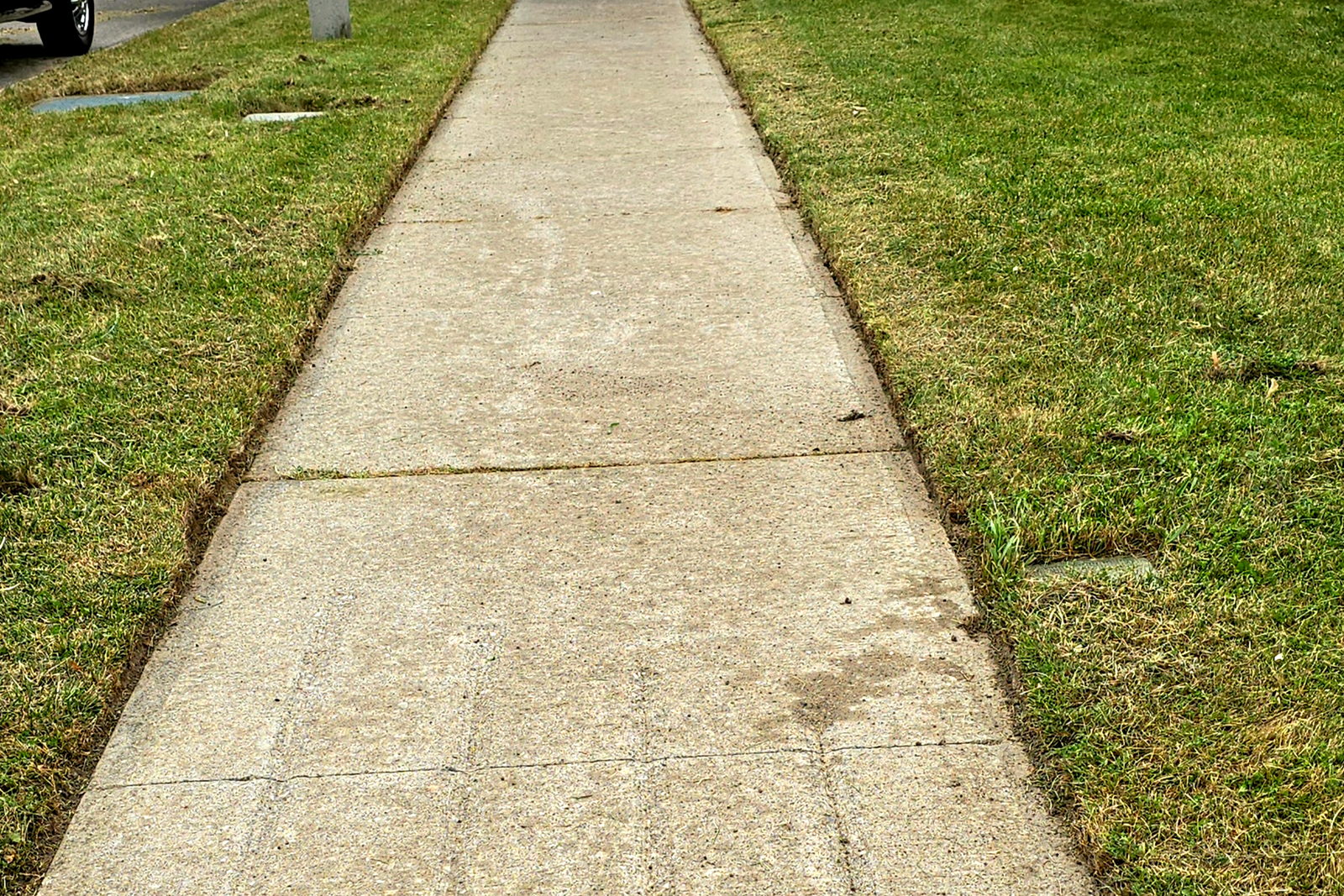
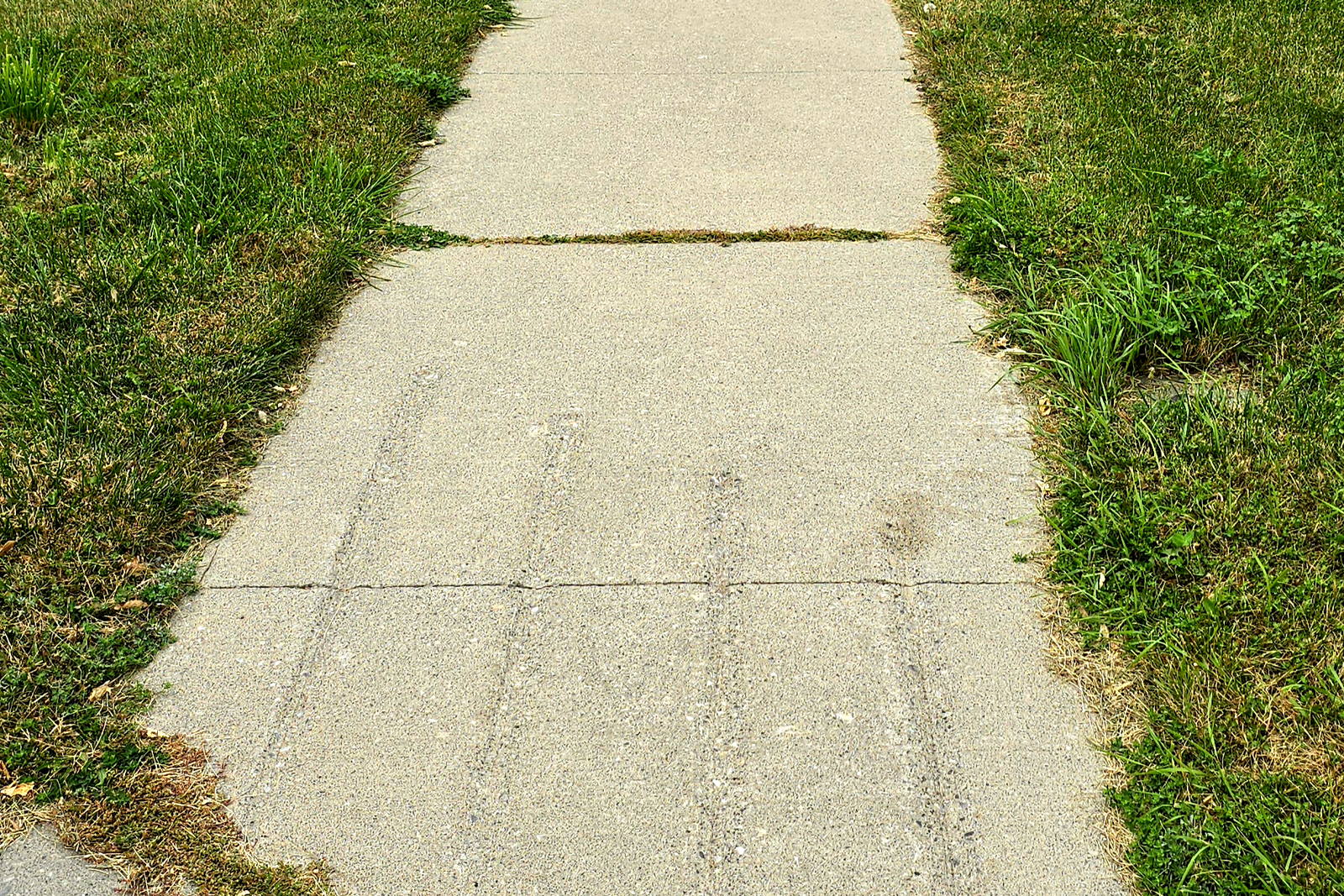
Real Northline properties, before and after, every one of them in Oshawa and every one of them this year. Drag the line to compare.
Andrew answers, October 2026
Why is your season longer than everybody else's?
Because November and April are when the awkward storms happen, and a season that ends on March 31 ends three weeks before the last one. November 1 to May 1 is six months and both ends of it are published, which is the part that matters: a season you can read is a season you can hold me to.
One of these goes on each page and it is replaced monthly. If the question you have is not here, ask it: 905-244-5779.
Tell me which parts the program leaves you and I will price only those
Apply to your own town first. Then send me the address and which municipality it is in, and I will tell you what their program reaches on your frontage, what it does not, and what the rest costs for the winter. If the answer is that you do not need us, that is the answer you will get.