Snow removal · Booking
When to Book Snow Removal in Oshawa, and the Two Dates That Decide It
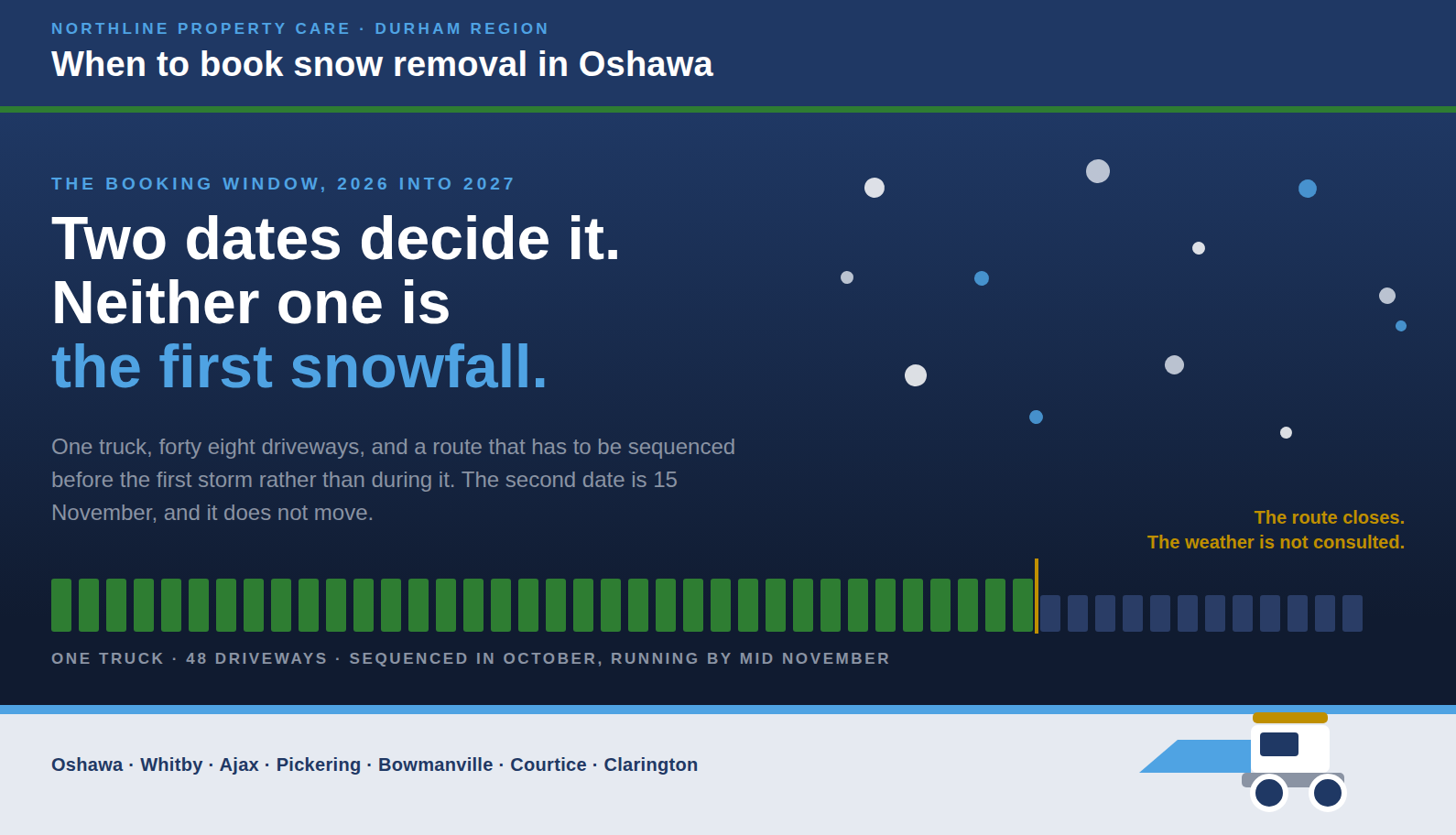
When to book snow removal in Oshawa is decided by two dates, and neither of them is the first snowfall. The first is the day a one truck route runs out of room. The second is 15 November, when our snow route closes for the season and stays closed.
Forty eight driveways, sequenced once. See how the winter route works.
Green in summer. Clear in winter.
The short answer
Book between the middle of August and the end of October. That is the window in which a residential driveway can still be added to a Durham snow route without anything being taken away from somebody else, and it sits comfortably ahead of the weather: in an ordinary Oshawa winter the first snowfall of 3 cm or more arrives between late November and the middle of December. If you are 65 or older, or you have a documented disability, check your own municipality first, because three of the four assistance programs in this region close their sign up before the end of October and one of them is free.
The first date is not on any calendar, and that is the awkward part
People assume snow removal works like a restaurant. You want it, you ring, somebody comes. It works more like a bus timetable, and the reason is arithmetic rather than attitude.
A single truck clearing residential driveways in Oshawa spends about six minutes on a property and about two and a half minutes driving to the next one, so the working figure is an eight and a half minute cycle. Multiply that out and forty eight driveways is roughly 408 minutes of continuous work. Add the mobilize time and it is a night that starts at 21:55, rolls at 23:10 and finishes at 06:40, which is twenty minutes of margin against a 7 AM target and no margin at all against a breakdown.
That is the whole constraint, and it is why the honest answer in February is usually no. Fifty is the absolute ceiling on the same route rolled an hour earlier, and it exists for buying salt and spare parts against, not for promising service. When somebody rings in the middle of January, the question is not whether we want the work. It is which of the people who signed in September gives up their place in the order so that a new address can be slotted in ahead of them.
So the first date is the day the last place goes, and nobody can print that date in advance. It moved twice last autumn while the routes were being drawn. What can be printed is the window in which it has never yet happened, and that window is August to October.
The second date is 15 November, and it is a hard stop
The snow route closes on 15 November. It is not a marketing deadline and it does not quietly extend for a good customer in a slow week.
A route has to be sequenced before it runs, and sequencing is the part nobody sees. Every property is put in an order that minimizes driving between them, the commercial and medical access work is placed overnight ahead of everything else, and then the residential tiers are laid in behind it: Platinum first with a 6:30 AM target, Gold behind it with a 7 AM target, and the Silver windrow pass as a separate daytime route that finishes by 5 PM. Change the membership list after that and every one of those positions moves.
There is a second reason, and it is the one that matters to a person who has already paid. Salt, fuel and spare cutting edges are bought against a known number of properties. Consumables ordered for forty eight driveways and spread across fifty five is how a contractor runs out of salt in the third week of January, which is exactly when running out of salt is least forgivable.
Fifteen November is also roughly where the lawn route ends, and the two are the same conversation held three or four weeks apart. If somebody is standing on your lawn in late October taking what is probably the last cut of the season, that is the cheapest moment there will ever be to settle the driveway as well.
What the Oshawa weather record says about the first clear
Booking in October feels early. It is not, and the station record is the reason.
Environment and Climate Change Canada's climate normals for the Oshawa water pollution control plant station, climate identifier 6155878, give the town an average of 105.8 cm of snow a year. The useful part is not the total, it is the shape. October averages 0.1 cm and 0.08 days with any measurable snow at all, which is to say almost none. November averages 4.7 cm across 1.8 days, but only 0.27 days at 5 cm or more, so roughly one November in four carries a single event big enough to matter. December averages 24.9 cm across 5.9 days, including 1.7 days at 5 cm or more.
Run those numbers forward from the first of October and the expected count of 5 cm days passes one somewhere around the middle of December. Read the daily record instead of the averages and the same answer turns up: the first snowfall of 3 cm or more at this station landed on 11 December in 2000, 6 December in 2004, 8 December in 2005, 1 December in 2007 and 11 November in 2019. In roughly one winter out of five it does not arrive until after the middle of December, and the earliest event of any size in the entire station record is 6.6 cm on 21 October 1969.
So the practical answer is that a booking made on 20 October is typically six to eight weeks ahead of the first driveway that needs clearing, and it is ahead of it in every winter the station has ever recorded. That is not cutting it fine. The people who cut it fine are the ones who ring on the morning of the first storm, and by then the truck is already out on a route with somebody else's address on it. If you want the full picture of how a Durham winter usually opens, the first snowfall timeline for Oshawa sets it out properly.
April is the mirror of it and it catches people out at the other end. March still averages 13.5 cm across 3.8 days and April averages 2.0 cm, with a 20.3 cm day on record on 3 April 1975. A season that is treated as over in the third week of March is a season with a hole in it, which is why the contract runs to the middle of April rather than to the end of a mild February.
Every date that closes between now and the first clear
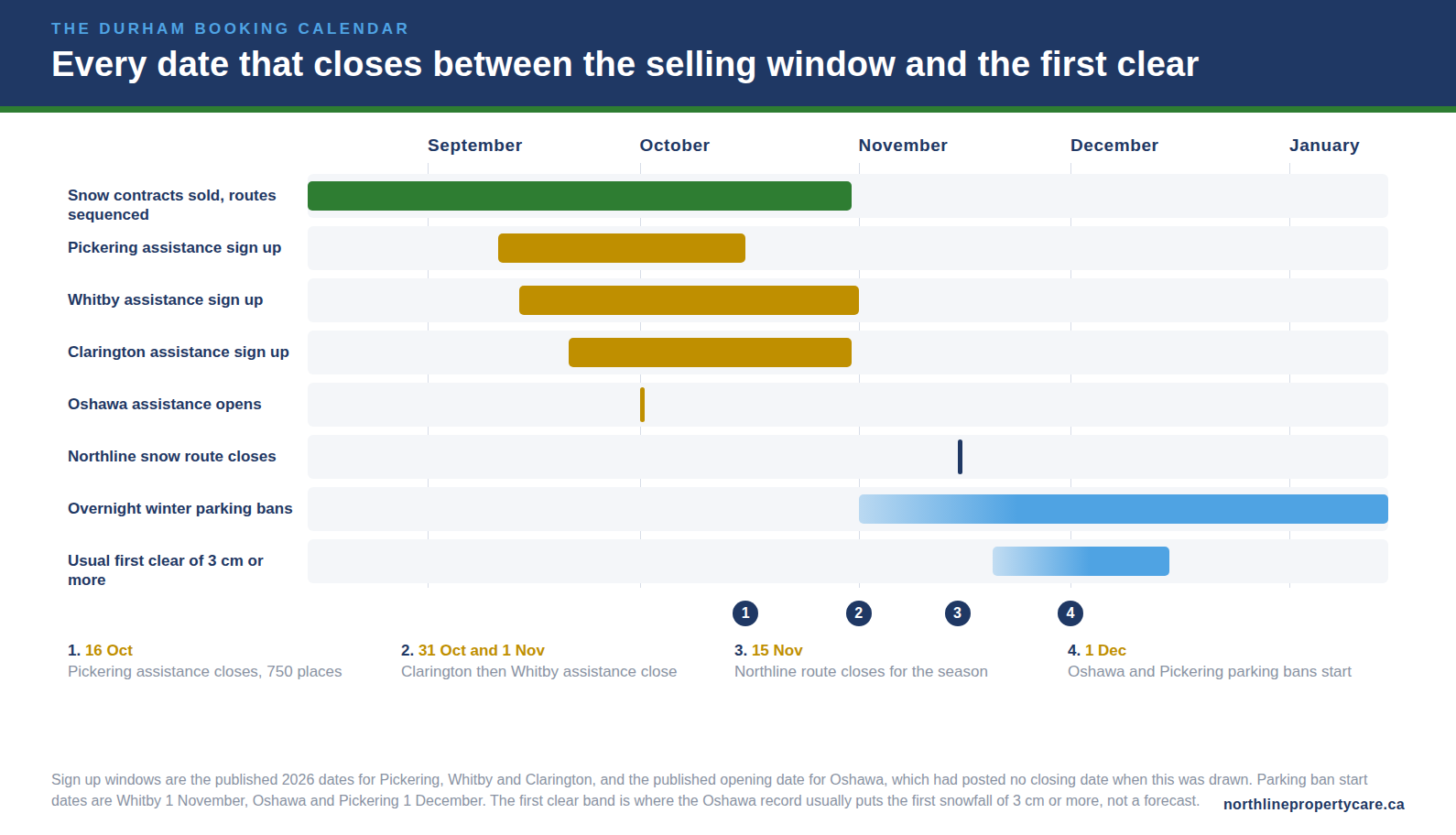
Everything on that chart is a published date except the pale blue band on the last row, which is where the station record usually puts the first clear rather than a forecast of this particular winter. Three of the four assistance sign up windows are open as this is written and the first of them closes in about a month.
Check the free option before you check ours
If you qualify for your municipality's assistance program, take it. No contractor in this region beats free, and one of these four programs is free.
Every Durham municipality leaves the driveway windrow to the property owner. Four of the five we serve run a program that clears it for residents who are 65 or older, or who have a documented medical inability to do it, provided nobody under 65 in the household is able to help. The rules, the price and above all the deadlines are different in every town, and the deadlines are the reason this section is here rather than further down the page.
| Municipality | Sign up window, 2026 | Cost for the season |
|---|---|---|
| Pickering | 11 September to 16 October | Free on the Guaranteed Income Supplement or GAINS, then $128.82, $186.45 or $240.69 by household income. Capped at 750 households |
| Clarington, including Bowmanville, Courtice and Newcastle | 21 September to 31 October | $107.69 including HST |
| Whitby | 14 September to 1 November | No fee at all |
| Oshawa | Opens 1 October, no closing date published | Not published for this season |
| Ajax | No windrow program | The Town clears no driveway windrows. A separate seniors snow removal program exists and the Town asks people to phone |
Read those windows against the weather record above and something obvious falls out. Pickering closes on 16 October, Clarington on 31 October and Whitby on 1 November. Every one of those doors shuts before the month in which the first clear usually happens. A person who waits for snow to remind them has already missed the free option and is left with the paid one, which is us, and we would rather say so in September than benefit from it in December.
Two details worth knowing before you apply. Every one of these programs has to be renewed each year, so being on it last winter is not the same as being on it this winter. And each one carries a minimum snow depth of its own: Whitby starts windrows at 10 cm and sidewalks at 5 cm, and Clarington starts windrows above 15 cm. A 6 cm night in Oshawa is a night the assistance program does not attend, which is a real gap and it is worth understanding before you rely on it. The windrow guide for Durham Region works through each program in full, including what happens on the nights they do not run.
Oshawa's own page says the program opens on 1 October and that changes are coming, and it publishes no closing date and no fee for this season. If you live in Oshawa, put a note in your phone for the first of October rather than waiting to be told.
What your street gets, and how long it takes to get it
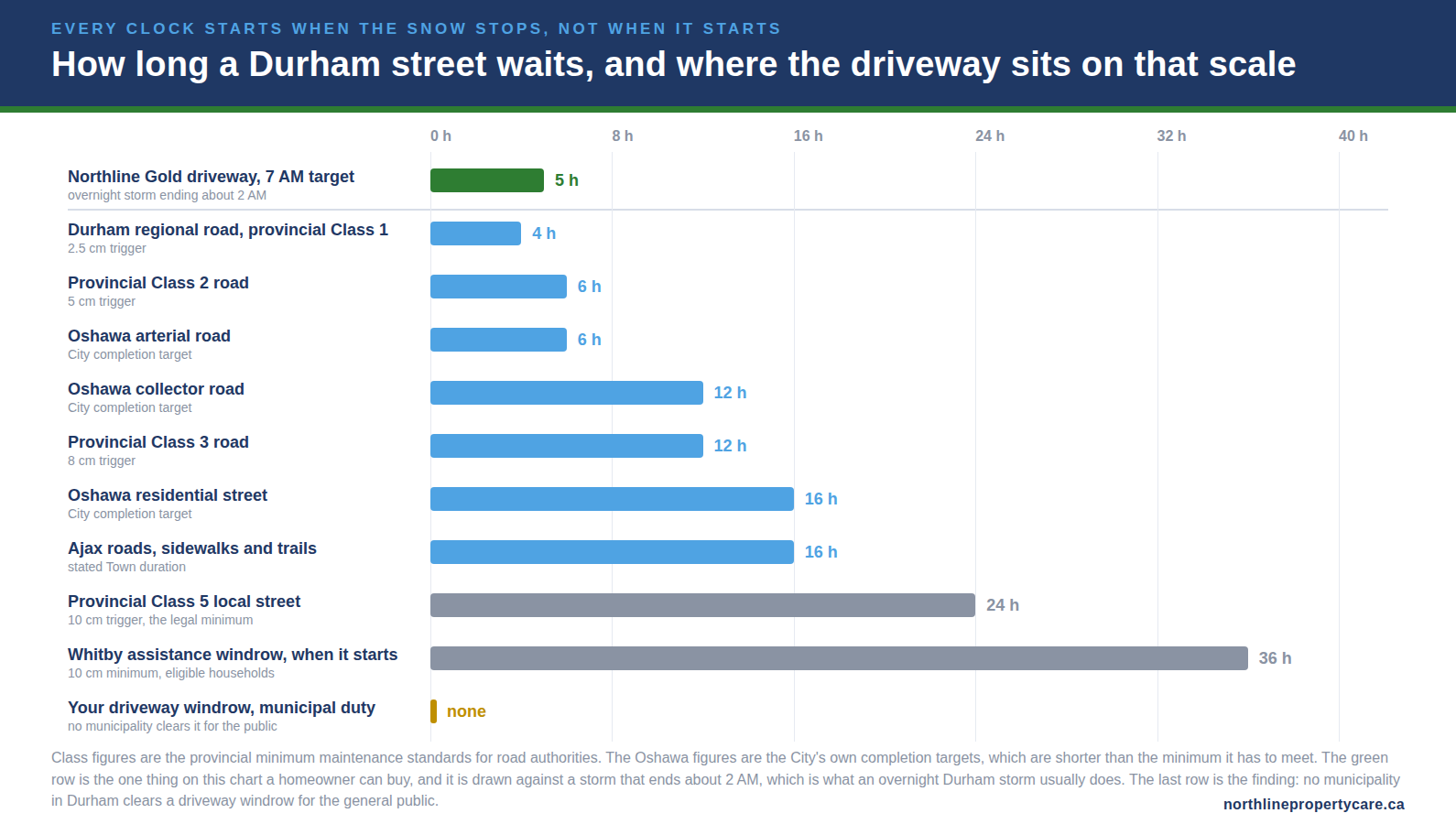
The province sets minimum maintenance standards for road authorities under Ontario Regulation 239/02, and they work on a class system. A Class 1 road, which in Durham means a regional road, has a 2.5 cm trigger and four hours to clear. A Class 5 road, which is the residential street almost everybody in Oshawa lives on, has a 10 cm trigger and 24 hours, and the 24 hours does not begin until the snow has stopped falling.
Oshawa does better than that minimum and publishes its own targets: six hours on an arterial road, twelve on a collector and sixteen on a residential street, with city sidewalks cleared no later than midnight on the first day after a storm ends. Durham Region patrols its regional roads seven days a week through the winter and deploys once about four centimetres has built up on the surface.
None of that is a complaint. It is a well run system and those targets are met most of the time. It simply answers a different question from the one a homeowner is asking at half past six in the morning, because there is no line anywhere in it for a driveway. Read the chart from the bottom and the argument makes itself: the municipal duty on the ridge of snow across the end of your driveway is nothing, and the ridge is the hardest, densest, most compacted snow on the property, because it has already been picked up and thrown by a plow blade.
Waiting for a snowfall warning stopped being a plan in November 2025
This one has not reached most people yet and it changes how a homeowner should think about triggers.
Environment and Climate Change Canada used to publish numeric alert criteria, and most of us carried one of those numbers around in our heads. In November 2025 the department replaced the whole arrangement with an impact based system: yellow, orange and red, and a set of Impact Guides written in consequences rather than centimetres. The old criteria page now carries a single line telling you to consult the new impact guides that replace the previous criteria, and the snow impact guide itself describes a high impact snowfall as one where travel is dangerous, delays are long and roofs are at increased risk of collapsing under the weight of snow. It contains no centimetre figure anywhere.
That is a better public alerting system and it is a worse trigger for a service contract, because a contract needs a number that two people can check the same way. Ours is three centimetres of measured accumulation on a residential driveway and five on a commercial property, measured on the ground rather than taken off a forecast. As of last November that private trigger is more precise than the federal alert it used to sit behind, and if you are comparing anybody's snow service this winter, the question to ask is what number starts the truck.
The forecast we would rather not publish
Here is the part of this article that costs us money to write, and it is the part we would want to read if the money were going the other way.
As of 10 September 2026 the American climate agency has an El Nino advisory in force. Its published discussion states that El Nino is strengthening, with a greater than 90 per cent chance of a very strong event during the northern hemisphere autumn and winter of 2026 into 2027, and it puts the Nino 3.4 index at plus 1.8 degrees. Environment and Climate Change Canada has not issued a Canadian winter outlook yet. In each of the last two years it published one in early December, so there is nothing official to read on this side of the border for another two or three months.
What that means for snowfall in Oshawa specifically, we do not know. We went looking for a defensible link between El Nino strength and Durham Region snow totals in government and university sources and did not find one, so we are not going to invent a correlation to make a point, in either direction. Anybody who tells you with confidence that this winter will be light is selling something, and so is anybody who tells you it will be brutal.
What we will say plainly is this. A very strong El Nino winter is the scenario in which a seasonal price looks worst on paper for the customer and best for the contractor, and you should decide with that in front of you rather than behind you. If you want to bet on a mild winter, the honest product for you is not a membership at all: it is one off clears when you actually need them. That is a genuine option, we will quote it, and in a four clear winter it will beat us.
What a seasonal price is actually buying
Eighteen complete winters of Environment and Climate Change Canada data for the Oshawa station, measured at our own 3 cm residential trigger, give an average of about twelve clears a winter. The honest version names the range as well: four clears in the mildest of those eighteen winters, twenty four in the worst.
So the product is not a number of clears, and we will not argue the price on the event count, because a price argument won on event count is an argument lost in a mild February. The product is that the payment does not move when the weather does. Four clears or twenty four, a Gold member pays the same $189 a month plus HST, which is $213.57 on the card and $2,268 across the year, and the driveway is cleared to a 7 AM target after every one of them.
The tiers are genuinely different and the difference is worth stating before you choose one, because the commonest complaint in this trade is somebody who bought the cheapest option and expected the middle one.
- Silver does not plow your driveway. It is the lawn membership with winter backup: the windrow pass by 5 PM on the daytime route, four banked full clears a season on request, and no salting at any depth, ever. It starts at $129 a month plus HST.
- Gold plows the driveway and carries the 7 AM target. That is the tier most households on a Durham cul de sac actually want, and it is $189 a month plus HST.
- Platinum is sequenced first, at a 6:30 AM target. It carries unlimited automatic salting and first choice of service day, at $279 a month plus HST.
Billing on all three is twelve equal payments taken on the final day of each month, and a year paid in advance is five per cent cheaper. Every one of those prices is before HST and there is no residential bundle discount, because the saving is already inside the tier rather than bolted onto it. The full breakdown of what each one covers is on the memberships page, and if you would rather see the arithmetic against per visit pricing first, the cost guide for Durham Region lays out all three models side by side.
Two clocks start the moment somebody falls on your driveway
Almost nobody books snow removal with liability in mind, and it is the strongest argument for booking properly rather than casually.
Ontario changed the rules in January 2021. Section 6.1 of the Occupiers' Liability Act now bars an action for personal injury caused by snow or ice unless written notice reaches one of two people inside 60 days of the fall. That notice has to carry the date, the time and the location, and it has to be handed over in person or posted by registered mail. The two people are the occupier and the independent contractor employed to clear the snow. Sixty days, in writing, and an email appears nowhere in the section.
The clock on a municipal sidewalk is a different one entirely, and people mix them up constantly. Under section 44 of the Municipal Act, 2001, a municipality is not liable for a personal injury caused by snow or ice on a sidewalk except in the case of gross negligence, and notice has to reach the clerk within ten days. Ten days and a much higher bar on the public sidewalk, sixty days and an ordinary reasonableness test on your own property.
The second thing that section does is worth reading slowly if you own the house. Hiring a contractor does not stop you being the occupier. Section 6 of the same Act gives you a defence where damage is caused by an independent contractor, but only if you acted reasonably in entrusting the work, and only if you took such steps as you reasonably ought in order to satisfy yourself that the contractor was competent and that the work had been properly done. Three conditions, all of them at once.
Translate that into September and it says something practical. Book somebody who is insured and will tell you so in writing, who works to a written trigger, and who leaves a record of which nights the property was attended. Those are the things that answer the competence question and the properly done question if it is ever asked. It is also the reason a contractor who takes cash in January and leaves no paper is a cheaper decision than it looks for about six weeks and a more expensive one after that. Northline is fully insured, every visit is logged against the property, and if you ask for the certificate you get the certificate.
Ten days to change your mind, and a year if the paperwork is wrong
We knock on doors in this business, and door to door has a bad name in Ontario for reasons that are mostly deserved. So here is the law that protects you from us, published on our own website, before anybody knocks.
An agreement negotiated or concluded in person somewhere other than the supplier's own place of business is a direct agreement under the Consumer Protection Act, 2002. Your kitchen table counts. Section 42 says the agreement has to be in writing and has to be delivered to you, and section 43 says you may cancel it, without giving any reason at all, at any time up to ten days after you receive that written copy. If the written copy does not carry everything the Act and Ontario Regulation 17/05 require, and the regulation lists fifteen separate items, then section 43 gives you a full year instead of ten days.
One correction while we are here, because it is the sort of thing that gets repeated wrongly. The Consumer Protection Act, 2023 has been passed but it is not in force: the provincial page still carries the line that it comes into force on a day to be named by proclamation. The 2002 Act is the one that governs anything you sign this autumn. When the new one is proclaimed the cooling off period stays at ten days, and a renewal of an existing contract will not restart it.
Snow removal is not on the list of services Ontario bans from being sold at the door. That list is furnaces, air conditioners, water heaters, water treatment and duct cleaning, and it is a closed list. So the knock is lawful, and the ten days is your answer to it. Take the paperwork inside, read it, and if you change your mind on day nine you owe nothing.
Where the car goes at four in the morning
Booking a contractor solves the driveway. It does not solve the street, and the overnight parking rules are the part people forget until the ticket arrives.
| Municipality | Overnight winter parking ban | Hours |
|---|---|---|
| Whitby | 1 November to 15 April | 2 AM to 6 AM |
| Oshawa | 1 December to 1 April | 2 AM to 6 AM |
| Pickering | 1 December to 31 March | 2 AM to 5 AM |
| Clarington | All year, not seasonal | 3 AM to 5 AM |
| Ajax | No calendar ban. Parking is suspended before, during and after a snow event | Any hour |
Oshawa escalates the fine on repeat: sixty dollars for a first offence, eighty for a second and one hundred after that, and parking is prohibited at any hour while plowing and salting are under way. Clarington raised the fine for a vehicle interfering with snow clearing to seventy five dollars, and an on street parking permit there is void during a snowfall or the clearing that follows it. Whitby runs the longest window of the five, from the first of November to the middle of April.
This matters to a booking because of where a second car sits. A truck arriving at 5 AM to clear a Gold driveway needs the apron clear, and a car left on the street outside is both a ticket and an obstruction to the city plow that has to pass before the windrow even exists. If a household has more vehicles than driveway, that is a conversation worth having in October rather than in the dark in January.
Three questions to ask anybody you book, including us
What number starts the truck. Ask for a depth, on the ground, in writing. A contractor who answers with when it needs it has given you nothing you can check in February, and since the federal alert criteria were retired there is no public number left to fall back on.
What happens below that depth, and what happens below minus ten. Sodium chloride is the ordinary rock salt everything in this region runs on, and it slows down badly as pavement temperature drops. Environment Canada's own priority substances assessment records that from minus five degrees downward sodium chloride acts more slowly than calcium chloride at the same rate of application, and the national technical guidance treats it as ineffective below about minus ten. The theoretical floor people quote, minus 21.1 degrees, is a laboratory number and it does not describe a driveway. A service that answers a cold snap by putting down more of the same salt is answering with something that has stopped working, and the honest answers at that temperature are mechanical clearing, traction grit, or a different melting agent.
Where the snow goes. Section 181 of the Highway Traffic Act makes it an offence to deposit snow or ice on a roadway unless the road authority has given written permission for it. The set fine published by the Ontario Court of Justice is eighty five dollars, with a twenty dollar provincial surcharge on top. It is the property owner who lives at the address, and a contractor who clears fast by pushing the pile across the street is buying speed with somebody else's money.
There is a fourth question that we would rather answer before it is asked. Nobody at Northline is watching a weather desk around the clock, because there is one truck and one operator, and a business that claims a staffed overnight vigil is claiming a second person it does not employ. What is true is that somebody watches messages through the overnight and the early run of a snow event, which is a different thing from office hours. The published hours themselves stop at 7 PM on a weekday, at 5 PM on a Saturday, and Sunday is closed.
What we could not verify
Everything quoted above that did not come from inside this business came from a municipal page, a provincial statute, a federal agency, a court fine schedule or a climate station file. Not one figure came from another contractor. Below is the list of things we went looking for and failed to pin down, which is the section almost nobody publishes.
- The Oshawa assistance program deadline and fee for this season. The City publishes the opening date of 1 October and a note that changes are coming. There is no closing date, no fee and no participant cap on the page, and the older application form now returns an error.
- Ontario Regulation 239/02 at source. The provincial e-laws page would not render for us. The class trigger depths and hour counts quoted above are the Town of Whitby's published reproduction of that table, which is a municipality rather than the regulation itself.
- Ajax sign up dates, fee and cap. Not published anywhere we could reach. The Town asks people to telephone 905-683-2951, and a 2019 report to its own committee costed a town wide windrow program at over 1.8 million dollars a year, which is presumably why there is not one.
- A mean date for the first 3 cm snowfall at the Oshawa station. The climate normals product carries frost dates, not snow dates, so the late November to mid December window above is read off individual winters and off the monthly counts rather than off a published average.
- Any link between El Nino strength and Durham snowfall. Looked for in government and university sources. Not found, and therefore not claimed.
- Whether the Whitby sign up form was actually open on the day its own page said it opened. The page gives 14 September and the form said otherwise when we read it. Telephone the Town rather than trusting either, including this page.
One more, and it belongs here rather than buried. The 1981 to 2010 climate normals are the newest published set we could retrieve for the Oshawa station, so every average in this article is one normals period out of date. It does not change the shape of the argument, because the shape is that October is empty, November is a coin toss and December is when it becomes routine. It does mean that anybody quoting these figures to the nearest tenth of a centimetre, ourselves included, is quoting a thirty year window that closed sixteen years ago.
Questions people in Durham actually ask
When should I book snow removal in Oshawa for this winter?
Between the middle of August and the end of October, and earlier still if you qualify for a municipal assistance program. The route closes on 15 November and does not reopen, because a single truck has to have its order settled before the first storm rather than in the middle of one. In an ordinary Oshawa winter the first clear of 3 cm or more lands between late November and the middle of December, so a booking made in October is still weeks ahead of the weather.
What happens if I call in January after the first big storm?
In most years you get an honest no. Once the route is running, adding a driveway means re sequencing a night that already ends at 06:40, and the only way to say yes is to take the time out of somebody who signed in September. If there is room we will say so the same day. If there is not, we will tell you that instead of taking a payment and hoping.
Is a seasonal price worth it if this winter turns out mild?
It might not be, and you should hear that from us rather than work it out from your own bank statement in March. The American climate agency has an El Nino advisory in force and puts the odds of a very strong event this winter above 90 per cent. Nobody can turn that into an Oshawa snowfall figure, and we are not going to pretend otherwise. What a seasonal price buys is that the figure stops being your problem: four clears or twenty four, the payment does not move.
Does the city clear the ridge of snow the plow leaves across my driveway?
Not for the general public, in any of the five municipalities we serve. Oshawa, Whitby, Pickering and Clarington each run an assistance program for seniors and for people with disabilities, and each one carries an age or medical test, a sign up deadline and a minimum snow depth. Ajax has no windrow program at all. Everybody else clears their own, or pays somebody to do it.
Can I cancel a snow contract after I sign it at the door?
Yes, and the law is more generous than most people expect. An agreement negotiated at your own door is a direct agreement under the Consumer Protection Act, 2002, and section 43 gives you ten days from the day you receive the written copy to cancel for no reason at all. If the written copy does not carry everything section 42 and the regulation require, that ten days becomes one year.
How much snow has to fall before you come?
Three centimetres of measured accumulation on a residential property, and 5 cm on a commercial one. That is a depth rather than a forecast, and it is well under the 10 cm the province sets before a local residential street has to be cleared at all. Below 3 cm nothing is pushed on a driveway, and what happens instead depends on the tier: Silver carries no salting at any depth, and Platinum salts automatically.
Who wrote this
Andrew runs Northline Property Care out of Oshawa. One truck, one operator, and seven towns: Oshawa, Whitby, Ajax, Pickering, Bowmanville, Courtice and Clarington. Six winters clearing snow in Durham Region, which is a number about the person rather than about the company, since Northline itself registered in August 2026 and this is its first winter under that name.
Northline is fully insured. Anything above that came from outside Northline carries a link to the page it was read on, and whatever could not be pinned down is named in its own section rather than quietly dropped. If something here is wrong, the fastest way to have it corrected is to telephone and say so: 905-244-5779.
Read next
Who clears the windrow, town by town
The ridge across the end of the driveway belongs to the property owner in all five municipalities. Here is every assistance program, every depth trigger and every deadline.
Read the windrow guide →What snow removal costs in Durham
Seasonal, per visit and monthly, with the real numbers behind each one and the single calculation that tells you which model suits your own street.
Compare the three models →Where the plow actually is
Every municipal tracker and activity report in one place, beside the live warning state, so you can see what the city is doing before you ring anybody.
Open the tracker index →Get on the route before the last place goes
Send me your address and I will tell you which tier your driveway actually needs, what it costs for the season, and whether your household qualifies for the municipal program instead. If the free one fits you better, I will say so.