Snow removal · Winter
When Does Snow Actually Start in Oshawa?
When does snow start in Oshawa? Later, lighter and less often than anybody expects, and we can say so with a figure attached because Environment Canada has been counting at a station here since 1969.
Bookings close when the route fills, because it has to be sequenced before the first storm. See what winter service covers.
Green in summer. Clear in winter.
The short answer
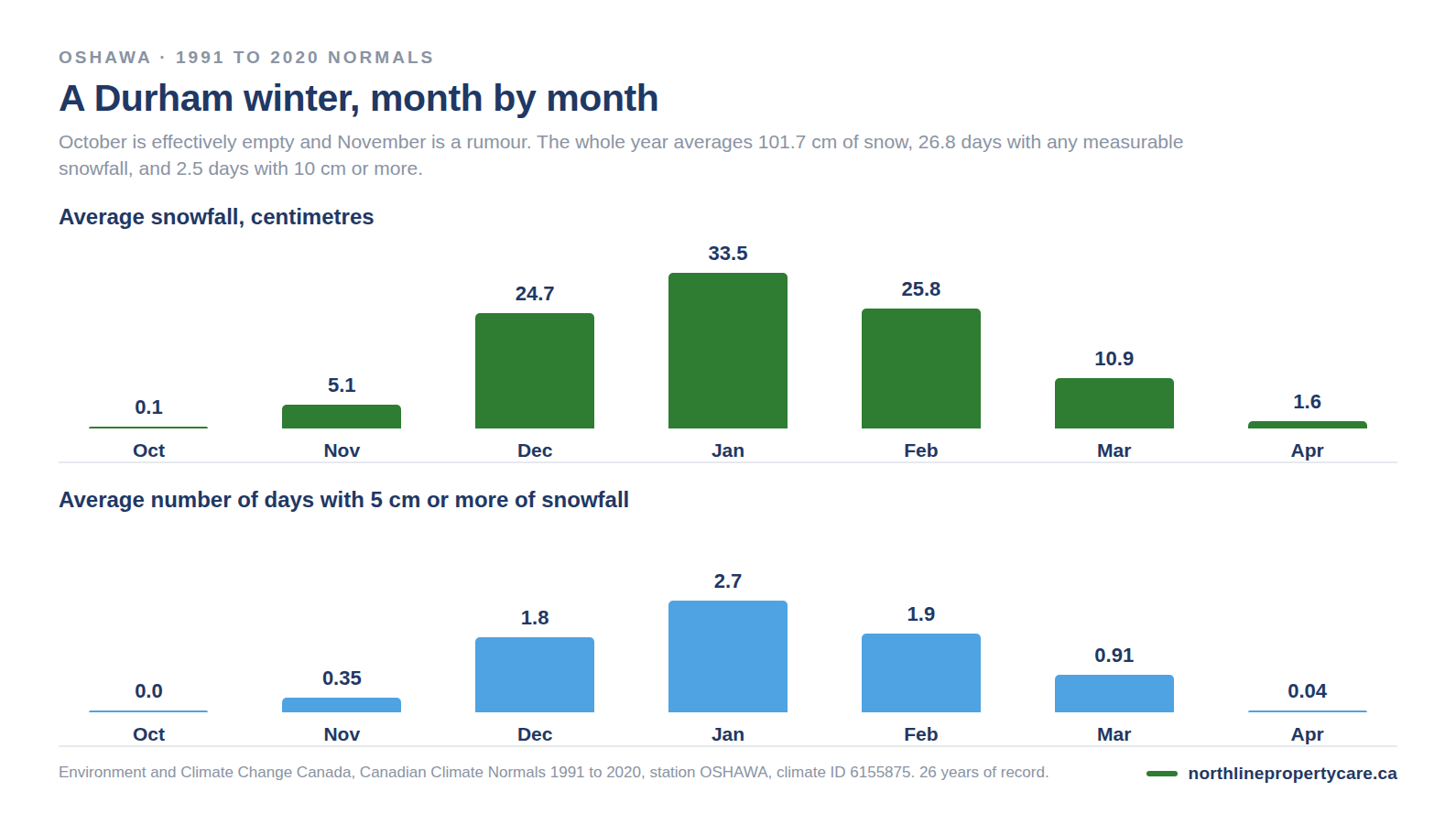
Meaningful snow arrives in Oshawa in the back half of November, and December is the first month that behaves like winter. Environment Canada's thirty year normal for October snowfall here is 0.1 cm. November is 5.1 cm. December jumps to 24.7 cm. The number of October days averaging 5 cm of snowfall or more is zero, and November averages about one such day every three years.
The whole winter, as the federal record has it
These are the published 1991 to 2020 Canadian Climate Normals for the composite station named OSHAWA, climate ID 6155875. The snowfall observations in it come from the Oshawa water pollution control plant site, which has been recording since August 1969.
| Month | Snowfall | Days with 0.2 cm or more | Days with 5 cm or more | Days with 10 cm or more |
|---|---|---|---|---|
| October | 0.1 cm | 0.09 | 0.0 | 0.0 |
| November | 5.1 cm | 1.6 | 0.35 | 0.17 |
| December | 24.7 cm | 5.8 | 1.8 | 0.63 |
| January | 33.5 cm | 8.5 | 2.7 | 0.88 |
| February | 25.8 cm | 6.8 | 1.9 | 0.67 |
| March | 10.9 cm | 3.3 | 0.91 | 0.14 |
| April | 1.6 cm | 0.74 | 0.04 | 0.04 |
| Whole year | 101.7 cm | 26.8 | 7.8 | 2.5 |
An average Oshawa winter has 26.8 days on which any measurable snow falls, 7.8 days on which 5 cm or more falls, and 2.5 days on which 10 cm or more falls. The bottom row is the one that changes how the whole subject looks.
Two and a half big days. That is the winter. Everything else is small snow, and small snow is what quietly ruins a Tuesday morning, because nobody plans around it.
Source: Environment and Climate Change Canada, Canadian Climate Normals 1991 to 2020.
What Environment Canada does not publish, and we are not going to invent
There is no such thing as an official average first snowfall date for Oshawa. Environment Canada does not publish one as a climate normal element and the Oshawa page carries no such row.
So when a page tells you the first snow here typically falls on some specific date, that date was calculated by whoever wrote the page, from data they may or may not have had. It is not a federal figure and it should not be quoted as one.
What the record does give you is the October and November columns above, plus one adjacent figure that is published: the average date of first fall frost in Oshawa is October 15, with a fifty per cent probability of the first freezing temperature falling on or before the 14th. Frost is not snow, and the six to eight week gap between the two is the part of autumn people misjudge.
One more piece of honesty about the data itself, because it is on the same page and it qualifies everything above. The Oshawa snowfall normal is built from 26 years of record with 3 missing years, covering 82.7 per cent of possible observations. The temperature elements come in at 87 to 88 per cent. These are sound figures and they are not a spotless thirty year run, and you should know that before anybody, ourselves included, quotes them to a decimal place.
Durham is not the snow belt, and here is the proof in one table
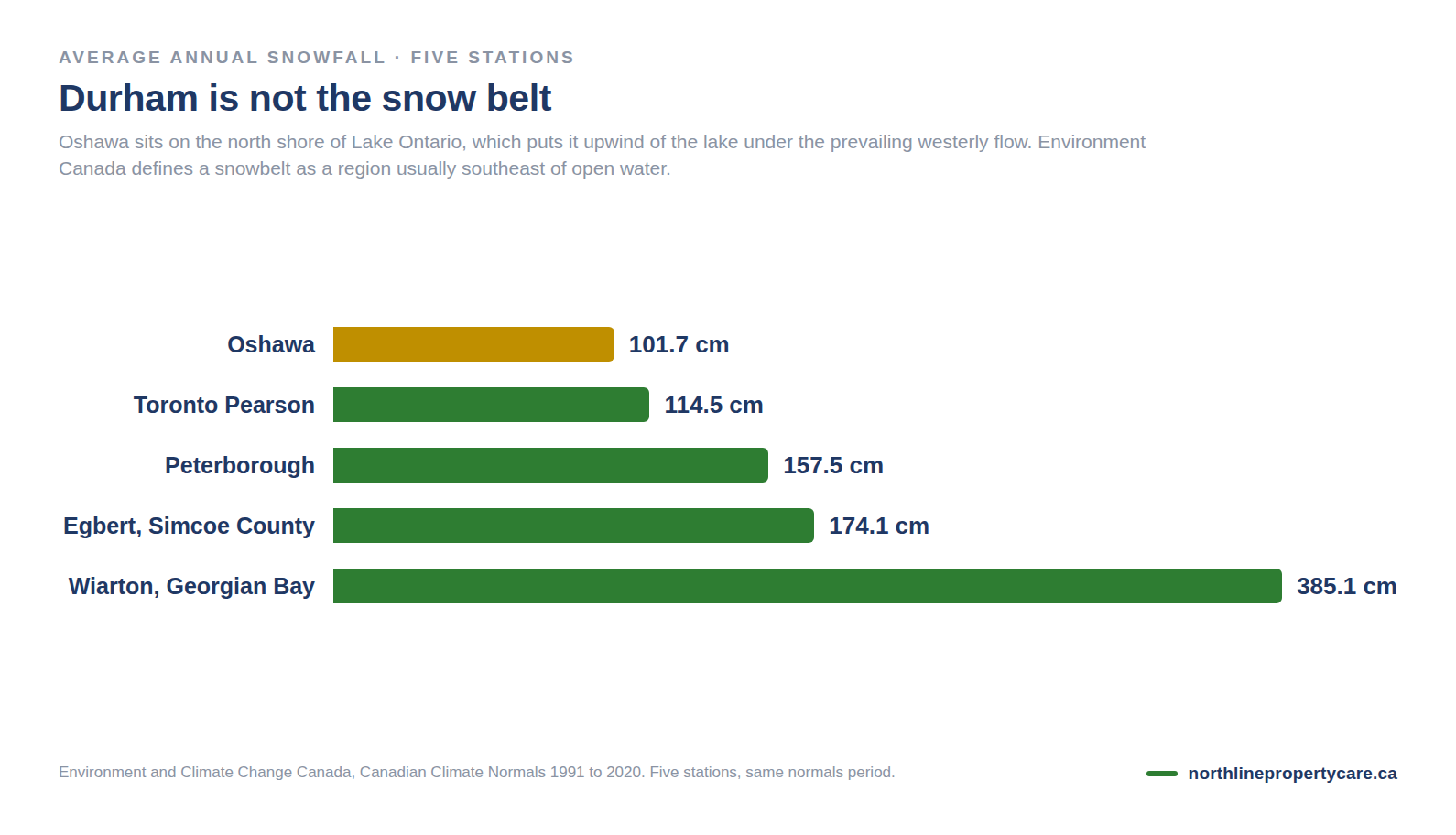
People who move to Durham from Toronto expect more snow, and people who move from Barrie expect a great deal less. Only one of those groups is right.
| Station | October | November | December | Year |
|---|---|---|---|---|
| Oshawa | 0.1 cm | 5.1 cm | 24.7 cm | 101.7 cm |
| Toronto Pearson | 0.2 cm | 9.3 cm | 24.1 cm | 114.5 cm |
| Peterborough | 1.1 cm | 16.9 cm | 32.6 cm | 157.5 cm |
| Egbert, Simcoe County | 2.7 cm | 21.9 cm | 41.5 cm | 174.1 cm |
| Wiarton, Georgian Bay | 4.5 cm | 47.9 cm | 91.8 cm | 385.1 cm |
Wiarton's November alone is more than nine times Oshawa's November. Its yearly total is close to four times ours. Even Peterborough, about fifty kilometres inland from our lakeshore, collects 55.8 cm more snow a year than we do and more than three times as much in November.
The mechanism is in Environment Canada's own glossary. A snowbelt is defined as an area where prevailing onshore winds produce heavy snowfall, and the glossary says plainly that it usually refers to regions southeast of open water. Oshawa is on the north shore of Lake Ontario. Under the prevailing westerly and northwesterly flow, that puts us upwind of the lake, not downwind of it. The lake moderates our temperature far more than it loads our snow.
Natural Resources Canada makes the wider point in its assessment of climate risk to Ontario transportation: the Great Lakes moderate temperature, shape where precipitation falls, and produce a snowbelt effect in winter. The snowbelt that effect produces is not here.
The province ranks our winters, and it publishes the score
The score is published, and it is a real number rather than an impression. The Ministry of Transportation divides the province into highway maintenance contract areas, one of which is named Durham, and it publishes a Winter Severity Index for each one: a zero to one hundred scale combining snowfall, temperature, freezing rain and other factors.
| Winter | Durham severity index | Simcoe, for comparison | Toronto, for comparison |
|---|---|---|---|
| 2025 to 2026 | 62 | 74 | 24 |
| 2024 to 2025 | 50 | 69 | 23 |
| 2023 to 2024 | 24 | not read | not read |
| 2022 to 2023 | 34 | not read | not read |
| 2021 to 2022 | 43 | not read | not read |
Two things jump out. Durham sits squarely between Toronto and the Simcoe snow belt, exactly where the climate normals put us. And the last five winters scored 43, 34, 24, 50 and 62. The most recent one was more than two and a half times as severe as the one two years before it.
That variability is the single most important fact on this page, and it is the reason a per visit snow contract is a gamble in both directions. You can read the table yourself on the ministry's page for how Ontario clears its highways in winter, which also names the Durham area contractor and publishes its bare pavement performance.
When winter legally starts, which is earlier than you think
Ontario sets the municipal winter standard in O. Reg. 239/02, the Minimum Maintenance Standards for Municipal Highways. Section 3.1 is the one that fixes the season, and it is worth reading because it is unambiguous.
From October 1 to April 30, a municipality must monitor the weather, current and forecast, once every shift or three times per calendar day, whichever is more frequent. From May 1 to September 30, once a day is enough.
So the legal winter is 212 days long and it opens on October 1, a full month before Oshawa records enough snow for anybody to notice. The province is watching the sky through all of October for something that, on a thirty year average, does not arrive.
What triggers actual work is depth and road class, not the calendar.
| Class of highway | Snow depth that triggers the standard | Time allowed to clear it | Time allowed to treat ice |
|---|---|---|---|
| Class 1 | 2.5 cm | 4 hours | 3 hours |
| Class 2 | 5 cm | 6 hours | 4 hours |
| Class 3 | 8 cm | 12 hours | 8 hours |
| Class 4 | 8 cm | 16 hours | 12 hours |
| Class 5 | 10 cm | 24 hours | 16 hours |
| Class 6 | The regulation does not apply. Section 2(3) excludes Class 6 highways entirely. | ||
The class is not something a town picks. It falls out of a published matrix of average daily two way traffic against the posted speed limit, so a quiet residential crescent lands in Class 4 or 5 and a Regional arterial lands in Class 1 or 2 whether anybody likes it or not.
Note what the regulation counts as addressing snow: plowing, salting, applying abrasives, applying other agents, or any combination. A road that has been salted and not plowed has, in law, been addressed.
Sidewalks get their own section. Section 16.3 requires snow on a sidewalk to be reduced to 8 cm or less within 48 hours, over a minimum width of one metre, and section 16.5 gives 48 hours to treat an icy one. Against that, Oshawa requires a property owner to clear the sidewalk in front of their house by midnight the day after the snowfall ends. The homeowner's deadline is tighter than the municipality's.
When each Durham municipality thinks winter starts
Only Whitby and Ajax publish an operational winter season. The rest publish an overnight parking restriction, which is the nearest thing to a published start date and should be read as that rather than as an operations calendar.
| Municipality | Published window | Hours |
|---|---|---|
| Whitby | November 1 to April 15, stated as the winter maintenance season | 2 AM to 6 AM |
| Ajax | November to April, stated as when winter response is active | Not a parking window |
| Oshawa | December 1 to April 1, parking restriction only | 2 AM to 6 AM |
| Pickering | December 1 to March 31, parking restriction only | 2 AM to 5 AM |
| Clarington | Year round. There is no seasonal window at all | 3 AM to 5 AM |
Clarington is the outlier and it catches people who move there. There is no day in Clarington on which winter parking rules begin, because they never stopped. The Municipality also asks residents not to phone about an unplowed road until eight to twelve hours after the storm ends, which is a more honest published expectation than most towns offer.
Oshawa's own published targets are six hours for arterials, twelve for collectors, sixteen for residential streets, and sidewalks by midnight of the first day after the storm. The City maintains over 500 km of primary road, 765 km of residential road and about 160 km of sidewalk. Adding every driveway to that list is not a scheduling problem, it is a second fleet, which is why the windrow at the end of your driveway is yours.
The night salt stops working, and why it is rarer here than you think
The National Research Council published the number in Canadian Building Digest 191 in 1977, and the physical chemistry has not moved since: sodium chloride is only effective above about minus ten degrees, and becomes most effective near the melting point. The same digest notes that calcium chloride below about minus eighteen is not always beneficial either, because the surface stays wet and slippery, and that abrasives may do better.
Now put that against Oshawa. The January daily minimum normal is minus 8.9, February is minus 8.3, and the daily averages for those months are minus 5.0 and minus 4.2.
Which means that in an average Durham winter, salt is inside its working range most of the time, including most nights. The days when it genuinely cannot work are the exception rather than the rule. That is the opposite of the assumption most homeowners carry, and it is why a contractor who salts on every single visit is spending your money on chemistry rather than on ice.
The Ministry of Transportation describes the alternative plainly: sand provides traction on slippery surfaces, especially when it is too cold for salt to be effective. Ontario's own environmental guideline for de-icing asks operators to reduce chemical application rates to the minimum amount necessary to do the job.
Freezing rain, and the warning criteria that quietly disappeared
Freezing rain is the hazard people underrate here, because it does not photograph like a blizzard and it closes a driveway just as effectively.
Oshawa's composite station publishes no freezing rain element, so we cannot give you a local figure and will not invent one. The nearest reliable series is Toronto Pearson, which averages 5.5 days a year with freezing rain or freezing drizzle, on a record of thirty years with no missing years, which is the best data quality code Environment Canada issues. Fifty kilometres inland, Peterborough averages 10.1.
Now the part worth knowing, because it has not reached most of the internet. Environment Canada has retired its numeric warning criteria. The page that used to carry the centimetre and hour thresholds for southern Ontario now says only that the criteria have been replaced by Weather Impact Guides, which describe three levels of impact and contain no numbers at all.
So any article telling you a winter storm warning in southern Ontario means a specific number of centimetres in a specific number of hours is quoting a standard that no longer exists. We would not have known that either if we had not gone looking for the number to put in this paragraph.
Winter tires: not the law, but the discount is
Transport Canada states it flatly: Quebec is the only jurisdiction in Canada where winter tires are mandatory province wide, and it is left to each province to decide. Ontario has not.
What Ontario does mandate sits on the insurer's side of the transaction, and it is in an odd place to find it. Regulation 664 under the Insurance Act, section 14.1(3), paragraph 1, requires insurers to use, as an element of their risk classification system, a discount in the rate of insurance for an automobile equipped with winter tires, for contracts issued or renewed on or after January 1 2016.
Read the obligation carefully. Insurers must use the element. The regulation does not set a minimum discount, which is why the amount varies so widely and why it is worth asking your own insurer rather than assuming.
Two more published facts that matter in a Durham driveway. All season tires begin to lose grip at 7 degrees, which in Oshawa is most of October. And studded tires are not permitted on vehicles registered in southern Ontario, only in the north.
What all of this means for booking a driveway
Here is where we turn the data into a decision, including the part that costs us money to say.
Our residential trigger is 3 cm. Below that there is no push: it is salt and the walkway rather than the blade. Against eighteen complete winters of Environment Canada daily records for Oshawa, a 3 cm trigger produces an average of 11.4 clears a year, with a median of 12. The mildest of those eighteen winters produced four. The worst produced twenty four.
That spread is the whole story, and it runs in both directions.
In a mild winter, a seasonal contract costs you more than paying per visit would have. Break even on a seasonal driveway sits around the tenth clear. Four clears and you have paid for six you did not get. That is not a trick and it is not fine print; it is what a fixed price is.
What you are buying is not twelve clears. What you are buying is that the price does not move when the weather does. Twenty four clear mornings in a bad year cost you exactly what four cost you in a good one, and the truck arrives on the twenty fourth without a conversation about surcharges. Anybody who wins the argument on event count will lose it in a mild February, which is why we will not run that argument.
The other reason the calendar matters is capacity. The snow season opens on November 1 and booking closes on November 30. The route holds a fixed number of properties, because the hours between the mobilize at 21:55 and the last driveway are fixed. When the route is full it is full, and the first storm is the worst possible moment to discover that.
Gold at $189 a month plus HST, $213.57 on the card, clears the driveway with a 7 AM target. Platinum at $279 goes first with a 6:30 AM target and unlimited salting. Silver at $129 does not clear the driveway, and it never has: Silver gets the windrow pass by 5 PM and four banked full clears a season on request. That is on the page in plain words on purpose, because the middle of a storm is a poor moment to learn what your tier does not do.
Questions people actually ask
What date does it first snow in Oshawa?
Environment Canada does not publish a first snowfall date as a normal, so anybody giving you one calculated it themselves. What is published is an October snowfall normal of 0.1 cm and an average of 0.October 09 days with 0.2 cm or more, which is roughly one October in eleven.
Does Oshawa get lake effect snow?
Not the way the Georgian Bay towns do. Environment Canada defines a snowbelt as usually being southeast of open water, and we are on the north shore, upwind under the prevailing flow. Wiarton averages 385.1 cm a year against our 101.7.
When do the plows actually start running?
The legal monitoring season opens October 1 and runs 212 days to April 30, but plowing is triggered by accumulation depth and road class, never by a date.
At what temperature does salt stop working?
The National Research Council puts sodium chloride at effective above about minus ten. Our January daily minimum normal is minus 8.9, so on an average night here salt is still working, which surprises most people.
Are winter tires required by law in Ontario?
No. Quebec is the only province where they are mandatory. Ontario instead obliges insurers to carry a winter tire discount, with no minimum set, so ask yours what theirs is worth.
How many times will my driveway be cleared in a winter?
About twelve at our 3 cm trigger, from eighteen winters of Oshawa records. The mildest produced four and the worst twenty four, and a contractor quoting one number without that spread is selling you weather.
Who wrote this
Andrew owns the business and is on the driveway himself at the 7 AM target. Owner operated from north Oshawa through the seven Durham towns, fully insured and an HST registrant. His six winters clearing snow in Durham Region cover one of the mild years in that table and one of the bad ones.
Every figure above is federal, provincial or municipal. The climate numbers are Environment Canada's, the standards are the province's, the parking windows are each municipality's own, and none of it comes from a competitor's website.
Read these before the first storm
The ridge the plow leaves across your driveway
Every Durham town leaves it to you. The assistance programs, the depth triggers, the deadlines, and what the Highway Traffic Act says about where that snow may go.
Read the town by town →What it costs, and what drives the price
Per visit against seasonal, the four municipal programs compared, and the statute that makes your contractor a named defendant class.
Read the numbers →What to finish before the ground freezes
The Region's last yard waste pickup, the final cut height that decides whether you get snow mould, and the two jobs that actually matter.
Read the checklist →The work, photographed
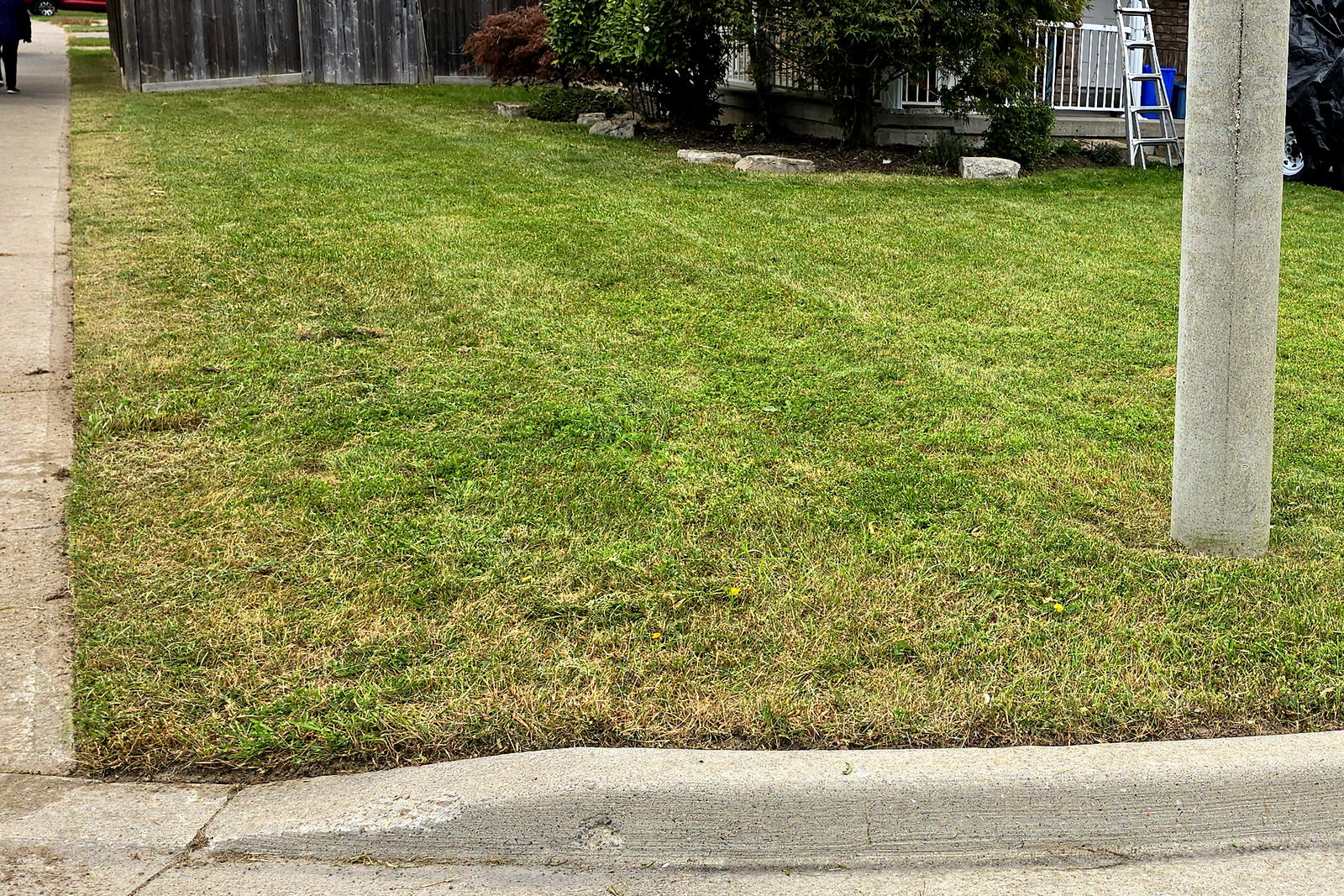
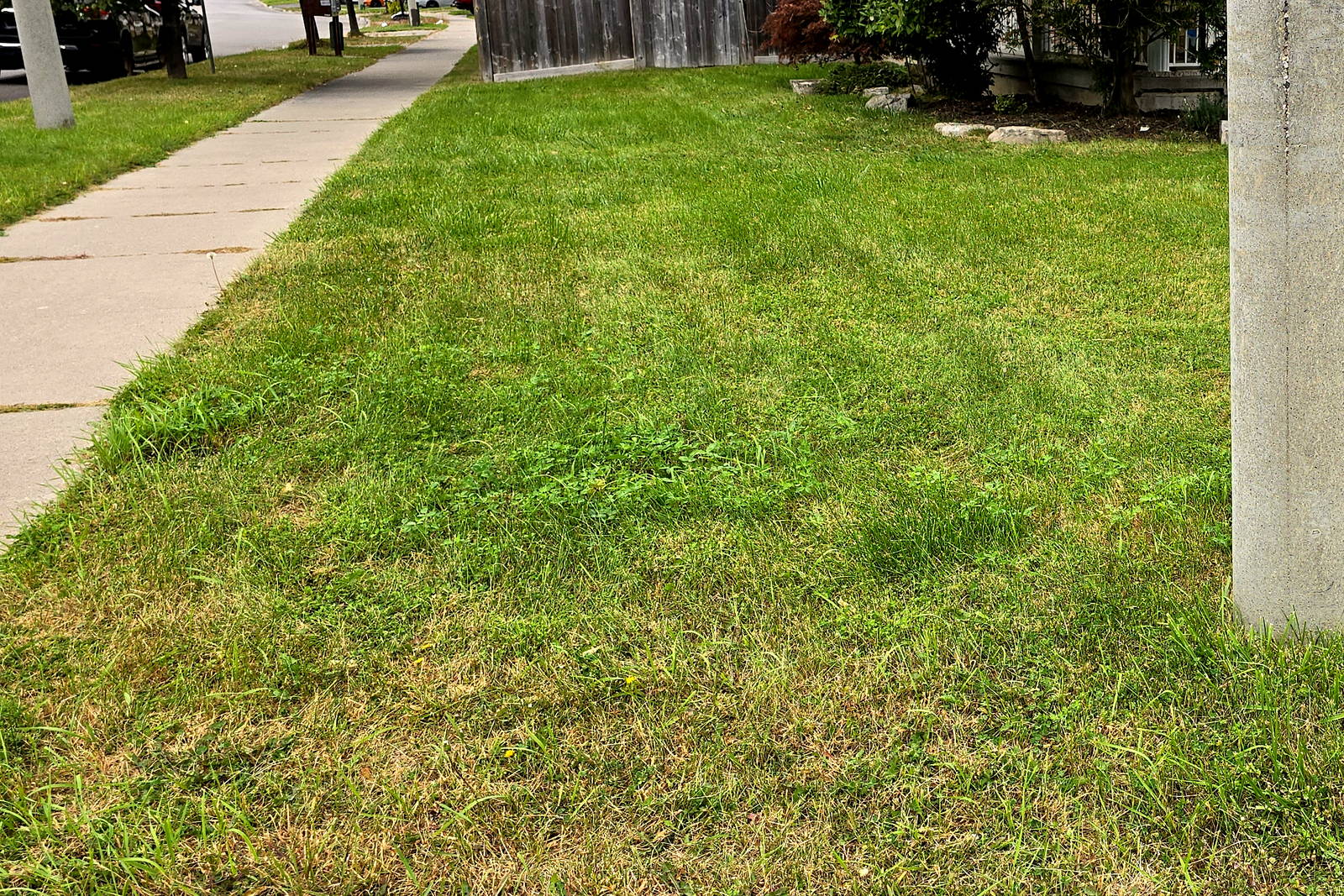
Real Northline properties, before and after, every one of them in Oshawa and every one of them this year. Drag the line to compare.
Andrew answers, October 2026
Is the 3 cm trigger measured at my house or somewhere else?
On the route, not at an airport. Three centimetres is the depth at which a residential driveway stops being something you can drive out of, so that is where the number is set. Below it we are still out, but it is salt and the walkway rather than the blade, and that happens without you asking for it.
One of these goes on each page and it is replaced monthly. If the question you have is not here, ask it: 905-244-5779.
The route fills before the first storm, not after it
Booking closes on November 30 and it does not move, because a route holds only so many driveways between the mobilize and sunrise. Ask while there are still places left and I will give you the winter figure the same day.