Snow removal · Townhouses
Townhouse Snow Removal in Oshawa, and Where the Snow Actually Goes
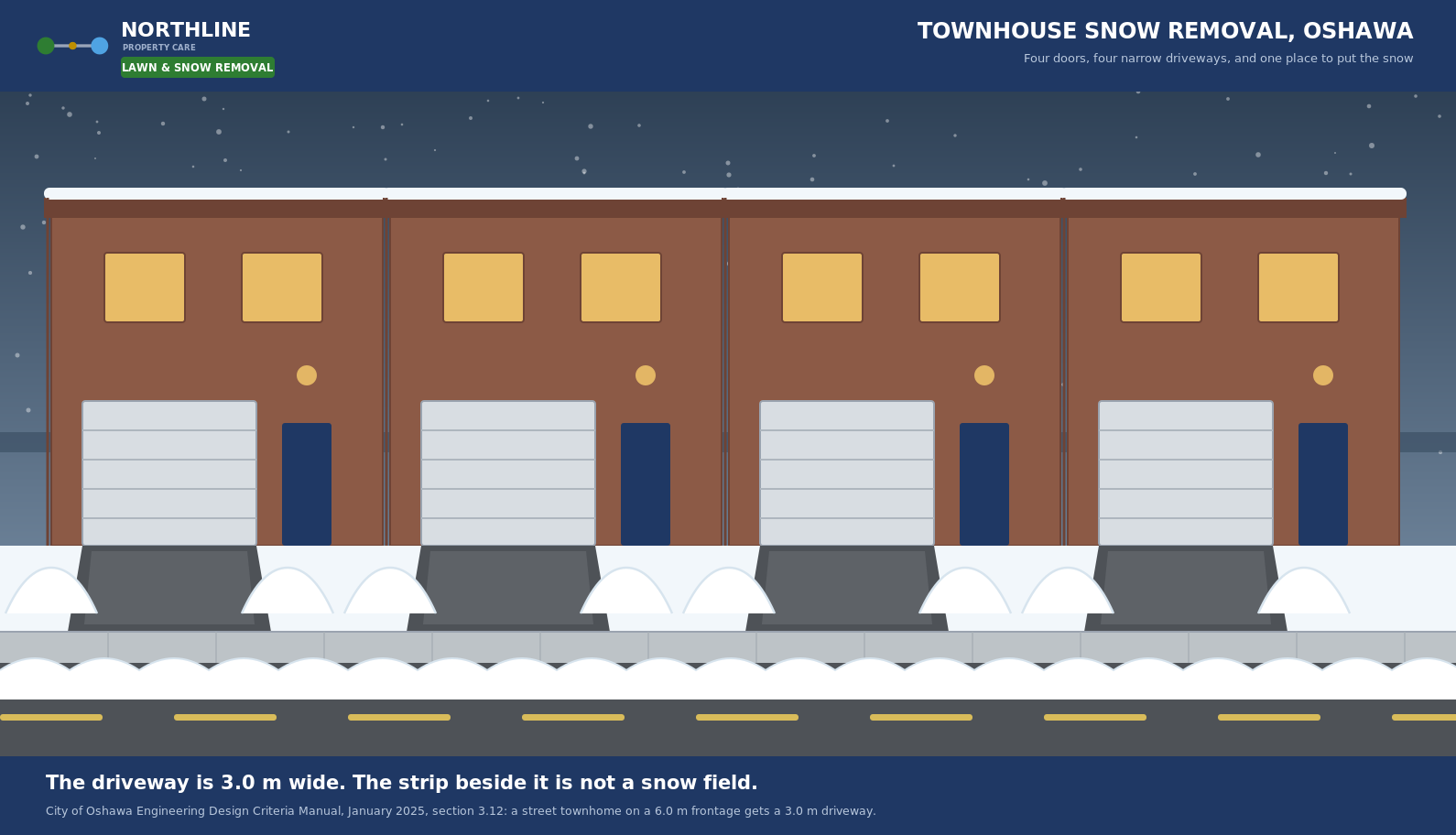
Townhouse snow removal in Oshawa is a storage problem before it is a clearing problem, because the City writes a street townhome driveway at 3.0 m and the land beside it is often about a metre.
The whole winter service, in one place. See how the snow route works.
Green in summer. Clear in winter.
The short answer
Townhouse snow removal in Oshawa is a storage problem before it is a clearing problem. A street townhome built to the City of Oshawa standard gets a driveway 3.0 m wide, against a 3.5 m minimum for everything else, and the land left on either side of it is frequently about a metre. The snow still has to go somewhere, the roadway and the sidewalk and the boulevard are all closed to you by by-law, and by February the strip beside the driveway is full. Before you price anything, answer two questions. The first is who owns the lane your driveway meets. The second is where the third storm is going to go.
Why a townhouse driveway is a different job, measured
The City of Oshawa writes the townhouse driveway narrower than every other driveway in the city, on purpose, and in writing. Section 3.12 of the Engineering Design Criteria Manual, last updated January 2025, sets a minimum driveway width of 3.5 m for residential subdivisions, and then carves out one exception: street townhomes and semi detached houses, where a 6.0 m lot frontage gets a driveway width of 3.0 m. That half metre is not a rounding difference. Over a driveway six metres deep it is three square metres of asphalt you do not have, and in a street of twenty units it is the reason nobody has anywhere to turn around in January.
The parking standard behind it is the second half of the squeeze. Oshawa sets a residential parking space at 5.75 m by 2.75 m and requires that spaces have unobstructed street access rather than being stacked one behind the other. A 3.0 m driveway holds one of those spaces across its width. Whatever else you own goes on the street, and on an Oshawa street there is no overnight parking at all between December 1 and April 1, from 2 a.m. to 6 a.m. under section 4.38 of Traffic and Parking By-law 79-99. Pickering runs the same ban from December 1 to March 31 between 2 a.m. and 5 a.m. So the second car is in the driveway, behind the first car, on the only strip of ground anybody could have cleared.
Ajax caps it tighter still. The Town publishes a maximum driveway width by zone, and the R2-B and R3 zones carry the lowest figure on the whole table at 3.0 m, with a footnote that driveways and parking areas may not occupy more than 30 per cent of the front yard. Oshawa comes at the same idea from the other direction and caps a driveway at 50 per cent of the front yard area so the rest stays landscaped. Read that cap the way a person with a shovel reads it: the landscaped half is not decoration, it is the only legal place the snow off the other half can go.
A narrow driveway does not produce less snow. That is the part that catches people who moved from a detached house. It produces the same depth over a smaller area, which is less total volume, and then the plow arrives and undoes the saving. The windrow laid across your apron is a function of how much snow the road carried and how wide the road is, not how wide your driveway is. The unit with the double driveway next street over gets the same ridge you do, and has three times the lawn to put it on.
For the mechanics of the ridge itself, including how deep it gets and why it is the heaviest snow on the property, the windrow guide for Durham Region works through it in full. If your driveway runs uphill to the garage as well, which a great many Kedron and Windfields units do, steep driveway snow removal covers the grade problem that sits on top of this one.
Where the snow can legally go, and the two places it cannot
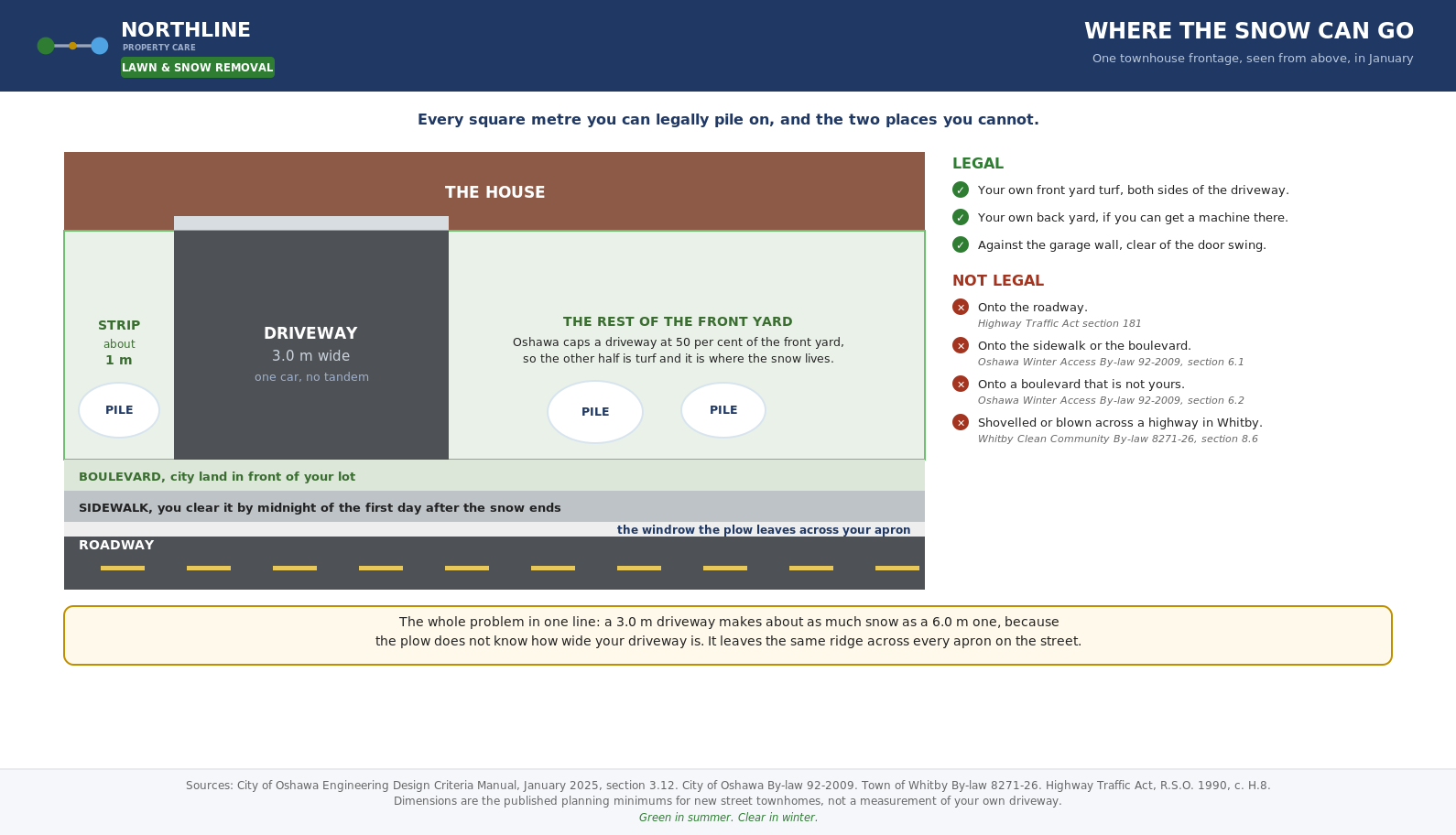
Three surfaces in front of your house belong to somebody else, and the law is specific about all three. The roadway is closed to you by the province: section 181 of the Highway Traffic Act says that no person shall deposit snow or ice on a roadway without permission in writing from the road authority responsible for maintaining it. That is a provincial offence and the general penalty in the Act runs from $60 to $1,000.
The sidewalk and the boulevard are closed to you by the City. Oshawa Winter Access By-law 92-2009, section 6.1, says that no person shall move snow or ice from private property onto, or pile or redistribute it on, a sidewalk or a highway. Read the definition section before you decide that leaves you the grass verge: the by-law defines highway to include the area between the lateral property lines including any boulevard. Section 6.2 closes the last door by prohibiting the deposit of snow on a boulevard that is not next to your own lot. The administrative penalty starts at $75 and a conviction carries a minimum fine of $300.
Whitby rewrote its version this year and anybody working from an older note has it wrong. By-law 6937-15 was repealed at the end of March 2026. The live instrument is the Clean Community By-law 8271-26, in force April 1 2026, and section 8.6 prohibits shovelling, plowing or blowing snow, slush or ice onto or across a highway, a sidewalk or a pedestrian walkway without authorization. Schedule A sets the first tier at $355.00, the second at $500.00 and the third at $750.00.
What is left to you is your own land, and on a townhouse lot that is a short list. The turf on both sides of the driveway. The back yard, if a machine or a person can actually get there, which on a block townhouse with a fenced four metre yard and no side gate usually means it cannot. The wall of the garage, clear of the door swing. That is the inventory, and it is why the pile placement decision on a townhouse has to be made on the first clear of the season rather than discovered on the fourth.
Two placement rules earn their keep locally. Put the pile on the downwind and downhill side so the melt runs to the lawn and not back across the asphalt to refreeze at the garage door, which is where freezing rain in Durham Region does its real damage. And keep the pile off the corner where your driveway meets the lane, because a snow bank at a sight line on a private lane is a collision waiting for a reversing car, and it is the one piece of snow management a condominium board will write to you about.
Who clears what, and it is decided by your deed rather than by your street
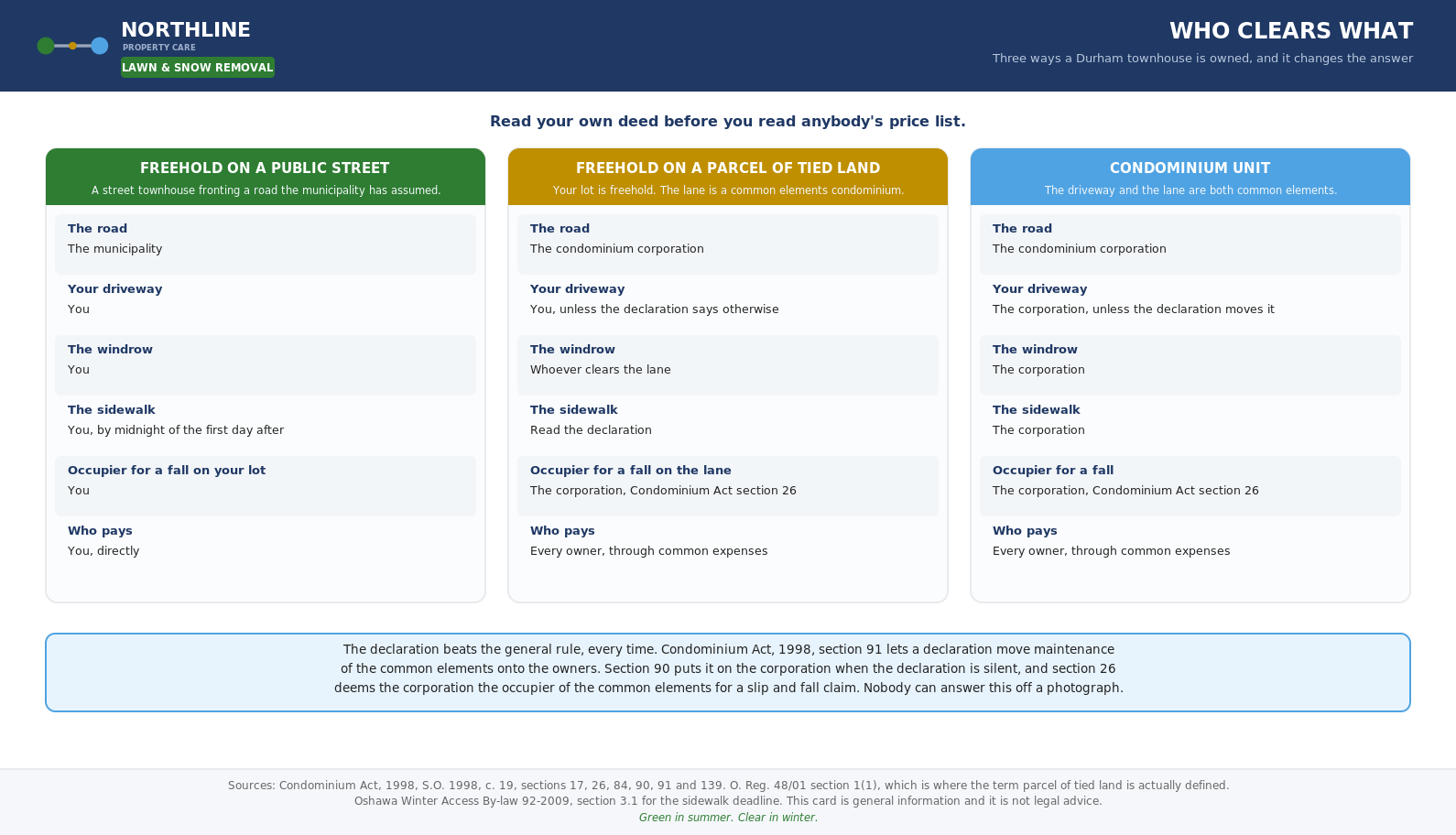
A Durham townhouse comes in three legal shapes and people routinely do not know which one they bought. The first is freehold on an assumed public street, where the municipality plows the road and everything from the curb inward is yours. The second is the one that causes the arguments: freehold title to your own lot, with the lane out front owned by a common elements condominium corporation. The third is a straightforward condominium unit, where the driveway itself is a common element.
The middle one has a name and it is worth knowing it. Your lot is a parcel of tied land. The term is not defined in the Condominium Act, 1998 at all, which is a point on which a great deal of casual advice is wrong; it is defined in section 1(1) of Ontario Regulation 48/01. The Act describes the mechanism in section 139: each owner holds the freehold in a parcel of land that is outside the condominium description, a common interest in the corporation attaches to that parcel, and subsection 139(4) says that interest cannot be severed from the parcel even on a sale. You cannot sell the house and keep out of the lane, and you cannot sell the house and leave the lane behind.
From there the chain is short and it decides the money. Section 90 of the Act puts the obligation to maintain the common elements on the corporation. Section 17 gives the corporation the duty to control, manage and administer them. Section 84 makes every owner contribute to common expenses in the proportions the declaration sets, and subsection 84(3) says an owner is not exempt even if they have waived the right to use the common elements or are in a dispute with the corporation. And section 26 is the one that matters at two in the morning in a thaw: for the purposes of occupier liability the corporation is deemed to be the occupier of the common elements, and the owners are deemed not to be.
Then comes the clause that undoes the tidy version. Section 91 allows the declaration to alter all of it, including by providing that the owners shall maintain the common elements or any part of them. So a declaration can hand the lane maintenance back to the owners, and some of them do.
Nobody can answer the question of who clears your lane from a photograph of your street. It is answered by reading the declaration, and if you do not have a copy, the corporation has to give you one.
Where that lands in practice, on an Oshawa or Whitby townhouse block: if the lane is a common element, the corporation arranges the lane and the visitor parking and usually the sidewalks inside the complex, and your own driveway is normally still yours unless the declaration says otherwise. Ask the board which it is in October rather than in January, because the board is buying its own winter service on roughly the same calendar you are.
What the municipality actually owes you, in hours
Your residential street has a legal clock on it and it is longer than most people assume. Ontario Regulation 239/02, the minimum maintenance standards made under the Municipal Act, 2001, classifies every municipal road by posted speed and average daily traffic, and sets a snow depth and a time against each class. A Class 1 road, which is where the regional arterials sit, is 2.5 cm and four hours. A Class 4 road, which is the ordinary residential street, is 8 cm and sixteen hours, and on a two lane Class 4 the standard is met by providing a total width of at least five metres rather than the full road.
Oshawa publishes the same figure in its own words. The City's asset management plan states that the minimum standard for a Class 4 residential road is a centre bare total lane width of at least five metres within sixteen hours while not exceeding a snow depth of 8 cm. The City's snow clearing guidelines table lists six hours for arterials, twelve for collectors and sixteen for residential, and it is worth noting that the published table does not say what those hours are measured from. Whitby prints the full regulation table on its snow clearing page and adds the part that explains the February phone calls: during longer snowfalls, secondary and tertiary roads encounter a delay in response times, because crews get recalled to the primary routes.
And there is an escape hatch that is used every winter. Section 4.1 of the regulation says that when a municipality declares a significant weather event, the standard for the duration is simply to monitor the weather and to deploy resources when the municipality deems it practicable, and every road in the municipality is deemed to be in a state of repair until the clock in the table expires after the declaration ends. Oshawa describes it on its own snow clearing page as suspending the standard timelines. That is lawful, it is sensible, and it means the honest planning assumption for a townhouse owner is that on the worst night of the year the street clock is paused.
None of this touches your driveway, and all four municipalities say so plainly. Oshawa, Ajax and Whitby each publish the same sentence in some form: windrow clearing is the responsibility of the property owner. What the municipalities do run is an assistance program, and the rules are different in every town.
| Municipality | What the program clears | Cost and the catch |
|---|---|---|
| Oshawa | The windrow only, and only when it is at least 20 cm high | No fee published. Age 65 or over or a documented disability, and nobody under 65 without a disability living at the address |
| Whitby | The windrow, under the named Windrow Snow Clearing Program | No fee at all. Applications opened September 14 2026 and close November 1 2026 |
| Pickering | The windrow and the concrete sidewalks next to the property | Free on GAINS or the Guaranteed Income Supplement, then $128.82, $186.45 or $240.69 by household income. Capped at 750 households with a lottery, and condominium residents qualify only where the corporation does not already provide full snow removal |
| Clarington | About three feet of the driveway apron, plus municipal sidewalks fronting the property | $107.69 including HST for the 2026 to 2027 season. Not walkways, not the rest of the driveway |
| Ajax | No town wide windrow service exists | Council studied it in 2019 and the estimate came back at $1.8 million a year or more. A separate seniors program is run by telephone |
If you qualify for one of these, take it. Two of them cost nothing and no contractor in this region beats free. The reason to read the table carefully is that four of the five clear the windrow and nothing else, so a townhouse owner who qualifies still has the driveway itself, and on a 3.0 m driveway the windrow is a smaller share of the work than it would be on a double.
Two more wrinkles that are specific to a townhouse. A lane that is a common element is not a municipal road, so if your street was never assumed by the municipality the program is clearing a windrow that a municipal plow never made. And Whitby tells residents in new neighbourhoods plainly that their street might not be maintained by the Town at all, and points them at a map to check who maintains it. Pickering goes further and states that where a new subdivision does not meet the City criteria, the developer is required to provide for winter control inside it. If you bought new in the last three winters, that sentence is worth ten minutes of your time.
Durham Region itself publishes no hour based service level for regional roads. What it publishes is that regional roads are patrolled seven days a week in winter and that equipment is deployed if needed. The four hour Class 1 figure above is the regulation, printed by Whitby, and it is not a promise made by the Region.
Salt on forty square metres, and the damage nobody sees until April
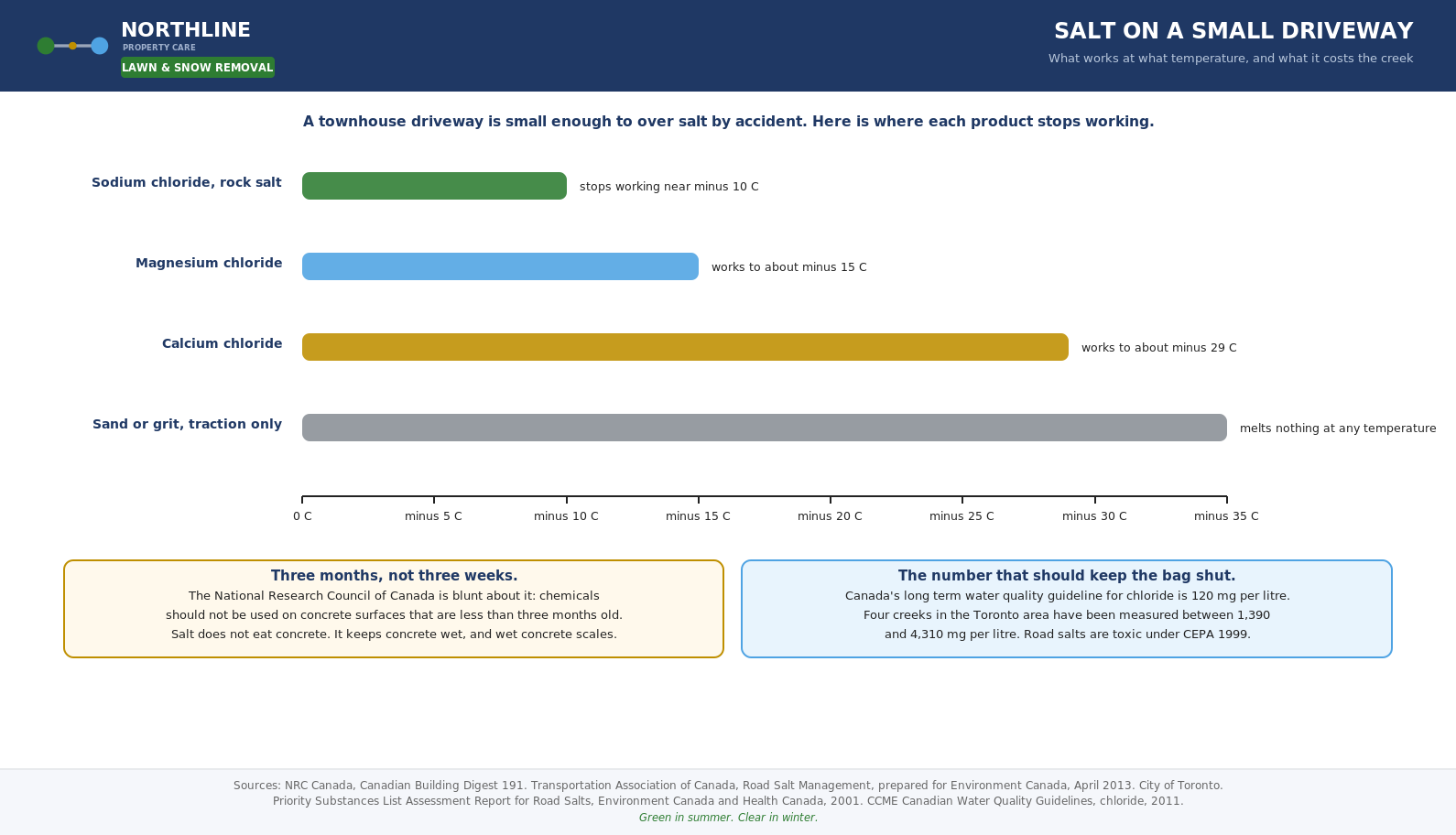
A townhouse driveway is small enough to over salt by accident, and the bag is usually bought by the person who is about to do it. Ordinary rock salt is sodium chloride, and it is usually not used below minus 10 C. Its eutectic point, the lowest temperature at which the brine stays liquid at all, is about minus 21 C at a concentration of 23.3 per cent. Magnesium chloride works to roughly minus 15 C and calcium chloride to roughly minus 29 C. Sand melts nothing at any temperature and is a traction aid, which is the right tool on a night below the working range rather than a second bag of the wrong one.
The damage mechanism is the part worth understanding, because it is not the one people expect. Salt does not chemically attack concrete in any ordinary case. The National Research Council of Canada's work on frost action shows what it actually does: a salt solution has a lower vapour pressure than water, so a porous material holding it stays wet far longer. Concrete holding a 26 per cent sodium chloride solution does not start to lose liquid until the relative humidity drops below about 77 per cent. Saturated concrete is the concrete that fails in a freeze, and in one measured comparison the residual expansion of a paste cycled in a five per cent salt solution was about one per cent against roughly 0.18 per cent in plain water.
Chemicals should not be used on concrete surfaces that are less than three months old. That is the single most useful rule a new townhouse owner can be given, and it comes from the NRC rather than from a product label. A transportation research guideline funded through the United States federal highway program puts the floor at an absolute minimum of thirty days of environmental exposure before de-icers are applied, and recommends not sealing for at least twenty eight days either. On a new build in Windfields or Columbus where the walkway and the front steps went in during late autumn, that rule is the difference between a surface that lasts and one that is pitted by the third spring.
The environmental figure is the one we put on the page because it changes behaviour. Road salts were assessed under the Canadian Environmental Protection Act, 1999 and concluded to be toxic as defined in section 64 of that Act. About 4.9 million tonnes of road salts are released into the Canadian environment each year, including roughly 3.0 million tonnes of chloride. Canada's long term water quality guideline for chloride for the protection of aquatic life is 120 mg per litre, and the assessment reports measured maxima in four Toronto area creeks between 1,390 and 4,310 mg per litre. Harmony Creek and the Oshawa Creek run through the middle of this service area and both reach the lake.
The federal Code of Practice for the Environmental Management of Road Salts, published in April 2004, explicitly does not apply to road salts used for domestic purposes or for private or institutional uses. That is an unusual gap to point at in public, and it is exactly why a private operator ought to work to the standard anyway. The useful habit on a small driveway is to treat the ice rather than the asphalt: the shaded three metres at the bottom of the apron and the step at the front door are where falls happen, and they are a fraction of the area most people broadcast over. Salting the whole slab because the whole slab is small is how a bag goes down in two visits.
There is more on the application rate question, including what a per application charge is actually buying, in the driveway salting guide for Oshawa.
The strip of turf beside the driveway, and what it looks like in April
The metre of grass you have been piling on all winter is the same metre of grass somebody is going to ask you about in May. That is the trade on a townhouse lot and it is worth making deliberately rather than by default.
The soils mapped under the townships that Oshawa and Whitby were built on are the Darlington series, a loam to silt loam, with the imperfectly drained Whitby series as its catena member, and a band of Schomberg lacustrine clay running along the Lake Ontario shore. The federal soil survey of Ontario County maps about 20,700 acres of Darlington and about 15,300 acres of Schomberg, and records that most of the Schomberg occurs along the lakeshore. Further east, in the township Courtice and Bowmanville were built on, the Darlington shifts to a sandy loam near Courtice and north of Bowmanville, with the poorly drained Granby sandy loam mapped north of Courtice.
What that means under a snow pile is specific. A silt loam over a clay subsoil, compacted by a season of construction traffic and then loaded with a settled snow bank for four months, drains slowly and stays anaerobic under the pile long after the open lawn has dried. The strip that carried the pile comes out of winter later than the rest of the lawn, thinner, and more prone to the grey and pink patches of snow mould. Snow mould in Oshawa covers what to do about that in March, and the short version is that the damage is usually cosmetic and the lawn recovers if it is raked open rather than fertilized in a panic.
The worse version is salt carried into the pile. If the pile is the one you salted and it sits on the strip, the melt in March runs through a metre of turf and takes the chloride with it, and that strip is where you will see the burn. Rotate the pile to a different side in alternate storms where the frontage allows it, and keep the salted apron snow separate from the clean snow off the middle of the driveway. It is a small discipline and on a narrow lot it is the difference between a strip that recovers by June and one that needs seed.
What this costs, and when it is not worth buying
On a great many townhouse driveways the right answer is a shovel, and you should hear that from us. A single car driveway, a household with somebody who can safely lift wet snow, and a front yard with room for the pile adds up to a job that takes fifteen or twenty minutes after an ordinary storm. Buying a season of service for that is buying certainty, not labour, and certainty is worth paying for only when something real depends on it.
The cases where it earns the money are concrete and they are easy to recognise. A working day that starts at seven and cannot be missed, because a driveway cleared at nine is a driveway cleared after you needed it. A household where nobody should be lifting snow, which is the single commonest reason people call us in December. A lane with genuinely nowhere to pile, which happens on back to back and stacked units where the front yard is a strip less than a metre deep. A corner unit, where the plow lays a windrow across the apron and then a second one along the flankage, and the owner clears twice as much as the neighbours for the same house.
Silver does not plow your driveway. That is the first thing to know about the published numbers. Memberships start at $129 a month plus HST for Silver, which clears the windrow after each storm by 5 PM and carries no salting at any depth, which on a narrow driveway with a shovel in the garage is sometimes exactly the right product and sometimes not enough. Gold is $189 a month plus HST and plows the driveway with a 7 AM target after overnight snow. Platinum is $279 a month plus HST, sequenced first with a 6:30 AM target and automatic salting. The seasonal snow package, sold on its own without a membership, is $800 for a small property, $975 for a standard one and $1,200 for a large one, plus HST, and it covers the driveway, the walkway and the salting at the measured 3 cm residential trigger. A salt only trip is $25. A windrow return trip is $45.
Most townhouse lots price as small. That is the useful part of a narrow driveway and it is the only part. Book by November 1 for the seasonal price, and understand that the residential route closes on November 30 and does not reopen that winter, because a route only holds so many driveways if every one of them is going to be clear by a morning target. If you want the arithmetic laid out against a per visit alternative, what snow removal costs in Oshawa does that properly, and the three memberships sit side by side with what each one plows.
One last unprofitable sentence. If the lane in front of your unit is a common element and the corporation already contracts the whole complex, buying a second service for your own driveway may be buying something the condominium fee already pays for. Read the contract the board holds before you sign one of ours.
Where the townhouses actually are in Durham
Row houses are 9.7 per cent of occupied private dwellings in Oshawa and 13.2 per cent in Whitby, and the planning documents say the share is going up. The Region of Durham published the 2021 Census dwelling mix by municipality and the row house counts are 6,445 in Oshawa, 6,135 in Whitby, 6,020 in Ajax, 4,980 in Pickering and 3,125 in Clarington. Ajax has the highest share of the five at 15.2 per cent.
The north Oshawa growth areas are where the new ones are, and two of the Part II Plans do not merely permit townhouses, they require them. The Kedron Part II Plan, at section 8.7.4.5, states that single detached dwellings shall not be permitted in areas designated Medium Density I Residential. The Columbus plan caps single detached dwellings at 25 per cent of the units in the same designation and excludes them entirely from the Mixed Use Nodes. The Windfields plan carries a policy permitting a specified area to develop only in the form of townhouses or apartments. Taunton and Samac are named planning areas as well, and we did not read their policy text, so we are not quoting it.
On the ground that is Windfields and Kedron north of Conlin, Columbus at the top of the city, the Taunton corridor, the Brooklin blocks in north Whitby, the Rossland and Taunton frontages in Ajax, and the Kingston Road precincts in Pickering where the intensification plan permits townhouses across its Residential category. Different plans, same winter problem: a narrow apron, a short pile strip and a lane that may or may not be the municipality's to plow.
We work all of it. The town pages carry the local detail: Oshawa, Whitby, Ajax, Pickering, Bowmanville and Courtice and Clarington. For Brooklin specifically, which sits inside Whitby for the windrow program, see snow removal in Brooklin.
Fire routes and visitor parking, which are a winter problem on a private lane
A fire access route on private property has to stay clear of snow and ice all winter, including where the municipality does not plow. Pickering Fire Services puts it in writing in its development design guidelines: snow and ice shall be removed from all emergency access routes, and the obligation covers fire access routes on private property including areas or routes that are not subject to the City winter control program. The same document sets a fire access route at a clear width of not less than six metres and an emergency secondary access at 4.5 metres, and says that visitor or resident parking shall not block the 2.4 metre unobstructed break giving access to the rear.
Put those two numbers beside a townhouse lane in February. A six metre clear width is the whole lane on most complexes. Pile the snow against the curb on both sides through three storms and the clear width is five, then four, and the parked visitor car that was legal in October is now the thing that closes it. Whitby makes parking on a fire route an offence under By-law 4084-97 with no seasonal exception.
This is the argument a board needs in October rather than a complaint in January, and it is the reason snow on a condominium lane gets trucked out rather than pushed to the end. If the pile has nowhere to go, the lane narrows, and a narrowing lane is a fire code problem before it is an inconvenience.
The liability tail is short and worth knowing. Under the Occupiers' Liability Act an occupier owes a duty to take such care as in all the circumstances is reasonable to see that persons entering the premises are reasonably safe. Since the 2020 amendment, section 6.1 requires written notice of a snow or ice injury claim within 60 days, served on the occupier or on the independent contractor engaged to remove snow. Against a municipality for snow or ice on a sidewalk the position is different again: the Municipal Act, 2001 gives the municipality a gross negligence standard and a 10 day notice window rather than 60.
What we could not verify
Every external figure on this page comes from a municipality, a ministry, a federal agency, a census release or a published standard, and not one of them comes from another property maintenance company. Here is what we went looking for and did not find, because a page that reports only what it found is not showing its method.
- No Durham municipality says in its own words that it excludes private or condominium roads from plowing. We read eleven municipal winter pages across Oshawa, Whitby, Ajax and Pickering. The word condominium appears on none of them. The nearest published statements are Oshawa saying it does not clear paths it considers private roads, Whitby warning that a street in a new neighbourhood might not be maintained by the Town, and Pickering putting winter control on the developer inside a subdivision that has not met the City criteria.
- We could not read a snowfall figure for Oshawa. Environment and Climate Change Canada lists an Oshawa composite station in its 1991 to 2020 normals inventory, and its own station search returns nothing within 25 km of Oshawa. The two interfaces disagree and we are not going to publish a number off either until that is resolved.
- Environment and Climate Change Canada no longer publishes a numeric snowfall warning threshold. The criteria page was replaced in November 2025 by impact guides and a yellow, orange and red colour scale. Any article still quoting a centimetres in twelve hours alert figure is quoting a retired document.
- Oshawa Zoning By-law 60-94 sections 39.4 and 39.9 could not be read in full. The consolidated file is large and its text stopped partway through the definitions, so the driveway and parking figures on this page come from the City web pages and the Engineering Design Criteria Manual rather than from the zoning by-law text.
- The published Oshawa snow clearing table does not say what its hours are measured from. The six, twelve and sixteen hour figures are printed without a stated start point, so we have anchored the sixteen hours to the regulation and to the City asset management plan instead.
- No municipal rule on visitor parking on a private condominium lane in winter could be found. The fire route figures above are Pickering Fire Services design guidelines, which is a City document, and they are not a statement by the Office of the Fire Marshal.
- The soil surveys map by township rather than by town. Neither federal report names Oshawa, Courtice or Bowmanville as a mapping unit, which is why this page says the soils mapped under the townships these towns were built on rather than claiming a soil for a street.
None of this is legal advice. The Condominium Act sections above are quoted as published, and what governs your own property is your own declaration.
Who wrote this
Andrew owns and operates Northline Property Care out of Oshawa, and has six winters of clearing snow in Durham Region behind him. He prices the property and he does the work, which is the only reason a page like this can carry a sentence about where a pile should sit on a particular kind of lot. Nothing is subcontracted and nobody arrives that a customer was not told about.
This page was written against the municipal by-laws, the provincial statutes and the federal surveys named in it, read this week rather than remembered. Where a figure could not be read, it is listed above instead of estimated. If something here does not match what your own municipality or your own declaration says, the document wins and we would like to hear about it: 905-244-5779.
Northline is fully insured, serves Oshawa, Whitby, Ajax, Pickering, Bowmanville, Courtice and Clarington, and publishes its prices. More on how the winter service runs is on the snow removal page, and the rest of the writing is indexed on the property care tips page.
Questions people actually ask
Townhouse snow removal, answered
How is townhouse snow removal in Oshawa different from a detached driveway?
The clearing is the same work. The storage is not. A street townhome built to the City of Oshawa Engineering Design Criteria Manual gets a driveway 3.0 m wide on a 6.0 m frontage, against a 3.5 m minimum for every other form, and the land left over on either side is often about a metre. The plow does not know how wide your driveway is, so it leaves the same ridge across your apron that it leaves across a double. By the third storm the question stops being how to clear it and becomes where to put it.
Who clears the private lane in a townhouse condominium?
The condominium corporation, in almost every case. Under the Condominium Act, 1998, a private lane that is a common element is maintained by the corporation under section 90, controlled and administered by it under section 17, and the corporation is deemed by section 26 to be the occupier of the common elements for a slip and fall claim. Owners pay for it through common expenses under section 84 and cannot opt out. The exception is section 91, which lets the declaration move that obligation onto the owners, so the declaration has to be read before anybody answers this with confidence.
Does the City of Oshawa plow a private townhouse lane?
Oshawa publishes a priority system for its own roads and does not publish a statement about private or condominium lanes either way, so the honest answer is that we could not source one. What is published is that the Region of Durham maintains all regional roads in Oshawa, that windrow clearing is the responsibility of the property owner, and that the City clears paths it considers private roads for nobody. In Whitby the Town says plainly that a street in a new neighbourhood might not be maintained by the Town, and in Pickering the developer is required to provide winter control inside a subdivision that has not met the City criteria. If your lane is a common element, the corporation is who arranges it.
Can I push the snow from my townhouse driveway onto the road?
No. Section 181 of the Highway Traffic Act prohibits depositing snow or ice on a roadway without written permission from the road authority. Oshawa goes further in its Winter Access By-law 92-2009, where section 6.1 prohibits moving snow from private property onto a sidewalk or a highway, and the by-law defines highway to include the boulevard. Whitby Clean Community By-law 8271-26, in force since April 1 2026, prohibits shovelling, plowing or blowing snow across a highway, a sidewalk or a pedestrian walkway, with a set fine of $355.00 on a first notice.
Where am I allowed to pile the snow on a townhouse lot?
On your own land. The turf on both sides of the driveway, the back yard if a machine can reach it, and against the garage wall clear of the door swing. Oshawa caps a driveway at 50 per cent of the front yard area so that the other half stays landscaped, and that landscaped half is the only legal snow storage most townhouse lots have. Keep the pile off the sight line where the driveway meets the lane, and keep it clear of a fire access route, because a fire route has to stay open all winter.
Is a seasonal snow package worth it on a 3.0 m townhouse driveway?
Often it is not, and that is worth saying before you ask for a price. A single car driveway with a healthy adult in the house and somewhere to put the snow is a shovel job most winters. The seasonal snow package starts at $800 plus HST for a small property, and a household that clears its own apron four times a winter is paying for certainty rather than for labour. The cases where it earns its money are a working day that starts at seven and cannot be missed, a household where nobody should be lifting wet snow, a lane with no pile room at all, or a corner unit that collects the windrow from two directions.
Do I qualify for the municipal windrow program if I live in a condominium?
In Pickering the rule is written down: a condominium resident qualifies only if the condominium corporation does not already provide full snow removal, and the City clears the windrow and the concrete sidewalks next to the property and nothing more. Oshawa and Whitby publish an age or disability test and a household test without naming condominiums either way, Clarington runs a flat fee program that covers about three feet of the driveway apron, and Ajax has no town wide windrow program at all. Check your own municipality first, because one of these is free and no contractor beats free.
When does the city have to clear my residential street in Oshawa?
Ontario Regulation 239/02 sets the minimum maintenance standard. A Class 4 road, which is what most residential streets are, has to be brought back under 8 cm of snow within 16 hours after the accumulation ends, and on a two lane Class 4 road that means a total cleared width of at least five metres. Oshawa publishes the same 16 hours against residential roads in its own asset management plan. A declared significant weather event suspends those clocks until the municipality declares the event over.
Andrew answers, October 2026
You keep telling townhouse owners not to buy. Why?
Because a narrow driveway is the easiest job I do, and charging a season for fifteen minutes of shovelling would be taking advantage of somebody who did not have time to think it through. The townhouses I want are the ones where the morning actually matters, or where there is nowhere left to put the snow by January. If that is not you, keep the money and call me the winter it changes.
A different question sits on every page here, and the set is refreshed each month. Townhouse question of your own? Put it to me directly: 905-244-5779.
Send me the address and I will tell you whether you need us
Most townhouse properties price off the map without a visit. I will tell you which tier your driveway actually needs, whether the seasonal package is cheaper for you, and whether your household qualifies for the municipal program instead. If the free one fits you better, I will say so.