Snow removal · Unoccupied property
Snowbird Snow Removal in Durham Region, and the Four Day Clock Nobody Mentions
Snowbird snow removal in Durham Region is a different purchase from snow removal for a house somebody is living in, because the empty house carries four obligations the occupied one does not.
Away in November? See what the winter service covers.
Green in summer. Clear in winter.
The short answer
Four things on an empty property carry on working while you are not there, and only one of them is the snow. The first is your insurance, where the clause that bites a snowbird is not the thirty day vacancy clause everybody quotes but a separate absence clause measured in days rather than weeks. The second is your municipality, which in Pickering and Whitby puts the words occupied or unoccupied directly into the sidewalk duty, and in Oshawa can clear your frontage and bill you without telling you first. The third is the wall of the house, where a vent about a foot off the ground has to stay open all winter whether anybody is inside or not. The fourth is what the driveway says to the street, and on that one the regional police service has written down its own opinion.
Start with the clock that is actually short
Almost everybody gets this one backwards, and the error is expensive in exactly one direction. Ask a homeowner how long they can leave the house before the insurance becomes a problem and the answer comes back as thirty days. That number is real and it is in the wordings. It is also, for a snowbird, very nearly irrelevant.
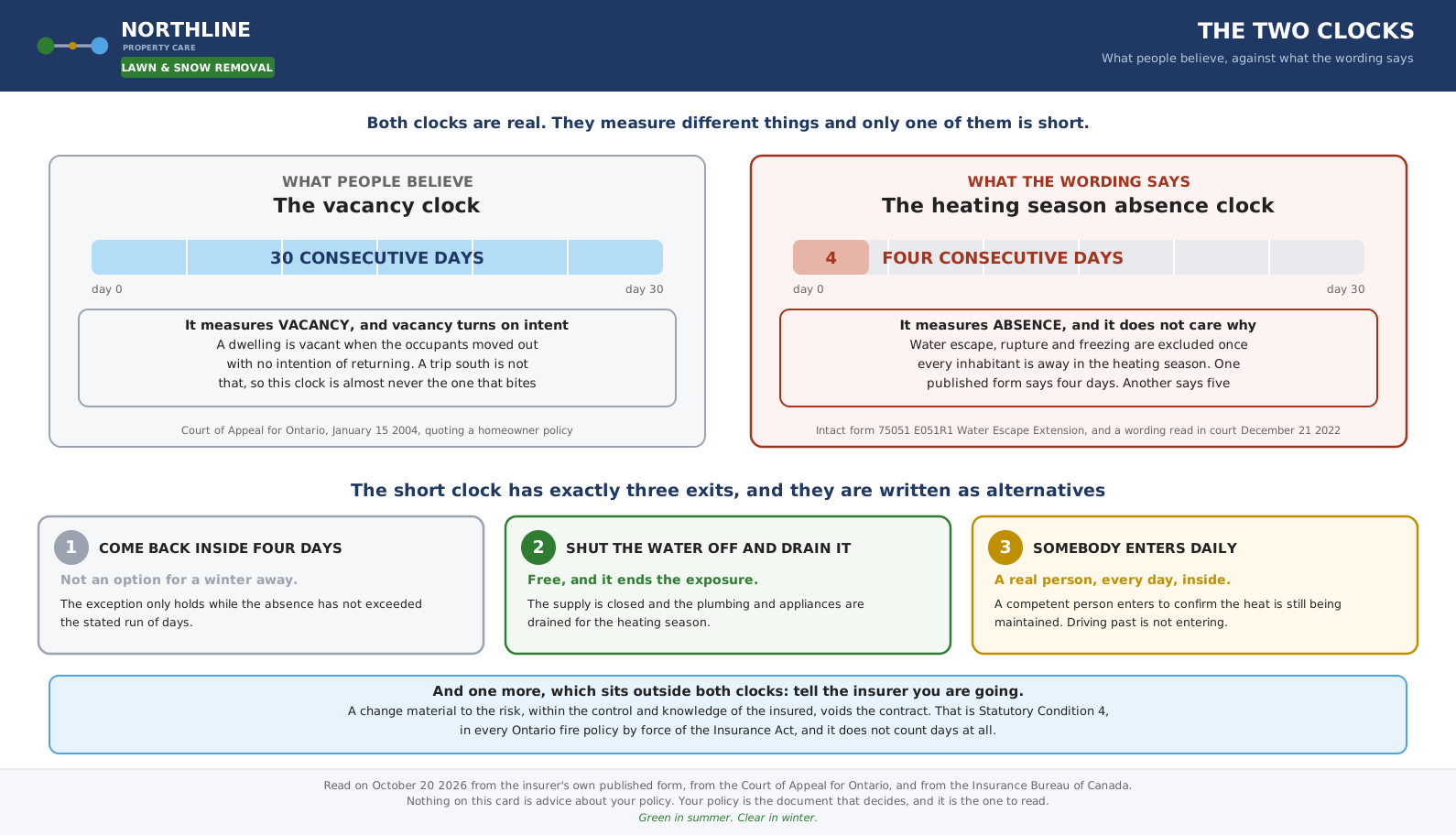
Thirty days is the vacancy clock. The Court of Appeal for Ontario quoted a homeowner policy in January 2004 carrying the exclusion for loss or damage occurring after the dwelling has been vacated for more than thirty consecutive days, and that shape of wording is still the market norm. What makes it nearly irrelevant is the meaning of the word vacated. Ontario courts have settled this: a dwelling becomes vacant when the occupants have moved out with no intention of returning and nobody new has moved in. A reader who has left furniture, a wardrobe and a chest freezer behind, and who has a return flight booked for April, has not done that. Their house is unoccupied. It is not vacant.
The clock that does apply sits in a different clause and measures something else entirely. It measures absence during the heating season, and it does not ask why you are absent. A water escape extension published by one Canadian insurer excludes loss occurring at any time during the usual heating season while all inhabitants of the insured building are absent, and then sets out the only three ways back in: the inhabitants were not absent for more than four consecutive days, or the water supply was shut off and the system drained, or the building would be entered daily by a competent person to ensure that heating was being maintained. A different insurer's wording, read by the Ontario Superior Court in December 2022, used five consecutive days for water escape, rupture and freezing in the same policy that used thirty days for everything else.
Read those two clauses together and the shape of the problem is clear. Four or five days is not a long trip. It is a long weekend. The Insurance Bureau of Canada puts the same requirement in plainer words, saying that being away from home during the usual heating season may require someone to check on your home every day or every other day to ensure the heat is maintained. That is a person going inside. Driving past and looking at the windows is not entering, and in the vacancy case the court made the related point that occasional visits do not change the status of a home.
There is one more rule and it sits outside both clocks. Statutory Condition 4 is written into every Ontario fire policy by force of the Insurance Act, and it says that any change material to the risk, and within the control and knowledge of the insured, voids the contract. It counts no days at all. A homeowner who reads the thirty day clause, decides they are fine, and never mentions the trip has not escaped the problem. They have simply moved it to a clause with no number in it. Telling the insurer you are going is free, it takes one call, and it is the single cheapest thing in this article.
The by law does not pause because you did
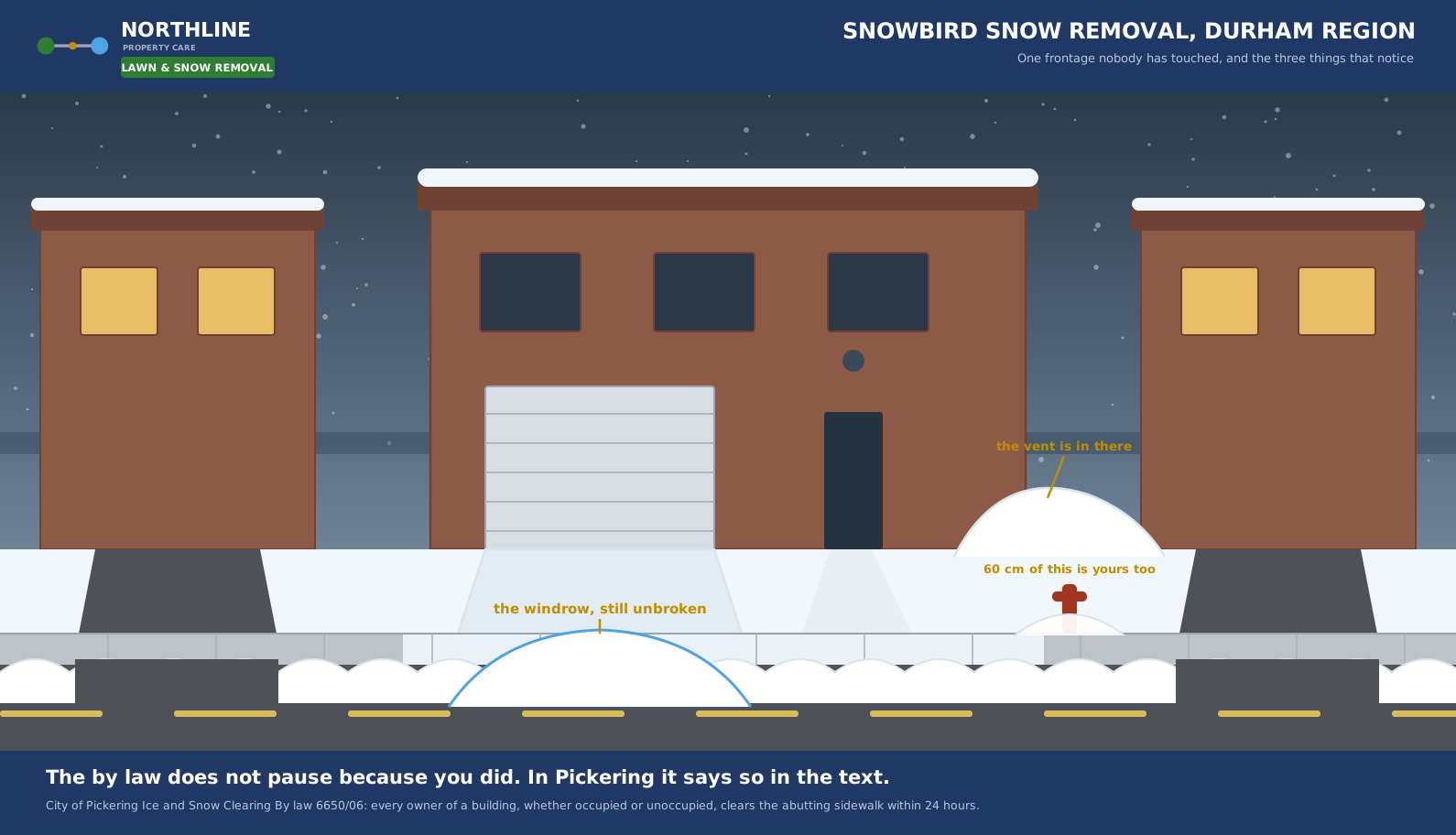
Two Durham municipalities settle this inside the text of the by law itself, using the same four words. Pickering attaches the duty to the owner of a building or of vacant land, adds the phrase whether occupied or unoccupied, and allows twenty four hours after an accumulation to get the abutting sidewalk clear. Whitby prints the same formula in the by law guide it hands to residents. When two neighbouring municipalities reach for the same phrasing, it is because the question gets asked often enough to be worth answering in advance.
Oshawa answers it a third way, by never raising occupancy at all. The Winter Access By law puts the duty on every owner of a lot and uses the word occupant nowhere in the document. Its deadline is unlike anybody else's too, which matters if you are arranging all of this from a distance. Oshawa does not count hours. It gives you until midnight on the first day after the snow, or any other freezing precipitation, stops falling. Depending on when the storm stops, that is either more generous than twenty four hours or considerably less.
Ajax uses twenty four hours and then adds the clause that matters most to somebody who will be away for months. Under its public nuisance and safety by law a person is guilty of a separate offence on each day that the offence continues. A single missed storm is one thing. An uncleared frontage from January to March is a different thing in the eyes of that by law, and nobody is going to telephone Fort Myers about it.
Whitby carries one duty that catches almost everybody, including people who are home. The same twenty four hour clause that covers the sidewalk also covers an area within a sixty centimetre radius of any fire hydrant on the boulevard, at the same penalty. If there is a hydrant on your frontage, it is yours to keep clear, and it does not become somebody else's in February because you booked a flight.
The part that costs money is what happens next, and Oshawa writes it most plainly. Where an owner has not cleared the sidewalk, the City may cause the snow and ice to be removed, at that owner's expense, without notice to any owner. Interest runs at fifteen per cent from the day the cost is incurred, the total can be added to the tax roll and collected like taxes, and a notice of lien can be registered against the lot. Ajax measures your frontage through its own mapping system, charges by the metre and applies the amount automatically to your property taxes. Whitby may enter the property, do the work and recover the expense on the tax roll in the same way. None of these are punishments for travelling. They are simply what the by law does when nothing happens, and from two thousand kilometres away nothing happening is the default.
Read your own town before you assume. Oshawa publishes the whole Winter Access By law as a document, Pickering sets out its ice and snow clearing rule on one page, and Whitby replaced its old property and boulevard maintenance by law with the Clean Community By law in April 2026, which is worth knowing because several pages still name the retired one.
The municipal help exists, and it is built to exclude you
If you qualify for your town's windrow assistance, take it, because no contractor beats free. That advice stands on every other page we publish and it stands here. What changes for a property that will be empty is that the programs themselves say no, in writing, before anybody else does.
Oshawa states that its program does not clear City sidewalks and driveway windrows of vacant properties or vacant land, and separately urges anyone who frequently needs to leave the home to make alternate arrangements. Whitby is more specific and gives an actual number: its free windrow service is available to residents who are not away for more than forty five consecutive days, and it tells people away for long periods to make private arrangements for snow clearing. Forty five days is six and a half weeks. A winter away is three to five months.
That is a genuinely awkward overlap and it is worth saying out loud. The person most likely to qualify for an assistance program on age is also reasonably likely to be the person who spends part of the winter somewhere warmer, and the program is designed around a resident who is physically there. It is not an oversight. A free service that quietly accepts responsibility for an unattended property for five months is a service with a liability problem. The honest reading is that these programs and a winter absence are two different answers to the same question, and you have to pick one.
Oshawa's own window for this season runs from October 1 to December 18, with later applications reviewed case by case, and the City publishes the eligibility rules on its snow clearing help page. Apply before you book anything private.
The vent at ankle height, and the failure that is not about property
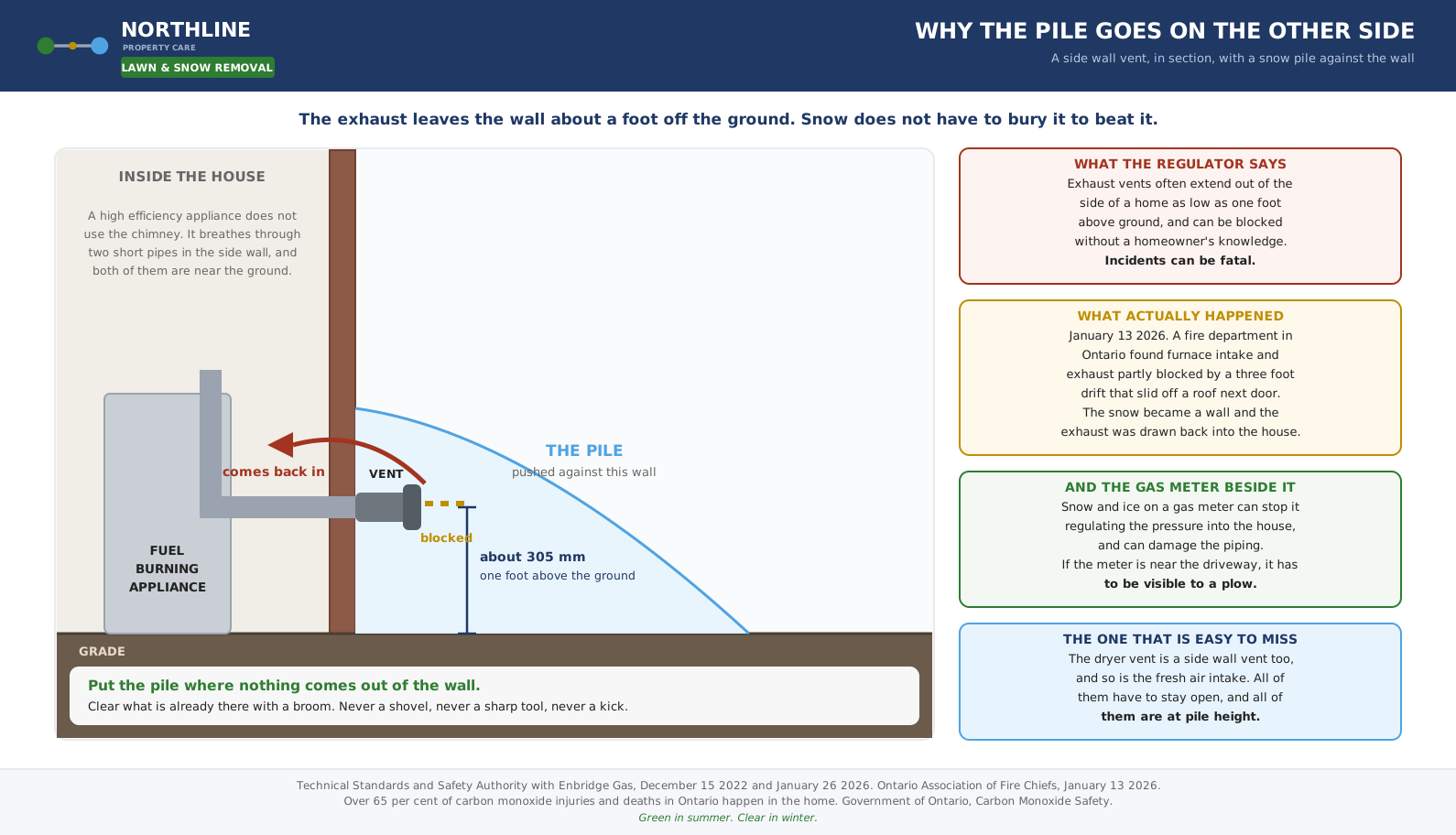
This is the part of the article that is not about money, and it is the reason the pile location gets agreed in October rather than in January. A modern high efficiency appliance does not use a chimney at all. It breathes through two short pipes that leave the house through the side wall, and Ontario's safety regulator warns that such vents sit as little as one foot off the ground, low enough to be blocked without anybody in the house ever knowing. The regulator's own words on what follows are not hedged: carbon monoxide poisoning incidents from snow blocked vents have happened before, and these incidents can be fatal.
The mechanism is unglamorous and it does not need a blizzard. On January 13, 2026 a fire department in Ontario attended a house where the furnace intake and exhaust were partly blocked after a large volume of snow slid off a neighbour's steel roof, leaving a drift about three feet deep along the side of the home. The department's description of what the drift did is the sentence worth remembering: the snow buildup created a wall that caused carbon monoxide to be drawn back into the house. In February 2025, after sixty nine centimetres of snow fell in Ottawa across four days, the city's fire service took around eighty calls for carbon monoxide and natural gas odours, and crews spent a night shovelling out vents. Its chief of special operations put it simply, saying that the vents are often close to the ground and that when there is snow really close or blocking them, the carbon monoxide comes back into the house.
In this province the dwelling is where carbon monoxide does its killing: more than sixty five per cent of Ontario injuries and deaths from it happen indoors at home. The province's own carbon monoxide safety page lists keeping outside vents and chimneys clear of snow and debris among the things a household has to do. The same applies to the gas meter next to them. The gas utility asks customers to keep the meter clear because snow and ice can stop it regulating the pressure into the house and can damage the piping, and it asks for one specific thing from anyone whose meter sits beside a driveway: make sure it can be seen by a plow driver.
How you clear it matters as much as whether. Never a shovel, never a blower aimed at the wall, never a sharp tool and never a kick. A broom or a soft brush, and icicles hanging above the meter taken down so the drip does not refreeze on it. An empty house makes all of this worse for an obvious reason: nobody inside notices the headache, and a carbon monoxide alarm that sounds in an empty hallway is a sound nobody hears.
Heat it or drain it, and the house that is in neither state
The authorities do not agree on one indoor temperature, and that disagreement is more useful than a single number would be. Toronto tells residents to keep areas with water pipes above eight degrees Celsius, especially near the water meter. Ottawa says the same figure and adds the words that matter here, asking for at least eight degrees Celsius even if you are away for a few days. Calgary sets a higher floor at fifteen degrees and tells people to hold it even when away. What every one of them agrees on is the alternative: find the main shut off valve, close it, and open the taps so the plumbing drains.
Those are two complete strategies and the empty house is usually in neither of them. The thermostat is set low to save money, the water is still on, and nobody is inside. A National Research Council building note makes the physical point that insulation does not rescue a pipe with no flow in it, because still water in a cold pipe will freeze regardless of insulation. Insulation slows heat loss. It does not make heat.
What a failure costs is easier to picture with a number attached. Two American state emergency agencies both put a crack of one eighth of an inch at up to two hundred and fifty gallons a day, which is roughly nine hundred and fifty litres, or about forty litres an hour, running into an unoccupied basement for as long as it takes somebody to notice. The University of Waterloo reported that the average cost of repairing damage from a basement flood had reached forty three thousand dollars by 2018, which is basement flooding generally rather than a burst pipe specifically, and still the right order of magnitude to think in. For scale on how common winter water damage is in this province, insured damage from two February 2025 weather events in eastern Canada exceeded two hundred and sixty million dollars, the vast majority of it in Ontario, with ice damming and water infiltration named as the leading causes.
None of that is snow removal and we are not qualified to drain your plumbing. It is in this article because the decision about the water is made in the same week as the decision about the driveway, and only one of those two decisions usually gets made.
What an uncleared driveway tells the street
On this point we are going to hand the argument to somebody with no commercial interest in it. Durham Regional Police Service publishes guidance on residential break and enter, and under the heading for being on vacation or away it gives this instruction: arrange snow removal or lawn care to keep your home looking lived in. The reason follows on the same page, in its own words: an unkempt property can look vacant and may encourage break ins. That is the regional police service naming the category of service in writing, which is a stronger citation than anything a contractor could write about itself.
Halton Regional Police Service reaches the same conclusion independently, advising residents to arrange to have the lawn cut or the snow shovelled, and noting that thieves often look for homes where the snow has not been cleared. Both services pair it with the other signals that go together: pause the mail or have somebody collect it, put interior lights on timers, and do not announce the trip on social media.
Neither service puts a number on how many days a property can look untouched before it becomes a target, and we are not going to invent one. The honest framing is the one Durham uses: it is not elapsed time, it is visible signs, and an uncleared driveway is one of the signs they name. A cleared driveway with tire tracks across it, by contrast, is the least expensive deterrent on the whole list, because it is a side effect of something you were having done anyway.
There is a second street level detail that catches people. Canada Post asks customers to clear snow and ice from driveways, walkways, stairs and around the mailbox, and states plainly that it can only deliver if there is a clear and safe path to the mailbox. Delivery is suspended where conditions are unsafe. A house that nobody can safely walk up to stops receiving mail, and mail that stops arriving at a property with somebody holding a key is a different problem from mail piling up at the door.
The roof, and the number Oshawa publishes about your own street
Oshawa does not design the whole city to one snow load, and the table is on the City's own letterhead. Its snow load zones document sets the one in fifty year ground snow load by ground elevation in ten metre steps, from 1.40 kilopascals at 110 metres or less up to 2.21 kilopascals at 320 metres. In plain terms, a house down near the lake is built for a lighter load than a house up on the moraine in the north end, and the difference across the city is more than half again. A homeowner in Windfields or Kedron is in a different column of that table from a homeowner in Lakeview, and almost nobody writing about snow in this region knows that the table exists.
What nobody official will give you is a depth at which a residential roof should be cleared. The Ontario ministry responsible for workplace safety publishes an alert on snow loading and roof failures that deliberately declines to name one. What it gives instead is a weight: a cubic foot of snow can weigh from seven pounds when it is new and dry up to thirty pounds when it is old and compacted, rain falling on accumulated snow adds more, and drifting puts excessive loads on the places where it piles up. Its advice is to watch for signs of distress such as twisting, bending or cracking, and to have a professional engineer assess a roof carrying snow. It also warns that uneven removal is itself a collapse risk, which is the part that rules out a neighbour with a roof rake and good intentions.
Ice damming is the related failure and the federal energy guidance on it is counterintuitive enough to be worth repeating. Natural Resources Canada explains in Keeping the Heat In that an attic with almost no insulation tends to escape ice damming, since enough heat reaches the deck to melt snow on arrival, and that a thoroughly sealed and insulated attic escapes it too, because its roof never warms at all. The house that dams is the one caught between those two states, and the fix is air sealing and insulation rather than attacking the ice every winter with an axe or an ice pick, which the same guidance says will damage the roof surface. An empty house held at eight degrees behaves differently from the same house held at twenty one, so a roof that has never dammed may dam in the winter you are not there.
What an Oshawa winter actually delivers while you are gone
The nearest climate station with a long snowfall record is Oshawa WPCP, climate identifier 6155878, and its published normals describe a winter that arrives in pieces. Across the 1981 to 2010 normals period the station averages 105.8 centimetres of snowfall a year, of which 99.8 per cent falls between November and April: 4.7 centimetres in November, 24.9 in December, 35.6 in January, 24.9 in February, 13.5 in March and 2.0 in April. More useful than the totals are the counts. In a normal year the station records eight days with five centimetres or more and 2.5 days with ten centimetres or more. The heaviest single day in the record is 29.0 centimetres, on December 10, 1992, and the deepest snow ever measured on the ground there is 51 centimetres, on January 13, 1981.
Then there is the spread between winters, which is the number that should decide how much attention an empty property gets. Adding the station's own monthly files from November through April gives a snowiest season of 241.9 centimetres in 1975 and 1976, and a least snowy season of 32.0 centimetres in 1982 and 1983. The snowier of those two delivered about seven and a half times the snow of the quieter one, at the same station, in the same city, eight years apart. There is no such thing as a typical Oshawa winter. There is only the average of winters that look nothing like each other.
Two further things are worth knowing this season in particular. The American climate agency moved to an El Nino advisory on October 8, 2026 and puts the odds above eighty three per cent that a strong to very strong event holds through January to March of 2027. Three of the four strongest El Nino winters in the Oshawa record came in well below normal, and the fourth, in 1972 and 1973, came in at 121.4 centimetres, which is above the mean. We are not going to turn an ocean temperature into a driveway forecast and neither should anybody else. What is worth noting is that even the lightest winter in the whole station record still dropped thirty two centimetres across five months, and all of it still had to be moved off somebody's property.
The second thing is a correction rather than a forecast. Environment and Climate Change Canada has retired the numeric thresholds that every article in this market still quotes for snowfall and winter storm warnings. As of the update published on November 26, 2025 the federal criteria page says the alert system has been updated and directs readers to new weather impact guides that replace the previous criteria. Those guides describe moderate, high and extreme impacts and carry no centimetre figures at all. If you are watching the weather from somewhere warm this winter, the thing you are watching has changed shape.
When you should not buy this from us
Three situations where the honest answer costs us the sale, and they are worth putting in writing.
- You qualify for your town's windrow program and you will be home. Take the municipal program. Whitby charges nothing at all, several of the others charge a fraction of a seasonal price, and no private contractor in this region can compete with that. The deadlines are the catch rather than the price, and most of them close in the autumn.
- What you actually need is somebody inside the house. If your policy requires daily entry by a competent person to keep water damage covered, that is a house sitting arrangement and not a snow contract. We clear the outside of the property. We are not in the house, we do not hold your keys, and we are not going to let you leave believing that a cleared driveway satisfies an insurance clause about heating.
- You are away for two weeks at Christmas and your neighbour has offered. Take the offer. Two weeks is one or two clearing events in an average December, the neighbour is already standing there, and buying a whole season to cover that is poor value even by our arithmetic.
The case where this is worth paying for is the long absence: a property that will be unattended for one or more of December, January and February, on a frontage with a sidewalk duty, with a wall vent at pile height and a by law office that does not need you present to act.
What it costs, and what we will and will not promise
A membership that plows the driveway is Gold at $189 a month plus HST, which is $213.57 on the card and $2,268 across the year. It carries the 7 AM target after overnight snow and it is billed in twelve equal payments taken on the last day of the month, with the first taken on the last day of the month before service starts. There is no deposit and no cancellation fee. Platinum at $279 a month plus HST is sequenced first with a 6:30 AM target and unlimited automatic salting, which on an unattended property is less about comfort than about not leaving a sheet of ice in front of a door somebody may have to open.
The seasonal snow package is the other way to buy it: $800 plus HST for a small property, $975 for a standard one and $1,200 for a large one, covering driveway, walkway and salting, unlimited, at the three centimetre residential trigger. Book by November 1 for that price. The residential route closes on November 30 and does not reopen, because the running order of a route has to be worked out before the first storm instead of partway through one.
Four things come with an unattended property at no extra charge, because they cost us nothing but a conversation in October. The pile location is agreed in advance and kept off the wall where the vents and the gas meter are. The path to the door is cleared, not only the driveway, because Canada Post, a meter reader and anybody checking your heat all arrive on foot. Your file carries the name and number of whoever is holding a key, so that if something on the property looks wrong there is somebody to call who is not in another country. And the sidewalk across your frontage is cleared to the deadline your own municipality publishes rather than to ours.
What we will not do is tell you your heat is on. We are outside. The only honest way to know the furnace is running is for a person to go in and look, and that person should be somebody you chose rather than somebody you hired to push snow.
Three dates to put in your phone before you fly
Everything in this article resolves into a short list with dates on it.
| Before you go | Why it is on the list | When |
|---|---|---|
| Tell your insurer the dates you are away | Statutory Condition 4 counts no days, and the absence clause in the wording may count as few as four | As soon as the flights are booked |
| Apply to your municipal windrow program, or rule it out | Free beats paid, and several programs disqualify a property that is empty for long stretches | Oshawa accepts applications from October 1 to December 18 |
| Decide heat or drain, and write down which | The insurer's exception is worded as alternatives, and the house is usually in neither state | Before the first hard freeze |
| Agree the pile location with whoever clears the property | The wall vents and the gas meter have to stay open all winter | In daylight, in October, not during a storm |
| Book the clearing itself | The seasonal price closes November 1 and the residential route closes November 30 | Now, if you are leaving in November |
One last practical note that catches Ontario residents who stay away longer than they planned. The province requires that you be physically in Ontario for 153 days in any twelve month period to hold OHIP coverage, and says that being outside Ontario for more than 212 days in a twelve month period may mean reapplying at a ServiceOntario centre. A five or six month southern winter sits inside that comfortably. A nine month one does not. It has nothing to do with snow and everything to do with the same trip.
What we could not verify
Nothing on this page was sourced from another snow or lawn company. Where a figure did not come out of our own operation it came out of a municipal by law, a provincial or federal page, an Ontario court, a published insurance form, a regulated utility, a police service or a climate station file, and the link is beside it. What follows is the list of things we hunted for and could not nail down.
- The Ontario statutes at source. The provincial e-laws pages would not render for us, so the sections of the Occupiers' Liability Act and the Insurance Act referred to above were read through a legal publisher's consolidation, the Legislative Assembly's own bill page and the Court of Appeal's published reasons rather than off e-laws itself.
- The judgments in their own words. The national case law database refused our requests, so the two Ontario decisions on vacancy are reported here through the published reasons of the Court of Appeal and through trade and legal reporting of the Superior Court, not from the Superior Court files.
- Any homeowner policy wording in full. What we obtained are endorsements and extensions published by insurers, plus the fragments courts have quoted. Your own policy booklet is the document that governs your house and it is the one to read, and the numbers in it may differ from both of the ones above.
- The Pickering and Clarington windrow program absence rules. Their program pages would not load for us on the day this was written, so only the Oshawa and Whitby absence rules are stated here. If you are in Pickering, Bowmanville, Courtice or Newcastle, call your own municipality rather than assuming the Whitby figure applies.
- A Canadian figure for water released by a fully burst supply line. No Canadian government, utility or university page we fetched gives one. The two hundred and fifty gallons a day above is for a crack of one eighth of an inch and comes from two American state emergency agencies, which is why it is labelled that way.
- The retired snowfall warning numbers. We can prove the federal criteria were replaced, because the criteria page says so. We could not find a current government page stating what the old centimetre thresholds were, so this article does not quote them.
- A 1991 to 2020 normals set for the Oshawa station. The station is listed as having one, but the values were not retrievable, so every average above is from the 1981 to 2010 period and is one normals period out of date.
One more, and it belongs here rather than in a footnote. The Oshawa station's snowfall record degrades after about 2009, with whole months logged as zero that were plainly not dry, so the seasonal totals above are drawn from the window ending in the 2008 and 2009 season, where the record carries the federal completeness code. The shape of the argument does not change. The shape is that two Oshawa winters can differ by a factor of seven, and nobody books a flight in October knowing which one they are leaving behind.
Questions people in Durham actually ask
Does my insurance still cover me if I go south for the winter?
Probably yes for most of what can happen, and probably no for the one thing most likely to happen, which is water. The clock people quote is the vacancy clause, and it runs to about thirty consecutive days. That clause almost never catches a snowbird, because vacancy turns on having moved out with no intention of returning, and somebody wintering in Florida with their furniture still in the house has not done that. The clause that does catch them is a separate one about absence during the heating season. One published Canadian form excludes water escape, rupture and freezing once every inhabitant has been away for more than four consecutive days, and a wording read in an Ontario court in December 2022 used five. The exclusion lifts if the water is shut off and the system drained, or if a competent person enters the building daily to confirm the heat is still on. Read your own policy, because your policy is the document that decides, and tell your insurer you are going.
Do I still have to clear the sidewalk if nobody is living in the house?
Yes, in every one of the towns Northline serves, and two of them say so in the text of the by law. Pickering writes the words whether occupied or unoccupied straight into the duty, and gives the owner of the building or the vacant land twenty four hours to clear the abutting sidewalk. Whitby publishes the same sentence in its own guide for residents. Oshawa reaches the same place from the other direction, by never using the word occupant in its Winter Access By law at all. The duty is fixed on whoever owns the lot, and instead of counting hours the City gives you until midnight on the first day after the precipitation has stopped. Ajax runs twenty four hours and treats each further day as a separate offence. Being away is not a defence anywhere in Durham Region, and the enforcement does not need you to be home.
What happens if the city clears it for me while I am away?
You get a bill, and in Oshawa you get it without being asked first. Section 5.1 of the Winter Access By law lets the City remove the snow and ice without notice to any owner and recover the cost from that owner, section 5.2 adds interest at fifteen per cent from the day the cost was incurred, and the amount can be added to the tax roll and registered as a lien on the lot. Ajax bills by the frontage it measures through its own mapping system and puts the charge on your property taxes. None of that is a penalty for being away. It is simply what happens when the duty is not performed, and a property owner in another country finds out about it in March.
Will the municipal windrow program clear my driveway while I am gone?
No, and the programs are unusually blunt about it. Oshawa states in writing that the program does not clear City sidewalks and driveway windrows of vacant properties or vacant land, and it asks people who frequently have to leave the home to make alternate arrangements. Whitby limits its free windrow service to residents who are not away for more than forty five consecutive days, and tells anyone away for long periods to make private arrangements. A winter away is exactly the situation these programs are shaped to exclude, which is awkward because it is also the situation most likely to involve somebody eligible on age. Check your own town before you book anything, including before you book us, because free beats paid every time it applies.
Can the snow pile hurt the house while I am away?
Yes, and the way it does it is not the one most people picture. The provincial safety regulator and the gas utility both warn that exhaust vents on a house often come out of the side wall as low as one foot above the ground, and that snow against the wall can block them without the homeowner knowing. In January 2026 an Ontario fire department found furnace intake and exhaust partly blocked by a drift about three feet deep that had slid off a roof next door, and the snow acted as a wall that drew the exhaust back into the house. The province reports that the dwelling, rather than the garage or the workplace, is where more than sixty five per cent of its carbon monoxide injuries and deaths take place. So where the snow gets piled is a safety decision and not a tidiness one, and it is why the pile location is agreed before the season instead of during a storm.
What does snow removal for an empty house actually cost in Durham Region?
The same as for a full one, because the work is the same work. A membership that plows the driveway and carries the morning target is Gold at $189 a month plus HST, which is $213.57 on the card and $2,268 across the year, billed in twelve equal payments. The seasonal snow package for a standard property is $975 plus HST, with $800 for a small property and $1,200 for a large one, and the price deadline is November 1. Where it differs is what we add around it: an agreed pile location that keeps the wall vents clear, a path to the door rather than only the driveway, and a note in the file naming who to contact when something on the property is wrong. None of those carry a surcharge. What we do not sell is a report that your heat is still on, because that requires somebody inside the house and the person inside the house has to be somebody you chose.
Who wrote this
The owner of this business writes these pages, prices the properties and then goes out and does the work, so the name on your file belongs to whoever was standing in your driveway. Andrew covers a service area running from Pickering across to Newcastle, fully insured, and he brings six winters of clearing Durham snow to the question this article asks. Those six winters belong to him personally rather than to the business, whose own trading history is shorter, and the difference is worth stating plainly on a page built out of other people's citations.
This article is not legal advice and it is not insurance advice. It is a contractor reading the by laws and the published wordings that govern a property he is being asked to look after, and writing down what they say. Where something could not be confirmed it is in the section above rather than quietly dropped. Spotted an error in something above? Telephone 905-244-5779 and it gets fixed the same day, which is quicker than any other route into this website.
Read next
Snow removal for seniors in Oshawa
The assistance programs in full, the medical tests, the depth triggers and the household rules that decide who qualifies.
Read itThe Oshawa snow removal by law
Midnight of the first day after the snow ends, what the penalties actually are, and the clause that lets the City act without telling you.
Read itWho clears the windrow, town by town
The ridge the municipal plow leaves across your driveway belongs to you in every Durham town. Here is each assistance program and each deadline.
Read itThe work, photographed
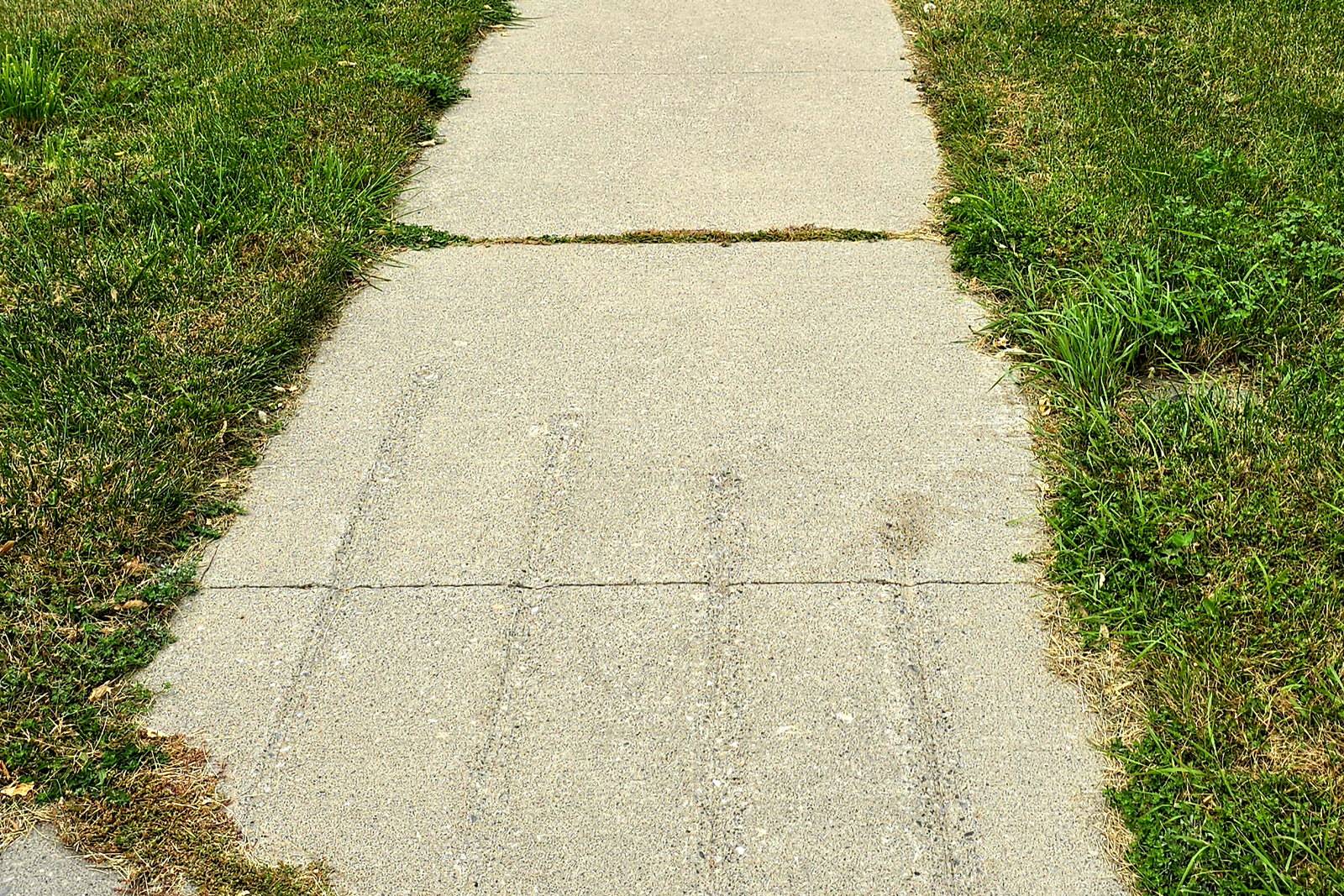
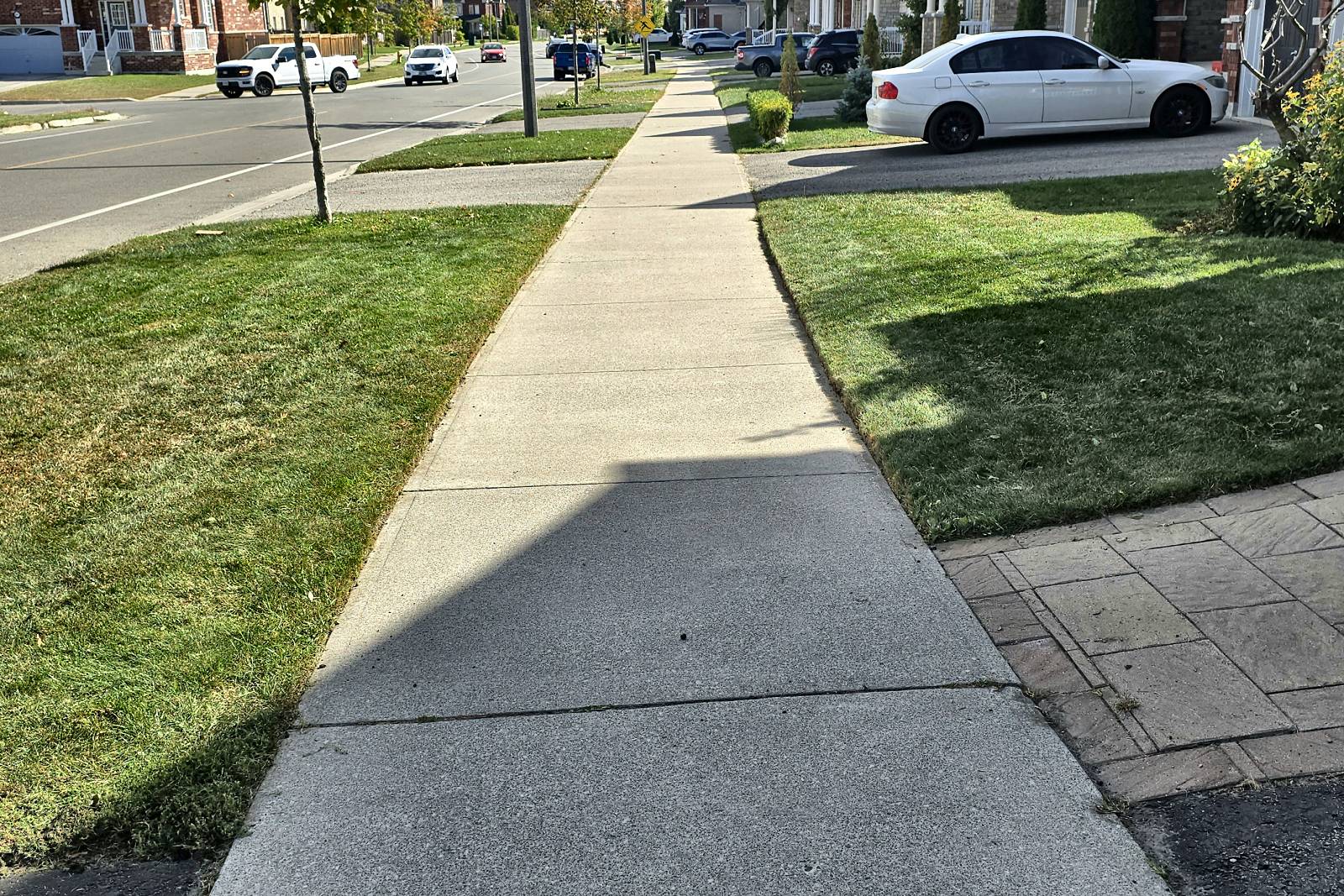
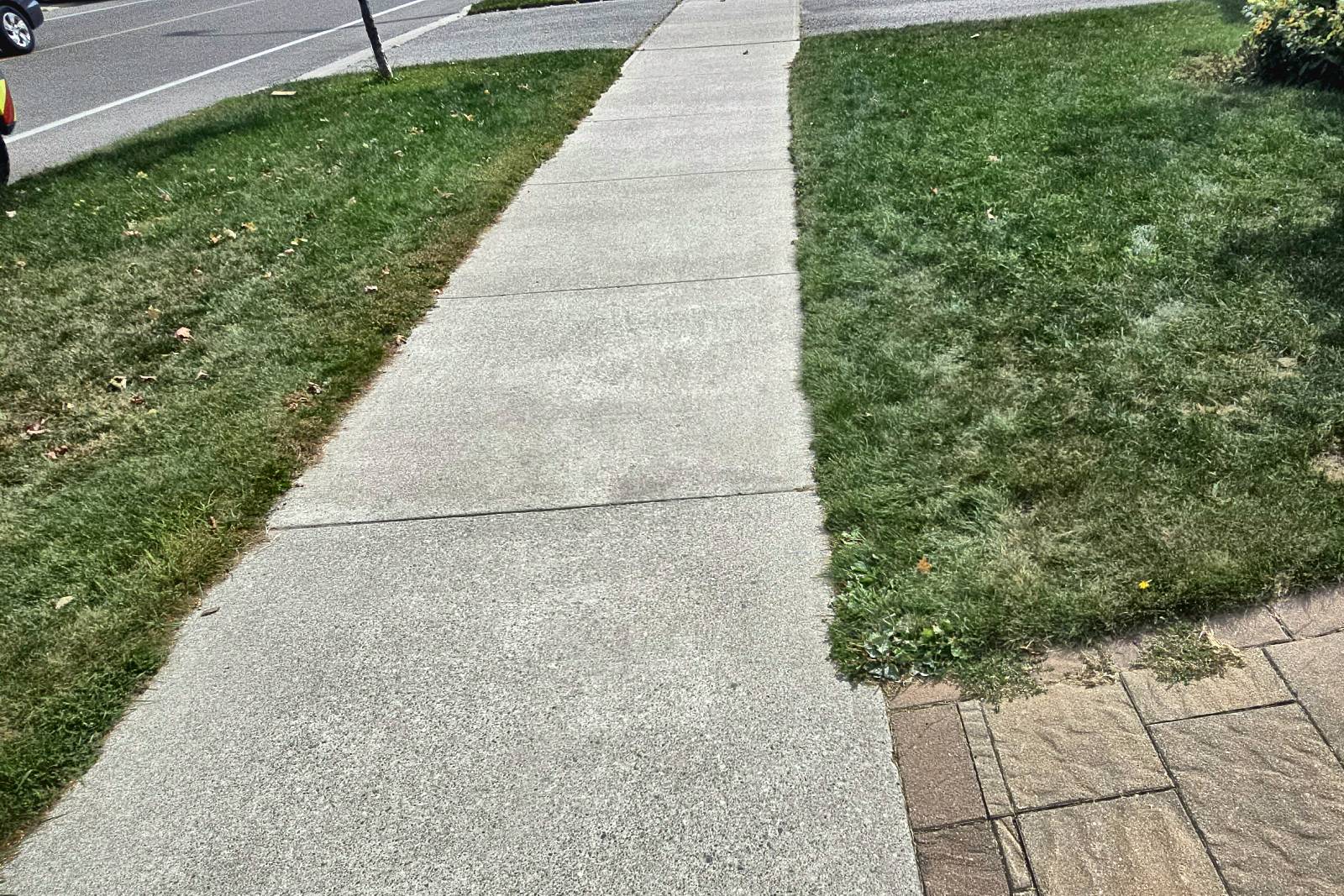
Real Northline properties, before and after, every one of them in Oshawa and every one of them this year. Drag the line to compare.
Andrew answers, October 2026
If I am not there, how do I know you came?
You get the same thing every other property gets, which is the property showing up in the job log with the date on it. For a house nobody is living in I will also text a photograph of the cleared driveway after the first storm of the season, so you can see the pile is where we agreed it would go. After that it is on request, because a photograph of an empty driveway in February looks exactly like a photograph of an empty driveway in January.
A new one of these is written every month and no two pages carry the same question. Nothing here answers yours? Then put it to me directly on 905-244-5779.
Leaving for the winter? Settle the property before you settle the flights
Send me the address and the dates you are away. I will tell you what your own town requires of the frontage, whether your household qualifies for the municipal program instead, where the pile has to go so the wall vents stay open, and what the season costs. If the free program fits you better, I will say so.