Snow removal · Snow storage
Where to put snow from your driveway in Oshawa, and the 0.9 metre line nobody mentions
Where to put snow from your driveway in Oshawa is settled by one measured line almost nobody has read. Inside the sight triangle at the end of your driveway, nothing may stand higher than 0.9 metres, and that triangle runs 3.0 metres by 3.0 metres.
- Fully insured
- Owner operated, one accountable name
- Fixed price before the season starts
- Nothing subcontracted out
The short answer
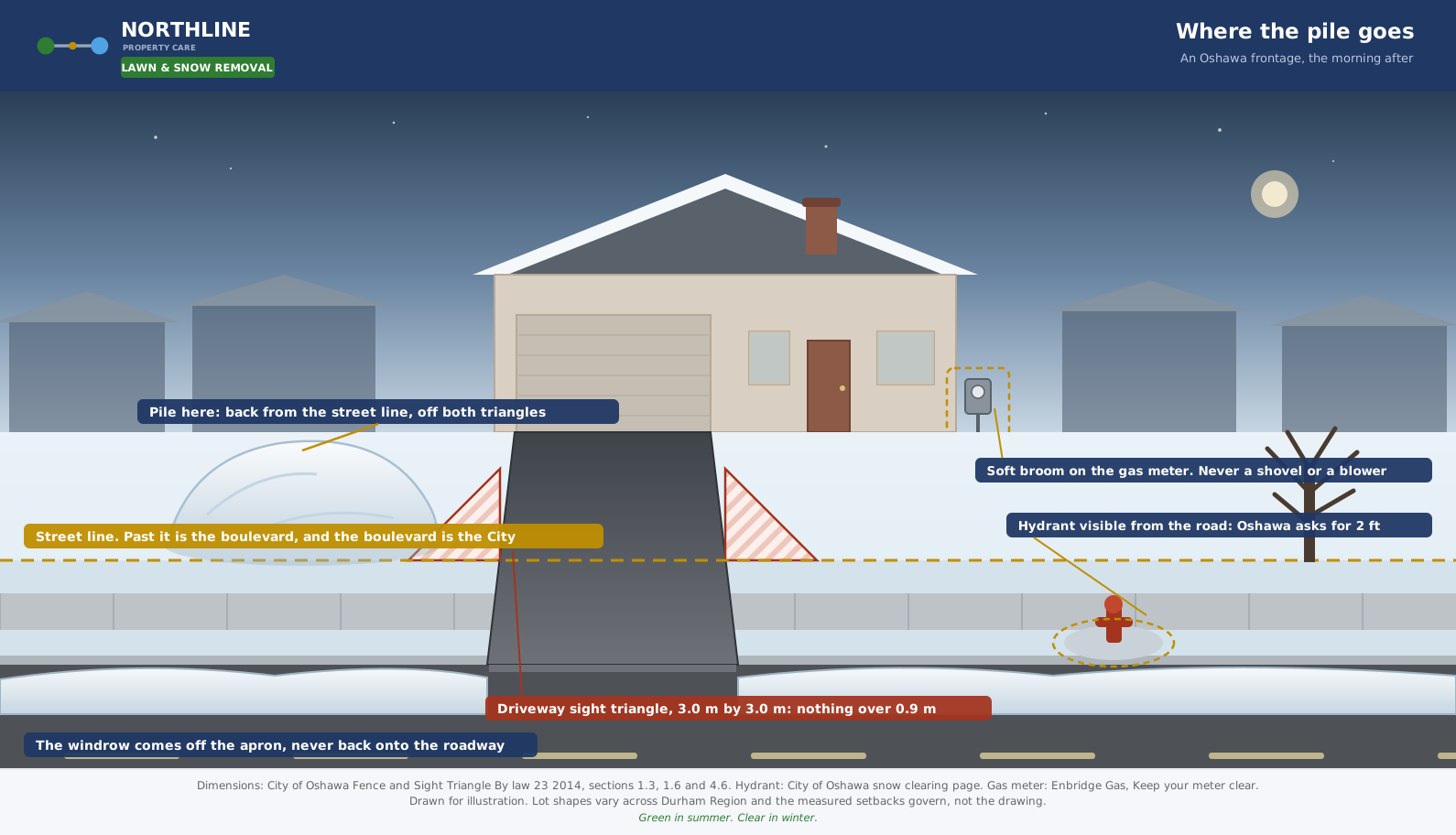
On your own lawn, back from the street line, on the downhill side of the driveway, and under 0.9 metres anywhere near the apron. The roadway is barred by the Highway Traffic Act and the sidewalk is barred by municipal by law in every town we serve. The boulevard is the piece nobody agrees on, and Oshawa is stricter about it than Whitby is. Inside the sight triangle at the end of your driveway there is a measured height limit of 0.9 metres, and it applies to a snowbank because it applies to things and objects.
Then three things on the frontage have to stay uncovered no matter what: the fire hydrant, the natural gas meter and the first stride of ground out from the foundation wall. Everything else on this page is about where the water from that pile ends up in March, and what it does to the grass underneath it in May.
The 0.9 metre rule is a by law, and a snowbank is a thing
Start with the only number on this page that somebody can be ticketed over. The City of Oshawa publishes a Fence and Sight Triangle By law, 23 2014, and its section 4.6 sets a single height for everything standing inside a sight triangle, whether that is a corner one or a driveway one: no fence, no natural feature, no thing and no object above 0.9 metre, anywhere outside the central business area. Read the list again. Things and objects. A by law drafted for hedges and lattice fences catches a February snowbank without ever using the word snow, because a snowbank is a thing that stands in a place.
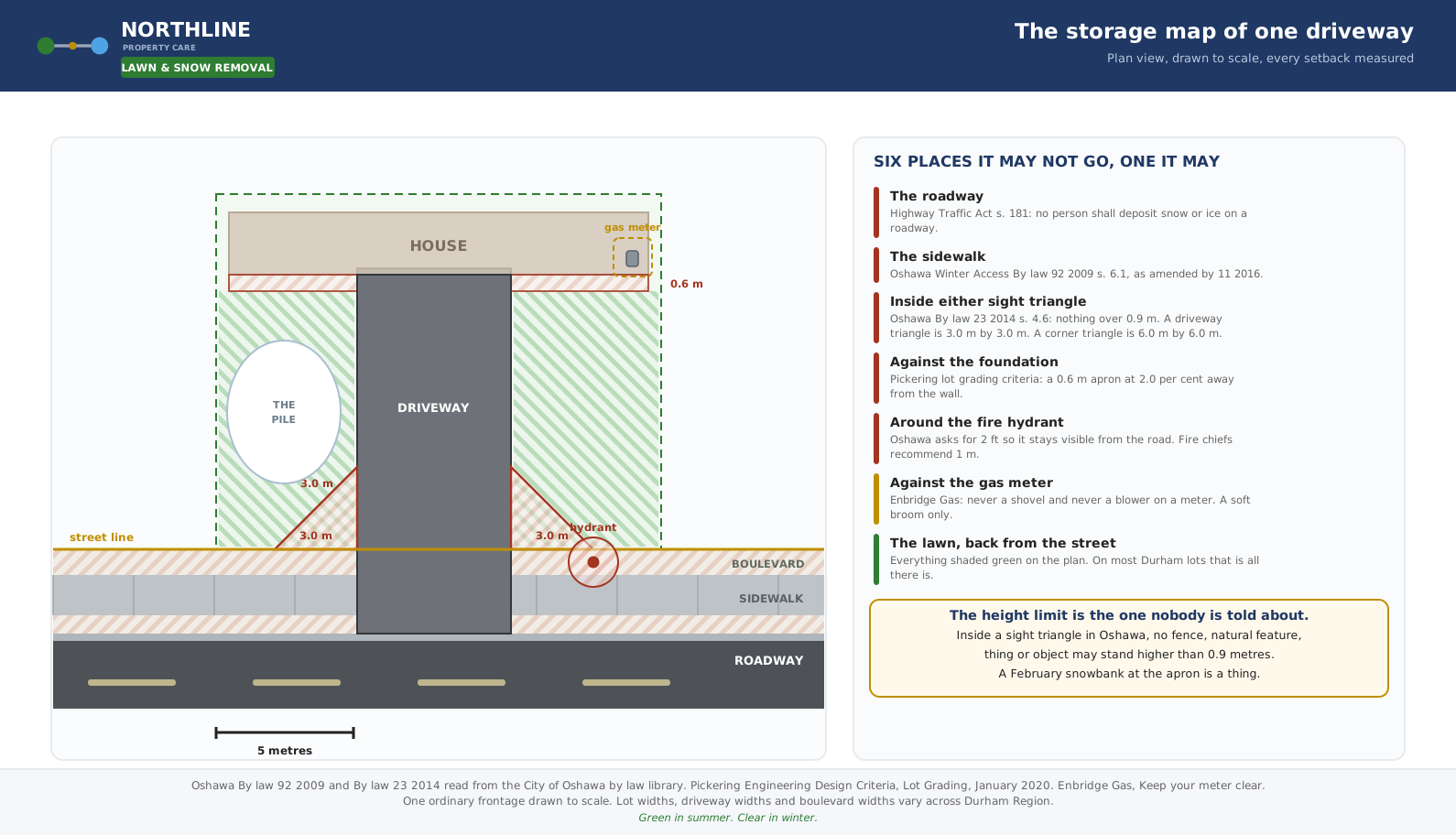
The two triangles are defined in the same document and they are small enough to pace out. Section 1.6 sets a driveway sight triangle as the space bounded by the street line, the side of the driveway, and a line joining points 3.0 metres from where those two meet. Section 1.3 sets a corner sight triangle at 6.0 metres along each street line from the corner. So on an ordinary Oshawa frontage there are two driveway triangles, one on each side of the apron, each of them three paces by three paces, and on a corner lot there is a third that is twice as long on each leg.
Three paces by three paces, nothing over knee height on an adult. That is the whole rule, and it is the part of snow storage that has an enforcement mechanism behind it rather than a preference. Height inside a corner triangle is measured from the grade of the centreline of the abutting street, which matters on the streets north of Taunton where front lawns sit above the road.
Here is the honest limit of it. Outside a sight triangle we could find no Oshawa by law and no Durham Region by law that sets a maximum height for a pile of snow anywhere. You may build a snowbank as tall as you can throw it in the middle of your own front lawn and nothing in the by law library has an opinion. The rule exists where somebody pulling out of a driveway needs to see a child on the sidewalk, and it stops there, which is a sensible place for a rule to stop.
What makes this worth knowing in October rather than in February is that nobody builds an illegal pile on purpose. The pile at the apron starts at ankle height after the first storm, and it gets there because the apron is the shortest carry from wherever the shovel is. By the third storm it is at the knee, and by the fifth it is above the hood of a car and the driver backing out is looking at a white wall. The decision that produced it was made in November and it was never actually made, it was just the first place the snow went.
The road is out, and the rule that says so is provincial
Section 181 of the Highway Traffic Act is the sentence that governs this, and it is one line long. The operative words are short enough to carry around. No person may deposit snow or ice on a roadway, the prohibition runs, and it is lifted only by permission in writing, which has to come from the Ministry or from whichever road authority maintains that stretch. There is no exemption for a homeowner, none for a small amount, and none for putting it back where the plough got it. The Act itself is published by the province, and the wording above is reproduced identically on municipal notices across Ontario.
The word that does the work is roadway. Under the Act a roadway is the part of a highway between the curbs that vehicles actually travel on, which is narrower than the highway, and the highway runs to the property line and takes in the boulevard. So section 181 on its own does not say anything about the boulevard. It says the driving surface is off limits, and that is the clause that bites when somebody blows a driveway across the street or shovels the windrow back into the lane.
The Town of Whitby makes the connection on its own snow clearing page and it does not hedge: pile snow only on your property or on the boulevard, because the alternative is a violation under the Highway Traffic Act, and it notes that pushing or blowing snow onto the street can bring a ticket from Durham Regional Police. That is a municipality telling residents which police force shows up.
One wrinkle belongs to this region specifically. A good share of the streets people live on in Oshawa are Regional roads rather than City roads, and the Region of Durham publishes the list. Simcoe, Ritson, Harmony, Wilson, Thornton, Stevenson, Park, Townline, Taunton, Rossland, Bloor, Adelaide, Gibb, Olive and Wentworth are all on it. The written permission section 181 asks for would have to come from the Region on those streets, not from the City, and the practical point is that the road in front of a house on Harmony is maintained by a different authority than the road in front of a house on the crescent behind it.
Which brings up the thing everybody actually wants to argue about, the windrow. The ridge a municipal plough leaves across the bottom of a driveway is the homeowner's to clear in this region, and both Oshawa and Ajax publish that sentence almost word for word. Ontario Regulation 239 02, the minimum maintenance standard that sets how quickly a municipality has to clear a road by class, measures the clock from the end of the snow accumulation to the restoration of the roadway. A private driveway is not in it, and neither is a windrow. There is no provincial standard being breached when a plough fills your apron.
Oshawa goes one further and publishes the engineering answer to the obvious complaint, which is that raising or lowering the plough blade would not stop driveway windrows and would leave snow on the road instead. That is correct and it is worth repeating to the neighbour who insists the operator is doing it on purpose. The snow has to leave the lane, the blade has to carry it to the edge, and the edge is where the driveways are. The windrow is the geometry of a plough, not an attitude.
The boulevard is where the five towns stop agreeing
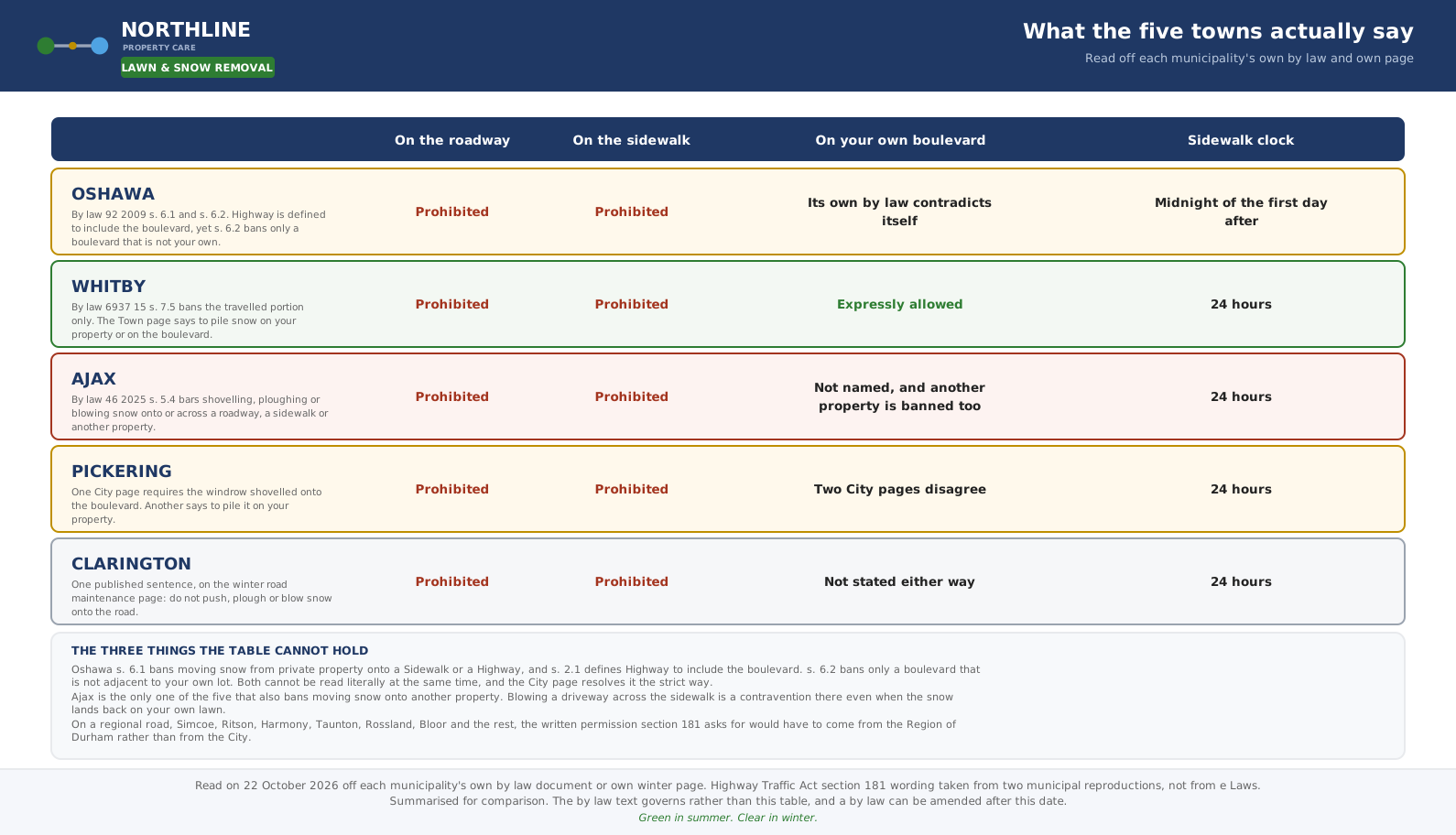
Northline serves five municipalities and they publish five different positions on the strip of grass between your lawn and the curb. This is the single most useful finding on the page, because almost every piece of advice on the subject assumes there is one answer. There is not.
Whitby is the clearest. Its own page says to pile snow on your property or on the boulevard, and its Property and Boulevard Maintenance By law, 6937 15, prohibits placing snow on the travelled portion of a highway and says nothing at all about the boulevard. A Whitby resident who moves the windrow back onto the grass strip is doing exactly what the Town asked.
Pickering says both things in the same week. One City page tells residents they are required to shovel the windrow onto their boulevards and not back onto the road. Another City page tells them to pile it on their property and not throw it back onto the sidewalk or street, and adds that the City owns the boulevard area and will repair with asphalt any damage its ploughs cause there. The two pages are not reconcilable as written, and a resident following either one in good faith is following the City.
Ajax never mentions the boulevard and is the strictest of the five on everything else. Section 5.4 of its Public Nuisance and Safety By law, 46 2025, bars shovelling, ploughing or blowing snow off any property and onto or across four named things: a roadway, a sidewalk, a pedestrian walkway, or another property, in every case without authorization. Another property is the clause worth noticing. In Ajax, blowing your driveway so the stream lands on the neighbour's lawn is named, and so is blowing it across the sidewalk even if the snow comes back down on your own grass.
Clarington publishes a single sentence on its winter road maintenance page: do not push, plough or blow snow onto the road. Nothing about the boulevard either way.
Oshawa is the one that cannot be read literally. The Winter Access By law, 92 2009 as amended by 11 2016, bans at section 6.1 the moving of snow off private property and onto either a sidewalk or a highway, and the definitions at section 2.1 state that highway here takes in any boulevard. Taken on its own that prohibits piling snow on any boulevard anywhere, including the one in front of your own house. Section 6.2 then bans putting snow on any boulevard that is not next to your own lot, which only makes sense as a rule if the boulevard that is next to it is permitted. Both clauses cannot be true at once.
The City resolves it the strict way on its own public page, which tells residents to put the snow from the driveway and the sidewalk onto their property rather than the roadway. Two pieces of practical advice sit beside it. Keep the heap on the right hand side as you look out at the street, because that is the side a passing blade reaches last. And push snow back onto the lawn to improve what you can see when you pull out. Nowhere does Oshawa invite anybody to use the boulevard, and that is the difference between it and Whitby.
The penalties sit at the back of the Oshawa by law and they are not nominal. Administrative penalties run at $75, $175 and $275 by tier, and the offence provision carries a fine of not less than $300 and not more than $5,000 on a first conviction. In Ajax, sidewalk fines start at $150 and are applied to the property tax bill, which is a quieter enforcement route and a more effective one.
So the one sentence that is correct in all five towns is the conservative one. Put it on your own property, back from the street line, and the question of who owns the grass strip never comes up.
The sidewalk clock in Oshawa is not twenty four hours
Oshawa runs the only non standard sidewalk deadline in the five towns we serve, and it is the clause that catches people who have moved within Durham. Section 6.4 of the Winter Access By law requires an owner to take snow and ice off any sidewalk at the front, the side or the rear of the lot, windrows included, and to have it completely gone by midnight on the first day following the snow, or following any other precipitation that freezes.
Work that through on a real storm and the difference is large. Snow that stops at nine on a Tuesday morning has to be off the sidewalk by midnight on Tuesday, which is about fifteen hours. Snow that stops at eleven on Tuesday night has until midnight on Wednesday, which is twenty five. The same by law, same storm, and the deadline moves by ten hours depending on what time the sky cleared.
Whitby, Ajax, Pickering and Clarington all run a flat twenty four hour clock from the end of the accumulation. If you learned the rule in one of those four and then bought a house in Oshawa, the rule you are carrying is wrong in the direction that costs you, because an early morning storm gives you less time here, not more.
Two more Oshawa clauses are worth knowing because they survive the clearing. Section 6.5 requires sand or salt on any sidewalk that remains or becomes slippery after the snow and ice have been removed, so a scraped sidewalk that glazes over at dusk is still your problem. Section 6.6 requires removal of roof snow and ice that may fall onto a sidewalk or highway, which is the only place in this by law that looks upward.
Three things on a Durham frontage a pile must never touch
The hydrant, the gas meter and the foundation, in that order of consequence. None of the three is obvious from the driveway, and all three are routinely buried by somebody who was concentrating on getting the car out.
The hydrant first. In Oshawa the hydrants belong to the Region of Durham, and the City asks the households and businesses beside them to take the snow back two feet, far enough that the hydrant can still be seen from the road. Note the word asks. There is no clause in the Winter Access By law requiring it, and we could not find a numeric clearance anywhere in the Ontario Fire Code. The Ontario Association of Fire Chiefs states plainly that there are few rules about who should clear hydrants, that it is generally considered the property owner's responsibility, and that fire officials recommend at least one metre of clearance. Waterloo Fire Rescue publishes 1.2 metres on all sides. Three different numbers from three sources, none of them provincial law, and the smallest of them is Oshawa's own.
The honest way to hold that is as a judgement rather than a rule. A crew arriving at three in the morning needs to find the hydrant from the truck and then get a wrench onto it. Two feet makes it visible. A metre makes it workable. If the hydrant is on your boulevard, clear the metre and stop arguing about which document says what, because the cost of being right is measured in minutes and the cost of being wrong is measured in a house.
The gas meter second, and this one is a safety instruction rather than a preference. Enbridge Gas publishes that snow, ice or debris around a meter or its vents can prevent proper gas pressure regulation, damage gas piping and increase the risk of a leak, block appliance vents causing malfunctions, and lead to carbon monoxide entering the home. The instruction is a broom or a soft brush after every storm, never a sharp object, never a shovel and never a blower on the meter or the vents, and no attempt to break or melt the ice. Enbridge asks to be called at 1 877 542 2630 to deal with icing buildup, which is a free service most people do not know exists.
The same page carries a line aimed squarely at this article: if your meter is near a sidewalk or driveway, make sure it is visible to anybody operating a plough. On a Durham sideyard the meter is often within a metre of the driveway edge, which puts it exactly where the pile wants to go and exactly where a blower discharge chute points if the operator is working away from the house. It is also the one item on this list where the failure mode is not an inconvenience.
The foundation third. The grade around a house was built to shed water away from the wall, and the City of Pickering engineering design criteria for lot grading are the clearest local statement of what that means: positive surface drainage at a minimum of 2.0 per cent away from all buildings, and a minimum 0.6 metre wide apron sloping at 2.0 per cent away from the foundation wall. The National Building Code requires backfill graded to prevent drainage toward the foundation after settling, and a site graded so water will not accumulate at or near the building, though it states no percentage.
A pile of snow stacked against a basement wall is a deliberate reversal of that design. It sits on the 0.6 metre apron that was built to move water away, it holds a month of precipitation in one place, and it releases it at the wall in March when the ground below is still frozen and has nowhere to take it. Keep the pile off the first stride out from the wall and the apron does the job it was graded for.
A pile is not a place to put snow, it is a place to put water later
The volume is larger than anybody estimates, and the arithmetic takes ten seconds. Environment and Climate Change Canada publishes climate normals for the Oshawa WPCP station, climate identifier 6155878, on the 1981 to 2010 period. Average annual snowfall is 105.8 centimetres. January alone brings 35.6, December and February bring 24.9 each, and the station records 8.0 days a year with a snowfall of 5 centimetres or more.
Take an ordinary double driveway at 6 metres by 10 metres, which is 60 square metres. Multiply by the 1.058 metre annual normal and roughly 63 cubic metres of fresh snow lands on that driveway in an average Oshawa winter. That is a cube about four metres on a side. It does not stay that big, because snow compacts hard under a shovel and harder under a blade, but every cubic metre of it gets moved by somebody and ends up somewhere on the lot, and the place it ends up holds the water it was made of.
Then it cycles. The City of Toronto published a climate report in December 2024 counting 61.9 freeze thaw days a year on the 1971 to 2000 observed baseline, measured as days when the daily minimum is at or below minus 1 degree and the maximum is above zero. That is the closest published count to this area and it is Toronto rather than Oshawa, which is stated here rather than glossed over. Sixty one times a winter, a pile gives up water in the afternoon and takes it back as ice overnight.
Where that water goes is the whole decision. Stand at the garage door on a wet October day and watch which way a hose runs. Almost every Durham lot drains from the house toward the street, often with a shallow swale along one side, because that is how the lot was graded and how the City required it. A pile placed uphill of the driveway pours its meltwater across the surface you walk on, every sunny afternoon, and that surface is below freezing again by six. A pile placed downhill of the driveway sheds toward the street and is somebody else's problem only in the sense that it reaches a catch basin.
The one place that always loses is the bottom corner of the driveway beside the apron, which is also the easiest place to put it. It is the lowest point of the paved surface, it collects melt from the pile above it, and the puddle it makes is the one that freezes first and thaws last because it sits in the shade of the pile that made it. A driveway with a permanent patch of grey ice at the bottom in February almost always has a snowbank directly above it.
The pile is a salt store, and the lawn pays for it in May
Every grain of salt spread on a driveway between November and March leaves in the melt, and most of it leaves through one spot. That spot is wherever the snow was piled. It is the reason a lawn can be uniformly healthy except for one brown scar in the same corner every spring, and it is the single most avoidable damage on this page.
Canada uses about five million tonnes of road salt a year as a de icer, and the federal position on it is more nuanced than either side of the argument usually admits. A Priority Substances List assessment under the Canadian Environmental Protection Act concluded in 2001 that road salts meet the environmental harm criteria in paragraphs 64 a and 64 b of the Act. They were never added to Schedule 1. What arrived instead, in April 2004, was a Code of Practice It applies to organizations that spread more than 500 tonnes in a year, averaged over five. Nothing federal governs the bag in your garage.
The thresholds in that work are the useful part. Chloride concentrations above about 230 milligrams per litre have chronic effects on sensitive freshwater organisms, and 870 milligrams per litre is the median lethal range. For soil the Code names roughly 60 milligrams of sodium and 90 milligrams of chloride per litre as protective. Those are small numbers next to what winter runoff actually carries.
Toronto and Region Conservation Authority monitored 47 stream stations across the Lake Ontario watershed from 2016 to 2020 and published the results. The highest average winter chloride concentration at a single tributary was 2,345 milligrams per litre. In summer, with no salt being applied at all, 32 of the 47 sites still exceeded the 120 milligram chronic guideline. A provincial study in the Journal of Great Lakes Research in 2022, written by Ontario ministry scientists, found mean chloride in monitored urban streams rising from about 111 milligrams per litre in the 1970s to about 273 in the 2010s. None of those readings is from a Durham creek and none of them is from anybody's lawn, which is said here rather than quietly implied.
What happens at the scale of one pile is better documented on the plant side. University of Wisconsin extension puts most de icing salt soil damage within about 30 feet of the treated surface and most spray damage within 60 feet, and explains the mechanism: sodium wrecks soil structure, raises pH and cuts infiltration, while the salt binds water tightly enough that roots cannot take it up, so the plant experiences a drought in wet ground. Purdue measured 890 parts per million of chloride in soil within 30 feet of a highway and noted that this is about ten times the level known to inhibit seed germination and root growth in grasses.
The part that confuses homeowners is the delay. The University of Massachusetts extension states that damage from salt in the soil can be delayed, with symptoms not appearing until summer or even years later, and it names snow piled onto lawns and garden beds as a pathway in its own right. So the brown patch in July is not July's fault, and the cedar hedge that thins on the driveway side over three winters is not a hedge problem.
Two things fix most of it and neither costs anything. Use less salt in the first place, which is a subject in its own right and one we have written about separately. And once the ground thaws in April, flush the pile corner heavily, because the published remedy for salt in a root zone is water: at least six inches of it, applied to move the chloride down past the roots rather than leaving it to be taken up.
Forty five days under a pile is when the grass starts to lose
Snow mould is a function of how long the ground stays covered, and a pile is a local winter that runs twice as long as the real one. This is the second half of why one corner of a lawn comes back worse than the rest of it, and it has nothing to do with salt.
The University of Massachusetts turf program puts grey snow mould where snow cover is present for 45 to 60 days, and notes that both grey and pink snow mould do their worst under snow that is covering wet turf on unfrozen soil, because deep snow insulates the ground and keeps it from freezing. Purdue's plant pathology bulletin on grey snow mould gives the same window from the other end: mild symptoms, a few small patches, after 40 to 60 days of cover, and severe outbreaks threatening beyond 90 days.
Now compare that to what an Oshawa lawn actually gets. The open lawn in a normal winter here carries thin, interrupted cover that comes and goes with every thaw, which is why most Durham lawns show nothing worse than a few straw coloured rings in April. The pile corner gets something different. It is a compacted mass that was built up over three months, it is shaded by its own volume, and it is the last snow on the property to disappear, often by two or three weeks. That corner can easily pass the 45 day threshold in a winter where the rest of the lawn never comes close.
The symptoms are worth recognising because they are easy to mistake for salt burn, and the treatment is different. Grey snow mould shows after melt as roughly circular patches of yellow, straw coloured or grey brown turf, typically one to three feet across, and on short turf six to twelve inches. Pink snow mould bleaches white to tan with a pink margin at the edge. Salt damage is usually a band or a scar rather than a circle, and it follows the shape of the pile rather than appearing in discrete rings.
The cheap answer is rotation. If the lot allows a pile on either side of the driveway, alternate the side from one winter to the next, and the corner that took the compaction and the chloride last year gets a season to recover. That is a decision made in November and it costs nothing. The expensive answer is reseeding the same two square metres every May for ten years.
The order to decide it in, on one frontage, in about four minutes
Walk it once in October, in daylight, with nothing on the ground, and the decision is made for the whole winter. Here is the order we use when we price a property, and there is nothing in it a homeowner cannot do themselves.
One. Rule out the roadway and the sidewalk. That is provincial law and municipal by law respectively and it is not a judgement call in any of the five towns.
Two. Pace out the two driveway sight triangles, three paces along the street line and three paces up the driveway edge, and mark the apex in your head. Nothing over knee height goes inside either one. On a corner lot pace six along each street line as well.
Three. Find the hydrant, the gas meter and the first stride out from the foundation wall, and rule those out too. The hydrant may be on the neighbour's boulevard, in which case it is still worth clearing and it is still nobody's legal duty.
Four. Work out which way the lot drains, and pick the downhill side of the driveway for the pile. If both sides are equal, pick the side with more lawn behind it, because the pile needs room to spread sideways rather than up as the winter goes on.
Five. Decide where the windrow goes before the first storm, not during it. The windrow arrives after the driveway has already been cleared, which is why it so often ends up in the worst available place: the operator or the homeowner is tired, the car is already out, and the apron is right there.
Six. Write the side down, or tell whoever clears the property, and change it next winter. A property with a note in the file saying the pile goes left does not get a different answer every storm depending on who is holding the shovel.
On a narrow lot this walk sometimes ends with the honest conclusion that there is nowhere good, only somewhere less bad. Ajax says as much on its own winter page, that snow storage availability is very limited in newer communities where narrow lots reduce available space, and anyone who has stood on a thirty foot frontage in north Whitby in February knows the Town is being polite. On those lots the answer is to spread the pile thin and long down one side rather than high and round at the apron, because a low wide pile stays under 0.9 metres and melts faster.
When you should not buy this from us
If you can clear your own driveway and you have somewhere on the lot to put the snow, you do not need a membership and we are not going to pretend otherwise. Snow storage is the one part of this job that money does not solve. A contractor can clear a driveway faster and earlier than a homeowner can, but the snow still has to live on the same lot afterwards, and a blade does not make the lot bigger.
There is a specific case where the answer is no. If a frontage genuinely has no room, a townhouse with a single width driveway, a corner lot where both triangles eat the only available lawn, a property with the gas meter and the hydrant on the same side, then the honest service is hauling the snow off site, and Northline does not sell that. We will tell you at the quote rather than after the second storm, and we would rather lose the property than take it on and then run out of places to put February.
The second thing worth saying plainly is about tiers. Silver does not plough the driveway. If the reason you are reading this page is that you want the driveway cleared before you leave in the morning, Silver is the wrong product and the entry price is not the price that buys it.
And if the only problem is the windrow, a return trip to clear it is $45 and that is the whole transaction. Not everybody needs a season.
What it costs if you hand the whole thing over
The tier that clears a driveway to the 7 AM target after overnight snow is Gold, and it is $189 a month plus HST. On the card that reads $213.57, and over twelve equal payments it comes to $2,268 for the year. Platinum goes first in the sequence, at a 6:30 AM target, with salting applied automatically and without limit, and the first pick of service day. Memberships open at $129 a month plus HST, and what the entry tier buys is the windrow pass by 5 PM rather than the driveway cleared in the morning, which is the distinction most of this page turns on.
Bought as a season instead of a membership, a standard property is $975 plus HST, a small one is $800 and a large one is $1,200. That price holds until November 1. The residential route itself closes on November 30, and after that a property cannot join for the winter at all. Those are two separate dates and both of them are real.
The snow storage walk described above is part of pricing a property and it carries no surcharge. What comes out of it is a note in the file naming which side the pile goes on, how far back from the street line, and whether the frontage will hold a full winter. On a property where it will not, that is in the quote in writing rather than discovered in January.
What we could not verify
Six things on this page would be stronger if a document had opened, and they are listed rather than smoothed over. The first is the penalty for section 181 of the Highway Traffic Act. The consolidated set fine schedules published by the Ontario Court of Justice were checked and no entry for section 181 was found in the schedules read, and the provincial e Laws site would not render for the tools used here. The wording of section 181 quoted above is reproduced identically on two municipal government documents and is reliable, but it was not read off e Laws, and no dollar figure for that offence appears anywhere on this page for that reason.
The second is the primary text of Ontario Regulation 239 02. The same e Laws rendering problem applied. The statement above that the standard measures to the restoration of the roadway and does not address private driveways rests on municipal winter maintenance policies that reproduce the regulation, not on the regulation itself.
The third is two of the five by laws. The text of Pickering By law 6650 06 sits behind a document portal that returned an error, so the Pickering position above comes from the City's own summary pages rather than from the clause. The same is true of every Clarington by law: the numbers the Municipality names on its own pages are recorded, but none of the documents could be opened, so no Clarington clause is quoted here.
The fourth is the Region of Durham. We looked for a Regional by law prohibiting the deposit of snow on a Regional road, in the Regional Roads By law, the road maintenance pages and the permits pages, and found none. The conclusion above, that the Region relies on section 181, is the best available reading and it is not proof. A negative cannot be proved from a by law listing that would not enumerate.
The fifth is hydrant clearance. No section of the Ontario Fire Code setting a numeric clearance could be found. Two fire service sources assert the Code requires hydrants to be kept clear and neither cites a section. The three distances quoted above are a City request, an association recommendation and another municipality's figure, and none is provincial law.
The sixth is local data. There is no published chloride concentration for a Durham creek: Central Lake Ontario Conservation grades its watersheds on phosphorus, E. coli and benthic invertebrates and reports chloride only as a pass or fail against drinking water guidelines in eleven wells. The Toronto area figures above are not Oshawa figures. The climate normals quoted are the 1981 to 2010 set because the 1991 to 2020 station pages could not be read, and the freeze thaw count is Toronto's rather than Oshawa's. And no source anywhere ties a chloride loading to a single residential snow pile, so the link between the pile and the brown patch is a mechanism supported by extension research rather than a measurement of a driveway. The compaction ratio of a ploughed pile is not published either, which is why the 63 cubic metre figure above is stated as fresh snowfall and not as the size of the heap.
Questions Durham homeowners actually ask about snow storage
Where am I allowed to put snow from my driveway in Oshawa?
On your own property, and the City says so in those words on its own snow clearing page. The Winter Access By law, 92 2009 as amended by 11 2016, stops an owner at section 6.1 from shifting snow off private property and onto either a sidewalk or a highway, and the word highway is defined in the same document to take in the boulevard as well. Provincially, section 181 of the Highway Traffic Act closes off the driving surface itself, because snow and ice may not be put there at all unless the authority that maintains the road has given written permission. That leaves the lawn, and the lawn has four pieces taken out of it before you start: the two sight triangles at the end of the driveway, the strip immediately against the foundation, and anything within reach of the gas meter.
Can I push the windrow back onto the road after the plough has gone by?
No, and the City has already answered the follow up question. Clearing the windrow is the property owner's job in Oshawa and in Ajax, both of which publish that sentence, and the provincial prohibition on depositing snow on a roadway applies to the homeowner exactly as it applies to anybody else. Oshawa also publishes the reason the plough cannot simply avoid leaving one, which is that raising or lowering the blade at a driveway would leave snow on the road instead. The windrow has to go somewhere on your side of the street line, and the best place for it is the same place as the rest of the pile.
Can I put snow on the boulevard in front of my house?
It depends which town you live in, and the five we serve do not agree. Whitby tells residents in plain words to pile snow on their property or on the boulevard. One City of Pickering page requires the windrow to be shovelled onto the boulevard while another page tells residents to pile it on their property. Ajax never names the boulevard and bans moving snow onto another property as well as onto a roadway or sidewalk. Clarington publishes one sentence about the road and nothing about the boulevard. Oshawa is the awkward one, because its by law defines highway to include the boulevard and then separately bans only a boulevard that is not next to your own lot. The safe answer in all five is your own property.
How high can a snow pile be at the end of my driveway?
Inside a sight triangle in Oshawa, 0.9 metres, and that is a by law rather than a guideline. The Fence and Sight Triangle By law, 23 2014, holds everything inside either kind of triangle to one height at its section 4.6: no fence, no natural feature, no thing and no object above 0.9 metre, in every part of the City outside the central business area. A driveway triangle measures 3.0 metres out along the street line by 3.0 metres along the side of the driveway. A corner triangle is 6.0 metres each way. Outside those triangles we could find no Oshawa or Durham by law that limits the height of a pile at all, so the rule bites exactly where the visibility matters and nowhere else.
Does piling snow on the lawn kill the grass?
Sometimes, and when it does the cause is usually one of two things rather than the snow itself. The first is salt. University extension research puts most de icing salt soil damage within about 30 feet of the treated surface, and a driveway pile is a concentrated version of that because every grain you spread all winter ends up in one spot when it melts. The second is time. Grey snow mould needs roughly 45 to 60 days of snow cover to show, and a compacted pile sits far longer than the thin cover on the rest of the lawn, so the pile corner can carry a winter nearly twice as long as the ground beside it. Both are survivable. Flushing the spot heavily once the ground thaws, and moving the pile to the other side next winter, deals with most of it.
How long do I have to clear my sidewalk in Oshawa after it snows?
Until midnight on the first day following the end of the snow, which is not the same as twenty four hours and is the clause most people get wrong. Snow that stops at nine in the morning gives you until midnight that night, roughly fifteen hours. Snow that stops at eleven at night gives you until midnight the following day. Oshawa also requires sand or salt on any sidewalk that is still slippery once the snow is off. The other four towns we serve run a flat 24 hour clock, so if you have moved into Oshawa from Whitby, Ajax, Pickering or Clarington, this is the rule that will catch you.
Who wrote this
Andrew owns Northline Property Care, runs it out of Oshawa and has six Durham winters of snow work behind him. He is the one who walks a frontage in October and the one clearing it in February, and the number on the invoice reaches him directly. Insurance is in place, the truck carries the CVOR registration Ontario requires of a work vehicle, and there is no trade licence on the wall because Ontario does not issue one for this work.
Every by law number, section number and figure below was read off a municipal, provincial, federal or university document, and each one is linked wherever the document is public. No external link on this page points at another lawn care, snow removal, landscaping or property maintenance business. That is a standing rule here rather than an accident, and it is why the page carries clause numbers that competitor pages do not.
Where the published record argues with itself, as it does between two Pickering pages and inside a single Oshawa by law, the argument is printed instead of being settled in whichever direction suits us. Where a document would not open at all, it is named in the section that says so.
Read next
Windrow clearing in Durham Region
The ridge across the apron, who owns it in each town, and why the blade cannot be lifted to avoid leaving one.
Driveway salting in Oshawa
How little is actually enough, measured in grams per square metre, and the temperature at which more salt stops buying anything.
The Oshawa snow removal by law
What the Winter Access By law requires of a property owner, clause by clause, and what the City only asks for.
Andrew answers, October 2026
My driveway is one car wide and the hydrant is on my side. Where is the snow supposed to go?
Long and low down one edge, not high and round at the apron, and I will say on the quote if I think it runs out in February rather than letting you find out. On a frontage that tight the usable lawn is whatever is left after both sight triangles and the hydrant ring, and that is often one strip. A pile spread thin along it stays under the 0.9 metres the by law allows at the apron and it melts faster, which is the whole trick. What I will not do is tell you it is fine and then start putting it somewhere it should not go in January.
One of these goes on each page and it is replaced monthly. If the question you have is not here, ask it: 905-244-5779.
Have the snow storage settled before the first storm settles it for you
Send the address and I will price the winter the same day. The walk that decides which side the pile goes on, how far back from the street line and whether the frontage holds a full season is part of the quote, and what comes out of it is in writing before anything is cleared.
Green in summer. Clear in winter.