Snow removal · Ajax
Who Plows Driveways in Ajax, and Who Is Responsible for the Windrow
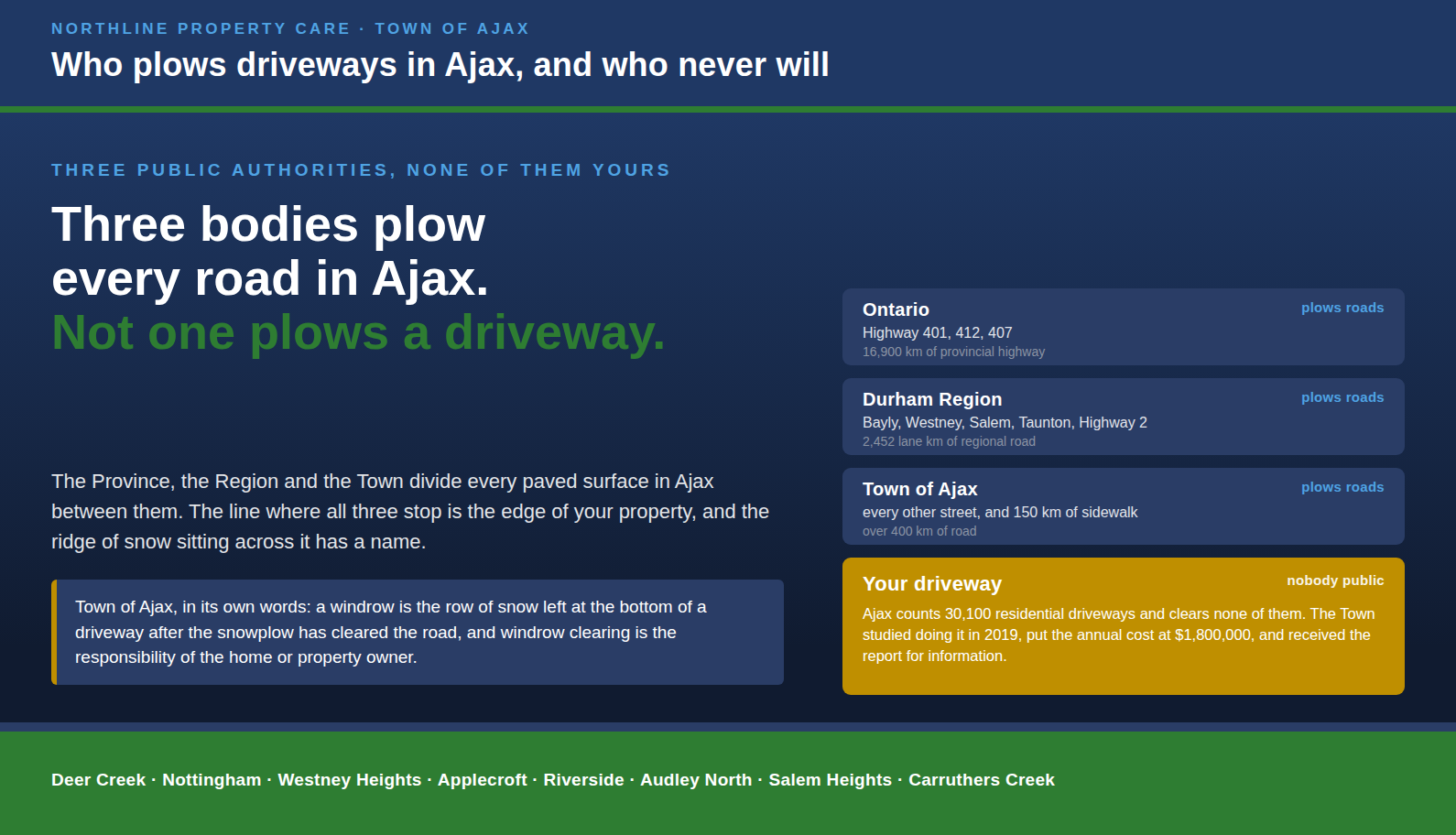
Who plows driveways in Ajax? No public body does, and the Town says so in its own words: the plow clears the road, the ridge it leaves across the mouth of your driveway is called a windrow, and clearing that windrow belongs to the property owner.
Lots past 0.35 of an acre are priced in a band of their own. See the acre pricing.
Green in summer. Clear in winter.
The short answer
Who plows driveways in Ajax is a question with a short answer and an awkward one: the homeowner, or a contractor the homeowner pays, and nobody else.
The Town of Ajax plows the road past your house and leaves a windrow across the end of your driveway, and its own winter control material puts clearing that windrow on you, within 24 hours where it lies across a sidewalk or a hydrant. The Town runs one narrow exception, a fee based snow removal program for residents over 65 and for residents with a physician verified physical disability, and it does not begin until more than 5 centimetres has fallen, the snow has stopped for 24 hours, and the Town plows have finished the roads. Everyone outside that program buys the work privately or does it themselves. On a Northline membership the driveway is Gold at $189 a month plus HST with a 7 AM target after overnight snow, or Platinum at $279 with a 6:30 AM target and automatic salting. Silver at $129 does not plow the driveway at all and should not be bought by anybody who thinks it does.
The Town plows over 400 kilometres of road, and the ridge is the price of that
Ajax maintains over 400 kilometres of road, 150 kilometres of sidewalk, 37 kilometres of trail, 27 parking lots and 53 school crossings, and its winter response runs November to April. That is published on the Town's winter roads maintenance page, along with the order the work happens in. Primary roads go first, being the roads that feed the regional roads, the schools, the community centres and the industrial and commercial areas. Secondary roads follow, and the Town names Ravenscroft, Williamson, Burcher, Monarch and Clover Ridge among them. Residential streets, sidewalks, trails and parking lots come last.
If you live on Clover Ridge you are on the second pass. If you live on a court off Audley North you are on the third, and on a long storm the third pass can begin a considerable time after the snow stops. None of that is a complaint about the Town. It is the arithmetic of clearing 400 kilometres of road with the roads that carry ambulances first.
The windrow is a by-product of that work and the Town explains exactly why it cannot be avoided. Its snow and windrow material states that raising or lowering the front plow or the side wing at a driveway would leave snow deposited on the travelled portion of the road, which is unsafe for road users. A plow that lifts its blade for every driveway on a street is a plow that leaves a line of ridges down the middle of the lane instead. There is no version of plowing a residential street that does not put snow at the end of the driveways on it.
So the real question is not whether the ridge appears. It is who moves it, and how quickly, because a windrow is the densest snow on the property. It has been compacted by a blade, pushed at speed, and then left to set. A driveway that took fifteen minutes to shovel takes another fifteen at the bottom of it, and that fifteen minutes lands at the worst possible hour on the worst possible day.
Ajax costed clearing every driveway itself, and then did not buy it
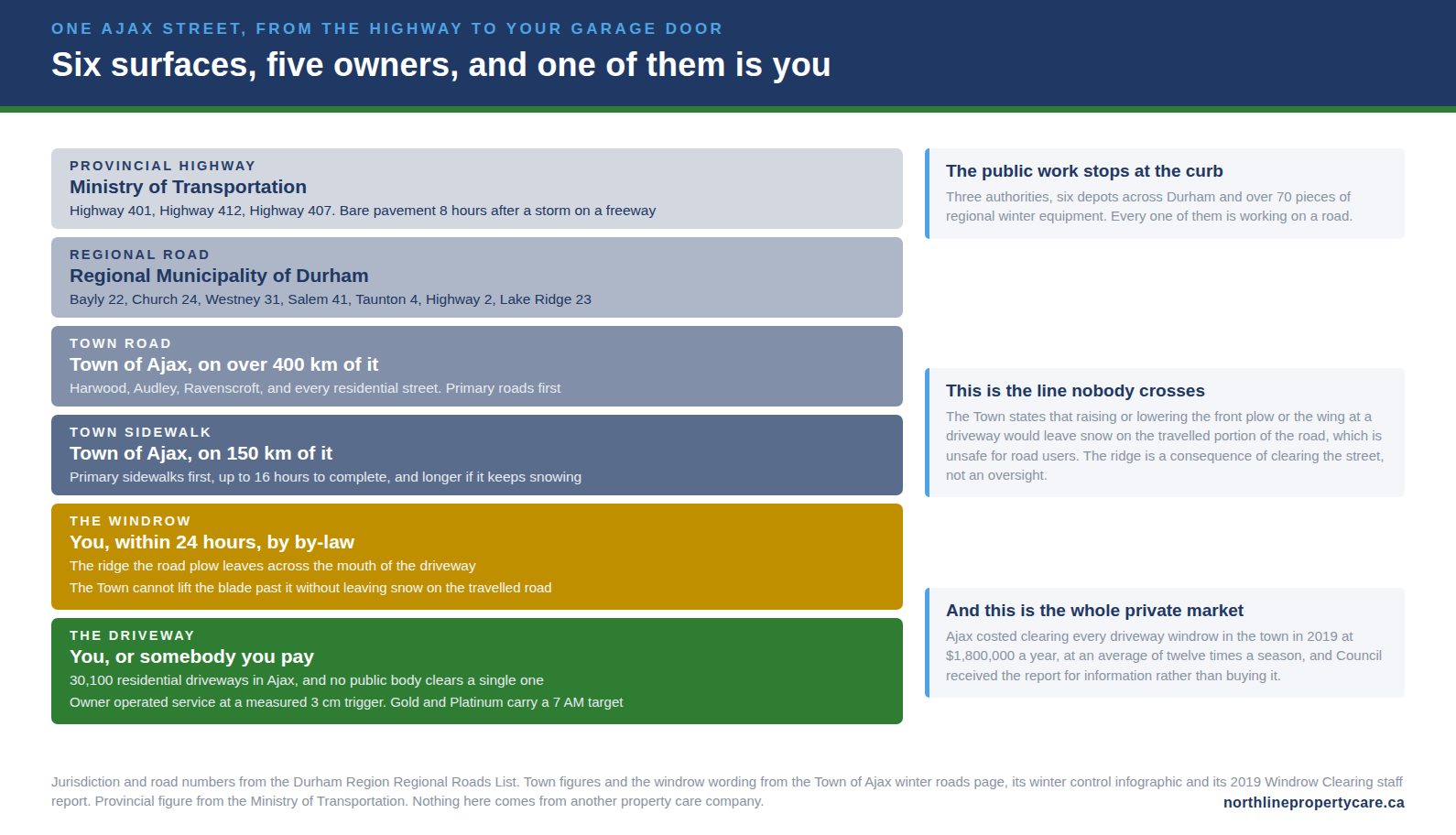
In 2019 the Town put a price on clearing the windrow at every residential driveway in Ajax, and the number was $1,800,000 a year before the Town had hired anybody to run it. The staff report went to Council with a recommendation that Council receive it for information, which is the polite municipal form of no. The report counted 30,100 residential driveways in Ajax, assumed an average of twelve service events a season, and set a target of clearing within a 10 to 12 hour window after the roadway plowing finished. The Town's own windrow material adds that equipment of that kind clears only about 80 per cent of a driveway width, that heavy snow reduces its effectiveness, and that newer developments have nowhere to put the snow.
Those four sentences are the most useful thing an Ajax homeowner can read before asking anybody for a price. They are not marketing. They are a municipality doing the arithmetic on the identical job, at the largest scale available to anyone in this town, and concluding that it could not carry the cost. Around $60 a driveway a year buys a machine passing twelve times and finishing four fifths of the width, without touching the walkway, without salt, and without any obligation to arrive before you have to leave for work.
That is the shape of the whole market. Moving a windrow is cheap in equipment and expensive in timing, because every driveway in the town needs it inside the same few hours, and no amount of scale makes that easier. It is the one job where being bigger does not help.
The figure also settles an argument that comes up on every Ajax street in February. Nobody is withholding a service the Town could easily provide. The Town measured it, published both halves of the measurement, and made a decision in public. A homeowner who understands that stops waiting for the ridge to be somebody else's problem and starts deciding what to do about it in October, which is the only month in which the decision is cheap.
If you qualify for the Town program, take it, because nothing beats $41
Before you price anything privately, read the Town of Ajax snow removal program for seniors and qualified residents, because for a household that qualifies it is cheaper than anything a contractor in Durham Region can honestly quote. The 2026 to 2027 application form sets two service levels. Level 1 covers the driveway area, the windrow at the end of the driveway, the municipal sidewalk and a pathway to a specified door, at $360.70 including HST for the season. Level 2 covers the windrow and the municipal sidewalk only, at $41.13 including HST for the season.
Forty one dollars for a season of windrow clearing is not a price any private operator can meet, and pretending otherwise would be an insult to the reader. If your household is eligible, the honest advice is to apply and stop reading.
Eligibility is narrow, and the conditions attached to the service are the part most people skip. Either the applicant has passed 65 and nobody younger and able bodied lives at that address, or a physician confirms that a physical disability prevents the work, confirmed again each year unless the condition is permanent. Applications go to Operations and Environmental Services at 65 Harwood Avenue South, by mail, in person or by email, and the Town states that an applicant is added about seven business days after the application is processed. The intake line is 905-683-2951, weekdays from 8 in the morning until 4 in the afternoon.
Then the conditions. Service happens after more than 5 centimetres of snow, which is nearly double the depth at which a residential clearing contract is normally triggered. It happens 24 hours after the snow has stopped falling, and only after the Town's plows have finished clearing the roads. Both of those conditions have to be satisfied, so on a long storm that ends at dawn on a Tuesday the program clearance can fall on the Wednesday. That is the difference between a subsidy designed to prevent a household being trapped and a service designed to get somebody to work on time. Both are legitimate. They are not the same product and they should not be compared as though they were.
One honest caveat about the numbers above. The application form footnotes both fees as subject to change on January 1 2027, and the Town publishes no registration deadline on either the form or the winter page. Confirm the current fee and whether the list is still open on 905-683-2951 rather than trusting a figure copied off any website, this one included.
Several roads in Ajax are not the Town's at all, and that changes who you call
Three separate public bodies plow roads in Ajax, and Durham Region says so in one sentence: the Province of Ontario, the Regional Municipality of Durham and your local area municipality all maintain Durham Region's roads in the winter. The Regional Roads List names which ones belong to the Region. In Ajax that is Bayly Street as Regional Road 22, Church Street as 24, Westney Road as 31, Salem Road as 41, Taunton Road as 4, Kingston Road as Regional Highway 2, and Lake Ridge Road as 23 on the Whitby boundary. Highway 401 and the 412 and 407 links north of the town belong to the Ministry of Transportation.
Everything else is the Town, which means Harwood Avenue, Audley Road, Ravenscroft Road and every residential street in Westney Heights, Applecroft, Nottingham, Deer Creek, Riverside, Salem Heights and Audley North. A useful and widely repeated error is worth naming here: Rossland Road is Regional Road 28 only from Lake Ridge Road eastward through Whitby and Oshawa, so the Ajax stretch west of Lake Ridge is not a regional road and never was.
This matters for two practical reasons and one legal one. The practical reasons are that an unplowed street gets reported to the body that owns it rather than to whoever answers first, and that a regional arterial is patrolled seven days a week through the winter by a fleet the Region describes as over 70 pieces of winter maintenance equipment working from six depots, one of which sits at 2020 Salem Road in Ajax. A house fronting Westney Road sees the road cleared on a different schedule, and often a different number of times, from a house on a court off it.
The legal reason is that a claim against a municipality for a road or sidewalk in disrepair carries a 10 day written notice requirement under section 44 of the Municipal Act, served on the clerk of the municipality that owns the road. Getting the owner wrong costs ten days you do not get back. A further subsection of it shields a municipality from a sidewalk snow or ice injury claim altogether unless gross negligence can be shown, and gross negligence is a far harder thing to prove than the ordinary carelessness most people have in mind on the way to the ground.
What the law actually requires of a public plow, hour by hour
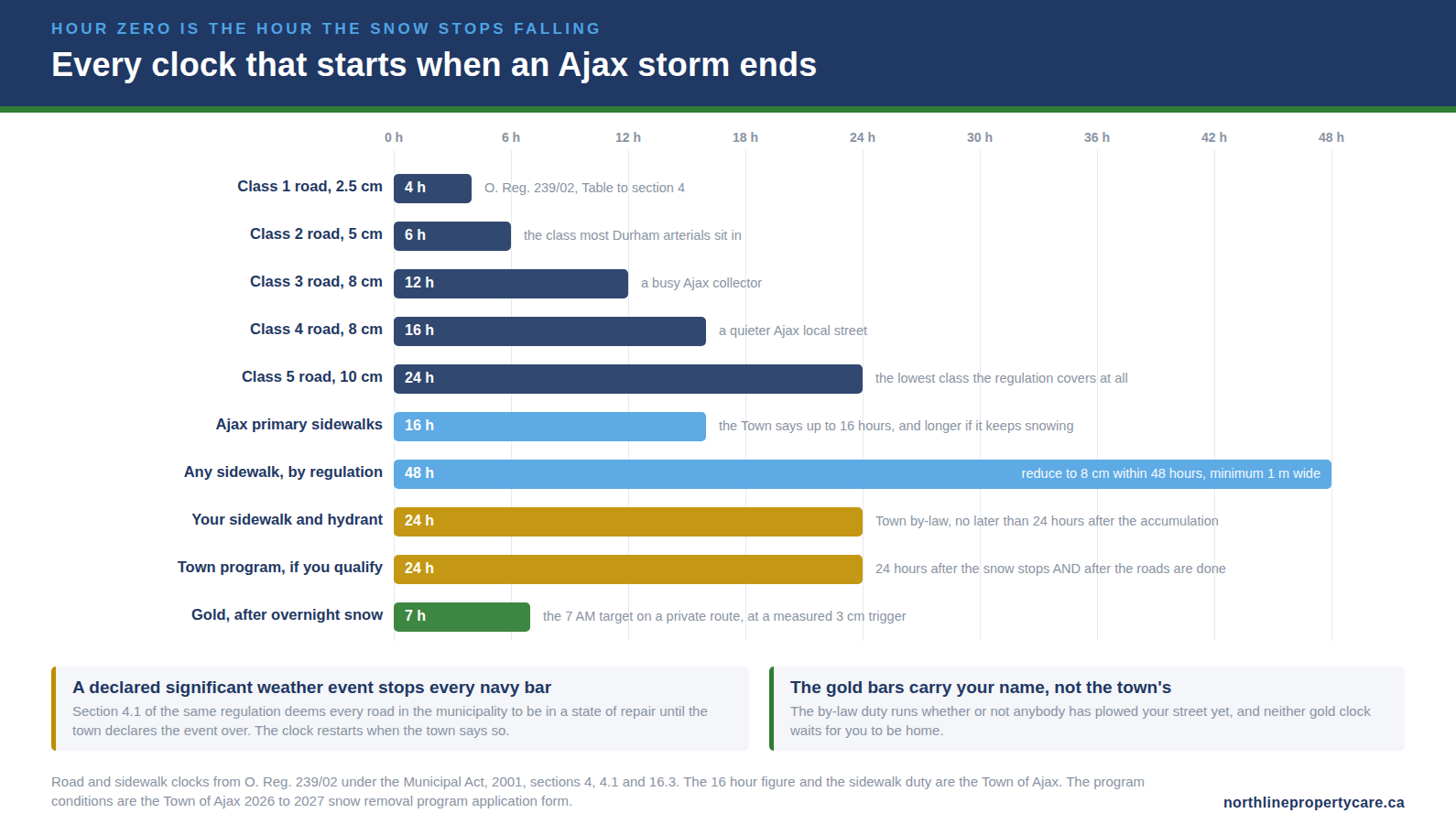
Ontario sets the clock, not the town, and the clock is slower than almost anybody expects. The Minimum Maintenance Standards for Municipal Highways, O. Reg. 239/02 under the Municipal Act, 2001, give each class of road a snow depth and a number of hours after the accumulation ends. Class 1 is 2.5 centimetres within 4 hours. Class 2 is 5 centimetres within 6 hours. Class 3 is 8 centimetres within 12 hours. Class 4 is 8 centimetres within 16 hours. Class 5 is 10 centimetres within 24 hours. Class 6 is not covered by the regulation at all.
A road's class comes from a table of average annual daily traffic against posted speed, so a busy Ajax collector and a quiet crescent off it can sit two or three classes apart. Meeting the standard is a complete defence for the municipality under section 44 of the Act, which is precisely why the standard exists. Sidewalks have their own clause: reduce the snow to 8 centimetres or less within 48 hours and provide at least a metre of walking width.
And a declared significant weather event pauses all of it. Section 4.1 of the same regulation says that when a municipality declares one, the standard becomes a duty to monitor the weather and to deploy resources if the municipality deems it practicable, and every road in that municipality is deemed to be in a state of repair until the municipality declares the event over. Ajax publishes its own description of this power and notes that during such an event winter maintenance service levels for roads and sidewalks may not be met. It is not a loophole. It is an acknowledgement that a storm can arrive faster than any fleet can answer it. What it does mean is that the worst day of the winter is the exact day on which the public clock legally stops, and that is the day a private arrangement is either in place or is not.
Read the two clocks side by side and the shape of the decision is obvious. The public standard on a residential street is measured in hours after the snow has finished. A private residential clearing contract on a membership is triggered at 3 centimetres and aims at a morning, which on Gold means a 7 AM target and on Platinum a 6:30 AM target with the property sequenced first. Those are different promises about different surfaces, and neither replaces the other.
Two by-law duties that stay yours, whoever clears the driveway
Your sidewalk and your hydrant belong to you for one day after every snowfall, and the Town collects on a missed deadline through the tax bill rather than through a notice. Under the Town's public nuisance and safety by-law the duty sits with whoever owns or occupies the property, it reaches a windrow as readily as a snowfall, it covers the fire hydrant on the frontage as well as the walking surface, and the deadline is a day from the moment the snow or the ice builds up. Where the deadline is missed, the Town points at its User Fees By-law for the amount and says the charge goes straight onto the property tax account, so there is no invoice to argue about. There is no invoice to argue with, which is an unusually effective piece of municipal design.
Snow you clear off your own property is not allowed to end up on the street, and this is the rule most often broken by the person working hardest. A separate clause of the same by-law forbids anybody moving snow off a property onto or over a road, a walking surface or somebody else's land unless they have been authorized to do it. Putting your driveway snow into the street is not a shortcut, it is an offence, and it creates the exact hazard the plow operator was avoiding when it left your windrow in the first place. Ask any prospective contractor where the snow is going before you ask what it costs, because on a small Nottingham or Duffins Crossing lot that answer is the whole job.
Two more Ajax specifics worth knowing. On street parking is prohibited overnight between 1 in the morning and 5 in the morning except by permit, permits are revoked during an active winter weather event, and the Town states that a car parked on the road while plows or salt trucks are working will be ticketed and possibly towed at the owner's expense. And the Town's parking rules require 3 metres of clearance from a fire hydrant and 1.25 metres from a driveway, which is worth remembering before you build a snow pile at the curb.
Who actually does plow driveways in Ajax, described by category and not by name
This page names no company, and the reason is a rule rather than a courtesy: nothing here cites, links to or takes a figure from any business that competes for the same customer. Every external fact above comes from the Town of Ajax, the Region of Durham, the Province of Ontario or the Government of Canada. That constraint is the reason this page can tell you things a comparison article cannot, and it is also the reason you will have to do the last step yourself. What follows is the shape of the market, so you can recognize which kind of operator you are speaking to.
The first kind is the seasonal contract operator. The price is fixed before the winter starts, service is triggered at a stated snow depth, and the number does not move whether the season brings four events or twenty four. That is the category Northline sits in. The second kind is the per storm operator, who charges per visit. In a quiet winter this is the cheapest answer available and in a heavy one it is the most expensive, and nobody knows which winter is coming in October. The third kind is the neighbourhood informal operator, often a young person with a machine, which works beautifully until the morning it does not and there is no second answer. The fourth is the landscaping firm running plows as winter fill, where the winter work is a way of keeping equipment busy rather than the main business, and the service level tends to follow that priority.
The questions that separate them are boring and they are the ones that matter. What depth triggers service, measured where. What time of day is the target, and is it a target or a promise. Is the walkway included or is it driveway only. Is salt included, charged separately, or not offered. Where does the snow get piled as the season builds. What happens on the third storm of a week when everybody is behind. Is the agreement in writing, because Ontario's consumer protection rules require a written copy of an agreement of this kind and give a cancellation right where one is not provided. And is there a certificate of insurance and a clearance certificate from the Workplace Safety and Insurance Board, which takes one email to ask for and tells you a great deal about the answer you get back.
One point of law that almost nobody raises and everybody should. Since the Occupiers' Liability Act was amended, a claim for personal injury caused by snow or ice has to be notified in writing within 60 days, and the Act names the snow and ice removal contractor alongside the occupier as a person to whom that notice may be given. If a letter of that kind ever arrives at your house, it goes to your contractor immediately, and if it arrives at your contractor, the Act obliges them to send it to you. A contractor who does not know that is telling you something about how they run the rest of it.
Salt, and the compliance claim you should not believe from anybody
Road salt is assessed federally and the honest summary is narrower than the way it is usually sold. Environment and Climate Change Canada assessed road salts in 2001 and concluded that they meet the criteria in paragraphs 64(a) and (b) of the Canadian Environmental Protection Act, 1999. Road salts were then never added to the List of Toxic Substances. The instrument Canada reached for instead was a voluntary Code of Practice for the Environmental Management of Road Salts in 2004. It bites only on an organization spreading over 500 tonnes in a year, averaged across five, and it carves out domestic, private and institutional salting by name.
That exclusion is the point. No residential contractor in Durham Region is covered by the federal code, so any claim to be compliant with it is a claim about a document that does not apply. What a contractor can honestly say is that the code's practices are followed voluntarily: calibrate the spreader, match the application to the pavement temperature rather than the air temperature, and stop applying below the point at which sodium chloride stops working. The Region does exactly this on its own roads with pre wetted salt and brine, and publishes that it does.
The environmental figures are worth carrying because they make the restraint concrete rather than decorative. The Canadian water quality guideline for chloride in fresh water is 120 milligrams per litre long term and 640 short term. Salt applied to an Ajax driveway leaves that driveway, and in the south end of town it reaches Duffins Creek, Carruthers Creek or the lake within a very short distance. Using less of it is not a marketing position, it is the correct amount.
Where your windrow comes from, and why some Ajax driveways get two
The ridge across the end of your driveway is not snow that fell there, it is snow the blade carried down the street and had to put somewhere. How much of it lands on you is decided by three things that have nothing to do with the size of your lot: the direction the plow travels on your street, where your driveway sits on the block, and whether your street gets a second widening pass later in the day.
A plow casts to one side. Snow moves toward the curb the truck is running beside, so on a street cleared in a single direction the driveways on the casting side inherit the whole block's load while the driveways opposite them inherit very little. Two houses facing each other on Ravenscroft can have completely different mornings out of one storm, and neither household is imagining it.
A corner lot collects from two streets, and a driveway in the bulb of a court collects from all of it. Deer Creek and Salem Heights carry a lot of corner properties with the driveway set close to the intersection, and those pick up the turning load on top of the run. A cul-de-sac is worse again, because a plow sweeping a circle has nowhere to shed what it has gathered except the outer edge, and the outer edge is exactly where every driveway on that court is. The Town's own windrow material makes the same point from the other direction when it notes that newer developments have limited space to store snow.
Then there is the second pass, which is the source of most of the anger on an Ajax street in January. The first run opens the lane. The widening or cleanup run pushes the snow back to the curb properly, and it can arrive several hours behind the first. That is how a driveway cleared at seven in the morning acquires a fresh ridge by lunchtime, and it is not a contractor failing to finish. It is two municipal passes doing two different jobs on one street.
What follows from all of that is practical. Do not build your snow pile on the side of the driveway the plow is travelling toward, because you will be given it back. Do not clear the driveway mouth before the street has been plowed unless you enjoy doing it twice. And if the street is regularly getting a late second pass, the thing worth buying is the return, not the first visit. On a membership the return is part of the arrangement. Outside one, a windrow return trip is $45 plus HST and a salt only trip is $25 plus HST, which is a fair price for a single bad morning and a poor way to buy a whole winter.
The part that argues against us
If you qualify for the Town of Ajax program at Level 2, no private quote in Durham Region is going to beat $41.13 for a season of windrow clearing, and you should take it. The only reasons to buy privately alongside it are the two conditions on the program: the 5 centimetre trigger and the wait until both the snow has stopped for 24 hours and the roads are finished. If being out of the driveway on a work morning is the thing that matters, those conditions are the answer to why, and if it is not, the program is simply the better deal.
Second. If you are physically able, you own a two stage machine you are happy with, and your driveway is a standard Ajax subdivision run, a seasonal contract is a convenience purchase rather than a necessity, and it is fair to describe it that way. Plenty of people on Clover Ridge clear their own driveway for thirty years and are right to.
Third. Silver at $129 a month does not plow the driveway. What it is instead is the lawn membership carrying a real but narrow winter half: the ridge across the driveway mouth dealt with on a daytime pass after every storm, four full clears banked for the season and released on request, and no salt at any depth. It is the wrong product for anybody whose real requirement is a clear driveway on a weekday morning, and every winter somebody buys it thinking otherwise. The tier that plows the driveway to a morning target is Gold at $189 a month plus HST.
Fourth. A route only holds so many driveways if every one of them is going to be clear by a morning target, so it closes when it is full and does not reopen that winter. That is a real reason to decide in October rather than in December, and it is also the reason nobody can promise you a place in January.
What we could not verify
An article that reports only what it found is not showing its method, so here is the other half. The Town of Ajax publishes no snow depth at which its own road plowing begins. The 5 centimetre figure above belongs only to the seniors program, and a separate 4 centimetre figure belongs to the Region of Durham for regional roads, which is itself a number that does not appear anywhere in the regulation the Region cites for it. Neither of those figures is an Ajax road trigger and neither is reported here as one.
The Town publishes no completion time for residential roads. The only published figure is up to 16 hours for primary sidewalks, with the Town adding that it takes longer if the snow continues. The 10 to 12 hour figure in the 2019 windrow report is a target for a program that was never adopted, not a current service level, and it is not treated as one above.
No Ajax winter control budget total, cost per storm or seasonal salt tonnage could be found. The 2026 operating budget booklet carries no winter control line item. The number of plows and sidewalk machines in the Town fleet is not published anywhere we could reach, and the Region's fleet figure is region wide and is not Ajax's.
The number of the Town's current public nuisance and safety by-law could not be confirmed. The Town's own download link is labelled with one number and serves a document identifying itself as another, so the wording of the snow clauses is quoted above and the by-law number deliberately is not. Ontario's e-Laws site would not render for us, so the regulation and statute text above was taken from municipal and legislature reproductions rather than from a certified consolidation, and the consumer protection framework is in the middle of being replaced, so no section number of it is printed on this page.
Questions people in Ajax actually ask
Who plows driveways in Ajax after a snowfall?
Nobody the Town of Ajax employs, and nobody the Region or the Province employs either. The Town maintains over 400 kilometres of road and 150 kilometres of sidewalk and its winter control material states plainly that clearing snow at the end of a driveway, windrows included, belongs to the homeowner. A private driveway in Ajax is cleared by the person who lives there or by somebody they hire, and the only exception is the Town's fee based program for seniors and qualified residents.
Why does the snow plow leave a ridge across my driveway in Ajax?
Because a blade that lifted at every driveway would drop that snow on the road instead. The Town puts it directly: raising or lowering the front plow or the side wing at a driveway would leave snow deposited on the travelled portion of the road, and that is unsafe for the people driving on it. The ridge is therefore a consequence of clearing the street rather than a mistake, and it is why the Town assigns it to the property owner instead of promising to come back for it.
How much does the Ajax snow removal program for seniors cost?
The Town's 2026 to 2027 application form sets two service levels. Level 1 covers the driveway area, the windrow, the municipal sidewalk and a pathway to a specified door at $360.70 including HST. Level 2 covers the windrow and the municipal sidewalk only at $41.13 including HST, and that windrow only tier is remarkable value. Service runs after more than 5 centimetres of snow, 24 hours after the snow has stopped and after the Town plows have finished the roads. Both amounts are footnoted as subject to change on January 1 2027, so confirm them on 905-683-2951 before relying on either.
Who is eligible for the Town of Ajax snow removal program?
Two routes in, and the Town closes both of them carefully. Either the applicant has passed 65 and nobody able bodied and younger than 65 lives at that address, or the applicant cannot do the work because of a physical disability and a doctor confirms it, which has to be confirmed again each year unless the condition is permanent. Applications go to Operations and Environmental Services at 65 Harwood Avenue South or to the operations mailbox, and the Town adds an applicant to the program about seven business days after the application is processed. The Town publishes no closing date, which is not the same thing as having no queue.
Which roads in Ajax are not the Town's to plow?
Bayly Street, Church Street, Westney Road, Salem Road, Taunton Road, Kingston Road as Regional Highway 2 and Lake Ridge Road on the Whitby boundary are all Regional Municipality of Durham roads, carrying regional road numbers 22, 24, 31, 41, 4 and 23. Highway 401 and the 412 and 407 links are the Province. Harwood Avenue, Audley Road, Ravenscroft Road and the residential streets are the Town. It matters because the body that plows the street beside your house is not always the body you would call about it.
Am I legally required to clear the sidewalk outside my Ajax house?
Yes, and the hydrant on your frontage comes with it. Under the Town's public nuisance and safety by-law the duty falls on the owner or the occupier, it covers a windrow lying across either one, and the clock is 24 hours from the moment the snow or ice builds up. A missed deadline is not billed as an invoice you can dispute: the Town states that the charge is added straight onto the property tax account. Moving your own snow onto a road, a walkway or a neighbour is separately forbidden.
Who wrote this
Andrew owns Northline Property Care and sets the price on an Ajax property himself before anything is booked on it. Six Durham winters of clearing snow sit behind the judgements above. They are his, not the business's, and the business has been trading for a fraction of that time, which is a distinction this page would rather state than blur. Whoever quotes your property is whoever turns up to clear it, which means one accountable name rather than a dispatch desk, nothing subcontracted out, and nobody arriving that you were not told about.
Every external figure on this page comes from a municipality, a region, a province or a federal department, and not one comes from another property care company. Anything on this page that turns out to be wrong can be reported on 905-244-5779, and the correction goes onto the page instead of into an argument.
Read next
Snow removal in Ajax
The service page for this town, from the lakeshore neighbourhoods up past Taunton, with what a winter on each kind of Ajax street actually looks like.
See the Ajax page →Every windrow program in Durham
What each municipality does with the ridge the plow leaves, which ones run an assisted program, what each one charges and when each one closes.
Compare the towns →What it costs in Ajax
The seasonal bands for an Ajax driveway, what moves a quote up or down, and the arithmetic behind paying once instead of paying per storm.
Read the Ajax costs →The work, photographed
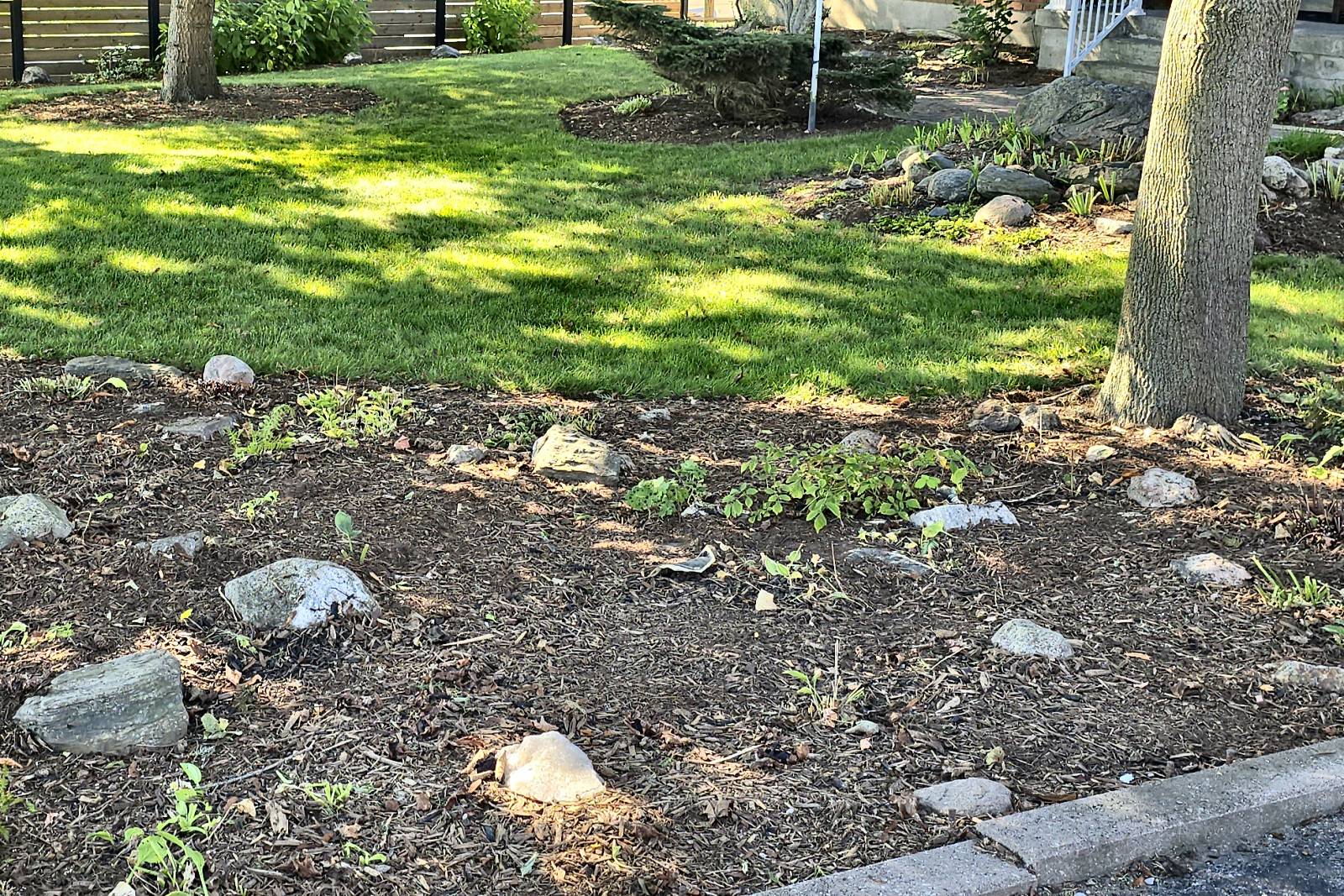
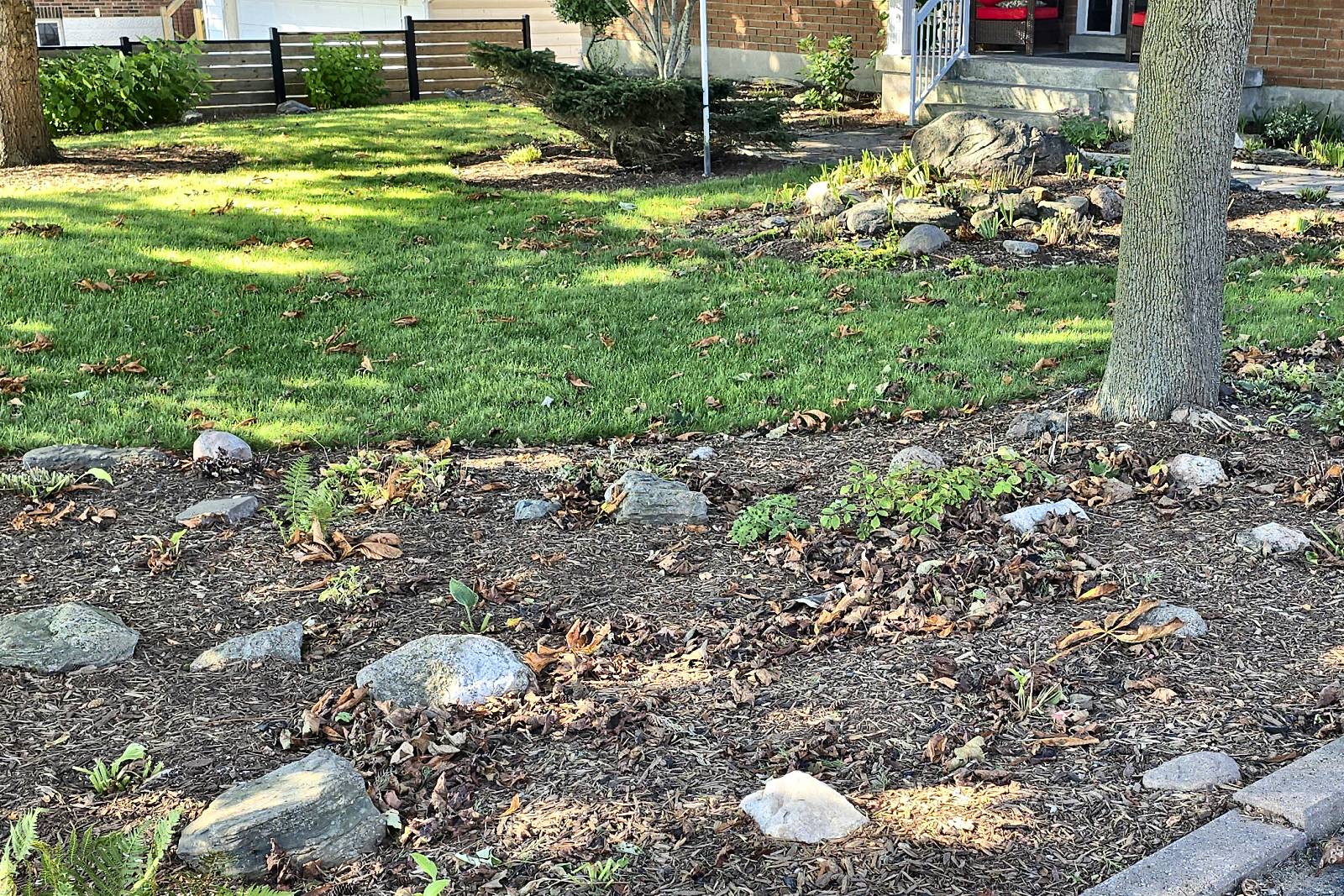
Real Northline properties, before and after, every one of them in Oshawa and every one of them this year. Drag the line to compare.
Andrew answers, October 2026
Why is the morning clearing time a target rather than a promise?
Because a promise about the morning is a promise about the weather, and nobody can make one of those honestly. What I can promise is where you sit in the route and the order the route runs in, and both of those are published on this site. In eighteen years of Oshawa data the worst winter had twenty four clearing days and the mildest had four, and a promise written to survive the worst of those is a promise priced for it. A target I actually hit is worth more to you than a promise I have quietly priced the risk of breaking.
One of these goes on each page and it is replaced monthly. If the question you have is not here, ask it: 905-244-5779.
Find out what your own Ajax driveway costs, before the route fills
Send the address and, if you are north of Taunton Road, the acreage and the laneway length. Back comes the band, the season price and exactly what it covers, on the same day, for your property rather than for a category. If the Town program is the better answer for your household, that is what you will be told.