Snow removal · Ajax pricing
How Much Does Snow Removal Cost in Ajax?
How much does snow removal cost in Ajax? A standard driveway is $975 plus HST for the season. The Town of Ajax costed the windrow itself in 2019, at $1.8 million a year, and then did not buy it.
Every band on one page. Compare the three pricing models across Durham.
Green in summer. Clear in winter.
The short answer, in numbers
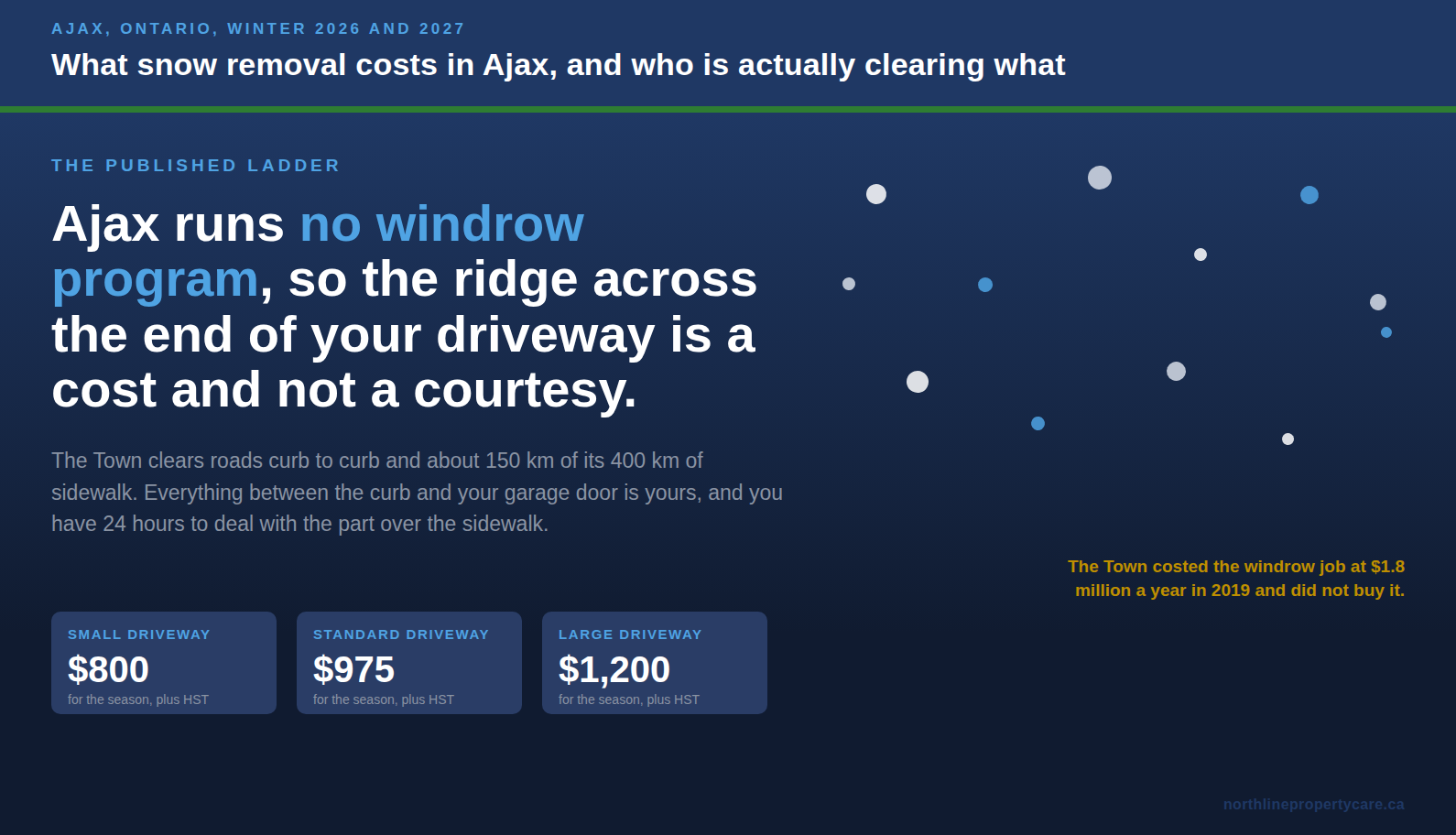
A standard Ajax driveway on a seasonal snow package is $975 plus HST for the whole winter. Northline Property Care clears driveways in Ajax, from Pickering Village through to Audley and Northeast Ajax, on a seasonal contract with unlimited clears. Small driveways are $800 and large ones are $1,200, all plus HST, and all three cover the driveway, the walkway and salting, with no cap on the number of clears. Booking closes on November 1.
If you want the lawn and the snow on one payment instead, memberships run from $129 a month plus HST. The entry tier does not plow the driveway and does not salt, so read the next paragraph before you pick it on price alone. Gold is $189 a month plus HST, which is $213.57 on the card, and it is the tier that plows the driveway and carries the 7 AM target after overnight snow. Platinum is $279 a month plus HST, sequenced first at a 6:30 AM target with automatic salting.
The honest version of the entry price is this. Silver at $129 a month clears the windrow across the end of your driveway by 5 PM and banks four full clears a season on request. It does not plow the driveway after every storm. If what you want is a clear driveway at breakfast, Silver is the wrong product and we would rather say so here than take the payment and watch you learn it in January.
Bigger properties are priced by lot size rather than by argument. An Ajax lot between 0.35 and 1.0 acre, or a driveway longer than 100 feet, sits in the Estate band at $1,750 for the season, with memberships at $229, $349 and $499 a month. Between 1.0 and 3.0 acres, or a laneway over 250 feet, the Grand Estate band is $2,600 for the season, with memberships at $329, $519 and $739. A laneway past 400 feet adds $200 for each further 100 feet, published as a formula so nobody has to drive out to quote it. Above three acres there is no published price, because above three acres a blanket formula stops being honest.
Two small numbers that are easy to forget when you are comparing: a salt only trip is $25, and a return visit to clear a windrow the municipal plow put back after we had gone is $45.
The Town of Ajax priced this job itself, and then did not buy it
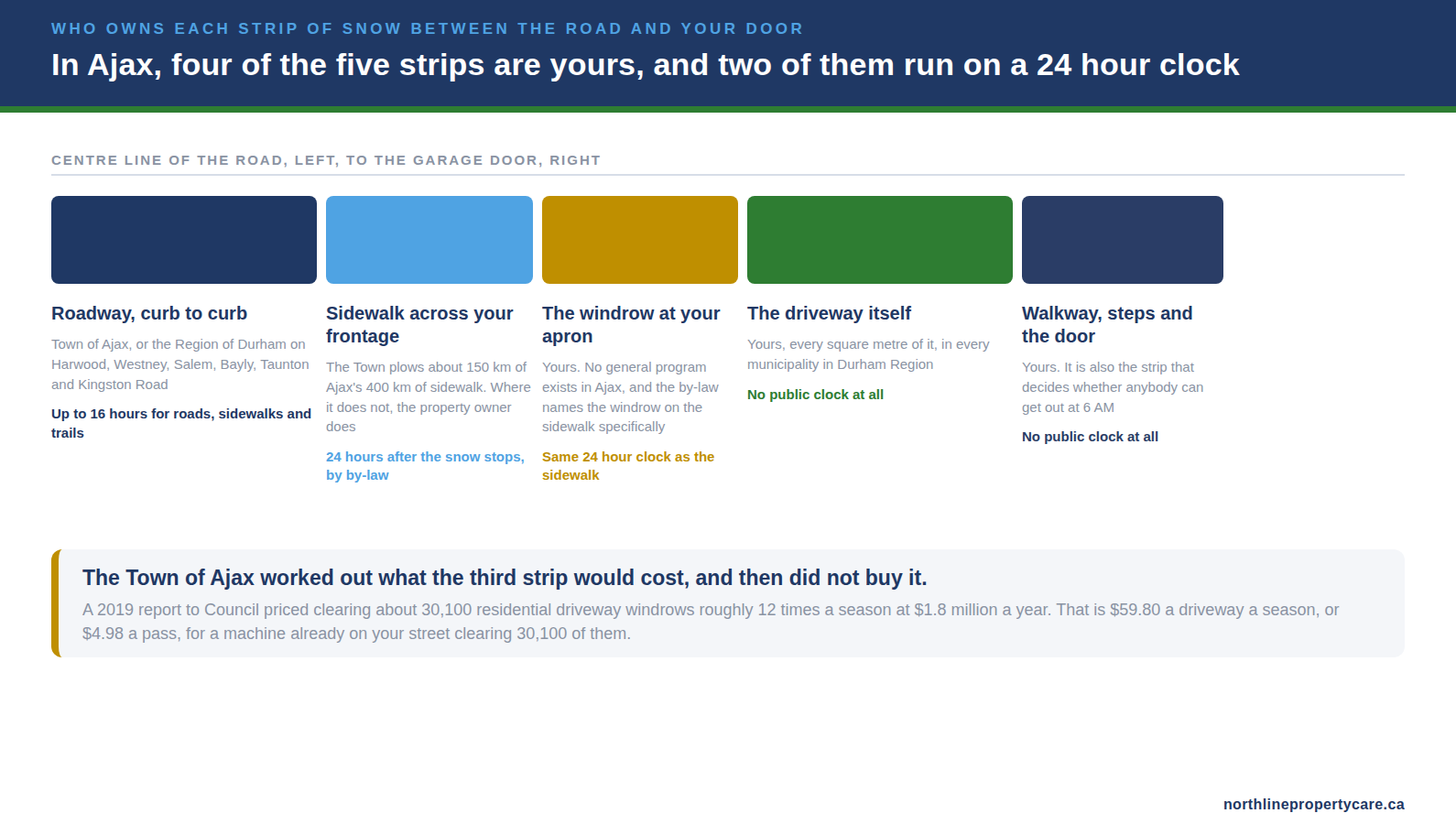
The single most useful number in any conversation about snow pricing in Ajax was published by the Town of Ajax, not by a contractor. A staff report titled Windrow Clearing went to Council on October 15, 2019. It priced a municipal windrow service at $1,800,000 a year, based on clearing approximately 30,100 residential driveways an average of 12 times per season, at a proposed standard of clearing within a 10 to 12 hour window after road plowing finished. The recommendation was that Council receive the report for information. Nothing was adopted. You can read it at the Town of Ajax windrow clearing report.
Work the arithmetic through, because it is the part nobody does. One point eight million dollars across 30,100 driveways is $59.80 a driveway for the season. Across twelve passes that is $4.98 a pass. That is the municipal cost of pushing one ridge off one apron when the machine is already on your street and has 30,100 of them in a row.
That number is the reason a private windrow only service cannot be sold for five dollars, and it is worth understanding rather than resenting. The Town's figure is what density buys. A contractor covering a residential route in Ajax is driving between properties that are not adjacent, on a night when every street needs doing at once, in a truck that has to be insured, plated and fuelled whether it clears four driveways or forty. The machine is not the expensive part. The drive between the driveways is.
It also settles an argument that comes up at almost every door. People in Ajax often assume the windrow is a municipal responsibility that has been quietly dropped. It was never adopted in the first place, it was costed properly, and the number was judged not worth the tax line. Knowing that changes what you are shopping for: you are not chasing a service you already pay for, you are buying one nobody in Ajax provides for free.
What the Town of Ajax actually clears, and the sixteen hours
The Town clears roads curb to curb on a priority basis, and about 150 km of Ajax's 400 km of sidewalk. Its own winter page puts the whole operation at over 400 km of roads, 150 km of sidewalks, 37 km of trails, 27 parking lots and 53 school crossings, and states that snow clearing of roads, sidewalks and trails can take up to 16 hours to complete. Primary roads, the ones feeding regional roads, schools, community centres and industrial areas, go first. Secondary roads named on that page include Ravenscroft, Williamson, Burcher, Monarch and Clover Ridge. Residential streets, sidewalks, trails and parking lots are the third priority. The source is the Town of Ajax winter response information page.
Two dates on that page matter more than most people realize. Snow control starts on November 15. Proactive patrols begin on November 1 or earlier during inclement weather. That is two weeks of November in which the Town is watching rather than working, and it is exactly the stretch in which a first wet snow lands on a driveway nobody has arranged for.
The bigger roads in Ajax are not the Town's at all. Harwood Avenue South, Westney Road, Salem Road, Bayly Street, Taunton Road, Church Street and Kingston Road are Regional Roads, maintained by the Region of Durham and listed on the Region of Durham regional roads list. The Region publishes very little about how it clears them. Its road maintenance page states only that Regional roads are patrolled seven days a week and that winter maintenance equipment is deployed if needed. There is no depth trigger, no hours to clear and no priority table on the Region's own road maintenance page.
The practical effect for an Ajax homeowner living off a regional road is that two different authorities, on two different schedules, can both push snow across the end of your street on the same night. Neither of them is coming down your driveway afterwards.
Ajax publishes no snow depth trigger, and the provincial floor is ten centimetres
The Town of Ajax does not publish a centimetre figure at which it begins plowing residential roads. Six separate Town pages were read for this article and the only depth the Town publishes anywhere is the 5 cm that activates its senior program. That is not a criticism. Most Ontario municipalities work to the provincial standard rather than to a published local promise.
The standard is Ontario Regulation 239/02, the minimum maintenance standards for municipal highways, at the Ontario e-Laws copy of the regulation. It sets a snow accumulation depth and a clearing time for each class of road. Class 1 is 2.5 cm and four hours. Class 2 is 5 cm and six hours. Class 3 is 8 cm and twelve hours. Class 4 is 8 cm and sixteen hours. Class 5, which is where an ordinary residential street in Ajax sits, is 10 cm and twenty four hours.
Read that last line slowly, because it is the one that surprises people. Nine centimetres of snow can sit on a residential street in Ajax and nothing at all is legally owed. When the depth does pass 10 cm, the clock that starts is twenty four hours, and it starts when the snow stops, not when it starts. The regulation also lets a municipality declare a significant weather event, and while that declaration stands, every roadway in the municipality is deemed to be in a state of repair with respect to snow accumulation. The Town of Ajax cites that provision on its own winter page.
None of this is an argument that the Town is doing badly. It is an argument about what you are actually buying when you pay somebody privately. You are not buying a faster version of the municipal service. You are buying the only service that exists for the surface you park on.
Check the Town's program before you check our price
If you are 65 or older, or you have a physical disability confirmed by a doctor, call the Town before you call anybody in this industry, including us. Ajax runs a Senior Snow Removal Program through Operations and Environmental Services on 905-683-2951, Monday to Friday, 8 AM to 4 PM. The eligibility the Town publishes is residents 65 years of age or older with no able bodied person under 65 living at the address, or a resident unable to do the work because of a physical disability as indicated by a doctor's note. Applicants are added within seven days of processing. Details are on the Town of Ajax winter roads maintenance page.
Two things about that program are worth knowing before you sign anything private. It is a fee based program rather than a free one, and the Town does not publish the fee, so the call is the only way to get it. And it activates 24 hours after snow has stopped falling and only where more than 5 cm has fallen, which the Town states plainly on its snow tips and reminders page.
So the program is the right answer for some households and the wrong one for others, and the deciding factor is not money. If you are retired, at home, and the driveway simply has to be passable by the afternoon, the Town's program is very likely the better value and we will tell you so. If somebody in the house leaves for a shift at 6:30 AM, a service that begins a full day after the snow stops does not solve the problem you actually have. That is the whole comparison, and it has nothing to do with who is cheaper.
The 24 hour clock across your frontage is yours, windrow included
The Town's Public Nuisance and Safety By-law puts the sidewalk in front of your house on a 24 hour clock, and it names the windrow specifically. The operative words are that every owner or occupier of property shall remove snow or ice, including a windrow, from any sidewalk and from any fire hydrant on or bordering that property, no later than 24 hours after the accumulation of snow or ice. The Town's plain language pages say the same thing in fewer words: ice and snow must be removed from the sidewalk surrounding your home within 24 hours of a snowfall. The by-law is published at the Town of Ajax by-law library.
The same by-law prohibits shovelling, plowing or blowing snow from any property onto or across a roadway, a sidewalk, a pedestrian walkway or another property without authorization. That one catches more Ajax homeowners than the sidewalk clause does, because the obvious place to put a driveway's worth of snow on a narrow lot is across the road, and doing it is an offence rather than a discourtesy.
Parking is the third clock and the one that costs the most on a storm night. Ajax has no dated winter parking ban of the kind Toronto runs. What it has instead is a year round prohibition on parking between 1 AM and 5 AM without a permit under Traffic By-law 45-2020, a three hour limit outside those times, and a storm rule with no tolerance in it: vehicles may not be parked on Town streets during winter storm events, and occasional use permits are expressly not valid during active snow events, which the Town says could include the day before, during or after the event. The consolidated by-law is at the Town of Ajax traffic by-law.
This is a real operational constraint for anybody clearing Ajax in the small hours, and it is the reason we ask on the quote form how many vehicles live at the property. A driveway with two cars that cannot legally go to the street overnight is a different job from an empty one, and pretending otherwise is how a route falls behind on the first big night.
What a winter in Ajax is, counted in clears rather than centimetres
Ajax has no climate station with published normals, and anybody quoting you an Ajax snowfall figure is quoting an interpolation. We checked both the 1981 to 2010 and the 1991 to 2020 Environment Canada normals inventories for Ajax, Pickering, Whitby, Claremont, Uxbridge, Markham and Stouffville. None of them has one. The nearest station with published normals is Oshawa, about 15 km east on the same lakeshore, and the honest thing to do is to say that out loud rather than to dress an Oshawa number up as an Ajax one.
On the 1991 to 2020 normals, Oshawa records 101.7 cm of snow a year, 26.8 days with measurable snowfall, 7.8 days with 5 cm or more, and 2.5 days with 10 cm or more. January and December carry almost half of it between them. The figures are published at the Environment and Climate Change Canada climate normals archive.
Centimetres are the wrong unit for a price conversation, though, and clears are the right one. Our own trigger for a residential property is 3 cm of measured accumulation, and eighteen complete winters of daily Oshawa records at that trigger give an average of 11.4 days, a median of 12, a mildest season of 4 and a worst season of 24. That spread is the entire argument for and against a seasonal price, so here it is drawn out rather than described.
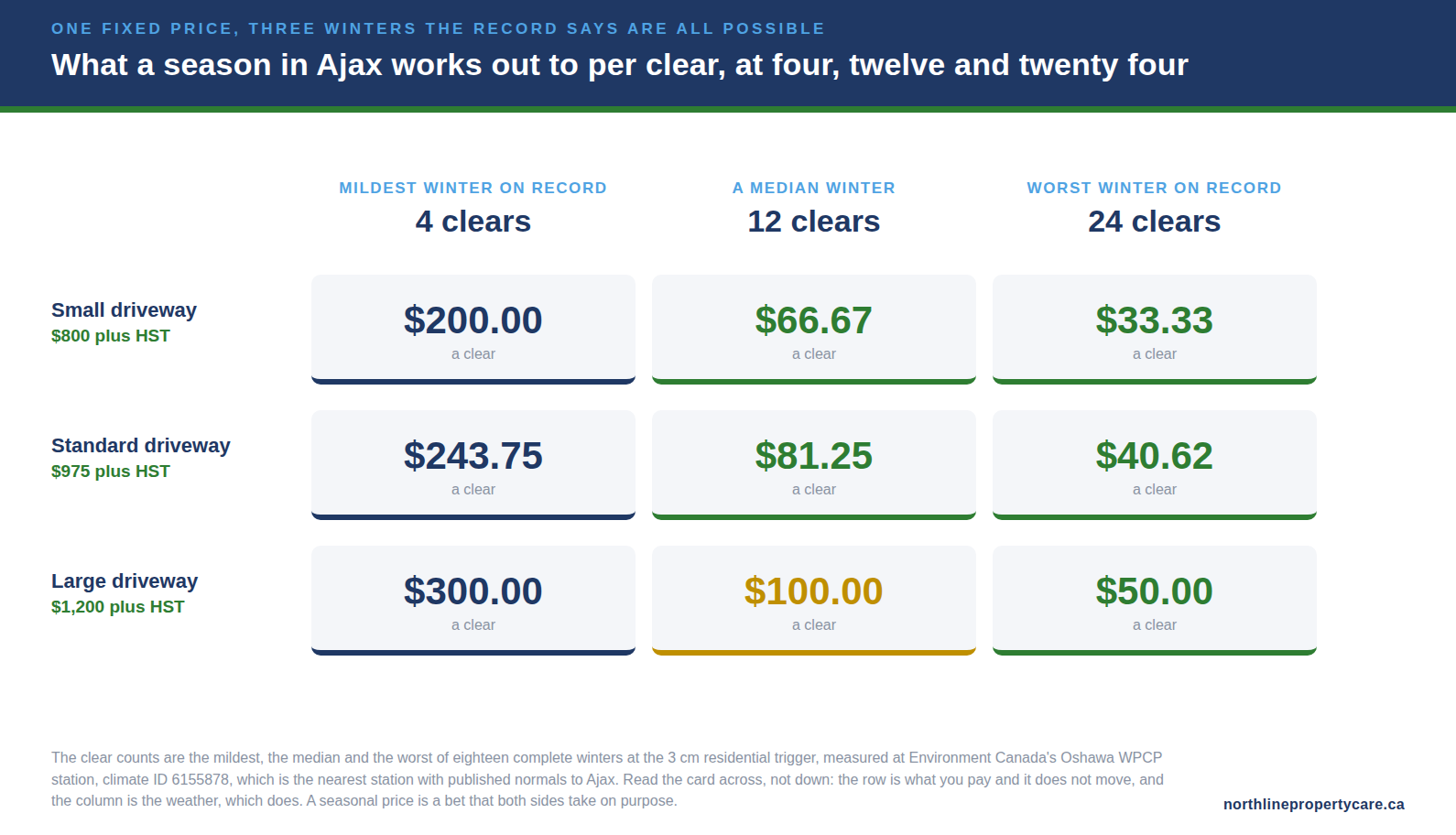
In the mildest winter in that record, a standard Ajax driveway on the seasonal package works out to $243.75 a clear and you have overpaid. In the median winter it is $81.25. In the worst winter it is close to $40 and we have worked most of the season for nothing. We are not going to pretend the first column does not exist, because you will work it out yourself in March and then never call again.
What the price actually buys is that the figure stops being your problem. Four clears or twenty four, the payment does not move. That sentence survives every winter. An average does not, and any operator who wins the price argument on an average of twelve is going to lose it on a winter of four.
North Ajax is not the same job as the lakeshore, and the ground says so
Ajax is flatter than people think and the land north of it is not. Natural Resources Canada's elevation service puts the Rotary Park end of Ajax at about 83 m, the Highway 401 and Harwood area at about 99 m, and Taunton Road at Salem at about 106 m. Greenwood is about 134 m, and Claremont, twenty kilometres up, is about 254 m. So inside the Town boundary the climb is roughly 23 m, which is almost nothing, and the real rise starts north of Ajax entirely.
That matters because the snowfall difference over that rise is large. Environment Canada's 1991 to 2020 normals give Buttonville, at about 198 m and roughly 25 km inland, 146.4 cm a year against Oshawa's 101.7 cm on the lakeshore. That is more than forty per cent more snow for about 115 m of elevation. The interesting part is where the extra snow sits: days with 10 cm or more are almost identical at the two stations, 2.8 against 2.5. The inland station is not getting more big storms. It is getting more small and medium ones.
We should be careful about how far that is pushed, and we will be. Those are two station records, not a published study of a Durham snowfall gradient. No government or university source we could find quantifies the difference between the Ajax lakeshore and the ground north of Taunton Road. The closest local work is the Toronto and Region Conservation Authority's technical reporting for the Duffins Creek and Carruthers Creek watersheds, which records growing season precipitation ranging from 380 mm along the moraine to 356 mm along the Lake Ontario shore, and higher potential evapotranspiration at the shore than on the moraine. That is rainfall and water balance, not snow. It is at the TRCA Duffins and Carruthers watershed technical reports.
What we will say from the truck is narrower and we can stand behind it. A property in Audley or off Rossland in the north end of Ajax tends to need the blade on days when Pickering Village and the south end of Harwood need salt and a walkway. Over a season that is a handful of extra clears on the same fixed price, which is one of the reasons the price is fixed.
Next door, Pickering publishes the same idea as a map instead of a sentence. That city splits itself into four snow load zones running from 1.0 kilopascals at the water up to 2.3 at its northern boundary, which is the plainest municipal statement in Durham that one municipality can hold two different winters. It is read in full in what snow removal costs in Pickering.
What actually moves an Ajax quote, in the order it moves it
Lot size moves the price more than anything else, and it is the one thing you can check before you call. Your acreage is on your property tax bill and on the listing the house last sold under. Anything at or under about a third of an acre with a normal two car driveway is the standard band at $975. Past 0.35 acre, or past 100 feet of driveway, the Estate band applies. We quote the band the lot size gives, and we move up a band if the driveway says so, never down.
Driveway shape is second, and it is where most of the difference between two identical lots comes from. A straight run to an attached garage is the cheapest shape there is. A circular driveway, a shared mutual driveway of the kind found in older parts of Pickering Village, a driveway that turns behind the house, or a driveway that slopes down to a below grade garage all cost more, because the snow has to go somewhere and each of those shapes takes away the place it usually goes.
Third is where the snow can be stacked, and in the newer Ajax subdivisions this is the quiet problem. On a 30 foot frontage in Audley or Northeast Ajax with a widened driveway and a small front lawn, there is very little bank left by February. That is not a reason to charge more in November. It is a reason to agree in November where the third storm goes, rather than in the dark during it.
Fourth is surface. Interlock aprons, exposed aggregate and a settled asphalt edge all change how a blade is set and how much salt is reasonable to use. That is a service decision rather than a price decision on a residential driveway, but it is a conversation worth having at the quote rather than after.
Fifth, and last, is the number of vehicles that live at the property overnight, for the parking reason above. Nothing else on this list is worth a price change and we will not invent one.
Three ways to buy it, and the arithmetic that picks one
Per clear buying is the right answer for exactly one household: the one that can wait. If your household can leave the driveway for a day or two, has somewhere to park, and a person who can push a path to the car, then calling somebody after a big storm and paying once or twice a winter beats any contract. We will not pretend otherwise. The catch is that everybody calling on the morning after a 20 cm night is calling the same afternoon, and price is the least of it.
A seasonal snow package at $800, $975 or $1,200 plus HST is the right answer for the household that needs the driveway open and does not want to think about the weather. It is one number, it covers the driveway, the walkway and salting with no cap, and it is the only seasonal snow price we publish for a standard property. It is bought before November 1 because the route is sequenced once, in October, and a route has to have its order settled before the first storm rather than in the middle of one.
A monthly membership is the right answer for the household that also has a lawn. Twenty six weekly cuts through the summer, the spring cleanup, the fall cleanup and the winter on one payment on the last day of every month. Gold at $189 a month is $2,268 for the year. Weekly mowing bought on its own without a membership starts at $75 a cut, so twenty six cuts is $1,950 plus HST for the grass and nothing else. The difference between those two figures is $318, and that $318 is the entire winter.
If prepaying suits you better than twelve payments, the annual prepay takes five per cent off: $1,470.60, $2,154.60 or $3,180.60 depending on the tier. It is raised as a single invoice rather than a recurring job.
One thing we do not offer, and it comes up: there is no residential bundle discount. The membership is already the bundle. Commercial work is a different product with its own trigger at 5 cm. A residential driveway clears at 3 cm.
The ground under an Ajax driveway, and why the edges go first
The Ajax lakeshore sits on heavy, stonefree lacustrine clay laid down under glacial Lake Iroquois, and that is why driveway edges in this town fail the way they do. The Soil Survey of Ontario County, surveyed in 1949 and 1950 and published by the federal Experimental Farms Service with the Ontario Agricultural College, maps the Schomberg series across this shoreline: developed from stonefree clay, very calcareous, surface texture varying from a silt loam to a clay loam, and mapped along the Lake Ontario shore more than anywhere else in the county. The survey is at the Agriculture and Agri-Food Canada Canadian Soil Information Service.
Clay holds water, and water that freezes in clay lifts whatever is on top of it. Twenty kilometres north, on the Oak Ridges Moraine at Greenwood and Claremont, the same survey maps the Pontypool series, irregularly stratified calcareous sands and gravels. Sand drains and does not lift nearly as much. That contrast explains why an interlock apron in south Ajax moves over a winter and the same apron on a moraine lot does not.
Here is the part that surprises trades as well as homeowners. There is no legislated frost depth for southern Ontario. The Ontario Building Code that was in force until the end of 2024 stated in plain words that depth of frost penetration shall be established on the basis of local experience, at the e-Laws copy of Ontario Regulation 332/12, and the current code adopts the National Building Code of Canada 2020 with Ontario amendments at Ontario Regulation 163/24. Ontario's own watermain design criteria simply require cover greater than the depth of frost penetration without naming a number. Every fixed centimetre figure you have heard for the Ontario frost line is a trade rule of thumb, not a code requirement.
The operating consequence is small and specific: we set a blade high on a first pass over a clay driveway in November and December, because the surface it is riding on is still moving. A contractor who sets low in December and low again in February is a contractor whose customers have chipped edges by April.
The forecast we would rather not publish
The published expectation for this winter is a strong El Nino, and a strong El Nino is usually the wrong winter to sell a seasonal snow contract in. The United States Climate Prediction Center's ENSO discussion of September 10, 2026 has an El Nino Advisory in force, describes El Nino as strengthening with a greater than 90 per cent chance of a very strong event through the northern hemisphere autumn and winter of 2026 and 2027, and puts a 75 per cent chance on a historic event from October to December exceeding anything back to 1950. The discussion is at the NOAA Climate Prediction Center ENSO advisory. Its seasonal outlook discussion of September 17 leans warm across the Great Lakes and carries a weak signal for below normal precipitation there, consistent with past El Nino winters.
Nobody has turned that into an Ajax snowfall number and we are not going to be the first. What it means for your decision is that the mildest column of the chart above is more likely this winter than it would be in an average year, and you should weigh it accordingly.
One more thing about warnings, because the old numbers are still being quoted at doors. Environment and Climate Change Canada retired its fixed centimetre criteria for public weather alerts and replaced them with impact based guides that contain no snowfall thresholds at all. The old criteria page now carries nothing but a notice pointing at the replacement, and the new guides describe consequences rather than depths. They are at the Environment and Climate Change Canada weather impact guides. If somebody quotes you a snowfall warning threshold in centimetres for Ontario, they are working from a page that was withdrawn.
What we could not verify
Every external figure above came from a municipality, a region, a provincial regulation, a federal agency or a federal soil survey. Not one came from another lawn care, landscaping, snow removal or paving company, and where a fact existed only on such a site it was dropped rather than repeated. Here is what that method could not settle.
The by-law number. The Town of Ajax lists its current instrument as the Public Nuisance and Safety By-law 46-2025, but the file its own website serves under that label is By-law Number 24-2022, passed on March 28, 2022, and the details page for 46-2025 returns an error. The 24 hour rule and the wording are quoted above from the file the Town actually serves. We are not going to assert a section number against a by-law we could not open.
The fine. The Town points to its User Fees By-law for the penalty for failing to clear a sidewalk. We could not retrieve the amount.
The Ajax residential plowing trigger and completion time. Not published by the Town as separate figures. The only cm figure the Town publishes is the 5 cm senior program activation, and the only time figure is the 16 hours covering roads, sidewalks and trails together.
Any Region of Durham winter service standard. No depth trigger, no clearing hours, no road class priority and no windrow position is published anywhere we could find on durham.ca.
An Ajax snowfall figure. There is no climate station with published normals in Ajax. Every number above is Oshawa, Buttonville or Pearson, named as such.
A published Durham snowfall gradient. The lakeshore to moraine comparison above is two station records and our own route experience. No study of it exists that we could find.
The Senior Snow Removal Program fee. Not published. The call to 905-683-2951 is the only way to get it.
Questions people in Ajax actually ask
How much does snow removal cost in Ajax for an ordinary driveway?
A standard Ajax driveway is $975 plus HST for the season, which covers the driveway, the walkway and salting with no cap on the number of clears. Small driveways are $800 and large ones are $1,200, both plus HST. If you would rather pay monthly and have the lawn on the same payment, memberships run from $129 a month plus HST, and the tier that plows the driveway after every storm is Gold at $189 a month plus HST. Lots over about a third of an acre are priced in the Estate bands instead, starting at $1,750 for the season.
Does the Town of Ajax clear the windrow at the end of my driveway?
No. Ajax runs no windrow clearing program for the general public, and its own winter pages state that windrow clearing is the responsibility of the property owner. A staff report to Council on October 15, 2019 costed the service at $1.8 million a year for about 30,100 driveways at roughly 12 passes a season, and no program was adopted. The one exception is the Senior Snow Removal Program, which is fee based, is for residents 65 or older or with a physical disability confirmed by a doctor, and activates 24 hours after the snow stops where more than 5 cm has fallen.
Do I have to clear the sidewalk in front of my house in Ajax?
Yes, within 24 hours. The Town's Public Nuisance and Safety By-law requires every owner or occupier to remove snow or ice, including a windrow, from any sidewalk and from any fire hydrant on or bordering the property no later than 24 hours after the accumulation. The Town plows about 150 km of Ajax's 400 km of sidewalk itself, so whether your frontage is one of them decides whether the clock is yours. The same by-law also prohibits pushing or blowing snow from your property onto a roadway, a sidewalk or a neighbour's property.
How many times will somebody actually come in an Ajax winter?
At our 3 cm residential trigger, eighteen complete winters of Environment Canada daily records at the nearest station with published normals give an average of 11.4 clears, a median of 12, a mildest season of 4 and a worst season of 24. Ajax itself has no climate station with published normals, so any figure presented as an Ajax snowfall number is an interpolation from Oshawa, Buttonville or Pearson. We quote the spread rather than the average because the average is the number that gets an operator into trouble in a mild year.
Is it cheaper to pay per storm than to buy the season?
In a mild winter, yes, and you should hear that from us rather than work it out from your own bank statement in March. In the mildest winter in the eighteen year record a standard seasonal package works out to $243.75 a clear. In a median winter it is $81.25 and in the worst it is close to $40. What the seasonal price buys is not a discount, it is that the number stops moving. If your household can genuinely leave the driveway for a day or two after a storm, paying once or twice a winter is the better deal and we will say so.
When does snow removal booking close for Ajax?
Booking closes on November 1, and the route is sequenced once, in October, on paper. The Town of Ajax does not begin snow control until November 15, with patrols from November 1, so there is a stretch of early November in which nobody is working and a first wet snow can land on a driveway that has no arrangement behind it. Once the route is full it does not reopen, because adding a driveway in January means taking the time out of somebody who signed in September.
Who wrote this
Andrew owns Northline Property Care, runs the truck himself and priced every band above. He clears driveways in Ajax, Pickering, Whitby, Oshawa, Courtice, Bowmanville and Clarington, and he brings six winters of clearing snow in Durham Region to the numbers on this page. Those six winters are his own and they are not the company's trading history, which began in August 2026.
Every external figure on this page carries a link to the page it was read on, and every figure we looked for and could not find is named in a section of its own rather than quietly left out. Nothing here is sourced from another company in this industry. If a number on this page is wrong, the fastest way to get it corrected is a call to 905-244-5779.
Read next
Snow removal in Ajax, street by street
How the Ajax route is built backwards from the GO station, what the estate courts behind Deer Creek need, and where a fixed monthly price lands on your own address.
See the Ajax route →Who plows driveways in Ajax?
Three public bodies plow every road in the town and none of them touches a driveway. The Town program, its two conditions, and the by-law clock that runs whoever clears it.
Read the answer →Every windrow program in Durham
Ajax has no universal one and its assisted tier starts at $41.13. Each of the other municipalities carries its own age test, depth trigger and sign up deadline, in one table.
Compare the programs →What a membership covers
Silver, Gold and Platinum side by side, with the winter each one actually delivers rather than the one the price suggests, and the annual prepay figures.
See the three tiers →The work, photographed
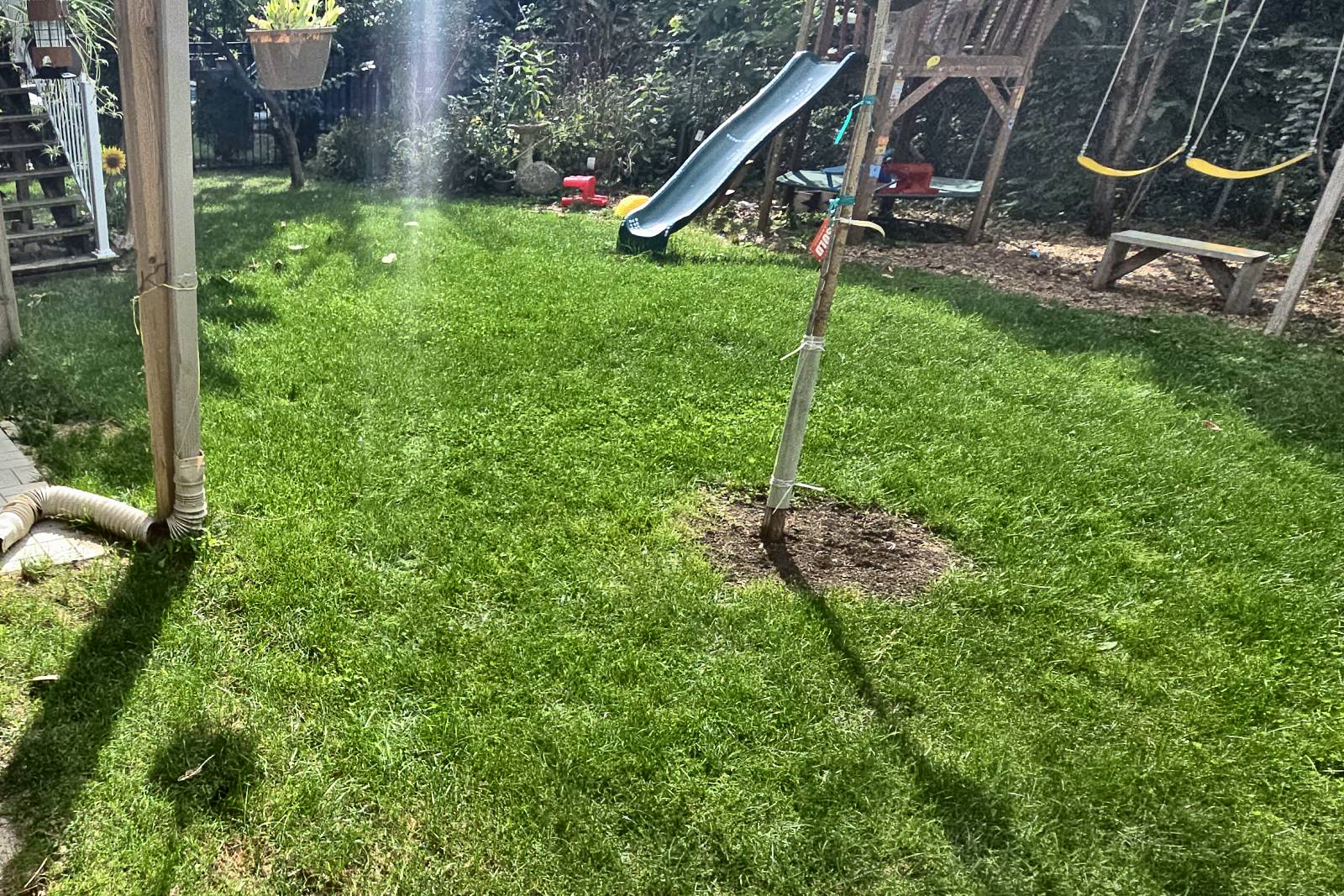
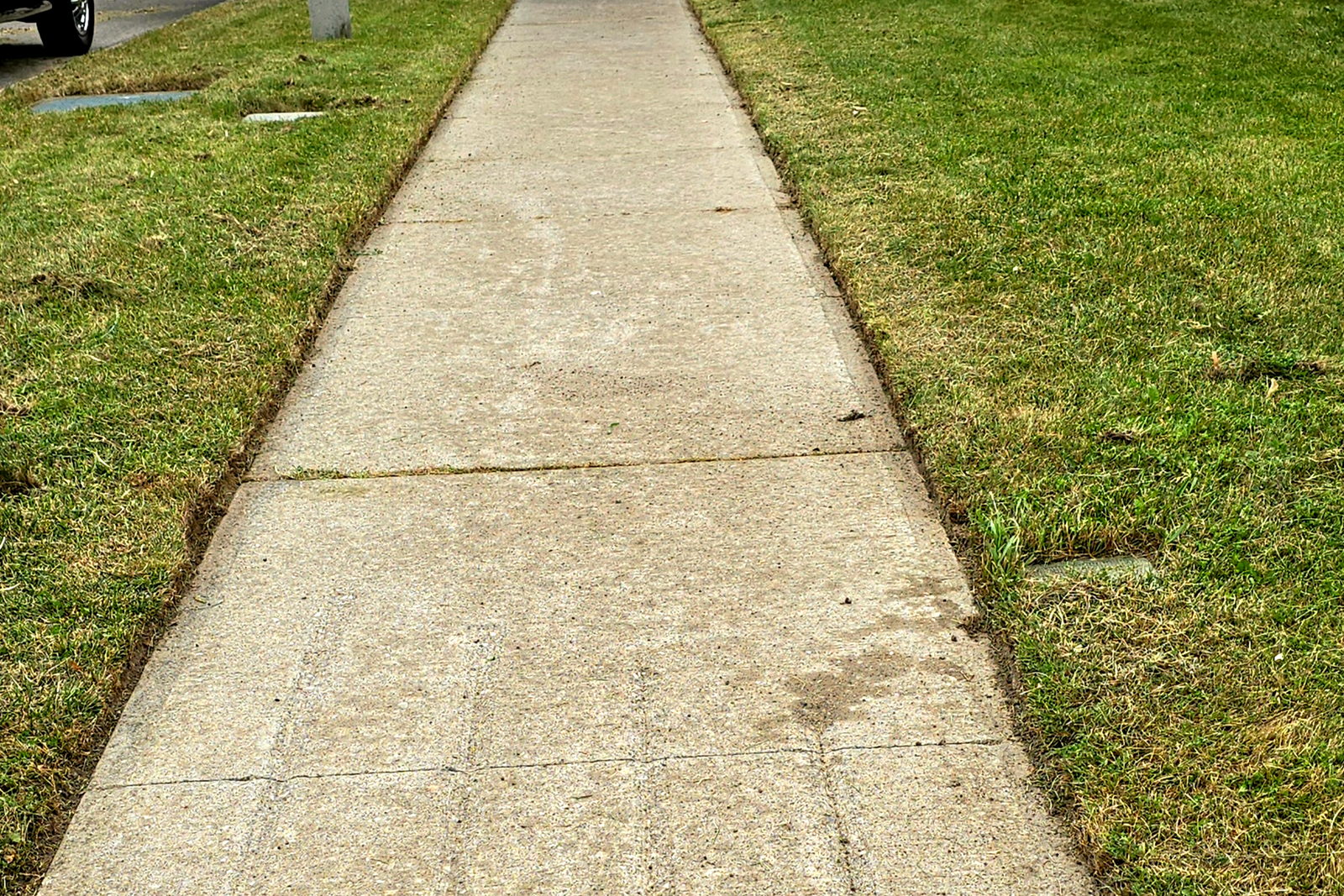
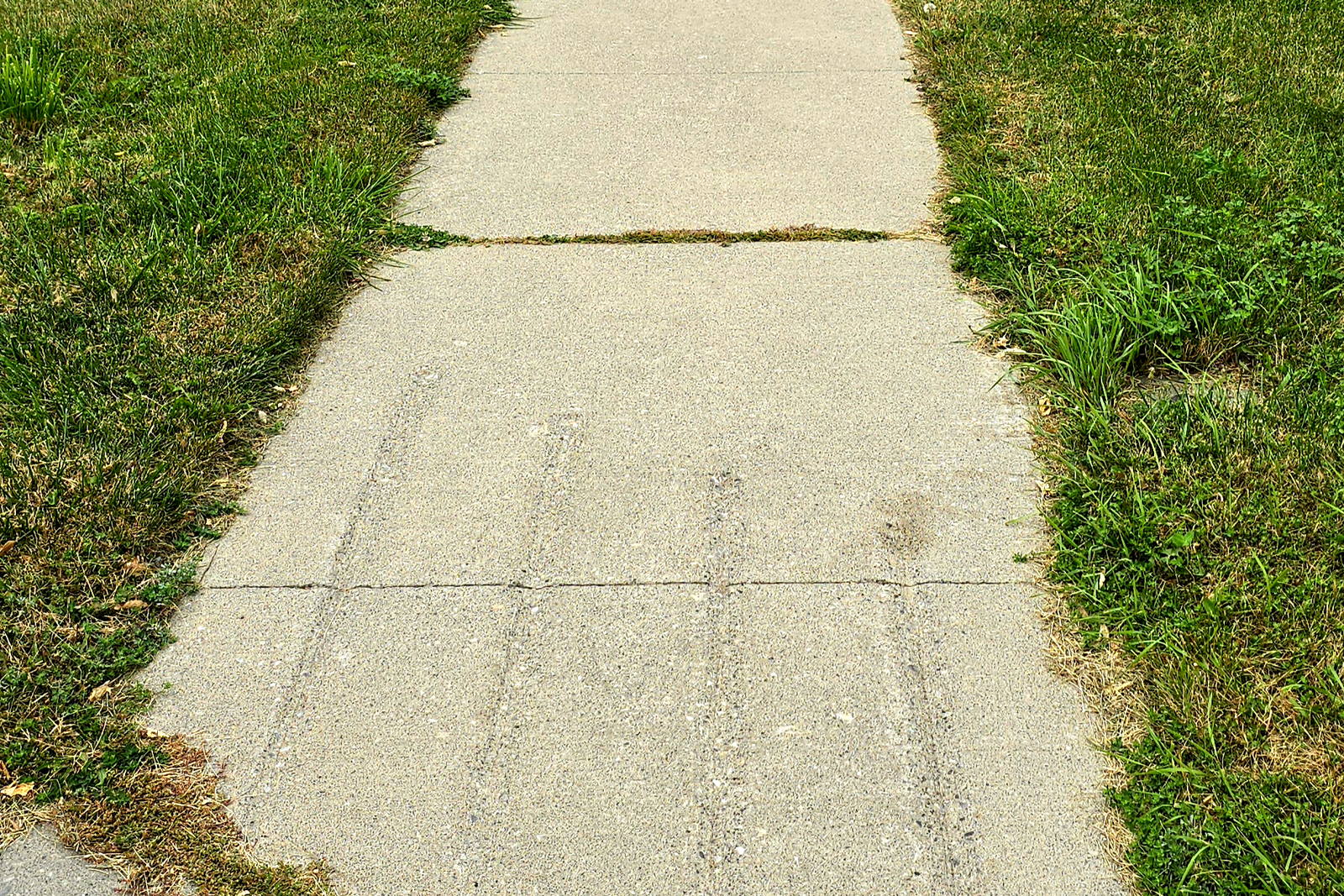
Real Northline properties, before and after, every one of them in Oshawa and every one of them this year. Drag the line to compare.
Andrew answers, October 2026
Why is the morning clearing time a target rather than a promise?
Because a promise about the morning is a promise about the weather, and nobody can make one of those honestly. What I can promise is where you sit in the route and the order the route runs in, and both of those are published on this site. In eighteen years of Oshawa data the worst winter had twenty four clearing days and the mildest had four, and a promise written to survive the worst of those is a promise priced for it. A target I actually hit is worth more to you than a promise I have quietly priced the risk of breaking.
One of these goes on each page and it is replaced monthly. If the question you have is not here, ask it: 905-244-5779.
Get a real Ajax number instead of a range off a web page
Send me your address and your acreage and I will come back with the band your lot sits in, what the season costs, and whether the Town's senior program is the better answer for your household. If it is, I will tell you to call 905-683-2951 instead of me.