Snow removal · Equipment
Snow Blower vs Plow Service in Oshawa: What Each One Really Costs
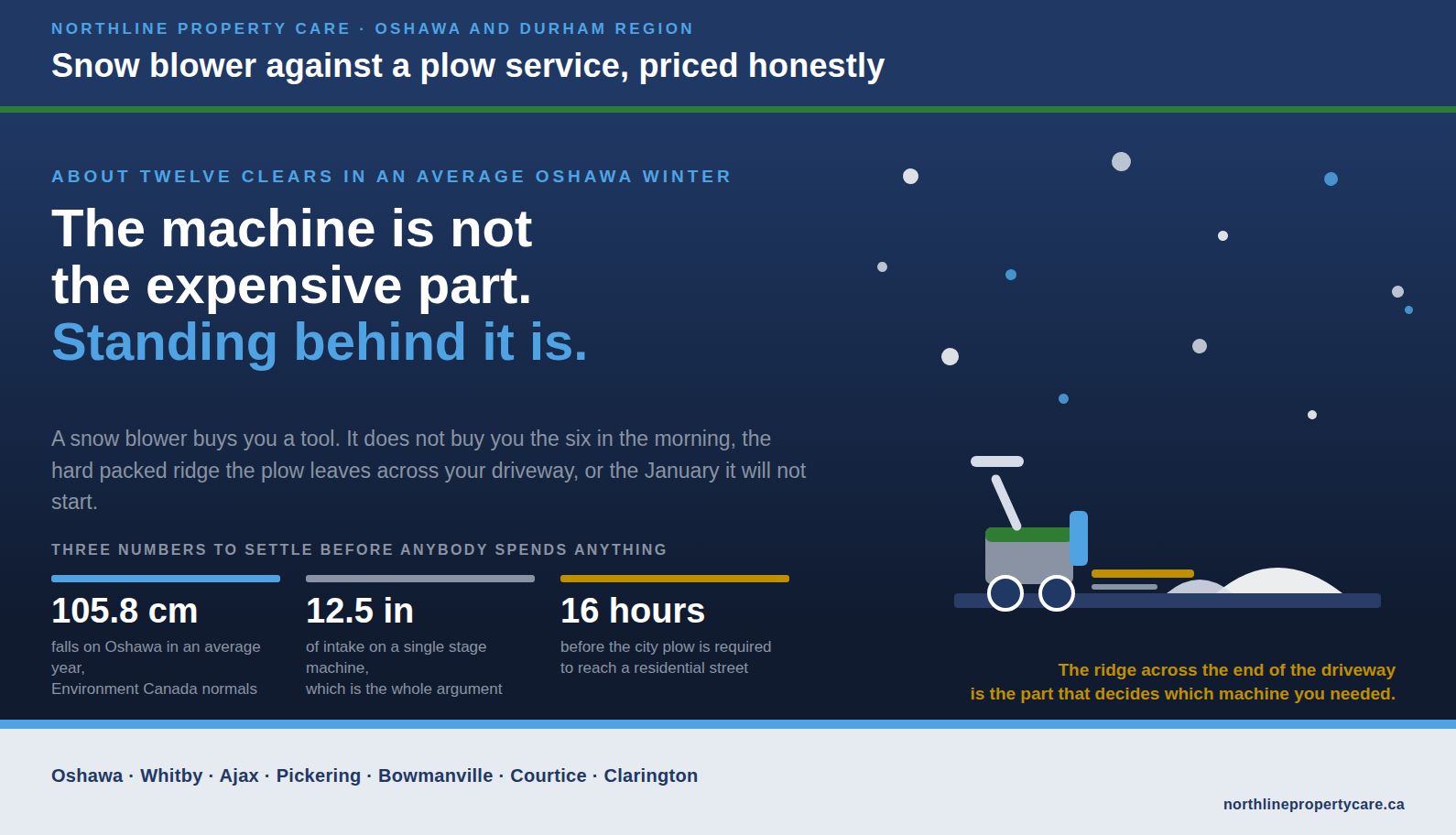
Snow blower vs plow service in Oshawa comes down to eight numbers, and the first of them is that a normal winter here asks for about twelve clears.
Written by somebody who owns the truck rather than the machine. See what our own winter service covers.
Green in summer. Clear in winter.
The short answer
Buy the machine if your driveway is paved, short and yours to clear at your own pace, and hire somebody if the driveway has to be open by a fixed hour on a morning you cannot control. That is the whole decision, and everything below is the evidence for it. A two stage machine is a genuinely good purchase for a fit person with a flat asphalt driveway, about 28 per cent of Ontario households own one, and over ten winters it will beat any contract in Durham Region on price. What it does not buy is the hour, the hard packed ridge the city plow leaves across the bottom of your driveway, or a plan for the February you are on crutches. And before either option, check whether your own municipality will do the windrow for nothing, because two of the five towns here do.
What a Durham winter actually asks a machine to do
An average year drops 105.8 centimetres of snow on Oshawa, and almost none of it arrives in the amounts people picture. Those are the Environment and Climate Change Canada climate normals for the Oshawa water pollution control plant station, climate identifier 6155878, measured over the years 1981 to 2010. The same table records 8.0 days a year carrying 5 centimetres or more of snowfall and 2.5 days carrying 10 centimetres or more. Days of 25 centimetres or more turn up 0.16 times a year, which is roughly one winter in six. The station record for a single day is 29.0 centimetres, set in December 1992.
The snow is also crowded into three months. January averages 35.6 centimetres, February 24.9 and December 24.9, with March at 13.5 and November at 4.7. April manages 2.0 and October 0.1. So the machine sits in the garage for eight months and works hard for three, which is the shape of the purchase and the reason fuel left in the tank becomes a problem later on this page.
A residential contract in this region normally starts a visit at 3 centimetres, and at that trigger a normal Oshawa winter delivers about twelve clears. Northline derives that figure from eighteen complete winters of Environment Canada data for the same station, and the honest version names the spread in the same breath: as few as four in a mild year and as many as twenty-four in a bad one. A machine bought in October is being bought against a number nobody knows yet.
One thing worth knowing before you read anybody else on this subject. Environment and Climate Change Canada has stopped publishing fixed centimetre thresholds for snowfall and winter storm warnings. The old criteria page now points to a set of Weather Impact Guides that grade an alert by expected impact rather than by depth, and no centimetre amount appears anywhere on it. Any page still telling you that a warning is issued at a particular number of centimetres is quoting a retired rule.
Durham is also not in the lake effect snowbelt, and this is a genuine local advantage that nobody sells. Environment Canada defines a snowbelt as a region downwind of open water, usually to the southeast of it, and the Great Lakes Integrated Sciences and Assessments program at the University of Michigan places the Lake Ontario snowbelt east and southeast of the lake while noting that the western and northern shores see less. Oshawa sits on the north shore, upwind under the prevailing flow. That is geography rather than a quoted finding, and it is why a Durham winter is a run of region wide storms rather than the stationary bands that bury Barrie. It matters to this decision because a region wide storm means every driveway in seven towns needs clearing on the same morning.
Intake height is the whole argument, and it is not the number on the box
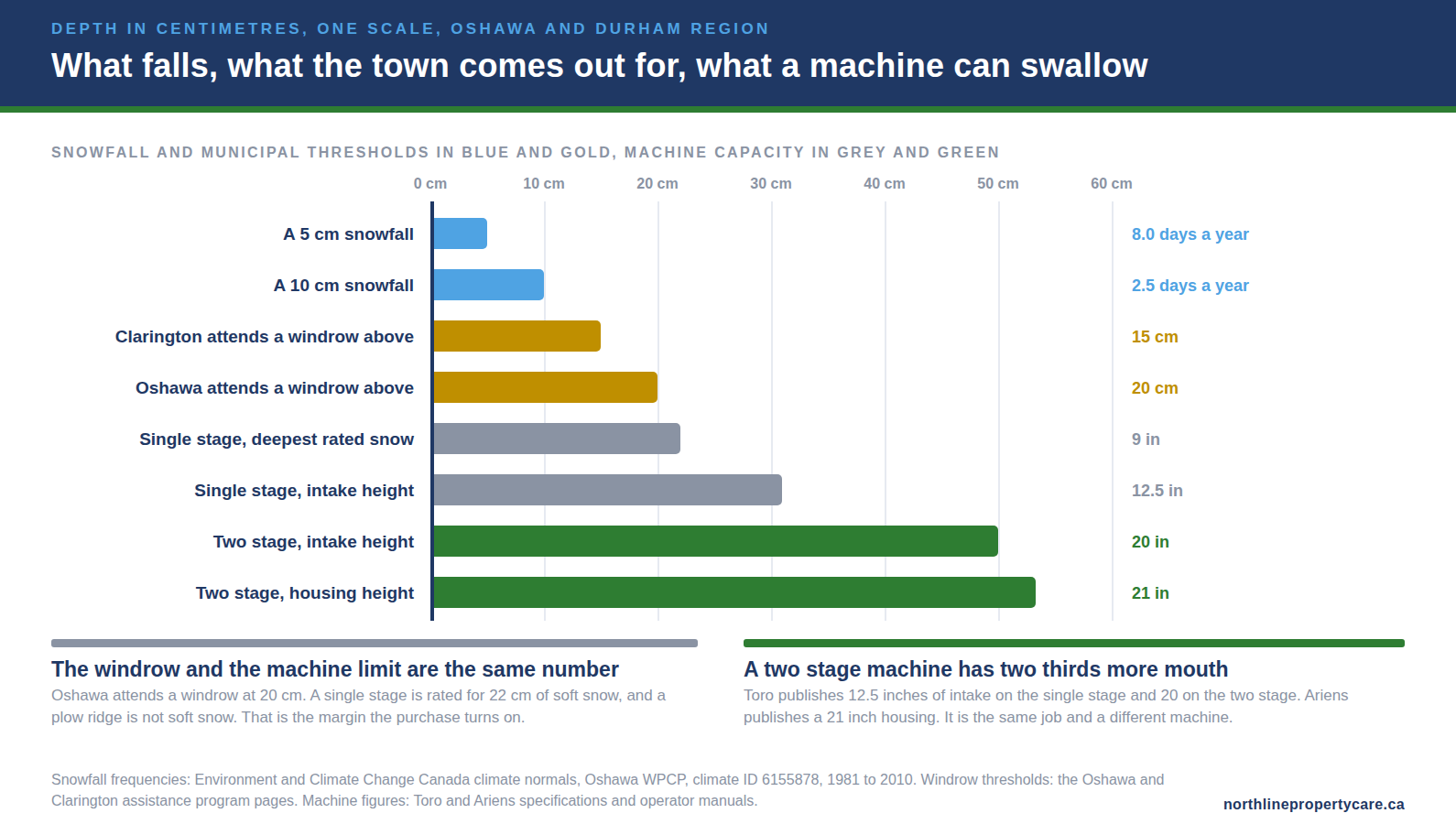
A snow blower is sold on clearing width and bought on intake height, and those are not the same thing. Clearing width tells you how many passes the driveway takes. Intake height tells you what the machine can physically swallow in one of them. Toro publishes an intake height of 12.5 inches, which is 31 centimetres, for its 21 inch single stage Power Clear, and publishes 20 inches, or 50 centimetres, for the 26 inch two stage Power Max. Ariens publishes a 21 inch housing height across its Deluxe range in its own published bid specification. Honda publishes 21.7 inches of clearing height for the HSS724. So the two stage machines have roughly two thirds more mouth than the single stage, for the same job on the same driveway.
The single stage machines also carry two limits their makers state plainly and buyers rarely read. Toro rates its single stage for snow up to 9 inches deep and describes the snow it suits as fluffy and light. The same machine's operator manual says, in its own words, that it is not designed for removing materials other than snow and is not designed for clearing gravel surfaces. A single stage auger touches the ground by design, which is exactly why gravel is out. On a Durham driveway that is asphalt in most subdivisions and gravel on a good many rural lots north of Taunton, that one sentence rules the cheaper machine out of a real share of the region.
Even on pavement, a gravel or uneven surface changes the machine's own set up by a factor of seven. The Ariens operator manual instructs the owner to set the skid shoes with two 3 millimetre spacers on a hard smooth surface and two 22 millimetre spacers on an uneven or gravel one. Honda publishes the same idea as a clearance range: 4.0 to 8.0 millimetres for ordinary snow, 0 to 5.0 millimetres on ice, and 25.0 to 30.0 millimetres on rough or uneven ground. Read that the other way round and it says something useful. On a gravel driveway the machine is required to ride roughly an inch off the surface, so it leaves roughly an inch of snow behind by design, and that inch is what freezes into the layer everybody complains about in February.
Set the machine specifications beside the Durham snowfall figures on one scale and the comparison stops being an opinion. That is what the card below does, in centimetres, with the municipal windrow thresholds dropped into the same axis so that the three sets of numbers can finally be read against each other.
The ridge at the end of the driveway, and the sixteenth hour
The snow that defeats a machine is almost never the snow that fell on the driveway. It is the ridge the city plow pushes across the bottom of it, and in Oshawa that ridge arrives late on purpose. The City publishes its own targets in its snow clearing activity report: six hours to clear an arterial road after the storm ends, twelve hours for a collector, and sixteen hours for a residential street. Sidewalks are due no later than midnight of the first day after the storm ends. The City also says in plain words on its snow clearing page that windrows are an unavoidable result of clearing roads quickly and that clearing the windrow is the property owner's responsibility.
So the order of events on a snowy Tuesday is fixed, and most people get it backwards. You clear the driveway in the morning, the plow arrives at hour twelve or hour sixteen, and you clear the same driveway again. Anybody who has run a route in this region knows that the second clear is the one that produces the phone call, and it is not a service failure. It is the schedule the municipality publishes. Whitby says the same thing to its residents in more direct language, telling owners they may need to clear a windrow more than once a day depending on the storm.
The ridge is also packed rather than fallen, which is what the machine cares about. A plow blade has already compressed it, and it has usually been sitting long enough to set. Oshawa's own assistance program tells you how substantial it gets: the City will only attend a windrow under that program once it is at least 20 centimetres high. Clarington's threshold is 15 centimetres and Whitby's is 10. Put those next to the single stage rating of 22 centimetres of fluffy, light snow and the margin disappears.
No manufacturer says in plain words that a single stage machine cannot clear a plow ridge, and this page is not going to put those words in their mouths. What the manufacturers do publish is a 12.5 inch intake, a 9 inch depth rating and a snow type described as light, against a 20 to 21.7 inch intake, a 12 inch depth rating, a serrated ice breaking auger and an explicit heavy and wet snow rating on the two stage machines. Honda goes as far as saying that lowering the auger on its two stage model lets the machine cut through hard packed snow. The numbers are allowed to do the work. If you want the fuller version of what that ridge is and who is legally responsible for it, we wrote a whole page on windrow clearing in Durham Region.
Where the snow is allowed to go, which is the part that gets people fined
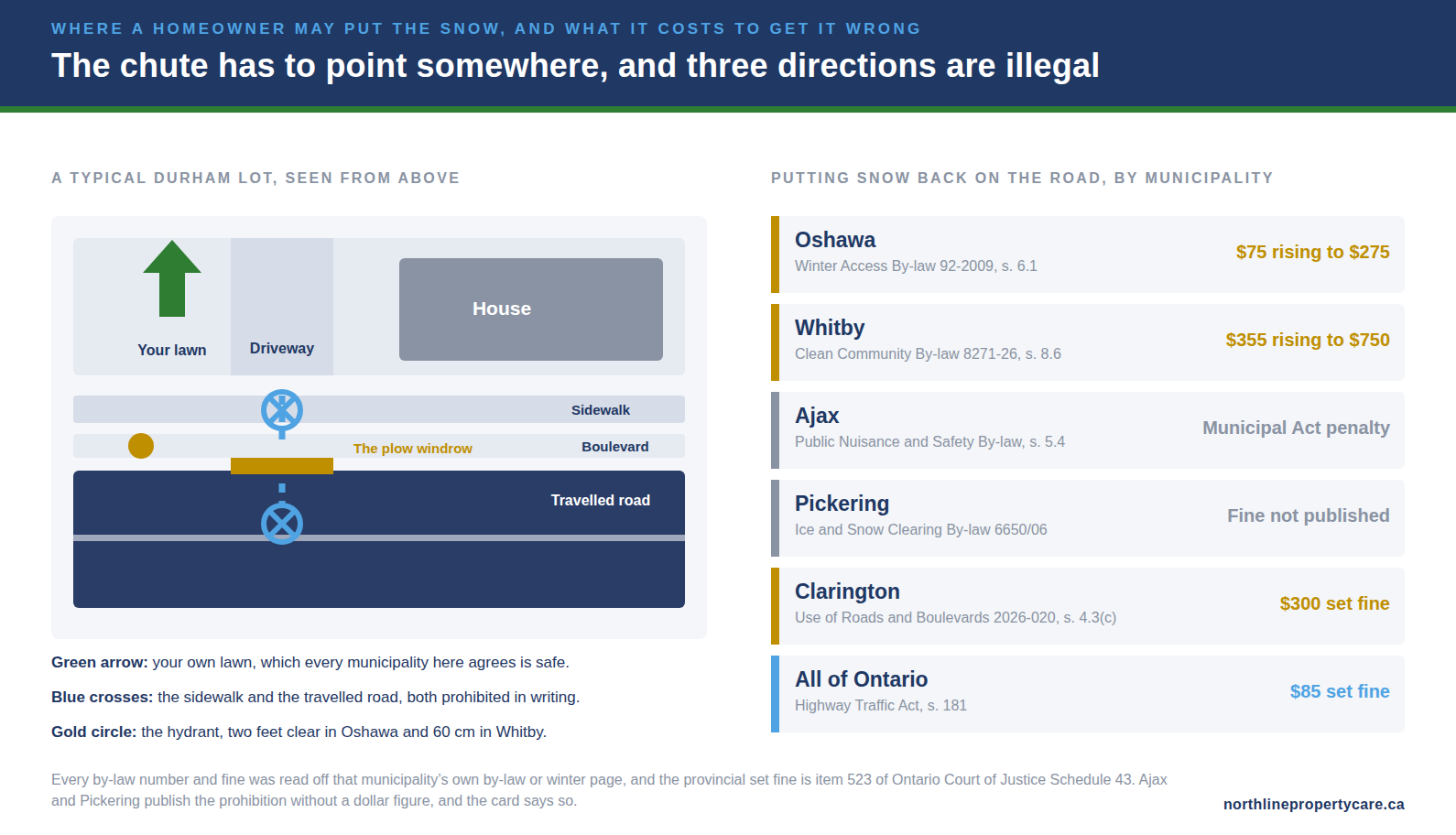
A chute has to point somewhere, and in every municipality Northline serves at least three of the available directions are prohibited in writing. Section 6.1 of the City of Oshawa Winter Access By-law 92-2009 reads: no Person shall move or permit to be moved snow or ice from private property onto or pile, redistribute or otherwise cause the accumulation of snow on a Sidewalk or a Highway. The same by-law defines a Highway as including the area between the lateral property lines, which takes in the boulevard. Oshawa enforces it through administrative penalties of $75, rising to $175 for a second violation in a calendar year and $275 for a third.
The neighbouring towns publish the same rule and charge more for it. Section 8.6 of the Town of Whitby Clean Community By-law 8271-26 prohibits shovelling, plowing or blowing snow, slush or ice onto or across a highway, a sidewalk or a pedestrian walkway, and its own schedule of set fines starts at $355 and reaches $750. Ajax carries the identical prohibition at section 5.4 of its Public Nuisance and Safety By-law. Pickering warns that an owner may be fined under Ice and Snow Clearing By-law 6650/06 for placing snow on the road or the sidewalk. Clarington sets a $300 set fine under section 4.3(c) of its Use of Roads and Boulevards By-law 2026-020. And underneath all five sits a provincial offence: item 523 of the Ontario Court of Justice set fine schedule carries an $85 fine for depositing snow or ice on a roadway, under section 181 of the Highway Traffic Act.
This is a constraint on the machine specifically, and it is worth saying why. A two stage machine throws snow 45 to 60 feet, which is a manufacturer figure and a real one. A typical Durham subdivision lot is forty feet wide. Aim badly and the snow lands on the sidewalk you are also required to clear, or on the road, or on the neighbour's driveway, and only one of those three is merely rude. A person with a shovel makes a pile. A person with a chute makes a decision about direction, twelve times a winter, usually in the dark.
There is a fourth thing on the lot that most people forget, and two municipalities publish a measurement for it. Oshawa asks residents to clear snow back two feet from a fire hydrant so that it is visible from the road. Whitby puts the duty in the by-law itself and sets a 60 centimetre radius, within 24 hours. Clarington requires hydrants to be clear, visible and free from obstruction at all times. If your hydrant sits on your frontage, it is part of your snow clearing job whoever does the driveway.
And the sidewalk is yours in every one of these towns. Oshawa gives you until midnight of the first day after the precipitation ends. Whitby, Ajax, Pickering and Clarington all give 24 hours. Ajax publishes what happens if you do not: the Town clears it and bills $150 for up to 23 metres. Clarington bills its cost plus a $50 administrative fee. The tidiest way to understand the whole arrangement is that the municipality owns the road, you own the sidewalk in front of it, and nobody owns the ridge in between except you.
What the machine costs after the machine
The purchase price of a snow blower is the one figure this page will not quote, and the reason is a rule rather than an oversight. Northline does not publish a number it cannot stand behind, and every source for machine prices, running costs and depreciation sits on a retailer's buying guide, a home services marketplace or a competitor's blog. None of those are sources. So the cost of ownership below is built only from what the manufacturers themselves publish in their service schedules, and the missing half is named rather than filled in.
Fuel is the first recurring cost and it is the one that strands people in January. Honda's own owner manual states that fuel deterioration and oxidation can occur in as little as 30 days, and sets three storage tiers: fresh fuel under one month, stabiliser between one and three months, and drain the tank and the carburettor beyond three. Toro's manual says not to store fuel in the tank or in a container over the winter unless a stabiliser is used, and advises buying only the quantity you expect to use in 30 days. Ariens warns that gasoline left in the fuel system without a stabiliser deteriorates and leaves gummy deposits even over short periods.
That matters more in Ontario than it would elsewhere, because of what comes out of the pump here. Natural Resources Canada records a federal renewable fuel requirement of an average five per cent renewable content in gasoline since December 2010, so most pump gasoline in this province is an ethanol blend. Every manufacturer above caps the machine at ten per cent ethanol. Natural Resources Canada also notes that small engines are more susceptible to water contamination and should be checked and drained before fuelling with an ethanol blend. A machine that sat from April to December with untreated blended fuel in it is the machine that will not start on the morning you need it, and that morning is statistically likely to be in January.
The service schedule is real work and the four major makers do not agree on it. Toro calls for an oil change after the first two hours and then yearly. Ariens calls for oil and a spark plug check every 25 hours and an oil change annually. Honda calls for an oil change at the first month or 20 hours, then every 100 hours, with the spark plug checked at 100 and replaced at 300. Husqvarna specifies oil at 20, 50 and 100 hours and then every 100. They are different machines and the intervals are genuinely different, which is worth stating rather than averaging. Shear bolts are a consumable on every one of them, and Honda is explicit that the replacement has to be a correctly sized shear bolt, because an ordinary bolt of the same thread will not shear and the gearbox takes the impact instead.
Add the part no schedule covers, which is the storage. A two stage machine with a 24 to 30 inch housing occupies a real footprint in a garage for the eight months of the year it does nothing, in a region where a great many subdivision garages are already holding two cars, a lawn mower and a set of winter tires. That is not a cost with a dollar figure attached, and pretending it is would be the kind of invented number this page has just refused to publish. It is still a cost.
The injury nobody prices into the purchase
The largest published dataset on this counts 91,451 emergency department visits for snow blower events over sixteen years, and names one mechanism above all the others. The study, published in Cureus in 2020 from the United States National Electronic Injury Surveillance System, covers 2003 to 2018. Placing a hand in the chute accounts for 44.5 per cent of incidents. Amputation is 11.2 per cent of all diagnoses, fracture 25.9 per cent and laceration 20.2 per cent. Of the amputations, 99.8 per cent involved fingers. The mean age of the injured person is 51 and 91.2 per cent are male.
A second study isolates the exact act and counts it. Hammig and Jones, writing in the American Journal of Emergency Medicine in 2020, counted 27,826 hand injuries in nine years specifically among people attempting to clear snow out of a clogged snow blower. Roughly 22 per cent were amputations, and amputations, fractures and avulsions together made up nearly seventy per cent of all the hand injuries in the set. The United States Centers for Disease Control looked at two 1980s storms and found the same pattern from the other end: of those whose machine had clogged, 95 per cent of the injured people had used their hands to dislodge the snow, against almost none of the uninjured controls.
The mechanism is the part worth understanding, because the usual precaution is not enough. An emergency physician at UConn Health describes it precisely: a clog holds stored energy in the belt and impeller, and when the jam releases, that stored energy can spin the blades even with the engine already stopped. Turning the machine off is necessary and it is not sufficient. Every manufacturer says so in the same words. Ariens writes that hand contact with the rotating auger and impeller inside the discharge chute is the most common cause of injury associated with snow throwers, and instructs the operator to shut the engine off, wait ten seconds, and always use a clean-out tool rather than hands. Honda Canada's own safety page says never to put a hand into the discharge chute while the engine is running, and to use a bar or a wooden stick.
Machines also occasionally fail in the direction that makes this worse. Health Canada posted a recall in February 2025 on a range of Ariens snow throwers because the auger and impeller might continue rotating after the operator released the control lever. One hundred and eight units were sold in Canada, and no injuries were reported. It is a small recall and it is the right kind of evidence: the hazard is understood well enough by the regulator that a machine which might keep spinning is pulled off the market.
And there is the one people genuinely do not expect. Health Canada's carbon monoxide guidance names snow blowers directly and says never to run gas powered equipment in a garage or a shed. Ontario's Office of the Fire Marshal goes further and says never to run a fuelled engine inside a garage even if the garage door is open, and records that over 65 per cent of carbon monoxide injuries and deaths in Ontario happen in the home. Starting the machine in the attached garage to warm it up on a cold morning is a common Durham habit and it is directly against both.
The heart, which argues against shovelling and does not fully argue for a machine
The Canadian evidence on snow and heart attacks is unusually good, and it is about shovelling rather than about machines. A study in the Canadian Medical Association Journal in 2017 examined 128,073 hospital admissions and 68,155 deaths from myocardial infarction in Quebec across the winters of 1981 to 2014. The day after a 20 centimetre snowfall, men showed an increased risk of admission, with an odds ratio of 1.16, and an increased risk of dying of it, at 1.34. Women showed essentially no association at 1.01 and 1.04. The authors concluded that both the quantity and the duration of the snowfall were associated with the risk, driven primarily by an effect in men.
Ontario has its own reading of the same phenomenon, from Kingston. A review published as a letter in the same journal looked at 500 acute coronary syndrome cases across two winters and found that thirty-five of them, or 7 per cent, were documented as having occurred after snow shovelling. Those patients were 4.8 times more likely to be male and 3.6 times more likely to have a family history of premature cardiovascular disease. The University of Ottawa Heart Institute puts the practical conclusion in one sentence, advising people with a family history or other risk factors to arrange for someone else to do the snow removal.
Here is the part that cuts against the easy conclusion, and it is the single most counter intuitive number on this page. In that dataset of 91,451 snow blower emergency visits, there were 648 deaths, and 647 of them were cardiac events rather than machine injuries. Buying a machine moves the risk profile toward fingers and away from a shovel. It does not move a person out of the cold, out of the exertion, or out of pushing something heavy through wet snow at six in the morning. If a doctor has told you to stay away from this work, a different machine is not the answer to that instruction.
When the machine is the right answer, and it often is
A two stage snow blower is a good purchase for a specific household, and pretending otherwise would cost you more trust than it would win Northline in sales. If the driveway is asphalt or concrete rather than gravel, if it is a standard two car subdivision drive rather than a hundred foot rural run, if you are physically fit and have no cardiac history, if you are at home during the day or your working hours are your own, and if you are the sort of person who will actually put stabiliser in the fuel in April, then buy the machine. Over ten winters it will beat every seasonal contract in this region on cost, and it is not close.
If you buy, buy the two stage. The money saved on a single stage machine is spent again the first time a plow ridge sets across the end of the driveway, and the manufacturers' own depth ratings say why. If any part of the surface is gravel, a single stage is ruled out by the manual rather than by preference.
And if you already own a working two stage machine, do not buy a snow membership on top of it. The honest product for that household is the lawn half, not the winter half. Northline's Silver membership at $129 a month plus HST does not plow the driveway and has no 7 AM target, and a person with a machine in the garage should not be paying for a driveway clear they will never call for. Say so when you call, and the quote will come back shaped differently.
The case for hiring is narrower than most contractors admit and stronger than most homeowners think. It comes down to a fixed hour. If the driveway has to be open by seven because somebody leaves for a shift, if there is a mobility or health reason the work cannot be done, if the household travels in winter, or if nobody in it wants to own a decision about where the chute points at half past five in the morning, then a service is buying the thing a machine cannot supply, which is that the driveway is clear whether or not anybody in the house is able that morning.
If your municipality will do it for nothing, take that instead
Two of the five municipalities here clear a senior's windrow at no charge, and a third charges about a hundred dollars for the season, so anybody who qualifies should register before they price a contractor at all. No private operator in Durham Region can compete with free, and a page that quietly omitted this would be worth less than the sale it protected. The catch is the scope: these programs cover the municipal sidewalk and the windrow across the driveway apron. They do not cover the rest of the driveway and they do not cover the walkway to your door.
| Municipality | Season cost, 2026 to 27 | What it clears | Register by |
|---|---|---|---|
| Whitby | No fee | Sidewalk above 5 cm, windrow above 10 cm | November 1, 2026 |
| Oshawa | No fee published | Sidewalk, plus a windrow at least 20 cm high | Applications open October 1, 2026 |
| Clarington | $107.69, HST included | Sidewalk above 7.5 cm, windrow above 15 cm, three feet of apron | October 31, 2026 |
| Pickering | $0 to $240.69, income tested | Windrow and the adjacent concrete sidewalk | October 16, 2026, 750 places |
| Ajax | Not published | Senior snow removal, scope on request | Call the Town for the rate |
Eligibility is broadly the same shape across all five and the wording is worth reading closely. Every one of them requires that the applicant be 65 or older, or certified by a physician as unable to do the work, and that no able bodied person under 65 lives in the household. Oshawa accepts an Access 2 card, an accessible parking permit, a Canada Pension Plan disability record, a Canadian National Institute for the Blind card or a doctor's note as proof. Pickering caps the program at 750 households and is the only one that asks about income.
Two of the timing details are easy to miss and both fall inside the next six weeks. Whitby opened registration on September 14 and closes it on November 1. Clarington runs from September 21 to October 31. These are not rolling programs, and a household that misses the date waits a year. That is also true of Northline's own snow route, which fills and then closes, but the municipal deadline comes first and should be dealt with first.
What a plow service is actually selling, priced the same way
Northline's seasonal snow package is $800 for a small property, $975 for a standard one and $1,200 for a large one, plus HST, and it covers the driveway, the walkway and the salting without a visit cap from November 1 to May 1. The trigger is a measured 3 centimetres and the target is 7 AM after overnight snow. Bought one storm at a time instead, a driveway clear is $45 to $95 and a salting application is $40 to $90, so the package crosses over somewhere near the eighth event in a twelve clear winter.
The product is not a number of clears, and a contractor who sells it that way will lose the argument in a mild February. A seasonal price buys a fixed figure on the invoice set against a variable number of storms. Four clears or twenty-four, the season costs the same. A machine does not care how many storms arrive either, which is the one honest thing the two options have in common.
The comparison most people should actually run is not machine against snow package. Gold is $189 a month plus HST, which is $2,268 for the year, and it carries the driveway plow, the 7 AM target, twenty-six weekly cuts through the lawn season, the spring cleanup and the fall cleanup. A machine solves December and leaves July untouched. The membership comparison puts both seasons on one page, and what snow removal costs in Durham Region takes the per visit side apart.
Ask for the written agreement before you ask for the price. A seasonal snow arrangement over fifty dollars is a future performance agreement under Ontario law and it has to be in writing. The sixteen items the regulation requires are set out in what must be in a seasonal snow removal contract.
And if the answer is neither a machine nor a service
A shovel is still the right tool on most Oshawa snowfall days, and it has a number attached to it. A winter of hand clearing on a double driveway comes to roughly 3.8 tonnes, nineteen of about twenty seven snowfall days bring under 5 cm, and the same fall weighs more than four times as much if it is left to set. Those figures, the Canadian cardiac evidence and the by-law deadline sit together in our guide to snow shovelling in Oshawa.
What we could not verify
Every external figure on this page came from a government agency, a university, a peer reviewed journal, a court schedule or an equipment manufacturer's own manual, and none from a company that sells snow removal in Durham Region. That constraint is why several obvious things are missing.
- Machine purchase prices, running costs and depreciation. Every source sat on a retailer guide, a marketplace or a competitor blog, so all of it was dropped. Price the machine yourself.
- Canadian snow blower injury counts. The Canadian Institute for Health Information and the Canadian Hospitals Injury Reporting and Prevention Program publish by broad cause, not by consumer product. The injury numbers above are United States data and are labelled as such. The cardiac studies are Canadian.
- The current Oshawa climate normals. Environment Canada has built a 1991 to 2020 entry for Oshawa but does not publish the values on the open data service, which carries only the 1981 to 2010 set. Every Oshawa snowfall figure above is labelled accordingly.
- The depth at which Oshawa starts plowing a residential street. The City publishes clearing times and points to the provincial minimum maintenance standards without printing a trigger depth. Pickering publishes one, at approximately 5 centimetres.
- The current by-law number for the Ajax snow deposit prohibition. The Town links it as a 2025 by-law and the file served carries a 2022 number on its face. The section and its wording are verified. The number is not, so none is printed.
- The set fine amounts for Ajax and Pickering. Neither publishes a dollar figure for depositing snow on the road. Ajax publishes only a $150 charge for a sidewalk the Town ends up clearing.
- A manufacturer statement that a single stage machine cannot clear a plow windrow. Nothing of the kind appears on the manufacturer sites we searched. The argument above is built from their published depth ratings, intake heights and snow type ratings.
- Any official statement placing Durham Region inside or outside a lake effect snowbelt. None that we could find. The reading above is our own inference from Environment Canada's definition of a snowbelt and the Great Lakes assessment mapping of the Lake Ontario belt.
Questions people in Durham actually ask
Is a snow blower cheaper than a snow removal service in Oshawa?
Over a long enough run, usually yes, and that is the honest answer. A two stage machine that lasts ten winters and gets serviced costs less per season than any seasonal contract in Durham Region. What it does not buy is the time, the six in the morning before work, the physical risk, or somebody to do it the week you are away. The machine is cheaper. The winter is not the machine.
Will a single stage snow blower clear the ridge the plow leaves at the end of my driveway?
Not reliably. Toro rates its 21 inch single stage to 9 inches of fluffy light snow, with an intake height of 12.5 inches. A windrow is packed rather than fluffy, because a plow blade has already compressed it, and Oshawa attends one under its assistance program only at 20 centimetres or more. A two stage machine has a 20 to 22 inch intake and a serrated auger built for packed snow.
Can I blow snow from my driveway onto the road in Oshawa?
No. Section 6.1 of the City of Oshawa Winter Access By-law 92-2009 says that no person shall move snow or ice from private property onto, or pile or redistribute it on, a sidewalk or a highway, and it defines a highway as including the boulevard. Whitby, Ajax, Pickering and Clarington publish the same prohibition. Put it on your own lawn.
How many times does a driveway in Oshawa actually need clearing in a winter?
About twelve, at the 3 centimetre trigger a residential contract normally uses, and the spread matters more than the average: four in a mild winter, twenty-four in a bad one. Environment Canada records 105.8 centimetres of snow a year at the Oshawa water pollution control plant station. A machine is bought once and used about twelve times.
Does a snow blower protect my heart better than shovelling?
Less than people assume. A Quebec study of 128,073 heart attack admissions found a higher risk of admission and of death in men the day after a 20 centimetre snowfall, and a Kingston review of 500 acute coronary cases found 7 per cent followed snow shovelling. Of the 648 deaths in the largest snow blower injury dataset, 647 were cardiac. Pushing a heavy machine through wet snow in cold air is still exertion.
How much of a snow blower injury risk is the chute?
Most of it. Across 91,451 United States emergency department visits between 2003 and 2018, placing a hand in the chute accounted for 44.5 per cent, amputation was 11.2 per cent of all diagnoses, and 99.8 per cent of those amputations were fingers. Shut the engine off, wait ten seconds, and use the clean-out tool rather than your hand.
Should I take my town's senior snow clearing program instead of hiring somebody?
If you qualify, yes, and you should stop reading here and go and register. Whitby charges nothing. Oshawa publishes no fee at all for its program, which is not the same thing as a published zero. Clarington charges $107.69 including HST for the season. Pickering is income tested and free for GAINS recipients. No contractor beats free. The limit is what those programs cover, which is the municipal sidewalk and the windrow, not the rest of your driveway.
Who wrote this
Andrew owns the business and has talked people into buying the machine instead. Owner operated from north Oshawa, reaching Oshawa, Whitby, Ajax, Pickering, Bowmanville, Courtice and Clarington, fully insured and registered for HST. Six winters of snow clearing in Durham Region stand behind the opinions above, and they are his own rather than the company's.
This page exists because the question turns up at almost every door in October, and the honest answer is not always the one that sells a membership. The climate figures were read out of the Environment Canada data file itself rather than off anybody's summary of it. The machine figures came out of operator manuals and published specifications. Every by-law number was read off that municipality's own document, and where a document could not be opened, the article says so instead of guessing. No link on this page goes to a company that sells snow removal in Durham Region, and none goes to a shop selling a machine either. If something here is wrong, the quickest way to tell me is a call or a text to 905-244-5779.
Read next
The ridge at the end of your driveway
Who is responsible for the windrow, what every Durham municipality says about it, and why it turns up hours after the storm rather than during it.
What our own winter service covers
The 3 centimetre trigger, the 7 AM target, what the seasonal package includes and where the truck goes first after an overnight storm.
Watch the storm before you decide
Live Durham Region storm status and the municipal plow trackers in one place, so you can see what is coming before you buy anything.
The work, photographed
Real Northline properties, before and after, every one of them in Oshawa and every one of them this year. Drag the line to compare.
Andrew answers, October 2026
Is the 3 cm trigger measured at my house or somewhere else?
On the route, not at an airport. Three centimetres is the depth at which a residential driveway stops being something you can drive out of, so that is where the number is set. Below it we are still out, but it is salt and the walkway rather than the blade, and that happens without you asking for it.
One of these goes on each page and it is replaced monthly. If the question you have is not here, ask it: 905-244-5779.
Tell me about the driveway and I will tell you whether to buy a machine
Send me the address and how the driveway is surfaced and I will come back with a price and, where the machine is the better answer for your household, I will say that instead. If your municipality will clear the windrow for nothing, I will point you at the form rather than at an invoice.