Snow removal · Doing it yourself
Snow shovelling in Oshawa, and what a winter of it actually weighs
Snow shovelling in Oshawa moves about 3.8 tonnes of snow a winter on an ordinary double driveway, and the number that should worry you is not the tonnage. It is which month it lands in, and how long you let it sit.
Rather not do any of it. snow removal Oshawa, priced for the season.
Green in summer. Clear in winter.
The short answer
A winter of hand clearing on a 33 square metre double driveway in Oshawa comes to roughly 3.8 tonnes of snow, spread across about 27 snowfall days. Nineteen of those days bring less than 5 cm, and on those days a decent shovel and ten minutes is the correct answer. Two or three days a year bring 10 cm or more, and those are the days that decide whether paying somebody was worth it.
The risk worth taking seriously is cardiac, not muscular, and the Canadian evidence for it is an association rather than a proven cause. The single largest thing you control is timing. Snow cleared the evening it falls weighs about a quarter of what the same snowfall weighs once it has been left, driven over and plowed in.
Start with the mass, because nobody ever does
Every article about clearing snow by hand opens on technique. That is the wrong end of the problem. Technique matters at the margin. Mass is the thing that decides whether the job is ten minutes or forty, and whether your chest is tight at the end of it, and almost nobody puts a number on it before they pick the shovel up.
So here is the number for this town, built from two published figures and one stated assumption.
Environment and Climate Change Canada publishes snowfall normals for the composite Oshawa station, climate identifier 6155875, over the period 1991 to 2020. The annual snowfall normal is 101.7 cm. December carries 24.7 cm of that, January 33.5 cm, February 25.8 cm, March 10.9 cm and November only 5.1 cm. You can read those figures yourself in the Canadian Climate Normals.
The Government of Ontario, in a public alert about snow loading and roof failures, states that a cubic foot of snow weighs between seven pounds when it is new and dry and thirty pounds when it is old and compacted. Converted, that is a range from about 112 to about 481 kilograms per cubic metre. Those are roof loading figures rather than driveway figures and that is worth saying plainly, but they are the only published Ontario numbers and the physics does not change between a roof and a slab.
Take a double driveway of 6.0 metres by 5.5 metres, which is 33 square metres and is about as ordinary as a Durham subdivision gets. A year of snowfall at the light end of the Ontario range puts roughly 3,759 kilograms onto it. The Canadian Centre for Occupational Health and Safety uses 5 kilograms as the weight of an average shovel load. That makes the winter about 752 loads.
A single width driveway of 6.0 by 3.0 metres comes to about 2,050 kilograms and 410 loads. Neither figure is a published statistic. Both are arithmetic on a stated area and a stated density, which means you can redo them for your own driveway in about a minute, and you should, because the shape of the answer changes more with frontage than it does with anything else.
The shape of the season, which is the part that surprises people
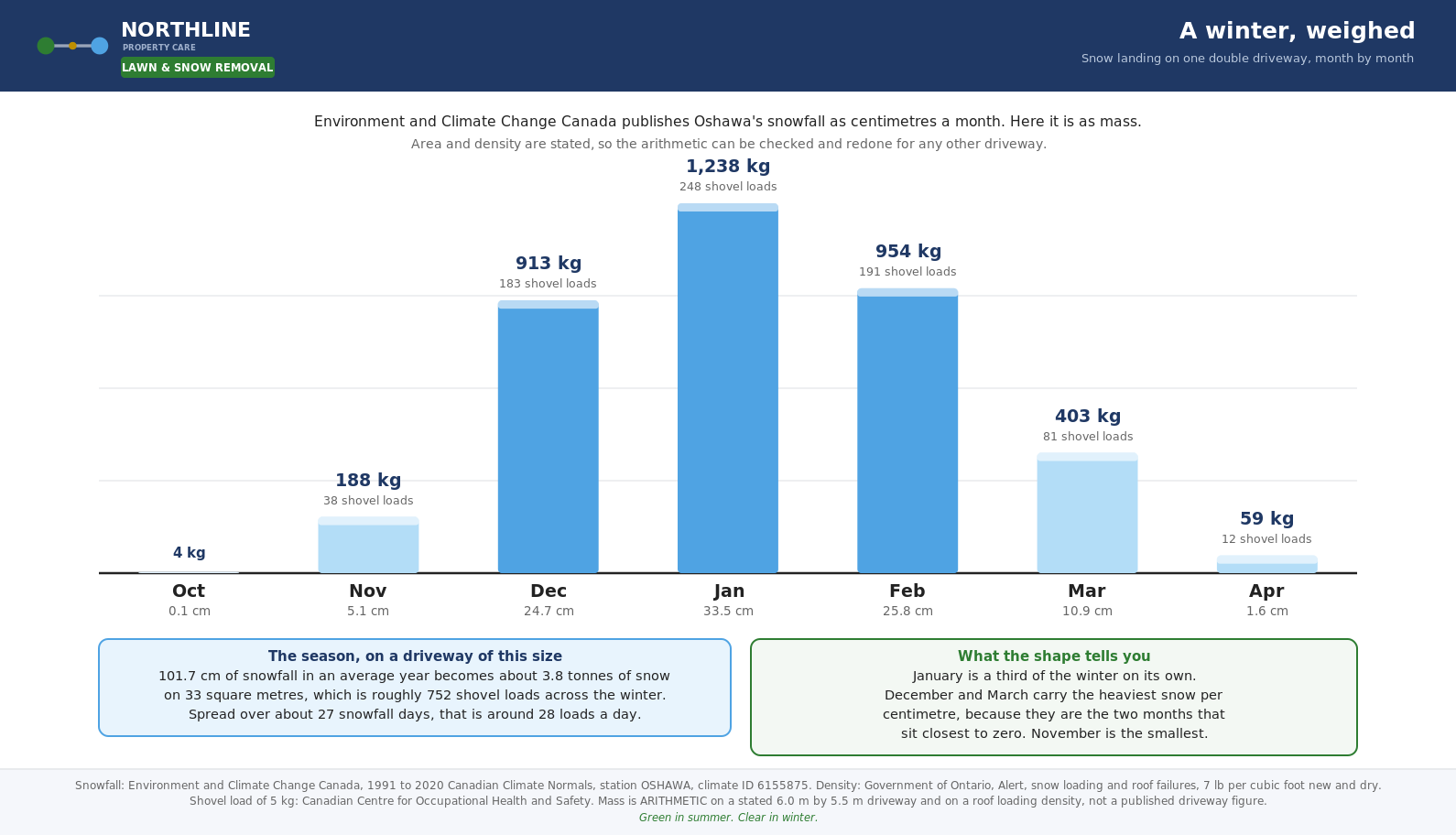
November is the month everybody worries about and it is the smallest month that matters, at about 188 kilograms on that driveway. January is the month almost nobody plans for and it is about 1,238 kilograms, a third of the whole winter in thirty one days. December and February sit close together in the nine hundreds.
There is a second pattern underneath the first one, and it is specific to this stretch of the lake shore. Oshawa's daily average temperature in January is minus five degrees and in February minus four. In December it is minus one, and in March it is just above zero. The American weather service publishes the relationship between temperature and snow ratio, and it is consistent: the closer the air column sits to zero, the lower the snow to water ratio and the denser each centimetre is. The fluffiest snow falls around minus nine or ten degrees.
Which means December and March, the two months whose averages sit nearest zero, deliver the heaviest snow per centimetre in the Oshawa year. Between them they carry 35.6 cm of the annual 101.7, a little over a third. January delivers more snow and lighter snow. December delivers less snow and heavier snow, and it arrives in the four weeks when most people are least interested in being outside with a shovel.
That is the honest reason the booking deadline sits at November 1 rather than in December. It is not a sales device. It is that December is the first month where the snow is both plentiful and heavy, and a route that is still being sequenced in the second week of December is a route that is late.
Why leaving it costs you four times the work
This is the single most useful thing on the page, and it costs nothing to act on.
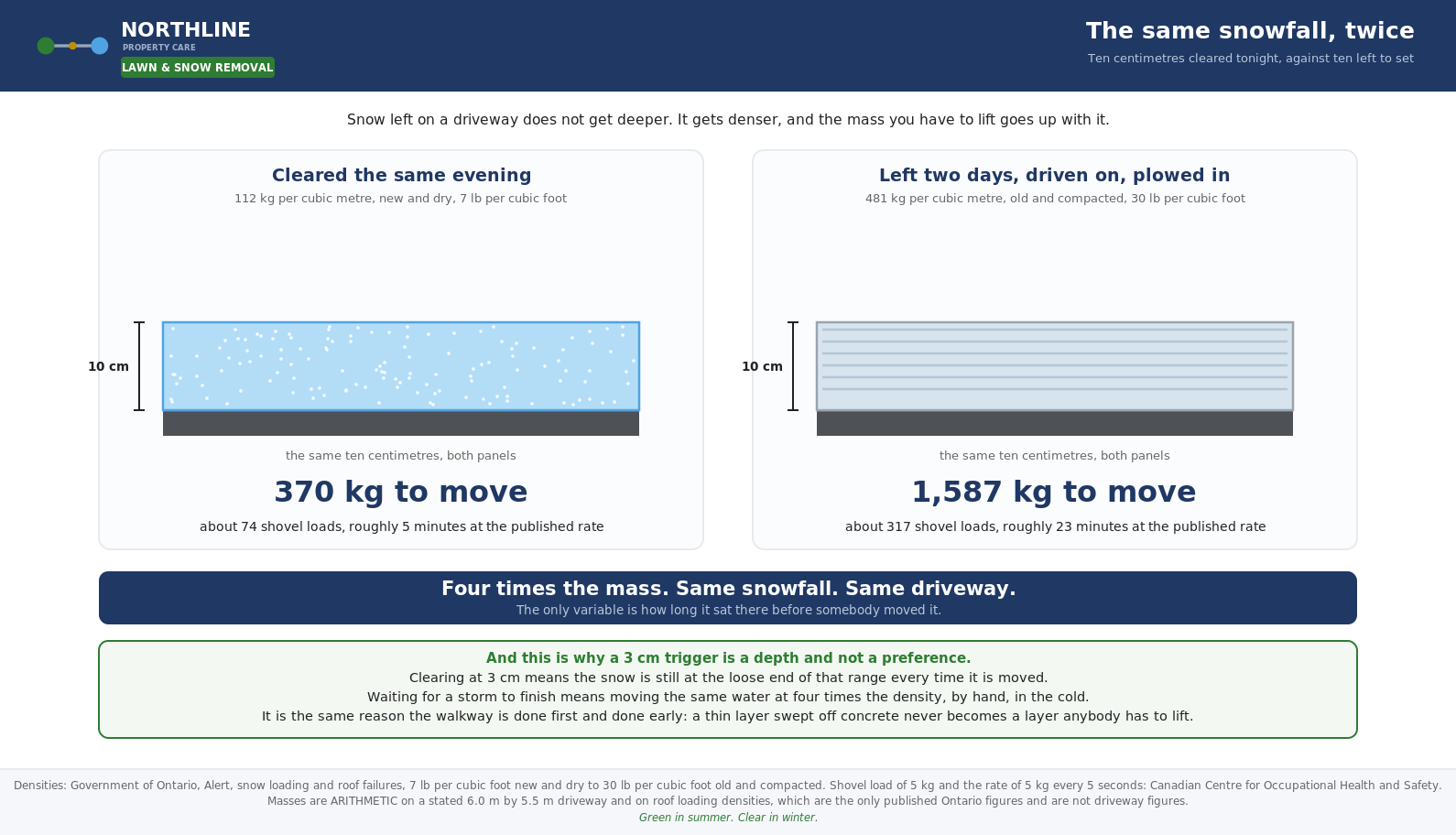
Ten centimetres on that 33 square metre driveway, cleared the evening it falls at the light end of the Ontario range, is about 370 kilograms. That is 74 shovel loads. Left for two days, driven over by a car twice a day, walked on and then plowed in at the foot, the same ten centimetres sits at the compacted end of the range and becomes about 1,587 kilograms. That is 317 loads.
Nothing fell in between. The depth on the ruler is identical. All that changed is how tightly the crystals are packed, and the mass you have to pick up went up by a factor of more than four.
Everything else in this article is a detail beside that. If you do one thing differently this winter, clear the snow the day it lands rather than the day you have time. The ten minutes you spend on Tuesday evening is not ten minutes saved from Thursday. It is forty minutes saved from Thursday, in colder air, on a surface that now has ice under it.
It is also the reason our own threshold is a measured 3 centimetres rather than a forecast or a judgement call. At 3 cm the snow has not had time to settle into anything. Waiting for a storm to finish producing a tidy number means moving exactly the same water at four times the density.
What the Canadian research says about your heart, and what it refuses to say
There is a version of this section written by somebody selling snow removal, and it says that shovelling causes heart attacks. That is not what the evidence establishes, and a page that overstates it is a page nobody should trust on anything else either.
Here is what was actually measured.
In 2017 the Canadian Medical Association Journal published a Quebec study by Auger, Potter and colleagues covering November to April across the years 1981 to 2014. It analyzed 128,073 hospital admissions for myocardial infarction and 68,155 deaths from one. One third of those heart attacks happened the day after a snowfall. Comparing a 20 cm snowfall against no snowfall at all, the odds of a man being admitted the next day rose by about 16 per cent and the odds of a man dying of one rose by about 34 per cent. In women there was no meaningful rise in either.
The authors wrote that they suspect shovelling is the mechanism linking the two, and that men are more likely than women to be the ones doing it after a heavy fall. They also wrote, in the same paper, that they had no information on who shovelled. The association is large and well measured. The cause is a stated suspicion by the people who did the work, and reporting it as anything firmer than that would be a misuse of their paper.
A second Canadian study, run at Kingston General Hospital and summarised in the same journal, reviewed 500 patients presenting with acute coronary syndromes across two consecutive winters. Thirty five of them, 7 per cent, had an event documented as following snow shovelling.
The physiology that makes this plausible is not in dispute. The commentary published alongside the Quebec paper describes shovelling as repetitive aerobic and resistance work that induces a Valsalva manoeuvre, loads the arm muscles rather than the legs, and therefore raises heart rate, blood pressure and the oxygen the heart muscle demands, all while cold air is constricting the vessels that supply it. The 2011 Compendium of Physical Activities scores hand shovelling at vigorous effort at 7.5 metabolic equivalents and a walk behind snow blower at 2.5. Anything above 6.0 is classed as vigorous. Shovelling is not light housework performed outdoors.
Now scale that honestly to this town. Oshawa averages 2.5 days a year with 10 cm or more of snowfall and a tenth of a day a year with 25 cm or more. The 20 cm comparison in the Quebec paper describes a day Oshawa sees rarely, not a Tuesday. The heaviest daily snowfall recorded at the Oshawa station in the 1991 to 2020 normals period was 29.0 cm, in December.
So the correct statement, which is less dramatic and more useful than the one you will read elsewhere, is this. On nineteen of a typical twenty seven snowfall days, shovelling in Oshawa is ordinary exercise. On the two or three heaviest days, it is vigorous exercise performed in the cold, often first thing in the morning, by somebody who has not done anything vigorous since the last storm, and that specific combination is the one the Canadian literature keeps finding at the scene.
The cold is doing something to you as well
The exertion gets all the attention and the air temperature gets almost none, which is backwards for a region that spends four months below freezing.
Health Canada, on its extreme cold page, puts it in one sentence: if you have health problems such as a heart condition you may wish to avoid strenuous activities like shovelling snow. That is the federal position, and it is conditional rather than prohibitive, which is itself worth noticing. No Canadian health authority publishes a list of people who must not shovel.
The Durham Region Health Department, which is the public health unit for this city, carries two lines on the subject on its cold weather page. Wear several layers of warm lightweight clothing when shovelling snow, and follow medical advice if you have a history of back or heart problems. The same page carries something less obvious that is worth repeating: people with heart problems can experience a worsening of their condition up to several days after cold weather occurs. The risk does not end when you come inside.
The Canadian Centre for Occupational Health and Safety treats cold work as a scheduling problem rather than a clothing problem. Its guidance applies a work and warm up schedule once the wind chill reaches minus seven, tighter controls below minus twelve, and mittens rather than gloves below minus seventeen. Those thresholds were written for people paid to be outside. They are the right thresholds for an unpaid person doing vigorous work at seven in the morning.
There is a practical consequence for how a Durham driveway should be cleared, and it is not the one most people land on. The instinct is to go out once, after the storm, and get it over with. Everything above argues for the opposite: go out early, go out more often, move less each time, and stop before you are breathing hard. The 3 cm trigger is not a contractor convenience. It is the same conclusion arrived at from the equipment side.
How to shovel so that it costs you less
Every item below comes from a Canadian federal agency or an Ontario municipal public safety page. None of it is our opinion, and we have left out the parts that sounded sensible but had nobody behind them.
The Canadian Centre for Occupational Health and Safety guidance on shovelling snow is the best single page on this in the country, and its first instruction is the one that matters most.
- Push the snow rather than lift it. Lifting is where the heart rate and the blood pressure go, and most of a driveway can be pushed to its edge instead.
- Keep the shovel itself light, at about 1.5 kilograms, and keep the blade small, between 25 and 35 centimetres, if you are going to be lifting and throwing. A bigger blade does not save time. It just raises the mass of every load.
- Take small bites. Two or three centimetres of depth per scoop, not the full layer.
- Turn your feet toward where the snow is going. Do not throw over your shoulder and do not twist at the waist.
- Warm up first by walking or marching on the spot for a few minutes. The City of Toronto public safety page is the only Ontario government source that publishes an actual interval: shovel for five to seven minutes, then rest for two to three.
- Wait one to two hours after eating, and skip the coffee and the cigarette beforehand.
- Stop and call 911 for discomfort or heaviness in the chest, arms or neck, for unusual or prolonged shortness of breath, for feeling dizzy or faint, or for excessive sweating with nausea.
The CCOHS page also carries the arithmetic that makes the scale of this visible. A shovel loaded with 5 kilograms every five seconds moves over 70 kilograms in a minute, and 1,000 kilograms in fifteen minutes. Hold that against the figures above. The 370 kilograms of a fresh 10 cm fall is a little over five minutes of lifting at that pace. The compacted version of the same fall is twenty three.
Treat that rate as a floor rather than an estimate. It describes the lifting and nothing else, and a real driveway also involves walking the snow to the bank, stopping, and standing up straight. The gap between the two has never been measured on this property or on any other, and we are not going to invent a multiplier for it.
The deadline you are actually working against
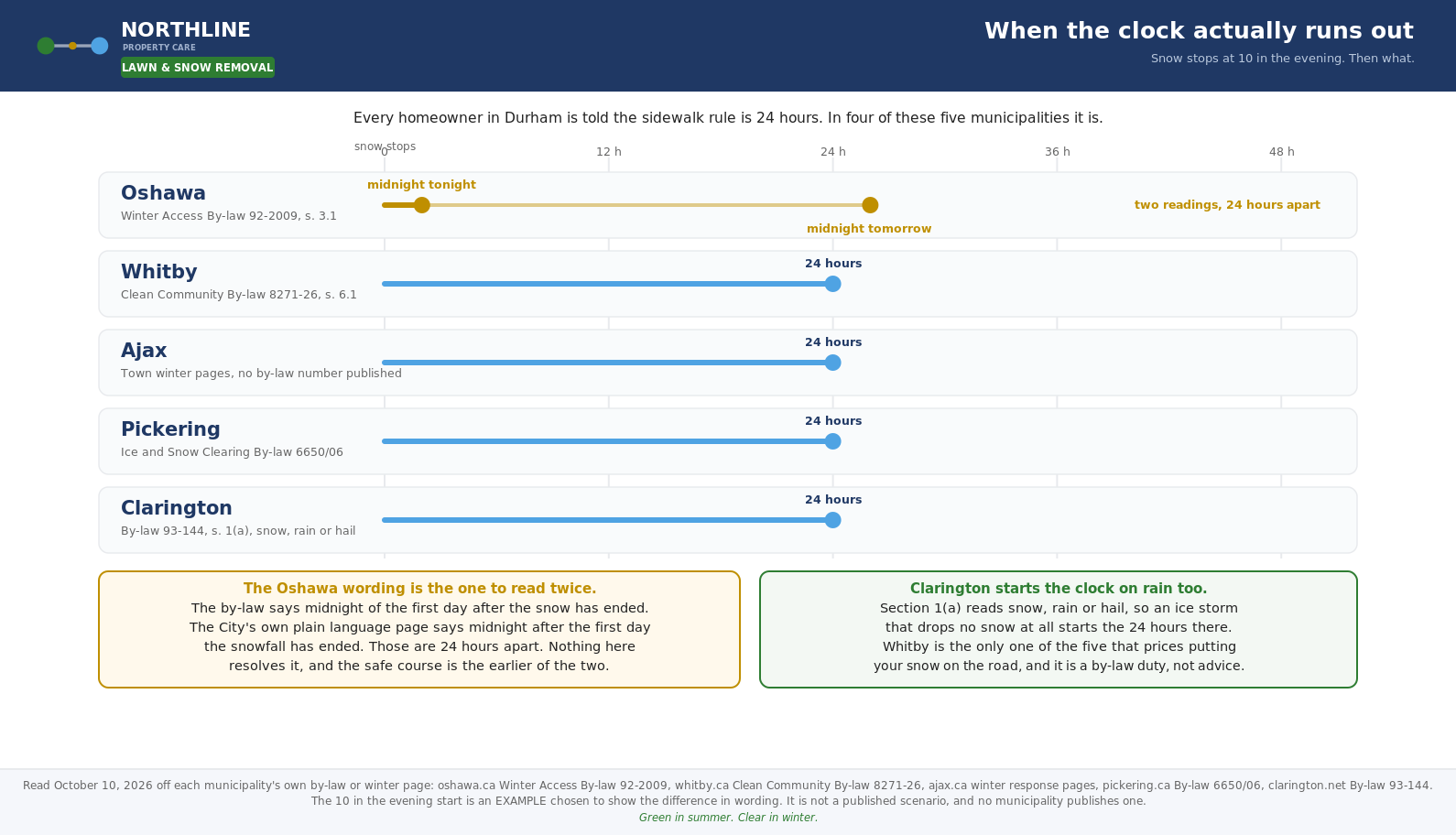
Ask anybody in Durham when the sidewalk has to be clear and they will tell you twenty four hours. In four of the five municipalities we serve they are right.
Whitby Clean Community By-law 8271-26 section 6.1 gives the owner or occupant 24 hours after the accumulation, and it includes the windrow in what has to come off. Pickering Ice and Snow Clearing By-law 6650/06 gives 24 hours after the accumulation. Ajax publishes 24 hours on its winter pages without naming a by-law number. Clarington By-law 93-144 section 1(a) gives 24 hours, and it is the only one of the five that starts the clock on a fall of snow, rain or hail, so a Bowmanville or Courtice ice storm that drops no snow at all still starts it.
Oshawa is the one worth reading twice. Under Winter Access By-law 92-2009, section 3.1, the clock stops at midnight on the first day that follows the end of a snowfall. The City of Oshawa plain language snow clearing page words the same duty as midnight after the first day the snowfall has ended. Read one way the deadline for a snowfall that stops at ten on Tuesday evening is two hours later. Read the other way it is twenty six. Nothing on the City site resolves which reading an officer applies, and we are not going to resolve it for them.
What we will say is which way to err. The penalty structure in that by-law runs from an administrative penalty through three escalating tiers to a prosecution with a minimum fine, and none of that is worth testing to find out which clock was running. Clear it the evening the snow stops and the question never arises. The full set of Oshawa provisions sits on our snow removal bylaw guide.
Section 3.2 of the same by-law carries a second duty almost nobody knows about. Once the sidewalk is cleared, the owner must apply sand, salt or other suitable material immediately and as often as necessary whenever the surface is or becomes slippery. Clearing is not the end of the obligation. What to put down, and the temperature at which the common products stop working, is on the driveway salting guide.
Where the snow you shovel is allowed to go
On your own property. That is the whole rule, and the reason it needs five paragraphs is that every municipality words the prohibition slightly differently and one of them prices it.
Oshawa section 6.1 stops any person putting snow off private property onto a sidewalk or onto a highway, and it stops piling or redistributing it there as well. Section 6.2 bars depositing snow on a boulevard that is not next to your own lot, which is the clause that catches throwing it across the property line in a townhouse block.
Whitby section 8.6 is the blunt one. Nobody may shovel, plow or blow snow, slush or ice onto a sidewalk, onto a pedestrian walkway or onto a highway, and nobody may send it across one either, authorization aside. Whitby is also the only municipality of the five that attaches a published administrative penalty to that specific act, escalating through three tiers for repeat notices, and the only one that makes the fire hydrant a legal duty rather than a request. Section 6.1 of that by-law requires snow and ice removed from within a 60 centimetre radius of any hydrant on a boulevard. Oshawa asks for about two feet around a hydrant and calls it a request.
Clarington By-law 93-144 section 8 is the strongest statutory wording in the region. No person shall sweep, shovel, throw, drop or place any snow, slush or ice onto the travelled portion of any highway or onto any sidewalk on any highway. It leaves very little room to argue about what counts.
Pickering adds the one instruction nobody else publishes, and it is the one that causes the most actual damage. Keep shovelled snow away from the storm sewer catch basin, particularly the one next to your own property. A blocked catch basin is how a thaw becomes street flooding and how a refreeze becomes a sheet of ice across the road in front of your house. Pickering also explains, on its own winter pages, why the second windrow arrives: plows push the ridge as tight to the curb as they can while maintaining at least a five metre road width, and anything that does not fit comes back across the driveway mouths.
None of the four by-laws we read contains a clause about depositing snow on a neighbour's property. Oshawa section 6.2 comes nearest, and it is about the boulevard rather than the lot. That gap is reported here because it is a gap, not because it is permission.
When a shovel is the right answer, and we will tell you so
Most of a Durham winter does not need a contractor, and pretending otherwise would be the easiest lie on this page to tell.
The Oshawa normals give about 26.8 days a year with measurable snowfall. Of those, 7.8 days reach 5 cm, and only 2.5 days reach 10 cm. Subtract and nineteen days a year bring less than 5 cm. On a single width driveway that is under a hundred kilograms a time at the fresh density. Ten minutes with a pusher, done the evening it lands, and the whole thing stays in the easy part of the range for the rest of the week.
If your driveway is one car wide, your walk from the door to the sidewalk is short, you are reasonably fit and you have no cardiac history, buy a light pusher with a 25 to 35 centimetre blade, go out early, and keep your money. That is the correct answer and nobody should be selling you out of it.
There is a second case where the honest answer costs us even more. Every municipality in this region runs a snow clearing assistance program for seniors and for people with disabilities, and every one of them is cheaper than hiring anybody. Whitby charges nothing. Clarington charges $107.69 including tax for the 2026 to 2027 season. Pickering runs a sliding scale by income that starts at nothing for people receiving certain benefits. Oshawa publishes no fee at all on its program page. If you qualify, join it. No contractor beats free, and we will not pretend to.
The catch with all four is the calendar, and this is the part worth acting on today. Pickering closed registration on October 16. Clarington closes on October 31. Whitby closes on November 1. Oshawa runs to December 18. Every one of those programs also carries an age or medical test and a rule that nobody able bodied under 65 lives at the address, so read the eligibility before you plan around it.
One thing worth adding for an older household, because the programs are narrower than their names suggest. Not one of them clears the walk between the front door and the driveway, and the depth gates mean that on most snow days of a Durham winter nobody is dispatched at all. Snow removal for seniors in Oshawa works through what each program reaches, what the by-law still requires whatever your age, and what the age specific research on cold and exertion actually measured.
And the days a shovel does not win
Four of them, and they are the reason this service exists.
The windrow is the first and the worst. When a municipal plow passes your street it leaves a ridge across the mouth of your driveway, and that ridge is not the snow that fell on your driveway. It is the snow from the road, pushed, compacted under a blade and left to set. It sits at the dense end of the range from the moment it lands. Oshawa will clear it for assistance program households, and only when it measures at least 20 centimetres high. Whitby clears it for its program households at 10 centimetres. For everybody else, in all five municipalities, it belongs to the property owner. The town by town detail is in the windrow clearing guide.
The second is the surface that has already been driven on. Two tire tracks compressed into a 10 centimetre layer and then frozen overnight do not shovel. They chip. A pusher rides straight over them and the only thing that lifts them is an edge and a lot of weight, which is also how driveways get gouged. What happens to the surface underneath is covered in what actually causes plow damage.
The third is the morning you have to be somewhere. Fifteen centimetres overnight on a 33 square metre driveway is about 555 kilograms at the fresh density, which is 111 loads. That is not a ten minute job in the dark before work, and a 7 AM target is not a marketing line when the alternative is leaving at seven thirty with your chest pounding.
The fourth is the one nobody plans for. Anybody can be the person who should not be out there, and it is rarely announced in advance. A new diagnosis, a parent who moved in, a winter spent on crutches. The right question is not whether you can clear your driveway this year. It is what happens to it in the February you cannot.
What that costs is published rather than quoted on the phone. The seasonal snow package covers the driveway, the walkway and salting, unlimited, at the measured 3 cm trigger with the 7 AM target after overnight snow. Three property sizes, three figures, and HST goes on all three.
| Property | Seasonal snow package, plus HST | Against the mass on a driveway of that order |
|---|---|---|
| Small | $800 | roughly 2.1 tonnes a winter on a single width slab |
| Standard | $975 | roughly 3.8 tonnes a winter on 33 square metres |
| Large | $1,200 | scales with the area, so redo the arithmetic above for yours |
Spread the middle figure across the 27 snowfall days on a standard driveway and it lands near $36 a day, or about 26 cents a kilogram. A good pusher costs roughly what one of those days costs. We would rather you did that arithmetic properly than took our word for it, which is why the inputs are all on this page. The month by month cost comparison, including the per visit and monthly models, is on what snow removal costs in Oshawa, and how the whole winter is priced is on the membership page.
One more thing the money does not buy, and it should. A plow clears the driveway. It does not clear the three steps to your front door, and almost every winter fall that matters happens on a step, a landing or the strip of concrete between the two. Whatever you decide about the driveway, do the walkway first, do it early, and put something down on it afterwards.
What we could not verify
Every article on this site carries this section, because a page that reports only what it found is not showing you its method.
- There is no Canadian count of snow shovelling injuries. The Public Health Agency of Canada surveillance system records 18 cases of shovelling or manual labour inside 1,121 reported cold related injuries between April 2011 and July 2024, but those are frostbite and hypothermia presentations at a sample of emergency departments, not musculoskeletal or cardiac shovelling injuries. We looked for a national figure on the second thing and there is not one.
- No Canadian health authority publishes a list of people who must not shovel. Everything we found is conditional. We looked for a harder statement specifically because it would have been the easier thing to quote.
- The two snow densities in this article come from an Ontario alert about roof loading. They are the only published Ontario figures and they were written for a different surface. Every mass on this page and on the two charts is arithmetic on those densities and on a stated driveway size, not a measured driveway.
- We could not read Ontario Regulation 239/02, the Minimum Maintenance Standards, in its own words. The provincial e-Laws site would not serve its text to us. The road clearing table quoted on municipal pages in this region comes from those municipalities reproducing it, and we have left it off this page rather than quote a regulation through somebody else.
- Environment and Climate Change Canada no longer publishes a centimetre threshold for a snowfall warning anywhere we could find. The former criteria page now redirects to impact based guides and the hazard is described by its effects rather than its depth. If you have seen a number quoted for southern Ontario, it is not currently published.
- The Oshawa deadline wording is unresolved and is reported that way above. Two City documents read 24 hours apart and we did not ring the City to ask, because the answer one officer gives on the phone is not the same thing as the published rule.
- The Canadian Centre for Occupational Health and Safety rate of 5 kilograms every five seconds describes lifting only. How much longer a real driveway takes has not been measured here and no multiplier is offered.
Who wrote this
Andrew owns and runs Northline Property Care out of Oshawa. He has six winters of clearing snow in Durham Region behind him, which is his own experience and not the trading history of the company, because Northline registered in August 2026, so no winter has yet been worked under the business name. The distinction matters and this site keeps it.
This article was written because the question keeps arriving in the same shape. People do not ask whether they should hire somebody. They ask whether shovelling is bad for them, and then they go and look it up and find a page written by a company that wants the answer to be yes. So the numbers here are built from Environment and Climate Change Canada, the Government of Ontario, the Canadian Centre for Occupational Health and Safety, the Canadian Medical Association Journal, the Durham Region Health Department, Health Canada and five municipal by-laws, and not one figure on this page comes from another property maintenance company.
If something here is wrong, say so. The phone number at the top of this page reaches the person who wrote it.
Questions people actually ask
How much snow does shovelling a driveway in Oshawa actually move in a winter?
About 3.8 tonnes on a double driveway of roughly 33 square metres, which is around 752 shovel loads at the 5 kg load the Canadian Centre for Occupational Health and Safety uses. That is arithmetic on Oshawa's 1991 to 2020 snowfall normal of 101.7 cm and on the lighter of the two snow densities the Government of Ontario publishes. A single width driveway is closer to 2.1 tonnes. Both figures assume the snow is cleared while it is still fresh. Left to compact, the same snowfall weighs more than four times as much.
Is shovelling snow actually dangerous, or is that just something people say?
The honest answer is that the Canadian evidence is strong on the association and silent on the cause. A Quebec study published in CMAJ in 2017 looked at 128,073 hospital admissions and 68,155 deaths from heart attack between 1981 and 2014 and found that for men, 20 cm of snowfall was associated with higher odds of an admission the next day and higher odds of dying of one, with no equivalent rise in women. The authors wrote that they suspect shovelling is the mechanism. They did not measure who shovelled, and they said so.
What is the sidewalk snow clearing deadline in Oshawa?
Winter Access By-law 92-2009 section 3.1 puts it at midnight on the first day after a snowfall has ended, and the duty is the owner's. The City of Oshawa plain language snow page words it as midnight after the first day the snowfall has ended. Those two readings sit 24 hours apart and nothing on the City site resolves which one an officer applies, so the safe course is the earlier of the two. Whitby, Ajax, Pickering and Clarington all run a flat 24 hour clock instead.
Where am I allowed to put the snow I shovel off my own driveway?
On your own property, and nowhere else. Oshawa section 6.1 keeps snow that came off private property away from the sidewalk and away from the highway, and section 6.2 bars depositing it on a boulevard that is not next to your own lot. Whitby section 8.6 is the one with a price on it, at an administrative penalty rising through three tiers, and Whitby also requires a 60 cm clear radius around a boulevard fire hydrant. Pickering asks you to keep snow off the storm sewer catch basin beside your property.
When is a shovel genuinely the right answer?
When the driveway is one car wide, the walk is short, the snowfall is under 5 cm and you have no reason to think your heart would mind. In an ordinary Oshawa winter 19 of about 27 snowfall days are under 5 cm, so a good shovel handles most of the calendar. What it does not handle is the plow windrow, a surface that has already been driven on and frozen, or a 15 cm overnight fall on a morning you have to be somewhere. Those are the days worth paying for.
Does a seasonal contract cover the walkway and the steps, or only the driveway?
The seasonal snow package covers the driveway, the walkway and salting, unlimited, at the measured 3 cm residential trigger with the 7 AM target after overnight snow, Plus HST, it is $800 on a small property. A standard one is $975 and a large one is $1,200. The walkway matters more than the driveway for anybody worried about a fall, because the steps and the landing are where people actually go down, and no plow has ever reached either.
Read next
A blower, a shovel or a service
The same arithmetic applied to a machine instead of a back, including what a blower costs to own over its life and the one job it still cannot finish.
Run the comparison →Every Oshawa winter by-law clause
The clearing deadline, the salting duty that follows it, the penalty tiers, and what a declared significant weather event suspends and what it does not.
Read the by-law guide →Who is liable if somebody falls
The occupier duty, the written notice period a snow and ice claim now carries in Ontario, and where a tenant obligation starts and a landlord one stops.
See where liability sits →The work, photographed
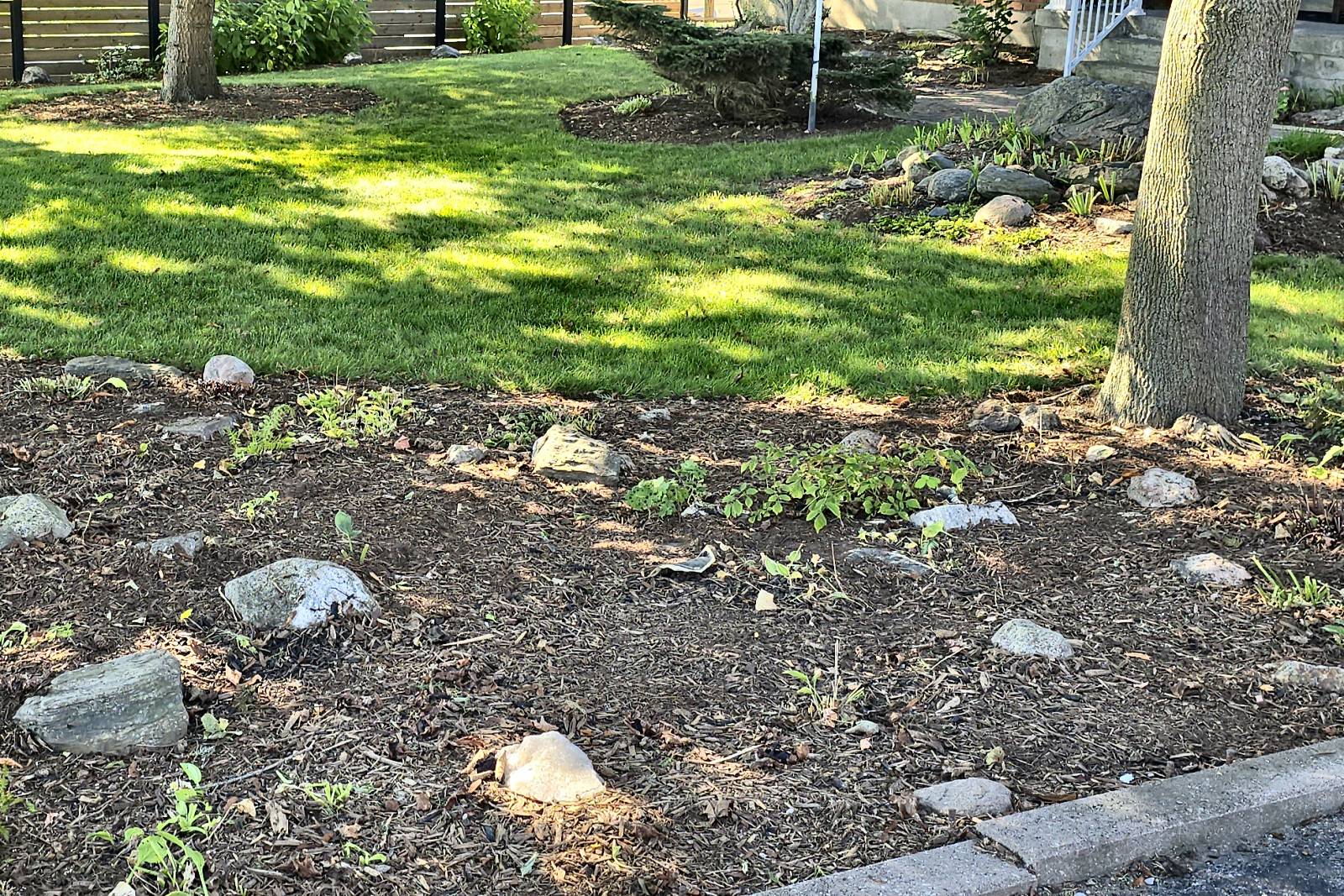
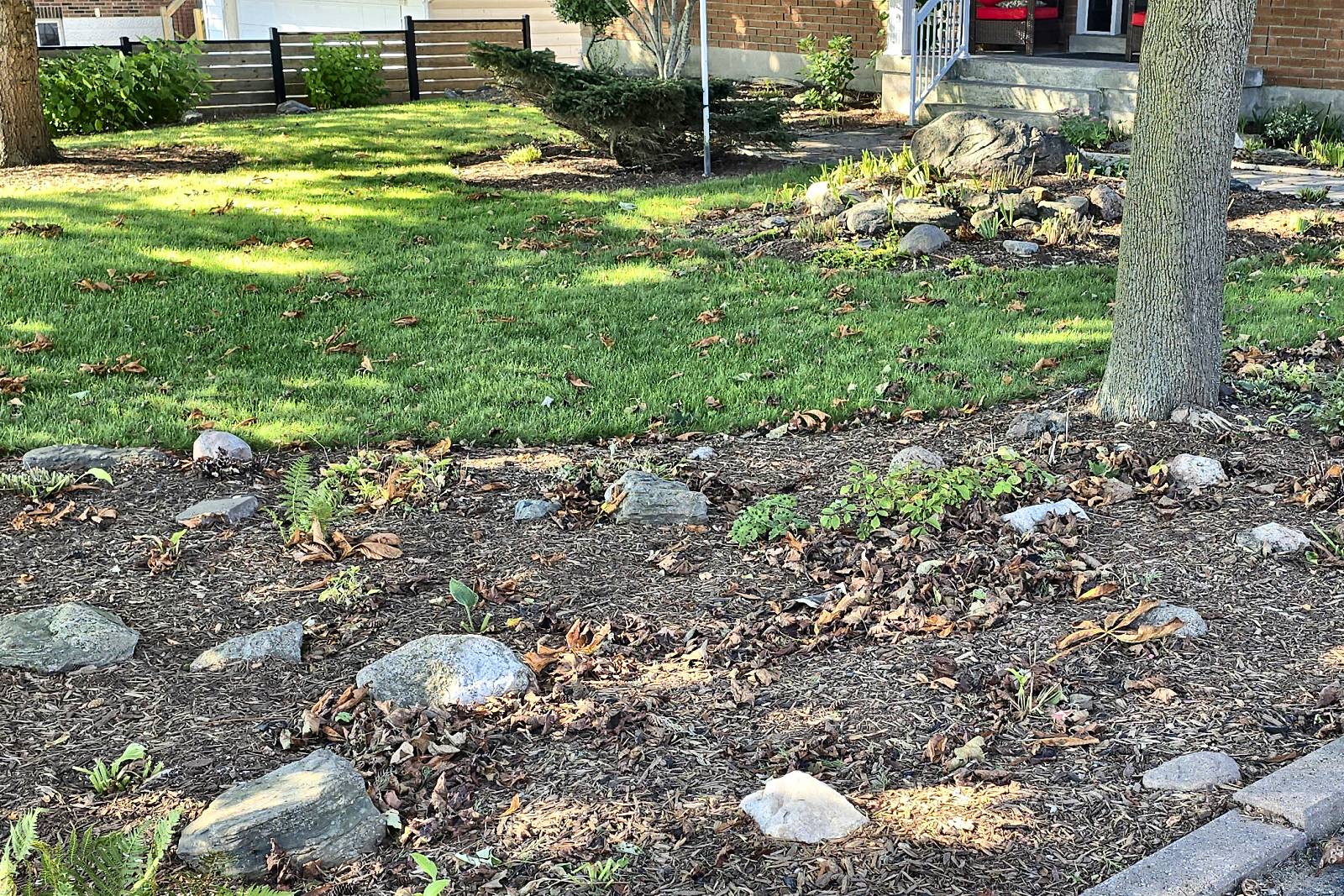
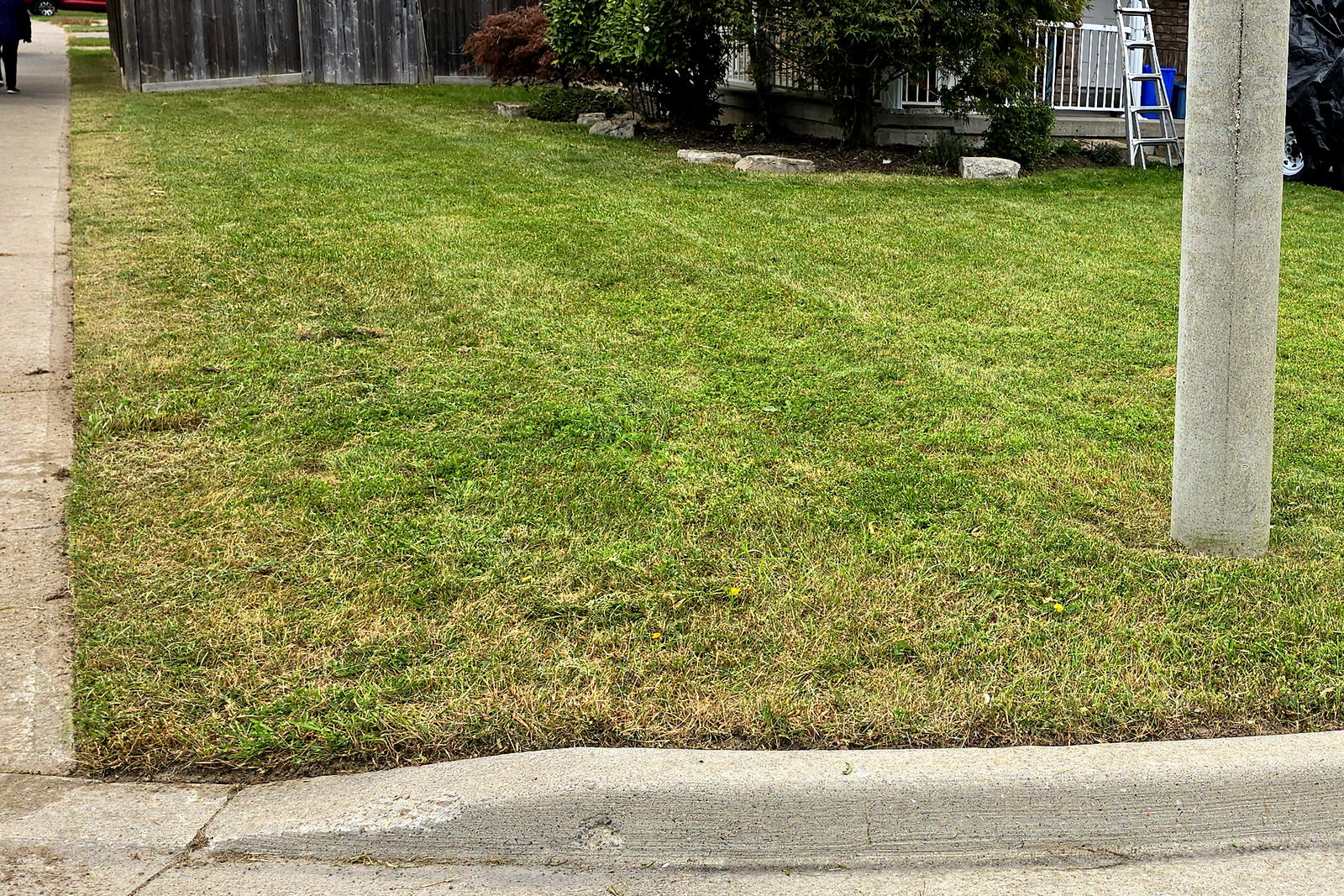
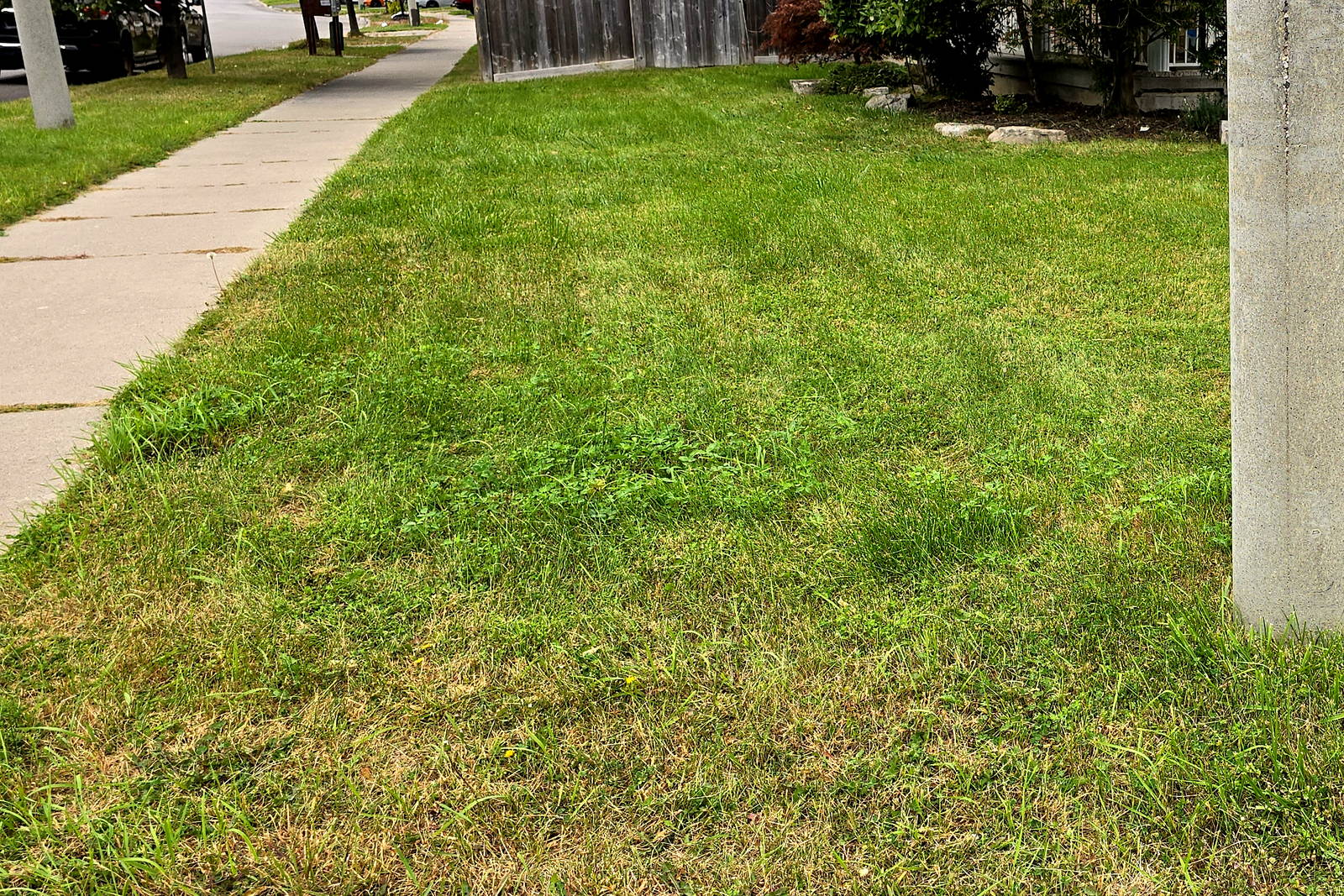
Real Northline properties, before and after, every one of them in Oshawa and every one of them this year. Drag the line to compare.
Andrew answers, October 2026
What happens if it snows all day instead of overnight?
The first pass opens a lane out to the road, the walkway and the steps, so you can get out. Then the whole route gets that same first pass. Then, once the snow stops, we come back for the full clear: full width to the pavement, the windrow off at the road, piles tidied and salt down again. If it looks half done at eight in the morning in heavy snow, that is deliberate and we are already on the way back. There is no extra charge for the second visit.
One of these goes on each page and it is replaced monthly. If the question you have is not here, ask it: 905-244-5779.
Put the shovel down for one winter and see
Tell me your driveway size and whether anybody at the address is managing stairs in February. I will tell you which package your property actually needs, what the season costs, and whether your household qualifies for the municipal program instead. If the shovel is still the right answer for you, that is what I will say.