Snow removal · Before the first storm
Driveway Markers for Snow Removal in Oshawa, and Exactly Where They Go
Driveway markers for snow removal in Oshawa go in while the ground still takes a rod by hand, which is the last two weeks of October in most years. They exist so the person clearing your driveway can see where the pavement ends, because under fresh snow at night that edge is invisible.
The tier that plows the driveway is Gold, at $189 a month plus HST. See what each tier does between the end of a storm and breakfast.
Green in summer. Clear in winter.
The short answer
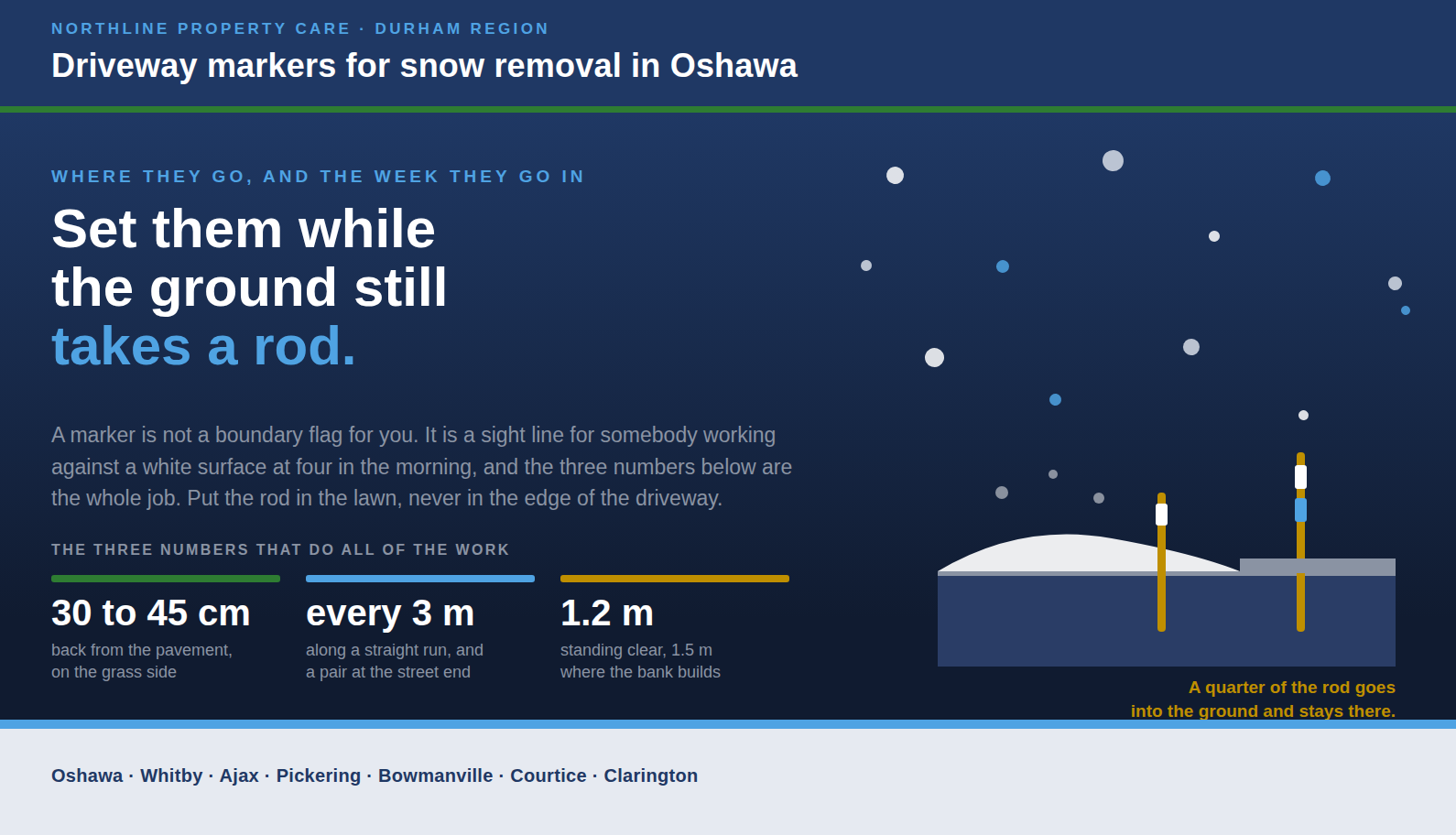
Set them in the grass, not in the driveway, and set them in October. Thirty to forty five centimetres back from the pavement edge, one every three metres along a straight run, a taller pair at the street end, and a quarter of the rod in the ground. Push them in by hand. Keep them off the strip past the sidewalk, because that strip belongs to the municipality and not to you, and keep them off the line between your gas meter and the road. Pull them out before the first cut in April. If your driveway is a plain rectangle with a mown grass edge and nothing in the first metre of it, you do not need markers at all, and we will not sell you any.
A marker is not a boundary flag for you. It is a sight line for somebody else
Once fifteen centimetres of snow is lying, a front lot stops having edges. The driveway, the shoulder beside it, the lawn, the garden bed and the neighbour's lawn are one continuous white plane with a few humps in it. The operator is not guessing where your driveway is. He knows where it is. He is guessing where it stops, and the difference between those two problems is the whole reason this job exists.
The province does exactly the same thing at highway scale and writes the reason down. Ontario Provincial Standard Specification 704, which is the Ministry of Transportation's own construction specification for roadside delineators, requires that a delineator carries high intensity retroreflective sheeting to ASTM D 4956, Type III or IV, and that post mounted delineators are installed plumb and set to alignment and grade. The Ontario Traffic Manual lists delineation for winter maintenance operations as one of the standard reasons a delineator is there in the first place. A rod in your lawn is that idea shrunk to one property.
There is a second job the rod does, and it is the one that saves money rather than grass. A plow blade moving at walking pace still needs a metre or two to change line. A marker seen four seconds early is a correction. The same marker seen as the blade arrives is a marker on the floor of the truck.
Orange survives a Durham winter better than white or silver because the background is white. That is not a taste argument. A white rod against a snow bank at four in the morning, lit by two headlights and nothing else, is a rod nobody sees.
The week they go in, and why no calendar will give you a date
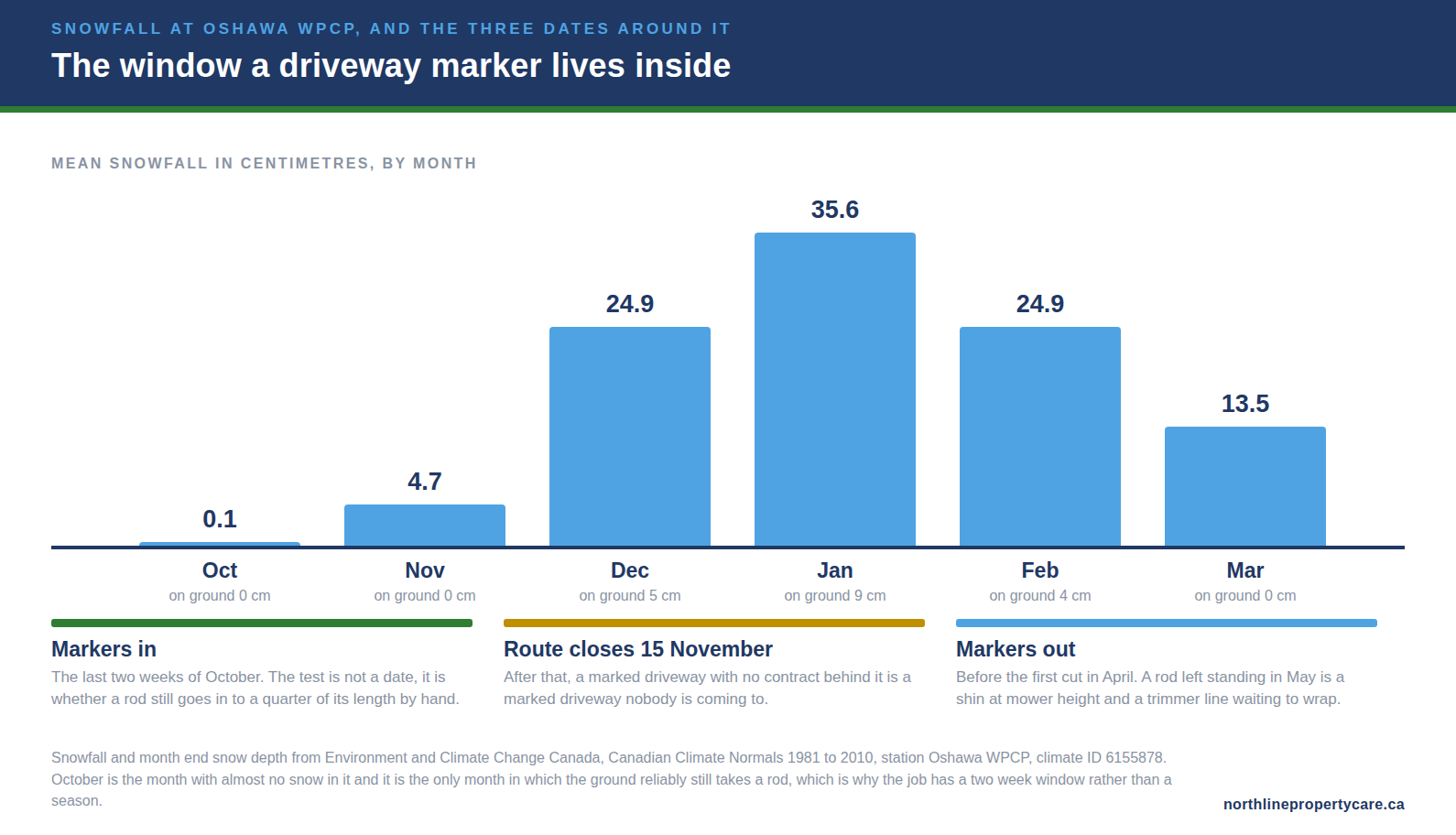
October, and specifically the second half of it. The reason is arithmetic rather than tradition. In the Environment and Climate Change Canada climate normals for Oshawa WPCP, station 6155878, mean October snowfall is 0.1 cm and mean November snowfall is 4.7 cm. December is 24.9 cm and January is 35.6 cm. October is the only month on that table with effectively no snow in it, and it is also the last month in which the ground reliably takes a rod pushed by hand.
The same normals set gives the other half of it. The mean date of the first fall frost at Oshawa WPCP is October 14, the mean last spring frost is April 29, and the frost free period runs 168 days. So the first air frost and the second half of October are the same two weeks, which is a tidy way to remember the job.
Now the distinction that actually decides the date, because a first frost is not a frozen ground. An air frost is a reading taken at screen height in a box a metre and a half up. The soil is a heat store that has spent all summer charging, and it gives that heat back slowly, so a lawn stays workable for weeks after the first morning the windscreens are white. The date the soil itself freezes here is not published anywhere. There is no published soil temperature normal at five or ten centimetres for a southern Ontario station across October to December that we could find, and even the building code declines to give a frost depth: Ontario Regulation 332/12, Division A, Article 1.1.2.2, says in full that the depth of frost penetration shall be established on the basis of local experience. Its own prescriptive table then uses 1.2 metres as the minimum footing depth on clay, which is where the commonly quoted four feet comes from.
So the test is not a date. Push a long screwdriver into the lawn beside the driveway. If it goes in to the handle under hand pressure, a marker will go in too. If you are leaning on it, you have left it too late, and the answer then is a pilot hole made with a steel bar and a hammer, never a mallet on the marker itself.
There is a business date behind the weather date as well, and it is worth saying plainly. Once the winter route is full it stops taking driveways, and it does not open again part way through a season. A marked driveway with nobody contracted to clear it is a marked driveway nobody is coming to. If you are still deciding, the two dates that actually govern that decision are set out in our piece on when the route fills.
Where exactly they go, in three numbers
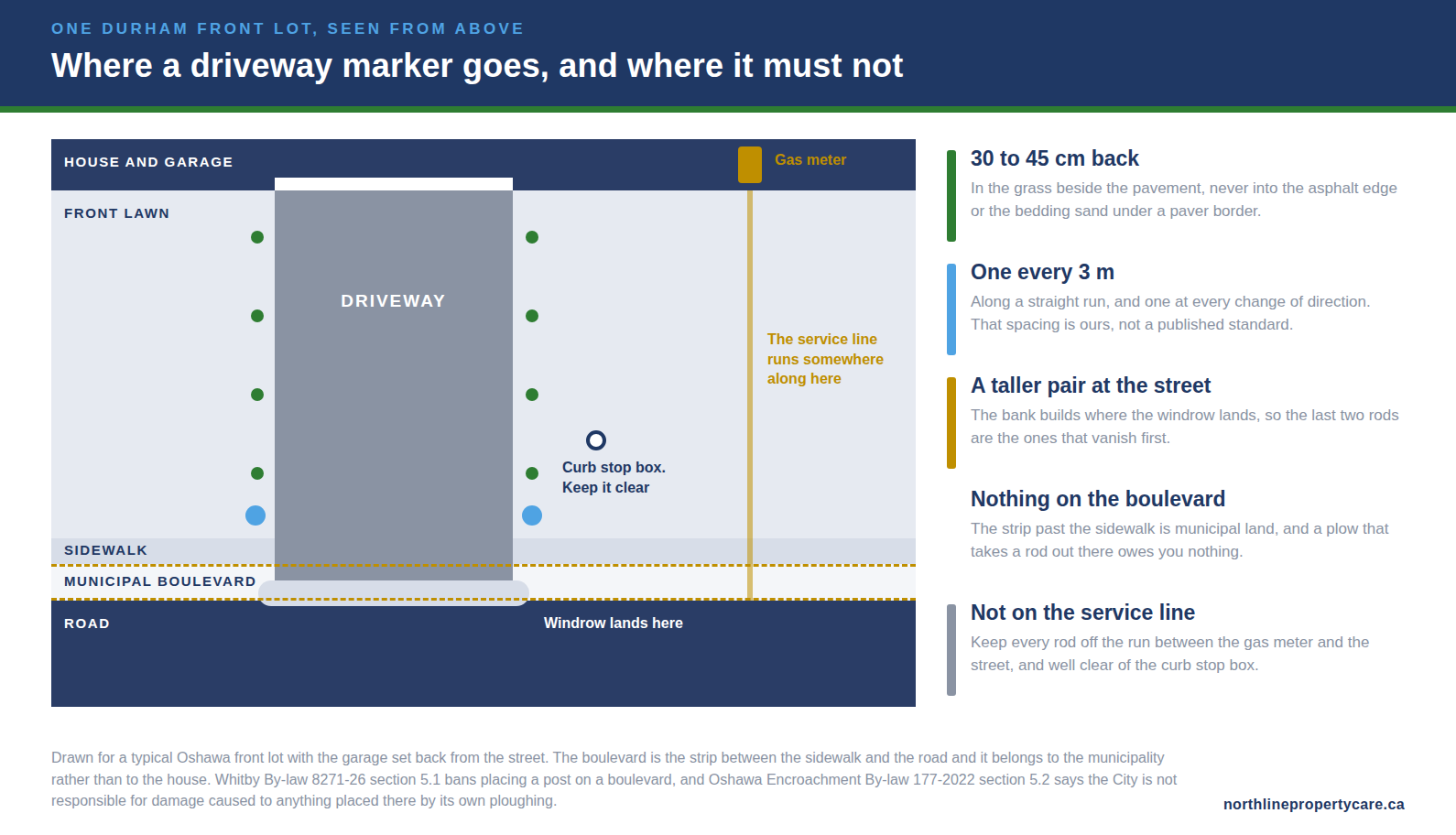
Thirty to forty five centimetres back from the pavement, on the grass side. One every three metres along a straight run. A pair at the street end and one at every change of direction. Those three numbers carry almost the whole job, and each of them exists for a reason that is easy to get backwards.
The setback is the one people get wrong most often. A marker driven into the very edge of the asphalt, into the paver border course or into the bedding sand beneath it is worse than no marker, because you have introduced a hole and a lever exactly where the surface is already weakest. Our piece on what actually breaks a driveway in this region sets out why an unsupported edge is the single most fragile part of a Durham driveway. Do not put a spike in it.
Going too far the other way costs you the point of the exercise. A rod standing a metre out on the lawn tells the operator nothing useful about where the pavement stops, and it is the rod the wing clips on the return pass. The strip of sod between the rod and the pavement is where a winter shows first, and what the equipment does to a lawn edge depends on which tool is on the front of the truck.
The pair at the street matters more than any other two rods on the property, because that is where the municipal windrow lands, where the bank grows fastest, and where the operator is working at an angle with the most snow in front of him. Who clears the windrow, town by town explains why that ridge is there at all and why no Durham municipality simply removes it.
On the three metre spacing, the honest note: that figure is ours. OPSS 704 does not publish a spacing, a height or an offset for a delineator at all. It defers every one of those to the contract documents for the job, and the numeric tables in the Ontario Traffic Manual could not be read in the version available to us. Three metres is what works on this route. It is not a standard and it is not presented as one.
How tall, and the number that decides it
A marker does not have to clear the snowfall. It has to clear the pile you make out of the snowfall, and those are very different numbers.
The Oshawa normals put the mean snow depth on the ground at month end at 5 cm in December, 9 cm in January and 4 cm in February. Read on its own that suggests a very short rod would do. It would not, because the snow that was lying on a six metre by twelve metre driveway does not stay spread out. It gets moved into two piles at the sides, and everything that fell on the road in front of the house gets added to one of them as a windrow. The record depths on that same table are 43 cm in December and 51 cm in January, and a bank at the street end of a cleared driveway in a February like that is chest high.
So the working figures are a rod of about 1.2 metres along the run and about 1.5 metres at the two street corners, with a quarter of the length in the ground. A 1.2 metre rod set 30 cm deep is standing 90 cm clear, which is fine in the middle of a driveway and short at the end of one. Buying two longer rods for the corners costs a few dollars and is the difference between a marker doing its job in February and a marker that stopped working in January.
Fibreglass is the material that behaves best here. Plastic tube goes brittle and snaps at the temperatures a Durham January produces, wood heaves and rots at the ground line, and metal is the one that will do damage rather than take it. A steel rod bent over by a bank and buried in it is a hazard for a blade and for a shovel.
Durham clay will push them back out, and it is not your fault
Set a rod 30 cm into an Oshawa lawn in October and there is a fair chance it is standing 5 cm higher in February without anybody touching it. That is frost heave, and the mechanism is worth understanding because it decides how deep you set them and when you walk the run.
The National Research Council of Canada's building digest on frost action and foundations describes it plainly. As a freezing front moves down through the soil, water migrates upward toward it and accumulates as ice lenses, which force the soil particles apart. Fine grained soils sustain that migration and coarse ones do not. Its own wording is that coarse grained soils such as sands and gravels do not heave, whereas clays, silts and very fine sands will support the growth of ice lenses. The magnitudes are not trivial either. The digest records movement of more than 100 mm developing under basement floors within three weeks in one case, and a seven storey building on a raft foundation heaving more than 50 mm.
Which brings it home. The old Ontario Soil Survey reports for this area, published by the Canada Department of Agriculture and the Ontario Agricultural College and now hosted by Agriculture and Agri Food Canada, describe the soils of Ontario County, which is Oshawa and Whitby, and the soils of Durham County, which is Courtice, Bowmanville and Newcastle. The Schomberg series, silt loam to clay loam, is mapped along the Lake Ontario shore. The Newcastle series, loam and clay loam, occupies the plain of glacial Lake Iroquois across the southern townships. Darlington sandy loam turns up near Courtice and north of Bowmanville. Silt loam and clay loam are exactly the textures the NRC names as the frost active ones.
Two consequences follow. Set them deeper than feels necessary, 25 to 30 cm rather than 10. And walk the run once in January. A rod that has risen is doing what the soil does, not what you did wrong, and it goes back down with one push while the surface is still soft under the snow.
What is buried under the strip you are about to push a rod into
You are about to push something pointed 30 centimetres into the ground, several times, in a strip of lawn that a gas service, a water service and sometimes a buried hydro or telecom run all cross. That is worth thirty seconds of thought before the first rod goes in.
Ontario One Call, which operates under the Ontario Underground Infrastructure Notification System Act, 2012, tells homeowners that a locate is required for planting trees, building fences and decks and digging gardens, and asks for the request at least five business days before work starts. Its regulation page says the same rule applies to every job, big or small, and lists building a fence, putting in a pool, planting a tree and digging a new garden among the examples. The organization's published rules define excavation broadly enough to reach almost any disturbance of the ground.
Here is the part we are not going to dress up. We looked for a published depth threshold or an exemption for a hand driven stake and we did not find one anywhere in the accessible material. Every source we could read says every job. We also do not think anybody is going to prosecute a homeowner for pushing a fibreglass rod into a front lawn, and pretending otherwise would be silly. What is genuinely worth knowing is why the risk is not zero. Enbridge Gas warns in its own safe digging material that buried lines may not be as deep as you expect and that a line could lie just a few inches below the surface. The Technical Standards and Safety Authority's fuels safety advisory 104-08 instructs that you must carefully hand dig within one metre of a locate marking, and warns that depth may change over time because of erosion or changes in the landscape.
Two rules cost nothing and remove most of it. Never set a rod on the straight line between your gas meter and the street, because that is the shortest path and the shortest path is where the service usually runs. Never set one within a metre of locate paint or a flag still sitting on the grass from earlier work.
There is one more fitting people forget entirely. The curb stop is the small round metal cap in the front lawn that shuts the water off to the house, and the Region of Durham's Water Supply System By-law 89-2003 says at section 10(2) that plants, shrubs, trees, hedges, fences, other structures and vehicles shall not obstruct free access to a hydrant, a hydrant valve, a water service connection, a valve box, a service box, a curb stop or a chamber. Do not mark beside it, and do not choose it as the side you pile snow on. If a pipe lets go in February, the crew has to find that cap.
While you are looking at the lawn, look at the hydrant. The City of Oshawa asks residents to clear snow back by two feet so that a hydrant is visible from the road.
The boulevard, and the marker you are not allowed to put there
The last few metres of what looks like your front lawn are probably not yours. The strip between the sidewalk and the road is the municipal road allowance, usually called the boulevard, and several Durham municipalities have written down what may not go on it.
Whitby is the clearest. The Clean Community By-law 8271-26, in force since April 1, 2026, says at section 5.1 that no owner or occupant of a property shall install or place a fence, post, wall or rock on a boulevard, and at section 5.2 that nothing protruding, sharp or dangerous may be placed there either. A driveway marker is a post and it protrudes. We should be fair about what that clause is: it does not name snow stakes, and no Durham municipality uses the words snow stake or driveway marker anywhere we could find. It is a reading of two clauses that plainly cover a driven post, rather than a rule written about markers.
Oshawa approaches it from the liability side and the wording is unusually direct. Encroachment By-law 177-2022 says at section 5.2 that the City is not responsible for any damages caused to an encroachment as a result of the City's reasonable use of its lands, and it names ploughing in the list of operations that follows. If the municipal plow takes out a rod you put on the boulevard, that is the end of the matter.
Pickering's Traffic and Parking By-law 6604/05 defines an obstruction at section 36.1(1) as a basketball net, a hockey net, a skateboard ramp or any other object that can interfere with the safe passage of vehicular traffic on a highway, and section 36.1(2) prohibits leaving one unattended. Ajax By-law 24-2022 carries a similar prohibition at section 4.3. For Clarington we have nothing to report, because the Boulevard By-law 2013-066 would not open from the municipality's document portal on three attempts, and we are not going to summarize a by-law we could not read.
The practical version is short. Keep the rods on your side of the sidewalk. Where there is no sidewalk, keep them back at least as far as the boulevard trees. And if you rent, check with the landlord before you drive anything into the lawn at all.
Where the snow goes decides where the markers go
The marking plan and the snow storage plan are the same plan, and doing them in the wrong order is how people end up moving rods in December.
Oshawa gives the advice first. Its snow clearing page says to pile snow from the driveway and sidewalk onto your property rather than the roadway, and to pile it on the right side of the driveway facing the street, so the municipal plow pushes less of it back in. That single sentence decides which of your two sides is the pile side.
The by-laws then set the limits. Oshawa's Winter Access By-law 92-2009 says at section 6.1 that no person shall move snow or ice from private property onto a sidewalk or a highway, or otherwise cause snow to accumulate there, and at section 6.2 that no person shall deposit snow on a boulevard that is not adjacent to their own lot. Whitby covers the wider case at section 8.6 of the Clean Community By-law, which prohibits shovelling, plowing or blowing snow onto or across a highway, a sidewalk or a pedestrian walkway without authorization, and Ajax says the same at section 5.4 of By-law 24-2022. None of that is unusual, and all of it is enforced when a neighbour complains.
Once you know the pile side, the marking follows. The pile side takes the taller rods and the deeper setting, because that is the side carrying weight all winter. The other side can take the standard rod. And if you have a rural mailbox, Canada Post's own guidelines require that the area in front of it is kept clear of snow and ice and that the bottom of the box sits at least 100 cm above the ground, with 107 to 114 cm preferred. That is a third fixed point your pile has to avoid.
The part that costs us money to write down
Most Oshawa driveways do not need markers, and we would rather say so here than sell a homeowner something they will not use.
A rectangle of asphalt with a mown grass edge, no garden bed against it and nothing in the first metre is a shape any competent operator reads fine in the dark. Marking it is thirty minutes of your life for no gain. The driveways that genuinely do need markers are a shorter list than most people expect: a curved or dog leg drive, a driveway with an interlock border course or a raised edge, a driveway with a garden bed, armour stone or a low wall against one side, a driveway where the lawn sits higher than the pavement so the edge disappears under the first storm, a corner lot where the windrow arrives from two directions, and any drive an operator has never been down before.
If yours is on that list, a bundle of ten fibreglass rods is about twenty dollars at any hardware shop, and the job is fifteen minutes with a bucket of water to soften the ground and a screwdriver to start the holes. You do not need us for it and you certainly do not need to buy them from us.
What we do is put them in and take them out for members on the tiers that clear the driveway. Gold at $189 a month plus HST is the tier that plows the driveway and carries the 7 AM target after overnight snow, and Platinum carries a 6:30 AM target. We install the markers in December on those tiers because it saves us time on the route in January, not because the job is difficult. Silver does not plow the driveway at all, so a Silver member marking a driveway edge is marking something nobody is coming to clear. The full comparison is on the memberships page and what happens after a storm is set out on the snow removal page.
The cheapest correct answer is usually to have somebody walk the property in October and tell you which of the six cases above you actually have. That costs nothing and it takes about four minutes.
Taking them out, and the date that matters more than people think
Before the first cut. Not in May, not when you get to it, before the first cut.
A fibreglass rod standing in a lawn in the second week of April is invisible by the third week, because the grass comes up around it while the lawn is still too wet to walk on. After that it is a post at shin height in growing grass, a trimmer line waiting to wrap, and on a rod that has snapped at ground level over the winter it is a splintered fibreglass stub that nobody can see. The snow season closes on May 1 and the first cut in Oshawa usually falls within two weeks of it, so the removal window is genuinely narrow.
Pull them on the first dry weekend after the melt, wipe the mud off, band them together and store them flat rather than leaning in a corner of the garage, where the bottom ends take a permanent bend. Good rods last several seasons. Check each one as it comes out, because a rod that has split at the ground line is the one that will break off in the lawn next year rather than the one that will bend.
The same visit is the right moment to look at what the winter did to the edge of the driveway, while the damage is still visible and before the grass hides it. That is a five minute job in April and an expensive one in July.
Before the markers, the rest of the frontage
Markers are the second job on an October frontage rather than the first. The edges, the side the pile goes on, the catch basin and the overnight parking all have to be settled first, because three of those four decide where a rod actually belongs. The full order of work, with the boulevard setbacks drawn to scale, is in our guide to preparing a driveway for snow removal in Oshawa.
What we could not verify
Every borrowed figure above carries the link it came from, and each of those sources is a government agency, a regulator, a federal Crown corporation or a municipality. Not one is another property care company. Ten things were looked for and not found.
- A published freeze up date for the soil. Environment and Climate Change Canada publishes a first fall frost date for Oshawa WPCP, quoted above, and no date on which the ground itself freezes. The two are not the same measurement.
- The frost figures, read on one instrument only. The web table for this station renders the frost free rows empty while the agency's machine readable normals file for the same station and period carries them. The figures above come from the file, and the host refuses this network on a second attempt. One instrument, named, on a date.
- The building code article, on a second instrument. Ontario's e-Laws site serves an application rather than a document, so Article 1.1.2.2 was read in a browser and could not be fetched again. The quotation above is a single reading of the primary source.
- A soil temperature normal for southern Ontario. No published mean soil temperature at five or ten centimetres through October to December for a station near here, from the federal agency, the University of Guelph or the Ontario Ministry of Agriculture.
- A published spacing, height or offset for a delineator. OPSS 704 defers all three to the contract documents for the job, and the numeric tables in the Ontario Traffic Manual could not be extracted from the copy available to us. The three metre spacing above is operational and is ours.
- A depth threshold in Ontario's locate law. No published depth below which a locate is not required, and no exemption for a hand driven stake, in Ontario One Call's homeowner guidance, its regulation page or its rules.
- A burial depth for a residential gas service. No depth of cover figure for a house service line from Enbridge Gas, the Ontario Energy Board or the Technical Standards and Safety Authority.
- Clarington's boulevard rules. Boulevard By-law 2013-066 exists and its document portal returned an error on three attempts, so nothing is claimed for Clarington either way.
- Any municipal rule that names markers. No Durham municipality uses the words snow stake or driveway marker in published material we could find. The clauses quoted above are about posts and obstructions in general.
- The soil survey page references. Both soil survey reports are scanned documents from 1949 and 1950. The series names and textures are reported as read, and the page numbers behind them were not re read.
Questions people in Durham actually ask
When should I put driveway markers in around Oshawa?
The last two weeks of October, and the test is the ground rather than the date. If a long screwdriver goes into the lawn to its handle under hand pressure, a marker will go in. Environment and Climate Change Canada puts mean October snowfall at Oshawa WPCP at 0.1 cm and November at 4.7 cm, so October is the only month with effectively no snow in it and the last with reliably soft ground.
How far back from the driveway edge should a driveway marker go?
Thirty to forty five centimetres back from the pavement, in the grass. Not in the asphalt edge, not in the paver border course and not in the bedding sand under it, because a hole and a lever at the edge of a driveway is damage you have caused yourself at the weakest point of the surface. A rod standing a metre out on the lawn is the opposite mistake: it says nothing about where the pavement stops and it is the one the wing clips on the way out.
How tall does a driveway marker need to be for a Durham winter?
About 1.2 metres standing clear along the run and about 1.5 metres at the two street corners, with a quarter of the length in the ground. The rod is not clearing the snowfall, it is clearing the pile you make out of the snowfall. Oshawa WPCP records a mean snow depth of 9 cm at the end of January and a record depth of 51 cm, and the bank at the foot of a cleared driveway is higher than either.
Do I need a locate before I push a driveway marker into my own lawn?
Ontario One Call says a locate is required for planting a tree, building a fence and digging a garden, and asks for five business days. We looked for a published depth threshold or an exemption for a hand driven stake and did not find one. We also do not think anybody is going to prosecute a homeowner over a fibreglass rod. What matters is that Enbridge Gas warns a line could lie just a few inches below the surface, so keep every rod off the straight run between your gas meter and the street, and a metre away from any locate paint still on the grass.
Can I put driveway markers on the boulevard beside the road?
No, and in Whitby it is written down. Clean Community By-law 8271-26 section 5.1 prohibits placing a fence, post, wall or rock on a boulevard, and section 5.2 covers anything protruding, sharp or dangerous. Oshawa comes at it from the other side: Encroachment By-law 177-2022 section 5.2 says the City is not responsible for damage caused to anything placed on its land by its own ploughing. Keep the rods on your side of the sidewalk.
Do I need driveway markers if Northline is clearing the driveway?
Usually not, and we would rather say so. A plain rectangle of asphalt with a mown grass edge and nothing in the first metre reads fine in the dark without them. Markers earn their place on a curved driveway, one with a raised interlock border, a bed or low wall against one side, a lawn sitting higher than the pavement, or a corner lot taking a windrow from two directions. On Gold at $189 a month plus HST and on Platinum we install them in December and pull them in April. Silver does not plow the driveway at all.
Who wrote this
Andrew owns the business and puts the rods in himself, on his own lawn first. Owner operated out of Oshawa, working Oshawa, Whitby, Ajax, Pickering, Bowmanville, Courtice and Clarington, fully insured. Six winters of snow clearing in Durham Region are his own, and the rods described above go in the way he sets his.
Anything borrowed here is linked to the agency, regulator or municipality that published it, and none of it came from another property care company. A wrong figure gets fixed quickest by a call or a text to 905-244-5779. The published hours and service area sit on their own page.
Read next
What actually breaks a driveway
Four causes, three of them decided by whoever is driving the truck, and why an unsupported edge is the most fragile part of a Durham driveway.
Read the four causes →The ridge at the end of the driveway
Where every Durham town stands on the windrow, which assistance programs exist, and the deadline most people miss by two weeks.
See the town by town table →Where the municipal plow is
Every Durham municipality's own tracker in one place, with the live warning state from Environment and Climate Change Canada beside it.
Open the tracker index →The work, photographed
Real Northline properties, before and after, every one of them in Oshawa and every one of them this year. Drag the line to compare.
Andrew answers, October 2026
Why is the morning clearing time a target rather than a promise?
Because a promise about the morning is a promise about the weather, and nobody can make one of those honestly. What I can promise is where you sit in the route and the order the route runs in, and both of those are published on this site. In eighteen years of Oshawa data the worst winter had twenty four clearing days and the mildest had four, and a promise written to survive the worst of those is a promise priced for it. A target I actually hit is worth more to you than a promise I have quietly priced the risk of breaking.
One of these goes on each page and it is replaced monthly. If the question you have is not here, ask it: 905-244-5779.
Have the edges walked while the grass is still showing
Send an address and the driveway gets walked in daylight in October. The walk sorts it into one of the six awkward cases, marks where the rods belong, names the ground they must stay off, and says plainly whether it needs any at all. That costs nothing, it takes about four minutes, and October is the only month it can be done honestly.