Snow removal · The rules
Snow Removal Bylaw in Oshawa, and the Deadline Nobody Reads
The snow removal bylaw in Oshawa gives you until midnight of the first day after the snow stops, which is not the twenty four hour clock Whitby, Ajax, Pickering and Clarington run.
The route closes when it is full and does not reopen. See what a winter visit covers.
Green in summer. Clear in winter.
The short answer
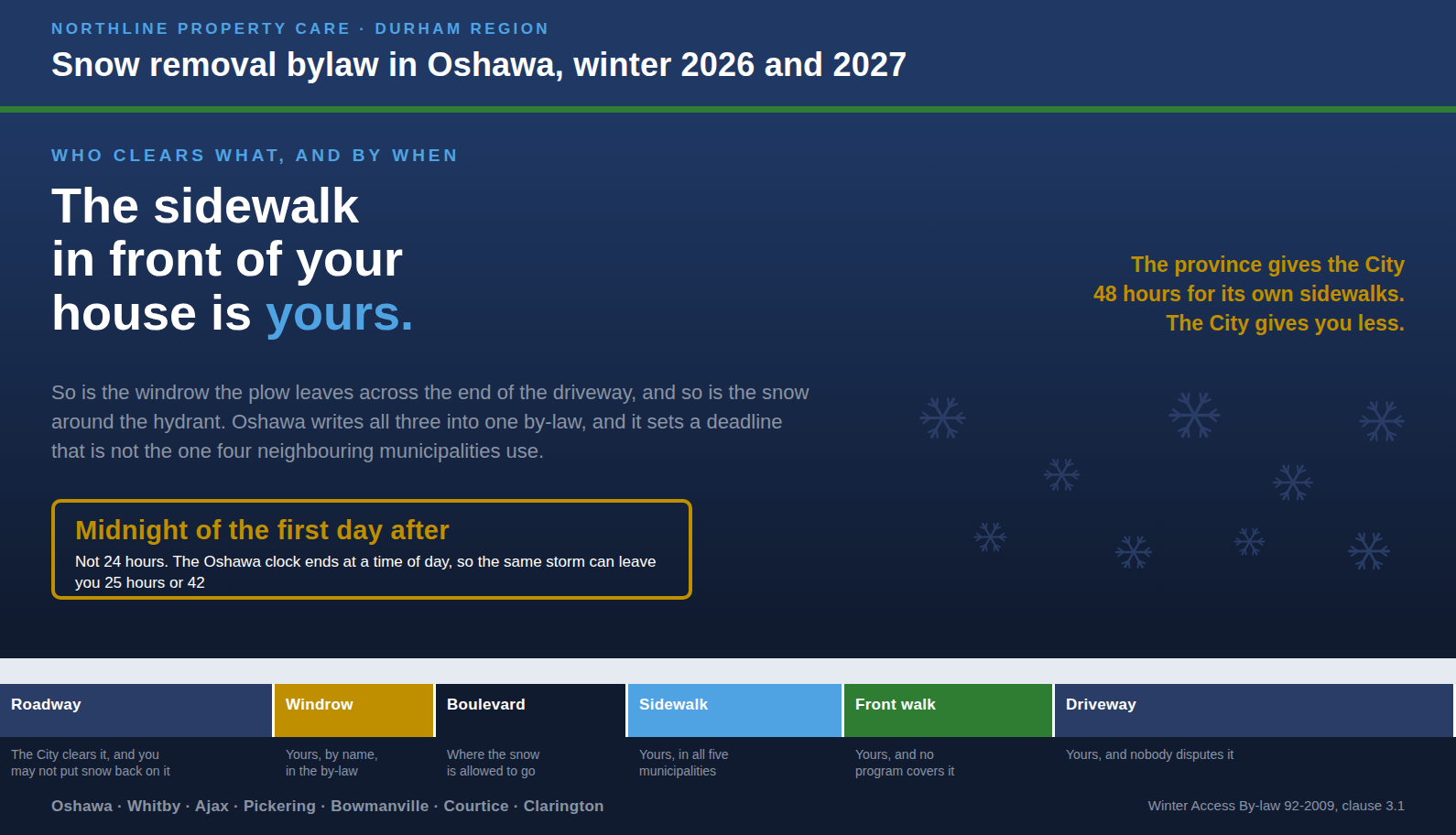
The sidewalk in front of your house is yours, so is the windrow across the end of the driveway, and cleared means the whole width of it.
In Oshawa the owner of the lot has until midnight of the first day after the snow stops to clear the public sidewalk, and cleared means the whole sidewalk rather than a path across it. That is not a rolling twenty four hours. It is a time of day, so a storm that ends at six in the morning leaves you about forty two hours and a storm that ends at eleven at night leaves you about twenty five. Whitby, Ajax, Pickering and Clarington run a straight twenty four hour clock instead. The duty falls on the owner rather than the occupant, freezing rain starts the same clock as snow, and a snow squall warning does not pause it, even though it can pause the standard the municipality is held to.
What the Oshawa by-law actually says, in its own words
The document is called the Winter Access By-law, number 92-2009, and the sentence everybody argues about is clause 3.1. It says that every owner of a lot shall, no later than midnight of the first day after the fall of snow or any other precipitation which freezes has ended, clear away and completely remove the snow and ice, including windrows, from any sidewalk on any highway in front of the lot.
Four separate things are hiding inside that clause.
- The duty is on the owner. Not on whoever happens to live there, which is the next section of this article.
- The words are clear away and completely remove. Not clear a path, not make passable. Clarington puts the same requirement in plainer language and adds the detail that settles the argument: to the full width, including between snowfalls and when drifting fills it back in.
- Windrows are named in the same sentence as the sidewalk. The ridge the plow leaves across the foot of the driveway is not a separate grievance that the City forgot to mention. It is inside the duty, in the same line.
- The trigger is any precipitation which freezes. Freezing rain starts the clock exactly the same way snow does, and Ajax says so in as many words on its own page, that the twenty four hours runs from the snowfall or from the ice forming.
The City of Oshawa snow clearing page carries the same duties in a shorter form. In winter the City itself maintains more than five hundred kilometres of primary roads, seven hundred and sixty five kilometres of residential roads and one hundred and sixty kilometres of sidewalk. The sidewalks on that list are the ones beside City owned property, the ones in the Central Business Improvement Area, the walkways and trails, the municipal parking lots, and the sidewalks of households registered on its assistance program. A sidewalk across the front of an ordinary house on an ordinary street is not on it, and clause 3.1 is why.
The duty is the owner's, and a rented house is the awkward case
Oshawa names the owner of the property and nobody else, and so does Pickering, but three of the five by-laws in this region name the occupant as well. Pickering is the most explicit of the two owner only towns and reaches furthest: every owner of a building or vacant land, whether occupied or unoccupied, is responsible for clearing any sidewalks abutting the building or the land. Vacant land with no house on it still carries the duty. Whitby, Ajax and Clarington are the other way: each of those by-laws binds the owner or the occupant, so in those three towns the municipality can charge a tenant directly.
This paragraph said all five named the owner alone until September 25, 2026, and it was wrong. It had been written from each municipality's own summary page rather than from each by-law, and for Whitby the two do not agree: the Town's page describes the duty as falling on people who own property, and the Clean Community By-law it is summarising binds every owner or occupant. The by-law is the instrument and the summary is a description of it.
That produces three situations worth thinking about before December rather than after.
- A rented house. The lease can put shovelling on the tenant and most leases do. That agreement binds the two of you and it does not move the by-law, so when the municipality sends somebody and charges for the work, the charge follows the property and the owner is the one holding it. A landlord who lives in Ottawa and relies on a tenant who works nights is carrying a risk that costs about the price of a membership to remove.
- A property being sold over the winter. A vacant house between closings has nobody in it and the duty is unchanged. This is the case that produces the most complaints in a January thaw, because an empty driveway with an uncleared frontage is the most visible thing on a street.
- An owner who is away. Six weeks in Florida does not suspend anything. A charge collected through the tax account does not arrive as a ticket you can argue about at a counter, and it does not go away because you were not there.
None of that is a reason to panic and it is a reason to decide in advance who is doing it. The by-law does not care who does the work. It cares that it is done, and in Oshawa it knows exactly one name.
The by-law is only half of the rental question, and it is the half that is easiest to answer. The other half is the Residential Tenancies Act, which puts repair and maintenance on the landlord under section 20 (1) and voids a lease term inconsistent with it under section 4 (1), so a shovelling clause does not move the obligation even where it does move the work. We have taken both halves apart, with the two statutes and all five by-laws side by side, in landlord snow removal responsibility in Ontario. The short version for a landlord reading this page: the clause you wrote into the lease probably does not protect you, and in four of the five towns it quietly converts your tenant into an owner under the property standards by-law.
Five municipalities, five clocks, and Oshawa is the odd one out
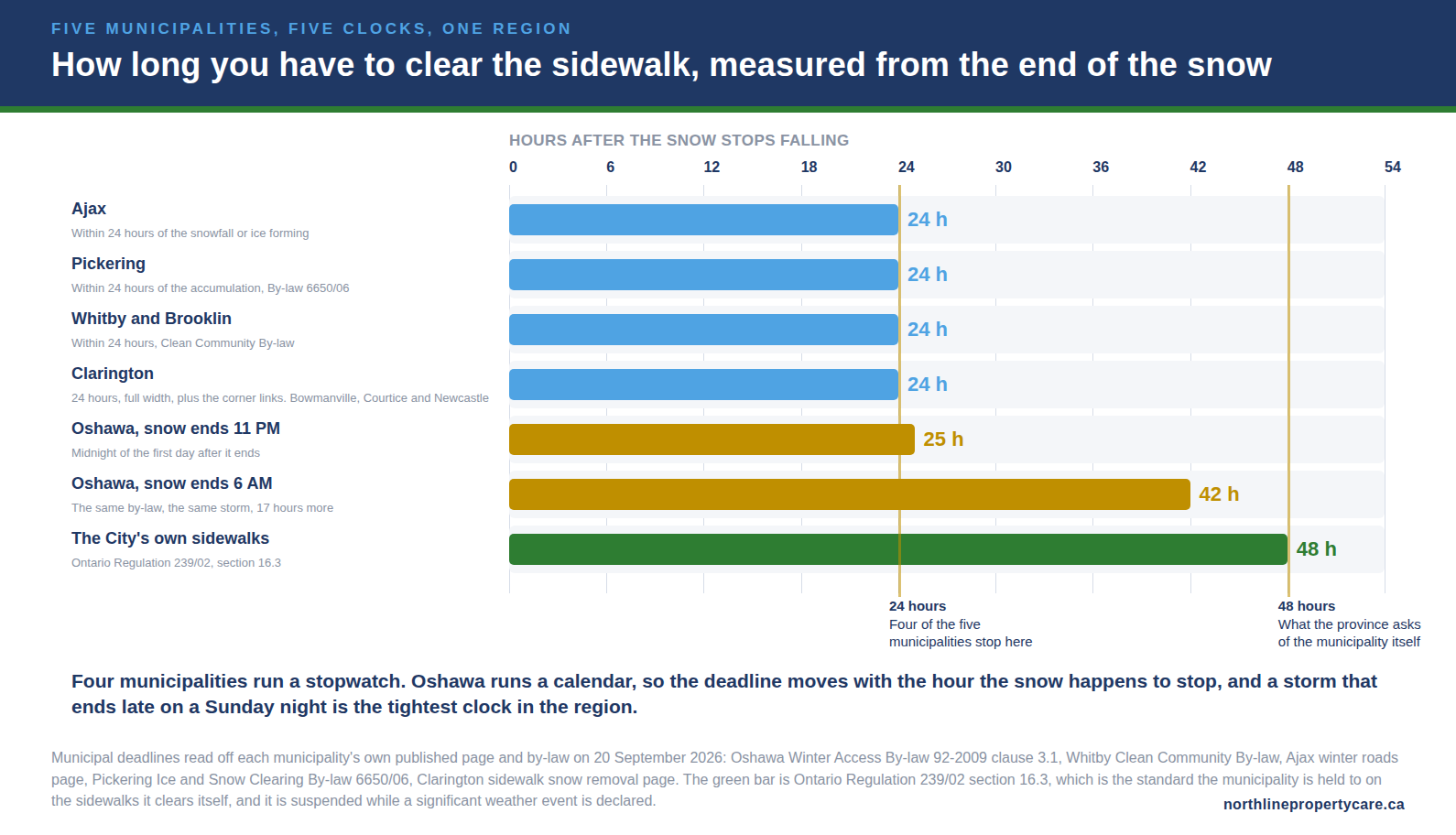
Four of the five municipalities Northline serves give you twenty four hours from the end of the accumulation, and Oshawa gives you until midnight of the day after. Those sound like the same rule and they are not. One is a stopwatch and the other is a calendar.
Here is the whole set, read off each municipality's own page on September 20, 2026 rather than off anybody's summary of it.
- Oshawa. Midnight of the first day after the precipitation ends, under Winter Access By-law 92-2009.
- Whitby, which includes Brooklin. Twenty four hours after a snowfall, under the Clean Community By-law. The Town says plainly that failing to comply may result in the Town clearing the snow and charging you for the service.
- Ajax. Twenty four hours after a snowfall or after ice forms, and the Town states that the charges sit in its User Fees By-law and are applied automatically to your property taxes.
- Pickering. Twenty four hours after the accumulation, under Ice and Snow Clearing By-law 6650/06. Pickering is the only one of the five that spells out frontage, flankage and rear.
- Clarington, which covers Bowmanville, Courtice and Newcastle. Twenty four hours, full width, plus the corner links, on its sidewalk snow removal page.
The practical difference shows up on exactly the storm you would expect. A great deal of Durham snow arrives overnight and burns itself out through the early morning. A storm that stops at six on a Monday morning gives an Ajax homeowner until six on Tuesday morning and gives an Oshawa homeowner until midnight on Tuesday night. That is seventeen extra hours on the same kind of street in the same region, for no reason other than which side of a municipal boundary the house sits on.
The same rule runs the other way and this is the half nobody notices. A storm that finishes at eleven on a Sunday night gives the Oshawa homeowner twenty five hours, which is tighter than the Ajax homeowner gets on any storm at all. The Oshawa clock is not more generous. It is less predictable, and a rule you cannot predict is a rule you plan badly for.
The province gives the City forty eight hours and the City gives you twenty four
Ontario sets a minimum maintenance standard for the sidewalks a municipality clears itself, and it is looser than the standard the municipality sets for you. The instrument is Ontario Regulation 239/02, and sections 16.3 and 16.5 were added to it in 2018.
Section 16.3 says that after snow accumulation on a sidewalk has ended, the standard is to reduce the snow to a depth of eight centimetres or less within forty eight hours, and to provide a minimum sidewalk width of one metre. Below eight centimetres the sidewalk is deemed to be in a state of repair, which in plain words means the municipality has no obligation at all until the snow is deeper than that. Section 16.5 gives the same forty eight hours for treating an icy sidewalk, running from the moment the municipality first becomes aware that it is icy.
Set the two standards beside each other and the asymmetry is hard to miss.
- Your sidewalk. Cleared completely, to the full width, within twenty four hours, or by midnight of the day after in Oshawa, from the first centimetre that settles.
- The municipality's sidewalk. Reduced to eight centimetres, over a width of one metre, within forty eight hours, and only once the accumulation passes eight centimetres at all.
We are not going to pretend that is outrageous, because there is a real reason for it. A municipality is clearing hundreds of kilometres with a fixed number of machines and operators, and Whitby publishes the constraint everybody forgets: a driver cannot work more than fourteen hours straight before resting. A homeowner is clearing about fifteen metres. The standards are different because the jobs are different sizes.
There is a third layer on top of both, and it only moves one of them. A municipality in Ontario may declare a significant weather event, and while that declaration stands the timelines in the regulation are suspended. Oshawa explains the mechanism on its own snow clearing page and lists what can trigger one: heavy accumulation inside twenty four hours, ice forming with no forecast warning, high winds producing drifting, or temperatures cold enough that de icing will not work. It suspends the standard the municipality is measured against. It does not suspend clause 3.1, and no municipal page in this region suggests that it does.
So the honest reading of a snow squall warning is the opposite of the comfortable one. The storm that makes the City slower to reach your street is the storm on which your own deadline is unchanged.
What cleared actually means, and it is not a shovel path
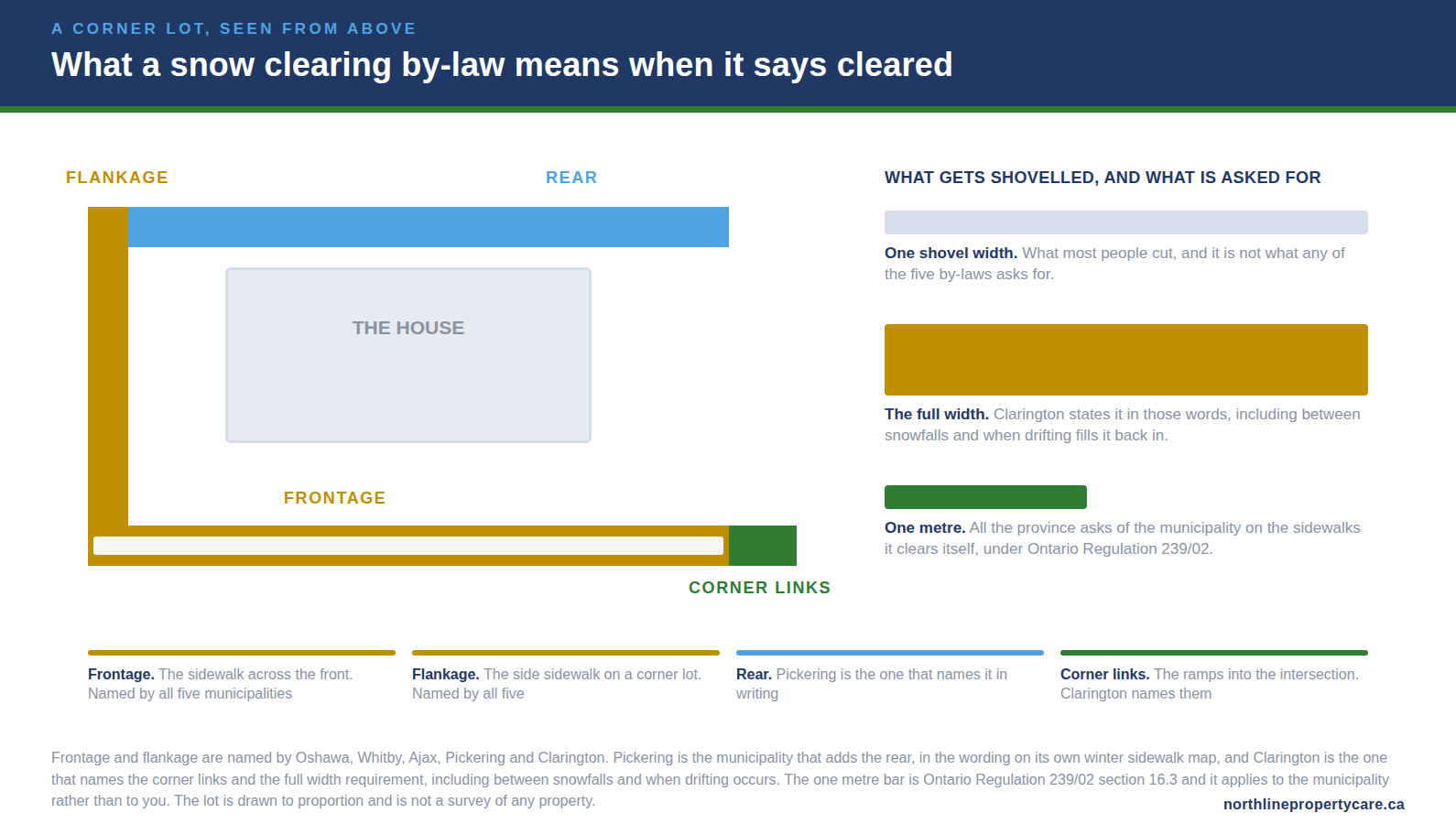
The single most common way to break one of these by-laws is to do the work and still not satisfy it. A shovel is about forty five centimetres wide. A residential sidewalk in Durham is usually about a metre and a half. A neat path down the middle looks like a cleared sidewalk from a front window and is roughly a third of one.
Four words in the published rules decide this and they are worth collecting in one place, because no single municipality states all four.
- Full width. Clarington states it directly, that residents must clear the sidewalks of snow to their full width. Oshawa's clause says completely remove, which arrives at the same place by a different road.
- Flankage. The side sidewalk on a corner lot. Every municipality here includes it, usually with a phrase like in front of and alongside, and it roughly doubles the work on a corner property for no extra frontage.
- Rear. Pickering is the one that names it, on its own winter sidewalk map, which reads frontage, flankage and rear. A through lot with a sidewalk behind it carries three sides.
- Corner links. Clarington names these as well, and they are the pieces easiest to miss: the short ramps that run from the sidewalk into the intersection. They are also the exact squares of concrete a wheelchair has to cross.
Two more conditions sit on top of the width. Clarington says the duty runs between snowfalls and when drifting occurs, which means one clearing does not discharge it if the wind fills the sidewalk back in that afternoon. And every by-law here names ice as well as snow, with Clarington adding that it is the property owner's responsibility to use safety salt or sand on ice and slippery surfaces if necessary.
That last one is the trap on a January thaw. A sidewalk that was cleared properly on Tuesday and then glazed over on Thursday night is not a cleared sidewalk on Friday morning, and clearing is not the same job as treating.
How the rule is enforced, which is not by patrol
Nobody drives residential streets looking at sidewalks. Every municipality in Durham runs this as a complaint system, which means the person who ends up paying is almost always the person whose neighbour got tired of walking on the road. That is an uncomfortable sentence and it is the accurate one.
Clarington publishes the process in more detail than anybody else and it is worth reading as the regional pattern. A complaint is accepted only after at least twenty four hours of clear weather. The municipal contractor attends every address on the list, photographs the area before and after the work, and leaves a yellow door hanger on the door explaining what happened. The cost of the work is charged to the owner with a fifty dollar administrative fee on top. Pickering does the same thing with a twenty five per cent administration fee instead, and Ajax applies its charges directly to the property tax account.
The tax account is the part worth understanding, because it behaves nothing like a parking ticket. A charge added to the roll attaches to the property rather than to a person, it does not lapse because you disagree with it, and it surfaces in a lawyer's search when the house is sold. For an owner who is away in February, that is the real exposure, and it is a better reason to arrange cover than the size of any fee.
The set fines for the related offence of putting snow back onto the road are a separate matter, they are larger than most people expect, and we set every one of them out with its by-law section in the snow blower and plow service comparison rather than repeating them here.
Twelve deadlines a winter, not one
The by-law does not set a deadline for the winter. It sets one for every snowfall, and in this region that is about twelve of them. We take that figure from the Environment and Climate Change Canada record for the Oshawa water pollution control plant station, climate identifier 6155878, across eighteen complete winters from 1995 and 1996 through 2018 and 2019.
At a three centimetre threshold, which is the depth at which our own residential route rolls, the average is 11.4 days a winter and the median is twelve. The mildest of those eighteen winters produced four and the worst produced twenty four.
That number is what changes how the by-law feels. One obligation to clear a sidewalk is a chore. Twelve of them, arriving unannounced, several overnight, one of them on the Tuesday you are in Ottawa, is a standing commitment that has to be arranged in advance rather than handled as it comes. The spread is the honest part: four in a mild winter and twenty four in a bad one is a factor of six, and nobody knows in October which winter is arriving.
It is also why we refuse to argue about price on the number of storms. A membership is not twelve clears. It is a price that does not move when the weather does, and at four clears or at twenty four the member pays the same.
What Northline does about it, and the part that costs us money to write down
Our route is built around the same by-law this article describes, and the three tiers differ mostly in how much of it they take off you. All three clear the walkway. Only two of them touch the driveway.
- Silver at $129 a month plus HST does not plow your driveway. No 7 AM target, no salting at any point in the season, and a separate daytime windrow pass by 5 PM. If you want the driveway open before work, Silver is the wrong product and we would rather say so here than after you have paid for it.
- Gold at $189 a month plus HST plows the driveway and carries the 7 AM target after overnight snow. That is the tier the by-law deadline maps on to for most households.
- Platinum at $279 a month plus HST is sequenced first with a 6:30 AM target. It carries unlimited automatic salting and first choice of service day.
All three are billed in twelve equal payments on the last day of the month, and an annual prepay takes five per cent off. Once the winter route is full it stops taking properties and stays shut, because a route that keeps adding driveways after it has been sequenced is a route that starts missing the 7 AM target.
Three sentences that cost us something. If you qualify for your municipality's assistance program, join it before you price anybody, because it is free in two of the five towns. No program in this region clears the path between your door and the sidewalk: Oshawa states that its program does not clear private property walkways leading to City sidewalks and Whitby states that its service covers the Town owned portion only, and for a lot of households that strip is the actual problem. And if a neighbour already clears your windrow with a blower, you do not need us.
What a winter visit covers is on the snow removal page, and the tier by tier comparison on the memberships page.
Where the by-law gets harder to obey, and it is not the sidewalk
Section 6.2 of the same by-law is the one that catches a shared entrance, and almost nobody has read it. It prohibits depositing snow on a boulevard that is not adjacent to your own lot. Where two houses share a single continuous entrance, the boulevard in front of that entrance is partly your frontage and partly the neighbour's, with no mark on the ground saying where one stops. A pile placed to the wrong side of an invisible line is, on the face of the by-law, an offence. The arithmetic of that surface and the equivalent rule in the other four towns are set out in shared driveway snow removal in Durham Region.
What we could not verify
The outside material here is municipal, a provincial statute, a provincial regulation or a federal climate record. Not one figure came from another lawn care, landscaping or snow removal company. Seven things were looked for on September 20, 2026 and not found.
- The full text of the Oshawa Winter Access By-law. The document would not render as readable text, so clause 3.1 is quoted from the wording Oshawa's own search index publishes and everything else about that by-law comes from the City page rather than the instrument.
- The set fine amount under that by-law. The City page says a fine plus any costs and names no figure. We do not publish a dollar amount we did not read.
- A published sidewalk width for a residential street in Durham. The one and a half metres used above is a working figure from our own route. The one metre in the regulation is a floor for the municipality, not a description of the concrete.
- Any enforcement count. No Durham municipality publishes how many sidewalk charges it issues in a season, so every statement above is about what the by-law permits rather than how often it is used.
- How Oshawa's sidewalk kilometres reconcile across its own documents. The snow clearing page says one hundred and sixty kilometres and a 2020 committee report says one hundred and twenty three. Both may be right for their own date and we could not find the figure in between.
- A University of Guelph or provincial ministry source on winter sidewalk maintenance. Nothing relevant surfaced, so every provincial fact above comes from ontario.ca directly.
- Brooklin, Courtice and Newcastle as separate rule sets. They are not separate. Brooklin follows Whitby, Courtice and Newcastle follow Clarington, and we have said so rather than inventing three more rows.
Questions people in Durham actually ask
Does the City of Oshawa clear the sidewalk in front of my house?
Almost certainly not. Oshawa clears about one hundred and sixty kilometres of sidewalk, and those are beside City owned property, in the Central Business Improvement Area, on walkways and trails, and at the homes of people registered on the Snow Clearing Assistance Program. An ordinary residential frontage is not on that list. Winter Access By-law 92-2009 puts that sidewalk on the owner of the lot, along with the windrow at the driveway.
How long do I have to clear my sidewalk in Oshawa?
Until midnight of the first day after the snow or freezing precipitation has ended. That is a time of day rather than a fixed number of hours, so the same by-law gives you about forty two hours after a storm ending at six in the morning and about twenty five after one ending at eleven at night. Whitby, Ajax, Pickering and Clarington all use a straight twenty four hours instead.
Does cleared mean a shovel path or the whole sidewalk?
The whole sidewalk. Oshawa's clause says clear away and completely remove, and Clarington states that residents must clear the sidewalk to its full width, including between snowfalls and when drifting occurs. A shovel is about forty five centimetres and a residential sidewalk is usually about a metre and a half, so a neat path down the middle is roughly a third of the job. On a corner lot the side sidewalk counts too.
I rent the house. Is the sidewalk my job or my landlord's?
In Oshawa the by-law names the owner, so the City looks at your landlord and not at you. Your lease can put the shovelling on you and most leases do, but that agreement is between the two of you and does not change who the municipality looks at, and when the City sends a contractor and charges for the work the charge follows the property. Be careful carrying that answer across a municipal boundary: Whitby, Ajax and Clarington all bind the occupant as well as the owner, so a tenant in those three towns can be charged directly. Pickering goes the other way and names the owner of a building or vacant land, whether occupied or unoccupied.
What happens if I just do not clear it?
The municipality sends somebody, does the work and charges you for it, and in most of Durham the charge lands on your property tax account rather than as a ticket. Clarington adds a fifty dollar administrative fee to the cost, Pickering adds twenty five per cent, and Ajax applies its charges automatically to the taxes. It is complaint driven everywhere in the region, so the trigger in practice is a neighbour reporting the address.
Can I push my driveway snow onto the road in Oshawa?
Pushing your driveway snow onto the road is illegal in Oshawa, and it is illegal in Whitby, Pickering and Clarington as well, because each of those four municipalities prohibits depositing snow on a road, a boulevard or a sidewalk and Highway Traffic Act section 181 prohibits it on the driving surface across Ontario on top of that.
Ajax is the one municipality in Durham where that is not the whole answer. Its common by-law index was read, then By-law 38-2025 Clean and Clear, By-law 39-2025 Clean Community and By-law 46-2017 Property Standards were each read in full, and none of the three carries that prohibition, so in Ajax the governing rule is the provincial Act alone and the Act reaches the driving surface rather than the boulevard beside it.
The part that costs us money to say is that the pile you move across the road is usually the pile the municipal plow brings back to your own driveway on its next pass, so it is not only against the rule, it is work you will do twice.
Does a snow squall warning give me longer?
No. A municipality in Ontario can declare a significant weather event, and while it stands the timelines in Ontario Regulation 239/02 are suspended for the roads and sidewalks that municipality maintains. That is a pause on the standard the municipality is measured against. Nothing in it touches the by-law clause that applies to your own frontage. The storm that makes the City slower to reach your street is the storm on which your own deadline has not moved.
Who wrote this
Andrew owns the business and takes the by-law deadline on himself the moment a member signs. Owner operated across seven Durham towns, no office in between, fully insured and an HST registrant. Six winters of snow clearing are his personal record rather than the company's trading history, and the company is new enough that the distinction matters.
This article was built under two rules. The first is the one every article here is built under: no fact may come from another lawn care, landscaping, property maintenance or snow removal company, anywhere, even where that company happens to be right. Municipalities, statutes, regulations and federal climate records only, with every by-law read on the municipality's own site rather than on a summary of it. The second rule is newer and it is why this page is shorter than it started. Anything this site had already published properly on another page was cut out and linked to instead, and the section above names all three of them. A page that repeats its own site is competing with itself.
Read next
Three things belong to this subject and sit on other pages, because saying the same thing twice on two pages makes both of them worse. The free municipal assistance programs, with the fees, the depth triggers and the sign up windows that close between the middle of October and the first of November, are set out in when to book snow removal in Oshawa. The one piece that belongs here is the threshold: Oshawa clears a registered household's windrow once it reaches twenty centimetres, so on a four centimetre snowfall clause 3.1 is still yours. Where the snow may be thrown, and the fines attached to each direction, is answered in the snow blower and plow service comparison, under section 181 of the Highway Traffic Act: no person shall deposit snow or ice on a roadway without permission in writing so to do from the Ministry or the road authority responsible for the maintenance of the road. The sixty day notice period for a snow and ice injury claim, which may be served on the contractor as well as on the occupier, is in what snow removal costs in Durham Region.
The windrow, and why the plow cannot avoid leaving it
The ridge across the foot of the driveway is written into the by-law as yours. Here is the physics of why it exists and what a municipality can and cannot do about it.
Read the windrow articleWhat a plow does to a driveway edge, and how to stop it
Sod torn at the apron, an interlock edge lifted, a marker set in the wrong place. Most of that damage is decided before the first storm rather than during it.
Read the damage articleWhat a seasonal snow removal contract actually covers
Per push, per season, per centimetre. The three pricing models set side by side, and the one question that tells you which of them fits your driveway.
Read the contract articleThe work, photographed
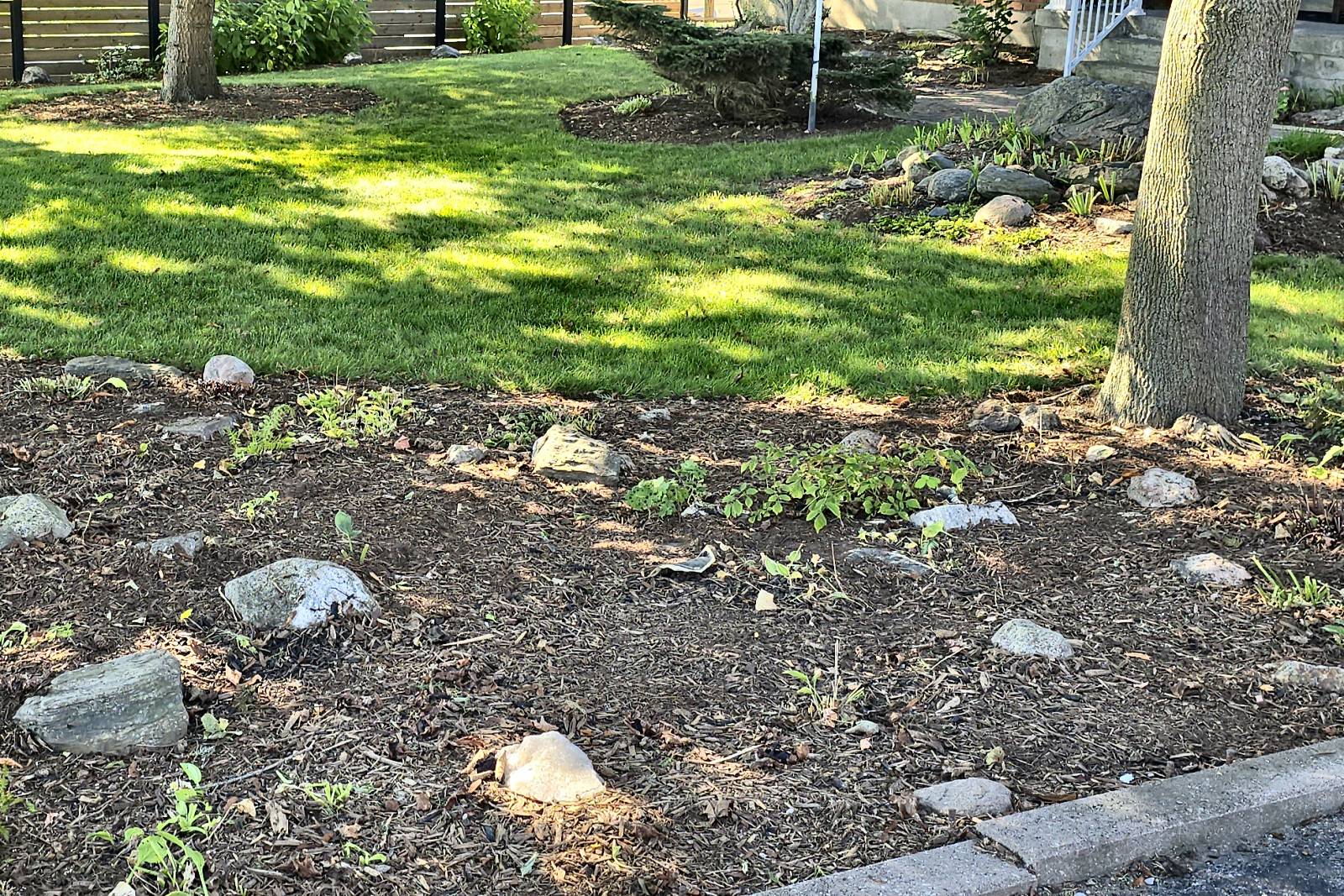
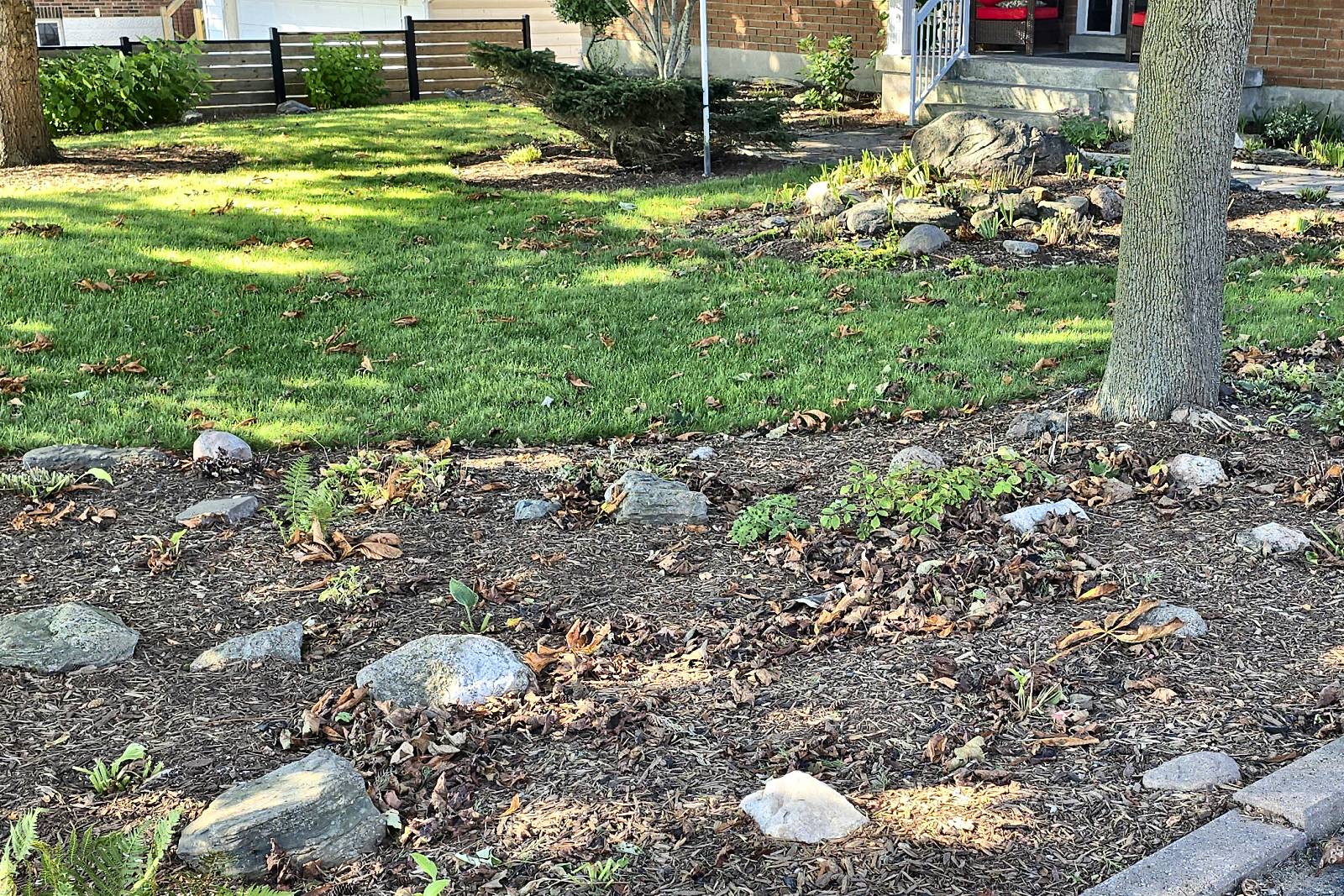
Real Northline properties, before and after, every one of them in Oshawa and every one of them this year. Drag the line to compare.
Andrew answers, October 2026
Is the 3 cm trigger measured at my house or somewhere else?
On the route, not at an airport. Three centimetres is the depth at which a residential driveway stops being something you can drive out of, so that is where the number is set. Below it we are still out, but it is salt and the walkway rather than the blade, and that happens without you asking for it.
One of these goes on each page and it is replaced monthly. If the question you have is not here, ask it: 905-244-5779.
Have the by-law taken off your hands before the route fills
Send me the address and I will tell you which municipality you are in, which clock it runs, whether the free program covers you, and what it costs to have the sidewalk, the windrow and the driveway handled on the same visit. If the free program covers you, I will say so and you will not hear from me again.