Snow removal · Durham Region
Snow plowing in Durham Region, and where the snow actually goes
Snow plowing in Durham Region relocates snow and never removes any of it, so every centimetre that lands on your driveway spends the rest of the winter somewhere else on your own lot, and deciding where it goes is the part of the job that gets skipped.
Need the service page instead of the reasoning behind it? the residential snow page is here.
Green in summer. Clear in winter.
The short answer, before the detail
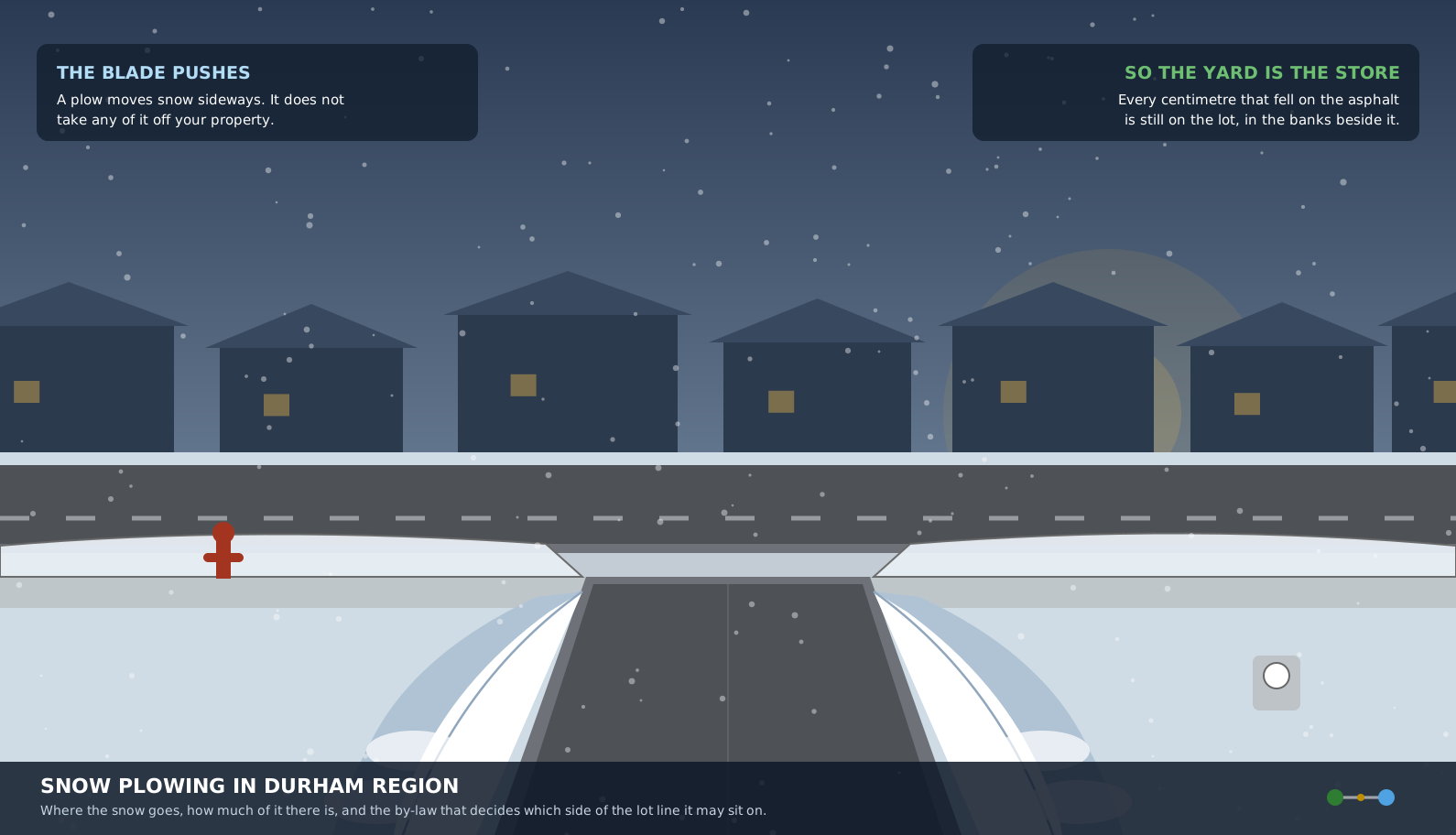
A plow pushes snow. It does not remove snow. On a residential property in Oshawa, Whitby, Ajax, Pickering, Bowmanville, Courtice or anywhere else in Clarington, every centimetre that falls on your driveway stays on your lot, piled along the edges, until it melts in March or April. Nothing is trucked away, because trucking it away costs more in one visit than a whole winter of clearing does.
That single fact decides more about your winter than the price does. Section 181 of the Highway Traffic Act keeps the snow off the road, four of the five municipalities we serve keep it off the boulevard and the sidewalk as well, and Oshawa's own sight triangle by-law caps the height of anything sitting within three metres of where your driveway meets the street line. What is left after all of that is the ground the pile is allowed to use, and on a modern Durham lot it is a smaller patch than most people expect.
Plowing, clearing and hauling are three different products, and only one of them is being sold to you
The words get used as if they mean the same thing, and the gap between them is where most winter disappointment starts. Here is the honest separation.
Plowing is relocation. A steel or poly blade meets the surface at an angle and the snow slides along it to one side. The machine does not pick anything up. Everything the blade touches ends up in a row at the end of the pass, and that row is the pile. A plow on a residential driveway is a relocation tool and nothing else.
Blowing is relocation with more reach. An auger feeds snow into an impeller that throws it, so the snow lands further from where it started, which is useful when a bank has grown too tall for a blade to climb. The snow is still on your lot. It has simply been thrown deeper into the yard.
Removal, used strictly, means the snow leaves the site. A loader fills a dump truck and the truck drives to a disposal site the province has assessed. This happens on commercial properties where a parking lot has run out of storage, and Ontario regulates where that snow may be put: the Ministry of the Environment publishes guidelines on snow disposal and de-icing operations that require a disposal site to be assessed by the ministry, to be sized for the maximum load expected in one season, and to sit away from watercourses. It is priced in writing before a single load moves, and it is not a residential service.
So when a residential company advertises snow removal, which is the phrase everybody searches, what is actually being sold is plowing, shovelling, salting and the judgement about where the pile goes. That is not a complaint about the industry. It is the correct product for a house. It just means the question worth asking a contractor in October is not how fast they clear, it is where they intend to put it.
There is a measurable footnote to this. Across the nine towns we price work in, the phrase people type most often is the plain one, and the regional and general form of it is the plowing word rather than the removal word. At the town level that reverses completely: somebody searching for help in Ajax or Bowmanville types the removal word almost every time. The same person uses two different words depending on whether they are thinking about the machine or about their own street, which is a small sign of how blurred the two ideas are in ordinary use.
What a blade is actually doing on your driveway, pass by pass
A driveway is cleared in passes, and the order of those passes is a decision made before the truck arrives, not during. Done properly it looks like this.
The first pass runs down the middle and opens a spine. It gives the machine somewhere to work from and it puts the first ridge of snow on both sides of a line that is not yet near anything fragile.
The following passes widen outward, alternating sides. Each pass carries its load to the edge and stacks it against what the last pass left. By the third or fourth pass the blade is no longer cutting fresh snow at the edge, it is pushing into an existing bank, and the machine has to climb slightly to do it.
The last pass is the apron at the street, and it is the one that has to be thought about in October. The snow pulled off the bottom three metres of a driveway cannot go forward onto the road, cannot go onto the sidewalk, and in most of Durham cannot be stacked high in the corner where the driveway meets the street line. So it has to be carried back up the driveway and added to a bank that is already there, which takes longer and costs more than any other part of the job.
Two things follow from that sequence and they are worth more than any list of features.
The first is that a bank does not reset between storms. Once snow has been pushed into a pile and compacted by the blade, it stops behaving like snow and starts behaving like a solid. Later storms are stacked on top of it rather than melting into it. By February the usable storage on a driveway is whatever is left over the top of January.
The second is that where the first bank of the season goes determines whether a driveway can be cleared at all in a heavy winter. Put the first pile in the wrong corner and by the middle of February the blade has nowhere to carry the snow, the driveway narrows one storm at a time, and the only remaining options are to throw it further with a blower or to move it by hand. That is a planning failure made in November and paid for in February, and it is the single most common reason a driveway that was fine last year is not fine this year.
Where the snow is legally allowed to go, and the one province wide rule underneath it
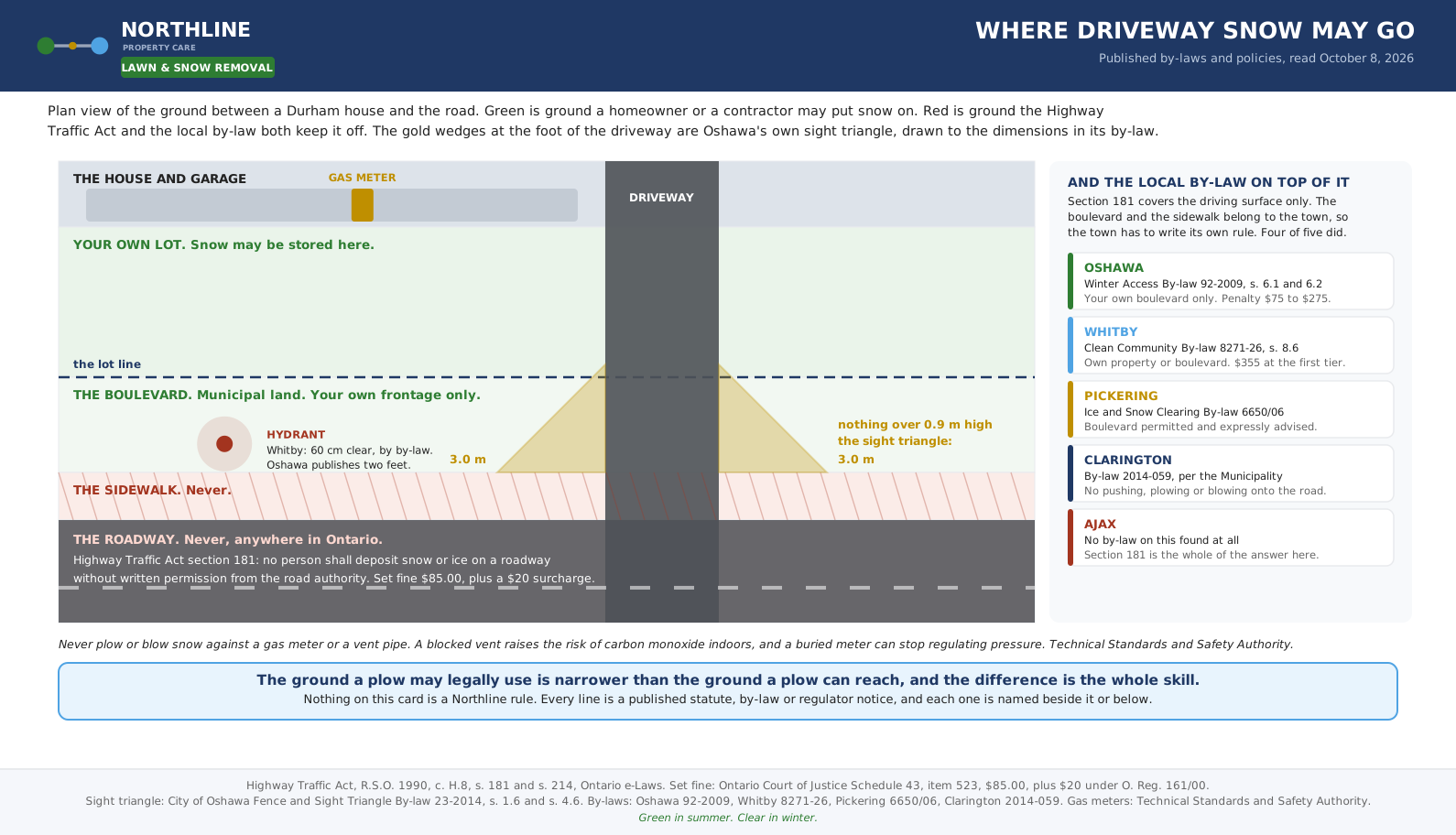
Start with the provincial rule, because it applies identically in every town we work in and it is shorter than people assume. Section 181 of the Highway Traffic Act runs to a single sentence. It forbids any person from depositing snow or ice onto a roadway, and the only way out of it is written permission issued beforehand by whichever authority maintains that particular road.
Two words in that sentence are doing all the work. The first is roadway. The Act defines a roadway as the part of the highway improved, designed or ordinarily used for vehicular traffic, and it expressly excludes the shoulder. The second is highway, which the Act defines far more broadly, covering everything between the lateral property lines, which takes in the boulevard and the sidewalk. So section 181 covers the driving surface only. It does not cover the grass strip or the sidewalk in front of your house, and that gap is precisely why every municipality has had to write its own by-law.
The provincial consequence is published as well. Section 181 carries no penalty of its own, so the general penalty in section 214 applies, which is a fine of not less than sixty dollars and not more than one thousand dollars on conviction. The ticket amount is lower and is set separately: the Ontario Court of Justice set fine schedule for the Highway Traffic Act lists the short form wording deposit snow or ice on roadway at eighty five dollars, and a fine in that range attracts a twenty dollar victim fine surcharge under the provincial regulation that sets them. Nobody publishes a single total payable figure, so we do not quote one.
Now the local layer, which is the part that differs street by street.
Oshawa is the strictest and the clearest. The Winter Access By-law 92-2009 prohibits moving snow or ice from private property onto a sidewalk or highway, and prohibits piling or redistributing it there. A separate clause rules out putting snow on any boulevard except the one running along your own lot, which is the same thing as saying your own frontage is fine and the frontage next door is not. The administrative penalties published with it run from seventy five dollars for a first contravention to two hundred and seventy five for a third within a year, and a conviction instead of an administrative penalty carries a minimum of three hundred dollars.
Whitby prices it highest. Its Clean Community By-law 8271-26 bars anybody from shovelling snow, slush or ice onto a highway, a sidewalk or a pedestrian walkway, and from plowing or blowing it across one, unless the Town has authorized it. The penalty schedule attached sets three hundred and fifty five dollars at the first tier and seven hundred and fifty at the third. Whitby also publishes the permitted side plainly: a pile may sit on your own property or on the boulevard.
Pickering tells residents where to put it rather than only where not to. The City's ice and snow clearing page states that snow may not be placed onto a City street, and may not be placed so as to obstruct visibility of or access to a fire hydrant, and the City separately instructs residents to shovel windrow snow onto their boulevards rather than back onto the road.
Clarington states the rule on its winter page and attributes it to a by-law. The Municipality's winter road maintenance page tells residents not to push, plow or blow snow onto the road, citing by-law 2014-059. The by-law text itself is held in a document repository that will not open to a plain request, so we quote the Municipality's own words rather than a section number.
And Ajax, on the evidence we could find, has no by-law on this at all. We read the Ajax common by-law index and then read the Clean and Clear By-law, the Clean Community By-law and the Property Standards By-law in full. None of the three contains a prohibition on depositing snow on a road, a boulevard or a sidewalk. Ajax publishes a sidewalk clearing duty and a fine for failing it, and its winter pages tell residents that windrow clearing is the owner's responsibility, but the thing other towns put in a by-law appears nowhere. In Ajax, section 181 is the whole of the answer, and section 181 only reaches the driving surface.
We are naming that gap rather than quietly working around it because it changes what a contractor should do on an Ajax property. The absence of a local rule is not permission to pile snow across a sidewalk. It means the duty rests on the general law and on ordinary care, and the sidewalk still has to be passable because somebody will walk on it.
The sight triangle, which is the rule almost nobody has read and the one a pile breaks first
Oshawa publishes a numeric rule for the corner where a driveway meets the street, and it is the strongest citation available anywhere in Durham on this point. The Fence and Sight Triangle By-law 23-2014 defines a driveway sight triangle as the triangular space bounded by the street line, the side of the driveway leading from that street, and a straight line joining two points three metres from where those lines intersect. Within that triangle, the by-law states that all fences, natural features, things and objects shall not exceed 0.9 metres in height.
The phrase that matters is things and objects. It is broad, it is not limited to anything built or planted, and a snow bank is both a thing and an object. A pile standing a metre and a half high at the foot of a driveway is inside that triangle and over that height, and Oshawa publishes administrative penalties of one hundred and twenty five dollars rising to three hundred and twenty five for contraventions of the by-law it sits in.
There is an engineering version of the same idea, and the Region of Durham publishes it. The Region's design specification for roads and entranceways states that sight distance requirements at an entrance are typically based upon an eye height of 1.08 metres and a height of object of 1.3 metres. In other words, the geometry that makes it safe to pull out of a driveway assumes nothing solid stands between those two heights near the entrance. A bank at 1.3 metres is sitting exactly on the line the design assumed would be empty.
Oshawa says the practical version of this in plain language on its own winter pages, which advise reducing the snowbank at the end of your property by shovelling it further back, because it improves visibility when entering or exiting your driveway. The by-law puts a number on the same advice.
So the useful instruction for anybody clearing their own driveway is short. Keep the first three metres back from the street low, carry the height further up the driveway where the sight lines do not matter, and accept that this makes the job longer. It is the trade that keeps a driveway usable and legal at the same time.
The hydrant, the gas meter and the things that disappear under a pile
Three fixed objects sit in the strip a plow works in, and two of them carry published clearances.
Fire hydrants carry a measured clearance in Whitby and a published one in Oshawa. Whitby's Clean Community By-law requires owners and occupants to remove snow or ice, including a windrow, from within sixty centimetres of a boulevard fire hydrant within twenty four hours of accumulation, and the penalty schedule attached to that by-law starts at three hundred and fifty five dollars. Oshawa publishes the instruction in imperial, telling residents and businesses to clear snow by two feet so the hydrant is visible from the road. Pickering's ice and snow clearing by-law prohibits placing snow so as to obstruct visibility of or access to a hydrant, without naming a distance. We could not find a Region of Durham figure, and the Region maintains the hydrants in Oshawa, so no single region wide number exists to quote.
Gas meters carry regulator guidance rather than a by-law, and the guidance is unambiguous. The Technical Standards and Safety Authority, which is the body the Government of Ontario has delegated provincial safety enforcement to, publishes winter instructions that say in plain words never to shovel, plow or blow snow against the meter or the vent pipe, to use a brush or broom rather than a sharp tool, and to avoid bumping the meter with a blower. The reason is given with the instruction: a blocked vent can increase the risk of carbon monoxide building up inside the home, and a snow covered meter can lose its ability to regulate gas pressure.
That one is worth taking seriously on a Durham subdivision lot, because the meter is very often on the side wall of the garage, a metre or two from where a blade or a blower naturally throws snow. It is not a theoretical hazard. It is an object in the working envelope.
Water shut offs are the third, and here we found nothing at all. We looked through the Region of Durham water by-law and its amending by-law and the Region's by-law index, and found no published prohibition on covering a curb stop or water service box with snow, and no penalty for it. Common sense says keep it findable. We are not going to tell you a rule exists when we could not find one.
How much snow is actually there, and why it does not shrink when you push it
Most people have never estimated the volume sitting on their own driveway, and the number is larger than it feels. Here is the arithmetic, with the published part and the assumed part kept separate.
The Region of Durham commissioned a downscaled climate study whose appendices tabulate, municipality by municipality, the largest single day of snowfall across a baseline decade running from 2000 to 2009. For Oshawa that figure is twenty nine centimetres. For Pickering it is thirty three. For Port Perry it is thirty nine and for Uxbridge forty. Those are the Region's own published numbers and you can read them in the study's executive summary.
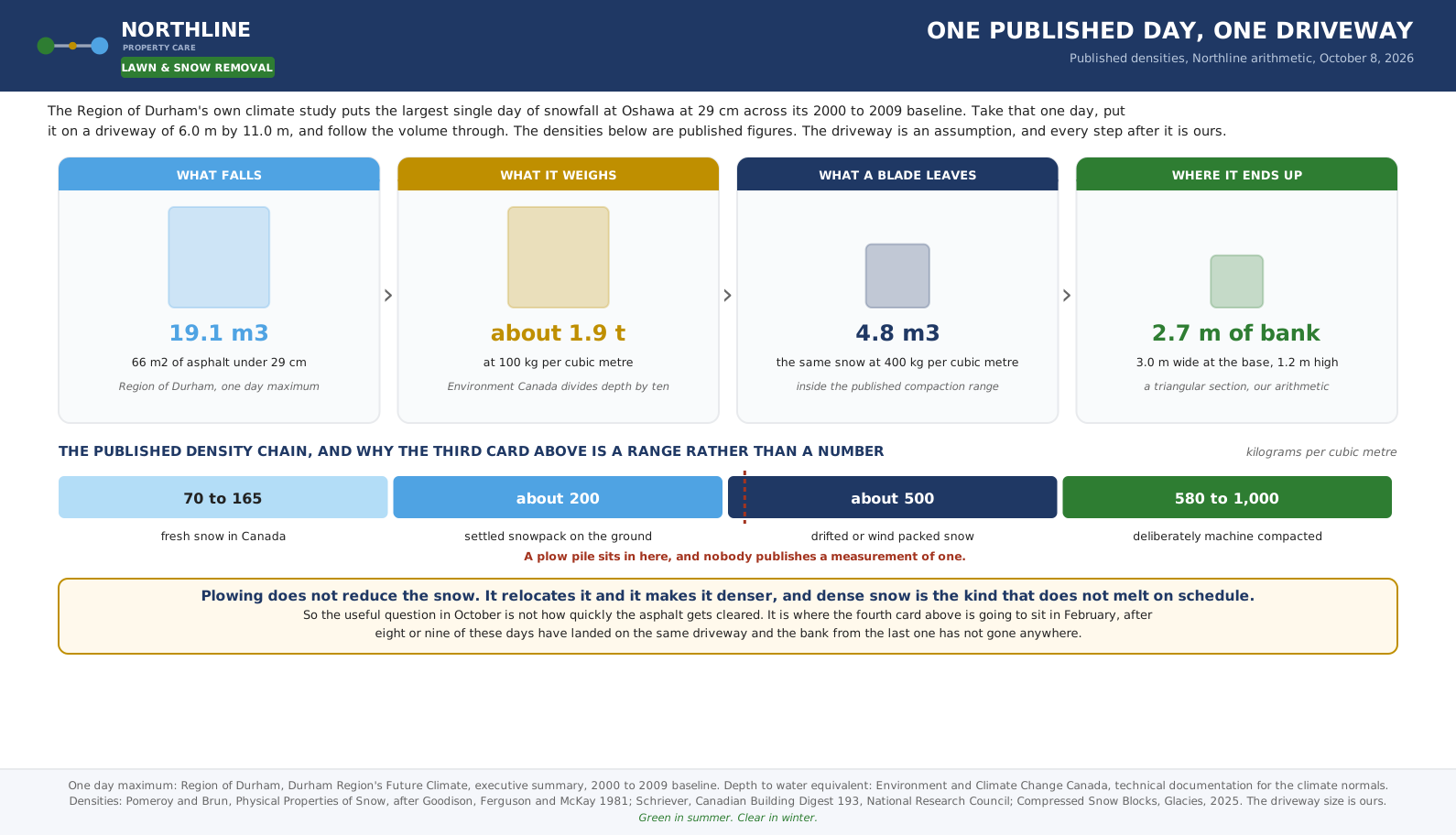
Now take a two car driveway of six metres by eleven, which is a reasonable modern Durham subdivision size and is our assumption rather than a published figure. That is sixty six square metres. Twenty nine centimetres of snow across it is a little over nineteen cubic metres of snow.
How much that weighs depends on density, and the density of snow is published in several places. Environment and Climate Change Canada's own technical documentation for the climate normals states that snowfall is the measured depth of newly fallen snow, taken with a snow ruler, and that at most ordinary stations the water equivalent of snowfall is computed by dividing the measured amount by ten. That is the famous ten to one rule, and it is not folklore, it is the national measuring procedure. It implies a working density of about one hundred kilograms per cubic metre.
At that density, nineteen cubic metres of fresh snow weighs about one point nine tonnes. That is the water content of one heavy day on one driveway, and it is already more than most people picture when they look out of the window.
The published chain of densities then explains what a blade does to it. Work on the physical properties of snow, drawing on Canadian measurements originally made by the federal atmospheric service, puts fresh snow density in Canada between seventy and one hundred and sixty five kilograms per cubic metre. Settled snow on the ground is heavier: Canadian roof snow load practice was built on a figure of about two hundred kilograms per cubic metre for a settled ground pack, published by the National Research Council. Drifted and wind packed snow runs around five hundred. And snow that has been deliberately compacted by machinery, in work published in 2025 on compressed snow blocks, measures between about five hundred and eighty and one thousand kilograms per cubic metre, which is to say it approaches the density of ice.
A plow pile sits somewhere in the middle of that chain, and here is an honest gap: nobody publishes a measured density for a residential snow bank. We looked. So rather than assert a figure we will reason inside the published range. If the blade leaves the pile at four hundred kilograms per cubic metre, then the nineteen cubic metres that fell becomes roughly four point eight cubic metres of bank. Stacked in a triangular section three metres wide at the base and a metre and a bit high, that is about two point seven metres of bank length, from one day.
Two consequences follow, and they are the practical payoff of the arithmetic.
The first is that compaction is not the same as disappearance. The water is all still there. Nineteen hundred kilograms of water went into a smaller box, which means the box is now much harder to move and much slower to melt. A dense bank in February is a block, not a drift, and no amount of mild weather over a weekend clears it.
The second is that this was one day. The Region's same table puts Oshawa at nine days a year carrying more than five centimetres, and everything below five centimetres falls on top of that. The storage question is not whether a driveway can hold one storm. It is whether it can hold the accumulated residue of a season, because nothing between December and March removes very much of it.
Your town is not the regional average, and the gap is about half again
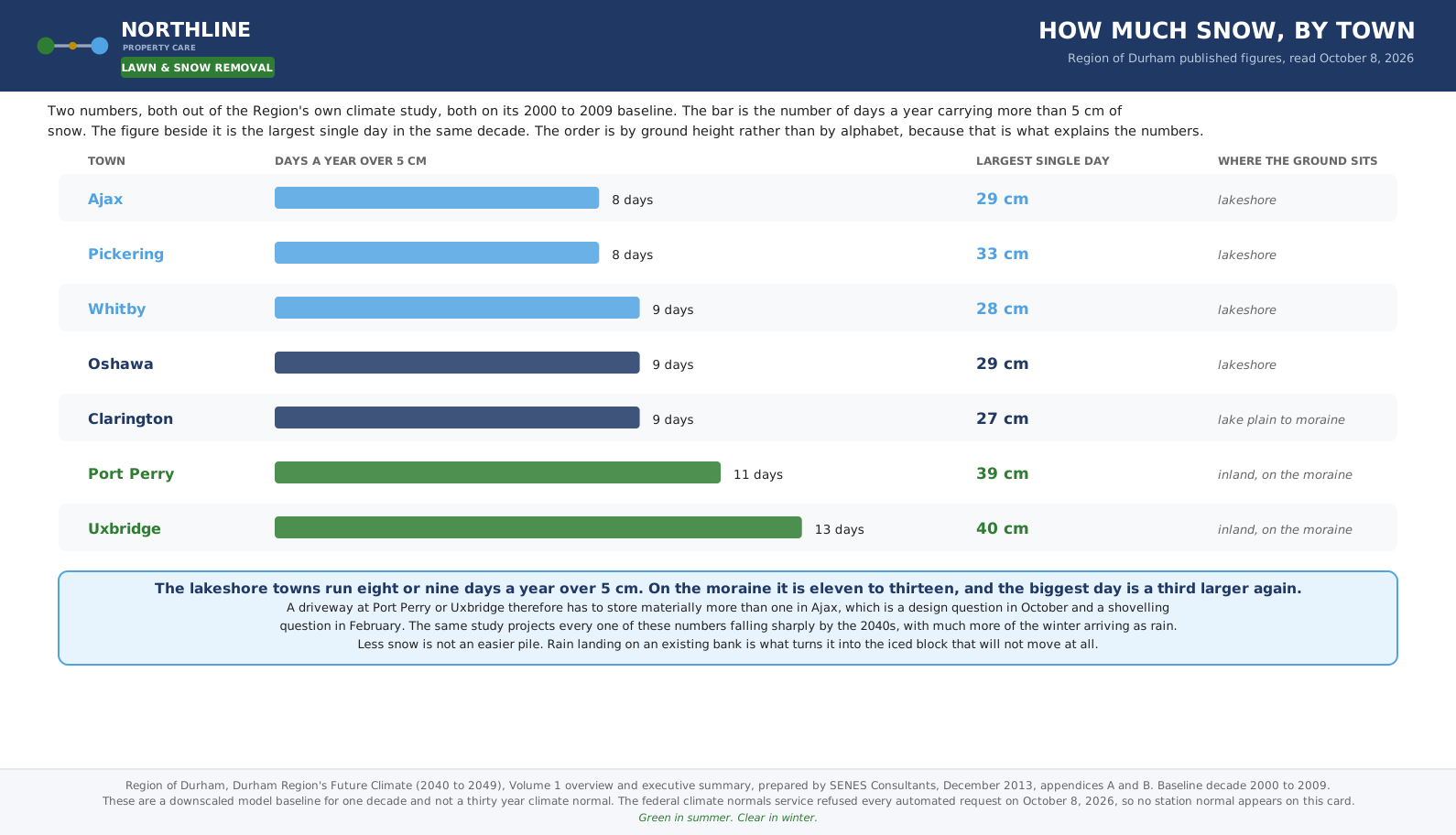
The Region's study tabulates the number of days a year carrying more than five centimetres of snow for each municipality, on the same 2000 to 2009 baseline. Ajax and Pickering sit at eight. Whitby, Oshawa and Clarington sit at nine. Port Perry sits at eleven and Uxbridge at thirteen. The largest single day moves the same way: twenty seven to thirty three centimetres along the lake, thirty nine and forty inland.
Durham runs uphill from Lake Ontario to the Oak Ridges Moraine, and the snow goes up with the ground. A storm arriving as wet snow or rain on the Ajax waterfront is often still falling as dry snow north of Taunton Road, and the same system that quit at the lake is still going on the high ground. That is why a property in Solina, Enniskillen, Tyrone or Hampton needs materially more pile room than one in Westney Heights, and why the same quote does not fit both.
Two honest limits travel with these figures and they belong on the page rather than in a footnote. The first is that they are a downscaled model baseline for one decade and not a thirty year climate normal. The second is that no federal climate normal for any Durham station could be read at all. Each automated request sent to the federal climate data service on October 8, 2026 came back refused. So the Region's own study is what this page uses, and it is labelled as such rather than dressed up as a federal statistic.
The same study projects all of these numbers falling sharply by the 2040s, with much more of the winter arriving as rain rather than snow. That sounds like relief and it is not. Rain landing on an existing bank is what turns a pile into an iced block, and a block will not move for a blade at all. Less snow and more rain is a harder winter for storage, not an easier one, which is also why a freezing rain event is the one weather a plow genuinely cannot fix.
Why the municipality may leave a ridge across your driveway that you may not put back
This is the question that generates more anger than anything else in a Durham winter, and the answer is in a provincial regulation rather than in anybody's attitude.
Ontario Regulation 239/02, the minimum maintenance standards for municipal highways, sets the legal floor for snow on a roadway. It classifies every road from one to five by traffic volume and speed, and it gives each class a depth and a time. A class one road, which in Durham means the regional roads, has to be brought below two and a half centimetres within four hours of the snow ending. A class four road gets eight centimetres within sixteen hours. A class five road, which is where many quiet residential streets land, gets ten centimetres within twenty four hours. The regulation is published in full and anybody can read their own street into it.
Three clauses in it explain the windrow completely.
First, addressing snow accumulation does not mean plowing. The regulation says it includes plowing, salting, applying abrasives, applying other chemical or organic agents, or any combination of those. A municipality that salts a street has met the standard without a blade ever touching it.
Second, the regulation expressly excludes the portion of a roadway used by a municipality for snow storage. The province contemplates the road allowance itself being used to store snow. That is the legal reason a municipal plow may leave a long ridge at the edge of the road while a homeowner may not put a shovelful back onto it: one of them is the road authority storing snow on its own allowance, and the other is depositing snow on a roadway under section 181.
Third, a declared significant weather event suspends the clock. Once a municipality declares one, every roadway is deemed to be in a state of repair until the applicable time in the table expires after the municipality declares the event over. This is the clause that explains why a street can sit unplowed for a long time after a large storm with no recourse at all.
The asymmetry at the end of it is worth stating plainly. The same regulation gives a municipality forty eight hours to bring its own sidewalks down to eight centimetres, while Oshawa, Whitby, Ajax, Pickering and Clarington each give the homeowner twenty four hours to clear the sidewalk in front of their house. The public body gets twice as long as the resident, and almost nobody knows it. We have written about the Oshawa sidewalk deadline and about who clears the windrow in each Durham municipality separately, because each of those deserves its own page.
What the pile does to the ground underneath it
Where the bank goes is not only a legal and a logistical question. It is an agronomic one, and the lawn pays for a bad decision in April.
A compacted, salted bank sitting on turf does three things. It holds the ground at a steady temperature just below freezing for months under an insulating cover, which is the condition grey and pink snow mould need. It stays in place long after the surrounding lawn has thawed, so the turf under it comes out of winter weeks behind everything around it. And it carries whatever was applied to the driveway with it, which on a Durham driveway means chloride.
The salt part carries a federal context that most people have never seen. Under the federal environmental protection statute, Ottawa published a national Code of Practice for the Environmental Management of Road Salts, dated April 2004. Inside it, the section dealing with snow disposal gives one objective, which is to control what is released from the sites where snow is dumped, and it tells road authorities to think about where a site is placed, how it is built and how its drainage is handled. That code is aimed at road authorities rather than at households, and the mechanism underneath it does not care about scale: salted snow concentrates its chloride wherever it is stacked, then hands it to the ground when it finally melts.
The practical answer on a residential lot is not complicated. Keep the pile off the best part of the lawn where there is a choice. Put it where meltwater runs away from the house and away from a garden bed rather than toward them. Keep it off the base of cedars, which carry salt damage visibly and for years. And salt the driveway at a rate that actually matches the temperature rather than by habit, which we have written about in detail on driveway salting in Oshawa. If the bank is going to end up on grass anyway, and on most lots some of it must, then snow mould is the thing to expect in the spring and plan the first cut around.
When plowing stops being the answer, and what the alternative actually is
There is a point on some properties where relocation runs out. The banks are at the height a blade can no longer climb, the sight triangle is full, and the only remaining storage is somewhere a machine cannot reach. At that point there are two real options and both of them cost money.
The first is relocation on site with a bigger machine. A loader pushes the existing piles back and stacks them higher inside an agreed area, so nothing leaves the property but the storage is reset. On a commercial site this is almost always the cheaper and the more sensible answer, and it is the one we offer first.
The second is genuine removal: a loader, a dump truck and an approved disposal site. It is a commercial service, it is quoted in writing with an approved number of loads before any truck moves, and it is never done on a residential driveway, because the cost of one call would exceed a whole season of clearing. We do not publish those rates here because they depend on the site and the destination, and a number on a web page would be a number we could not stand behind for every property.
For a house, the honest version is simpler. If a driveway genuinely cannot store its own snow, the fix is a blower throwing it deeper into the yard, or a different pile plan agreed before the season starts, or in a few cases accepting that the usable width narrows in February. Nobody is trucking snow off a residential driveway in Durham Region at a price a homeowner would pay.
What Northline does with the snow, and what that costs
Here is the service against everything above, stated so it can be checked.
Service starts at a measured three centimetres on a residential property. That is a depth on the ground rather than a forecast, and nobody has to call after a storm. Five centimetres is the commercial trigger, because a parking lot behaves differently from a driveway.
Where the pile goes is agreed at the quote, before the season, and written down. That is the part of this job that is actually skilled, and it is decided in daylight in October rather than at five in the morning in January. It takes the sight triangle, the hydrant, the gas meter, the lawn and the direction the meltwater runs into account at the same time.
Driveway plowing starts at Gold, which is $189 a month plus HST and carries the 7 AM target after snow that falls overnight. Above it, Platinum at $279 goes first in the sequence, aims at 6:30 AM, salts automatically however often that takes, and picks its own service day. Below it, Silver at $129 does not touch the driveway with a blade at all. You should hear that here rather than work it out in December. What Silver buys on the driveway is one pass at the windrow by five in the afternoon, and that is the whole of it.
Bought as a season rather than as a membership, the snow package runs $800, $975 or $1,200 plus HST, by property size from small through standard to large. It covers the driveway, the walkway and the salting, with no cap on how often, on the same three centimetre trigger and the same 7 AM target. Booking closes November 1.
Two extras exist because the road plow keeps its own schedule: salting on its own costs $25, and coming back out for a windrow after we have already been costs $45. Neither of us controls when the municipal blade makes its second pass down the street.
On a larger property the bands move with the lot. Estate pricing starts at a driveway over one hundred feet or a lot between a third of an acre and an acre, and grand estate above that. Over three acres there is no published price at all, because above that size the laneway, the turf and the pile placement stop being predictable from acreage alone and a published number would be one we could not stand behind. For those two figures we ask instead, the acreage and the length of the laneway, and both of them sit on your own tax bill. The price is then settled on the call, the same day.
Who should not buy this
Three cases, and in all three you are better off somewhere else.
If you qualify for your municipality's assisted clearing program, join it, because nobody can beat it. Whitby runs its windrow and sidewalk clearing free of charge for residents sixty five and over or with a certified disability, with applications closing November 1, 2026. Clarington's price for the 2026 to 2027 winter is one hundred and seven dollars and sixty nine cents with the HST already in it, and its applications stay open to October 31, 2026. Pickering charges nothing for recipients of the federal income supplement and scales a fee by household income above that, and Oshawa publishes no fee at all for its program. Ajax has no program. Those are the municipalities' own published terms, and no contractor is going to price against free.
If what you want is the snow gone from the property, a residential membership is not that product. Everything above is relocation. If a property genuinely needs snow hauled away, that is a commercial conversation with a written price attached, and it belongs on a site with a loader, not on a driveway.
And if you are willing and able to clear it yourself, you probably should. A driveway that gets cleared early and often by the person who lives there, with the pile put in the right place from the first storm, is in better shape in February than most serviced driveways. What you are buying from us is not a skill you lack. It is the certainty that it is done by a fixed time on a morning you were not planning to spend outside.
Your own corner of Durham
The pile question changes from lot to lot, so each page below was written about the ground it actually covers instead of being one paragraph with a different town name dropped into it.
Along the lake and in town: snow removal in Oshawa, Whitby, Ajax, Pickering, Bowmanville and Courtice, each of which has its own municipal rules and its own storage problem.
On the high ground, where the banks get taller and the laneways get longer: Hampton, Tyrone, Solina and Enniskillen. If the driveway is long enough that the pile has nowhere obvious to go, start at long driveway snow removal instead.
What we went looking for and could not find
Everything quoted on this page came from one of the following and from nothing else: a statute, a regulation, a municipal by-law or municipal page, the Region, a federal department, a regulator, a university, or a peer reviewed journal. Not one figure came from another grounds or snow business, because a competitor's price page is an advertising decision rather than a measurement. That rule has a cost, and this is the bill.
No federal climate normal for any Durham station. On October 8, 2026 not one automated request reached the federal climate data service, which refused all of them, so no station snowfall normal appears above for Oshawa or for any other place in the Region. The Region's own study is used in its place, and its baseline decade and its model basis are both named rather than smoothed over.
No measured density for a plowed residential snow bank, from anybody. The published chain runs from fresh snow through settled pack and drifted snow to deliberately compacted snow, and a driveway bank sits inside it with no measurement attached. The four hundred kilograms per cubic metre used in the arithmetic is a figure chosen inside that range and labelled as ours.
No Ajax by-law prohibiting snow on a road, a boulevard or a sidewalk. The common by-law index was read, and then the Clean and Clear, Clean Community and Property Standards by-laws were read in full. If such a provision exists in Ajax it is not where any of those point.
No full text for the Clarington, Pickering or Ajax by-laws named above. All three municipalities publish them through document repositories that refuse an ordinary request, so what is quoted is each municipality's own summary of its own by-law and no section number is invented to go with it.
No published rule anywhere in Durham about snow covering a water shut off. The Region's water by-law and its amending by-law were both read, and the Region's by-law index with them.
No Region of Durham numeric clearance for snow around a fire hydrant. The Region maintains hydrants in Oshawa and publishes no figure, so the only numbers above are Whitby's sixty centimetres by by-law and Oshawa's published two feet.
No Region of Durham snow depth trigger or clearing time target for regional roads. What the Region does put on its pages is a description of how it works, how often it patrols and how it manages salt, with no depth and no hour attached to any of it. The provincial minimum standard stands in for that above, and it is labelled as provincial rather than dressed up as Durham's own.
No published numeric snowfall warning threshold from Environment and Climate Change Canada. The department has replaced its numeric public alert criteria with impact based guides, which carry no centimetre figure at all. The widely repeated fifteen centimetre threshold for southern Ontario appears nowhere in a current federal publication, so it is not on this page.
A page that prints only what it found has hidden half the work. The list above is a fairer test of whether anything else here was checked with any care.
Questions people actually ask about snow plowing in Durham
Is snow plowing the same thing as snow removal?
Not strictly, and the difference is where the snow ends up. Plowing relocates snow within the property, usually into banks along the edge of a driveway. Removal, used precisely, means the snow is loaded and trucked to an approved disposal site. Almost every residential service advertised as snow removal in Durham Region is plowing, shovelling and salting, because trucking snow off a house lot would cost more in one visit than a whole winter of clearing. The useful question to ask a contractor is not how fast they clear, it is where they are going to put it.
Can I push the snow from my driveway onto the road?
No, anywhere in Ontario. Under section 181 of the provincial Highway Traffic Act, nobody may deposit snow or ice onto a roadway unless the authority that maintains that road has given written permission first. The provincial set fine published for that offence is eighty five dollars, and a fine in that range attracts a twenty dollar victim fine surcharge. On top of that, Oshawa, Whitby, Pickering and Clarington each carry their own by-law, with Whitby's administrative penalty starting at three hundred and fifty five dollars. Ajax appears to have no by-law of its own on this, so section 181 is the whole of the rule there.
Can I put driveway snow on the boulevard in front of my house?
In most of Durham, yes, with one important limit. Oshawa permits it on the boulevard adjacent to your own lot and prohibits it on a neighbour's. Whitby publishes that snow may be piled on your own property or on the boulevard. Pickering goes further and actively instructs residents to shovel windrow snow onto their boulevards rather than back onto the road. The sidewalk is a separate surface and it is not permitted anywhere, and in Oshawa a pile at the foot of the driveway also has to stay under 0.9 metres inside the sight triangle.
How high can a snow bank be at the end of my driveway?
In Oshawa the published answer is 0.9 metres inside the driveway sight triangle, which the Fence and Sight Triangle By-law 23-2014 defines as the triangle formed by points three metres from where the side of the driveway meets the street line. The by-law covers fences, natural features, things and objects, and a snow bank is an object. The Region of Durham's own entranceway design specification assumes an eye height of 1.08 metres and an object height of 1.3 metres, so a bank taller than that is sitting in the space the entrance was designed around.
Why does the city plow leave a ridge across my driveway if I am not allowed to put snow on the road?
Because the two acts are different in law. Ontario Regulation 239/02 expressly excludes from the maintenance standard the portion of a roadway used by a municipality for snow storage, so the road allowance is somewhere the road authority may store snow. A resident pushing snow the other way is depositing snow on a roadway under section 181. The ridge itself is nobody's duty to clear in Durham except under the assisted programs, which carry an age or medical test and a sign up deadline.
How much snow does a driveway actually have to store over one winter?
More than it looks. Take the Region of Durham's own published largest single day for Oshawa, twenty nine centimetres, across a two car driveway of six metres by eleven. That is about nineteen cubic metres of snow, weighing roughly one point nine tonnes of water at the hundred kilograms per cubic metre that the federal ten to one measuring rule implies. Compacted by a blade it becomes a few cubic metres of dense bank that will not melt on any useful schedule. Then remember that Oshawa averages nine days a year over five centimetres, and that the banks do not reset in between.
Does salted snow piled on the lawn damage the grass?
It can, and the mechanism is both the salt and the cover. A dense bank holds the turf under it near freezing for months, which is the condition grey and pink snow mould need, and it releases its chloride into that patch of ground when it finally melts. Ottawa makes the same point at a far larger scale in its national code of practice on managing road salts, in the part dealing with where snow gets dumped. On a house lot the practical answer is to keep the bank off the best turf and away from the base of any cedars, and to match the salt rate to the temperature instead of to habit.
Who wrote this
Northline Property Care belongs to Andrew. It is run out of Oshawa, working west through Whitby, Ajax and Pickering, and east through Courtice, Bowmanville and the rest of Clarington. Six winters of snow work in Durham Region sit behind the service. That number is Andrew's personal record and not a statement about the trading history of the business, which registered in August 2026 and has still to put a first winter behind it. Whoever prices your property is whoever turns up and does the work on it.
This page exists because the pile is the part of the job nobody writes about. Every snow page in this market sells speed, and speed is the easy half. The hard half is a decision made in October about where four or five cubic metres of compacted snow a storm is going to sit without blocking a sight line, burying a hydrant, leaning on a gas meter or killing the best part of a lawn. A contractor who has not had that conversation before the first storm is going to improvise it in the dark, and improvising it is how a driveway ends up narrower in February than it was in December.
If a figure above is wrong, 905-244-5779 reaches whoever typed it, which is faster than any correction form.
Read next
Will a plow wreck the driveway
What a blade can and cannot do to asphalt and interlock, which damage is real, and which is blamed on the plow and caused by something else.
Read the damage piece →Blower or a service
What a machine of your own really costs against a season of service, and the one job a blower does better than any blade.
Read the comparison →Marking the driveway
Where to put the stakes so a blade knows where the lawn starts, and when to put them in before the ground freezes.
Read the markers piece →The work, photographed
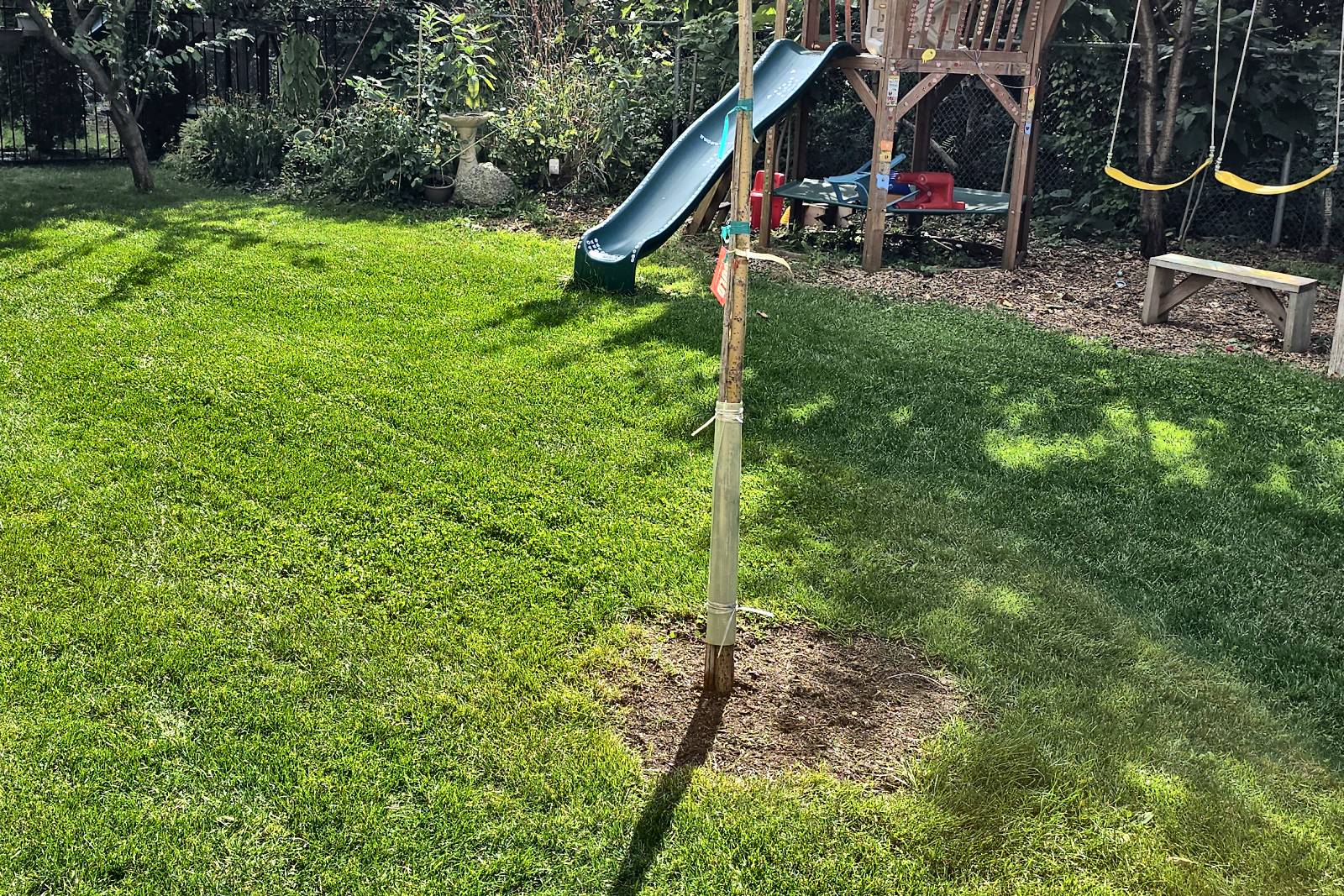
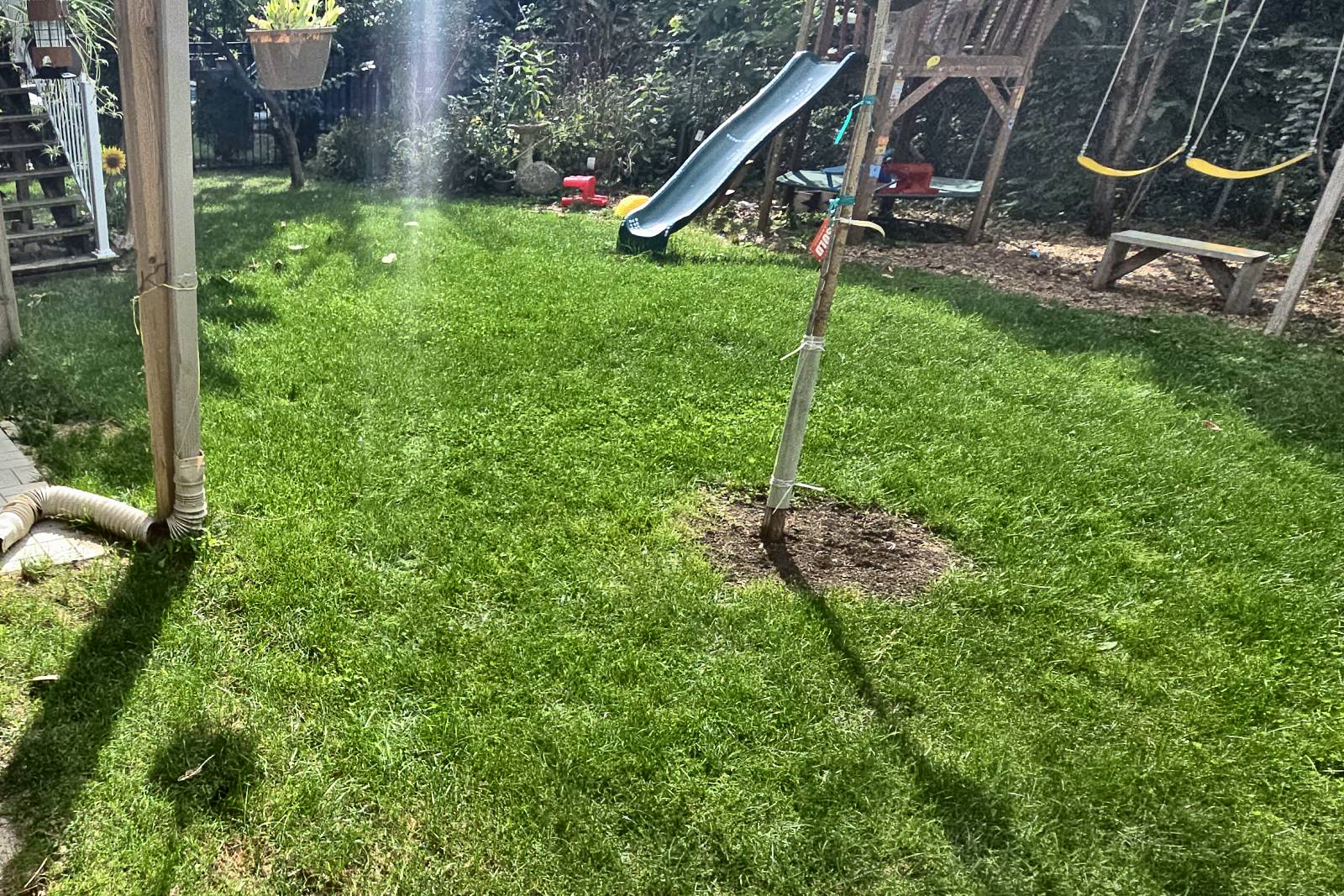
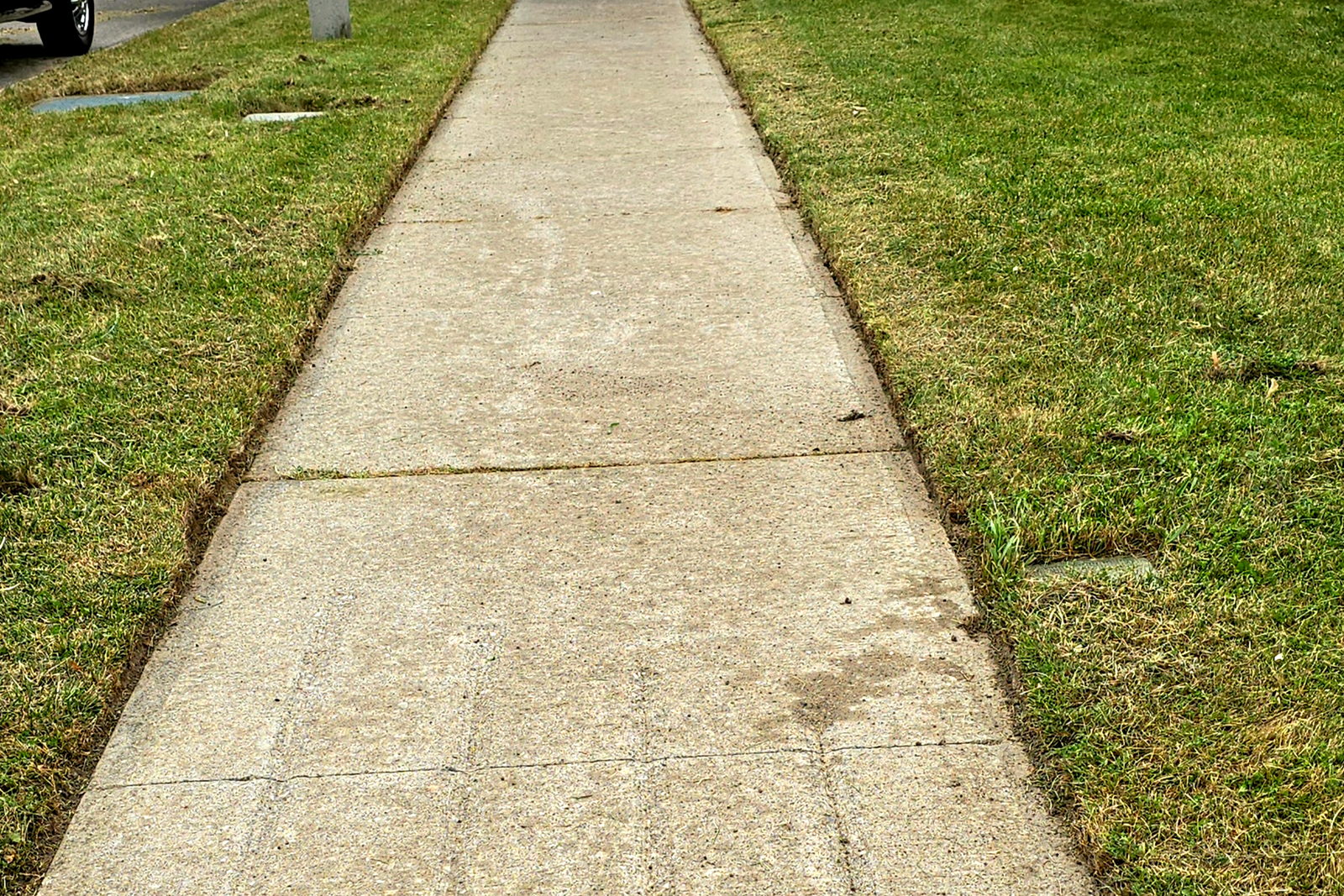
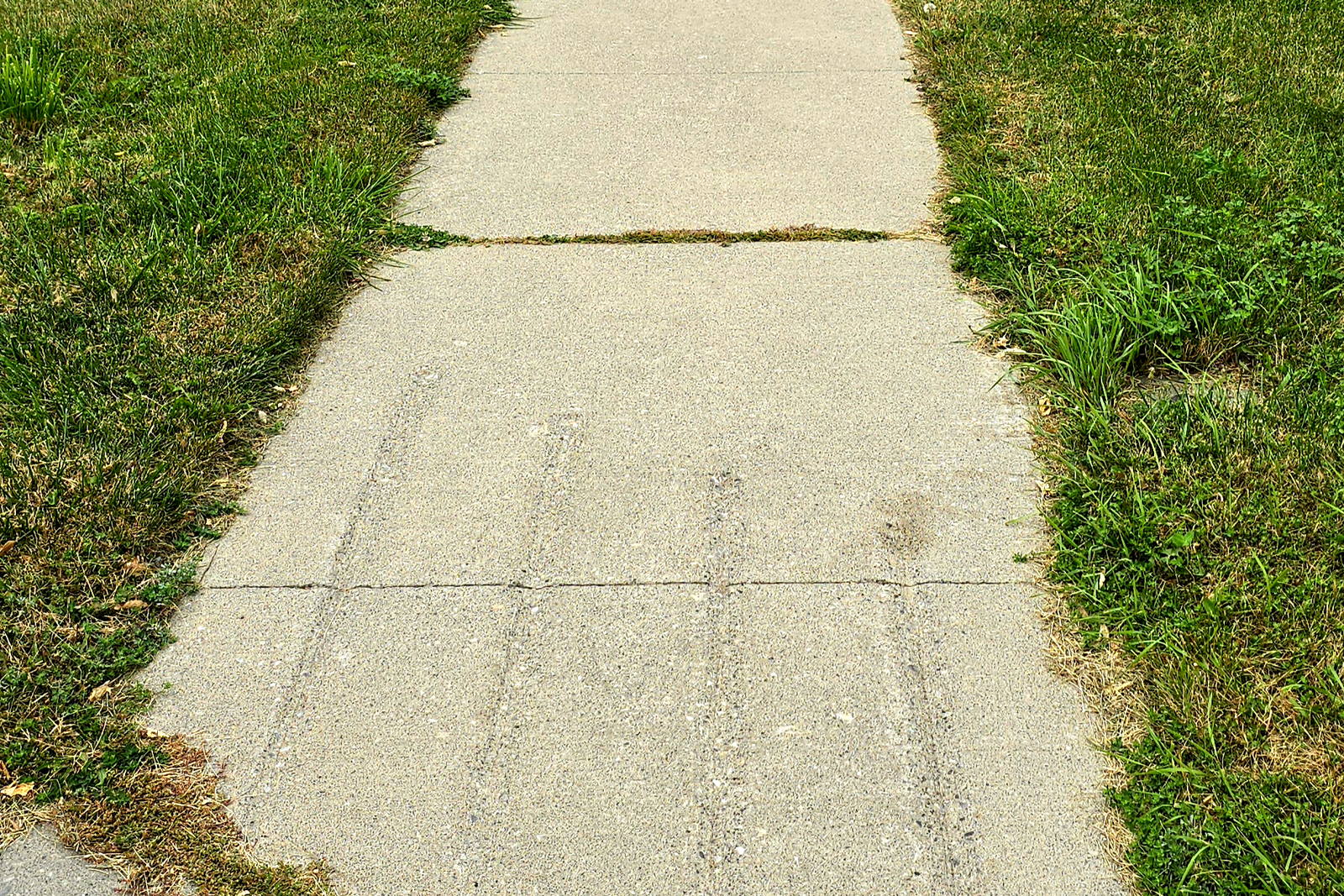
Real Northline properties, before and after, every one of them in Oshawa and every one of them this year. Drag the line to compare.
Andrew answers, October 2026
What happens if it snows all day instead of overnight?
The first pass opens a lane out to the road, the walkway and the steps, so you can get out. Then the whole route gets that same first pass. Then, once the snow stops, we come back for the full clear: full width to the pavement, the windrow off at the road, piles tidied and salt down again. If it looks half done at eight in the morning in heavy snow, that is deliberate and we are already on the way back. There is no extra charge for the second visit.
One of these goes on each page and it is replaced monthly. If the question you have is not here, ask it: 905-244-5779.
Tell me where the pile went last winter and I will tell you whether it fits this one
That one answer prices a Durham driveway better than a photograph does, because it says how much storage the lot has and how hard the apron is going to be. If you qualify for your own municipality's assisted program I will point you at it and at its deadline instead. If you do not, the monthly number and the seasonal number will both be in front of you before November 1, which is when the route closes for the winter.