Snow removal · Ice control
Driveway Salting in Oshawa, and When Salt Stops Working
Driveway salting in Oshawa stops working somewhere near minus 10 degrees, which is not the number printed on the bag, and on a cold January night in Windfields the bag is a decoration. The rest of the winter it works, and the whole skill is putting down about a tenth of what most people spread.
Salting sits inside one membership and is bought by the trip on another. The route closes when it is full and does not reopen. See what a winter visit covers.
Green in summer. Clear in winter.
The short answer
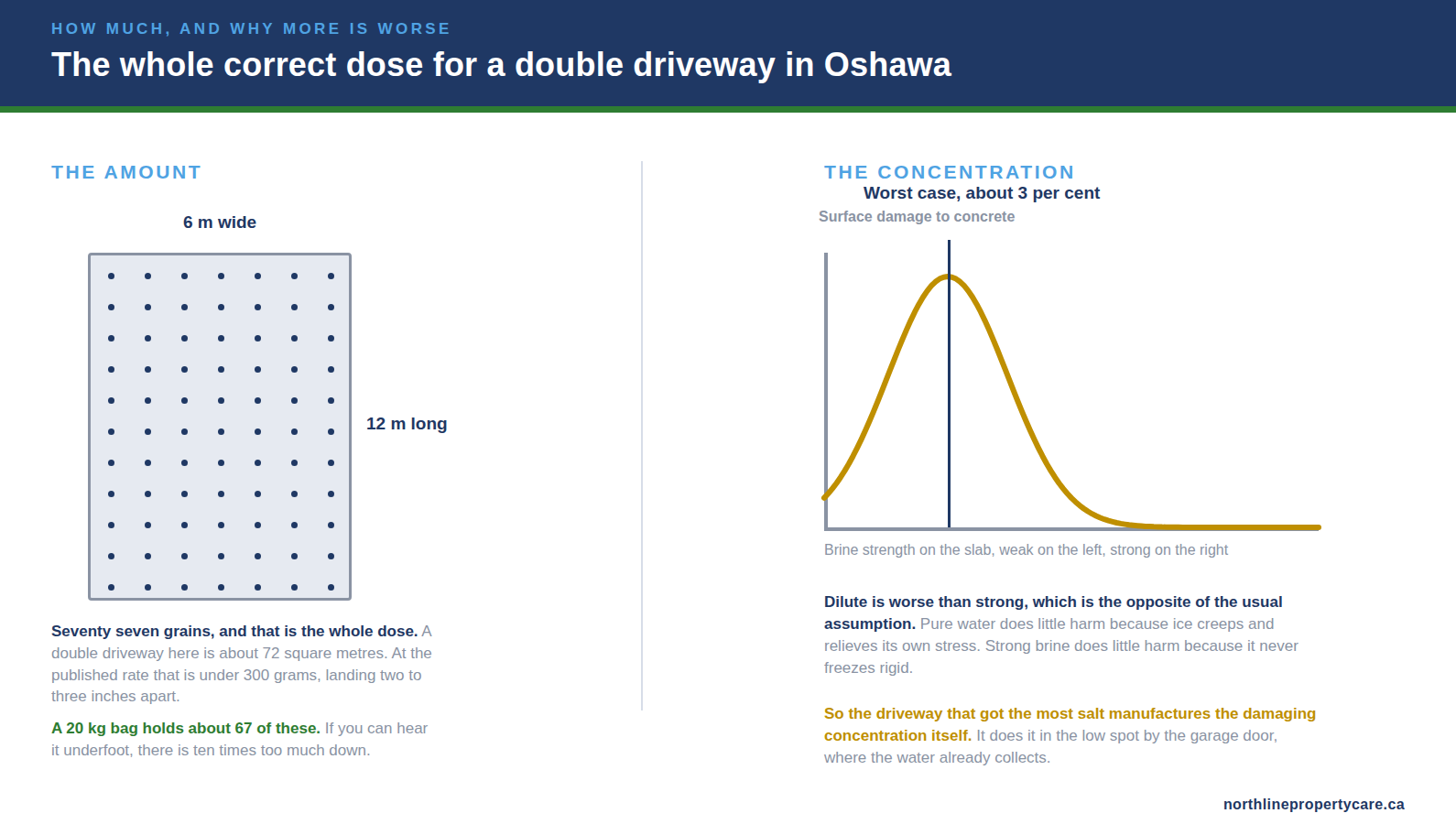
The amount almost everybody uses is roughly ten times what the surface needs. A coffee mug of salt is enough for about a thousand square feet, which is most of a double driveway, and the grains should land two to three inches apart rather than crunching underfoot. That is the whole answer, and the section under this box is the arithmetic behind it.
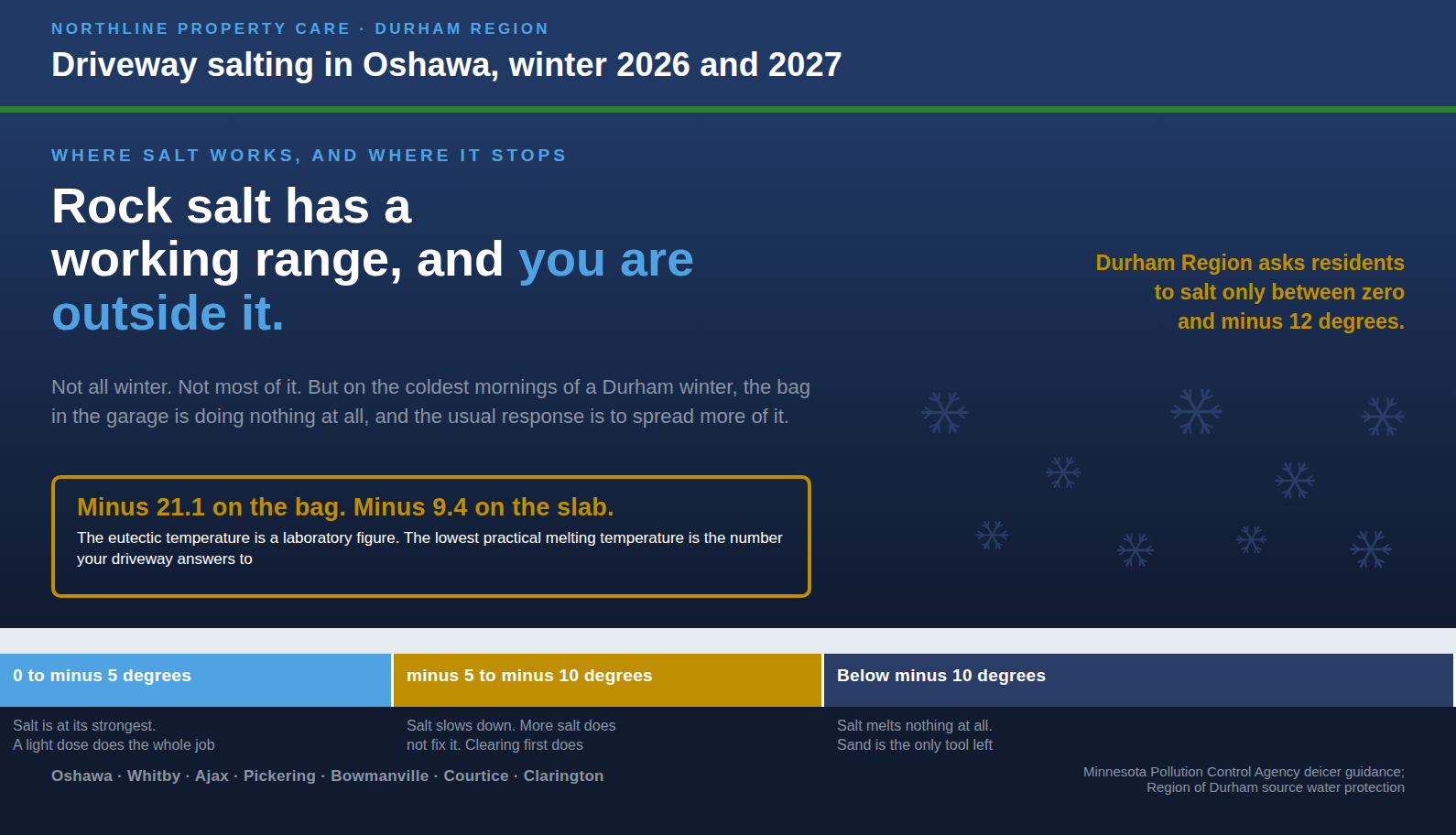
Rock salt is a chemical with a working range, not a winter habit. It works from about zero down to roughly minus 10 degrees Celsius on pavement. Below that it sits on the ice and does nothing, and the correct tool is sand, which buys grip and melts nothing at all.
Salt is not what wrecks a concrete driveway, and a weak brine is worse than a strong one. The damage is physical rather than chemical, it needs the concrete to be nearly saturated, and the worst case is a diluted solution sitting on the slab at roughly three per cent.
Every gram of chloride that goes down stays down. It does not break down, it cannot be filtered back out, and chloride is already climbing in Oshawa Creek, Harmony Creek, Farewell Creek and Black Creek on the Region's own monitoring record.
The dose, and why almost every driveway in Durham is over salted
If you can hear the salt under your boots, there is about ten times too much of it down. It costs nothing to check and nothing to act on. Salt works by dissolving into a film of brine that spreads across the surface and lowers the freezing point of what is already there. A grain that never dissolves has done no work, and a grain sitting on a grain that has already dissolved has done less than no work, because it cost money and it is going into the ground.
The published rate is startlingly small. The Minnesota Pollution Control Agency states that around twelve ounces of salt, roughly a coffee mug full, effectively treats a twenty foot driveway or ten sidewalk squares, which is about a thousand square feet. Its upper bound across every condition is four pounds per thousand square feet. Converted to metric, that range is roughly five to twenty grams a square metre, and the coffee mug is closer to four.
A standard Durham double driveway is about six metres wide and twelve long, which is seventy two square metres or about seven hundred and seventy five square feet. At the coffee mug rate that driveway takes something under three hundred grams of salt. Most households tip a scoop out of a twenty kilogram bag and think nothing of it. Twenty kilograms is about sixty seven applications.
There is a visual test that needs no scale at all, and it is the one we use on the truck. The University of Minnesota's winter salt guide states it as grains about two to three inches apart, not overlapping or piled up. Penn State Extension gives the same figure independently at roughly three inches. If you look down and see scattered crystals with bare pavement between them, that is correct. If you see a white crust, that is a bag of money on its way to Oshawa Creek.
Three more things change the dose more than the brand does.
- Shovel or plow first, always. The Minnesota Pollution Control Agency puts it plainly: the more snow and ice you remove manually, the less salt you will have to use. Salt spread on top of eight centimetres of snow has to melt its way down through all of it before it reaches the bond at the bottom, and it will run out of strength on the way.
- Before beats after, and the mechanism is documented. The Federal Highway Administration describes traditional de-icing as frequently leading to a compacted pack tightly bonded to the pavement, after which clearing it usually requires a large quantity of chemical to work its way through the pack to reach the interface. A light treatment before the storm prevents the bond. A heavy one afterwards fights it.
- Liquid beats solid, and there is a real number on it. A study by the Traffic Operations and Safety laboratory at the University of Wisconsin analyzed 143 winter storms across ten counties in the 2020 and 2021 season and found that brine treated roads allowed a reduction in salt use of 23 per cent on average, and came clear more than two hours faster.
That last point deserves an honest footnote rather than a sales line. Northline does not run a brine tank. A liquid system is a tank, a pump, a boom and a storage problem that a residential route this size cannot yet justify. The City of Oshawa does run pre wet salt and liquid brine, and says so in its own staff report. We spread dry material at a deliberately low rate, we clear first, and we salt the places that refreeze rather than the whole slab. When the route is large enough to carry liquid, we will carry liquid, and this paragraph will be the first thing that changes.
Salt that is visible on dry pavement, the same regulator notes, is no longer doing any work and will be washed away. That is worth reading twice, because it means the white crust people find reassuring is the part of the purchase that was entirely wasted.
The number on the bag is not the number on your driveway
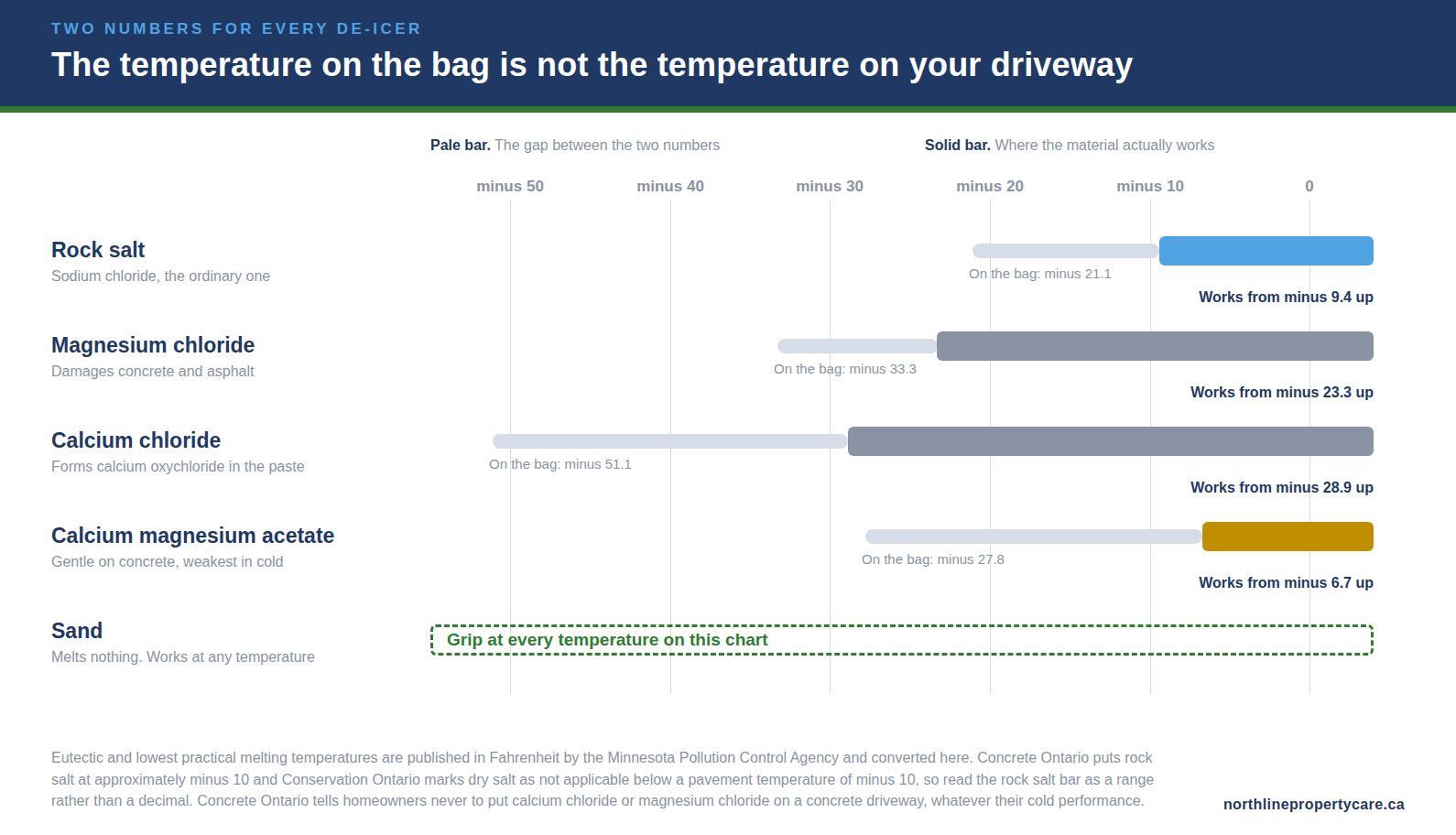
There are two temperatures for every de-icer and the useful one is almost never the one advertised. The first is the eutectic temperature, which is the coldest a solution of that salt in water can remain liquid under laboratory conditions. The second is the lowest practical melting temperature, which is the coldest pavement on which the material will actually do work in the time you have. For sodium chloride, ordinary rock salt, those two numbers are minus 21.1 and minus 9.4 degrees Celsius. The gap is eleven and a half degrees, and it is the difference between a product that sounds like it handles an Ontario January and one that does not.
The Minnesota Pollution Control Agency, which publishes both columns side by side, says it in one line: pick your material based on the lowest practical melting temperature, not the eutectic temperature which is often listed on the bag. That sentence exists because the bag is where the misunderstanding starts.
Three Canadian sources put rock salt in the same place by three different routes, which is about as close to settled as this subject gets.
On a sloped driveway that working limit matters more than it does on the flat, for a reason that has nothing to do with chemistry. A surface a car cannot climb is unusable even when it is only lightly iced, and published figures put the steepest slope a passenger car can take on smooth ice at around 5.4 per cent, which is gentler than any residential driveway maximum published in this region. The grade numbers, and what gets spread once the pavement is too cold for this material, are set out in steep driveway snow removal in Durham Region.
- Concrete Ontario puts it at approximately minus 10 degrees. Its de-icing salt bulletin names sodium chloride as the preferred de-icer for concrete and states it is effective to a temperature of approximately minus 10 degrees Celsius.
- Conservation Ontario is harder still and marks the material off entirely. Its winter maintenance guidance gives sodium chloride a lowest effective working temperature of minus 7, and lists dry salt as not applicable below a pavement temperature of minus 10.
- Durham Region tells residents the window in plain words. The Region's own source water protection fact sheet asks people to apply salt only when temperatures are between zero and minus 12 degrees, and to use only what is needed to melt the snow or ice on the driveway.
Note the disagreement rather than averaging it away. Minus 7, minus 9.4, minus 10 and minus 12 are four numbers from four bodies, and nobody who has stood on a driveway at six in the morning should pretend to know which is right to a decimal place. What all four agree on is the shape of the answer. Salt is strong near zero, it fades through the minus single digits, and somewhere around minus 10 it is finished.
There is one more variable and it is the one people forget. The temperature that matters is the pavement temperature, not the air temperature on your phone. A driveway with a night sky over it radiates heat and runs colder than the air. A driveway in the shade of a north facing garage on Rossland runs colder again, and it stays that way for hours after the sun has come around. The two houses either side of the street can want different treatment on the same morning.
And salt needs liquid water before it can begin. The United States Federal Highway Administration describes the mechanism precisely: a dry particle of salt placed on a dry surface will just sit there until it can absorb enough thermal energy to form a liquid film. On a bone dry deep freeze morning, salt scattered on a dry driveway is not a slow de-icer. It is gravel with a chemistry lesson attached.
What an Oshawa winter actually asks of a bag of salt
The enemy in this region is not deep cold. It is the crossing. Durham sits on the north shore of Lake Ontario, and the lake holds this strip of the province in a band of temperature that hovers either side of freezing for a very large share of the winter. That is exactly the band in which ice forms, thaws, runs and refreezes, and exactly the band in which salt is at its most useful.
That same band is the one that produces freezing rain, and it is the single situation in which the advice on this page has to change. On bare glaze the salt has no pack to loosen and the rain still falling keeps diluting the brine it makes, so the dose below is the wrong instrument. Freezing rain in Durham Region sets out the sequence that does work, which starts with traction rather than with melting.
There is a published figure for how much of the year sits in that band, and it is larger than most people would guess. A study in the journal Hydrology and Earth System Sciences measured surface air temperature across ninety two Environment and Climate Change Canada hourly stations from 1981 to 2011, and for Toronto it recorded 1,201.8 hours a year in the band from minus 2 to plus 2 degrees. That is fifty days a year of hovering, at the station closest to this region with a published figure. The same table gives Toronto 8.3 hours a year of freezing rain and 5.2 hours of freezing drizzle.
Thirteen and a half hours of freezing precipitation a year sounds trivial written down. It is the most dangerous weather this business deals with, and it is the one kind of storm where a plow is useless and salt is the only tool that exists. You cannot push a film of ice. You can only change its freezing point or stand on something rough.
Then there is the freeze and thaw count. The Financial Accountability Office of Ontario, costing climate impacts to public infrastructure, puts Ontario at roughly 77 freeze thaw cycles a year against the 1976 to 2005 baseline, counting days when the temperature crosses zero. Seventy seven times a year the water in and on your driveway changes state. That is the machine that breaks concrete, and salt is not the machine. Salt is the thing that keeps the water liquid long enough to soak in first, which is a different accusation and a fairer one.
Put those three numbers together and the shape of an Oshawa winter appears. A long hovering season where salt earns its keep, a handful of genuinely cold nights where it does not, and about a dozen storms in between. Our winter timeline for Oshawa covers the arrival dates in detail. The salt decision is a different question from the plow decision, and on this route we treat it as one.
One correction worth making while we are on the subject of weather, because it turns up in almost every article written about winter in Ontario. Environment and Climate Change Canada has retired the numeric criteria for public weather alerts and replaced them with impact guides graded moderate, high and extreme. The centimetre thresholds that everybody still quotes are gone. The only numbers left in the winter set are visibility ones, at 800 metres for blowing snow and 400 for a blizzard.
Salt does not eat concrete, and the real mechanism is stranger than that
Sodium chloride does not chemically attack cement paste, and the evidence is from a laboratory rather than an opinion. The United States Federal Highway Administration compared electron micrographs of concrete soaked in sodium chloride, calcium chloride and lime water, and reported no damage observed in specimens soaked in sodium chloride. The same brief states the general position in one clause: de-icing chemicals amplify the physical mechanisms responsible for freeze and thaw deterioration. They add force to a machine that was already running.
Calcium chloride is a different animal and this is where the folk wisdom gets it backwards. Calcium hydroxide in hardened cement paste reacts with calcium chloride to form calcium oxychloride, which is highly expansive and cracks the paste in rings. It does not need a freeze at all. The reaction runs at temperatures between zero and fifty degrees Celsius depending on concentration, which means a calcium chloride product can damage a slab on a mild afternoon.
Concrete Ontario reaches the same conclusion from the other end and states it without hedging: never use de-icers containing ammonium sulphate, ammonium nitrate, calcium chloride or magnesium chloride. Plain rock salt is the one it recommends. That is worth knowing before buying a premium blue or green pellet marketed on how cold it works, because the cold performance is real and the cost is the slab.
Now the counterintuitive part, and it is the reason the second graphic on this page exists. The damage mechanism that matters for surface scaling is called glue spall, and it has a worst case concentration rather than a worst case amount. Work by Valenza and Scherer at Princeton establishes that a maximum amount of damage is achieved with a moderate amount of salt, at a solution of roughly three per cent by weight. Pure water does little damage because ice creeps and relieves its own stress. Strong brine does little damage because it does not freeze into a rigid layer. Weak brine, at about three per cent, freezes into a flawed and brittle ice layer that cracks and takes the surface with it.
Read that against how a driveway actually behaves through a Durham afternoon. Salt goes down heavy. The surface melts. A pool of increasingly diluted brine sits in the low spot near the garage door. The sun goes off the slab at four o'clock and that pool passes straight through the three per cent window on its way to refreezing. The householder who spread the most salt has manufactured the exact concentration that does the most harm, in the exact place water already collects.
The mechanism was confirmed from a second direction in asphalt research too, which is the kind of agreement worth noticing. A 2024 report for the Mountain Plains Consortium found that lower concentrations had an even more damaging effect due to their high ion mobility. Two different materials, two different laboratories, same conclusion: dilute is worse than strong.
So what does fail in a residential slab? The National Ready Mixed Concrete Association lists the causes of scaling and salt is not first on the list. Insufficient air entrainment. Water added at the jobsite. Finishing carried out while bleed water is still on the surface. Over finishing, which drives the entrained air out of the top layer. Insufficient curing, leaving a weak surface skin. A driveway that scales in its third winter was usually decided in the two hours it was poured.
The standard that governs it in this province is CSA A23.1, and a residential driveway is exposure class C-2, concrete exposed to chlorides and freezing and thawing without reinforcement. For the fourteen to twenty millimetre aggregate ordinarily used, that means four to seven per cent total air, a maximum water to cementing materials ratio of 0.45, and 32 megapascals at twenty eight days. Concrete Ontario also puts a number on what you should get for it, which is that a properly built concrete driveway should last at least thirty years with minimal maintenance.
One absolute rule follows from all of this and we enforce it on the route whether the customer asks or not. A driveway poured this year gets no de-icer of any type through its first winter. Concrete Ontario states it in those words and gives the reason: the microscopic air voids that provide freeze thaw protection are still saturated in new concrete and cannot yet do their job. The Federal Highway Administration sets an absolute floor of thirty days of exposure before any de-icer. If your driveway was poured in the autumn of 2026, the answer this winter is sand.
Asphalt and interlock, where the damage is almost never the salt
Rock salt has essentially no effect on the tensile strength of an asphalt mix. The Mountain Plains Consortium study tested sodium chloride at two concentrations against a pure water control and recorded an eighteen per cent reduction in tensile strength for both the salt and the water. In other words, soaking the asphalt did the damage and the salt added nothing measurable on top of it. Magnesium chloride was the outlier, at a thirty two per cent reduction in bond strength with total adhesive failure.
What actually destroys an asphalt driveway in Durham is frost in the base, and it needs three things at once. The soil has to be frost susceptible, the freezing temperatures have to reach it, and water has to be available. Our soils supply the first and third generously. Clay and clay loam across Oshawa, Whitby and Courtice hold water, and the Casagrande criterion for frost susceptibility is met by any non uniform soil with more than three per cent of grains finer than 0.02 millimetres. Clay is almost entirely finer than that.
The mechanism is an ice lens, described by the Transportation Research Board in terms any homeowner can picture. Water in a large void freezes. The crystal draws water from the voids around it, which freezes on contact, so the crystal grows. The growing lens exerts vertical pressure and heaves the surface above it. Then the thaw arrives and the support under the pavement drops well below its autumn value before recovering over weeks or months. That is why a driveway that looked sound in February is cracked in April, and why April is when people call about it.
Interlock is the surface that behaves best of the three. A concrete paver is manufactured under machine vibration and compaction with a low water to cement ratio and low absorption aggregate, so its density limits how far de-icer gets into it. The weak point is not the paver. It is the jointing sand and the bedding layer underneath, which is why slope matters: a minimum of two per cent so meltwater leaves rather than standing in the joints. An interlock apron that ponds is an interlock apron that will lift.
None of which means salt is irrelevant on these surfaces. It means the salt argument and the damage argument are usually two different conversations, and it is worth separating them before spending money on either. What a plow blade does to an edge, an apron or a set of pavers is a separate matter again, and we have written that one up in full in what a plow actually does to a driveway in Oshawa.
The brown strip along the driveway, and why Durham clay makes it worse
Salt injures a lawn in two entirely separate ways and only one of them is reversible in a season. The first is chloride in the soil solution, which holds water so tightly that roots cannot pull it away. Colorado State University describes the result on Kentucky bluegrass as a blue grey cast indicating drought stress even in moist soil. Purdue puts it in one clause: the salt absorbs the water that would normally be available to roots, so the roots dehydrate. The grass dies of thirst in wet ground, which is why the symptom confuses people in April.
The second mechanism is the one that matters here, and it is about sodium rather than chloride. Sodium carries the largest hydrated radius relative to its charge of the common exchangeable cations, so it sits on the clay surface without pulling the particles together the way calcium and magnesium do. As exchangeable sodium rises, the clay disperses instead of flocculating. Iowa State's soil science text describes the consequence exactly: dispersed clay particles flow through the soil and clog the pores, reducing infiltration and drainage, then set into a hard crust on drying.
Now place that on a Durham lawn. This region is clay and clay loam, which is the soil texture we work on every day across Oshawa, Whitby and Courtice, and it is already the tightest, slowest draining material in the catalogue. Sodium dispersal does not push a sandy loam very far. On a clay boulevard it takes a soil that was marginal and makes it impermeable. There is peer reviewed support for the accumulation too: a roadside soil study found high clay content minimised the leaching of accumulated salts, with sodium still building at twenty to thirty centimetres depth over three seasons.
That is the reason the standard advice does not fully work here, and saying so costs us an upsell. Every extension service in North America tells you to flush salt out with water, and the arithmetic is real. Six inches of good quality water through the profile removes roughly half the salt. Oregon State, Utah State, Colorado State and Penn State all publish versions of that figure. But the University of Massachusetts adds the clause that decides it on a Durham lot: leaching by heavy watering can help remove salts from well drained soils, and this is not possible with poorly draining soils. A clay boulevard in Oshawa is a poorly draining soil. Watering it hard in April mostly produces a puddle.
Where the damage is sodium rather than salinity, gypsum is the correct amendment and the mechanism is ion exchange rather than washing. Calcium from the gypsum replaces sodium on the clay surfaces, and the displaced sodium can then move. Wisconsin Extension states it for exactly our case: applying gypsum to heavy clay soils high in salt will displace the sodium with calcium and improve both aeration and drainage. Penn State gives a homeowner scale rate of forty pounds per thousand square feet. Two honest caveats travel with it. Gypsum does nothing for a merely saline soil and Oregon State warns that adding it there compounds the problem, and we have not soil tested a Durham boulevard for exchangeable sodium percentage to prove the case one way or the other.
The cheaper answer is nearly always to stop putting it there. The edge of a driveway is a two foot strip. Sweeping the loose salt back onto the driveway before it melts, which Durham Region asks for in its own fact sheet, keeps most of it out of the lawn for no cost at all. And if the strip is being rebuilt anyway, perennial ryegrass and tall fescue tolerate salt substantially better than Kentucky bluegrass, which is the most sensitive cool season species on every ranking we could find.
On what to expect and when: the damage shows up in spring, not in winter, which means the person who over salted in January has usually forgotten by the time they see the result. Ontario field work on roadside plants recorded peak salt accumulation in February and March with symptoms appearing in early spring. A cedar hedge beside the driveway is the plant this hits hardest in Durham, and we set out where the pile should go. If you want the lawn side of the calendar rather than the driveway side, our guide to starting the cut in Oshawa covers what to do with that strip once the snow leaves it.
The dog, because this is the question we get asked most
De-icing salt irritates paw pads and can crack them, and the real exposure is what happens next, which is that the dog licks it off. That turns a skin problem into an ingestion problem, and ingestion is where the numbers get uncomfortable.
The Merck Veterinary Manual puts the acute oral lethal dose of salt in dogs at approximately four grams per kilogram of body weight, with clinical signs of toxicosis possible after two to three grams per kilogram. It notes that vomiting typically appears within several hours and can progress to weakness, diarrhea, muscle tremors and seizures. It also notes the mitigating fact, which is that toxicosis is unlikely while sodium regulation is intact and fresh drinking water is available.
The American College of Veterinary Pharmacists translates the dose into a household measure that lands harder: a small dog of eleven to twenty five pounds can become symptomatic on more than half a tablespoon of sodium chloride. That is not much crust to pick up across a salted walkway and a salted front step.
The Ontario SPCA's winter paw guidance is the practical half and it is worth doing whatever anybody spreads: wash and dry the paws after a walk, including between the toes, check for cracks or redness, and consider balm or boots.
The connection back to the rest of this article is the rate. A driveway treated at the coffee mug rate leaves scattered crystals two to three inches apart with bare pavement between them. A driveway treated the way most people treat one leaves a crust a dog walks through for ten metres. The correct dose is not a compromise between safety and grip. It is the same decision reached twice.
Where it goes afterwards, and the Durham numbers are not comfortable
Chloride does not break down, does not settle out and cannot be removed by ordinary treatment. Environment and Climate Change Canada's own assessment describes chloride ions as conservative, moving with water without being retarded or lost, and states that chloride entering soil and groundwater will ultimately reach surface water over periods from a few years to several decades. Every kilogram that goes onto a driveway in Windfields is still in the system a long time after the person who spread it has moved house.
The guideline it is measured against is the Canadian Council of Ministers of the Environment water quality guideline for the protection of aquatic life, which is 120 milligrams a litre for long term exposure and 640 for short term.
Against that, here is the local record, taken from the Central Lake Ontario source protection assessment report rather than from anybody's campaign material. Chloride was rising between 2003 and 2008 at named monitoring stations on Oshawa Creek at Simcoe Street South, Farewell Creek at Colonel Sam Drive, Harmony Creek at Bloor Street, Black Creek at Trulls Road in Courtice, and Lynde Creek at Victoria Street in Whitby. Concentrations in those watercourses are greatest in the winter months from December to March, when road salt application is most frequent. Bowmanville Creek and Soper Creek are described as historically elevated. Of sixteen provincial groundwater monitoring wells in the area, three average above the 250 milligrams a litre drinking water standard, and all three sit in the more urbanised and densely populated parts of it.
Two numbers belong beside those, in fairness, because an article that only reports the alarming half is not reporting.
- Durham Region's own Lake Ontario drinking water intakes read between 20 and 30 milligrams a litre. That is nowhere near a problem, and the same source protection report concludes that only low threat scores are possible for road salt application anywhere in this source protection area, with no issues or conditions identified. This is an ecological problem in the creeks, not a drinking water emergency in the tap, and anybody telling you otherwise about Oshawa is contradicted by the Region's own assessment.
- The municipality is not the only one salting, and there is a measurement of that. The Toronto and Region Conservation Authority reports research estimating that forty per cent of road salt inputs to Highland Creek streams were not from municipal sources, alongside chloride levels at around fifty stream stations across the Greater Toronto Area almost doubling from 2002 to 2012. Forty per cent is driveways, parking lots and walkways. It is us.
The City of Oshawa has said as much in its own words. A staff report to the Environmental Advisory Committee in February 2023 records that the City uses pre wet salt, liquid brine and salted sand in rural areas, acknowledges the negative environmental impacts of rock salt, and notes that those impacts are hard to measure precisely because private property owners contribute salt use beyond municipal operations. The same report records sixty three slip and fall claims on City property across five years, of which thirty were denied or dismissed and twelve settled. Council endorsed a road salt awareness postcard in May 2023.
That is the honest tension in this whole subject and it is worth naming rather than resolving cheaply. Salt is a liability tool as much as a comfort tool, for a municipality and for a homeowner. The answer is not to stop using it. The answer is to use the right material at the right rate at the right temperature, which happens to be cheaper as well as cleaner, and that is a rare alignment worth taking.
What the federal rules actually say, and where a driveway sits in them
The commonest thing written about road salt in Canada is that it was declared toxic, and it is not quite right. What the 2001 Priority Substances List assessment actually found was that inorganic chloride road salts satisfy the environmental harm test written into paragraphs 64(a) and (b) of the Canadian Environmental Protection Act of 1999. The ministers recommended adding them to Schedule 1. The registry then records the outcome in one flat sentence: road salts have not been added to Schedule 1 of CEPA. What happened instead was the Code of Practice for the Environmental Management of Road Salts, published on April 3, 2004.
The Code is worth reading for one detail that puts a driveway in perspective. It applies to organizations that use more than 500 tonnes of road salt a year on a five year rolling average, or that have vulnerable areas in their territory, and it is not legally binding. Canada uses about five million tonnes of road salt a year.
So the floor at which the federal government considers salt use worth managing at all is five hundred tonnes. A residential driveway at the published rate uses something in the order of three hundred grams an application. Nothing federal governs what goes on your driveway, nothing provincial does either, and the Toronto and Region measurement above suggests the unregulated share is not small. That is not an argument for regulation. It is an argument that the decision is entirely yours, and that it is therefore worth making deliberately once rather than by habit fifteen times a winter.
What Northline does on a salted visit, including the parts that cost us money
Clear first, then salt only what is going to refreeze, at a rate you would struggle to photograph. The spots that refreeze on a Durham driveway are predictable: the dip at the garage door, the apron where the plow ridge was cut out, the shaded strip along a north wall, and the front steps. Our trigger for pushing snow is three centimetres measured on a residential property, and salt is a separate decision, because a two millimetre glaze of freezing rain triggers no plowing at all and is the most dangerous surface of the winter. What a residential winter visit covers sets out the sequence.
Which tier gets salt is a flat matter of fact rather than a judgement made in the driveway. Silver at $129 a month plus HST includes no salting at any depth and does not plow the driveway either. Gold at $189 a month plus HST clears the driveway, the walkway and the steps every storm with a 7 AM target after overnight snow, and takes salt as a salt only trip at $25 or on a visit we are already making. Platinum at $279 a month plus HST carries unlimited automatic salting and is sequenced first with a 6:30 AM target. The seasonal package and the salt only trip are priced on our add-ons and one off services page.
Four of these cost us money to write down, so they are written down.
- Below minus 10 you need sand, not us. A salt only trip at $25 onto a driveway at minus 14 buys you a wet bag and nothing else. I will say so on the phone and I will not book it.
- A driveway poured this year gets no de-icer from anybody, including us. Concrete Ontario asks for none of any type through the first year. Sand for one winter costs you a broom in April, and scaling costs you a driveway.
- Buy less salt rather than better salt. The premium blends that keep working below minus 10 are calcium chloride and magnesium chloride, which are the two Concrete Ontario tells you never to put on concrete.
- If the free windrow program in your municipality covers you, take it. No contractor beats free, including this one, and our guide to windrow clearing across Durham sets out who qualifies in each town.
One real limitation. We do not put an infrared gun on the pavement at every property. We read the air, the sky, the aspect of the driveway and what the surface did last visit, which is judgement built over six winters of driving this region in the dark, and judgement is not an instrument.
What we could not verify
Nothing above came from a company that sells this service. Every external figure traces to a regulator, a conservation authority, a university extension service, a standards body, a veterinary reference or a journal, and each link goes to the document we opened. Five things were searched for on September 21, 2026 and not found.
- A chloride concentration in milligrams a litre published for Oshawa Creek itself. The source protection assessment report gives the trend and the station and no number. The nearest measured figures are from the Toronto and Region watershed, which is not ours.
- Any Environment and Climate Change Canada climate normal for the Oshawa station. The climate normals host refused every request we made of it that day. The freezing rain hours quoted above are published for Toronto in a peer reviewed paper, and Toronto is not Oshawa.
- A Canadian or Ontario application rate for a residential driveway, in grams a square metre. It does not appear to exist. Conservation Ontario publishes parking lot rates of 28 to 34 grams a square metre for pre treatment and 56 to 67 after clearing, which are not driveway figures, and the metric conversion of the coffee mug rule is ours.
- Any measurement of how far salt travels from a residential driveway. The Ontario roadside work that found no significant soil salt increase beyond thirty metres was measured along a highway with traffic generated spray, which a shovel and a driveway are not.
- A tonnage of salt applied annually by the City of Oshawa or the Region of Durham. Neither publishes one we could read, so we can state that private property salting is material, per the City's own report, and not the ratio.
Questions people in Durham actually ask
At what temperature does driveway salt stop working in Oshawa?
In practice around minus 10 degrees Celsius, and the number on the bag is not that number. Concrete Ontario puts rock salt at effective to approximately minus 10. Conservation Ontario lists its lowest effective working temperature as minus 7 and marks dry salt as not applicable below a pavement temperature of minus 10. The Minnesota Pollution Control Agency separates the two figures: a eutectic temperature of minus 21.1 and a lowest practical melting temperature of minus 9.4. The practical number is the one that matters on a driveway.
How much salt should I put on my driveway?
Far less than almost anybody uses. The Minnesota Pollution Control Agency publishes the clearest rule available: a twelve ounce coffee mug treats a twenty foot driveway or ten sidewalk squares, roughly a thousand square feet, with an upper limit of four pounds per thousand square feet. The University of Minnesota gives the visual test, which is grains landing two to three inches apart rather than piled up. Salt still visible on dry pavement has finished working and is waiting to be washed away.
Will rock salt wreck my concrete driveway?
Rock salt does not chemically eat concrete. The United States Federal Highway Administration found no chemical damage in concrete soaked in sodium chloride, and reports that de-icers amplify the freeze and thaw mechanism rather than creating a new one. Calcium chloride is the one that attacks the paste chemically, by forming expansive calcium oxychloride. What usually fails on a residential slab is the surface layer, from poor air entrainment, water added on site, finishing over bleed water or poor curing.
Is driveway salt safe for my dog?
De-icing salt irritates and can crack paw pads, and a dog licks its paws afterwards. The Merck Veterinary Manual puts the acute oral lethal dose at about four grams per kilogram of body weight, with signs of toxicosis possible from two to three. The Ontario SPCA asks owners to wash and dry the paws after a walk, between the toes included. A driveway salted at the correct rate leaves a dog almost nothing to pick up.
Does Northline salt every driveway it clears in Oshawa?
No, and the tier decides it rather than the weather. Silver at $129 a month plus HST includes no salting at any depth. Gold at $189 a month plus HST clears the driveway with a 7 AM target after overnight snow and takes salt as a separate salt only trip at $25. Platinum at $279 a month plus HST carries unlimited automatic salting.
What should I use on the driveway when it is too cold for salt?
Sand or grit, and you are buying traction rather than melting. The University of Minnesota states plainly that sand will provide traction on ice but will not melt it. The Smart About Salt Council recommends sand, grit or non clumping cat litter below the range where salt works. Calcium chloride and magnesium chloride keep working colder, but Concrete Ontario tells homeowners never to use either on a concrete driveway.
Who wrote this
Andrew owns the business and spreads the salt himself. Owner operated across seven Durham towns, fully insured and HST registered, with no dispatcher, no crew leader and no franchise standing in between. He has cleared snow through six Durham winters. That tenure belongs to the man and not to the business, which registered in August 2026, and the two get separated on purpose every time the subject comes up.
Salt turned out to be the hardest topic yet to research honestly, because almost everybody publishing about it is selling a bag of it. So the chemistry came from a state pollution regulator that prints both temperature columns side by side, the concrete from the United States Federal Highway Administration and this province's own concrete association, the soil from four university extension services, the dog from a veterinary manual and the Ontario SPCA, and the water from the source protection assessment report written for this exact watershed. Three of those bodies contradicted one another on something. All three contradictions are printed above rather than averaged into a number nobody published.
Read next
Blade damage, and the half of it decided in October
Salt gets blamed for marks a blade left. Here is which is which on an apron, a lawn edge and a set of pavers, and what to move before the first storm arrives.
Read the damage articleIce counts too, and your clock is shorter than you think
The Oshawa by-law names freezing precipitation as well as snowfall, and it ends at a time of day rather than after a fixed run of hours. Four neighbouring towns count differently.
Read the bylaw articleIs salting inside the price, or billed beside it
The question separates a seasonal agreement from a per visit one faster than any other, and most quotes in this region answer it in a footnote if they answer it at all.
Read the contract articleThe work, photographed
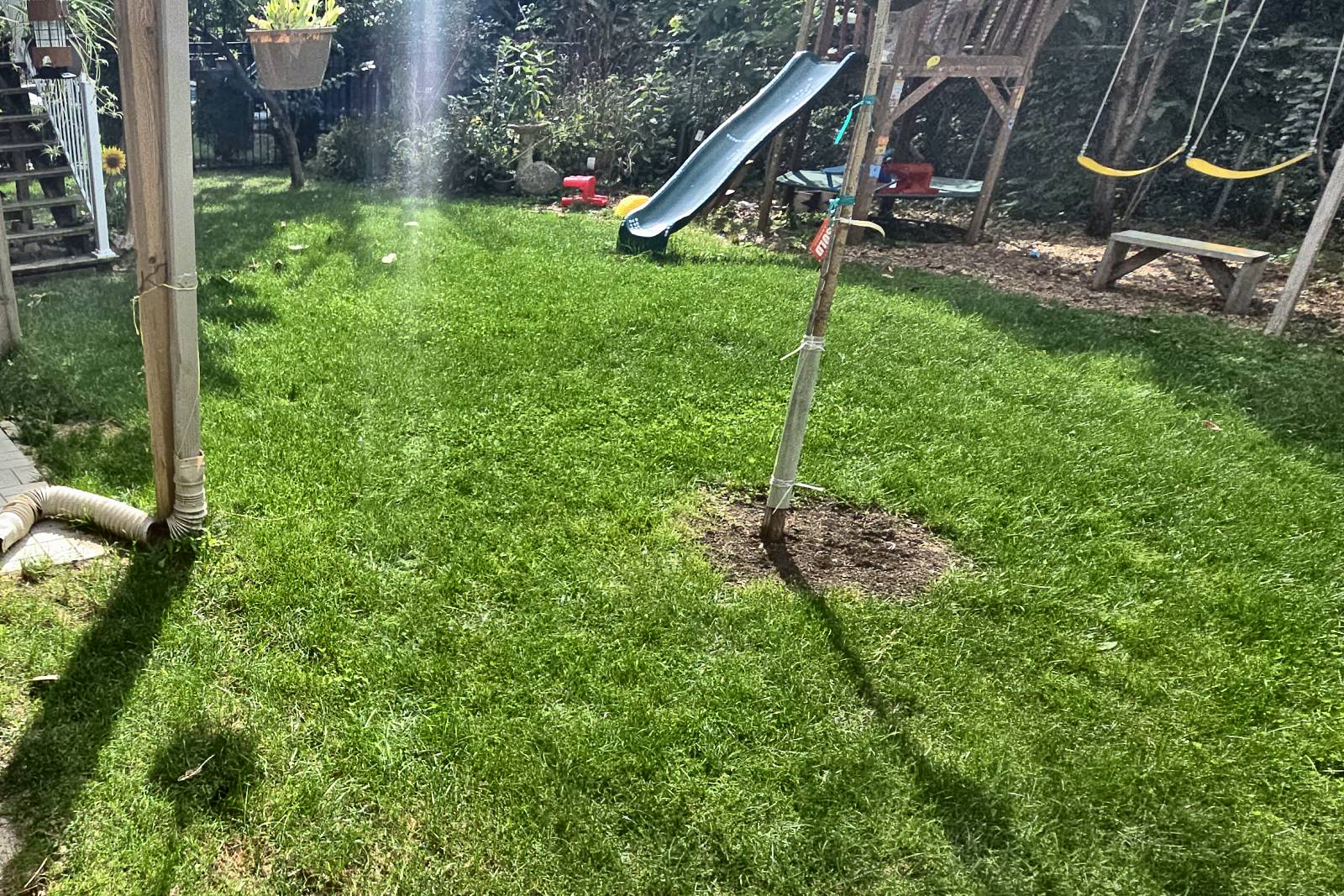
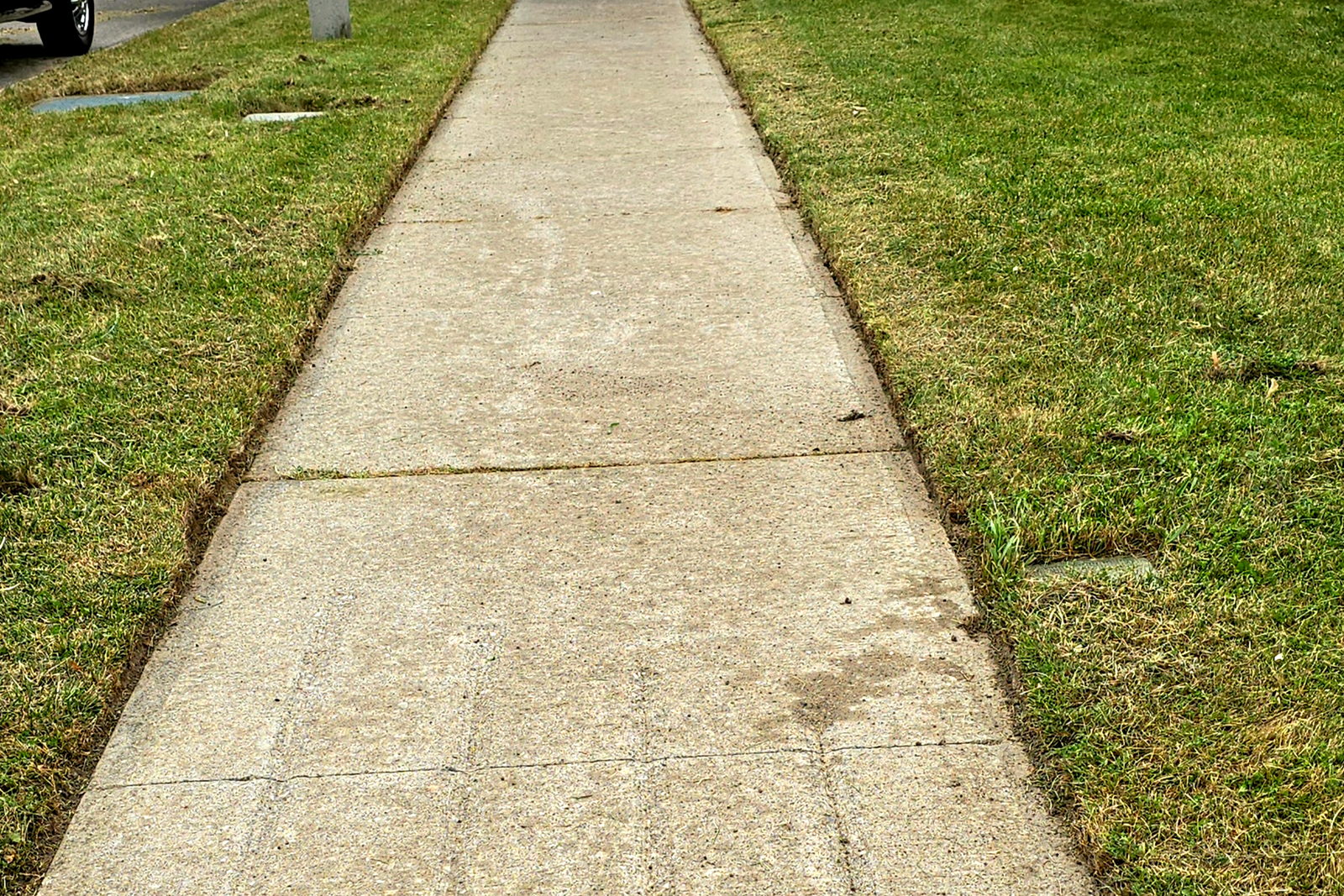
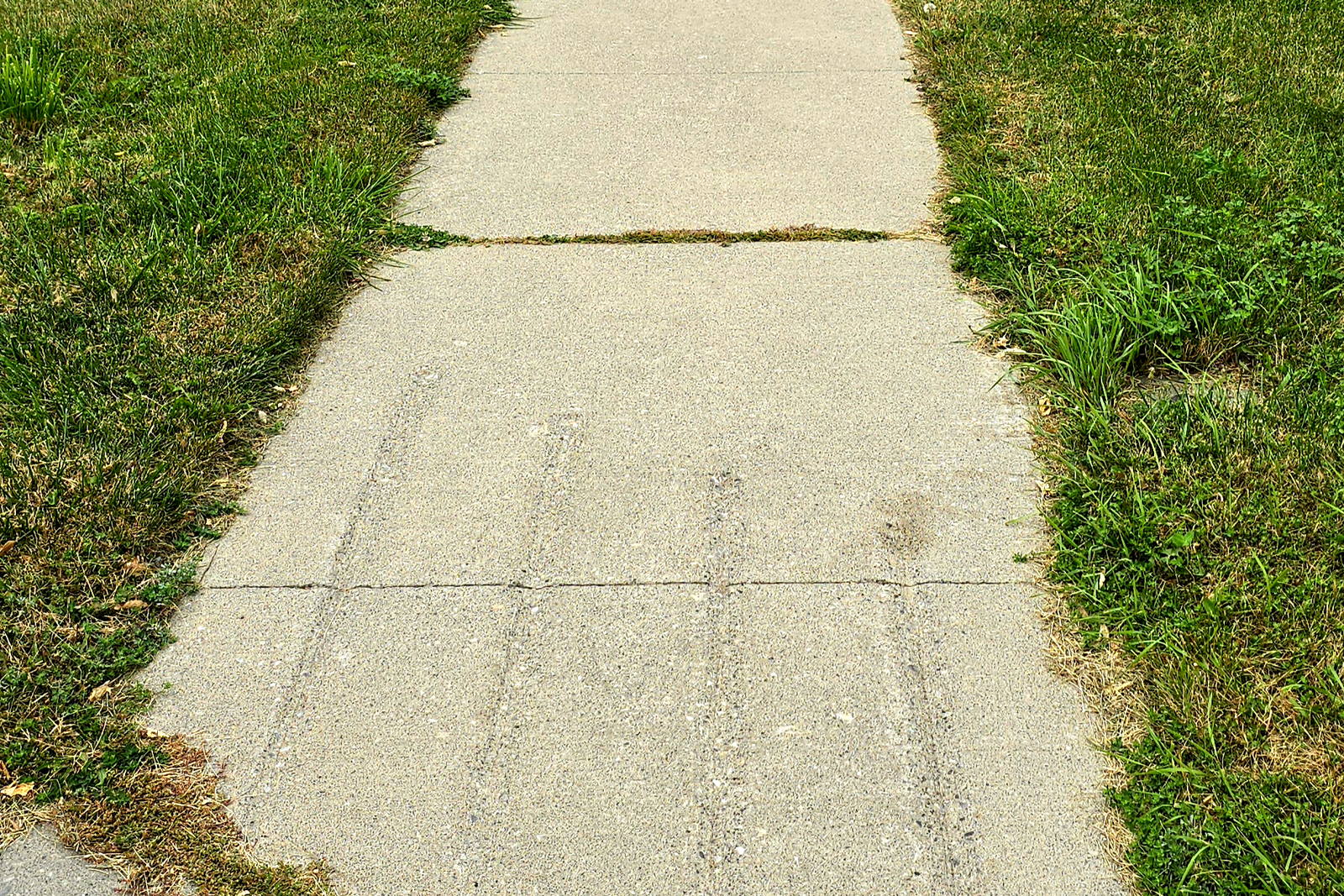
Real Northline properties, before and after, every one of them in Oshawa and every one of them this year. Drag the line to compare.
Andrew answers, October 2026
What happens if it snows all day instead of overnight?
The first pass opens a lane out to the road, the walkway and the steps, so you can get out. Then the whole route gets that same first pass. Then, once the snow stops, we come back for the full clear: full width to the pavement, the windrow off at the road, piles tidied and salt down again. If it looks half done at eight in the morning in heavy snow, that is deliberate and we are already on the way back. There is no extra charge for the second visit.
One of these goes on each page and it is replaced monthly. If the question you have is not here, ask it: 905-244-5779.
Have the ice handled at the right rate, before the route fills
Give me the address and I will come and walk the property in daylight, before there is any snow on it. I will tell you which surfaces on it actually refreeze, whether the salting belongs inside a membership or is better bought a trip at a time, and what the whole winter comes to. If the slab went down this year I will say use sand, and to call me back next autumn.