Snow removal · Driveway surfaces
Snow Plow Driveway Damage in Oshawa, and What Actually Causes It
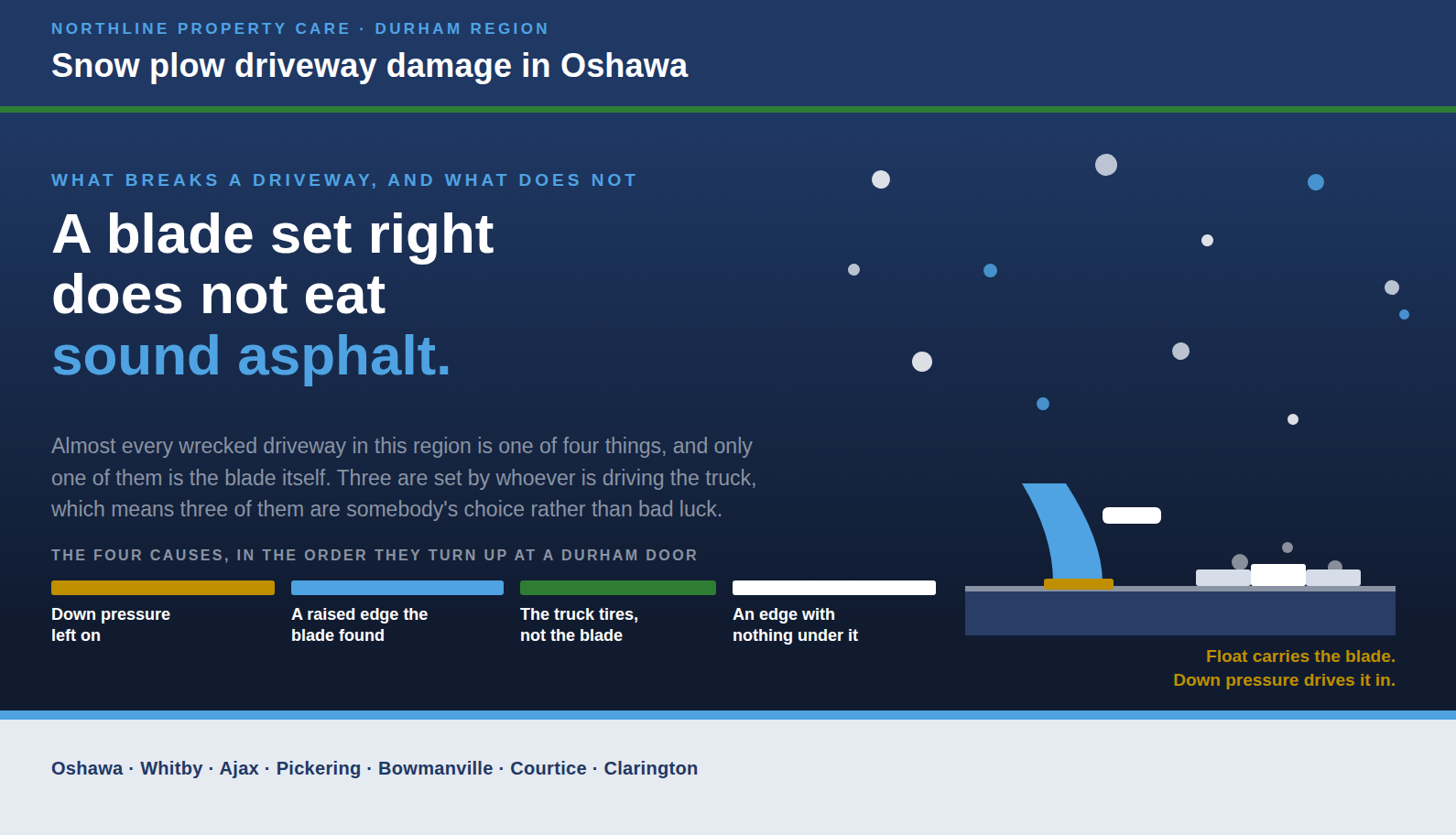
Snow plow driveway damage in Oshawa is almost always one of four things, and only one of those four is the blade. Three of the four are decided by the person driving the truck.
Gold at $189 a month plus HST is the tier that clears the driveway. See what each tier does after a storm.
Green in summer. Clear in winter.
The short answer
A blade set correctly on a sound surface does not wreck it. The four things that do are down pressure left on, a raised feature the blade found under the snow, a wheel loading an edge that has nothing packed against it, and salt working on a slab that is too young for it. Three of those four are decided by whoever is driving the truck. If your drive is interlock with a lifted unit in it, or asphalt with a crumbling shoulder, the honest answer is that a blade is the wrong tool for it and a contractor should tell you that before you sign rather than after the first storm.
Start with the thing almost nobody explains: the blade is carried, not pressed
Every truck plow has a mode called float. In float, hydraulic fluid is allowed to move freely between the reservoir and the lift cylinder, so the cylinder extends and retracts on its own as the ground rises and falls. The blade is resting on the surface under the weight of the plow and nothing else. It rides over a hump instead of trying to shear through it.
Down pressure is a completely separate system, and it does the opposite. It pushes hydraulic pressure onto the down side of the lift cylinder and drives the blade into whatever is under it. The manufacturer who sells it says in the owner's manual that it should be switched off on gravel, dirt and sand to prevent cutting into the surface being plowed. That is the whole warning, written by the people who built the machine.
So the first question to ask a contractor is not what his blade is made of. It is whether he runs down pressure on a residential drive. Down pressure is there for hard packed snow on a commercial lot at four in the morning, where the alternative is leaving a compacted layer that turns to ice by noon. On a residential driveway with a 3 cm trigger, there is rarely anything to force through, because at 3 cm you are moving loose snow that has been on the ground for hours rather than a week of traffic polished into a slab.
Minnesota's local road research board reaches the same place from the opposite direction. Its 2025 guide for cities and counties says that a cutting edge's angle, down pressure and material choice all significantly affect performance, and its operating instruction is to use only the pressure needed, because too much wears the blade faster. The road agencies are not worrying about the homeowner. They are worrying about the blade, and they arrive at the same setting.
What the cutting edge is made of, and why the soft ones are not a free lunch
A cutting edge is the replaceable strip along the bottom of the blade that actually touches the ground. It comes in steel, in tungsten carbide, in polyurethane, and in rubber or rubber and ceramic composite, and they behave very differently on a surface.
Carbide is close to diamond in hardness and it is the one to be careful about. The largest plow manufacturer in North America says on its own guidance page that because of the strength of the material, carbide can cause surface damage, and that it is typically used on roads or surfaces that are repaved often. A public road gets resurfaced on a cycle. Your driveway does not.
Rubber and composite sit at the other end. Minnesota's material table lists rubber and composite as non damaging and fast wearing in the same row, and that pairing is the entire trade. A rubber edge glides over the surface rather than scraping into it, so it leaves more snow behind and needs more salt afterwards to finish the job.
It is worth saying how short the wear life actually is, because this is where the marketing usually stops. Virginia's transportation research council measured rubber blades needing replacement every 72 to 96 kilometres of plowing and urethane blades lasting no more than 128 kilometres. A Durham route of 48 driveways has a truck covering that kind of distance inside a handful of storms. It also cited a Washington State study finding that urethane removed nearly all slushy snow but only about 85 per cent of dry compacted snow.
And the counter evidence deserves its own paragraph, because the easy version of this article would leave it out. Indiana's transportation department ran partial rubber plow blades against steel and carbide specifically to see whether they reduced damage to raised pavement markers and painted lines, and found no meaningful advantage, with operators rating the snow removal performance worse. Soft edges are not magic. They are a trade between what the surface takes and what the surface keeps.
The quarter inch that decides everything, and where it lives on a driveway
Here is the measurement that turned this from a matter of opinion into something checkable. Minnesota's transportation department had a persistent problem with snowplowable pavement markers being destroyed by blades, so it modified 90 of 96 marker castings by breaking off the levelling tabs, which lowered their profile from half an inch above the pavement surface to roughly a quarter of an inch. After five seasons, about ten per cent of the unmodified markers were non functional, against under two per cent of the modified ones.
A quarter of an inch, which is about six millimetres, was the difference between a raised feature surviving a winter and being smashed. That number is not about roads. It is about anything on a surface that stands proud of the rest of it, and a residential driveway in Durham Region is full of those: a drain grate at the garage door, the lip where a garage floor meets the apron, a settled slab whose neighbour did not settle with it, a paver lifted by a tree root, and a decorative border course set a touch high when the drive was laid.
Snow hides every one of them. That is the point. A blade in float will ride over a gentle rise, but a square edge standing six millimetres up and buried under ten centimetres of snow is not a rise, it is a step, and a blade arriving at a step at walking pace does not negotiate.
Which is why the useful pre winter job on a driveway takes about fifteen minutes and costs nothing. Walk it in daylight before the snow comes, and put a marker beside anything that is standing up. Manufacturers say the same thing in the safety section of their manuals, in the flattest possible language: flag obstructions that are under snow to prevent damage to product or property. That instruction is written for the operator, and it works just as well for the homeowner who knows the drive better than any contractor ever will.
Interlock, and the three millimetre rule the institute publishes
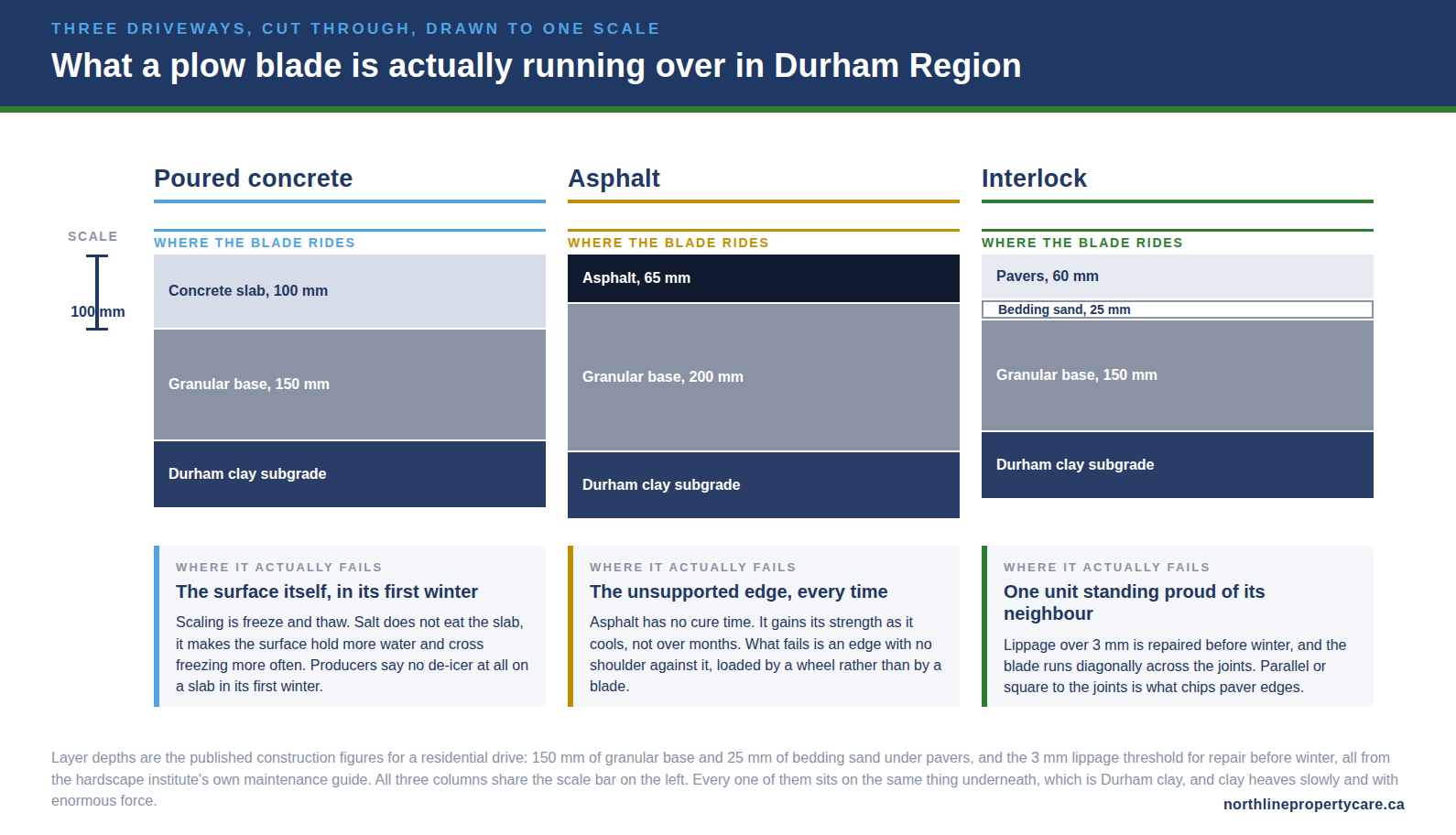
Interlock is the surface where the blade genuinely is the risk, and it is also the surface with the clearest published guidance anywhere in this article. The hardscape institute that writes the North American standards for interlocking concrete pavement publishes an operation and maintenance guide, and three lines in it decide whether a paver drive survives a plow.
The first is a number. Any unit that has heaved or lifted so that it stands more than three millimetres above its neighbour is to be repaired before the winter season. Not noted, not watched. Repaired. Three millimetres is roughly the thickness of two pound coins stacked, and it is well under the six millimetre step that Minnesota found was smashing cast iron markers.
The second is a direction. The guide says experience shows easier snow removal by shovelling and plowing diagonally to the joints, to prevent catching the edge of the pavers, and it warns that powerful equipment working parallel or perpendicular to the joint lines can chip paver edges. A joint line running the length of the drive is a continuous seam for a blade to drop into. Crossing it at an angle means the blade is only ever over one joint at a time.
The third is about the shoes. Shoes are the adjustable skids that hang off the bottom corners of a plow and hold the cutting edge a set distance off the ground. The manuals put that distance between a quarter and a half inch on a hard surface, and one to two inches below the wearstrip on gravel. The institute adds the part the manuals do not: shoes wear, and a worn shoe lowers the blade without anybody deciding to lower it. It also notes that synthetic shoes are available which prevent the rust staining that steel shoes leave behind on pale pavers, which is a defect nobody thinks about until a cream coloured drive in Brooklin has two orange tracks down it in March.
There is one more line in that guide worth carrying to a Durham homeowner, because it is cheap and it is seasonal. If the sand in the joints has dropped more than about twelve millimetres below the chamfer at the top of the paver, it wants topping up with dry masonry sand. Joint sand is not decoration. It is what transfers load sideways from one unit to the next, and a drive with empty joints has units working as individual blocks rather than as a pavement.
Asphalt does not cure, and almost every article in this market says it does
Ask around Durham Region about a newly paved driveway and you will be told it needs six months, or a full year, before anything heavy goes on it. That figure is not in any standard, any government document or any association guidance that we could find. It lives on contractor websites, and it repeats because everybody copies it from everybody else.
The Asphalt Institute, which is the industry body for the material, says the opposite in plain words on its own magazine: asphalt does not have a cure time. It typically gains full strength and can support traffic within minutes after construction, and for a two inch surface the time before it can be opened to traffic is generally a few minutes. Asphalt gains its strength as it cools, not by curing chemically the way concrete does. Paving stops when the mix drops to roughly 80 degrees Celsius because it can no longer be compacted, and the only wait afterwards is the wait for it to reach air temperature.
That is not the same as saying new asphalt is invulnerable. A municipal public works notice for new driveway paving asks residents to stay off for at least 48 hours, not to park on it for at least five days because tires leave imprints, and not to make sharp turns on it. Those are all about soft asphalt under a static or twisting load, and every one of them is a summer problem rather than a winter one.
The winter problem with asphalt is the edge, and it has nothing to do with the blade. The asphalt pavement association guidance for driveway owners is blunt about it: keep the edges supported using stone, gravel, topsoil or grass, and keep vehicles away from the edges if the edges are not supported. An asphalt drive is a flexible pavement with no reinforcement in it. Where it meets the lawn, the only thing stopping it breaking off is whatever is packed against it.
Drive along an older street in central Oshawa or the Donevan area in April and you can read this. The cracks are almost never in the middle. They run parallel to the edge, a hand's width in from it, on the side people turn across. That is a wheel loading an unsupported cantilever, over and over, and the winter version is worse because the ground under that edge is soft on a thaw day.
The same guidance carries a detail that reassigns a lot of blame. Motorists turning their steering wheels while not in motion can scuff the pavement surface, especially in front wheel drive vehicles and those with low profile tires. A plow truck turning around on your driveway is doing exactly that, with more weight on the front axle than a car has. When somebody says the plow marked their asphalt, the mark is often the tire and not the blade, and that distinction matters because the fix is different: it is where the truck turns, not what is bolted to the front of it.
Concrete in its first winter, and the rule every producer publishes
North Oshawa has been building steadily through Windfields, Kedron and the Taunton corridor, and every new build arrives with a poured concrete apron or walkway that has never seen a February. Those surfaces have one rule and it is unanimous across every concrete producer association we read.
Put no de-icing chemical on a concrete slab in its first winter. Use sand for grip instead.
The reason is worth understanding, because most people carry the wrong model of it. Salt does not dissolve concrete. The concrete producers' own technical bulletin on scaling says that when concrete is saturated and the temperature approaches freezing, the water expands as it turns to ice and that creates stress inside the concrete, and that de-icing chemicals make this worse by increasing the saturation of the surface and increasing the number of freezing and thawing cycles. The salt is not an acid. It is an accelerator of the freezing and thawing that was already going to happen, and the top few millimetres of surface mortar flakes off under it.
Concrete's defence against this is air entrainment, which is millions of deliberate microscopic bubbles mixed into it that give the freezing water somewhere to expand into. Ontario's own exposure classification for exterior flatwork that will meet chlorides and freezing asks for air entrained concrete at 32 megapascals at 28 days with a water to cementitious ratio no higher than 0.45. If your builder poured to that, the slab has the defence. If water was added on site to make it easier to place, which is the commonest way a driveway is spoiled before anybody drives on it, the surface layer is weaker than the specification says and the first winter finds out.
None of this is the plow. A blade in float on a flat slab is the least of that surface's problems. What matters on a new concrete drive is that the contractor carries sand and is willing to use it, and that nobody reaches for the blue bag in January because it is closer to hand.
The bag that saves your lawn is the bag that eats your concrete
This is the finding that surprised us most while checking sources for this article, and it is the one a contractor writing from memory would get wrong in both directions.
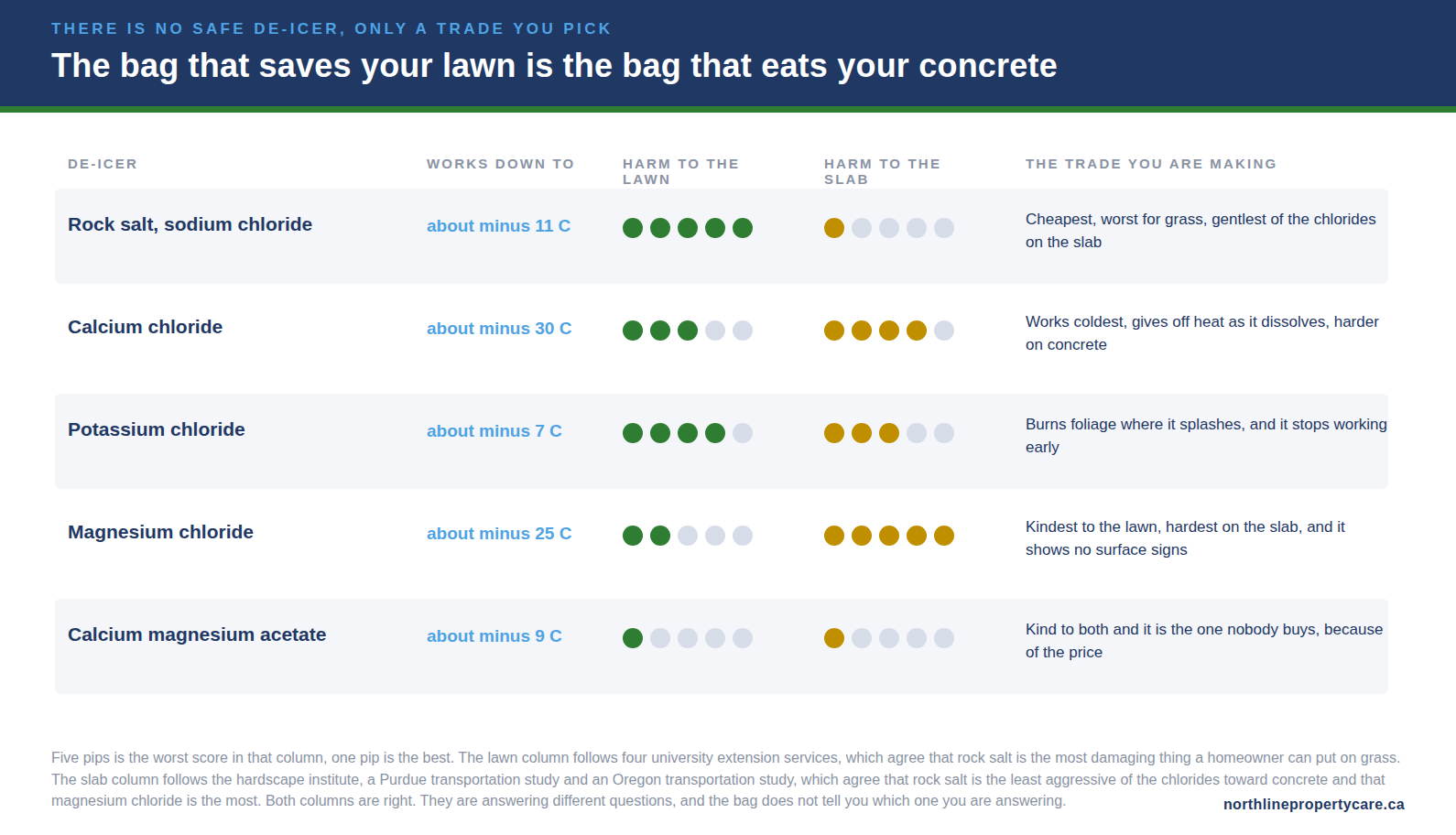
On the plant side the answer is settled. Four separate university extension services agree that sodium chloride, ordinary rock salt, causes the most significant plant damage of the common de-icers, and that magnesium chloride and calcium magnesium acetate are the kindest to landscape planting. If your only concern is the grass strip and the cedars beside the drive, rock salt is the wrong bag.
On the concrete side the ranking inverts. The hardscape institute says outright that rock salt is the least damaging to concrete materials and should be used whenever possible, and warns that magnesium chloride can chemically degrade all types of concrete. A Purdue transportation study of the three chloride de-icers found sodium chloride more benign than the other two, because calcium and magnesium chloride produce additional phases inside the concrete that can be expansive and cause cracking. An Oregon transportation study found that concrete exposed to a magnesium chloride de-icer lost the most compressive strength of anything it tested, and added the detail that makes it genuinely dangerous: chemical attack by magnesium chloride generally does not show apparent signs of distress. It does its damage without the surface telling you.
So there is no safe bag. There is a trade, and you pick which side of it you would rather lose on. On a new concrete apron, choose the slab and use sand until spring. On an established drive with plants tight against it, use less of whatever you use, because the institute's own instruction on de-icers is to use only as much as needed to do the job.
One correction while we are here, because it circulates locally and it is wrong. Road salt is not a designated toxic substance in Canada. Environment and Climate Change Canada assessed it in 2001 and concluded that road salts containing inorganic chloride salts meet the criteria set out in the Canadian Environmental Protection Act, and the ministers recommended adding them to the toxic substances schedule. They were never added. What arrived instead, in 2004, was a voluntary code of practice, and that code applies to road organizations using more than 500 tonnes a year and explicitly does not apply to road salts used for domestic, private or institutional purposes. Nothing in it governs what you put on your own driveway, and nothing in it governs what a residential contractor does either. You can read the federal assessment of road salts and the University of Minnesota summary of what de-icing salts do to a landscape yourself and reach the same place.
Durham clay, frost, and the awkward fact about clearing snow at all
Under every driveway in this article is the same material. Oshawa, Whitby and Courtice sit largely on clay and clay loam, and the City of Toronto's own pavement guidance describes the cohesive tills, clays and silts of the Iroquois Lake Plain and the Peel Plain, which run right through Durham, as fair subgrade support with frost susceptibility ranging from low to high depending on what is actually in the soil.
The National Research Council's building digest on ground freezing is the clearest explanation of what that means. At the freezing plane, water in the soil turns to ice, which acts as a drying action and draws more water up from the unfrozen soil below, the way dry soil pulls moisture from wet. Given enough water and the right soil, an ice lens can keep growing. Its verdict on our ground is specific: clean gravels and coarse sands do not heave, fine sands and silts heave badly, and clays are also very susceptible although they normally heave slowly, often with tremendous pressures. Vertical movements of four to eight inches are not unusual.
That is why your house stays put while the apron in front of the garage does not. The council's companion digest on foundations explains it: heat loss from a heated basement reduces the depth frost reaches in the soil immediately around a building, so the footings sit in warmer ground. An unheated slab a metre away has no such protection. It is also why the join at the garage door is so often the place a drive cracks. Two things that move differently are fastened together at that line.
Municipal design documents give a sense of the depths involved without anybody having to guess. Durham Region requires a minimum of 1.80 metres of cover over its watermains, measured from the top of the pipe, and the province requires that watermain cover exceeds the depth of frost penetration. Read that carefully: 1.80 metres is a burial standard, not a frost depth. But it is the number an engineer in this region designs against, and it puts the frost line a long way below a 150 millimetre granular base.
And here is the sentence that costs us something to publish, from the same NRC digest. It has been shown that each foot of undisturbed snow reduces the depth of soil freezing by approximately the same amount. A driveway scraped bare after every storm freezes deeper than the untouched lawn three metres away from it. Clearing snow does not cause frost heave, and a driveway nobody can use is not a driveway. But anybody claiming that a plowing membership protects your driveway from frost has the physics backwards, and we are not going to make that claim to sell a tier.
What follows from it is practical rather than dramatic. Where the snow goes matters. Piled hard against one edge, it keeps that edge wet through every thaw and loads it when it settles. Piled where it will drain away from the drive rather than back across it, it does neither. That is a decision made once, in October, when the route is sequenced and somebody stands on the property and works out which corner the snow lives in for five months.
The grass along the edge, and who pays when it goes
The single commonest piece of winter damage on a residential property is not the driveway at all. It is the sod along the first thirty centimetres of lawn beside it, torn up in February when a blade found the edge under a foot of snow, or scalped in March when a pile of hard snow finally slid.
Municipalities across Ontario treat this as routine. A typical Ontario city page on snowplow damage offers reimbursement for sod damaged by a city road plow or sidewalk plow, and is precise about the limit: materials only, meaning soil, seed or sod, and not labour. The same pages usually add that an irrigation head sitting in the municipal right of way and destroyed by a plow will not be replaced at all. That is the public sector position, written down, on the assumption that some lawn edge damage every winter is simply what winter costs.
On a private drive it is avoidable and it is avoided the same way every time. The edge gets marked before the first storm, and the marker stays there until April. A stake at each corner of the drive and one at the midpoint of each side is about six markers on a typical Oshawa lot. It is the cheapest insurance on the property and it is the first thing any contractor should be doing in October rather than in January.
Where the grass does go, the repair belongs in spring rather than in the same week. A strip of torn sod along a drive is an opportunity as much as a defect, because it is already open ground at exactly the time of year when seed takes. It is the same argument as the one behind a full lawn restoration, scaled down to a metre wide strip: seed that reaches soil grows, and seed that lands on thatch dries out.
What we do about all of this, including the part that costs us money
Northline runs one truck with a plow on the front of it, and there are contractors in this region who sell the opposite as their headline feature. Rather than argue with that, here is exactly what we do and where we agree with them.
Every property is walked before it is quoted, in daylight, with no snow on it. That is when a lifted paver, a proud drain, a crumbling asphalt shoulder and a first winter slab all get found, and it is the only time of year they are visible. What comes out of that walk is a decision about the tool, and it is written on the quote rather than discovered in January.
Where the walk finds a drive that a blade should not be on, we say so and we clear it a different way at the same price. A paver drive with lippage over that three millimetre threshold, a slab poured this year, a badly undercut asphalt edge: those get cleared by blower and by hand, they take longer, and the membership price does not move because the price is for the outcome rather than for the machine. That is the unprofitable sentence in this article, and it is here on purpose. A drive that takes fifteen minutes by hand instead of six minutes by blade costs us route time we cannot get back.
The trigger is published and it does not move. Three centimetres of measured accumulation on a residential property, five on a commercial one. Below three centimetres nothing is pushed on a driveway at all, which removes a whole category of unnecessary blade contact from the season. Measured depth is also not a forecast, which is deliberate: a forecast is a possibility and a depth is a fact.
The tiers do different things and the difference is worth stating plainly rather than leaving in a table. Gold at $189 a month plus HST clears the driveway with a 7 AM target after overnight snow. Platinum at $279 a month plus HST is sequenced first with a 6:30 AM target and carries unlimited automatic salting. Silver, which is the entry tier at $129 a month plus HST, does not plow the driveway at all. A Silver member gets the windrow pass by 5 PM and no salting at any depth, and anybody who tells you otherwise has not read what each membership actually includes.
And the genuinely free option comes first, not last. If you are 65 or older or have a documented disability, four of the five municipalities we serve run a windrow assistance program, and if you qualify for one you should take it instead of paying us. The town by town breakdown of who clears the windrow has every deadline and every depth trigger in it. No contractor in this region can beat free, and pretending otherwise at a doorstep in October is how a business gets a reputation it cannot shed.
What we could not verify
Everything above that did not come from inside this business came from a government agency, a university, a standards body, an equipment manufacturer's own manual or a peer reviewed source. Not one figure came from another contractor, and several widely repeated local claims were dropped for exactly that reason. Below is what we went looking for and failed to pin down.
- The six month or one year asphalt curing figure. Repeated everywhere in this market and not present in any government, university, association or standards source we could reach. The Asphalt Institute contradicts the premise directly, and you can read its own position on asphalt cure time. If somebody can point us at a real source for the figure we will publish it here.
- Any published wait time before plowing newly paved asphalt. No manufacturer, association, municipality or agency we read addresses plowing new asphalt at all. Ontario's own asphalt association driveway guide has no winter guidance in it beyond a marketing line.
- A published frost penetration depth in metres for Oshawa or Durham Region. Not in the Ontario Building Code as a single number, not in the City of Oshawa engineering design criteria manual, which carries a frost susceptibility chart but no depth, and not in the regional or provincial water documents. The 1.80 metre watermain cover above is a burial standard and we have not dressed it up as anything else. The tidy municipality by municipality frost depth tables circulating online are all on contractor websites.
- How much force a light truck plow actually puts on a driveway. No manufacturer publishes it and no transportation study we fetched measured it for a light truck plow, so there is no number here and there should not be one anywhere else either.
- Any City of Oshawa or Region of Durham published position on plow damage to private driveways. Not found. The Ontario municipal damage pages we could read cover sod and boulevard, not driveway surfaces, and none of them is Oshawa.
- A standards body statement on a maximum safe blade height over pavers. The hardscape institute addresses it only through shoe adjustment and the three millimetre lippage threshold. There is no published height specification, so the local advice to always run shoes on interlock is not something we can source, whatever its merits.
One more thing belongs here rather than buried. The counter evidence in the cutting edge section, the Indiana finding that rubber blades gave no meaningful advantage and the Virginia finding that urethane clears only about 85 per cent of dry compacted snow, cuts against a claim this business could have made comfortably. It is in the article because leaving it out would have made the rest of it worth less.
Questions people in Durham actually ask
Will a snow plow damage my driveway in Oshawa?
A correctly set blade on a sound surface does not. The blade is carried by the weight of the plow in float, so it rides over the contour rather than being pressed into it, and the damage people blame on the blade is usually one of three other things: down pressure left switched on, a truck wheel running off an unsupported edge, or something on the surface that stood proud of it. The surfaces that genuinely are at risk are interlock with a lifted unit in it, an asphalt edge with no shoulder against it, and a concrete slab in its first winter.
Can you plow an interlock driveway without chipping the pavers?
Yes, on a paver drive that is flat. The hardscape institute's own maintenance guide says to repair any unit sitting more than 3 mm proud of its neighbour before winter, and to work diagonally across the joints rather than along them or square to them, because a blade travelling parallel to a joint line is the thing that catches a paver edge. If a drive in Windfields or Brooklin has a lifted unit near the garage, we will say so on the quote and clear that drive by machine and shovel instead, at the same membership price.
Does road salt damage a concrete driveway?
Not directly, and the mechanism matters because it changes what you should do about it. Salt does not dissolve concrete. It makes the surface hold more water and drives it through more freezing and thawing cycles in a season, and the surface flakes off under that. Concrete producers publish the same first winter rule everywhere: put no de-icing chemical on a slab in its first winter and use sand for grip instead. You can read the concrete producers' bulletin on surface scaling in full.
Which de-icer is safest for my lawn and my driveway in Durham Region?
There is no single answer, because the two questions have opposite answers. Four university extension services agree that ordinary rock salt is the most damaging thing you can put on grass. The hardscape institute, a Purdue transportation study and an Oregon transportation study agree that the same rock salt is the least aggressive of the chlorides toward the concrete itself, and that magnesium chloride is the worst of them while showing no surface signs at all. Calcium magnesium acetate is kind to both and almost nobody buys it, because it costs several times what a bag of rock salt costs.
Why does the edge of my driveway crack and sink every winter?
Two reasons, and neither is the blade. The first is that a driveway edge with nothing packed against it has no lateral support, so any wheel that runs over it loads an unsupported cantilever. The second is frost. Durham sits on clay and clay loam, and the National Research Council's building digest on ground freezing says clay heaves slowly but often with tremendous pressure, with vertical movements of four to eight inches not being unusual in frost susceptible ground. Your house does not move with it, because a heated basement keeps the soil under the footings warmer.
Does clearing my driveway make the frost under it worse?
It does, and it is the honest awkward fact in this trade. The National Research Council found that each foot of undisturbed snow reduces the depth of soil freezing by roughly the same amount, so a driveway you scrape bare after every storm freezes deeper than the untouched lawn beside it. That is not a reason to stop clearing it, because an unclearable driveway is not a driveway. It is a reason to keep the snow you push off it somewhere useful rather than piled against the one edge that is already weakest.
What does Northline do if my driveway is too fragile to plow?
We tell you before you sign, and we clear it a different way at the same price. Gold at $189 a month plus HST is what carries a cleared driveway and a 7 AM target after overnight snow, and none of that changes because the tool changed. Silver does not plow the driveway at all, which is worth saying plainly here, because a Silver member gets the windrow pass by 5 PM and nothing else on the drive itself.
Who wrote this
The owner runs Northline Property Care out of Oshawa, with one truck and one operator across seven towns: Oshawa, Whitby, Ajax, Pickering, Bowmanville, Courtice and Clarington. Six winters clearing snow in Durham Region, which is a figure about the person rather than about the company, because Northline registered in August 2026 and this is its first season under the name.
Northline is fully insured. The sources behind this article are linked where they are used, the equipment behaviour described here is what is written in the manufacturers' own manuals rather than what anybody remembers, and the things we could not establish have a section of their own instead of being quietly left out. If a figure on this page is wrong, the quickest way to have it corrected is to ring and say so: 905-244-5779. Our published hours and service area are on their own page.
Read next
What snow removal costs here
Seasonal, per visit and monthly, set out with the arithmetic behind each one and the single calculation that says which model suits your street.
Compare the three models →When the route actually fills
Two dates decide whether a driveway gets on a one truck route at all, and neither of them is the first snowfall of the year.
Read the booking dates →Snow removal in Oshawa
The route through Windfields, Samac and Donevan, the 3 cm trigger, and what each tier does between the end of a storm and breakfast.
See the Oshawa route →Have the surface looked at before the snow hides it
Send me your address and I will walk the drive while it is still bare, tell you which surface you have, mark anything a blade should not meet, and say straight out whether a blade belongs on it at all. That costs nothing and it is the only month of the year it can be done properly.