Lawn care · Autumn
When to Stop Cutting Grass in Oshawa, and the Last Cut of the Season
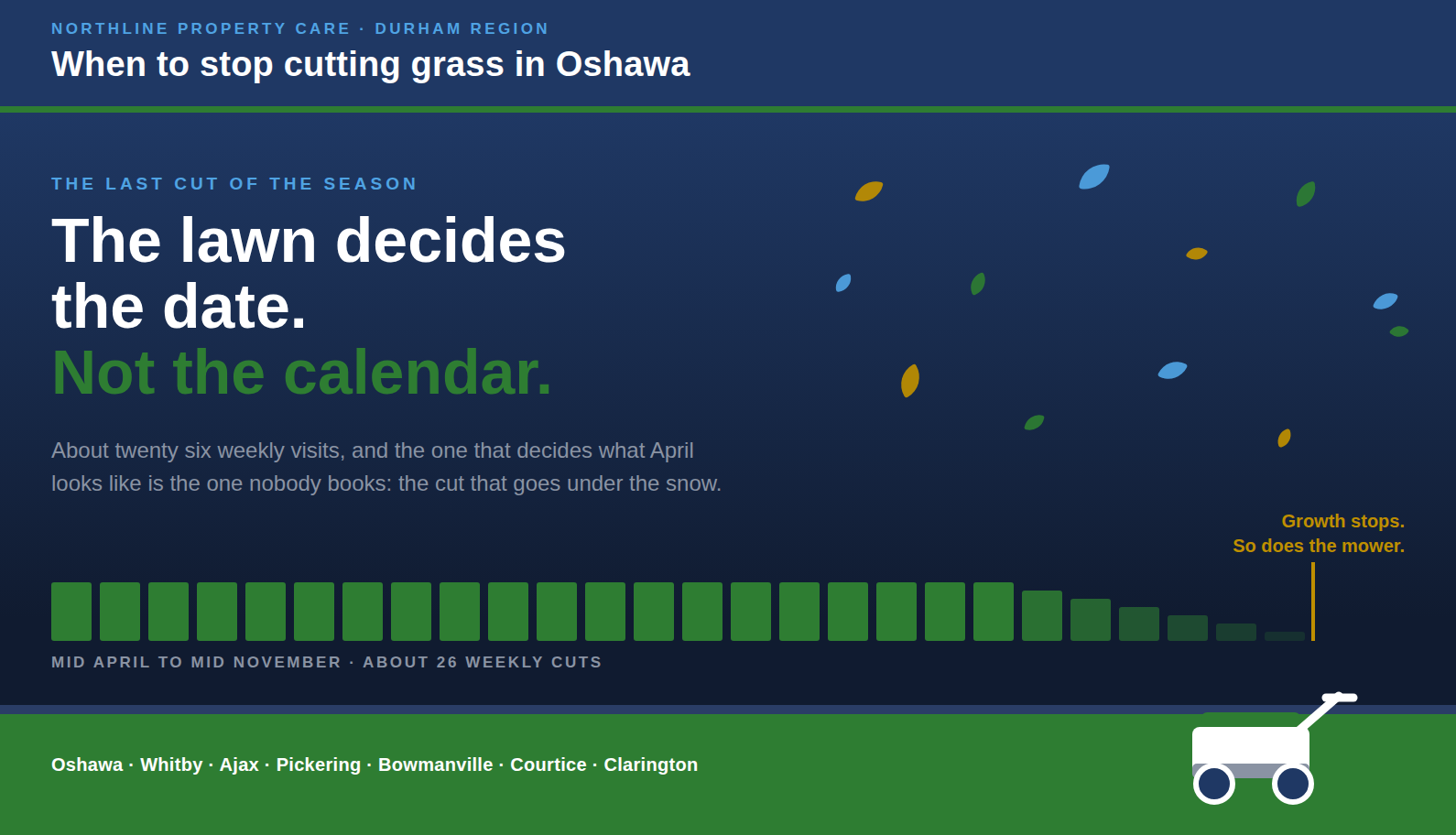
When to stop cutting grass in Oshawa is a question the lawn answers, not the calendar. You take the last cut when top growth stops, which in most Durham years falls between the last week of October and the third week of November.
Twenty six weekly cuts, then the winter. See what each membership covers.
Green in summer. Clear in winter.
The short answer
Keep mowing while the grass is still growing, and stop when it stops. In Durham that is usually somewhere between the last week of October and the third week of November, and it moves by two weeks or more from one autumn to the next. Finish slightly shorter than your usual height, about 6.5 cm against a weekly 7.5 cm, and do not let a wet mat of leaves go under the snow on top of long grass. That combination is what decides whether April looks green or grey.
Stop when the grass stops, not when the calendar says
The reason people want a date instead is that a date can be booked. So here are the two that bracket it in this region. Before the last week of October, the grass is almost always still growing in Oshawa, and stopping early is the mistake rather than the safe choice. After the third week of November, you are usually mowing a lawn that quit weeks ago, and driving on frozen ground to do it. In between, it depends on the autumn.
That is not a Northline opinion. The University of Minnesota's turfgrass science group puts it as plainly as anyone: continue mowing until the grass stops growing, because that is what reduces snow moulds and winter damage. Wisconsin, Purdue, Penn State, Cornell and North Carolina State all say a version of the same sentence on their own disease pages.
Our own weekly route runs from about mid April to about mid November, roughly 26 visits, and the last one is scheduled loosely on purpose. Some years it happens in the first week of November. Other years plenty of lawns in Durham are still putting on visible growth in the second half of the month. A route built on a fixed date would cut some of those lawns twice too early and leave others shaggy until spring.
What growth stops actually looks like on a Durham lawn
Cool season grass, which is what almost every lawn between Pickering and Newcastle is made of, keeps making leaf while the average daily temperature holds above about 10 degrees. Cornell's turfgrass program states it as 50 degrees Fahrenheit, which is exactly 10 Celsius, and adds the part that matters more: the roots keep going after the top stops, right up until the soil itself freezes.
That split is the single most useful thing a homeowner can hold on to in the autumn. Above the ground the lawn looks finished. Below it the plant is still working, still moving sugar down, still thickening the crown that has to survive January. Penn State puts the best root growth at soil temperatures between 10 and 18 degrees, and notes that roots keep growing below that, just slowly, all the way to freezing.
So the visible test is simple, and you can run it on your own front lawn in thirty seconds. Look at how much you are taking off. Through July you are removing a real handful every week. By late October, on a lawn holding at 7.5 cm, a week of growth is barely a shadow on the blade. When two weeks pass and there is nothing on the mower, the season is over whatever the date says.
Two things in Durham push that date later than people expect. The first is Lake Ontario, five kilometres from most of the lawns we cut, which gives the lakeshore strip of Oshawa, Whitby and Courtice a slower autumn than the tableland north of Taunton Road. The second is nitrogen. A lawn fed in September is still growing in November, and that is not a fault, it is the fertilizer doing exactly what it was bought to do.
What height to finish at, and where the experts genuinely disagree
This is the part of the subject where the honest answer is that it is not settled, and anybody who tells you otherwise has read one source.
Ontario's own guidance, on the provincial page on preparing a lawn for winter, says to raise the mowing height slightly in the fall. Its reasoning is rooting depth and crown insulation, and it carries its own warning in the next breath: grass that goes into winter too long mats down, and matted grass is what pink and grey snow mould want.
Several American extension services say the opposite. Minnesota Extension tells homeowners to drop the mower one or two settings, with a floor of two inches. Illinois says finish at about two inches, flat. Purdue's grey snow mould bulletin says mow into dormancy at two and a half inches, while Purdue's pink snow mould bulletin, written on the same campus, says keep it taller at two and a half to three inches so it cannot mat.
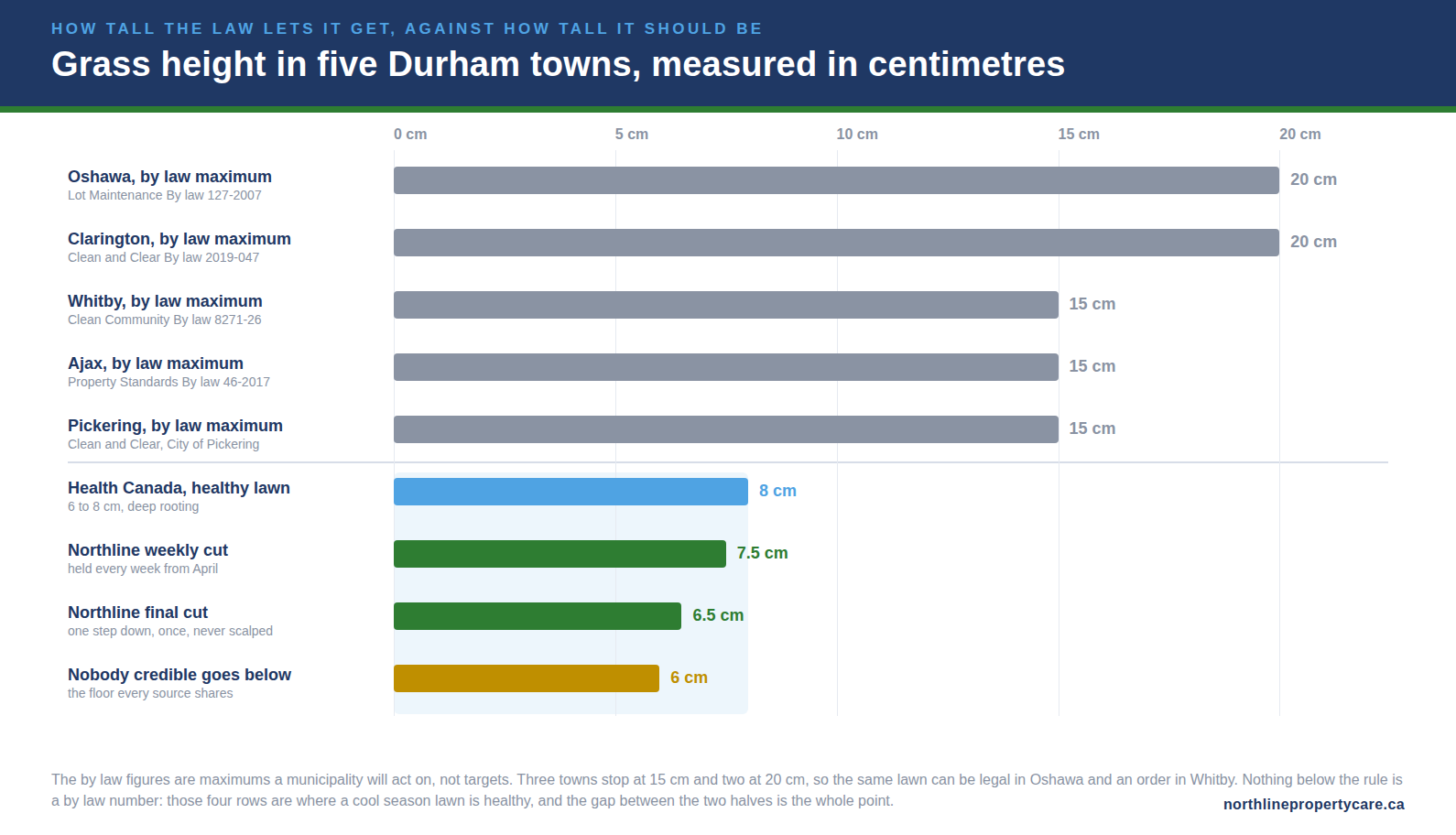
Read all of them together and the disagreement collapses into a band. Nobody credible recommends going below about 6 cm. Nobody credible recommends going into winter above about 8 cm. Every single one of them says do not scalp, and says keep cutting until growth stops. The argument is about two centimetres inside a band that everyone already agrees on.
Our position, and why. We hold 7.5 cm every week from April, and we finish the season slightly shorter, at about 6.5 cm, once. One step, on the last visit, and never below 6 cm on any lawn for any reason. That sits inside the band every source above agrees on. It takes the matting risk the province warns about seriously, it lands on the height Purdue names for mowing into dormancy, and it does none of the damage a real scalping does.
It is also what our fall cleanup has always done, which is worth saying out loud rather than quietly: the final cut in that service is described on our own service page as slightly shorter than the usual 7.5 cm. This article is the reasoning behind a number that was already published, not a new position invented for an article.
What we will not do is take a healthy lawn from 7.5 cm to 4 cm in one pass in November because it is the last cut. That is a scalp, and scalping costs the lawn root mass and stored food at the exact moment it needs both. Cornell's sports field guidance is blunt about what routine scalping produces: shallow rooted, weakened turf that everything else then picks on. If you want the longer version of the height argument, we wrote it out in the piece on mowing height in Durham Region.
What happens under the snow when the last cut is wrong
Snow mould is the reason any of this matters, and it is worth understanding properly, because it is the one lawn disease in Durham that gets decided in November and only becomes visible in April.
There are two of them. Grey snow mould needs prolonged snow cover sitting on unfrozen ground. Purdue's bulletin puts numbers on it in a way a homeowner can actually use. Forty to sixty days under snow buys you a few small patches. Sixty to ninety and the bulletin calls the damage moderate. Past ninety days it uses the word severe. Pink snow mould is the nastier neighbour, because it does not need snow at all. It runs in cold wet conditions above freezing, which describes a Durham February thaw and most of a Durham March.
Both of them want the same three things: a mat of long grass, a wet layer of leaves on top of it, and temperatures hovering just above zero at ground level. The first two are the only ones you control, and you control both of them with the mower.
The other thing that turns up at snowmelt is vole runs. Voles travel under snow cover into open lawn they would never cross in daylight, and their runways show up as pale grey channels the week the snow goes. Penn State's guidance on voles is about cover and food rather than a magic final cut height, and it is worth saying plainly: we could not find a source that proves a specific final cut height reduces vole damage. Minnesota asserts it. Penn State does not. We are not going to sell you a low final cut on a claim we cannot stand behind.
Vole damage almost always fills in on its own by June. Where it does not, it is an overseeding job in the spring, not a disaster, and on a badly thinned lawn it is one of the few honest reasons to look at a full restoration rather than another season of patching.
The leaves, and the number Ontario publishes that almost nobody quotes
Here is the most useful autumn fact in this whole article, and it comes from the province rather than from us: the province says a leaf layer as deep as 15 cm can go through a mulching mower and straight back into the turf, and the grass will be none the worse for it.
Fifteen centimetres. That is not a light dusting, that is ankle deep on a Windfields front lawn under a silver maple. The instruction that goes with it is to mow dry leaves with a mulching mower and sharp blades, and to keep going until the lawn is visible again. Minnesota's turf group gives a good visual test for that: after the pass you should still be able to see 80 to 90 per cent grass.
The research behind it is real and it is not ours. A peer reviewed study in HortTechnology, with Michigan State authors, mulched maple and oak leaves into established Kentucky bluegrass across two autumns and measured what happened. Two findings stand out. The high application rate produced the best spring green up regardless of which tree the leaves came from, and dandelion counts fell by up to 80 per cent after one season of mulching and 53 per cent after two.
Read that second number again in an Ontario context. We cannot spray a lawn for weeds here. The cosmetic pesticide ban under the Pesticides Act and Ontario Regulation 63/09 took 2,4-D and the rest off the table for lawn use, for us and for every other contractor in Durham equally. Weed control here is density, shade and competition. A mulched leaf layer is a free, legal, research backed piece of dandelion suppression, and most people in this region bag it up and put it at the curb.
The limit is real though, and it is the same limit the province names. Leaves left whole in a mat will block the light, and the grass under them will die. Mulching means mowing the leaves into pieces small enough to fall between the blades. It is not leaving them there and hoping.
What does not get mulched has to go somewhere legal. Yard waste across Durham runs from April to early December, every other week on the regular garbage day, in kraft paper bags or open topped containers under 20 kg. No plastic bags, on any of it. Whitby lifts its 16 item limit for bagged leaves through October and November, which is the most generous piece of autumn waste policy in the region and one that almost nobody seems to know about.
What you cannot do is push them into the road. Whitby's Clean Community By law 8271-26 prohibits placing leaves on the travelled portion of a highway outright, and so does Ajax. Oshawa's own instruction is blunter and explains why: do not rake or blow leaf or yard waste onto the street, because it plugs catch basins and causes flooding. Ajax goes one step further and puts the catch basin grate on your own property on you, in section 4.32 of its property standards by law.
How long the by law lets you leave it: five towns, two different numbers
If the real question behind when do I stop cutting is how long can I get away with leaving it, then the answer depends on which side of a town line you live on. The gap is bigger than most people realize.
| Municipality | Maximum grass height | Instrument |
|---|---|---|
| Oshawa | 20 cm | Lot Maintenance By law 127-2007, section 4.1(c) |
| Clarington, including Bowmanville, Courtice and Newcastle | 20 cm | Clean and Clear By law 2019-047 |
| Whitby | 15 cm | Clean Community By law 8271-26, section 4.2 |
| Ajax | 15 cm | Property Standards By law 46-2017, section 4.7 |
| Pickering | 15 cm | Stated on the City property standards page |
A lawn at 18 cm is perfectly legal in Oshawa and an order in Whitby, on the same day, five kilometres apart. Whitby's by law is also brand new: 8271-26 was passed on 9 March 2026 and came into force on 1 April 2026, replacing By law 6937-15. Anything you read quoting the old number is out of date, including a good deal of what is still online.
The enforcement is not a warning letter and nothing else. In Oshawa the Director can have the work done without notice to the owner and add the cost to the tax roll. Clarington describes the same sequence in plain words on its own by law enforcement page: an order, a reinspection, then a contractor is called and the owner is invoiced. Nobody wants that invoice, and it is a considerably worse deal than a cut.
The rest of the Durham autumn calendar, deadline by deadline
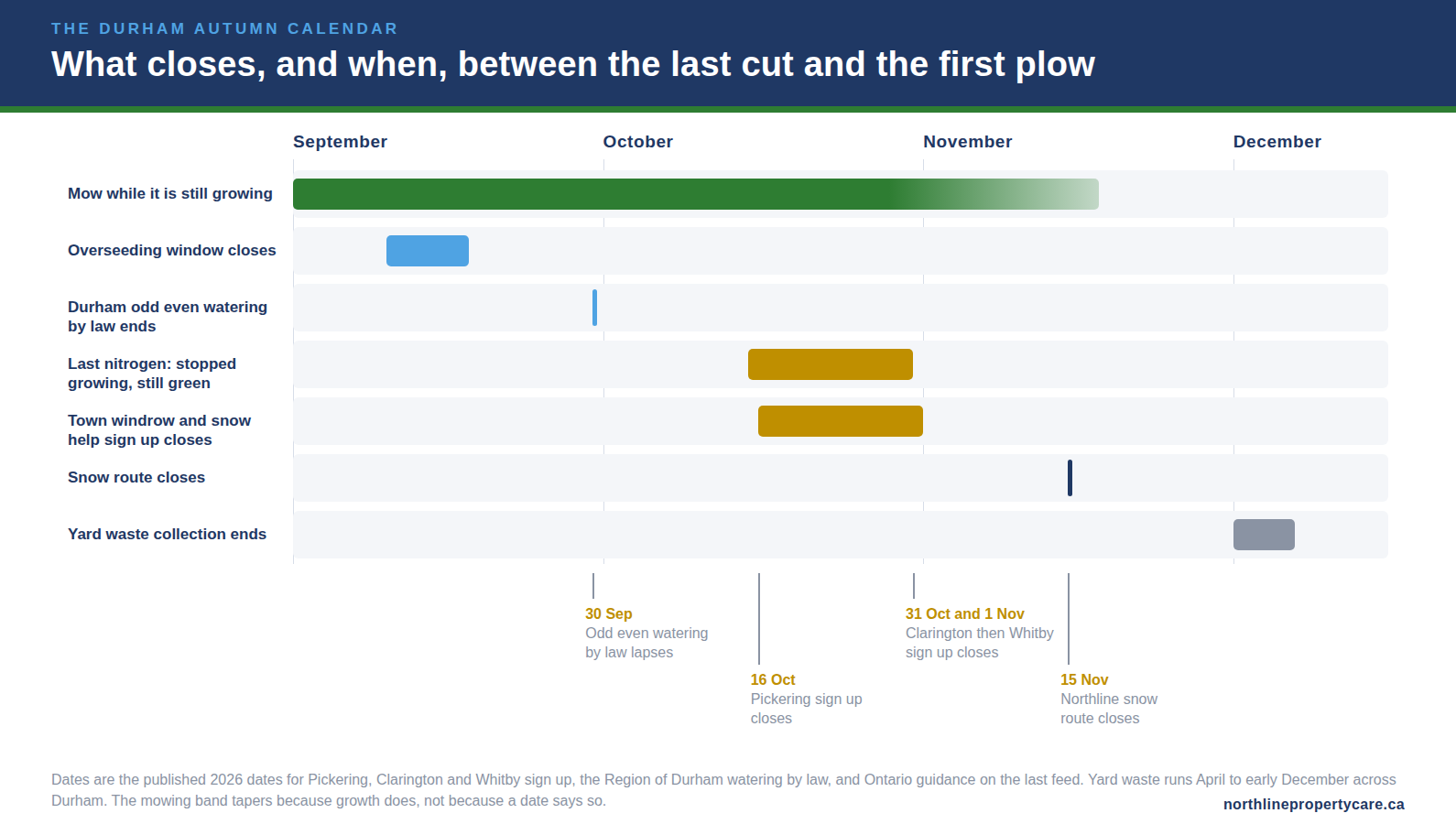
The last cut does not happen in isolation. It sits in a run of eight weeks where several things close, and most of them are published by somebody other than us.
Mid September. The overseeding window closes. Ontario names mid August to mid September as the best time to overseed, and the reason is arithmetic rather than tradition: a seedling needs six to eight weeks of root growth before freeze up, and seed going down in October does not get them.
30 September. Durham's mandatory odd even lawn watering by law runs from May to September and lapses at the end of the month. If you overseeded in September, the establishment watering gets easier in October rather than harder, and almost nobody notices that.
Mid to late October. The last feed. Ontario's guidance is to make the late fall nitrogen application when the turf has stopped growing but is still green, at the same rate as the early fall one. Purdue explains the hard stop on the other side: when the soil is cold, the plant takes nitrogen up slowly, and what is not taken up leaches or runs off. Fertilizer spread on frozen ground or snow is money going into a storm drain.
16 October, 31 October and 1 November. Three municipal sign up deadlines, one per town. More on those in the next section, because they are the part of this article that costs us money.
15 November. Our snow route closes. That date does not move, and it is not a sales device: a one truck route has to be sequenced before the first storm, and a driveway added on 20 December is a driveway that pushes every other clear later that morning.
Early December. Yard waste collection ends across Durham. The Region publishes the season as April to early December and delivers the exact final date through its own address lookup rather than as a single regional date, so check yours rather than trusting a number in an article, this one included.
The part that costs us money to write down
If you are 65 or older, or you have a disability and nobody under 65 in the house can do the work, four of the seven towns we serve will clear your windrow or your sidewalk for free or close to it. Take it. We are not going to beat free, and we are not going to pretend otherwise.
- Whitby. The windrow program costs nothing at all. Applications opened on 14 September 2026 and close on 1 November 2026, and the service runs to 15 April.
- Clarington. $107.69 including tax for the season, with applications open from 21 September to 31 October.
- Pickering. Registration for this winter opened on 11 September and closes on 16 October, with fees running from free for GAINS and GIS recipients up to $240.69.
- Oshawa. Applications open on 1 October, and it is worth knowing that Oshawa's program covers City sidewalks only, not your driveway windrow.
Those windows are short and every one of them closes before the first storm, which is not a coincidence. If you qualify, that phone call is worth more to your household than anything on our price list, and we would rather you made it in October than found out in January that it had closed. We wrote the whole town by town version in the guide to windrow clearing in Durham Region.
The second unprofitable thing, while we are here. You do not need a contractor for the last cut of the season. If you own a mower and your lawn is an average Oshawa single detached front and back, the final cut is twenty minutes of your Saturday. The reason to have somebody on it weekly is the 26 visits before it, not the one at the end.
What the last visit of the season looks like on a Northline route
Four things happen on the final scheduled visit, and none of them is a surprise charge.
The cut goes on at about 6.5 cm rather than the weekly 7.5 cm, one step and no more, edge first then mow then trim. The leaves get mulched into the lawn where the layer is inside what the turf can take, and bagged where it is not, because a maple that drops everything in one week in the third week of October beats any mower. The clippings stay down, as they do all season. And we walk the property once for the winter, because anything that will be under snow and in the way of a plow needs noting: a solar light nobody moved in November is a solar light somebody finds in April in three pieces.
On its own, weekly mowing starts at a floor of $75 a cut plus HST. Twenty six of those is $1,950 plus HST, and that money buys mowing and nothing whatsoever else. Gold runs $189 a month plus HST, which comes to $2,268 across a year. For that you get the same weekly visit, both seasonal cleanups, and a driveway plowed to a 7 AM target after every storm from mid November onward. Three hundred and eighteen dollars separates those two numbers, and the winter sits inside the gap.
Silver, at $129 a month plus HST, does not plow your driveway and carries no 7 AM target. It gets the windrow pass by 5 PM on the daytime run. We say that in the same sentence as the price every time, because the alternative is somebody signing up in October and finding out in December.
One thing we will not do is argue the price on how often it snows. A Durham winter at our 3 cm residential trigger produces about twelve clears in an average year, and the honest version of that number carries the spread with it: as few as four in the mildest of the last eighteen winters, as many as twenty four in the worst. The product is not a number of clears. The product is that the price does not move when the weather does.
What we could not verify
Every external figure above comes from a municipality, a ministry, a federal agency, a university extension service or a peer reviewed journal. Not one of them comes from another contractor's price page or blog. Here is what we went looking for and could not establish, which is the part most articles leave out.
- Oshawa's own frost dates and monthly temperature normals. Environment and Climate Change Canada's climate normals tables for the Oshawa station would not open for us on the day we wrote this, so there is no first frost date in this article. We would rather print nothing than print a plausible one.
- A recommended final cut height in centimetres from any Ontario source. Ontario's guidance is qualitative: raise it slightly, mow as high as possible. Every numeric final cut height quoted above is American, and we have named which state each one came from.
- The exact last yard waste collection date for this autumn. The Region publishes the season, not the date. The date comes from its address lookup.
- Pickering's 15 cm figure inside a by law. The City states it on its property standards page. We read Property Standards By law 7887/21 in full and it carries no number, so the figure presumably sits in Clean and Clear By law 6832/08, which we could not retrieve.
- A source that says do not mow frost covered grass in those words. What is actually published is guidance against foot and vehicle traffic on frosted turf, from Purdue and Nebraska. A mower and an operator are traffic, so we act on it, but we are not going to dress an inference up as a citation.
- Ajax's application dates for this winter's snow assistance. Not published. The Town directs applicants to phone.
One more, and it is the one that surprised us. The received wisdom is that Durham is heavy clay. The Ontario Soil Survey does not say that. The dominant mapped soils around Oshawa and Whitby are the Bondhead and Darlington series, loam and sandy loam over calcareous limestone till, with clay loam concentrated along the Lake Ontario shore and on the old lakebed deposits. And the province declines to classify built up Oshawa at all: the modern soil layer maps the urban area as built up area, no series and no texture, because the original profile was graded, stripped and replaced when the subdivision went in. Which means the only honest answer about the soil under any particular front lawn in Oshawa is that somebody has to dig a plug and look at it.
Questions people in Durham actually ask
Can I stop cutting in September to save money?
You can, and the lawn will be taller than the by law allows in Whitby, Ajax or Pickering within about three weeks. Grass in Oshawa is still growing through September in almost every year. Stopping then is stopping in the middle of the season, not at the end of it.
Should the last cut be shorter than the others?
Slightly, and only slightly. We finish at about 6.5 cm against a weekly 7.5 cm, which is one step down, once. Ontario's own guidance says raise the height in the fall, several American extension services say lower it a little, and every one of them agrees on the two things that actually matter: never scalp, and keep mowing until growth stops.
Do I have to rake the leaves off before winter?
Not all of them. Ontario states that a layer up to 15 cm deep can be mulched into the lawn with a mulching mower without harm, and mulched leaves suppress dandelions the following spring. What you cannot do is leave a whole, wet, unmulched mat on the grass over winter, and what you must not do is push them into the road.
What happens if I mow when there is frost on the grass?
Wait for it to melt. The published guidance is about traffic on frosted turf rather than mowing specifically, and cool season grass handles a Durham frosty morning perfectly well as long as nothing drives or walks on it. By the time you are getting hard frosts most mornings, the lawn has usually stopped growing anyway.
When does snow removal start in Oshawa, and how does it connect to the last cut?
Our snow season runs mid November to mid April, and the route closes on 15 November. In practice the last cut and the first plow are about the same conversation, three or four weeks apart, which is why we ask about the driveway while we are still standing on the lawn.
Is a fall cleanup the same thing as the last cut?
No. The last cut is a mowing visit. A fall cleanup is a separate job: leaves off the beds, the corners and the fence lines, drains and window wells cleared, and the property put to bed. Plenty of lawns need both, a couple of weeks apart.
Who wrote this
Andrew runs Northline Property Care out of Oshawa. One truck, one operator, seven towns: Oshawa, Whitby, Ajax, Pickering, Bowmanville, Courtice and Clarington. Six winters clearing snow in Durham Region, and a lawn route that opens in mid April and closes when the grass says so rather than when the diary does.
Northline is fully insured. Every figure in this article that came from outside the business is linked to the government, municipal or university page it came from, and the ones we could not establish are listed above rather than quietly left out. If something here is wrong, the quickest way to get it fixed is to phone and say so: 905-244-5779.
Read next
The fall cleanup checklist for Durham
Everything that has to come off the property before the snow, in the order it is worth doing, with the jobs most people forget until spring.
Work the checklist →Mowing height in Durham Region
Why 7.5 cm is the number we hold every week, what happens to the roots below it, and the one third rule that decides frequency.
Read the height argument →When does snow actually start in Oshawa?
The last cut and the first plow are four weeks apart in a normal year. Here is what the weather record says about the second one.
See the snow timeline →Book the rest of the season before the route closes
There are only a handful of cuts left in this one. Send me your address and I will tell you what the weekly visits cost from here to the last one, and what the driveway costs after that, in the same message and on the same day.