Snow removal · Contracts
Seasonal Snow Removal Contract Oshawa: The Sixteen Items
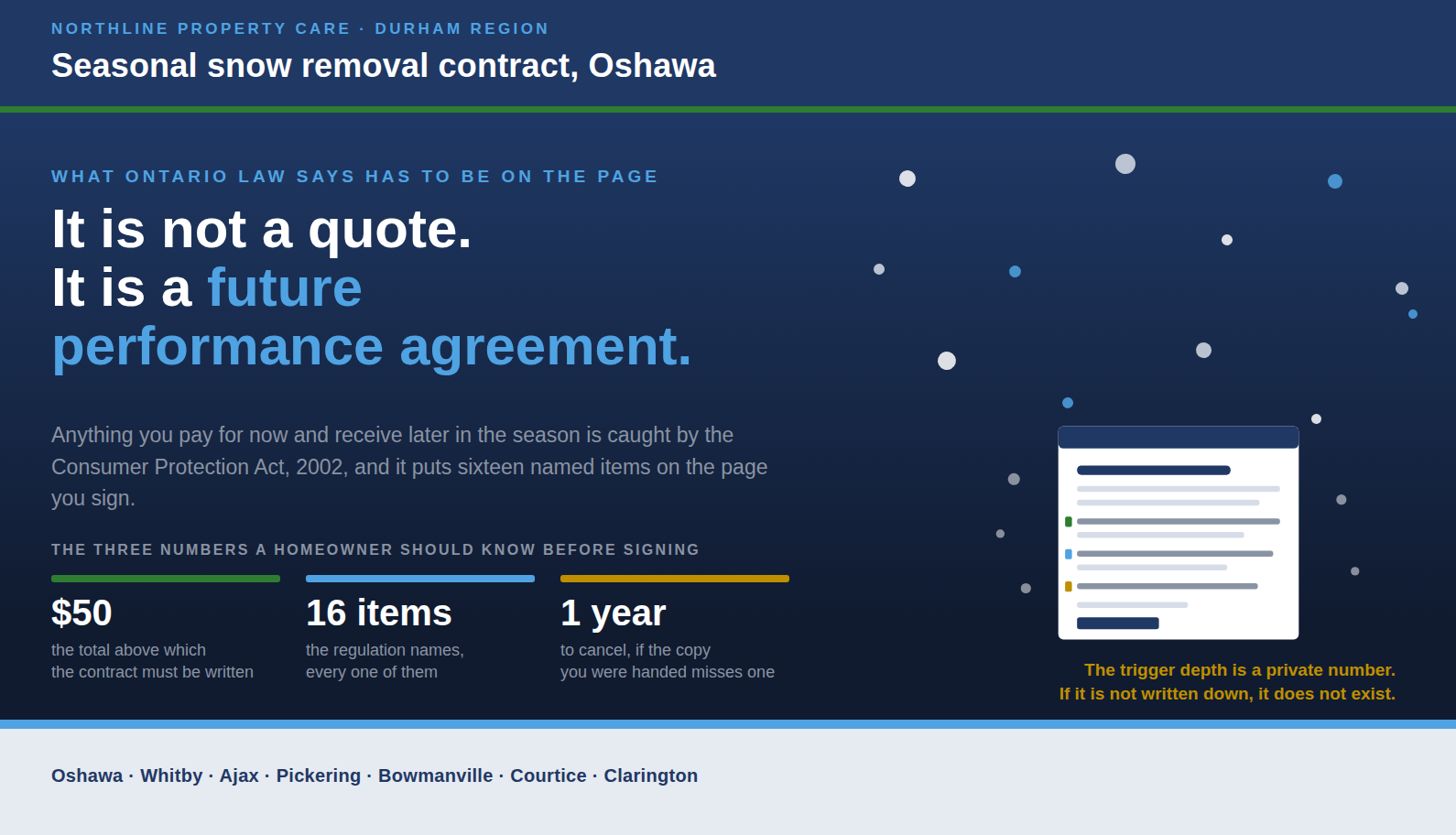
A seasonal snow removal contract in Oshawa is a future performance agreement, and Ontario law names sixteen things it has to carry before you sign.
Written by somebody who has to obey it too. See what our own winter contract covers.
Green in summer. Clear in winter.
The short answer
Ask for the whole agreement in writing before you pay anything, and read five lines in it. The trigger depth that starts a visit, the date the season begins and ends, the total payable, whether there is a cap on visits, and who actually drives the truck. Ontario requires all five to be on the page, because a seasonal snow agreement is a future performance agreement and section 22 of the Consumer Protection Act, 2002 says it must be in writing and delivered to you. If the copy you were handed is missing any part of what the regulation requires, section 23 lets you cancel it for a full year from the day you signed. That is the law working in your favour, and it is the reason a contractor who writes a proper agreement is telling you something about how the rest of the winter will go.
A seasonal snow removal contract in Oshawa costs $800, $975 or $1,200 plus HST at Northline for a standard lot, and $1,750 or $2,600 for an Estate or Grand Estate lot above 0.35 of an acre. The band is set by the size of the lot, and a driveway over 100 feet moves a property up a band. A property over 3.0 acres is quoted on the call. It runs the full six months from November 1 to May 1.
The agreement is the last check, not the first one
A clause only protects you if the business behind it can produce the paperwork that stands behind the clause. Before reading any of the sixteen items below, it is worth running the company itself through four documents that can be requested in one message and read in an afternoon. That check is written up separately as how to choose a snow removal company in Durham Region, and it covers what each document proves as well as what it quietly fails to prove.
Ontario does not call it a snow contract. It calls it something more useful
The phrase that matters is future performance agreement, and the Consumer Protection Act, 2002 defines it in section 1 as a consumer agreement where delivery, performance or payment in full is not made when the parties enter into it. A person paying in September for clearing that happens in January is the textbook case. So is a person paying monthly against work that arrives in bursts. Almost every residential winter arrangement in Durham Region is one of these, and almost nobody selling them says so out loud.
Section 21 applies the written agreement rules wherever the total the customer could end up paying is more than a prescribed amount, and Ontario Regulation 17/05 sets that amount at fifty dollars. There is no seasonal snow product anywhere in this region priced under fifty dollars, so the threshold is not a filter. It is a formality that everything clears.
One thing worth getting right, because it will be said badly elsewhere this winter. Ontario has passed a replacement statute, the Consumer Protection Act, 2023, and it is not in force. The e-laws page carries a banner saying it comes into force on a day to be named by proclamation, and as at the currency date of September 14 2026 no such day has been named. The 2002 Act governs every snow agreement signed this season. Anyone quoting the new Act at you is quoting a law that does not yet apply to anything.
The practical weight of all this is simple. A verbal arrangement over a fence is not illegal, and plenty of them work out. It is just that when the February argument arrives about whether four centimetres was supposed to trigger a visit, the person with the written agreement wins and the person without one is relying on memory.
The sixteen items, and what each one is actually for
Section 24 of Ontario Regulation 17/05 lists what a written consumer agreement has to set out. It is a long list and most of it is administrative, which is exactly why it is worth reading once: the boring items are easy to satisfy, so a contractor who has left several of them out has not made a judgement call, they have never opened the regulation.
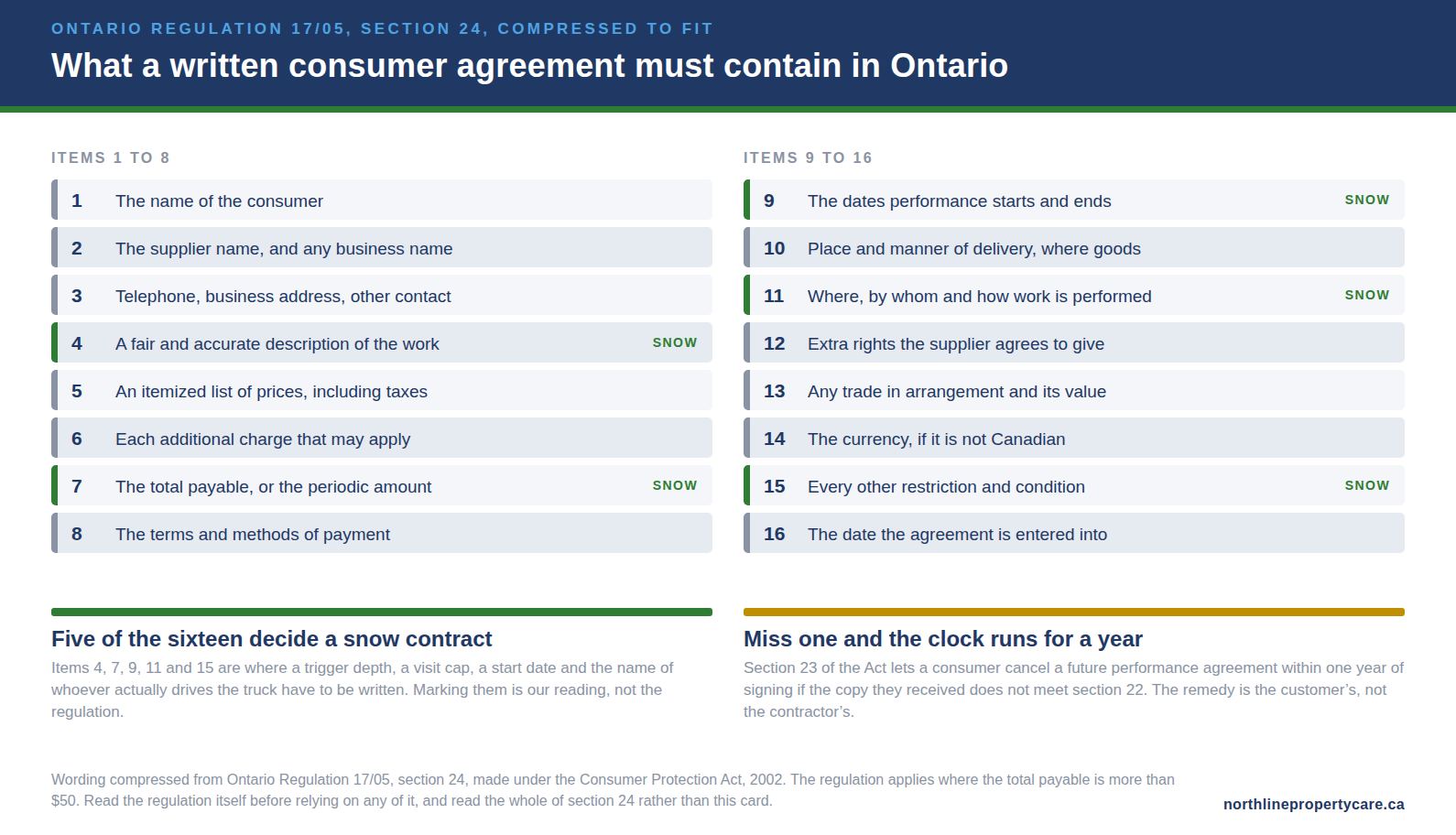
Read it and you will notice something odd. Nowhere does the regulation say the words snow, depth, trigger, visit or salt. It could not, because it governs furniture and gym memberships and roofing in the same breath. What it does instead is leave a place for all of that, in item fifteen, which requires the agreement to set out any other restrictions, limitations and conditions imposed by the supplier.
That single item is where a snow agreement lives or dies, and it is the one nobody argues about until February. Every constraint a contractor intends to rely on has to be written there or it does not exist. A minimum depth before anybody comes out. A cap on the number of visits. A separate charge for a second pass after a plow rebuilds the windrow. An exclusion for freezing rain. A clause suspending service during a declared weather event. None of those is unfair in itself. All of them are unenforceable surprises if the customer meets them for the first time in the middle of a storm.
Five items carry almost all of the weight
Item four, a fair and accurate description of the goods and services. Driveway only, or driveway and walkway, or driveway and walkway and salt. Three different products and three different prices, and the commonest complaint in this trade starts with a customer who believed the walkway was in it. Our own seasonal snow package is written as all three together and priced in three bands by property size, eight hundred dollars small, nine hundred and seventy five standard, one thousand two hundred large, all plus HST, so that the description and the price cannot drift apart from each other.
Item seven, the total payable or the amount and frequency of periodic payments. A seasonal figure paid up front is easy. A monthly membership is the one that gets written loosely, and the fix is one sentence naming the amount, the day it is taken and how many times. Ours is taken on the last day of the month, twelve times, and it says so on the agreement because a payment date the software chooses and the paper does not mention is the sort of small dishonesty that costs a customer in April.
Item nine, the dates on which performance commences, continues and completes. This one has a sting attached to it. Section 26 of the Act lets a customer cancel a future performance agreement if the supplier does not begin performance within thirty days of the commencement date written in the agreement, and if no commencement date is written at all, the thirty days runs from the day the agreement was signed. Think about what that means for an agreement signed at a door on the twentieth of September in a region where the first snowfall over three centimetres usually lands in December. A contract with no start date written on it is cancellable by the customer for the whole of a dry October, and the contractor who wrote it will not find out until the money is asked back.
Item eleven, where the work is done, by whom, and the method. Read the regulation closely and it says that where a supplier holds out that a specific person other than the supplier will perform the work, that person has to be named. On an owner operated business this is trivial and on a subcontracted route it is not, and it is the question a homeowner should ask out loud: is the person quoting me the person who will be in the driveway at six in the morning, or is my address about to be sold on to somebody I have never met.
Item fifteen, every other restriction, limitation and condition. Covered above, and it is the one to read twice.
There is a sixteenth requirement that is not in the list of sixteen, and it sits in section 25 of the same regulation. Before the agreement is entered into, the supplier has to give the consumer an express opportunity to accept or decline it and to correct errors. In a kitchen that means putting the paper down and letting somebody read it. It is the clause most often breached by a friendly conversation that ends with a signature nobody quite decided to give.
The trigger depth is a private number, and it stopped being a public one
There is no longer a government snowfall figure for a contract to point at. Environment and Climate Change Canada has retired the numeric criteria it used to publish for public weather alerts and replaced them with Weather Impact Guides, which grade snow as moderate, high or extreme by described consequence and carry no centimetre figure at any level. The old criteria page now says only that the guides replace the previous criteria.
So any snow agreement that says service begins when a warning is issued has tied itself to an instrument that no longer produces a number, and any marketing that says Environment Canada issues a warning at some particular depth is quoting something that is not on the federal page any more. The depth in your contract is a number the contractor chose. It is private, it is contractual, and it only exists if it is written down.
Ours is three centimetres of measured accumulation on a residential property and five centimetres on a commercial one. Measured, not forecast, because a forecast is somebody else's guess about tomorrow and a depth is a thing you can walk out and check. Below three centimetres nothing is pushed on a driveway, and what happens instead depends on which tier the property is on rather than on how the morning feels.
Said plainly, and it is the half that costs us: a three centimetre trigger means there will be mornings you look out at a white driveway and nobody comes, because two centimetres is not three. A contractor who promises to arrive whenever it looks snowy has promised something no route can deliver, and the first time they fail to deliver it will be the morning you needed them most.
Whose clock is running after a storm, and why the windrow is late on purpose
A seasonal agreement is the only clock on your property that you get to choose. Every other deadline around it belongs to somebody else, and knowing where they sit is the difference between a reasonable complaint and an unreasonable one.
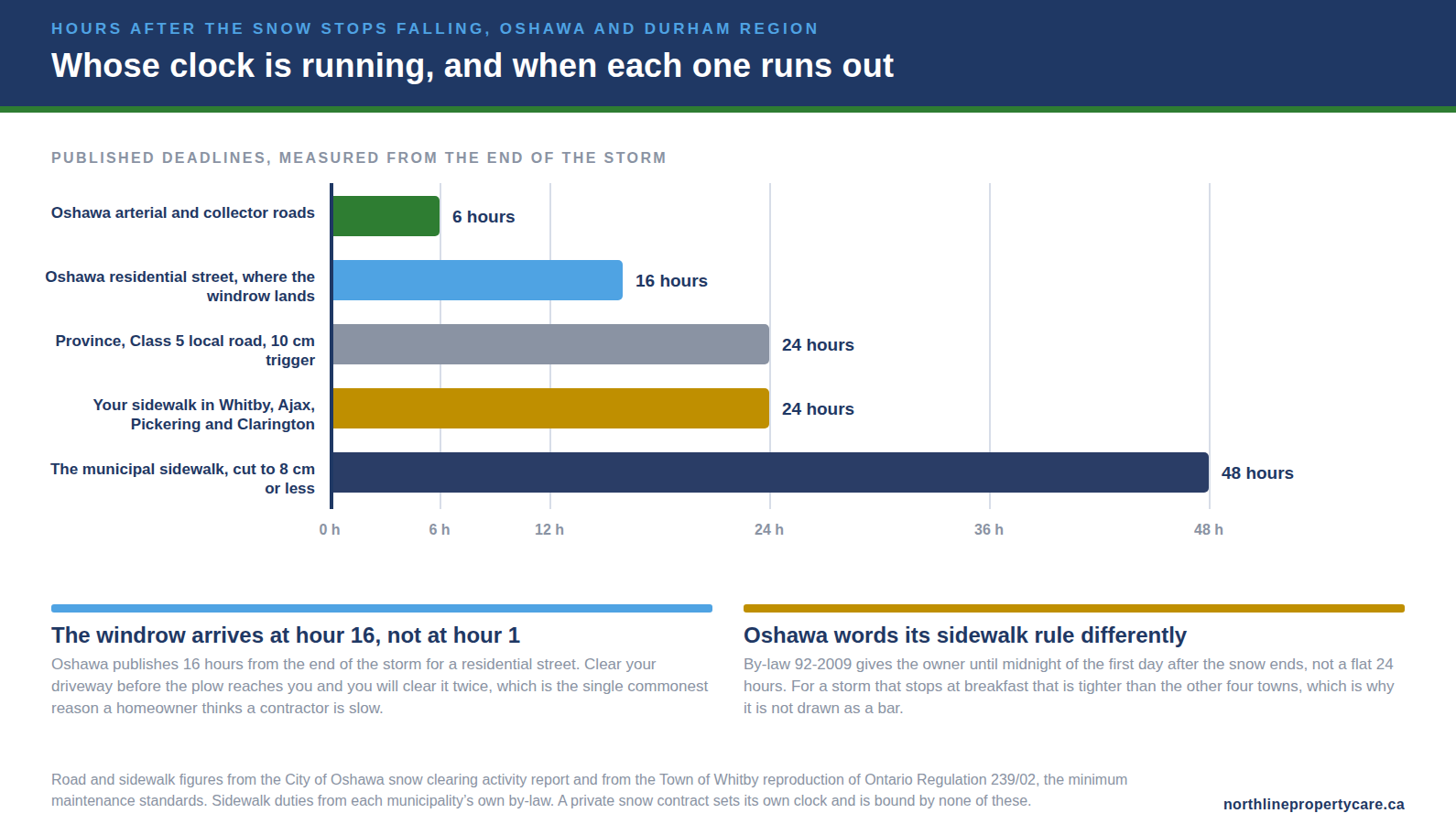
Ontario Regulation 239/02, the minimum maintenance standards made under the Municipal Act, 2001, sets a snow depth and a number of hours for each class of municipal road. The Town of Whitby publishes the table in full: class one at two and a half centimetres and four hours, down to class five at ten centimetres and twenty four hours. A quiet residential crescent is usually a class five, which means the province allows a full day and does not require anything at all until ten centimetres have fallen.
Oshawa does better than the provincial floor and publishes its own figures on the snow clearing activity report: six hours for arterial and collector roads, twelve hours for collectors, and sixteen hours for residential streets, all measured from the end of the storm. The City runs a four phase order, more than five hundred kilometres of primary road first, then seven hundred and sixty five kilometres of residential road, then a hundred and sixty kilometres of sidewalk, then the assistance program properties.
Hold those two numbers together and the most useful sentence in this article falls out of them. The ridge of packed snow across the end of your driveway is left by the municipal plow on its residential pass, which in Oshawa can be up to sixteen hours after the snow stops. Clear your driveway at hour two and you will clear it again at hour seventeen. That is not a contractor being slow, and a seasonal agreement that sequences its route against the plow rather than against the weather is doing the customer a favour that looks, on the morning, like a delay. We have written the whole of that argument out separately in the windrow guide for Durham Region, town by town.
What a normal Oshawa winter actually delivers
A seasonal price is insurance, and you cannot price insurance without knowing the hazard. The climate normals for the Oshawa water pollution control plant station, climate identifier 6155878, are the closest public record this town has, and they are worth reading before anybody signs anything.
Across the 1981 to 2010 normals period the station averages one hundred and five point eight centimetres of snow a year, spread across roughly twenty seven and a half days on which any measurable snow fell. Only eight of those days average five centimetres or more. Only two and a half average ten centimetres or more. A day of twenty five centimetres or more turns up about sixteen times in a hundred years of Januarys, which is to say roughly one winter in six.
By month it is lopsided. November averages four point seven centimetres, December twenty four point nine, January thirty five point six, February twenty four point nine, March thirteen point five and April two. December, January and February together are eighty five point four centimetres, which is about eighty one per cent of the season inside three months. November and April together are under seven centimetres and they sit inside every seasonal contract written in this region, because the two or three years in ten when they are not quiet are the years nobody wants to be uncovered.
The honest caveat on all of that, and it belongs here rather than in a footnote: the 1981 to 2010 set is the newest normals period we could retrieve for this station. Every figure above is therefore a thirty year window that closed sixteen years ago. It describes the shape of an Oshawa winter well and it should not be quoted to the tenth of a centimetre as though it described this one.
The arithmetic that sometimes says do not buy this
Our seasonal snow package is nine hundred and seventy five dollars plus HST for a standard property, and it covers the driveway, the walkway and the salting, unlimited, from November 1 to May 1, at the three centimetre trigger, with a seven in the morning target after overnight snow. Book by November 1, because the route has to be sequenced before it runs.
Bought a visit at a time instead, a driveway clear is forty five to ninety five dollars and a salting application is forty to ninety dollars. Pair them and a full service event costs somewhere between eighty five and one hundred and eighty five dollars. Against nine hundred and seventy five dollars, the seasonal price crosses over somewhere around the eighth full event of the winter.
Now put that beside the station record. Eight days a year average five centimetres or more. So in a normal winter the seasonal price and the per visit price land close to each other, in a hard winter the seasonal price is clearly the better of the two, and in a mild winter it is clearly the worse. In a four event season you will have paid nine hundred and seventy five dollars for something like three hundred and forty to seven hundred and forty dollars of work, and that is what a policy costs in the winter that never tested it.
We would rather you heard that from us in September than worked it out from your own bank statement in March. What a seasonal price actually buys is not a quantity of clearing. It is that the quantity stops being your problem, and that your driveway is on a sequenced route rather than at the end of a queue of people ringing on the morning of the storm. If that trade does not appeal to you, the per visit rates are on the add ons and one off services page and nobody will chase you.
And if you qualify for a municipal program, take the municipal program. Whitby charges no fee at all for its windrow and sidewalk service and takes registrations until the first of November. Clarington charges one hundred and seven dollars and sixty nine cents including HST for the 2026 to 2027 season and registers between the twenty first of September and the thirty first of October. Pickering is free for recipients of the Guaranteed Annual Income System and income scaled above that, and its window for the coming season runs from the eleventh of September to the sixteenth of October. Oshawa opens applications on the first of October. Every one of them requires re registration each year and every one of them closes before most of the snow falls. No contractor in this region will beat free, and we are not going to pretend otherwise to hold on to a sale.
One thing those programs do not do, which matters if you are comparing them against a private agreement: not one of them clears the driveway itself. Oshawa clears the windrow only where it is at least twenty centimetres high. Clarington clears roughly the first three feet at the bottom of the driveway. Pickering clears the windrow and the adjacent sidewalk and says plainly that driveways are not included. They are a genuinely good answer to the ridge at the end of the driveway and they are not an answer to the driveway.
Signing at your own door creates a second set of rights
If the agreement is negotiated or concluded at your home rather than at a place of business, it is also a direct agreement under section 1 of the Act, and a different part of the statute switches on. That matters in Durham in September and October, because door knocking is how most residential winter work in this region is sold.
Ten days, from receipt rather than from signature. Section 43 gives a consumer ten days to cancel a direct agreement for no reason at all, and the clock starts on the day the written copy is received. If a salesperson signs you up and posts the copy a week later, you have ten days from the week later. The government sets this out in plain language on its door to door sales page.
A consumer rights box on the first page, in specified type sizes. Section 35 of Ontario Regulation 17/05 requires a direct agreement to carry a statement headed Your Rights under the Consumer Protection Act, 2002, in at least ten point type with the heading in at least twelve point bold, on the first page, unless a notice on the first page in twelve point bold says where else it is. The regulation then sets out the exact words. This is the single fastest way to judge a snow agreement handed to you at a door: turn it over, and either that box is there or the contractor does not know the rules they are working under.
Snow removal is not on the banned list, and it is worth knowing why that list exists. Section 43.1 of the Act prohibits door to door solicitation for a closed list of goods and services, and Ontario Regulation 17/05 names them: furnaces, air conditioners, air cleaners, air purifiers, water heaters, water treatment devices, water purifiers, water filters, water softeners and duct cleaning. Snow is not among them, so a winter agreement may lawfully be signed at a door. It simply carries every one of the protections above.
Cancelling does not require a form. Section 92 says notice may be expressed in any way, may be oral or in writing, and may be given by any means. Section 94 says the cancellation takes effect when the notice is given. The advice to use a method that proves the date is practical advice about evidence, not a condition of the right. Once cancelled, section 79 of the regulation gives the supplier fifteen days to refund, counted from the day notice was given rather than from the day anybody agreed what the number should be.
There is a last provision that cuts both ways and deserves to be said even though it is the one that protects us rather than you. Section 93 says a consumer agreement is not binding on the consumer unless it is made in accordance with the Act, and then allows a court to bind a consumer anyway where it would be inequitable not to. So a missing item is not a licence to take a season of clearing and pay nothing for it. It is a reason for the contractor to write the agreement properly in the first place.
Where the snow goes, and the clause that has to say so
Pushing your snow across the road is an offence, and the ticket goes to whoever did it. Section 181 of the Highway Traffic Act says no person shall deposit snow or ice on a roadway without written permission from the road authority responsible for maintaining it. There is no exception for a driveway that has nowhere else to put it. The set fine published by the Ontario Court of Justice for that short form offence is eighty five dollars, and where no penalty is stated in the Act itself section 214 sets a general range of sixty to one thousand dollars.
Underneath the provincial offence, every municipality we serve has its own by-law and they are not identically worded. Oshawa's Winter Access By-law 92-2009 prohibits moving snow from private property onto a sidewalk or a highway, and separately prohibits depositing snow on a boulevard that is not adjacent to your own lot. Whitby's Clean Community By-law forbids shovelling, plowing or blowing snow onto or across a highway, a sidewalk or a pedestrian walkway. Ajax goes one step further and also forbids pushing it onto another property, which is the neighbour dispute that arrives every February. Pickering's ice and snow by-law adds a clause about not obstructing access to a fire hydrant.
The same by-laws put the public sidewalk on the property owner, and Oshawa words it differently from everybody else. Oshawa requires the sidewalk cleared by midnight of the first day after the precipitation ends, with fines starting at three hundred dollars on a first conviction. Whitby, Ajax, Pickering and Clarington each give twenty four hours from the accumulation. Whitby and Ajax both write the word windrow into that duty explicitly, which is to say that in those two towns the ridge at the end of your driveway is legally your sidewalk problem rather than a favour the town might do you.
None of this is decoration on a contract. If your agreement does not say where the snow will be stacked, you have not agreed anything about the one part of the job that can produce a ticket in your own name, block your own sight line at the end of the driveway, or kill the strip of lawn it is piled on. Ours says the pile stays on the property, off the boulevard and clear of the hydrant, and it says it in item fifteen because that is where the regulation leaves room for it.
Salt, and the claims a contractor cannot honestly make about it
Rock salt stops working before a Durham January does. The Transportation Association of Canada, writing under contract with Environment Canada in a synthesis aimed specifically at private roads, parking lots and walkways, states that sodium chloride is generally considered ineffective below minus ten degrees. Below that the same document points to chemicals with lower working temperatures or to sand and salt mixtures, and it sets the governing principle in one sentence: only enough material should be applied to do the job.
That is a real operational limit and it belongs in a conversation about a contract, because an agreement that promises a salted surface at any temperature is promising chemistry rather than service. Ours includes the salting inside the seasonal package and does not promise bare pavement on a minus twenty morning, which is a smaller promise and a keepable one.
Two claims to be suspicious of. The first is any contractor describing themselves as salt compliant or certified under a federal rule. Road salts were assessed under the Canadian Environmental Protection Act in December 2001, found to meet the definition of toxic in section 64, and recommended for addition to the list of toxic substances. They were never added. What exists instead is a voluntary Code of Practice published in 2004, which applies to organizations using more than five hundred tonnes of road salt a year. A residential contractor in Durham Region is nowhere near that threshold, so there is no federal licence, cap or reporting duty to be compliant with. The honest version of the claim is restraint, not certification.
The second is the idea that the salt is somebody else's problem once winter ends. The federal assessment records that salt spray damage extends up to thirty five metres from a two lane road, and that sensitive plants can be affected above roughly sixty eight milligrams of sodium and two hundred and fifteen milligrams of chloride per kilogram of soil. Almost every front lawn in Oshawa sits inside thirty five metres of a two lane road. If the strip beside your driveway comes out of April brown and refuses to thicken, the salt is a likelier explanation than the seed, and that is a lawn conversation rather than a snow one. The full lawn restoration exists for exactly that kind of soil problem, and it is deliberately not bundled into any winter agreement.
What we could not verify
The outside material here is provincial statute, provincial regulation, municipal by-law, federal agency, a court fine schedule or a climate station file. Where a fact existed only on a competitor page it was dropped rather than cited. Seven things could not be pinned down.
- Ontario Regulation 239/02 at source. The provincial e-laws page would not render for us, twice. The class trigger depths and hour counts above are the Town of Whitby's reproduction of that table, which is a municipality rather than the regulation.
- The section numbers for the sidewalk standards in that regulation. One municipality reproduces them as sections 16.3 and 16.5, another as section 15. Both agree on the substance, eight centimetres within forty eight hours and a metre of walking width, so the substance is quoted and the numbering left out.
- The fee and the closing date for Oshawa's assistance program. The City publishes an opening date of the first of October and a note that changes are coming. No fee, no closing date and no participant cap appear, and the older application form returns an error.
- The operative by-law number in Ajax. The document the Town serves reports itself as 24-2022 while the listing pointing at it is titled 46-2025. Call the Clerk rather than trusting either, this page included.
- The text of Clarington By-law 93-144. The by-law portal returned an error on every attempt. The twenty four hour sidewalk duty is confirmed on the Municipality's own page. The wording is not.
- A 1991 to 2020 normals set for the Oshawa station. Two attempts, both timed out on the federal server, which is why every climate figure above is labelled as the 1981 to 2010 period.
- The surcharge and costs on top of the eighty five dollar set fine. We read the set fine schedule and not the surcharge regulation, so no total ticket cost is quoted.
One limit rather than a gap. Nothing here is legal advice and nobody here is a lawyer. It is a contractor reading the rules he has to work under and telling you where they are, so you can read them yourself and hold him to them.
Questions people in Durham actually ask
What does a seasonal snow removal contract cost in Oshawa?
Northline's seasonal snow package is $800 for a small property, $975 for a standard one and $1,200 for a large one, plus HST, covering the driveway, the walkway and unlimited salting from November 1 to May 1. Bought one storm at a time instead, a driveway clear is $45 to $95 and a salting application is $40 to $90.
Does a seasonal snow removal contract in Oshawa have to be in writing?
Yes, once the total you could pay is more than fifty dollars. Section 22 of the Consumer Protection Act, 2002 requires a future performance agreement to be in writing and delivered to you, and Ontario Regulation 17/05 sets the fifty dollar threshold. Every seasonal snow product sold in this region is over it. A verbal arrangement leaves you with nothing to point at in February.
What can I do if the contract is missing something the regulation requires?
Section 23 lets you cancel within one year of entering into it if the copy you received does not meet section 22. Notice can be given in any way under section 92 and takes effect the moment you give it, and the supplier then has fifteen days to refund what you have paid. A court can still bind you to part of an agreement where it would be unfair not to, so this is a remedy for a badly written contract rather than a free winter.
How deep does the snow have to be before anybody comes out?
Whatever the contract says, and it has to say it. There is no government trigger any more, because Environment and Climate Change Canada has replaced its numeric alert criteria with impact guides carrying no centimetre figure. Ours is three centimetres of measured accumulation on a residential property and five on a commercial one. A depth that is not written down is a depth that will be argued about.
Can I cancel a snow agreement I signed at my front door?
Yes. An agreement negotiated at your home is a direct agreement, and section 43 gives you ten days to cancel for no reason at all, counted from the day you received the written copy rather than the day you signed. That copy should carry a rights box on its first page, headed Your Rights under the Consumer Protection Act, 2002, in at least ten point type. If the box is missing, the ten days becomes a year.
Why does my driveway get cleared after the city plow rather than before it?
Because clearing it first means clearing it twice. Oshawa publishes sixteen hours from the end of a storm for a residential street, and the ridge across your driveway is left by that pass. A route sequenced against the plow does the job once. A route sequenced against the weather does it twice and charges you for one, or arrives at hour two and leaves you with a windrow at hour seventeen.
Is it against the rules for my contractor to push the snow into the street?
Yes. Section 181 of the Highway Traffic Act prohibits depositing snow or ice on a roadway without written permission from the road authority, and the Ontario Court of Justice publishes an eighty five dollar set fine for it. Oshawa, Whitby, Ajax and Pickering each add their own by-law, and Ajax also prohibits pushing it onto a neighbour's property. Ask where the pile is going before the season starts.
Who wrote this
Andrew owns the business and wrote the agreement himself, with the statute open beside him. The route runs out of Oshawa and covers Oshawa, Whitby, Ajax, Pickering, Bowmanville, Courtice and Clarington, an HST registrant and fully insured. Six Durham winters of snow work are his, and he is the one at the wheel before daylight, and the agreement he sends you is the one he signs too.
This page exists because he had to read the statute and the regulation before he could write that agreement properly. Every provincial section number above was taken off the government page it links to. Every municipal rule was taken off that municipality's own site. The card summarising the sixteen items compresses the regulation so that it fits a graphic, and it says so on the card. Anything that resisted checking is listed in its own section rather than quietly left out. Corrections are welcome and the quickest route for one is a call or a text to 905-244-5779.
Read next
When to book, and the two dates
The day the route runs out of room, and November 1, when it closes. Neither of them is the first snowfall.
Read the booking guide →What snow removal costs in Durham
Seasonal, per visit and monthly, with the arithmetic behind each one and the single calculation that decides which suits your street.
Compare the three models →One payment, both seasons
Where a winter agreement and a lawn season become the same monthly line, and what each tier does and does not include.
See the memberships →The work, photographed
Real Northline properties, before and after, every one of them in Oshawa and every one of them this year. Drag the line to compare.
Andrew answers, October 2026
What happens if it snows all day instead of overnight?
The first pass opens a lane out to the road, the walkway and the steps, so you can get out. Then the whole route gets that same first pass. Then, once the snow stops, we come back for the full clear: full width to the pavement, the windrow off at the road, piles tidied and salt down again. If it looks half done at eight in the morning in heavy snow, that is deliberate and we are already on the way back. There is no extra charge for the second visit.
One of these goes on each page and it is replaced monthly. If the question you have is not here, ask it: 905-244-5779.
Ask me for the agreement before you ask me for a price
Send me your address and I will send back the written agreement with the trigger depth, the season dates, the total and the conditions already filled in, so you can read all of it before any money moves. If a municipal program fits your household better, I will tell you that instead.