Property care · Snow removal
Corner lot snow removal in Oshawa, and the two frontages one midnight covers
Corner lot snow removal in Oshawa is two sidewalk frontages and two windrows on a single midnight deadline, because the by-law attaches the duty to every highway the lot touches rather than to the one the front door faces.
- Fully insured
- Owner operated, one accountable name
- Every by-law section on this page was read in the original
- No figure here was taken from a business that competes with us
The short answer
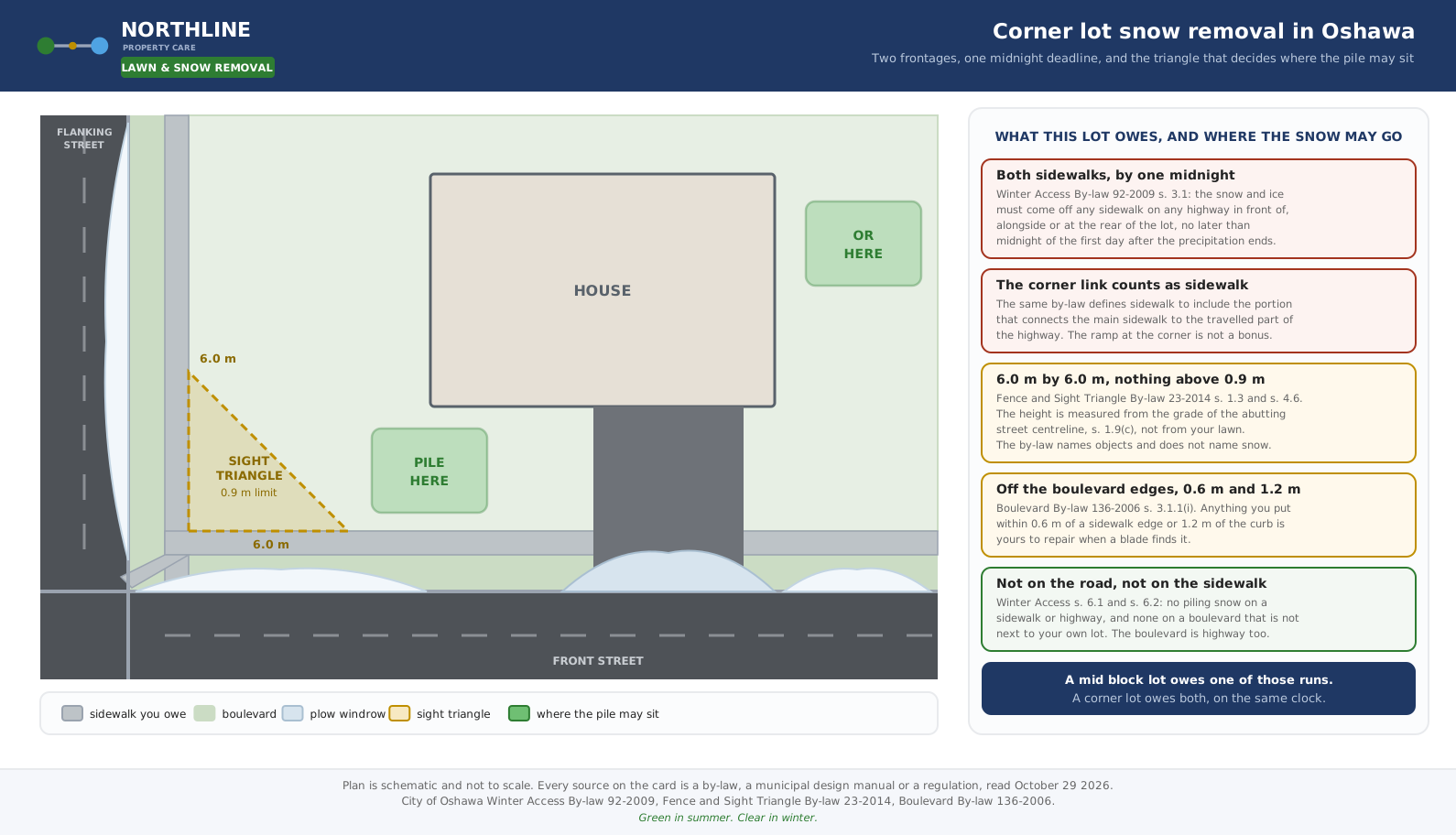
A corner lot in Oshawa owes the sidewalk on both streets by the same midnight, including the ramp where the two sidewalks meet, and the only lawful places left for the pile are behind the sight triangle and off the boulevard edges. Everything else on this page is the measurement behind that sentence.
Two things make the corner different rather than merely bigger. The duty in the by-law attaches to every highway the lot touches, not to the frontage the front door faces. And the six metres of ground nearest the intersection, the part that looks like the obvious dumping place, is the one piece of your own lawn that is height limited by a separate by-law all year round.
The by-law attaches the duty to every street the lot touches, and it does it in six words
Oshawa puts the duty in section 3.1 of its Winter Access By-law, numbered 92-2009, and the wording does the corner lot work by itself. An owner has to clear the snow and ice away from any sidewalk sitting on any highway, and the by-law then names three positions that sidewalk can be in: in front of, alongside, or at the rear of the lot. Those six words are the whole question answered in a sentence somebody wrote in 2009. Read the consolidated by-law yourself if you want it in the original. It is short.
A mid block house touches one highway and owes one run of sidewalk. A house on the corner of a crescent and a collector touches two and owes both. The by-law does not grade the second one as lesser, does not give it a later hour, and does not care that the flanking street has no driveway on it and no front door looking at it.
The part that surprises people is what counts as sidewalk. The same by-law defines it to include the portion that crosses a private driveway, the portion that connects the main sidewalk to the travelled part of the highway, and the portion that connects the main sidewalk to private property. That middle clause is the corner ramp. The flared concrete apron where the two sidewalks turn the corner and drop to the road is not a municipal extra that somebody else sweeps. It is your sidewalk under the definition, and it is the piece that fills first, because it is the lowest point on both runs and the place the blade on the flanking street has the most room to throw.
Clarington is the only municipality in Durham that names this out loud. Its sidewalk snow page tells residents to clear the full width of the sidewalk bordering the property including corner links, which is a better phrase than anything Oshawa publishes for the same object. Oshawa gets there by definition instead, which works in law and fails on a web page, because nobody reads a definitions section before they shovel.
And the deadline is a clock time, not a stopwatch, which is worth about a day
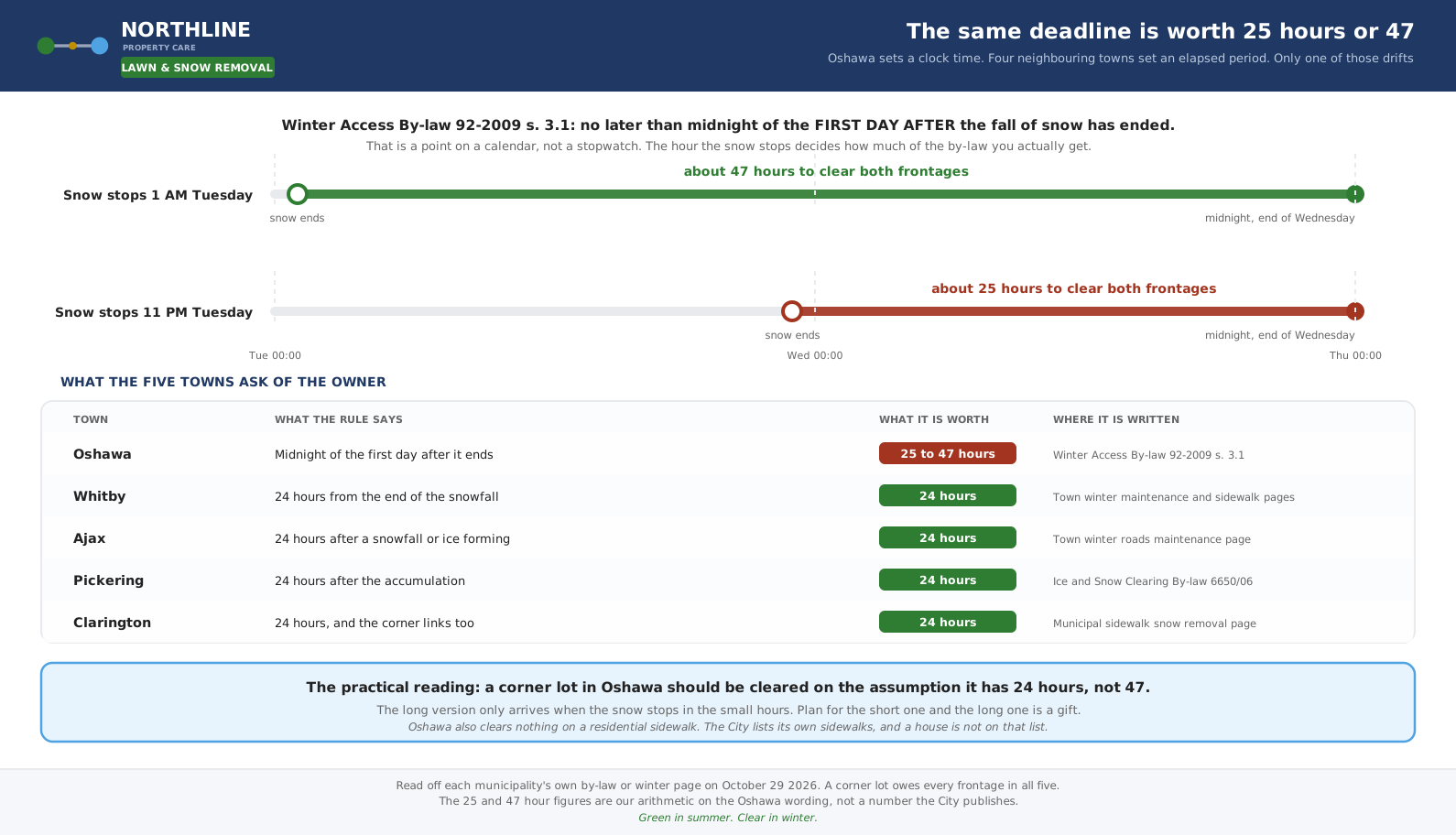
Oshawa does not give you twenty four hours. What it sets is a point on the calendar: the end of the day following the one on which the weather stopped, and that is a different instrument from a stopwatch. A stopwatch starts when the snow stops. A calendar does not care when the snow stops, only what day it was.
Work it through on a real week. Snow ends at one in the morning on a Tuesday. The first day after that is Wednesday, so the deadline is midnight at the end of Wednesday, and you have had about forty seven hours. Now move the same storm nine hours later so it ends at eleven at night on the same Tuesday. The first day after is still Wednesday, the deadline is still midnight at the end of Wednesday, and you have about twenty five hours. Identical sentence, identical by-law, almost double the time, and the only variable is an hour of weather nobody controls.
Whitby, Ajax, Pickering and Clarington all use an elapsed period instead. Whitby asks for twenty four hours from the end of the snowfall. Ajax asks for twenty four hours after a snow fall or ice forming. Pickering writes it into Ice and Snow Clearing By-law 6650/06 as twenty four hours after the accumulation. Clarington asks for twenty four hours after a snowfall ends. None of those four drifts with the hour, and none of them gives a resident forty seven hours either.
The practical reading for a corner lot is to work to twenty four hours and treat the long version as a gift that sometimes arrives. Two frontages on a short clock is the planning case. Two frontages on a long clock takes care of itself.
What it costs when nobody clears it
Section 5.1 of the same by-law lets the Commissioner remove the snow and ice without notice to any owner and at the owner's expense, and section 5.2 makes owners jointly and severally liable for that cost plus interest at fifteen per cent. The administrative penalties run seventy five dollars, then one hundred and seventy five for a repeat inside a year, then two hundred and seventy five. On conviction the fines start at not less than three hundred dollars and run to five thousand on a first offence.
We have never seen a Durham homeowner collect one of those. That is not the reason to clear a corner, and a page that leans on the fine is a page selling fear. The reason is that two frontages of unshovelled sidewalk is where a pedestrian steps into a live lane, and the second frontage is the one nobody watches because the house is not facing it.
The windrow really is bigger at a corner, and one Durham town publishes the reason
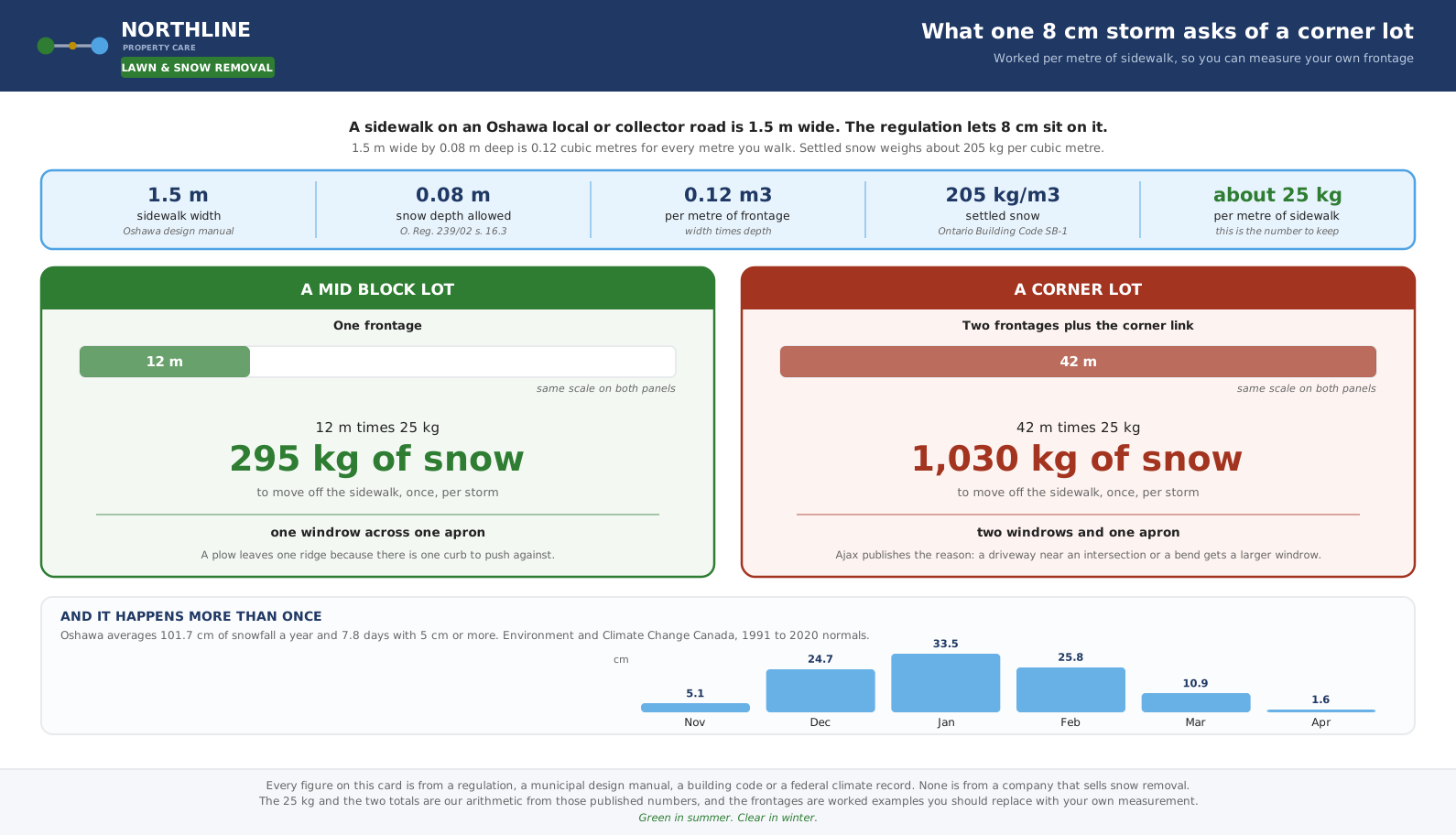
The Town of Ajax states on its winter roads page that driveways near intersections or road bends usually get a slightly larger windrow, because the plowed area is larger and more snow is left in front of those homes. That is the only place in Durham where a municipality writes down what every corner lot owner already suspects, and it is worth quoting because it moves the claim out of folklore. Read it on the Town of Ajax winter maintenance page.
The mechanism is geometry rather than malice. A blade carries a load along the curb line and sheds it where the geometry opens up. An intersection is the widest piece of pavement on a residential street, because two carriageways and four curb returns meet there, so there is more surface to sweep and the turning radius forces the operator to discharge more of the load into a shorter run of curb. On a bulb crescent the same thing happens on the outside of the curve. The lot on the corner is standing where the load gets put down.
Then there is the second frontage, which has no driveway on it and therefore looks harmless. It is not. It is a full length of curb that receives a ridge along its whole run, and because the lot is usually deeper than it is wide, the flanking frontage is the longer of the two. The windrow across your apron is the one you notice at seven in the morning. The ridge along the flanking sidewalk is the one that is still there in March, because it was never in the way of a car.
The arithmetic, done per metre so you can do it on your own lot
Nobody publishes an average driveway, so here is the calculation built out of numbers that are published. Oshawa's Engineering Design Criteria Manual sets the sidewalk on a local or collector road at one and a half metres wide. Ontario Regulation 239/02, the Minimum Maintenance Standards, lets eight centimetres of snow sit on a municipal sidewalk before the municipality has to act. One and a half metres by eight centimetres is zero point one two cubic metres for every metre you walk.
Settled snow weighs about two hundred and five kilograms per cubic metre. That figure comes out of Supplementary Standard SB-1 of the Ontario Building Code, which assigns a seasonal snow pack specific weight averaging two point zero one kilonewtons per cubic metre east of the continental divide. So every metre of sidewalk carries roughly twenty five kilograms after a storm that only just reaches the regulated threshold.
Take a twelve metre frontage, which is an ordinary width for a serviced lot in Oshawa. That is about two hundred and ninety five kilograms to move, once, by midnight. Now take a corner lot with the same twelve metre front and a thirty metre flanking side. Forty two metres of sidewalk, about one thousand and thirty kilograms, same midnight. The lot did not get three and a half times bigger. The duty did.
And that is the storm that barely qualifies. Environment and Climate Change Canada's 1991 to 2020 normals for Oshawa record seven point eight days a year with five centimetres or more of snowfall and two point five days with ten centimetres or more. The eight centimetre case is not the worst morning of the winter. It is a Tuesday.
Where the snow may lawfully go, measured in metres rather than argued
Three separate Oshawa by-laws decide where a corner lot pile may sit, and not one of them is the by-law about snow. That is why the answer is hard to find and why most people guess it wrong. The snow by-law tells you where the pile may not go. The fence by-law and the boulevard by-law tell you what is left.
Start with the places that are closed
Section 6.1 of the Winter Access By-law bars moving snow off private property onto a sidewalk or a highway, and bars piling it, redistributing it or otherwise causing it to accumulate there. Section 6.2 then closes the boulevard opposite: snow may not be put on any boulevard except the one next to your own lot.
The trap in that pair is the word highway. The same by-law defines it as the common and public highway including the area between the lateral property lines including any boulevard. So the strip of grass between your sidewalk and the curb is highway for the purposes of section 6.1, and the Boulevard By-law 136-2006 independently makes you responsible for maintaining it. City land, your upkeep, and a prohibition on piling snow on it. A corner lot has two of those strips.
Across the street is closed as well. Section 6.2 exists precisely because the tidy solution at an intersection is to throw the snow onto the quiet boulevard opposite, and that boulevard belongs to the lot it abuts rather than to the person with the shovel.
Then the six by six metres nobody knows about
The City of Oshawa Fence and Sight Triangle By-law 23-2014 defines a corner sight triangle as the triangular space bounded by the two straight lines containing the defining angle of a corner lot, with the points taken at a distance of six metres from where those lines intersect. Section 4.6 limits all fences, natural features, things and objects inside that triangle to zero point nine of a metre.
Section 1.9 carries the clause that almost nobody reads. Inside a corner sight triangle the measurement is taken from the crown of the road rather than from the ground you are standing on, specifically the grade at the centreline of the abutting street. Residential roads are crowned and lots usually sit above the road, so on a typical Oshawa corner your real allowance is less than ninety centimetres of pile measured off your own lawn, and on a lot that sits a foot above the road it can be a good deal less. Nobody is out there with a surveyor's level in February. The useful version is that waist high at the corner is already a conversation and knee high is comfortable.
Here is the honest limit of that argument, and we would rather state it than let the page sound more certain than the law is. By-law 23-2014 regulates fences, natural features, things and objects. It does not use the word snow anywhere. We asked the question directly and could not find any Oshawa instrument that says a snow pile inside the corner sight triangle is a contravention. So treat the six by six metres as the City's own published statement of where a driver's eyes need to be able to travel, which is a very good reason to keep a pile out of it, rather than as a ticket waiting to be written. The City's own winter reminders ask residents to shovel snowbanks at the end of the property farther back onto the land to improve sightlines, which is the same instruction without the enforcement.
And the two bands that decide who pays for the broken edging
Boulevard By-law 136-2006 section 3.1.1 prohibits placing anything within zero point six of a metre of either edge of a sidewalk, within one point two metres of the curb or travelled portion where a sidewalk exists, and within one point eight metres of the curb where there is no sidewalk. Those are not decorative numbers. The City's own snow clearing assistance bulletin says plainly that property owners are responsible for repairing damage to items within those distances, while minor sod damage from City winter operations outside them is inspected and repaired in spring if it is reported to Service Oshawa.
So the decorative stone border a corner lot owner installs forty centimetres off the sidewalk to stop people cutting the corner is, on the day a blade finds it, entirely theirs. We have pulled enough broken landscape edging out of April boulevards in Oshawa and Whitby to say that this single paragraph is the most expensive thing on this page for the people it applies to, and it has nothing to do with snow removal at all until the morning it does.
Encroachment By-law 177-2022 sits behind all of it. It defines an encroachment to include any landscaping, vegetation, natural or artificial object or structure wholly or partly on City owned lands, and its list of exemptions covers boulevard improvements made under the Boulevard By-law and fences that meet the Fence and Sight Triangle By-law. There is no exemption in it for snow, and there is no prohibition on snow either. The by-laws in this area were written about objects that stay put.
What that leaves, on a real lot
Behind the sight triangle, back from both sidewalk edges, and on your own side of the property line. In practice that is the interior side yard, the part of the front lawn furthest from the intersection, and the rear yard if there is a gate wide enough to get to it. On the new lots in Windfields and Kedron, where the Official Plan has been pushing density up for twenty years, the interior side yard is often the only one of the three that exists. On the 1910s and 1920s grid north of the downtown, where the Simcoe Heights plan registered in May 1912 and built out through the thirties, the lots are narrow but the setbacks are deep, and there is usually room at the front.
The one instruction the City does publish, and it is good, is to pile the snow from the driveway on the right hand side facing the street, so the next pass does not push it back in. On a corner lot work out which of your two curbs the blade runs along first, and put the pile on the far side of the apron from it. Half the re-clearing on a corner is a pile placed on the side the plow is about to arrive from. We walk this with every corner lot we quote, and the walk is free whether anybody signs anything. More on where the snow goes is on our page about where to put snow from your driveway in Oshawa.
What the City clears on your street, and what it will never clear
Oshawa does not plow residential sidewalks, so neither of your two frontages is on anybody's route. This is the single most common misunderstanding we hear on a first call from a corner lot, and it comes from people who moved here from Whitby or Ajax, where sidewalk plows genuinely exist.
The City's published list of what it does clear is short. Sidewalks adjacent to City facilities such as parks and recreation centres. Multi use paths in the boulevard that take the place of a sidewalk. School crosswalks where a crossing guard stands. Sidewalks in the Central Business Improvement Area. Four named trails. And the sidewalks and windrows of residents registered under the snow clearing assistance program. A house on a crescent in Taunton is on none of those lists and never will be.
Whitby does run sidewalk plows, across three hundred and thirty five kilometres of sidewalk, as a tertiary priority after primary and secondary roads. Ajax runs the largest program of the five, clearing about one hundred and fifty kilometres of its roughly four hundred kilometres of sidewalk, primary routes first, and says that can take up to sixteen hours or longer if the snow keeps falling. Clarington plows primary sidewalk routes, pedestrian crossovers and school crossings under a program it launched in 2023 and 2024. In every one of those towns the owner still owes the sidewalk under the local by-law, because a plowed primary route is not the same object as the residential sidewalk in front of a house.
The hours the City works to on the roads
Oshawa publishes targets rather than depths. Arterial roads within six hours, collectors within twelve, residential streets within sixteen, and City sidewalks and school crosswalks by no later than midnight the first day following the end of a storm. The cycle is primary roads, then residential roads, then City sidewalks, then the assistance program properties, and the City states that the cycle starts over if there is new or rapid accumulation. The activity report is updated three times daily during operations.
Sixteen hours is the number that matters to a corner lot, and not for the reason people assume. It is not about when your street gets cleared. It is about when the windrow arrives. A storm that ends at four in the morning can produce a residential pass at any point up to eight that evening, which means a corner lot owner who clears the apron at seven can be doing it again after dinner, on both frontages, and still be inside one deadline.
Those targets sit on top of a provincial floor. Ontario Regulation 239/02 carries the Minimum Maintenance Standards, and it sets how much accumulation a municipality may leave on each class of road: two point five centimetres and four hours on a Class 1, five and six on a Class 2, eight and twelve on a Class 3, eight and sixteen on a Class 4, ten and twenty four on a Class 5. Residential streets in Oshawa are the lower classes, which is why the City's own sixteen hour residential target maps onto the regulation so neatly. Section 16.3 adds the sidewalk standard: reduce snow to eight centimetres or less within forty eight hours of the end of the storm, and provide a minimum sidewalk width of one metre.
Two cautions on that regulation, both of which belong on the page rather than in a footnote. First, section 4(6) of the standard does not apply to portions of a roadway designated for parking, for bicycle facilities or used for snow storage, so a shoulder the plow throws a corner windrow onto may sit outside the standard entirely. Second, we could not open the regulation on the province's own e-Laws service, which would not render for us at all. The section numbers and values above were read off a municipal copy of the e-Laws consolidation dated May 3 2018 and cross checked against four other Ontario municipalities that publish the same table, all of which agree. We cannot tell you whether it has been amended since 2018, and we are not going to pretend otherwise.
Who maintains which road also changes at a corner, and in Oshawa it changes often. The Region of Durham maintains Regional roads all year and patrols them seven days a week in winter. Simcoe, Ritson, Harmony, Wilson, Taunton, Rossland, Bloor, Thornton, Stevenson, Park and Adelaide are all Regional roads along parts of their length. A corner lot where a City crescent meets a Regional road has two different authorities running two different standards past the same house, on two different clocks, and the owner owes both sidewalks regardless.
Before you call anybody, check whether the City already owes you this
Oshawa runs a Snow Clearing Assistance Program that clears the City sidewalk and the driveway windrow for eligible residents, and if you qualify for it you should apply to it instead of hiring us. It is a better answer than anything we sell, for the people it fits, and the deadline this year is December 18 2026.
Eligibility is sixty five or older, or a person with a disability. Proof has to accompany each application, and the City accepts a range of it: a Ministry of Transportation accessible parking permit, a Canada Pension Plan disability benefit card, a CNIB client card, an ODSP receipt, a doctor's note or a doctor's signature on the form. The applicant has to live in the single family dwelling the application is tied to, and there must be no resident without disabilities under sixty five living there.
Two thresholds govern when it actually runs. Service begins after a snowfall of more than two point five centimetres, and a windrow is cleared only if it is at least twenty centimetres high. Below those, the resident clears it. The windrow service covers the windrow and not the rest of the driveway, which is the sentence most people miss, and sidewalks and windrows at vacant properties are excluded. The window for the 2026 season opens on October 1 and closes on December 18. Anything arriving after that is looked at case by case, and anybody who was on the program last winter should receive a renewal letter during October. Details are on the City of Oshawa snow clearing assistance page.
We will not tell you it is free, because the City does not publish a fee for it on the program page or in its own season bulletin and we do not state numbers we have not read. What we will tell you is that for a corner lot owner over sixty five this program covers the two things a corner lot has most of, the sidewalk runs and the windrow, and that it is the only route by which either of those gets cleared by somebody other than the owner or a contractor.
Every neighbouring town has an equivalent. Ajax runs a senior snow removal program for residents sixty five or older with no able bodied person under sixty five at the address, added within seven days of the application being processed. Whitby's program covers residents over sixty five or with an accessibility issue and no able bodied person in the household. Clarington's covers municipal sidewalks fronting and adjacent to the property plus up to three feet of driveway apron, with sidewalk service above seven and a half centimetres of snow and windrow service above fifteen. Pickering's is for people with permanent physical or cognitive disabilities and has been expanded to up to seven hundred and fifty applicants. Every one of those is worth an application before it is worth a quote. Our page on senior snow removal in Oshawa walks through the same comparison in more detail.
Salt arrives from two directions on a corner, and April is when the lawn tells you
A corner lot has two boulevards receiving plow spray instead of one, and the salt load on the grass along those edges is the thing that shows up in April as a straw coloured strip the owner blames on the dog. It is not the dog. It is chloride, and the gradient gives it away: the damage is always worst at the hard edge and fades going into the lawn.
The federal assessment of road salts under the Canadian Environmental Protection Act found that aerial dispersion of salt spray extends up to two hundred metres from the edge of a multi lane highway, and thirty five metres from a two lane road where de icing salts are used. A residential corner lot sits well inside thirty five metres of two of them. The same assessment names the mechanism, which is the part worth understanding: the effects are on soil structure, soil dispersion, soil permeability, soil swelling and crusting, and the primary abiotic impact is the loss of soil stability during drying and wetting cycles. Sensitive terrestrial plants may be affected above soil concentrations of about sixty eight milligrams of sodium per kilogram and two hundred and fifteen milligrams of chloride per kilogram. The assessment is published by Health Canada and Environment Canada.
University of Wisconsin extension work puts numbers on how far it reaches on the ground. Most soil salt injury happens within about thirty feet of the road and most spray injury within about sixty feet, with sensitive plants affected a great deal further from major highways. The timing matters as much as the distance: salt applied in late winter or early spring causes the most damage, because plants are most resistant in December and early January and most susceptible in March and April. A University of Minnesota turf trial reports measured concentrations around twelve thousand parts per million of sodium chloride three metres from the road.
What that means for a corner is cumulative rather than dramatic. Two frontages of municipal salting plus whatever you put down on two sidewalk runs plus whatever ends up in the pile means the chloride arrives at the lawn edge from several directions and leaves in one event, when the pile melts. The Canadian Council of Ministers of the Environment sets the freshwater chloride guideline at one hundred and twenty milligrams per litre for long term exposure and six hundred and forty for short term. Those numbers are about the creek rather than the lawn, but in north Oshawa the pile at the corner drains to a catch basin that reaches the Oshawa Creek east branch, so they are not somebody else's problem.
What to do about it, which is cheaper than most people expect
Water the strip heavily in early spring, at least six inches, before you do anything else. That is the University of Wisconsin recommendation and it works by flushing the chloride below the root zone rather than by treating the grass. On the heavy clay soils common across south Oshawa and Courtice, gypsum is the second step, because calcium displaces sodium on the exchange sites and restores some of the structure the sodium dispersed. Then reseed, in April, while the dead strip is still visible and before crabgrass finds the gap. Tall fescue and perennial ryegrass came out most salt tolerant in the Minnesota trial of thirty eight cultivars across fifteen species, and smooth bromegrass, hard fescue and prairie junegrass came out worst at every concentration.
On the de icer itself, less is the whole lever. Rock salt stops being practical around minus nine or ten degrees of pavement temperature, which in a Durham cold snap is most of the mornings you most want it. Calcium chloride keeps working to roughly minus twenty nine and magnesium chloride to roughly minus twenty three, and both are rougher on young concrete. Our page on driveway salting in Oshawa goes through the temperature bands properly. We sell a salt only trip at twenty five dollars plus HST and we would rather sell you one of those than watch half a bag go down on a corner.
The corner is where the pile is deepest, and the deep pile is where the lawn dies
Snow piled deep at a corner changes what happens to the grass under it, and the two failure modes arrive at opposite ends of the winter. Grey snow mould wants long snow cover over unfrozen ground. Crown hydration injury wants a thaw followed by a hard freeze in a spot where the meltwater cannot leave. A corner lot pile tends to supply both.
Grey snow mould, Typhula incarnata, works best between about zero and two degrees and shows as matted light patches with greyish threads as the snow goes off, three to six inches across at first and merging past a foot. Pink snow mould, Microdochium nivale, does not need snow cover at all and runs from about two to seven degrees wherever humidity stays high. Both are described in University of Wyoming extension bulletin B868. The cultural controls are the part that applies to a pile: avoid late autumn nitrogen, keep the thatch down, mow until dormancy so the snow does not settle on tall grass, and prevent snow compaction, ice formation and early snow accumulation before the ground freezes. A packed pile shoved onto a lawn in the first week of November, before the ground has frozen, is the textbook case. Our page on snow mould in Oshawa covers the spring recovery in detail.
The other half is drainage. Penn State extension puts crown hydration injury in late February and March, when temperatures rise above freezing for a few days and a rapid freezing event follows the thaw, and states that it is worst in depressions and poorly drained soils, because the subsurface stays frozen and water does not leave the low spot. UMass extension adds the ice encasement numbers: annual bluegrass and perennial ryegrass tolerate roughly seventy five to ninety days of ice cover, while creeping bentgrass and Kentucky bluegrass tolerate one hundred and fifty or more. UMass also notes that snow covered soil sits near zero degrees, which is the one kind thing a pile does, and that mechanically removing snow or an early melt can cause rapid deacclimation.
So the rule that comes out of all of it is boring and useful. Put the pile on the high side of the lot and never in the low corner, even when the low corner is the convenient one. A pile on a rise sheds its meltwater. A pile in a hollow turns into an ice lens in March and the grass under it does not come back without seed.
The ground under a Durham corner lot decides where the meltwater goes
South Oshawa, Whitby and Courtice sit largely on the lacustrine clays and clay loams of the old glacial Lake Iroquois plain, and those soils drain slowly. That is not a detail for a gardening page. It is the reason a pile placed on the wrong corner of a Durham lot is still an ice slab in the third week of March while the same pile across town has gone.
The 1956 Soil Survey of Ontario County, which covers Oshawa, Whitby, Pickering and Ajax, names the series and gives each one a drainage class in its own words. Simcoe clay loam, developed on stone free calcareous lacustrine clay, is recorded with both external and internal drainage poor. Peel clay loam, lacustrine clay over clay till at three feet or less, is written up with inadequate drainage named as one of its chief drawbacks. Smithfield clay loam is imperfect. Whitby loam is imperfect. Schomberg has good external drainage and only fair internal drainage. Darlington loam, the better of the group, is good to moderately good. The 1946 Soil Survey of Durham County, which covers Courtice and Bowmanville, places Darlington sandy loam mainly near Courtice and north of Bowmanville with good drainage, and puts Granby sandy loam, poorly drained, in larger areas north of Courtice. The beach ridge of the old lake itself is Brighton gravelly sand, which drains freely.
Here is what we could not do with that, and it matters. The survey maps are scanned images rather than data, so we cannot tell you that Windfields sits on one named series and Donevan on another, and we are not going to guess. What we can tell you is the practical test, which takes no survey at all. Walk your lot after a heavy rain in October and find the place water stands longest. That is the corner the pile must not go on. On a clay loam lot in Courtice or south Oshawa that place is usually obvious and usually close to the street, because the boulevard grade falls to the curb and the lot falls to the boulevard.
One more thing the soil survey explains without meaning to. Salt leaches more easily through sand than through heavy clay, which is why a salt damaged lawn edge on a Courtice sandy loam recovers with spring rain alone, and the same damage on a south Oshawa clay loam needs the six inches of deliberate watering and the gypsum. The soil decides the repair, not the amount of salt.
Garbage day on a corner lot in February, and the rule that is actually written down
The Region of Durham waste by-law contains a sentence written for exactly this problem: no owner or occupant shall set out waste for collection on top of a windrow or other pile of snow created by snowplows. That is section 4.27 of Waste Management By-law 2024-009, and its predecessor carried the same clause. It is the only snow specific waste rule in Durham and almost nobody has read it.
The surrounding rules are the practical half. Section 4.23 requires waste to be set out as close as possible to, but not directly on, the travelled portion of the roadway, and not obstructing the roadway or any adjacent sidewalk or footpath. The City of Oshawa's own waste tips page puts a measurement on that: within thirty centimetres of the curb and at ground level, out no earlier than six the evening before and no later than seven on collection morning. The Region's green bin page says to place the bin on cleared parts of your driveway in winter and not on top of snowbanks or icy patches. Oshawa's winter waste reminders add the instruction to keep a path from the road to your collectibles clear of snow and ice, and to shovel snow further back on the property to reduce the height of the snow banks and improve visibility.
Put those together on a corner lot in February and you get a real conflict. The by-law wants the bin near the curb and not on a snowbank, and the apron is the only cleared ground near a curb. The thirty centimetres is measured off a curb that is buried. The bin cannot go on the flanking street side because that is just a windrow with a sidewalk behind it. So the apron has to carry the bins, the path to them and the cars, which is the reason we clear the apron wider on a corner than we do on a mid block driveway.
What is not written down anywhere, and we looked: no Durham or Oshawa document says which of a corner lot's two frontages the bins go on, or how far from a snowbank they have to be. Oshawa's waste page directs that question to Service Oshawa rather than answering it. Pick the frontage the truck runs on, which is almost always the one your address is numbered from, keep roughly a metre of cleared apron behind the bins, and do not invent a rule that the Region has not published.
Parking is tighter at a corner, which is why the apron gets cleared first
Oshawa's Traffic and Parking By-law 79-99 prohibits parking within ten metres of an intersection, and up to thirty metres where official signs say so. A corner lot therefore has materially less legal street frontage to park on than the house next door, before a single flake falls.
Then winter takes the rest of it. On street parking is prohibited across Oshawa from two in the morning until six, from December 1 to April 1, and parking is prohibited during plowing and salting regardless of the hour. Whitby, Ajax, Pickering and Clarington all run an overnight winter ban on their own dates, which we set out on our page about winter parking rules in Oshawa. Pickering's set fine for an overnight breach is fifty dollars and ninety for parking during snow clearing, with towing at the owner's expense.
So on a corner lot the driveway has to hold every vehicle on the property, every night, for four months. That is the reason the clearing order on a corner is not the same as on a mid block driveway. The apron and the parking area come first and they come wide, because a vehicle that cannot get off the street at eleven at night is a ticket and a vehicle that is parked badly on the apron at six in the morning is the whole visit lost.
There is a design number behind this too, and it is worth knowing if you are buying on a corner. Oshawa's Engineering Design Criteria Manual requires a minimum clearance of eleven metres from a new driveway to the face of curb of any intersecting street, specifically naming corner lots. That is a standard for new design rather than a retrofit duty, so an older corner lot may sit much closer than eleven metres, and the ones that do are the ones where the windrow and the sight triangle fight each other for the same ground.
What a Durham winter actually sends at the corner
Oshawa averages one hundred and one point seven centimetres of snowfall a year, and it arrives on about twenty seven days. That is the 1991 to 2020 climate normal from Environment and Climate Change Canada, for the Oshawa composite station, climate ID 6155875, with the snowfall thread coming from the Oshawa water pollution control plant station, climate ID 6155878.
The monthly shape is what plans a season. November 5.1 centimetres, December 24.7, January 33.5, February 25.8, March 10.9, April 1.6. December, January and February together carry eighty four centimetres, which is close to eighty three per cent of the year in three months. Measurable snowfall of two millimetres or more falls on 26.8 days, five centimetres or more on 7.8 days, ten centimetres or more on 2.5 days. A twenty five centimetre day happens about once every twelve years and has only ever been recorded in December in the normal period.
Freezing rain or freezing drizzle is recorded on 2.8 days a year at the same station, and we flag that one because its underlying record runs only from 1991 to 2006 rather than the full normal period. It rests on a shorter record than the snowfall numbers do. Our page on freezing rain in Durham Region explains why glaze is a different problem from snow on a corner apron.
There is a tidy piece of evidence about where it actually snows in the Ontario Building Code, of all places. Supplementary Standard SB-1 gives Oshawa a one in fifty ground snow load of 1.4 kilopascals and Whitby 1.2, while Whitby at Brooklin, eleven kilometres inland and about eighty metres higher, gets 1.9. The code is telling you in its own units that the snow load north of the Taunton line is a different product from the snow load near the lake, and anybody who has cleared both in the same morning knows it before they read it.
What that weighs, and the one health number worth carrying
Fresh snow runs around seventy to one hundred kilograms per cubic metre. Settled snow is about two hundred and five. Mechanically compacted snow, which is what a plow leaves and what a corner windrow is, has been measured by the United States Army Cold Regions Research and Engineering Laboratory across a range of two hundred and eighty to seven hundred and sixty kilograms per cubic metre. That is the whole reason a windrow is a different object from the snow on the lawn beside it: the same shovel load can weigh four times as much.
And a number that belongs on any page about two frontages of shovelling. A 2017 Canadian Medical Association Journal study of close to two hundred thousand heart attack events in Quebec found that on the day after a twenty centimetre snowfall, compared with no snowfall, men had an odds ratio of 1.34 for death from myocardial infarction and 1.16 for hospital admission. Two or three consecutive days of five centimetres or more gave men an odds ratio of 1.20 for death. There was no association in women. It is an observational study and association is not causation, which the authors say themselves. A separate review of United States emergency department data estimated about eleven thousand five hundred snow shovel related visits a year, of which six point seven per cent were cardiac, and every one of the one thousand six hundred and forty seven deaths in that dataset was cardiac.
We are not going to turn that into a sales line, because the honest version is simply this. A corner lot is roughly three times the sidewalk of a mid block lot, on the same deadline, and the people most likely to be living on a quiet corner in Oshawa are the people least able to do it. That is a fact about the geometry, not an argument for a membership.
What this costs, and the thing we will talk you out of
The seasonal snow package is eight hundred dollars for a small property, nine hundred and seventy five for a standard one and one thousand two hundred for a large one, plus HST. It covers the driveway, the walkway and the salting, unlimited, at the three centimetre residential trigger, with a seven in the morning target after overnight snow. Book by November 1 for that price, and the residential route closes on November 30. Those are two different dates and both are real: the first is the price deadline, the second is the last day a property can join at all.
Memberships run from one hundred and twenty nine dollars a month plus HST, on twelve equal payments taken on the last day of the month. Here is the part that costs us money to publish, and it matters more on a corner lot than anywhere else. The entry membership does not plow your driveway. It carries a windrow pass by five in the evening and no seven in the morning target. On a corner lot with two frontages, a tight apron, less legal street parking and an overnight ban, a five o'clock windrow pass is very often the wrong product, and we will say so on the call rather than after the first storm. The membership that plows the driveway and carries the seven in the morning target is one hundred and eighty nine dollars a month plus HST. If the honest answer for your lot is that one, you should hear it in October rather than in January.
Two things we price separately and one we do not price at all. A salt only trip is twenty five dollars plus HST. A windrow return trip, which a corner lot needs more often than a mid block driveway because two curbs mean two chances for a second pass, is forty five dollars plus HST. And the municipal sidewalk across both frontages is quoted on the measurement rather than off a table, because the length of the flanking run is the single biggest variable between one corner lot and the next, and a flat rate would be wrong in both directions.
The thing we do not charge for is the walk. Give us the address and we will stand on the lot, measure both frontages, find the sight triangle, find the low corner that must not take the pile, and tell you where the snow is going before anybody signs anything. We do that whether you buy from us, buy from somebody else or do it yourself with a shovel, and on a corner it is the half hour that decides the whole winter. More on the trigger and the route is on our Oshawa snow removal page, and the full windrow explanation is on windrow clearing in Durham Region.
What we looked for and could not find
Every page on this site that makes a claim also publishes what it could not establish, because an article that reports only its findings is not showing its method. On this subject the gaps are unusually interesting, and two of them are gaps in what the City publishes rather than gaps in our searching.
- The operative text of Oshawa Zoning By-law 60-94 section 4.5, which the by-law's own table of contents lists as Corner and Driveway Sight Triangles. Both copies the City serves contain only the preliminary parts and the definitions, and both stop partway through the definitions section. The six metre and zero point nine metre figures on this page therefore come from Fence and Sight Triangle By-law 23-2014 and from the Engineering Design Criteria Manual, which agree with each other.
- The minimum exterior side yard depth in metres for any Oshawa residential zone. Oshawa does not use the word flankage at all, the equivalent term is exterior side yard, and the zone tables that carry the number are in the part of 60-94 that is not published. We will not print a setback we have not read.
- Whether Ontario Regulation 239/02 has been amended since May 2018. The province's e-Laws service would not render the regulation for us on any of three addresses. Everything we quote from it was read off a municipal copy of the e-Laws consolidation dated May 3 2018 and cross checked against four other municipalities that publish the same tables.
- Any Oshawa by-law that prohibits piling snow around a fire hydrant, a catch basin or street furniture. There is none. The two foot hydrant clearance is a request on a City web page, not a duty, and the three metre hydrant rule in the parking by-law applies to parked vehicles. Whitby, by contrast, states a sixty centimetre radius, and Pickering's by-law prohibits obstructing visibility or access to a hydrant.
- Any instrument anywhere in Oshawa that names snow inside the corner sight triangle. The fence by-law regulates fences, natural features, things and objects and is silent on snow. We have said so in the section itself rather than letting the implication stand.
- The fee charged for any of the five municipal windrow or senior clearing programs. Oshawa publishes none on the program page or in the season bulletin. Ajax asks people to call for pricing. Clarington says payment is required without saying how much. Whitby and Pickering do not state one.
- Whether the City of Pickering operates sidewalk plows, and on which sidewalks. Of the five municipalities it is the only one where neither page we read answers the question either way.
- Which named soil series lies under a named Oshawa neighbourhood. The federal soil survey map sheets are scanned images rather than data, so we can name the series present across Ontario County and Darlington Township and give each its published drainage class, and we cannot attach one to a subdivision.
- The base text of Durham Region By-law 03-2021, which governs traffic and parking on Regional roads. We reached only an amending by-law from 2022. So whether the Region prohibits depositing snow on a Regional road allowance is unknown to us, and that matters for every corner lot that fronts Simcoe, Ritson, Harmony, Wilson, Taunton, Rossland, Bloor or Thornton.
- Any numeric snowfall depth that triggers Oshawa's own road or sidewalk plowing. The City publishes hour targets and points at the provincial standard without reproducing it.
- A density figure measured on an actual plow windrow or municipal snow bank from any eligible source. The compacted snow range we quote is from a United States Army cold regions laboratory study of compacted snow generally, and we have said what it is rather than calling it a windrow density.
Every external figure on this page comes from a municipality, a regional government, a provincial regulation, a federal department, a building code, a federal soil survey, a university extension service or a peer reviewed journal. Not one came off the website of a business that competes with us for the same customer, and that includes every landscaping, lawn care and property maintenance company in Durham. Where a number on this page is our own arithmetic on published figures, the page says so in the same sentence.
Who is behind this page, and what the corner taught us
Northline Property Care is Andrew's business, and the person who measures your two frontages is the person standing on them before it gets light. Six winters of clearing snow in Durham Region sit behind this page. The corner lots are the ones you remember, because they are the ones where a plan made in October either holds or does not.
What those winters actually taught about corners has very little to do with equipment. It is that the pile position is the whole job. Put it on the wrong side of the apron and you clear the same ground twice on every storm night of the season. Put it in the low corner and you hand the owner a dead strip of lawn in April and a conversation neither of you wanted. Put it in the sight triangle and a neighbour stops you in the street in January, which is a fair thing for a neighbour to do.
We read the by-laws for this page rather than repeating what everybody says about them, and the two things that surprised us are both in here: that the Oshawa deadline is a calendar date rather than an elapsed period, and that the City's own bulletin puts the repair of anything within sixty centimetres of a sidewalk on the owner. If you take two things off this page, take those, and neither of them is something we sell.
Questions people actually ask about corner lot snow removal in Oshawa
Do I have to clear both sidewalks on a corner lot in Oshawa?
Yes, and the by-law is unusually clear about it. Under section 3.1 of Winter Access By-law 92-2009 an owner must take the snow, the ice and the windrows off every sidewalk that sits on a highway touching the lot, whether that highway runs across the front, along the side or behind. A corner lot touches two of them and so owes two runs of sidewalk, by the same deadline, with no reduction for the frontage the house does not face. The same by-law defines sidewalk to include the portion that connects the main sidewalk to the travelled part of the highway, which is the ramp at the corner, so that piece is yours as well. Clarington calls the same object a corner link on its own sidewalk page, which is a clearer phrase than anything Oshawa publishes.
When exactly is the Oshawa snow clearing deadline?
The end of the day after the weather stops, which is a point on a calendar rather than a number of hours. If the snow or the freezing rain finishes on a Tuesday, both sidewalks have to be clear by midnight at the close of Wednesday. Work out what day the weather stopped, take the next day, and you have until the end of it. That means snow ending at one in the morning on a Tuesday leaves you about forty seven hours, and snow ending at eleven that same night leaves you about twenty five, from the identical sentence. Whitby, Ajax, Pickering and Clarington all use twenty four elapsed hours instead, so none of them drifts this way. On a corner lot, plan for the short version.
Where can I pile snow on a corner lot in Oshawa?
On your own property, behind the corner sight triangle and back from both boulevard edges. The corner sight triangle under Fence and Sight Triangle By-law 23-2014 runs six metres along each street line and limits anything in it to zero point nine of a metre, with the measurement taken off the crown of the road rather than off your own lawn. Boulevard By-law 136-2006 keeps objects out of a band sixty centimetres from either sidewalk edge and one point two metres from the curb. The snow by-law closes the rest: no piling on a sidewalk or highway, and nothing on a boulevard that is not next to your own lot. Note that the fence by-law regulates objects rather than snow, so the triangle is a very good reason to keep the pile low rather than a rule that names snow.
Does the City of Oshawa clear the sidewalk on my corner?
No. Oshawa clears sidewalks adjacent to City facilities, multi use paths in the boulevard, school crosswalks with crossing guards, the Central Business Improvement Area, four named trails, and the sidewalks and windrows of residents registered in the Snow Clearing Assistance Program. A residential corner is on none of those lists. This catches people who have moved from Whitby or Ajax, both of which do run sidewalk plows on primary routes, although in those towns the owner still owes the residential sidewalk under the local by-law.
Who pays when a plow wrecks the lawn or the edging on my corner?
It depends entirely on how far off the sidewalk and the curb the damaged thing was. The City of Oshawa states that minor sod damage from its winter operations is inspected and repaired in the spring if it is reported to Service Oshawa. But the same bulletin says property owners are responsible for repairing damage to items placed within the Boulevard By-law distances, which are sixty centimetres from either sidewalk edge and one point two metres from the curb, or one point eight metres from the curb where there is no sidewalk. Decorative edging installed to stop people cutting the corner almost always sits inside those bands.
Why is the windrow bigger at my corner than at my neighbour's driveway?
Because there is more pavement to sweep and less curb to put it against. The Town of Ajax publishes the explanation on its own winter roads page: driveways near intersections or road bends usually get a slightly larger windrow, because the plowed area is larger and more snow is left in front of those homes. An intersection is the widest piece of a residential street, two carriageways and four curb returns meeting at once, and the turning radius forces more of the blade load down in a shorter run. The same thing happens on the outside of a bulb crescent.
Do I have to clear the corner ramp as well?
In Oshawa, yes, because of the definition rather than a separate rule. Winter Access By-law 92-2009 defines sidewalk to include the portion that crosses a private driveway, the portion that connects the main sidewalk to the travelled portion of the highway, and the portion that connects the main sidewalk to private property. The flared ramp at the intersection is the second of those. It is also the piece that fills first, because it is the low point of both runs and the blade on the flanking street has the most room to discharge there.
Read next
The Oshawa snow removal by-law
Winter Access By-law 92-2009 read end to end: the duty, the hour it falls due, the penalties behind it, and the two clauses that shut every convenient place to put a shovel load.
Winter parking rules in Oshawa
Five towns, five sets of overnight dates, and the ten metre rule at an intersection that quietly takes legal street parking away from a corner before any weather arrives.
Windrow clearing in Durham Region
Why a plow ridge weighs several times what the same shovel load weighs off the lawn, and who in Durham is actually coming to move one.
Andrew answers, October 2026
We bought a corner lot in north Oshawa in the spring. Where do we put the snow, and is there anything we should move before November?
Move the edging if you have any, and do it this week while the ground is still soft. Anything you have put within sixty centimetres of the sidewalk or one point two metres of the curb is yours to repair when a blade finds it, and the City says so in its own winter bulletin. After that, stand on the lot after the next heavy rain and find where the water sits longest. That corner is the one the pile must never go on, whatever the shape of the lot says. Then pick your pile spot on the far side of the apron from whichever curb the plow runs down first, and keep it out of the six metres nearest the intersection. That is the whole plan and it costs nothing. The part worth paying for on a corner is the second frontage, because it is usually the longer one and it is the one nobody has time for at seven in the morning.
One question lands here each day, and yesterday’s is retired rather than recycled. Put yours to Andrew on 905-244-5779.
Two frontages, one deadline, and a plan that has to be made in October.
Give us the address and a written number comes back the same day. Included at no charge: we measure both sidewalk runs, mark the six metres at the corner that has to stay low, and find the low spot that must not take the pile.
Green in summer. Clear in winter.