Snow removal · Municipal rules
Winter parking rules in Oshawa, and the four neighbouring towns that do not match
Winter parking rules in Oshawa shut the curb lane from 2 AM until 6 AM, every night that falls between December 1 and the first of April, and each of the four Durham municipalities next door publishes a window of its own, which matters far more than it sounds, because those are the hours your street gets plowed.
- Fully insured
- Owner operated, one accountable name
- Clearing starts at the measured 3 cm trigger
- Five municipal parking pages read on October 24 2026
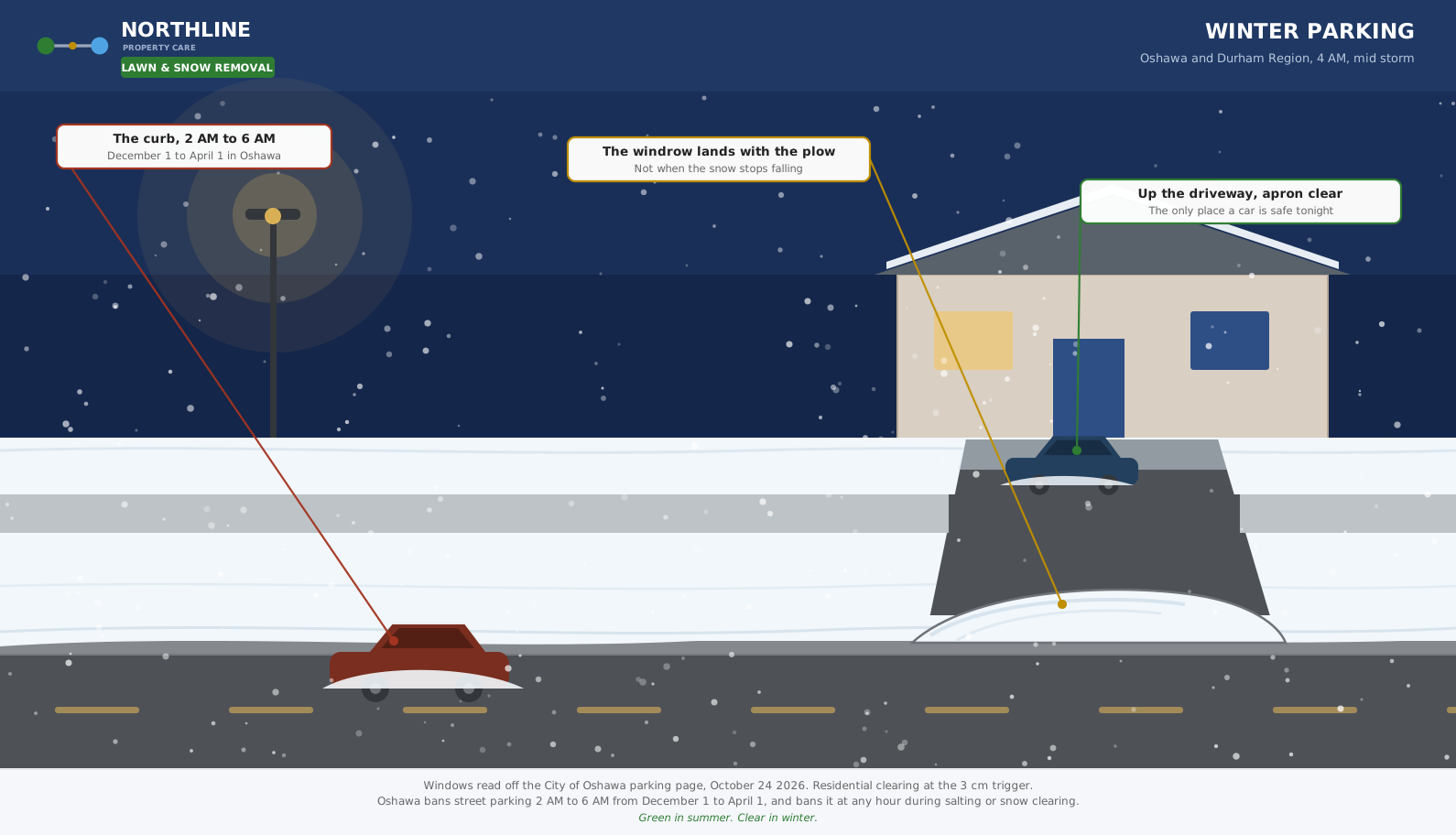
The short answer
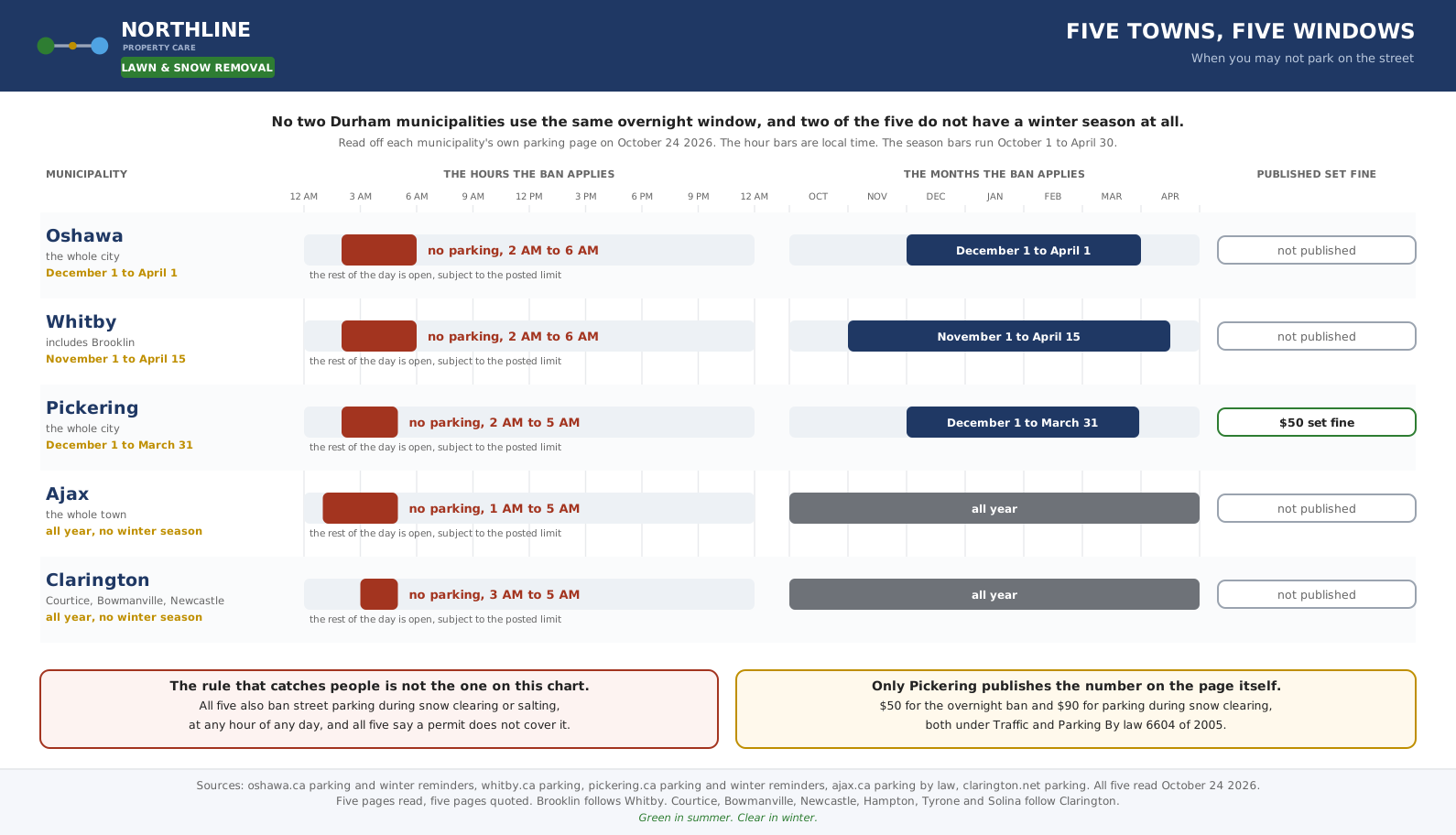
Oshawa shuts the curb lane 2 AM to 6 AM, December 1 until April 1. Whitby 2 AM to 6 AM, November 1 until April 15. Pickering 2 AM to 5 AM, December 1 until March 31. Ajax 1 AM to 5 AM and Clarington 3 AM to 5 AM, both all year round. Five municipalities, five windows, no two of them the same.
All five also prohibit parking on the street while salting or snow clearing is happening, at any hour of any day, and all five state that a parking permit does not cover you while it is. Put the car in the garage, or as far up the driveway as it will go with the apron left clear, on any night snow is in the forecast.
The parking window is not a restriction, it is a published plowing schedule
Every overnight parking ban in Durham Region exists for one reason, which is that a street cannot be plowed to the curb while cars are standing against it. The hours are not chosen to inconvenience anybody and they are not revenue. They are the window a municipal street crew needs, written into a by law so that the crew has a legal basis for finding the curb empty when it arrives.
Read that way, your own town's window becomes a useful piece of information rather than a rule to resent. Oshawa closes the street from 2 AM to 6 AM. That is the City telling you, in writing and a year in advance, roughly when a blade is most likely to come down your residential street after an overnight storm. It is not a promise and no municipality in this region publishes one, but it is the only public timing signal a homeowner gets, and almost nobody uses it.
It also explains the thing that confuses people most about a Durham winter morning. The ridge of hard packed snow across the bottom of your driveway did not fall there. It was pushed there by the street plow, during those hours, hours after the snow itself stopped. The windrow follows the plow and the plow follows the by law, which is why the parking window and the state of your driveway at 6 AM are the same subject and not two different ones.
Five municipalities, five windows, and not one of them matches another
The five Durham municipalities Northline serves publish five different overnight parking rules, and two of them do not have a winter season at all. Every figure below was read off each municipality's own parking page on October 24 2026, and the pages are linked where they are quoted.
The City of Oshawa states it in one line: there is no parking on the street from December 1 to April 1 from 2 a.m. to 6 a.m. The Town of Whitby runs the longest season in the group, November 1 to April 15, in the same 2 AM to 6 AM band. That is a month earlier at the front and two weeks later at the back than Oshawa, and a Brooklin driveway follows Whitby.
The City of Pickering runs December 1 to March 31 and closes the street from 2 AM to 5 AM, an hour shorter each end than Oshawa, with a three hour maximum the rest of the time. The Town of Ajax has no separate winter rule because it does not need one: no parking overnight between 1 a.m. and 5 a.m. except by permit, all year. Clarington is the same shape, 3 a.m. to 5 a.m. year round under By law 2014 dash 059, which covers Courtice, Bowmanville, Newcastle, Hampton, Tyrone and Solina.
So a household that moved from Courtice to Whitby last spring has gone from a two hour band that never changes to a four hour band that starts on November 1, and nothing told them. A household that moved the other way has stopped worrying about a season that no longer exists and started breaking a rule at 3 AM in July. Neither of those is a hypothetical. Both are what happens when five neighbouring municipalities write the same rule five different ways.
The rule that actually catches people is not the overnight one
Every one of the five also bans parking on the street during snow clearing or salting, at any hour, on any day, in any month, and that is the rule most people have never read. The overnight ban is a calendar. The snow clearing ban is a condition, and a condition can start at three in the afternoon on a Tuesday in November.
Oshawa puts it bluntly on its own winter page: vehicles parked on any street during active salting or snow clearing can be ticketed or towed at any time of year. Clarington goes further and says you cannot park on the street during a snow storm at any time of day or night, and that a vehicle left there may be towed. Whitby says parking that interferes with snow clearing operations is prohibited and advises moving the vehicle off the road during a winter snow event. Pickering says vehicles are not permitted on City streets or highways during snow clearing operations.
The practical difference is the one nobody expects. A homeowner who has carefully learned that the ban is 2 AM to 6 AM comes home at four in the afternoon during the first real squall of December, parks on the road because it is daylight and the ban is obviously not running, and gets a ticket from an officer who is correct. The two rules live on the same page, and the second one has no hours in it on purpose.
If you want the number, Pickering is the only one of the five that publishes it on the page. Parking during the overnight ban carries a set fine of $50. Parking during snow clearing carries a set fine of $90, both under Traffic and Parking By law 6604 of 2005. The condition costs nearly twice what the calendar does, which tells you which of the two the municipality actually cares about.
A parking permit is not an exemption from any of this
Every one of the five municipal pages says, in its own words, that a permit does not cover you while the street is being cleared. This is the part that generates the angriest telephone calls, because somebody has paid for something and reasonably assumed it protected them.
Oshawa states that Occasional Use Parking Permits are not valid during salting or snow clearing, and that permits arranged in advance are suspended while those operations run. Clarington says temporary parking passes are not valid during periods of snow clearing, and adds the sentence that should be printed on the pass itself: if you book ahead and it snows unexpectedly, your permit will not be re issued for another day. Ajax says permits are not valid during active snow events. Pickering grants parking consideration to a maximum of 21 days per calendar year per licence plate and says other restrictions, snow clearing included, still apply.
Whitby is the strictest on paper and the most interesting of the five. Its page says there are no exemptions to the time restricted rules, and that accessible permit holders are not exempt either. The one exemption Whitby does publish is a narrow and sensible one: personal care workers registered with the Town are exempt from the overnight restriction and the three hour limit. If somebody comes to your parent's house in Brooklin overnight, that registration is worth knowing about, and it is the kind of thing a municipality buries three clicks deep and never mentions again.
One storm night, in the order it actually happens
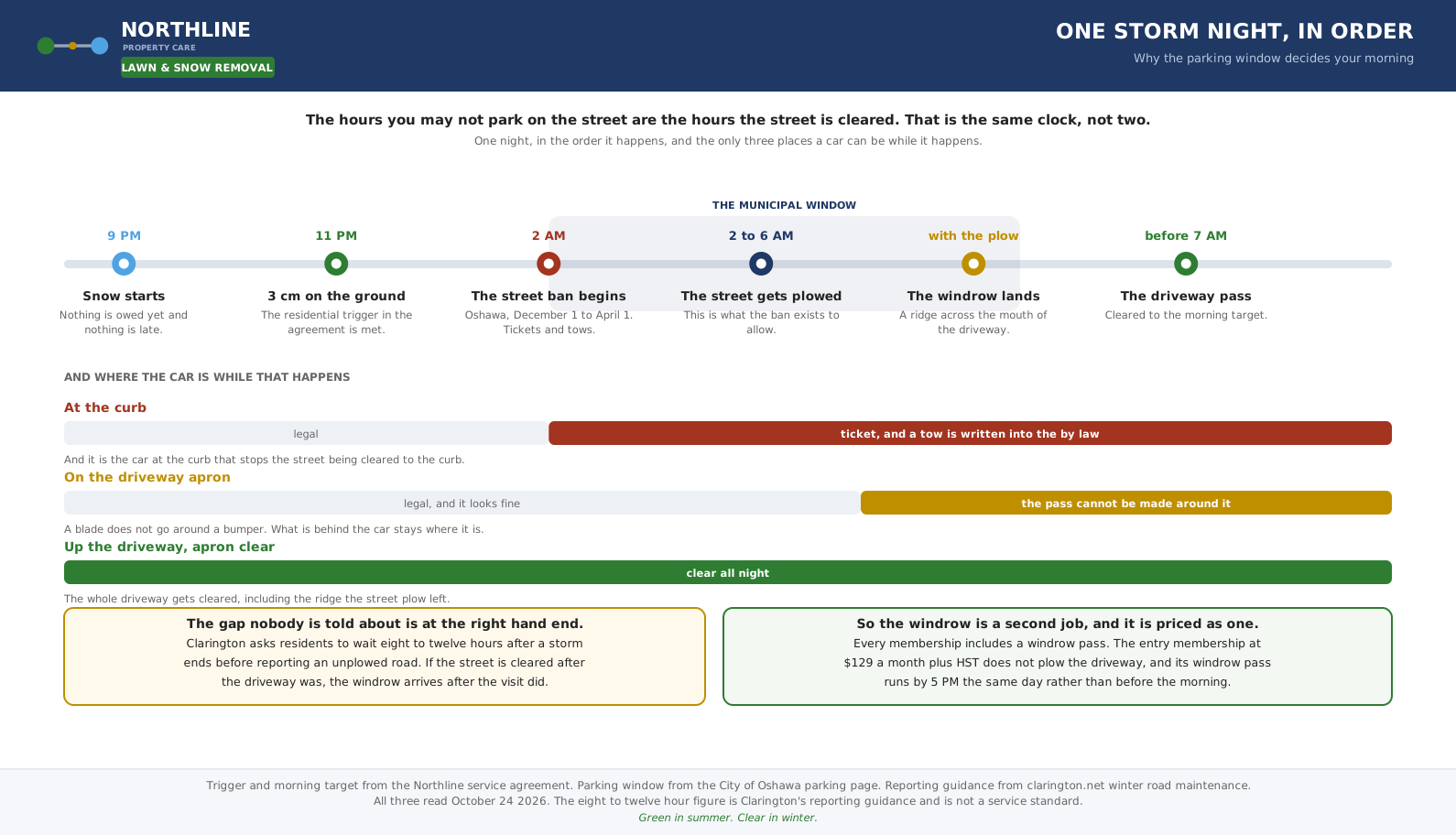
The order of a Durham storm night is not the order most people assume, and getting it wrong is what produces a driveway that was cleared and then was not. The sequence runs: snow falls, the depth trigger is met, the overnight parking ban opens, the street plow passes, the windrow lands across the driveway, and only then does a contracted driveway pass make sense.
Put real numbers on it for an Oshawa property on a December night. Snow starts at nine in the evening. By eleven there is 3 cm on the ground, which is the residential trigger written into our agreement and is well below every municipal trigger in the region. At 2 AM the City closes the street. Somewhere in the four hours that follow, a municipal blade goes down the road and leaves a compacted ridge across the mouth of every driveway on it. A driveway cleared at midnight is sealed shut again by four.
This is why the order matters commercially as well as physically. Clearing a driveway before the street has been plowed is clearing it twice, and the second clear is the hard one, because windrow snow has been compressed under a blade and refrozen rather than falling softly. The difference between a thirty second pass and a fifteen minute dig is entirely a question of whether the street went first.
The eight to twelve hour gap, and what it does to a clear driveway
A municipal street plow may not arrive for a long time after the snow has stopped, and when it does, it will undo part of what a driveway visit achieved. Clarington is the only one of the five that publishes a usable figure, and it is worth quoting because it is the honest one: residents are asked to wait at least eight to twelve hours after a storm ends before reporting a road as unplowed.
That is reporting guidance rather than a service standard, and it should not be read as a promise by anybody. What it does tell you is the interval the municipality itself considers normal. Clarington plows and treats roughly 892 kilometres of municipal road, about 1,800 lane kilometres, and a quiet crescent in Hampton or a cul de sac off Nash Road is not first in that order.
So here is the unprofitable sentence, and it goes in writing because a customer who hears it in October does not feel misled in February. A driveway can be cleared to a morning target and still have a ridge across it by mid morning, because the street behind it was plowed after the visit rather than before. That is not a missed visit and it is not a failure of the contract. It is the physical consequence of two separate clearing operations running on two separate clocks, one of which belongs to the municipality.
The Region of Durham adds a third clock on top of that for the regional roads, which it patrols seven days a week and treats before weather arrives when frost or black ice is likely. The Region can also declare a Significant Weather Event, which is triggered by an Environment Canada hazard rather than by any snow depth and stays in place until crews bring roads back to standard. Taunton Road and Simcoe Street answer to that schedule. Your crescent answers to the City.
Where to put the car, in order, and why the apron is the trap
The garage first, then as far up the driveway as the vehicle will go, and never on the apron at the bottom. Those three in that order will prevent almost every parking related problem a Durham homeowner has in a winter, and the third one is the one that gets ignored because it looks harmless.
The apron is the flared bottom few metres of the driveway where it meets the road. It is where the windrow lands, where the snow is deepest, where it is hardest, and where every piece of equipment has to begin. A vehicle sitting there is not in a slightly inconvenient place. It is sitting on the only working surface, and everything behind it becomes unreachable in the same moment.
Parking at the top of the driveway, tight to the garage door, costs the homeowner and leaves the entire run clear. On a long Clarington country driveway, pulling up beside the house rather than halfway down the lane does the same job. If the property has a turning area, that is better again, because it keeps the vehicle out of the line the equipment travels. None of this requires anybody to get up at 2 AM. It requires the decision to be made at ten at night, once, on a night when snow is in the forecast.
Our guide to preparing a driveway for snow removal in Oshawa covers the rest of the list, including the things that get buried in November and found in April.
The sidewalk has its own clock, and the parked car is what stops you clearing it
Clearing the sidewalk in front of your Oshawa property is a separate legal obligation from parking, with its own deadline and its own penalty, and the two rules collide. The City wants the sidewalk beside your property cleared of snow and ice by midnight on the day after the precipitation stops, and it wants the clearing kept up during a storm rather than left until the storm is over.
It also requires something most people miss entirely. Ridges of snow on the public sidewalk bordering your property have to be removed, especially where the sidewalk meets the road. That ridge is exactly what a street plow deposits, and it is exactly where a car parked at the curb prevents you getting at it. The penalties escalate from $75 to $275 per day of violation, and the City can additionally invoice the property owner for the cost of removing the snow and ice itself.
The number worth holding onto is the deadline, not the fine. Midnight of the first day after precipitation ends sounds generous until a storm finishes at four on a Sunday afternoon, at which point you have eight hours, in the dark, after a weekend. The full set of Oshawa timings sits in our guide to the snow removal by law in Oshawa, including what the City does when a sidewalk stays uncleared.
The towing clause, which is the expensive half nobody reads
Three of the five municipal pages put towing in writing, and a tow on a storm night is a far worse morning than a ticket. Oshawa says a vehicle may be ticketed and or towed during the restricted hours regardless of snow clearing or weather. Pickering says vehicles parked on the road during snow clearing operations are subject to being ticketed and towed at the owner's expense. Clarington says a vehicle parked during a snow event may be towed.
Work out what that actually costs before deciding the overnight ban is a trivial risk. A $50 set fine is an annoyance. Recovering a towed vehicle from a compound in Oshawa at six in the morning after a storm, with the tow charge and the storage on top of the ticket, is most of a day and considerably more than the fine, and it happens on the one morning you most need the car. The arithmetic is not close.
There is a second cost that lands on the neighbours rather than on the owner. A single car left on a Whitby crescent during a pass means the whole strip of road beside it stays unplowed, and it does not get a second visit. Four houses then have a snow covered curb lane until the next storm, which is also why municipal enforcement on this is less arbitrary than it looks from inside the ticketed car.
What Northline does about it, and the one thing we will not do
If the overnight ban means the car has to sit in the driveway on a storm night, then the driveway is the thing that has to be dealt with, and Northline Property Care clears residential driveways across Oshawa, Whitby, Ajax, Pickering, Bowmanville, Courtice and Clarington, starting at a measured 3 cm, which is lower than every municipal trigger named on this page. The driveway, the walkway and the path to the door are part of the job, and the ridge the street plow leaves behind is part of that job rather than extra on top of it.
Here is the scoping, stated plainly, because an unscoped promise is a promise that gets broken somewhere. The driveway itself, and the morning targets that go with it, sit in Gold at $189 a month plus HST and in Platinum at $279 a month plus HST. The entry membership is Silver, $129 a month plus HST. Silver does not take a blade to the driveway at all, and what a Silver property gets after a storm is a windrow pass by 5 PM the same day. So if the thing you actually need is a clear driveway before you leave for work, Silver is the wrong plan, and saying that in October beats having the conversation in January. Bought on its own without any membership, a seasonal snow package runs $800 small, $975 standard and $1,200 large, plus HST.
The one thing we will not do is work tightly around a parked vehicle. That is not a policy written to save time, it is written because a blade or a blower passing a bumper in the dark, in blowing snow, on a surface nobody can see, is the way a routine visit turns into a claim on somebody's vehicle. The reachable part gets cleared, the covered part does not, and the customer gets told which. Anybody promising to tuck in around your car in a January storm is describing a risk they intend to take with your property.
The deadline is real and it is worth stating plainly rather than dressing it up. The seasonal price holds for anybody booked by November 1. The residential route then closes on November 30 and does not reopen that winter, and the reason is the morning target itself: every property on the list has to be finished by it, so the list has a ceiling and the ceiling is reached. Our page on windrow clearing in Durham Region covers the municipal assistance programs first, including the ones that are free if you qualify, because no contractor beats free.
What this page could not verify, named rather than quietly left out
Four things were looked for on the five municipal sites and not found, and they are listed here instead of being filled in from somewhere less reliable. Five municipal parking pages and three winter maintenance pages were read on October 24 2026, and that is the denominator for everything on this page.
No set fine for the overnight ban is published on the Oshawa, Whitby, Ajax or Clarington parking pages. Four of the five say only that a vehicle may be ticketed, and refer the reader to a by law document or a brochure. Pickering is the exception and its two figures, $50 and $90, are the only ones quoted above. A figure that appears on one municipal page is not evidence about the other four, and no attempt was made to average them or to guess.
No snow depth trigger that starts municipal plowing is published by any of the five. Residential depth triggers for municipal roads exist in provincial maintenance standards and are not on the pages a homeowner reads, so this page quotes none. No residential street clearing time commitment was found for Oshawa, Whitby, Ajax or Pickering either. Clarington's eight to twelve hour figure is reporting guidance and has been described as such throughout rather than being promoted into a standard.
And the by law texts themselves were not opened for Oshawa, Whitby or Ajax. What is quoted above is each municipality's own public parking and winter page, which is what a homeowner actually reads, and the page is named every time. Pickering's By law 6604 of 2005 and Clarington's By law 2014 dash 059 are named because those municipalities name them on the page. Every external figure on this page comes from a municipality or from the Region of Durham, and not one came from a company that sells snow removal in this region or anywhere else.
Questions Durham homeowners ask about winter parking
Can I park on the street in Oshawa in the winter?
Not between 2 AM and 6 AM on any night falling inside the season the City sets, which runs from December 1 until April 1, and not at any hour of any day while salting or snow clearing is under way. The City publishes both rules and they are separate. The overnight one is a calendar you can plan around. The snow clearing one is a condition, it can begin at three in the afternoon, and the City says a vehicle left on the street during it may be ticketed or towed at any time of year. An Occasional Use Parking Permit does not cover you during salting or clearing, and the City states that permits already arranged are suspended while those operations run.
Do Whitby, Ajax, Pickering and Clarington have the same winter parking rule as Oshawa?
No, and none of the five matches another. Whitby has the longest season of the group. Its parking ban runs November 1 to April 15, a full month earlier than Oshawa. Pickering runs December 1 to March 31 between 2 AM and 5 AM, one hour shorter at each end than Oshawa. Ajax and Clarington have no winter season at all, because their overnight bans already run all year, Ajax from 1 AM to 5 AM and Clarington from 3 AM to 5 AM. If you live in Brooklin you follow Whitby. If you live in Courtice, Bowmanville, Newcastle, Hampton, Tyrone or Solina you follow Clarington.
Why is the ban in the middle of the night rather than during the day?
Because that is when residential streets get plowed, and an empty curb is the only way a blade can reach it. Every hour on those five charts is a working hour for a municipal street crew. The useful way to read your own town's window is not as a restriction, it is as a published statement of when your street is most likely to be cleared, which also tells you roughly when the ridge of snow is going to land across the end of your driveway. That ridge is the windrow, and the hours in the by law are your best public clue about when to expect it.
Will a plow come back if a car was blocking the curb?
In general no, and that is the part worth knowing before you leave the car out. A municipal pass is made once on a residential street in most storms and the crew moves on, which means the strip of road beside a parked vehicle stays unplowed until the next pass, however long that is. Clarington asks residents to wait eight to twelve hours after a storm ends before reporting a road as unplowed, which gives a fair sense of the intervals involved. The same answer applies to a private driveway for the same physical reason, which is covered further up this page.
Where should I put the car on a night when snow is forecast?
In the garage if there is one, and if there is not, as far up the driveway as it will go, leaving the bottom of the driveway and the apron completely clear. The apron is the part a blade has to get to, because that is where the windrow lands and where the deepest snow sits. A car halfway down a Durham driveway looks harmless at midnight and is the single commonest reason a driveway only gets half cleared. Leaving it at the curb instead is worse again, because after 2 AM in Oshawa that is a ticket and the by law puts a tow on the table.
Does a snow removal company move a car or clear around it?
We do not move vehicles, and we do not clear tightly around them either, which is worth saying plainly because it costs us work. A plow blade or a blower passing close to a bumper, a rocker panel or a side mirror in the dark, in blowing snow, on a surface nobody can see, is how a property care visit turns into an insurance claim. What happens instead is that the reachable part of the driveway gets cleared and the covered part does not, and the customer finds a note. Anyone who tells you they will tuck a blade in around your car in a January storm is describing a risk they are planning to take with your vehicle.
Who wrote this
This page was written by Andrew, who owns Northline Property Care, prices the property himself and then does the work on it. Six winters of clearing snow in Durham Region sit behind it, which is why it is able to tell you that the apron is where a visit succeeds or fails, and why it is willing to say in writing that a driveway can be cleared on time and still carry a ridge by mid morning.
The sourcing here was deliberately narrow. Every rule, hour, date and dollar figure above was read off a municipal or regional website on October 24 2026, and each one is linked where it is quoted. Nothing was taken from any company that sells snow removal or property maintenance, in this region or anywhere else, and where a figure could only be found on such a page it was left out rather than reworded. What was looked for and not found has its own section above instead of being quietly filled in.
Read next
Windrow clearing in Durham Region
What the ridge across your driveway is, who is responsible for it, and which municipal assistance programs will do it for nothing if you qualify.
The snow removal by law in Oshawa
The sidewalk deadline, the escalating penalty, and what the City does about a property that leaves a sidewalk under ice.
When to book snow removal
Why the booking date and the first snowfall date are two different problems, and which one actually decides whether you have a contractor.
Andrew answers, October 2026
We have three cars and a two car driveway. On a storm night one of them has to be on the road. What do we do?
That is the commonest version of this problem in Oshawa and there is no clever answer to it, so here is the practical one. Put the vehicle that leaves first in the morning at the top of the driveway, put the second one beside it if the width allows, and put the third one on the road but move it before 2 AM rather than after 6 AM, because the ticket risk and the plow both sit in that window. If the third one genuinely cannot move, tell me when you book, and I will clear what is reachable and come back for the rest rather than working a blade past a bumper in the dark. What I will not do is pretend the problem does not exist and then leave you a half finished driveway with no explanation.
One of these goes on each page and it is replaced monthly. If the question you have is not here, ask it: 905-244-5779.
Settle the driveway before the first ban night
Send the address and the price comes back the same day. The quote says what gets cleared, when it starts, where the snow is going to be put and what happens on a night a vehicle cannot be moved, and all of that is in writing before anything is touched.
Green in summer. Clear in winter.