Snow removal · Shared and mutual driveways
Shared Driveway Snow Removal in Durham Region, and Who Clears the Middle
Shared driveway snow removal in Durham Region has no rule behind it, because Ontario wrote a statute to settle who maintains the fence on a property line and wrote nothing at all for the driveway sitting on the same line.
Looking for the service itself rather than the law behind it? See residential snow removal.
Green in summer. Clear in winter.
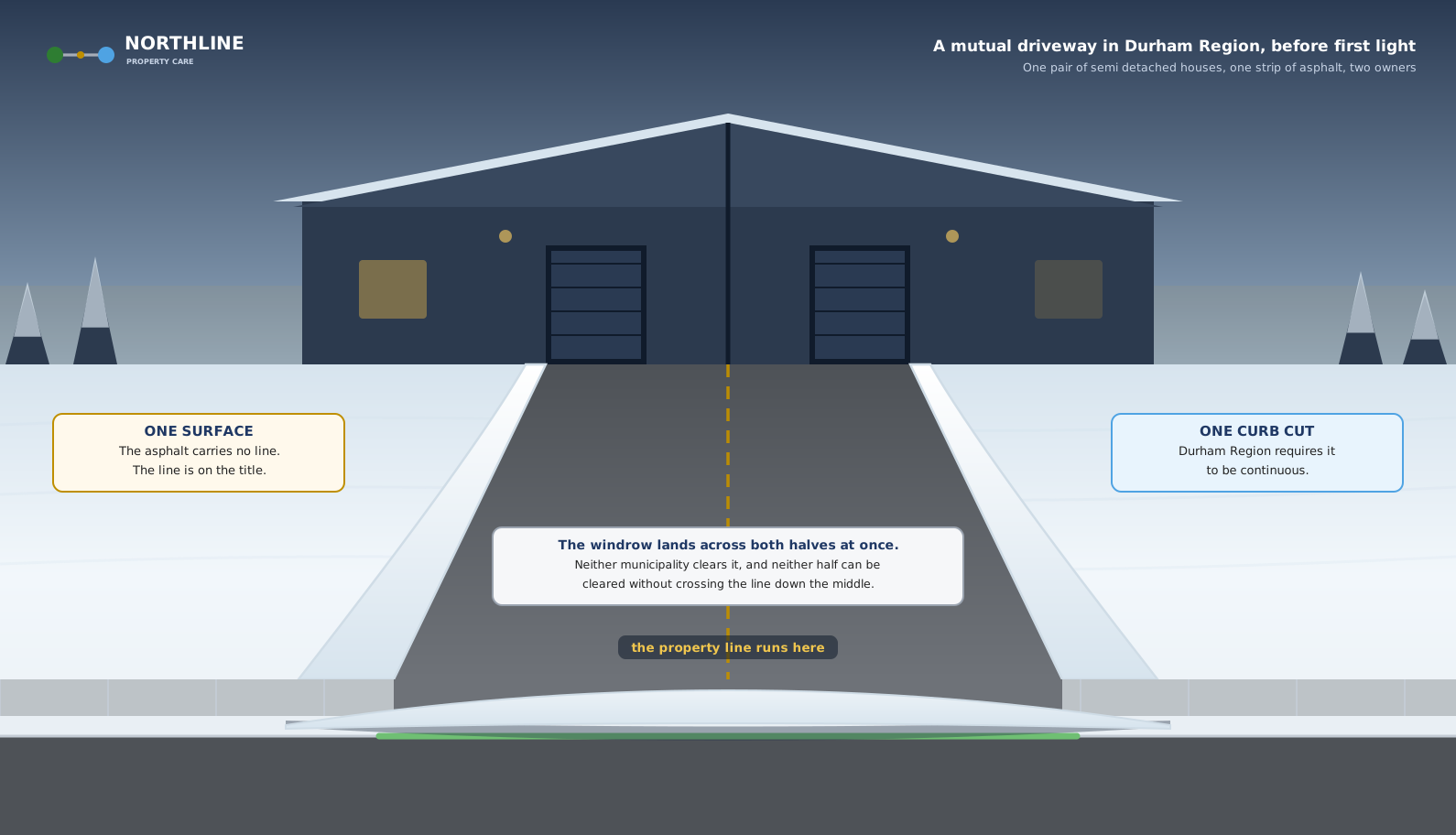
The short answer
On a mutual driveway the snow is one job and the responsibility is two, and no Ontario statute and no Durham by-law divides it for you. The surface is a single slab with a boundary running up the middle of it. Nothing in the asphalt marks where that boundary is, the Region of Durham requires the curb cut across the pair to be continuous, and a blade that clears one half has already crossed into the other. What settles who may clear what is the wording registered on your own title, and where the title is silent, an arrangement the two households make between themselves.
Where the snow is allowed to go is settled, and it is narrower than most people expect. In all five Durham municipalities the snow off your driveway may go onto land you own or onto the boulevard directly in front of your own lot, and nowhere else. Ajax goes one step further than the other four and names another property in the by-law itself. The street is never an answer anywhere: the Highway Traffic Act prohibits depositing snow on a roadway, and each municipality carries its own version of that prohibition with a penalty attached.
The price does not change because a driveway is shared. A property is quoted on what has to be cleared to make it usable, and on a mutual driveway that is the whole surface, because half of a shared slab cannot be cleared on its own. The seasonal snow package runs $800, $975 or $1,200 plus HST by size and covers the driveway, the walkway and the salting from the first 3 cm of snow until the spring. A membership pays for the same winter in twelve equal monthly payments and carries the summer with it. Driveway plowing and the 7 AM target sit on Gold, at $189 a month plus HST. Silver, at $129, takes the windrow in a daytime pass and does not plow the driveway at all. Memberships start at $129 a month plus HST.
Two dates matter and they are not the same date. November 1 is the last day for the published seasonal price. November 30 is the last day a property can join the residential route at all, and the route does not reopen that winter.
Nobody counts driveways, so start with the houses that have them
No census, no ministry and no municipality publishes a count of shared driveways in Ontario. What Statistics Canada does publish is the structural type of every occupied private dwelling, and a mutual driveway belongs almost entirely to two of those types: the semi-detached house and the row house. The Region of Durham republished the 2021 figures for every municipality in its own report, which is the easier document to read and which matches the census tables exactly.
| Municipality | Semi-detached | Row house | Both together | Share of all dwellings |
|---|---|---|---|---|
| Oshawa | 5,330 | 6,445 | 11,775 | 17.67 per cent of 66,630 |
| Whitby | 1,385 | 6,135 | 7,520 | 16.19 per cent of 46,460 |
| Ajax | 2,265 | 6,020 | 8,285 | 20.98 per cent of 39,485 |
| Pickering | 2,510 | 4,980 | 7,490 | 22.41 per cent of 33,425 |
| Clarington | 1,075 | 3,125 | 4,200 | 11.68 per cent of 35,955 |
| Durham Region | 12,915 | 27,300 | 40,215 | 16.55 per cent of 243,050 |
Occupied private dwellings by structural type, 2021 Census of Population, 100 per cent data. Published by the Region of Durham in Report 2022-INFO-77, tables 3 and 4, and read against the Statistics Canada census profile for each municipality. Statistics Canada rounds census counts randomly to a multiple of five, so the components do not always sum exactly to the published total.
Pickering carries the highest share in the Region at 22.41 per cent and Oshawa carries the largest absolute number at 11,775 households. Oshawa also holds the highest semi-detached share of any Durham municipality, at 8.00 per cent of its dwellings, which is roughly one in every twelve addresses in the city. Clarington sits at the other end at 11.68 per cent, which is what you would expect of a municipality whose growth has been low density and recent.
Here is the honest limit of those numbers, and it belongs in the paragraph with them rather than in a footnote. A row house normally has its own driveway, plenty of semi-detached pairs were built with two separate entrances either side of the pair, and some mutual driveways serve two detached houses on narrow old lots. Statistics Canada defines the dwelling types and never asks about the driveway. So the table above is the population a shared driveway is drawn out of. It is not a count of shared driveways and this page does not pretend otherwise.
One further figure is worth putting beside it. In Oshawa, 39,030 occupied dwellings, 58.58 per cent of the city, were built in 1980 or earlier, against 37.29 per cent across Durham Region as a whole. The mutual driveway is a form that belongs to narrower frontages and to an era when households were assumed to park far less than they do now, so the oldest housing stock in the Region sitting in the city with the most semi-detached houses is a pattern worth noticing. Treat that as reasoning rather than as a measurement, because no source connects the two directly and this page is not going to invent one.
One curb cut, and the line that is not in the asphalt
The Region of Durham has an engineering standard for a thing none of its municipalities defines. Section 6.5 of the Region's Design Specifications for Roads, Structures and Entranceways, revised April 2025, says this in one sentence:
Where mutual driveways are constructed between two adjoining properties, the curb cut shall be continuous.
That single requirement is why a mutual driveway reads as one property from the street. There is no notch in the curb, no seam in the asphalt and no change in the surface at the boundary. Everything a passer-by can see says one driveway, and everything on title says two. You can read the standard in the Region's own roads and entranceways specification.
The same section sets two grades that matter once there is water involved. On new developments the maximum grade permissible for an access driveway from the sidewalk to the garage is 10 per cent, and there must be a minimum grade of two per cent toward the road from the property line to the curb line. A mutual driveway therefore sheds its meltwater to one place by design, and both halves send it there. On a mild February afternoon that is a single sheet of water running to a single low point, and on the following morning it is a single sheet of ice that neither household made on its own.
Below the Region, the definitions run out. Not one zoning by-law in Oshawa, Whitby, Ajax, Pickering or Clarington defines a mutual driveway, a shared driveway or a common driveway. The closest any of them comes is Whitby, whose Zoning By-law 2585 uses the word once, at section 6 (2) (b) (i), and uses it about a building: where a mutual garage is erected on a common lot line between two lots, no interior side yard is required. The driveway leading to that garage gets no mention at all.
Whitby also supplies the most revealing sentence in the whole set, in its older By-law 1784, which defines a link dwelling as a group of attached units each having its own entrance from the outside, its own driveway from the street, and its own garage or parking area. The by-law assumes a separate driveway per unit. It is written as though the mutual driveway does not exist, which is roughly the position every planning document in the Region takes.
The arithmetic, and why there is nowhere on the surface to put the snow
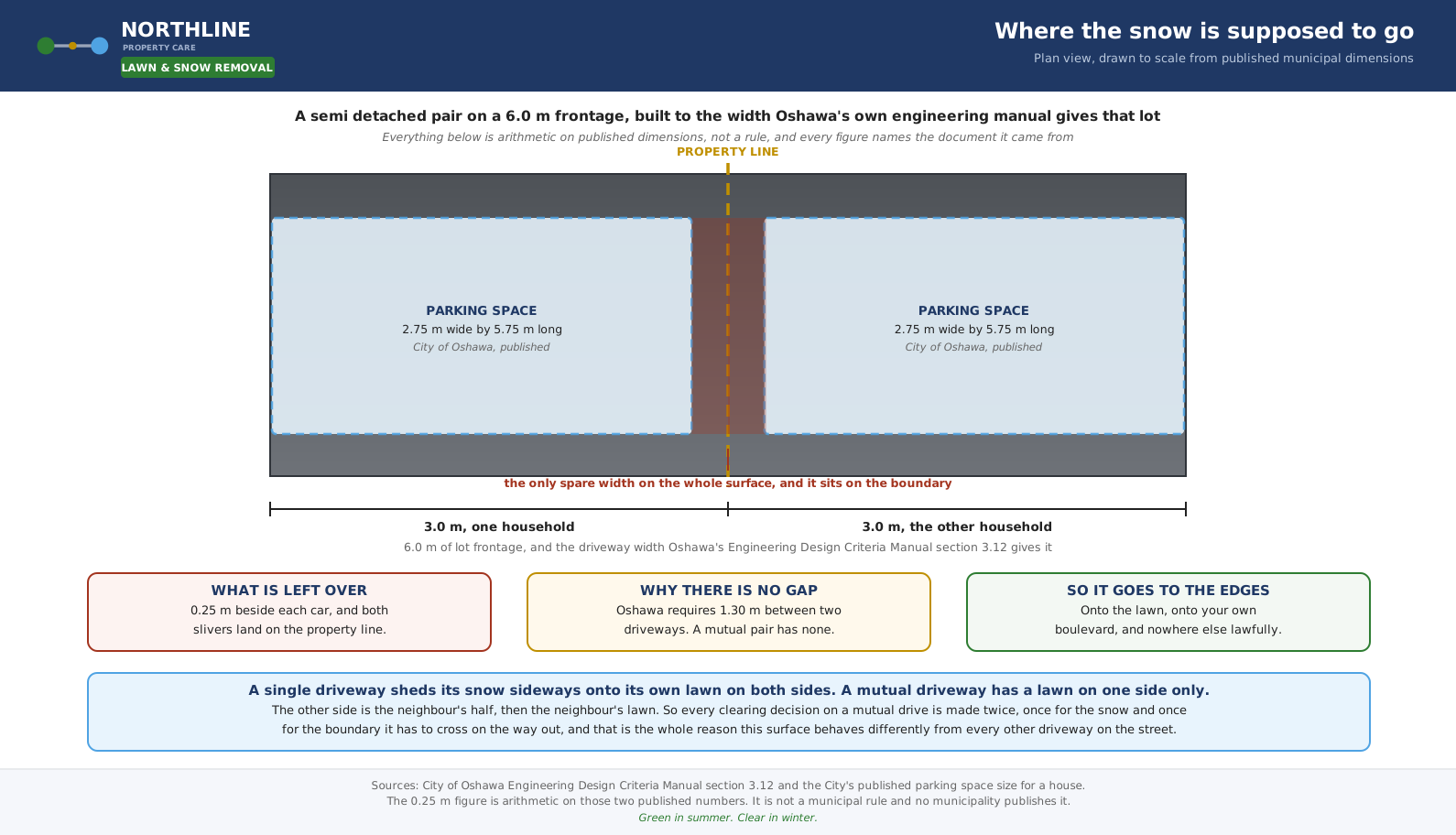
A mutual driveway built to the published minimums has about a quarter of a metre of spare width per household, and it sits on the boundary. The City of Oshawa Engineering Design Criteria Manual, section 3.12, puts the minimum residential driveway width at 3.5 m measured edge to edge of the garage, and gives a street townhouse or semi-detached lot with 6.0 m of frontage a driveway width of 3.0 m. The City separately publishes the parking space size for a house on its driveways and curbs page, at 5.75 m by 2.75 m. Subtract one from the other and a household on a mutual pair has 0.25 m of width beside the car.
That subtraction is arithmetic on two published figures. It is not a municipal rule, no municipality states it, and it does not describe every shared driveway in Durham Region. It describes the one a builder put up to the minimum on a narrow lot, which is a very large share of them. What it shows is the thing the prose cannot: on a surface built that way, there is no spare width anywhere except against the line down the middle.
The second figure from the same manual is the one that makes a shared driveway genuinely different from every other driveway on the street. Oshawa states that the minimum spacing between driveways, and between driveways and sidewalk ramps, shall be 1.30 m. Two separate driveways on two separate lots have at least that much ground between them, and that strip is where the snow goes. A mutual pair has none of it, because the Region requires the curb cut to be continuous, and the two halves meet with nothing in between.
So the snow goes sideways, and sideways is only available in one direction. A single driveway on its own lot can shed snow onto lawn on both sides. A mutual driveway has lawn on one side and the neighbour on the other. Every clearing decision on a shared surface therefore gets made twice, once about the snow and once about the boundary it has to cross on the way out, and that is the entire mechanical reason this surface behaves unlike any other driveway on the block.
There is a limit on the lawn too. Oshawa states that a driveway cannot be more than 50 per cent of the front yard area, in order to keep the other half landscaped. That rule exists to protect drainage and the streetscape, and the side effect is that it guarantees a strip of grass to pile snow onto. On a mutual pair, half of that guaranteed strip belongs to somebody else. The same point applies to where the edge of the blade meets the lawn, which is its own problem and the commonest cause of a complaint in April.
Ontario wrote a law for the fence and none for the driveway
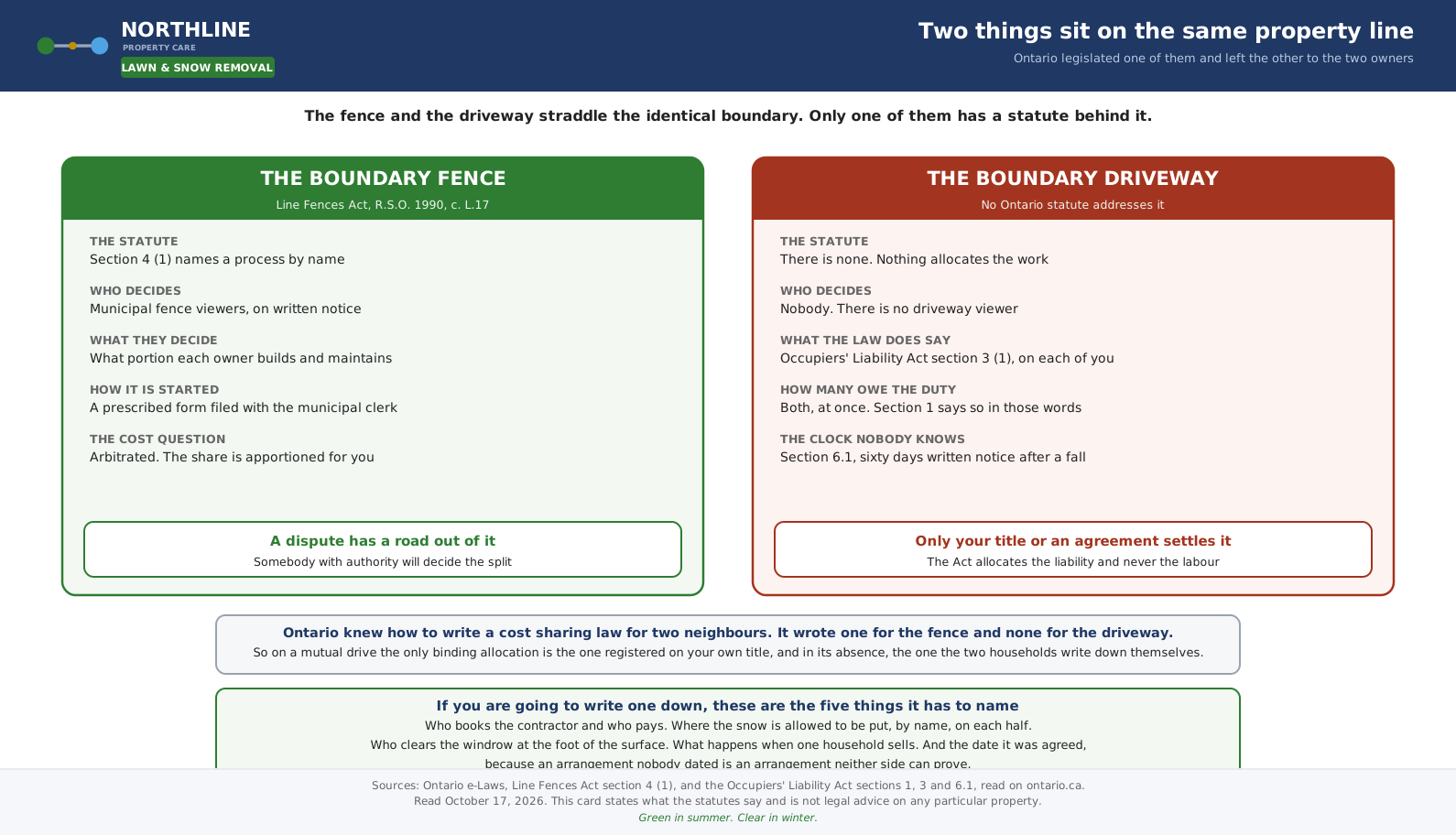
Two things sit on the identical property line, and the legislature wrote an arbitration process for one of them and nothing at all for the other. The Line Fences Act gives neighbours a statutory route out of a disagreement about a boundary fence, run by municipal fence-viewers. Section 4 (1) says it plainly:
If the owner of any land wishes to have a fence that marks the boundary between their land and the land of an adjoining owner constructed, repaired or reconstructed, the owner of the land may, using the prescribed form, notify the clerk of the local municipality in which the land is situated that the owner wishes fence-viewers to view and arbitrate what portion of the fence each owner shall construct, reconstruct or repair and maintain and keep up.
You can read the whole Act on Ontario e-Laws. A form goes to the municipal clerk, somebody with authority attends, and the share each owner carries is apportioned for them. The dispute has a road out of it.
There is no equivalent for the driveway on that same line. There is no driveway-viewer, no prescribed form and no municipal arbitration. The Occupiers' Liability Act, the Highway Traffic Act, the Land Titles Act, the Registry Act, the Conveyancing and Law of Property Act, the Real Property Limitations Act and the Line Fences Act were all read for this page, and not one of them divides, apportions or assigns the job of clearing a mutual driveway between two freehold owners.
The one place Ontario does impose a snow and ice standard is rental housing, and even there it binds a landlord rather than a neighbour. Under the maintenance standards made under the Residential Tenancies Act, exterior common areas must be kept free of hazards, and the list of things to be removed includes unsafe accumulations of ice and snow. That obligation falls on the landlord, and it applies to a residential complex in the circumstances the Act prescribes. Two owner occupiers on a mutual driveway are outside it entirely.
That contrast is worth holding onto, because it answers the question most people are actually asking. They want to know what the rule is. The accurate answer is that the legislature knew exactly how to write a cost sharing rule for two neighbours, wrote one for the fence, and left the driveway to the two households and whatever is on their title.
Two things sit on one line, and only one of them has a statute
What your title says, and why it is the only document that settles it
A mutual driveway in Ontario is held one of two lawful ways, and nothing in the law says which one is normal. It may be an easement or right of way registered over the neighbour's half, or the strip may be owned jointly or in common by both households. Which one you have is a fact about your own parcel register and your own deed, not a rule. Anybody who tells you a mutual driveway is usually one or the other is reporting an impression of the market, and no statute and no government publication states a proportion.
Three provisions do the heavy lifting. The Land Titles Act provides that registered land is subject to any right of way, watercourse, right of water and other easements, whether or not the register says so, which is why a right of way can bind a property that does not appear to carry one. The Conveyancing and Law of Property Act provides that every conveyance of land, unless an exception is made in it, includes the ways, waters, liberties, privileges, easements and appurtenances belonging to that land, which is why nobody mentions the driveway again after the first sale and the right travels with the house anyway.
The third is the one that upsets people, and it is the most useful thing on this page for anyone in a long argument with a neighbour. Section 51 (1) of the Land Titles Act reads:
Despite any provision of this Act, the Real Property Limitations Act or any other Act, no title to and no right or interest in land registered under this Act that is adverse to or in derogation of the title of the registered owner shall be acquired hereafter or be deemed to have been acquired heretofore by any length of possession or by prescription.
In the Land Titles system, which covers the great majority of Durham Region, you cannot build a right over your neighbour's half by using it for twenty years. Long use proves nothing. The Real Property Limitations Act still provides for a prescriptive right of way after twenty years of uninterrupted enjoyment, and after forty years that right is absolute and indefeasible, but that route survives only on land that stayed in the Registry system. The practical instruction is the same either way: pull your own parcel register before you argue, because the answer is written on it and nowhere else.
If the disagreement is about where the boundary physically runs rather than who owns what, that is a different process again. The province runs a Boundaries Act application through ServiceOntario, and its own client guide puts the distinction in one line: the Boundaries Act deals with the location of boundaries, and the Land Titles Act and the Certification of Titles Act deal with ownership. A surveyor settles the first question and a lawyer settles the second, and a contractor settles neither.
Substantial interference, which is the test a court actually applies
Where the access is a registered right of way, the question is never whether your neighbour blocked it, but whether the blocking substantially interfered with the use the grant allows. The Court of Appeal for Ontario settled the standard in a case about a private laneway right of way and an encroachment onto it. At paragraph 12 the Court put the whole principle in four sentences:
The requirement that the dominant owner prove substantial interference to maintain a claim reflects the nature of the dominant owner's right. He or she does not own the right-of-way or the land upon which the right-of-way runs, but only enjoys the reasonable use of that property for its granted purpose. The dominant owner may only sustain a claim predicated on substantial interference with that reasonable use. The distinction is between the rights of ownership and the right of reasonable use for an identified purpose.
The same decision records that the applicants in that case had asked for a declaration of ancillary rights, giving as their example the right to use the right of way for snow removal. The reasons are published on the court's own decisions site and are worth reading if a dispute has reached the point of letters.
There is a trap in how that rule is usually reported. On a public highway, any appreciable obstruction is a wrong. On a private right of way, the obstruction is not actionable unless it is substantial. So the sentence people repeat, that a neighbour cannot block a right of way at all, is the public rule applied to a private driveway, and it is wrong. A car on the surface for an afternoon is one thing. A structure, a fence, or a pile left there from December to March is a different thing, and whether either crosses the line is a question of fact about your grant and your property.
The remedy is where most people get it backwards, and the cost of getting it backwards is a filing fee and several months. An order requiring somebody to stop doing something, or a declaration of what the right of way actually permits, is equitable relief. Under the Courts of Justice Act only the Court of Appeal and the Superior Court of Justice may grant equitable relief, and the Small Claims Court is expressly excluded. The Small Claims Court has jurisdiction in an action for the payment of money and for the recovery of personal property, and since October 1, 2025 its limit has been $50,000. Money for a damaged car or an unpaid share of an invoice goes to Small Claims. An order to stop goes to the Superior Court.
None of the preceding six paragraphs is legal advice and none of it is a reading of your property. It is what the statutes and the reported decision say, with the sections named so that you or your lawyer can check every line of it.
You are both occupiers, and that is the part that costs real money
Two households on one driveway owe the same duty to the same visitor on the same patch of ice at the same moment, and neither of them discharges it by pointing across the line. The Occupiers' Liability Act defines an occupier as a person in physical possession of premises, or a person who has responsibility for and control over the condition of premises, and then adds the clause that decides a mutual driveway: despite the fact that there is more than one occupier of the same premises. The Act defines premises as lands and structures, so a driveway is squarely inside it.
Section 3 (1) then states the duty:
An occupier of premises owes a duty to take such care as in all the circumstances of the case is reasonable to see that persons entering on the premises, and the property brought on the premises by those persons are reasonably safe while on the premises.
Read those two provisions together and the question a homeowner usually asks, which is whose half the ice was on, turns out not to be the question. If you are an occupier of that surface, your exposure does not stop at the boundary, and the letter carrier who falls does not have to work out which side of an invisible line they landed on. The full text of the Act is on Ontario e-Laws and it is short enough to read in ten minutes.
There is one place in the Act where this arrangement works in your favour, and almost nobody knows it is there. Section 6 (1) gives an occupier a defence where damage is caused by the negligence of an independent contractor they employed, provided they acted reasonably in entrusting the work, took reasonable steps to satisfy themselves that the contractor was competent and that the work had been properly done, and it was reasonable for that work to be done by a contractor at all. Section 6 (2) then does something unusual:
Where there is more than one occupier of premises, any benefit accruing by reason of subsection (1) to the occupier who employed the independent contractor shall accrue to all occupiers of the premises.
So on a mutual driveway where one household hires a competent contractor and the work is properly done, the benefit of that defence reaches the household that did not hire anybody. That is a genuine and rarely mentioned reason for the two households to agree on one contractor rather than two, and it is a stronger reason than the price.
Where one half of the pair is rented, section 8 (1) adds a third party to the picture. Where premises are occupied under a tenancy in which the landlord is responsible for maintenance or repair, the landlord owes the same duty of care in respect of dangers arising from any failure to carry out that responsibility. A pair with one owner occupier and one rental is therefore a surface with an owner, a tenant and a landlord all capable of being answerable for the same ice, which is covered at more length on our page about who clears snow at a rental property in Ontario.
The sixty day clock almost nobody knows is running
Since 2021 an injury claim for a fall on snow or ice has to be preceded by written notice inside sixty days, and the notice can lawfully be served on the contractor instead of the homeowner. Section 6.1 (1) of the Occupiers' Liability Act reads:
No action shall be brought for the recovery of damages for personal injury caused by snow or ice against a person or persons listed in subsection (2) unless, within 60 days after the occurrence of the injury, written notice of the claim, including the date, time and location of the occurrence, has been personally served on or sent by registered mail to at least one person listed in subsection (2).
The list in subsection (2) has two entries: an occupier, and an independent contractor employed by the occupier to remove snow or ice on the premises during the relevant period. Notice to any one of them preserves the claim against all of them, which subsection (7) states for greater certainty. The notice has to carry the date, the time and the location, and it has to be personally served or sent by registered mail. An email, a text message and a phone call are not in the section.
Two things follow for a shared driveway and both are practical. The first is that a notice about a fall on your mutual driveway may arrive at your neighbour's address, or at a contractor neither of you has spoken to in months, and you will not know it exists. Subsection (3) obliges an occupier who receives one to forward it by personal service or registered mail to any other occupiers of the premises during the relevant period and to any contractor employed to clear the snow, and subsection (4) puts the matching obligation on a contractor who receives one. The plural in that subsection is in the statute, and on a mutual driveway the plural is both of you.
The second is that missing the sixty days is a bar to the action, with two narrow exceptions. It is not a bar where the injured person died as a result of the injury. And a judge may relieve against want or insufficiency of notice, but only on finding both that there is a reasonable excuse and that the defendant is not prejudiced in its defence. Both limbs are required and neither is a formality.
For our part the procedure is written down rather than improvised. Any snow or ice injury notice that reaches Northline is forwarded by registered mail to the household that engaged us, the same day it arrives, because the statute requires it and because the clock was already running before the envelope was opened.
Where the snow may lawfully go, municipality by municipality
Every municipality in Durham Region prohibits putting your snow on the road and on the sidewalk, and only one of them says anything about putting it on somebody else's property. The by-laws were read directly for this page in October 2026, and the differences between them are real rather than cosmetic.
| Municipality | What the by-law prohibits | Penalty as published |
|---|---|---|
| Oshawa | Winter Access By-law 92-2009, section 6.1: no moving snow or ice from private property onto, or piling or redistributing it on, a sidewalk or a highway. Section 6.2: no depositing it on a boulevard that is not next to your own lot | Administrative penalties of $75, then $175, then $275 for repeats within a year, and on prosecution a fine of not less than $300 |
| Whitby | Clean Community By-law 8271-26, section 8.6: no shovelling, plowing or blowing snow, slush or ice onto or across a highway, a sidewalk or a pedestrian walkway without authorization | Schedule A, items 29 and 30: $355, then $500, then $750 |
| Ajax | Public Nuisance and Safety By-law 46-2025, section 5.4: no shovelling, plowing or blowing snow from any property onto or across a roadway, a sidewalk, a pedestrian walkway or another property, without authorization | Administrative penalties under the Town system, and on conviction a fine of not more than $100,000, with a continuing offence carrying a minimum of $500 a day |
| Pickering | Ice and Snow Clearing By-law 6650/06, as the City publishes it: snow, ice or slush cannot be deposited onto a City street or highway, and cannot be deposited in a way that obstructs visibility of or access to a fire hydrant | Where the City does the work, the cost plus a 25 per cent administration fee |
| Clarington | By-law 93-144, section 8: no sweeping, shovelling, throwing, dropping or placing snow, slush or ice onto the travelled portion of any highway or onto any sidewalk. Section 10: nothing deposited so as to obstruct access to a fire hydrant | The by-law creates the offence without stating an amount. Remedial work by the Municipality is charged at cost plus a $50 administrative fee |
Read from each municipality's own by-law text in October 2026. Pickering publishes the prohibitions on its web pages and the by-law document itself would not serve, so no section number and no fine is quoted for Pickering on this page. Named rather than filled in from another town.
Ajax is the outlier and it matters here more than anywhere else in the Region. Section 5.4 of By-law 46-2025 names another property in the prohibition. On a mutual driveway in Ajax the neighbour's half is therefore not a lawful destination for your snow, by the by-law's own words. In Oshawa, Whitby, Pickering and Clarington the by-laws stop at the road, the sidewalk, the walkway and the boulevard, so snow placed on a neighbour's private land is not an offence under those by-laws. It may still be a private matter between the two of you, which is a different and slower problem.
Oshawa carries the provision that catches a shared entrance most often, and it is section 6.2 rather than the more famous 6.1. Depositing snow on a boulevard that is not adjacent to your own lot is prohibited. The boulevard in front of a continuous mutual curb cut is partly your frontage and partly the neighbour's, and there is no mark on the ground telling anybody where one ends. A pile placed to the wrong side of an invisible line at the foot of a shared entrance is, on the face of the by-law, an offence. The full text is in the City's Winter Access By-law, and there is more about how Oshawa enforces the rest of it on our page about the Oshawa snow removal by-law.
Behind all five sits one provincial section, and it is quoted wrongly almost everywhere. Section 181 of the Highway Traffic Act reads in full:
No person shall deposit snow or ice on a roadway without permission in writing so to do from the Ministry or the road authority responsible for the maintenance of the road.
The word is roadway and not highway, and the Act defines a roadway as the part of the highway improved, designed or ordinarily used for vehicular traffic, expressly excluding the shoulder. So section 181 bites on the travelled portion only. Snow pushed onto a sidewalk or a boulevard is not caught by it at all, and that gap is exactly what the five municipal by-laws above exist to fill. Anyone who tells you the provincial Act covers the sidewalk has not read the definition.
One more point about those by-laws, and it is the one that keeps our own blade honest. Oshawa section 6.1 is addressed to no Person, not to the owner. Whoever physically moves the snow is the person who contravenes it. A contractor taking the quickest route off a shared surface is the one exposed, which is why the route the snow takes off a mutual driveway is a decision made before the work starts and not during it.
Where the second car goes, and five different answers
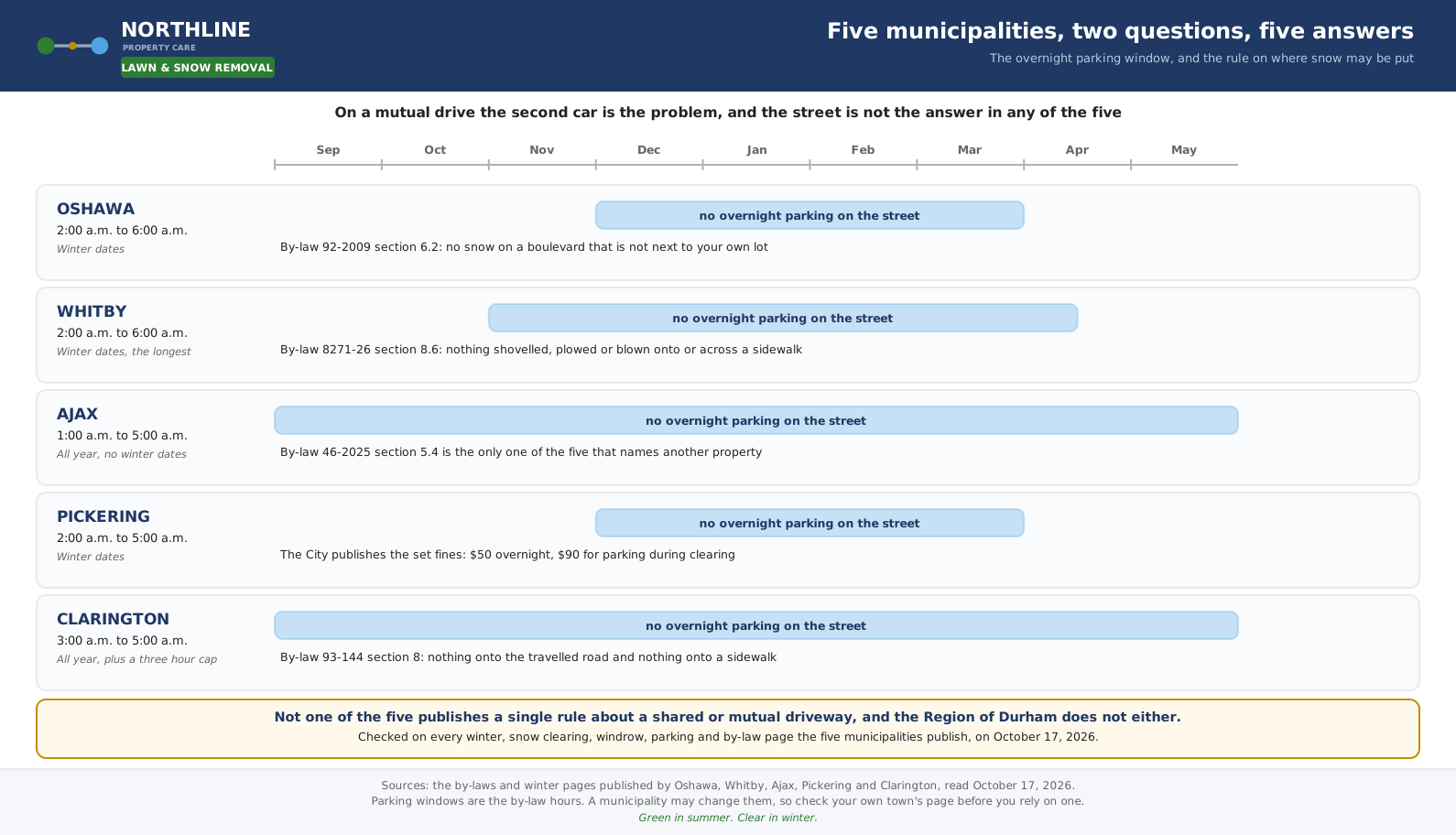
A shared driveway is short of width before it is short of anything else, so the second vehicle is the problem, and the street is not the answer in any of the five municipalities. Every one of them runs a blanket overnight parking prohibition that is set by the clock rather than by the weather, and every one of them separately makes it an offence to park where you interfere with clearing, at any hour of the day.
| Municipality | Overnight hours | When it runs |
|---|---|---|
| Oshawa | 2:00 a.m. to 6:00 a.m. | December 1 to April 1 |
| Whitby | 2:00 a.m. to 6:00 a.m. | November 1 to April 15, the longest window in the Region |
| Ajax | 1:00 a.m. to 5:00 a.m. | All year, with no winter dates at all |
| Pickering | 2:00 a.m. to 5:00 a.m. | December 1 to March 31 |
| Clarington | 3:00 a.m. to 5:00 a.m. | All year, alongside a three hour cap on street parking at any time |
Pickering is the only one of the five that publishes the actual set fines, and they are worth knowing before you decide to risk a night. The overnight winter offence carries a set fine of $50, and parking on the road during snow clearing operations carries $90 with the vehicle subject to being ticketed or towed at the owner's expense. The others refer their amounts to schedules or to the Provincial Offences Act, and Oshawa publishes an escalating ladder of $60, then $80, then $100 specifically for interfering with snow clearing.
Ajax carries one further provision that was written for exactly this situation without ever naming it. Its traffic by-law prohibits parking a vehicle in a way that would prevent the removal of another vehicle previously parked. On a mutual driveway where two households park in tandem on a surface about three metres wide, that is a live rule and not a theoretical one, and it applies on the street side as much as it describes the problem on the slab.
Clarington is the strictest of the five once snow is actually falling. It operates a year round overnight prohibition, a three hour daytime cap, and a separate rule that you cannot park on the street during a snow event at any hour, which overrides its own parking permits. The permit regulations say so in terms: a permit is not valid during any period of snowfall or subsequent snow removal activity. A household that was relying on a permit to solve the second car problem does not have a solution on the one night it needs one.
Put the two halves of this section together and the shape of the problem is clear. The surface has no spare width, the street is closed overnight from somewhere between November 1 and December 1 in three of the five towns and all year in the other two, and the one night both of those bite is the night it snows. That is the night a shared driveway has to be clear early rather than clear eventually, and it is the argument for buying the season rather than the storm.
The municipal assisted programs, and the question none of them answers
Every Durham municipality runs an assisted winter service for older residents and residents with a disability, and not one of them clears a driveway surface. What they clear is the municipal sidewalk and the windrow across the entrance. Whitby charges nothing. Clarington sets a flat fee of $107.69, tax included, and shuts its applications on October 31. Pickering ties its fee to household income and its registration deadline fell on October 16. Oshawa and Ajax publish no figure at all and take the inquiry over the phone.
Clarington is the only one of the five that states how far into the driveway the service reaches, and the number is small: up to three feet of driveway apron adjacent to the road. Oshawa is the only one that publishes a depth threshold, and it will clear a windrow only where the windrow is at least 20 cm. Pickering frames it in a sentence that explains the whole category better than any of the others: driveways form part of the boulevard, and the City does not have the resources to remove the snow from them.
Here is the question none of the five answers, and it is put in the could not verify list below rather than guessed at. Oshawa, Pickering and Clarington all condition eligibility on the property being a single family dwelling or a single dwelling. No municipality publishes how that condition is read for a semi-detached unit that shares one continuous entrance with the unit next door. A semi-detached unit is a single family dwelling in ordinary use, the programs are plainly aimed at a household rather than at a building type, and a household on a mutual driveway has exactly the problem these programs exist to solve. None of that is the same as a published answer, so the honest instruction is to ask your own municipality in writing and keep the reply.
If you do qualify, apply, and understand precisely what arrives. The sidewalk and the ridge at the entrance get cleared. The surface between the ridge and your garage does not, at any depth, in any of the five. That is the gap a contract fills, and our page on snow removal for seniors sets out the eligibility rules in full.
What this page could not confirm
An article that reports only what it found is not showing its method, so this is the list of what was looked for and not obtained. Every item names the thing and the reason.
- A count of shared or mutual driveways anywhere in Ontario. Statistics Canada counts dwellings by structural type and never asks about the driveway, and no provincial ministry or municipality publishes such a count. The table above is a population, not a measurement of the thing itself.
- A government definition of a mutual driveway. The Region of Durham uses the term in its engineering specification and defines it nowhere. No zoning by-law in the five municipalities defines it. Nothing on ontario.ca, and nothing published by the Canada Mortgage and Housing Corporation, defines it either.
- Whether a mutual driveway is more often an easement or shared ownership. No statute, no ServiceOntario publication and no court page states a proportion. Both structures are lawful and the answer is on your own title.
- The text, the section numbers and the penalties of Pickering Ice and Snow Clearing By-law 6650/06. The City links it through a document portal that would not serve the file. Everything attributed to Pickering above comes from the City's own published description of the by-law.
- The section numbers and the set fines in Clarington Traffic and Parking By-law 2014-059. The consolidated document is blocked to automated reading on the Municipality's own portal. The Clarington hours, the three hour cap and the snow event rule are quoted from the Municipality's own published pages instead.
- The administrative penalty amounts behind Ajax by-law 46-2025 section 5.4. The by-law refers them to the Town's administrative monetary penalty system by-law, which could not be located on the Town site. Only the fines on conviction are quoted above.
- How any of the five municipalities reads its single family dwelling condition for a semi-detached unit on a shared entrance. No published answer exists and none was invented.
- Any decided Ontario case on a snow clearing dispute between two owners of one mutual residential driveway. The Court of Appeal decision quoted above concerns a private laneway right of way, and the snow removal point in it was something the applicants asked for rather than something the Court resolved. The main free Canadian case law database refuses automated access, so a search of decided cases could not be run.
The part that costs us the sale, said plainly
If your neighbour already has a contractor, do not hire a second one. Two contractors on one slab arrive at different times and the second one moves what the first one left, which means one household is paying for work that has already been done and done again in the wrong place. The right sequence is that the two households agree on one contractor first and then one of them calls. We would rather lose the quote than be the second truck onto a surface that was already clear at seven in the morning.
A mutual driveway cannot be half cleared, and the consequence is uncomfortable to put in writing. When one household on a shared pair buys a season and the other does not, the whole surface comes clear, because there is no way to clear one side of it. We do not invoice the household that did not buy and we do not chase them. If you are the household paying, you should know that before you sign, and the fair arrangement is the one the two of you settle between yourselves. That conversation is not ours to have and we have no part in it.
And if what you actually need is the ridge at the entrance rather than the whole surface, say so, because that is a smaller job and a cheaper answer. The windrow on its own is a return trip at $45, and the same ridge is covered inside every seasonal package and every membership. There is more about who is responsible for that ridge in each town on our page about windrow clearing across Durham Region.
What we actually do on a shared driveway
The first question on the call is whether the driveway is shared, and it is asked before a price is given. It changes where the snow can go, it changes how long the property takes, and on a narrow pair it changes whether a machine or a shovel finishes the job at the boundary. A quote given without that question is a quote built on a guess about the one thing that makes this surface difficult.
The snow goes onto the paying household's own ground, and only onto their own ground. That means their lawn, or the boulevard directly in front of their own frontage, and it is often the slower route rather than the shortest one. It is not pushed to the road, it is not pushed onto the sidewalk, and it is not put on the neighbour's side of an entrance where nobody can see where the line runs. The by-law is addressed to whoever moves the snow, so that decision protects both of us.
Salting on a shared surface takes a little more thought than on a single driveway, because the meltwater from both halves runs to the same low point by design. Salting comes with Gold and comes automatically and without limit on Platinum. Silver carries no salting at any time, which is the clearest single difference between the tiers and the one most worth understanding before choosing. There is more about dose, timing and the temperature at which salt stops earning its place on our page about driveway salting.
The clearing itself starts at the measured 3 cm residential trigger rather than at a judgement call, and after overnight snow the target is a cleared driveway by 7 AM on Gold and 6:30 AM on Platinum. On a shared surface an early finish is worth more than it is on a single driveway, because two households are trying to leave through the same opening and neither of them can go around the other. What is and is not inside a winter contract is set out in full on our page about what a snow removal contract includes.
Northline is fully insured, the person who quotes the property is the person who does the work, and nothing is subcontracted to somebody you were not told about. On a surface where two households are both occupiers under the Act, knowing exactly who is going to be standing on it matters more than it does anywhere else.
Questions people in Durham actually ask
Who is responsible for clearing a shared driveway in Ontario?
No Ontario statute allocates the work between two owners. The Line Fences Act gives neighbours a municipal arbitration process for a boundary fence and nothing equivalent exists for a boundary driveway. What binds you is whatever is registered on your own title, which is usually either a right of way over the neighbour's half or shared ownership of the strip, and in the absence of anything written there, an agreement the two households make themselves. The Occupiers' Liability Act is separate: it puts a duty of care on each of you at the same time, but it never says who picks up the shovel.
Can my neighbour stop me from clearing the whole driveway?
If your access is a registered right of way, the Court of Appeal for Ontario has held that an encroachment on a private right of way is actionable only where it substantially interferes with the use the grant allows. The practical reading is that a car left on the surface for an afternoon is unlikely to meet that test and a permanent obstruction or a season long snow pile may. An order requiring somebody to stop is equitable relief, which the Small Claims Court has no power to grant, so that application goes to the Superior Court of Justice. This is general information and not legal advice on your property.
Can I put the snow from a shared driveway onto my neighbour's half?
In Ajax, no. By-law 46-2025 section 5.4 is the only provision in the five Durham municipalities that names another property, and it prohibits shovelling, plowing or blowing snow from any property onto a roadway, a sidewalk, a pedestrian walkway or another property without authorization. Oshawa, Whitby, Pickering and Clarington stop at the road, the sidewalk and the boulevard, so snow onto a neighbour's private land is not an offence under their by-laws. Oshawa adds one that catches a mutual entrance: section 6.2 of the Winter Access By-law forbids depositing snow on a boulevard that is not next to your own lot, and the boulevard in front of a shared entrance is partly the neighbour's frontage.
Do both households need their own snow removal contract?
Not necessarily, and on a mutual driveway two contracts are usually worse than one. Half of a shared surface cannot be cleared on its own, so two contractors arriving at different times onto the same slab will undo each other, and the household that gets cleared second pays for work the first one has already moved. The useful conversation happens between the two households before either of them signs anything, and the cost split belongs in that conversation rather than in a contractor's quote.
Who is liable if somebody falls on a shared driveway?
Potentially both of you, at once. The Occupiers' Liability Act defines an occupier as a person in physical possession of premises or in control of their condition, and it says so applies despite the fact that there is more than one occupier of the same premises. Section 3 then puts the same duty of reasonable care on each occupier. Section 6 gives an occupier who hires a competent contractor a defence where the work was properly done, and subsection 6 (2) spreads the benefit of that defence to every occupier of the premises rather than only the one who did the hiring.
We have used the whole driveway for twenty years. Does that give us a right to it?
In the Land Titles system, no. Section 51 (1) of the Land Titles Act says no right or interest adverse to the registered owner may be acquired by any length of possession or by prescription. Most of Durham Region is registered land, so long use on its own builds nothing. A prescriptive right can still exist on land that remained in the Registry system, under section 31 of the Real Property Limitations Act, which is why the answer is a search of your own parcel register and never a rule of thumb.
Who wrote this, and what was read to write it
This page was written by the owner of Northline Property Care, who runs the winter work in Durham Region and has done this job for six winters. The business is owner operated out of Oshawa and serves Oshawa, Whitby, Ajax, Pickering, Bowmanville, Courtice and Clarington. The person who prices a property is the person who clears it, which on a shared driveway is the only way to know in advance where the snow is going to end up.
Every statute quoted above was read on Ontario e-Laws, and the section numbers are given so that any line of it can be checked. The by-laws were read on each municipality's own site, in October 2026. The dwelling counts come from the 2021 Census of Population and were taken from the Region of Durham's own published report, which matches the census tables exactly. The court decision was read on the Court of Appeal for Ontario's own decisions site. Nothing on this page is taken from any company that competes for the same customer, which is a standing rule here and the reason the findings above are not the ones every other page in this market carries.
Nothing here is legal advice, and a shared driveway is one of the few domestic questions where the answer genuinely turns on a document specific to your address. If a disagreement with a neighbour has reached the point of letters, the document to put in front of a lawyer is your parcel register, and it will cost less to pull than the first hour of anybody's time.
Read next
The ridge at the entrance
Who clears the windrow in each Durham municipality, what the assisted programs actually reach, and when the applications close.
Read the windrow page →The Oshawa by-law
The deadline on your own sidewalk, what the City will do if it goes past, and the penalty ladder behind the whole Winter Access By-law.
Open the by-law page →What a membership covers
The three tiers side by side, what each one does in a storm, and the one difference that decides which of them suits a property.
Compare the tiers →Andrew answers, October 2026
My neighbour and I share a driveway. Can we split one price between us?
The quote goes to one property and one person signs it, because somebody has to be responsible for the account and I am not going to invoice two households for one surface. What the two of you do about the cost afterwards is entirely yours to arrange, and plenty of neighbours split it directly. What I would ask is that whoever signs tells the other one it is happening, because a truck arriving at six in the morning on a driveway the neighbour did not know was being cleared is a conversation nobody enjoys.
One of these goes on each page and it is replaced monthly. If the question you have is not here, ask it: 905-244-5779.
Tell me it is a shared driveway and I will tell you where the snow goes
Most properties are priced from the map without anybody driving out. Send the address, say whether the entrance is shared and whether the neighbour already has somebody, and you get a real number the same day along with the route the snow will take off the surface. If a municipal program covers what you actually need, I will say so instead.