Snow removal · Whitby
Snow Removal Cost in Whitby, and the Ten Centimetres That Decide It
Snow removal cost in Whitby runs $45 to $95 a clear, or $800 to $1,200 plus HST for the season. Your street is a Class 5 road, so the Town is not obliged to touch it until ten centimetres have fallen.
Written for the town itself. See snow removal in Whitby.
Green in summer. Clear in winter.
The short answer
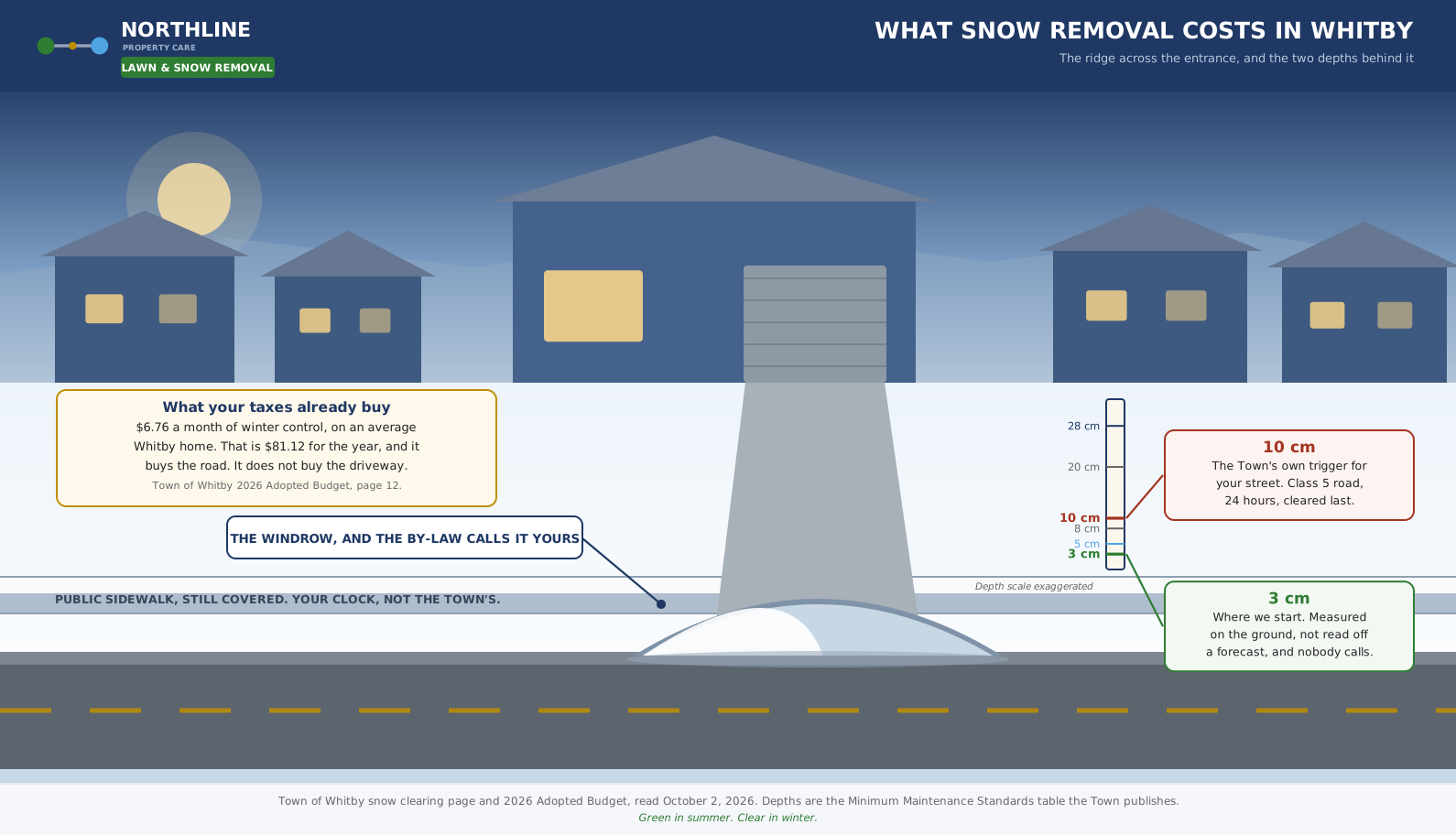
In Whitby you are buying the gap between ten centimetres and three. The Town of Whitby publishes a Minimum Maintenance Standards table on its own snow clearing page, and a residential street sits at the bottom of it: ten centimetres of accumulation, twenty four hours to meet the standard, and tertiary streets handled only after the primary and secondary network is done. Your own driveway is never in that table at all. Your sidewalk is, but in the opposite direction, because the Clean Community By-law gives you twenty four hours from the accumulation and names the windrow as part of what you have to move.
A seasonal snow package at the standard band is $975 plus HST for the whole winter. A membership that includes the driveway starts at $189 a month plus HST. Buying it one storm at a time runs $45 to $95 a clear plus $40 to $90 for a salt application, and the break even against the package lands around the eighth clear of a winter that averages twelve. The rest of this page is where those numbers come from and which one is actually right for your property.
Start with the number your taxes already buy, because it is smaller than people expect
Winter control costs an average Whitby household $6.76 a month. That figure is not an estimate. It is printed on page 12 of the Town of Whitby 2026 Adopted Budget, in the table headed what services taxpayers receive for their monthly Town taxes, calculated against an average Whitby home assessment of $503,000. It splits as $5.95 of operating and $0.81 of capital. Over a year that is $81.12.
Hold that number next to what it has to cover. The Town maintains over 1,205 lane kilometres of road, 335 kilometres of sidewalk, 297 cul de sac locations and 122,000 square metres of parking lot. Eighty one dollars a year per household against that network is remarkably good value, and it is also the clearest possible statement of what municipal winter maintenance is for. It is for the road. It was never for your driveway, and no amount of calling the Town will make it so.
The same line has moved steadily. In the 2022 budget book it read $8.15 a month, which included a much larger capital component. In the 2025 to 2027 adopted budget the 2025 figure was $5.78 operating plus $0.79 capital. The Town names the driver in its own words in that document: increasing winter control costs for supplies such as salt and brine. Salt is getting more expensive for the municipality for exactly the same reasons it is getting more expensive for a contractor, which is worth remembering the next time a private winter quote moves.
So the first honest framing of this whole question is a subtraction. You are already paying $81.12 a year for winter, and it buys the road in front of your house on the Town's own schedule. Everything from the curb line inward is a separate purchase, and the only question left is which of three ways you make it.
Ten centimetres, twenty four hours, and cleared last
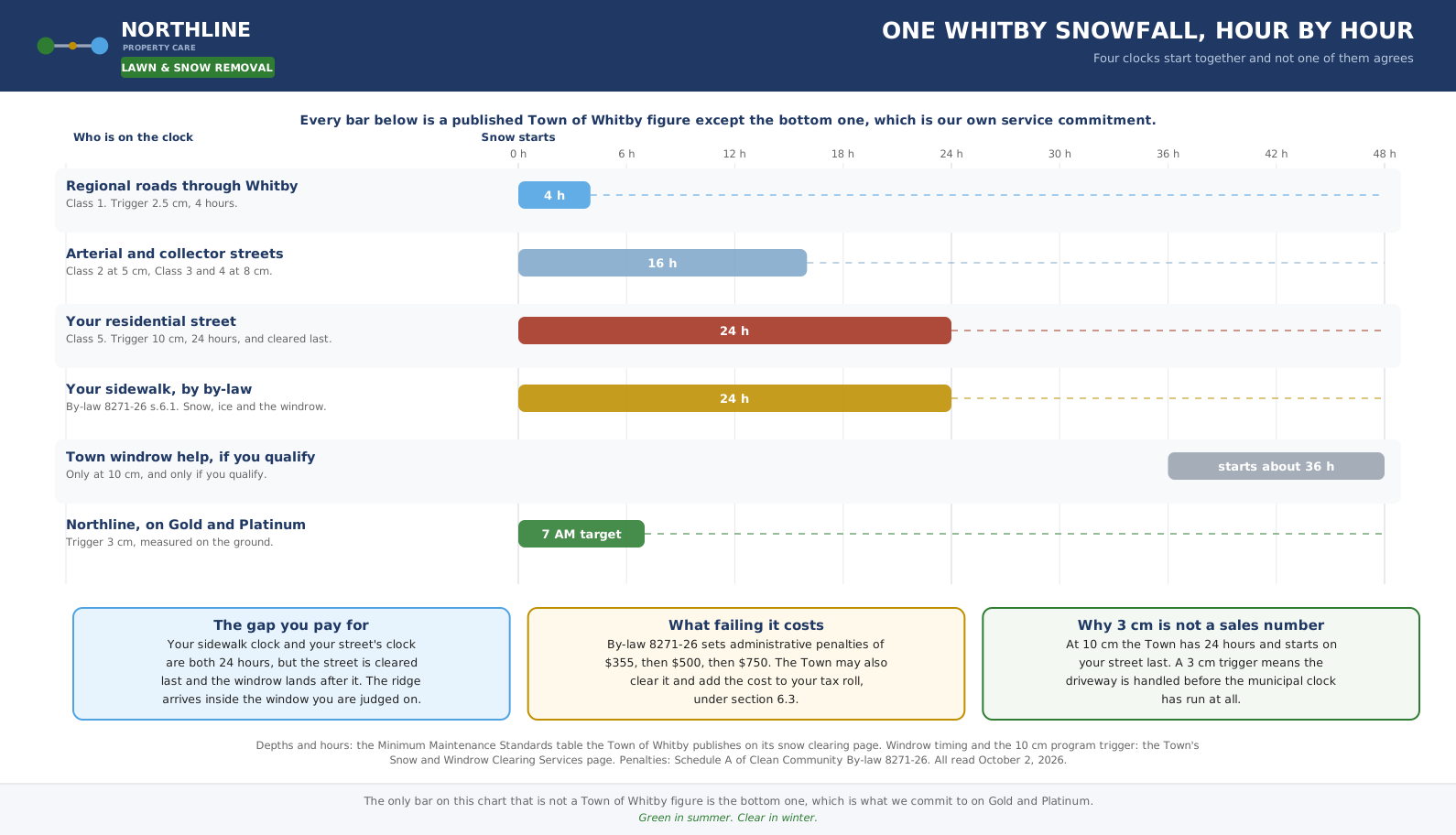
Whitby does not set its own trigger depths and says so plainly. The Town's snow clearing page states that it follows the clearing practices, timing and snow depth, set in the Minimum Maintenance Standards for Municipal Highways under Ontario Regulation 239 of 2002. It then reproduces the table. Class 1, which is the Regional roads running through Whitby, triggers at 2.5 centimetres with four hours to meet the standard. Class 2 is 5 centimetres and six hours. Class 3 is 8 centimetres and twelve hours. Class 4 is 8 centimetres and sixteen hours. Class 5, which is your residential street, is 10 centimetres and twenty four hours.
Two things in that table are easy to miss and both of them cost money. The first is that the clock does not start when the snow starts. It starts when the depth is reached. A nine centimetre snowfall on a Whitby residential street starts no clock at all. The second is the order. The Town states that it will focus on tertiary roads, sidewalks, trails and parking lots once primary and secondary roads have been completed. Your street is both the last trigger to fire and the last queue to be served.
None of this is a criticism of the Town. It is a sensible allocation of a finite winter budget across 1,205 lane kilometres, and the arterial network genuinely has to come first because that is where the ambulances are. But it is the single fact that decides what a private service is worth in Whitby, and almost every price conversation skips it.
Your own deadline is shorter than the Town's, and the by-law names the windrow
Whitby gives you twenty four hours from the accumulation, not twenty four hours from the end of the storm. The governing instrument is the Clean Community By-law, number 8271-26, passed on March 9, 2026 and effective April 1, 2026. Section 6.1 loads three duties onto an owner at once. Snow and ice, and the clause says "including a windrow", have to come off any sidewalk. They also have to come off the ground inside a sixty centimetre radius of any fire hydrant standing on a boulevard. And both of those are due no later than twenty four hours after the accumulation.
Read that clause twice, because three separate obligations are hiding in one sentence. The sidewalk is yours. The fire hydrant on your boulevard is yours, to a sixty centimetre radius, and almost nobody in Whitby knows that. And the windrow is named in the by-law by that word, which removes any argument about whether the ridge the street plow leaves is somebody else's problem. It is not. The Town's own snow clearing page says the same thing in plain words: clear your own driveway, and keep your windrows left by snowplows cleared on both the road and sidewalks, which the Town's own sidewalk page notes may need doing more than once a day depending on the severity of the event.
What failing it actually costs
Schedule A of the same by-law sets administrative monetary penalties in three tiers. Item 22, against section 6.1, is $355 for the first tier, $500 for the second and $750 for the third. Item 29, against section 8.6, carries those same three figures. It covers shovelling, plowing or blowing snow onto a highway, and equally moving it across one, together with a sidewalk and a pedestrian walkway. These are administrative penalties rather than set fines, which matters procedurally, but the number on the notice is the number.
There is a second exposure and it is the one most people have never heard of. Section 6.3 provides that where a person fails to comply, the Town may enter upon the property, achieve compliance at the expense of the defaulting person, and recover the cost by adding it to the tax roll and collecting it in the same manner as taxes. A charge that lands on your property tax bill is not a charge you negotiate.
And then there is the civil side, which is larger than either. Section 6.1 of Ontario's Occupiers' Liability Act, added by the Occupiers' Liability Amendment Act of 2020, requires a person injured by snow or ice to serve written notice of the claim within sixty days of the occurrence. Notice may be served on the occupier. It may equally be served on an independent contractor the occupier has engaged to clear snow or ice there. That second limb is the part worth noticing if you hire the work out: the Act names your contractor as a person who can be served, which means your contractor is a foreseeable defendant standing beside you rather than instead of you. Ask any contractor you are considering for proof of insurance before you ask them for a price. We are fully insured and will send the certificate without being chased for it.
The Town will clear your windrow for free, and most people reading this will not qualify
Whitby runs a snow and windrow clearing service and it costs nothing. The Town's page states that there is no fee charged for this service. If you are eligible, stop reading about private pricing and go and register, because no contractor on earth beats free and anybody who tries to talk you out of it is selling rather than advising.
The eligibility is narrow and it is worth stating exactly. You must be sixty five years of age or older, or certified in writing by a medical doctor to be physically unable to clear snow. You must also not have someone in the home under sixty five who can assist with snow clearing. Applications for the current season opened on September 14, 2026 and all applications must be submitted by November 1, 2026. The service runs November 1 to April 15, and it is not available to residents who are away for more than forty five consecutive days inside that window.
Four limits on the program are the reason it does not answer the whole question even for people who do qualify. Windrows are cleared only when there is at least ten centimetres of snowfall, so a registered household gets nothing from a nine centimetre storm. Sidewalks are cleared at five centimetres. Clearing typically begins about thirty six hours after the snow has stopped falling, which is a start time rather than a finish time, and it is twelve hours longer than the by-law clock the same household is held to. And the scope is explicit: the service covers only the Town owned portion of the property, meaning the ridge left by the plow and the public sidewalk. The driveway itself is not cleared, and clearing ice formation is stated to be the responsibility of the homeowner.
So the free program is real, it is genuinely useful, and it solves the windrow and the sidewalk for a qualifying household on storms over ten centimetres. It does not solve the driveway, it does not solve ice, and it does not solve the nine centimetre morning when you still have to get the car out. That is the honest shape of it, and we would rather you heard it from us than discovered it in February.
Nine mornings, not thirty, and the number nobody prices against
Whitby averages nine days a year with more than five centimetres of snowfall. That figure comes from the Durham Region future climate study, which reports a baseline for the 2000 to 2009 decade municipality by municipality. The Whitby row reads nine days a year over five centimetres, 129 frost days a year with a minimum below zero, twenty seven days a year below minus ten, and a maximum one day snowfall of twenty eight centimetres. The same study projects the over five centimetre count falling to two days a year by the 2040s, which is a change of a different order from the one most people assume is coming.
For annual total, the nearest published figure to Whitby is Oshawa at 118.4 centimetres a year, from Statistics Canada reporting Environment Canada climate normals. Toronto reads 115.4 in the same table. For context in the same table, London reads 202.4 and Sudbury 274.4. Durham is not a snowbelt and pretending otherwise is the oldest trick in winter sales.
Our own trigger is lower than the Town's, so our own event count is higher than nine. We clear residential properties at three centimetres measured on the ground, and against eighteen complete winters of Environment Canada data from the Oshawa station, three centimetres produces an average of 11.4 clearing days a winter, with a median of twelve. The mildest of those eighteen winters produced four. The worst produced twenty four.
Say both halves of that or do not say it at all. About twelve clears a winter is the honest average, as few as four and as many as twenty four is the honest spread, and a company that quotes you the average without the spread is selling you a number the weather is under no obligation to deliver. It is also the reason we do not argue the price on event count. The product is not twelve clears. The product is that the price does not move when the weather does.
What the depth weighs, because a forecast number is not a workload
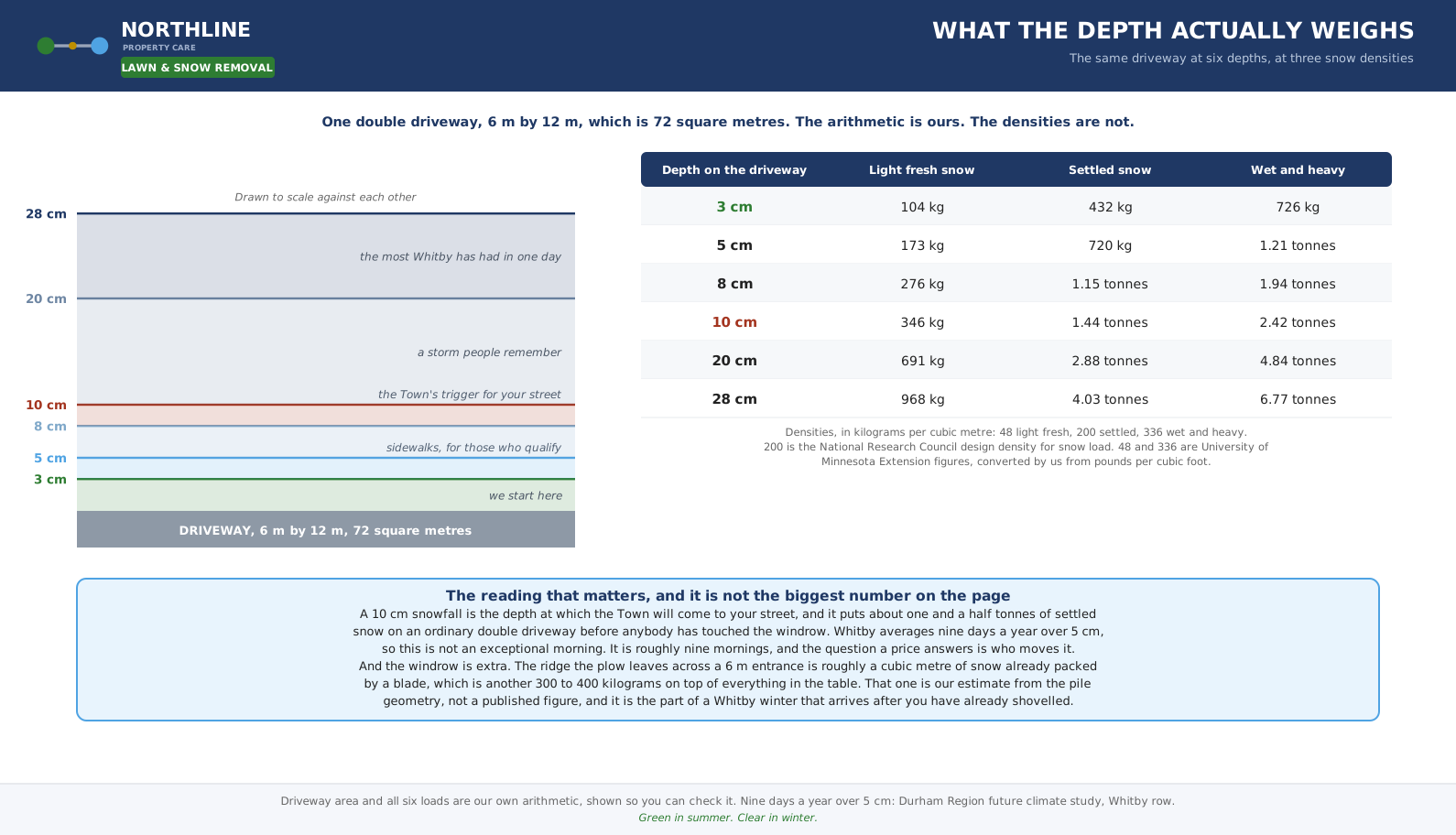
A centimetre on a forecast is an abstraction and a kilogram on a shovel is not. An ordinary Whitby double driveway runs about six metres by twelve, which is seventy two square metres. Snow density varies enormously, so the only defensible way to do this is to give you a range rather than a single figure. The National Research Council uses a design density of about 200 kilograms per cubic metre for roof snow load. University of Minnesota Extension gives light fluffy snow at about three pounds per cubic foot, wet heavy snow at twenty one, and ice at around fifty seven, which convert to roughly 48, 336 and 913 kilograms per cubic metre.
Run those through the driveway. Ten centimetres over seventy two square metres is 7.2 cubic metres. At the light end that is about 346 kilograms. At the National Research Council design density it is about 1.44 tonnes. At the wet and heavy end it is about 2.42 tonnes. A twenty centimetre storm doubles every one of those. The twenty eight centimetre day that the Durham study records as Whitby's baseline maximum puts between about 968 kilograms and 6.77 tonnes on the same slab depending on what kind of snow it was.
Then add the windrow, which is the part the arithmetic above leaves out. The ridge a street plow leaves across a six metre entrance is roughly a cubic metre of snow that a blade has already compacted, which puts it somewhere in the region of 300 to 400 kilograms on top of everything in the table. That one is our estimate from the pile geometry rather than a published figure and we label it as ours. It is also the single most hated third of a tonne in Durham Region, because it arrives after you have finished shovelling and it is harder than anything you have just moved.
We publish this because a price argument conducted in centimetres is a price argument nobody can evaluate. If you have moved one and a half tonnes of settled snow with a shovel before work, you already know what the service is worth to you, and if you have not, the table tells you what you would be taking on.
The three ways to buy it in Whitby, and the arithmetic of each
There are only three structures, and the right one depends on one question about your winter rather than on your budget. The question is whether you want a predictable annual number or a low floor with a tail risk, and whether what you actually need is snow, or ice, or both.
One storm at a time
A one off clear runs $45 to $95 depending on the property, and a salt application runs $40 to $90. A salt only trip on its own is $25 and a windrow return trip is $45. In a four clear winter that is cheap and nobody should pretend otherwise. In a twenty four clear winter it is the most expensive way to buy snow removal in Whitby by a wide margin, and the break even against a seasonal package lands around the eighth clear. The second disadvantage is the one that actually bites: a per visit customer is not on a route, so a per visit customer is served when there is room, not at a target time.
A seasonal snow package
The seasonal snow package is $800 for a small property, $975 for a standard one and $1,200 for a large one, plus HST, booked by November 1. It covers the driveway, the walkway and salting, unlimited, at the three centimetre residential trigger, with the 7 AM target after overnight snow. The whole argument for it is in one sentence: whether the winter brings four snowfalls or twenty four, the seasonal price does not change. It is one payment for one season and it does not touch your summer.
A year round membership
A membership is twelve equal monthly payments covering both seasons. Silver is $129 a month plus HST. Gold is $189. Platinum is $279.
Silver does not plow your driveway, and that is the distinction that matters most in Whitby. Silver gets the windrow pass after every storm, cleared by 5 PM, plus four banked full clears a season on request, and there is no salting on Silver at all. If your worry is getting the car out before work, Silver is the wrong product and we will tell you so before you buy it rather than after.
Gold plows the driveway and carries the 7 AM target after overnight snow. Platinum is sequenced first with a 6:30 AM target, unlimited automatic salting and first choice of service day. All three are billed in twelve equal payments on the last day of the month, with the first taken on the last day of the month before service starts. There is no deposit and no cancellation fee. Annual prepay takes five per cent off the annual price, raised as a single invoice.
Where each one wins
Buy per visit if you are physically able to do most of it and you want a contractor for the two mornings a winter you cannot face it. Buy the seasonal package if you want winter solved, you do not want a summer commitment, and you want one number you can put in a budget. Buy a membership if you want the same company handling the lawn from May and the driveway from November, because the monthly payment is then doing two jobs and the per season arithmetic changes. Twenty six weekly cuts at the $75 floor is $1,950 plus HST for mowing alone, against Gold at $2,268 for the year, which covers the same weekly cut, the spring cleanup, the fall cleanup and the driveway plowed after every storm. Three hundred and eighteen dollars buys the entire winter. That comparison is the whole reason the membership exists, and it only works if you were going to buy weekly mowing anyway.
If you want to see how the three sit side by side across the region rather than in Whitby alone, we have written out the full regional version with the municipal figures behind it in what snow removal actually costs in Durham Region.
Whitby is not one town, and a price that pretends it is will be wrong somewhere
Whitby runs from the Lake Ontario shore at about seventy five metres above sea level up into the Oak Ridges Moraine, which reaches as high as three hundred. That is a real gradient inside one municipality, and Whitby's own Official Plan recognises all three bands: the Lake Ontario waterfront, the former Lake Iroquois beach, and an Oak Ridges Moraine secondary plan at section 11.7. University of Toronto Scarborough puts the moraine at up to three hundred metres against Lake Ontario at seventy five, and Durham Region's official plan mapping carries a moraine boundary segment for Whitby alongside five other municipalities. A property in Ashburn or Myrtle is in genuinely different country from a property off Victoria Street, and the winter it gets is different too.
The soil underneath is different as well, and here we have to correct something the trade says constantly. We queried the Province of Ontario's own Soil Survey Complex at thirteen points across Whitby, from the lakeshore to the Myrtle and Ashburn end, and not one of them returned a clay or clay loam surface texture. North Whitby and the Brooklin edge come back as Bondhead sandy loam and Bondhead loam, well drained. The middle of the town and the Columbus Road area read Darlington loam, well drained. Myrtle Station reads Dundonald sandy loam. The west side inland of the lakeshore reads Brighton sandy loam. Two pockets behave differently and they are the ones worth knowing about: the Thickson and Taunton area on the east side reads Tecumseth sandy loam, imperfectly drained, and the northwest corner reads Granby sandy loam, poorly drained. Right at the lake, Lynde Shores reads marsh and the Lynde Creek flats read bottom land.
Why this belongs in a cost article rather than a gardening one: drainage class decides where meltwater goes, and where meltwater goes decides which driveways glaze over on the refreeze. An imperfectly drained lot near Thickson and Taunton and a poorly drained lot in the northwest hold water that a well drained Bondhead lot sheds, and a property that reliably glazes is a salting property rather than a plowing property. That is a different purchase at a different price, and it is one of the few things that genuinely justifies quoting two neighbours in the same town differently.
Lot size is the other one, and it is the straightforward half. Above roughly a third of an acre, or on a driveway longer than one hundred feet, standard residential pricing stops being honest and the Estate band applies: seasonal snow at $1,750, or memberships at $229, $349 and $499 a month. From one acre, or a laneway over two hundred and fifty feet, the Grand Estate band applies at $2,600 seasonal, or $329, $519 and $739 a month, and a laneway over four hundred feet adds $200 for each additional hundred feet. Those bands exist so that a north Whitby property can be priced over the telephone from the acreage and the laneway length, both of which are on your listing and your tax bill, without anybody driving out to look at it first. The full detail sits on the estate and acreage page.
What the climate is quietly doing to this price
The Durham Region climate study projects 146 per cent more rain and 61 per cent less snow in January by the 2040s, and 217 per cent more rain with 75 per cent less snow in February. Read as a snow forecast that sounds like good news. Read as a winter maintenance forecast it is the opposite, because winter rain falling on a surface that is at or below freezing is an ice event, and an ice event is the one thing a plow cannot help with.
Environment and Climate Change Canada's 2026 changing climate report records snow cover duration in southern Ontario shortening by one to four weeks, at medium confidence. Shorter snow cover plus more winter rain plus the Whitby baseline of 129 frost days a year is a recipe for more freeze and thaw cycling, not less. The cost of a Whitby winter is migrating from the blade to the bag.
Which brings up the limit nobody mentions when they quote a salting price. The Transportation Association of Canada's guidance on salt use for private roads, parking lots and walkways gives the lowest working temperature of sodium chloride as minus ten degrees Celsius. Whitby averages twenty seven days a year below minus ten. On those days rock salt is not slow, it is finished, and spreading more of it achieves nothing except the chloride load. That matters because road salts were assessed as toxic under section 64 of the Canadian Environmental Protection Act in the 2001 Priority Substances List assessment, which records that sensitive terrestrial plants are affected by soil concentrations above 68 milligrams of sodium and 215 milligrams of chloride per kilogram. Road salts were never added to Schedule 1 of the Act; Environment and Climate Change Canada published a Code of Practice in 2004 instead, which asks organizations using more than 500 tonnes a year to run a salt management plan.
The practical version for a Whitby driveway: a correct dose at minus four degrees does more than a heavy dose at minus twelve, and below the working temperature the answer is traction material rather than more chloride. We have written the full version of that argument, including what chloride does to concrete and to the creek at the bottom of the street, in the guide to when salt stops working. If what worries you is specifically glaze rather than snow, the freezing rain page is the one to read, because every tool reverses during that event.
The unprofitable part, said plainly
If you are sixty five or over in Whitby, or a doctor will certify that you cannot clear snow, and there is nobody under sixty five in the house, go and register for the Town's free windrow program before November 1 and do not buy anything from us for the windrow. It is free, it is run by the municipality you already pay, and no private price competes with zero. If after registering you still need the driveway itself cleared, or you need ice handled, those are the two things the program explicitly excludes and that is the conversation worth having.
Second, if your honest answer is that there are two mornings a winter you cannot face, buy those two mornings. A one off clear at $45 to $95 twice a season is around $190 at the top of the range. A membership is not a better deal than that and we are not going to construct an argument that it is.
Third, and this is the one that costs us the most to write down: Silver at $129 a month does not plow your driveway. It is the cheapest entry on our own price list and it is the wrong product for the person who most often asks for it, which is somebody whose entire concern is getting out of the driveway in the morning. That person needs Gold at $189. We would rather lose the sale at the bottom of the ladder than place somebody on a tier that does not do the thing they bought it for.
Fourth, a seasonal package in a mild winter is money you did not need to spend. Four clears against $975 is roughly $244 a clear, which is a bad outcome by any measure. The package is insurance, it is priced as insurance, and in a mild year insurance looks like waste. That is how insurance works and it is not a hidden feature.
How a Whitby property actually gets priced here, in order
Nobody drives out to look at your driveway before quoting it, and that is a deliberate design decision rather than a shortcut. A site visit costs time that ends up in the price, and almost everything needed to price a residential property in Whitby is already written down somewhere you can read.
The sequence is this. First the lot size and the laneway length, which are on your listing and your tax bill, and which decide whether you are standard, Estate or Grand Estate. Those two numbers beat whatever property type anybody selects from a dropdown, and where they disagree the band moves up rather than down. Second the driveway itself: width at the road, length, surface, and whether it slopes toward the garage, because a sloping driveway on an imperfectly drained lot is a salting property. Third, where the snow is going to go, which is the question people forget until the third storm of the season. Whitby's by-law forbids putting snow onto a highway or pushing it across one, and the same clause reaches a sidewalk and a pedestrian walkway. The Province publishes its own guidelines on snow disposal for anybody hauling it away in bulk, so the pile has to live on your property, and on a narrow lot that constrains the whole plan.
One point of law here is worth stating because people assume the opposite. We read the whole of section 8 of By-law 8271-26 and there is no provision prohibiting pushing or piling snow onto a neighbour's private property, and no provision stating where on your own land snow may be piled. Snow is covered only by section 8.6, which is limited to a highway, a sidewalk or a pedestrian walkway. In Whitby, a dispute with a neighbour about a snow pile is a civil matter rather than a by-law matter. That is a confirmed absence rather than a gap in our reading, and it is the kind of thing worth knowing before the argument rather than during it.
Fourth and last, what you actually want. Snow only, ice only, or both. We ask that question before we quote because the answer changes the tier more often than the driveway size does. The whole route runs November 1 to May 1, and it closes when it is full. There is no calendar closing date here and no invented deadline either. The limit is arithmetic rather than marketing. A morning target can only be promised to as many properties as will fit inside one morning, so the list shuts on the day it fills and stays shut until the next autumn. The only real deadline on this page is the Town's, which is November 1 for the free windrow program.
If you want to see what the municipalities are doing on any given morning before you call anybody, every Durham tracker and activity report sits in one place on the Durham snow plow tracker index, beside the live warning state.
What we could not verify
Not one external number above was taken from another contractor. They come from the Town, the Region, the Province, the federal government, the Transportation Association of Canada, Statistics Canada and two universities, and each is named where it is used. Nothing comes from a competitor's price page, which is a deliberate rule and not an accident of searching. Here is what we went looking for and did not find.
We could not open the text of Ontario Regulation 239 of 2002 itself. Ontario's e-Laws site served us a notice requiring JavaScript on every attempt, so the class by class table above rests on the Town of Whitby's own reproduction of the standard rather than on the regulation. We are not citing a section number for the snow accumulation standard, because we could not read one.
We could not find a total dollar winter control budget for the Town of Whitby. The 2026 adopted budget, the 2025 to 2027 adopted budget and the 2022 budget book all carry the per household monthly tax allocation and none of them carries a departmental winter control operating line that we could locate. We also found no published salt tonnage for Whitby and no count of households registered in the windrow program.
We could not reach a single Environment and Climate Change Canada climate normals station page. Every host serving station level normals refused our requests. The 118.4 centimetre annual snowfall figure for Oshawa therefore comes from Statistics Canada citing Environment Canada, over a normals period the Statistics Canada table prints as 1971 to 2001, which is almost certainly a typographical error for 1971 to 2000. We are not stating a station name, a station identifier or a normals period with any precision as a result. Our own eighteen winter event count is derived from Environment Canada data held in our own records rather than re fetched today.
We could not find any Environment and Climate Change Canada or academic source describing a snowfall gradient between the Lake Ontario shore of Durham and the inland north, so there is no lake effect or snow shadow claim anywhere on this page. Everything we found on that subject came from commercial weather media, which is not a source we will cite.
We could not find point elevations in metres for the Whitby lakeshore, Brooklin, Ashburn or Myrtle. Natural Resources Canada's elevation service refused every request. The seventy five metre and three hundred metre figures are for Lake Ontario and for the Oak Ridges Moraine generally, from the University of Toronto Scarborough, and not for any named Whitby location.
We could not find a published freeze and thaw cycle count for southern Ontario. We have used the 129 frost days figure instead and we have deliberately not converted it into a cycle count, because that conversion would be ours and it would look like somebody else's.
We could not read the original 1956 Soil Survey of Ontario County report, which is not available as a document. The soil series named above come from the Province of Ontario's current Soil Survey Complex queried point by point, not from the historical survey text, and we have no horizon descriptions or parent material detail.
Finally, and this is a correction against our own material rather than a gap: our own internal reference describes Durham as clay and clay loam. For Whitby specifically, at thirteen sampled points, the provincial dataset does not support that. We have published what the dataset says and we are treating our own note as the thing that needs checking.
Questions people in Whitby actually ask
How much does snow removal cost in Whitby?
A seasonal snow package covering the driveway, walkway and salting runs $800 for a small property, $975 for a standard one and $1,200 for a large one, plus HST, booked by November 1. A year round membership that includes the driveway plowed starts at $189 a month plus HST. Buying it one storm at a time runs $45 to $95 a clear plus $40 to $90 for a salt application, and the break even against the seasonal package lands around the eighth clear of a winter that averages about twelve. Properties over roughly a third of an acre or with a driveway longer than one hundred feet are priced on the Estate band instead.
At what depth does the Town of Whitby plow my street?
Ten centimetres. Your residential street is a Class 5 highway under the Minimum Maintenance Standards the Town publishes, which gives a trigger of ten centimetres of accumulation and twenty four hours to meet the standard. The Town also states that tertiary roads are handled once primary and secondary roads have been completed, so a residential street is both the last trigger to fire and the last in the queue. Regional roads through Whitby are Class 1 and trigger at 2.5 centimetres with four hours.
How long do I have to clear my sidewalk in Whitby?
Twenty four hours after the accumulation of snow or ice, under section 6.1 of the Clean Community By-law 8271-26. The same clause covers the windrow by name and requires a sixty centimetre clear radius around any fire hydrant on your boulevard. Note that the clock runs from the accumulation and not from the end of the storm.
What is the fine for not clearing snow in Whitby?
Schedule A of By-law 8271-26 sets administrative monetary penalties of $355, then $500, then $750 by tier, for failing to clear a sidewalk or a hydrant radius, and the same three figures for shovelling, plowing or blowing snow onto a highway, a sidewalk or a pedestrian walkway. Section 6.3 also allows the Town to clear it and recover the cost by adding it to your tax roll.
Does Whitby clear the windrow across my driveway?
Only for registered households in the free Snow and Windrow Clearing Services program, which is open to residents sixty five or over, or certified by a doctor as physically unable to clear snow, with nobody under sixty five in the home who can help. Applications for this season opened September 14, 2026 and close November 1, 2026. The service triggers at ten centimetres, typically begins about thirty six hours after the snow stops, covers only the Town owned portion and the public sidewalk, and excludes both the driveway itself and ice.
Is a seasonal snow package cheaper than paying per storm in Whitby?
It depends entirely on the winter, and the break even is around the eighth clear. At the three centimetre residential trigger, eighteen winters of Environment Canada data from the Oshawa station give an average of 11.4 clearing days and a median of twelve, with a mildest season of four and a worst of twenty four. A normal winter lands past the break even and a mild one lands under it. The argument for the package has never been that it always wins. It is that your winter number is fixed in October and no amount of weather can move it afterwards.
Why does my neighbour in north Whitby pay more than I do?
Usually lot size. Above roughly a third of an acre, or a driveway over one hundred feet, the Estate band applies at $1,750 for the season or $229, $349 and $499 a month. From one acre or a laneway over two hundred and fifty feet, the Grand Estate band applies at $2,600 for the season, and a laneway over four hundred feet adds $200 for each further hundred feet. Drainage is the second reason: an imperfectly drained lot near Thickson and Taunton or a poorly drained one in the northwest glazes over on the refreeze in a way a well drained Bondhead lot does not, and a glazing property is a salting property.
Does the cheapest membership plow my driveway?
No. Silver at $129 a month plus HST gets the windrow pass after every storm, cleared by 5 PM, and four banked full clears a season on request, and there is no salting on Silver. If what you need is the driveway plowed with a 7 AM target after overnight snow, that is Gold at $189 a month plus HST, and Platinum at $279 is sequenced first with a 6:30 AM target and unlimited automatic salting.
Who wrote this
Andrew owns and operates Northline Property Care out of Oshawa and works across Whitby, Ajax, Pickering, Bowmanville, Courtice and Clarington. Six winters clearing snow in Durham Region sits behind that. It is his own record and not a trading history for the business, which registered in August 2026. Whoever prices a property here is whoever turns up to it afterwards.
The method on this page is worth stating because it is unusual. Every external figure was taken from the Town of Whitby, the Regional Municipality of Durham, the Province of Ontario, the Government of Canada, the Transportation Association of Canada, Statistics Canada or a university, and the page names the document and the year. Nothing was taken from another property maintenance company, including the prices, because a competitor's price page is marketing rather than evidence. Where the arithmetic is ours it says so on the face of it, and the things we went looking for and could not find have their own section above instead of quietly disappearing. If something here is wrong, 905-244-5779 reaches the person who wrote it, which is faster than any correction form.
Read next
Snow removal in Whitby
The service page for the town itself: wide double driveways, the Rolling Acres and Brooklin end, trigger depth and morning targets.
Open the Whitby page →Every windrow program in Durham
Which municipalities clear the ridge, what each one charges, who qualifies and when each registration window closes.
Compare the programs →What each tier actually includes
The three memberships side by side, what the entry tier does not cover, and how twelve equal payments are taken.
See the memberships →The work, photographed
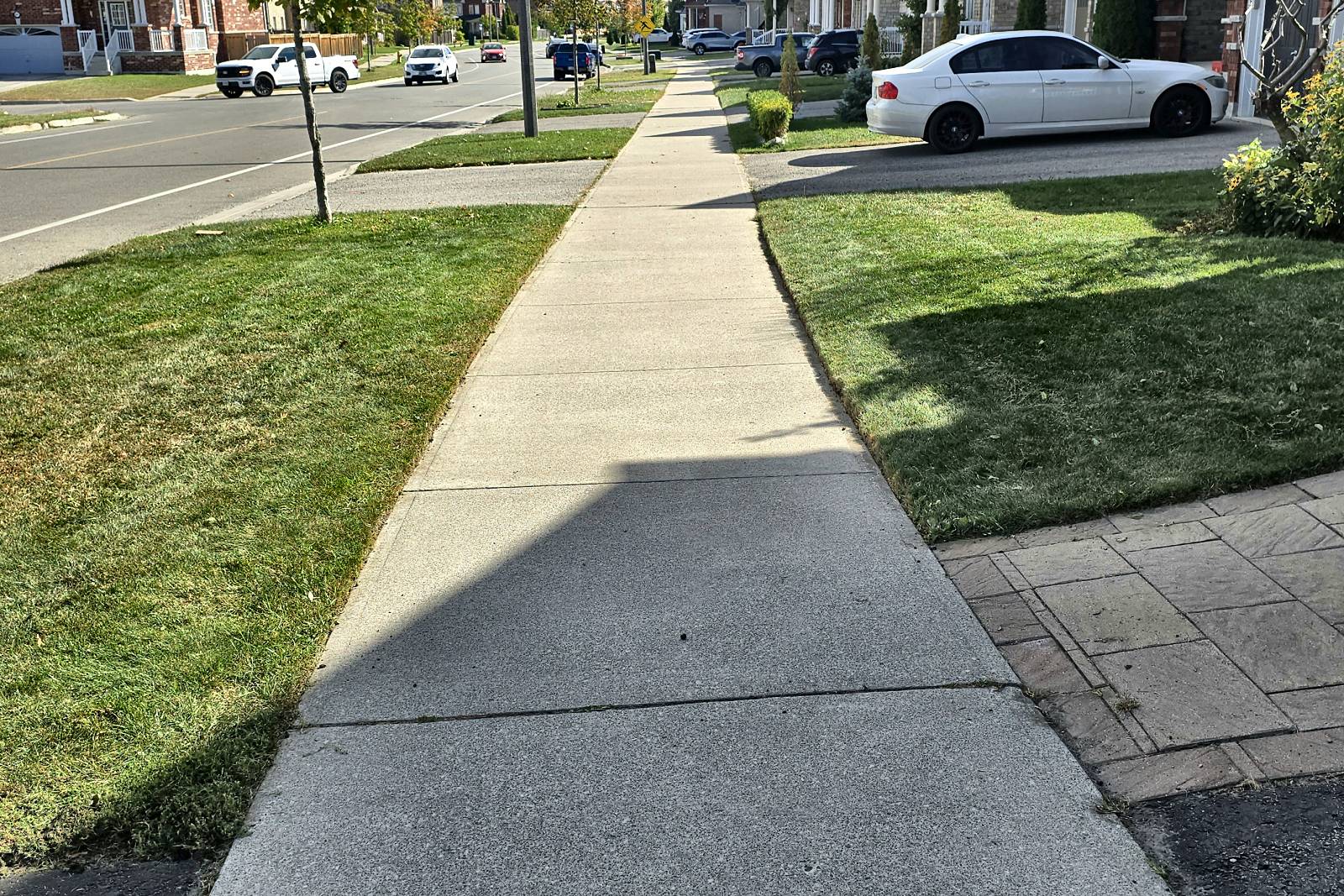
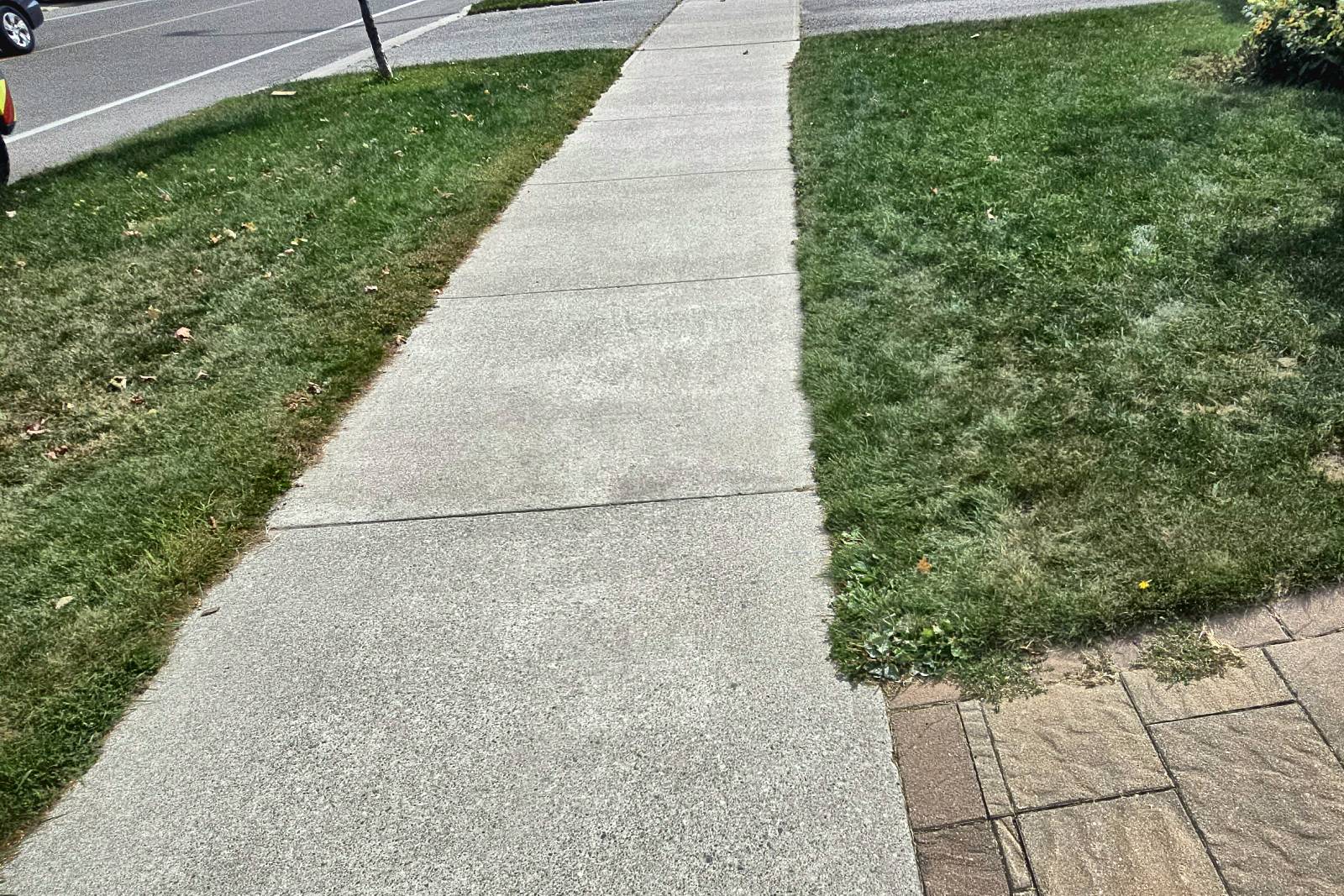
Real Northline properties, before and after, every one of them in Oshawa and every one of them this year. Drag the line to compare.

Andrew answers, October 2026
What happens if it snows all day instead of overnight?
The first pass opens a lane out to the road, the walkway and the steps, so you can get out. Then the whole route gets that same first pass. Then, once the snow stops, we come back for the full clear: full width to the pavement, the windrow off at the road, piles tidied and salt down again. If it looks half done at eight in the morning in heavy snow, that is deliberate and we are already on the way back. There is no extra charge for the second visit.
One of these goes on each page and it is replaced monthly. If the question you have is not here, ask it: 905-244-5779.
Send me the acreage and the laneway length
Those two numbers are on your listing and on your tax bill, and they are enough to price a Whitby property over the telephone without anybody driving out to look at it. Tell me whether the worry is snow or ice while you are at it, because that decides the tier more often than the driveway size does.