Snow removal · Pickering pricing
How Much Does Snow Removal Cost in Pickering, and Why the North End Costs More
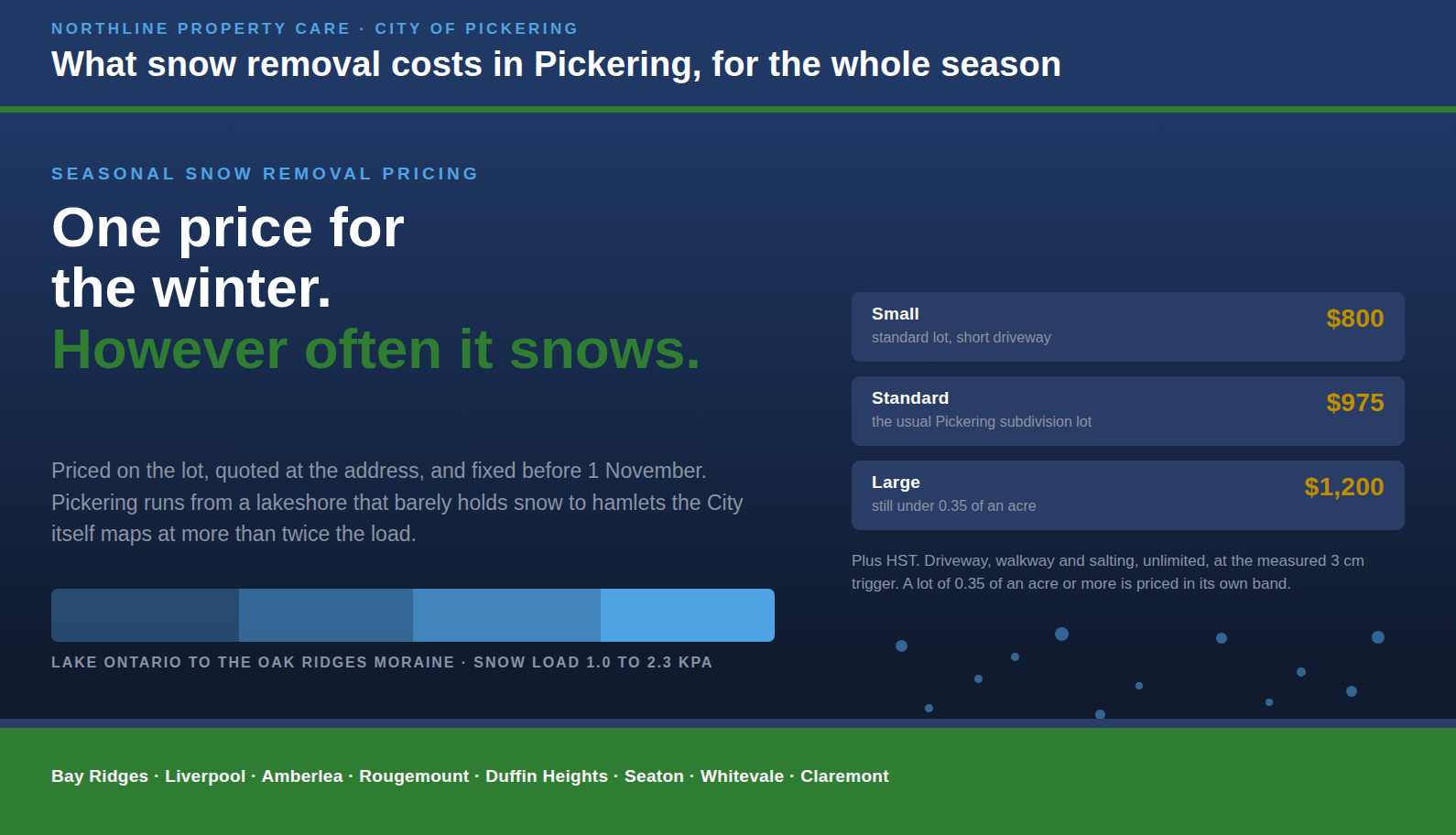
How much does snow removal cost in Pickering? A standard lot runs $975 plus HST for the six months from November 1 to May 1, and the City's own snow load map is the reason a Claremont laneway is never priced off the same sheet.
North of Taunton Road the bands change. See the estate and acre pricing.
Green in summer. Clear in winter.
The short answer
Snow removal in Pickering costs $189 a month plus HST on the Gold membership, which plows the driveway to a 7 AM target on every storm from November 1 to May 1, measured at a 3 cm trigger.
A standard Pickering lot is $975 plus HST for the whole season, with $800 at the small end and $1,200 at the large end, and a lot of 0.35 of an acre or more moves into the Estate band at $1,750. Above one acre, or on a laneway past 250 feet, the Grand Estate band is $2,600, and a property over three acres is priced on the call because no honest formula survives that far north. The monthly route is the other way in: $189 a month plus HST is the tier that plows a driveway, $279 buys a 6:30 AM target and automatic salting, and $129 does not plow a driveway at all. Every one of those prices covers November 1 to May 1, unlimited, at a measured 3 cm trigger.
Pickering costed this exact job itself, and then published both numbers
The City studied clearing every driveway windrow in Pickering and put two figures on it in 2023. Contracting the work out was estimated at $7.4 million a year. Running it with City equipment came out at $19.8 million in the first year, in 2023 dollars. Neither option was bought, and the City says so on its own winter reminders page, which also states in plain words that windrow clearing is an exceedingly rare service across Ontario because of what it costs.
Those two numbers are the most useful thing a Pickering homeowner can read before asking anybody for a price. They are not a contractor's marketing. They are a municipality doing the arithmetic on the same job, at city scale, and deciding it could not carry it. A ridge of plow snow across a driveway mouth is genuinely expensive to move, and the reason it stays expensive is that it has to be moved inside a few hours of the road being plowed, on every driveway at once, which is the one shape of work that no amount of scale makes cheaper.
What the City does instead is cap a subsidized program at 750 households. That is 750 places in a city the City's own neighbourhood profile puts at 99,186 people. The gap between 750 and the number of driveways in Pickering is the entire private market for this work, and it is also the reason a seasonal price sits where it sits rather than somewhere friendlier.
Northline quotes the season rather than the storm for the same reason the City reached for a fixed cost study: the only number a household can actually plan around is the one that stops moving in January.
Check the City before you check any price, and the date is October 16
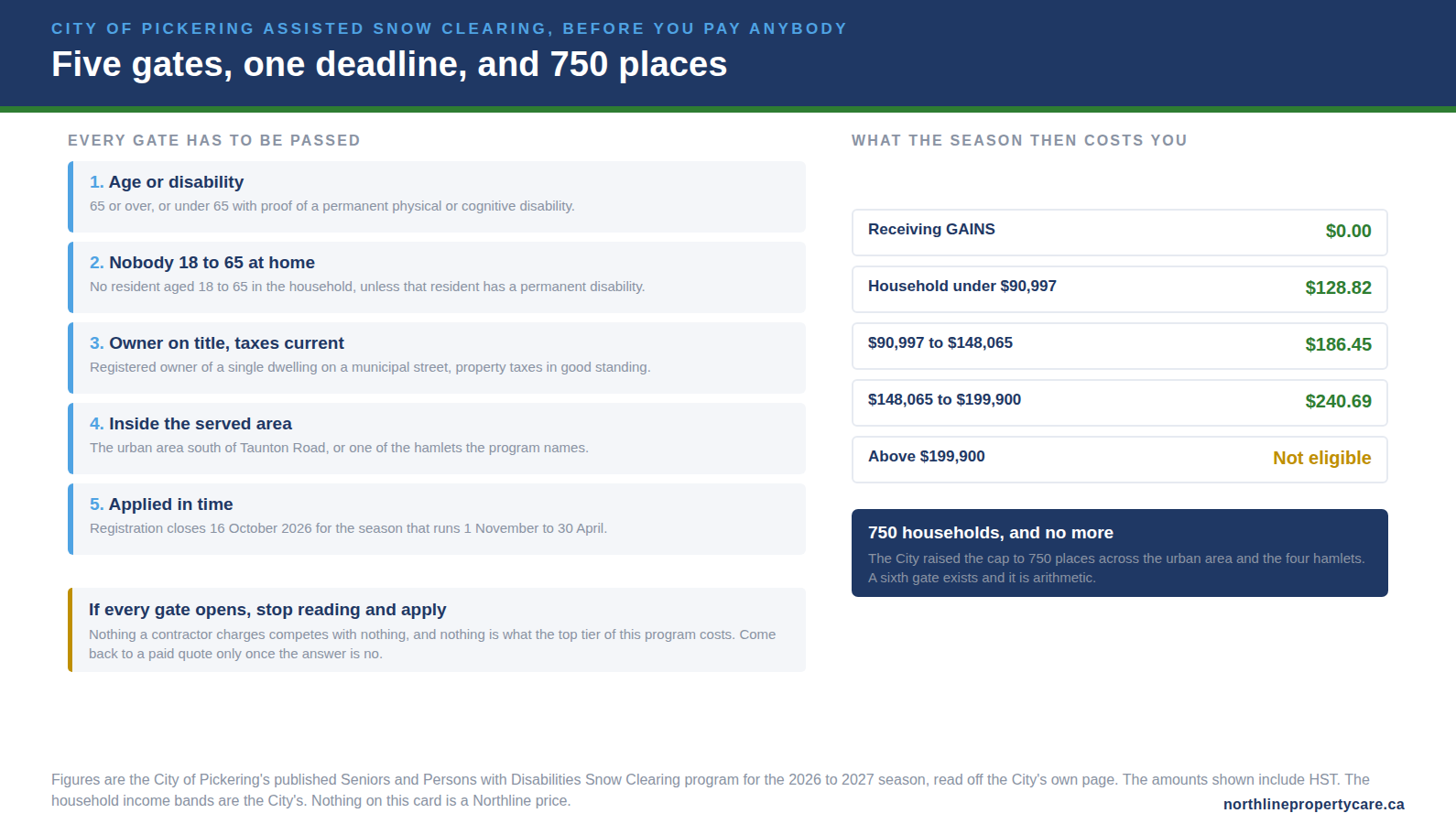
Registration for the City of Pickering Seniors and Persons with Disabilities Snow Clearing program closes on October 16 2026, for a season that runs November 1 to April 30. That is roughly two weeks before anybody clears anything, and it is the single most valuable date on this page, because the program costs a qualifying household somewhere between nothing and $240.69 for the winter. Read the eligibility and the fee tiers on the City of Pickering program page before you read another price anywhere.
The gates are narrow and they are worth reading in order. The applicant is 65 or over, or under 65 with proof of a permanent physical or cognitive disability. No resident aged 18 to 65 lives in the household, unless that resident is the one with the permanent disability. The applicant is the registered owner on title, in a single dwelling on a municipal street, with property taxes in good standing. The property sits in the urban area south of Taunton Road, or in one of the named hamlets. And the form is in by the October date.
The fee is scaled to household income. A household receiving the Guaranteed Annual Income System supplement pays nothing. Below $90,997 the winter costs $128.82 including HST, then $186.45, then $240.69, and a household above $199,900 is not eligible at all. There is also a rule that catches snowbirds: a participant cannot be away for more than two consecutive weeks during the program.
If every one of those gates opens for you, apply and stop reading. No private price in Durham Region competes with $128.82 for a winter, and it would be dishonest to write an article about what this costs without saying so in the section where it matters rather than in a footnote. Come back to a paid quote only when the answer is no, or when the 750 places are gone.
What the City actually clears, and the two different triggers it publishes
Pickering publishes two different plowing triggers on two of its own pages, and a homeowner comparing quotes should know that before a contractor quotes a number at them. The salt shortage notice on the main snow page says plowing typically begins once approximately 5 centimetres has accumulated. The snow clearing process page says staff decide whether to plow at usually 75mm, which is 7.5 centimetres. Both are the City's own words, live on the City's own site, and we are not going to pretend we know which one governs.
The service levels are clearer. On the urban side, a storm up to four inches gets complete service, salting and plowing, within 13 hours, and a storm up to eight inches within 24 hours. On the rural side those same two figures are 20 hours and 30 hours. A salt route takes roughly four to six hours to run and a plow route roughly six to thirteen. Cleanup operations continue for up to 48 hours after the snow stops. Pickering runs 13 urban routes and 2 rural routes under a two tier priority system: collector and main roads first, then the local residential streets.
None of those hours are about your driveway. The City states the position without softening it: it is the resident's responsibility to clear the snow left by the plow at the end of the driveway, and Pickering does not have the resources to remove snow from driveways. So the honest way to read the 13 hour and 24 hour figures is as the clock that decides when the ridge appears across your driveway mouth, not the clock that decides when it leaves.
The rural 30 hour figure is the one that changes a quote north of Taunton Road. A Claremont or Whitevale property can be inside a storm cycle for a day and a quarter before the road in front of it is finished, which is a different operating problem from a Liverpool crescent that is done inside 13 hours, and it is priced as one.
Several Pickering streets are not the City's to plow, and that is not a technicality
Three separate authorities clear roads inside Pickering, and the one your driveway meets decides what kind of ridge you get. The Region of Durham maintains the Regional roads, and inside Pickering that list includes Brock Road, Whites Road, Liverpool Road, Altona Road, Bayly Street, Finch Avenue, Westney Road, Alexander Knox Road, Peter Matthews Drive, Central Street and Whitevale Road, among others. The full set with Regional Road numbers is published on the Region of Durham roads list.
The Region patrols its roads seven days a week through the winter and, by its own statement, dispatches equipment once four centimetres has accumulated, which is a lower and firmer trigger than either of the City's two. It also runs brine before a storm and pre wetted salt during one, which it explains on its regional road maintenance page. Provincial highways are a third system again, and Ontario's own service standard for a freeway class highway such as the 401 is bare pavement within eight hours of the end of a storm.
Here is why a homeowner should care about any of that. A driveway that opens onto a Regional road is plowed by heavier equipment, on a faster trigger, more times per storm, and it collects a denser and wider ridge than a driveway on a City crescent that gets one or two passes. The same house, moved four streets, is a different job. A quote that does not ask which road you are on has not looked.
North Pickering is a different winter, and the City's own map says by how much
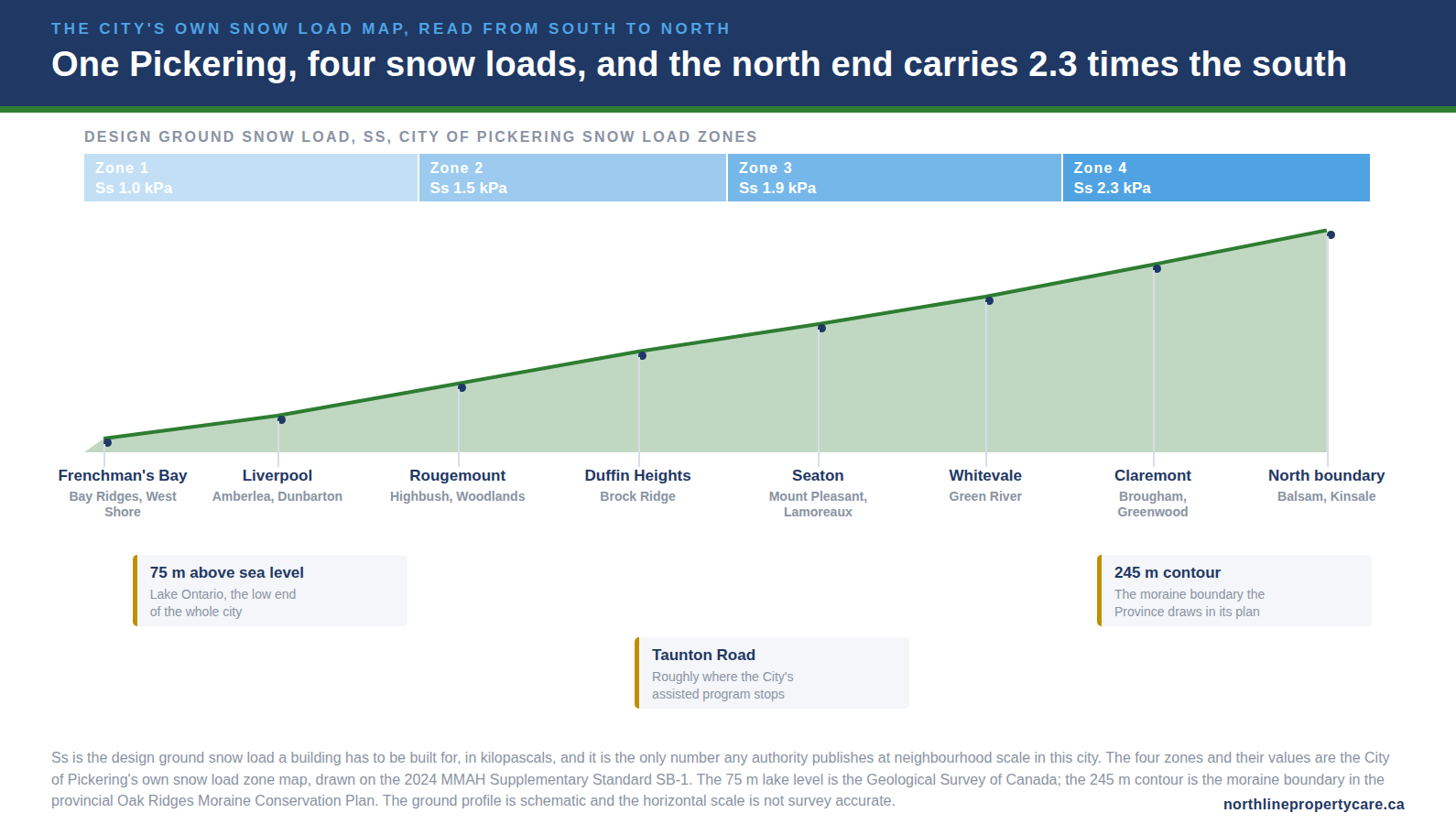
The City of Pickering publishes a snow load zone map, and it divides the city into four zones whose design ground snow load runs from 1.0 kilopascals at the Lake Ontario shoreline to 2.3 kilopascals at the northern boundary. Claremont sits in the 1.9 zone. The zone boundaries run roughly west to east and follow features including Highway 407, Taunton Road, Ninth Concession Road and McKay Road. The map is built on the 2024 Ministry of Municipal Affairs and Housing Supplementary Standard SB-1, which is the climatic data standard behind the Ontario Building Code.
Design ground snow load is what a roof has to be engineered to carry. It is not a snowfall total and nobody should read it as one. What it is, and this is why it belongs on a page about price, is the only number any authority publishes at neighbourhood scale inside this city. A building code standard that requires a Claremont roof to be built for 1.9 times the Bay Ridges figure is an official statement that these two places do not get the same winter, and it is available to read rather than asserted.
The ground under it explains the map. Lake Ontario sits at about 75 metres above sea level. The provincial Oak Ridges Moraine Conservation Plan draws the moraine's southern boundary at the 245 metre contour between Richmond Hill and Clarington, so that contour crosses north Pickering, which puts roughly 170 metres of rise between Frenchman's Bay and the top of the city. Read the plan itself on the Ontario government's moraine page.
What we deliberately are not going to claim is that Pickering sits in a snowbelt. We went looking for a federal statement that this part of the north shore of Lake Ontario receives lake effect snow and did not find one, and Environment and Climate Change Canada's own glossary defines a snowbelt as lying southeast of open water, which is the wrong side for Pickering. The snow load map does the job honestly and the snowbelt line would not, so the snowbelt line stays out.
What actually moves a Pickering quote, in the order it moves it
Lot size moves the number first, and it is the only thing that moves it between bands. Under 0.35 of an acre a property is in the standard set at $800, $975 or $1,200. At 0.35 of an acre it is an Estate lot at $1,750. Above one acre, or on a laneway past 250 feet, it is a Grand Estate lot at $2,600. A laneway over 400 feet adds $200 for every additional 100 feet, published as a formula precisely so that nobody has to drive out before answering.
Driveway length is the second lever and it only ever pushes upward. A driveway over 100 feet moves a property up a band even when the lot itself would have sat below the line. That rule exists because the pile has to go somewhere, and a hundred foot run of driveway generates more snow than the banks beside it can absorb by February.
Then geometry, and this is where Pickering is unusually varied. A Rougemount or Highbush property on a ravine lot often has a driveway that falls away from the street with nowhere on the low side to stack. A Seaton house on a new narrow lot may have a driveway that is wide at the garage and pinched at the sidewalk. A Bay Ridges bungalow from the 1960s usually has room on both sides. Stacking room is not a detail, because a driveway with nowhere to put the snow becomes a haul away job in a heavy February, and a haul away is the one thing that genuinely costs more than the price on this page.
Surface is fourth. Gravel and loose stone laneways in the rural settlements cannot be cleared to bare ground until frost has built a base, which changes when the season can open on that property rather than what it costs. Walkway length is fifth, and salting is sixth: salting is included and unlimited in the seasonal package, so it does not move the number, but it does move which package makes sense on a shaded north facing driveway in Whitevale.
Three ways to buy it, and the arithmetic that picks one
The seasonal package is one payment for the winter and it is the simplest to compare. At $975 plus HST for a standard Pickering lot, the price covers the driveway, the walkway and salting, unlimited, from November 1 to May 1, at a measured 3 cm trigger with a 7 AM target after overnight snow. The number does not change if February is brutal and it does not change if it is empty.
The monthly membership is the second route and it is a different product rather than the same product in instalments. Gold at $189 a month plus HST, $213.57 once the tax is on it, clears the driveway and carries the 7 AM target, and the same payment also carries the weekly lawn cut, the spring cleanup and the fall cleanup through the green half of the year. Platinum at $279 a month, $315.27 with HST, is sequenced first, targets 6:30 AM, salts automatically with no limit, and gets first choice of service day. Either one bills in twelve equal instalments. The charge lands on the final day of each month, and the first of the twelve is taken on the final day of the month before service begins.
Silver, at $129 a month plus HST, does not clear the driveway at all, and that sentence is here because leaving it out would sell somebody the wrong thing. What Silver buys is a windrow pass by 5 PM, which moves the ridge out of the mouth of the driveway and stops there. For a household that shovels its own driveway and only wants the heavy ridge moved, that is exactly right and it is the cheapest honest answer on this page. For anybody who expects to walk out to a cleared driveway, Silver is the wrong purchase and the tier that does it is Gold.
The third model is paying per storm, which is what a large part of the market sells. We do not price that way, so we are not going to publish a per push number we do not charge. What can be said is the arithmetic on the fixed price. Our own count at the Oshawa station covers eighteen complete winters. The average is 11.4 snow days of 3 cm or more, and the middle winter carries twelve of them. Set against $975, twelve clears divide out a little over $81 each, and the quietest of those eighteen winters, at four clears, divides out nearly $244. That is an Oshawa record and not a Pickering one, which matters, and it is named again in the section on what we could not verify.
The hamlets, the Estate bands, and why the formula is published at all
Pickering carries thirteen rural settlements in its own Official Plan, and most of them are priced out of the standard bands before anybody looks at the driveway. Claremont, Whitevale, Greenwood, Brougham, Kinsale, Balsam, Green River, Cherrywood, Spring Creek, Staxton Glen, Barclay Estates, Birchwood Estates and Forest Creek Estates are the City's own list. Lots in that country are routinely past 0.35 of an acre, which is the Estate line, and laneways past 250 feet are ordinary rather than exceptional.
So the Estate band at $1,750 and the Grand Estate band at $2,600 are not a premium applied to a bigger house. They are a different quantity of snow moved over a longer distance, on a road that the City's own service level says may take 30 hours to finish in a large storm, and often on a surface that is not asphalt.
The reason those numbers are published rather than quoted privately is that a rural homeowner already has both inputs in hand. The acreage is on the tax bill and the laneway length is on the listing. Publishing the bands and the $200 per additional 100 feet formula means a Claremont household can work out its own price in a minute without a site visit and without a conversation designed to find out how much they will tolerate. Past three acres nothing is published at all, and the silence is deliberate. Beyond that size the turf, the laneway and the pile placement stop being predictable from the acreage alone, so any figure printed here would be one the business could not stand behind.
The salt notice the City posted in January, and what it changes
In January 2026 the City of Pickering posted a notice about a province wide road salt shortage, and it is still on the snow removal page. The City wrote that it maintains a reserve but must use it carefully so supplies last the season, that salt may be applied later in a storm when conditions allow it to be most effective, and that in some areas a blend of salt, sand or other de icing materials may be used to improve traction and extend supplies.
That is a municipality stating in public that a service level moved because of supply. It is worth knowing for two reasons. The first is that a road which is sanded rather than salted stays slippery for longer, which changes what the bottom of your driveway is like when you reverse onto it. The second is that a private contractor buys from the same market, and any seasonal price that includes unlimited salting is carrying that risk on the contractor's side of the line rather than the customer's.
Salting on a Pickering driveway is not a volume problem anyway. It is a temperature problem, and the practical answer is a thin even spread early rather than a heavy spread late.
Two Pickering rules that cost money and have nothing to do with a contractor
Parking on a Pickering street is prohibited between 2 AM and 5 AM from December 1 to March 31, and the set fine is $50. That sits in Traffic and Parking By-law 6604/05, section 15(n). A vehicle parked on the road during snow clearing operations can be ticketed at a set fine of $90 and towed at the owner's expense. The by-law also forbids stopping a vehicle in a way that interferes with seasonally required road maintenance, which covers plowing, sanding and salting.
The second rule is the sidewalk. Under Ice and Snow Clearing By-law 6650/06, every owner of a building or vacant land in Pickering, occupied or not, is responsible for clearing ice and snow from the sidewalk abutting the property within 24 hours after the accumulation. The City publishes no dollar fine for that by-law. What it publishes is worse in most cases: if the City does the work, the cost is recovered from the owner with a 25 per cent administration fee added. Snow, ice and slush may not be deposited onto a City street either, and pushing a windrow back into the road is named as a contravention.
The 24 hour clock runs whether or not you are at home, and it runs across the whole frontage. A corner lot in Amberlea or Village East can carry two or three times the sidewalk of the house beside it, which is a real reason those properties buy the walkway and frontage work rather than only the driveway.
The part that argues against us
A seasonal price is the wrong purchase in a quiet winter, and anybody who tells you it always wins is selling something. Using the Oshawa record above, the gap between the hardest and the quietest of those eighteen winters is twenty four clears against four, and on a fixed $975 that is the gap between roughly $41 for each clear and roughly $244. A fixed price is not a discount. It is a risk moving from one side of the table to the other, and in one winter out of several the customer is on the losing side of that move.
The second argument against us is the City program in the section above. If you qualify, take it. Nothing here competes with $0.00 or $128.82 for a season.
The third is that a household with a short flat driveway, a snow blower already in the garage and nobody in the house who cannot use it may simply not need this service. The honest version of that sentence is that the seasonal price buys a morning back rather than a task that cannot be done, and a person who does not value that morning should keep their money.
What we could not verify
Every figure on this page that belongs to a municipality was read off that municipality's own page, and the gaps are named here rather than papered over. We could not obtain Environment and Climate Change Canada climate normals for a Pickering area station this week, so there is no Pickering snowfall figure anywhere in this article and the per clear arithmetic above is explicitly the Oshawa station instead. We could not find a published lane kilometre or centreline kilometre figure for Pickering's road network, nor a count of City winter equipment.
We could not resolve the City's two plowing triggers, five centimetres on one page and 75mm on another, and we have quoted both rather than choosing. We could not find a dollar fine for Ice and Snow Clearing By-law 6650/06 anywhere on the City site, so this page states the cost recovery and the 25 per cent administration fee and no fine amount. We could not confirm which authority maintains Highway 7 inside Pickering. And we did not find any federal or provincial statement that Pickering receives lake effect snow, which is why that claim does not appear.
Not one figure on this page came from another snow removal company's price list. Every external number is from the City of Pickering, the Region of Durham, the Province of Ontario, the Geological Survey of Canada or Environment and Climate Change Canada.
Questions people in Pickering actually ask
How much does snow removal cost in Pickering for an ordinary driveway?
A standard lot under 0.35 of an acre is $975 plus HST for the season, with $800 at the small end and $1,200 at the large end. That covers the driveway, the walkway and salting, unlimited, from November 1 to May 1, at a measured 3 cm trigger. A lot of 0.35 of an acre or more is an Estate lot at $1,750, a lot above one acre or a laneway past 250 feet is a Grand Estate lot at $2,600, and a property over three acres is priced on the call. A driveway over 100 feet moves a property up one band.
Does the City of Pickering clear the windrow at the end of my driveway?
No, and the City says so directly: it is the resident's responsibility to clear the snow the plow leaves at the end of the driveway, and Pickering does not have the resources to remove snow from driveways. The City costed a citywide windrow service in 2023 at $7.4 million a year contracted, or $19.8 million in the first year in house, and bought neither. The one exception is the assisted program for seniors and people with disabilities, which is capped at 750 households.
What is the deadline for the Pickering snow clearing assistance program?
Registration closes October 16 2026 for the 2026 to 2027 season, which runs November 1 to April 30. The applicant must be 65 or over, or under 65 with proof of a permanent disability, with no resident aged 18 to 65 in the household unless that person is the one with the disability. The fee is income scaled from nothing for a household receiving the Guaranteed Annual Income System supplement up to $240.69, and a household above $199,900 is not eligible. If you qualify, this is cheaper than any private quote in Durham Region.
Why would snow removal cost more in Claremont than in Bay Ridges?
Because they are not the same winter and the City says so in a document neither of us wrote. Pickering's own snow load zone map specifies a design ground snow load of 1.0 kilopascals at the Lake Ontario shoreline and 1.9 at Claremont, rising to 2.3 at the northern boundary. On top of that, the City's rural service level allows 30 hours to finish a rural road after a large storm against 24 hours in the urban area, lots in the hamlets are usually past the Estate line at 0.35 of an acre, and many of those laneways are gravel rather than asphalt.
Who has to clear the sidewalk outside a Pickering house after it snows?
Yes. Ice and Snow Clearing By-law 6650/06 makes every owner of a building or vacant land responsible for clearing ice and snow from the abutting sidewalk within 24 hours after the accumulation, whether the property is occupied or not. The City publishes no dollar fine for it. What it does publish is that if the City clears it for you, the cost is recovered from you with a 25 per cent administration fee on top. Pushing snow off your driveway onto a City street or sidewalk is separately prohibited.
Is a fixed seasonal price actually better than paying for each storm in Pickering?
In an average Durham winter it wins, and in a quiet one it loses, and an honest answer names both halves. There is no Pickering snowfall record we could obtain, so the nearest figure we can stand behind is the Oshawa station: eighteen complete winters, averaging 11.4 snow days of 3 cm or more, the middle winter carrying twelve of them, the quietest carrying four and the hardest carrying twenty four. Set against $975, the middle winter divides out a little over $81 for each clear and the quietest one nearly $244. What a fixed price really buys is that the number stops moving the day it is signed.
Who wrote this
Andrew owns Northline Property Care, and the price on a Pickering property is one he sets himself before anything is booked on it. Six Durham winters sit behind the judgements above. Those winters belong to him rather than to the company, whose own trading history is a great deal shorter and is not being quietly borrowed against here. Northline carries full insurance and runs a fixed route through the seven towns, from Pickering in the west across to Clarington in the east.
The person who quotes the property is the person who does the work, on a fixed local route, with one accountable name. Nothing is subcontracted out and nobody arrives that a customer was not told about. If a figure on this page is wrong, say so on 905-244-5779 and it gets corrected on the page rather than defended.
Read next
Snow removal in Pickering, street by street
The service page for this city, from Seaton and the south shore neighbourhoods up to the 407 hamlets, with what a winter actually looks like on each.
See the Pickering page →Estate and Grand Estate pricing
The acre bands, the laneway formula and the point past which nothing is published, written for the properties north of Taunton Road.
Read the estate bands →Every windrow program in Durham
What each town does with the ridge the plow leaves across your driveway, which ones run an assisted program, and when each one closes.
Compare the towns →The work, photographed
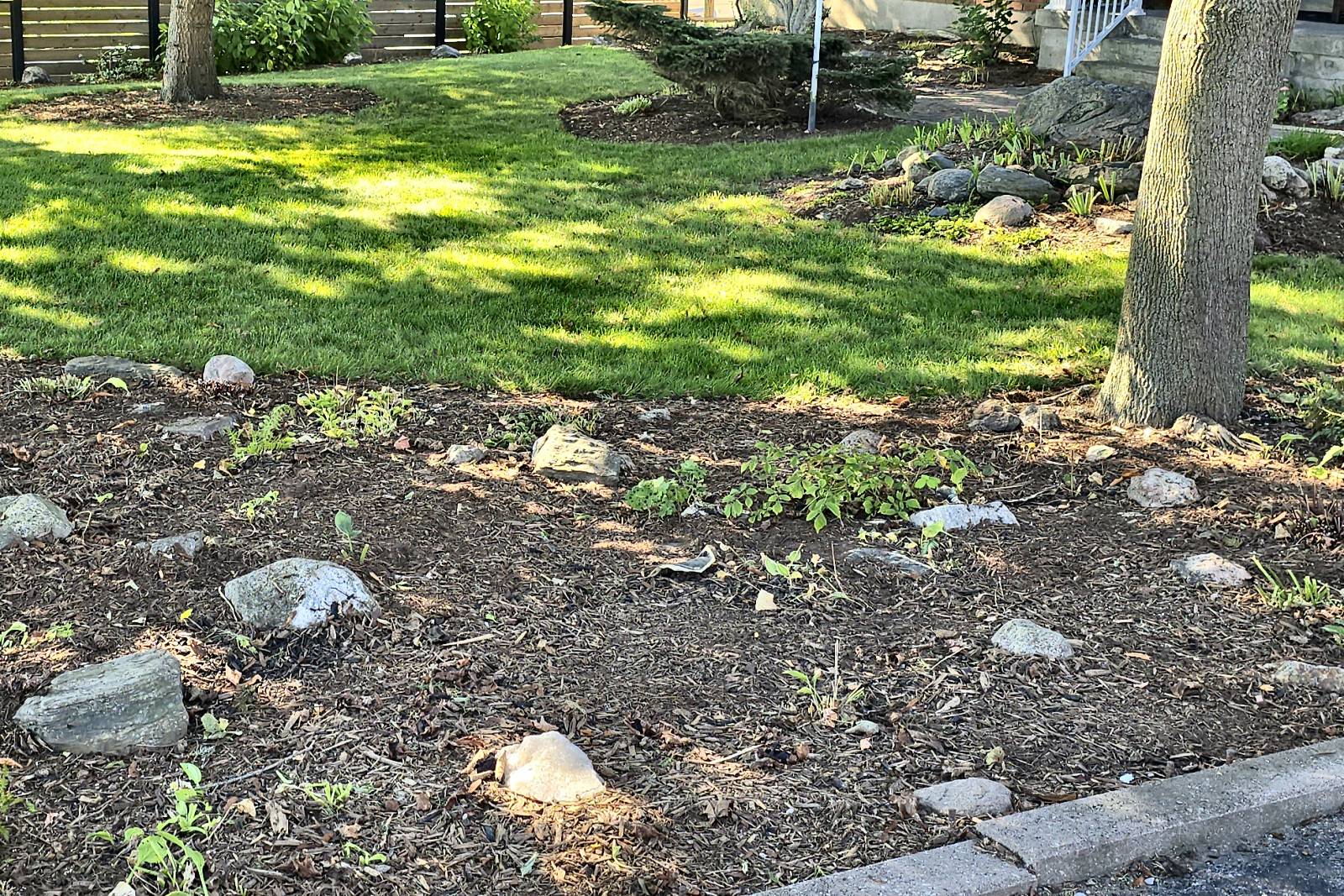
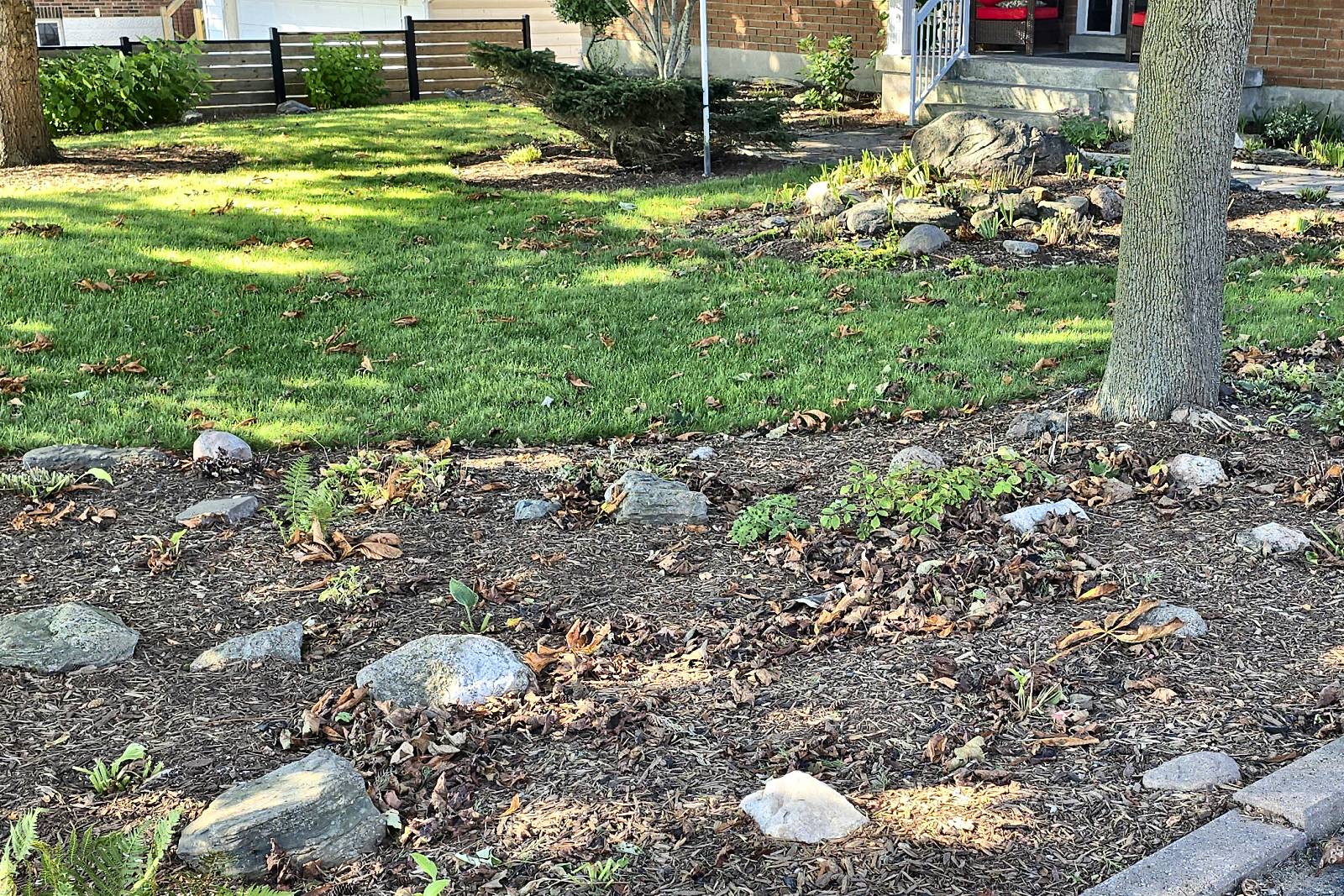
Real Northline properties, before and after, every one of them in Oshawa and every one of them this year. Drag the line to compare.
Andrew answers, October 2026
What happens if it snows all day instead of overnight?
The first pass opens a lane out to the road, the walkway and the steps, so you can get out. Then the whole route gets that same first pass. Then, once the snow stops, we come back for the full clear: full width to the pavement, the windrow off at the road, piles tidied and salt down again. If it looks half done at eight in the morning in heavy snow, that is deliberate and we are already on the way back. There is no extra charge for the second visit.
One of these goes on each page and it is replaced monthly. If the question you have is not here, ask it: 905-244-5779.
Get a Pickering number instead of a range off a web page
Send the address and, if you are north of Taunton Road, the acreage and the laneway length. You get the band, the season price and what it covers, on the same day, for your own property rather than for a category. If the City program is the better answer for your household, that is what you will be told.