Snow removal · Sloped and steep driveways
Steep Driveway Snow Removal in Durham Region, and the Grade That Decides It
Steep driveway snow removal in Durham Region turns on one number almost nobody has measured on their own property, and that number is the grade rather than the length of the slab.
Need a price for a sloped property instead of the engineering behind it? Start at residential snow removal.
Green in summer. Clear in winter.
The short answer
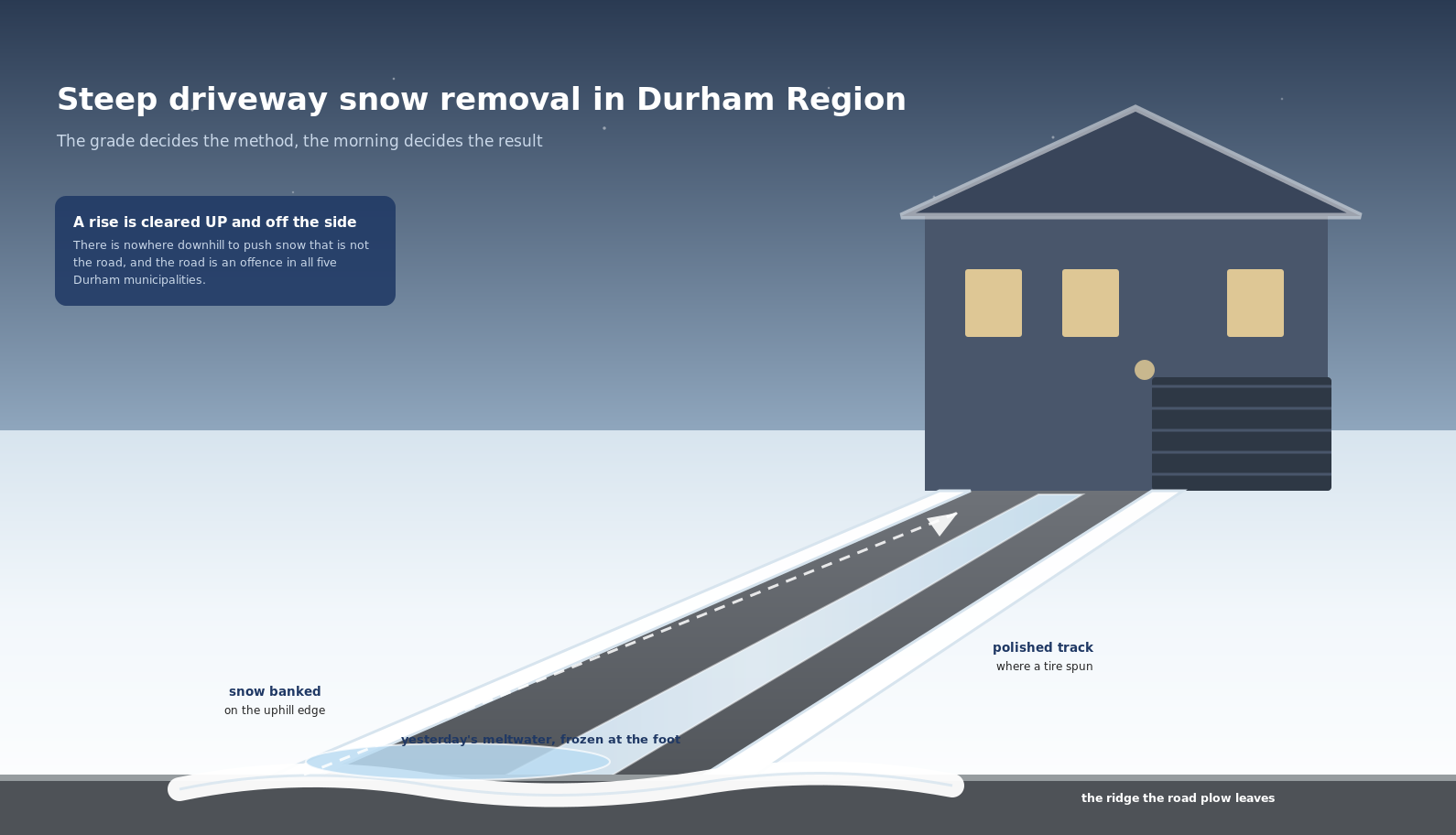
A steep driveway is a traction problem before it is a snow clearing problem, and the number that decides it is the grade. Grade is the rise over the run, so 8 per cent means eight centimetres of climb for every metre travelled. The five authorities that approve driveways in this region cap residential grades between 6 and 10 per cent. Work presented at the 2014 World Road Congress puts the steepest slope a passenger car can climb on smooth ice at about 5.4 per cent. Every published maximum in Durham Region is steeper than that, which means a legal driveway can become an unusable one overnight without anything going wrong.
Snow off a rise goes up and sideways, onto ground the household owns. It does not go onto the road, the sidewalk or a boulevard that belongs to somebody else, because each of the five municipalities writes that prohibition into its own by-law with a penalty behind it. That constraint is the whole reason a sloped driveway takes longer than a flat one of the same size: the shortest way off the surface is the one direction that is not available.
Ice beats snow on a slope, every time. A driveway that sheds its meltwater to one low point by design sends all of it to the same two or three metres at the bottom, which refreeze overnight while the rest of the surface looks fine. Salt handles that until the pavement gets down to roughly minus 7 to minus 9 degrees, at which point the published guidance stops recommending it and traction material takes over.
A grade does not change the price. A seasonal snow package covers the driveway, the walkway and the salting for a whole winter from the first 3 cm, priced at $800, $975 or $1,200 plus HST, and which of those three applies is a question of lot size. A membership spreads that same winter over twelve equal monthly payments and brings the lawn season along with it. Driveway plowing, together with the 7 AM target that goes with it, belongs to Gold at $189 a month plus HST. At $129 a month plus HST, Silver takes the ridge at the entrance on a separate daytime pass and leaves the driveway surface alone. Memberships start at $129 a month plus HST. Two deadlines apply and they fall on different days: the published seasonal price closes on November 1, and the residential route itself closes on November 30 and does not reopen until the following winter.
What counts as steep, and the five different answers in one region
There is no single legal maximum for a residential driveway in Durham Region, because five separate authorities set one and none of them agrees with the others. Each municipality publishes its own lot grading or design standard, and the Region of Durham sets a further rule for the part of the entrance that crosses regional road allowance. A homeowner finds this out only when they try to look up what their own driveway was allowed to be.
| Authority | Minimum grade | Maximum grade | The clause |
|---|---|---|---|
| Town of Ajax | 2 per cent away from the building | 6 per cent | Design Criteria Section E, clause 3.22 |
| City of Pickering | 2.0 per cent | 8.0 per cent | Lot Grading standard, section 3.1 |
| Municipality of Clarington | 2 per cent | 8 per cent designed, 10 per cent as built | Design Guidelines Section 300, clause 5.03 |
| City of Oshawa | 2 per cent | 10 per cent | Standard drawing OS-323, revision 4 |
| Region of Durham | 2 per cent falling to the road, property line out to the curb line | 10 per cent, sidewalk to garage | Design Specifications, section 6.5 |
Read off each authority's own published standard in October 2026. Sources: the Region of Durham roads and entranceways specification, the City of Pickering lot grading standard, the Town of Ajax lot grading criteria, the Clarington design guidelines and City of Oshawa standard drawing OS-323.
Two details in that table are worth more than the numbers. Ajax writes into the same clause that its 6 per cent maximum is not recommended and should be used only in exceptional cases, which is a standards writer saying out loud that the legal limit is not the advisable one. The Region uses almost the same language about 10 per cent, allowing it only where physical conditions prohibit anything gentler. Both of them are describing a driveway that drains and gives a car enough clearance, and neither of them is thinking about February.
Now set those permitted grades against what a vehicle can actually do. A paper presented to the World Road Congress in 2014 gives the maximum climbable slope by surface for a passenger car: about 3.09 degrees on smooth ice, which converts to roughly 5.4 per cent, and about 8.53 degrees on snow that has not been packed down, which is roughly 15 per cent. The same work sets out maximum starting grades of roughly 10 per cent on ice for all season tires and 11 per cent for winter tires. You can read the paper in the World Road Congress proceedings.
Put the two sets of numbers on one axis and the result is uncomfortable. The gentlest maximum any Durham municipality publishes, Ajax at 6 per cent, is already above the slope a car can climb on smooth ice. Oshawa and the Region allow nearly double it. A driveway approved at 9 per cent on a Windfields or Taunton lot is a perfectly ordinary driveway for forty eight weeks of the year and a slope nothing will climb on the morning after freezing rain, and no inspection, warranty or disclosure has ever told the owner that.
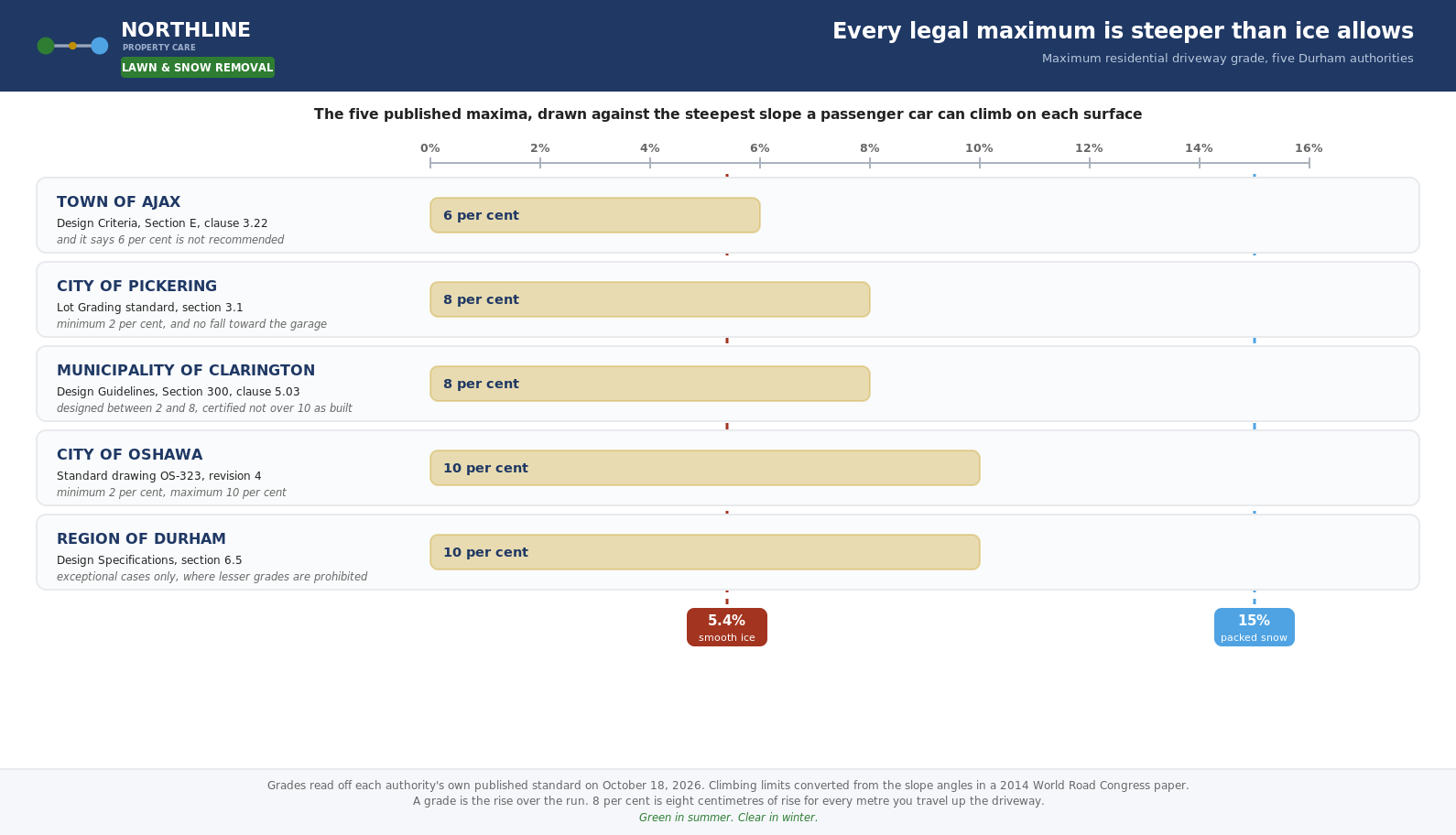
The useful way to use this is to stop guessing. Stand at the garage with a builder's level or a phone inclinometer, or simply measure the vertical drop from the garage slab to the top of the curb and divide it by the distance between them. A 15 metre driveway falling or rising 1.2 metres is 8 per cent. That number is the one worth knowing before the first storm, because it decides whether the property needs traction material as a routine and not as an emergency.
Where the slopes actually are in Durham Region
Durham Region drops about 324 metres from its northern edge to Lake Ontario, and almost none of that happens where the housing is. The ground surface runs from roughly 400 metres above sea level near Chalk Lake down to about 75 metres at the shoreline, over a north to south distance of something like 23 kilometres. That figure comes from the approved assessment report for the Central Lake Ontario source protection area, which you can read through the CTC Source Protection Region.
That drop is not a ramp. It arrives in three belts. The Oak Ridges Moraine sits across the top, described in the conservation authority reporting as hilly, with a knob and basin relief built out of sandy and gravelly material. Below it the South Slope is a drumlinized till plain draining south through what the same report calls sharply incised valleys. Below that again the old shoreline of Glacial Lake Iroquois runs east to west as a sandy band about two kilometres wide, and south of it the Iroquois Plain runs flat to the lake on fine grained lake deposits.
So the genuinely steep residential ground in this region is in three specific places, and a homeowner can usually tell which one they are on. The first is the edge of a creek valley. Oshawa Creek, Harmony Creek, Farewell Creek, Black Creek, Pringle Creek, Lynde Creek, Bowmanville Creek, Soper Creek, Duffins Creek and Carruthers Creek all cut north to south through the built up area, and the lots backing onto those ravines are the ones with real grade. Centre Street South in Oshawa runs along the Oshawa Creek valley and is the clearest example of a residential street sitting on a valley edge rather than near one.
The second is the old Iroquois shoreline itself, which the Ganaraska report describes as marked by bluffs or gravel bars running east to west, sitting roughly 6.4 to 10.3 kilometres north of the present lake and about 75 metres above it. The named places sitting directly on that shoreline in the conservation authority record include the Harmony and Farewell Iroquois Beach wetland complex across Oshawa and Clarington, Heber Down in Whitby, Maple Grove in Clarington and the Kinsale raised shoreline west of Audley Road and south of Highway 7. Anywhere a Durham street climbs noticeably as it heads north, within that band, the shoreline is usually the reason.
The third is the newer subdivision built up the South Slope, north of Taunton Road and north of Rossland, where the land is already rising and the lots are deep. Ajax is the flattest of the five municipalities by a clear margin, and the watershed plan for Carruthers Creek describes the relief there as flat to slightly rolling with one distinct but shallow ravine, so an Ajax homeowner with a steep driveway almost certainly backs onto a valley rather than sitting on a general grade.
Here is the limit of all that, and it goes in the paragraph with the claim rather than in a footnote. No government source names residential streets or subdivisions sitting on the Iroquois bluff, and none publishes a slope gradient for it. The conservation authorities map physiography for water, not for driveways. Everything above is a description of where the landform runs, and the only measurement that settles your own driveway is the one taken on your own driveway.
The driveway that falls toward the house, and why it is the hard one
A driveway that runs downhill from the street to the garage is a different winter problem from one that climbs, and two Durham municipalities have banned building new ones. Pickering states plainly in section 3.1 of its lot grading standard that reverse driveways sloping toward the garage are not permitted. Ajax says in clause 3.22 that driveways shall not slope downward from the street line to the house. Oshawa allows a reverse grade entrance only for commercial, industrial and multi-unit residential uses on standard drawing OS-323, which reads in practice as a refusal for an ordinary house.
None of that helps the owner of a lot built before those standards, and Durham has plenty of them. Nearly 59 per cent of occupied dwellings in Oshawa were built in 1980 or earlier, against about 37 per cent across the Region as a whole, so the city with the most housing stock of that age is also the one most likely to carry grading nobody would approve today.
What the building code asks for on such a lot is a drain. Its surface drainage article requires a building to be located, or the site graded, so that water does not accumulate at or near it, and its catch basin article requires a catch basin where runoff from a driveway is likely to accumulate or enter a garage. The National Research Council sets out the reasoning behind that second article in plain terms on its code intent pages: inadequate driveway drainage leads to water getting into garages, which leads to accelerated deterioration from freeze and thaw. Separately, the City of Ottawa's building code advisory on garage floor drains in low rise residential records that an attached garage slab must still slope to drain to the outdoors, and that the code gives no relief from that requirement.
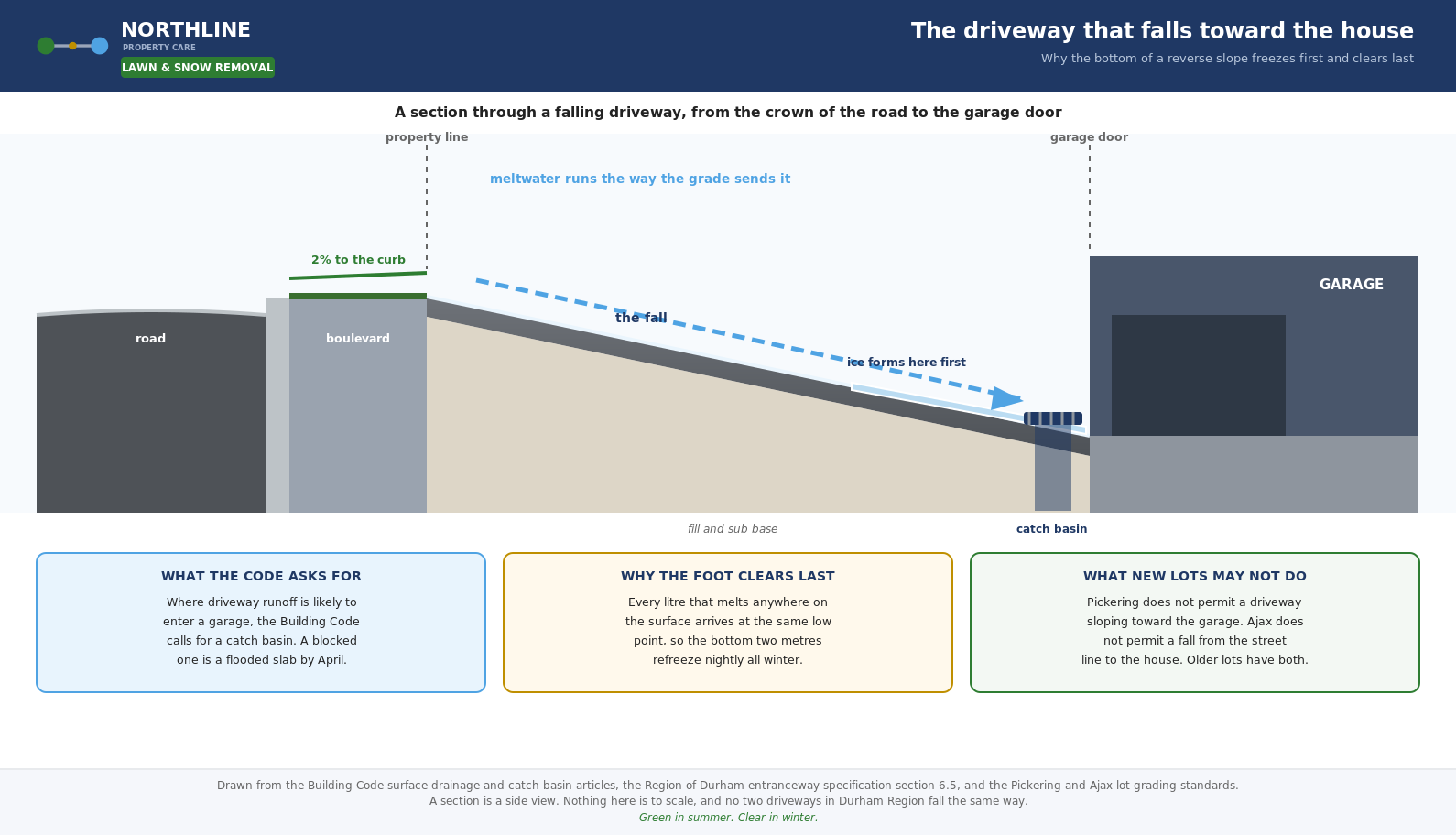
In winter that drain is the thing that decides the season. A catch basin at the foot of a reverse slope works until it freezes shut or fills with sand and leaf litter, and once it has, the next mild afternoon puts meltwater against the garage door with nowhere to go. The honest instruction is to clear that grate before the ground freezes in November, not in January when it is under ice, and to check it again after every thaw. That is a five minute job in the autumn and a contractor call in February.
There is a second reason a falling driveway is harder, and it is about where the snow can be put. On a rise the snow goes uphill and sideways onto the owner's own ground. On a fall, the uphill direction is the street, which is prohibited everywhere, so everything has to go sideways onto a strip that is often a retaining wall, a foundation or a neighbour's lot line. The narrower that strip, the sooner in the winter the driveway starts losing usable width.
Why a slope is cleared uphill, and what that costs in time
Snow comes off a sloped driveway in the one direction that is hardest and slowest, because every other direction is either illegal or somebody else's property. The road is out in all five municipalities. The sidewalk is out. A boulevard that is not in front of the household's own lot is out in Oshawa specifically. That leaves the lawn either side of the surface and the household's own frontage, which on a rise means pushing a loaded blade or a machine uphill and then turning it across the slope.
The practical consequence shows up in the middle of the season rather than at the start. Each storm takes a little width off the driveway as the banks either side grow, and on a slope those banks do not settle evenly because the meltwater runs through them. By the third or fourth event of a Durham winter the usable surface on a long rise can be a vehicle width narrower than it was in November, and the only remedy is to widen the banks early rather than to pile higher. That is a decision made in December and paid for in February.
Aspect matters more on a slope than anywhere else on the property. A driveway facing south gets sun on a clear January afternoon, melts, and refreezes as a sheet when the sun comes off it, which is why the sunniest steep driveway on the street is frequently the iciest one at seven the next morning. A north facing rise never melts at all and keeps packed snow instead, which is a worse surface to look at and a considerably better one to drive on. Neither of those is intuitive and both of them change how a property is treated.
Then there is the ridge the road plow leaves across the entrance. On a flat driveway that windrow is a nuisance. At the foot of a rise it is the first thing a vehicle has to climb through from a standing start, on the part of the slab that already carries the surface water from everything above it. Clearing the windrow and treating the bottom three metres is often worth more on a steep property than clearing the top half, and that is the opposite of how most people shovel. Our page on windrow clearing across Durham Region sets out who is responsible for that ridge in each town.
Salt stops working before the winter does
Sodium chloride has a working range, the bottom of that range is higher than the number printed on the bag, and on a slope the difference is the difference between a surface a car can use and one it cannot. Ontario public sector guidance prepared for salt vulnerable areas states that the effectiveness of sodium chloride is significantly reduced once the pavement temperature drops below minus 7 degrees, and lists minus 7 as its lowest effective working temperature. A second Ontario table, published through the Sustainable Technologies Evaluation Program, puts the lowest practical working temperature at minus 9. The United States federal highway anti-icing manual says it is not practical to use salt for general snow and ice control below about minus 9, and explains why in one sentence: the action is simply too slow down there.
The eutectic figure is the one that misleads people, and it misleads them in a predictable direction. A salt and water mixture at one exact concentration, close to 23 per cent salt by weight, stays liquid down to about minus 21.1 degrees. That number appears on bags and in marketing and it is perfectly true, but it describes a laboratory condition and not a driveway on a Tuesday morning. The gap between the eutectic and the practical working limit is about twelve degrees of false confidence.
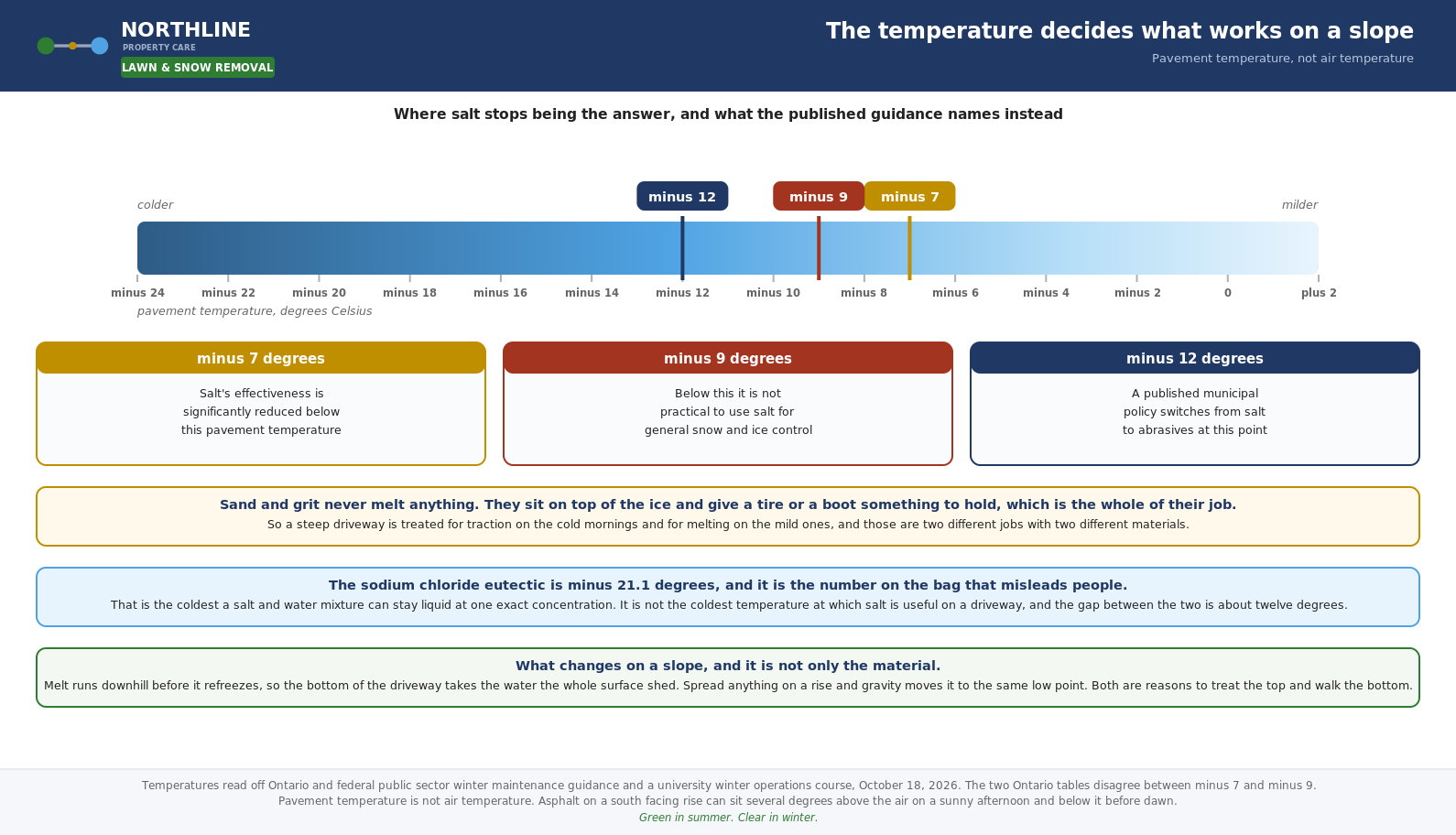
Below that limit the published answer is traction rather than melting. Sand and grit never melt anything, and that is not a criticism of them: they sit on top of the ice and give a tire or a boot something to hold, which is the entire job. Winter control policies written by Ontario municipalities put abrasives exactly where the physics says they belong, on hills, curves and intersections, and at least one northern Ontario municipality publishes a hard switch from salt to sand once it gets colder than minus 12.
Two things change on a slope that do not change on the flat, and both of them argue for treating earlier rather than heavier. The first is that spread material migrates downhill, so a heavy application at the top of a rise ends up concentrated at the bottom within a day or two, which wastes most of it and over salts the one strip of lawn nobody wants to lose. The second is that meltwater travels before it refreezes, so salt applied at the top of the driveway produces brine that runs to the bottom and freezes there once the surface temperature falls through the evening. Treating the top of a rise and then walking the bottom with traction material is not fussiness, it is the only sequence that matches what the water does.
Pavement temperature is the measurement that matters, and it is not air temperature. Asphalt on a south facing rise can sit several degrees above the air on a sunny afternoon and several below it before dawn, which is precisely why the same driveway can need two different materials inside twelve hours. There is more on dose, timing and what we actually carry on our page about driveway salting in Oshawa.
The clay underneath, and why the edges of a steep driveway fail first
The soil either side of a Durham driveway is usually clay or clay loam, and clay on a slope behaves badly in exactly the season a snow contractor is piling snow on it. The federal soil survey for the county covering Oshawa, Whitby and Pickering maps the Darlington series over about 20,700 acres of clay loam till, and describes it as occurring on gently sloping to steeply sloping topography with gully and sheet erosion very common and the till dissected by numerous gullies. The Schomberg clay loam mapped along the lakeshore carries the same warning in blunter terms: erosion is quite often severe on these soils. Both surveys are published through the Canadian Soil Information Service.
The Clarington survey adds a usefully specific figure. The Newcastle clay loam series, mapped inside the area once covered by glacial Lake Iroquois, is described as undulating with gentle slopes of about 5 per cent, which is a published number for the kind of ground the Bowmanville and Courtice subdivisions sit on.
What that means for a driveway is simple enough. Ontario's own guidance on soil erosion notes that the steeper and longer the slope the higher the erosion risk, that the velocity of the water is the mechanism, and that frozen or compacted soil reduces infiltration and makes runoff more likely. Runoff is at its greatest in late winter and early spring, which is exactly when a season of piled snow is melting off the banks either side of a sloped driveway and running down the same line every afternoon. The provincial factsheet on soil erosion sets out the mechanism in full.
The practical version is that where the snow is banked in January decides what the lawn edge looks like in April. On a rise the bank should be spread along the length of the slope rather than concentrated at one low corner, because a single pile at the bottom becomes a channel, and a channel in clay loam becomes a rut that has to be regraded. It costs nothing to push wide on the way up and it is the difference between a tidy edge in spring and a repair.
The mild morning is the dangerous one, and there is data on it
People do not fall most often on the coldest days, they fall most often when the temperature is sitting around freezing, and a sloped driveway is where that statistic lands. A study published by the Public Health Agency of Canada identified 761,853 fall related emergency department visits in Ontario across the winter months of November to March between 2011 and 2015. The odds of such a visit were elevated when the average daily temperature sat between roughly minus 4 and just below freezing, and they were lower, not higher, when the temperature dropped below about minus 9. The paper is available through the National Library of Medicine.
That inversion makes sense once the mechanism is named. Deep cold produces dry snow that holds a boot, and it keeps people indoors. A temperature hovering at zero produces melt, refreeze and a polished surface, and it feels harmless enough that nobody walks differently. On a slope the consequences of a surface like that are not comparable to the same surface on the flat, because a slip on a grade keeps going.
One honest caveat belongs here. That figure is Ontario wide, it counts every fall and not only falls on driveways, and nothing in it is specific to Durham Region or to sloped properties. It is quoted because it settles the timing question, which is the useful half: the day to treat a steep driveway is the mild one after the storm, not the cold one during it.
Worth knowing alongside it, because it affects how any winter advice should be read: Environment and Climate Change Canada retired its numeric public weather alert criteria and replaced them in November 2025 with a colour coded, impact based system. Any article still telling you that a warning fires at some fixed depth in centimetres is repeating a rule that was withdrawn. The current guides are published as weather impact guides, graded moderate, high and extreme, and the ice guide names slip and fall risk as an impact in its own right.
What this page looked for and did not find
A page that prints only its successes is hiding how it was built, so here is the other half of the research. Each entry names what was wanted and why it was not obtained.
- The Town of Whitby maximum driveway grade. Whitby's design criteria document lists a driveways and entrances section and a maximum and minimum grades section in its own table of contents, and the published file stops short of both when read. Whitby is therefore absent from the table above rather than estimated into it. What was confirmed is the Whitby minimum lot grade of 2.0 per cent.
- A slope gradient for the Glacial Lake Iroquois bluff, and any government source naming residential streets on it. The conservation authority reports map the landform and name wetlands and conservation areas, never subdivisions.
- A count of freeze and thaw days for Oshawa. Environment and Climate Change Canada publishes days with a maximum above zero and days with a minimum at or below zero as two separate annual counts and never publishes the number of days that did both, so the two cannot be combined. The 1991 to 2020 station pages would not load at all during this work, and the older normals for the Oshawa water pollution control plant station were read instead.
- A published count of freezing rain days for Oshawa or for Toronto. It is not in the climate normals tables for either station in any period that could be opened.
- A Durham Region or municipal clause requiring a trench drain specifically at the foot of a falling driveway. Nothing in the Region or in the five municipalities names one. The catch basin requirement quoted above comes from the building code, not from a local standard.
- An Ontario ministry source stating the friction a vehicle needs to hold a given grade on ice. The World Road Congress paper quoted above gives the governing relationship and the resulting maximum slopes, and it is the closest published figure found.
- Any data at all on how many Durham driveways exceed the permitted grade. No municipality publishes as built driveway grades, and no inspection record of that kind is public.
The part that costs us the sale, said plainly
If your driveway falls toward a below grade garage and the drain at the bottom is blocked, the job you need first is a drain contractor and not a snow contractor. Clearing snow off a surface that drains into a plugged basin moves the problem by one afternoon. We will say so on the phone and we will not take the season from somebody whose actual problem is a grate full of sand, because the first thaw makes that obvious and nobody enjoys that conversation in January.
Silver does not plow your driveway. On a flat lot that distinction is a matter of preference, and plenty of households are happy with the ridge at the entrance cleared in a daytime pass. On a steep driveway it is not a preference, because a surface nobody has pushed by mid morning has already been driven over, compacted and polished, and no afternoon pass fixes that. If a property climbs and somebody is leaving for work, the honest recommendation is Gold at $189 a month plus HST with its 7 AM target, or the seasonal package, and not the entry tier. We would rather lose the difference than sell a product that does not match the slope.
And if the grade genuinely beats what can be done with a blade and a bag of traction material, we will tell you that instead of taking the money. A handful of driveways in this region are steep enough that the only real answer is a heated slab or a rebuild of the grade, and neither of those is anything Northline sells or installs. Saying so costs us a season. Finding it out in the second week of January costs you one.
What we actually do on a sloped driveway
The first thing asked on the call is which way the driveway runs and roughly how much it climbs or falls, and it is asked before a price is given. It decides where the snow can go, it decides whether the property needs treating as a routine or only on bad mornings, and it decides how long the property takes. Price a sloped property without asking it and the number rests on a guess about the single feature that makes the surface hard.
Work begins at the measured 3 cm residential trigger and not at anybody's opinion of whether it looks bad enough. After snow overnight the target is a driveway cleared by 7 AM on Gold, and by 6:30 AM on Platinum. On a rise that early finish earns more than it does on a flat lot, because the surface has not yet been driven over and compacted by somebody trying to get out. Snow that has been polished into a slope by a set of spinning wheels at six in the morning is a different and much slower job than the same snow untouched.
The snow goes up and out onto the household's own ground, spread along the length of the slope rather than piled at the low corner, and it is kept off the garage door and off the foundation. Nothing goes to the road, nothing goes on the sidewalk and nothing is put on a boulevard that belongs to a neighbour. On a steep property that is the slower route rather than the shortest one, and it is the route that keeps the spring edge intact.
Salting is part of Gold, and on Platinum it happens automatically with no cap on how often. Silver carries none of it, ever, and on a property that climbs that is the distinction worth understanding before anybody chooses a tier. On the cold mornings the material changes to traction rather than melt, because the published guidance says salt has stopped earning its place by then and because a bag of sand on the bottom three metres of a rise does more good than twice the salt would.
If your driveway is over 100 feet, or your lot is between 0.35 and 1.0 acre, the property is quoted in the estate band rather than the standard one, and a laneway over 250 feet moves into the grand estate band. That is a published formula rather than a site visit, and there is more about it on our page for long driveway snow removal in Durham Region. Northline is fully insured, the person who prices the property is the person who clears it, and nothing is subcontracted to somebody you were not told about.
Questions people in Durham actually ask about a sloped driveway
How steep is too steep for a driveway in Durham Region?
The published maximum depends on which authority approved the lot, and the five answers are not the same. Ajax caps a driveway at 6 per cent by design and says in the same clause that 6 per cent is not recommended. Pickering sets 2 per cent as the minimum and 8 per cent as the maximum. Clarington designs between 2 and 8 per cent and asks for certification that the finished surface does not exceed 10 per cent. Oshawa allows 2 to 10 per cent on its own standard drawing, and the Region of Durham allows 10 per cent from the sidewalk to the garage in exceptional cases only. None of those numbers is a winter number. They are drainage and vehicle clearance numbers that happen to decide what February feels like.
Can a car get up an icy driveway on a slope?
Often it cannot, and the figure is smaller than most people expect. Work presented at the 2014 World Road Congress puts the steepest slope a passenger car can climb on smooth ice at about 3.1 degrees, which is roughly 5.4 per cent, and on snow that has not been packed down at about 8.5 degrees, which is roughly 15 per cent. Every residential driveway maximum published in Durham Region is steeper than the ice figure. That is the whole reason a sloped driveway is a traction problem first and a snow clearing problem second.
Where does the snow go on a steep driveway?
Uphill and off to the side, onto ground the household owns. It cannot go downhill, because downhill is the road or the sidewalk, and every Durham municipality makes it an offence to put snow there. It should not be banked against the garage door or against a foundation either, because that pile is the first thing to melt on a mild afternoon and the water has nowhere to go but back down the slope. On a long rise the usable width narrows every storm as the banks grow, which is why the far end of a steep driveway gets harder to clear in February than it was in December.
Does salt work on a frozen slope?
Only down to a point, and the point arrives earlier than the bag suggests. Ontario public sector winter maintenance guidance says the effectiveness of sodium chloride is significantly reduced below a pavement temperature of minus 7 degrees, a second Ontario table puts the lowest practical working temperature at minus 9, and the United States federal highway guidance says it is not practical to use salt for general snow and ice control below about minus 9. The eutectic figure of minus 21.1 degrees printed on many bags describes a laboratory mixture at one exact concentration and is not a working temperature. Below the practical limit the honest answer on a slope is traction material rather than more salt, because sand and grit never melt anything and are not trying to.
Why does the bottom of my driveway ice up when the rest is clear?
Because every litre of meltwater on the surface arrives at the same low point before it refreezes. A graded driveway sheds water in one direction by design, and on a slope that direction is emphatic, so the bottom two or three metres take the runoff from the entire slab plus whatever the roof and the banks contribute. Add the ridge the road plow leaves across the entrance, which is denser and wetter than anything that fell out of the sky, and the lowest part of the driveway is both the most loaded and the last to dry.
Do you charge more for a steep driveway?
Not for the grade on its own. Pricing follows the surface that has to come clear and the time the property takes, so a short rise on a subdivision lot is priced like any other driveway of that size. Length and lot size do move the price: a driveway over 100 feet, or a lot between 0.35 and 1.0 acre, is quoted in the estate band rather than the standard one. What a steep driveway does change is the conversation before the quote, because the grade decides where the snow can be put and whether salting is going to be needed on mornings a flat driveway would not need it.
Who wrote this, and what was read to write it
The owner of Northline Property Care wrote this page, after six winters doing the work it describes. Northline is owner operated, based in Oshawa, and covers Oshawa, Whitby, Ajax, Pickering, Bowmanville, Courtice and Clarington. Whoever quotes your property is the one standing on it in February, and on a slope that is the only way to know beforehand whether the grade and the equipment will agree.
The grade standards above were read on each authority's own published document in October 2026, and the clause numbers are given so any line of them can be checked. The physiography and the elevations come from conservation authority assessment reports. The soil descriptions come from the federal soil surveys published through the Canadian Soil Information Service. The de-icing temperatures come from Ontario and federal public sector winter maintenance guidance, and the climbing limits from a paper presented to the World Road Congress. The falls figures come from a study published by the Public Health Agency of Canada. No figure here came from a business chasing the same customer. That restriction is standing policy at Northline, and it is why several of the numbers above appear on no other site serving this region.
Nothing here is engineering advice on your specific property. A driveway that is steeper than its approved standard, or one that was regraded after a renovation, is a question for the municipality that issued the permit, and the document worth having in front of you when you call is the grading plan filed with it.
Read next
When salting earns its place
Dose, timing, the temperature at which salt stops working, and what goes down instead once the pavement is colder than that.
Read the salting page →Large driveways in Oshawa
What changes when a driveway is long rather than steep, how the time on the property is worked out, and where the snow ends up.
Open the large driveway page →Per visit or seasonal
The arithmetic behind buying a season instead of a storm, using the real event count for a Durham winter rather than a round number.
Compare the two →Andrew answers, October 2026
My driveway is on a hill and the plow truck left ruts in my lawn last winter. Why does that happen on a slope?
Because on a rise the blade is working across the grade rather than along it, and the moment a wheel finds the soft edge the whole machine slides the way the hill is pointing. The fix is stakes, put in before the ground freezes, so the edge of the surface is visible at five in the morning under thirty centimetres of snow. I would rather spend ten minutes in November putting markers down the sides of a steep driveway than have the conversation about a rut in April, and on a slope it is the single cheapest thing a homeowner can do for the result.
A new one of these lands on this page every month. Have a different question about a slope? Put it to me directly: 905-244-5779.
Tell me which way your driveway runs and I will tell you how it gets cleared
Most properties are priced from the map without anybody driving out. Send the address, say whether the surface climbs or falls and roughly how far, and you get a real number the same day along with where the snow is going to be put and whether the property needs treating as a routine. If the grade is one we cannot do properly, I will say that instead.