Lawn care · Spring
When to Start Cutting Your Lawn in Oshawa
When to start cutting your lawn in Oshawa is a question about the ground rather than the calendar, and the federal climate record is where the two part company.
The lawn season runs 26 weekly visits from May 1. See what a visit covers.
Green in summer. Clear in winter.
The short answer
Cut when the grass is growing and the ground will carry you, and not before. On a Durham clay loam those two conditions arrive in the same month and fight each other. If you can knead a handful of your soil into a ball, it is too wet to drive a mower across and you have just found your answer for that morning. Everything below is why.
The collision, in the federal record
Environment Canada's 1991 to 2020 normals for the composite station named OSHAWA, climate ID 6155875.
| Element | March | April | May | June |
|---|---|---|---|---|
| Daily average temperature | 0.3 C | 6.2 C | 12.6 C | 17.8 C |
| Daily minimum | -3.9 C | 1.7 C | 7.6 C | 12.9 C |
| Nights at or below freezing | 23.4 | 10.5 | 0.86 | 0 |
| Days with a maximum above 10 C | 4.0 | 15.8 | 29.2 | 30 |
| Degree days above 5 C | 14.5 | 67.2 | 231.8 | 386.1 |
| Rainfall | 42.9 mm | 85.3 mm | 85.1 mm | not read |
| Snowfall | 10.9 cm | 1.6 cm | 0.0 cm | 0.0 cm |
Read the last three rows together and you have the problem in one table.
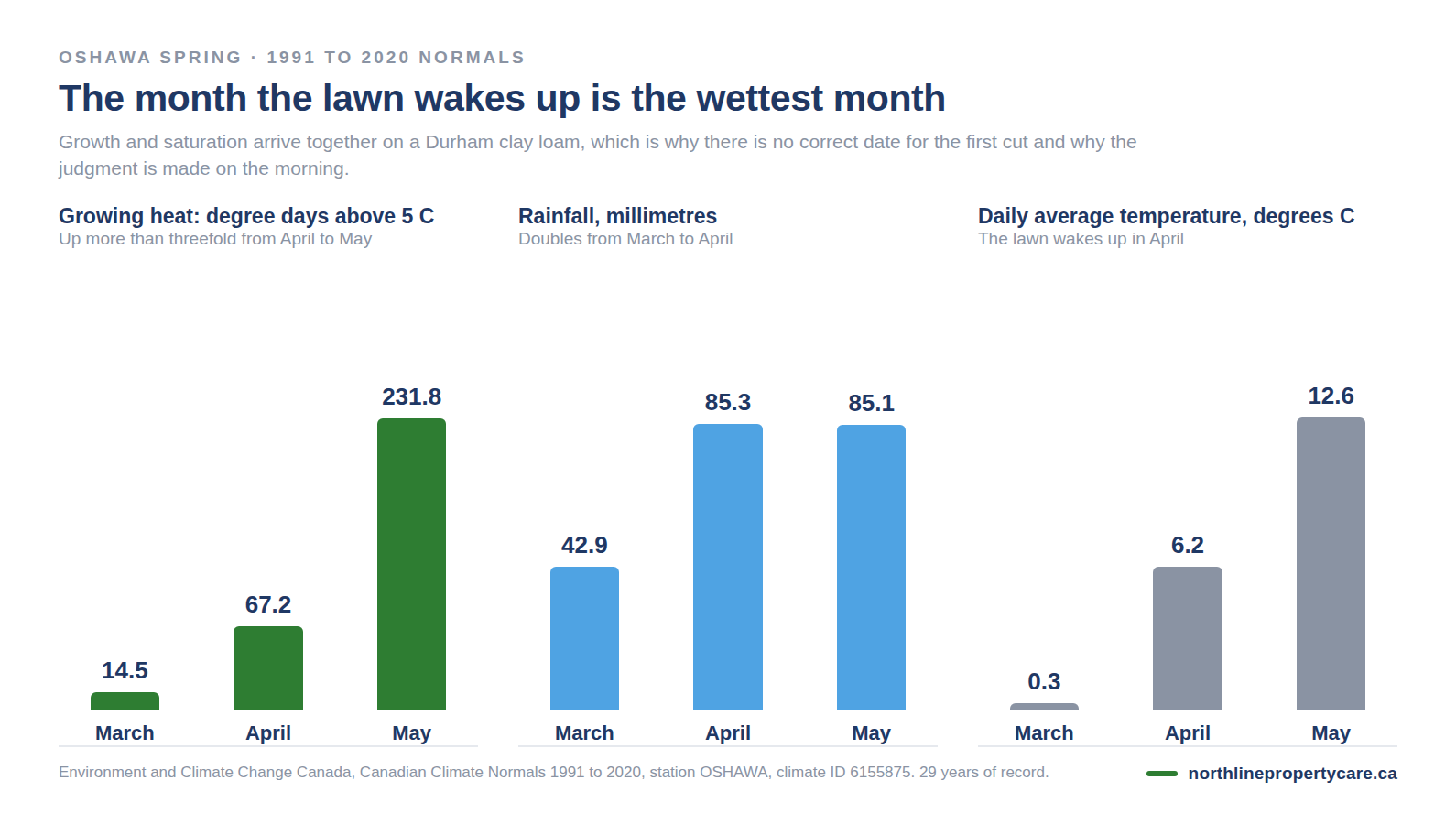
Rainfall doubles from March to April, from 42.9 mm to 85.3 mm, at exactly the same moment the lawn starts accumulating real growing heat. Degree days above five degrees go from 14.5 in March to 67.2 in April, and then more than triple again to 231.8 in May. Total April precipitation, at 86.9 mm, is the wettest of the three months.
Growth and saturation arrive together. That is not true everywhere, and it is why advice written for a drier spring elsewhere does not transfer to a Durham lawn.
Two more figures for the people who like to plan. The average date of last spring frost in Oshawa is April 30, and Environment Canada publishes the spread around it: a ten per cent chance of a freeze on or after May 14, and a fifty per cent chance on or after April 29. March still averages 23.4 nights at or below freezing, so a March lawn is refreezing most nights it thaws.
One honesty note on the data, which is published on the same page and is rarely reported: these temperature normals rest on 29 years with three missing years and about 87 per cent of possible observations, and the frost dates carry Environment Canada's weakest confidence code. They are sound. They are not a spotless run, and you should know that before anybody quotes them to you as gospel, ourselves included.
What is actually happening underground while nothing visible happens above it
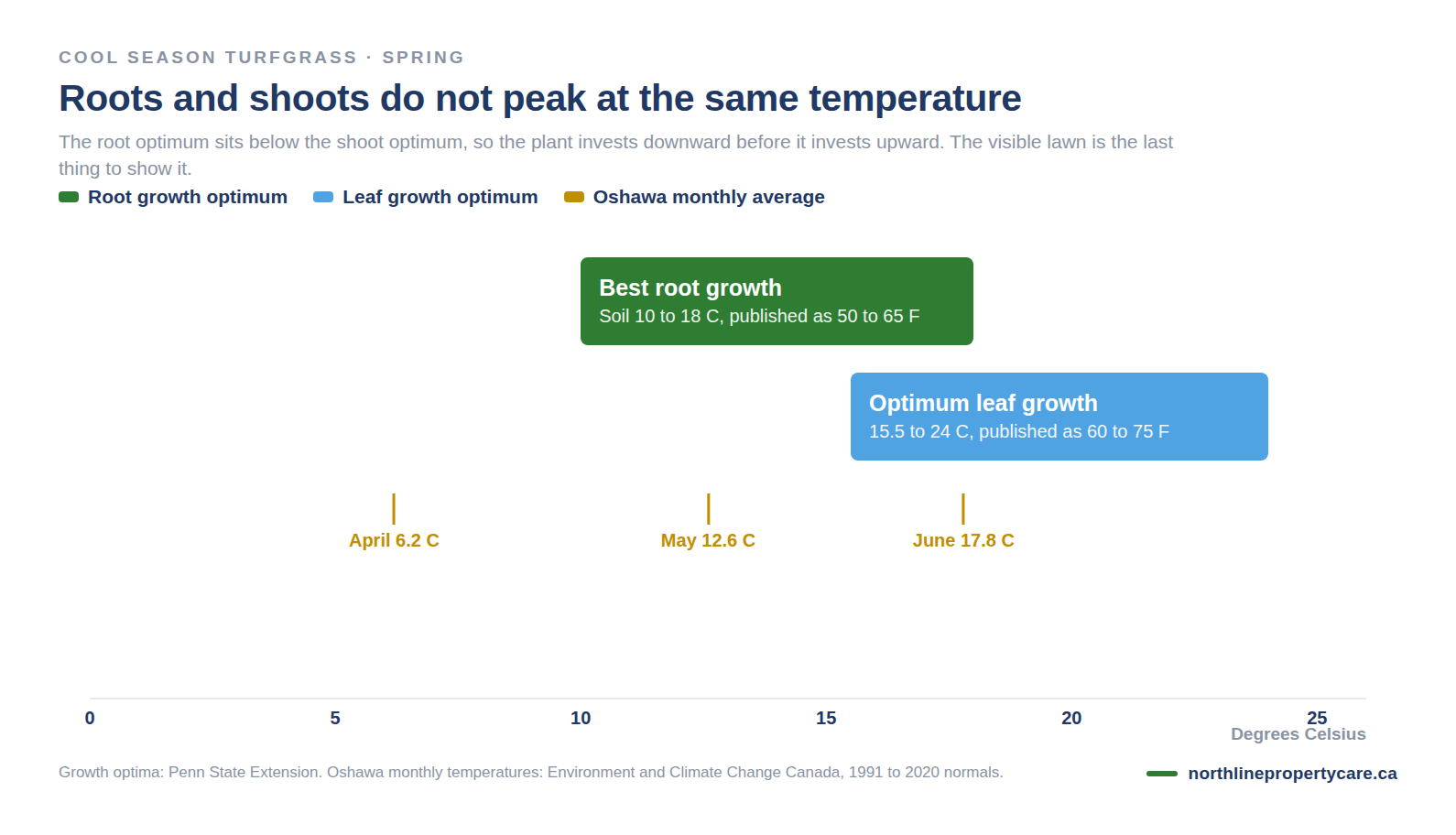
Penn State's summary of cool season turfgrass growth contains the fact that reframes the whole spring, and it is one sentence: the optimum temperatures for root growth of cool season grasses are lower than those for shoot growth.
The numbers behind it. Best root growth happens at soil temperatures of 50 to 65 degrees Fahrenheit, about 10 to 18 Celsius. Optimum leaf growth needs 60 to 75 Fahrenheit, about 15.5 to 24. And roots keep working below 50 F, slowing dramatically only as the soil approaches freezing.
Set that against the Oshawa table. April's daily average air temperature is 6.2 degrees and May's is 12.6. So through April and into May the root system is heading into its best window while the leaf blade is still below the temperature it prefers. The plant is investing downward before it invests upward, and the visible lawn is the last thing to show it.
That is why Penn State also reports that root growth is greatest for cool season grasses during spring and fall and much reduced in summer and winter. By July the roots are largely done for the season, which is a fact with consequences all the way through August.
And here is the part that decides how you treat the first cut. Penn State states that depletion of carbohydrates is fastest in spring, especially under low mowing heights and high nitrogen fertility. The plant is spending its stored reserve hardest in exactly the weeks people are most tempted to scalp it and feed it.
The soil under Oshawa, and the threshold that decides whether you drive on it
This is the chain that makes the first cut a local question, and it is built from three sources none of which mention each other.
One. The government's soil record for what is now Oshawa and Whitby is Report No. 23 of the Ontario Soil Survey, mapped in 1949 and 1950. The Darlington series, mapped across 20,700 acres, is a friable loam at the surface over a B horizon at fifteen to twenty three inches described as dark brown clay loam of plastic consistency. The Peel series carries a clay loam surface over a plastic clay. Plastic consistency means the material deforms and keeps the new shape rather than springing back.
Two. Penn State's guidance on compaction states the rule in four words: only wet soil can be compacted. Their operational threshold is the plastic limit, and the field test is exactly the one in the box at the top of this page. If the soil kneads easily into a ball, do not traffic it.
Three. The same source publishes bulk density figures by texture, and clay has the narrowest margin of any soil type. Ideal for a clay soil is below 1.10 grams per cubic centimetre and root restricting arrives at 1.47. For a sandy soil the same two numbers are 1.60 and 1.80. A clay soil has less room to be compressed before roots stop growing than any other texture.
Put those three together and the conclusion is not opinion. The dominant subsoil under Oshawa lawns is a clay loam that behaves plastically; only wet soil compacts; and clay has the least tolerance for it. Which means the first cut of the year on a Durham lawn is a soil moisture decision that happens to be about grass.
One figure to make compaction feel less abstract. In the same Penn State material, severe compaction of wet soil under ten tonne axle loads took earthworm populations from 166,000 per acre down to 8,000. A mower is not a ten tonne axle, and that is the direction of travel.
Cornell's turfgrass program gives the same instruction in one line and adds a diagnostic worth using in April: avoid traffic on moist soils, and dig into the places where water puddles and drains slowly after rain, because that is where your compaction already is.
The advice that runs opposite to what everybody says
Every spring lawn article tells you to wait until the grass is actively growing and greened up. Purdue's turf program says something close to the reverse, and it is worth quoting precisely.
It is better to mow too early rather than too late in the spring, and most of us tend to mow too late.
Their explanation is the bit that changes how you look at your own lawn. Grass grows from the base of the leaf, pushing last year's dead brown tissue up toward the tip. So a lawn that still reads as fairly brown when you look across it from standing height is frequently already growing underneath and already needs cutting. The brown you are looking at is last season's tissue being carried upward by this season's growth.
Which produces a genuinely useful test: get down and look at the base of the plants rather than across the surface. Green at the base with brown tips is a lawn that is ready. Brown all the way down is a lawn that is not.
Now the conflict, because Purdue publishes both sides of one and we would rather you heard it from us. One Purdue county extension page recommends that the first mowing be slightly lower than normal to encourage green-up. Purdue's own turf program page says to set your mower as high as feasible and that three inches or higher is the best way to maintain a healthy lawn.
We go with the high setting, and the tiebreaker is Penn State's carbohydrate finding above. If reserves deplete fastest in spring under low mowing, then a one time low cut in April is being paid for out of the plant's savings account at the moment the balance is dropping fastest. If you do take a low green-up cut, take it as a deliberate one off and understand what it costs, rather than as the new height.
On the height itself, we cut at 7.5 cm all season and the case for that is its own article, built on a Purdue field trial that measured what grows at three different deck settings.
May is the busy month, not July
This catches out every homeowner who buys a season of lawn care expecting the work to build toward August.
Purdue puts spring mowing at every four to five days and summer at every fourteen. Penn State says that at peak spring growth a lawn may need mowing more than once a week. Cornell publishes the intervals that fall out of the one third rule and they tighten the same way.
Look back at the degree day row in the first table. Oshawa accumulates 67.2 degree days above five degrees in April and 231.8 in May. That is a three and a half fold jump in the growing energy available to the plant, inside four weeks, at precisely the time the roots are in their best window and the soil is holding April's rain.
A weekly schedule absorbs that because the interval was set for the busy month rather than the average one. That is the whole argument for a fixed weekly visit instead of calling somebody when it looks long: by the time it looks long in May you are already breaking the one third rule.
Our lawn season runs roughly 26 weekly visits from May 1 to November 1. It is not 26 identical visits. The spring ones are the ones that earn the schedule.
What comes off the lawn with the snow
Two things usually turn up in April on a Durham lawn and only one of them is worth worrying about.
Snow mould. Matted, crusted patches at the melt line. Cornell distinguishes two: Typhula blight, which needs snow cover and rarely kills the grass, and Microdochium patch, which does not need snow cover and can. Both work at temperatures just above freezing, roughly zero to seven degrees, which describes a great many Durham mornings between February and April.
Cornell's remediation instruction for a home lawn is one line: rake the matted grass, encouraging new spring growth. That is genuinely all of it. Ontario's turf manual corroborates both diseases for this province and notes that the sclerotia of grey snow mould are visible to the naked eye if you want to confirm what you have.
Here is something we are deliberately not telling you, because we could not source it. There is a widely repeated instruction not to fertilize heavily in spring after snow mould. We could not find that guidance published by any university extension program or by any Ontario ministry. It may well be sound. It is not something we are going to put in your mouth without a source behind it.
Compaction damage from winter traffic. The other April arrival, and the one nobody looks for. Wherever the snow got piled, walked on or driven over during the winter, the soil underneath spent four months compressed and wet. Those are the spots that will puddle in the first rain, and they are the spots to mark now for core aeration in September.
The blade, before the first cut and not after it
Health Canada puts the seasonal instruction plainly: sharpen your mower blade in the spring and keep it sharp, because grass recovers more quickly and easily from a clean cut than from being torn.
There is research behind that and it is older than most people expect. A 1983 study in Agronomy Journal ran Kentucky bluegrass through repeated mowing with sharp and dull rotary blades and found turf quality, shoot density and verdure all reduced under the dull treatment, with leaf spot increasing on the more susceptible cultivar.
The spring case for doing it now rather than in July is the carbohydrate point again. A torn leaf tip loses water and admits pathogens at the moment the plant has the least stored energy to recover with. Ontario's turf manual makes the mechanism explicit: mowing injures the plant, and pathogens can get into the cut surface.
Sharpening intervals are covered in more detail alongside the cutting height, where the sources disagree in an interesting way.
How we actually decide, and the part that costs us
Here is the operating rule on our route, written out, including the bit that is not in our interest.
- The route starts on May 1. First visits are scheduled and then judged on the morning, property by property.
- A saturated lawn does not get mowed. We will drive to a property, look at it, and leave without cutting it. On a flat monthly membership that visit still costs us the fuel and the slot and you still pay the same price, so the incentive runs the wrong way and we do it anyway. Rutting a clay loam lawn in April is damage that takes a season and a core aeration to undo.
- North Oshawa goes first. Windfields and Kedron are on the front of the route for the same reason they are on the front of the winter one: they are closest to where the truck starts.
- The order on the property is edge, then mow, then trim. Edging first means the mower picks up the debris instead of somebody having to.
- Clippings stay on the lawn, except in the cool wet spring conditions where a thick layer would sit on the surface rather than falling through the canopy. Both Ontario and Health Canada flag that exact exception.
And the sentence that matters most for anybody comparing quotes. A contractor who mows your lawn in the last week of March so the first invoice lands sooner is doing you harm you will not see until August. That is not a hypothetical; it is the single most common thing we are asked to fix on a property that changed hands from another operator.
Questions people actually ask
Is there a date I should start mowing?
No, and any date you are given is somebody guessing. The month the grass starts moving here is also the wettest of the spring, 85.3 mm against March's 42.9. That collision is why it is a judgment made on the morning.
My lawn still looks brown. Is it too early?
Probably not. Grass grows from the base and pushes last year's dead tissue to the tip, so a lawn that reads brown from standing height is often already growing. Look at the base of the plants instead.
How do I know if the ground is too wet to walk on?
Pick up a handful and try to knead it into a ball. If it forms one easily, Penn State's threshold says do not traffic it. Only wet soil can be compacted.
Should the first cut be lower than usual?
Purdue publishes both answers in different places. We use the high setting, because carbohydrate reserves deplete fastest in spring and a low cut is paid for out of them.
How often does a lawn need cutting in May?
More often than in July. Purdue puts spring at every four to five days against fourteen in summer, and Oshawa's May degree day accumulation is more than three times April's.
What is the matted grey patch after the snow melts?
Almost certainly snow mould. Cornell's home lawn instruction is to rake the matted grass and let new growth through. We could not find published support for the common advice about not fertilizing afterwards, so we are not repeating it.
Who wrote this
Andrew owns the business and cuts the first lawn of the year himself. North Oshawa, with the lawn route opening across the seven Durham towns, fully insured, an HST registrant. Six winters of Durham snow clearing are behind him, and the route that finishes clearing snow in April is the one that opens for cutting three weeks later.
The soil chain in this article is assembled from a 1950s federal soil survey, a Pennsylvania compaction threshold and an Ontario climate record, none of which cite each other. Putting them together is the only original thing on this page and it is why the answer here is different from the answer anywhere else.
Where to go from here
The deck setting, and the trial behind it
Crabgrass cover measured at three cutting heights in an established bluegrass sward, plus what every Durham by-law will let you get away with.
Read the evidence →Fixing the compaction you found in April
Mark the puddling spots now and deal with them in September. The window, the published hole counts, and the honest limits of what aeration is proven to do.
Read the window →When the lawn needs more than a cut
Six steps in one day, once a year, on a lawn the weekly visit cannot fix. Including the dethatch pass that only runs if a ruler says so.
See the service →The work, photographed
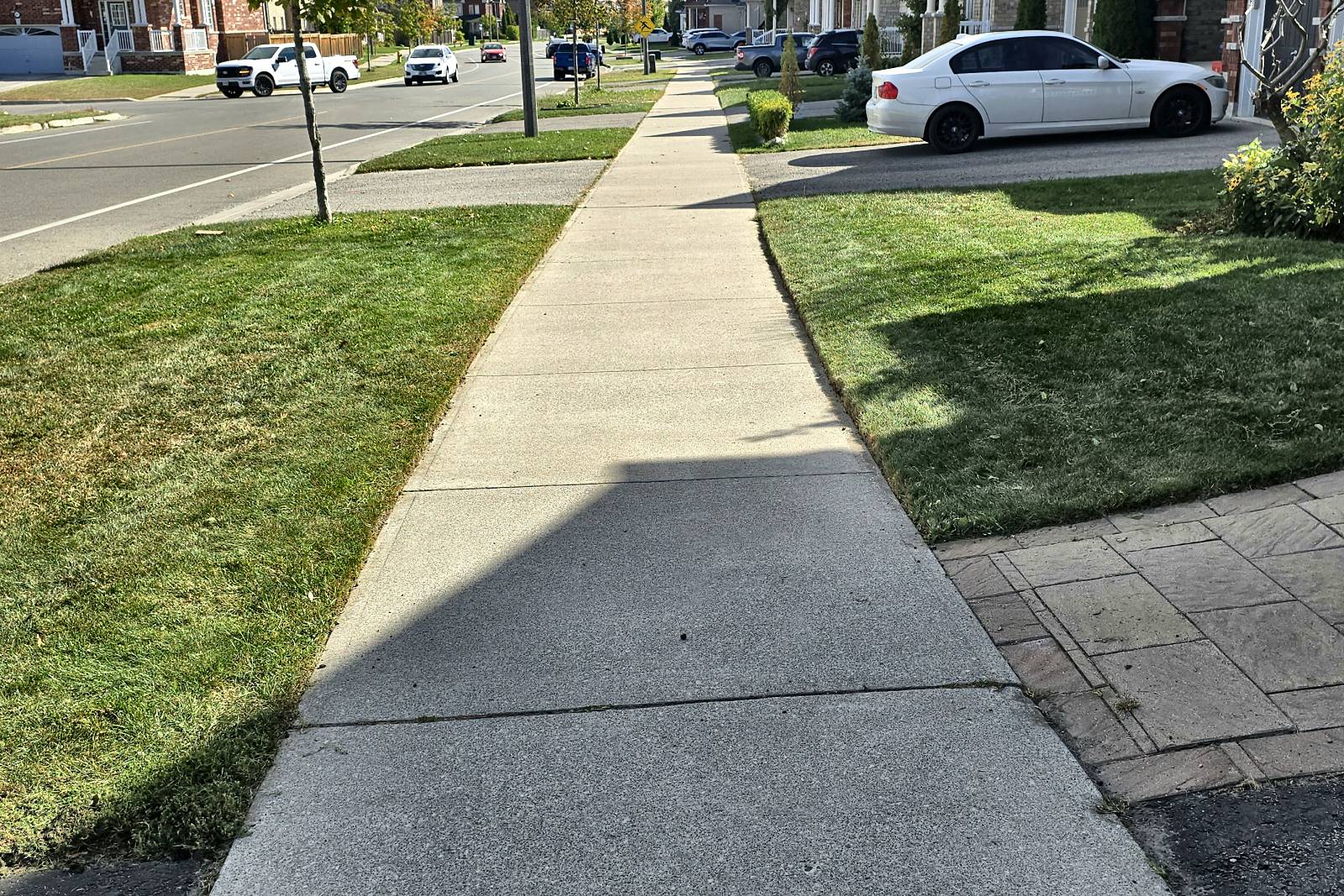
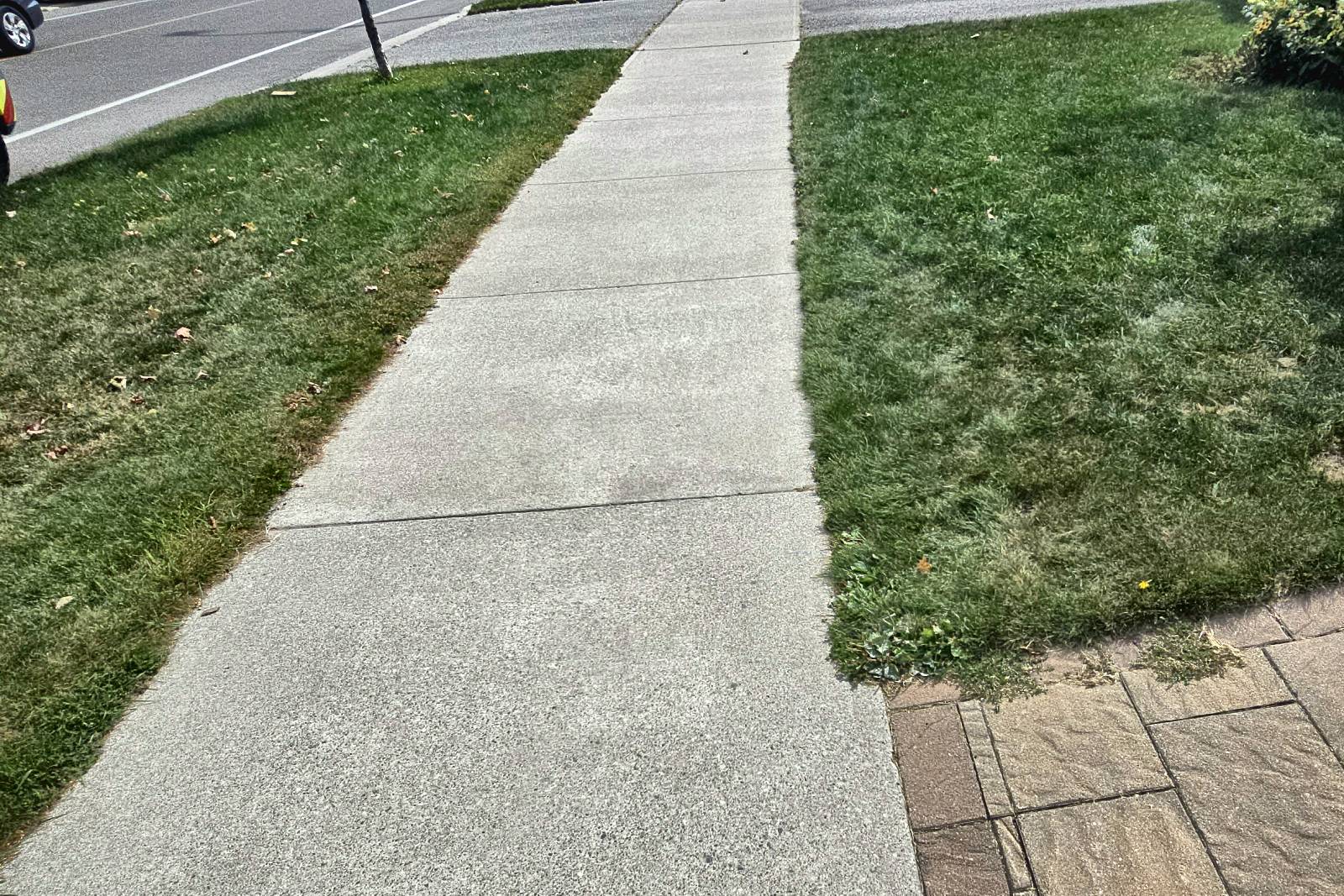
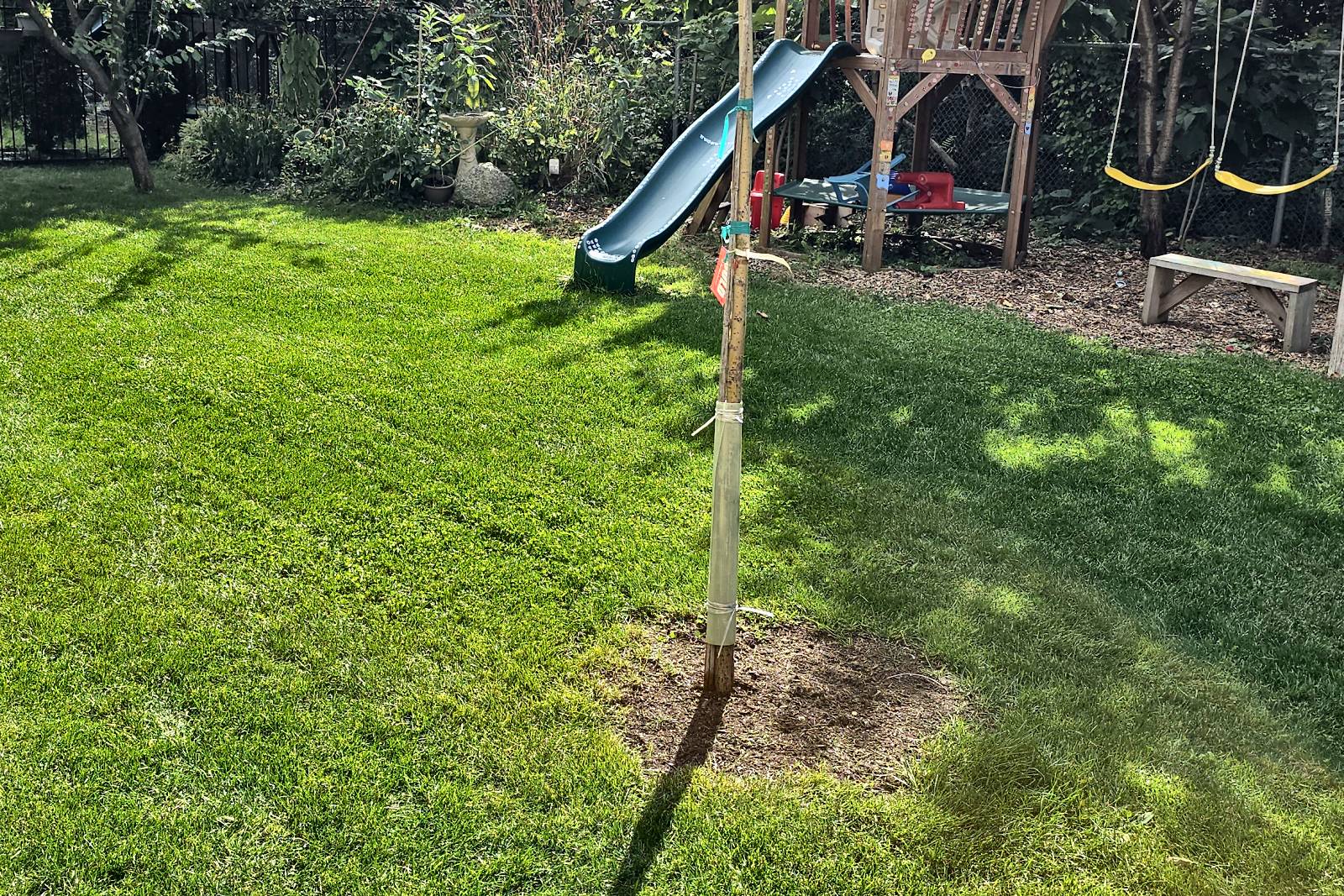
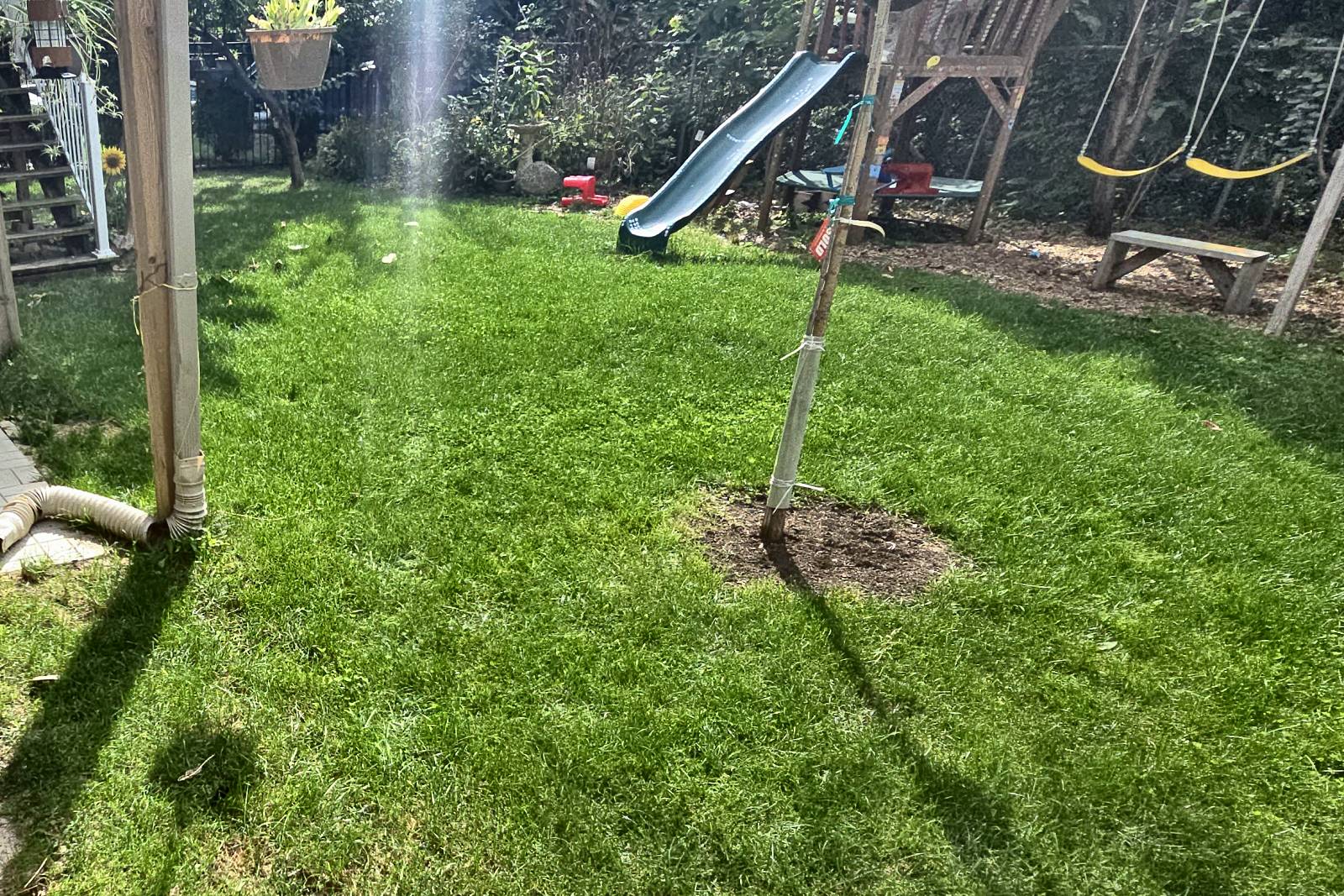
Real Northline properties, before and after, every one of them in Oshawa and every one of them this year. Drag the line to compare.
Andrew answers, October 2026
What happens in a drought? Do I still pay for a visit that did not happen?
We skip rather than cut, and we tell you why. Cutting a dormant lawn damages it. The payment does not change, because the payment is twelve equal instalments for a season rather than a charge per visit, and the same arrangement is what stops a twenty four storm winter costing you more than a four storm one. A contractor who mows on schedule through August because the schedule says so is charging you to hurt your grass.
One of these goes on each page and it is replaced monthly. If the question you have is not here, ask it: 905-244-5779.
The spring weeks are the ones a schedule earns its money in
A weekly slot booked for May absorbs the busiest month of the lawn year without anybody having to chase it, and the same person handles the driveway in winter. Send me one address and I will come back with the figure the same day.