Add on services · Hedge trimming
Hedge Trimming in Oshawa, and Why October Is the Wrong Month
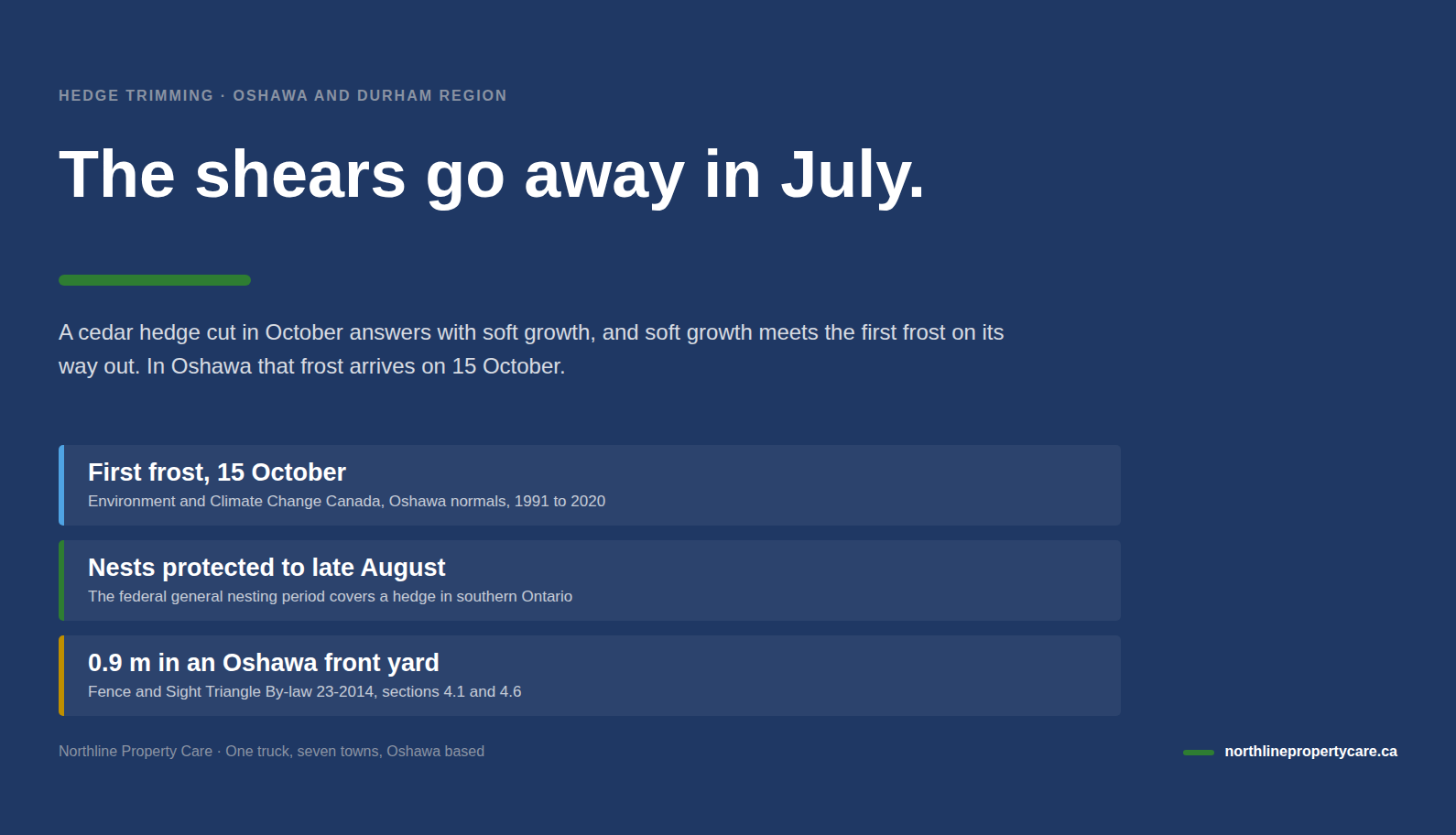
Hedge trimming in Oshawa belongs to the spring and the first half of the summer, and the reason is a date rather than a preference. A cedar hedge sheared in October answers the cut with soft new growth, and the average first frost at Oshawa lands on October 15.
Hedge and shrub trimming is $85 an hour, two hour minimum. See what the a la carte list covers.
Green in summer. Clear in winter.
The short answer
Shear a hedge in Oshawa between April and the middle of July, and leave it alone after that. A cut is an instruction to grow. Given in April, the plant has four months of warm weather to harden the growth it makes. Given in October, the same instruction produces soft tissue that meets the first frost within days, and the tips it kills are the tips you were paying to shape.
Two other dates sit on top of the horticulture and neither of them is optional. Active bird nests in a hedge are protected under federal law from roughly the end of March to the end of August, which eats the front of the season. The Region of Durham collects yard waste from April to early December, which decides when you can actually get rid of what you cut. The workable overlap is narrower than most people assume, and this page is about where it sits.
Why a cut in October is a cut you pay for twice
The mechanism is not complicated and it is worth understanding, because it explains every other rule on this page.
A woody plant spends late summer and autumn doing something invisible: moving sugars out of the leaves, thickening cell walls, and lowering the temperature at which its tissues freeze. Gardeners call it hardening off. It is a gradual process driven by shortening days and cooling nights, and it takes weeks rather than days.
Pruning interrupts it. Cutting a shoot removes the tip that was suppressing the buds below it, and those buds break. Iowa State University Extension puts the consequence plainly: pruning shrubs in August or early September may encourage a late flush of growth, and that new growth may not harden sufficiently before the arrival of cold weather. The University of Maryland Extension draws the line at the same place and names the months, advising against pruning from roughly August to late October because new growth will not have a chance to harden off before winter. Purdue, Wisconsin, Virginia Tech and the University of Maine all say the same thing in their own words.
So the question for a Durham homeowner is arithmetic. How long does soft growth have?
Environment and Climate Change Canada publishes an average first autumn frost at Oshawa of October 15, with the frost free period running 167 days. That figure has barely moved: the previous normals period, measured at the Oshawa water pollution control plant station, gave October 14 and 168 days. Two independent thirty year windows, one day apart. It is one of the most stable numbers this business uses.
It is worth saying where it comes from rather than just quoting it. The Oshawa frost normals rest on sixteen winters of daily minimum temperature, not thirty, because the station thread that supplies the frost element runs only to 2006. The number is sound and it is what the national agency publishes, and the honest version of the sentence names the sample.
Look at what October actually is at Oshawa. The mean daily temperature is 9.5 degrees. There are 3.8 nights in the whole month at or below freezing. November brings 14.2 of them, and the November mean daily minimum is plus 0.3 degrees, which means half of November nights are at or below zero.
A shoot that emerges in the second week of October therefore gets, on average, a handful of frost free nights and then a month in which it is freezing every other night. It does not harden. It dies back, and the dieback is at the outside of the plant where every cut you paid for is.
There is a second mechanism that is less widely known and worth knowing. Colorado State University Extension notes that evergreen needles form a protective waxy layer over the course of the summer. Foliage exposed by a late cut has not built it, which is one of the reasons a late sheared cedar can scorch in February sun on a face that was perfectly happy the winter before.
The three windows, on one year
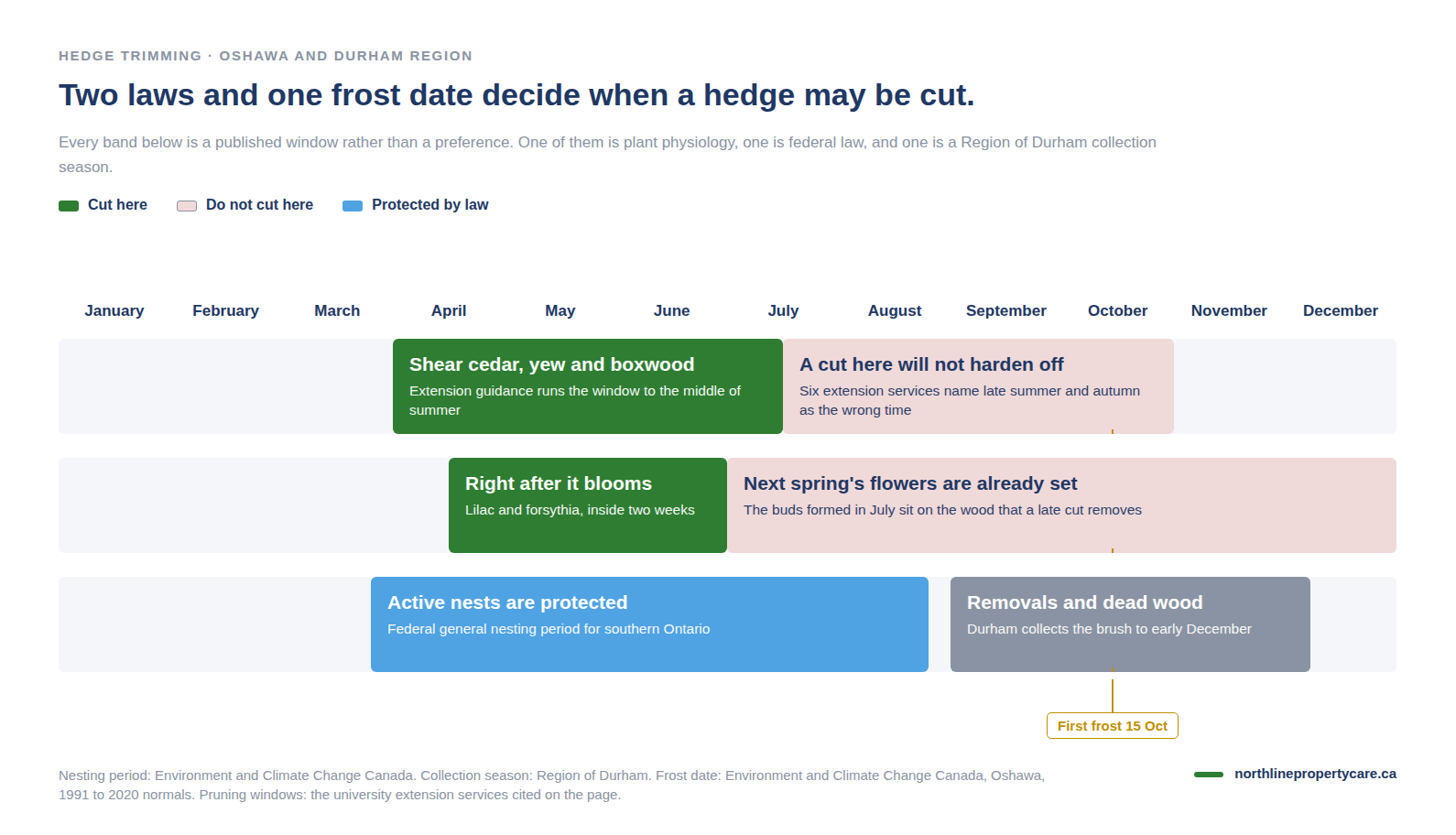
Nothing on that card is a preference. The green and red bands are plant physiology, taken from the extension services listed at the foot of this page. The blue band is the federal general nesting period. The grey band is the Region of Durham collection season, which decides whether you can get rid of what you cut. The marker is the Oshawa first frost normal.
Read the three rows together and the shape of the year falls out. April to mid July is the only stretch where an evergreen shear is horticulturally sound, and the back half of it sits inside the nesting period. September to early December is clean of nesting and still inside collection, and it is the wrong time to ask a cedar to grow. So the autumn is for removals, dead wood and preparation, and the shear waits for spring.
The dead zone, and why cedar is a one way decision
A cedar hedge is a one way decision and most people find that out too late. This is the single most expensive thing a Durham homeowner can get wrong about a hedge, and it costs nothing to avoid.
Eastern white cedar, which is what almost every hedge in Oshawa, Courtice and Bowmanville is made of, carries its growing points at the shoot tips and in the green scale foliage. Interior wood that has been shaded out drops its foliage and keeps no dormant buds capable of breaking. Penn State Extension states the consequence for the whole group: with the exception of yews, cutting back to only brown wood will not encourage growth on that branch, and it will be dead. Colorado State puts it as a physical fact: new growth comes only from the growing tips, so if the shrub is pruned back to bare wood it will have a permanent bare spot.
The practical rule, and the one that survives every source we read, comes from the University of Maine Cooperative Extension: prune a branch no further than back to the last green side branch, unless you are thinning out the entire branch.
Two permitted sources are more permissive about cedar than the rest. The University of Maryland lists arborvitae among conifers that may be headed back, and the Maine bulletin says cedar can be pruned back further than juniper. Our reading is that those sources are describing heading back further into green foliage, not cutting into bare brown wood, and we are recording the disagreement rather than flattening it. Either way the Maine operating rule holds, and it is the one to work to.
Yew is the exception that proves the point. Taxus carries dormant buds on old stem wood and can be rejuvenated by hard cuts, which is why the old clipped yews around the 1960s bungalows on Oshawa's Ritson and Wilson corridors can be brought back and a cedar screen of the same age usually cannot. Even with yew, Iowa State warns that recovery can take considerable time, so a hard cut on a yew hedge is a two or three year project, not a Saturday.
The consequence for a homeowner is simple. Decide the height and the width of a cedar hedge before the leaders pass them, and hold it there with an annual light shear. Once the hedge is bigger than you want, there is no cut that makes it smaller without leaving a hole, and the answer becomes either living with the size or replacing the run.
The taper, and the second reason for it that matters here
Cut the top narrower than the bottom, and the reason is light rather than looks. Six separate extension services say this, which is as close to unanimous as this subject gets.
A hedge with vertical sides shades its own lower branches. The bottom thins, then goes bare, and on cedar that bare zone is permanent for the reason in the section above. The University of Maryland publishes the only numeric specification we could find: a hedge five feet high could be three and a half to four feet wide at the base and about a foot wide at the top. Purdue, Colorado State, Minnesota, Maine and Iowa State all state the shape without the numbers.
Iowa State adds a second reason that matters far more in Durham than it does in most places that publish this advice. A pyramidal profile reduces snow accumulation on the top of the hedge, and snow on the top of the hedge is what breaks the branches.
Put those two together and the taper stops being a horticultural nicety. Oshawa averages 101.7 centimetres of snow a year, 7.8 days with a snowfall of 5 centimetres or more, and 2.5 days with 10 centimetres or more. A flat topped cedar hedge collects every one of those events. A tapered one sheds most of them. The same cut buys light at the bottom in July and load shedding in January.
On how much to take in one pass, we could not find a published percentage for a cedar or yew hedge anywhere, and we are not going to invent one. The nearest defensible benchmark is the City of Toronto's own urban forestry standard, which holds its arborists to removing no more than 20 per cent of foliage within one growing season, aligned to the ANSI A300 pruning standard. That document is written for trees and does not mention hedges or conifers, so treat it as the discipline a large municipality holds itself to rather than as a hedge specification.
How tall a hedge may legally be, town by town
This is the only part of hedge trimming that can produce a letter from the municipality.
Oshawa regulates hedges by name, and it is the strictest of the five. The Fence and Sight Triangle By-law 23-2014 defines a natural feature as including hedges, trees, shrubs and plants, then caps it. Section 4.1: a natural feature within 2.0 metres of the front lot line shall not exceed 0.9 metres. Section 4.6: everything within a corner sight triangle or a driveway sight triangle shall not exceed 0.9 metres. The corner triangle is measured 6.0 metres back along each lot line from the corner. The driveway triangle is 3.0 metres. A separate boulevard by-law, 136-2006, adds that nothing may be planted within 0.6 metres of either edge of a sidewalk or within 1.2 metres of the curb, and caps boulevard planting at 0.9 metres.
The neighbouring towns answer the same question four different ways, and the differences are real rather than cosmetic.
| Town | Is a hedge regulated? | Front yard limit | The sight line rule |
|---|---|---|---|
| Oshawa | Yes, by name, as a natural feature | 0.9 m within 2.0 m of the front lot line | 0.9 m inside a 6.0 m corner triangle or a 3.0 m driveway triangle |
| Whitby | Yes, in property standards | 1 m front yard, 3 m side and rear | Boulevard plantings 0.9 m, and branches at least 3 m above a sidewalk |
| Ajax | Yes. A hedge is inside the definition of a fence | 1 m front yard, 2 m side and rear | Nothing obstructing a 4.5 m residential daylighting triangle |
| Pickering | No. The fence by-law expressly excludes hedges | No hedge limit on private land | Boulevard plantings 1.0 m, none within 0.6 m of a sidewalk |
| Clarington | No. The fence by-law reaches structures only | No hedge limit on private land | Boulevard rules were consolidated into a new by-law in March 2026 |
The pattern is worth naming, because it is not obvious. The two towns that regulate a hedge hardest, Oshawa and Ajax, are the two with the densest older subdivisions and the most corner lots with driveways close to the intersection. The two that leave hedges alone in their fence by-laws, Pickering and Clarington, still reach them through boulevard and property standards rules. So there is no municipality in this service area where a hedge growing over a sidewalk is somebody else's problem.
That last point catches people every year: the strip between your lot line and the road is your job. Four of the five municipalities put the duty on the abutting property owner explicitly. Whitby is the only one that publishes a number for overhead clearance, and it is 3 metres above a sidewalk.
One thing we will happily talk somebody out of. If your hedge is over the limit inside a sight triangle, that is twenty minutes with a hand shear and a tarp, and there is no reason to pay anybody for it. Call us for the run along the side of the house, not for the corner the by-law officer is looking at.
The nesting period, and the law that protects it
An active nest in a hedge is protected by law, and the season it protects is most of the season you would want to cut in. This is the constraint that is almost never mentioned on a lawn care website, and it is the one that most often decides whether a job happens this week or in six weeks.
Under the federal Migratory Birds Regulations it is prohibited to damage, destroy, remove or disturb a nest, with a narrow exception where the nest holds no live bird and no viable egg and was not built by a species at risk. Environment and Climate Change Canada publishes general nesting periods by zone to make this workable. Durham Region sits on the boundary of two of them: one runs late March to late August, the other early April to late August. Both end at the same time, so for a hedge in Oshawa the defensible statement is late March or early April through to the end of August.
Ontario law runs alongside it. Most birds, nests and eggs are protected under the Fish and Wildlife Conservation Act, and ministry approval is needed to remove or disturb a nest that birds are using. Six species are exempted: American crow, brown headed cowbird, common grackle, house sparrow, red winged blackbird and European starling. The birds that actually nest in a suburban Durham cedar hedge, robins, cardinals, house finches and chipping sparrows, are not on that list.
Environment and Climate Change Canada is also explicit that searching a hedge for nests before you cut is not a good mitigation. Its guidance says the ability to detect nests is very low while the risk of disturbing or damaging active nests is high, and that flushing a nesting bird raises the odds of predation or abandonment. Its own conclusion is that the best way to avoid disturbing or destroying active nests is to avoid conducting harmful activities during the breeding season.
Which is why the shape of the year is what it is. The clean windows for heavy cutting are September through to freeze up for removals and dead wood, and roughly April through to the middle of July for the shear, with the understanding that you are working inside the nesting period in May and June and should look before the blades go in even though looking is a poor tool. In practice this is why we move a cedar shear to early April or to the first week of July wherever a customer's schedule allows it.
Where the clippings actually go in Durham
A hedge job produces a startling volume of material and the disposal is often the longer half of the afternoon. Durham has one set of rules and it applies across all eight municipalities.
- Accepted. Branches, sticks, twigs and brush, along with garden waste, leaves and pumpkins.
- Refused. Grass clippings, sod, soil, stones, hay bales and plastic flower pots. Grass clippings surprise almost everybody.
- Containers. Paper yard waste bags, or clearly labelled returnable open top containers with drainage holes drilled in the bottom. No plastic bags, no cardboard boxes, no blue box and no green bin.
- Bundles. Tied securely, up to one metre long and 76 centimetres wide, with no branch over 10 centimetres in diameter.
- Weight. Nothing over 20 kilograms per bag, container or bundle.
- Season. April to early December. Your street's final date is on the Region's address based collection calendar.
The one that costs people a wasted trip: leaf and yard waste is no longer accepted at Regional waste management facilities. You cannot take a truck bed of cedar brush to the Ritson Road North site and drop it. The Region directs residents to the curbside collection instead. There is no fee for the thing you cannot do.
That changes the arithmetic of a big hedge job more than people expect. A 30 metre cedar run trimmed hard can fill a dozen bundles, and twelve bundles is three collection weeks at a normal set out. If the hedge is being reduced rather than tidied, the material is part of the quote and it is worth saying so before the work starts rather than after.
The browning that is not winter burn
If your cedars browned on the road side last March, the likeliest cause is salt rather than winter. This is the section that costs us money to write, because Northline salts driveways and that is part of what a Gold or Platinum membership buys.
The best evidence on this is Ontario evidence. Two University of Guelph studies surveyed roadside plantings along Ontario highways, including Highway 401, and separated the two ways salt reaches a plant. The first finding is the counter intuitive one: runoff could not account for the injury observed, and most salt damage to roadside plants comes from aerial spray thrown by traffic rather than from salty water in the soil.
The two pathways have very different reach. The Guelph work found no significant increase in soil salt beyond 30 metres from the pavement edge, while injury to white pine and white cedar could be very severe 100 metres or more from the road. Environment Canada's own assessment of road salts puts aerial dispersion at up to 200 metres from a multi lane highway and 35 metres from a two lane road.
White cedar and yew are both on the wrong end of this. In the Guelph injury ratings white cedar scored moderate to extensive and yew scored extensive. The damage is worst on the side facing the road and worse again on the downwind side. Needle chloride peaks in February and March, which is exactly why the browning appears in early spring rather than during the storm that caused it, and why so many people attribute it to a hard winter.
The federal picture is worth stating accurately because it is usually stated wrongly. Road salts were assessed under the Canadian Environmental Protection Act in 2001 and found to be toxic within the meaning of the Act, and the ministers published a notice of intent to recommend adding them to the List of Toxic Substances. They were never added. What followed instead was a voluntary Code of Practice in 2004, under which organizations report their use. Ontario reported 1,679,395 tonnes in the 2023 to 2024 season, the largest reported figure in the country. That is a reported figure from participating organizations, not an audited provincial total, and it is not a number anybody should round up.
What this means for a driveway with a hedge beside it, in plain terms. Salt applied to a residential driveway is a much smaller dose than a highway, and it is not thrown at speed. But the snow it ends up in has to go somewhere, and the place it usually goes is the bed at the end of the driveway, which on a Durham lot is very often the foot of a cedar. So the useful conversation is not about whether to salt, it is about where the pile goes. On an estate lot or a long laneway there is room to choose. On a 1970s Oshawa driveway with a hedge down one side there often is not, and we would rather say that at the quote than have somebody work it out in April.
And two things that are sold as fixes and do not work. Anti transpirant and anti desiccant sprays are named as ineffective for salt spray injury by the University of Wisconsin Extension, and named again as ineffective for protecting evergreen foliage over winter by the University of Minnesota Extension. Two independent published negatives. We do not sell them and we would talk you out of buying them. Gypsum is a real treatment for sodium in soil, at roughly 40 pounds per thousand square feet, and it does nothing whatever for chloride already in the needles or for spray landing on the foliage.
What does help is dull and cheap. A physical barrier of burlap or snow fencing on the road side. Keeping the salted pile off the root zone. And a heavy leach of the soil in early spring, about six inches of water, which Penn State reckons removes roughly half the salt in a well drained soil. Durham is largely clay and clay loam, where leaching is far less effective, and we could not find a permitted source that quantifies how much less. That is a real limit on the advice and it is better said than glossed.
Snow load, and the hour in October that prevents it
The second winter problem is mechanical, and unlike the salt it is almost entirely preventable in an afternoon.
Multi stemmed upright evergreens are the most vulnerable things in a Durham front yard. Iowa State and Minnesota both name arborvitae and juniper specifically. Penn State says of the native cedar that its branches tend to break when weighed down with snow and ice. The United States Forest Service silvics record for eastern white cedar goes further: snow and ice often damage northern white cedar by breaking limbs, and they also break stems or force trees into a permanent leaning position.
Iowa State offers the reassuring half of the answer as well. Branches are remarkably flexible, and as long as they are not broken they will move back into their original position, though occasionally a bent branch does not.
Put that beside the dead zone and you have the reason a splayed cedar looks wrong forever. The leader bends out under load. If it does not break it usually comes back. If it does break, or if it stays out, the interior it was covering is bud free wood that will not refoliate, so the hedge carries an open V that no amount of future trimming closes.
The published prevention is specific. Tie the leaders before the first storm, using fabric strips, nylon or flexible cord rather than anything that can cut into the bark, placed about two thirds of the way above the weak crotch. Upright boxwood takes twine tied at the base and spiralled up. The ties come off in mid to late April. And when snow does land on a hedge, shake it gently or sweep upward with a broom, never downward, because downward is how a loaded branch snaps.
How often does this actually matter at Oshawa? Roughly two and a half days a year carry a snowfall of 10 centimetres or more, and 7.8 days carry 5 centimetres or more. That is not a lot of events, which is exactly why the ties are worth it: one afternoon in October protects against a handful of nights, and the damage from any one of them is permanent.
It is also worth knowing that Durham is not one snow climate. Oshawa averages 101.7 centimetres a year. Udora, about 25 kilometres north on the Oak Ridges Moraine, averages 167.3, and in November it gets 18.6 centimetres against Oshawa's 5.1. Same region, one federal dataset, one normals period. A hedge in north Durham is carrying a different load from a hedge in south Oshawa and should be tied earlier.
What to do instead, in October
None of this means there is nothing to do. It means the October job is not a cut.
- Water, and keep watering. The University of Minnesota Extension gives the cleanest instruction we found for this exact month: decrease watering slightly in September to encourage hardening off, then water thoroughly in October until freeze up. Wisconsin puts the quantity at about an inch a week into mid or late November while the ground is open, applied from the trunk out to the drip line. An evergreen enters winter with whatever water is in it, and it cannot take up more until the ground thaws.
- Mulch, and get the depth right for the soil you have. Two inches on clay, four on sand, out to the drip line. Durham is largely clay and clay loam, so two is the number here, and piling on four is not generosity.
- Put a barrier on the windward side. Burlap or snow fencing on the south, southwest and windward faces, set back about 18 inches rather than wrapped against the foliage. At Toronto Pearson the most frequent wind direction is west in November, December, January and February, and that is the nearest station that publishes a prevailing direction normal, because Oshawa itself publishes only wind extremes.
- Tie the multi leader cedars. As above. This is the highest return hour of the autumn.
- Take out dead wood, and take out whole plants you have decided to lose. Removals and dead wood are not a cut that asks the plant to grow, so the hardening off objection does not apply, and the nesting period is over.
Winter burn is the injury all of this is aimed at, and the mechanism is worth a sentence. On a sunny winter day the foliage transpires, particularly the foliage facing the sun. The roots sit in frozen soil and cannot replace what is lost. Wind makes it worse. The browning starts at the branch tips and works inward, and it shows worst on south, southwest and west facing foliage, which is the tell that distinguishes it from the road facing, uniform browning of salt spray.
One more thing, for spring. Do not cut out winter damaged foliage in March. Wait until mid spring, after the new growth appears, because a good deal of what looks dead in March is not.
What it costs, and what we will not do
Hedge and shrub trimming is $85 an hour with a two hour minimum, a la carte, on any membership or on none. Garden bed maintenance is $75 an hour. Neither is included in a tier, and neither is bundled into the weekly lawn visit.
We price it by the hour rather than by the metre because the variable is not the length of the hedge, it is the access, the height and where the material has to be carried. A 20 metre cedar run along an open side yard is a different job from the same 20 metres between a house and a fence with a gate at one end.
Here is what we will not do, written down so it is not a conversation you have to have at the door. We will not shear a living cedar, yew or boxwood hedge in October or November, and we will say no to that even in the middle of quoting your winter snow, which is a sale we would rather keep. We will not cut a cedar past the last green side branch to make it narrower, because the hole does not fill. We will not sell you an anti desiccant spray. And if your only problem is 0.9 metres of hedge inside a sight triangle, we will tell you to do it yourself.
What we will do in the autumn is the dead wood, the removals, the ties before the snow, and the fall cleanup. And if you are booking snow for the season, the sensible order is to walk the hedge line at the same visit and settle where the pile goes, because that decision is made once and lived with all winter.
The seasonal snow package is $800 for a small property, $975 for a standard one and $1,200 for a large one, plus HST, with the 3 centimetre residential trigger and a 7 AM target after overnight snow. Memberships run through the year instead. The route is sequenced in October and it is running by November 1, so the hedge conversation and the snow conversation land in the same two weeks whether anybody plans it that way or not.
Questions we get asked at the door
When is the right time for hedge trimming in Oshawa?
The main shear runs from April to about the middle of July. Every university extension service we could find says the same thing in slightly different words: prune evergreen hedges through to mid summer and stop there. A second, light tidy in the first half of the summer is fine. What none of them supports is an autumn shear, because the plant answers a cut by pushing growth, and growth that appears in October has no time to harden before the first frost on October 15.
Can I cut my cedar hedge back hard to make it narrower?
Only into green foliage, and the limit is the last green side branch on each stem. Behind the green a cedar carries no buds that can break, so a cut past it leaves a brown hole that does not fill. Yew is the one common hedge conifer that carries dormant buds on old wood and can come back from a hard cut, and even then it is slow and it is not reliable inside one season. If your cedar hedge is already wider than you want it, the honest answer is that it cannot be made narrower without a gap, and the decision is whether you can live with the gap or would rather replace the run.
How tall am I allowed to let a hedge grow in Oshawa?
In Oshawa a hedge within 2.0 metres of the front lot line may not exceed 0.9 metres, and nothing in a corner sight triangle or a driveway sight triangle may exceed 0.9 metres either. That is the Fence and Sight Triangle By-law 23-2014, which names hedges directly as a natural feature. The rule is different in every neighbouring town: Whitby caps a front yard hedge at 1 metre under its property standards by-law, Ajax treats a hedge as a fence and caps it at 1 metre in the front yard, and the Pickering and Clarington fence by-laws do not reach living vegetation at all.
What do I do with the clippings in Durham Region?
Brush, branches, sticks and twigs go out as yard waste, tied in bundles no more than one metre long and 76 centimetres wide, with no branch thicker than 10 centimetres and nothing heavier than 20 kilograms. Paper yard waste bags or clearly labelled open top returnable containers only. Plastic bags, cardboard boxes, the blue box and the green bin are all refused. Collection runs from April to early December. The part that catches people out is that leaf and yard waste is no longer accepted at Regional waste management facilities, so driving a load to the Ritson Road site is not an option any more.
My cedars went brown on the road side last March. Was that winter burn?
Probably not. Winter burn shows on the side facing the winter sun, which is the south and southwest, and it works from the branch tips inward. Uniform browning on the side facing the road, appearing in late winter, is the signature of salt spray. University of Guelph surveys of Ontario highways rated white cedar at moderate to extensive injury and yew at extensive injury, found the damage worst on the road facing and downwind side, and measured needle chloride peaking in February and March. That is why the damage turns up in March rather than during the storm that caused it.
Should I tie my cedars up before winter?
If they are multi leader and upright, yes, and it is the single cheapest thing on this page. Snow and ice break limbs on white cedar and can force a stem into a permanent lean. An unbroken branch is flexible and usually returns to where it was, but once a leader splays out and exposes the bud free interior, the gap does not fill in. Tie the leaders with fabric strips or nylon rather than anything that can cut the bark, two thirds of the way above the weak crotch, and take the ties off in mid to late April.
What we could not verify
Everything above that came from outside this business carries a link to the page it was read on. These are the things we looked for and could not pin down, named here rather than quietly dropped.
- A Canadian source for hedge pruning timing. We could not find one. Ontario's ministries publish species facts, the City of Toronto's pruning standard expressly excludes hedges and conifers, and the timing guidance on this page therefore rests on United States land grant extension services. That is worth knowing when you read it.
- A published percentage of live foliage that may be removed from a cedar or yew hedge in one season. It does not appear in any government, university or arboretum source we could reach. The Toronto 20 per cent figure is a tree standard and is offered as a benchmark, not as a hedge rule.
- Whether cedar truly carries no latent buds on old wood. Four sources say it does not and two are more permissive. Nobody resolves it anatomically. The last green side branch rule is what survives the disagreement.
- Which federal nesting zone Durham Region falls in. The published zone descriptions do not resolve the north shore of Lake Ontario east of Toronto, and the answer lives in a map file rather than in text. Both candidate zones end in late August, so the difference is only whether the period opens in late March or early April.
- A road salt tonnage for the Region of Durham or the City of Oshawa. Neither publishes one that we could open. Durham states that a salt management plan is in place and gives no figure. The Ontario figure above is reported under a federal voluntary code and is not an audited provincial total.
- The exact last day of yard waste collection in 2026. The Region publishes April to early December and an address based calendar, and no single region wide date.
- How much less effective a spring soil leach is on Durham clay. The six inch figure is published for well drained soils and is qualified by the sources that give it. Nobody we could find quantifies the clay case.
- Clarington's current boulevard planting rules. Three by-laws were consolidated into a new Use of Roads and Boulevards By-law approved on March 23 2026 and we could not retrieve the text, so Clarington's row in the table above is incomplete on purpose.
Who wrote this
Andrew owns the business and runs the shears himself, in June rather than October. Seven towns worked out of Oshawa, fully insured, and no subcontractor has ever held the shears on any of them. Six winters of clearing snow in Durham Region are behind him, and that tenure is his own rather than the company's, which is a distinction worth keeping straight. He has talked more people out of an autumn cedar cut than he has booked.
The rule we set ourselves for a page like this one is that nothing here may come from another property care company. Every external fact above is from a federal agency, a provincial ministry, a municipality, a university extension service or an arboretum, and every one carries the link to the page it was read on. It makes the research slower, and it is the reason the nesting dates above come from the federal agency that sets them rather than from a trade page repeating a figure nobody can trace.
If something on this page is wrong, the fastest way to get it corrected is to call or text 905-244-5779.
Where every figure on this page came from
Every link below opens the page the fact above was read on. None of them is a company that competes for your business.
- Environment and Climate Change Canada, Canadian Climate Normals, Oshawa, 1991 to 2020. Frost dates, temperatures and snowfall.
- Natural Resources Canada, Canada's Plant Hardiness Site. Oshawa is Canadian hardiness zone 6b on the 1991 to 2020 mapping, and the Canadian system is not interchangeable with the American one.
- Environment and Climate Change Canada, general nesting periods of migratory birds in Canada.
- Environment and Climate Change Canada, reducing risk to migratory birds.
- Government of Ontario, removing bird nests or eggs, under the Fish and Wildlife Conservation Act.
- Region of Durham, yard waste collection, and waste management facilities.
- City of Oshawa, Fence and Sight Triangle By-law 23-2014.
- Town of Whitby, Property Standards By-law 6874-14.
- Town of Ajax, Fence By-law 42-2025.
- City of Pickering, boulevard maintenance.
- Lumis, Hofstra and Hall, University of Guelph, salt damage to roadside plants on Ontario highways, 1975.
- Hofstra, Hall and Lumis, University of Guelph, injury to roadside trees from de-icing salt, 1979.
- Environment Canada and Health Canada, Priority Substances List assessment report for road salts.
- Environment and Climate Change Canada, road salts Code of Practice reported quantities.
- University of Minnesota Extension, pruning trees and shrubs and protecting trees and shrubs in winter.
- Iowa State University Extension, the proper time to prune and preventing ice and snow damage.
- Penn State Extension, pruning needled evergreens.
- University of Maine Cooperative Extension, Bulletin 2169, pruning woody landscape plants.
- University of Maryland Extension, pruning shrubs and hedges.
- University of Wisconsin-Madison Extension, winter burn and winter salt injury.
- Colorado State University Extension, GardenNotes 617, pruning evergreens.
- United States Forest Service, Silvics of North America, Thuja occidentalis.
- City of Toronto Urban Forestry, tree pruning guidelines.
Read next
How much salt a driveway actually needs
The dose, the working temperature of each de-icer, and why the pile you shovel it into matters as much as the amount you spread.
Read the salting guide →The autumn jobs that are worth doing
What genuinely helps a Durham property through winter, in the order it should happen, with the jobs that are not worth paying for named as well.
Open the checklist →Every a la carte price we publish
Trimming, mulch, beds, aeration and the one off cut, each with its own rate, so nothing on the list has to be asked for before it can be compared.
See the price list →The work, photographed
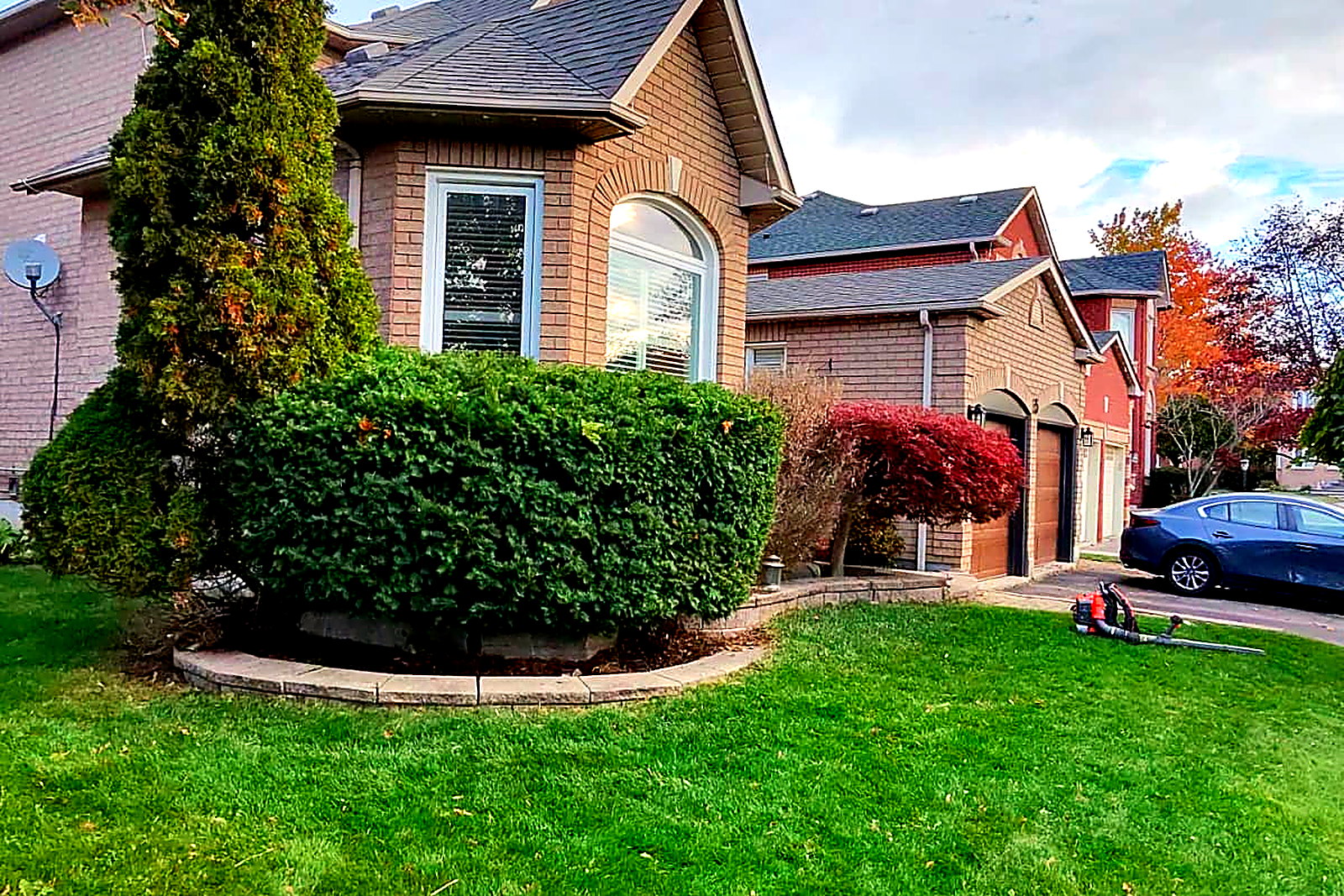
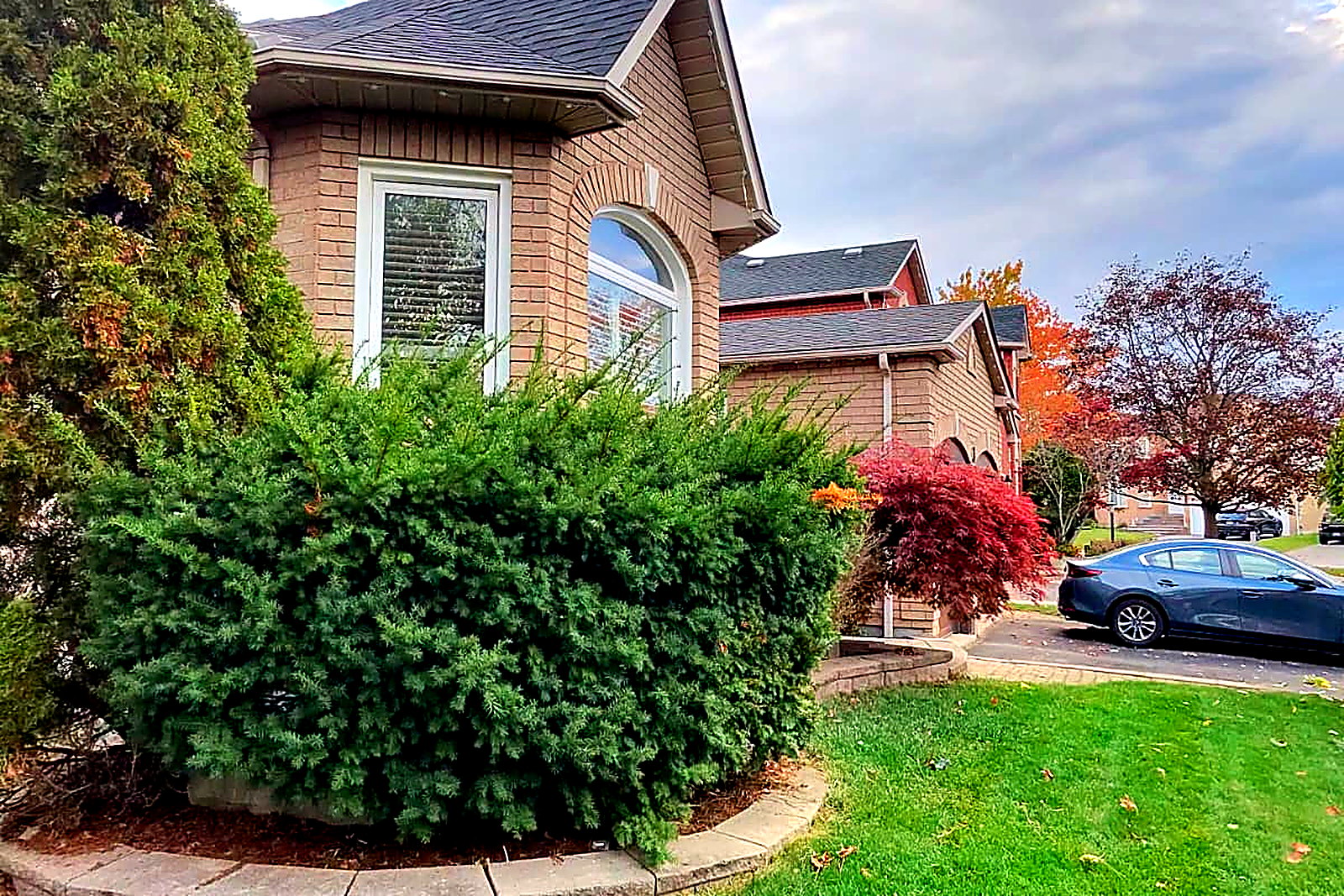
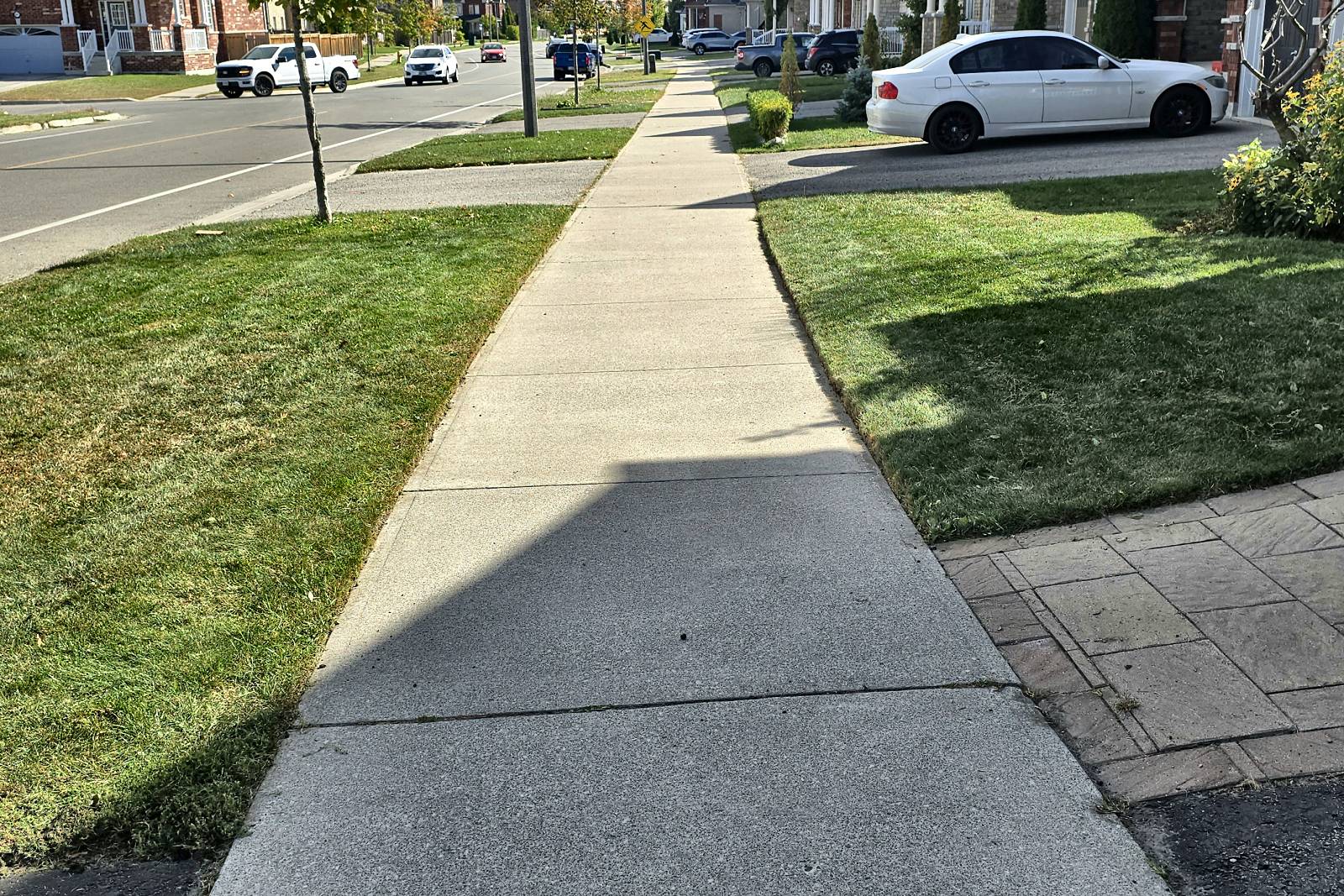
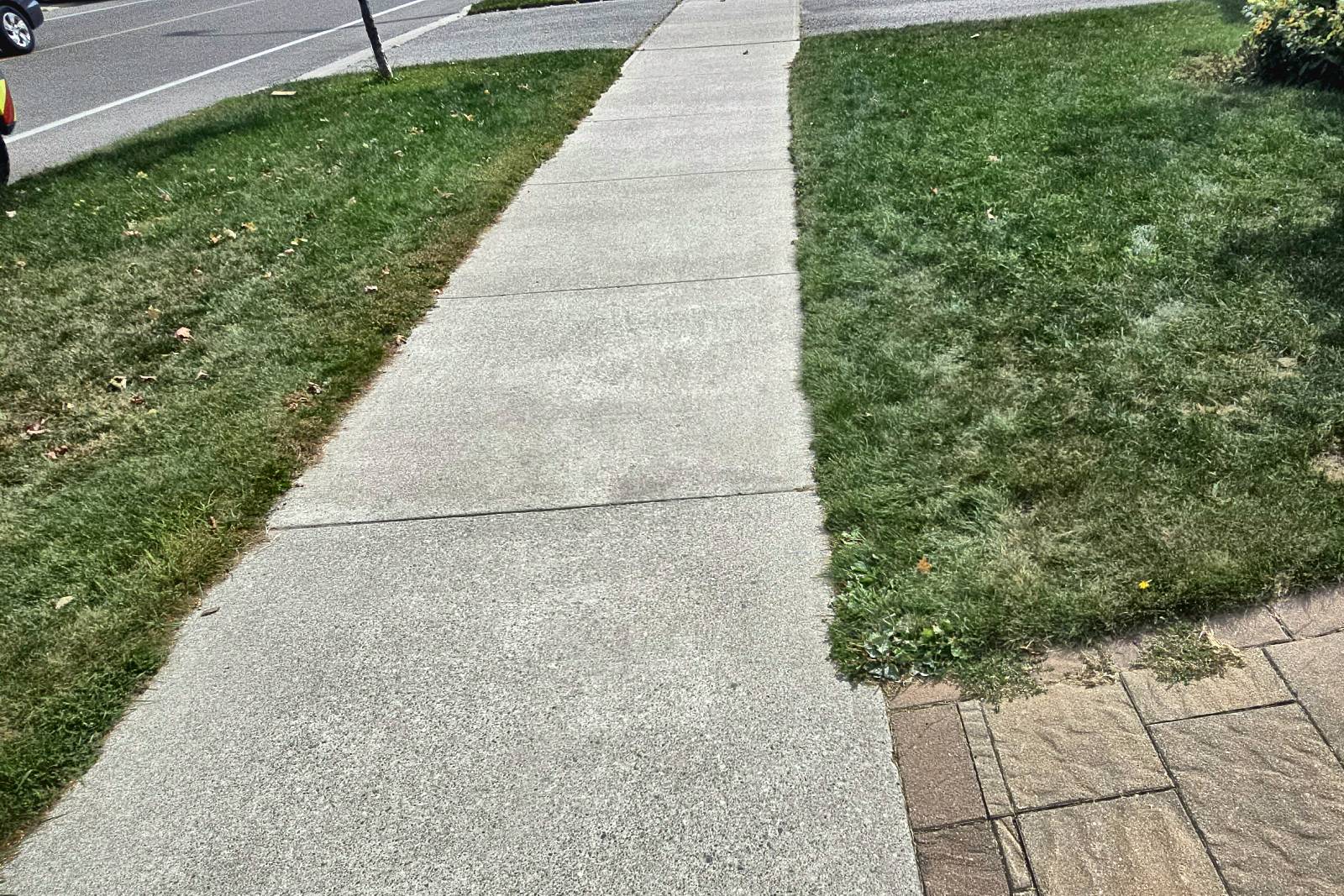
Real Northline properties, before and after. Drag the line to compare.
Andrew answers, October 2026
Why do you cut so high?
Because on Ontario clay a lawn cut short in July is a lawn growing crabgrass in August. Short grass lets light reach the soil surface, and light at the soil surface is the one thing crabgrass seed is waiting for. Cutting high shades it out, keeps the roots deeper and gets the lawn through a dry spell that would otherwise brown it off. It is the single setting that changes the most and it costs nothing.
One of these goes on each page and it is replaced monthly. If the question you have is not here, ask it: 905-244-5779.
Book the shear for spring and the snow for November
Send me your address and I will price the hedge run honestly, tell you which month it should happen in rather than the month you asked about, and settle where the snow pile goes before the first storm decides for us.