Snow removal · Rental property
Landlord Snow Removal Responsibility in Ontario, and Where the Tenant's Begins
Landlord snow removal responsibility in Ontario does not move because a lease says it moves. Two laws answer the question at once, and they answer it differently.
Quoting more than one address? See how the winter route works.
Green in summer. Clear in winter.
The short answer
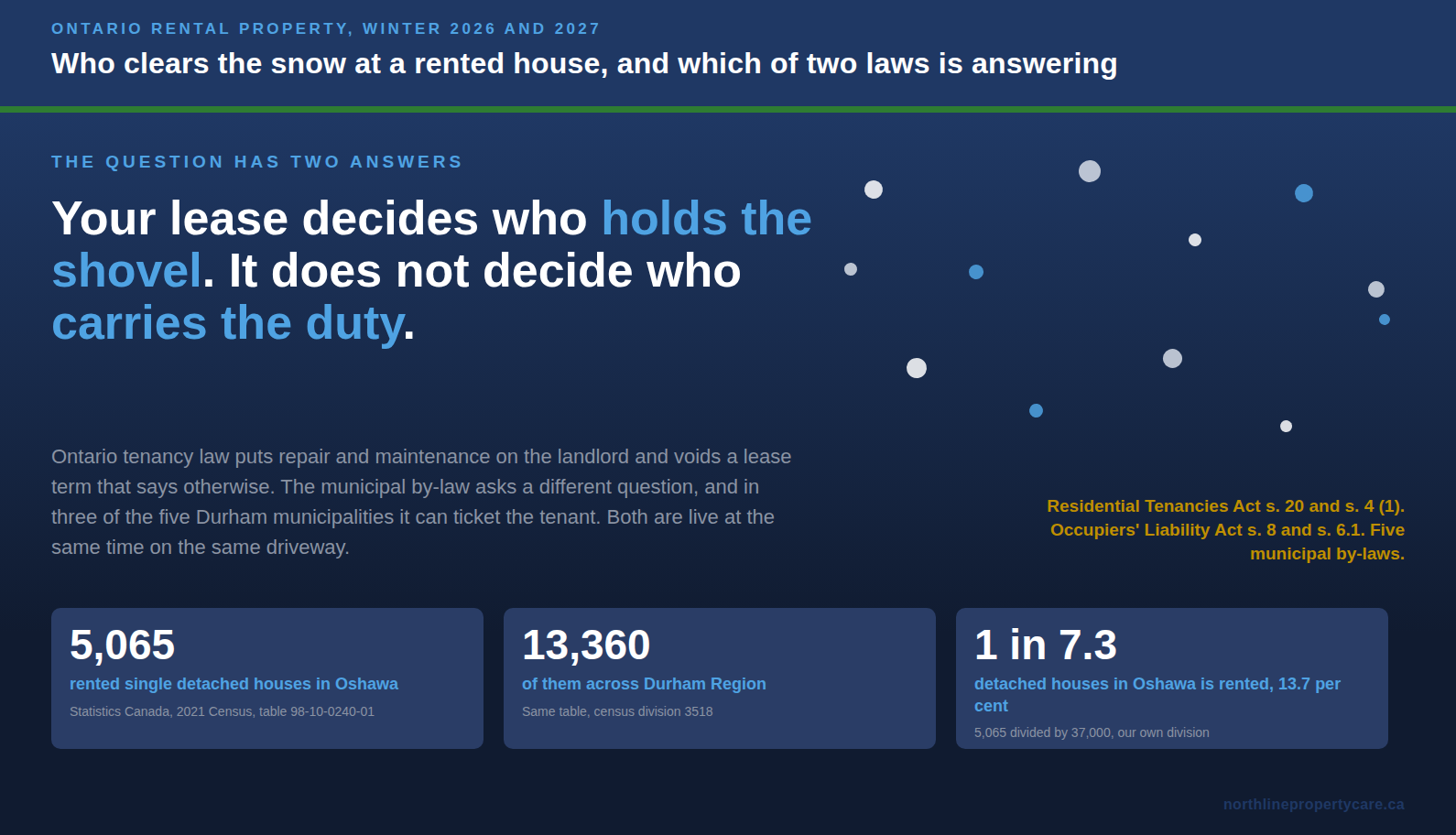
The landlord carries the duty and a lease clause does not move it, but the municipality may still ticket the tenant, and in three of the five Durham towns it can. Ontario tenancy law puts repair and maintenance on the landlord under section 20 (1) of the Residential Tenancies Act, and section 4 (1) voids a term inconsistent with the Act. The municipal snow by-law is a different instrument answering a different question, and Whitby, Ajax and Clarington all bind the occupant by name. So a landlord who writes shovelling into the lease has not transferred the obligation, and a tenant who signs it has still taken on real exposure. Both of those sentences are true at once, which is why this question is answered badly almost everywhere.
Two questions, collapsed into one, and that is the whole confusion
When somebody asks who has to shovel at a rental, they are usually asking two questions in one breath and getting an answer to whichever one the person replying happened to think of.
Question one is about the two of you. Who, as between the landlord and the tenant, has to make sure the snow is cleared, and who pays if it is not. That question is answered by the Residential Tenancies Act, 2006 and by the Landlord and Tenant Board.
Question two is about the town. Who can the municipality charge when the sidewalk across the frontage is still under 8 cm of packed snow on Thursday. That question is answered by a municipal by-law, and the by-law has never read your lease.
The two answers are not the same, and in Durham Region they are not even the same from town to town. A landlord in Pickering and a landlord in Whitby, doing exactly the same thing with exactly the same lease, are in two different positions on the second question and in an identical position on the first. That is not a technicality. It is the reason a confident answer read on the internet is wrong about half the time in this region.
There is a third question sitting underneath both, and it is the expensive one. Who pays when a person walking up to the front door goes down on the ice? That is the Occupiers' Liability Act, and it follows maintenance responsibility rather than the label on the lease. It gets its own section further down, along with the 60 day deadline that almost nobody knows exists.
What the Residential Tenancies Act actually says, in its own words
Three sections do almost all the work, and they are short enough to read in full.
Section 20 (1) is the landlord's obligation. The Act states that a landlord is responsible for providing and maintaining a residential complex, including the rental units in it, in a good state of repair and fit for habitation and for complying with health, safety, housing and maintenance standards. Subsection (2) adds that this applies even if the tenant knew about the state of non repair before entering the tenancy agreement.
Section 33 is the tenant's obligation, and it is narrower than people expect. The tenant is responsible for ordinary cleanliness of the rental unit, except to the extent that the tenancy agreement requires the landlord to clean it. Two limits are built into that single sentence. It is cleanliness, not maintenance. And it is the rental unit, not the grounds. Section 34 adds repair of undue damage caused wilfully or negligently by the tenant or the tenant's guests. Neither section mentions snow, a driveway, a walkway or a lawn.
Section 4 (1) is why a clause does not fix it. A provision in a tenancy agreement that is inconsistent with the Act or the regulations is void. Section 3 (1) reinforces it: the Act applies despite any other Act and despite any agreement or waiver to the contrary.
So the shape of the answer to question one is already visible. The obligation is statutory, the statute says a contrary term is void, and the words the tenant signed are not doing the work the landlord thought they were doing.
The Board's own guideline says it in one sentence
The Landlord and Tenant Board publishes interpretation guidelines that tell its own adjudicators how it reads the Act. Guideline 5, on breach of maintenance obligations, puts the point more plainly than any commentary:
The intention behind sections 20, 29 and 30 is to make landlords responsible for maintaining their complexes, and not to limit their obligations by transferring them by agreement to the tenant. If a tenant agreed in a lease to assume the responsibility to maintain any part of the unit or complex, beyond ordinary cleanliness and damage, this would not be enforceable.
The same guideline says the section 20 obligation is very broad, that it would include anything capable of being repaired, and that the full extent of the obligation does not depend on the tenancy agreement. It says the duty extends beyond the rental unit to the facilities and common areas provided for tenants, and it names exterior grounds and parking areas among them.
That is the answer to question one for any building with common areas: an apartment, a duplex, a triplex, a row of townhouses with a shared walk. It is not close, it is not arguable, and a clause purporting to shift it is dead on the page.
The one place the law is genuinely unsettled, and we are not going to pretend otherwise
Everything above is about a residential complex with common areas. A single rented house is different, and the honest answer is that the law is less clear there than anyone selling you something would like it to be.
Section 20 (1) still applies. Nothing in the Act, the standard lease, the guide to the standard lease or Guideline 5 creates an exception for a detached house, and section 4 (1) still voids an inconsistent term. But a private back yard and a private driveway are not common areas, and the reasoning in Guideline 5 leans heavily on facilities provided for tenants.
Steps to Justice, published by Community Legal Education Ontario, is the plain language legal source most Ontario tenants are pointed to, and it says this:
If you have a private outdoor space, the law is not clear about who is responsible for outdoor work in that space like lawn mowing and snow shovelling. It is a good idea to get legal help if your rental agreement says you are responsible.
We have reproduced that sentence with its contraction expanded, which is the only change made to it.
So the defensible line is this. For a complex with common areas, the landlord's duty is settled and an agreement cannot shift it. For the private outdoor space of a rented house, the duty still sits on the landlord in the statute, a contrary term is still void, and the leading plain language legal source in the province says the position is not clear and advises getting legal help.
Anybody who tells you that question is settled either way has not read the source.
Northline is a snow removal contractor and not a law firm, so treat everything here as a plain reading of published law and not as legal advice on your own lease. Where real money or a real injury is involved, the sources are all linked and a lawyer or a community legal clinic can read them against your facts.
The lawful way to have a tenant do the shovelling
There is one, and it is not a lease clause. Community Legal Education Ontario describes it as a separate bargain rather than a term of the tenancy: the landlord can pay the tenant, or give something else of value, so that the tenant does some of the maintenance work, provided it is clear what work has been agreed and what the tenant is getting in return. It advises the tenant to get legal advice before entering one.
Read what that changes. It is a contract for services with consideration attached, sitting beside the tenancy rather than inside it. It does not repeal section 20 (1), and if the tenant stops doing the work the landlord is still the one who has failed to maintain the property. What it does is make the arrangement honest and enforceable on its own terms instead of void.
Three practical points if you go that way. Put a number on it, because a rent reduction dressed up as a favour is the version that falls apart. Be specific about what is covered, since a driveway, a walkway, a set of front steps and a public sidewalk are four different jobs with four different deadlines. And write down what happens when the tenant is away in February, because that is the week it matters.
Two footnotes worth knowing. Ontario's standard lease does not mention snow, lawns, grass or yards anywhere in the form, and its guide states in terms that section 13, maintenance and repairs, cannot be changed and that anything extra has to go in section 15 as an additional term. And under section 130 (1) of the Act, a landlord who has been clearing the snow and then stops has handed the tenant a second application: a reduction in services and facilities, separate from a maintenance complaint, because section 2 (1) counts cleaning and maintenance services among services and facilities.
The municipal layer, which has never read your lease
Now the second question, and this is where Durham Region stops having one answer.
A municipal snow by-law is made under the Municipal Act and is enforced by the town against whoever the by-law names. It is not concerned with the allocation of duties between a landlord and a tenant, and it does not defer to the Residential Tenancies Act. It names a person, and that person is liable.
We read all five consolidations on September 25 2026. They do not say the same thing.
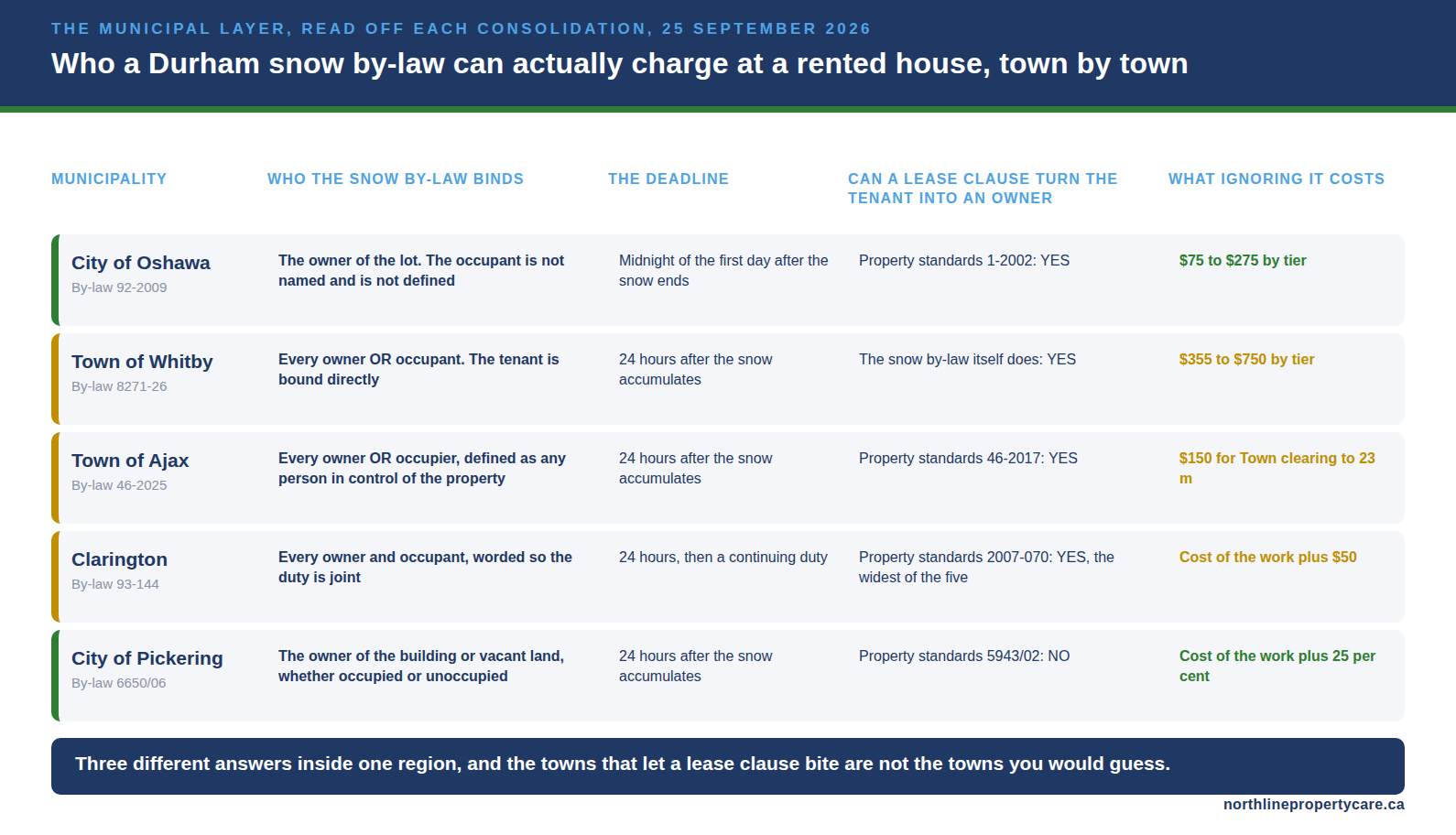
Oshawa, By-law 92-2009, binds the owner and nobody else. Every owner of a lot must clear the sidewalk no later than midnight of the first day after the fall of snow, or of any other precipitation which freezes, has ended. The word occupant does not appear as a person bound and is not defined. Administrative penalties run $75, $175 and $275 by tier, and the City may clear it and add the cost to the tax roll.
Whitby, By-law 8271-26, binds every owner or occupant, within 24 hours. The clock starts at the accumulation of snow or ice, not when the snowfall ends, which is earlier than most people assume. Whitby also has the highest published penalties in the region at $355, $500 and $750 by tier, and it can recover the cost of clearing from the owner or the occupant by legal action. Note that this by-law is new: it took effect on April 1 2026 and repealed the old Property and Boulevard Maintenance By-law 6937-15, so any advice written against the old number is out of date.
Ajax, By-law 46-2025, binds every owner or occupier, within 24 hours. Occupier is defined as any person who is in control of any property, which plainly reaches a tenant living in a rented house. There is an asymmetry worth noticing: the duty is on the owner or the occupier, and the cost recovery clause then runs against the owner. Ajax can ticket the tenant and bill the landlord.
Clarington, By-law 93-144, uses the widest wording of the five. Every owner and occupant must clear the sidewalk within 24 hours of a fall of snow, rain or hail, and a further section imposes a continuing duty to keep the sidewalk free of slippery surfaces after that. Neither owner nor occupant is defined, so both words carry their ordinary meaning and the duty reads as joint.
Pickering, By-law 6650/06, binds the owner only, and says so in a way that closes the argument. The duty falls on every owner of a building or vacant land, whether occupied or unoccupied. That phrase is doing deliberate work: an owner cannot say the presence of a tenant transferred the municipal duty. Cost recovery carries a 25 per cent administration fee.
If you own rental property in more than one Durham municipality, this is the paragraph to keep. The same lease produces a different municipal exposure in Whitby than it does in Oshawa, and neither of those exposures changes what you owe under the Residential Tenancies Act.
The property standards trap, and four of five towns have it
There is a second municipal instrument, and it is the one that catches people.
Every municipality has a property standards by-law, made under the Building Code Act, and each of them defines the word owner. In four of the five Durham municipalities that definition expressly includes a lessee or occupant who, under the terms of a lease, is required to repair and maintain the property.
Read that against a lease with a snow clearing clause in it. The clause is void as against the tenant under section 4 (1) of the Residential Tenancies Act, so it does not shift the landlord's obligation. But the property standards by-law is not reading the Residential Tenancies Act. It is reading the lease as a fact, and the fact is that this tenant is required by a lease to maintain the property.
So the clause that fails to protect the landlord succeeds in converting the tenant into an owner for by-law purposes. It is the worst of both outcomes and it is produced by the same sentence.
Clarington's definition is the widest of the five: it names a lessee, tenant or occupant, and it extends past a lease to any other rental agreement, which reaches an informal or unwritten arrangement. Oshawa, Whitby and Ajax all carry the same clause in narrower words.
Pickering is the exception, and its property standards by-law defines owner as the registered owner of the property and stops there.
Two more things live in those by-laws. Ajax requires that all walkways and access routes to and from buildings be kept free from ice and snow and hazards at all times, which is a continuous standard rather than a deadline. Pickering carries the same continuous wording for walkways, stairways and access routes. Those are private walkways, not sidewalks, and they are the strip that actually decides whether anybody can get to the door.
One structural consequence worth recording, because it removes a layer people spend time on. Ontario Regulation 517/06, the provincial maintenance standards under the Residential Tenancies Act, applies only where there is no applicable municipal property standards by-law. All five Durham municipalities have one, and all five cover both the exterior and the interior.
So the provincial maintenance standard is not the operative instrument at any rental property in Oshawa, Whitby, Ajax, Clarington or Pickering. The municipal by-law is. If you were about to go and read section 26 of the regulation about unsafe accumulations of ice and snow in exterior common areas, it is a good sentence and it is not the one that governs you here.
Oshawa is the outlier, and for once it favours the landlord
Oshawa is the largest rental market in Durham Region and it is also the town whose snow by-law is least interested in tenants. By-law 92-2009 binds the owner of the lot, full stop.
Then the licensing regime tightens the same screw from the other side. Oshawa licenses residential rental housing in a defined area around Durham College and Ontario Tech University, including the Simcoe Street corridor, under Schedule P of Business Licensing By-law 122-2024. A licence holder declares compliance with a list of City by-laws, and the snow and ice by-law is on that list.
So inside that rental licence area, the landlord's compliance with the snow by-law is a condition of holding the licence to rent the house at all.
Put the two together and Oshawa is structurally the clearest of the five municipalities: the snow duty is the owner's under the by-law, the maintenance duty is the landlord's under the statute, and inside the rental licence area the licence itself depends on the first one. A landlord operating student rentals in north Oshawa who has been assuming the tenants deal with it has three separate exposures pointing the same way.
Worth knowing alongside it: Oshawa's own snow clearing page states plainly that windrow clearing is the responsibility of the property owner, and the City's assistance program for residents 65 and over or with a disability clears City sidewalks only, with windrow service only where the windrow is at least 20 cm and never the rest of the driveway. The full town by town picture is in our guide to windrow clearing across Durham Region, and the Oshawa deadline itself is taken apart in the Oshawa snow removal by-law guide.
When somebody falls, which is the question that costs real money
The third question is answered by the Occupiers' Liability Act, and it is worth understanding because it does not follow the lease and it does not follow the by-law either.
Both of you can be the occupier. Section 1 defines an occupier to include a person in physical possession of premises, and a person who has responsibility for and control over the condition of premises, and then adds the words: despite the fact that there is more than one occupier of the same premises. A tenant in possession satisfies the first limb. A landlord who retains control over the condition of the walk and the driveway satisfies the second. Section 6.1 (3) speaks of occupiers in the plural, and section 9 (3) applies the Negligence Act, which is how liability gets apportioned between two of them.
Section 8 pulls the landlord in specifically. Where premises are occupied under a tenancy in which the landlord is responsible for maintenance or repair, the landlord owes the same duty of care as an occupier for dangers arising from a failure to carry that out. Section 8 (3) then says that obligations imposed by any enactment by virtue of a tenancy are treated as imposed by the tenancy. Read that with section 20 (1) of the Residential Tenancies Act and the loop closes: the landlord cannot contract out of the statutory repair duty and then argue the duty was never part of the tenancy.
And there is a 60 day fuse that most people have never heard of.
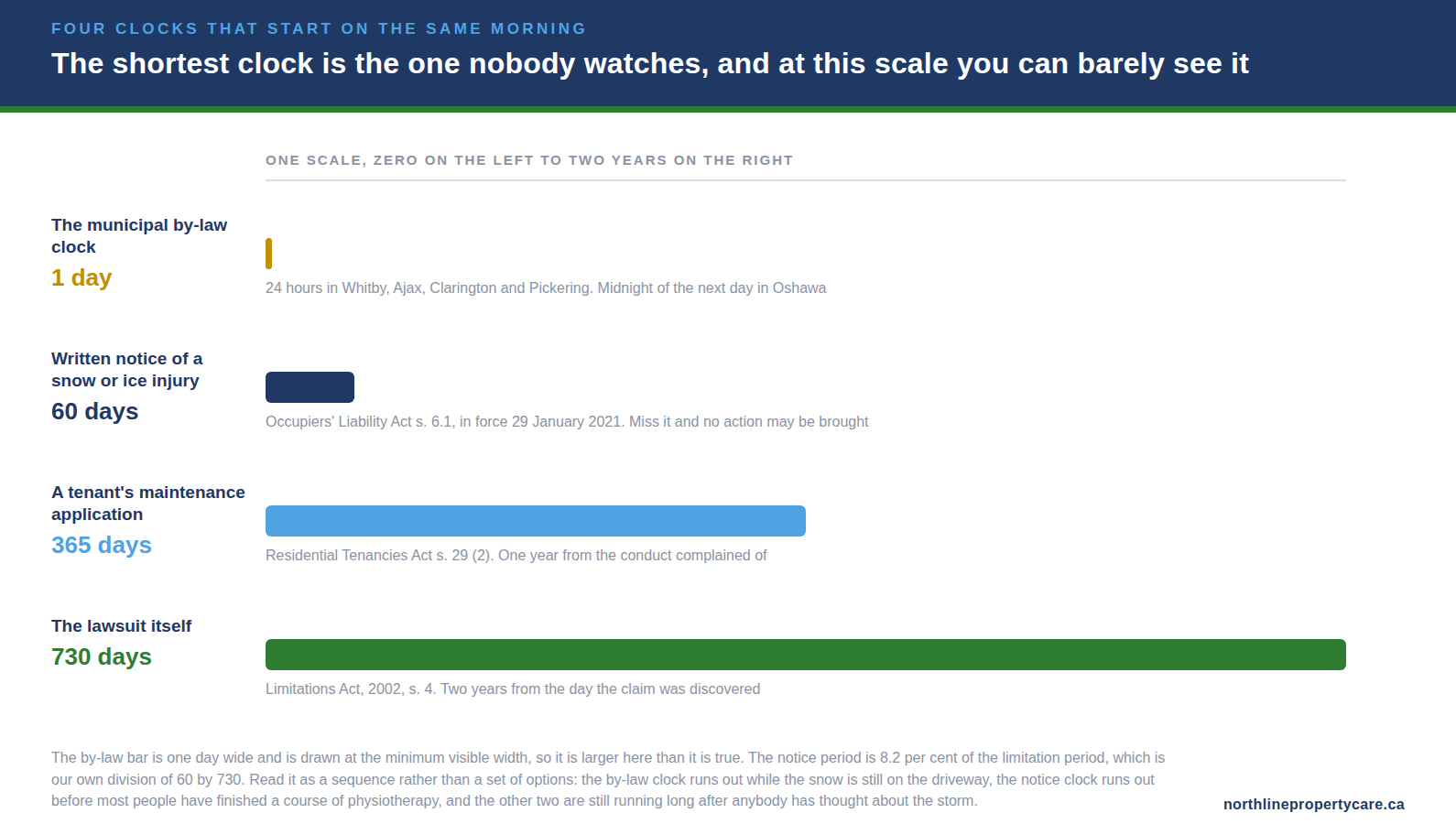
Section 6.1 was added by the Occupiers' Liability Amendment Act, 2020, assented to on December 8 2020 and in force on January 29 2021. It says that no action shall be brought for damages for personal injury caused by snow or ice unless, within 60 days of the injury, written notice of the claim including the date, time and location has been personally served on, or sent by registered mail to, an occupier or to an independent contractor employed by the occupier to remove snow or ice during the relevant period.
Four things follow that are worth holding on to.
One notice to any one of them preserves the claim against all of them. Subsection (7) says so expressly, and subsections (3) and (4) require whoever receives it to pass it on to the other occupiers and to the contractor.
Sixty days is 8.2 per cent of the limitation period. The general limitation period under section 4 of the Limitations Act, 2002 is two years from discovery. The notice period is 60 days from the occurrence, and occurrence is not discovery. A person who waits a year is comfortably inside the limitation period and a long way outside the notice period.
There are two escapes and neither is automatic. Failure to give notice is no bar where the injured person died of the injury, and a judge may excuse a missing or insufficient notice where there is a reasonable excuse and the defendant is not prejudiced in its defence. That is a finding a judge makes, not a box a claimant ticks.
The municipal rule is different and much shorter. A claim against a municipality for a personal injury on a highway or bridge requires written notice to the clerk within 10 days under section 44 (10) of the Municipal Act, 2001, and under section 44 (9) a municipality is not liable for personal injury caused by snow or ice on a sidewalk except in the case of gross negligence. That is why a fall on the public sidewalk and a fall on your driveway are entirely different cases.
Hiring a contractor is a defence with conditions, not a transfer
This is the part we have an interest in, so here is the law rather than the sales pitch.
Section 6 (1) of the Occupiers' Liability Act says an occupier is not liable for an independent contractor's negligence if, in all the circumstances, the occupier acted reasonably in entrusting the work to the contractor, took such steps as it reasonably ought to have taken to be satisfied that the contractor was competent and that the work had been properly done, and it was reasonable that the work should have been undertaken at all. Section 6 (2) shares that benefit with every occupier of the premises, which in a rental means the tenant benefits from the landlord's contract. Section 6 (3) preserves any duty that is non delegable at common law.
So the honest sentence is: hiring us does not move your duty, it gives you a defence, and the defence has three conditions you have to have actually met. Two of them are about us, and one of them is about you: were you satisfied the work had been properly done. That is a question about records, not about intentions.
Section 5 (1) closes the other door. An occupier's duty cannot be restricted or excluded by a contract to which the person entering is not a party. A snow contract cannot sign away your duty to a visitor, a postal worker or your own tenant, because none of them signed it.
What that means in practice for a landlord is unglamorous and cheap. Keep the service records. A dated log of visits for the address, held by somebody other than you, is the thing that answers the question about whether the work had been properly done, and it is worth more two years later than any clause in any lease. Every visit on our route is timestamped against the address as a matter of course, which is a side effect of running a scheduled route rather than a feature anybody designed.
How big this actually is, and how often it happens
It is easy to read all of the above as an edge case. It is not one, and the numbers are public.
The 2021 Census of Population counts 23,880 renter households in the City of Oshawa out of 66,630 households, which is 35.8 per cent. The Ontario figure is 31.4 per cent and Durham Region as a whole is 21.4 per cent. Oshawa is a renter city sitting inside an owner region, and the trend is steep: 19,720 renter households in 2016 against 23,880 in 2021, while owner households fell slightly.
The number that matters here is narrower. Statistics Canada table 98-10-0240-01 crosses tenure with structural type, and it records 5,065 renter households in the City of Oshawa living in a single detached house, and 13,360 across Durham Region. That is roughly one Oshawa detached house in seven. Add semi detached, row houses and the other ground oriented forms and the Oshawa figure is 9,190 renter households with their own ground to clear. None of those addresses are apartments where a superintendent handles it. Every one of them has a driveway, a walkway and a frontage.
Now how often the question comes up. At the Environment and Climate Change Canada normals location for Oshawa, threaded from the Oshawa Water Pollution Control Plant station, climate identifier 6155878, on the 1991 to 2020 normals: 26.8 days a year with measurable snowfall, 7.8 of them at 5 cm or more, and 2.5 at 10 cm or more. Annual snowfall is 101.7 cm.
And the figure that changes how you think about the duty: snow falls on 26.8 days, but there is snow lying on the ground on 55.4 days. A deadline measured from a snowfall covers the first number. A continuous standard of the kind Ajax and Pickering write into their property standards by-laws, free from ice and snow at all times, covers the second. The obligation to keep a walk safe lasts about twice as long as the obligation to clear a fresh fall, and freezing rain or freezing drizzle falls on another 2.8 days a year on top of it.
One correction while we are in the weather data, because it turns up constantly in winter writing. Environment and Climate Change Canada has retired its numeric snowfall warning criteria and replaced them with impact based guides that carry no centimetre figures at all. Any page quoting an official ECCC snowfall warning threshold today is quoting a withdrawn document.
What it costs to just deal with it
A landlord has three practical options, and one of them is free.
Do it yourself. If you live nearby and the property is one house, this is a real answer and we are not going to pretend otherwise. The catch is the 24 hour clock in four of the five towns and the fact that snow does not wait for a weekend. Seven or eight times a winter it will fall at 5 cm or more, and about half of those will be overnight.
Pay the tenant, properly. The CLEO route above. Cheapest, and it works right up until the winter the tenant travels, or moves out in January, or simply stops. The obligation snaps back to you the moment it fails, because it never actually left.
Put it on a route. The seasonal snow package is $800 for a small driveway, $975 for a standard driveway and $1,200 for a large one, plus HST, covering the driveway, the walkway and salting, with no cap on the number of visits, at a measured 3 cm trigger and a 7 AM target after overnight snow. Booking closes November 1. For a year round arrangement, memberships run from $129 a month plus HST.
Here is the part a landlord needs and nobody volunteers.
The entry membership does not plow the driveway. Silver at $129 a month covers the lawn side and gets a windrow pass by 5 PM, and it carries no morning target. If you are buying this to discharge a maintenance duty on a rented house, the tier you need is Gold at $189 a month plus HST, $213.57 on the card, which plows the driveway and carries the 7 AM target. Quoting you the entry price for a driveway promise would be selling you something that does not do the job, and you would find that out on the first storm.
Two things that suit rental property specifically. Ask for the addresses to be quoted together if you have more than one, because the route economics change when two of them sit on the same street, and tell us if the tenant is not to be contacted, since some landlords want every message going to them and some would rather we deal with the household directly. Both are ordinary requests and neither changes the price.
If the property is a small apartment building, a triplex or anything with a shared walk and a parking area, that is commercial work rather than a residential membership, and it is quoted on the commercial side at a 5 cm trigger with a written service level.
The things that cost us the sale, said plainly
If you own the house you live in, none of this applies to you. The whole page is about a rental. Your duty is simply yours, and the only questions you have are the by-law deadline in your town and whether you want to be outside at 6 AM.
If your tenant clears the snow well and reliably, you do not need us. A paid arrangement with a tenant who is actually there and actually does it is cheaper than anything we sell, and the statutory duty you retain is a duty you are in fact discharging. Write it down properly and get on with your life.
If your tenant is 65 or older, or has a documented disability, check the municipal program before you check us. Whitby runs its senior and accessibility snow clearing free of charge, with applications open from September 14 to November 1 2026. Oshawa runs one at no stated fee. Clarington charges $107.69 including HST for the 2026 to 2027 season with applications open from September 21 to October 31.
No contractor in this region beats free, and we are not going to try. The one thing to check before you count on it: Pickering requires the applicant to be the registered owner residing at the property, so a senior tenant in Pickering cannot use that program at all, and in every town these programs cover the municipal sidewalk and sometimes the windrow, never the driveway.
And hiring anybody, us included, does not move the duty off you. That is section 6 of the Occupiers' Liability Act and it is the second time this page has said it, because it is the sentence most likely to be sold to you the other way round.
The semi-detached case, where a third party arrives uninvited
A rented half of a semi-detached pair that shares one driveway puts an owner, a tenant and a neighbour on the same strip of ice at the same moment. The Act treats more than one occupier of the same premises as ordinary rather than unusual, so the duty does not divide itself at the boundary, and the neighbour who never signed your lease is answerable for the same fall. What the five Durham by-laws allow on that surface, and the one provision in Ajax that names another property outright, are in shared driveway snow removal in Durham Region.
What we could not verify
Every external figure on this page came from a statute, a regulation, a tribunal, a municipality, a federal statistical agency or a legal education charity. Not one came from another property maintenance company. Here is what we went looking for and did not find, which is the half most pages leave out.
- No case law was read. The reasoning about a landlord and a tenant both being occupiers rests on the words of the Act, which are explicit, and not on any judgment. We could not open CanLII to read a decision's own text, so no decision is cited here by name.
- No Ontario government source says in terms whether a tenant of a detached house can be made responsible for snow. The Act, the regulation, the standard lease, its guide and Guideline 5 do not mention snow, shovelling or a detached house at all. The closest statements are Guideline 5 on unenforceable transfers and Steps to Justice on private outdoor space being unclear, and both are quoted above.
- No authoritative source on the insurance consequences. Neither the Government of Ontario nor the Financial Services Regulatory Authority publishes anything on landlord liability insurance and snow, or on whether hiring a contractor changes a policy position. We are not going to fill that gap with a broker's page.
- No set fine was published for the Clarington or Pickering snow by-laws, and the Ajax fees by-law confirming the $150 clearing charge could not be opened. The Whitby and Oshawa penalty tiers are from the by-laws themselves.
- Who clears a sidewalk running along a regional road, such as Simcoe Street in Oshawa or Kingston Road in Pickering, is not answered on any Region of Durham page we could find. If your rental fronts a regional road, ask your own municipality rather than assuming the answer on this page covers it.
- The snowfall day counts are a 26 year record, not a 30 year one. Environment and Climate Change Canada reports the Oshawa snowfall element as 26 years used with 3 missing, 82.7 per cent of possible observations.
Who wrote this
Andrew owns and runs Northline Property Care in Oshawa. Six winters clearing snow in Durham Region, owner operated, on a fixed local route that is sequenced in October and closes when it is full.
A fair question is why a snow contractor is reading tenancy statutes. The answer is that a good part of the winter work in this region is at addresses where the person paying and the person living there are two different people, and almost every problem that arises on those jobs comes from the two of them having been told different things. It is cheaper to read the source once than to referee that in February.
Nothing here is legal advice, and Northline is not a law firm. Every claim on this page is linked to the statute, the by-law or the table it came from, so you can check it against your own situation or hand it to somebody who can.
Questions we get asked
Is the landlord or the tenant responsible for snow removal in Ontario?
The landlord carries the legal duty. Section 20 (1) of the Residential Tenancies Act, 2006 makes the landlord responsible for maintaining the residential complex in a good state of repair and for complying with health, safety, housing and maintenance standards, and section 4 (1) voids a term in a tenancy agreement that is inconsistent with the Act. A tenant can agree to do the shovelling and can be paid to do it, but the duty itself does not move to the tenant because a lease says it has.
Can a lease make the tenant responsible for clearing snow?
It can allocate the work. It cannot allocate the obligation. The Landlord and Tenant Board's own Interpretation Guideline 5 states that if a tenant agreed in a lease to assume responsibility to maintain any part of the unit or complex beyond ordinary cleanliness and damage, that would not be enforceable. Community Legal Education Ontario describes the lawful route as a separate bargain, where the landlord pays the tenant or gives something else of value and the work agreed and the payment for it are both clear.
Can a municipality fine a tenant for failing to clear the sidewalk?
In three of the five Durham municipalities it can. Whitby, Ajax and Clarington all bind the occupant as well as the owner, so a tenant is directly liable to the town. Oshawa and Pickering bind the owner only, and Pickering's by-law says the duty applies whether the land is occupied or unoccupied, which forecloses the argument that a tenant in residence takes it over. The municipal question and the tenancy question have different answers and they are decided under different statutes.
Who is liable if a visitor slips on the driveway of a rented house?
Possibly both the landlord and the tenant. The Occupiers' Liability Act defines an occupier to include a person in physical possession of premises and a person who has responsibility for and control over their condition, and says so despite the fact that there is more than one occupier of the same premises. Section 8 then puts the landlord under the same duty of care where the tenancy makes the landlord responsible for maintenance or repair, and section 8 (3) treats an obligation imposed by a statute as imposed by the tenancy.
What is the 60 day notice for a snow or ice injury in Ontario?
Section 6.1 of the Occupiers' Liability Act, in force since January 29 2021, says that no action may be brought for personal injury caused by snow or ice unless written notice of the claim, including the date, time and location, has been personally served or sent by registered mail within 60 days to an occupier or to the snow removal contractor the occupier employed. A judge may excuse a missed or insufficient notice where there is reasonable excuse and no prejudice to the defence, and the bar does not apply where the injured person died of the injury.
Does hiring a snow removal company transfer the landlord's responsibility?
No. It creates a defence, and the defence has conditions. Section 6 (1) of the Occupiers' Liability Act protects an occupier who acted reasonably in entrusting the work, who took the steps it reasonably ought to have taken to be satisfied the contractor was competent and that the work had been properly done, and where it was reasonable for the work to be undertaken at all. Section 6 (3) preserves any duty that is non delegable. Keeping the service records is part of the defence, not paperwork.
What can a tenant do if nobody is clearing the snow?
Tell the landlord in writing first, because the date of that message matters later. Then call the municipal by-law office, which enforces the property standards by-law in all five Durham municipalities. Then, if it is still not fixed, apply to the Landlord and Tenant Board under section 29 (1) of the Residential Tenancies Act, which carries a one year limit under section 29 (2). Where the landlord used to clear the snow and has stopped, section 130 (1) also allows an application to reduce the rent for a discontinued service.
What does snow removal cost for a rental property in Durham Region?
A seasonal snow package is $800 for a small driveway, $975 for a standard driveway and $1,200 for a large one, plus HST, covering the driveway, the walkway and salting with no cap on the number of visits, and the booking deadline is November 1. A year round membership starts at $129 a month plus HST, though the entry tier does not plow the driveway and a landlord almost always needs the tier above it. For a property with more than one address, ask for the addresses to be quoted together rather than separately.
Read next
The Oshawa deadline, in detail
Midnight of the first day after the snow ends is a stranger rule than it sounds, and the page takes apart what counts as the end of a snowfall and what the penalty tiers actually mean.
Read the by-law guide →What belongs in the contract
Sixteen items a seasonal snow agreement should name before anybody signs it, including the trigger depth, the morning target and who is responsible for the windrow.
See the sixteen items →Damage, and who wears it
The objection every landlord raises before signing anything: what a plow can and cannot do to a driveway, and which of the usual stories about it hold up.
Read the damage guide →The work, photographed
Real Northline properties, before and after, every one of them in Oshawa and every one of them this year. Drag the line to compare.

Andrew answers, October 2026
Why is your season longer than everybody else's?
Because November and April are when the awkward storms happen, and a season that ends on March 31 ends three weeks before the last one. November 1 to May 1 is six months and both ends of it are published, which is the part that matters: a season you can read is a season you can hold me to.
One of these goes on each page and it is replaced monthly. If the question you have is not here, ask it: 905-244-5779.
Quote the rental before the route fills
Send me the address, or several of them, and I will tell you which tier the driveway actually needs, what the season costs, and whether the household qualifies for a municipal program instead. If the free one fits, I will say so and you can stop reading.