Lawn care · Fall
The Fall Cleanup Checklist for Durham Homeowners
A fall cleanup checklist for Durham homeowners is only worth reading if it ranks the jobs honestly, because two of the nine below decide what your lawn looks like next May and the rest are mostly tidiness.
The fall cleanup sits inside the membership year rather than on a separate invoice. See what a membership covers.
Green in summer. Clear in winter.
The short answer
Two jobs matter and the rest are optional. Get the leaves off the grass, either by mulching them in or by taking them away, before a wet mat forms. And keep mowing at your normal height right into dormancy rather than dropping the deck for a special winter cut. Everything else on this list is worth doing and none of it changes what your lawn looks like in May.
Nine jobs, ranked by what they are actually worth
Ranked as we would rank them on our own property, not as a service menu.
| Rank | Job | What it is worth |
|---|---|---|
| 1 | Deal with the leaves before they mat | Decides next May. A wet leaf mat over winter kills turf outright and the dead patch reseeds as weeds |
| 2 | Keep mowing at normal height until growth stops | Decides next May. Long matted grass under snow is what snow mould needs |
| 3 | Late season nitrogen, applied after growth stops and while still green | Real and measurable. Earlier green-up, better density, better spring disease tolerance |
| 4 | Clear the eavestroughs and check where the downspouts discharge | Not about the lawn at all. It is about the foundation and the ice dam |
| 5 | Cut back perennials that flop, leave the hollow stems that do not | Half tidiness, half habitat. See the bees section below |
| 6 | Empty and shut off the outside taps, drain the hoses | Cheap insurance against a split pipe. Do it before the first hard frost |
| 7 | Move anything that will be under the snow pile | Practical. The pile at the driveway edge is the last thing on the property to melt |
| 8 | Dormant pruning, but only the right species | Do the oaks, skip the lilac, and leave the cedar hedge until spring. Why the hedge waits. See the pruning section |
| 9 | Edging, bed tidying and general presentation | Cosmetic. Worth doing if you are selling in spring, worth skipping otherwise |
The collection dates, which is where most plans fall apart
Before anything else, one structural fact that catches people who move within Durham: curbside yard waste here is not one system. The Region collects for some municipalities, and Oshawa and Whitby run their own programs entirely. Put an Oshawa address into the Region's collection calendar and it tells you to speak to the City instead.
The collection rules behind those dates are not the same in every town in this region, and the differences are large enough to leave bags at the curb uncollected. Which municipality collects yours, what container the by-law will accept and how many you may set out are all in leaf collection in Oshawa.
| Who collects | Season | Frequency | Weight limit |
|---|---|---|---|
| Region of Durham | April to early December | Every two weeks, switching to weekly from October 1 | 20 kg, 44 lb |
| City of Oshawa | Mid April to early December | Every other week, same day as garbage. No autumn switch to weekly | 20 kg, 44 lb |
| Town of Whitby | April to the end of November | Every other week, with the 16 item limit lifted for October and November | 20 kg, 44 lb |
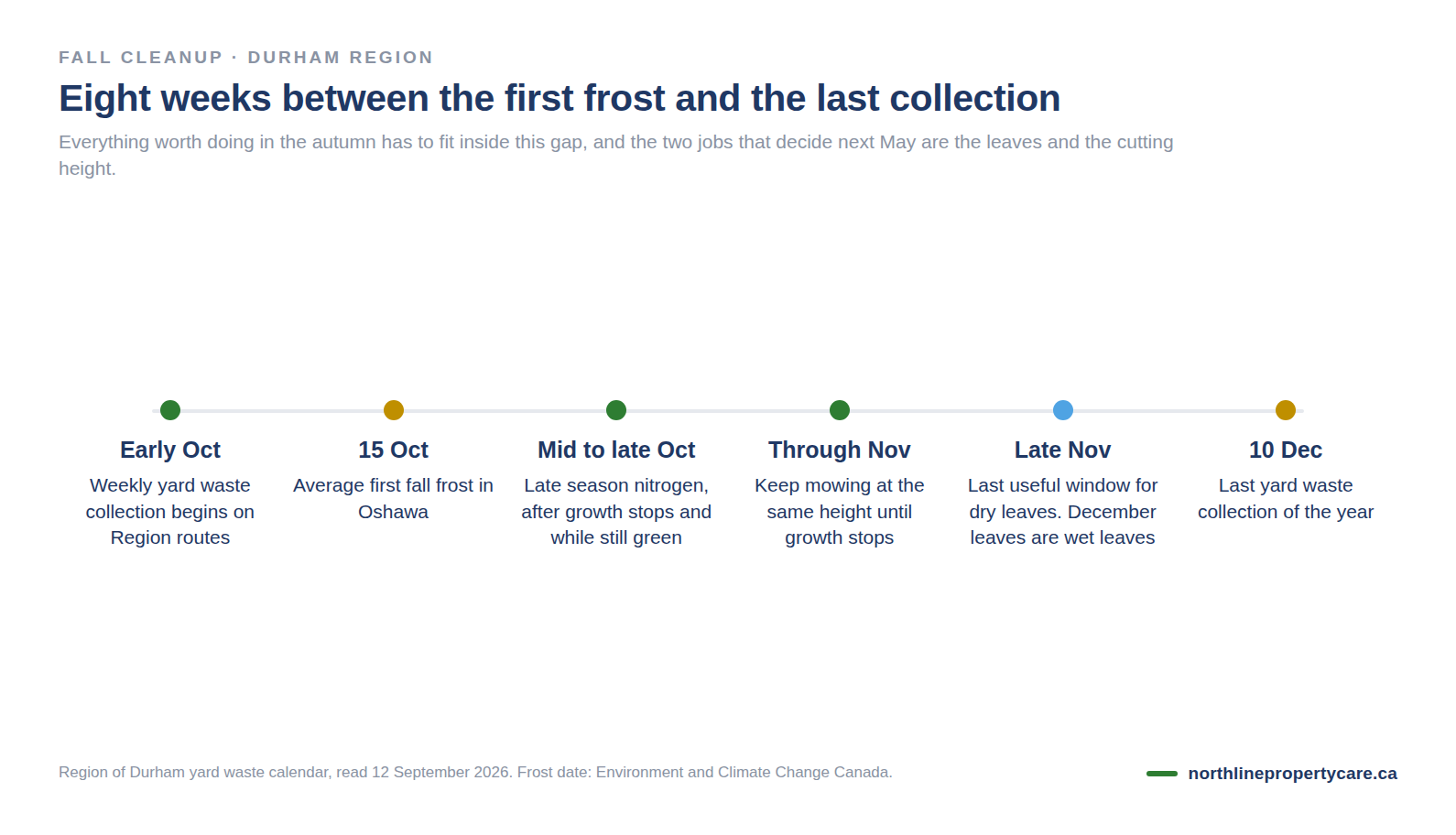
On the Region's own 2026 calendar, a Thursday route in Pickering runs every two weeks until September 24, goes weekly from October 1, and takes its last pickup of the year on December 10. Your collection day varies by address, so check your own rather than ours.
The rule that surprises everybody: the depots will not take it any more. The Region states that leaf and yard waste is no longer accepted at regional waste management facilities, and points residents to the free curbside collection instead. If your plan was to load the trailer and drive it somewhere, that plan has expired.
The container rules are worth knowing before you fill forty bags. Kraft paper bags or clearly labelled open top containers only. Plastic bags are not collected, and a paper bag that splits is not collected either. Brush goes in tied bundles up to one metre long and 76 cm wide, with no branch over 10 cm in diameter. Oshawa allows slightly longer bundles at 1.2 m. Everything is capped at 20 kg a bag or bundle, which on wet leaves is less volume than you would guess.
One small local detail that is genuinely useful in the first week of November: Oshawa collects pumpkins and gourds on the first yard waste day after Halloween.
Job one: the leaves, and what the research actually measured
This is the one job that changes the outcome, and the received wisdom about it is about half right.
Michigan State has been running leaf mulching research on turf for over twenty years. Their extension guidance is to raise the deck to the highest setting on a dewy October morning and cross over the leaves once or twice, and they put the ceiling at up to six inches of leaves mulched at a time, depending on the mower.
Here is the corroboration that makes it worth acting on. Ontario's agriculture ministry publishes the same ceiling in metric: a layer of tree leaves up to 15 cm deep can be mulched into a lawn without adversely affecting it, using a mulching mower with sharp blades on dry leaves. Fifteen centimetres is six inches. An American land grant university and an Ontario ministry arrived at the same number independently, which is about as good as agreement gets in this trade.
The weed effect is real and the way it is usually quoted is not. Michigan State's own tip sheet says experience has shown that nearly a hundred per cent reduction in dandelions and crabgrass can be achieved after three years of mulching, and we want to be precise that this is their phrasing of accumulated experience rather than a trial result. What the trials themselves measured is more modest and more checkable: in a 1996 report from their turfgrass research centre, plots treated with mulched maple leaves carried 1.4 weeds per plot by September 20 against 12.4 in the untreated check. Application rates across their studies ran from 100 up to 450 pounds of dry leaves per thousand square feet.
Two results from those trials that are worth having because they kill common objections. Soil pH did not change across the duration of the field experiment. And organic matter went up rather than down: 7.5 per cent in the control, 8.4 under maple, 8.9 under oak.
Now the limit, stated by the same ministry that publishes the 15 cm figure. If fallen leaves are not removed, the lawn will not get light and will eventually die. Purdue says the same thing from the disease side and tells homeowners to rake and mow through the fall specifically to prevent the insulating effect of matted grass and accumulated leaves.
So the operating rule is not leave them or take them. It is this: leaves you can chop into pieces small enough to fall through the canopy are fertilizer. Leaves that sit whole and get wet are a tarpaulin. The line between the two is roughly six inches deep and it moves with how dry the leaves are and how good your mower is.
The case for leaving them, which is real, and where it actually applies
There is a genuine conservation argument here and we are not going to talk you out of it, because it is correct in the place it applies to.
The Canadian Wildlife Federation's gardening guide notes that leaves on the ground shelter spiders, beetles, salamanders, shrews, frogs and toads, and recommends letting them stay where they fall or piling them around trees and garden beds. It also makes a point about stems that changes what you cut in the beds: hollow or pithy plant stems, on elderberry, raspberry, sumac and annual sunflowers, are nesting and overwintering sites for native solitary bees. Cut those to the ground in October and you have thrown out next year's pollinators with the tidying.
The reconciliation is straightforward once you separate the surfaces. Leaves stay in the beds. Leaves come off the turf, or go through the mower. The conservation source is talking about ground and garden beds; the turf sources are talking about a living grass canopy that needs light. Nobody credible is arguing for a wet leaf mat sitting on grass all winter.
On the beds, the other CWF point worth carrying into spring is to resist cleaning up too early. Bare ground, leaf litter and dead stems in March are doing a job.
Job two: the last cut, and why we are talking ourselves out of a sale
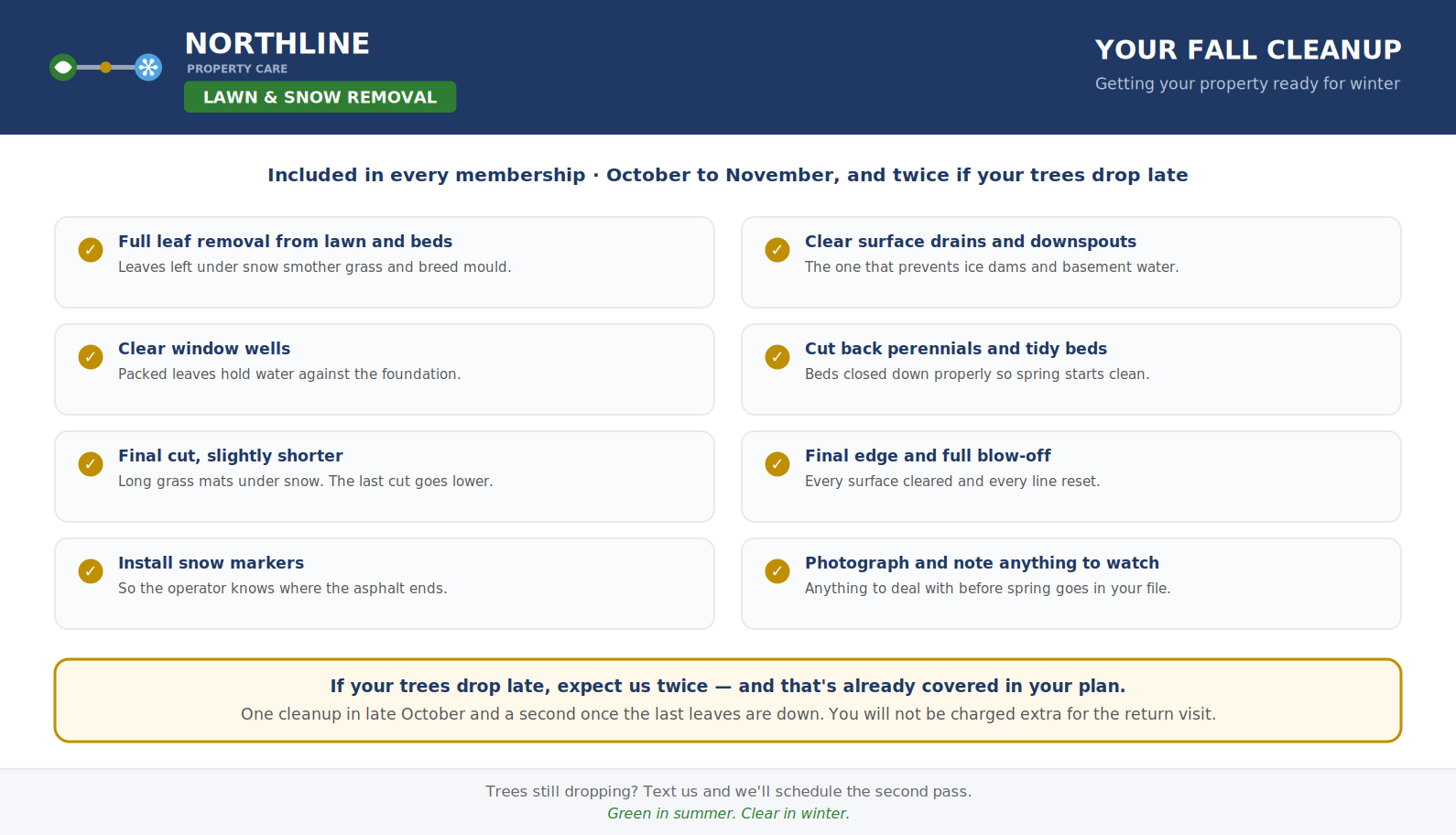
Plenty of operators sell a special short final cut for winter. We do not, and the reason is in the published guidance rather than in our scheduling preferences.
Purdue's fact sheet on grey snow mould says that continued mowing to a height of two and a half inches into the dormant period will decrease the risk. Their pink snow mould sheet goes further and says efforts should be made to maintain taller mown turf at two and a half to three inches to prevent the matting, because long lush growth and the insulating effect it creates extend the temperature window the disease can work in.
Two and a half to three inches is 6.4 to 7.6 cm. We cut at 7.5 cm all season. Which means the winter recommendation is already the height we were at in June, and there is nothing extra to sell you. Cornell puts the same instruction the simplest way: continue mowing turf as long as it continues growing in the fall.
What nobody in the acceptable research says is scalp it. Not one source we could find recommends dropping the deck for a final cut, and the two that discuss height going into winter both name a figure at or above three inches.
The practical version, on a Durham calendar: keep the weekly visit going into November for as long as the grass is still growing, at the same height, and stop when it stops. Growth on a cool season lawn here usually gives up somewhere in the second half of November, which is also when the truck switches over to the snow route.
Snow mould: two diseases, and the one that does not need snow
Both of these turn up in Durham and they are not the same problem.
Grey snow mould, or Typhula blight
Caused by Typhula incarnata and T. ishikariensis. It needs snow cover, and Penn State describes the ideal conditions as temperatures slightly above freezing at the snow and turf interface, wet leaf tissue and darkness. You find it at melt as white or tan crusted patches of matted blades that Penn State compares to papier mâché, with tiny reddish brown sclerotia embedded in the leaves.
Purdue publishes a dose response that is useful for reading a winter as it happens: mild symptoms after 40 to 60 days of snow cover, moderate after 60 to 90, and severe outbreaks threatened beyond 90 days. An Oshawa winter averages 55.4 days with 1 cm or more of snow on the ground, which sits comfortably in the mild band. It is the long unbroken cover that does the damage, and we do not usually get one.
The exception is the part of the property where cover is manufactured rather than fallen, which is why snow mould in Oshawa is better read as a question about where the driveway snow gets put.
Pink snow mould, or Microdochium patch
Caused by Microdochium nivale, and this is the one to watch here. Cornell states plainly that it does not require snow cover to develop, and unlike grey it can kill the turf outright. Purdue notes the pathogen is active across a broad range from about 30 to 60 degrees Fahrenheit.
Read that against a Durham winter and the risk profile becomes obvious. We get repeated thaw cycles, long stretches of bare wet ground, and temperatures hovering just above freezing for weeks. That is the Microdochium pattern almost exactly, and it is why the height and the leaf mat matter more here than the snow depth does.
The cultural controls are the same for both and all three sources agree on them: keep mowing into late fall, avoid creating long lasting snowbanks on good turf when you clear the driveway and the walk, and use only moderate amounts of nitrogen in fall. That last one carries a conflict worth naming, and it is in the next section.
Fall feeding, and a disagreement between sources we will not paper over
Late season nitrogen is the third ranked job and it is the one with the best measured payoff.
Ontario publishes two applications and the rates for both: one from mid August to mid September at 0.5 kg of nitrogen per 100 square metres, and a late season one in mid to late October at the same rate, applied when the turf has stopped growing but is still green. The season total is 1.5 to 2 kg per 100 square metres across two to four applications, and in the absence of a soil test the province recommends a 4-1-2 ratio, something like a 20-5-10.
Purdue gives the imperial equivalent and puts the timing slightly later: 0.5 to 1.0 lb of nitrogen per 1,000 square feet, near or after the last mowing of the year while the lawn is still green, generally in the first few weeks of November. Their published list of what it buys is specific: better root development, stored energy reserves, colour retention, earlier green-up, improved density and better tolerance of spring diseases such as red thread.
Here is the conflict. Cornell says to apply fall fertilizer before October 1, specifically to avoid stimulating succulent growth ahead of freezing weather and feeding snow mould. Ontario and Purdue both endorse a mid to late October or November application.
We are not going to pretend those agree. What reconciles them is the condition attached to the later date by both Ontario and Purdue: after growth has stopped, while the plant is still green. The thing Cornell is warning against is lush new growth going into winter. A dormant application on a plant that has stopped growing does not produce lush growth; it produces root and stored reserve. The disagreement is really about whether you can be trusted to judge when growth has stopped, and the honest answer is that on a warm Ontario November plenty of people cannot.
One more thing on fall feeding, published by Ontario and easy to miss: rooting depth is proportional to mowing height, and a late season nitrogen application promotes deep rooting through the fall so the plant enters spring and summer with a better root system. The feeding and the cutting height are the same argument told twice.
A legal footnote that catches people at the garden centre
Ontario's cosmetic pesticide ban does not regulate fertilizer. We checked this properly rather than assuming it: the word fertilizer does not appear anywhere in the Pesticides Act. Straight fertilizer is untouched by the ban.
The catch is combination products, and the mechanism is neat enough to be worth knowing. Ontario Regulation 63/09 classifies a pesticide as Class D if it is registered federally as a domestic pest control product or if it is registered under the Fertilizers Act. That second clause is the hook that catches a weed and feed bag, because the product is doing both jobs and the regulation follows the pesticide half.
So: fertilizer, yes. Fertilizer with a herbicide mixed into it, read the label and assume the answer is no. Ontario names 2,4-D and glyphosate among the banned cosmetic ingredients, and a weed and feed is usually carrying the first of those.
The eavestroughs, and how an ice dam actually forms
This one is not about the lawn at all, and it is the job with the largest downside if it is skipped.
Natural Resources Canada publishes the explanation of ice damming, and the interesting part is that the worst case is the half insulated attic, not the uninsulated one. Their guidance is explicit: an uninsulated attic usually does not get ice dams, because the heat coming through melts the snow as it lands. A well sealed and insulated attic also does not, because the roof stays cold. The dam forms where the attic is warm enough to melt snow up high and the eave is cold enough to freeze the water when it gets there.
Their published remedy is not a heated cable. It is seal all attic air leaks and insulate thoroughly, with a ventilation ratio of 1 to 300, unobstructed vent area to insulated ceiling area, and about half of that as continuous soffit vents. They also note something you would never guess: a dark, south facing wall heated by the sun can drive warm convection up into the eave and cause damming from outside the house.
On the eavestrough itself, the federal flood guidance is specific and easy to act on. Discharge downspouts at least 2 m from the foundation, and from neighbouring foundations too. Install one downspout for every 6 to 12 m of eavestrough. And clean them at least twice a year, fall and spring, plus after a severe storm and when ice starts building up.
That two metre figure is the one most Durham subdivisions fail, because the lots are narrow and the splash block points straight at the neighbour's wall.
Pruning, and the three things not to touch in October
Most pruning is a late winter job and doing it now costs you something. The University of Minnesota's extension guidance is the clearest published summary and it splits into three rules.
- Anything that flowers in spring set those buds last year. Prune a lilac or a forsythia in October and you are cutting off next May's flowers. The window for those is immediately after they bloom.
- Autumn and early winter pruning is more likely to cause drying and dieback at the cut on apple, crabapple, mountain ash, hawthorn and shrub cotoneaster. Those wait for late winter, just before growth starts, so the wound seals quickly.
- Oaks are the exception that runs the other way. Do not prune an oak between April and October because of oak wilt, which makes late fall and winter the correct window for them. If you have one mature oak on the property, this is the season for it.
Evergreens get a fourth rule: avoid heavy winter pruning, because they dry out and suffer winter burn.
The dates this all has to fit between
Two federal figures bracket the whole autumn on an Oshawa property, and they are worth writing on a calendar.
The average date of first fall frost is 14 to October 15, depending on which normals period you read, with a frost free season of about 167 to 168 days. Environment Canada also publishes the probability spread, which is more useful than the average: there is a ten per cent chance of the first freeze on or before October 5 and a ninety per cent chance it has happened by October 25.
Against that, the Region's last yard waste collection lands around December 10. So you have roughly eight weeks between the median first frost and the last chance to put leaves at the curb, and the useful part of that window is the first four, because December leaves are wet leaves and wet leaves are heavy.
The other date worth knowing for a different reason: Oshawa's December snowfall normal is 24.7 cm. November is 5.1. The idea that you have to finish before the snow arrives is true in December and mostly not true in November.
Questions people actually ask
Can I leave the leaves on my lawn?
You can mulch them in, which is different from leaving them. Ontario puts the ceiling at 15 cm and Michigan State at about six inches, which is the same number. What kills turf is a wet whole layer sitting over winter, and Ontario is blunt about that too.
When is the last yard waste collection in Durham?
The Region publishes April to early December, and the 2026 calendar for a Thursday Pickering route ends on December 10, going weekly from October 1. Oshawa and Whitby run their own separate programs.
Should I cut the grass shorter for winter?
No. Purdue's snow mould guidance is to keep mowing at two and a half to three inches into dormancy specifically to prevent matting, which is the height we already cut at, so there is nothing extra to buy.
Does pink snow mould need snow?
No, and that is what makes it the one to watch here. Cornell states it does not require snow cover, and it can kill turf where grey snow mould rarely does.
Can I still use fertilizer under the pesticide ban?
Yes. The word fertilizer does not appear in the Pesticides Act. Combination weed and feed products are a different matter, because the regulation catches them through the pesticide half.
What should I not prune in the fall?
Anything that flowers in spring, because the buds are already set. Minnesota also warns about drying and dieback on apple, crabapple, mountain ash, hawthorn and cotoneaster. Oaks are the reverse and this is their window.
Who wrote this
Andrew runs the business and works this list himself, in the order it is printed. North Oshawa, and the seven Durham towns the route covers, fully insured, an HST registrant. Six Durham winters of snow clearing sit behind that, his own rather than the company's, and the November changeover from mower to plow is done in a single afternoon.
The ranking at the top of this page is the order these nine jobs would be done in on his own property, which is why the presentation work sits ninth instead of first.
Sources here are ministries, municipalities, federal agencies and university extension programs, and every link is live so any line of it can be checked.
What to read next
The September job that outranks everything on this list
If you only do one thing to a tired lawn this year, it happens before the leaves fall, not after. The window, the soil survey and the seed law.
Read the window →How much time you really have
Thirty years of Environment Canada normals for Oshawa, month by month, and the five station comparison that shows Durham is not the snow belt.
Read the timeline →The ridge across the end of the driveway
Whose job it is in each Durham town, the assistance programs and deadlines, and what the law says about pushing it back onto the road.
Read the rules →Fall lawn fertilizer in Oshawa
The cleanup and the last feed land in the same two weeks, and only one of them has a temperature you can read. The rate Ontario publishes, the date the evidence stops supporting, and what the ground underneath changes about both.
Read the feeding guide →The work, photographed
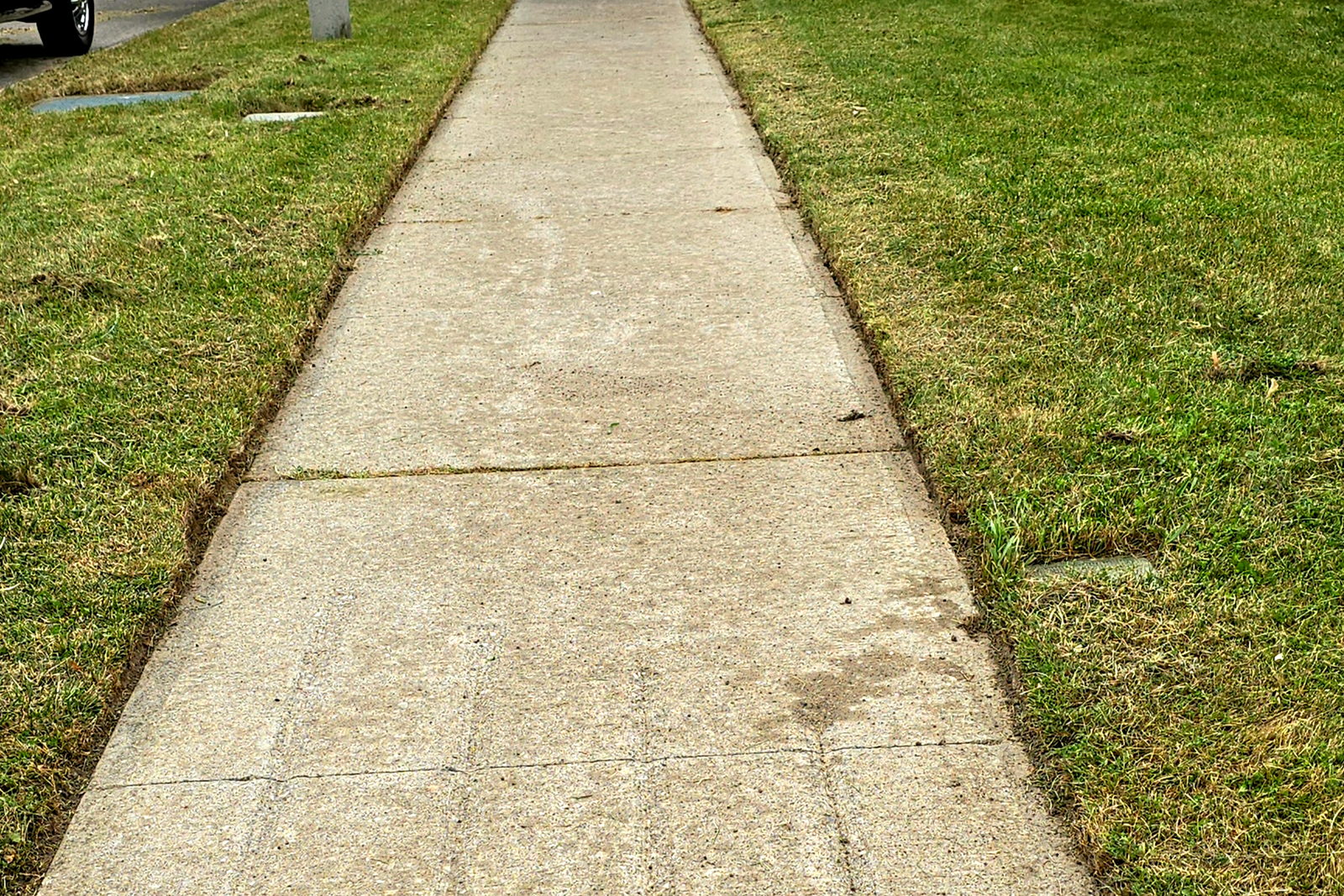
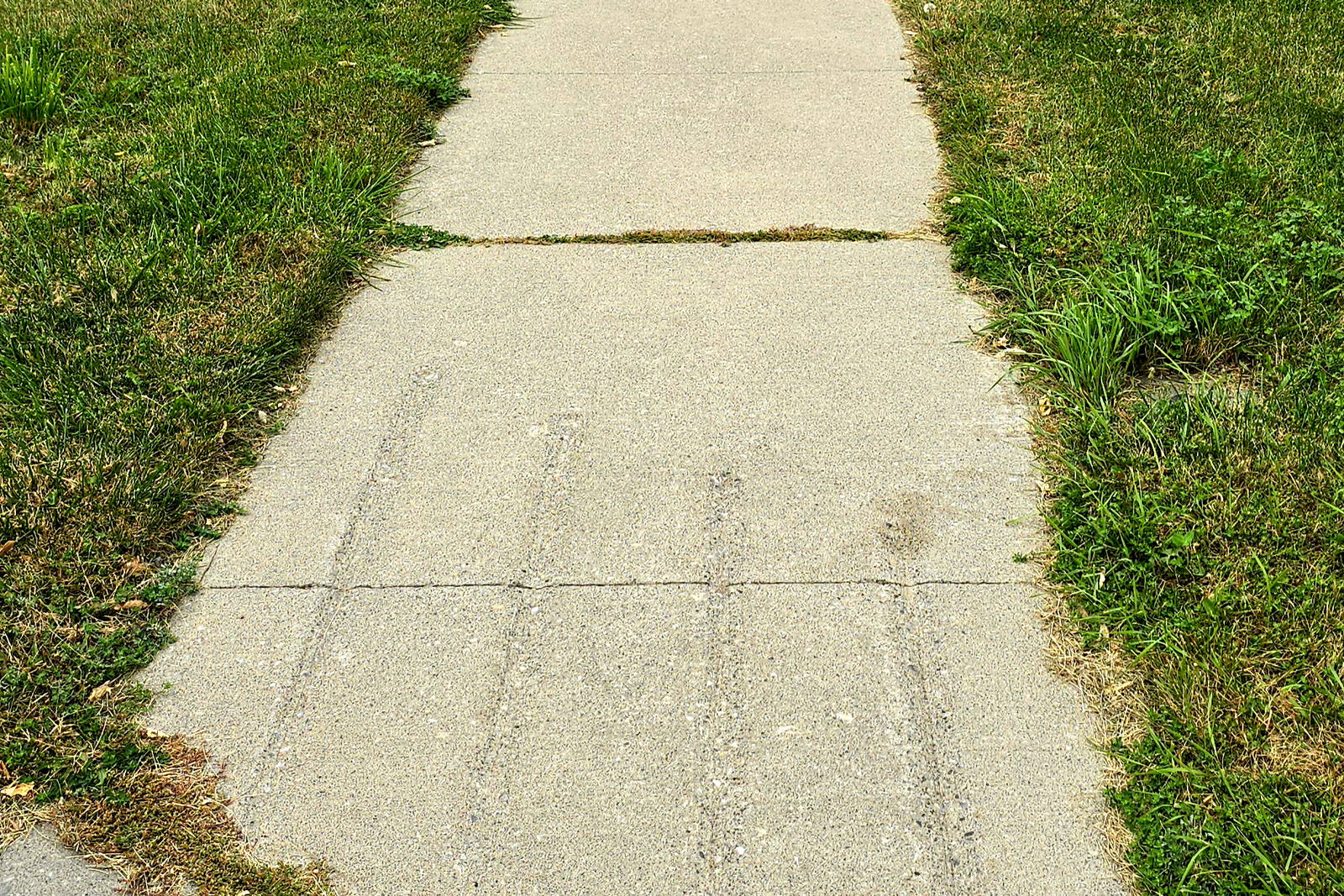
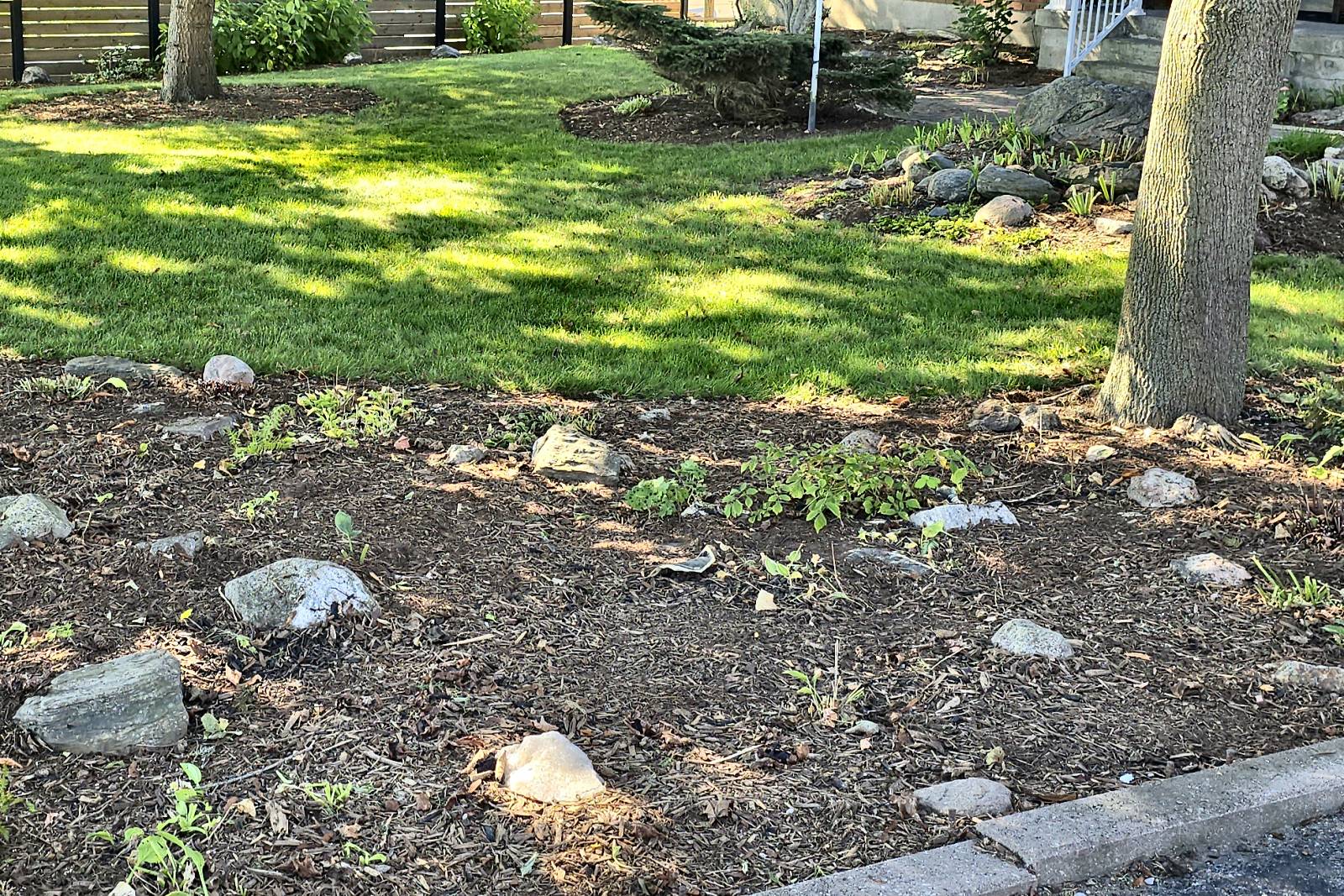
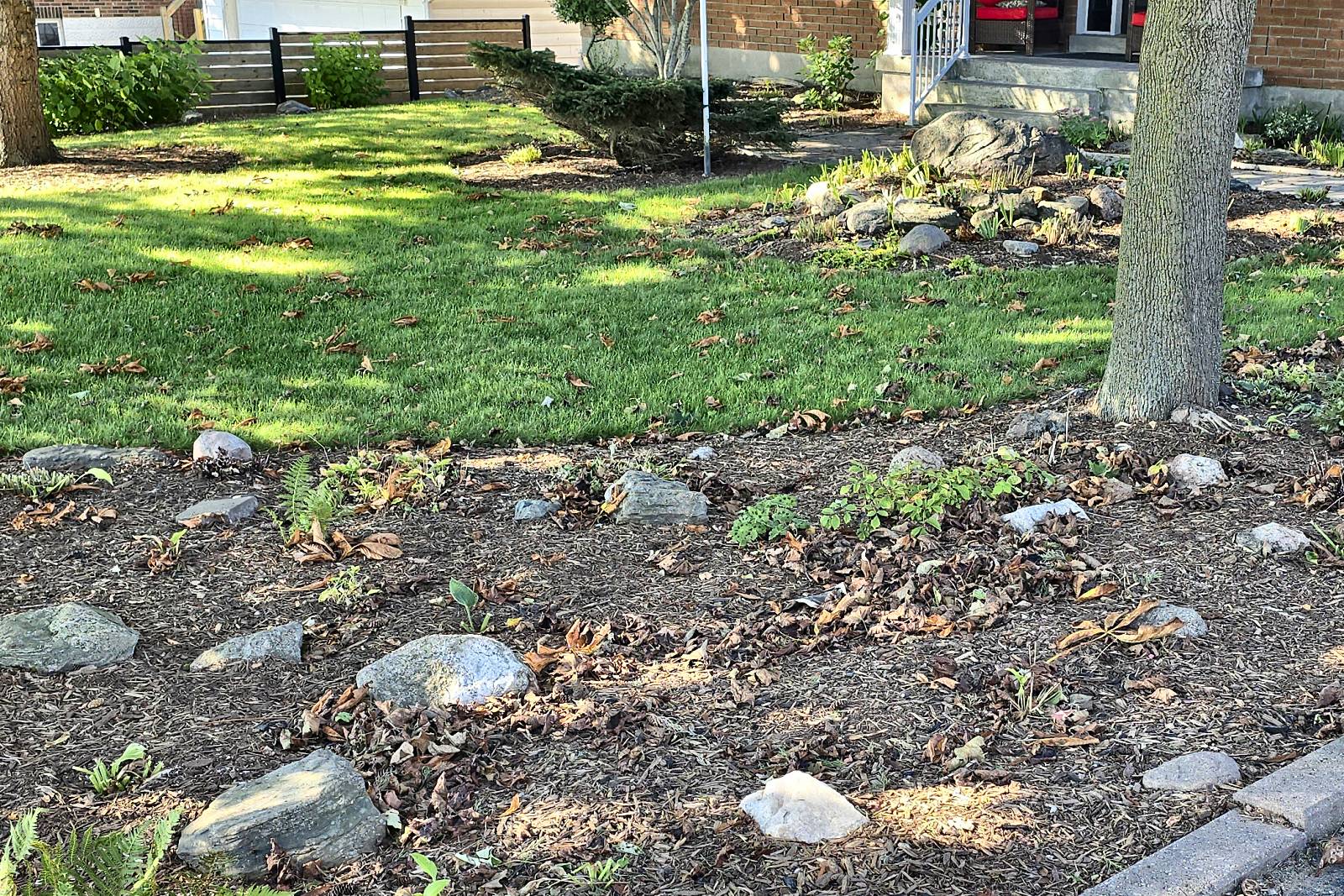
Real Northline properties, before and after, every one of them in Oshawa and every one of them this year. Drag the line to compare.
Andrew answers, October 2026
What happens in a drought? Do I still pay for a visit that did not happen?
We skip rather than cut, and we tell you why. Cutting a dormant lawn damages it. The payment does not change, because the payment is twelve equal instalments for a season rather than a charge per visit, and the same arrangement is what stops a twenty four storm winter costing you more than a four storm one. A contractor who mows on schedule through August because the schedule says so is charging you to hurt your grass.
One of these goes on each page and it is replaced monthly. If the question you have is not here, ask it: 905-244-5779.
Two jobs done properly beats nine done in a hurry
Members have the leaf work and the cutting height handled on schedule right through the autumn, and the same person turns up in January with a plow on the front. Give me the address and I will have a price back to you the same day.