Lawn care · Autumn
Leaf collection in Oshawa, and the rules that change at the town line
Leaf collection in Oshawa is bagged, never loose, every other week on your garbage day. The City sends no vacuum truck down your street, and what goes to the curb goes in a kraft paper bag or an open top container.
Rather hand the whole autumn over? See what a fall cleanup covers.
Green in summer. Clear in winter.
The short answer, before the detail
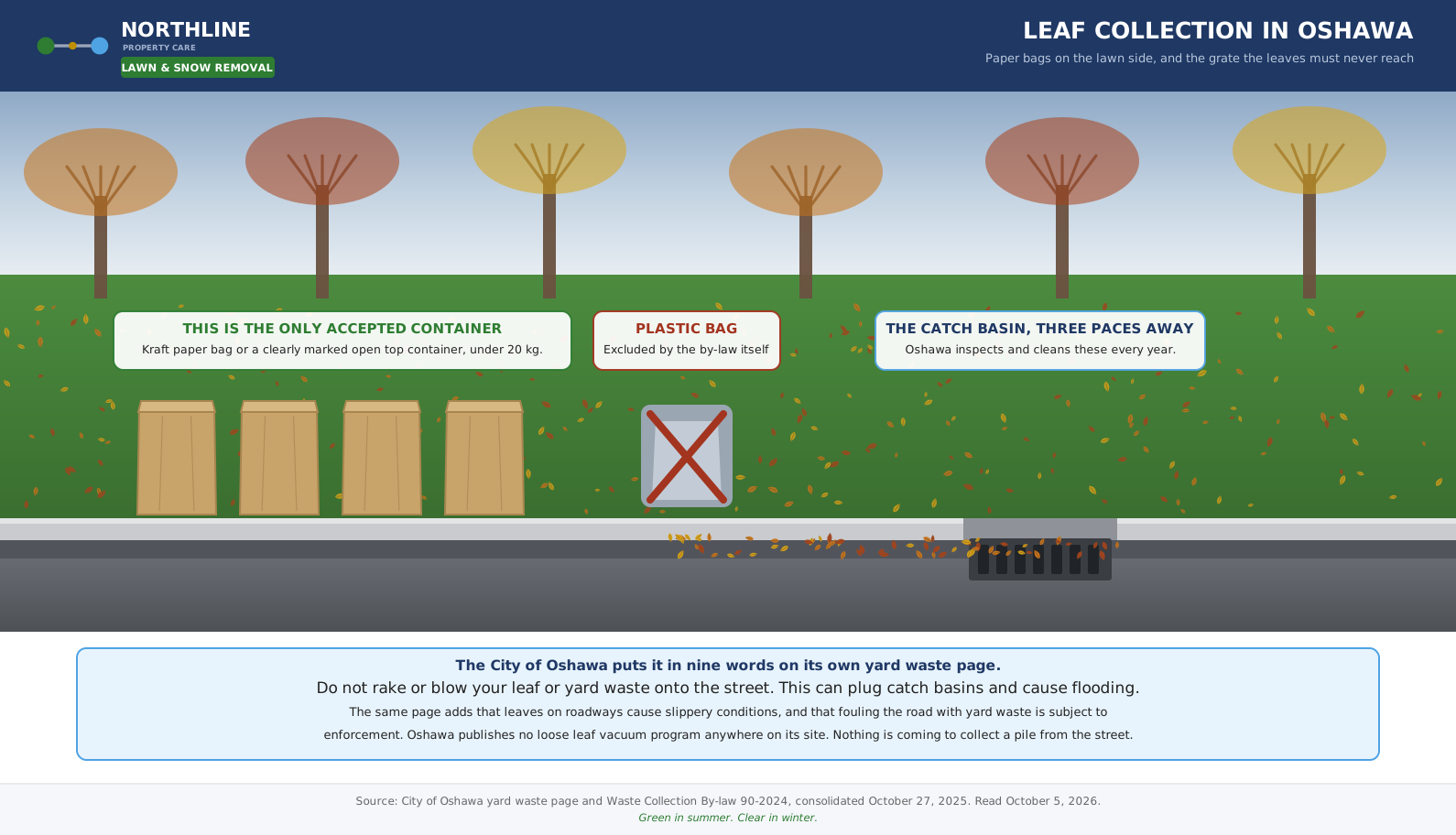
Oshawa does not vacuum leaves off the street and never has, as far as anything the City publishes goes. Leaves leave an Oshawa property in a kraft paper bag or a clearly marked open top container, under 20 kilograms, out between 6 PM the night before and 7 AM on the day, every other week on your garbage day, from the middle of April until early December. There is no limit on how many bags you put out. There is a by-law that says what the bag may be, and a plastic bag is not one of the things it may be.
Two streets over the rules are different, and that is the part almost nobody knows. Whitby collects its own leaves under a different by-law with a different bundle length and a different kind of twine. Ajax, Pickering and Clarington are collected by the Region of Durham under a third set. One region, three rule books, and a homeowner who moved from Ajax to north Oshawa last spring is working from the wrong one.
Who actually collects your leaves, and the line runs between towns
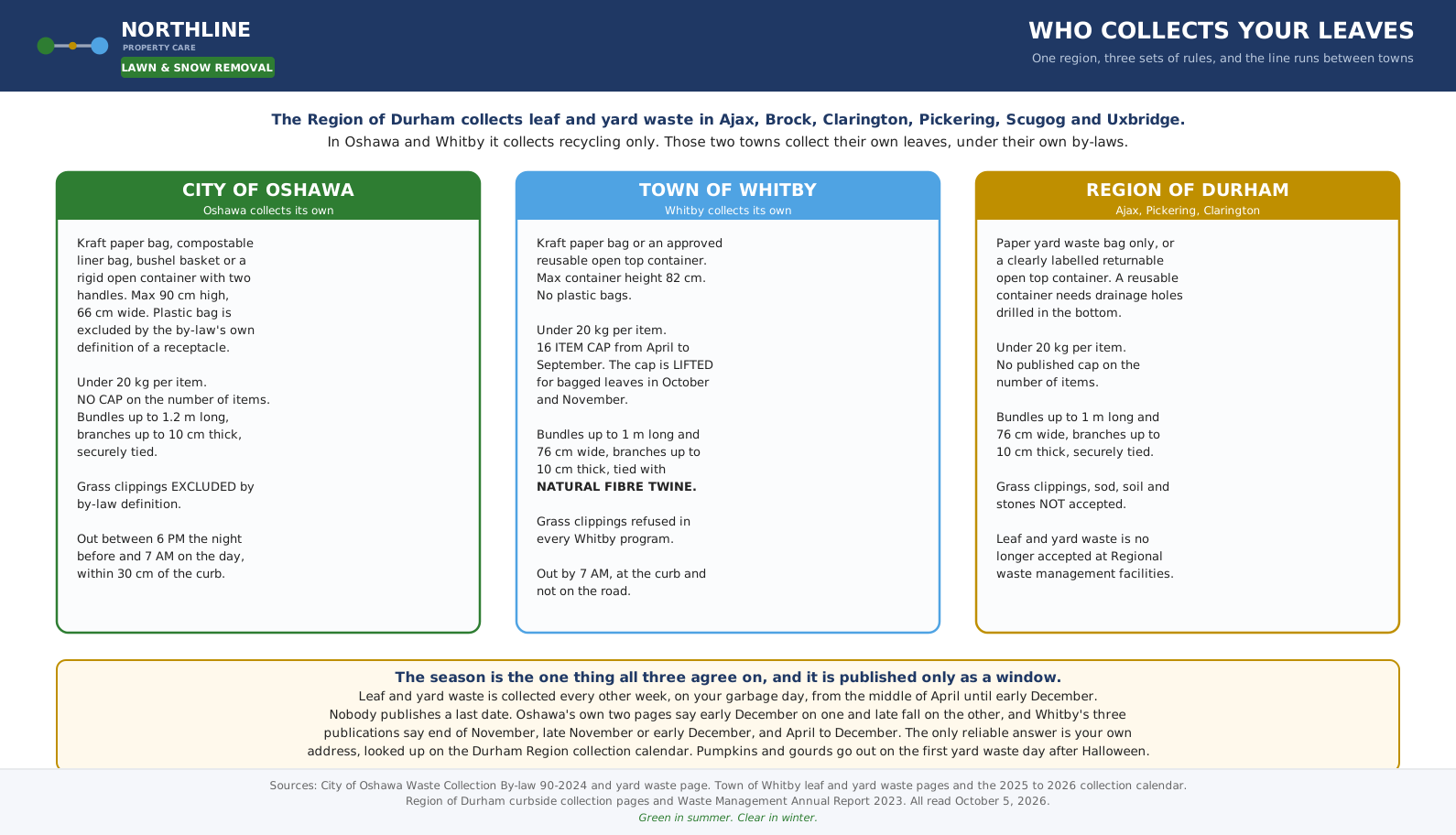
The Region of Durham collects leaf and yard waste in Ajax, Brock, Clarington, Pickering, Scugog and Uxbridge. It does not collect it in Oshawa or Whitby. In those two municipalities the Region collects recycling only, and the town itself handles the leaves.
That sentence is taken from the Region's own Waste Management Annual Report for 2023, which states that Durham Region manages curbside collection of recycling, organics, leaf and yard waste, garbage and special collections in the six municipalities named above, and that it only collects recycling in Whitby and Oshawa while partnering with both to keep the programs consistent. Every one of the five lower tier municipal websites in this service area points residents at durham.ca for waste questions, which is why the split is so easy to miss. Ajax, Pickering and Clarington point there because the Region genuinely collects for them. Oshawa and Whitby point there for other streams while writing their own yard waste rules.
The proof that Oshawa writes its own is sitting in the by-law. Waste Collection By-law 90-2024, passed June 24, 2024 and consolidated to October 27, 2025, is a City of Oshawa instrument, and it is the document that defines what a yard waste receptacle is, how long a bundle of branches may be and what time it has to be at the curb. A region that collected Oshawa's yard waste would not have the City legislating the container.
For a homeowner this is not trivia. It decides how many bags you may put out, what you may tie a bundle with, how tall your container may be, and in one case whether a pile of leaves on the road surface is an offence with a named penalty attached. People move within Durham constantly, from an Ajax townhouse to a Taunton or Windfields lot in north Oshawa, and the habits come with them.
What Oshawa accepts, written down in a by-law rather than a tip sheet
Most municipal waste guidance is advice. Oshawa's is partly legislation, and the difference matters when something is left at the curb uncollected.
By-law 90-2024 section 9.3.1 says no person shall set out yard waste unless it is in a yard waste receptacle. Section 2.0 then defines that receptacle as a rigid open container no more than 90 centimetres high and no more than 66 centimetres wide or in diameter with two suitable handles, a kraft paper yard waste bag, a compostable liner bag, or a bushel basket, and it expressly states that the definition does not include a blue box or a plastic bag.
A plastic bag of leaves in Oshawa is not a judgement call made at the curb by whoever is collecting. It is excluded by the definition of the container itself. That is why it sits there afterwards, and why nobody can make an exception for it. The City of Oshawa yard waste page lists yard waste set out in plastic bags under what is not accepted, alongside soil, sod, stones and clay, hay and straw bales, tree stumps, lumber and plastic plant pots.
What is accepted reads like an October property: brush and leaves, garden trimmings, weeds and plants, corn stalks, fallen fruit from trees, pine needles and cones. Pumpkins and gourds have their own line, and it is a useful one to know in this part of the year, because they are collected on the first yard waste day after Halloween rather than being treated as garbage.
Three numbers do the rest of the work. Nothing may weigh more than 20 kilograms, which is 44 pounds, and that applies to a bag, a container or a bundle alike. Branch bundles may be up to 1.2 metres long with no branch thicker than 10 centimetres, securely tied, under section 9.3.3. And there is no cap at all on how many items you may set out. That last one is worth dwelling on, because Oshawa does cap garbage at four bags per dwelling per collection, and a reasonable person assumes the same limit applies to leaves. It does not. Twenty two bags of maple leaves off a mature lot on Alexandra Street is not a problem the by-law has anything to say about.
The set out window is section 9.7.1, and it is narrower than people treat it: not before 6 PM on the day immediately preceding collection, and not after 7 AM on the collection day. The City's own waste tips page asks for material within 30 centimetres of the curb at ground level so it is visible and reachable. It also warns that collection can run up to two business days late during the spring and autumn peaks, which is exactly the period this page is about.
And there is a clause most people never read that changes how you think about the pile at the end of the driveway. Section 9.6.5 deems waste set out in front of a property to have been set out by the owner of that property unless the owner proves otherwise on a balance of probabilities. The onus sits with the homeowner. If somebody dumps a load of yard waste at your curb, the by-law starts from the position that it is yours.
Whitby is not Oshawa, and October is the month the difference shows
Whitby collects its own leaf and yard waste every other week on the regular garbage day, and its rules differ from Oshawa's in four specific ways.
The first is the one that actually costs people money in October. Whitby sets an item limit of 16 yard waste receptacles or bundles per collection from April through to September, and then lifts that limit entirely for bagged leaves in October and November. So a Whitby property with heavy tree cover has two months a year with no cap and ten months with one, and the two uncapped months are precisely the ones where the leaves are on the ground. A homeowner who spreads the job over September and October is working against the calendar rather than with it.
The second is the container. Whitby accepts kraft paper bags or an approved reusable open top container, and publishes a maximum container height of 82 centimetres. Oshawa's by-law allows 90 centimetres. A bin that is legal in Oshawa can be eight centimetres too tall at a Whitby curb.
The third is the twine. Whitby's collection calendar asks for branches and brush securely tied with natural fibre twine, in bundles up to 1 metre long and about 0.7 metres wide, with no individual branch over 10 centimetres in diameter. Oshawa's by-law says only securely tied, and allows 1.2 metres. Baler twine out of a hardware store is polypropylene more often than not, and in Whitby that is the wrong material for a job that in Oshawa has no material specified at all.
The fourth is new this year and it is the one with a penalty attached. Whitby's Clean Community By-law 8271-26 was passed March 9, 2026 and replaced the old Property and Boulevard Maintenance By-law at the end of March. Section 8.7 states that no person shall place or deposit, or cause or permit to be placed or deposited, any leaves on the travelled portion of a highway. Section 8.8 says the same thing about grass clippings. The administrative penalties under that by-law run from $355 to $1,000 depending on the violation and whether it recurs.
Read that section narrowly, because it is narrow. The prohibition bites on the travelled portion of the highway, which is the road surface. It does not say anything about the boulevard, and Whitby's own winter guidance tells residents to pile snow on the boulevard. So leaves swept onto the road in Whitby are a by-law offence with a number and a fine. Leaves on the grassed boulevard are not addressed by 8271-26 at all. Anyone telling you otherwise has not opened the document.
Oshawa has no equivalent clause naming leaves. What it has instead is section 9.6.3, which forbids setting out residential waste that obstructs the travelled portion of a highway or a sidewalk, read together with the requirement that yard waste be in a receptacle in the first place. Loose leaves raked into an Oshawa roadway are not in a receptacle and are not in a prescribed location, and the City's own yard waste page states that any fouling of the road with yard waste will be subject to enforcement. The route to the same outcome is different. The outcome is the same.
Ajax, Pickering and Clarington run on the Region's rule book
In Ajax, Pickering and Clarington the rules come from the Region of Durham, and they are close to Oshawa's without being identical.
The Region accepts paper yard waste bags or clearly labelled returnable open top containers, and asks that a reusable container have holes drilled in the bottom for drainage, which is a detail neither town publishes. Nothing may exceed 20 kilograms. Brush has to be tied securely into bundles, and the Region caps those at one metre by 76 centimetres, with 10 centimetres the thickest any single branch may be. Accepted material includes branches, sticks, twigs, brush, decorative corn stalks, fallen fruit, garden waste, gourds and pumpkins. Grass clippings, hay bales, plastic flower pots, sod, soil and stones are refused.
One change is worth flagging for anyone in Bowmanville, Courtice or Newcastle who used to load the trailer in November. The Region has stopped taking leaf and yard waste at its own waste management sites. Its facilities page says exactly that, and sends residents to the free curbside collection instead. The Clarington depot on Bowmanville Avenue is a household special waste site, not a leaf drop.
The Clarington question comes up often enough to be worth settling here, because there is a widely repeated idea that Clarington runs its own leaf program separate from the rest of Durham. Clarington's own website says the opposite in two places: that the Region of Durham provides garbage, green bin and yard waste collection services in Clarington, and that the Region also collects leaf and yard waste. Searching the municipal site for a leaf collection program returns nothing. If Clarington ever ran a separate program, the Municipality does not publish it now.
Whatever town you are in, the date is the one thing none of them publish. Oshawa says mid April until early December on one page and late fall on another. Whitby says end of November on one page, late November or early December on a second, and April to December on its printed calendar. The Region says April to early December. Not one of those is a date, and no 2026 date list exists anywhere I could find. The collection calendar at durham.ca takes an address and returns the actual days, and the Durham Region Waste app does the same thing on a phone. That lookup is the only answer that is true for your house rather than true on average.
The street is the one place leaves must never go, and the reason is measurable
The City of Oshawa states it in two sentences on its yard waste page: do not rake or blow your leaf or yard waste onto the street, because this can plug catch basins and cause flooding. The same page adds that leaves on roadways cause slippery road conditions.
That is a municipal instruction rather than a by-law, and it deserves better than being read as housekeeping, because the mechanism behind it has been measured twice in different disciplines and both numbers are large.
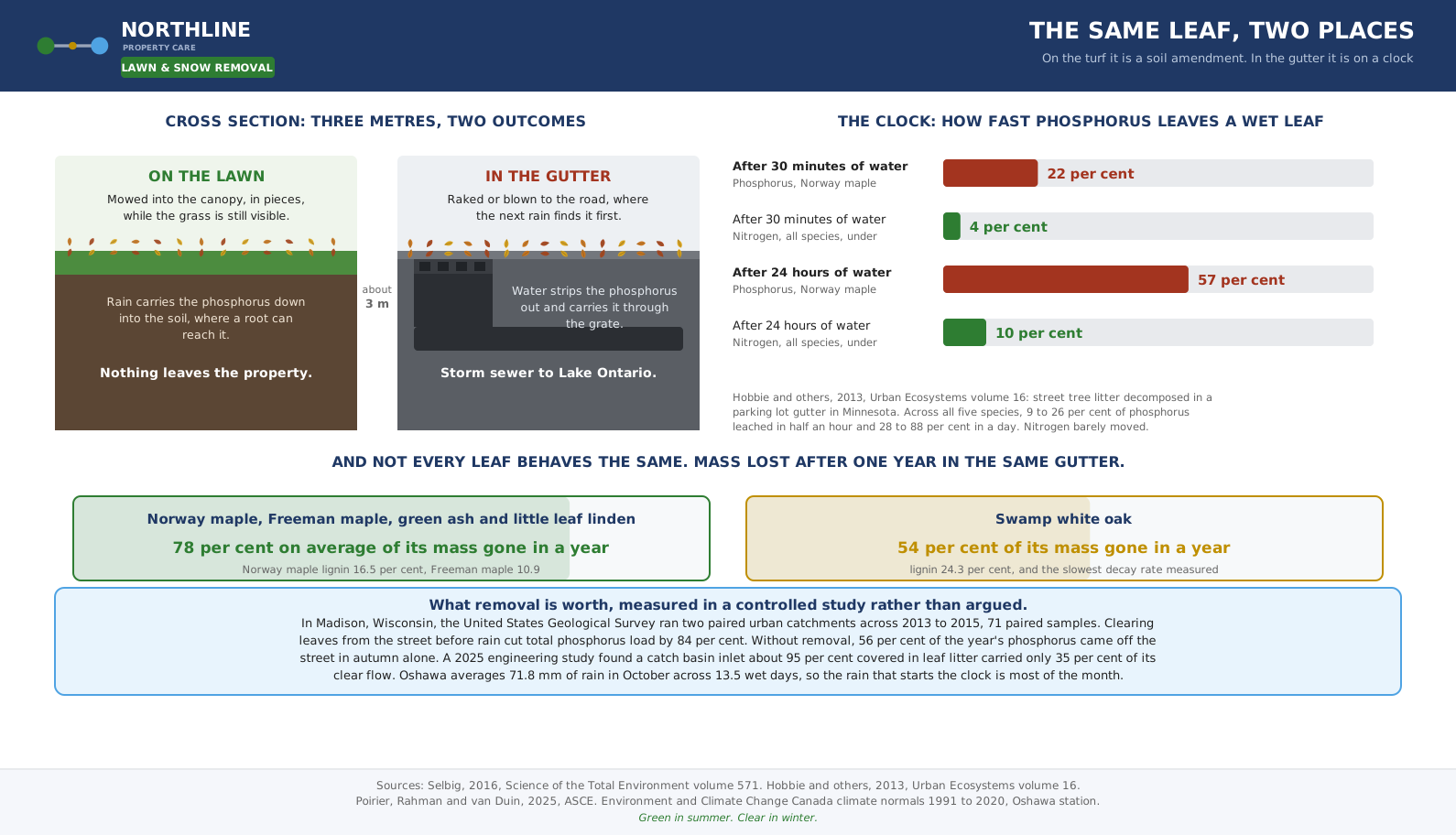
The first is hydraulic. A 2025 paper presented at the American Society of Civil Engineers World Environmental and Water Resources Congress, by Poirier, Rahman and van Duin, tested catch basin inlets under obstruction. With leaf litter covering roughly 95 per cent of the inlet in a ponding condition, the inlet carried only 35 per cent of the flow it carried clear. Roughly two thirds of the drain's capacity gone, from leaves, at the exact time of year when Oshawa averages 71.8 millimetres of rain across 13.5 days with measurable rainfall. That figure is read off the Environment and Climate Change Canada climate normals, 1991 to 2020, at the Oshawa station. October ties the wettest months of the year for how often rain falls, even though it is not the wettest by volume.
The second is chemical, and it is the one that surprised me. Work by Hobbie and colleagues published in Urban Ecosystems in 2013 put street tree litter in bags in a parking lot gutter and measured what water pulled out of it. After half an hour of water, less than 4 per cent of the nitrogen had leached, but between 9 and 26 per cent of the phosphorus had. After 24 hours, nitrogen was still under 10 per cent while phosphorus ranged from 28 to 88 per cent. For Norway maple specifically, which is the single most common street tree in a lot of Ontario subdivisions, it was 22 per cent of the phosphorus in half an hour and 57 per cent in a day.
A wet leaf in a gutter is not waiting to be collected. It is unloading. Half an hour of ordinary October rain and a fifth of its phosphorus is already in the water heading for the grate, and the grate in an Oshawa subdivision feeds a storm sewer that discharges toward Lake Ontario without treatment.
What timely removal is worth has been measured too. The United States Geological Survey ran paired urban catchments in Madison, Wisconsin across 2013 to 2015, 71 paired samples, with leaf collection and street cleaning applied to one catchment and not the other. Total phosphorus load fell by 84 per cent and dissolved phosphorus by 83 per cent. Without removal, 56 per cent of the year's phosphorus yield came off the street in autumn alone. With it, 16 per cent.
That study was run in Wisconsin, not in Durham, and I am not going to pretend a Madison number is an Oshawa number. What transfers is the mechanism and the direction, not the decimal. Whitby's own spring bulletin asks residents to help prevent flooding by clearing leaves and debris from storm catch basins near their property, which is the same instruction arrived at independently. If there is a grate at the end of your driveway, the five minutes spent pulling the mat off it in late October is probably the highest value five minutes in the whole autumn.
What should stay on the lawn, and the limit nobody has actually measured
Not every leaf needs to go in a bag, and the research on mowing them into the turf is better than most people expect.
The work usually cited is from Michigan State University and was published in HortTechnology in 2009 by Kowalewski and colleagues. Leaves from red maple, silver maple, sugar maple, a high sugar content sugar maple and red oak were mulched into an established Kentucky bluegrass stand in the autumns of 2003 and 2004, at a low rate of half a kilogram per square metre and a high rate of one and a half. The high rate, regardless of species, produced the highest spring green up ratings. Dandelion counts fell by up to 80 per cent after one application and up to 53 per cent after two. Coarse fragments and fine fragments performed the same, with no differences observed between particle sizes across the whole data collection period.
Two honest caveats belong with that, and they are the reason this section is not a sales pitch for a mulching mower.
The first is that no published trial I could reach establishes the point at which mulched leaves start to harm turf. Every study reports no harm at the rate it tested. Virginia Cooperative Extension, reporting earlier Purdue work, describes up to 4,000 pounds of maple leaves per acre in a single application and a depth of up to six inches mulched successfully with no undesirable effects on turf quality, colour, growth, thatch, soil pH, weed populations or disease pressure. That is a ceiling nobody reached, not a ceiling somebody found. The practical limits in circulation are extension rules of thumb and they disagree with each other: one university extension says no more than 20 per cent of the lawn covered after each mulching event, another says keep mulching until about half the lawn surface is still visible. Those are different numbers and I am not going to average two guidelines into a third.
The second is that the Michigan dandelion result has not, as far as I could establish, been reproduced in a published Ontario trial. It is a Michigan measurement on Michigan turf, and quoting it as a promise about an Oshawa lawn would be overclaiming. What is robust across every permitted source is narrower and still useful: mulching leaves into the canopy does no measured harm to the turf and improves spring green up.
The mechanism when it does go wrong is light, not chemistry. The guidance is consistent that if the chopped layer is too thick, or the fragments too large, the grass plants are deprived of the sunlight they need. So the operating rule that survives all of it is one you can check by eye without a scale: keep mowing until you can still see grass through the pieces, and make a second pass rather than a single slow one. When you cannot see grass any more, the rest goes in a bag.
Grass clippings are the easier half and Oshawa gives the reason itself: clippings are not allowed at the curb because they cause problems at the compost facility, and the City's instruction is to leave them on the lawn to decay naturally. Whitby refuses clippings in every one of its waste programs and recommends the same thing. Two municipalities independently telling you to stop bagging something is about as clear as municipal advice gets.
Oak is the leaf that argues back, and it is worth knowing which tree you have
If you are deciding what to mulch and what to bag, species is a better guide than volume, and there is a published measurement behind that.
The same Minnesota study that produced the phosphorus leaching figures also tracked how much of each leaf was gone after a year in the same conditions. Norway maple, Freeman maple, green ash and little leaf linden lost on average 78 per cent of their initial mass over twelve months. Swamp white oak lost 54 per cent. The lignin content explains it: 10.9 per cent for Freeman maple, 16.5 for Norway maple, and 24.3 for the oak. Lignin is the part that does not break down quickly, and an oak leaf carries roughly half again as much of it as a Norway maple leaf.
In practical terms, maple goes into the lawn and oak comes off it. An oak leaf mulched in late November on a Courtice lot is still recognisably an oak leaf in April, lying in a mat over turf that is trying to green up. A maple leaf is largely gone.
One claim I will not make, because the evidence does not support it, is that Norway maple needs special handling. Norway maple is invasive enough that the City of Toronto's own canopy study names it as a species causing significant challenges for native regeneration, and it made up 13.5 per cent of Toronto's street tree population in 2018, down from 22 per cent in 2008. But it is not a regulated invasive species under Ontario's Invasive Species Act, and in the decomposition work it behaved like the other fast species rather than like a problem. Its leaves go in the lawn with the rest of the maples.
The leaf mat is a snow mould problem before the snow arrives
There are two snow moulds and only one of them needs snow, which is the fact that makes a late leaf mat worth taking seriously in a Durham November.
Grey snow mould is caused by Typhula incarnata and Typhula ishikariensis, and Purdue's extension bulletin is explicit that it requires snow cover for infection and patch development. Mild symptoms follow roughly 40 to 60 days of cover, moderate levels 60 to 90, and severe outbreaks more than 90. Pink snow mould is Microdochium nivale, and the same source states that, unlike grey snow mould, snow cover is not necessary for extensive infection.
The link to leaves is documented rather than assumed. Penn State's turf disease material states that in the absence of snow, lodged turf or heavy leaf litter can mimic the conditions that favour snow moulds, and that in areas with many deciduous trees, raking leaf litter helps reduce the disease. Purdue's pink snow mould bulletin ends on the same instruction: rake and mow lawns through the autumn to prevent the insulating effect of matted grass and accumulated leaves.
Now put the Oshawa climate normals against that. November at the Oshawa station averages 5.1 centimetres of snowfall across 1.6 days with measurable snow, and December averages 5.8 such days. The snow that matters for grey snow mould is a December and January event here. The leaf mat that imitates it is in place from the first week of November.
So the window that decides next spring is the one before the snow, not the one after it. A mat laid down in the first half of November has six to eight weeks to work on the turf underneath before anything white arrives, and that is the part a homeowner can still do something about. There is more detail on how this plays out on a specific lawn in the piece on snow mould in Oshawa and why the plow pile decides it.
Where the water actually goes, and why the grate is doing the draining
The reason a blocked catch basin matters more in a subdivision than it would on a rural lot is that in a subdivision the grate is most of the drainage system.
The provincial Soil Survey Complex maps the ground around Oshawa, Whitby, Courtice and Bowmanville mostly as Bondhead loam and Darlington loam, well drained and in hydrologic soil group B, which the survey documentation defines as a moderate infiltration rate when thoroughly wet. Loam, not clay. We measured that properly on October 4, 2026 and published the whole texture breakdown on the dethatching page, including the correction of our own earlier copy, so it is not re argued here.
What matters for leaves is the second half of that query, and it is the half that sounds like an error until you understand it. Ask the survey what the soil is at the centre of Oshawa, Whitby, Courtice or Bowmanville and it does not return a series. It returns the map unit "Built up area", with texture, drainage and hydrologic group all recorded as not applicable. The province declines to characterise the ground under an established subdivision, and it is right to, because that ground is fill, subsoil and whatever got spread as topsoil the week the lot was graded.
Under a built up street there is no mapped soil doing the draining, so the engineered system is doing it instead. That is the storm sewer, and the only way into it from your frontage is the grate at the curb. Fill the grate with a leaf mat and an October downpour has nowhere to go but along the gutter to the next one, or across the road, or back up the driveway apron. The 2025 inlet study put a number on how fast that capacity disappears. The soil map explains why there is no second route.
It also explains why a lawn is the better destination for the leaf. Mowed into turf sitting on a group B loam, the material and whatever leaches out of it go down through moderate infiltration into root depth. Blown to the curb, it meets a surface with an infiltration rate of effectively zero and a pipe at the end of it.
The calendar is tighter than it looks, and frost is the thing that closes it
The practical window for getting leaves off a Durham lawn is shorter than the collection season suggests, and the climate normals are where you can see it.
At the Oshawa station, the 1991 to 2020 normals put the average date of the first fall frost at October 15 and the average length of the frost free period at 167 days. The probability table is the more useful half: there is a one in four chance of the first temperature at or below zero by October 8, an even chance by October 14, and a three in four chance by October 20. October averages 9.5 degrees as a daily mean and November averages 3.9.
Cool season turf root growth is best between about 10 and 18 degrees of soil temperature, and while roots keep growing below that, growth slows sharply as the soil approaches freezing. So the period when the grass can still respond to having light and air restored to it is closing through late October, at the same time as the heaviest leaf drop and at the same time as the stretch of the calendar with the most rain days. Those three things overlapping is why the job feels rushed every year. It is rushed.
The one deadline that is published and fixed is Halloween, and only because of the pumpkins. In Oshawa they go out, with the gourds, on whichever yard waste day falls first after October 31. Everything else resolves to your own address on the Region's calendar.
If you are already thinking about the other end of the season, the companion piece on when to stop cutting grass in Oshawa covers the last cut and why the height it is left at matters more than the date.
Burning them is not an option anywhere in this service area
It comes up every autumn, usually from somebody who grew up on a rural property, so it is worth stating plainly with the by-law numbers attached.
In Oshawa, open air burning is governed by By-law 73-2012, consolidated to 2025. Open air fires are restricted to properties with an area of more than ten acres and located north of Conlin Road, and a permit is required. The administrative penalty is $250 for each day or part of a day the by-law is contravened. For an ordinary residential lot anywhere in the built up part of the city, that is a flat prohibition.
Whitby names leaves outright. The Town's outdoor burning guidance lists construction material, wood, brush and leaves as things that cannot be burned, and directs residents to the garbage and recycling pages for proper disposal instead. Permits exist for rural residential and agricultural purposes at $94.92.
Clarington's recreational open air burning by-law, 2025-002, prohibits the burning of noxious or treated materials, garbage or yard waste, and its guidance says no refuse, grass or leaves because of the fire spread risk and the volume of dark smoke. In Ajax, open air burning requires a permit under By-law 49-2004 and the Town states that most properties do not meet the requirements. Pickering has no open air burning by-law number to cite at all: the City states that open air burning appliances are not permitted and enforces under the Ontario Fire Code, Division B, sentences 2.4.4.4.(1) and (2), where a conviction can carry a fine of up to $50,000.
Province wide, the Government of Ontario's own outdoor fire rules state that a fire permit is required to burn wood, brush, leaves and grass outdoors during the fire season of April 1 to October 31, and that you should check with your local municipality first because it may impose more rules. In Durham, the municipal by-law is the operative one and the answer is the same in all five municipalities.
Where the leaves actually end up, and what comes back
Everything collected at the curb goes to outdoor windrow composting, and what it becomes is the compost the Region gives back to residents.
The numbers are published in the Region's waste management annual reports. Durham composted 27,101 tonnes of leaf and yard waste in 2023 and 27,227 tonnes in 2022. Up to 70 per cent of that is collected in the autumn each year, which is the single clearest statement anywhere of why this season is different from the rest.
The Region states that all the compost distributed to residents at its compost giveaway events is produced from the leaf and yard waste program. Green bin material is a separate stream entirely and goes to an anaerobic digestion facility near Leamington, Ontario, so the compost you collect in a bucket in spring is the autumn leaf pile, come back around.
What the Region does not publish anywhere I could find is the name or location of the facility that does the windrow composting, or any participation rate for the collection program. Both are reasonable things to want to know and neither exists in public.
What this costs, and the part where the free option wins
Curbside leaf and yard waste collection is free in all five municipalities, there is no cap on how many bags you may put out in Oshawa, and no cap on bagged leaves in Whitby in October and November. For a great many households that is the whole answer and nothing should be bought.
If you are able to rake your own leaves and carry your own bags, the municipal program beats anything anybody can sell you, and it is not close. It costs nothing, it runs every other week, and it takes an unlimited quantity. A contractor competing with free is competing on time and on physical effort, and nothing else. Saying so costs us work and it is still true.
Where it stops being true is specific and worth naming honestly. A mature treed lot producing twenty or thirty bags is a full weekend with a tarp, twice over, because the drop does not finish in one week. A property with beds, hedges, a back lawn that has to be carried through a gate, and no vehicle to move bags is a different job from a front lawn with one tree. And a household that physically cannot do the lifting is in a different position again.
For those cases the price of a one off autumn cleanup runs $200 to $475 plus HST across this service area. It is quoted at your address and fixed before anybody starts. Lot size and tree cover are the two things that move the number. There is no membership required and no card held for the rest of your life. The detail of what a cleanup covers sits on the fall cleanup page, and the fall cleanup checklist for Durham homeowners ranks the autumn jobs by what each one is actually worth if you would rather do it yourself.
If leaves are one visit inside a year of property care rather than a single job, memberships run from $129 a month plus HST and include the autumn cleanup. The arithmetic on that, against buying the same services one at a time, is laid out on the memberships page, and the general lawn program for this area is on lawn care in Oshawa.
What we went looking for and could not find
Every claim above has a municipal, provincial, federal, university or peer reviewed source behind it, and not one figure on this page came from another property maintenance company. Here is what that method could not deliver.
No 2026 collection dates. Not in Oshawa, not in Whitby, not from the Region. Every one of them publishes a window and sends residents to an address lookup. There is no printed Oshawa date list for any recent year either.
No agreed season end, even as a window. Oshawa's two pages say early December and late fall. Whitby's three publications say end of November, late November or early December, and April to December. These are the municipalities contradicting themselves, not a reading error.
No published Ontario leaf mulching trial. The dandelion and green up results are from Michigan and have not, as far as I could establish from permitted sources, been reproduced in a published Ontario study.
No measured harm threshold for mulched leaves. Every trial found no harm at the rate it tested. The practical limits in circulation are extension rules of thumb and they disagree with each other.
No Ontario storm water figure for leaf removal. The 84 per cent phosphorus reduction is from Madison, Wisconsin. No conservation authority in Durham publishes anything equivalent for leaf litter or catch basin blockage.
No participation rate for the collection program. There is also no name or location published for the facility that composts the material. Both are absent from every regional source.
No numeric infiltration rate for the local soil series. The survey publishes texture, drainage class and hydrologic group, and the group definitions are qualitative. The original county soil survey reports exist but could not be read.
No average first snowfall date for Oshawa. Environment and Climate Change Canada does not publish that element for this station. The November and December figures quoted above are days with measurable snowfall, which is a different thing.
A page carrying only the things it managed to find has hidden half of what it did. The list above is how you judge whether the rest was checked properly.
Questions people actually ask about leaf collection
Does Oshawa pick up leaves raked into the street?
No, and the City says so directly on its own yard waste page: do not rake or blow your leaf or yard waste onto the street, because this can plug catch basins and cause flooding. Oshawa publishes no loose leaf vacuum program anywhere on its site. Leaves must be in a kraft paper bag, a compostable liner bag, a bushel basket or a rigid open top container with two handles. The same page states that any fouling of the road with yard waste will be subject to enforcement.
How many bags of leaves can I put out in Oshawa?
As many as you like. Waste Collection By-law 90-2024 sets no cap on the number of yard waste receptacles or bundles for a collection. The only quantity limit is weight: nothing may exceed 20 kilograms, which is 44 pounds. This is different from garbage, which is capped at four bags per dwelling per collection, and that difference is what catches people out. Whitby does cap yard waste at 16 items from April to September, but lifts the cap for bagged leaves in October and November.
When does leaf collection end in Oshawa for 2026?
Nobody publishes a date. The City says yard waste is collected every other week on your garbage day from the middle of April until early December, and another City page says late fall. Whitby and the Region of Durham publish equally soft windows. The only reliable answer is your own address, looked up on the Region of Durham collection calendar at durham.ca or in the Durham Region Waste app, which returns the actual days for your street rather than a season.
Can I leave the leaves on my lawn instead of bagging them?
Some of them, yes. Research from Michigan State University published in HortTechnology in 2009 found that maple and oak leaves mulched into established Kentucky bluegrass produced the highest spring green up ratings at the heavier of the two rates tested, with no harm to the turf. The rule that survives every source is visual rather than numeric: keep mowing until you can still see grass through the pieces, make a second pass rather than one slow one, and bag the rest. Oak is the one to be strict about, because it decomposes far more slowly than maple.
Why are grass clippings refused when leaves are accepted?
The City of Oshawa gives the reason on its waste tips page: clippings are not allowed at the curb because they cause problems at the compost facility, and the instruction is to leave them on the lawn to decay naturally instead. Oshawa goes further than guidance and excludes grass clippings from the by-law definition of yard waste, alongside sod and soil. Whitby refuses clippings in every one of its waste programs and gives the same advice about leaving them on the lawn.
Is it legal to burn leaves in Oshawa?
Not on an ordinary residential lot. Oshawa By-law 73-2012 restricts open air burning to properties of more than ten acres located north of Conlin Road, with a permit, and sets an administrative penalty of $250 for each day or part of a day it is contravened. Whitby names leaves outright as a material that cannot be burned. Clarington By-law 2025-002 prohibits burning yard waste. Ajax requires a permit most properties do not qualify for, and Pickering enforces under the Ontario Fire Code with a maximum fine of $50,000.
Who wrote this
Northline Property Care is Andrew's, run out of Oshawa, working into Whitby, Ajax, Pickering, Bowmanville, Courtice and Clarington. Six winters clearing snow in Durham Region sits behind that, which is his own record rather than a trading history for the business, since the business registered in August 2026. The person who quotes your property is the person who then does the work on it.
The sourcing rule on this page is worth stating because it is unusual and it shaped what you have just read. Every external fact came from a municipal by-law or municipal page, the Region of Durham, the Government of Ontario, the Government of Canada, a provincial map service, a university extension service or a peer reviewed journal, and the page names the document. Nothing was taken from another lawn care or property maintenance company, because a competitor page is marketing rather than evidence. Where a source contradicted itself, as Oshawa and Whitby both do on their season end, you were told rather than given the tidier of the two. If anything above is wrong, the number 905-244-5779 goes straight to whoever typed it, and that beats a correction form every time.
Read next
Fall cleanup in Oshawa
What a cleanup actually includes, what it costs at $200 to $475 plus HST, and when late October stops being early enough to book.
See the cleanup page →The last cut of the year
Why the height the lawn goes into winter at decides more than the date of the final visit, and what happens underneath the snow.
Read the last cut piece →One off jobs and add-ons
Hedges, beds, aeration and the rest, priced one at a time, with no membership attached to any of them.
See the price list →The work, photographed
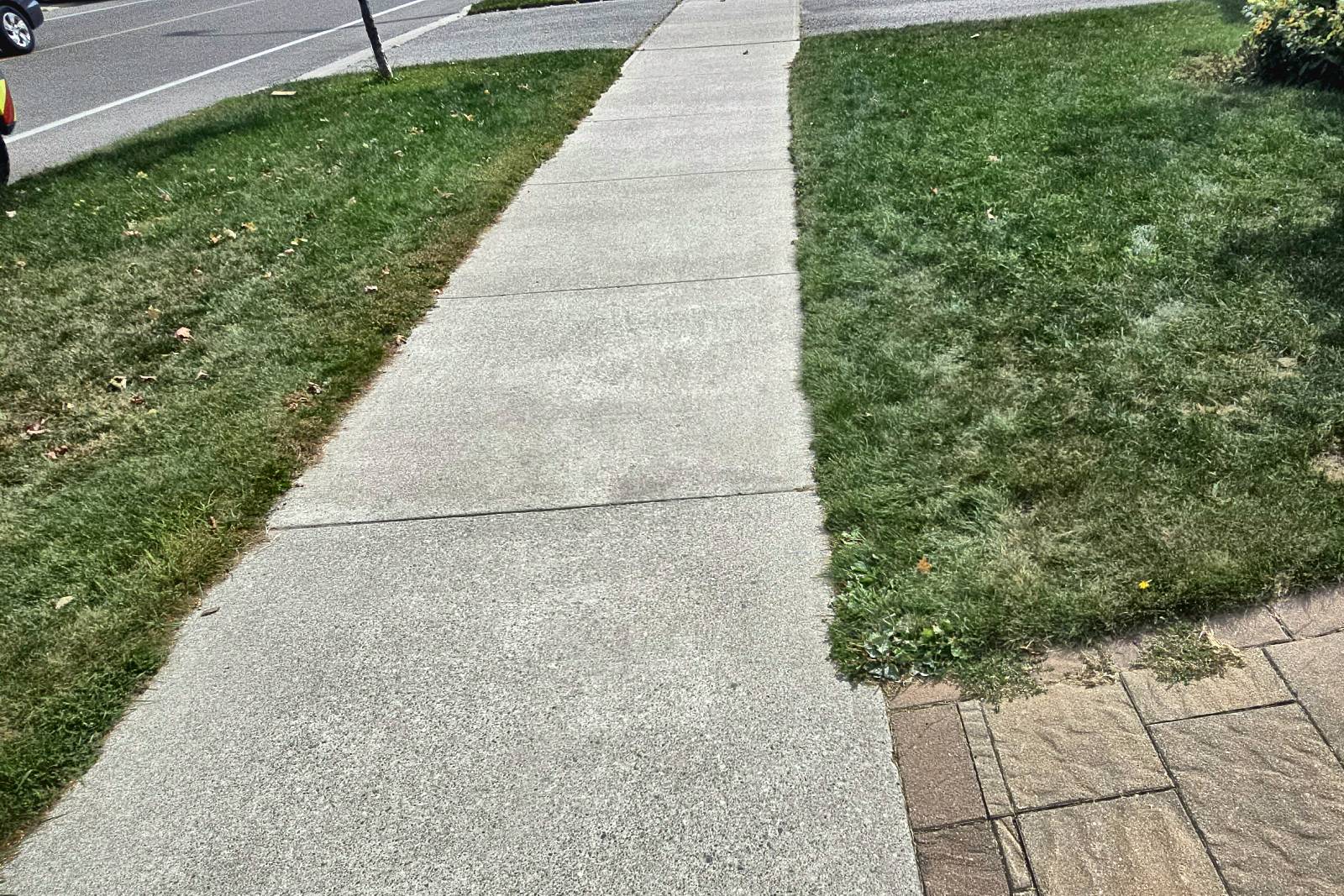
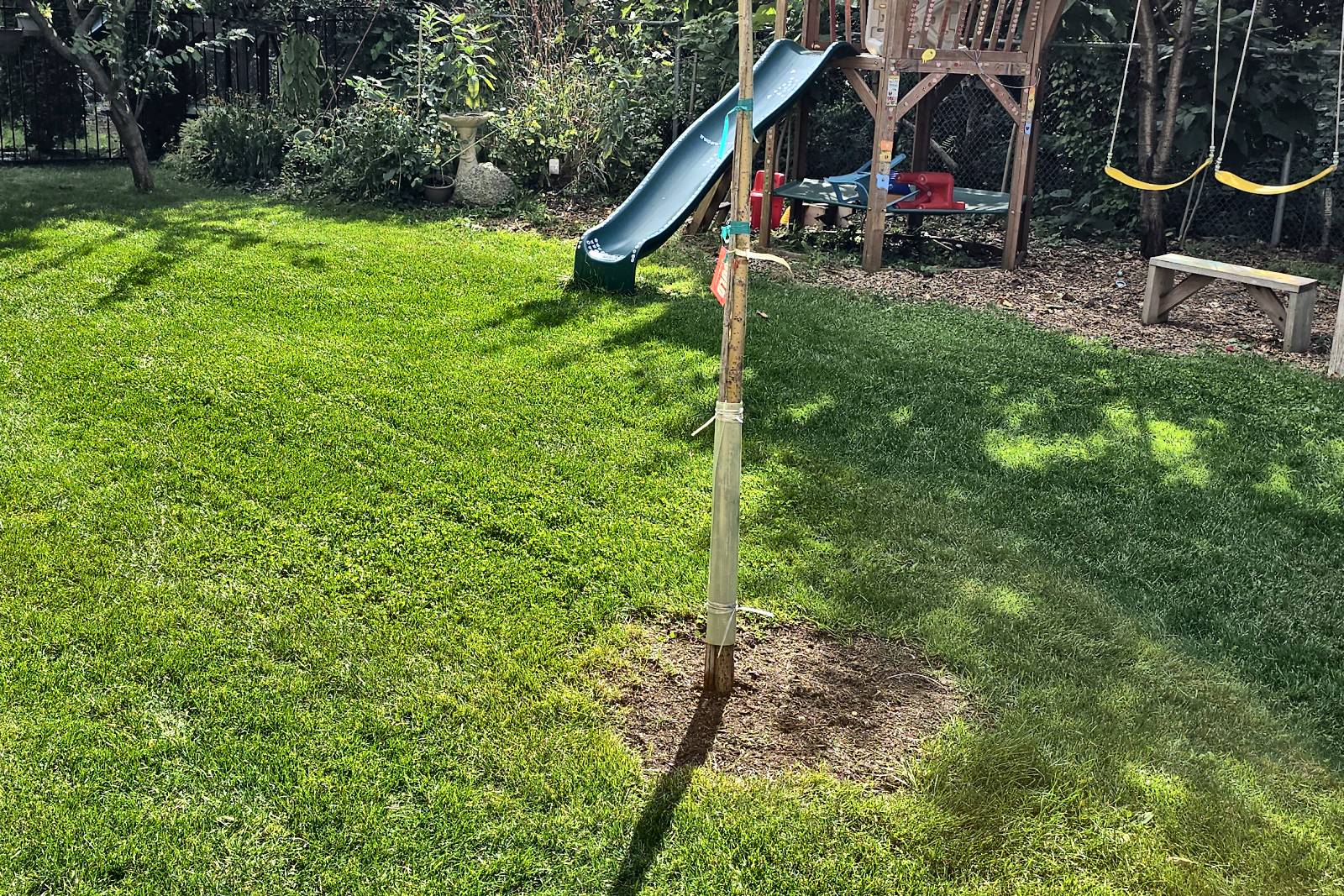
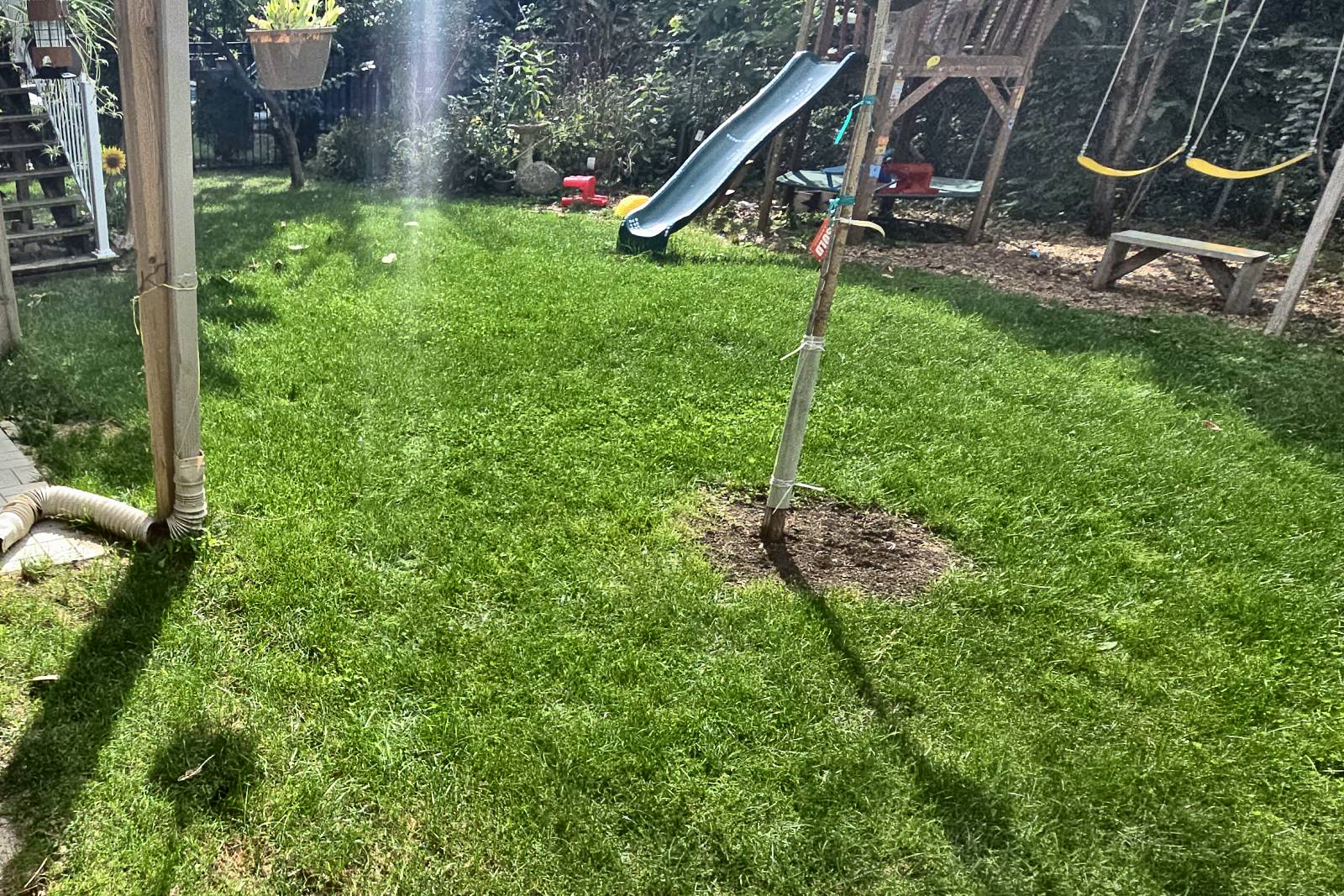
Real Northline properties, before and after, every one of them in Oshawa and every one of them this year. Drag the line to compare.
Andrew answers, October 2026
Is the fertilizer included?
No, and I would rather say so here than have you find out in May. The five step fertilizer program is a paid add on at $300 to $600 a season, and it is included only on Platinum. The weekly visit is the cut, the trim and the blow down. Anybody describing a weekly lawn service as including a fertilizer program is selling you something nobody has bought.
One of these goes on each page and it is replaced monthly. If the question you have is not here, ask it: 905-244-5779.
Send me the address and I will tell you whether you need me at all
If your leaves fit in bags you can carry, the municipal collection is free, unlimited in Oshawa, and better than anything I could sell you. If the lot is bigger than that, tell me what is on it and I will price the cleanup before the first frost rather than after it.