Lawn care · Fall feeding
Fall Lawn Fertilizer in Oshawa, and the Date After Which It Stops Paying You Back
Fall lawn fertilizer in Oshawa earns almost all of its money inside about two weeks of October, and the date it stops earning is earlier than the bag on the shelf suggests.
Booking the winter as well? Compare the memberships.
Green in summer. Clear in winter.
The short answer
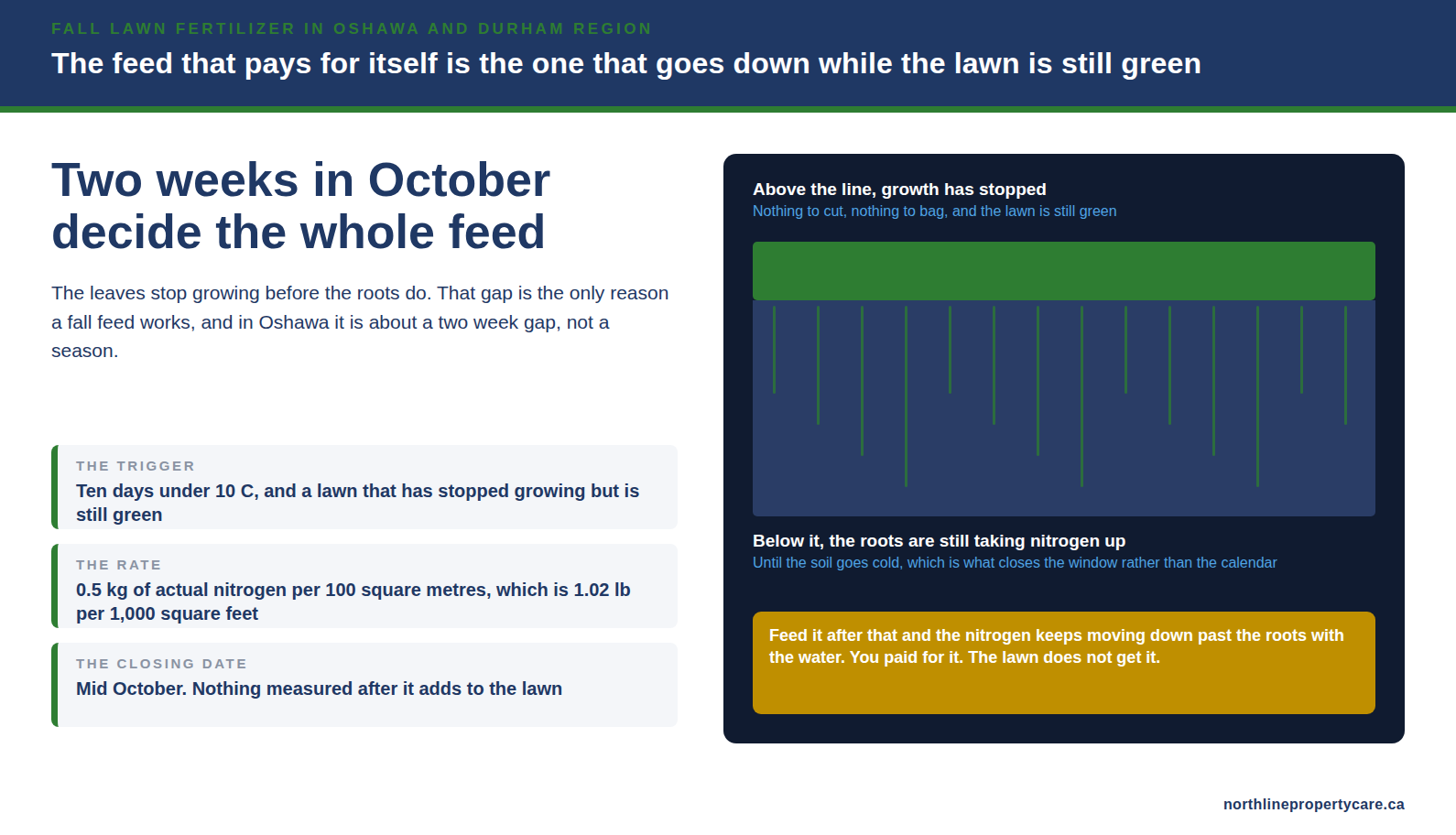
Feed the lawn once between the last week of September and roughly the middle of October, at half a kilogram of actual nitrogen for every hundred square metres, and then stop. The trigger is not a date. It is ten days of air temperatures under 10 degrees Celsius and a lawn that has stopped growing while it is still green, which the Government of Ontario puts at mid to late October. A study that tested exactly this question, feeding identical lawns on September 15, October 15, November 15 and December 15, found no difference in colour or density between the October feed and the December one, while the nitrate draining below the root zone rose with every later date. So the November application the trade calls a winterizer buys something nobody has been able to measure and costs something that has been measured repeatedly.
Why a fall feed works at all, and why it is a gap rather than a season
Cool season grass stops growing upward well before it stops growing downward. Penn State puts the best root growth for these species at soil temperatures between 10 and 18 degrees Celsius and the best leaf growth between about 15 and 24, so there is a band of weather in which the top of the plant has finished for the year and the bottom of it has not. Carbohydrate storage in a cool season turf is at its greatest in the fall. That band is the entire mechanism, and it is why the same bag of fertilizer is a good decision in the second week of October and a poor one in the second week of August.
The Government of Ontario states the outcome in plain words on its own lawn maintenance page: a late fall application increases fall and spring root growth, promotes a thicker lawn, and produces an earlier spring green up, with the useful side effect that spring feeding can then be pushed back to late May or early June. Ontario also gives the physiology, which almost nothing else written for homeowners bothers with. Nitrogen continues to move into the plant through the roots while the shoots are dormant, photosynthesis carries on, and cells that are full of stored sugars freeze later and at lower temperatures than cells that are not.
Two things make that band shorter here than a national article would suggest. The first is the lake. South Oshawa, Lakeview and the Port Darlington shore sit on the Iroquois Plain within sight of open water, and open water holds the shoulder season open a little longer than the ground ten kilometres inland does. The second is the moraine. Solina, Enniskillen, Hampton and Tyrone sit on the Oak Ridges Moraine, high and coarse and exposed, and they cool first. The same route crosses both in a morning, which is how you learn that a single date printed in a provincial guide is doing a lot of work.
Honesty about the evidence belongs here rather than at the end. A 2012 review in Crop Science looked at the peer reviewed literature behind late fall nitrogen and concluded that the physiological and agronomic benefits so often quoted for it are poorly supported by research, with the exception of the fall and spring colour response, and that much of the supporting work was done in warmer coastal climates than ours. The extension services and the province say one thing with confidence, the review says a narrower thing with evidence, and both of those sentences are on this page on purpose.
The trigger, stated so you can check it yourself without buying anything
Stop using the month. Use two readings that you can take standing on your own lawn.
The first is temperature. Cornell's turf program gives the cleanest version anybody publishes: apply when the soil is not frozen and foliar growth has slowed, which they define as air temperatures below 10 degrees Celsius for ten days. That is a reading from a phone weather app and a calendar, and it costs nothing. Purdue adds the lower bound from the other direction, noting that plant growth slows significantly once soil drops below about 4.4 degrees Celsius, and telling homeowners that once Halloween has come and gone the spreader goes back in the shed.
The second is the mower. If two weeks have passed without the lawn needing a cut, and the lawn is still green rather than straw coloured, you are inside the window. That is the same event Ontario describes as stopped growing but still green, expressed in something a homeowner already tracks. Our page on when to stop cutting grass in Oshawa works through the other half of the same decision, because the last cut and the last feed are usually within a week of each other on a Durham lawn.
The commonest failure we see is not lateness, it is earliness. People read the word fall, buy the bag on the Labour Day weekend, and put it down while the grass is still growing hard in warm September soil. Ontario names that failure specifically: fertilizer applied too early promotes succulent growth in the fall that makes the lawn more susceptible to winter injury. A lawn in north Oshawa that is still throwing clippings into the bag every seven days is not in the late fall window, whatever the bag says on the front.
The rate, in the units the province actually publishes
Half a kilogram of actual nitrogen for every hundred square metres of lawn, in one application. That is 1.02 pounds per thousand square feet, and it is the figure the Government of Ontario gives for a late season feed. Across a whole season Ontario allows 1.5 to 2 kilograms per hundred square metres, split into two to four applications, and OMAFRA Publication 845 sets out a non irrigated home lawn at half a kilogram in May, again in the summer and again in September. Cornell puts a ceiling on any single pass of one pound of nitrogen per thousand square feet. Those numbers agree with each other, which is rarer than it sounds.
Here is the arithmetic that almost nothing on the first page of a search result will do for you. Take a fairly ordinary Oshawa lot with about four hundred square metres of actual turf once the house, the driveway, the deck and the beds are taken out of it. At the Ontario rate that lawn wants two kilograms of actual nitrogen. If the bag reads 12-0-4, it is twelve per cent nitrogen by weight, so two kilograms of actual nitrogen means sixteen and a half kilograms of product. One seven kilogram bag does not feed that lawn and most people buy one bag.
| What you are reading | What it means on an Oshawa lawn |
|---|---|
| The first number on the bag | Per cent nitrogen by weight, and under the federal Fertilizers Regulations it is a guaranteed minimum rather than an estimate |
| 0.5 kg N per 100 square metres | The Ontario rate for one late season application, equal to 1.02 lb per 1,000 square feet |
| 400 square metres of turf | Needs 2.0 kg of actual nitrogen, which is 16.7 kg of a 12 per cent product |
| 1.5 to 2 kg N per 100 square metres | The whole season, split across two to four feeds, not one |
| A soil test for nitrogen | Does not exist. Ontario says so in as many words, and the turf testing page repeats it |
That last row matters more than it looks. Phosphorus and potassium can be tested for and nitrogen cannot, so the nitrogen decision is made from maintenance level and season rather than from a laboratory number. Anybody who tells you a soil test set their nitrogen rate is describing something the province says is not available. Measuring the lawn is the part a homeowner can actually control, and it is the same discipline that decides the price of our full lawn restoration, where the quoted size is the measured turf area and never the lot size.
The date after which it stops paying, and how that was measured
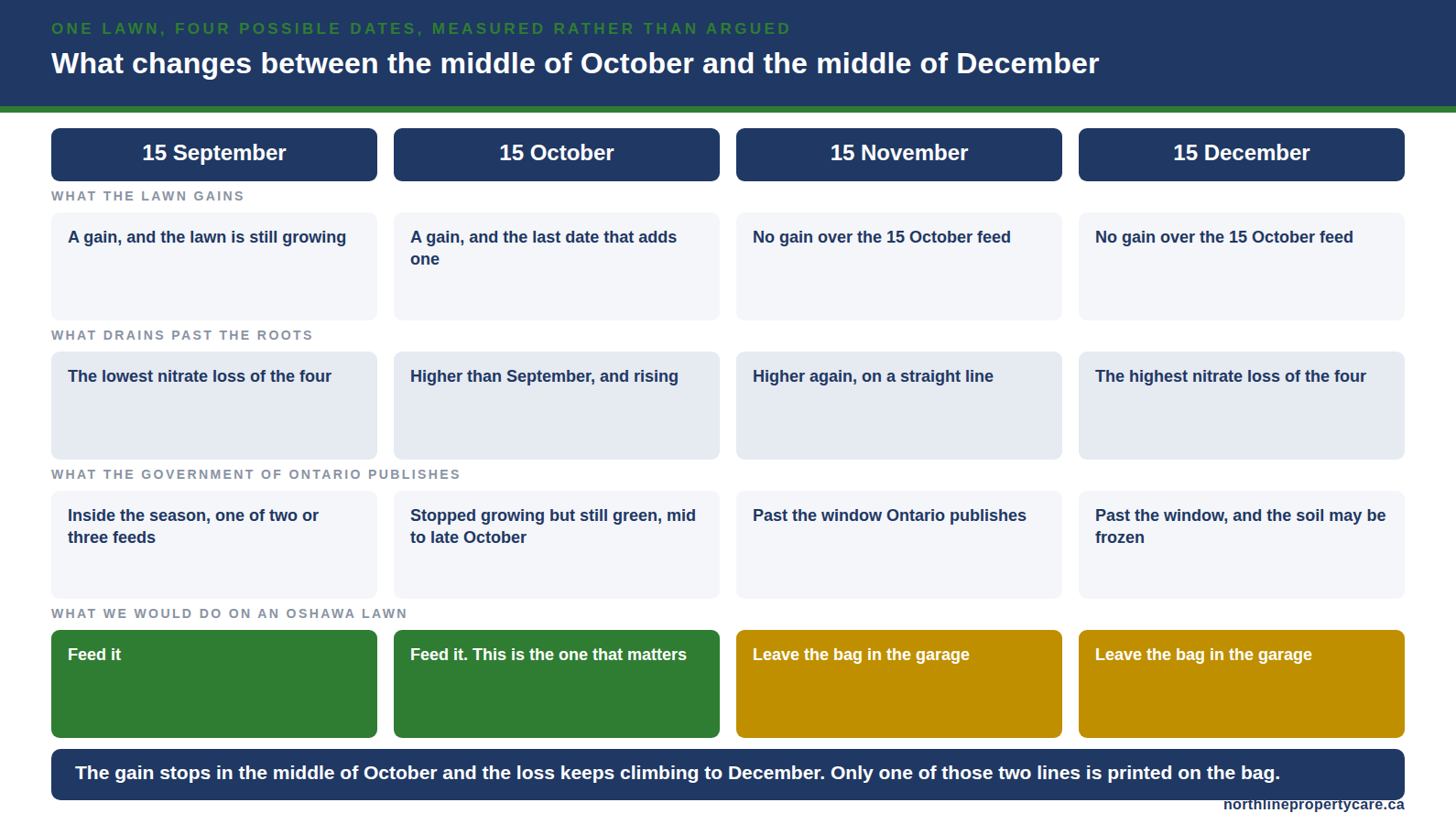
The study everybody in this field ends up citing set out four fall dates on a Kentucky bluegrass and creeping red fescue lawn, fed on September 15, October 15, November 15 or December 15, against an unfertilized control, with soil monolith lysimeters underneath collecting the water that drained past the root zone every week. Two findings came out of it and they point in opposite directions. Fall feeding improved colour and density, and there was no difference in colour or density among the applications made between October 15 and December 15. Nitrate mass in the drainage water was linearly related to the date of application, with higher loss for every later date.
Read those two sentences together and the decision makes itself. Everything the lawn was going to gain, it had gained by the middle of October. Everything that went on after that showed up in the water rather than in the grass. The authors said in the paper that the then current recommendation of applying nitrogen in mid to late November in southern New England may not be compatible with water quality goals, which is a careful academic way of saying the calendar was wrong.
The transferability limit is real and we are not going to hide it. That work was done in southern New England, where the winter is warmer and wetter than Durham's, and as far as we can find nobody has repeated it in Ontario. Cornell's own New York State best practice manual reaches the same conclusion by a different route, naming the two mechanisms: more precipitation and groundwater recharge from late fall through early spring, and reduced plant uptake during winter dormancy. Their instruction is blunt. Applications should not be made in November or later.
Institutions genuinely disagree about the outer edge of this window, and pretending otherwise would be dishonest. Ontario publishes mid to late October and goes quiet after that. Purdue says stop at Halloween. Ohio State is comfortable with November and possibly into December. Cornell says November is too late. Our position on a Durham lawn is the middle of October, earlier on the sand up on the moraine, and we would rather explain that now than have somebody read a American article written for a warmer state and feed a lawn in the last week of November.
The word winterizer, and what the potassium in it is actually doing
Winterizer is a marketing category rather than an agronomic one, and the potassium that usually defines it is the ingredient with the least evidence behind it for a home lawn.
The University of Minnesota's WinterTurf project, summarising work from Wisconsin, Rutgers and Cornell, reports that potassium fertilization consistently increased the severity of snow mould on bentgrass and on annual bluegrass, and that potassium has not been reported to affect the winter survivability of bentgrass. Rutgers has documented winterkill from low potassium in annual bluegrass. Every species in those findings is a golf turf species. Nobody has shown a winter hardiness benefit from extra potassium on the Kentucky bluegrass, perennial ryegrass and fine fescue mix that is actually growing in a front lawn in Whitby.
None of that makes potassium useless. The Guelph Turfgrass Institute publishes the ratio it works to, which is roughly one kilogram of potassium per hundred square metres for every two kilograms of nitrogen across a year, and Minnesota notes that coarse sandy soils are where potassium is most likely to need supplementing. On the moraine lots north of Taunton that is a real consideration. What it is not is a winter coat, and a bag sold on the promise of hardiness is being sold on the part of its analysis that research has been least able to support.
Here is the part that costs us money to write. If there is already a bag marked winterizer in your garage, use it. The nitrogen in it is the ingredient doing the work, and it is the same nitrogen that is in any other bag. Do not go out and buy a second product because a page on the internet told you the first one was wrong.
The middle number, the law behind it, and the storm drain at the end of your driveway
Most established lawns in Oshawa do not need added phosphorus, and no by-law in Durham Region stops you from applying it anyway.
The agronomic position is close to unanimous outside this province. Minnesota states that established lawns show little response to added phosphorus and that it should only be applied where a soil test calls for it. Cornell, Purdue and Rutgers all say the same in their own words. Ontario is the local exception, and it is worth reporting rather than smoothing over: the province recommends a four to one to two ratio, something like 20-5-10, where no soil test has been done, on the same page where it says soil testing is the way to determine phosphorus and potassium. The local authority and the wider agronomic consensus are not aligned, and a soil test is what settles the argument on any individual lawn.
What is regulated is the label rather than the lawn. Under the federal Fertilizers Act a bag must carry a guaranteed analysis, and the Canadian Food Inspection Agency sets out what a phosphate claim is allowed to mean on a lawn and turf product. No phosphate or phosphate free requires available phosphoric acid of not more than 0.69 per cent by weight. Low phosphate means above that and not more than 3.3 per cent, and a product making that claim carries a ceiling of 0.125 kilograms of available phosphoric acid per hundred square metres in a single application and 0.250 kilograms in a year. The same memorandum lets such a product carry the line that it may not provide all nutrients required and should be used as part of a complete fertilization program based on soil testing, which is a federal regulator tying a label claim to a laboratory test.
One Ontario municipality has gone further. Greater Sudbury's lawn fertilizer by-law requires the middle number on general use lawn fertilizer to read zero, with exemptions for a lawn being established from sod or seed in its first growing season, for a soil test showing insufficient phosphorus, and for agriculture, sod farms and golf courses. The city is explicit that the by-law restricts use rather than sale. No municipality in Durham Region has anything comparable, and the only local number that touches the subject at all is in the Region's Sewer Use By-law 55-2013, whose Table 2 sets a total phosphorus limit of 0.4 milligrams per litre on discharge to a storm sewer on a Regional Road.
Whether that matters to a homeowner depends on where the granules end up. Ontario's own Lake Simcoe phosphorus strategy estimates urban stormwater at about 31 per cent of the total phosphorus load reaching that lake, names lawn and garden fertilizer among the sources, and instructs residents to eliminate or reduce phosphorus rich lawn fertilizers. That is Lake Simcoe and not Lake Ontario, and we have not found any provincial or federal document that puts a number on lawn fertilizer reaching Lake Ontario from Oshawa, so we are not going to imply one exists. The practical version needs no watershed study. The granules that bounce onto the driveway are the ones that reach a catch basin, and Purdue tells homeowners to sweep fertilizer particles off hard surfaces for exactly that reason. The City of Oshawa already asks residents to keep leaf and yard waste off the road, on the plain ground that a blocked catch basin is what floods a street. A spreader wheel run down the edge of the asphalt is the same problem in a smaller package.
What is actually under an Oshawa lawn, and why no map will tell you
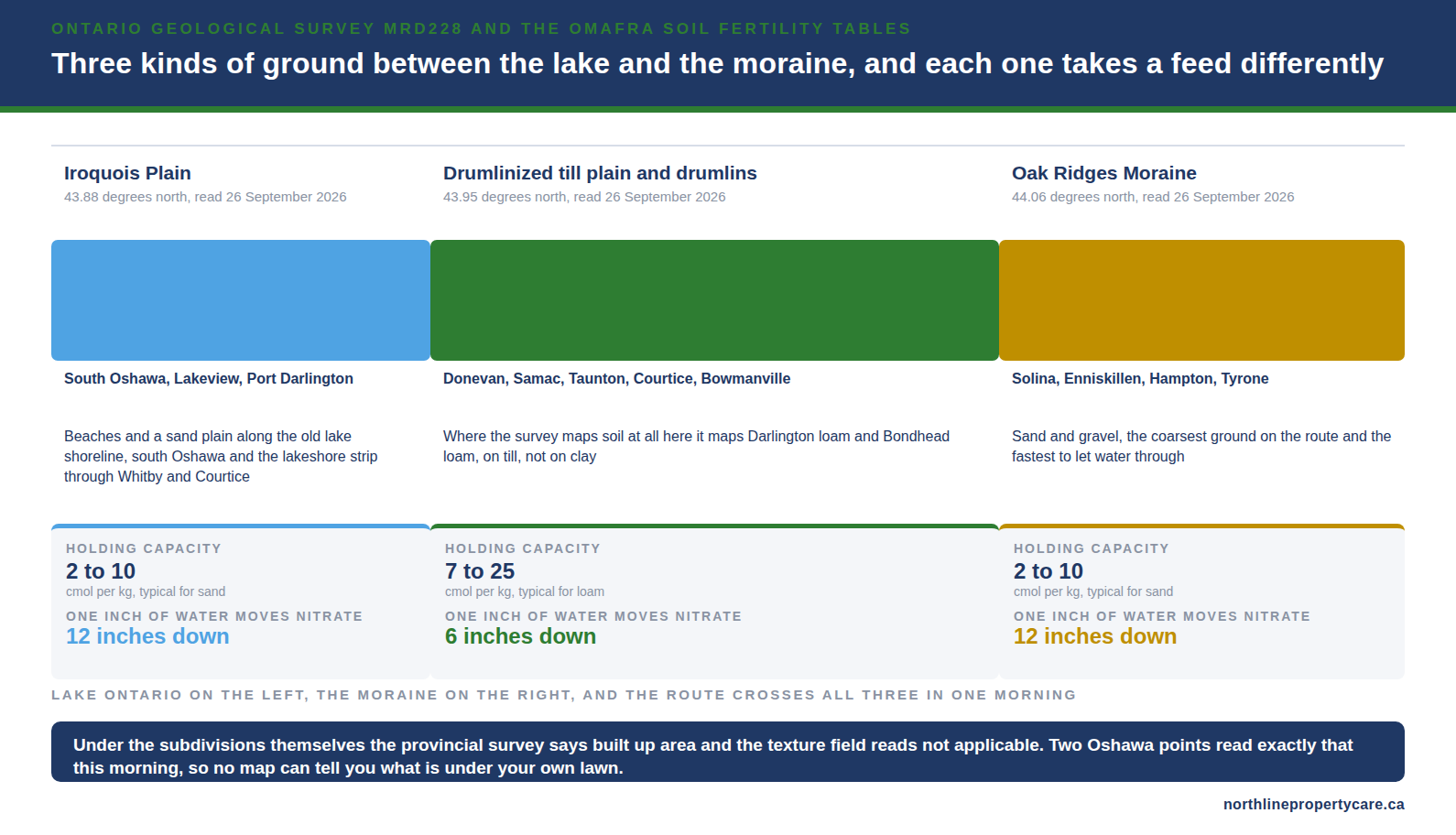
There are three kinds of ground between the lake and the moraine, and the province's own mapping will name all three and then refuse to tell you which one is under your lawn.
Read at a point in south Oshawa, the Ontario Geological Survey's physiography mapping returns the Iroquois Plain, the old glacial lake shoreline, which is where the beach sand and the sand plain polygons sit. Read a little further north it returns drumlins, part of the drumlinized till plain that carries most of the region. Read north of Taunton and it returns the Oak Ridges Moraine, which is sand and gravel and is the coarsest ground on our route. Where the provincial soil survey maps soil around Oshawa at all, the series it names is Darlington loam, a loam texture on till. Not clay.
Then comes the part that no lawn care page in this region admits. Read the same soil layer at two points inside the built up parts of Oshawa and it returns built up area, with the texture field reading not applicable and the drainage field reading not applicable. The survey does not classify the ground under a subdivision, because that ground was stripped, graded and backfilled when the subdivision was built, and whatever the map says about the field next door may have nothing to do with the sixty centimetres under your sod.
The difference is not academic, because it changes the rate and the date. OMAFRA's nitrogen guidance gives the number: one inch of water moving through the soil displaces nitrate about six inches downward in silt loam and silty clay loam, and about twelve inches downward in sandy soil. Twice as far, for the same rain. The OMAFRA soil fertility handbook gives the matching holding capacity figures, with a typical sandy soil at 2 to 10 centimoles of positive charge per kilogram, a loam at 7 to 25 and a clay at 20 to 40. A sand lot in Solina and a till loam lot in Courtice are not the same decision with the same bag.
So on the coarse ground north of Taunton we split the season rate across more passes and we finish earlier, and on the till loam through Donevan, Samac, Courtice and Bowmanville there is more room for error in both directions. And for a homeowner who wants to know which one they have, there are only two honest answers. Cut a plug with a spade and look at it, which takes two minutes and is the first thing we do on any lawn we are asked to quote. Or send a sample away, which Ontario's turf testing page describes precisely: sample a residential lawn to a depth of 10 to 15 centimetres, take at least fifteen cores in a W or M pattern, and repeat every two or three years, through a laboratory accredited by the province. Note that the Ontario phosphorus test uses a sodium bicarbonate extractant, so an Ontario phosphorus number cannot be read against a number produced by an American laboratory using a different method.
Quick release or slow release, and what cold soil does to an organic bag
For the October feed, choose a soluble nitrogen source. For a September feed, either will work.
The reason is microbial and it has a number attached. Cornell's best practice manual explains that ureaform and methylene urea products depend on soil bacteria to release their nitrogen, as do natural organic sources, and that little nitrogen is released from any of them unless soil temperature is above about 10 degrees Celsius. Wisconsin's horticulture program says the same about organic fertilizers and notes that release is slower precisely in spring and fall when soils are cool. So an organic bag spread on an Oshawa lawn on the twentieth of October is not a slow feed. It is a stalled one, waiting for a soil temperature that will not return until April, by which point a winter of drainage has had its turn at it.
Polymer coated urea behaves differently and it is worth knowing why. Penn State describes its release as water moving through the coating and carrying dissolved nitrogen back out by osmosis, a process driven by temperature rather than by a living population, so it slows in cold soil without depending on microbes being awake.
The institutions disagree here too. Ontario states plainly that late fall fertilization with a quick release nitrogen fertilizer is beneficial for home lawns, and Purdue agrees, preferring water soluble sources from October onward. The University of Massachusetts takes the opposite side on disease grounds, recommending slow release forms in autumn to avoid the soft growth that snow mould feeds on. Cornell splits the difference with sources that are not temperature dependent, and adds a rule that maps straight onto the cross section above: at least thirty per cent slow release nitrogen on non sandy soils, at least sixty per cent on sandy ones.
Five ways a fall feed goes wrong on a Durham lawn
- Too early, while the lawn is still growing hard. Ontario warns that this promotes succulent growth going into winter and raises the risk of winter injury. If the mower is still filling a bag every week, wait.
- Too late, onto frozen or snow covered ground. Purdue says not to apply fertilizer during winter or when the soil is frozen, and Minnesota's crop guidance is blunter still: on frozen ground or snow there is an extreme risk of the product running off with the melt, whatever the source. A lawn under snow cannot take anything up.
- Too much in a single pass. Cornell's ceiling is one pound of nitrogen per thousand square feet in any one application. Purdue explains the damage in plain terms, which is that mineral fertilizers are salts and a high salt concentration draws water out of plant cells until they die. Urea carries a salt index of 75.
- Not watered in. Minnesota puts it as a flat rule: always water after applying any fertilizer unless the label says otherwise. Urea in particular loses nitrogen to the air if it is left sitting dry on the surface.
- Left on the hard surface. Every granule on the driveway, the walkway or the road is both wasted and headed for a catch basin. Sweeping the edge back onto the grass takes a minute and is the single cheapest thing on this list.
Snow mould, and the one way a fall feed can cost you a spring
The risk is real, it is about how lush the lawn goes into the winter rather than about fertilizer in general, and in Durham it matters most in a winter with long lasting snow cover.
Penn State lists the same aggravating factor for both diseases that turn up here. Pink snow mould, caused by Microdochium nivale, and grey snow mould, caused by Typhula incarnata, both do more damage to lush turf that has been maintained with high amounts of nitrogen fertilizer, and the control advice in both cases is to use only moderate amounts of nitrogen in the fall and to keep mowing the lawn well into it. The University of Massachusetts is more categorical and says no nitrogen should be applied after the first frost. Their guidance also puts numbers on the snow cover itself: grey snow mould shows up where snow lies for 45 to 60 days, and the speckled form needs 75 to 90.
What nobody has is a dose response curve. The University of Minnesota set out a trial designed to answer exactly this question, with final nitrogen applications in September, October and November and rate treatments alongside, and the disease evaluation had not been published when this page was written. So the link between a late heavy feed and a spring disease problem is the settled opinion of every turf extension service we can find, and not a measured relationship we can show you a number for. That distinction is the difference between an article you can trust and one you cannot.
The practical Durham version is that the bag is only one of three inputs, and the other two are free. Cut the lawn late into the fall and keep the canopy short going into winter, which is where our page on the right mowing height for a Durham lawn explains why 7.5 centimetres is the number we hold through the season and why the last cut of the year is the one exception. Then get the leaves off, because matted leaf cover holds the moisture these fungi need, and our fall cleanup checklist for Durham homeowners works through the order that takes least time.
Why this matters more in Ontario than it would anywhere else
Since 2009 the legal routes to controlling weeds on an Ontario lawn have been narrow, and turf density is the main one left standing.
The cosmetic pesticides ban is a prohibition on pesticides and it does not touch fertilizer. Section 7.1 of the Pesticides Act, as enacted, says that no person shall use or cause or permit the use in, on or over land of a pesticide that has been prescribed for the purpose of that subsection, and a parallel subsection does the same for sale. The word fertilizer does not appear in it. Ontario's homeowner page names 2,4-D, diazinon and glyphosate among the ingredients banned for cosmetic use on lawns, gardens, patios, driveways, parks and schoolyards, and publishes an allowable list carrying things like corn gluten meal, soap and sulphur. A 2020 amendment replaced the old class machinery with that list. Fertilizing a lawn in Oshawa is not restricted by any of it.
Which leaves density, and OMAFRA has put a number on how well density works. Publication 845 reports that weed cover could be reduced to less than five per cent simply by fertilizing with half a kilogram of nitrogen per hundred square metres four times a season for five seasons. Read that sentence twice. Four times a season, for five seasons. It is the most useful figure in this entire article and it is also the least convenient one, because it says the answer to a weedy lawn is a program measured in years rather than a product measured in bags.
The crabgrass mechanism is worth spelling out because it is the one people get backwards. Crabgrass germinates when the top inch of soil reaches roughly 13 degrees Celsius for four or five days running, and it needs light reaching the soil surface to do it. A feed in the middle of October cannot possibly encourage crabgrass, because the crabgrass is already dead and the seed is lying there waiting for May. What the October feed buys is the canopy density that denies that seed its light next spring. The same logic runs through aeration and overseeding in Ontario, which is the other half of building density and which shares the same narrow autumn window.
The City of Oshawa gives residents the same advice from the other direction, telling them that lawns need one inch of water a week including rain, that keeping the cut between two and a half and three inches holds weed growth back, and that overseeding with the right grass type keeps a lawn thick. That is a municipality describing a weed control program with no pesticide in it, which is what the law now requires of everybody.
What we charge for this, and when we would tell you not to buy it
Our fertilizer program is $300 to $600 a season depending on the lawn, it is bought separately, and it is included only on the Platinum membership. It is not part of the weekly lawn visit and we never describe it as though it were, because a service somebody has not bought does not belong in a description of one they have.
Now the part that costs us the sale. If there is a suitable bag sitting in your garage and it is the first half of October, put it down yourself. Fifteen minutes with a spreader is not work worth paying a contractor for, and we would rather have your driveway in January than your fall feed in October. What the program actually buys is somebody choosing the date off the weather instead of the calendar, splitting the rate on a sand lot up on the moraine, measuring the turf area rather than guessing it, and declining to invoice a November application that the research does not support. If that is not worth $300 to you this year, it is not worth $300 to you this year.
If you are spending on one thing this month, spend it in this order. A soil test from an accredited Ontario laboratory first, because it is the cheapest instrument in this whole article and it answers the phosphorus question permanently. Core aeration second, at $110 to $220 depending on the lawn. Fertilizer third. And if the soil itself is the problem rather than the feeding, the full lawn restoration is $600 for a small lawn, $850 for a medium and $1,250 for a large, plus HST, and its season closes on October 10. Selling a restoration to a lawn whose only real trouble is compaction is how a contractor loses the next three years of that property, so the quote is always the cheapest answer that actually solves it.
The other half of the year is the reason most people find this page. Memberships start at $129 a month plus HST for Silver, which covers the lawn season and the winter walkway but does not plow the driveway and has no morning target. Gold is $189 a month plus HST, which adds the plowed driveway and a 7 AM target after overnight snow at the 3 centimetre residential trigger. If you want winter only, the seasonal snow package is $800 for a small driveway, $975 for a standard one and $1,200 for a large one, plus HST, with no separate charge after each storm, and the booking deadline is November 1. Details are on the memberships page and the weekly lawn care page, and the one off prices live on add-ons.
What we could not verify
Every figure above came from a government body, a university extension service, a regulator or a peer reviewed journal. Not one came from a competitor, a garden centre or a fertilizer brand. Below is what this page looked for and could not obtain. An article that prints only its findings is hiding half of its own method.
- Environment and Climate Change Canada's climate normals for the Oshawa station could not be opened from here today, so this page publishes no frost date and no monthly average temperature for Oshawa. That is why the trigger above is a reading you take rather than a date we derived.
- No government or university source publishes routine October and November soil temperature for Durham Region. Anyone quoting one for this area is quoting something we could not find.
- OMAFRA Publication 384 holds the interpretation bands for turf phosphorus and potassium and we could not obtain it, so this page names the test, the depth and the method and prints no breakpoints.
- There is no Ontario or Canadian field trial of fall nitrogen timing against nitrate leaching that we could locate. Everything quantitative on that question is from New England or the upper Midwest.
- There is no published trial measuring fall nitrogen rate against snow mould severity on a home lawn. The link is extension consensus rather than a curve.
- The share of Durham lawns sitting on each soil texture. Two separate reads of the same provincial soil layer returned different polygon sets on the same morning, so this page names the soil series and the physiographic regions that both reads agreed on and publishes no percentage.
Questions we get asked
When should you put fall fertilizer on a lawn in Oshawa?
Feed it when the lawn has stopped growing but is still green, which in Oshawa is usually the second or third week of October. The Government of Ontario publishes that same trigger and puts it at mid to late October. Cornell gives a reading you can take yourself: air temperatures under 10 degrees Celsius for ten days, and soil that is not frozen. If you have gone two weeks without needing to cut and the grass is still green, you are standing in the window.
What is the best lawn fertilizer for fall in Ontario?
The one whose first number gives you half a kilogram of actual nitrogen for every hundred square metres of lawn, with little or no phosphorus unless a soil test asked for it. For the October feed a soluble nitrogen source is the better choice, because the microbes that release an organic or ureaform product need soil above about 10 degrees Celsius and Oshawa soil is past that by then. Brand is the least important part of the decision.
How late in the fall can I fertilize my lawn in Durham Region?
Later than mid October and you are paying for nitrogen the lawn has been shown not to use. A lysimeter study that tested September 15, October 15, November 15 and December 15 found no difference in colour or density between the October and December applications, while the nitrate draining past the roots rose with every later date. Ontario stops publishing a window after late October, Purdue says put the spreader away once Halloween has gone, and Cornell says flatly not to apply in November or later.
What is the difference between fall fertilizer and winterizer?
Mostly the word on the bag. A winterizer usually carries more potassium, and potassium is the part of that bag with the least evidence behind it for a home lawn. University research has found potassium increasing snow mould severity on golf turf and has not shown a winter survival benefit on the grasses in an Oshawa front lawn. The nitrogen is doing the work in both bags, so if you already own a winterizer, use it and do not buy a second product.
Does an established Oshawa lawn need the middle number, the phosphorus?
Usually not. Minnesota, Cornell, Purdue and Rutgers all say an established lawn shows little response to added phosphorus and that none should go down without a soil test. Ontario is the local exception and recommends a four to one to two ratio where no soil test has been done, on the same page where it says testing is how phosphorus and potassium are decided. A soil test from an accredited Ontario laboratory settles it, and nothing else does.
Can I just sprinkle fertilizer on top of the soil?
You can spread it on the surface, which is how every granular lawn product is designed to go down, but water it in afterwards unless the label says otherwise. Minnesota puts that as a flat rule to prevent burning, and urea in particular loses nitrogen to the air if it sits dry. Sweep any granules off the driveway and the sidewalk before you leave, because those are the ones that reach a catch basin rather than a root.
Is it worth feeding if I am about to stop mowing for the year?
That is exactly the moment it is worth it. The whole reason a fall feed works is that leaf growth stops before root growth does, so the nitrogen goes into roots, rhizomes and stored sugars instead of into clippings you have to cut. It is worth saying that the peer reviewed literature is less certain about this than the extension pages are, and the strongest review of it found the colour response well supported and the rest of the claims thin.
What does a fall fertilizer program cost in Oshawa?
Our fertilizer program is $300 to $600 a season depending on the lawn, it is bought separately from the weekly cut, and it is included only on Platinum. If you already own a suitable bag and it is the first half of October, put it down yourself and keep the money. What the program buys is somebody choosing the date off the weather rather than the calendar, splitting the rate on a sand lot, and declining to invoice a November application that the research does not support.
Who wrote this
Andrew owns and runs Northline Property Care, owner operated out of Oshawa, covering Oshawa, Whitby, Ajax, Pickering, Bowmanville, Courtice and Clarington. Six winters clearing snow in Durham Region, which is his own experience and not a claim about the company, since Northline registered in August 2026 and has not yet run a full season under this name.
The habit behind this article is a spade. On any lawn we are asked to quote, the first thing that happens is a plug gets cut and looked at, and the homeowner gets shown it. That is how you find out whether you are standing on Darlington loam, on moraine sand, or on whatever the builder left behind, and it is the reason this page spends so long on a soil layer that most lawn care writing treats as a decorative adjective.
Read next
The last cut, and when it is
The feed and the final mow land within about a week of each other on most Durham lawns, and the page works through the height, the timing and what happens if the mower goes away too soon.
Read the last cut guide →Aeration and overseeding
The other half of building the density that does the weed control now that spraying is not an option, and the one pairing in autumn lawn care that genuinely has a deadline attached to it.
See the autumn window →The fall cleanup order
Matted leaves hold the moisture that snow mould needs, so getting them off is part of the same job as the last feed. This is the order that takes the least time on a Durham property.
Work the checklist →The work, photographed
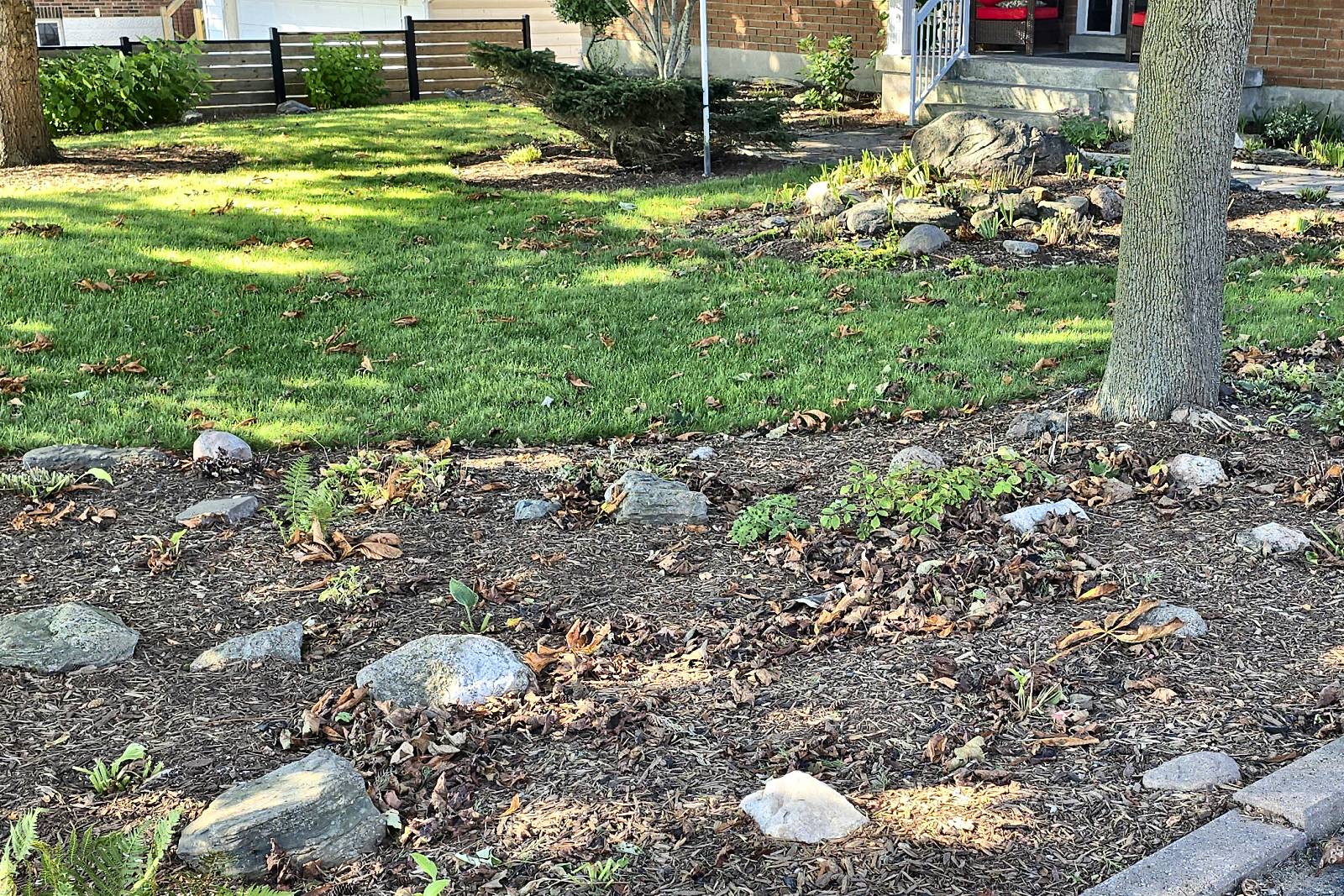
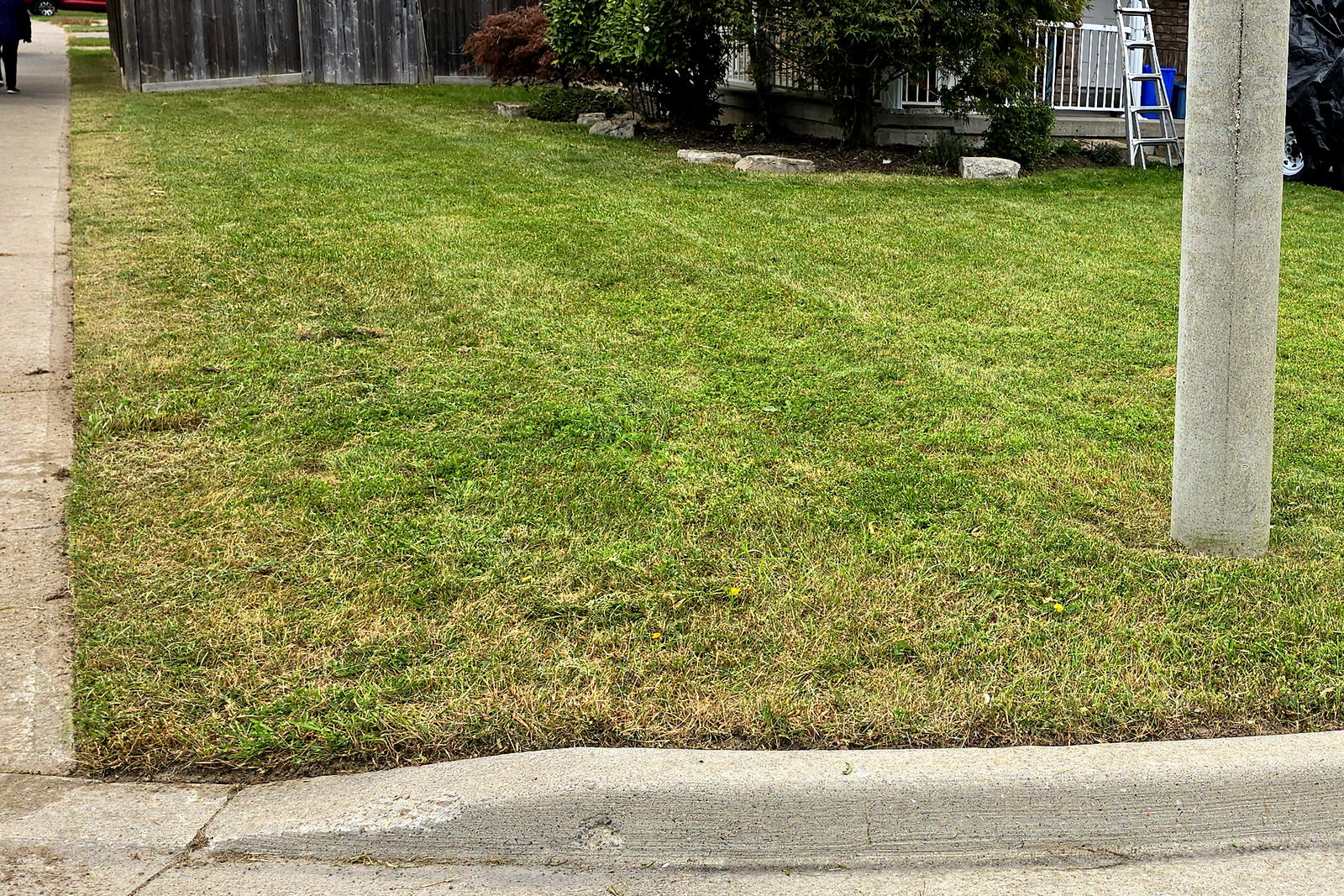
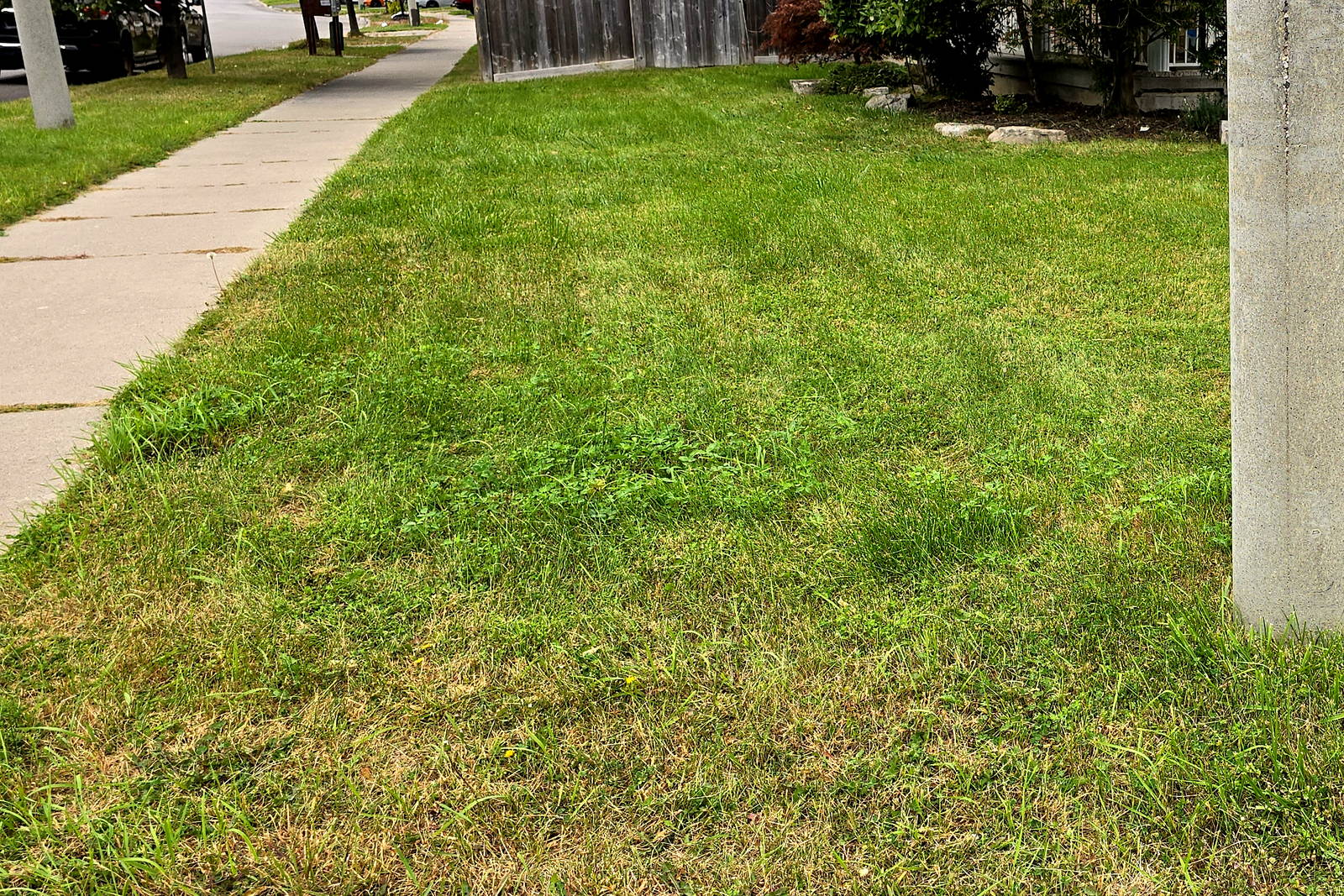
Real Northline properties, before and after, every one of them in Oshawa and every one of them this year. Drag the line to compare.
Andrew answers, October 2026
Is the fertilizer included?
No, and I would rather say so here than have you find out in May. The five step fertilizer program is a paid add on at $300 to $600 a season, and it is included only on Platinum. The weekly visit is the cut, the trim and the blow down. Anybody describing a weekly lawn service as including a fertilizer program is selling you something nobody has bought.
One of these goes on each page and it is replaced monthly. If the question you have is not here, ask it: 905-244-5779.
Get the date right on your own lawn
Send me the address and I will tell you what the turf area actually measures, which of the three kinds of ground you are standing on, and whether the feed is worth buying this year at all. If the honest answer is a bag from the hardware store and fifteen minutes of your own time, I will say so.