Lawn care · Fall
Aeration and Overseeding in Ontario: the September Window
Aeration and overseeding in Ontario are two operations with two different seasons, and September is named as the window because of the seed half rather than the aeration half. The distinction is what decides whether you have missed it.
Aeration runs every year on Platinum and is an add-on on any membership. See the one-off prices.
Green in summer. Clear in winter.
The short answer
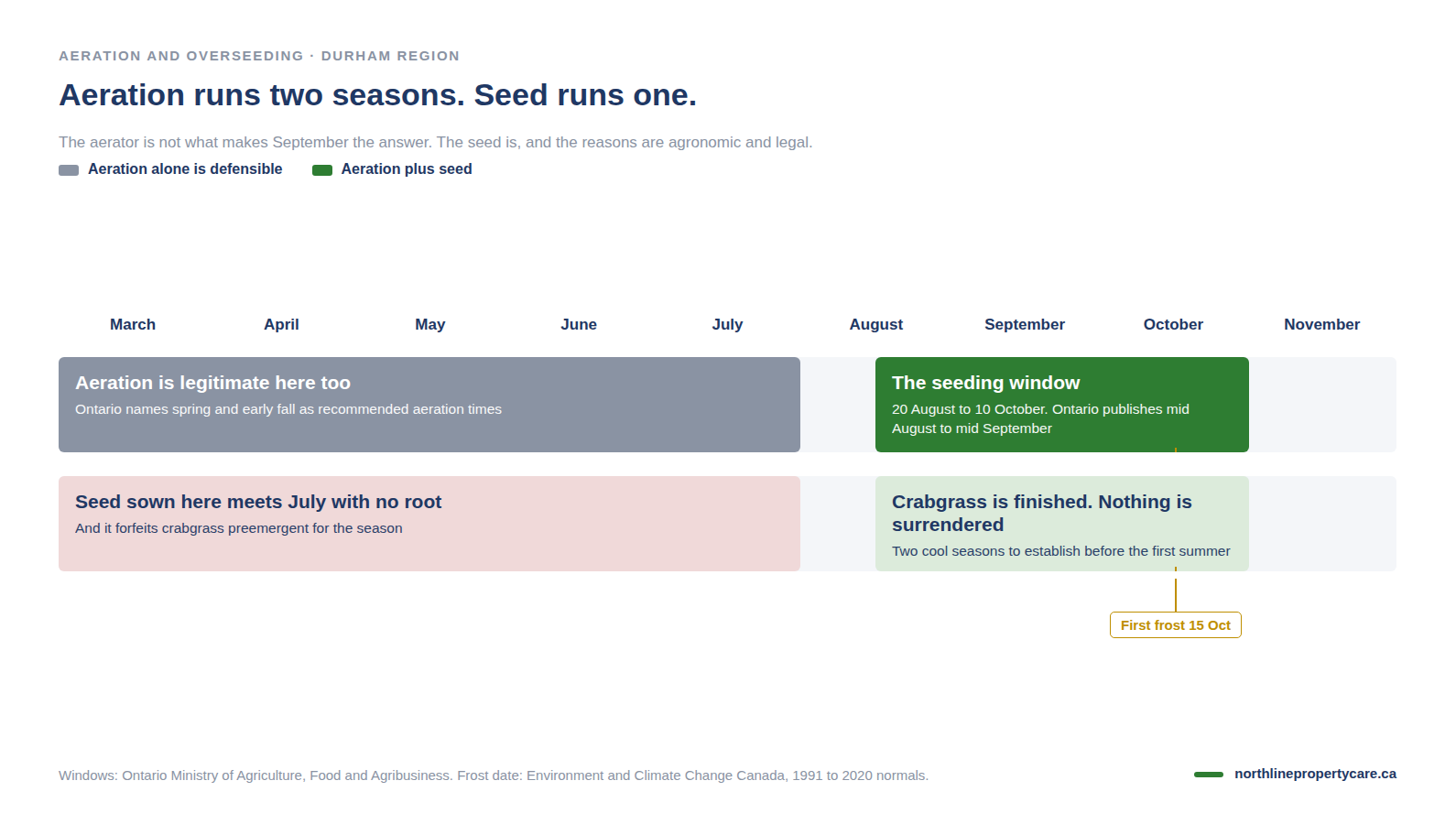
Overseed between August 20 and October 10, and treat the first three weeks of September as the middle of that range rather than the whole of it. Aerate at the same time, because the holes are where the seed needs to land. Ontario's agriculture ministry publishes mid August to mid September as the establishment window for southern Ontario, and every week you wait past it costs the lawn more than a week.
We had this wrong, and here is the correction
This page used to say that spring aeration is close to a waste of money. That sentence is not supportable and it has been removed.
Ontario's own guidance says the opposite in plain words: spring and early fall are the recommended times to aerate. The province's turf manual, Publication 845, goes further and tells you to aerate at least twice a year to reduce compaction, improve infiltration and break down thatch. Purdue's turf program names April alongside September. Three sources, none of them ours, and all three contradict the sentence we had published.
So here is the narrower claim, which is the one that survives contact with the evidence. Spring aeration is fine. Spring aeration paired with seed is the combination that fails. The aerator is not the problem. The seed is, and the two reasons are below.
We are leaving this correction on the page rather than quietly deleting the old line, because a business that only ever publishes the version of a fact that suits it is not worth reading. If you have been told by anybody, including us, that aerating in April is pointless, that was wrong.
What is actually under a Durham lawn
Start with the ground, because the ground is what makes this a local question rather than a general one.
The mapping was done in 1949 and 1950 and published as Report No. 23 of the Ontario Soil Survey, which is still the government's own soil record for what is now Oshawa, Whitby and Pickering. Read the profiles rather than the summary and the picture is specific.
The Darlington series, named for the township that is now Courtice and Bowmanville, is mapped across 20,700 acres of Whitby and Pickering. Its surface is a very friable loam. Its B horizon, from fifteen to twenty three inches down, is a dark brown clay loam of plastic consistency. The Peel series carries a clay loam at the surface and a plastic clay beneath it. Bondhead, the largest series in the county at 75,400 acres, is loam and sandy loam over a clay loam B horizon, though in fairness to the survey that one is described as friable rather than plastic, and we are not going to pretend otherwise.
Plastic consistency is not a figure of speech. It is a soil mechanics term, and it means the material deforms and holds the new shape instead of springing back or crumbling. That is the layer a core aerator is trying to reach, and it is also the layer that seals shut if you work it wet.
New subdivisions are worse than old ones and not better. The topsoil comes off for construction, the subsoil gets graded and driven over by machinery for months, and a thin layer of screened soil goes back down before the sod arrives. That is why a lawn in Windfields or Kedron can be fed and watered correctly for five years and still look thin. The feeding is not the problem. Nothing is getting down.
What core aeration does, with the published numbers
Core aeration removes material. That is the entire distinction and everything else follows from it.
Ontario specifies the tool: a hollow steel tine core aerator, with tines one to two centimetres in diameter set ten to fifteen centimetres apart. The same page makes a point worth repeating to anyone who thinks compaction is a farm problem: foot traffic alone compacts the first two to three centimetres of the root zone. Not a tractor. Feet.
Purdue publishes the density that makes the operation worth doing. Penetration should be two to three inches deep, at twenty to forty holes per square foot, and the bulletin says plainly that multiple passes will be needed to achieve it. One pass does not. Rutgers gives the core dimensions you should see lying on the grass afterwards: half an inch to three quarters of an inch across, three to four inches long. If what comes out of your lawn is shorter than that, the tines did not reach the layer that matters.
There is also a useful rule of thumb from Purdue on how much of a surface a real program touches: about twenty per cent of the entire area, annually. That number is what tells you whether a single lazy pass with a rented machine was a service or a gesture.
Leave the cores. Cornell's turfgrass program says to let them dry and then rake them apart across the lawn, and Purdue says the simplest approach is to leave them and let mowing and rain take them back in. They look untidy for about ten days. Bagging them is the commonest way to throw away half of what you just paid for.
Here is the honest limit of what we can tell you. We could not find a single university extension source publishing a measured change in soil bulk density or infiltration rate from core aerating a home lawn. Hole counts, core dimensions and mechanism are published. A before and after number is not. Anyone quoting you a percentage improvement in drainage is quoting something they did not measure.
Why the seed decides the date, and why April loses
Two reasons, and the second one is legal rather than agricultural.
The first reason is that a spring seedling meets July with no root
Penn State puts it in one sentence: a late summer seeding gets two cool growing seasons, fall and then spring, to establish, where a spring seeding runs straight into the heat and drought of summer. Purdue's bulletin on spring seeding opens by saying that seeding in spring is very difficult and often unsuccessful, which is not hedged language for a land grant university.
The timing penalty inside the good window is worth knowing too, because it is the reason we will not book restorations into late October. Purdue measured it: waiting one week later to seed can mean the turf takes two additional weeks to mature, because germination and everything after it slows as the season closes. Nebraska's extension service puts the same effect at two to four extra weeks per week of delay. September is not a preference. It is compound interest running the wrong way.
The second reason is that spring seeding forfeits the only weed control you have left
Ontario bans the cosmetic use of pesticides on lawns. Read the structure of the ban rather than the headline and it is tighter than most people realize. Section 7.1 of the Pesticides Act is a permission list, not a prohibition list: nothing may be used on land for a cosmetic purpose unless the Director has determined it appropriate and added it to a document called the List of Active Ingredients Authorized for Cosmetic Uses. The exceptions in subsection 2 cover golf courses, agriculture, forestry and public health. A residential lawn is in none of them. And subsection 5 makes any municipal by-law on the subject inoperative, so there is no local workaround either.
One more thing that is out of date almost everywhere it appears: the old Class 7 to Class 11 system has been eliminated. Ontario now runs Classes A to E aligned to the federal designations, plus that single Allowable List. If a page you are reading still talks about Class 11 lower risk products, it has not been updated since 2020.
So density is the weed control. Seed is how you buy density. And here is where spring seeding cuts its own throat: Purdue states that you must avoid preemergent crabgrass control at the time of a spring seeding, and that siduron is the only preemergent usable on a new seeding, holding crabgrass for three or four weeks. Minnesota says the same thing more bluntly, that preemergents are not to be applied where turf has recently been seeded.
Crabgrass germinates when soil warms, and the published threshold is not as settled as the internet suggests. Purdue says approximately 60 F for three to five days at the quarter inch level. Minnesota says about 55 F with no depth given. Nebraska says 55 F at four inches. Three universities, three numbers, and if anyone quotes you one of them as the figure they have not read the other two.
What is not in dispute is the shape of it. A spring seeding either surrenders crabgrass control for the season or buys three or four weeks of it. A September seeding surrenders nothing, because crabgrass is finished for the year.
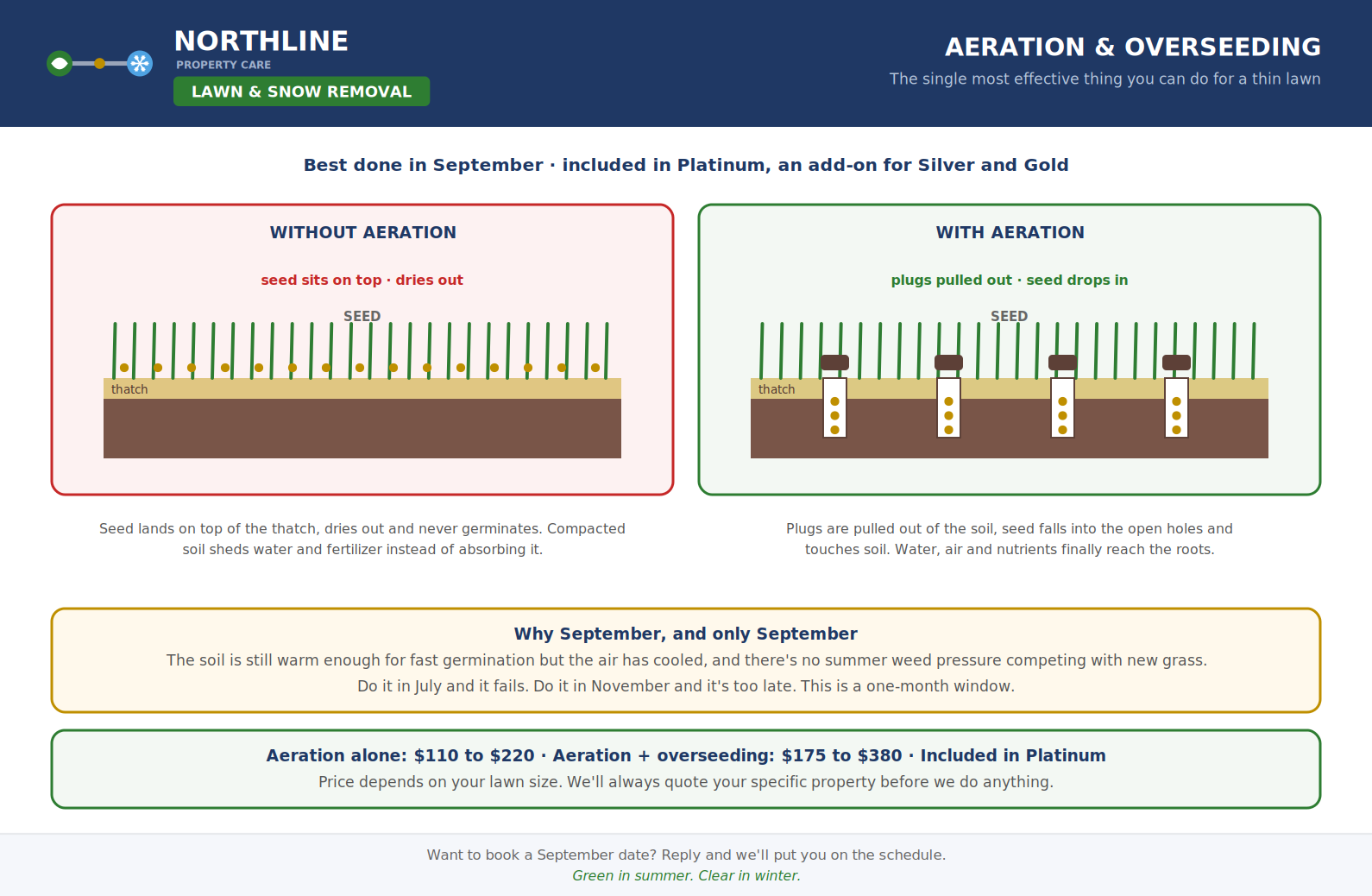
What aeration does, in one picture
What is actually in the seed bag, and how loose Canadian law is about it
This is the section we would most like you to read, because it costs nothing to act on and it decides more of the outcome than the machine does.
The Canadian Food Inspection Agency sets grade standards for lawn seed under the Seeds Regulations. A bag graded Canada No. 1 Lawn Grass Mixture must contain a minimum of 85 per cent pure seed by weight, with a maximum of 15 per cent inert matter. Read that twice. Up to fifteen per cent of a legally top graded bag is permitted to be something that is not seed.
The reason that standard is written down at all is better than the standard. CFIA published an advisory because companies were bulking lawn mixtures with ground peanut shells and ground corn cobs. The agency's position is that such a product is a specialty seed and has to be labelled to show the approximate percentage or net quantity of actual seed in it.
There is a second gap worth knowing. Under section 29 of the Seeds Regulations, the label on a ground cover mixture must name each kind or species that makes up five per cent or more by weight. Anything under five per cent need not be named at all. A species listed as a noxious or restricted weed under provincial law must be declared at any percentage, which is the part of the rule doing real work.
Against that legal floor, set the quality benchmarks the universities publish for reading a tag. Purdue and Minnesota give an identical list: purity above 90 per cent, germination above 85 per cent, weed seed below 0.3 per cent, other crop below 0.5 per cent, inert matter below 8 per cent, no noxious weeds, and a test date within the last nine months.
Eight per cent is the quality bar. Fifteen per cent is the legal ceiling. That gap is the single most useful thing on this page, and checking it takes you about twenty seconds in the aisle.
How much seed, in the units the bag uses
Ontario publishes rates in metric for a new lawn, and they are the only Canadian government figures on this we could find.
| Species | New lawn, per 100 square metres | Overseeding an existing lawn |
|---|---|---|
| Kentucky bluegrass | 0.5 to 1.0 kg | Double the new lawn rate |
| Fine fescues | 1.0 to 3.0 kg | Double the new lawn rate |
| Perennial ryegrass | 2.0 to 4.0 kg | Double the new lawn rate |
| Tall fescue | 2.0 to 3.0 kg | Double the new lawn rate |
Source: Ontario's lawn establishment guidance, with the doubling rule from the province's lawn maintenance page.
Flagging one conflict so you are not caught out by it. Nebraska's extension service says the opposite for overseeding and halves the rate, on the reasoning that you are filling gaps in an existing stand rather than building one. Both positions are defensible. We use the Ontario rule because this is Ontario and because a thin overseeding on clay is the failure we see more often than a wasted bag.
Germination speed differs by species and it matters when you are deciding whether the job failed. Perennial ryegrass and tall fescue come up in roughly five to nine days. Fine fescues take five to twelve. Kentucky bluegrass is the slow one, and Purdue's own cultivar trial measured days to fifty per cent germination ranging from about eight days to nearly fourteen. A bluegrass lawn that looks bare on day ten has not failed. It is being bluegrass.
Thatch: measure it before anyone sells you a machine for it
Thatch is the brown spongy layer between the green growth and the soil. It is not clippings, and the myth that it is clippings is the most durable falsehood in this trade.
We have since written the measurement up on its own, with the three published thresholds set against each other and the provincial soil mapping behind them, in dethatching a lawn in Oshawa. The short version is that most lawns here come in under the line and should be left alone.
Ontario says clippings contain nutrients and water, break down rapidly and do not contribute significantly to thatch. Wisconsin's extension service says that despite widespread belief, returned clippings do not cause thatch. Cornell says the same. Three independent sources, one answer.
How to measure it takes a knife and a minute. Minnesota publishes the method: remove a two inch deep, pie shaped wedge from the lawn and measure the layer between the soil surface and the green growth.
Then a number, and the sources genuinely disagree, so we will give you both rather than pick the one that sells more work. Ontario says more than 2.5 cm of thatch is too much. Minnesota, Purdue, Ohio State and Wisconsin all set the threshold at half an inch, about 1.3 cm. Cornell is the outlier in the other direction and puts it near a full inch. We work to the half inch figure because four university programs agree on it, and we say plainly that Ontario's own ministry publishes a number twice as permissive.
And a second correction to something this business has said before. We have described clay soils as compacting rather than building thatch. That is not what the research says. Wisconsin lists high clay content, excessive moisture, alkaline pH and compaction together as the conditions that favour thatch and suppress the microbes that break it down. Minnesota says compacted and poorly drained soils accumulate thatch faster, not slower.
The corrected version is more useful anyway: on Durham's clay loam subsoils, compaction and thatch arrive together, and core aeration is the one operation that addresses both at once. Wisconsin makes exactly that point, calling core aerification the better recommendation because it degrades thatch and corrects the soil conditions that cause it.
The watering, which is the part we do not control
Every quote we write for this work carries the same sentence, and it is not a disclaimer. The result depends on the watering, and we are not there to do the watering.
Purdue publishes the regime: irrigate a newly seeded lawn two to four times daily depending on the weather, keeping the top half inch to one inch moist, for the first two or three weeks. Nebraska publishes near identical numbers independently, which is the kind of agreement worth noticing. Cornell adds the warning that matters on a slope: water only enough to keep the surface damp, because overwatering moves seed off site with the soil.
After germination you taper. Ontario's guidance for established turf is to wait until the lawn wilts and then wet the whole area to a depth of ten to twenty centimetres, which works out to roughly 2.5 to 4 cm of water caught in a tin.
We leave the schedule written down with the customer, on paper, because the one factor that decides the outcome is the one factor that is not ours.
Topdressing with compost, and what the research actually found
We topdress seed with about a quarter inch of screened compost as part of a full restoration, and we are going to be straight with you about the evidence for it.
There is no university research we could find that measures compost topdressing at seeding and reports a germination or survival benefit. None. What Penn State has actually published on compost at establishment runs the other way: a spent mushroom compost with a high soluble salt content was incorporated into a clay loam and produced no noticeable seedling inhibition, and a poultry manure compost at pH 9.1 did inhibit seedlings through high pH and ammonia toxicity.
So the honest position is this. Compost holds moisture at the surface, and moisture at the surface is what a seedling dies without, which is why it is in our package. We are not going to dress that up as a measured result, and the practical lesson from the Penn State work is that what the compost is matters more than whether there is compost.
Ontario does publish a rate, which is useful: spread topsoil or compost over an overseeded area at 0.5 cubic metres per 100 square metres.
It sits inside the restoration price rather than beside it as an upcharge. A caveat with a paid mitigation next to it reads as an upsell. A caveat with the mitigation already bought is the only version anyone believes.
Three tests that tell you whether your lawn needs this at all
Rutgers publishes the best one and it uses a piece of wire.
- The wire test. Push a length of stiff wire into the ground. If it goes in twelve inches or more, the soil is not compacted and is in good condition. If it starts bending at less than four inches, Rutgers calls the condition poor and compacted. That is a published threshold, not a rule of thumb, and it is in their fact sheet on assessing soil compaction.
- The runoff test. Water the lawn and watch where it goes. If it pools or runs to the curb before soaking in, the surface is sealed. Cornell suggests digging into the spots where water puddles and drains slowly, which is the same test with a shovel.
- The history test. If the house is under fifteen years old, or the lawn takes vehicle, trailer or heavy foot traffic, assume compaction. Ontario's own note that foot traffic alone compacts the top two to three centimetres is the reason this test is not as lazy as it sounds.
What it costs, and how to buy the cheapest version that works
Three products, three prices, and the right answer is whichever one solves the problem your lawn actually has.
| What the lawn is | What to buy | Medium lawn, plus HST |
|---|---|---|
| Thick on top, but compacted underneath | Core aeration alone | $110 |
| Thin, with sound soil under it | Aeration plus overseed | $260 |
| The soil itself is the problem: tired, mossy, compacted | The Full Lawn Restoration, six steps in one day | $850 |
Core aeration on its own runs $110 to $220 depending on lot size. The Full Lawn Restoration is $600 for a small lawn, $850 for a medium one and $1,250 for a large one, and the size is the measured lawn area, never the lot size. A quarter acre lot carrying a house, a driveway, a deck and two beds is a small lawn, and quoting off the lot is how a small job gets billed large.
Quoting a restoration on a lawn that needs aeration alone is the fastest way to lose a customer who later finds out. If your lawn is thick and simply hard underfoot, buy the $110 job and keep the other $740. In an owner operated business in a town this size, the person who finds out tells the street.
Aeration and overseeding are included every year on Platinum. Where the driveway also needs clearing after every storm, that is Gold at $189 a month plus HST, $213.57 on the card, or Platinum at $279. Silver does not clear the driveway and never has.
Questions people actually ask
Is spike aeration as good as core aeration?
No. A spike pushes soil sideways and compresses the wall of the hole it just made, which on a clay loam adds compaction rather than relieving it. Core aeration removes material and leaves a real void. Ontario's guidance specifies a hollow steel tine that takes cores out of the ground, and the aerator sandals sold online are the spike version of the job.
Should I rake up the plugs afterwards?
No, leave them where they fall. Cornell tells homeowners to let the cores dry and then break them up across the lawn, because returning that soil to the surface is part of what you paid for. They look untidy for about ten days and then they are gone.
Can I overseed without aerating first?
You can, and most of the seed will sit on thatch and die. Seed that reaches soil grows and seed that lands on a dry mat does not, which is the whole reason the two operations are sold as one job. If you are only going to do one, aeration alone still returns more than seed alone.
What if I miss September entirely?
Dormant seeding in late November is a real fallback. You sow onto cold ground, nothing germinates, and the winter freeze and thaw works the seed into the surface for a spring start. Less reliable than September, and still a better bet than seeding in May.
How often does a Durham lawn need aerating?
Ontario's turf guidance says at least twice a year on heavily used surfaces, and once a year is the sensible residential figure on these clay loam subsoils. On an older lawn with good structure and no vehicle traffic, every second year is enough. Use the wire test rather than a calendar.
Does aeration fix a lawn full of weeds?
Not on its own, and this is where the pesticide ban bites. Aeration plus seed buys density, density is what crowds weeds out, and that is a two to three season project rather than a Saturday. Anybody promising you a weed free lawn from one visit is either breaking the law or not telling you what is in the tank.
Who wrote this
Andrew owns Northline Property Care and pulls the aerator himself. Owner operated out of north Oshawa, working the seven Durham towns on a fixed local route, fully insured and registered for HST. The machine comes off the trailer in the first week of September because that is the one week the calendar and the soil agree. He quotes the lawn and then kneels on it afterwards with a core in his hand. Behind him sit six winters of snow clearing in Durham Region, which is his time on the job and not the age of the business.
Every number above traces back to a ministry, an agency or a university turf program. None of it traces to a competitor price page, and each source carries its link so you can read the document instead of trusting the summary.
Three more things worth reading before October
The fall jobs, ranked by what they are actually worth
Nine jobs, the two that decide next May, and the leaf collection dates the Region publishes every autumn.
Read the checklist →Cutting height as weed control
A Purdue field trial measured crabgrass cover at three cutting heights. One of the three is the height we mow at.
Read the evidence →The six step restoration, in order
Cut, dethatch where it measures, aerate, overseed, topdress, feed. The order is the product, and the dethatch pass is gated by a ruler.
See the service →Before you seed, find out what ate the last lot
Seeding into a lawn that still has a live grub count under it is paying for seedlings that are about to be eaten. The count takes four minutes and it decides whether September or April is the right month.
Read the grub guide →The feed that follows the aeration
Holes in the ground and seed in the holes are half the job. The nitrogen that goes down two weeks later is what carries the new plants into April, and its window is narrower than the aeration window.
Read the feeding guide →The work, photographed
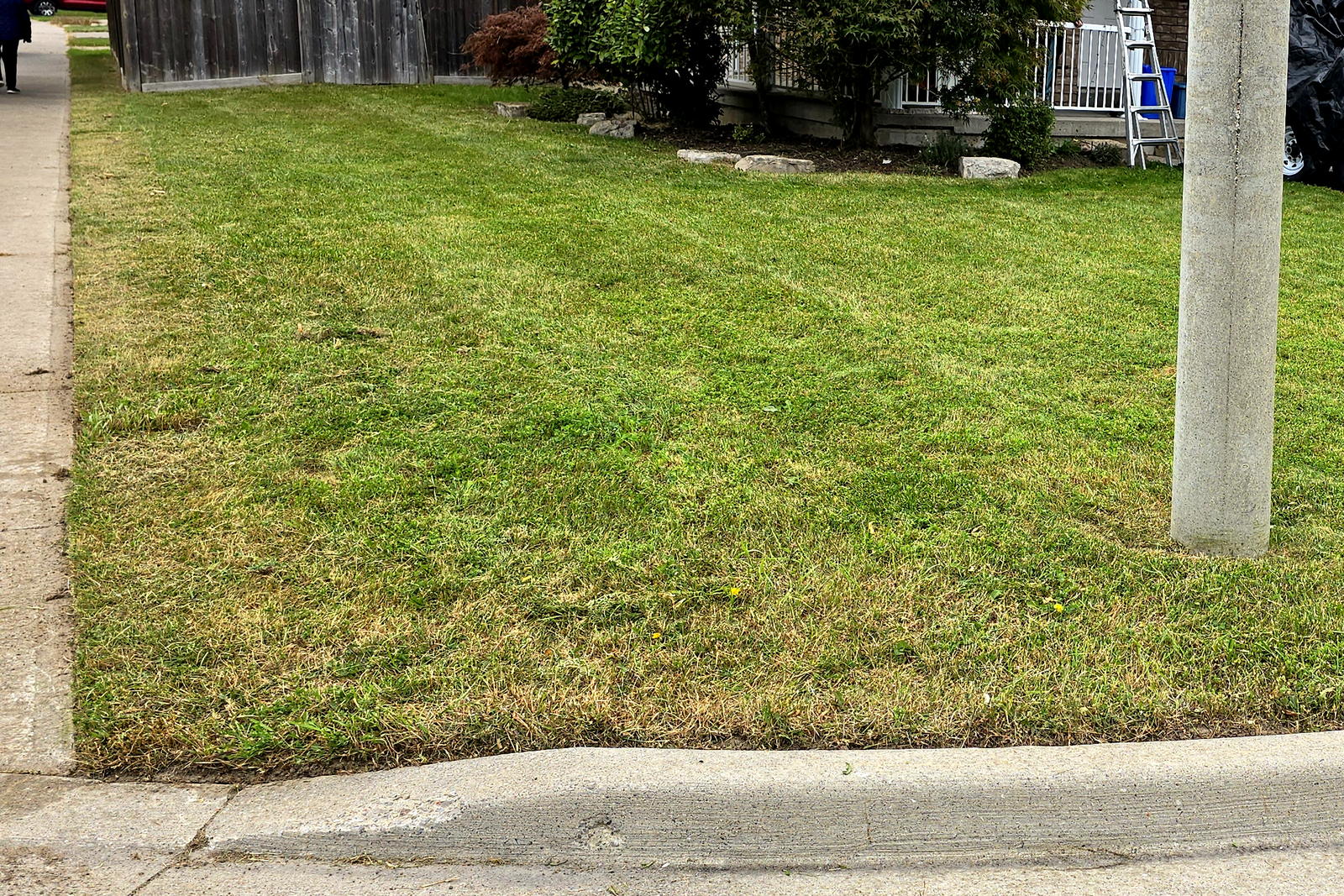
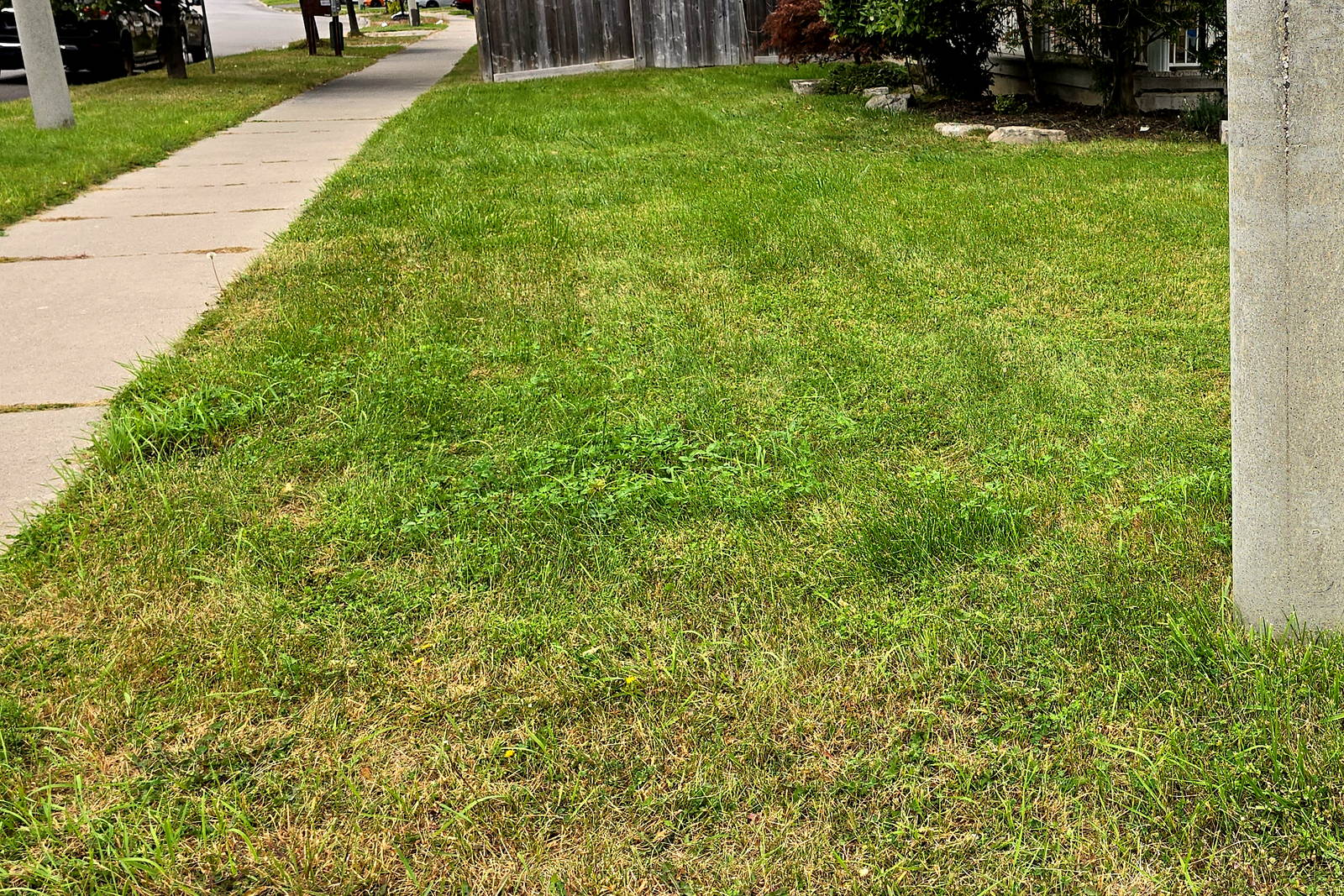
Real Northline properties, before and after, every one of them in Oshawa and every one of them this year. Drag the line to compare.
Andrew answers, October 2026
Is the fertilizer included?
No, and I would rather say so here than have you find out in May. The five step fertilizer program is a paid add on at $300 to $600 a season, and it is included only on Platinum. The weekly visit is the cut, the trim and the blow down. Anybody describing a weekly lawn service as including a fertilizer program is selling you something nobody has bought.
One of these goes on each page and it is replaced monthly. If the question you have is not here, ask it: 905-244-5779.
Book the September window before it closes
The aeration and overseed slot runs on the same eight weeks as the winter route sequencing, so both get settled in one conversation. Tell me the street and the rough square footage and I will send you the September figure the same day.