Lawn care · Season long
The Right Mowing Height for a Durham Region Lawn
The right mowing height for a Durham Region lawn is 7.5 cm, and that is not a house preference: it is one of the three treatments in a published Purdue field trial, and the trial measured what grows in the other two.
Every weekly visit on every membership is cut to this height. See what a weekly visit covers.
Green in summer. Clear in winter.
The short answer
Set the deck to 7.5 cm, which is three inches, and leave it there from April to November. Cut before the grass reaches 11 cm, because that is where the one third rule puts the trigger. Do not raise it in July and do not drop it in May. In Durham the strictest municipal height limit is 15 cm, so a lawn held at 7.5 cm and cut at 11 cm sits four centimetres inside the law all season without anybody having to think about it.
The field trial, and it measured exactly the height we mow at
Most writing about cutting height is assertion. This is not.
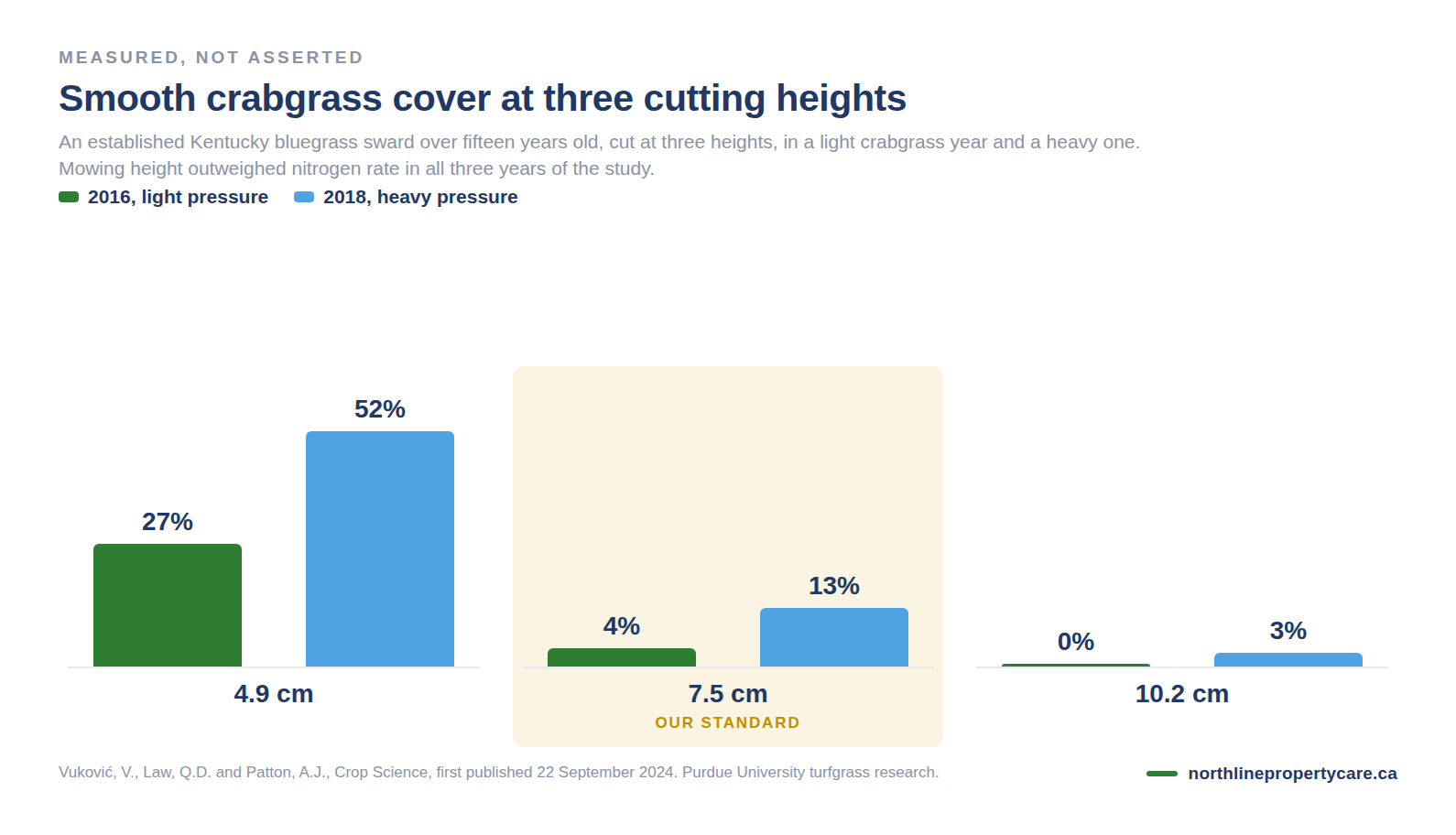
Researchers at Purdue's turfgrass centre ran a Kentucky bluegrass sward, over fifteen years old, at three mowing heights across several seasons and counted what grew in it. The heights were 4.9 cm, 7.5 cm and 10.2 cm. The paper is Vuković, Law and Patton, published in Crop Science in September 2024. Here is what they measured.
| Season | Cut at 4.9 cm | Cut at 7.5 cm | Cut at 10.2 cm |
|---|---|---|---|
| 2016, smooth crabgrass cover | 27% | 4% | 0% |
| 2018, heavier crabgrass pressure | 52% | 13% | 3% |
Two things are worth pulling out of that table.
First, the jump from 4.9 cm to 7.5 cm captures most of the available benefit. Going from 27 per cent to 4 per cent is the move. Going from 4 per cent to zero is a refinement, and it comes at the cost of a lawn that most Durham homeowners would find shaggy.
Second, and this is the sentence that should end the argument: the authors report that the main effect of mowing height had a larger influence on crabgrass cover than the nitrogen rate did, in all three years of the study. A separate study they cite found crabgrass could be cut by 74 per cent by raising the mowing height and only 36 per cent by raising nitrogen. The deck setting is doing more than the fertilizer, and the deck setting is free.
The mechanism, and the bit that everybody gets wrong
The usual explanation is that tall grass stops crabgrass seed from germinating because the seed needs light. That explanation is wrong, and the same Purdue paper is what proves it.
They tested it directly. Smooth crabgrass germination was 99 per cent or higher after exposure to blue light, red light, far red light, both red and far red, or complete darkness. Seed in the dark germinated just as happily as seed in the sun.
What the canopy actually does is starve the seedling after it comes up. In the deepest shade treatment, crabgrass plants produced no tillers at all, where plants in full sun produced an average of 2.1. The plant germinates, emerges into a dark, crowded, competitive canopy, and never gets big enough to matter or to set seed for next year.
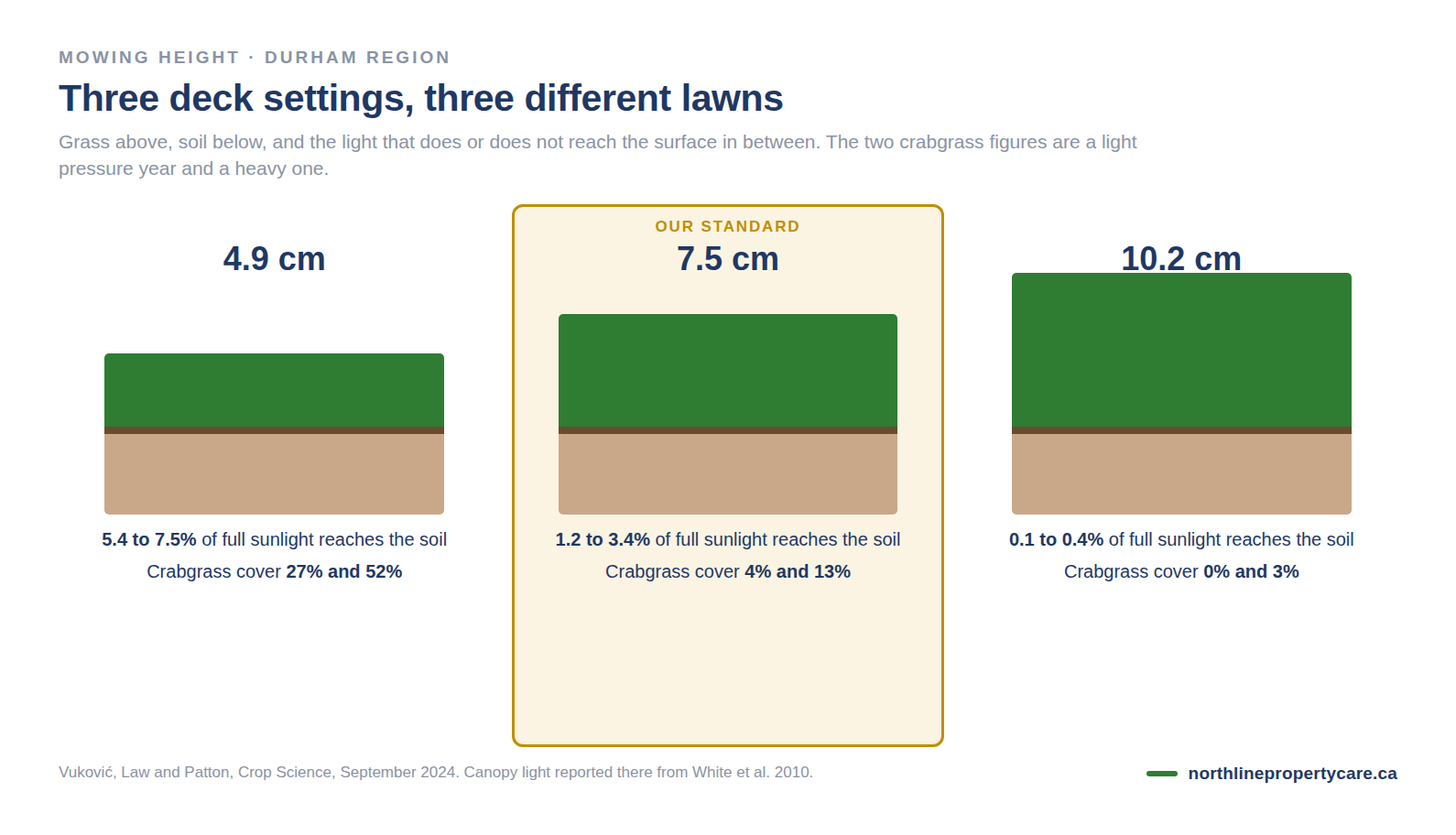
The light numbers are worth having, because they explain why small height changes have large effects. Measured at the base of a ryegrass canopy, light reaching the soil was 5.4 to 7.5 per cent of full sunlight at 3.2 cm, 1.2 to 3.4 per cent at 5.7 cm, and 0.1 to 0.4 per cent at 8.3 cm. Between a short cut and a tall one the soil surface goes from dim to effectively dark, and it does it across about five centimetres of deck travel.
Purdue's own model turns that into a prediction: a canopy thin enough to let 50 per cent of light through was projected to carry 8 to 21 per cent crabgrass by summer, and one letting 75 per cent through, 21 to 46 per cent.
Why this is the only weed control an Ontario homeowner has left
Ontario prohibits the cosmetic use of pesticides on lawns and gardens, and the way the prohibition is built matters more than the headline.
Named ingredients that are out include 2,4-D and glyphosate. The exemptions that exist under the Pesticides Act run to golf courses, agriculture, forestry and the promotion of public health or safety, which is defined as things like wasps, ticks, poison ivy and giant hogweed. Nothing in that list is a lawn that you would like to look nicer.
Then there is the clause that settles the argument. Subsection 7.1(5) makes any municipal by-law on the subject inoperative. A town cannot loosen this and a town cannot tighten it. There is no jurisdiction shopping, no Durham exception, and no supplier who has found a legal way around it.
One correction while we are here, because it is out of date on most pages that discuss this. The old Class 7 through Class 11 system has been eliminated. Ontario now runs Classes A to E aligned to the federal designations, with a single list of permitted active ingredients replacing what used to be called Class 11. Anything still talking about Class 11 products has not been revised in years.
So the lever is gone and the lever that remains is the one on the side of the mower deck. That is the whole reason this page exists.
The part that argues against us
Here is what a company selling you a mowing service would normally leave out.
Cutting height does not suppress every weed. Some of them like it. A Penn State review reports a Maryland study in which tall fescue plots cut at 8.8 cm carried more white clover than plots cut at 3.2 and 5.5 cm. A Minnesota study found that mowing at 8.3 cm increased cover of birdsfoot trefoil and black medic compared with lower heights.
Those are broadleaf, low growing, nitrogen fixing plants. They are perfectly adapted to sitting under a taller canopy, and the shade argument that beats crabgrass does not touch them. The same Penn State paper also found that mowing frequency had no significant influence on weed cover at all, which is another tidy story that did not survive measurement.
What that means practically on a Durham lawn: if your complaint is crabgrass, cutting height is the strongest free tool you have. If your complaint is clover, cutting height is not going to fix it and anyone who tells you it will has not read the research. Density from an autumn overseeding is the answer to clover, and it is slower.
Where 7.5 cm comes from, and where the sources disagree
The University of Guelph's turfgrass institute publishes the only species table we found in centimetres, and every cool season lawn species in it tops out at exactly the same figure.
| Source | Published range for a cool season lawn | Where it sits against 7.5 cm |
|---|---|---|
| University of Guelph turfgrass institute | Kentucky bluegrass 2 to 7.5 cm, tall fescue 5 to 7.5 cm, perennial ryegrass up to 7.5 cm, fescues up to 7.5 cm | 7.5 cm is the top of every range |
| Health Canada | 6 to 8 cm, two and a half to three inches | 7.5 cm is inside it |
| Purdue | 2.0 to 3.5 inches for bluegrass, ryegrass and fine fescue | 7.5 cm is near the top |
| Ohio State | 2.0 to 4.0 inches | 7.5 cm is mid range |
| Michigan State | 3.5 to 4 inches described as most desirable | 7.5 cm is below it |
| City of Oshawa | Two and a half to three inches helps prevent weed growth | 7.5 cm is the top of it |
Notice what that table actually shows. 7.5 cm is the highest setting that every single published source agrees on. The Canadian sources cap there; the American ones go higher. Claiming 7.5 cm is the tallest sensible height would be wrong. Claiming it is the tallest height nobody argues with is right, and it is a better claim because it is true.
The most useful corroboration is the last row. The City of Oshawa publishes, on its own website, that mowing at two and a half to three inches helps prevent the growth of weeds. That is the municipality telling its own residents the same thing the Indiana field trial measured.
The one third rule, and the visit interval it forces
Never remove more than a third of the blade in a single cut. Ontario's turf manual says it twice. Purdue, Ohio State, Minnesota and Cornell all say it.
The University of Guelph publishes a worked example, and the numbers in it are the numbers we run: if your mowing height is 7.5 cm then you should mow the field before the turf reaches 11 cm tall. A Canadian university, in centimetres, using the exact height and the exact trigger.
Guelph also explains why the rule exists, and the explanation is the useful half of it. Grass grows from the base, so the youngest fully expanded leaves sit at the top of the plant. Let it get away from you and a single cut removes precisely those leaves, which are the ones photosynthesising hardest and contributing most to recovery, and leaves behind the old senescing tissue and the immature growth. That is why a late cut looks pale for a week. You did not just shorten the plant, you removed its best working parts.
Cornell publishes the intervals this produces: about every five days at 2 inches, every seven and a half days at 3 inches, and every ten days at 4 inches. Cutting short does not buy you a longer gap between visits. It buys you a shorter one.
That interval is why our lawn season runs 26 visits between May 1 and November 1 on a weekly schedule. At 7.5 cm the weekly interval and the one third rule line up almost exactly through the growing season, and the visit does not have to be renegotiated every May.
What each Durham municipality will actually let you get away with
Every municipality here sets a maximum grass height in a by-law, and Durham is split two ways on where that maximum sits. These are the figures as published.
| Municipality | Maximum height | By-law | Headroom above a 7.5 cm cut |
|---|---|---|---|
| Whitby | 15 cm, six inches | Property Standards By-law 6874-14, s. 4.1.2 | 7.5 cm |
| Ajax | 15 cm | Property Standards By-law 46-2017, s. 4.7 | 7.5 cm |
| Pickering | 15 cm | Clean and Clear By-law 6832/08 | 7.5 cm |
| Oshawa | 20 cm, eight inches | Lot Maintenance By-law 127-2007, s. 4.1(c) and s. 4.6(b) | 12.5 cm |
| Clarington Bowmanville, Courtice, Newcastle | 20 cm | Clean and Clear By-law 2019-047 | 12.5 cm |
Read the right hand column and the standard defends itself. A lawn held at 7.5 cm and cut when it reaches 11 cm is four centimetres inside the strictest limit in the region, permanently, without anybody watching the calendar. A homeowner who instead waits until the by-law forces their hand is, by definition, breaking the one third rule every single time they mow.
Two footnotes on honesty. We verified Whitby, Ajax and Oshawa against the by-law documents themselves. Pickering's and Clarington's height figures come from those municipalities' own web pages, because both by-laws are published as scanned images with no readable text, so we can give you the number but not the section. And none of the five by-laws sets a minimum height. Nothing in Durham stops your neighbour scalping their lawn to an inch, which is worth knowing before you assume the rules are protecting anything but the look of the street.
Whitby's long grass provision carries two exemptions worth knowing: it does not apply to an actively farmed agricultural property, or to a property registered as naturalized.
Height is really a root decision
Ontario states the relationship in one line: rooting depth is proportional to mowing height, the longer the leaves, the deeper the roots. The province says the inverse on a second page: lower mowing produces a shallow root system, and shallow roots cannot take up enough water and nutrients, which is what makes a lawn fold in a dry August.
Purdue reduces it to seven words: the higher you mow a grass plant, the deeper the roots. Ohio State describes closely mown lawns as developing shallow root systems with less total mass. Health Canada, in metric, says grass cut at 6 to 8 cm will develop a deep, extensive root system and grow thicker.
That is the part that does not show up in July. It shows up in the third week of a dry August, on the two lawns on the same street where one is green and one is straw, and the decision that separated them was made in May.
Why we do not raise the deck in midsummer, even though plenty of people say to
Minnesota's extension service says to increase the mowing height by an inch in midsummer to help the lawn tolerate heat and drying winds. Ohio State says higher summer heights promote cooler soil temperatures through canopy shade.
Purdue argues the other way, specifically and in print, and we think Purdue is right for a lawn nobody is irrigating. The argument runs like this. Almost all root growth for cool season grass happens in April and May and again in October and November. By July the roots are done for the season. Raising the deck at that point does not force roots deeper, because roots are not growing. What it does is give the plant more leaf area to support on exactly the root system it already has. Purdue calls that a very bad decision on a non irrigated or droughty site.
Their recommendation is a consistent height, held all season, at the maximum the situation tolerates. That is what 7.5 cm from April to November is.
The exception in Purdue's own text is worth stating, because we are not going to pretend the disagreement is one sided: where ample water is available all summer, raising the height slightly does increase photosynthetic area and does help. If you irrigate properly, Minnesota's advice is defensible. Most Durham lawns are not irrigated properly, and the ones that are usually know it.
One thing we can honestly say we could not find: a published measurement, in degrees, of how much cooler the soil is under a tall canopy than a short one. The mechanism is published everywhere. The number is published nowhere we could reach. If you see one quoted, ask where it came from.
The blade, and the one figure you can actually act on
A dull blade tears the leaf instead of cutting it. Purdue describes the result as a whitish cast visible across the lawn from a distance, and the torn tissue as an opening for pathogens. A 1983 study in Agronomy Journal ran Kentucky bluegrass under repeated mowing with sharp and dull rotary blades and found turf quality, shoot density and verdure all reduced under the dull treatment.
How often to sharpen is where the sources scatter. Purdue's bulletin says four to six times a year. Purdue's own turf blog says homeowners should manage at least twice. Ontario's manual just says always mow with a sharp blade. Cornell gives the only figure tied to something you can count: sharpen after ten hours of mowing. That is the one we use, because hours are measurable and a calendar is not.
And a check you can run yourself in two minutes, from Michigan State: roll the mower onto the driveway and measure from the concrete to the bottom of the blade housing. That is your true cutting height, which is frequently not the number printed on the lever. Most mowers adjust between two and four inches, and on most machines the top setting lands somewhere between 3.25 and 4 inches.
Clippings, and how much fertilizer they are worth
We mulch clippings back into the lawn on every visit except one a year, and the exception is the first cut of a full restoration, where seed has to reach soil.
The nutrient return is real and the published figures are wide. Ontario's lawn maintenance page says you can reduce nitrogen fertilizer by 20 to 35 per cent by leaving clippings. In the interests of not being caught out, Ontario's own Publication 845 says something different on the same subject, putting it at up to 15 per cent. Two ministry publications, two numbers. Penn State measured that over three years, Kentucky bluegrass clippings contained 46 to 59 per cent of the nitrogen applied as fertilizer. Minnesota puts it at roughly one fertilizer application a year.
The honest summary is that returning clippings is worth somewhere between a sixth and a half of your nitrogen, depending on who you ask and how you measure, and that every source agrees the direction is up.
What none of them support is the thatch myth. Clippings do not cause thatch. Ontario says so, Penn State says so, Ohio State says so, Cornell says so. Thatch is stem and root material that resists decomposition. Clippings are leaf, and leaf rots. The one real caveat, from both Ontario and Health Canada, is to remove thick layers of clippings in cool wet spring conditions when growth is running away, because a mat of wet clippings sitting on the surface is a different thing from clippings falling into a canopy.
Grubs, chinch bugs, and the root mass argument
Ontario publishes the grub damage threshold: five to ten grubs per tenth of a square metre, which is roughly a square foot, is where dead patches start appearing. That works out to fifty to a hundred per square metre.
But the threshold is not the interesting part. This is: Ontario states that healthy, actively growing turf will have more roots and can withstand more grub feeding without turf loss, and conversely that a lawn which is not vigorous shows damage quickly after small amounts of feeding. Same number of grubs. Different outcome. The variable is root mass.
Michigan State closes the loop and makes the link explicit: raising the mowing height establishes a grub tolerant lawn because of the larger root mass. Their extension service goes further than we would in print, suggesting that height plus modest fertilizer plus watering in dry spells may remove the need for any pesticide at all.
Chinch bugs follow the same logic. Ontario's threshold is more than twenty chinch bugs per cylinder, or roughly ten found with the bucket method, and the page notes that irrigated lawns tolerate chinch bug feeding better without visible damage. Publication 845 adds that too little water induces dormancy and makes turf more susceptible to both hairy chinch bug and white grub.
None of that is a claim that mowing height controls insects. It is a claim that it changes how much damage a given population does, which is a different and much better supported statement.
Which matters more in some years than others, because the grub population is not a constant. Eggs have to take up water from the soil before they hatch, so a dry July thins them out and a wet one does not, and southern Ontario has just had four consecutive months of above normal rain. We have written the whole of that argument out, with the counting method and the thresholds, in lawn grubs in Oshawa.
Questions people actually ask
Will a taller lawn look untidy?
Michigan State put it in print: lawns mowed at three and a half or four inches out-compete weeds, tolerate grubs and look just as good as lawns mowed at two and a half. What reads as untidy is almost always a lawn cut too late rather than too high, because taking half the blade at once leaves pale ragged tips across the whole surface.
Does cutting short mean I can mow less often?
It is the reverse, and Cornell publishes the intervals. Two inches needs cutting about every five days, three inches about every seven and a half, four inches about every ten. Short buys a shorter gap, not a longer one.
How tall can my grass legally get in Oshawa?
Twenty centimetres, eight inches, under Lot Maintenance By-law 127-2007. Clarington is the same. Whitby, Ajax and Pickering are stricter at fifteen. None of the five sets a minimum, so nothing stops anybody scalping.
Should I raise the mower in the middle of summer?
Purdue argues against it on an unirrigated lawn, because root growth happens in spring and autumn and raising the deck in July adds leaf to roots that have already finished. A height held all season is what their turf program endorses.
Do grass clippings cause thatch?
No. Ontario, Penn State, Ohio State and Cornell all publish the same finding. Clippings are leaf tissue and leaf tissue decomposes; thatch is stem and root material, which does not.
How often does a mower blade need sharpening?
Cornell gives the only figure tied to a measurable unit: after ten hours of mowing. Purdue's bulletin says four to six times a year, its blog says at least twice for a homeowner, and Ontario's manual just says keep it sharp.
Who wrote this
Andrew owns the business and sets the deck himself. North Oshawa, with the mowing route reaching all seven Durham towns, fully insured and an HST registrant. Six winters clearing snow in Durham Region are his own, and that deck has sat at one setting on every property, every week, since the first one.
The order on a weekly visit runs edge, then mow, then trim, and it goes that way round because edging first means the mower picks the debris up instead of you.
Height is only half of the question. The other half is when to stop, and that is when to stop cutting grass in Oshawa, the last cut of the season.
Every number above comes from a ministry, an agency, a municipal by-law or a university turf program, and the sources are linked so you can check us.
Related reading, if this was useful
The first cut of the year, and the trap in April
Oshawa's April climate normals against what the grass is actually doing underground, and the reason the calendar is the wrong instrument.
Read the timing →Buying density in September
Density is what beats the weeds cutting height cannot. Here is the window, the soil survey, and the seed law that lets a bag hide fifteen per cent.
Read the window →What a weekly visit actually includes
Twenty six visits, one height, the same hands every week, and the price of buying weekly mowing on its own instead of inside a membership.
See the service →The work, photographed
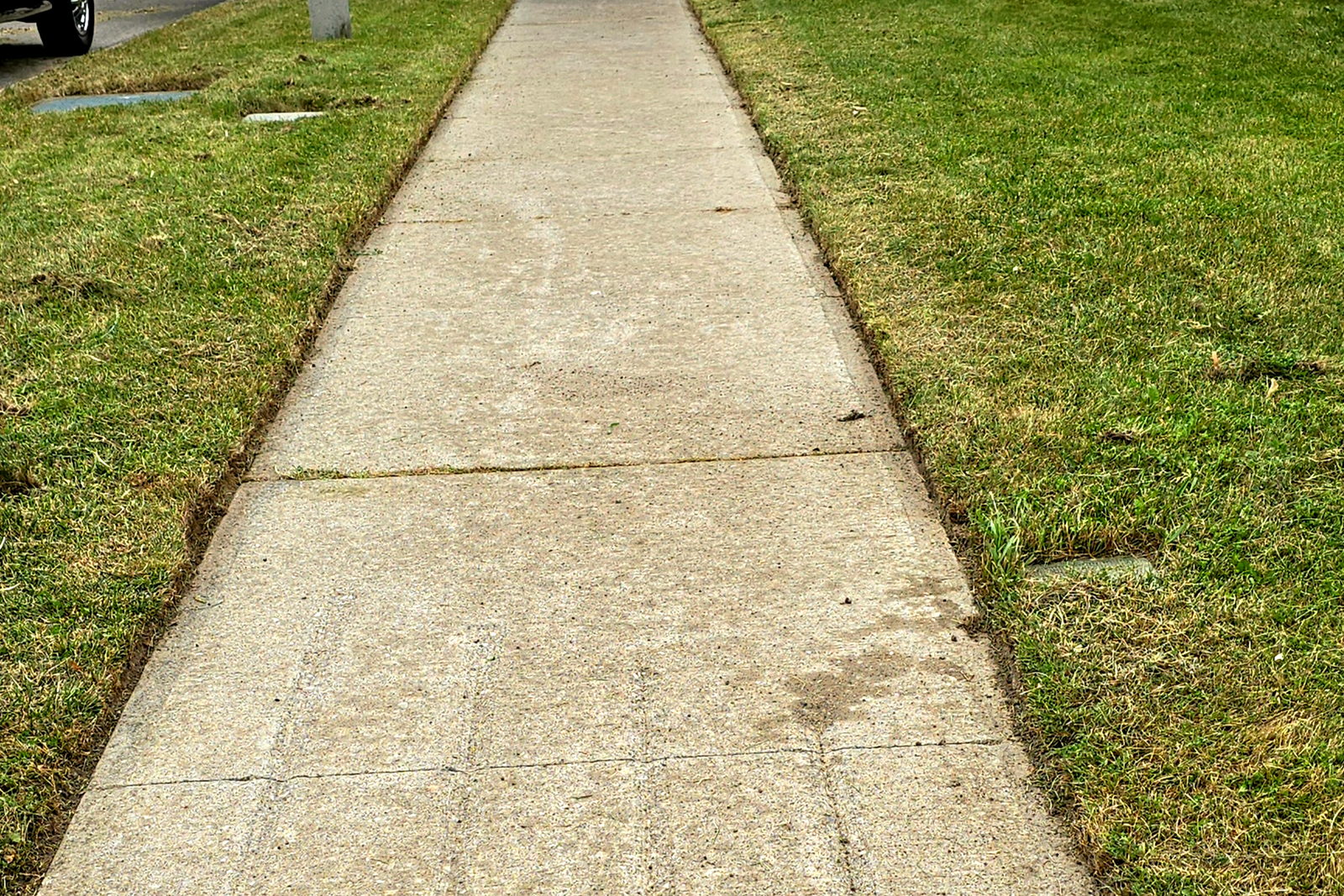
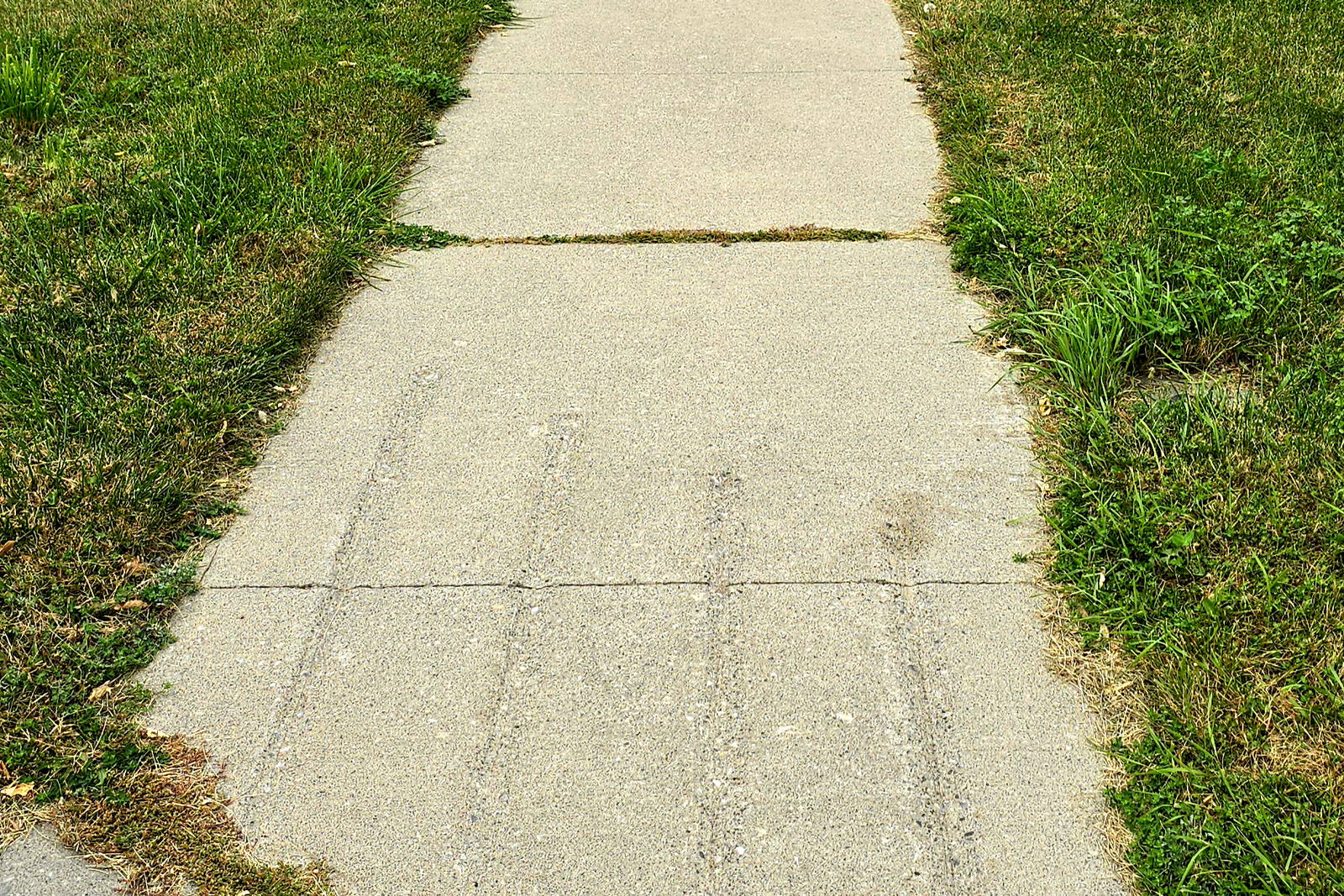
Real Northline properties, before and after, every one of them in Oshawa and every one of them this year. Drag the line to compare.
Andrew answers, October 2026
Why do you cut so high?
Because on Ontario clay a lawn cut short in July is a lawn growing crabgrass in August. Short grass lets light reach the soil surface, and light at the soil surface is the one thing crabgrass seed is waiting for. Cutting high shades it out, keeps the roots deeper and gets the lawn through a dry spell that would otherwise brown it off. It is the single setting that changes the most and it costs nothing.
One of these goes on each page and it is replaced monthly. If the question you have is not here, ask it: 905-244-5779.
One height, every week, without you having to ask
Members get the same deck setting on every visit from April to November, so the question does not come up again in June. Tell me where the property is and I will send you the weekly figure the same day.