Lawn care · What it costs
Lawn mowing cost in Oshawa, per cut and across a full season
Lawn mowing cost in Oshawa runs $40 to $75 plus HST for a single cut, and sits on a floor of $75 a cut plus HST for a weekly place held from the first week of May to the first week of November, and the difference between those two numbers is not the grass.
- Fully insured and HST registered
- Owner operated, one accountable name
- Turf held at 7.5 cm every visit
- Every figure on this page carries its source
The short answer
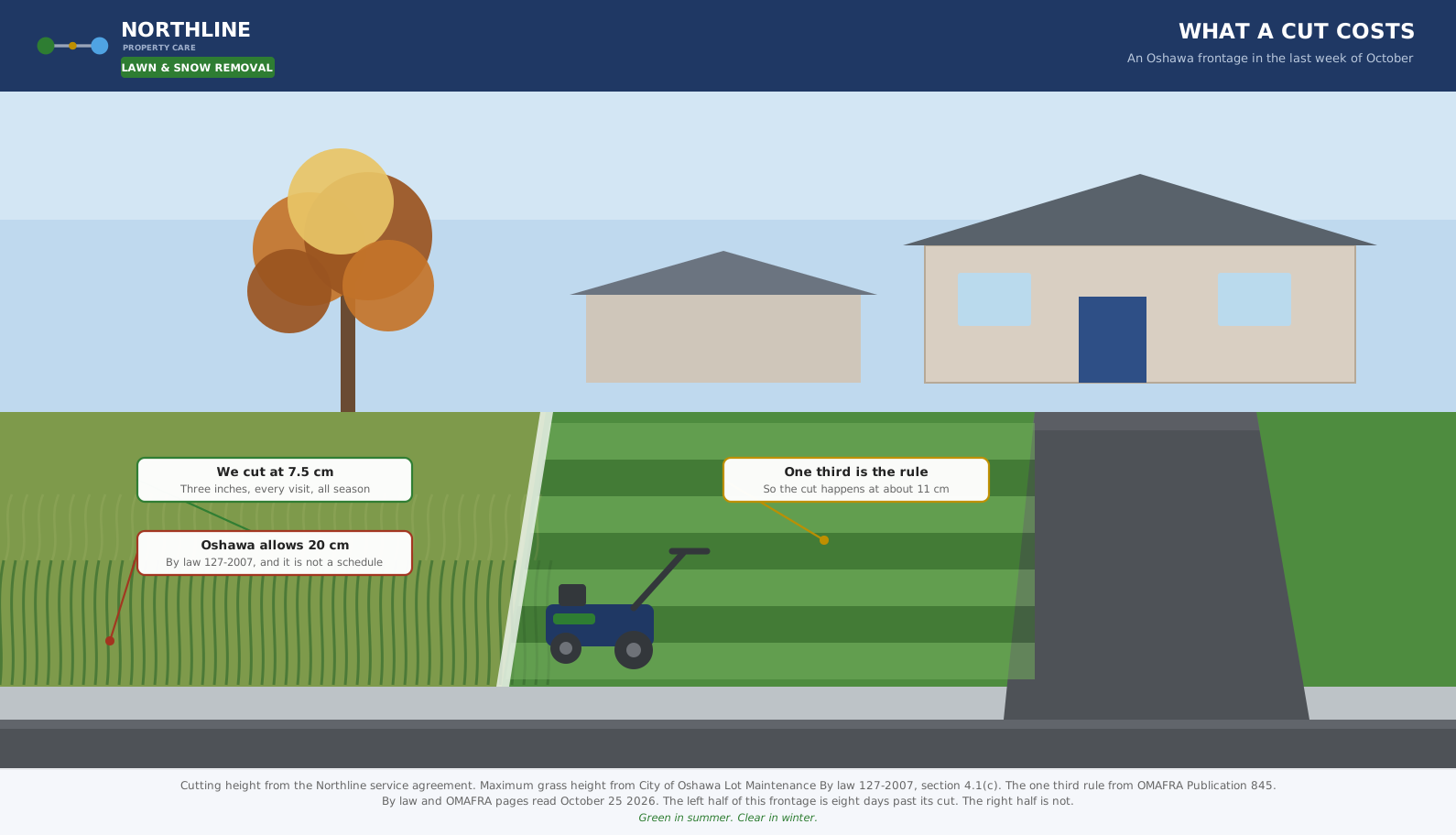
One cut on an ordinary Oshawa lot is $40 to $75 plus HST. A weekly place for the season starts at $75 a cut plus HST, and 26 of those is $1,950 plus HST for the year. The weekly figure is a floor and a larger or more awkward property sits above it.
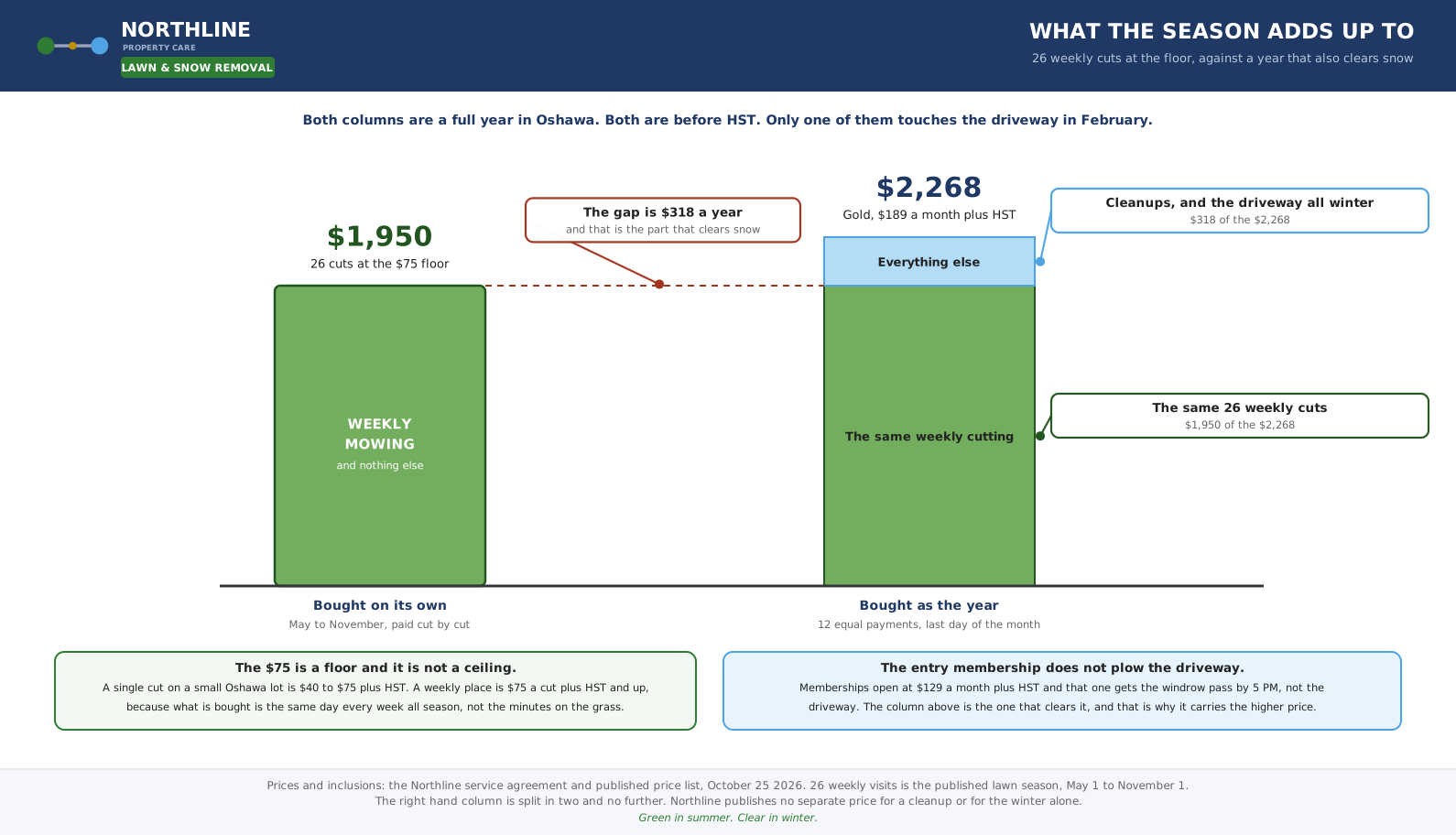
Weekly is what the agronomy requires through the spring flush and the autumn rise. Every two weeks is defensible through the heat of July and August, and in a drought the right answer is not to cut at all. Memberships open at $129 a month plus HST, and the one that also clears the driveway after every storm is $189 a month plus HST, which is $2,268 across the year against $1,950 for mowing on its own.
The two numbers, and why they do not divide into each other
A single cut on an ordinary Oshawa lot is $40 to $75 plus HST, and a weekly place for the season starts at $75 a cut plus HST. Both of those are published figures and neither of them is an estimate. What confuses people is that the second one is higher per visit than the first one can be, on the same lawn, cut by the same person, with the same machine.
The reason is that the two prices are not selling the same thing. A one off cut is sold against whatever space exists in a week, and it can be slotted into a Tuesday afternoon because nothing else is standing in that hour. A weekly place is a fixed position held in every single week from the first week of May to the first week of November, which is 26 visits in this region, and it is held whether the lawn grew four centimetres that week or whether a dry spell meant it barely grew at all.
So the weekly figure is a floor rather than a range. It is the lowest a weekly place goes, on a small property with an open frontage and no obstacles, and it is never the top of a range. A larger lot, a fenced rear yard behind a narrow gate, a slope that has to be taken across rather than up, or beds that need edging all move it up. Anybody quoting a weekly season price without having looked at the property is quoting the floor and hoping.
The part almost nobody in Durham Region publishes is the weekly figure at all. Most local price pages quote an every two weeks number, which looks cheaper per month and answers a different question. Publishing the weekly floor is a decision to be compared on the harder number rather than the flattering one.
The one third rule is what actually sets the interval
The interval is decided by the grass and by a published agronomic rule, not by what a contractor would like to sell. OMAFRA states it in Publication 845 and repeats it on its own homeowner lawn page: no more than one third of the leaf blade comes off in any single cut. That single sentence governs the whole of this article, because once a cutting height is chosen, the rule fixes how tall the lawn is allowed to get before the next visit.
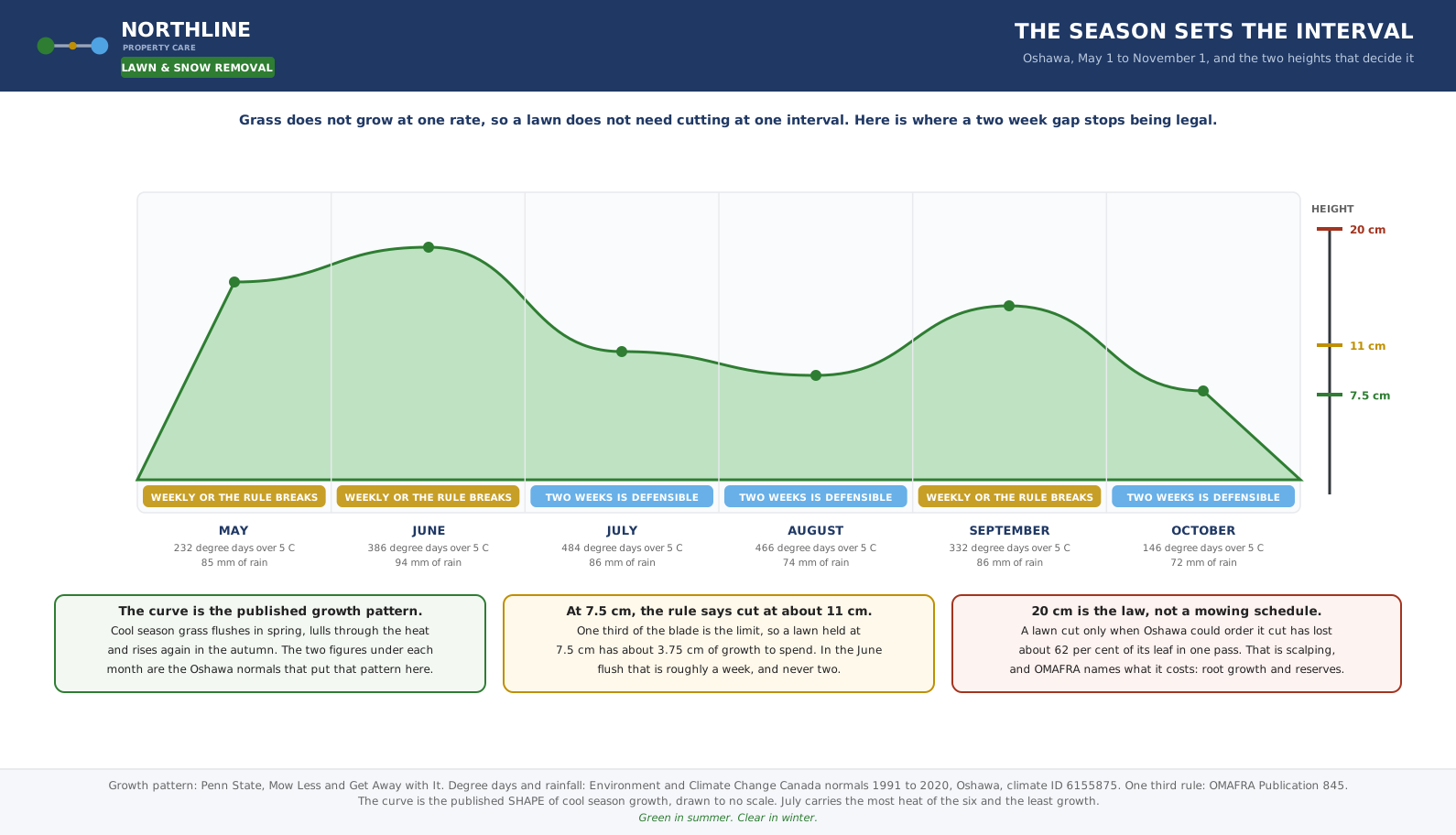
Northline holds residential turf at 7.5 centimetres, which is three inches, and it is held there all season rather than being dropped for summer. The City of Oshawa gives residents the same advice in its own words, recommending two and a half to three inches and saying that the height is what suppresses weeds. At 7.5 cm, one third of the blade is 3.75 cm, so the cut happens at about 11 centimetres and not later.
That is where the Durham calendar comes in. Cool season grass does not grow at one rate. Penn State publishes the pattern plainly: a flush in the spring, a lull through the heat, and a rise again in the autumn. In the June flush, a lawn in Oshawa puts on that 3.75 cm in about a week, which makes weekly the only interval that keeps the rule. By late July the same lawn may take twelve or fourteen days to do it, and Purdue says outright that some lawns need cutting only once every two weeks in summer.
Here is the unprofitable half of that, written down because it is true. If the summer turns dry and the lawn has gone dormant, a weekly visit is cutting almost nothing, and a visit that removes nothing is a visit that was not needed. Penn State goes further and says not to mow at all during drought periods. On a membership that visit still happens as part of the season, and on a pay per cut arrangement it should be skipped, and I will say so on the phone rather than take the money.
What an Oshawa lawn actually is, measured rather than guessed
The lot size on the deed is not the number that prices a cut, and the gap between the two is larger in Oshawa than people expect. Zoning By law 60-94 sets the minimums, and the City quotes them in its own development reports: 405 square metres with 13.5 metres of frontage in the R1-C zone, 360 square metres with 12 metres in R1-D, and 270 square metres with 9 metres of frontage in the R2 and R5 zones that most of the newer north end streets are built to.
Those are minimums and not averages, and they describe the whole parcel. Take off the house footprint, the driveway, the walkway, a deck and two or three beds, and the mowable turf on a 270 square metre lot in Windfields or Kedron can be a fraction of what the paper says. That is why a quote built off the lot area rather than off the turf area prices a small job large, and why the newer the subdivision the more often it happens.
There is a real structural reason the north of the city sits at the small end. Columbus is the most recent greenfield area Oshawa planned for growth, with its plan adopted in October 2023, and the City has written that with it adopted there are no other large north Oshawa areas that can be developed through a plan of that kind unless the urban boundary moves. New Oshawa lawns are getting smaller, not larger, and the trimming and edging share of the visit is rising as they do.
What sits under the grass matters too. The soil survey of Ontario County maps this area as Darlington and Whitby loam developed on clay loam till, with Schomberg lacustrine clay along the Lake Ontario shore and sandier Brighton and Pontypool material to the north, and Courtice sits largely on Darlington sandy loam. Clay loam holds water and compacts, which is why a wet week in this city turns into ruts and a rescheduled visit rather than a cut done anyway.
The minutes are the cost, and a university publishes the arithmetic
A mowing price is mostly time, and the time is largely decided by the width of the cut rather than by the skill of the person pushing it. Penn State publishes the figures in a piece written for landscape operators rather than for homeowners, and they are worth seeing. At a walking pace of 22 feet a minute, a 24 inch mower takes 23 minutes to cut 1,000 square feet. A 36 inch deck takes 16 minutes. A 72 inch deck takes 8 minutes.
Read that against an Oshawa lot. If a 270 square metre parcel leaves roughly 120 square metres of turf, which is about 1,290 square feet, the same work is about half an hour behind a homeowner sized push mower and about ten minutes behind commercial width. The arithmetic in that second sentence is ours and not Penn State's, which publishes the minutes per 1,000 square feet and no formula, and the honest way to use their figures is as a ratio rather than as a quote.
Mowing is also not the whole visit. Trimming the fence line, edging the walk, clearing the clippings off the driveway and the sidewalk, and getting in and out of a property on a residential street all consume the part of the visit that no deck width shortens. On a typical Oshawa frontage the trimming and the blowing are routinely as long as the mowing, and on a small new build lot with a fenced yard they are longer.
So when a $75 weekly cut is set beside a lawn that takes twenty minutes of actual mowing, the sum that matters is not an hourly rate. It is that a season of weekly service is 26 appointments that have to exist in the same week every week, in a city where May to July rain means some of those weeks are not workable on the day they were meant to be.
What has moved on the cost side this year, with the instrument on each figure
Two input costs moved in 2026 and only one of them moved gently. On October 1 2026 the general minimum wage in this province rose to $17.95 an hour from $17.60, a step of roughly 2.0 per cent. That is the published floor for an hour of work in this province and it anchors what every service hour in Durham Region has to clear.
Fuel did something different. Statistics Canada put regular unleaded at self serve stations in Toronto at 183.7 cents a litre in September 2026, the nearest published point to Oshawa, and the national gasoline index was up 27.8 per cent against September 2025 while Ontario all items inflation was 2.5 per cent. A lawn service burns fuel in the vehicle, in the mower and in the trimmer, so a line that rises eleven times faster than general inflation is felt here before it is felt almost anywhere else in a household budget.
Then HST at 13 per cent sits on top of everything quoted, which is why every figure on this page carries the words plus HST. A $75 cut is $84.75 on the card. A year of weekly mowing at the floor is $1,950 before tax and $2,203.50 after it. Quoting a price with the tax quietly folded in is how two quotes stop being comparable, and it is worth asking any contractor which of the two they just said.
For scale on what a household already spends without hiring anybody, the Survey of Household Spending put the average Canadian household at $452 on garden supplies and services in 2023, with a further $204 on lawn, garden and snow removal equipment and tools. Those are Canada wide averages rather than Durham figures, and they are quoted here as the only published anchor rather than as a local number.
The 20 centimetre number, and why it is not a mowing schedule
Oshawa sets a legal maximum on how tall grass may get, and it is 20 centimetres, which is eight inches. It sits in section 4.1(c) of the Lot Maintenance By law 127-2007, and section 4.6(b) applies the same limit to the boulevard abutting the property, which is the strip most people assume belongs to the City in every sense.
The five municipalities this business serves do not agree with each other. Whitby dropped to 15 centimetres when By law 8271-26, its Clean Community by law, came into force on the first of April 2026. Ajax sets 15 centimetres in Property Standards By law 46-2017. Pickering publishes 15 centimetres. Clarington sets 20 centimetres in Clean and Clear By law 2019-047. A Brooklin property and a Courtice property, a short distance apart, are measured against different numbers.
What happens next also differs. Oshawa may issue a work order, and section 7.1 lets the Director have the work done at the owner's expense without notice, with the cost recovered at 15 per cent interest and added to the tax roll if it is not paid. Clarington charges a flat $50 administrative fee on top of the work. Whitby adds an administrative charge of 25 per cent of the total cost and publishes penalties of $355, $500 and $750. None of the five publishes a fixed price for cutting it for you, because the cost recovered is the actual cost.
The useful reading of all this is the opposite of the obvious one. Twenty centimetres is nearly double the height at which the one third rule says the lawn should already have been cut, so a property that is legal is not necessarily a property that is healthy. By the time grass in Oshawa is tall enough for a by law officer to write anything down, the next cut removes about 62 per cent of the leaf, and the lawn pays for it in root growth for weeks afterwards.
Where the clippings go, and why that is an Oshawa specific cost
Oshawa does not accept grass clippings at the curb, at all, in any container. The City lists them explicitly among the materials excluded from yard waste collection, states the reason in its own words, which is that they cause issues at the compost facility, and then tells residents directly to leave the clippings on the lawn to decay naturally. Yard waste itself is collected every other week on the garbage day from the middle of April to early December, in paper bags or marked open containers under 20 kilograms.
That single municipal rule removes a whole line from a Durham quote, because bagging and hauling clippings is work that has nowhere legal to end in this city. Clippings are mulched back on every ordinary visit instead, which is what the City is asking for and what the agronomy supports anyway.
The benefit is measurable and the sources do not quite agree on the size of it, which is worth saying out loud rather than picking the flattering number. Oregon State puts the return at as much as two pounds of actual nitrogen per 1,000 square feet a year. Penn State reports measured recovery of 46 to 59 per cent of applied nitrogen in Kentucky bluegrass clippings over three years. OMAFRA states 15 per cent of the nitrogen requirement in Publication 845 and 20 to 35 per cent on its own lawn maintenance page, which is the same ministry publishing two figures.
One myth is worth killing while we are here, because it costs people money every year. Clippings do not cause thatch. Purdue states it plainly, on the grounds that clippings are primarily water and break down quickly, and thatch in this region is mostly a sandy soil and over fed lawn problem rather than a clay loam one. Anybody selling a dethatching pass on the argument that mulched clippings built the layer is selling against the published science.
The arithmetic against a season, with the full working shown
Mowing on its own, across 26 visits priced at the $75 floor, comes to $1,950 before HST. Hold that figure against any seasonal price that gets quoted, because it is the honest comparison point and it is almost never printed anywhere.
Set beside it, Gold runs $189 a month plus HST, which is $2,268 over twelve months. What that buys is the identical weekly cut beginning in the first week of May, a spring cleanup, a fall cleanup, and clearing of the driveway after each storm once snow reaches the measured 3 cm residential trigger, against a 7 AM target. Over a full year the difference is $318. That is the part of this article worth remembering, because it means the winter is barely being bought at all. It arrives attached to a lawn season somebody intended to pay for regardless.
The entry membership is a different product and the distinction matters. Memberships open at $129 a month plus HST, and at that level the driveway is not plowed. What it carries in winter is the windrow pass, which is the ridge the municipal plow leaves across the bottom of a driveway, cleared by 5 PM the same day rather than before the morning. Anybody who tells you the entry price clears a driveway before work has misread the price list.
Billing runs as twelve payments of identical size. Each one lands on the final day of a month, and the very first lands on the final day of whichever month comes before service begins. No residential bundle discount exists, and none is invented at a door. Settling the whole year up front takes five per cent off, so Gold becomes $2,154.60.
When you should not hire anybody, including us
Three situations come up every season where the right answer is to spend nothing, and they are written here rather than left for the customer to work out later. Each of them costs this business a sale and each of them is true.
The first is the small flat open lawn owned by somebody who already owns a mower and is physically able to use it. On a 270 square metre north Oshawa lot with maybe 1,300 square feet of turf, that is a half hour on a Saturday. Statistics Canada puts the average Canadian household at $452 a year on garden supplies and services, and a homeowner in that position is better off inside that figure than outside it.
The second is a corner lot in Oshawa whose owner is 65 or older, or has a disability with proof, and where no resident under 65 without a disability lives at the home. The City runs a side boulevard grass cutting program for exactly that case and cuts the side boulevard up to thirteen times a year at no charge. Take it. No contractor beats free, including this one. The front boulevard is not included, which is the one catch worth knowing before the call.
The third is a dry August. If the lawn has gone dormant and brown and the forecast carries no rain, a cut that week removes nothing and stresses what is left. The honest answer on a pay per cut arrangement is to skip it and spend the money in September, when the autumn rise means the same visit does something. A contractor who never tells you to skip a visit is selling attendances rather than a lawn.
What a lawn mowing quote in Durham Region should say before it is agreed
A quote that cannot answer these seven questions is not a quote, it is a number. Every one of them has cost somebody in this region money, and all seven can be answered in writing in under a page.
What height the grass is cut at, in centimetres or inches, and whether that height changes in summer. What the interval is, and what happens to the price in a week where the lawn is skipped for drought or for rain. Whether the clippings are mulched or collected, and if collected, where they are going, given that Oshawa will not take them at the curb. Whether trimming and edging are included or extra.
Then the three that decide whether a season goes smoothly. Which day of the week the property sits on, and what happens when that day is unworkable. How many visits the season is, stated as a number rather than as a phrase such as regular service. And whether the figure quoted is before or after HST, because 13 per cent is the difference between two quotes that look identical.
One more thing belongs in writing for a Durham property and it is specific to this province. Ontario's cosmetic pesticide ban means nobody can spray a residential lawn for appearance, not this business and not any competitor in the region. If a quote promises a weed free lawn, ask how, because the only legal route left is density, which means height, feeding and seed, and that takes seasons rather than a visit.
What this article could not establish
Several things were looked for while this page was written and not found, and the honest move is to say where the looking stopped. Reporting only the findings and none of the dead ends would be a method nobody can audit.
There is no published fuel price for Oshawa or for Durham Region from any official instrument. Statistics Canada table 18-10-0001-01 has no Oshawa geography, and the Ontario weekly motor fuel survey has Toronto and Peterborough columns but no Oshawa column, so the figure quoted above is Toronto and is named as Toronto. The Ontario weekly survey tables returned no data at all when they were read on October 25 2026.
There is no published average or median actual lot size for Oshawa, only zoning minimums, so no average Oshawa lawn area appears anywhere on this page. There is no quantified figure anywhere in the extension literature for how much weed invasion an infrequent cut causes. Penn State states that greater height reduces weed pressure significantly and publishes no percentage, so none is quoted here.
Statistics Canada's own census profile pages for Oshawa would not load on the day this was written, in every parameter combination tried, so the dwelling figures behind the small lot argument were read from Region of Durham bulletins that cite the census releases directly rather than from the profile itself. And the growth curve in the second graphic is the published shape of cool season growth rather than a measured Durham growth rate, because no such measured series exists for this city.
Nothing on this page came from any company that sells lawn care, landscaping or property maintenance, here or anywhere else. Where a figure could only be found on a page like that, it was left out rather than reworded, which is why there is no average market price for Oshawa quoted above. There is no honest source for one.
Where every figure on this page came from
Nine sources carry this article and not one of them sells lawn care. They are linked here rather than named vaguely, so that any figure above can be checked against the page it was read from.
- The one third rule, scalping, and what it costs the plant: OMAFRA Publication 845, and the plainer version on the ministry lawn maintenance page.
- Growth through the season, and when two weeks is defensible: Penn State on the cool season growth pattern and Purdue AY-8-W on mowing frequency and thatch.
- The minutes per 1,000 square feet by deck width: Penn State Extension.
- The maximum grass height and what the City may do about it: City of Oshawa Lot Maintenance By law 127-2007.
- Clippings at the curb, and the City telling residents to leave them on the lawn: Oshawa yard waste.
- The corner lot boulevard program: City of Oshawa grass cutting assistance.
- The minimum wage figure and its effective date: Ontario minimum wage.
- The soil under all of it: Agriculture and Agri-Food Canada, the soil survey of Ontario County.
- The climate normals behind the growing season: Environment and Climate Change Canada, Oshawa, climate ID 6155875, 1991 to 2020.
All nine were read on October 25 2026. Anything that could only be found on a contractor page was dropped rather than reworded, which is why no market average price for Oshawa appears anywhere above.
Questions Oshawa homeowners ask about mowing prices
How much does it cost to have your lawn mowed in Oshawa?
A single cut on an ordinary Oshawa lot is $40 to $75 plus HST, and the figure moves with the size of the turf, the slope and how much trimming the property carries rather than with the postcode. A weekly place for the season starts at $75 a cut plus HST and goes up from there on a larger property. Those two numbers answer two different questions and they are not a range. The first is what one visit costs. The second is what it costs to hold the same day every week from the first week of May to the first week of November, which is 26 visits, and that slot is the thing being bought.
Why does weekly mowing cost more per cut than a single visit?
Because a weekly place occupies a fixed position in a fixed week for about six months whether a given lawn needs twelve minutes or thirty on the day. A single cut is sold against a gap in the week and can be fitted wherever it lands. A season of weekly service is sold against every other Wednesday in May, and once it is taken it is gone. The honest way to say it is that the price is attached to the day and not to the grass, which is also why the weekly figure is a floor and not a ceiling.
How often does a lawn in Oshawa actually need cutting?
Weekly through the spring flush and the autumn rise, and every two weeks is genuinely defensible through the heat of July and August. That is not a Northline opinion. OMAFRA publishes the one third rule, which is that no more than one third of the leaf blade comes off in a single cut, and at a 7.5 cm height that gives a lawn about 3.75 cm of growth to spend between visits. In the June flush in Durham Region that is roughly seven days. In a dry August it can be fourteen or more, and Purdue says plainly that some lawns need cutting only once every two weeks in summer.
What is the highest my grass can legally get in Oshawa?
Twenty centimetres, which is eight inches, under section 4.1(c) of the City of Oshawa Lot Maintenance By law 127-2007, and the same limit applies to the boulevard in front of the property. Whitby, Ajax and Pickering all set 15 cm instead, and Clarington sets 20 cm like Oshawa, so a Brooklin address and a Courtice address are under different numbers. Treat the limit as a legal backstop and never as a mowing schedule. A lawn cut only when it reaches 20 cm has lost about 62 per cent of its leaf in one pass, which is scalping, and OMAFRA names what scalping costs: carbohydrate reserves and root growth.
Is a membership cheaper than paying per cut in Oshawa?
On mowing alone it is close, and the gap only opens once the rest of the year is counted. Twenty six visits priced at the $75 floor comes to $1,950 plus HST, covering mowing and nothing besides. Gold at $189 a month works out to $2,268 plus HST across twelve months, and that figure carries the identical weekly cut, a spring cleanup, a fall cleanup, and clearing of the driveway after each storm once snow reaches the measured 3 cm trigger, against a 7 AM target. Across a year the difference is $318. Where mowing really is the only thing wanted, paying per cut is the cheaper answer and I will say so.
Do you take the grass clippings away?
No, and in Oshawa that is not a shortcut, it is what the City asks for. Oshawa does not accept grass clippings at the curb at all, and its own waste page states that they cause problems at the compost facility and tells residents to leave them on the lawn. Clippings are mulched back on every ordinary visit. Oregon State puts the return at as much as two pounds of actual nitrogen per 1,000 square feet a year, and Purdue states that clippings do not cause thatch, because they are mostly water and break down quickly. The one visit of the year where clippings do come off is the restoration cut, and that is a different job with a different price.
What makes one Oshawa quote higher than another for the same street?
Turf area, obstacles and access, in that order, and none of the three is the lot size on the deed. Oshawa zoning minimums run from 270 square metres on the newer north end streets to 405 square metres in the established R1 zones, but the house footprint, the driveway, the deck and the beds all come off that before a blade touches anything. A property with a fenced rear yard, a narrow gate, four garden beds and a corner boulevard takes longer than a larger open frontage, and the quote should say which of those it is pricing.
Who wrote this
Andrew owns Northline Property Care. He prices a property himself, and he is the one who then works on it. That is the reason this page is willing to publish a weekly figure at all. A price nobody states is a price nobody can be held to, and the whole argument above only works if the number at the top of it is real.
The research rule for this article was narrow on purpose. Every agronomic claim came from a ministry or a university extension service, every municipal rule off the municipality that wrote it, every economic figure off Statistics Canada or the Province, and the soil off a federal survey. Nothing was taken from any company that competes for the same customer. That rule is why there is a section above listing what could not be established, and why the growth curve in the second graphic is labelled as a published shape rather than as a Durham measurement.
Read next
The right mowing height for a Durham lawn
Why the height is the single decision that changes a lawn most, what 7.5 centimetres does to weed pressure, and the one month of the year to change it.
When to stop cutting grass in Oshawa
What the last cut of the year should be set to, when the season actually ends in Durham Region, and what happens under the snow if it is left too long.
Weekly lawn care in Durham Region
The 26 visit season, what a visit includes, which day the property sits on, and how the weekly place is priced against a one off cut.
Andrew answers, October 2026
We are in north Oshawa on a small new build lot and we were quoted a monthly price for every two weeks. Is that cheaper than weekly?
Cheaper per month, yes, and it is not the same product, so the comparison needs one extra step before it means anything. Take the monthly figure, work out how many visits it actually buys between the first week of May and the first week of November, and divide. Thirteen visits at a lower monthly price is often a higher cost per cut than twenty six at a higher one. Then ask what happens in June, because a fourteen day gap in the flush takes more than a third of the blade off and the lawn pays for that in root growth. On a small open north Oshawa lot an every two weeks schedule can work perfectly well in July and August. In June it does not, and that is the month the quote should be judged on.
One of these goes on each page and it is replaced monthly. If the question you have is not here, ask it: 905-244-5779.
Get the number for your own lawn, not for an average one
Send the address and the price comes back the same day. The quote names the cutting height, the day of the week, the number of visits in the season and what happens in a drought week, and all of it is in writing before anything is cut.
Green in summer. Clear in winter.