Lawn care · Spring cleanup
Spring cleanup in Durham Region, and the seven months that decide what it costs
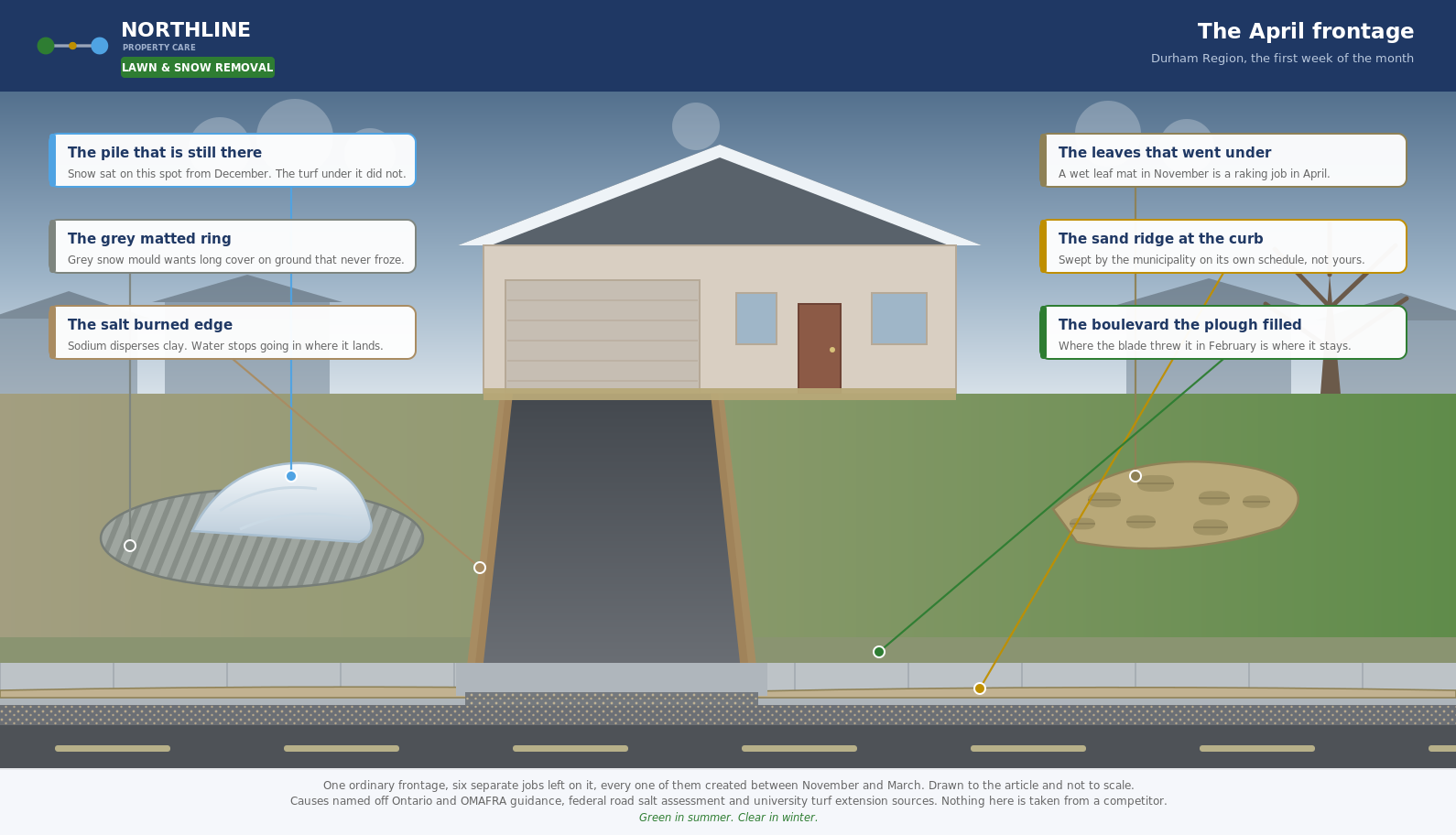
Spring cleanup in Durham Region is mostly decided between the middle of October and the first week of December, because almost everything a rake has to fix in April was put on the lawn by leaves, snow and salt that were already there before the ground froze.
- Fully insured
- Owner operated, one accountable name
- Priced at your address, in writing, before anything starts
- A spring cleanup is in every membership
The short answer
Wait for the soil to crumble rather than ball, break up the matted grey patches with a light rake, lift every leaf that went under the snow, clear the sand off the lawn edge, and cut at 7.5 cm. That is the whole visit on most Durham properties, and on a small open lot it is an hour or two with a rake you already own.
What it is not is a power rake pass, an early bag of nitrogen, a fungicide or a seeding. All four are commonly sold in April in this region and none of the four pays for itself here, for reasons that are set out below with the sources attached. A one off spring cleanup is $180 to $425 plus HST, and it is included every year in every membership.
Spring cleanup is an October decision that gets carried out in April
The size of the April job is set by what was left on the lawn in the autumn, not by what the winter did. Snow does not create work on a lawn. It preserves it. Whatever is lying on the grass when the first cover arrives is still lying there in March, pressed flat, soaked, and in contact with the crowns for four months instead of four days. A lawn that went under clean comes out tired. A lawn that went under carrying a layer of wet maple leaves comes out with grey matted patches, a thin canopy and a job that takes three times as long to put right.
That is why this post is published in October rather than in March. The two things on the chart below that a homeowner actually controls are both October and November decisions: whether the last leaves came off before the snow, and where the pile was put when it started. Everything else on the April side of the chart is weather, clay and chloride, and none of the three take instruction.
The Durham specifics matter here more than the general rule does. Oshawa, Whitby and Courtice sit on clay and clay loam, which holds water long after a sand soil has drained, so a Durham lawn spends a longer stretch of March and April in the state where traffic across it does real harm. Lake Ontario holds the lakeshore a little warmer and a little later, so a Port Darlington or south Ajax lawn comes out of cover on a different day from a Taunton North or Enniskillen one, and the spread across the Region in a given spring is a good two weeks apart in each direction. There is no calendar date that is correct for all seven towns, and anybody who gives you one is reading a template rather than a lawn.
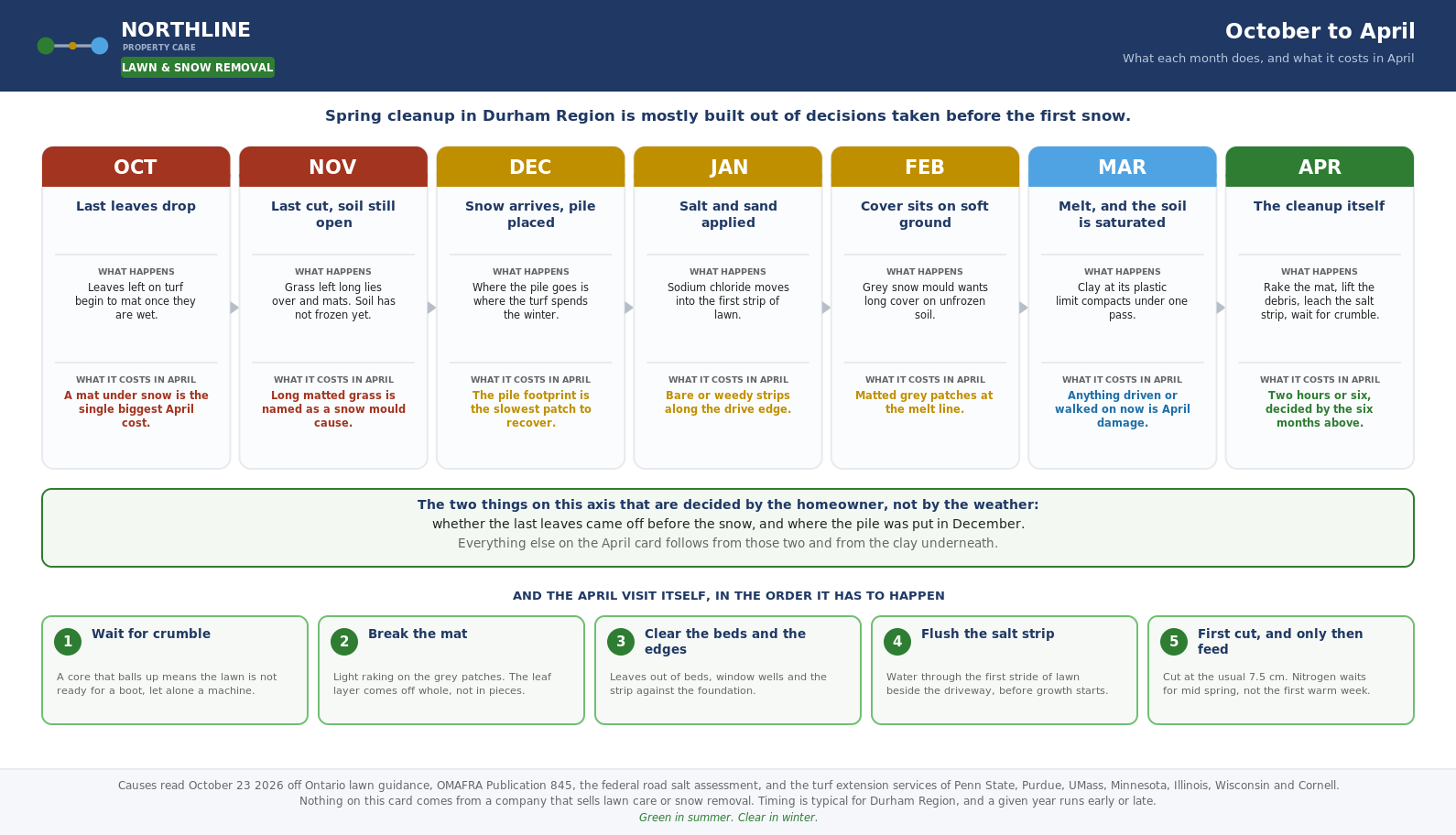
What sits under the snow on a Durham lawn between December and March
Grey snow mould, and it is caused by exactly the conditions Durham Region produces. The fungus wants long snow cover sitting on ground that never properly froze, and the University of Massachusetts turf program puts the threshold at roughly 45 to 60 days of cover for grey snow mould, with the speckled form needing 75 to 90. Wisconsin extension states the same mechanism from the other side: the disease usually does not develop if the ground freezes hard before the first snowfall, or if a midwinter melt opens the turf up. Durham gets a lot of the first pattern and a fair amount of the second, which is why some winters leave a lawn barely marked and others leave it looking like straw at the melt line.
The things that make it worse are a short list and two of them are entirely within a homeowner's control. Illinois extension names them plainly: deep and prolonged snow cover on unfrozen soil, tall matted down grass, and unbalanced nitrogen fertilization. Ontario says it in Canadian terms on its own page about preparing a lawn for winter, where matted grass is named as something that encourages pink and grey snow mould, and thatch is named as something that harbours it. Keep cutting into November until the grass stops growing, get the leaves off, and skip the late heavy feed, and you have removed most of what the fungus needs.
Here is the part that costs us money to write. In most cases the lawn fixes itself. Massachusetts, Minnesota, Wisconsin and Illinois all report the same outcome: only the leaf blades are killed, and new growth comes from the crowns once temperatures rise. Illinois notes that old scars may still be visible into May or early June, which is the only recovery timeline any permitted source would give us. The one real exception is the speckled form, where Wisconsin records crown injury and death and replanting may be needed. So the honest spring instruction is to rake the matted patches lightly so they dry and then leave them alone, which is what Ontario's own lawn maintenance guidance says in two separate tables.
A spring fungicide is money spent on a finished event. The University of Massachusetts snow mould fact sheet states it in one line: applications made after snow melt are ineffective. Penn State says the preventative window is before the first permanent cover, in late November, and that treatment after snowmelt is usually unnecessary. If a quote for a spring cleanup in Oshawa carries a fungicide line on it, ask what the product is expected to stop, because the answer is nothing that is still happening.
What a Durham lawn does need in those patches is air and light. The mat is a sealed layer of dead blades lying flat on living crowns, and until it is broken the crowns stay wet and dark. A leaf rake drawn across it lightly, enough to fluff the mat and not enough to tear out turf, is the whole treatment, and on most lawns it is twenty minutes of the visit. We write more about the disease itself on our page about snow mould in Oshawa and where the plow pile decides it.
The salt strip beside your driveway, and why flushing it does not work well on clay
The damage along a driveway edge is sodium damage, and sodium is a soil problem before it is a grass problem. The federal assessment of road salts, published December 1 2001 under the Canadian Environmental Protection Act, concluded that inorganic chloride road salts meet the criteria set out in paragraphs 64(a) and (b) of that Act. Canada uses about five million tonnes of them a year and the federal page names roadside vegetation damaged by salt splash as the most obvious effect. That is the national picture. The one on your frontage is narrower and more annoying.
The mechanism is specific and it is worse on Durham clay than it would be on sand. Minnesota extension describes sodium causing clay particles in soil to expand, increasing compaction and reducing water infiltration. Penn State puts numbers on the same thing for turf sites: a sodium adsorption ratio below 3.0 is considered very safe, and water at a ratio of 9.0 or above can cause significant structural damage to clay soils, producing breakdown of structure and reduced permeability. The same page notes that sandy soils are not as susceptible. Durham is not sandy.
So the standard advice, which is to flush the strip with water in spring, works less well here than where it is written. Massachusetts extension is explicit that heavy watering helps remove salts from well drained soils but not from poorly draining ones, and recommends organic matter for the poorly drained case. Wisconsin extension goes further for heavy, salt laden, compacted clay and names gypsum as something that can displace sodium and improve aeration and drainage. What none of them publish is a rate, a volume or a timing you could cost out, which is why this page does not give you one.
What is worth doing in April along that first stride of lawn is ordinary and cheap. Get the sand and grit off it so water can reach the soil at all. Water the strip heavily before growth starts, accepting that on clay you are rinsing rather than leaching. Work compost into the bare patches rather than topping them with more of the same soil that already failed. And if it has to be reseeded, use the species that tolerate salt: Cornell's turf program ranks tall fescue, perennial ryegrass and the fine fescues above Kentucky bluegrass for salt tolerance, which makes a bluegrass heavy builder mix the wrong thing to patch a driveway edge with.
The cheapest fix for the salt strip is not a spring fix at all. It is using less salt in January and keeping it on the asphalt where it belongs, which is the whole argument of our page on driveway salting in Oshawa and when salt stops working. One honest warning from Massachusetts to finish on: salt damage in soil may not show up until summer, or even years later, so a clean looking April edge is not proof that the winter did nothing.
The one test that says whether anybody should set foot on your lawn yet
Pull a plug, squeeze it, and if it holds as a tight ball that will not crumble, the lawn is not ready. That is not a rule of thumb somebody invented for a blog. The University of Massachusetts guidance on compaction and coring gives exactly that test, and warns that working soil that is too wet can be counterproductive and actually increase compaction. Penn State calls the same thing the ball test, and notes that soil which can be shaped into a ball is in its plastic state, which is when it is most compactible.
The number that should make a Durham homeowner careful comes from the Province of Manitoba's soil management guidance, written for farm equipment but describing the same physics: the opening pass over a spot does as much as four fifths of the compaction that four passes over the same spot would do. There is no fourth pass penalty to worry about. The damage is almost all in the first one. That is why anybody turning up with a rake on a sodden clay lawn on the first warm Saturday in March is not showing harmless enthusiasm. It is the single most avoidable injury of the whole spring.
Frost adds a second trap earlier in the window. Purdue's plant and pest guidance warns against walking on turf before the frost has melted, because ice crystals rupture the plant cell walls and the blades blacken and then brown behind the footprints. On a Durham April morning the lawn can be frozen at seven and soft at ten, so the same lawn is unwalkable twice a day for different reasons and workable in the middle. Anybody who has watched a set of boot prints show up in a front lawn a week later has seen it.
What this looks like in practice across seven towns is that spring cleanups do not get scheduled by date. They get scheduled by aspect and drainage. South facing open frontages in Bowmanville and Courtice dry first. North facing lawns, shaded side yards, the low corner where the downspout runs, and anything on the heavier clay north of Taunton come later, and sometimes a clear two weeks later. A schedule that ignores that is a schedule built for the convenience of whoever is holding the clipboard.
What a spring cleanup actually includes, and what it cannot fix
A spring cleanup is a debris and recovery visit, and it is not a renovation. What it covers is the material winter left and the first steps that let the turf start: the matted patches broken up and dried, every leaf lifted out of the lawn, the beds, the window wells and the strip against the foundation, the sand and grit cleared off the lawn edge and the hard surfaces, perennials and ornamental grasses cut back if they were left standing, branches and winter debris collected, a first cut at the usual 7.5 cm, and a full blow off so the driveway and walks are clean when it is finished.
What it cannot fix is a lawn that was thin before the snow arrived. A cleanup takes away what is dead and lets what is alive get going. It does not add plants. If the lawn went into November with bare patches, compacted traffic lanes and more weed than grass, the April visit will make it look tidier and will not make it thicker, and the honest answer at that point is either the September aeration and seeding window or a full lawn restoration, which is six steps in one day at $600, $850 or $1,250 plus HST by lawn size and is sold once a year between August 20 and October 10. Selling you a bigger spring cleanup instead would be selling you a tidier version of the same thin lawn.
It also does not include gutter work, because we do not work above ground level. Downspouts, window wells and drains are cleared at the ground, and anything above the ladder line is referred out. That boundary is published rather than discovered on the day, which is the same way we handle tree work, irrigation, hardscaping, sod and grading.
Three things people buy in April that do not pay for themselves
The first is a power rake pass on a lawn that does not have enough thatch to need one. Ontario's own number is clear: more than 2.5 cm of thatch is too much, and the way to find out is to cut a triangular patch with a sharp knife, lift it back and measure the brown spongy layer between the green and the soil. Most Durham lawns do not reach it. Clay compacts far more readily than it builds thatch, and thatch is mostly a sandy soil and over fertilized lawn problem. Penn State is blunt about what happens when the pass is done anyway: removing more thatch than intended can severely thin the stand, and on a heavy layer it removes live plants and leaves you reseeding. Penn State's thatch guidance also puts the right season for it in late summer, not spring. If somebody offers you a spring dethatch, ask them to cut the plug and show you the layer first. We do, and most of the time the answer is that it is not needed.
The second is an early spring feed. Ontario advises avoiding heavy nitrogen in early spring to minimize leaf spot and melting out, and its fertilizer tables carry no early spring nitrogen application at all. Cornell gives the agronomy behind it: heavy spring applications drive shoot and leaf growth at the expense of roots, which leaves the plant less able to handle summer, and about sixty per cent of the year's fertilizer belongs in the autumn. The feed that actually earns its money in Durham is the late season one, and we write about that on our fall cleanup checklist for Durham homeowners. A bag of early spring nitrogen buys three weeks of colour and a weaker plant in July.
The third is seed put down in April with a crabgrass preventer. These two cancel each other out and it is not a close call. Purdue's lawn establishment guidance says to avoid preemergent crabgrass controls at the same time as a spring seeding and to delay them until the new seedlings have been mowed four to eight times. The one product that can go down with seed holds crabgrass for only three to four weeks. So the choice in April is a lawn with crabgrass control and no new seed, or new seed and no crabgrass control, and the second one then asks a seedling to face a Durham July on a three month root system. Note what this does not say. Spring aeration on its own is fine, and Ontario's lawn renovation page names spring and early fall as the two recommended windows for it. It is aeration paired with seed that fails, not aeration.
Core aeration is $110 to $220 here and it is a real service with a real benefit on compacted clay. We will do it in spring if the soil crumbles and you want it. What we will not do is sell it to you in April with a bag of seed and let you find out in July. The pairing that works is aeration and seed together in September, which is what our page on aeration and overseeding in Ontario is about.
Where the bags actually go, and the five towns do not agree
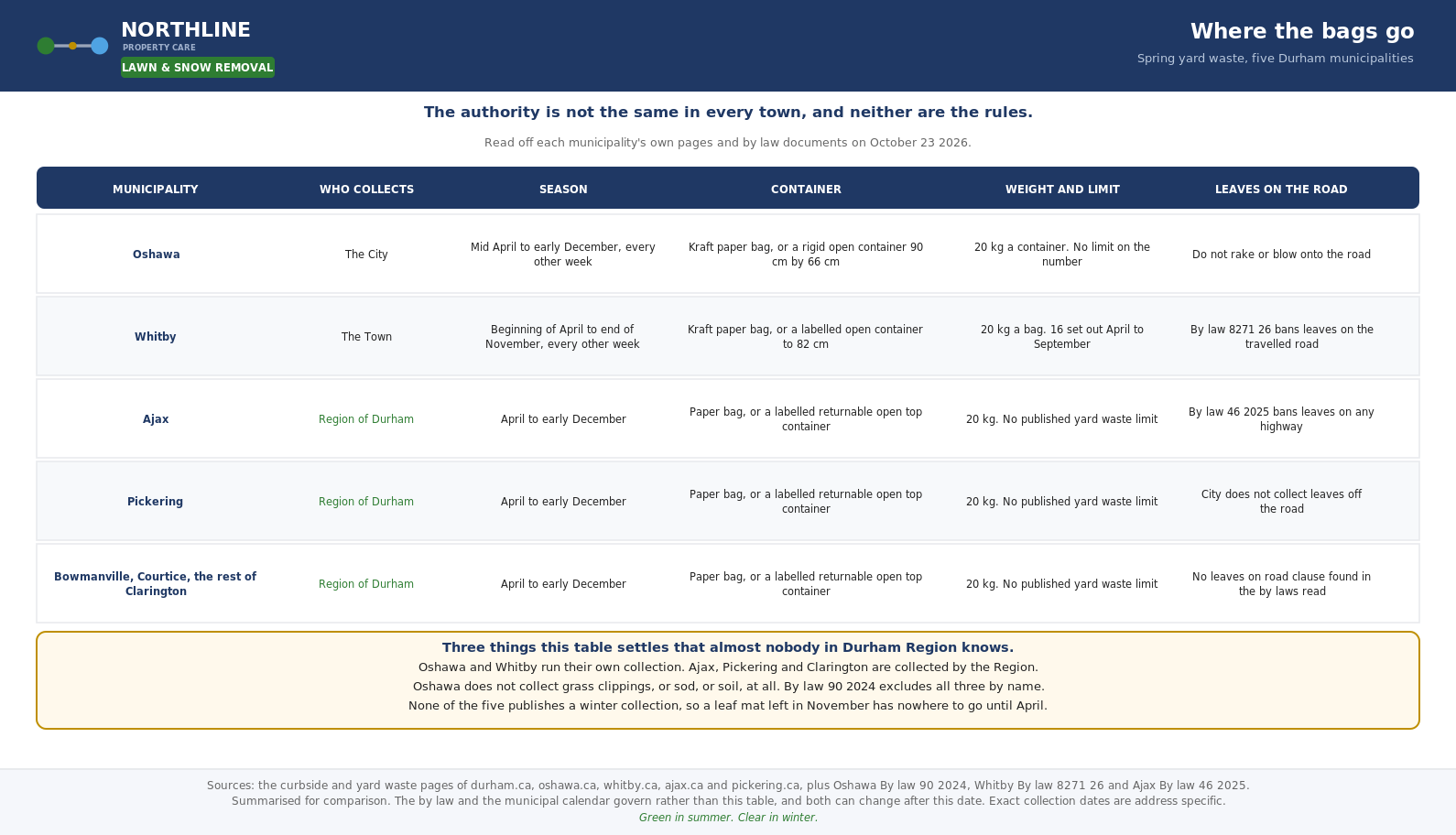
The first thing to know is that the authority is not the same across Durham Region. Oshawa and Whitby run their own leaf and yard waste collection. Ajax, Pickering and the whole of Clarington, which takes in Bowmanville, Courtice, Newcastle and Orono, are collected by the Region of Durham. The Region says so plainly in its own release on seasonal leaf and yard waste collection, and each municipality confirms it on its own page. That split is why the rules in the table above are different three columns across.
The seasons differ too, and the difference is weeks rather than days. Regional collection opens in April and closes in the first days of December. Oshawa runs the middle of April to early December, every other week, on the same day as garbage. Whitby runs the beginning of April to the end of November. Exact dates are address specific and move year to year, so the honest instruction is to check your own calendar rather than to trust a date printed in October by anybody, including us.
Three local details catch people every spring. Oshawa does not collect grass clippings at all, and does not take sod or soil either: its Waste Collection By law 90 2024 excludes all three by name in its definition of yard waste. Whitby is the only one of the five that publishes a set out limit, at sixteen receptacles or bundles per collection from April to September, with no limit in October and November. And every one of the five refuses plastic bags, so a cleanup bagged into black plastic is a cleanup that stays at the curb.
Then there is the rule about the road, which is the one that turns a tidy afternoon into a by law matter. Ajax has the sharpest wording in the Region: By law 46 2025 states at section 4.4 that no person shall rake, blow or place leaves on any highway except in an approved yard waste bag. Whitby's Clean Community By law 8271 26 prohibits placing leaves, and separately grass clippings, on the travelled portion of a highway. Oshawa reminds residents on its own pages not to rake or blow leaves and yard waste onto roadways, and gives the reason that matters more than the fine: yard waste blocks catch basins and contributes to localized flooding. Pickering publishes the flat statement that the City does not provide leaf removal services on municipal roadways, and that any incidental pickup during street sweeping is not the purpose of the sweep.
Street sweeping is the last piece and it is slower than most people expect. Clarington publishes its own figures: two full rounds between spring and fall, about 1,000 lane kilometres a round, with the first round anticipated to finish by July 1, weather permitting. Pickering dispatches its sweepers a minimum of twice a year. Oshawa's asset management plan sets a minimum frequency of once every six weeks on arterial and collector roads. None of that is fast, and none of it touches your lawn. The grit sitting on the first stride of grass beside your driveway in April is yours to deal with.
What a spring cleanup costs in Durham Region, and the two things that move the number
A one off spring cleanup here is $180 to $425 plus HST, and the two things that move it are lot size and tree cover. That is the published range and it is on our add ons and one off services page alongside everything else we sell separately. The number is settled at your address before anybody starts, in writing, so it does not move on the day because the job turned out larger than it looked from the street. The autumn version of the same visit runs $200 to $475 plus HST on the same property, and it is dearer for a reason worth knowing: October is a volume problem and April is a condition problem.
Tree cover is the bigger of the two variables and it is not really about the trees on your lot. A Durham front lawn collects whatever blew in from the street and from two neighbours in either direction, which is why a bare lot on a mature street can carry more leaf material in April than a treed lot on a new one. The lots that price at the top of the range in spring are the ones with deep beds, a long frontage along a sidewalk that got sanded all winter, and a low corner that stays wet into May.
The other way to buy it is inside a membership, and the arithmetic is worth seeing plainly rather than being sold. A spring cleanup, one full visit, is included every year in all three memberships, and so is a fall cleanup. Memberships start at $129 a month plus HST for the lawn plan with winter backup. If you are already planning to buy both cleanups and weekly mowing, the membership is cheaper than buying them one at a time, and our memberships page sets out the line by line comparison including what each plan does not cover. If you are not buying weekly mowing, then the one off cleanup is the right product and we will say so.
One more number, because it is the honest comparison and hardly anybody in this region publishes it at all. The floor for weekly mowing with no plan attached is $75 a cut plus HST, which over a season of twenty six visits reaches $1,950 plus HST and buys cut grass and nothing further. The year round plan is $189 a month plus HST, or $2,268 across the twelve, and the weekly cut, both cleanups and a plowed driveway from the middle of November all sit inside that figure. The difference between the two is three hundred and eighteen dollars, and the difference is the winter. The full arithmetic is set out on our lawn care page.
The October list that makes the April bill smaller
Five things done before the ground freezes do more for the April lawn than anything done in April. None of them is clever and all of them are cheap. First, get the last leaves off, properly, including the ones in the beds and against the foundation, because a wet leaf layer in November does more than anything else to make the grey matted patches of March. Second, keep cutting until growth stops rather than stopping on a date, so nothing goes under the snow long enough to lie over and mat.
Third, decide where the snow pile is going before the first storm decides for you, and put it somewhere the turf can afford to lose, away from the places meltwater will run back across. Our page on where to put snow from your driveway in Oshawa covers the by law side of that, including the 0.9 metre sight triangle limit, and the agronomy is simpler: the footprint of the pile is the slowest patch on the lawn to recover, every year, without exception.
Fourth, skip the late heavy nitrogen. Illinois extension advises against a nitrogen application within about six weeks of a killing frost or when the first snow is expected, and high nitrogen is named as a snow mould risk factor by every extension service we read. Fifth, if you salt your own driveway, use less of it and sweep what ends up on the lawn edge rather than leaving it to wash in. Environment and Climate Change Canada has been publishing on the environmental cost of road salts since the 2001 assessment, and the cheapest driveway edge to repair is the one that never got the sodium.
The last cut in Durham usually falls somewhere in the first half of November and it moves with the year rather than with the calendar, which is the subject of our page on when to stop cutting grass in Oshawa. If you are reading this in late October, that cut and the leaf pass before it are the two jobs that are still available to you. By December the April bill is already mostly written.
What this page could not establish, named rather than left out
Four things we went looking for and did not find on a source we are willing to cite. There is no published Environment and Climate Change Canada normal for the date snow cover ends at Oshawa. The station inventory confirms two normals stations, Oshawa at climate identifier 6155875 and Oshawa water pollution control plant at 6155878, but the normals tables themselves would not return for either one in the window this page was written in, so no average last frost date and no March or April means appear anywhere above.
There is no turf specific distance over which de icing salt damages a lawn out from a driveway edge. The federal assessment gives aerial dispersion distances for highways, Minnesota gives planting setbacks for trees and shrubs, and one cited study measured soil chloride at thirty feet from a highway. None of those is a figure for a residential driveway, so this page says bare or thinning strips form along drive and walk edges and attaches no distance to it.
There is no published rate for gypsum on salt affected clay. Wisconsin extension says it can displace sodium and improve drainage on heavy, compacted, salt laden clay and gives no quantity, no units and no timing, and nobody else we are willing to cite gives one either. And the extension services do not agree on the thatch threshold: Ontario and Penn State say 2.5 cm or one inch, Illinois says half an inch. This page uses Ontario's number because this is an Ontario lawn, and names the disagreement rather than hiding it.
One procedural note that belongs here rather than in a footnote. Every external figure on this page comes from a provincial ministry, a federal department, a municipality or a university extension service. Not one number came off a landscaping or lawn care company's price page or blog, and where a fact existed only on one of those, it was dropped. That constraint is why the salt section has a mechanism and no distance, and it is also why the yard waste table has an empty cell where Clarington's own road rule should be: the municipality's roads and boulevards by law text would not open, and the nuisance by law we could read has no leaves clause in it.
Questions Durham homeowners actually ask about spring cleanup
When should a spring cleanup be done in Durham Region?
When the soil crumbles rather than balls, which in most of Durham Region falls somewhere between the end of the first week of April and the start of May, and which is a reading rather than a date. Pull a plug of soil and squeeze it. If it holds together as a tight ball that will not break apart, the lawn is too wet to walk on, let alone to rake or to aerate, and every pass over it that day is damage you will be looking at in July. A south facing Courtice front lawn is ready a week or more before a north facing one on the same street, and the shaded strip beside a house in Windfields can still be sodden when the open part of the same lot is dry.
What should a spring cleanup actually include?
Breaking up the matted grey patches with a light rake so they dry, lifting every leaf that went under the snow out of the lawn, the beds, the window wells and the strip against the foundation, clearing the sand and grit that came off the road and the sidewalk onto the first stride of lawn, cutting back whatever was left standing over winter, a first cut at the usual 7.5 cm, and a blow off of every hard surface so the driveway and the walks are clean. What it does not include is a power rake pass, an early feed or a seeding, and there are reasons for all three further up this page.
Does a lawn recover from snow mould on its own?
Usually yes, and that is the part most people are not told. University extension guidance in Massachusetts, Minnesota, Wisconsin and Illinois all say the same thing: in most cases only the leaves are killed and new growth comes back from the crowns once the soil warms. The useful spring action is light raking to fluff the matted blades and let them dry, which is also what Ontario advises on its own lawn maintenance page. The useful spring action is not a fungicide. A fungicide applied after the snow has gone is applied to a disease that has already stopped.
Why does the salt damage show up along the driveway and not everywhere?
Because that is where the sodium lands. Sodium chloride spread on a driveway, a walk or a road goes into the first strip of lawn beside it with the meltwater and with whatever the plough throws, and sodium is the part that does the lasting harm. Sodium causes clay particles to swell and disperse, which destroys the structure of the soil and slows how fast water can get into it, so the strip beside the driveway stops draining and starts thinning. On a sandy soil you can water the salt down through the profile. On Durham clay the water has a much harder time leaving, which is why the same advice works less well here than it does in the places that publish it.
Is spring the right time to aerate and overseed a Durham lawn?
Spring aeration on its own is fine, and Ontario names spring and early fall as the two recommended windows. The pairing that fails is spring aeration with seed. A spring sown seedling meets a Durham July with a root system that has had three months rather than nine, and seeding in spring also forfeits the crabgrass preemergent for the season, because the products that stop crabgrass germinating stop grass seed germinating as well. Purdue puts the delay at four to eight mowings after seeding before most preemergents can go down. If the lawn needs seed, the September window is the one that pays.
Do I have to hire anybody to do a spring cleanup at all?
No, and on a small open lot with a couple of young trees you probably should not. Breaking a few matted patches with a leaf rake and bagging what came out from under the snow is an hour or two of work with a rake you already own, and the municipality takes the bags away for nothing once collection starts. The properties where hiring the work out is worth the money are the ones with mature maples, deep beds, a long frontage, a steep or shaded lawn that stays wet, or an owner for whom two hours of raking is not a reasonable afternoon. We would rather say that in writing than sell a cleanup to a lawn that does not need one.
Who wrote this
Northline Property Care belongs to Andrew, who prices the property and then does the job on it. Six winters of clearing snow in Durham Region sit behind him, and that is why this page is able to say which April jobs are worth paying for and which ones are not. A spring cleanup sold to a lawn that did not need one is a sale we would rather not have made, because the person who has to stand in the driveway next February and explain it is the same person.
The research behind this page was deliberately constrained. Every external figure comes from a provincial ministry, a federal department, a municipality or a university turf extension service, and nothing was taken from any company that sells lawn care or snow removal in this region or anywhere else. Anything found only on a competing company page came out of the draft rather than being reworded, and every gap left behind is named in the section above instead of being quietly filled.
Read next
Snow mould in Oshawa
Why the plow pile decides where the grey patches land, and what the melt line tells you about last winter.
The fall cleanup checklist
The autumn half of this page, including the leaf passes and the last feed that actually earns its money.
The right mowing height
Why 7.5 cm is the number here, and what changes about it in a Durham July.
Andrew answers, October 2026
My front lawn looks terrible every April and fine by June. Am I wasting money getting it cleaned up at all?
If it comes back on its own by June then most of what you are looking at in April is matted blade, and that does recover. What I would still do is break the mat so it dries, get the leaves and the grit off, and take a proper look at the strip beside the driveway, because that strip is the one part of the lawn that does not fix itself and it gets a little worse every winter. If that is all the property needs, I will tell you it is a small job and price it as one. I would rather have that conversation in April than sell you something bigger and have you wonder about it in June.
One of these goes on each page and it is replaced monthly. If the question you have is not here, ask it: 905-244-5779.
Settle the spring before the snow writes the bill
Send the address and I will price the year the same day. The walk that decides where the pile can go, which part of the frontage stays wet and whether the driveway edge is already thinning is part of the quote, and what comes out of it is in writing before anything is touched.
Green in summer. Clear in winter.