Snow removal · Driveway preparation
Prepare your driveway for snow removal in Oshawa, and the nine checks that decide the winter
Prepare your driveway for snow removal in Oshawa in October, around the first frost, because every one of the nine checks below is cheap now and most of them are impossible once there is snow on top of them.
Every driveway on this winter route is drawn in October. See how the winter route works.
Green in summer. Clear in winter.
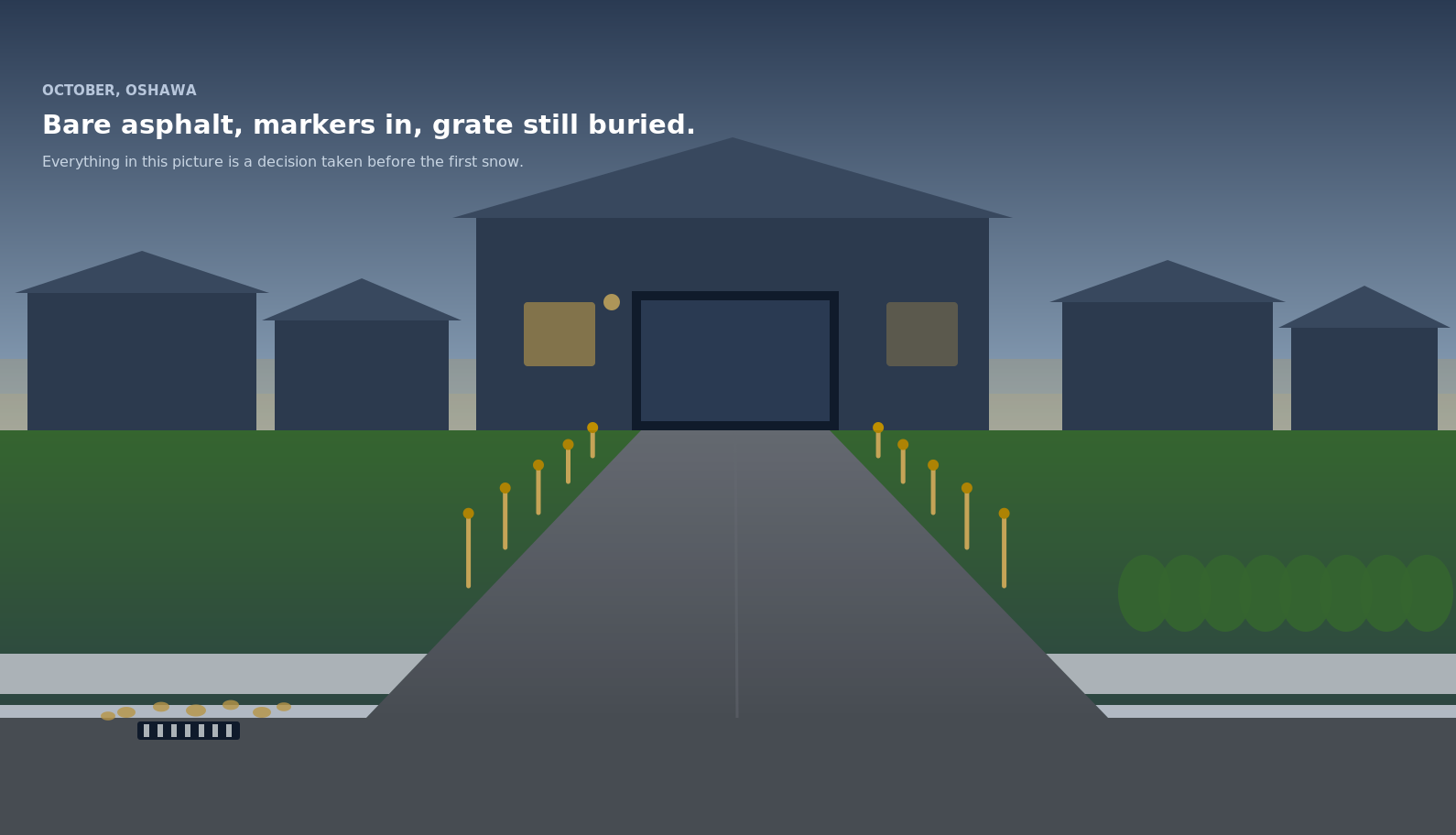
The short answer
Walk the frontage once in October with a tape measure and a notebook, and nine tenths of what goes wrong on a driveway in February stops being possible. The month is set by the ground rather than by the forecast: the 1991 to 2020 federal climate normal for the Oshawa station puts the average first fall frost at October 15, and the first measurable snowfall around the end of November. The checks that cost money if they are skipped are the edges, the markers, the pile side and the catch basin, and all four of them are about geometry rather than equipment. Two of the three municipal assistance programs in this part of Durham Region close before the first week of November, and both of those two are free, so the first thing to settle is whether your household qualifies for one of them rather than for anything a contractor sells.
First, the dates that are already running out
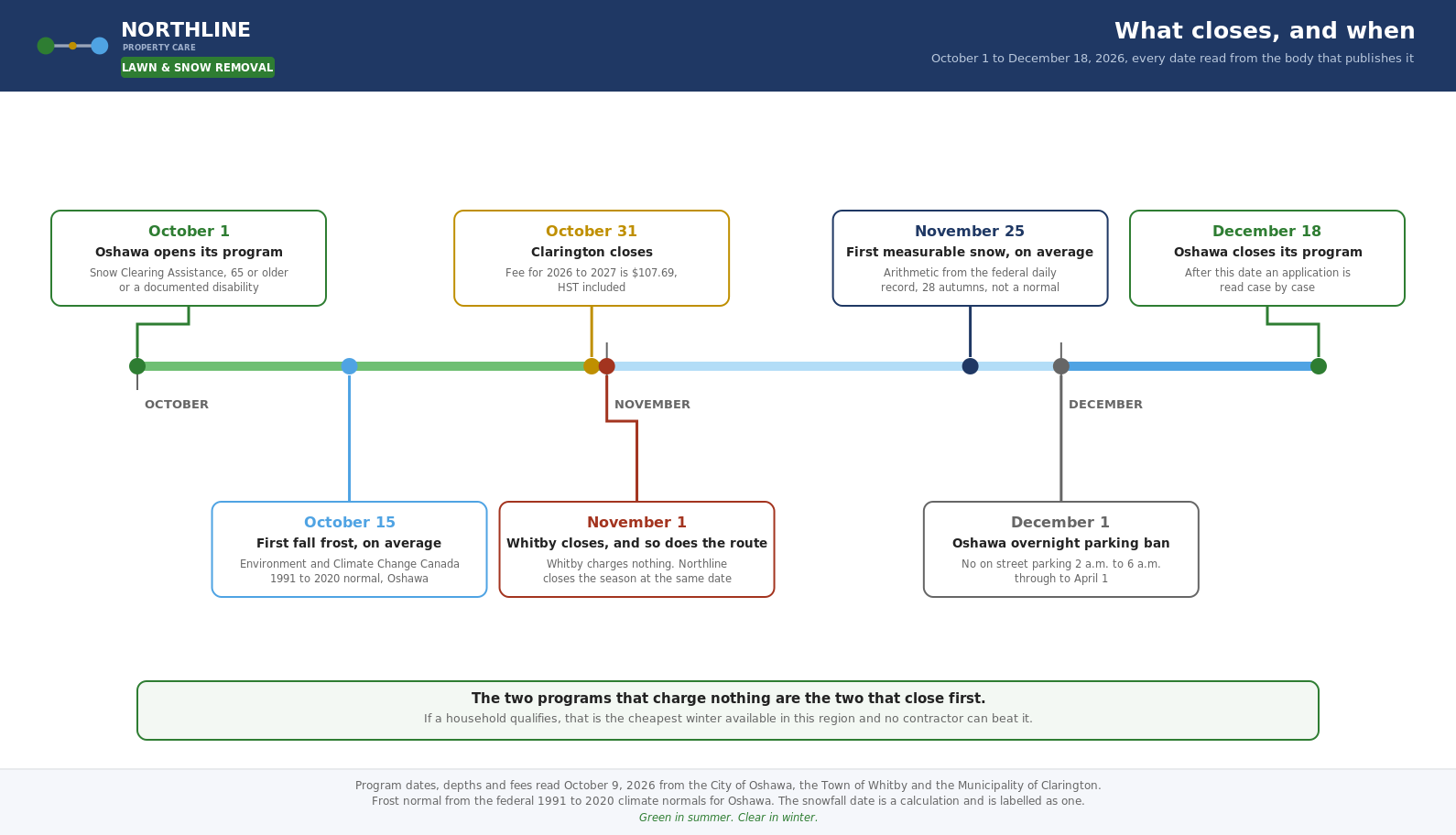
Three municipalities in this service area run a snow clearing assistance program, and the two that charge nothing are the two that close first. That ordering is not an accident of administration. A free program has to cap its intake before the season starts, because its cost is fixed by the number of households on the list, and a paid program can keep taking money for longer.
The table below was read on October 9, 2026 off each municipality's own page. The three are published by Oshawa, by Whitby and by Clarington respectively. Nothing in it came from a contractor, a directory or a news story.
| Municipality | Open | Closes | Fee | What is cleared, and at what depth |
|---|---|---|---|---|
| Oshawa | October 1, 2026 | December 18, 2026 | None published | City sidewalk and the driveway windrow only, after more than 2.5 cm of snow, and the windrow only when it is at least 20 cm high |
| Whitby | September 14, 2026 | November 1, 2026 | No fee charged | The plow ridge at the driveway and the public sidewalk, sidewalks after 5 cm and windrows after 10 cm of snowfall, typically about 36 hours after the snow stops |
| Clarington | September 21, 2026 | October 31, 2026 | $107.69 including HST | Municipal sidewalk and the windrow, up to three feet of the driveway apron, sidewalks over 7.5 cm and windrows over 15 cm |
Here is the part that costs us money to write down. If somebody in the household is 65 or older, or has a disability a doctor will certify, apply to the municipal program and do not buy anything from anybody until you have seen how it performs. In Oshawa and Whitby it costs nothing, and nothing is a price no contractor in this region can beat. The honest limit on it is also worth knowing: every one of these programs clears the windrow and the public sidewalk and not the driveway itself, and every one of them has a depth below which nobody comes. A 12 cm snowfall in Clarington leaves a windrow the program will not touch, because the threshold there is over 15 cm.
The three sets of rules are collected town by town in our guide to windrow clearing across Durham Region, which carries the eligibility tests in full.
Check one: walk the edges and write down where the asphalt ends
The single most common piece of winter damage on a residential property is a gouge in the turf along the edge of the driveway, and it happens because nobody can see the edge at four in the morning. A blade follows the operator's memory of where the asphalt stops. In October that line is visible from the street. By the second week of December it is a guess.
Walk both edges and look for three things. The first is any place where the lawn has crept over the asphalt, because that lip is what a blade catches first. The second is a settled or heaved section at the edge, which on a loam till lot is usually a drainage symptom rather than a paving fault. The third is the corner where the apron meets the municipal sidewalk, which is the one spot on the whole property where a steel edge, a concrete lip and a turf shoulder all meet within half a metre of each other.
Write the edge down rather than trusting that you will remember it. A note on your phone that says the left edge runs two steps inside the hydro meter and the right edge is level with the third fence post is worth more in January than any amount of good intention in October.
Check two: the markers go in now, and the by-law decides where
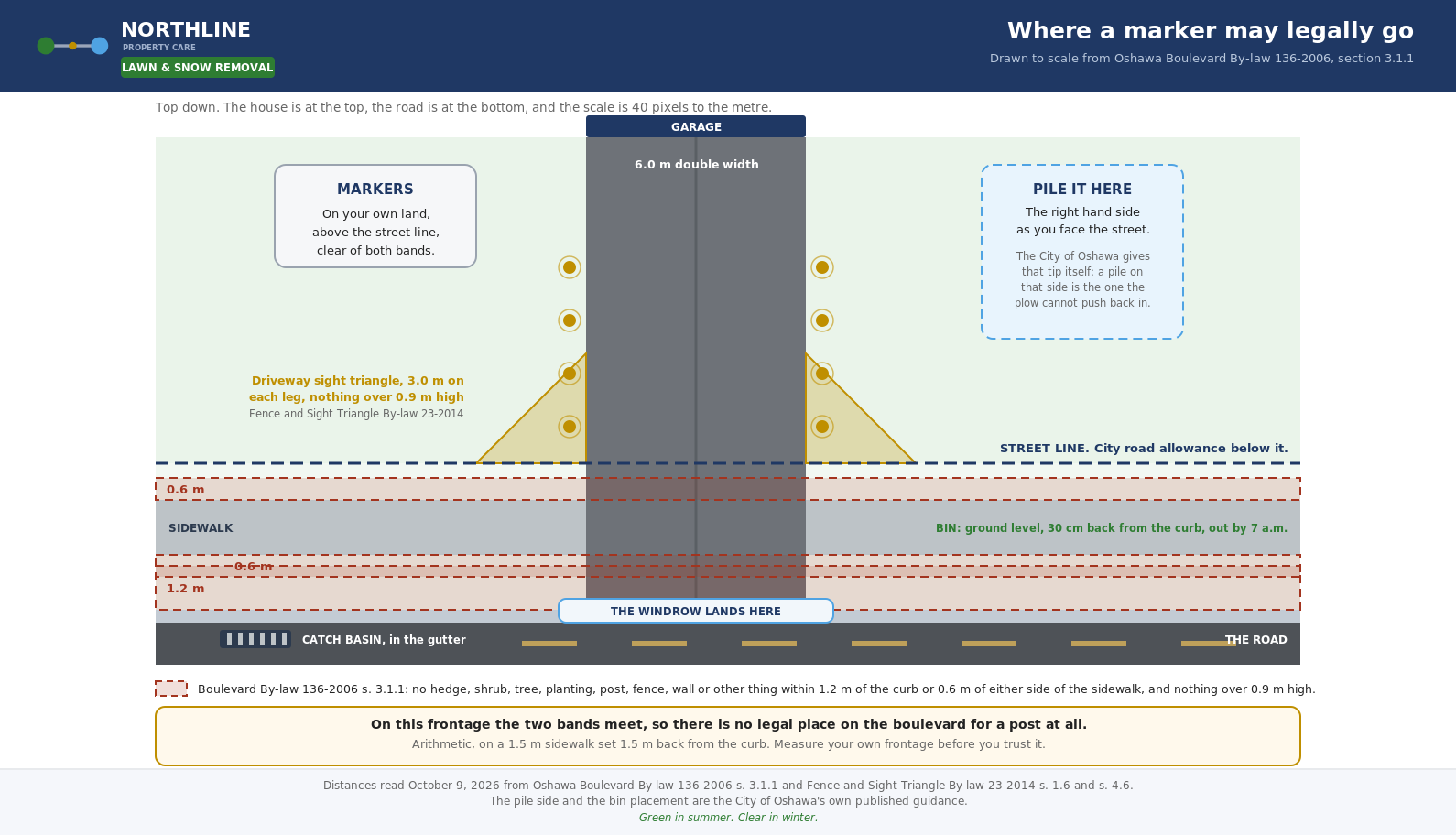
Most driveway markers in Oshawa are installed in the one place the by-law does not allow a post. Boulevard By-law 136-2006, section 3.1.1, bars a hedge, shrub, tree, planting, post, fence, wall or other thing within 0.6 metres of either side of a sidewalk, within 1.2 metres of the curb or travelled portion, or within 1.8 metres of the curb where there is no sidewalk. The same section caps anything on the boulevard at 0.9 metres above grade and refuses anything protruding, sharp or dangerous.
Put those distances on a typical frontage and the arithmetic settles the question. On a 1.5 metre sidewalk set 1.5 metres back from the curb, the 1.2 metre band off the curb and the 0.6 metre band off the sidewalk meet in the middle with nothing left between them. The drawing above is to scale, at 40 pixels to the metre, and the measurement is worth doing on your own frontage because boulevard widths in Windfields are not boulevard widths in the older grid south of Bloor Street.
The reason to care is money rather than tidiness. Oshawa Encroachment By-law 177-2022 puts that risk on the homeowner at section 5.2, which removes City responsibility for damage done to an encroachment by its own operations and names ploughing among them. The City puts the same point in plain words on its snow clearing help page: should damage occur to items found within those guideline distances, the onus for repairs will be on the property owner. A snapped marker is a trivial loss. A decorative boulder, a low wall or a run of landscape lighting in the same band is not.
Spacing, height and the two places a marker earns its keep are covered in detail in our guide to driveway markers for snow removal in Oshawa. The short version is that the markers belong on your own land, above the street line, and the street line is further back from the road than almost anybody assumes.
Check three: call for a locate before you drive anything into the ground
A locate is free, it takes five business days, and the service that used to be called Ontario One Call now operates as the Ontario Dig Authority. Any article or sign that still points at the old address is out of date, which matters because the old one now redirects.
Be careful about how far you take this. The Ontario Dig Authority names planting a tree, building a fence and building a deck as projects that need a locate before you dig. It does not name a driveway stake, and it publishes no depth below which a locate stops being required, so anyone telling you that a 30 centimetre marker is exempt is telling you something the regulator has not said. The gas utility serving this region publishes the part that should settle it for a homeowner on a tight frontage. Its own before you dig page states that a natural gas line could lie just a few inches below the surface, sets a tolerance zone of 18 inches on either side of a locate mark, and allows hand tools only within one metre of a mark.
A gas service runs from the street to the meter on the house, which on most Durham lots means it crosses the front yard somewhere near the driveway. If you are pushing fibreglass rod in by hand along a line you have used for years, that is one situation. If you are driving steel into ground you have never opened, near a service you cannot place, the five business days are cheaper than the alternative.
Check four: decide which side the pile goes on before the first storm
Pile the snow on the right hand side of the driveway as you face the street, and that is the City of Oshawa's own guidance rather than a contractor's preference. The mechanism is simple once somebody says it out loud. A plow working your side of the road carries its load to the right as it travels, so snow stacked on the left side of your driveway sits directly in the path of the next load, and the blade pushes the whole lot back across your apron.
Two limits bound the decision. The first is Winter Access By-law 92-2009, section 6.1, which makes it an offence to move snow or ice off private property onto a highway or a sidewalk, or to pile or redistribute it there, and section 6.2, which bars putting snow on any boulevard other than the one beside your own lot. The second is the sight triangle. Under Fence and Sight Triangle By-law 23-2014 the driveway version runs 3.0 metres along the street line and 3.0 metres up the side of the asphalt, and section 4.6 holds everything inside that wedge to 0.9 metres. A snow pile is a thing inside that triangle, and on a corner lot the triangle is 6.0 metres on each lot line rather than 3.0.
Where the snow goes once it leaves the asphalt is the whole subject of our piece on snow plowing in Durham Region, including what happens on a property that runs out of storage in February.
Check five: find your catch basin while you can still see it
The catch basin in the gutter near your frontage is the reason your apron either drains in a February thaw or turns into a sheet of ice. Oshawa asks residents to keep snow clear of catch basins and of fire hydrants, and its flooding page names leaves, snow and ice as the debris that blocks a grate, and tells residents either to clear it out or to contact Service Oshawa at 905-436-3311.
October is when this is a two minute job, because the thing blocking the grate is leaves. In January the same blockage is a solid plug of ice and nobody is chipping it out from the road side. If the grate is already under a leaf mat, that is also a signal about where your meltwater is going, and leaf collection in Oshawa sets out what the City will and will not take away.
One thing worth knowing before you make a phone call. The Region of Durham maintains ditches, catch basins and storm sewers only on Regional roads, and says so plainly on its own storm drainage page. In Oshawa the Regional roads include Simcoe, Ritson, Harmony, Taunton, Rossland, Bloor, Wilson, Thornton, Stevenson, Park and Townline. A blocked grate on one of those is a Regional matter and a blocked grate on a residential street is a City matter, and knowing which one you are standing beside saves a transferred call.
Check six: what the frost line is not, and what actually lifts a driveway edge here
There is no published frost depth for southern Ontario, and the number most people quote is from a table about foundations. The Ontario Building Code, Division B, article 1.1.2.2, says the depth of frost penetration is to be established on the basis of local experience and states no figure anywhere. The 1.2 metre number that circulates is the minimum depth of a foundation in clay or in soils not clearly defined, from Table 9.12.2.2, which is a requirement about footings rather than a measurement of frost. The Ontario Ministry of the Environment goes a step further in its design guidelines for sewage works and says frost depth depends on the freezing index, on frost susceptibility and on the thermal conductivity of the soil, and it reserves its extra drainage requirement for places with a design freezing index at or above 1,800 freezing degree days Celsius. The 1991 to 2020 federal normal for the Oshawa station is 439 degree days below zero Celsius a year. This is not a severe frost climate by Canadian standards and it does not need to be, because what damages a driveway edge here is not depth.
What does the damage is silt and water, and the City of Oshawa scores it that way in its own engineering standard. The Design Criteria Manual classifies subgrade frost susceptibility by percentage of silt and by percentage of very fine sand plus silt, and rates a subgrade from 51 to 100 per cent silt as unacceptable. Note what is not on that scale. Clay is not the test.
That matters locally because this city is not one soil. The federal soil survey puts Bondhead, a well drained loam till, under central Oshawa, and Brighton, a well drained fluvial sand and gravel at 87 to 98 per cent sand, under parts of the north and east. Cross into Whitby and the survey returns Darlington, which the same source classifies as imperfectly drained, meaning water is removed slowly enough to keep the soil wet for a significant part of the growing season. A silty to loamy till that holds water and does not shed it is the combination that lifts, because frost heave needs a frost susceptible gradation and available water at the same time. A sand and gravel frontage in north Oshawa and a wet till frontage in Whitby will behave completely differently in the same week of weather, which is why a single rule of thumb about Durham clay is worth very little.
The practical conclusion is modest and it is the honest one. Fix the drainage you can see, fill the cracks that will hold water, and do not pay anybody to chase a frost depth number that no public document contains. What a plow can and cannot do to asphalt, interlock and concrete is set out in our piece on snow plow driveway damage in Oshawa.
Check seven: move the five things that break
Everything light enough to lift and close enough to the asphalt to be hit should be off the driveway and its shoulders before the first week of November. In practice the list is short and it is the same list every year: planters and pots, solar path lights, the hose and its reel, a portable basketball net, and anything stored along the garage apron over the summer.
Solar lights deserve a sentence of their own, because they are the item people forget and the item that does the most damage per dollar. A row of them along a driveway edge is invisible under four centimetres of snow, sits exactly where a blade runs, and leaves a spike in the turf when the head shears off.
The waste bins are the other recurring problem, and Oshawa publishes exactly what it wants. Materials go out at ground level at the end of the driveway, within 30 centimetres of the curb, in an area free of snow and ice, and no later than 7 a.m. on collection day. The City also asks residents not to set out the night before during winter, when a bin at the curb in the dark is harder for an operator to see, and never to place materials on top of a snowbank.
Check eight: the overnight parking ban is a preparation item, not a winter surprise
In Oshawa there is no on street parking from 2 a.m. to 6 a.m. between December 1 and April 1, and the ban applies whether or not it has snowed. The City states that vehicles may be ticketed or towed regardless of weather or snow accumulation, and that occasional use parking permits are suspended during salting or snow clearing.
This belongs in an October checklist for one reason. If the household has more vehicles than the driveway holds, the answer is a parking decision taken in October and not an argument at 2 a.m. in a snowstorm. It also changes how the driveway should be laid out: the vehicle that leaves first in the morning parks nearest the street, because the alternative is shuffling the cars in the dark to get one out.
Clarington runs a different rule, with no parking on the road between 3 a.m. and 5 a.m. or for longer than three hours, so a Bowmanville or Courtice frontage is working to its own clock.
Check nine: settle the sidewalk, because the deadline is tighter than people think
In Oshawa the sidewalk in front of, alongside or at the rear of your lot has to be cleared by midnight of the first day after the snow or freezing precipitation falls, and the by-law puts windrows on the sidewalk inside that duty. Winter Access By-law 92-2009, section 6.4, is where that sits, and section 6.5 adds a second duty that gets much less attention: sand, salt or another suitable material has to be applied immediately and as often as necessary to cover any part of the sidewalk that remains or becomes slippery after the snow has been removed. As often as necessary is a repeating obligation, not a single pass.
The enforcement end is real. The same by-law carries administrative penalties of $75, $175 and $275 for repeat contraventions within a calendar year, and a set of offence fines that start at not less than $300. Section 5 allows the Commissioner to have the snow removed at the owner's expense, with interest, and to add the amount to the tax roll.
Clarington's deadline is written differently, at within 24 hours after the end of a snowfall, so the two rules do not line up and a household that moved from one to the other should read the new one. The Oshawa by-law and the sidewalk question are covered on their own in our piece on the snow removal by-law in Oshawa.
What the public plows do, and the part they will never do
Oshawa publishes clearing targets rather than promises, and they are useful numbers to hold in your head before you make a phone call about your street. The City snow clearing page sets out a four phase cycle: primary arterial and collector roads, then residential roads, then City sidewalks, then the properties in the assistance program, and a fresh accumulation restarts the cycle. Its published targets are 6 hours on an arterial, 12 hours on a collector and 16 hours on a residential road, against a network it describes as more than 500 kilometres of primary roads, 765 kilometres of residential roads and 160 kilometres of sidewalks. The Region of Durham maintains every Regional road inside Oshawa, which is why the street you turn onto is often cleared long before the one you live on.
Two published numbers in this region do not agree, and this article is not going to pretend they do. The Region of Durham stated in a news release that its equipment is dispatched once four centimetres has accumulated on road surfaces. The Town of Whitby reproduces the provincial Minimum Maintenance Standards with different figures entirely, at 2.5 centimetres for a Regional road and 10 centimetres for a residential street. We could not read the regulation itself to resolve the conflict, so both readings are reported here with their sources attached and neither is presented as the rule.
None of it touches the windrow. Every municipality in this service area treats the ridge the plow leaves across a driveway as the property owner's responsibility, and Oshawa adds that raising or lowering the blade will not prevent it. That ridge is the single item on this list that no amount of preparation removes. It can only be cleared, by the household or by somebody the household pays.
Where a membership fits, and where it does not
Northline clears at a measured 3 centimetres on a residential property, which is well below the depth at which any public plow is dispatched anywhere in this region. Gold and Platinum plow the driveway and carry a morning target, 7 a.m. on Gold after overnight snow and 6:30 a.m. on Platinum. Memberships run from $129 a month plus HST. A seasonal snow package instead of a membership is priced by the property it covers, at $800 on a small lot, $975 on a standard lot and $1,200 on a large lot, each plus HST.
Silver does not plow your driveway, and it is better that you read that here than discover it in December. Silver carries the windrow pass by 5 p.m. after a storm and no driveway clearing and no salting, which suits a household that shovels its own asphalt and simply cannot move the compacted ridge the plow leaves. A household that wants the asphalt clear before the first car leaves in the morning is buying Gold or Platinum, and nothing below them does that job.
The route is sequenced in October and closes on November 30. The limit is not a sales device. A route holds only the driveways that can all be finished by one morning target, so it fills, and when it is full it shuts for that winter. When to book snow removal in Oshawa sets out both dates and what happens to a call that arrives in January, and snow removal in Oshawa covers the route itself.
The one hour version
- Check the programs first. If anyone in the household is 65 or older or has a certifiable disability, apply to the municipal program before you price anything else.
- Walk both edges and write them down. Note the lip where turf has crept over asphalt and the corner at the sidewalk.
- Set the markers on your own land. Above the street line, clear of the 1.2 metre curb band and the 0.6 metre sidewalk bands, under 0.9 metres tall.
- Request a locate if you are driving anything into ground you have not opened before. It is free and it takes five business days.
- Choose the pile side. Right hand side facing the street, nothing over 0.9 metres inside the 3.0 metre sight triangle.
- Clear the catch basin while the blockage is still leaves.
- Fill the cracks that hold water and fix the drainage you can see, rather than chasing a frost depth that no public document publishes.
- Move the planters, the solar lights, the hose and the net, and settle where the bins will stand at ground level, 30 centimetres back from the curb.
- Settle the overnight parking before December 1, and settle who clears the sidewalk by midnight of the day after a snowfall.
What we could not verify
Every figure above carries the body that published it, and the gaps are named here rather than smoothed over. A list of findings with no list of misses beside it is half a method.
- The Minimum Maintenance Standards themselves. The provincial e-Laws site would not return the text of O. Reg. 239/02 to us on October 9, 2026. The depth and time figures in this article are the Town of Whitby's reproduction of that standard, attributed to Whitby and not to the regulation.
- The Highway Traffic Act section on depositing snow on a roadway. Whitby cites section 181. We could not load the statute to confirm the wording, so the Oshawa by-law is the authority quoted here instead.
- A snowfall depth at which Oshawa begins plowing residential streets. The City publishes a sequence and a set of time targets and no depth. The 2.5 centimetre and 20 centimetre figures in this article belong to the assistance program and are not a city wide trigger.
- Any source on when ground in this region becomes too hard to drive a stake into. We looked for a government, university or standards source and found none, so this article gives a date for the first frost and the first snowfall and makes no claim about the ground itself.
- A soil series for Courtice or Bowmanville. The federal digital survey for the old Durham County ships without the table that links its map units to series names, so the soils named above stop at Oshawa and Whitby.
- Clarington by-law 2014-059, which Clarington cites for its own rule against pushing snow onto a road. The document portal returned an error, so that rule is reported as Clarington describes it.
- The first measurable snowfall date. Environment and Climate Change Canada publishes no normal for it. The late November figure used here is our own calculation from 28 autumns of federal daily records at the Oshawa station, and it is labelled as arithmetic on the graphic as well as here.
Questions homeowners ask in October
When should I prepare my driveway for snow removal in Oshawa?
Through October, and the reason is the calendar rather than the weather. The 1991 to 2020 federal normal for the Oshawa station puts the first fall frost at October 15 and the first measurable snowfall falls around the end of November in an ordinary year, so October is the month in which the ground is still soft, the asphalt is still warm enough to work on and the municipal programs are still open. Two of those programs close on October 31 and November 1.
Can I put driveway markers on the boulevard in front of my house?
Almost certainly not where most people put them. Oshawa Boulevard By-law 136-2006 section 3.1.1 bars a hedge, shrub, tree, planting, post, fence, wall or other thing within 1.2 metres of the curb, within 0.6 metres of either side of a sidewalk, and anything over 0.9 metres in height. On a frontage with a 1.5 metre sidewalk set 1.5 metres back from the curb, those two distances meet and cover the whole strip. The markers belong on your own land, above the street line.
Who pays if a plow destroys something I installed on the boulevard?
You do. Under Oshawa Encroachment By-law 177-2022, at section 5.2, the City carries no responsibility for damage done to an encroachment by its own operations, and ploughing is named inside that by-law text. The same point is put in plainer words on the City snow clearing help page: should damage occur to items found within those guideline distances, the onus for repairs will be on the property owner.
Which side of the driveway should I pile the snow on?
The right hand side as you face the street, and that is the City of Oshawa's own advice rather than ours. A plow travelling down your side of the road carries snow to its right, so a pile on the left of your driveway is a pile the blade pushes straight back across your apron. Keep the pile under 0.9 metres anywhere inside the triangle that Fence and Sight Triangle By-law 23-2014 draws at the end of a driveway, which runs 3.0 metres in each direction from the corner.
Is there a frost line depth I should dig below in Durham Region?
No published one, and anyone who quotes you a number is quoting the wrong document. The Ontario Building Code, Division B article 1.1.2.2, says the depth of frost penetration is to be established on the basis of local experience and gives no figure at all. The 1.2 metre number that circulates is the minimum foundation depth for clay soils in Table 9.12.2.2, which is a different thing. For a driveway marker the depth that matters is whatever holds it upright in November.
Does the City clear the ridge of snow left across the end of my driveway?
Only for households in an assistance program, and each municipality runs its own. Oshawa accepts applications from October 1 to December 18 and publishes no fee. Whitby closes on November 1 and states that there is no fee charged for the service. Clarington closed on October 31 and charges $107.69 including HST for the 2026 to 2027 season. Everybody else clears the windrow themselves or pays somebody to do it.
Who wrote this
Andrew owns Northline Property Care and does the work himself, on a fixed local route through Oshawa, Whitby, Courtice, Bowmanville, Clarington, Ajax and Pickering, fully insured. The nine checks above are the ones he walks on a property before it goes on a winter route, and they are written out here so a household can do them without him. He brings six winters of clearing snow in Durham Region to them, and that tenure is his own rather than the company's.
Every figure here was read on October 9, 2026 from a municipality, a region, a provincial ministry, a federal agency or a utility, and each one carries a link to the page it came from. Not one number in this article came from another property care company. Anything in it that turns out to be wrong gets fixed fastest if you phone or text 905-244-5779 and say so.
Read next
Markers, and exactly where they go
Spacing, height, what they are made of, and the two corners where a marker earns its place on a Durham frontage.
Read the marker guide →What a plow can and cannot damage
Asphalt, interlock and concrete, the failures blamed on a blade that were caused by water, and the ones that really are the blade.
See what is real →The salt plan, before you buy a bag
What rock salt stops doing as the temperature falls, what it does to a lawn edge, and the one surface that should never see it.
Read the salting guide →The work, photographed
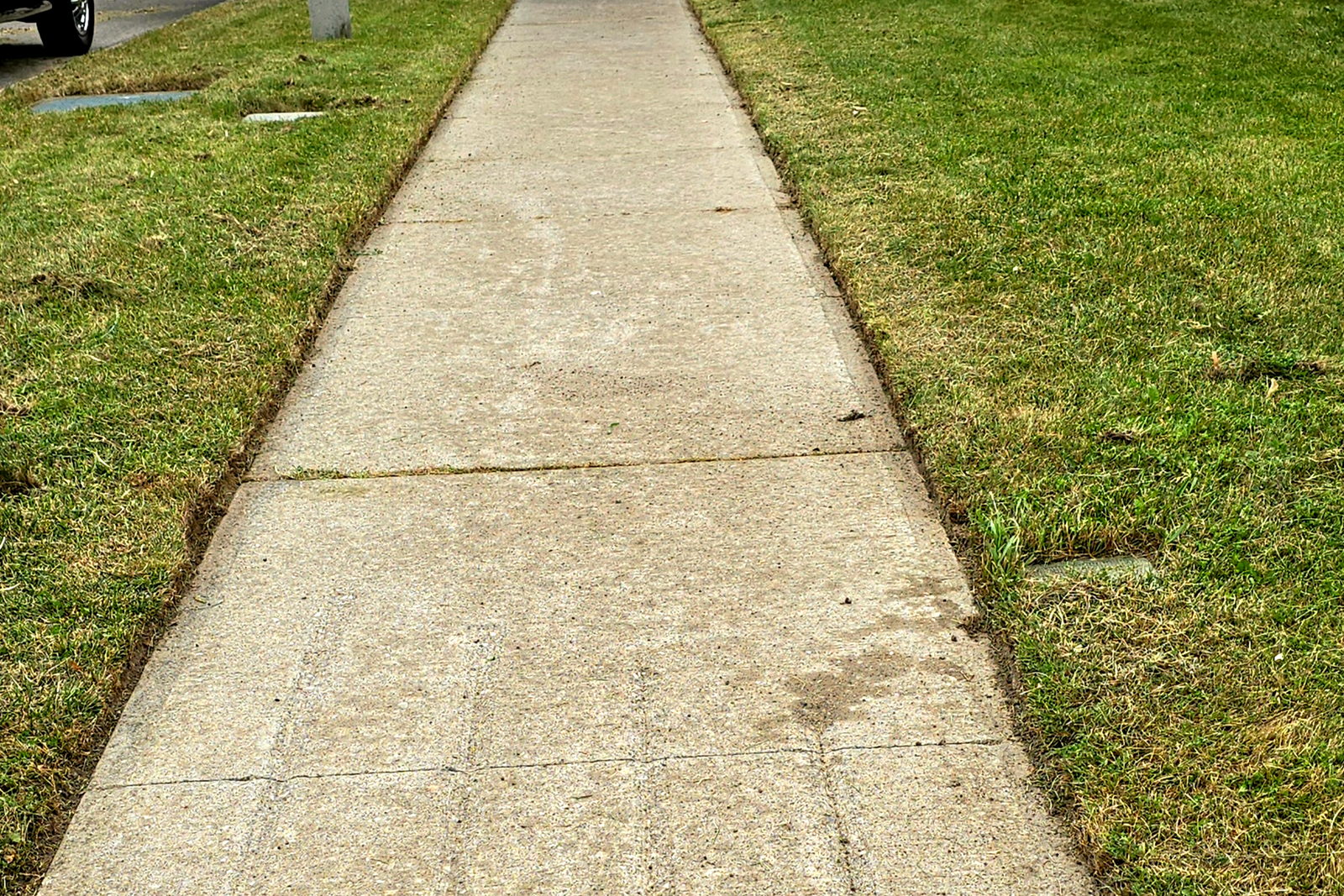
Real Northline properties, before and after, every one of them in Oshawa and every one of them this year. Drag the line to compare.
Andrew answers, October 2026
Why is the morning clearing time a target rather than a promise?
Because a promise about the morning is a promise about the weather, and nobody can make one of those honestly. What I can promise is where you sit in the route and the order the route runs in, and both of those are published on this site. In eighteen years of Oshawa data the worst winter had twenty four clearing days and the mildest had four, and a promise written to survive the worst of those is a promise priced for it. A target I actually hit is worth more to you than a promise I have quietly priced the risk of breaking.
One of these goes on each page and it is replaced monthly. If the question you have is not here, ask it: 905-244-5779.
Have the frontage looked at before the ground hardens
Send me the address and I will tell you where your street line actually sits, which side the pile belongs on, what the winter costs for that driveway, and whether your household should be applying to the municipal program instead. If the free one fits you better, that is what I will say.