Snow removal · Large properties
Snow Removal for Large Driveways in Oshawa, and the Two Numbers That Price It
Snow removal for large driveways in Oshawa is priced on two numbers you already have: the acreage on your property tax bill and the length of the driveway from the garage door to the edge of the road. Where the two disagree, the driveway wins and the band moves up.
Over a third of an acre? See the estate bands in full.
Green in summer. Clear in winter.
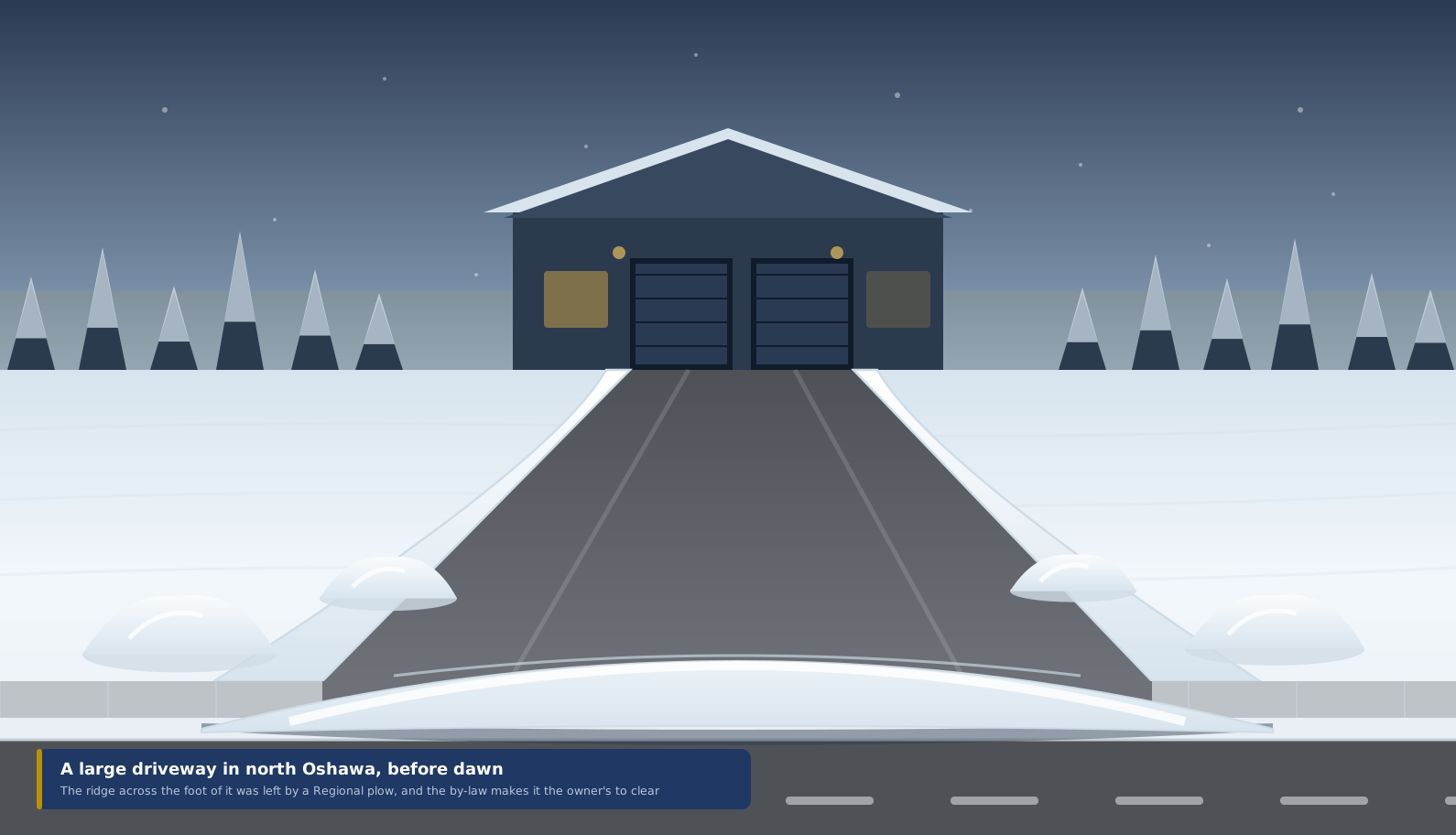
The short answer
Snow removal for a large driveway in Oshawa costs $1,750 plus HST for the season on an Estate lot of 0.35 to 1.0 acre or any driveway over 100 ft, and $2,600 plus HST on a Grand Estate lot of one to three acres or a laneway over 250 ft.
Measure two things and the price settles itself. Read the acreage off your property tax bill and measure the driveway from the garage door to the edge of the road along the path a vehicle actually travels. Up to 0.35 acre with a driveway under 100 ft is a standard property, and the seasonal snow package is $800, $975 or $1,200 plus HST by size. From 0.35 to 1.0 acre, or any driveway over 100 ft, is the Estate band at $1,750 plus HST for the season. Between one acre and three, or past 250 ft of laneway, is Grand Estate at $2,600 plus HST. Over three acres carries no published price, and that is deliberate.
The second half of the job is not the price. It is where the snow goes. A large driveway produces a volume of snow that a standard lot never has to solve, and Oshawa has a by-law for the road, a by-law for the sight line, and nothing at all for the middle of your own lawn, which is where the decision actually gets made.
Two numbers, and the longer one wins
A property type is what a homeowner thinks they are, and the two measurements are what they actually are. People underestimate their own driveway constantly, and not through any dishonesty. A driveway that curves, or widens into a parking apron by the garage, or runs back past the side of the house, measures far longer on the ground than it looks from the street. The quote form asks for the acreage and the laneway length for exactly that reason, and where the dropdown and the numbers disagree, the numbers decide and the band moves up rather than down.
The reason the band only ever moves up is arithmetic rather than policy. A driveway that is twice as long is not twice the time, because the snow has to be moved somewhere, and the further back the property line sits the further each pass has to carry what it is pushing. Quoting a 180 ft laneway as a standard property does not produce a small loss, it produces a job that runs late and pushes every property behind it later on the same morning.
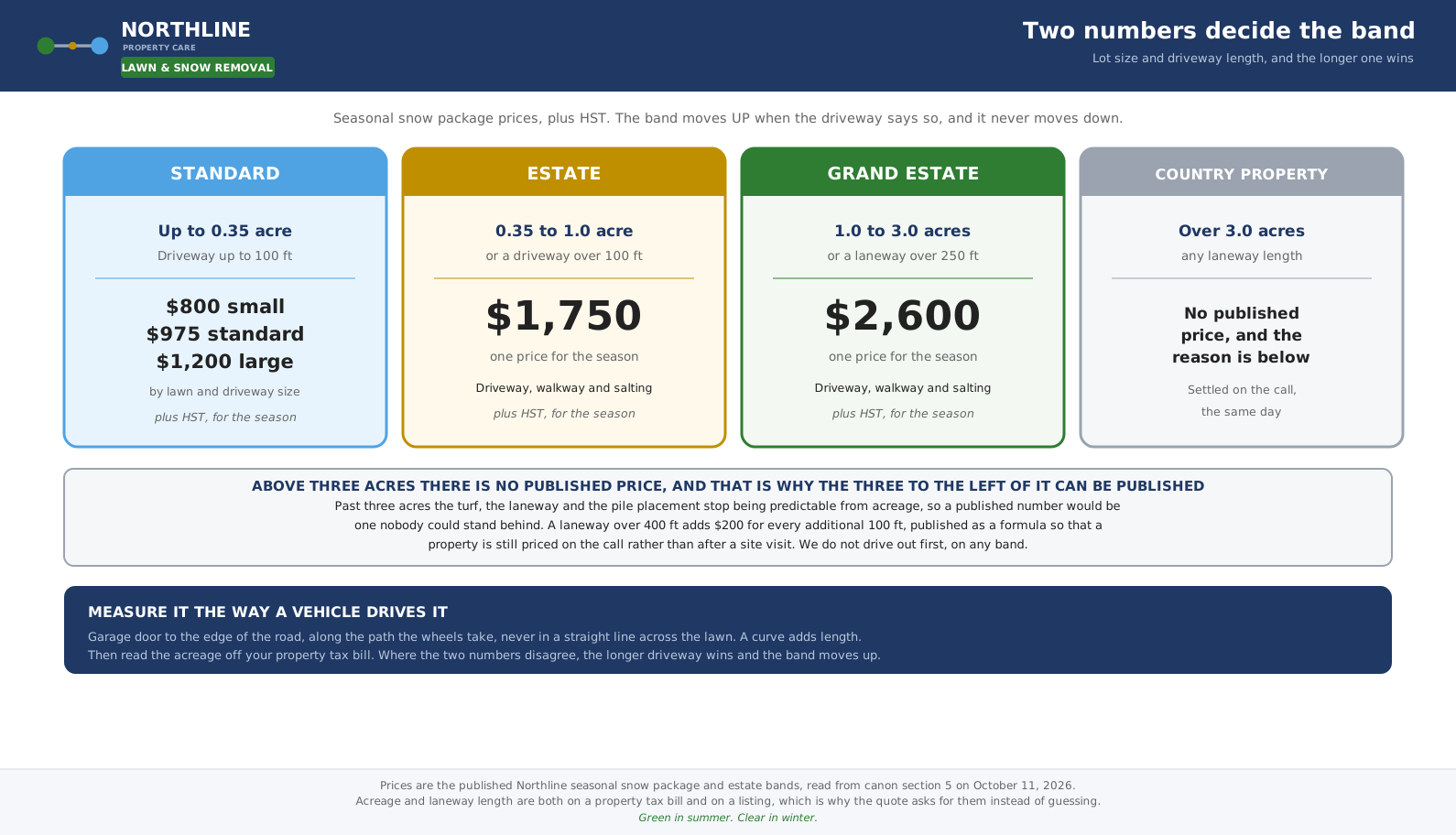
Above three acres there is no published price, and that omission is what lets the other three be published. Past that size the turf area, the laneway run and the available pile placement stop being predictable from acreage alone. A number printed for that case would be a number the business could not stand behind, which is worse than no number. What survives is the promise that matters, which is that nobody drives out to look first. The acreage and the laneway length settle it on the call, the same day.
If the property sits in the Estate or Grand Estate band and the household wants the lawn and the winter under one arrangement, the estate memberships run at $229, $349 and $499 a month for Estate and $329, $519 and $739 a month for Grand Estate. On any band, the entry tier does not plow the driveway, and the next paragraph but one says so in plainer words than most people expect from a price page.
Length is not the only measurement that changes the work, and the other one is rarely measured at all. A driveway that climbs or falls has somewhere it cannot put snow, it needs treating on mornings a level surface would not, and it loses usable width faster as the banks build either side of it. Where the grade rather than the run is the awkward part of a property, the numbers behind that sit on our page about steep driveway snow removal in Durham Region.
Where the large lots in Oshawa actually are, and two names that are not Oshawa
Oshawa carries a named Estate Residential land use designation in its own Official Plan, governed by policy 2.7.3.1. It is on Schedule A alongside Prime Agricultural, Rural Areas and the Oak Ridges Moraine, and it is the planning department's acknowledgement that a meaningful share of this city is not quarter acre subdivision. The Part II Planning Areas named in the Official Plan are Eastdale, Pinecrest, Taunton, Windfields, part of Kedron and Columbus, and the Columbus Part II Plan was only adopted by Council in October 2023.
North of Taunton Road the lots get deep fast. Above Winchester the zoning stops being residential at all in places and becomes agricultural: a Committee of Adjustment file at 571 Raglan Road East carries the zone as Oak Ridges Moraine Agricultural, which is the zoning that sits under the genuinely rural properties along the Raglan corridor. Those are the laneways that run past 250 ft without anybody thinking of them as long.
Two place names that come up in conversations about large Durham properties are not in Oshawa at all. Enniskillen, Hampton and Solina are hamlets in the Municipality of Clarington, zoned under Clarington by-law 84-63 with their own hamlet schedules. We clear in all of them, and we price them from the same bands, but a page that calls them Oshawa is simply wrong and the distinction matters the moment anybody looks up a by-law.
Here is the detail that changes who leaves the ridge across your driveway. Almost every spine serving the big north Oshawa lots is a Regional road and not a City road: Taunton Road, Winchester Road, Simcoe Street North, Harmony Road North, Ritson Road North, Columbus Road East, Raglan Road West and Grandview Street North are all on the City's own list of Regional roads. The Region of Durham patrols those seven days a week in winter and dispatches once about four centimetres has accumulated on the road surface. So on a Windfields or a Kedron frontage, the windrow is a Regional plow's work, the City is not going to come back for it, and the by-law that makes it yours is a City by-law. Three different authorities, one ridge of snow, and it is still in your way at six in the morning.
The ground under a north Oshawa lawn is not clay, and nearly everybody says it is
The Ontario government soil mapping returns loam at the surface for north Oshawa, not clay. Query the province's own Soil Survey Complex layer at points north of Winchester Road and the map unit comes back as Darlington Loam, texture class loam, drainage class well. Move east and it returns Bondhead Loam, also loam and also well drained. Along the Simcoe Street North corridor it returns Tecumseth Sandy Loam, which is imperfectly drained. The developed core of the city is mapped as built up area with no series at all, which is why series names can only honestly be quoted for the rural and newly developing fringe where the big lots are.
The clay is real and it is underneath. The Ontario Geological Survey surficial geology mapping returns unit 5d at the Darlington points, described as clay to silt textured till derived from glaciolacustrine deposits or shale, and unit 5b at the Bondhead point, a stone poor sandy silt to silty sand textured till. So the accurate sentence, and it is more useful than the lazy one, is loam topsoil over a dense till. Water moves through the top easily enough and then meets something that it does not move through, which is why a melting pile produces a patch that stays saturated for weeks rather than draining away.
One honesty note, because the research turned up a disagreement rather than a clean answer. Standard pedology places Darlington as the imperfectly drained member of the Bondhead catena, while the province's own attribute returns well drained for both. The provincial value is what a government source actually returned and it is what is reported here, but anybody leaning hard on well drained for a specific property should dig a hole and look rather than trust a map layer, ours included.
The volume collapses. The mass does not move at all.
This is the single thing that separates a large driveway from a hard version of a small one. Take a driveway of 10.0 m by 12.0 m, which is 120 square metres and a fair description of a three wide, two deep parking area in front of a double garage on an Estate lot. Put 20 cm of fresh snow on it. At the one kilonewton per cubic metre that the National Building Code climatic commentary gives as the Canadian average for new snow, roughly 102 kg per cubic metre, that is 24 cubic metres and about 2.4 tonnes.
Leave it a day. The seasonal snow pack east of the continental divide averages 2.01 kilonewtons per cubic metre in the same source, roughly 205 kg per cubic metre, and the old snow range runs to five kilonewtons. The same snow now occupies twelve cubic metres, or under five if a plow has compacted it into a windrow. The pile looks half the size. It weighs exactly what it weighed.

The same 20 cm fall on a standard double driveway of 33 square metres is about 0.67 tonnes. That is the comparison worth holding on to: a large driveway is not a slightly worse job, it is roughly four times the job, and it is four times the job every single event of the winter. Those unit weights are structural loading figures published for roofs and ground loads rather than measurements of a driveway pile, and the honest position is that we could not find anybody who has ever measured a residential driveway pile. The figures are the right order of magnitude and they are not a survey of your driveway.
Where it bites is not the first clear. It is the fifth one in February, when the two storage areas are already full and the next 2.4 tonnes has nowhere obvious to go. That is a problem you solve in October on paper, or you solve it at six in the morning in the dark, badly.
Where the snow can legally go in Oshawa, and the three places it cannot
Oshawa writes down where the snow may not go and says almost nothing about where it may. Section 6.1 of the Winter Access By-law 92-2009 forbids any person moving snow off a private lot and onto a highway, and section 2.1(f) defines highway widely enough to take in the boulevard. Section 6.2 closes the other obvious route, which is a neighbour‧s boulevard, by forbidding a deposit on any boulevard other than the one in front of your own lot. Section 2.1 defines a sidewalk to include the portion that crosses a private driveway, and section 3.1 requires the owner to clear snow, ice and windrows from it by midnight of the first day after the precipitation has ended.
Read those two together and something that surprises most people falls out. The strip of sidewalk that runs across the end of your own driveway is legally your sidewalk, the windrow sitting on it is legally yours to remove, and the deadline is midnight of the day after the snow stops. The administrative penalties are $75, $175 and $275 within one calendar year, and a conviction runs from $300 to $5,000 for a first offence. The City may also clear it without notice and add the cost to your tax roll with interest.
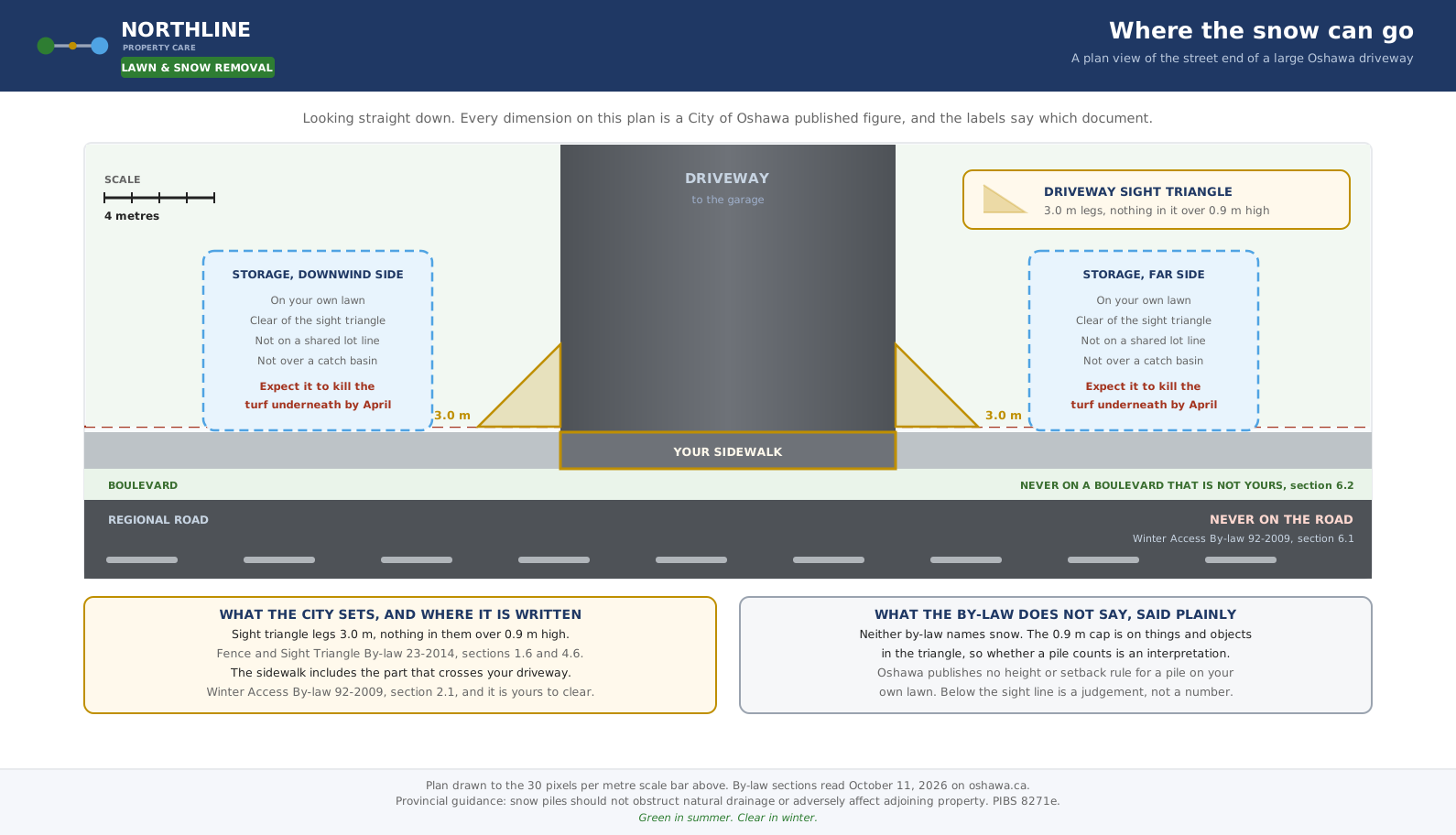
The third restriction is the one nobody knows. Under the Fence and Sight Triangle By-law 23-2014, a driveway sight triangle is struck by measuring 3.0 m back along the side of the driveway, 3.0 m along the street line, and joining those two points. Section 4.6 then holds every fence, natural feature, thing and object standing inside that triangle to 0.9 metres. A pile at the end of a long driveway is very easily taller than 0.9 m, and on a Regional road at seven in the morning it is sitting exactly where a driver needs to see.
Here is the limit of that argument, stated rather than glossed. Neither by-law names snow. The 0.9 m cap is on things and objects in the triangle, and whether a seasonal pile counts as a thing or an object is an interpretation and not a published rule. Oshawa publishes no height limit and no setback for a pile in the middle of your own lawn either. What the province does say, in its Guidelines on Snow Disposal and De-icing Operations in Ontario, is that snow piles should not obstruct natural drainage or adversely affect adjoining property. That is the sentence that should decide it, and it rules out the two placements people reach for first: hard against a shared lot line, and on top of the catch basin.
Check the City's free option before you check ours
If your household qualifies for the City of Oshawa Snow Clearing Assistance Program, take it, because no contractor beats a service with no fee. The City's 2025 to 2026 bulletin sets out the terms. The applicant has to live in the single family dwelling on the application, has to be 65 or older or have a disability with proof submitted each year, and there must be no resident without disabilities living at the address. Service begins after a snowfall of more than 2.5 cm and is planned for completion by midnight the day after the snowfall ends, with no guaranteed schedule.
Then read the two limits, because this is where a large property falls out of it. The program clears City sidewalks and driveway windrows, and nothing else. It does not touch the rest of the driveway, and on a 150 ft laneway the windrow is a small fraction of the problem. And a windrow is only cleared if it is at least 20 cm high, which means a 6 cm night in Oshawa is a night the program leaves you exactly where you were.
That is the honest shape of it. The program is genuinely good and it is genuinely narrow, and on a large property it solves the first three metres of a job that is thirty metres long. Apply anyway. Then decide separately what to do about the other twenty seven.
What the City and the Region actually owe you, in hours
Oshawa publishes completion times by road class and never publishes the snow depth that starts the clock. The City's own activity report sets six hours for arterial roads, twelve for collectors and sixteen for residential streets, and points at Ontario Regulation 239/02 for the accumulation that triggers it. The provincial table puts a Class 4 highway at 8 cm and sixteen hours, and Oshawa's published sixteen hours lines up with that row exactly, so an Oshawa residential street is almost certainly a Class 4 and the clock starts at 8 cm. That is an inference from two documents rather than a statement by the City, and it is flagged here as one.
The scale of what they are clearing is on the same page: more than 500 km of primary roads, 765 km of residential roads and 160 km of sidewalks. Nobody is coming to your laneway. The City settles it in one line on its snow clearing page, which is that the windrow belongs to whoever owns the property it blocks.
Two more dates that catch large property owners out. On street parking is prohibited from 2 a.m. to 6 a.m. from December 1 to April 1, regardless of whether it is snowing, so the overflow parking habit of leaving a vehicle on the street during a clear is a fine waiting to happen. And the City does not inspect or complete curb cuts from December 1 to March 31, so if the answer to your driveway problem is a wider entrance, that decision has to be made in the autumn or it waits a year.
Salt, a long driveway, and the edge of the lawn
A long driveway is a long salted surface, and the lawn either side of it takes the whole of it. The Environment Canada and Health Canada assessment of road salts puts the threshold at which sensitive terrestrial plants are affected at roughly 68 mg of sodium per kilogram of soil and 215 mg of chloride per kilogram. The same report measured chloride in waste snow and meltwater at concentrations running from 1,366 to 18,230 mg per litre across one set of storm samples. That meltwater does not evaporate off a driveway. It runs to the edges, which on a large property is a great deal of edge.
The regulatory history is worth knowing because almost everybody states it wrong. In 2001 the federal assessment concluded that road salts satisfy the toxicity test written into section 64 of the Canadian Environmental Protection Act, at paragraphs (a) and (b). That is the formal finding. The Code of Practice that followed in April 2004 is voluntary, and it is aimed at public road authorities burning through more than 500 tonnes a year. Road salts never were added to Schedule 1, the List of Toxic Substances. None of it reaches a residential driveway.
Which makes the next figure the interesting one. In the Highland Creek watershed in Toronto, the federal and provincial work behind the Canadian water quality guideline for chloride attributed about 38 per cent of applied road salt to private contractors rather than to municipalities. Private application is a large and almost entirely unregulated share of the total. On a long Oshawa driveway, how much salt goes down is a decision somebody makes, and the only thing stopping it being far too much is whether that somebody is paying attention.
The practical answers are not complicated. Salt where there is ice, not where there is snow, because a blade removes snow and salt does not. Keep the application off the last metre at the edges where it does nothing for traction and everything to the turf. And expect the strip either side of a long driveway to need overseeding more often than the rest of the lawn, which is a conversation for the salting page rather than this one.
The pile is a lawn decision, not a tidiness decision
Wherever the pile goes, that patch of lawn is the last thing on the property to melt, and that is exactly the condition grey snow mould needs. Penn State Extension puts the disease in the areas of greatest snow accumulation and names driveways and sidewalks specifically, and notes it seldom occurs except under snow cover when the soil is not frozen. A deep pile is an insulating blanket. It keeps the soil beneath it unfrozen and the interface just above zero, in the dark, on wet leaf tissue, for weeks.
The durations are published. The University of Massachusetts gives grey snow mould a window of 45 to 60 days of snow cover and speckled snow mould 75 to 90 days, and its own prevention advice is a single sentence that most property owners have never read: do not pile snow on the lawn when shovelling walkways and driveways. On a standard lot that advice is almost achievable. On a large property it is not, because there is nowhere else for 2.4 tonnes to go, and pretending otherwise would be dishonest.
So the real rule for a large driveway is placement rather than avoidance. Put the pile where it gets afternoon sun, keep it off the finest turf, keep it away from anything you care about in a bed, and accept that the pile site will be the patch that needs raking out and overseeding in April. Plan for that in the spring rather than being surprised by it. If it does show up, the snow mould page covers what to do and what not to do, and the first thing not to do is panic and apply a fungicide.
The second mistake is heavier and it lasts longer. Manitoba Agriculture's soil management guidance states that the first pass accounts for up to 80 per cent of the compaction that four passes would cause on the same spot, and that wheel traffic compaction reaches 30 to 90 cm deep. Alberta Agriculture adds that the risk is highest when soil moisture is highest, which in Durham is the late February thaw. Widen your track onto the lawn once during a thaw on that loam over till profile and you have bought most of the compaction damage of doing it four times. Recovery, on Alberta's own figure, is three to five years. That is why a long driveway gets a planned travel path in October and the same path every event after it.
What a large property actually buys, and the tier that does not plow
Silver does not plow the driveway, and on a large property it is usually the wrong answer. At $129 a month plus HST, Silver covers a windrow pass by 5 p.m. and carries no salting at any depth and no morning target. On a 30 ft driveway that is a real product. On a 150 ft laneway on Raglan Road it is a windrow pass on a driveway that is still full of snow, which is not a service anybody should be sold. Say that at the quote rather than at the first storm.
Gold at $189 a month plus HST plows the whole driveway and carries the 7 a.m. target after overnight snow. Platinum, at $279 a month plus HST, goes first in the sequence, carries a 6:30 a.m. target, salts automatically with no limit on it, and takes first choice of service day. On the estate bands the same three tiers run at $229, $349 and $499 a month, and at $329, $519 and $739 a month on Grand Estate. Clearing begins at a measured 3 cm on a residential property. That is a depth read on the ground rather than anything a forecast said the night before, and it sits a long way below the 8 cm at which the province expects a residential street to be touched at all.
The argument for a seasonal price on a large property is not the number of events. An eighteen winter record at the Oshawa station gives about twelve clears a winter at the 3 cm residential trigger, with a spread from four to twenty four, and anybody who wins a price argument on an average will lose it in a mild February. The product is that the number stops being your problem. Four clears or twenty four, the seasonal price does not move, and on a property producing 2.4 tonnes an event that is worth more than it is on a property producing 0.67.
One operational note that is specific to length. A morning target is the thing that limits how many properties a route can hold. So it closes once it is full, and it stays closed until the following season. A long laneway takes a bigger share of that morning than a standard driveway does, which is why the Estate and Grand Estate places go first and why November 1 is a real date rather than a selling line. More on how the winter is sequenced is on the Oshawa snow removal page, and the long laneway specifics are on the long driveway page.
What we could not verify
Every figure above carries the document it came from. These are the things that were looked for and not found, which is the half of a method that most pages never print.
- Oshawa's own snowfall normals. Environment and Climate Change Canada blocks automated access to the climate normals for the Oshawa station, so no annual snowfall total appears on this page. The event count above comes from the eighteen winter analysis already held in our own records rather than from a figure read today.
- A snow depth that triggers an Oshawa residential plow run. The City never publishes one. The 8 cm figure is an inference from the provincial Class 4 row matching the City's published sixteen hour standard, and it is named as an inference.
- Any rule anywhere in Oshawa's by-laws on the height or the setback of a snow pile on private property. There is none. The 0.9 m sight triangle cap is on things and objects and does not name snow.
- A measured density for a plow windrow or a residential driveway pile. Nothing found. The unit weights used are structural loading figures for new snow, seasonal pack and old snow.
- Minimum lot areas for Oshawa's R1 and agricultural zones. The zoning by law text would not yield past the definitions section, so no zone minimum is quoted here.
- A measured distance that salted meltwater travels into turf from a residential driveway. The verified distances are highway scale aerial spread and a university planting setback of three feet from driveways, neither of which answers the question.
- Whether Darlington Loam is well drained or imperfectly drained. The province's own layer says well. Standard pedology says imperfectly. That disagreement is reported rather than resolved.
Every external figure on this page came from a municipality, a region, a ministry, a federal agency, a provincial geological survey or a university extension service. Not one came from another property maintenance company's price page, and that is a rule rather than an accident.
Questions people with large properties actually ask
What counts as a large driveway in Oshawa?
A driveway over 100 ft, or a lot of 0.35 acre or more, puts a property into the Estate band. Past 250 ft of laneway, or a lot of one acre up to three, moves it again into Grand Estate. The two tests are read together and the one that lands higher is the one that counts, because the work is set by the longer measurement rather than by the average of the two. Measure from the garage door to the edge of the road along the path a vehicle actually takes, not in a straight line across the lawn, because a curve adds real length and real time.
What does snow removal cost for a large driveway in Oshawa?
The seasonal snow package covers a standard residential property at $800, $975 or $1,200 plus HST according to size, and it takes in the driveway, the walkway and the salting at the measured 3 cm residential trigger. An Estate property is $1,750 for the season plus HST and a Grand Estate property is $2,600 plus HST. A laneway over 400 ft adds $200 for every additional 100 ft, published as a formula so that a property can be priced on the call instead of after a site visit. Above three acres there is no published price at all, and the reason is that a published number up there would be one nobody could stand behind.
Where am I allowed to put the snow from a large driveway?
On your own property, clear of the driveway sight triangle, and nowhere else. The Oshawa Winter Access By-law 92-2009 puts the road and the sidewalk out of bounds at section 6.1, and section 6.2 does the same for any boulevard other than the one in front of your own lot. Under the Fence and Sight Triangle By-law 23-2014, a triangle is struck 3.0 m back along the side of the driveway and 3.0 m along the street line, and section 4.6 holds everything inside it to 0.9 metres. Neither by-law names snow in those words, which is worth saying plainly rather than claiming more certainty than the documents carry.
Does the City of Oshawa clear the windrow across my driveway?
Not for most households. The City settles it in one line on its snow clearing page, which is that the windrow belongs to whoever owns the property it blocks. There is an assistance program, and it is narrow by design: the applicant has to be 65 or older or have a disability, there must be no resident without disabilities living at the address, service starts after a snowfall of more than 2.5 cm, and a windrow is only cleared if it is at least 20 cm high. If you qualify, apply for it, because the bulletin states no fee and no contractor beats that.
Is my north Oshawa lawn clay?
Probably not at the surface, whatever you have been told. The Ontario government soil mapping returns Darlington Loam and Bondhead Loam for the rural and newly developing parts of north Oshawa, both of them loam at the surface, with Tecumseth Sandy Loam in the sand body along the Simcoe Street North corridor. The clay is in the till underneath, which the Ontario Geological Survey maps as clay to silt textured till. That matters for snow because water moving off a melting pile reaches that dense layer and then sits, which is how a pile site ends up as the wettest and latest patch of lawn in April.
Why does where I pile the snow matter at all?
Because the pile decides which patch of lawn is still under snow in April, and snow cover is what grey snow mould needs. Penn State Extension puts the damage where the snow is deepest, naming driveways and sidewalks specifically, and the University of Massachusetts gives grey snow mould a window of 45 to 60 days of snow cover and speckled snow mould 75 to 90 days. A pile that takes three extra weeks to melt hands the fungus the conditions it needs on that one patch, long after the open lawn has dried out.
Who wrote this, and what was read to write it
Andrew owns Northline Property Care, and he prices every property off the two numbers at the top of this page before anybody is booked. He clears driveways across Oshawa, Whitby, Courtice, Bowmanville, Clarington, Ajax and Pickering, fully insured. Six winters of clearing Durham snow sit behind the placement advice above, and that tenure belongs to him rather than to the company.
The soil mapping, the by-law sections, the unit weights and the extension service findings above were each read on the page they are linked to, on October 11, 2026. Where a document disagreed with what this business believed, the document is what is printed. If something on this page turns out to be wrong, the fastest way to have it put right is a text message to 905-244-5779.
Read next
The estate bands in full
Both halves of the year on a property over a third of an acre, with the acreage and laneway thresholds and what each band includes.
See the estate bands →Acreage, and where the formula stops
What changes past an acre, why the laneway length beats the lot size, and the point at which a published price stops being honest.
Read the acreage page →Who clears the windrow, town by town
Every municipal assistance program in this region, with its depth trigger, its deadline and the households it quietly excludes.
Open the windrow guide →The work, photographed
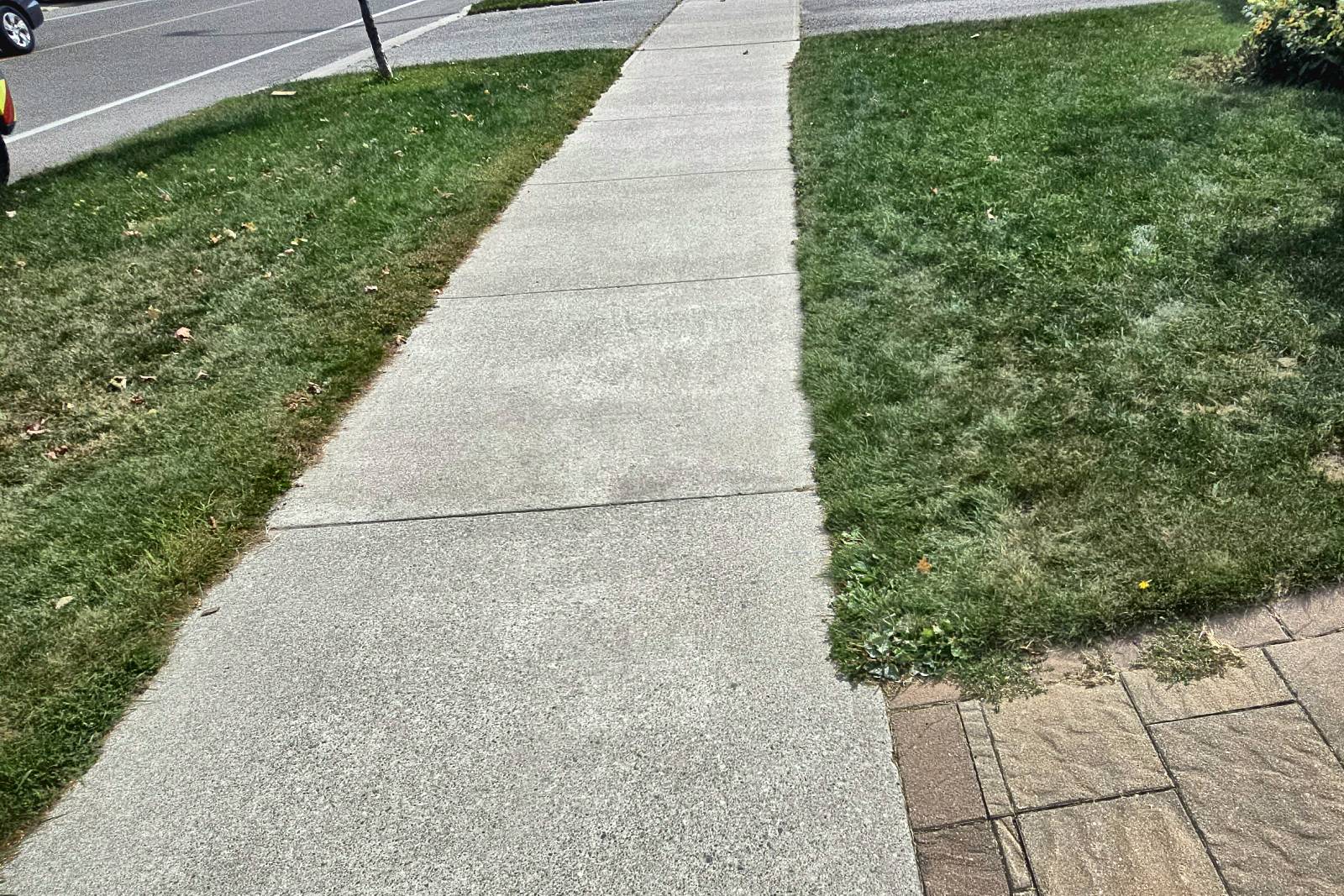
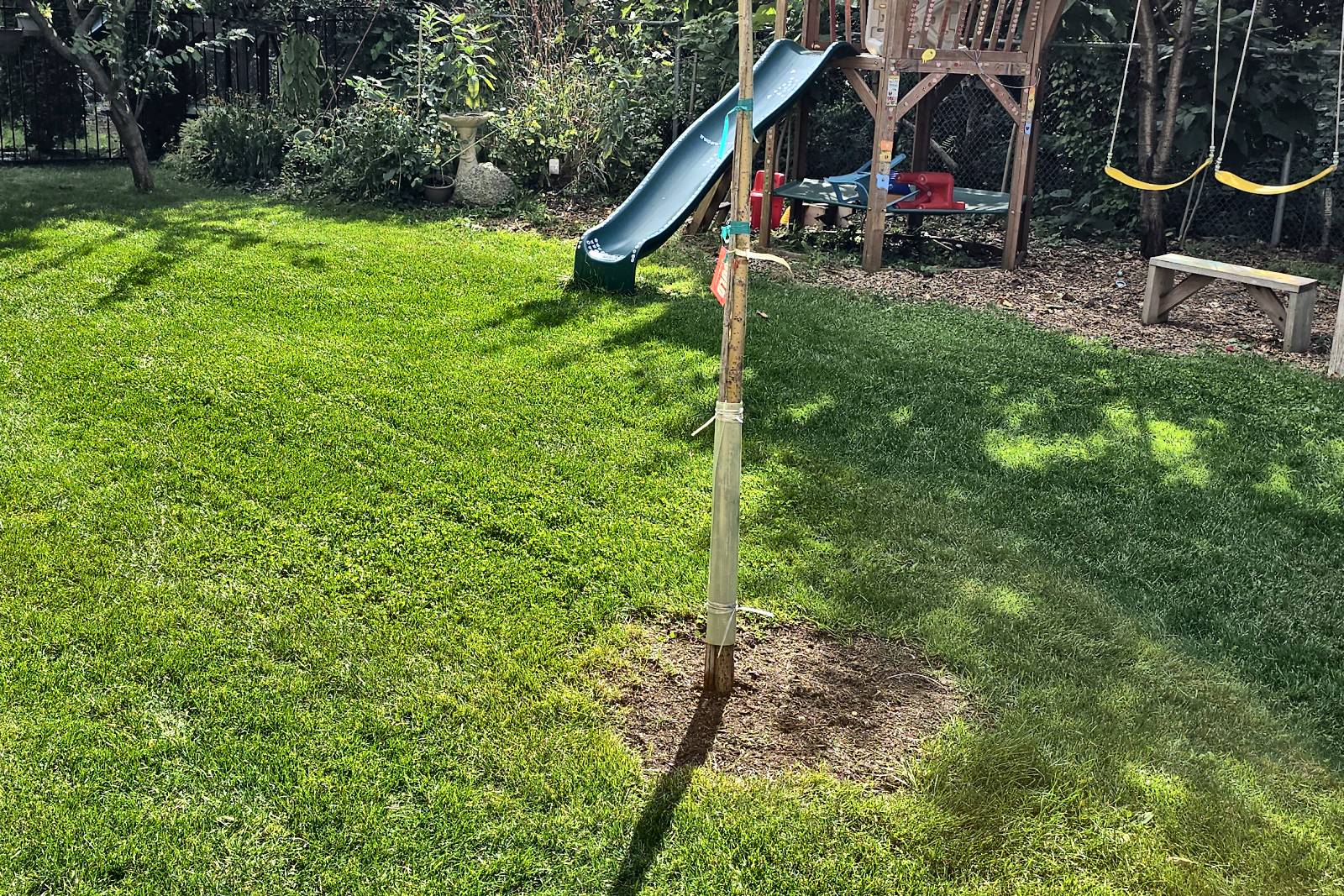
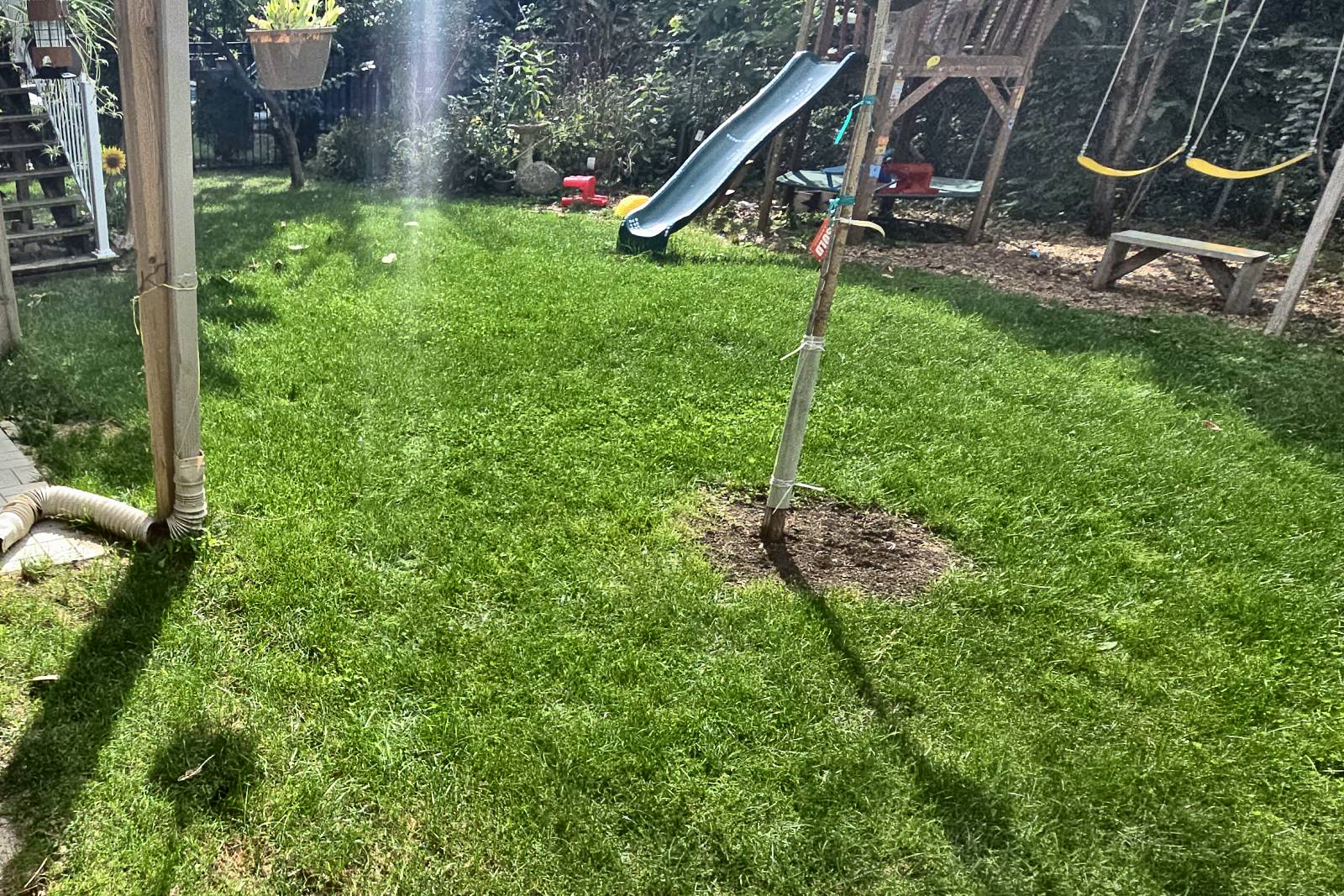
Real Northline properties, before and after, every one of them in Oshawa and every one of them this year. Drag the line to compare.
Andrew answers, October 2026
Is the 3 cm trigger measured at my house or somewhere else?
On the route, not at an airport. Three centimetres is the depth at which a residential driveway stops being something you can drive out of, so that is where the number is set. Below it we are still out, but it is salt and the walkway rather than the blade, and that happens without you asking for it.
One of these goes on each page and it is replaced monthly. If the question you have is not here, ask it: 905-244-5779.
Send me the two numbers and I will price it on the call
The acreage off your tax bill and the driveway length from the garage door to the road. That is everything needed to tell you the band, the seasonal price and whether the City program would serve you better. Nobody has to drive out and look first.