Property care · Ice control
Pet safe ice melt in Oshawa, and why nobody has to prove the two words on the front of the bag
Pet safe ice melt in Oshawa is a sentence on a bag before it is anything else, because de icer packaging carries no labelling standard that a manufacturer has to meet. What protects a dog here is how much goes down and where the open bag is kept.
- Fully insured
- Owner operated, one accountable name
- Every figure here comes from a government, a university or a veterinary source
- We sell no ice melt and recommend no brand
The short answer
Clear to bare pavement first, spread about a coffee mug of product on a standard two car driveway, keep the bag shut and off the garage floor, and put a full water bowl inside the door. That is the whole protection, and not one item on it is a product you have to go and buy.
The words on the front of the bag are the part that does the least work. No labelling standard governs them, the chemistries marketed as gentle are the ones that stop melting first in a Durham cold snap, and two of the chemistries that do keep working in deep cold are rougher on a dog gut than plain rock salt. The quantity is the lever. The label is a preference.
Pet safe is two words on a bag, and nobody anywhere has to prove them
There is no labelling standard for de icer packaging, so pet safe is a claim a manufacturer makes rather than a test a product passes. The Minnesota Pollution Control Agency, a state environmental regulator with no interest in selling anybody anything, writes that there are no standards for de icer packaging and that any company could label its salt pet friendly. Its own technical manual repeats the point in flatter words still: there are no labelling requirements, and manufacturers can choose to label products in their own way.
The ASPCA says the same thing from the animal side rather than the regulatory one, and it is worth reading twice because it comes from the organisation that runs the poison control line. There are no specific requirements for labelling a de icer product as pet safe. The advice that follows from that is to treat every chemical de icer the same way whatever the front of the bag says.
Canada does not have a tidier answer. Federal law reaches this subject through exactly one document, the Code of Practice for the Environmental Management of Road Salts. It took effect on April 3, 2004 and it is voluntary. It reaches organisations burning through more than 500 tonnes in a year, measured on a five year rolling average. And its own application clause rules out salt put down for a domestic purpose, or for a private or an institutional one. Read that sentence slowly, because it is the whole regulatory position on the bag in your garage. Nobody is watching what a homeowner or a private contractor in Oshawa spreads, and nobody is checking the word on the front of the bag either.
What does exist are rules against misleading claims in general. The United States Federal Trade Commission treats a non toxic claim as covering household pets by name, and says a marketer needs competent and reliable scientific evidence behind it. The Competition Bureau in Canada tells businesses to avoid vague environmental claims in favour of clear and specific ones, and sums its own guidance up as when in doubt, spell it out. Neither of those is a product standard, and neither one puts a number on a bag. They are a reason to be sceptical, not a reason to be reassured.
The unprofitable part first: the treated driveway is the weakest of the four risks
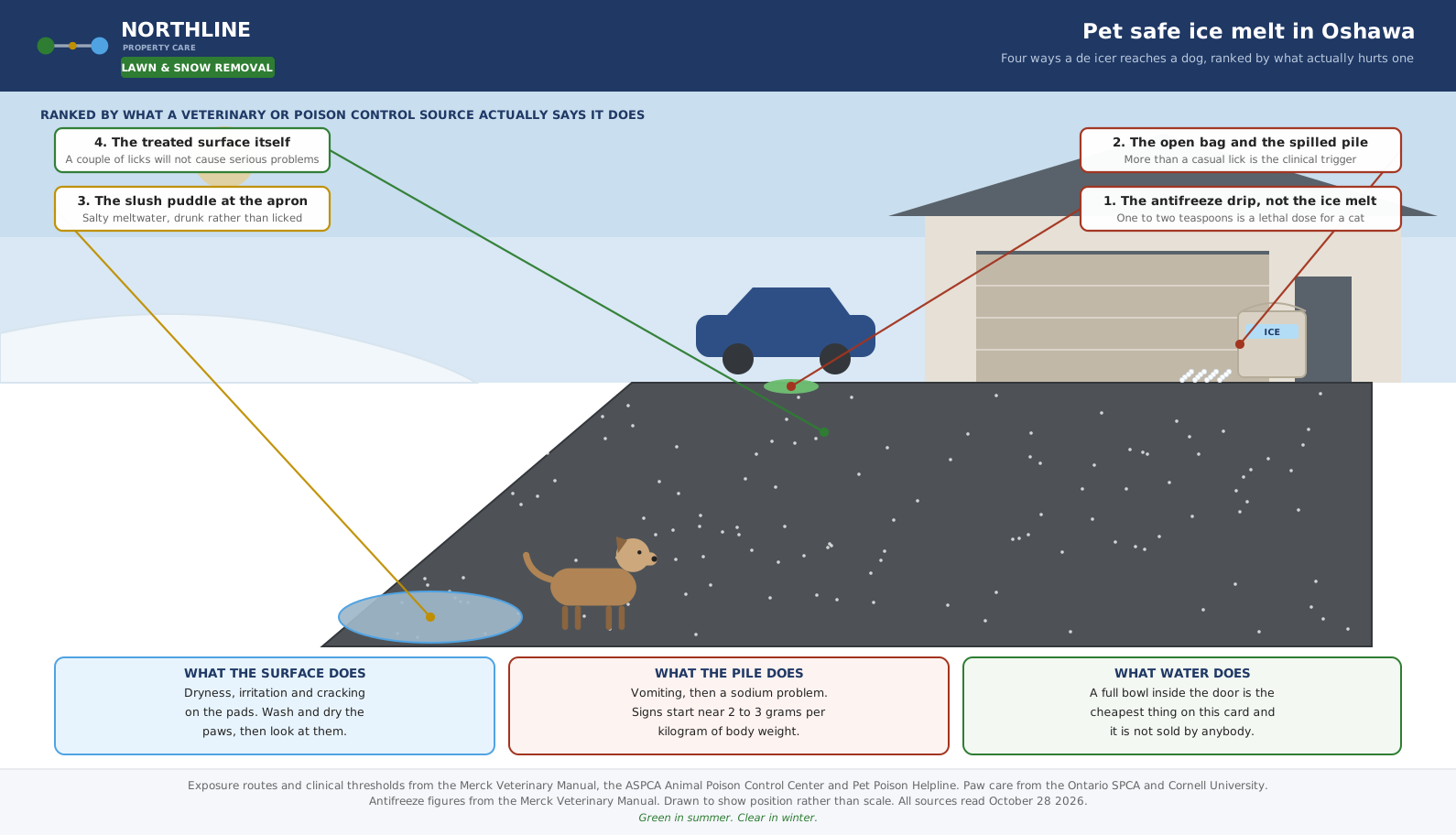
Walking a dog across a driveway with a correct scatter of ice melt on it is close to the bottom of the list of things that will hurt that dog this winter. The ASPCA Animal Poison Control service states that a couple of licks of a paw or of treated ground will not cause serious problems, and sets its own clinical trigger at anything more than a casual lick. An emergency veterinarian at the Tufts Cummings School of Veterinary Medicine put it more bluntly in an interview published by the university: you do not need to stress too much about protecting a dog from salt and chemical de icers, and a dog that licks its paws will at worst have an upset stomach.
There is a second figure that points the same way. The ASPCA Animal Poison Control service handled more than 451,000 calls about toxic exposures in animals in 2024 and published the ten categories those calls fell into. Over the counter medications led it, then human food and drink, then human prescriptions, then chocolate. Ice melt, de icer and road salt are not on the list at all. That is not proof that nothing happens, and we say so in the section on what we could not verify, but it is the best public picture available and it does not describe a driveway as a hazard.
We are a snow removal business and this paragraph costs us a sale, so here it is in plain words. If the only reason you are considering a winter service is that you are worried about what the driveway is doing to your dog, the cheapest correct answer is a shovel, a mug of product and a bowl of water by the door, and that answer costs you nothing from us. Where a service earns its money is the hour of your morning, the ridge the plow leaves across the end of the driveway, and the part of a Durham winter that happens before anybody is awake. It is not a pet safety product and we are not going to sell it as one.
So where does the real danger sit, and why is one of the four not ice melt at all
The quantities that worry a poison control centre come from a container rather than from a surface. A bag left open in the garage, a pile spilled by the side door that nobody swept, a bucket tipped over by a dog that found it interesting. That is where a dog gets a mouthful instead of a trace, and it is the one path on the drawing above that sits entirely inside your control and costs nothing to close. Shut the bag, lift it off the floor, and sweep what spills.
The second route is the slush puddle at the apron. A dog that will not lick a dry driveway will happily drink salty meltwater out of a low spot, and in Durham that low spot is usually where the municipal apron meets a private driveway, because that is where the grade changes and where the street plow leaves its deposit. Pet Poison Helpline names drinking salty meltwater alongside licking paws, and Minnesota's own homeowner guidance says the same. It is also the one place on a driveway where the concentration is highest, because every grain that was spread uphill ends up dissolved in that one puddle.
The fourth route on that drawing is not ice melt at all, and it is the only one on the list that kills animals in Durham every winter. Antifreeze tastes sweet, and the Merck Veterinary Manual puts the lethal dose at only three to four teaspoons for a dog and one to two teaspoons for a cat. That is a few drops of a puddle under a parked car. No source we could find lists ethylene glycol or propylene glycol among the ingredients of any solid driveway ice melt, and the Merck page on ethylene glycol does not mention de icers at all. So if you are worried about your driveway on a cold morning, look under the car first and at the bag second. The two hazards get conflated constantly, and only one of them is measured in teaspoons.
The dose, in grams, for the size of dog most people in Durham actually own
Signs of salt toxicosis are expected in a dog at about two to three grams of sodium chloride for every kilogram of body weight, and the Merck Veterinary Manual gives roughly four grams per kilogram as the lethal figure. That is the professional edition of the manual, not a consumer page, and the same four gram figure is given independently by Pet Poison Helpline and by two ASPCA Animal Poison Control toxicology briefs. It is the most load bearing number in this whole subject and it is almost never printed anywhere a homeowner will see it.
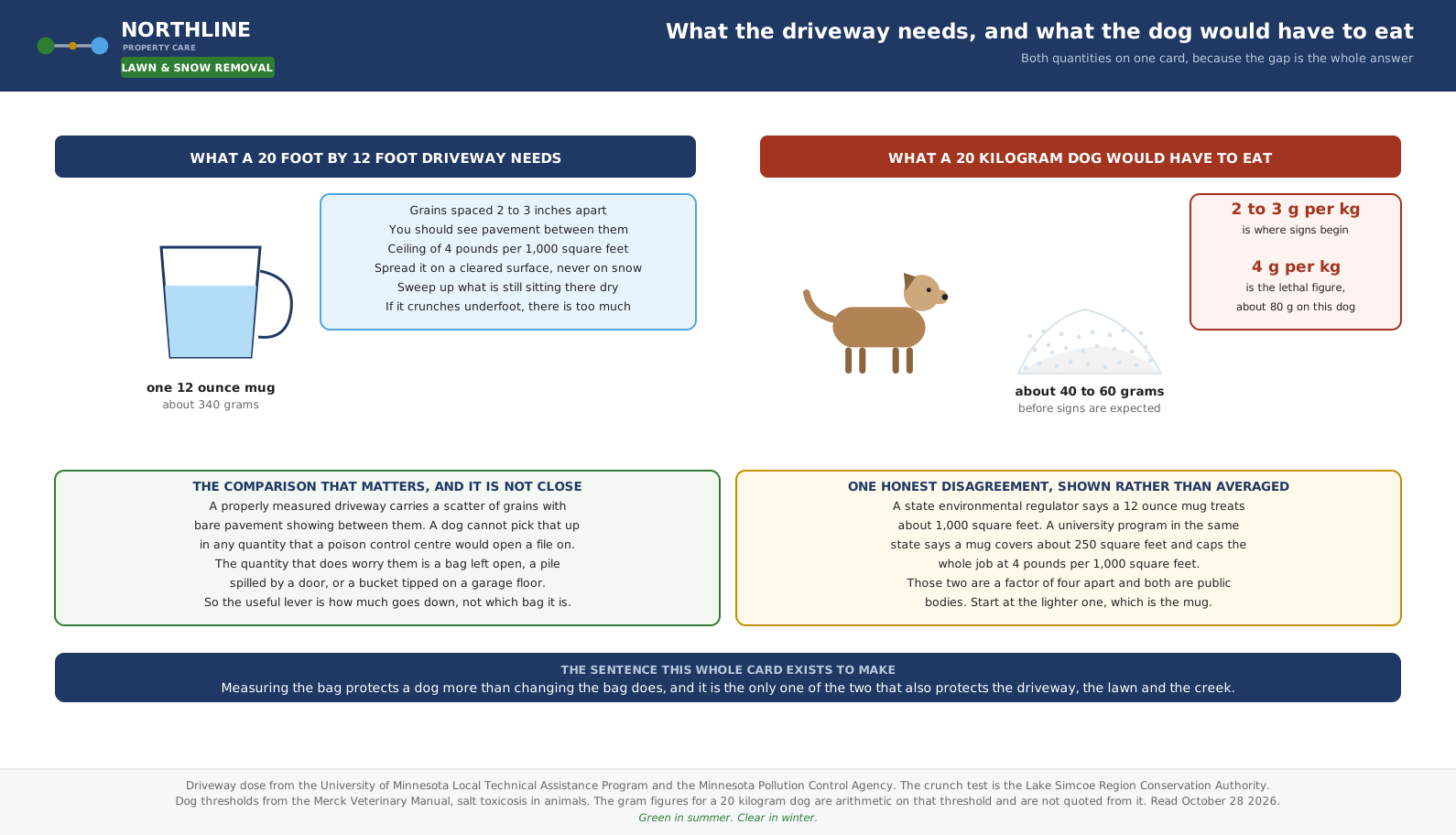
Put it on a real dog. A twenty kilogram dog, which is a mid sized retriever cross and the commonest shape on a Durham sidewalk, reaches the lower threshold at roughly forty to sixty grams and the lethal figure at roughly eighty grams, which is something like a third of a cup. A five kilogram dog reaches the lethal figure at about twenty grams, which is a heaped tablespoon and a half. Those gram figures are our arithmetic on the published threshold rather than numbers quoted from the manual, and we flag that because a figure with the wrong attribution outlives the person who wrote it.
Now set that against what is actually on a correctly treated driveway. A twenty foot by twelve foot driveway takes about a mug of product spread with pavement visible between the grains. A dog cannot pick up forty grams off that surface by licking, and it can pick up forty grams out of a tipped bucket in seconds. That gap is the entire argument of this page, and it is why measuring the bag protects an animal more reliably than changing the bag does.
Two honest limits on those numbers. The Merck manual reports a mortality rate above fifty per cent in animals that have developed clinical salt toxicosis regardless of treatment, and that figure is across species and across every cause of it, not a figure about dogs that licked a driveway. And the mechanism is worth knowing because it explains the advice: a fast rise in blood sodium pulls water out of brain cells, which is why vomiting comes first and neurological signs come after it, and why free access to water is the single most useful thing standing between an ingestion and a hospital visit.
The marketing is upside down, and the gut is where it shows
The chlorides sold as the kinder upgrade are the ones a poison control centre is hardest on. Pet Poison Helpline ranks them plainly: calcium salts are the most hazardous and the most severe irritants of all the ingredients in ice melts, potassium chloride is a severe irritant that can push a dog to bloody vomiting or diarrhoea, and magnesium chloride is irritating and produces gastrointestinal upset. The ASPCA puts the same conclusion in one sentence: calcium, potassium and magnesium chloride can be even more irritating to the gastrointestinal tract than sodium chloride is.
Calcium chloride earns a specific line of its own. Two separate ASPCA sources report that it can ulcerate a dog's mouth and stomach, painfully enough to put the animal off eating and drinking, which is a bad outcome in its own right when the underlying problem is a sodium load that needs water to clear. Magnesium chloride is the one most often painted on a bag as the pet friendly choice, and it is the one that keeps turning up on the wrong side of these comparisons.
Urea is the exception, and it is the only chemistry an allowed source actually points at. The ASPCA Animal Poison Control service describes urea as the least irritating to the stomach and recommends urea based products for pets that lick their feet or lick puddles. The mechanism is real rather than marketing: cattle and other fermenters carry gut bacteria that break urea down into ammonia, and dogs and cats do not, so what is a serious poisoning in a cow is drooling and an upset stomach in a dog. Large ingestions can still cause weakness and tremors, so this is a ranking rather than a licence.
And every one of these sources, asked whether the gentle options are safe to eat, says no. Pet Poison Helpline: all types of ice melts have a potential to be hazardous. The ASPCA: pet friendly ice melts typically contain urea or magnesium chloride, and while those are typically safer ingredients, they may also cause stomach upset. The University of Wisconsin veterinary school declines to endorse any de icer as pet safe at all and refers only to products branded as pet friendly. Nobody with a veterinary degree is willing to say the words the bag says.
Why the gentle chemistries fail in a Durham winter, which is the part the bag never mentions
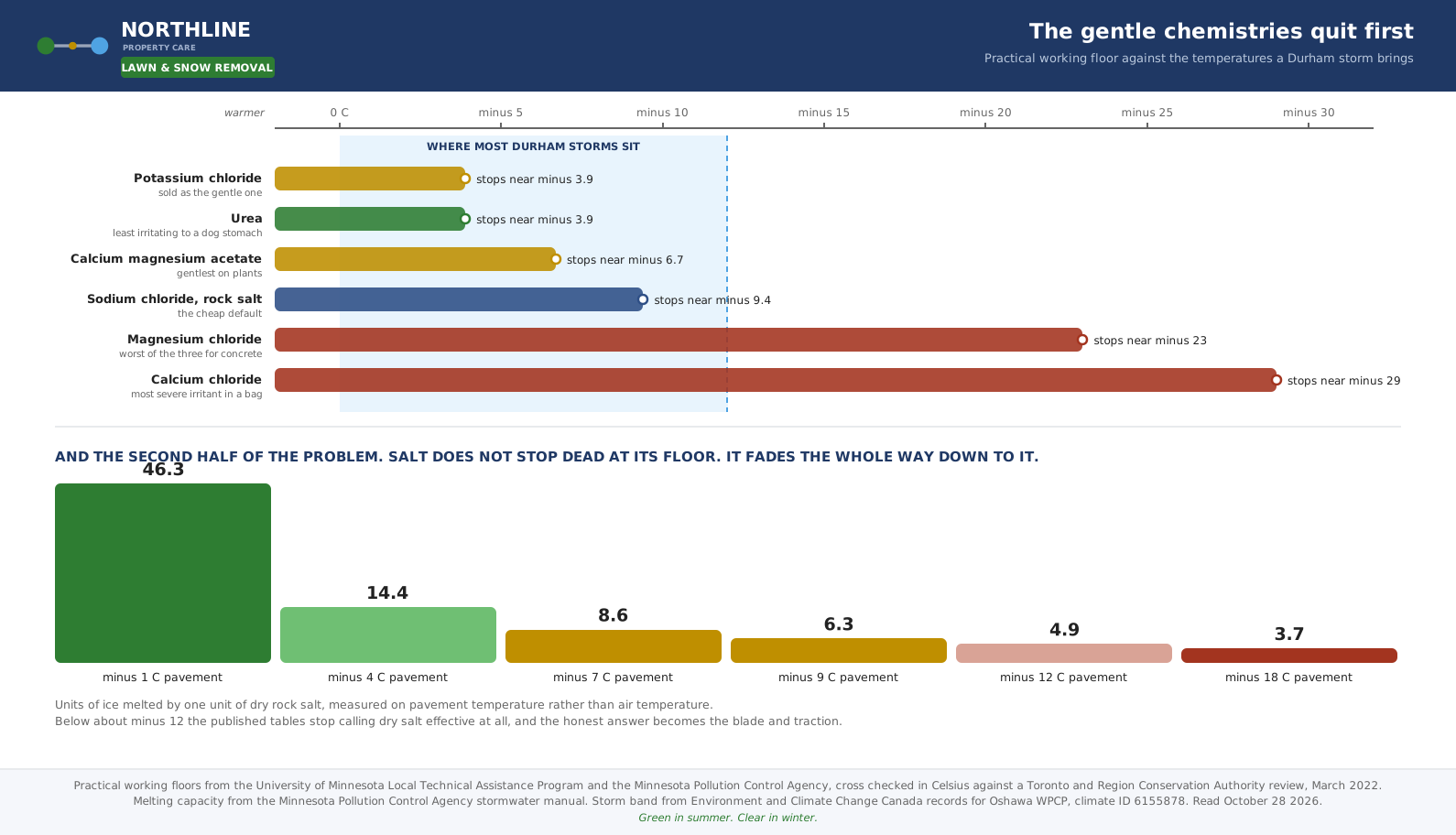
Every chemistry sold as the kinder one stops melting at a warmer temperature than plain rock salt does. The University of Minnesota Local Technical Assistance Program publishes the practical working floor of each, separately from the laboratory eutectic figure that product sheets like to quote, and the ladder in the graphic above is that table turned into Celsius. Potassium chloride and urea are finished near minus 4. Calcium magnesium acetate is finished near minus 7. Rock salt runs to about minus 9. Magnesium chloride and calcium chloride carry on to roughly minus 23 and minus 29.
Those Celsius figures are not our conversion alone. A review of snow and ice control practices prepared by the Toronto and Region Conservation Authority for the Ontario Ministry of the Environment, Conservation and Parks in March 2022 gives sodium chloride an effective range to about minus 9 against a eutectic of minus 21, magnesium chloride minus 23 against minus 33 and calcium chloride minus 29 against minus 51. The Lake Simcoe Region Conservation Authority, working one watershed north of here, narrows the useful band for ordinary salt further still and says it works best between zero and minus 7.
Now line that up against a Durham winter. The clearing standard on our own residential route is 3 cm, and the event count behind it comes from Environment and Climate Change Canada records for the Oshawa water pollution control plant, climate ID 6155878, across eighteen complete winters: about twelve clearing days in an average season, as few as four in the mildest and as many as twenty four in the worst. The storms themselves mostly arrive in the band between zero and minus 12, which is the shaded strip on the graphic, and the mornings after them are colder than the storms were. A product that quits at minus 4 is a product that quits on the morning you most wanted it.
There is a second trap in that sentence, and it catches people with a thermometer in the kitchen window. The number that governs is pavement temperature, not air temperature, and the two are routinely different. Minnesota's guidance says so directly and notes that pavement temperature can be read with a handheld infrared sensor for the price of a decent shovel. An asphalt driveway facing south in Courtice behaves differently from a shaded north facing driveway in Brooklin on the same morning, and the same bag will work on one and sit there on the other.
Salt does not stop dead at its floor, it fades the whole way down to it
One unit of dry rock salt melts about forty six units of ice at minus 1, about nine at minus 7, and under four at minus 18. The Minnesota Pollution Control Agency publishes that table against pavement temperature and attaches melt times to it, and the melt time column is the half that matters on a driveway: five minutes at minus 1, twenty minutes at minus 7, an hour at minus 9, and at minus 12 and below the column simply reads that dry salt is ineffective.
This is the mechanism behind the thing everybody has noticed and nobody has been given a number for. You spread the same amount you always spread, it worked fine in December, and on a hard February morning it sits on the surface doing nothing. The salt did not go stale. It is being asked to do twelve times the work with the same grain, and it cannot. The common response is to spread more, which is the one response that makes the environmental side of this worse without fixing the ice.
The useful conclusion is the unglamorous one. Below about minus 12 the answer stops being a bag at all. It is clearing down to bare pavement while the snow is still loose, traction where somebody has to put a foot, and waiting for the pavement temperature to come up, which in Durham it usually does inside a day or two because the lake moderates this shoreline more than people give it credit for. We go into which de icer belongs in which temperature band in more detail on our page about driveway salting in Oshawa, and the companion question of what happens when the storm arrives as glaze rather than snow sits on the page about freezing rain in Durham Region.
Sand does not melt anything, and bagged winter sand is not a salt free choice
Sand provides traction and melts nothing at all. The Minnesota Pollution Control Agency states it in one line, and adds the detail that it only works while it is sitting on top of the snow and ice rather than buried under the next centimetre. The Toronto and Region Conservation Authority review says the same and adds that abrasives are usually applied at higher rates than chloride de icers are, do not dissolve, and therefore build up and travel.
Two things follow for a Durham driveway. The first is that bagged winter sand typically carries five to ten per cent salt mixed through it so that it does not freeze into a solid block in an unheated garage, which means buying sand in a bag is not the salt free choice it looks like. The second is that sand on dry pavement causes skidding, so once the surface comes up the sand should be swept off and not left to wash into the storm drain in March.
Where sand genuinely earns its place is the deep cold snap, and it earns it precisely because the melting chemistry has quit. It is also the right answer on a gravel driveway, which is a surface with its own rules that we set out on the page about gravel driveway snow removal in Durham Region. For a dog, sand is close to inert, which is one genuine advantage it has over everything else discussed on this page.
How little a driveway actually needs, and the one disagreement worth showing
A twelve ounce coffee mug of salt is the right order of magnitude for a standard driveway, and almost nobody in Durham spreads anything close to that little. The University of Minnesota Local Technical Assistance Program puts about one pound of salt on roughly 250 square feet, caps the whole job at four pounds per 1,000 square feet, and says the grains should be spaced two to three inches apart with pavement showing between them rather than a layer. The Minnesota Pollution Control Agency, measuring the same mug, says it treats a twenty foot driveway or ten sidewalk squares.
Those two readings disagree by a factor of four, and both of them are public bodies in the same state. We are showing the disagreement rather than averaging it, because an averaged figure with no source attached is exactly the kind of number that gets quoted back at you a year later with nobody able to say where it came from. Start at the lighter of the two, which is the mug on the smaller area, and work up only if the surface tells you to.
The field test that settles it needs no measuring at all, and it is the Lake Simcoe Region Conservation Authority's: if salt is crunching under your feet and the surface is dry, there is too much down. Poison control puts the same instinct in four words aimed at pet owners, which is that more is not better. And the Minnesota regulator adds the step everybody skips, which is to sweep up the visible salt still sitting on a dry surface and put it back in the bag, because that salt has already failed to do anything and is now only waiting for rain.
The sequence matters as much as the quantity. Every one of these sources assumes the surface was cleared first, and the Minnesota rate tables say in a footnote that all application rates are based on thoroughly cleared surfaces. Salt spread on top of ten centimetres of snow is salt spent on turning that snow into slush that will refreeze overnight into something a shovel cannot lift. Clear it, then treat the film that is left. That order is also the one that puts the least chloride on the ground, which is the rare case where the cheap answer and the responsible answer are the same answer.
What the bag does to a new concrete driveway, which is half of north Oshawa
Magnesium chloride and calcium chloride, the two chemistries that keep working in deep cold, are also the two that chemically attack concrete. A guide published by Iowa State University explains the mechanism: both react with cement paste to form calcium oxychloride, which is expansive and damages the cement matrix, while sodium chloride is not as reactive and has a minimal effect on hydrated cement paste. Independent laboratory work from the Joint Transportation Research Program at Purdue University found the same ranking, with calcium and magnesium chloride solutions causing a higher degree of deterioration and the least damage in the sodium chloride specimens. The Minnesota Pollution Control Agency puts magnesium chloride at the top of the damage list outright.
Sodium chloride is not innocent, it simply does its damage a different way. Research from Princeton University, published in Materials and Structures, establishes that salt scaling happens when a freezing surface layer containing more than about one per cent sodium chloride cracks where pure ice would not, with the brine weakening the cement paste at the same time. That is the flaking you see across the top two or three millimetres of a driveway after a few winters, and it is also why rock salt still corrodes the reinforcing steel in anything structural.
This matters more in Durham than it would almost anywhere else, because so much of the housing stock here is new. Windfields, Kedron and Taunton in north Oshawa, the Seaton lands in Pickering, the newer streets north of Taunton in Brooklin and the whole north end of Bowmanville are full of concrete driveways poured inside the last few seasons. Two separate sources, a Michigan Tech Transportation Institute guide prepared for the South Dakota Department of Transportation and a University of Nebraska extension publication, give the same instruction: new concrete needs a minimum of thirty days of air drying before any de icing chemical touches it, and longer where the mix contains supplementary cementitious materials, because partially cured concrete is more permeable.
So the homeowner who buys the pet friendly magnesium bag for a driveway poured in September has made two decisions at once, and the second one is the expensive one. If the driveway is new, the right answer this winter is to clear it mechanically, treat only the strip somebody has to walk on, and accept a slower surface. We go through the other three ways a driveway gets damaged over a winter, only one of which is the blade, on the page about snow plow driveway damage in Oshawa.
What it does to the lawn edge, the cedars and the soil underneath them
The brown strip along a driveway edge in April is a chloride injury and it has a published threshold. The federal assessment of road salts carried out under the Canadian Environmental Protection Act reports that sensitive terrestrial plants may be affected above roughly 68 milligrams of sodium and 215 milligrams of chloride per kilogram of soil. Iowa State University extension describes the mechanism in the clearest words we found: salt puts a plant into a physiological drought, so it cannot absorb enough water even when there is plenty of soil moisture, and sodium damages soil structure at the same time.
Purdue University extension adds a figure that puts the scale in perspective. At less than thirty feet from a highway, soil there measured 890 parts per million of chloride. That is about ten times a level the same publication says is already enough to hold back germination and rooting in grass and wildflower. A driveway is not a highway, but a driveway edge concentrates everything that was spread on the whole surface into a strip a few hundred millimetres wide, because that is where the melt runs and that is where the plowed snow is piled.
Durham soils make this worse rather than better. Oshawa, Whitby and Courtice sit largely on clay and clay loam, which drains slowly and holds what arrives, so the sodium and chloride that land on a bed in February are still being dealt with in May. A cedar hedge along a driveway is the hardest case of all, because it does not get to start again from seed in spring the way turf does, and we set out what is salt injury and what is the drying damage usually blamed on salt on the page about winter protection for cedar hedges in Oshawa.
The control that actually works here is not the bag at all, it is the pile. Every grain spread on a driveway through a whole winter arrives at one place when that pile melts, and where that pile sits is a decision somebody makes in November rather than in April. Which corners of a lot will lawfully take a pile here, and what one sitting there for four months does to whatever is underneath it, is set out on the page about where to put snow from your driveway in Oshawa.
Where it all ends up, and the number nobody is watching on a private driveway
Chloride does not break down, does not settle out and is not removed by anything a municipality can build. The Toronto and Region Conservation Authority says it in one sentence and a land grant extension service in Pennsylvania says it in another: nothing in the environment naturally breaks chloride down, and because the ion is negatively charged it is repelled by soil particles rather than held by them. Stormwater ponds cannot take it out. Once it is in the water it is in the water.
The Canadian Council of Ministers of the Environment set the water quality guideline for chloride in fresh water in 2011 at 120 milligrams per litre for long term exposure and 640 milligrams per litre for short term exposure. The Toronto and Region Conservation Authority, whose jurisdiction includes Pickering and Ajax, reported that median chloride concentrations in 2021 passed the guideline at 72 per cent of its monitoring stations, and that 79 per cent of stations were rising over time. Duffins Creek, which runs between Ajax and Pickering, sat at 15 milligrams per litre in the late 1960s and carried a median of 71 milligrams per litre across 2011 to 2015.
Here is the sentence that makes this a page about driveways rather than a page about highways. The same conservation authority reports research estimating that 40 per cent of the road salt reaching Highland Creek did not come from municipal sources. Municipalities are already managing their side of it: the Region of Durham states that it has a salt management plan, uses brine for anti icing before a storm and pre wets its salt at the spinners so that it stays on the road instead of bouncing off, and calibrated spinners control the amount released. The Municipality of Clarington asks residents directly, in a list of ways to help its stormwater ponds, to avoid excess salting. Nobody is applying that kind of discipline to the bag in a private garage, because nobody has ever been asked to.
For scale, Canada uses about five million tonnes of road salt a year, and the organisations reporting under the federal Code of Practice applied 1,679,395 tonnes in Ontario in the 2023 to 2024 winter. Those are the reporting organisations only and the federal page says plainly that the total does not represent the whole quantity of de icing material used in Canada. The part nobody counts is the part this page is about.
The paw routine, from a veterinary college and an Ontario charity
Wash the paws rather than wipe them, dry them, look at the pads, and put the balm on afterwards rather than instead. That order is the Ontario SPCA's, and every step in it has a reason attached. Wash and dry thoroughly after a walk, because that is what removes the de icing chemicals. Use the moment to inspect for cracks or redness. Then, once the paw is clean, apply a paw balm or petroleum jelly to soothe irritation or treat dryness.
Three details in that guidance are worth more than the rest of the page. The first is that trimming the hair between the pads prevents the painful ice balls that form there, which is a Durham problem every February and is mistaken for salt injury constantly. The second is that balm can also go on before a walk as a barrier, and the paws still get washed afterwards. The third is the one almost nobody publishes: do not use a moisturiser made for humans, because it softens the pads and leaves them open to injury.
The veterinary colleges add their own. Cornell University says to wipe paws, legs and belly after a winter walk rather than paws alone, and makes an argument for boots that has nothing to do with chemicals at all: boots can improve a dog's balance on ice and snow, which reduces slips and falls in dogs with arthritis. For an older dog on an Oshawa sidewalk in February that is a better reason to buy boots than anything on this page. Tufts recommends a damp washcloth after each walk and notes that petroleum jelly between the toes is non toxic and safe, provided it gets wiped off afterwards. The University of Wisconsin gives the simplest rule of all, which is to avoid visible salt wherever possible.
And Pet Poison Helpline adds the two that read like afterthoughts and are not. Keep the dog on a leash where there are piles of salt, because the pile is the hazard rather than the surface. And provide free access to water, because every serious outcome described on this page runs through blood sodium, and water is what stands between a mouthful and a problem.
What we do on a storm night, and the two things we will not promise
Our residential clearing standard is 3 cm, we clear mechanically first, and we treat the film that is left rather than the pile we are standing in. That order is not a courtesy to anybody's dog, it is simply how salt works: every published rate table assumes a cleared surface, and a bag emptied onto unplowed snow is a bag spent on making slush. The commercial standard is a different product on a different contract and clears at 5 cm.
Pile placement gets decided on the quoting walk, long before anything falls. A dog run, a planting bed, a cedar hedge, or the dip at the apron where meltwater gathers, each of those changes the answer, and October is a far cheaper month to raise them in than March is. It is also free, whether or not anybody signs anything. A membership starts at $129 a month plus HST.
Two things we will not promise, and both of them cost us money to say. The first is a salt free driveway through a Durham February. Anybody offering one is either spreading a chemistry that stops melting near minus 4, which means the driveway is not actually being treated on the mornings that matter, or they are not telling you what is in the spreader. The second is that the entry tier does not include salting at all. Silver does not plow a driveway and it gets no salting at any point in the winter. The tier that plows a driveway, and that carries the 7 AM target once snow has fallen overnight, is Gold, at $189 a month plus HST. Unlimited automatic salting and a 6:30 AM target belong to Platinum, at $279 a month plus HST. If automatic salting is the thing you want, the entry price is not the price that buys it, and we would rather write that here than have somebody find out in January.
For the households that want to do their own treating and simply need the heavy part done, a salt only trip is $25 and the full list of one off work sits on the add on services page. On the seasonal snow package the figures are $800 plus HST on a small property, $975 on a standard one, $1,200 on a large one. Four clearing days or twenty four, that number does not move all winter. Book by November 1 for that price. The residential route closes November 30.
Questions people actually ask about pet safe ice melt
Is pet safe ice melt actually safe for dogs in Oshawa?
Safer in the gut than some of the alternatives, and not regulated in any way that would let you rely on the words. A state environmental regulator in Minnesota states plainly that there are no labelling requirements for de icer packaging and that any company could label its salt pet friendly. The ASPCA says the same thing from the animal side: there are no specific requirements for labelling a de icer product as pet safe. What is true underneath the label is that urea based products are the least irritating to a dog stomach, and that every ice melt sold will upset one if a dog eats enough of it. So treat the words as a preference rather than a protection, and put the effort into the quantity and into where the bag lives.
Can my dog walk on a salted driveway?
Yes, and this is the part most articles get backwards. The ASPCA Animal Poison Control service states that a couple of licks of a paw or of treated ground will not cause serious problems, and sets its own clinical trigger at more than a casual lick. An emergency veterinarian at the Tufts Cummings School of Veterinary Medicine goes further and says you do not need to stress too much about protecting a dog from salt and chemical de icers on a walk. What the surface does do is dry and irritate the pads, so wash the paws and dry them when the dog comes in, and look at the pads while you are down there. The danger is the open bag and the spilled pile, not the thin scatter on the asphalt.
How much ice melt should I put on my driveway?
Far less than almost anybody uses. The University of Minnesota Local Technical Assistance Program puts a twelve ounce coffee mug of salt, about one pound, at roughly 250 square feet, with a ceiling of four pounds per 1,000 square feet, and says the grains should sit two to three inches apart with pavement showing between them rather than a layer of salt. The Minnesota Pollution Control Agency, using the same mug, says it treats a twenty foot driveway or ten sidewalk squares. Those two public bodies are a factor of four apart and we show the disagreement rather than averaging it. Start at the lighter reading. The Lake Simcoe Region Conservation Authority gives the test that settles it in your own driveway: if salt is crunching under your feet and the surface is dry, there is too much down.
Which ice melt works in a cold Durham snap?
Not the gentle ones. Potassium chloride and urea both stop being practical near minus 4, and calcium magnesium acetate near minus 7. Plain rock salt runs to about minus 9. Magnesium chloride and calcium chloride keep working far colder, to roughly minus 23 and minus 29, and both of those are harder on a dog gut than rock salt is, and harder on concrete. That is the trade almost nobody states out loud. Below about minus 12 the published melting tables stop calling dry salt effective at all, and the honest answer stops being a bag and becomes clearing to bare pavement, traction where somebody has to walk, and waiting for the pavement to come up.
Does sand melt ice?
No. The Minnesota Pollution Control Agency says it in one line: sand does not melt anything, and it provides temporary traction only when it is sitting on top of snow and ice. There are two things worth knowing beyond that. Bagged winter sand usually contains five to ten per cent salt mixed in so it does not freeze solid in the bag, so it is not a salt free choice. And sand on dry pavement causes skidding, so once the surface comes up it should be swept off rather than left. On a Durham driveway sand earns its place in a deep cold snap when salt has stopped working, and nowhere else.
What should I do if my dog eats ice melt?
Make sure there is water available and call a veterinarian or a poison control centre, and do it on the quantity rather than on the label. Signs of salt toxicosis in a dog are expected from about two to three grams of sodium chloride per kilogram of body weight, and the Merck Veterinary Manual gives about four grams per kilogram as the lethal figure. On a twenty kilogram dog that is roughly forty to sixty grams before signs are expected and about eighty grams at the lethal figure, which is arithmetic on the published threshold rather than a quoted number. Vomiting within a few hours is the usual first sign, and it can progress to weakness, tremors and seizures. Free access to water matters more than it sounds, because the sodium problem is a water problem. And if the suspect is a sweet tasting puddle under a car rather than the bag, treat it as an emergency: the Merck manual puts the lethal dose of antifreeze at only three to four teaspoons for a dog and one to two for a cat.
What this page could not verify
This section runs on every page we publish, for one reason: a write up that lists only its wins has hidden half of its method. Below is what was searched for on October 28, 2026 and never turned up.
- Any Canadian government statement that pet safe has no legal definition on an ice melt label. The clear statement that de icer packaging carries no labelling standard comes from a state regulator in Minnesota, and the clear statement about labelling a product pet safe comes from the ASPCA. We could not find a Health Canada, Canadian Food Inspection Agency or Competition Bureau page that addresses the phrase on an ice melt bag specifically.
- Any published count of winter de icer poisoning calls in Canada or the United States. The ASPCA Animal Poison Control service publishes the number of calls it takes and the ten categories they fall into, and de icer is not one of them. We will not turn an absence from a top ten list into a number.
- Whether paw damage is a chemical burn, osmotic drying or abrasion from the crystal edges. No veterinary source we could reach separates them. The defensible wording is irritant contact plus drying with cracking as the visible result, and the cold and the ice share the blame.
- Any paw specific ranking of the chlorides. The irritancy ranking we quote is about contact and the gut. Nobody publishes a comparison of what each one does to a pad, and we are not going to invent one.
- Chloride monitoring figures for the creeks that actually run through Oshawa, Whitby and Bowmanville. The Central Lake Ontario Conservation Authority watershed report card we read carries no chloride figures at all, and the source protection assessment report that would hold local groundwater numbers could not be fetched. The nearest real local data is the Pickering and Ajax creeks quoted above.
- A road salt tonnage figure for the Region of Durham or for any Durham municipality. Neither the Region nor any of the five local municipalities publishes one on any page we could reach. The Ontario total is reported federally, and it is not broken down to a municipality.
- A salt management plan for Oshawa, Whitby, Ajax, Pickering or Clarington as municipalities. Only the Region of Durham states it has one. The local snow pages mention salt only in passing.
- An application rate expressed in grams per square metre for a residential walkway from any public body. The Ontario review we read says outright that few studies address rates on sidewalks, ramps and walkways at all. The imperial figures above are what exists.
Every external figure on this page comes from a federal department, a provincial ministry, a conservation authority, a university, a veterinary college, a poison control centre or a registered animal welfare charity. Not one of them comes from a company that sells snow removal, lawn care or ice melt, including us.
Who is behind this page, and what we do not have for sale
Northline Property Care is Andrew's business, and the person who quotes your property is the person standing on it at five in the morning. Six winters of clearing snow here sit behind this page, and most of what those winters taught about ice melt came off driveways where half a bag had already gone down before anybody arrived.
We sell no ice melt and we recommend no brand, which is deliberate rather than coy: there is no standard behind the claims on the front of any of those bags, so a recommendation from us would be worth exactly what the label is worth. What we do price is the clearing, a salt only trip at $25, and the walk that decides where the plowed snow is allowed to sit on your lot. That walk is free whether you join or not.
The one honest sales argument on this page is the order of operations. A driveway cleared to bare pavement while the snow is still loose needs a fraction of the product a packed one needs, and that is true whether we do it or you do. Everything else here is yours to do with a shovel, a mug and a bowl of water.
Read next
Driveway salting in Oshawa
Which de icer belongs in which temperature band, how little of it a driveway actually takes, and what the leftover does to concrete and to the soil along the edge.
Where to put snow from your driveway
The pile is where a whole winter of chloride arrives at once in March. Which corners of a Durham lot will take one lawfully, and which will not.
Freezing rain in Durham Region
Glaze grips the asphalt instead of resting on top of it, so there is nothing for a blade to get under. What treats it, and how early.
Andrew answers, October 2026
We have two dogs and a new concrete driveway. Which bag should I be buying?
Neither of the ones you are probably looking at, and that is the short version. The gentle bags stop melting around minus 4, so on the mornings you need them they are decoration. The deep cold bags are magnesium or calcium chloride, and those are the two that chemically attack young concrete and the two a poison control centre calls the worst irritants. On a driveway poured this year I would clear it to bare pavement and treat only the strip from the door to the car, with plain rock salt, about a mug of it. Then keep the bag shut and up off the garage floor, because that bag is the thing that actually puts a dog in a vet's office, not the driveway.
One question lands here each day, and yesterday’s is retired rather than recycled. Put yours to Andrew on 905-244-5779.
The bag is yours. The part that happens before you are awake is ours.
Give us the address and a written number comes back the same day. Included with it, at no charge: the walk that settles which corner takes the pile, what it has to stay clear of, and where the meltwater is going to gather at the apron.
Green in summer. Clear in winter.