Property care · Winter
Winter protection for cedar hedges in Oshawa, and why the burlap wrap most people buy is the wrong tool
Winter protection for cedar hedges in Oshawa is one job: keeping light and wind off the west and south sides from freeze up to the end of March. The browning you see in April is drying damage, and drying is preventable.
- Fully insured
- Owner operated, one accountable name
- Every figure on this page comes from a government or a university
- Nothing here is a service we are selling you
The short answer
Put an open topped screen on the west and south sides of the hedge once it is dormant, put a quarter inch wire guard around the stems before the ground freezes, keep mulch and long grass back from the base, and then leave the hedge alone until the middle of May. That is the whole list. It costs an afternoon and some stakes, and nothing on it is a service with a price attached.
What is not on the list matters more. Do not wrap the hedge tight in burlap, do not buy an anti desiccant spray, and do not give the hedge a heavy soak in late November believing it will carry the plant through February. All three are common, all three are sold, and the published evidence runs against every one of them.
What is actually happening to a cedar in February, and it is not freezing
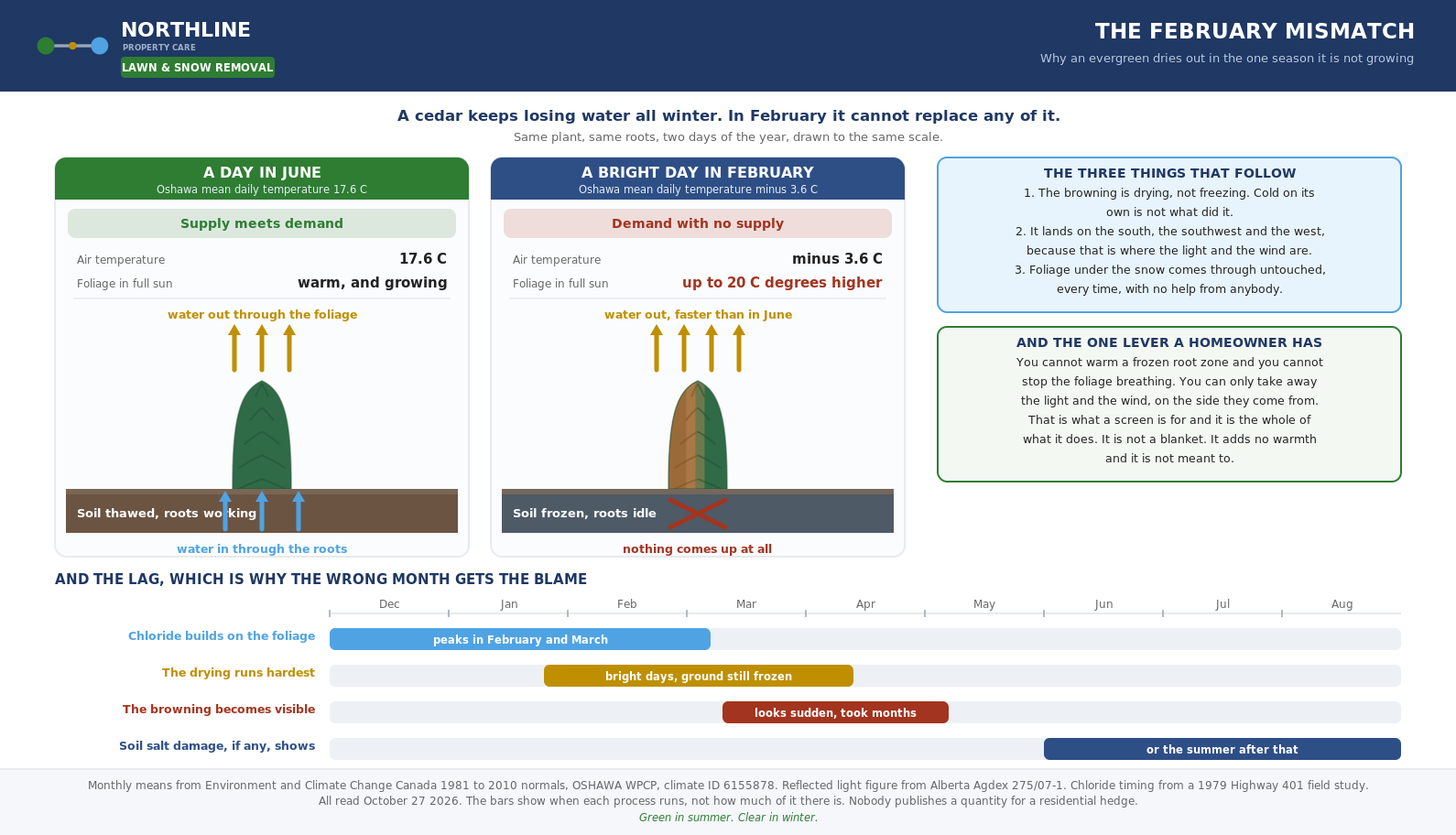
A cedar keeps losing water through its foliage all winter, and in February the roots cannot replace one drop of it. That is the entire mechanism, and every sensible decision about a hedge follows from holding it in your head. The foliage is still there, still exposed, still giving off moisture on any day with sun or wind on it. The soil around the roots is frozen. Water goes out and nothing comes back, the cells on the outside of the plant dry past the point of recovery, and the tissue dies. Extension services across the northern half of this continent call it winter burn, winter desiccation, winter drying or winter scorch, and the four names all describe the same thing happening.
The part that catches people is that the damage is worst on warm bright days rather than on brutally cold ones. The University of Minnesota puts the figure on it: chlorophyll does not rebuild itself below minus 2.2 degrees, so a bright cold day destroys pigment the plant cannot then replace. The University of Nebraska is blunter about the calendar, recording that the most severe winter burn turns up in March or April while the soil is still frozen. In Oshawa that lines up almost exactly with the end of the snow pack, which is why the hedge that looked fine in January is the hedge somebody photographs in disgust in early April.
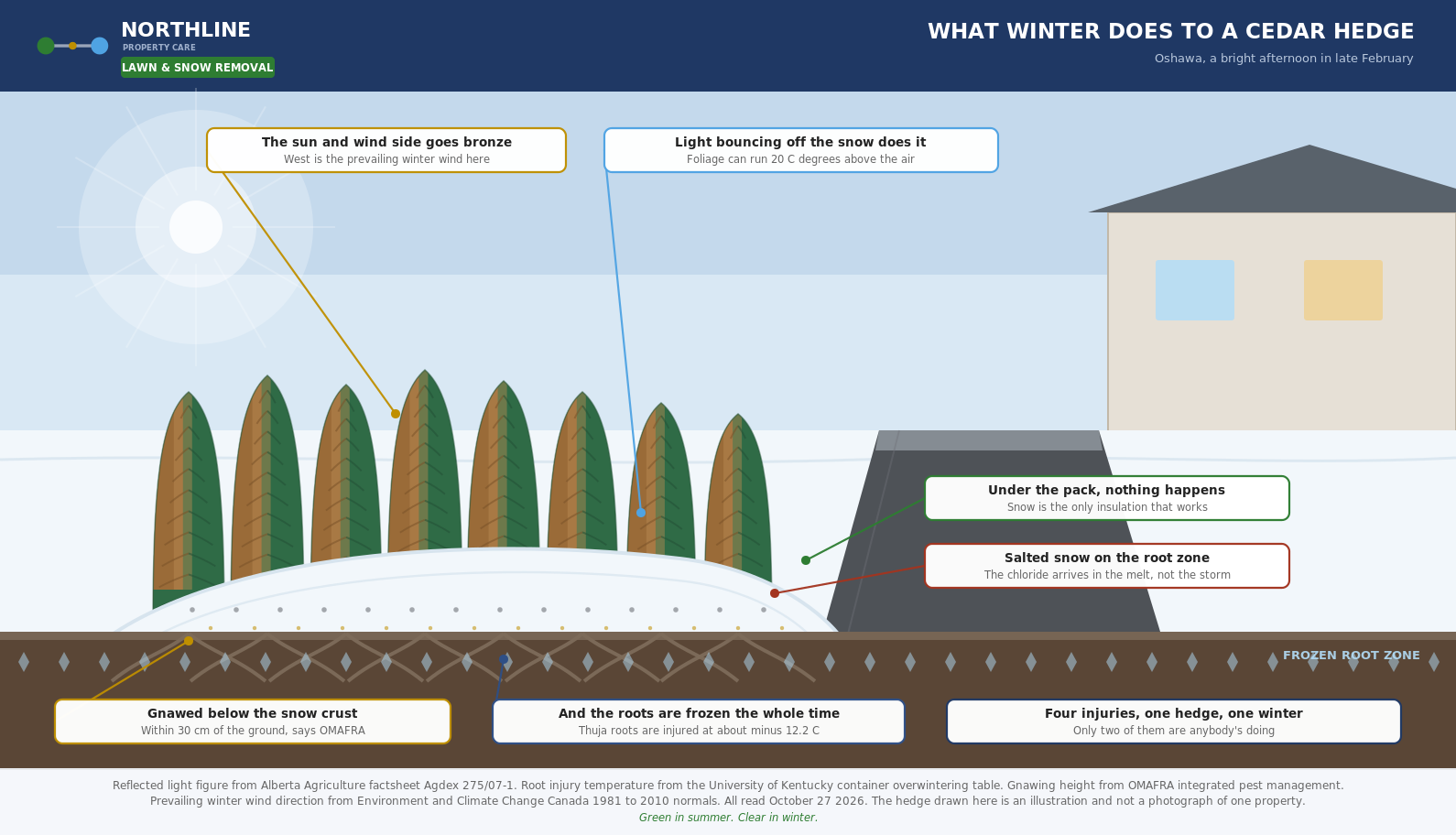
The second thing worth holding is the temperature difference between the air and the foliage. Alberta Agriculture, in a factsheet on browning of evergreens, states that sun or reflection from snow and light coloured buildings can raise leaf temperatures as much as 20 degrees above the surrounding air. That is the single most useful number on this page. On a bright day in late February the air over Oshawa averages around minus 3.6 degrees on the Environment Canada 1981 to 2010 normals for the station at the water pollution control plant, and the west face of a cedar hedge standing against a snow covered lawn can be running well above freezing while the root zone a metre below it is locked solid.
And the roots are the governing limit, not the tops. A container overwintering table from the University of Kentucky puts the root killing temperature for Thuja occidentalis at about minus 12.2 degrees, which is far warmer than the temperature the shoots can survive. A plant cannot be hardier than its roots, young roots are less hardy than mature ones, and every one of those facts points at the same practical conclusion: the first winter after a hedge goes in is the dangerous one, and the hedge that has been there a decade is mostly looking after itself.
Bronze is not always damage, and the month tells you which one you are looking at
Eastern white cedar goes bronze every winter on purpose, and a hedge that colours in November is doing something completely different from a hedge that goes brown in April. North Carolina State records adult Thuja occidentalis foliage as bronze coloured through the winter months as a plain description of the species rather than as a problem. The University of Connecticut notes that some cultivars were selected specifically because people find the ordinary winter colour unattractive. There is a pigment behind it: a deep red carotenoid called rhodoxanthin builds up through the autumn, sits near the surface of the foliage, and is more abundant on the sun exposed side, which is consistent with it protecting the plant from light it cannot use while it is too cold to photosynthesize.
So the test is the calendar. Colour that appears in late autumn and early winter, spread fairly evenly over the plant, is the normal thing and it reverses when the warmth comes back. Brown that appears in spring, concentrated on one side, starting at the tips of the foliage and working inward, is injury and it does not reverse. The University of Nebraska states the distinction in one line: winter burn turns needles brown in spring, not in autumn.
When the brown does appear, there are two tests that cost nothing. Scratch the bark on an affected branch, and green underneath means the branch is alive while brown means it is almost certainly dead. Peel back a bud and look for green inner tissue. Both come from the University of Wisconsin, and both answer the only question that matters, which is whether to prune or to wait. Wait is usually the right answer. The buds on a cedar are hardier than the foliage around them, so a plant that looks ruined in April often fills in over a season or two. The published advice is uniform: assess in mid spring, after the new growth comes, and prune only to living tissue once you can see where living tissue starts.
One warning goes with that patience. A hedge can look acceptable in spring and then slide in July, and when that happens the problem is usually the roots rather than the foliage, which is a different and worse diagnosis. If a hedge that browned in March struggles through a dry August, the summer is not what hurt it.
Three things about Oshawa that decide which side of your hedge browns
The wind here is from the west all winter, and it is the windiest season of the year. There is no wind record for the Oshawa station itself, so the nearest set of normals with wind in it is Toronto Pearson, about 77 km west and roughly 90 metres higher, which is worth saying out loud rather than passing off as a local measurement. On that file the most frequent winter wind direction is west in December, January and February, and the monthly mean speed runs between 16.7 and 17.6 km an hour, against 11.9 in August. The windiest months of the year are the exact months the root zone is frozen. If you only ever shelter one face of a hedge in Durham, shelter the west one.
The second thing is the snow. Reflected light off a white lawn is part of the load that pushes foliage temperature up, which argues for shelter, and at the same time anything buried under the pack comes through the winter untouched, which is why a hedge so often browns in a clean band from the snow line upward. Snow is the best insulation available and it is free. The Oshawa normals show a month end snow depth that never averages more than 9 cm, in January, which means the pack here is thin and unreliable and a hedge in this region cannot count on being buried.
The third is the lake, and the lake is genuinely in your favour. Comparing the two Environment Canada files, the Oshawa station sits warmer than Pearson in every winter month, by a full degree in December and about 0.9 of a degree in February. Environment and Climate Change Canada notes that Lake Ontario has the lowest maximum ice coverage of the Great Lakes because of its depth and its relatively warmer winters. Part of that difference is elevation rather than water, and we are not going to pretend otherwise, but a hedge on the Oshawa lakeshore is in a milder spot than the same hedge in Uxbridge.
Put those together and the pattern on a Durham frontage is predictable. The browning lands on the west, the southwest and the south, on the side facing an open lawn or a road, in the band above the snow and below the top. A hedge on the north east side of a house, tucked behind the building, usually comes through fine with nobody doing anything at all.
What actually works is a screen, and a screen is not a wrap
The thing with evidence behind it is an open topped screen standing clear of the foliage on the west and south sides, and the top being open is not a detail. The method is consistent across every extension service that publishes one. Drive stakes a little taller than the hedge, set them back from the foliage, run burlap, canvas or snow fencing between them, and leave the top open so air moves and light still reaches the plant. Cornell asks for at least six inches of clearance between the screen and the foliage. The University of Wisconsin and Penn State both describe stakes of four to five feet set about two feet out from the drip line. Alberta Agriculture puts the standoff at about a foot. Any of those works. Touching the hedge does not.
What the screen does is take away the two things that dry a plant out, which are direct light and moving air. It adds no warmth whatsoever and it is not meant to. If somebody tells you a wrap keeps a cedar warm, they have the physics backwards: the one thing that genuinely insulates a plant in this climate is snow, and the University of New Hampshire makes the point that snowy winters are the good ones for woody plant survival.
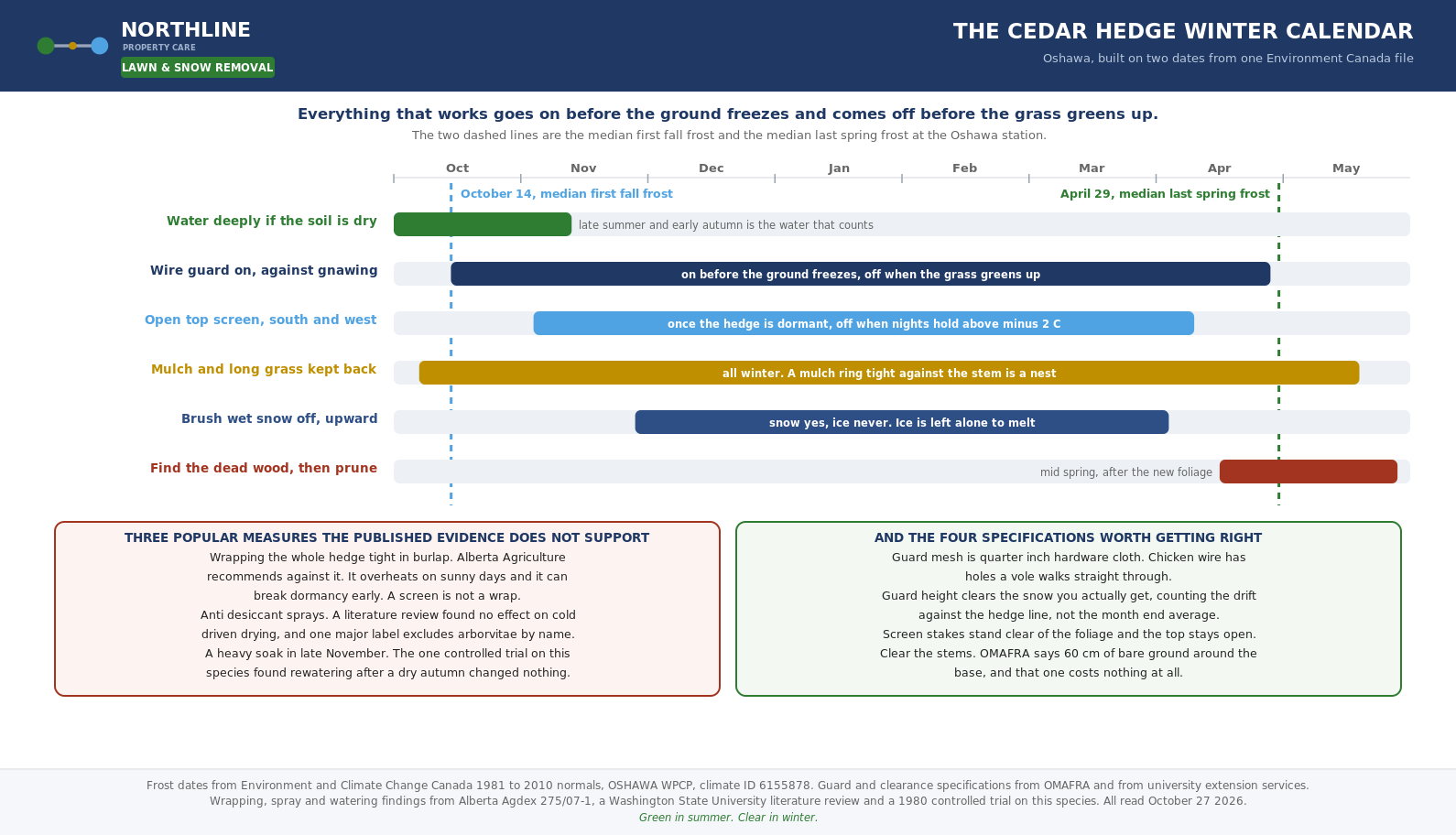
Timing is simple at both ends. On after the hedge is fully dormant but before the ground freezes. The Environment Canada normals put the median first autumn frost at Oshawa on October 14, with a one in four chance of it arriving by October 8, so the practical window here is the second half of October through the first week of November. Off promptly in spring. Penn State gives a number for the removal end as well: take the burlap off once temperatures are above minus 2.2 degrees. On the same Oshawa file the median last spring frost is April 29, which makes the second half of April the right time to be pulling stakes.
Two more jobs belong in the same afternoon and both of them are free. Clear long grass, leaves and loose mulch back from the base of the hedge, which costs nothing and solves a problem we will come to further down. And if the autumn has been dry, water deeply in late summer and early autumn, which is the water that counts, while the roots are still working. Agriculture has a number for when that stops: root growth and nutrient uptake in most nursery stock continue while soil temperatures stay above 5 degrees, and below that the plant has stopped being able to use what you give it.
The three measures that get sold, and what the evidence says about each
Wrapping a cedar hedge tight in burlap is recommended against by a provincial agriculture ministry, in writing. The Alberta factsheet on browning of evergreens says that wrapping evergreens in burlap or plastic is not recommended, because internal temperatures can get too high on warm sunny winter days and the tissue is then damaged by the cold that follows, and because wrapping may break dormancy too early in spring. Three American extension services add the other half of the problem: a tight wrap collects ice, traps moisture against the foliage and raises the risk of disease. Iowa State says in terms that burlap should not be wrapped around a plant like a blanket. The screen described above is the supported version of the same idea, and the difference between the two is literally whether the fabric touches the plant.
Anti desiccant and anti transpirant sprays are the second one. A literature review from Washington State University, going through the published trials by category, reports no effect for heat or cold induced desiccation, which is precisely the case a cedar hedge is. The mechanism is the problem: these products work by covering the pores a leaf breathes through, and interfering with that exchange is not harmless. The University of Minnesota states flatly that these sprays are not effective for protecting evergreen foliage. The detail that settles it for this species comes from the University of Nebraska, which notes that the label on one of the major products tells you not to use it on arborvitae. When a product excludes your plant by name, the argument is over.
The third one is the hardest to let go of, because it feels like care. The idea is that a deep soak just before freeze up loads the plant for winter. The only controlled experiment on this species that we could find says otherwise. Three researchers at the University of Minnesota ran container grown Thuja occidentalis through a deliberate autumn drought in 1977 and again in 1978, then rewatered different groups to field capacity at different dates through October and into early November. Cold hardiness did not differ between the moisture treatments. Visible injury tracked how badly the plant had been stressed earlier, and rewatering did not reduce it no matter when it was done. Their conclusion was that watering in late autumn before freeze up was not very beneficial, while watering during a dry late summer or early autumn was. The University of Minnesota extension service says the same thing in one sentence and adds that overwatering stresses a plant going into winter.
There is one honest qualification on that last one. The same authors suggested late autumn water might still help the roots, because moist soil does not freeze as deeply as dry soil. So if the ground is bone dry in November and still open, water it. Just do not expect it to save the foliage, because the evidence says it will not.
Salt, which is the part of this that is our own doing
The Government of Ontario species page for eastern white cedar says, under the heading for soil, that it does not tolerate road salt. That is a flat statement from the province about the most commonly planted hedge in this region, and anybody who sells winter service beside a cedar hedge ought to be the first to repeat it rather than the last. Penn State calls arborvitae very salt sensitive and warns that it may not do well near roads. An Ontario field study along Highway 401 in 1979 found white cedar badly injured, with symptoms carrying more than a hundred metres from the pavement. The one source that rates it moderately tolerant is a 1975 Minnesota bulletin whose own author admits the symptoms on cedars were not studied in detail. The weight of the published record is not close.
Salt reaches a hedge two different ways and they behave differently. Spray carried on wind and traffic lands on the foliage and burns it from the tip down, on the side facing the source, above the snow line, and it shows up quickly. Salt in the soil is taken up by the roots, builds over years, and produces a slow decline across the whole plant, old foliage and new alike. The 1979 Ontario work found chloride accumulating on needles through the winter, peaking in February and March, falling away from early April and back to background by late summer. It also found something that explains the apparent suddenness of the damage: needles held near 2 degrees took thirty daily salt sprays without injury, while needles at 15 degrees were injured within two days. The salt sat there for two months and the first warm day set it off.
Nobody has published a spray distance for a residential driveway. Every figure in the literature is for highway traffic, and we are not going to invent a driveway number by scaling one down. What does transfer is where the snow goes. A pile of plowed driveway snow sitting on a hedge root zone is a slug of chloride delivered straight into the melt, and that is a decision somebody makes on every storm. It is also the one part of this page we control directly, so it is the part we will state as a commitment rather than as advice: where the pile goes is settled in writing when the property is quoted, before the first storm, and a cedar hedge is one of the things that decides it.
The City of Oshawa gives one number here that is worth borrowing. In a 2023 City report on reducing road salt, Oshawa states that pre wetting salt reduces the amount scattered onto boulevards from 30 per cent down to 4 per cent, because wet salt has a narrower dispersion pattern. That is a municipal measurement of how much salt ends up where hedges live. The same report confirms that Oshawa has had a salt management plan since 2005, updated in 2014, and that rural roads north of Winchester Road are treated with a mix of 12 per cent salt and 88 per cent sand by weight.
The wider context is uncomfortable and it is worth a paragraph. Environment and Climate Change Canada assessed road salts under the Priority Substances List and concluded in 2001 that they are toxic under the federal environmental protection act. The federal government then declined to add them to the list of toxic substances, and Environment and Climate Change Canada says so in plain words on its own page, substituting a voluntary code of practice that applies only to organizations using more than 500 tonnes a year. Household and contractor driveway salting sits entirely outside that instrument. Peer reviewed monitoring published in 2023 and funded in part by the Region of Durham put the 2021 median chloride concentration in Petticoat Creek in Pickering at 433 milligrams per litre and in Carruthers Creek in Ajax at 217, against a national long term guideline for aquatic life of 120. None of that is a reason to stop clearing ice off a walkway in January. It is a reason to use the least that works, which is the whole argument of our page on driveway salting in Oshawa, and to think hard about where the pile lands.
Snow and ice on the hedge itself: brush the snow, never touch the ice
A multi stemmed upright evergreen is the shape most likely to splay open or snap under wet snow, and cedar is exactly that shape. North Carolina State lists Thuja occidentalis as susceptible to stem breakage from ice and snow accumulation. Cornell and the University of Connecticut say the same in fewer words. Illinois names arborvitae and juniper as the two that most often lose branches. Once a column has opened out from the middle it rarely closes again without help, and a hedge with one splayed plant in the middle of it is a hedge somebody is going to want replaced.
The prevention is a length of soft material and ten minutes in the autumn. Tie the stems of a multi leader cedar loosely together before the first heavy snow, using cloth strips, coated twine or a flexible cord, never anything thin enough to cut into the bark. Iowa State explains why it works: the ties pull the plant into a cone that sheds snow instead of catching it. Take them off in April, once the risk of heavy fall is behind you.
Wet snow already sitting on a hedge comes off gently, with an upward motion of a broom rather than a downward one, because a branch that is already bent and loaded breaks when you push it further. Ice is the opposite instruction and it is absolute. Do not knock ice off, do not beat it with anything, do not pour hot water on it, and do not push an iced branch back upright. Illinois states that removing ice encased on branches causes additional damage and should not be attempted. Let it melt. A bent branch very often returns to where it was over the following weeks, and the thing most likely to break it is somebody helping.
The same rule governs where storm snow is thrown. Do not shovel or blow snow onto a hedge, do not dump roof snow onto one, and be careful about the arc a blower cuts near a plant. This is ordinary enough that it barely needs saying, except that it is the single commonest way a hedge gets wrecked on a property where everything else was done right, and the legal places a pile can go on a Durham lot are set out on our page about where to put snow from a driveway.
What eats a cedar hedge under the snow, and the one claim we are not going to make
The meadow vole is the real winter threat to a hedge base in this region, and it works under the snow where nobody can see it. OMAFRA describes the damage precisely: strips of bark removed from around a stem, usually within 30 cm of the ground, starting at one spot and eventually girdling the trunk, occurring near the ground under grass or snow, with the girdling happening below the snow crust. Damage begins in August and runs through autumn and winter. Complete girdling kills the plant. Partial girdling deforms it. Natural Resources Canada adds the diagnostic that separates a vole from a rabbit: vole gnawing leaves a patchy fuzzy wound with tooth grooves about 3 mm wide, while a rabbit leaves a clean cut at roughly a forty five degree angle.
Two measures handle it and the cheaper one is the better one. OMAFRA says to remove straw, trash and sod from around the base of a plant for at least 60 cm, because the nesting material and the cover are what bring the voles in. Mulch piled tight against a stem is a nest with a food supply attached. That instruction costs nothing and is the single highest value thing on this entire page. The second measure is a guard: quarter inch galvanized hardware cloth, formed into a cylinder standing an inch or two off the stem, with the bottom buried a few centimetres or pinned flat so nothing tunnels under, and the top clearing the snow you actually expect including the drift against the hedge line. Chicken wire does not work here, because the holes are big enough for a vole to walk through. OMAFRA adds one material warning: avoid dark guards, tar paper and heavy foil, because dark materials heat the bark on sunny winter days.
Deer are the other one and cedar is a known preference rather than an accident. The Ontario Ministry of Natural Resources guide to white tailed deer habitat describes white cedar as both preferred cover and preferred browse, and sets the accessible browse envelope at between 0.5 and 2.0 metres from the ground. Deeper snow raises that reach, because the animal is standing on it. The published exclusion for deer is a different order of thing from a vole guard: eight foot fencing, or a cylinder that stands well clear of the snow, neither of which is realistic along a suburban hedge line. If deer browse a hedge in your neighbourhood, the honest answer is that the fix is a repellent program or a fence, and neither is something this business sells.
And here is the claim we are not going to make. Rabbits are usually blamed for winter damage to cedar hedges, and the University of Wisconsin says the opposite in print: cottontails usually do not bother evergreens, and it attributes serious evergreen browsing to snowshoe hares instead. We could not find a single Ontario source documenting cottontail damage to a cedar hedge. If somebody tells you the rabbits ate your cedars, ask them for the source, because we looked for one and came back with a source that disagrees.
If the hedge is on the boulevard, the rules are different in every town
Every municipality in this service area lets a homeowner plant on the boulevard in front of their own property, and every one of them caps the height at roughly knee to waist level, which no cedar hedge stays under. A cedar grown as a hedge is still a tree in the legal sense in Oshawa, because the City Trees by law defines a tree as a woody perennial that can reach at least 4.5 metres at maturity and this species reaches fifteen. The numbers below were read off each municipality's own consolidated by law on October 27, 2026.
| Municipality | Maximum planting height on the boulevard | Setback from the curb or travelled edge |
|---|---|---|
| Oshawa | 0.9 m above the grade of the boulevard | 1.2 m where there is a sidewalk, 1.8 m where there is none, and 0.6 m clear of either edge of the sidewalk |
| Whitby | 0.9 m above the grade of the boulevard | 2.0 m from the curb or the edge of the travelled portion, and 1.0 m clear of a fire hydrant |
| Pickering | 1.0 m above the grade of the boulevard | 0.6 m from a sidewalk, 1.8 m from the curb where there is no sidewalk, 1.5 m from the top of a ditch bank |
| Ajax | Not stated as a number in the public nuisance by law | Landscaping must not encroach or interfere with a sight line or safe passage |
| Clarington | Not published at a readable address | Council approved a replacement roads and boulevards by law on March 23, 2026 |
Two further rules bite at the mouth of a driveway and both of them are about sight lines rather than about plants. Oshawa's fence and sight triangle by law treats a hedge as a natural feature and caps anything inside a driveway sight triangle, measured 3.0 metres back from where the street line meets the side of the driveway, at 0.9 metres. On a corner lot the same cap applies inside a triangle measured 6.0 metres from the intersection of the lot lines. Separately, nothing may exceed 0.9 metres within 2.0 metres of the front lot line. A mature cedar hedge running to the end of a driveway in Oshawa is almost certainly offside on at least one of those, and the fine structure starts at $125 and climbs with repetition.
There is one more line worth knowing before anybody plants on a boulevard, and it is in the Town of Whitby property and boulevard maintenance by law. Section 4.17 says the Town is not liable for removing or damaging landscaping a resident placed on the boulevard, unless there is a written agreement saying otherwise. Oshawa's encroachment by law takes the same position about its own operations. So a boulevard hedge is planted at the owner's risk, in the strip that takes the most plow snow, the most salt spray and the most sight line scrutiny of any ground on the property. We would plant the hedge two metres further back and lose nothing.
What we could not verify, and it is a longer list than usual
This page was built under a rule: every external figure had to come from a government, a university, a regulator or a peer reviewed journal, and anything that existed only on a company page was dropped rather than reworded. That rule is what makes the list below worth printing instead of hiding.
- The current 1991 to 2020 climate normals for Oshawa. Every climate figure on this page is from the 1981 to 2010 set, which is the most recent one that can be read without a browser session. The newer file exists only behind an interactive portal.
- A hardiness zone for Oshawa from Natural Resources Canada. The federal lookup is closed to automated reading. The City of Oshawa's own website states that Oshawa is zone five b, and that is a municipal statement rather than a federal one.
- A hardiness zone for Thuja occidentalis from any government or university source. Every zone number for this species sits on a retail page, and retail pages were out of bounds.
- A spray distance for salt thrown by a passenger vehicle on a residential driveway. Every published distance is for highway or city street traffic.
- A soil chloride threshold specific to this species. The nearest are generic values for sensitive plants and a generic conifer foliar threshold.
- How much road salt any Durham Region municipality applies. Not one of them publishes it. Oshawa's own 2023 report on reducing salt use does not contain the number.
- Chloride monitoring for Oshawa Creek, Farewell Creek or Bowmanville Creek. The conservation authority covering them publishes chloride for groundwater wells only. The creek figures on this page are from Pickering and Ajax.
- Any controlled trial of burlap screens on this species. The screen recommendation is consistent expert guidance, not measured evidence, and we would rather say so.
- A published deer browse height for cedar specifically, and any figure at all for deer numbers in urban Durham.
- Clarington's current boulevard planting rules, which matters because Courtice, Bowmanville and Newcastle are a quarter of this service area.
Questions Durham homeowners actually ask about cedar hedges in winter
Should I wrap my cedar hedge in burlap for the winter in Oshawa?
Not as a wrap. Alberta Agriculture recommends against wrapping evergreens in burlap or plastic, because the inside gets too warm on a sunny winter day and the tissue is then damaged by the cold that follows, and because a wrap can break dormancy too early in spring. Three American extension services add that a tight wrap collects ice, traps moisture and raises disease risk. What is supported instead is an open topped screen: stakes a little taller than the hedge, burlap or snow fencing between them on the west and south sides, standing at least six inches clear of the foliage, with the top left open so air and light still get through. The fabric should never touch the plant. Put it up once the hedge is dormant and before the ground freezes, which in Oshawa means the second half of October through the first week of November, and take it down in the second half of April.
Why has one side of my cedar hedge gone brown and the other side is still green?
Because the brown side is the side the winter light and wind came from, and this is drying damage rather than cold damage. Foliage keeps losing water all winter while the roots sit in frozen soil and cannot replace it, and the loss is fastest on the side taking direct sun and the prevailing wind. In Durham Region the winter wind is from the west and the worst exposures are west, southwest and south. Alberta Agriculture puts a number on the other half of it: sun reflecting off snow and off light coloured buildings can raise foliage temperature as much as 20 degrees above the surrounding air. Foliage that was under the snow pack usually comes through untouched, which is why the damage so often stops in a clean line at the old snow level.
Will road salt or driveway salt kill a cedar hedge in Durham Region?
It can, and the Government of Ontario's own species page for eastern white cedar states that it does not tolerate road salt. There are two separate routes. Salt spray lands on the foliage, burns it from the tip down on the side facing the source, and shows up fast. Salt in the soil is taken up by the roots, accumulates over years and produces a slow decline across the whole plant. An Ontario field study along Highway 401 found chloride building on cedar foliage through the winter, peaking in February and March, then falling from early April. Nobody publishes a spray distance for a residential driveway, so do not trust anybody who quotes one. The thing you can control is where plowed snow is piled, because a pile of salted driveway snow sitting on a hedge root zone delivers all of that chloride into the melt in one place.
Do anti desiccant sprays protect cedars over the winter?
The published evidence says no for this exact situation. A literature review from Washington State University, sorting the trials by what was being prevented, reports no effect for heat or cold induced desiccation, which is what winter burn is. The University of Minnesota states plainly that these sprays are not effective for protecting evergreen foliage. The detail that ends the discussion for this species is that the label on one of the major products tells you not to use it on arborvitae. Spend the money on stakes and burlap for a screen instead, or on nothing at all, because a hedge in a sheltered spot usually needs neither.
What is chewing the bark off the bottom of my cedars under the snow?
Almost certainly meadow voles. OMAFRA describes the damage as strips of bark removed from around a stem, usually within 30 cm of the ground, beginning at one spot and eventually girdling the trunk, occurring under grass or snow with the girdling happening below the snow crust. Complete girdling kills the plant. The fix that costs nothing is to clear straw, leaves, sod and loose mulch back from the base for at least 60 cm, because that cover is what brings them in. The fix that costs a little is a cylinder of quarter inch galvanized hardware cloth standing an inch or two off the stem with the bottom pinned flat to the ground. Chicken wire is not a substitute, because the holes are large enough for a vole to walk through.
My cedar hedge went brown in April. Should I pull it out or cut it back?
Neither, yet. Scratch the bark on an affected branch and look for green underneath, and peel back a bud and look for green inner tissue. Buds on a cedar are hardier than the foliage around them, so a plant that looks finished in April often fills in over a season or two. Wait until mid spring, after the new growth has come, and only then prune back to living tissue so you can see where living tissue starts. The one case for pulling a plant out is a stem that has been girdled right around near the ground, because nothing above a complete girdle recovers. And watch the plant through a dry July, because a hedge that looks acceptable in spring and then slides in summer has a root problem rather than a foliage problem.
Who wrote this, and what we do not sell
Northline Property Care belongs to Andrew, who prices the property and then does the work on it. Six winters of clearing snow in Durham Region sit behind that, and most of what those winters taught about cedar hedges was learned by looking at the ones that browned beside driveways that had been salted and plowed all season.
We do not publish a price for wrapping, screening or guarding a hedge, and we are not trying to turn this page into one. Almost all of it is an afternoon of your own time and some stakes. Hedge and shrub trimming is a thing we do price, at $85 an hour with a two hour minimum, and garden bed maintenance at $75 an hour. If a hedge needs cutting back after a bad winter, that is the line it falls under, and we cover how far a cedar hedge can safely be taken back on its own page. The honest time to ask about it is in May when you can see which parts are alive.
The one thing on this page we do control is the salt and the snow, and that is the one we will put in writing. Where the pile goes is settled when the property is quoted, before the first storm, and a cedar hedge along a driveway is one of the things that settles it. A membership starts at $129 a month plus HST and the walk that decides those details costs nothing whether you join or not.
Read next
Driveway salting in Oshawa
Which de icer works at which temperature, how little of it you actually need, and what the leftover does to concrete and to soil.
Hedge trimming in Oshawa
When a cedar hedge is cut, how far back it can safely be taken, and the brown wall that follows a cut into old wood.
Where to put snow from a driveway
Every legal place a pile can sit on a Durham lot, and the beds, hedges and sight lines that rule most of them out.
Andrew answers, October 2026
My cedars along the driveway went brown on the driveway side last spring and came back patchy. Is that the salt or is that the sun?
Probably both, and the two leave different marks. Look at where it stops. If the brown ends in a clean line at about the height the snow used to sit, and it is on the west or south face, that is drying and the hedge will likely thicken back in. If the tips are burnt on the side nearest the driveway and it shows up on old growth as well as new, salt is in it. The thing I would change first is not the hedge, it is the pile. Move the plowed snow off that root zone this winter and look at the same hedge next April before spending a dollar on anything else.
A new question goes in this spot on every post, and the previous one is retired rather than reused. Ask yours on 905-244-5779.
Most of this hedge page is yours to do. The pile against it is ours.
Send the address and the winter gets priced the same day, in writing. The walk that decides where plowed snow can sit, which beds and hedges it has to stay off, and how wide the apron really is comes with the quote and costs nothing.
Green in summer. Clear in winter.