Snow removal · Unpaved surfaces
Gravel Driveway Snow Removal Durham Region, and the Freeze That Has to Come First
Gravel driveway snow removal in Durham Region waits on the frost, because gravel is not a working surface until the ground under it has frozen hard.
Long laneway, acreage or a hamlet lot? See how larger properties are priced.
Green in summer. Clear in winter.
The short answer
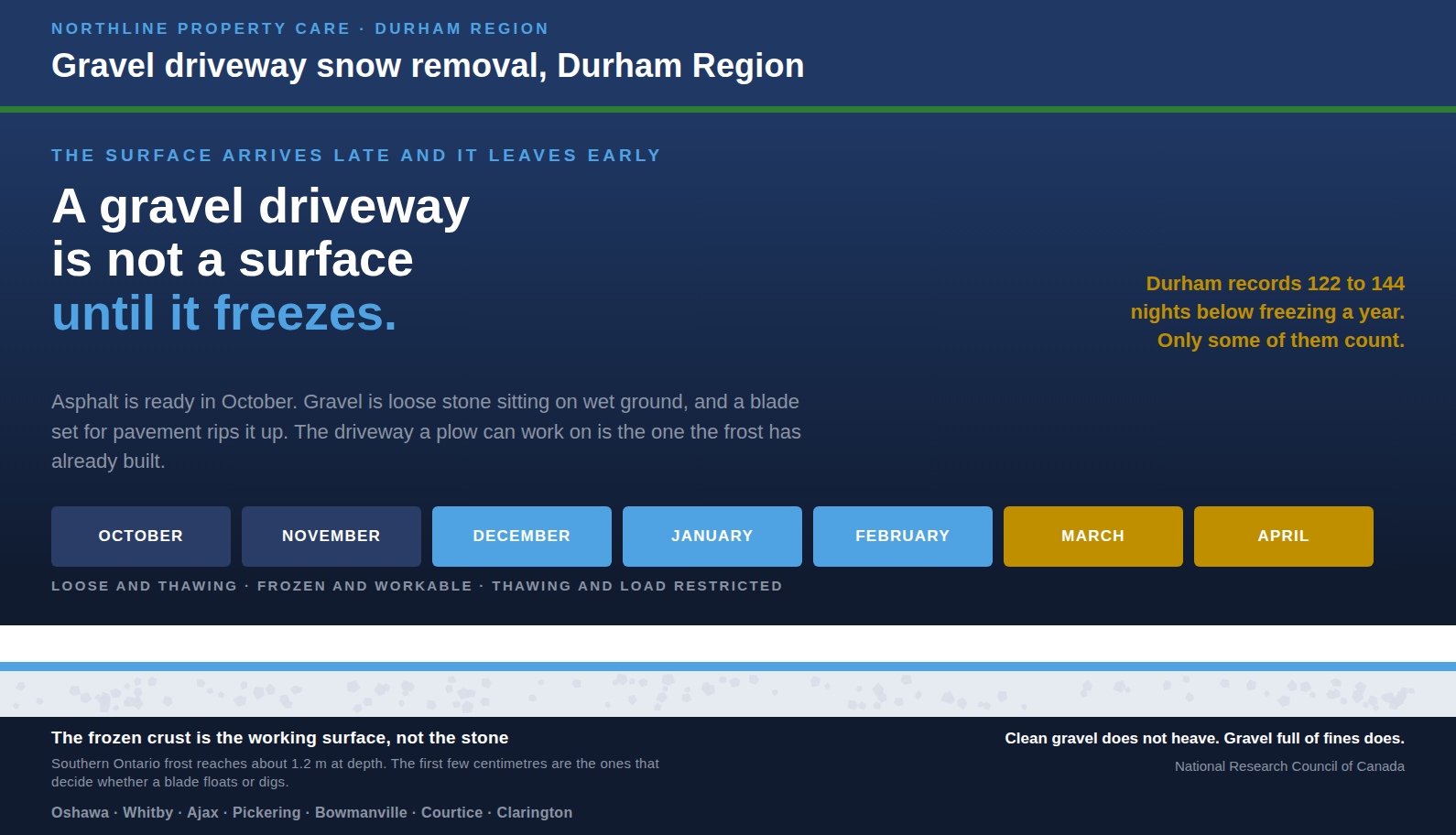
A gravel driveway is cleared to the same 3 cm trigger as any other driveway, and its season opens three to six weeks later. Asphalt is ready the day the contract starts. Gravel is loose stone lying on ground that is still soft through most of November, and there is no way to push snow off it without taking stone with the snow. What a plow actually works against is the frozen crust in the top few centimetres, and in an ordinary Durham winter that crust arrives somewhere in the first half of December. Before it arrives the driveway is cleared high and light or it is not cleared at all, and any contractor who tells you otherwise is quoting a spring repair without mentioning it.
What is actually under a gravel driveway in Durham Region
Durham is not one kind of ground and the difference runs north to south in three bands. The approved source protection assessment for this watershed describes them plainly: the Oak Ridges Moraine across the north, a drumlinized South Slope in the middle, and the Iroquois Plain along the lake. Ground elevation falls from roughly 400 metres near Chalk Lake to about 75 metres at the shoreline over some 23 kilometres.
The moraine is sand and gravel. The plain is fine lacustrine material, which is to say clay. The Region's own agricultural discussion paper puts about 51,800 hectares of moraine inside Durham, a little over twenty per cent of the Region's land base. So a gravel driveway in Solina or Enniskillen is sitting on a naturally draining granular deposit, and a gravel driveway on the flat south of Taunton Road is often sitting on clay that holds water all winter. Those two driveways look identical from the road and they behave nothing alike in March.
Unpaved driveways are commoner here than most people in a subdivision assume. The Township of Uxbridge publishes its own road inventory: 100.7 of 645.9 lane kilometres are gravel, which is about one lane kilometre in six. The Township of Scugog maintains 192 kilometres of gravel road and spent a million dollars resurfacing 22 kilometres of it in one year. Durham contains 53 hamlets with a median size of 63 lots, plus roughly 900 hectares designated for country estate residential subdivisions. Clarington's own settlement list names Solina, Enniskillen, Tyrone, Hampton, Haydon, Burketon, Leskard, Kendal and Orono. Pickering's names Claremont, Whitevale, Greenwood and Brougham. Every one of those places is full of driveways that have never seen asphalt.
Here is what is not published anywhere, and it is worth saying before the rest of this article leans on numbers. No municipality in Durham, and neither the Region nor the Province nor Statistics Canada, publishes a count of unpaved residential driveways. Every figure above is a road figure or a lot figure standing in for a driveway figure, and it is named as a proxy rather than dressed up as a statistic.
The frost is the contractor, and it works to its own schedule
The useful thing about frost on a gravel driveway is that it is building something, not just making the place cold.
The National Research Council of Canada explains the mechanism in its own building digest on ground freezing and frost heaving, and the sentence that matters to a driveway owner is short: growing ice crystals draw water out of the surrounding soil and develop into ice lenses, and the vertical movement that produces is far greater than the expansion of water turning into ice. Three things have to coincide for it: a freezing plane, a fine grained material water can travel through, and a supply of water. Take away any one and the heaving stops. And then the council states the conclusion outright. Coarse sands and clean gravels do not heave.
The American federal highway administration publishes the same idea as a classification in its geotechnical guidance for pavements. Gravelly material carrying three to ten per cent of fines is group F1, negligible to low frost action. Push the fines over twenty per cent and the same material becomes group F3, high. Silt is group F4 and it is the worst thing you can have under anything.
So the difference between a good winter surface and a bad one is not the stone, it is what has worked its way in between the stone. A driveway that has been topped up, crowned and kept draining is close to the best winter surface a rural property can have, because it freezes into a slab and stays put. A driveway that has not been regraded in six years, where the crown has flattened into a shallow pan and the stone is half soil, is the worst surface on the property. It holds water, it heaves unevenly, it goes soft on every thaw, and it is the one that produces the ruts people blame on the plow.
Frost depth for southern Ontario is given as about 1.2 metres in the Ontario Ministry of Transportation pavement design manual, which this article takes at second hand from a City of Toronto geotechnical report quoting it, because the manual itself is not published online. The full 1.2 metres is a footing question rather than a driveway question. What decides whether a blade floats or digs is the first few centimetres, and those arrive weeks before the profile is fully frozen.
Two figures give the shape of a Durham winter. The Region's own future climate study counts between 122 and 144 days a year with a minimum temperature below zero across the eight municipalities, on a 2000 to 2009 baseline, with Whitby at 129. The City of Toronto counts 65.5 freeze and thaw cycles a year on a 1971 to 2000 baseline, using the same definition every time: a day whose low is at or below minus one and whose high is above zero. That second number is Toronto's rather than Durham's, and it is used here as a proxy because nobody publishes a Durham one.
And here is the part that surprises people, including contractors. Clearing the driveway makes it freeze harder. The research council's Ottawa frost pits measured an average reduction in frost penetration of about 0.2 feet for every foot of snow cover sitting on the ground. Snow is an insulator, so a driveway left under thirty centimetres of it in December freezes shallower and later than the identical driveway beside it that has been cleared after every storm. The first two or three clears of the season are doing work that has nothing to do with getting the car out. They are building the surface that the rest of the winter runs on.
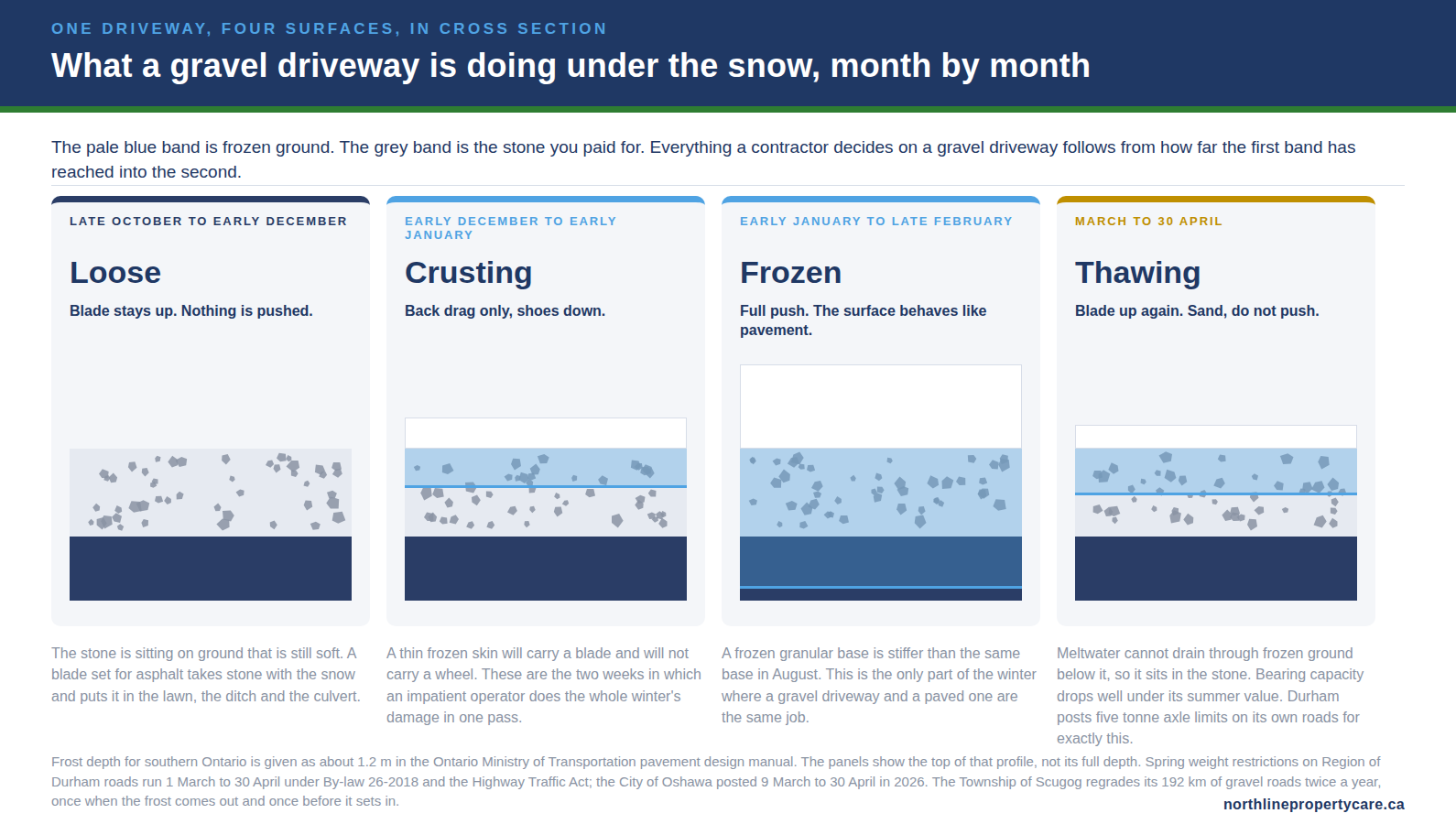
The month labels on that drawing are typical rather than promised. A warm November pushes the whole sequence two weeks later and a cold snap in the last week of November pulls it forward. What does not move is the order, and the order is what the operating rules are built on.
How the job changes, one pass at a time
On pavement a driveway is a push. On gravel it is a sequence, and the sequence is designed around not touching the stone.
The first move is backwards. The blade goes to the garage door with nothing in front of it, drops, and drags away from the house before anything is pushed. Back dragging on gravel is not a tidiness habit, it is the only way to clear the top of the driveway without building a pile against the door and without driving a loaded blade into an apron that may still be soft underneath.
The blade never rides on the stone. It rides on shoes, set so the cutting edge sits clear of the surface rather than scraping it, and the acceptable finish on a gravel driveway in December is a clean white floor with a centimetre of snow still on it. A gravel driveway that has been scraped back to bare stone has been damaged, and the damage will not be visible until April.
The speed comes down and it stays down. Most of the stone that ends up in a lawn is thrown there rather than scraped there, and throw distance is a function of blade speed. On a hundred foot laneway that difference is two extra minutes on the property and it is the whole argument.
The one place that stays hard all winter is the apron at the road, because the municipal plow has already been past and packed the windrow into a ridge of ice with road sand through it. That ridge is worked separately, and it is the reason a rural driveway often takes two visits in a storm rather than one. If you want the detail on what a blade can and cannot do to a surface, the driveway damage question is set out properly here, including what frost heave does and does not explain.
Markers matter more on gravel than on anything else, and most people put them in too late. A paved driveway has a visible edge under the first few storms. A gravel driveway has no edge at all once it is white, and the boundary between driveway, shoulder and ditch is an operator's memory of what it looked like in October. Stakes go in before the ground closes, which is the same reason they cannot be installed in December, and the spacing and placement rules are worth reading before you buy them.
Salt does not work on stone, and Durham's own trucks say so
Rock salt needs a hard surface to work against. It melts a thin brine film and that film has to stay between the ice and something solid. Spread the same salt on loose stone and most of it disappears into the voids between the pieces, where it goes on melting things you cannot see and produces a wet base rather than a clear surface. What you get on the next cold night is a driveway that has been softened rather than cleared.
This is not a theory and it is not a contractor's opinion. It is what the municipalities in this region already do. The City of Pickering publishes its winter clearing process in plain words: rural gravel roads are monitored and plowed as necessary, and if warranted they are then sanded, while salt trucks are dispatched for paved roads only. The Municipality of Clarington sweeps roughly a thousand lane kilometres per round twice each spring precisely because of what goes down over the winter, and it reported using a salt and sand mix more extensively than usual in the 2025 and 2026 season during a salt shortage.
What that means for a driveway is simple enough. On gravel the traction material is sand, or a sand and salt mix where there is a genuine slope, and the quantity is smaller than people expect because the stone itself is doing most of the work. What goes down on a specific property is settled on the quote call rather than assumed, because the surface decides it and no two rural drives have the same grade at the road.
Two canon points belong here and they are unglamorous. Silver carries no salting at any depth and does not plow the driveway at all, which on a rural property is a poor fit. Platinum salts automatically. Anything in between is a conversation about how steep the approach to the road is.
Where the snow goes is a harder problem on a big lot, not an easier one
People assume an acre solves the storage question. It creates a different one.
A subdivision driveway has a boulevard and a front lawn, and the worst outcome of a badly placed pile is a dead patch of grass in May. A rural driveway has a ditch, and a ditch has a culvert under the entrance. Snow pushed into the ditch line melts on the first mild week, runs to the low point, and refreezes in the culvert mouth. A culvert that is plugged with ice in the third week of March does not fail quietly. It backs water up across the laneway, and the laneway is the softest it will be all year at exactly that moment.
So the rule on a gravel driveway is that the pile goes back off the shoulder rather than into it, on the downhill side of the entrance, and clear of the sight line at the road. The sight line part is not a courtesy. It is the difference between a rural intersection you can pull out of in February and one you cannot.
The municipal side of that boundary is already published and it is unambiguous everywhere in Durham. The City of Oshawa states that the windrow the plow leaves across a driveway is the property owner's responsibility and that the city does not clear private paths. The City of Pickering states that plows deposit snow on the boulevard and that a driveway forms part of the boulevard. The Town of Whitby tells residents to keep windrows cleared on both the road and the sidewalk, more than once a day in a heavy storm. None of that changes because the driveway is gravel, and pushing your snow back out onto the travelled road is an offence under the Highway Traffic Act whatever the surface.
Private laneways are their own category and it is worth knowing where you stand. A Durham township policy on the assumption of private and unassumed roads defines a private road as one in private ownership that has not been assumed, whose use and maintenance are the responsibility of the abutting owners, and states that year round road service is not provided until council passes a by-law to assume it. If your lane serves three houses and the township has never plowed it, that is not an oversight. It is the position, and it is written down.
The bill in April that never appears on a quote
The Region of Durham explains spring load restrictions better than any contractor could, and it does it while describing gravel. Its own weight restriction page says that in spring the frozen roads start to thaw, the thawing water may not drain out of the gravel that is under the pavement, the water soaks into the gravel, and when it is absorbed the pavement temporarily loses strength. Restrictions run March 1 to April 30 under Regional By-law 26-2018 and the Highway Traffic Act, at five tonnes per axle. The City of Oshawa posted March 9 to April 30 in 2026 under sections 110 and 122 of the same act.
Read that description again with one substitution. On your property, the gravel that is under the pavement has no pavement over it. It is the driving surface. Every mechanism the Region is describing happens on a gravel driveway too, and it happens at the surface where you can see it rather than a foot down where you cannot.
The federal highway guidance puts a number on the consequence: spring thaws normally produce a loss of bearing capacity well below summer and autumn values, followed by a gradual recovery over weeks or months. Cold regions laboratory testing found the stiffness of granular material collapsing on thaw and then substantially recovering within ten to twenty days of the thaw starting, with clean dense graded stone recovering to autumn values without significant weakening and finer material not doing so. That last clause is the same sentence the frost section ended on, arriving from the other direction.
Which is why the Township of Scugog regrades its gravel network twice a year and does it on exactly that calendar: once in late May or early June when the frost comes out of the ground, and again in late October or early November before the frost sets in. A driveway is on the same calendar as the road it joins, and the spring job on a gravel driveway is a real line item rather than an optional tidy up. It is raking the stone back out of the lawn edge where the winter put it, topping up and reshaping the crown so water leaves rather than stands, and clearing the culvert before the melt rather than during it.
Budget for it in March, not in May. A driveway that gets its crown back every spring stays in group F1 and freezes into a slab next December. A driveway that does not gets a little more soil in it every year, and in about five years it is the pan that heaves, ruts and goes soft, at which point the repair is a load of stone and a machine rather than an afternoon with a rake.
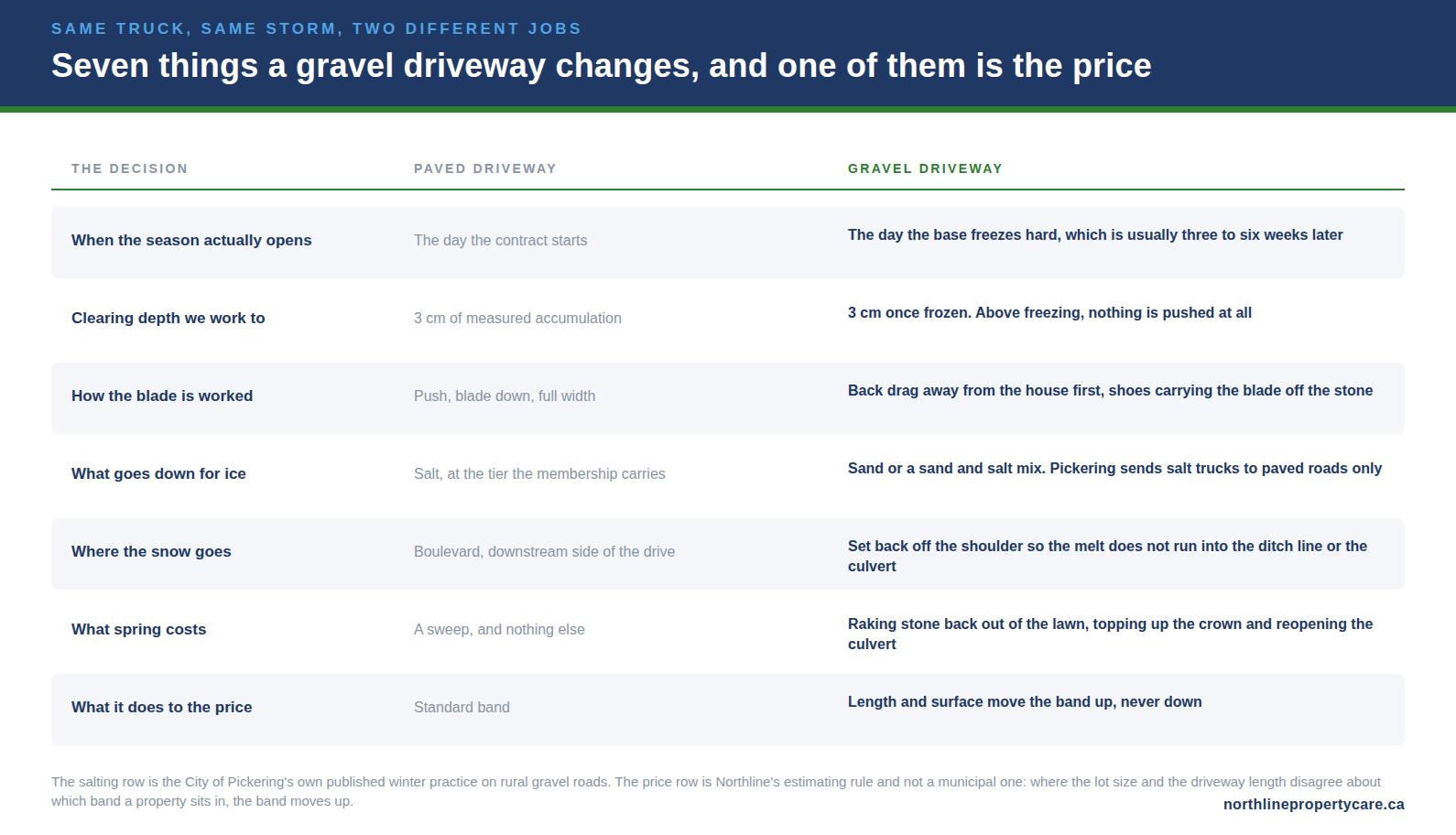
Six of those seven rows cost the contractor time and cost the customer nothing. The seventh is the one worth being straight about, so it gets its own section rather than a footnote.
What it does to the price, and the number we do not publish
A gravel surface on an ordinary suburban driveway does not move the price. On a standard residential property the seasonal snow package runs $800, $975 or $1,200 plus HST according to the size of the driveway, and what it buys is the driveway, the walkway and the salting together, with no cap on the number of visits, at the 3 cm trigger. Stone, asphalt and interlock are all quoted from that same ladder. Book by November 1.
What moves the price is length and lot size, and gravel and length tend to arrive together in this region. The bands are published so that a property can be priced without a site visit.
| Property | What puts it in this band | Seasonal snow, plus HST | Membership, a month plus HST |
|---|---|---|---|
| Standard | An ordinary lot with a driveway under 100 ft | $800 small, $975 standard, $1,200 large | From $129 |
| Estate | 0.35 to 1.0 acre, or a driveway over 100 ft | $1,750 | $229, $349 or $499 |
| Grand Estate | 1.0 to 3.0 acres, or a laneway over 250 ft | $2,600 | $329, $519 or $739 |
| Country Property | Over 3.0 acres | No published price | Settled on the call |
A laneway over 400 feet adds $200 for each additional 100 feet, published as a formula for the same reason. Where the lot size and the driveway length disagree about which band a property sits in, the band moves up and never down, because the longer of the two numbers is the one the truck has to deal with at two in the morning.
Above three acres there is no published number and that is deliberate. It is the reason the other three can be published at all. Past that size the turf, the laneway and the place the snow can physically go stop being predictable from acreage, and a blanket figure would be a number this business could not stand behind. So Country Property carries no price on the website. What survives is the promise that actually matters, which is that nobody drives out to look at it first: you give the acreage and the laneway length, both of which your property tax information already carries, and the price is settled on the call the same day.
One canon point belongs in the middle of a price section rather than at the end. Any driveway clearing at all, on any surface, is Gold or Platinum. Silver is $129 a month and it buys the windrow pass by 5 PM and nothing on the driveway itself, which on a two hundred foot gravel laneway is not a saving, it is the wrong product. The detail on the larger bands, including what changes at the entrance and what a laneway turnaround costs in time, sits on the acreage page and the long driveway page.
Three things we would rather you knew than bought
If the driveway has not frozen, nobody should be plowing it, and that includes us. A contractor who turns up on November 12 and squares off a soft gravel driveway has given you a tidy looking driveway and moved a barrow of your stone into the grass. You will pay for that stone twice, once when it leaves and once when it is replaced. If your first invoice of the season arrives in November and the ground was still soft, ask what was actually done.
If your gravel driveway is short, flat and you are fit, a two stage blower is very likely a better buy than a membership. Two stage machines are built for uneven and unpaved surfaces in a way single stage machines explicitly are not, and on a fifty foot hamlet drive the arithmetic does not favour a contract. The honest version of that comparison, including where it stops being true, is set out here with the manufacturers' own numbers.
And if you are 65 or older, or you have a documented medical inability to clear your own driveway, check your municipality's assistance program before you check our prices. Four of the five municipalities we serve run one, the sign up deadlines fall in October and early November, and one of them charges nothing at all. No contractor in this region beats free. Those programs clear the windrow at the road rather than the driveway itself, which on a long gravel laneway is a smaller share of the problem than it is in a subdivision, but it is still the first place to look.
Frequently asked questions about gravel driveway snow removal
Can a gravel driveway be plowed at all?
Yes, and once it is frozen it is a straightforward job. The constraint is timing rather than possibility. A frozen granular base is stiffer than the same base in August, so from roughly early January to late February a gravel driveway and a paved one are the same piece of work. The care goes into the weeks at either end of that, when the surface is either not built yet or coming apart.
When does the season actually start on a gravel driveway in Durham Region?
When the top of the stone is frozen hard, which is usually three to six weeks after the contract starts on November 1. In most Durham winters that lands somewhere in the first half of December. It is a condition rather than a date, and it is read on the property rather than off a calendar, which is why the first visit of the season on a gravel driveway is often a look rather than a clear.
Will plowing put my gravel in the lawn?
Some stone moves every winter on every gravel driveway, including one that is cleared perfectly. The question is how much, and the answer is decided by three things: whether the base was frozen before anything was pushed, whether the blade was carried on shoes rather than run on the stone, and how fast the machine was moving. A driveway cleared properly loses a thin line of stone along the edges that a spring rake puts back. A driveway cleared in November on soft ground loses a barrow of it.
Do you salt a gravel driveway?
Not the way a paved driveway is salted, because salt needs a hard surface to hold a brine film against and loose stone simply swallows it. Sand, or a sand and salt mix where there is a real slope at the road, is what actually works, and it is what the municipalities around here already do on their own gravel roads. Pickering states outright that its salt trucks go to paved roads only and that rural gravel roads are sanded if warranted. What goes down on a specific driveway is settled on the quote call.
Does a gravel driveway cost more to clear?
The surface on its own does not change the price. A standard property is $800, $975 or $1,200 for the season plus HST whatever it is surfaced with. What changes the price is length and lot size, and those two often arrive with gravel: 0.35 to 1.0 acre or a driveway over 100 feet is the estate band at $1,750, and 1.0 to 3.0 acres or a laneway over 250 feet is the grand estate band at $2,600. Over three acres carries no published price and is settled on the call.
What about a long private laneway the township does not maintain?
It is yours, legally and practically, and that is written down rather than implied. A Durham township policy on assuming private roads defines a private road as one whose use and maintenance are the responsibility of the abutting owners, and says year round municipal service does not begin until council passes a by-law to assume it. For a shared lane the practical questions are who is paying, where the machine turns around, and whether the culvert at the entrance is clear before the season starts.
What we could not verify
Every external figure above was taken from a municipality, a regional government, a provincial or federal agency, a national research council or a transportation authority, and the standing research rule here is that a fact which exists only on a competing company's website gets dropped rather than repeated. Below is what that method went looking for and failed to find, because an article that publishes only its hits is hiding half of its working.
- No count of unpaved residential driveways exists for Durham Region. Not at any municipality, not at the Region, not at the Province, not at Statistics Canada. The road and hamlet figures in this article stand in for it and are named as proxies.
- Clarington and Pickering publish no gravel road kilometre figure we could reach. Clarington's total of 892 kilometres, or about 1,800 lane kilometres, is confirmed. The gravel share of it is not.
- Environment and Climate Change Canada's climate normals server could not be read on the day this was written. So the frost day range here is the Region of Durham's own 2000 to 2009 baseline rather than a thirty year normal for the Oshawa station, and it is labelled that way in the text.
- The freeze and thaw cycle count is Toronto's, not Durham's. Durham's frost day range of 122 to 144 brackets Toronto's 133.7, which is why it is used as a proxy, but no agency publishes a Durham cycle count.
- The 1.2 metre southern Ontario frost depth is quoted at second hand. The Ontario Ministry of Transportation manual that carries it is not published online, so the figure comes from a City of Toronto geotechnical report quoting that manual.
- Ontario's e-Laws service would not serve the text of the Highway Traffic Act or the minimum maintenance standards regulation. Section numbers here are taken from the municipal pages that cite them, and those pages are named rather than the statute.
Who wrote this
Andrew owns the business and drives the laneways himself, frost or no frost. Oshawa, Whitby, Ajax, Pickering, Bowmanville, Courtice and Clarington on a fixed local route, fully insured, with the rural half of that list the reason this page exists at all. The six winters he has spent clearing snow in Durham Region are personal experience and they predate this company, and he has turned down more soft gravel in November than he has squared off. Nothing above is a municipal position and nothing above is legal advice: where a by-law, a regulation or a program is named, that municipality's own page is linked so you can read it for yourself.
If you own a gravel driveway in this service area and want a straight answer on whether it is worth a contract at all, that is a five minute phone call and it costs nothing. Talking somebody out of the wrong product in September beats arguing about a spring repair in April.
The work, photographed
Real Northline properties, before and after, every one of them in Oshawa and every one of them this year. Drag the line to compare.
Andrew answers, October 2026
Why is your season longer than everybody else's?
Because November and April are when the awkward storms happen, and a season that ends on March 31 ends three weeks before the last one. November 1 to May 1 is six months and both ends of it are published, which is the part that matters: a season you can read is a season you can hold me to.
One of these goes on each page and it is replaced monthly. If the question you have is not here, ask it: 905-244-5779.
Tell me the length of the laneway and the acreage
The acreage sits in your property tax information and the laneway you can pace out, and those two are all it takes to price a rural property without anybody driving out to look at it. Send them over and I will tell you which band you are in, what the season costs, and whether the driveway is worth clearing before the ground closes.