Snow removal · Paver driveways
Interlock driveway snow removal in Durham Region, and the three millimetres that decide it
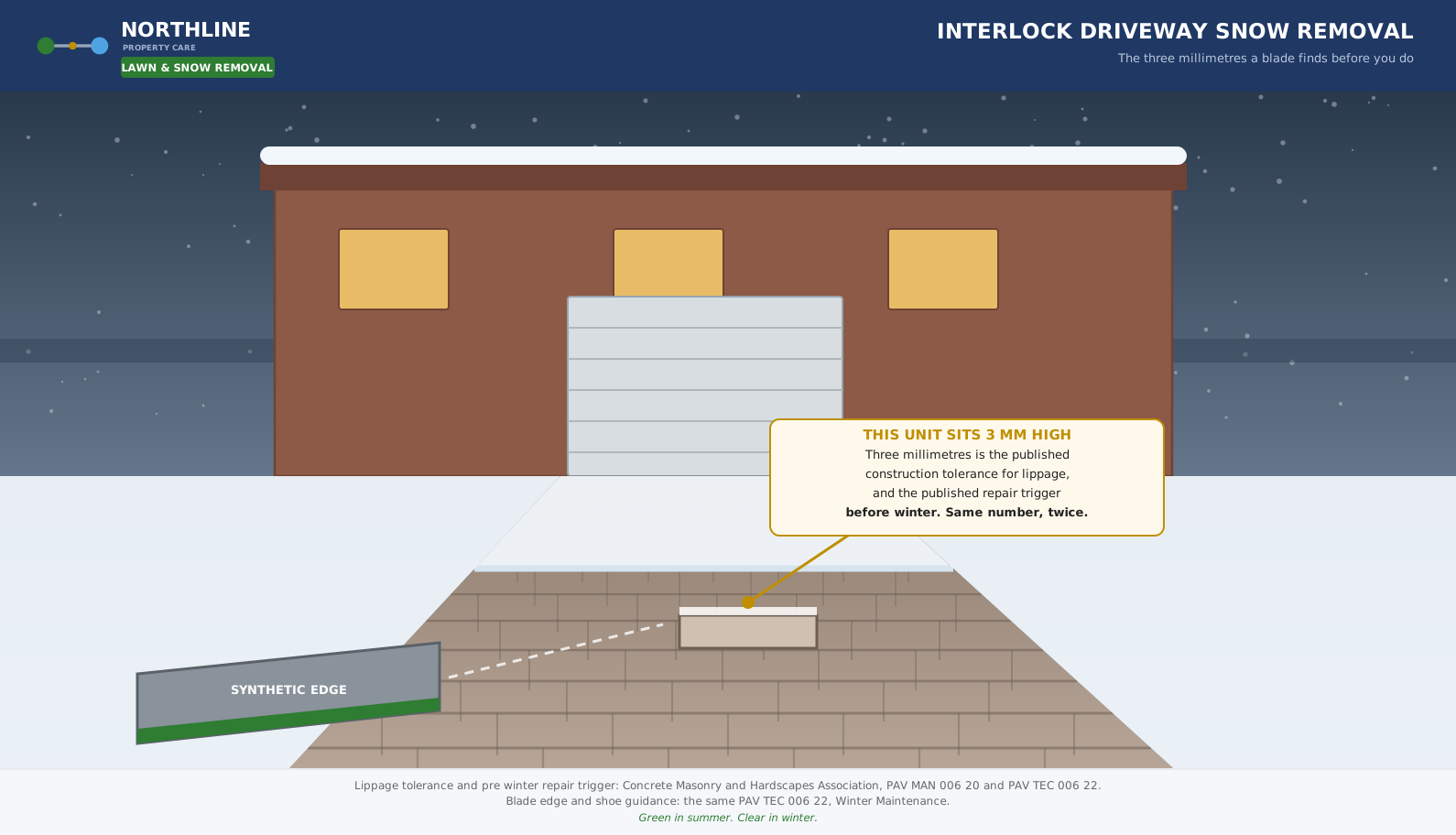
Interlock driveway snow removal in Durham Region turns on three millimetres, because that is both the published construction tolerance for a paver sitting proud of its neighbour and the published repair trigger before winter.
- Fully insured
- Owner operated, one accountable name
- Fixed price before the season starts
- Nothing subcontracted out
The short answer
Three millimetres is the whole story, and it is the same three millimetres twice. The construction tolerance for lippage between two pavers, meaning the step from the top of one unit to the top of the next, is one eighth of an inch. The repair trigger published for getting a paver pavement ready for winter is also one eighth of an inch. A driveway inside that figure gives a blade, a shovel or a snow blower a flat plane to work across. A driveway outside it gives them a step to catch, and the unit that gets pulled out is almost never the one that was loose.
Everything else on this page follows from that. The clay under a Durham driveway is why the step appears, the direction the blade travels is why it matters, and the salt argument most people start with turns out to be the one thing the Canadian product standard already settled.
The number that decides it is three millimetres
Say it first and the rest of the page explains itself: mechanical damage to an interlock driveway is a tolerance failure rather than a material failure. The Concrete Masonry and Hardscapes Association, which publishes the construction tolerances this pavement is built to across North America, sets the maximum lippage between individual pavers at one eighth of an inch, which is three millimetres, and sets joint width between two and five millimetres. Those are the numbers a driveway is laid to on the day it is built.
The same association publishes an operation and maintenance guide for getting that pavement through a winter, and it uses the identical figure from the other direction. Units that have heaved or lifted to a lippage of greater than one eighth of an inch should be repaired, and if they are not, the guide warns that pavers may be removed, meaning pulled out of the pavement entirely. Read those two documents side by side and the picture is unusually clean for construction guidance: the number you built to is the number you inspect against, and nothing in between is a judgement call.
Three millimetres is about the thickness of two stacked coins. It is invisible under snow, it is invisible at walking pace, and it is perfectly visible if you kneel at the end of the driveway in daylight in October with your eye near the surface and look along the courses. That is the entire inspection. It takes about four minutes on a standard Durham driveway and it is the difference between a winter with no incident and a spring with three units to reset and a chipped edge on four more.
The association is also specific about what a raised edge does. A raised edge could catch a shovel, a snow blower or a snowplough and damage the paver or the snow removal equipment. Both halves of that sentence are worth sitting with. The homeowner worries about the stone. The person pushing the equipment worries about the equipment, and a hardened steel cutting edge meeting a 3 mm concrete step at working speed transmits that step straight up into whatever is holding it.
Interlock is common enough in Durham Region that this is not a niche question. Walk the post 2000 subdivisions north of Taunton Road in Oshawa and Whitby, or the Brooklin streets built out over the last fifteen years, and the full paver driveway and the paver border around asphalt are both ordinary. Walk the 1960s and 1970s streets south of Highway 401 and interlock usually shows up as a replacement, laid over a base somebody else designed for a different surface.
Why an interlock driveway in Durham moves at all
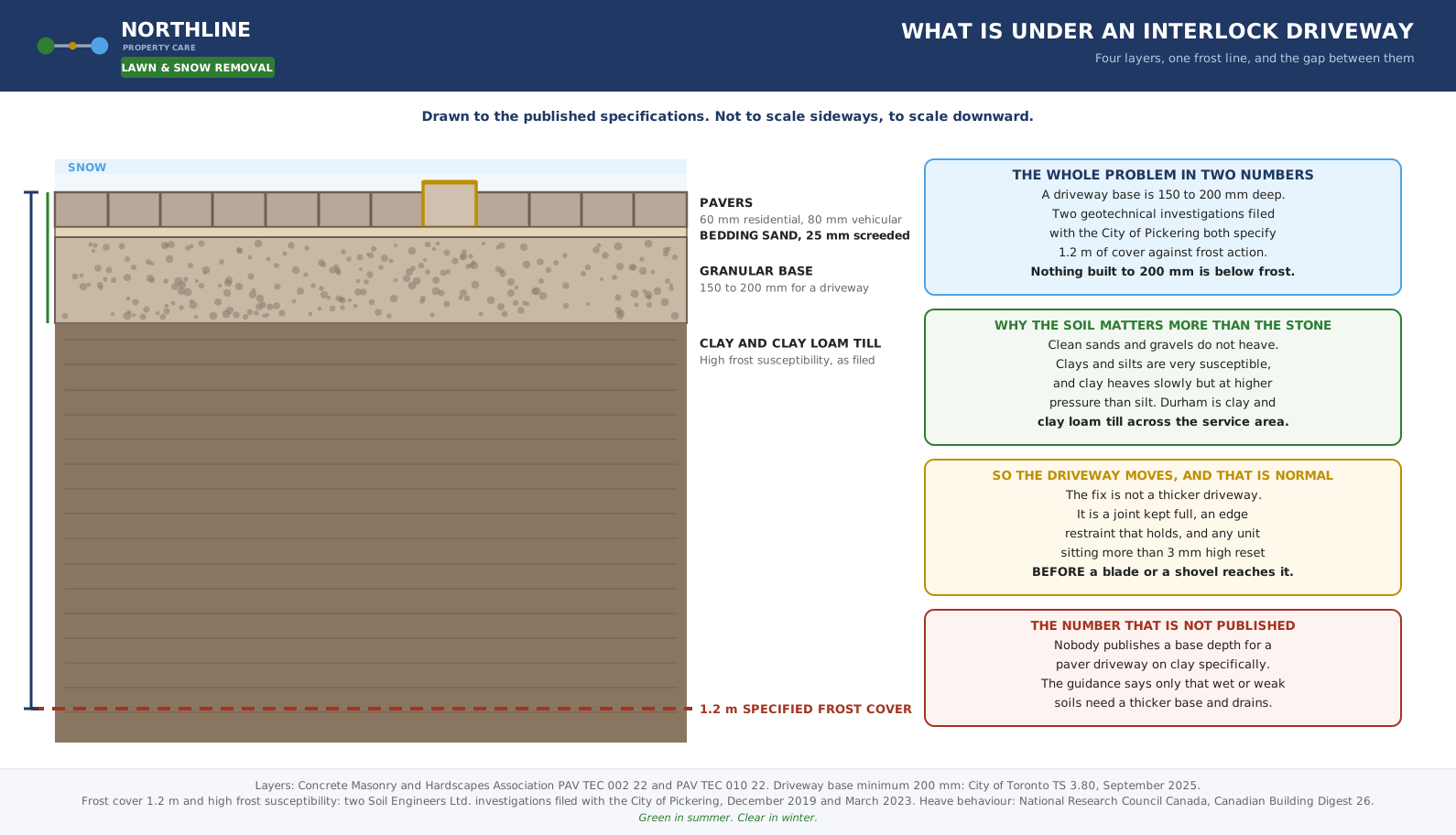
The driveway moves because it is built 150 to 200 millimetres deep and the frost in this region is specified at 1.2 metres. That gap is the honest answer and it is not a criticism of anybody's workmanship. The hardscape specifications call for a granular base of at least 150 mm for a residential driveway on well drained soil and 150 to 200 mm as the working range. The City of Toronto construction specification for concrete unit pavers, which governs this pavement on public right of way and has no reason to be generous, sets its minimum at 200 mm for a driveway. Nobody anywhere publishes a base depth that reaches frost, because reaching frost on a driveway would cost more than the house it serves.
What frost actually is here has been measured locally and it is on the public record. Two geotechnical investigations by the same consulting firm, filed with the City of Pickering as planning documents, one for a site on Brock Road in December 2019 and one for a site on Granite Court in March 2023, both state that foundations exposed to weathering should have at least 1.2 m of earth cover for protection against frost action. Both classify the native material as having high frost susceptibility. One of them describes the local silty clay in exactly those words and the other says the same of the sandy silt till.
Why clay rather than sand is the thing that matters was settled by the National Research Council of Canada in 1962 and has not been overturned since. Coarse sands and clean gravels do not heave. Fine sand and silts are very susceptible. Clays also are very susceptible, although they normally heave slowly, and because their pores are smaller they develop higher heaving pressures than silt does. The mechanism is not the water already in the soil expanding as it freezes. It is water drawn upward from unfrozen soil below to the freezing plane, where it forms a lens of ice that lifts everything above it.
Which brings it home. The soil survey of Ontario County, the federal survey covering Pickering, Ajax, Whitby and Oshawa, maps Darlington loam on clay loam till over 20,700 acres, Whitby loam as the imperfectly drained counterpart of it, and Schomberg clay loam on lacustrine clay. The survey of Durham County, covering Courtice, Bowmanville and the rest of Clarington, maps Newcastle clay loam across the old glacial Lake Iroquois plain and describes that plain as extending over a portion of the three southern townships. The ground under most driveways in this service area is clay or clay loam over till, which is the exact material the National Research Council names as very susceptible, sitting under an assembly that stops 1 metre short of the frost.
Then the freeze thaw count does the rest. The Great Lakes Integrated Sciences and Assessments consortium publishes a regional average of about 42 freeze thaw cycles a year for the Great Lakes region, with a maximum of 60 and a minimum of 23.4, counting the times the temperature crosses freezing and dividing by two. That figure is regional and it is not an Oshawa reading, which is worth saying plainly rather than borrowing the precision. Even at the low end it is a lot of lifting and settling for one winter, and every cycle is an opportunity for a joint to lose sand and for a unit to come back down a fraction higher than it started.
So the realistic goal is not a driveway that does not move. It is a driveway whose joints stay full, whose edge restraint still holds, and whose high units get found in October rather than in January by a blade. The hardscape guidance agrees: where heave is caused by frost it recommends frost resistant subbase material, and where faulting has happened it says the blocks may be reset, with the base repaired first if the base is the cause.
Which way the blade crosses the joints
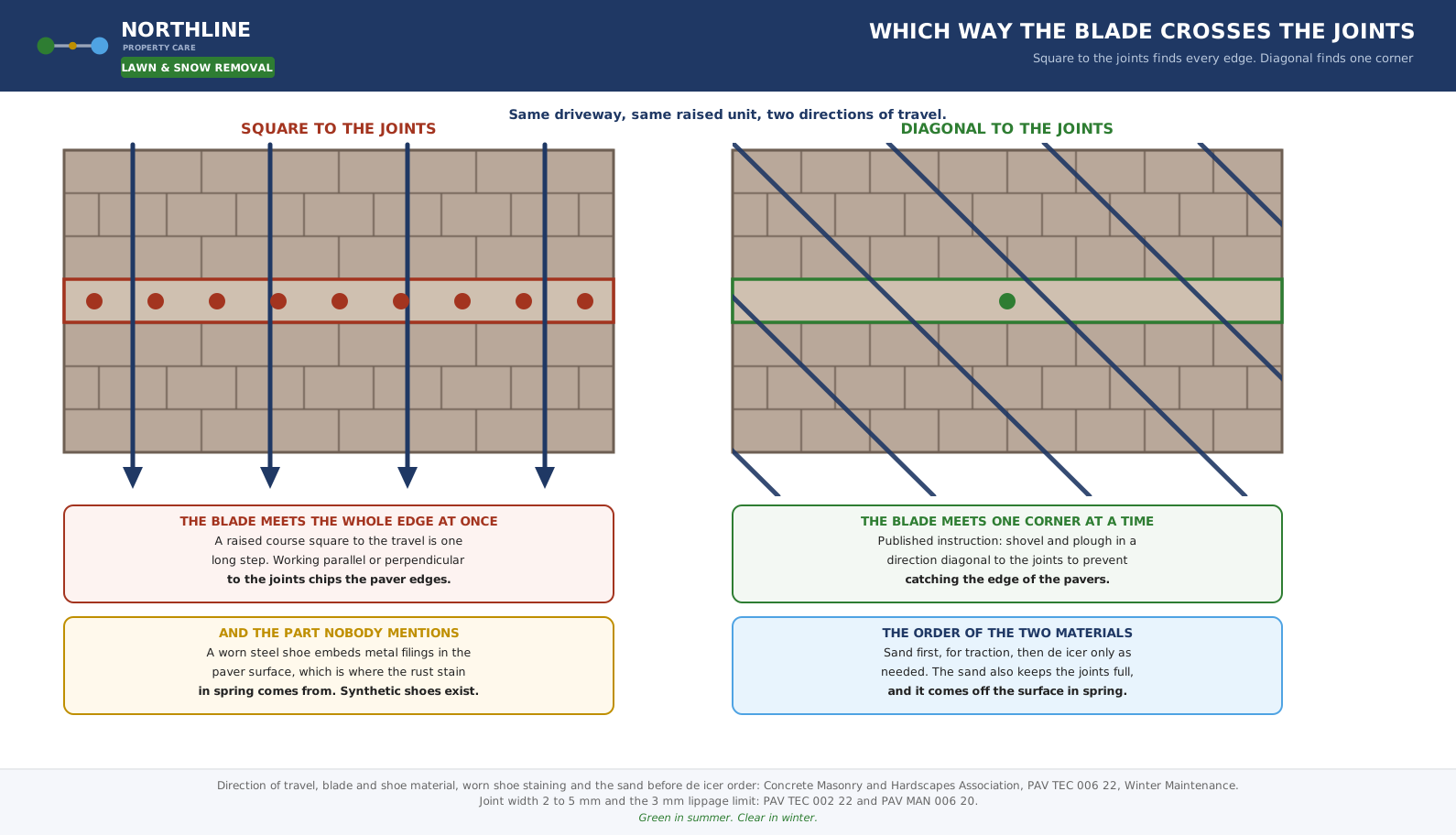
Work diagonally to the joints, and the reason is geometry rather than preference. The published winter maintenance instruction for this pavement is to shovel and plough on a diagonal so that the tool never runs along a joint line, and the warning attached to it is that lippage worked at square angles chips paver edges. Picture a course that has lifted across the width of the driveway. A blade running straight up and down the driveway meets that whole raised line at once, every unit in it simultaneously. A blade crossing at an angle meets one corner, then the next, then the next, and each contact is a fraction of the load.
The second instruction is about the shoes, the skids that set how high the cutting edge rides. The guidance is to adjust worn shoes so the blade rides at a height that removes as much snow as possible without catching paver edges. On asphalt a shoe is a convenience. On interlock it is the control that decides whether the edge touches stone at all, and a shoe that has worn down over a season quietly lowers the blade onto the surface it was set to clear.
The third is the one almost nobody publishes, and it answers a question Durham homeowners ask every April. Worn steel shoes can embed metal filings from the shoe into the paver surface, and that is where the rust coloured staining comes from. It is not the salt, it is not the stone bleeding, it is powdered steel sitting in the pores of a concrete surface and oxidizing in the spring rain. Synthetic shoes are available which prevent exactly that, and the same guidance recommends considering plastic snow shovels or synthetic blade edges on this surface.
A homeowner with a shovel inherits all three rules. Cross the joints at an angle, keep the blade from digging, and a plastic shovel beats a steel one on this one surface even though steel is better on everything else. A homeowner with a snow blower inherits a fourth, which is that the skid shoes on the blower do the same job as the shoes on a plough blade and are set the same way: high enough that the auger housing never touches stone.
Our own practice on an interlock property is to agree the direction of travel at the pre season walk around and write it in the file, because the direction that works on a given driveway depends on where the courses run and where the snow has somewhere to go. A driveway laid in a herringbone pattern already presents its joints at an angle to the length of the driveway, and the diagonal that is right on a running bond is not automatically right there.
The salt argument, answered by the standard rather than by opinion
The Canadian product standard for concrete pavers already contains a de icing salt test, and that is the single most useful fact on this page. CSA A231.2 specifies requirements for concrete pavers made from hydraulic cement concrete for pedestrian and vehicular traffic areas, and it carries a compressive strength test at clause 7.2 and a de icing salts freeze thaw durability test at clause 7.3. The standard itself sits behind a paywall, so the numbers below come from two independent public specifications that cite it and agree with each other exactly.
The City of Toronto construction specification for concrete unit pavers, TS 3.80, dated September 2025, requires a minimum average compressive strength of 50 MPa on laboratory cured specimens and, for freeze thaw durability tested immersed in a three per cent salt solution, no greater mass loss than 225 grams per square metre after 28 cycles or 500 grams per square metre after 49 cycles. McGill University master specification 32 14 15, citing CSA A231.1 and A231.2, publishes the same three figures, plus a maximum absorption of five per cent that only that one document gives.
Read what that test actually is. Forty nine complete freeze thaw cycles, with the unit sitting in salt water the whole time, and a pass requires losing less than half a kilogram of material per square metre of surface. No Durham driveway is treated that hard. The honest conclusion is that the common worry, that salting an interlock driveway will eat the stone, is answered by the product before anybody picks up a spreader, provided the pavers were sold to the Canadian standard.
The published advice on which de icer is less honest than the test is, and this is worth saying rather than smoothing over. The hardscape association names rock salt as the least damaging to concrete materials, suggests judicious use of calcium chloride, and recommends against magnesium chloride and calcium magnesium acetate on the grounds that they can chemically degrade all types of concrete. The cement industry position is similar, putting sodium chloride and calcium chloride in the acceptable column for good quality dense concrete. But a Utah Department of Transportation report from June 2014, which is a transport agency rather than a trade body, says the opposite about rock salt, that sodium chloride causes scaling of concrete surfaces and increases the rate of corrosion of embedded steel.
Underneath the disagreement sits a sentence from the peer reviewed literature that explains why it exists. Valenza and Scherer published a two part critical review of salt scaling in Cement and Concrete Research in 2007 and concluded that although salt scaling is a major durability issue for concrete, there is no agreement regarding the cause of the damage, and consequently no means for preventing it can be identified. That is why the Canadian standard tests an outcome, grams lost per square metre, rather than a mechanism. Anybody who tells you confidently which chemical reaction is damaging your driveway is ahead of the published science.
Where all three positions do agree is the absolute. Never use a de icer containing ammonium sulphate or ammonium nitrate, because those are too aggressive and will destroy a concrete surface. Those compounds turn up in fertilizer, and the bag of fertilizer in the garage is the thing a homeowner reaches for when the salt runs out in February. It is the one de icing decision on this page that has no grey area in it.
When salt stops working, and how little is enough
Rock salt is generally considered ineffective below minus 10 degrees, and almost every Durham driveway gets more of it than any published rate calls for. The Transportation Association of Canada published a best practice synthesis covering salt on private roads, on parking lots and on walkways in April 2013, prepared under contract with Environment Canada, and it is the right document for a driveway because that is literally its scope. Its table gives sodium chloride a lowest working temperature of minus 10 and a eutectic point of minus 21 at a concentration of 23.3 per cent, calcium chloride a lowest working temperature of minus 29, and magnesium chloride minus 15.
The eutectic number is the one that causes trouble in conversation. Minus 21 is a laboratory figure at one exact concentration, and the same synthesis says plainly that sodium chloride is usually not used below minus 10. The United States Federal Highway Administration reaches the same practical limit from its own direction, saying it is not practical to use salt below minus 9 degrees. An Oshawa overnight in January that reads minus 14 on the phone is a night when more salt does not buy more melting, and the answer is grit for traction instead.
| Material | Lowest working temperature | Eutectic point |
|---|---|---|
| Sodium chloride, rock salt | minus 10 C | minus 21 C at 23.3 per cent |
| Magnesium chloride | minus 15 C | minus 33.6 C at 21.6 per cent |
| Calcium chloride | minus 29 C | minus 51 C at 30 per cent |
The quantity question has a published answer and a measured answer, and the gap between them is the story. The same Canadian synthesis gives a parking lot spreading rate of 1.5 kilograms per 100 square metres above minus 1 degree, rising to 3.9 kilograms per 100 square metres between minus 9 and minus 15. Converted, that is 15 to 39 grams per square metre, and the conversion is arithmetic on the published figures rather than a number printed in the document. The Lake Simcoe Region Conservation Authority, measuring real commercial lots in Ontario, reports approximately 90 grams per square metre as the typical rate in its studies, against 58 grams per square metre suggested as reasonable for a moderate event.
At the household scale the University of Minnesota extension program puts it in units anybody can picture: about one pound of salt per 250 square feet, no more than four pounds per 1,000 square feet, and granular crystals spaced two to three inches apart so you can see pavement between them. A twelve ounce coffee cup of salt covers roughly ten sidewalk squares. A small driveway, twenty feet by twelve, needs about one pound. Most people in Durham Region put down ten times that and then wonder why the grass along the edge comes back brown.
One thing worth knowing before anybody lectures you about salt. Ottawa's road salts Code of Practice was issued in April 2004, once an assessment three years earlier had found that road salts met the toxicity criteria set out in the Canadian Environmental Protection Act. It binds organizations spreading more than 500 tonnes a year, and it says in terms that domestic, private and institutional use falls outside it. No federal rule governs the salt on a Whitby driveway. Everything a contractor does about it is discretion rather than compliance, which is a reason to be careful with it rather than a reason to stop thinking about it.
On interlock specifically the hardscape guidance adds an order of operations worth adopting. Apply sand first to increase traction, then apply de icers only as needed, and remove the excess sand from the surface in the spring. Sand on a paver driveway is doing a second job while it sits there, because the sand that works into the joints is keeping them full, which is the thing that holds the pavement together. It is the only winter material on this page that improves the driveway while it is being used.
The joints are the maintenance, and polymeric sand is the wrong answer in February
An interlock driveway is held together by the sand in the joints, and the published trigger for topping it up is a drop of more than twelve millimetres. The pavement works because load on one unit is transferred to its neighbours through the sand filled joint, which is where the word interlock comes from. Empty the joints and the units stop sharing load and start working as individual blocks, which is when edges chip and courses go out of line. The maintenance guidance is to inspect the joints, and where the sand has dropped more than half an inch, top up the joint sand immediately.
Here is the part that surprises people, and it is published guidance rather than a trade opinion. Top up with dry masonry sand, because using polymeric sand for topping up joints is not recommended. Polymeric sand, the kind that sets hard when it is wetted, is a product for a full installation, where the joint is filled from the bottom and the whole surface is treated at once. Dropped into a partly full joint as a repair it bridges the top and leaves a void underneath, and the next freeze finds that void.
The association is equally clear that joint sand stabilizers do not add structural capacity, so the base design must not count on them. That is a useful sentence to carry into a conversation with anybody who proposes sealing or stabilizing a driveway as a cure for movement. It is not a cure for movement. It is a way of keeping sand in a joint that already works.
The practical Durham sequence is to top up joints in late October when the surface is dry and before the ground closes, not in April when the damage has already happened. Water flow, wind, aggressive cleaning and tire action are the four things that empty a joint, and three of those four are at their worst in a winter with a lot of melt. A driveway that sheds meltwater down one edge will lose that edge first, every year, and that is the edge to look at.
Where the pile goes, and the five by laws that have an opinion
Not on the road, not on the sidewalk, and in Pickering not by any method that could damage the sidewalk or the curb. Every town Northline serves prohibits moving snow from private property onto a highway or a sidewalk, and the wording differs enough that it is worth knowing which one applies to you. The City of Oshawa Winter Access By law, 92 2009 as amended, forbids at section 6.1 the moving of snow or ice off private property onto a sidewalk or a highway, or permitting anybody else to move it there, and says at section 6.2 that nobody shall deposit snow or ice on a boulevard that is not adjacent to their own lot.
The sidewalk clock is not uniform across Durham Region and the exception is the biggest town. Oshawa gives an owner until midnight of the first day after the precipitation has ended, which is not twenty four hours and can be longer or shorter depending on when the snow stops. Whitby runs twenty four hours under the Clean Community By law 8271 26, which took effect on April 1, 2026 and replaced the by law a lot of older advice still quotes. Ajax runs twenty four hours under By law 46 2025. Clarington runs twenty four hours under By law 93 144, whose section 8 is the one that expressly names the sidewalk as well as the travelled portion of the highway. Pickering runs twenty four hours under By law 6650 06.
Pickering carries the clause that belongs to this page. Its ice and snow clearing rules prohibit removal methods that may damage the sidewalk or the curb. That is a municipality writing down, in a by law, the exact failure this article is about, and it is the only one of the five that does. It does not apply to your driveway, which is yours, but it tells you how a municipality thinks about a hard tool on a segmental surface.
On the private side the pile location is a decision and not an accident. Snow off an interlock driveway should not be stacked against the edge restraint, because the restraint is the thing holding the outside course in position and a loaded pile with meltwater running under it is the worst case for it. It should not sit on the lawn immediately beside a paver edge either, because that is where salt concentrates as the pile melts. The place it belongs is the downhill side, away from the restraint, away from any side wall vent, and clear of the sight line out of the driveway.
If you want the full town by town picture of who clears what on the municipal side, including which windrow program closes on which date, that is set out on who clears the windrow in Durham Region, and the Oshawa rules in detail are on the Oshawa snow removal by law.
The white bloom in March is not salt damage
That chalky white film on the pavers at the end of winter is almost certainly efflorescence, it is harmless, and winter is the season that produces it. The Portland Cement Association describes efflorescence as a crystalline deposit, usually white, formed when calcium hydroxide left over from cement hydration reaches the surface and reacts with carbon dioxide in the air to form calcium carbonate. Three conditions have to coexist: soluble compounds in the material, moisture to carry them, and evaporation or pressure to move the solution. Remove any one and it does not happen.
The winter link is chemical rather than coincidental. Efflorescence is more common in winter because the slower rate of evaporation allows the salts to migrate to the surface, and because calcium hydroxide dissolves more readily in cold water. The masonry association adds the spring half of the cycle: moisture that froze inside the material thaws, dissolves more salts and pushes them outward, which is why it often looks worse in March than it did in January.
The useful part for a homeowner is that it is described as generally harmless and it often disappears by itself. On pavers specifically the published note is that it does not affect structural performance or durability, that it can appear within months of installation, and that it frequently peaks within about sixty days of the pavement first getting properly wet. Scrubbing it with an aggressive cleaner in March is a good way to open the surface and lose joint sand at the same time, for a problem that was going to resolve on its own.
There is one case where white on a paver is worth a second look, and that is when it appears only in a band along the edge where a salt pile sat, rather than across the field of the driveway. That pattern is a concentration problem rather than a cement chemistry problem, and the answer to it is the application rate in the previous section.
Sealing, and the two warnings that come with it
Seal an interlock driveway because you want the colour, not because you think it is winter protection. The published position from the hardscape association is that sealers reduce water, stain, oil and dirt intrusion and do not increase the pavement system load capacity. Nothing in the winter maintenance guidance treats sealing as a durability measure, and nothing needs to, because the salt and freeze thaw durability is already in the product standard.
The first warning is about moisture. The cleaned surface must be completely dry before most sealers are applied, with at least twenty four hours free of moisture beforehand. Whitening after sealing happens when the surface or the joints were wet, when efflorescence is still arriving from below, or when the sealer is not breathable, and a thick application over poor drainage produces cloudiness. In Durham Region that effectively closes the sealing window well before the weather does, because a dry twenty four hours in late October is not something to count on.
The second warning is about grip, and it is the one that matters on a driveway with any slope. The guidance is to maintain adequate slip and skid resistance and to be careful not to over apply the sealer such that the surface becomes slippery when cured. The research literature on concrete pavement treatments reaches the same conclusion from the engineering side, noting that barrier coatings may be poor candidates for pavements because of their potential influence on skid resistance, and that film forming treatments can crack under freeze thaw and lose effectiveness. That research covers cast in place concrete rather than unit pavers, so take it as a principle about film forming products in a freeze thaw climate rather than as a finding about your driveway.
The practical reading, for a Durham property, is that if a sealer goes on at all it should be a breathable one, applied thin, on a surface that has been dry for a day, and never late enough in the autumn that the first frost arrives before it has cured.
When you should not buy this from us
If the walk around finds a course sitting more than three millimetres high, the right purchase this autumn is a paver reset, and it is not a purchase we sell. We do not do hardscaping, we do not reset pavers, and we do not relay a base. That position is published on our own add on page: hardscaping sits on the referred out list here, alongside sod, grading, irrigation repair and any tree work above ladder height. Buying a winter of plowing for a driveway that needs a reset first is buying the thing that will find the defect rather than the thing that fixes it.
Second, and this one costs us a sale every year. If you qualify for your municipality's snow clearing assistance program, join it. Whitby charges nothing at all for its windrow and sidewalk service and its applications close on November 1. Clarington runs its enrolment from September 21 to October 31 and charges $107.69 including HST for the season. Pickering runs an income tested fee that is zero for residents receiving the Guaranteed Income Supplement. No contractor beats free, and no contractor should try to talk you out of it.
Third, be clear about what the entry membership does on a driveway. Silver, the $129 a month plus HST entry tier, leaves the driveway to you and carries no morning target at all. What Silver covers is the 5 PM windrow pass after a storm, plus four full clears a season banked against a request, and salting forms no part of it at any point in the winter. If your reason for calling is a cleared interlock driveway before you leave for work, the tier that does that is Gold, and quoting you the entry price against that promise would be the most common piece of dishonesty in this trade.
Fourth, if your driveway is a short single width with good drainage and you are physically able, a plastic shovel used diagonally across the joints is a perfectly good answer for an interlock driveway and we will say so. The arithmetic on hand clearing, including what a winter actually weighs, is set out on snow shovelling in Oshawa.
What it costs, and what changes on interlock
Nothing on this page is a surcharge, and the price for a paver driveway is the price for any driveway. Plowing the driveway, with the 7 AM target after an overnight fall, is what the Gold tier buys: $189 a month plus HST, $213.57 on the card, and $2,268 over a year that is billed as twelve identical payments, each taken on a month end. Platinum, at $279 a month plus HST and $315.27 on the card, is sequenced ahead of it with a 6:30 AM target and unlimited automatic salting. Buying the winter outright instead, the seasonal snow package is $800 plus HST on a small property, $975 plus HST on a standard one and $1,200 plus HST on a large one, covering driveway, walkway and salting, unlimited, at the 3 cm residential trigger.
Two dates govern the purchase and they are not the same date. Book by November 1 for the seasonal price. The residential route closes on November 30, or earlier if it fills, and it does not reopen that winter. Morning targets are what cap the route, because a driveway promised clear by 7 AM has to have somewhere in the night to be cleared, and once the nights are spoken for the route is shut.
What an interlock property gets added to the file, at no charge, is four things. A pre season walk along the courses looking for lippage, with anything over three millimetres reported to you in writing before the season starts. An agreed direction of travel, written down, so the same decision is not made again in the dark. A note on where the pile goes, chosen away from the edge restraint. And sand before de icer as the standing order on that property, with the excess swept off in spring.
For a property that does not want a whole season, two per visit numbers exist: $25 buys a salt only trip, $45 buys a windrow return trip. Those exist because a driveway that is already clear sometimes needs one of the two and not the other, and charging a full visit for a bag of grit is how a customer learns not to call.
If you would rather compare the whole price structure before anything else, the three tiers are set out on the memberships page and the full winter service on snow removal.
What we could not verify
Three things this page would be stronger for having, and none of them could be opened. The first is CSA A231.2 itself. The standard is paywalled, so the strength, absorption and freeze thaw figures above come from two public specifications that cite it, the City of Toronto TS 3.80 of September 2025 and the McGill University master specification, which agree exactly on 50 MPa and on the 225 and 500 grams per square metre limits. The five per cent absorption figure rests on the McGill document alone. We also found no published CSA thickness class scheme, so the 60 mm and 80 mm figures in the drawing are hardscape association application guidance rather than a Canadian standard classification.
The second is a base depth published specifically for a paver driveway on a clay subgrade. It does not appear to exist. The guidance says only that in colder climates continually wet or weak soils will require thicker bases, and recommends drain pipes in clay soils subject to vehicular traffic. Anybody quoting you a clay specific number is quoting their own practice, which may well be sound, but it is not a published specification.
The third is a freeze thaw cycle count for Oshawa. The peer reviewed paper that would settle it, on freeze thaw cycles in Toronto in a changing climate, has its table of observed averages behind a paywall. The Environment and Climate Change Canada climate normals pages could not be read by the tools used for this research, which is a tool failure rather than a finding about the data. The regional figure quoted above is the Great Lakes average and it is labelled as such on purpose.
And one more, named because it is the kind of thing that gets assumed. No peer reviewed study of differential frost heave of segmental pavement on a clay subgrade could be found in the open literature. The closest permitted evidence is a cold climate test facility study in New Hampshire, funded by the hardscape foundation, which reported that winter plowing and freeze thaw did not dislodge any of the pavers, and that study is permeable pavement in a different state with no heave measurements in it. The argument on this page about why interlock moves in Durham rests on the frost depth filings, the soil survey and the National Research Council heave mechanism, which is three sources and not one, but it is not a direct measurement of a Durham driveway.
Questions Durham homeowners actually ask about interlock
Can you plow an interlock driveway, or does it have to be shovelled?
It can be plowed, and most interlock in Durham Region is plowed every winter without a mark on it. What decides the outcome is not the machine, it is the state of the surface before the machine arrives. The hardscape association that publishes the construction standards for this pavement sets the repair trigger at a lippage of more than one eighth of an inch, which is three millimetres, and the same three millimetres is the construction tolerance a correctly built driveway was laid to. A driveway inside that tolerance presents a blade with a flat surface. A driveway with a course that has lifted over a winter presents it with a step. So the honest answer is that a blade is safe on interlock that has been looked at, and a gamble on interlock that has not.
Does road salt damage interlocking pavers?
Far less than most people assume, and the reason is in the product standard rather than in anybody's opinion. A concrete paver sold to the Canadian standard has been frozen and thawed forty nine times while sitting in a three per cent salt solution, and it has to come out of that test having lost less than five hundred grams of material per square metre. The City of Toronto writes the same limits into its own construction specification for unit pavers. That is a harsher winter than any driveway in Oshawa will ever have. The real salt problems on a paver driveway are the plants and the soil at the edge of it, the steel in anything buried near it, and the habit of spreading five times what the published rate calls for.
What de icer should I use on an interlock driveway?
Plain rock salt, sparingly, and sand first. The hardscape association names sodium chloride as the least damaging of the common de icers to concrete materials and advises against magnesium chloride and calcium magnesium acetate because they can chemically degrade concrete. The cement industry puts calcium chloride in the acceptable column with rock salt. Everybody agrees on one absolute: never a product containing ammonium sulphate or ammonium nitrate, which will destroy a concrete surface rather than merely wear it. The honest caveat is that the research literature on cast in place concrete is less forgiving of rock salt than the hardscape guidance is, so the safe position is to use the least aggressive product and use less of it.
Why does one corner of my interlock driveway lift every winter?
Because the driveway is built 150 to 200 mm deep and the frost is not. Two geotechnical investigations filed with the City of Pickering, one in December 2019 and one in March 2023, both specify 1.2 m of earth cover for protection against frost action, and both classify the native soil as high frost susceptibility. The National Research Council has published since 1962 that clean sands and gravels do not heave while clays and silts are very susceptible, and the soil survey for this county maps clay loam till and lacustrine clay across Oshawa, Whitby, Courtice and Bowmanville. The corner that lifts is usually the one where water collects, because water moving to the freezing plane is what builds the ice lens that does the lifting.
Should I seal my interlock driveway before winter?
Only if you want it to look a particular way, and not as winter protection. A sealer does not add structural capacity and it is not what keeps a paver intact through a Durham winter, because the paver already passed a salt and freeze thaw test to be sold here. If you do seal, the two published warnings matter more than the product choice. The surface has to be completely dry first, with at least twenty four hours free of moisture, or the sealer traps what is underneath and turns white. And over applying it makes the surface slippery once it cures, which on a sloped Durham driveway in February is a worse problem than the one the sealer was bought to solve.
What does snow removal for an interlock driveway cost in Durham Region?
The same as for asphalt, because the work is the same work and the care is included rather than billed. A driveway cleared to the 7 AM target after overnight snow is the Gold tier, $189 a month plus HST, $213.57 on the card, $2,268 over twelve equal payments. Bought as a season instead, a standard property is $975 plus HST, a small one $800 and a large one $1,200, and November 1 is the deadline for that price. What changes on interlock is the walk around before the season, the shoe height, the direction of travel and a note in the file naming the raised course so the same decision is not made twice. None of that carries a surcharge. What we do not sell is paver repair, so if the walk around finds a lifted course we will tell you and we will not quote you for fixing it.
Who wrote this
This was written by Andrew, who owns Northline Property Care and runs it out of Oshawa with six winters of Durham snow work behind him. The person who measures your property is the person who clears it, and the name on the invoice is the one answering the phone. The business carries full insurance and a CVOR registration, which is what Ontario requires of a work truck, and it carries no trade licence because the province issues none for this work.
This page was written against published documents rather than trade habit. Every figure in it carries the specification, by law, survey or journal it came from, and every external link goes to a standards body, a municipality, a federal agency, a university or a peer reviewed journal. Not one goes to another lawn care, snow removal or hardscaping company, which is a rule here rather than an accident, and it is the reason the page contains numbers that competitor pages do not.
Where the published record disagrees with itself, as it does on rock salt and concrete, the disagreement is printed rather than resolved in our favour. Where a figure could not be verified it is in the section that says so.
Read next
Snow plow driveway damage in Oshawa
What a blade does to asphalt and poured concrete, what it does not do, and which of the four winter failure modes is actually the plough.
Driveway salting in Oshawa
How little is enough on a Durham driveway, measured in grams per square metre, and the reading on the pavement that ends the argument.
Prepare your driveway for snow removal
The October checks that have to happen before the ground closes, drawn to scale, with the setbacks a marker rod has to respect.
Andrew answers, October 2026
My interlock has a course that lifts every winter. Will you still take the driveway?
Yes, and I will tell you what I am going to do about it before the season rather than after. A course that is up more than three millimetres gets written into the file, the direction of travel gets set across it rather than into it, and the shoe gets raised on that property. What I will not do is pretend the problem is gone, and I will not quote you to reset it, because resetting pavers is not work this business does. If it is bad enough that a blade is a bad idea, I will say that too and you can decide.
One of these goes on each page and it is replaced monthly. If the question you have is not here, ask it: 905-244-5779.
Get the walk along the courses done while the ground is still open
Send the address and I will price the winter the same day. On a paver driveway the pre season look along the joints comes with it, and anything sitting high gets reported to you in writing before a blade is anywhere near it.
Green in summer. Clear in winter.