Snow removal · Municipal schedules
When does the city plow my street in Oshawa, and why a residential street is the last road on the list
When does the city plow my street in Oshawa? After every arterial and collector road in the city, on a clock that does not start until the snow has stopped falling, which is why a street can still be white at nine in the morning while the City is comfortably inside its own published standard.
- Fully insured
- Owner operated, one accountable name
- Priced at your address, in writing, before anything starts
- Every membership includes a pass at the windrow
The short answer
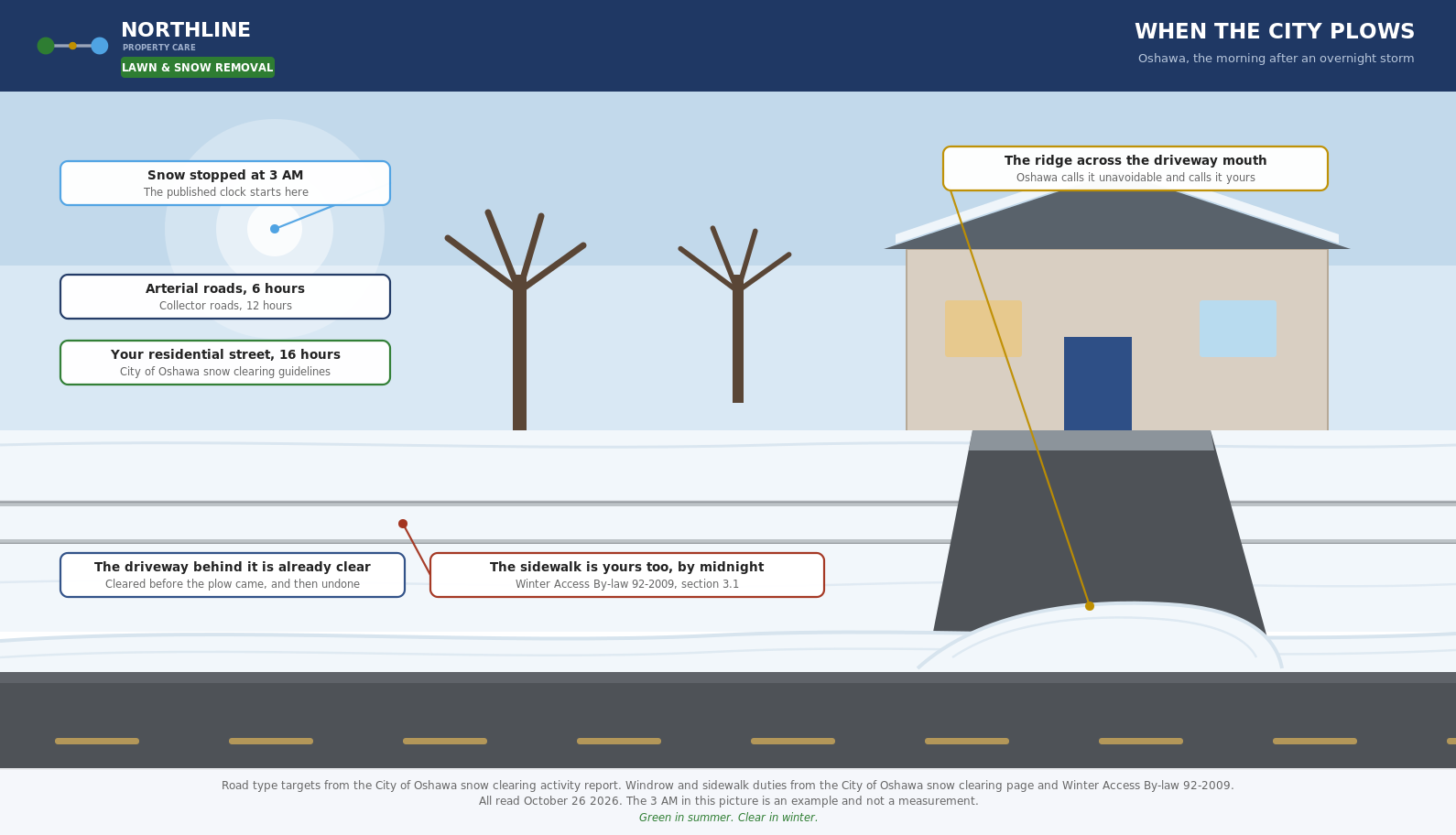
Your residential street is the third road job of the storm and the City gives itself sixteen hours for it, counted from the moment the snow stops rather than the moment it starts. Arterial roads are published at six hours and collector roads at twelve. City sidewalks come after that, no later than midnight on the first day following the end of the storm.
So a street that is still white at nine in the morning after an overnight fall is almost always a street that is exactly where the published schedule says it should be. Nothing has gone wrong and nothing needs reporting yet. What none of those hours covers is the ridge the plow leaves across the mouth of your driveway, which the City names as unavoidable and assigns to you.
The order is the answer, and a residential street sits at the back of it
Oshawa works a storm in four phases and publishes the order plainly. Primary roads go first, which the City splits into arterial roads at a six hour target and collector roads at a twelve hour target. Residential streets follow at sixteen hours. City maintained sidewalks, multi use paths and the school crosswalks where a crossing guard stands come next, no later than midnight on the first day after the storm ends. Properties registered under the Snow Clearing Assistance program are the fourth and final phase, which is worth knowing if somebody in the household is on that list and is wondering why the ridge is still there at lunchtime.
The arithmetic underneath the order is the part nobody puts on a sign. The City says it maintains more than 500 km of primary road, 765 km of residential road and 160 km of sidewalk. The primary network has to be finished before the residential network is properly started, and the residential network is half again as long as the primary one. Nothing about that ordering is unusual and nothing about it is negotiable: a transit route, an ambulance route and the road to a school are genuinely more urgent than the street a dozen houses sit on.
There is one more clause and it is the one that makes a bad storm feel personal. If fresh snow starts before the previous event has been finished, crews may pause where they are and go back to the roads at the front of the list. In a two day storm the same residential street can be passed over twice. Oshawa says this in its own words on the City of Oshawa snow clearing page, and the practical consequence is that a long storm does not simply add hours to the end of your wait. It restarts the queue in front of you.
The City also asks residents not to report an unplowed street immediately. The published instruction is to check the activity report, wait a full day, and raise a concern after 12:01 a.m. on the second day. The Oshawa snow clearing activity report is updated three times a day during operations and carries the road type table those six, twelve and sixteen hour figures come from.
The clock starts when the snow stops, and the regulation says so in terms
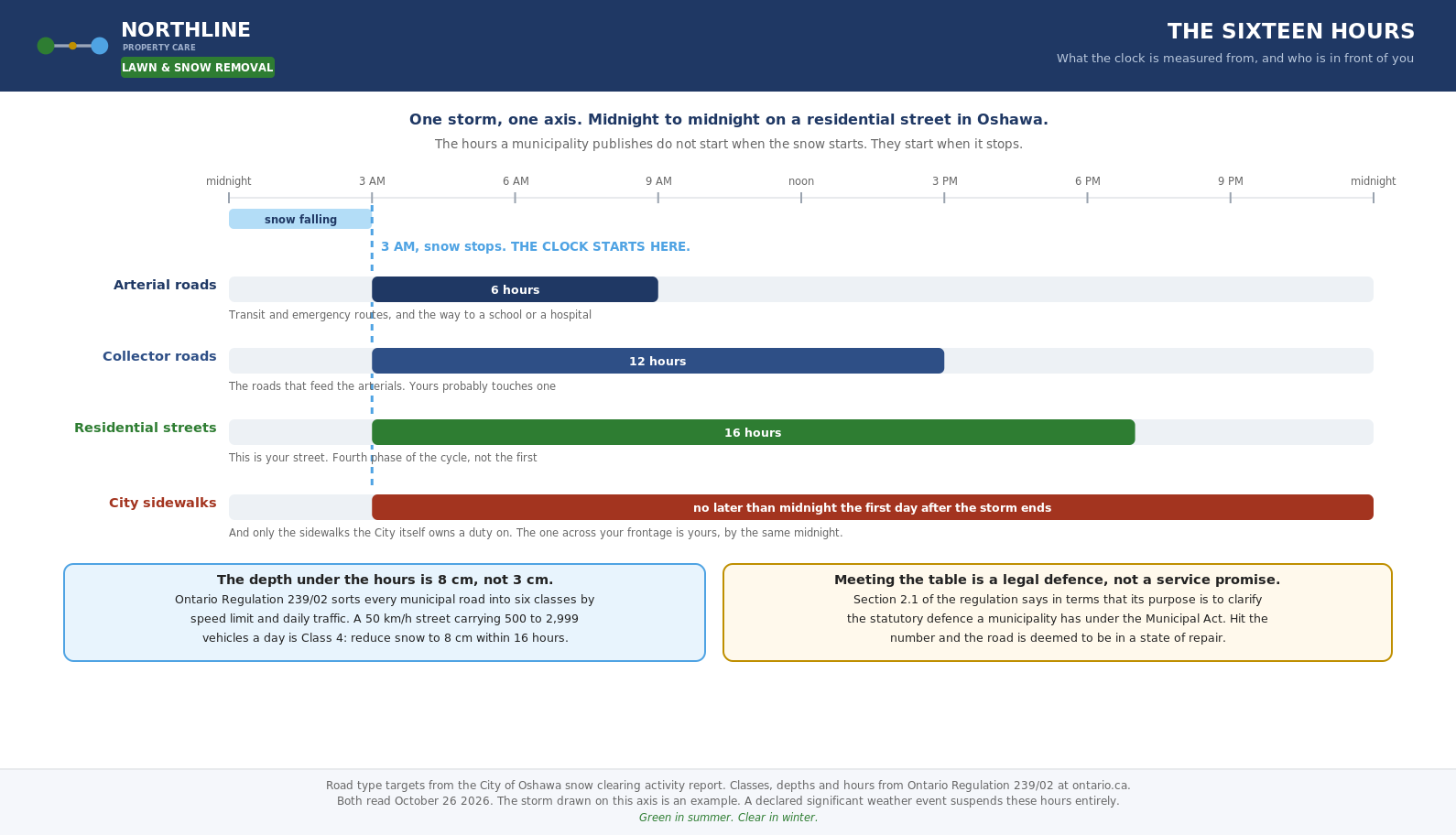
Every hour figure a municipality in Ontario publishes for snow is measured from the end of the accumulation, not from the beginning of the storm. Section 4 of Ontario Regulation 239/02 sets the standard in two halves. The first half is that once the municipality becomes aware the snow on a roadway is deeper than the figure in its table, it deploys as soon as practicable. The second half is that after the accumulation has ended, it reduces the snow to the table depth within the table time.
Read against a real Durham storm that distinction is worth a whole night. Snow that begins at eight in the evening and finishes at three in the morning has already been falling for seven hours before anybody's clock starts. The sixteen hours on a residential street then runs to seven in the evening of the following day. A homeowner who started counting at eight the previous night believes the City is nine hours late. The City is on time, and both of them are looking at the same street.
The regulation is also narrower about what counts as snow than most people assume. Its definition of snow accumulation is newly fallen snow, wind blown snow and slush, alone or together, covering more than half a lane width of a roadway. Drifting counts. A thin skim across a third of the lane does not. And the depth may be settled by an actual measurement, by monitoring the weather, or by a visual estimate, which means the number that engages the standard on your street was very often somebody looking at it rather than anybody measuring it.
Which class your street is, and the table that decides it for you
Ontario sorts every municipal road into six classes by two numbers only: the posted speed limit and the average daily traffic. Nothing about the neighbourhood, the surface or the number of houses enters into it. On the table in section 1 of the regulation, a road posted at 50 km/h carrying 500 to 2,999 vehicles a day is a Class 4. The same road carrying 200 to 499 vehicles a day is a Class 5. Drop below 50 vehicles a day at that speed and it becomes a Class 6, and section 2 of the regulation says plainly that the regulation does not apply to Class 6 roads at all.
That is why the published hours change at the town line without anything changing on the ground. Class 4 is 8 cm within sixteen hours. Class 5 is 10 cm within twenty four hours. A quiet crescent and the busier loop road it hangs off can easily fall either side of the 500 vehicle boundary, which means two streets a hundred metres apart can carry a different legal standard and nobody living on either of them has ever been told which one they are on.
Oshawa treats its residential streets as Class 4, which is the better of the two for a homeowner. The City states that standard in its own 2025 asset management plan rather than on the snow clearing page, which is why almost nobody has read it. Whitby takes the other route and reproduces the provincial table itself on its Town of Whitby snow clearing page, defining its tertiary roads as Class 5 and Class 6. A Whitby homeowner reading their own Town's page carefully will find that the standard on their street is 10 cm within twenty four hours, which is six centimetres and eight hours further out than the same house would get in Oshawa.
There is a second table most people never reach. Section 5 of the same regulation deals with ice rather than snow and splits into prevention and treatment. On a Class 4 road the municipality has twenty four hours to treat against ice it has determined is substantially likely to form, and twelve hours to treat an icy road once it becomes aware of it. The regulation defines substantial probability as a significant likelihood considerably in excess of 51 per cent, which is as close to a number as that phrase ever gets.
What the standard promises is a lane, and it is not a clean road
The outcome the regulation requires is a minimum width of travelled surface, and on a two lane residential street that width is five metres in total. Not a bare curb line, not a clean road edge, and nowhere in the text is there a word about the apron of a driveway. On a wider road the figure is the lesser of three metres for each lane or the actual lane width.
Section 4 then excludes three things from the roadway it is talking about: the part designated for parking, the part that is a bicycle lane or other bicycle facility, and the part the municipality is using for snow storage. The last of those three is the one that lands in front of a house. The strip of road against your curb is a lawful place for the municipality to put snow, and once snow is put there the regulation stops treating it as roadway. A street can be fully compliant, finished, signed off and still have a ridge along the curb and across every driveway on it.
That is the gap this business exists inside, and it is worth saying in plain words rather than selling around. The municipality owes the travelled lane. Nobody owes the twenty feet between that lane and your front door. Everything a homeowner pays anybody for in winter happens in that twenty feet.
Meeting the table is a legal defence, and it was never a service promise
Section 2.1 of the regulation states its own purpose, and the purpose is not customer service. It says the regulation exists to clarify the scope of the statutory defence available to a municipality under the Municipal Act, by setting maintenance standards that describe a desired outcome rather than prescribing methods or materials.
The statute behind it is short. A municipality must keep a highway in a state of repair that is reasonable in the circumstances, and it is liable for the damages anybody sustains if it does not. Then comes the defence: a municipality is not liable if the minimum standards applied and those standards were met. Section 4 of the regulation closes the loop by deeming a roadway to be in a state of repair with respect to snow accumulation whenever the depth is at or below the table figure.
So the sixteen hours on your street is the point at which legal exposure ends, not the point at which a service was promised. That is not a criticism of anybody. It is simply what the document is, and knowing what kind of document you are reading changes what you do with it. It is also why a winter maintenance page can be entirely accurate and still leave a homeowner feeling misled: the page is answering a question about liability while the reader is asking a question about their morning.
A declared significant weather event stops the clock completely
Any Ontario municipality can suspend its own winter timelines by declaring a significant weather event, and while that declaration stands the published hours simply do not apply. Section 4.1 of the regulation replaces the whole standard with two obligations: monitor the weather, and deploy resources to address snow accumulation if the municipality deems it practicable, starting at a time the municipality deems appropriate. Every roadway is then deemed to be in a state of repair until the ordinary table time expires after the municipality declares the event over.
There is a second table for what happens once the declaration ends, and it is more generous than the first. A Class 1 road goes from four hours to eight. A Class 3 goes from twelve hours to twenty four. Class 4 stays at 8 cm but the time moves from sixteen hours to twenty four. So a declared event does not only pause the clock, it widens the window that follows it.
The trigger is not a municipality's own opinion of the weather. The regulation defines a weather hazard as one Environment Canada has determined meets the criteria for an alert under its Public Weather Alerting Program, and a significant weather event as an approaching or occurring weather hazard with the potential to pose a significant danger to road users. Oshawa lists the four conditions it applies: a lot of snow inside twenty four hours, ice forming with no warning in the forecast, high winds producing blowing snow and large drifts, and temperatures cold enough that de icing will not work.
How you find out is the weak part. The regulation lets a municipality declare the beginning or the end of an event by posting a notice on its website, by a post on a social media platform, by a press release to media, through its police service, or by any other method set out in one of its own by laws. There is no requirement to tell a household directly and no common channel across the seven towns. In practice the honest advice is to check the municipal website and social feed during a bad storm before concluding that anybody is behind, and to keep the Durham Region storm status and plow tracker open rather than the clock.
Five municipalities in one service area, and five different answers
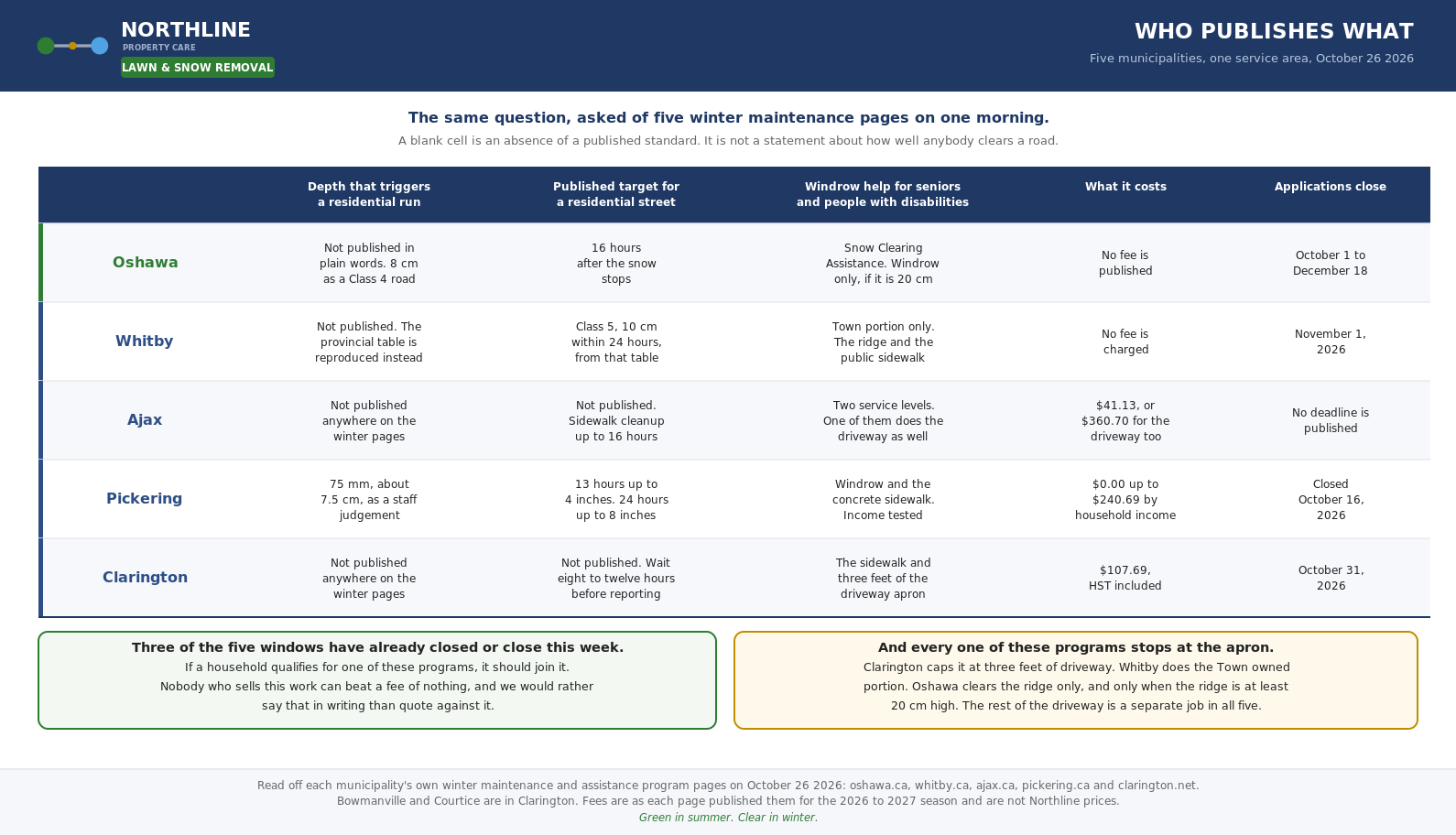
Only one of the five publishes a snow depth that triggers a residential run, and it is Pickering. The City of Pickering snow clearing process page states that staff decide whether to plow, usually at 75 mm of snowfall or more, which is about 7.5 cm. It is framed as a judgement rather than a rule, and it is still more than anybody else gives a resident. Pickering also publishes a time target in a form a person can use: complete service in the south urban area within thirteen hours for storms up to four inches, within twenty four hours for storms up to eight inches, and cleanup for up to forty eight hours after the event ends.
Whitby publishes the provincial table and defines its own tertiary roads as Class 5 and Class 6, so a Whitby resident can work out the standard on their street with two readings of one page. Ajax publishes neither a depth nor a residential completion target on its Town of Ajax winter roads maintenance page, although it does say sidewalk cleanup can take up to sixteen hours. Clarington, which contains both Bowmanville and Courtice, publishes neither as well, and instead gives the most practically useful sentence of the five: do not call to report an unplowed road until at least eight to twelve hours after the end of the snow storm. That figure is reporting guidance and it is not a service standard, and the Clarington winter road maintenance page is careful about the difference.
A blank cell on that grid is an absence of a published standard. It is not a statement about how well anybody clears a road, and it would be dishonest to present it as one. Clarington maintains 892 km of municipal road, about 1,800 lane kilometres, across a municipality that runs from the Lake Ontario shore up onto the Oak Ridges Moraine, and it runs a live plow tracking map that refreshes every five minutes. Ajax publishes a winter roads map that flags Durham Region roads as roads the Town does not service at all. Pickering publishes a per event activity report with the start time, the estimated completion and the actual completion for each service area. Three of the five are doing more than the one that publishes the cleanest number.
What the spread means for a household is small and specific. If you move from Oshawa to Whitby your street probably carries a looser legal standard than the one you left. If you move from Pickering to Clarington you lose the only published depth trigger in the region. Nothing about the quality of the work follows from either of those sentences, but the answer to the question at the top of this page genuinely changes at the town line.
Some of the roads near you are not the City's at all
The Region of Durham maintains the regional roads inside every one of the seven towns, and a municipal winter maintenance page says nothing about them. In Oshawa that includes Simcoe Street, Taunton Road, Ritson Road, Rossland Road, Harmony Road, Bloor Street, Thornton Road, Park Road, Stevenson Road, Adelaide Avenue, Wentworth Street and more besides. Those roads are patrolled seven days a week through the winter, they are treated with brine ahead of weather when frost or black ice is likely, and where there is no room left to store snow after plowing it is loaded into trucks and hauled away.
The way to settle which is which is the Region of Durham regional roads list, which names every one of them town by town. There is one trap in Clarington worth carrying: the Municipality rather than the Region is responsible for King Street and Highway 2 between Bowmanville Avenue and Haines Street in Bowmanville, and between Baldwin and Arthur Street in Newcastle. So the main street of downtown Bowmanville is municipal while the same highway on either side of it is regional, and a resident who reports a problem to the wrong body loses a day to it.
Two things follow for a driveway. If your house fronts a regional road, the plow that leaves the ridge across your apron is not the City's and the timing on the City's page does not describe it. And if you are deciding whom to call, a regional road concern goes to the Region at 905-668-7711 or through 311, and a municipal street goes to the City. That is a two minute lookup once and it saves an argument every February.
If your household qualifies for an assistance program, take it
All five municipalities run a snow clearing assistance program for seniors and for people with disabilities, and two of them charge nothing at all. Whitby states in writing that there is no fee for the service. Oshawa publishes no fee on either its program page or its information bulletin. Clarington is $107.69 with HST included for the 2026 to 2027 season, Ajax is $41.13 for the windrow and the sidewalk or $360.70 if the driveway is included, and Pickering is income tested from nothing up to $240.69.
We are a business that sells this work and we would still rather you took the program. Nobody quoting a driveway can beat a fee of nothing, and a household that qualifies and pays a contractor instead has been badly advised. The deadlines are the catch and they are nearly all behind us: Pickering closed on October 16, 2026, Clarington closes on October 31, 2026, Whitby closes on November 1, 2026, Ajax publishes no deadline at all, and Oshawa runs from October 1 to December 18, 2026, which makes it the one still comfortably open as this is written.
Every one of those programs stops at the apron, which is the thing to understand before relying on one. Clarington caps its service at three feet of driveway next to the road. Whitby does the Town owned portion, meaning the ridge and the public sidewalk. Oshawa clears the windrow only, and only when the windrow is at least 20 cm high, after a snowfall of more than 2.5 cm. The rest of the driveway is a separate job in all five. The full comparison, including what each program will and will not touch on a frontage, is on our page about snow removal for seniors in Oshawa.
The City finishing your street is the moment your own job starts
Oshawa describes the ridge across a driveway as an unavoidable result of clearing roads quickly and safely, and assigns the clearing of it to the home or property owner. The City also answers the two things everybody asks. Raising or lowering the blade would not stop the ridge and would leave snow on the road. Pushing all the snow to one spot would take many passes, would be unsafe, and would still not remove every ridge.
Then it gets stricter than most homeowners realise. The Winter Access By-law, number 92-2009, defines a windrow as a ridge of snow left behind by a snow plow at a sidewalk or driveway, and it defines a sidewalk as including the portion that crosses a private driveway. Section 3.1 puts the duty on the owner to clear sidewalks, windrows included, no later than midnight of the first day after the fall of snow. Section 6.1 makes it an offence to move snow from private property onto a sidewalk or a highway, or to pile or redistribute it there. Administrative penalties run at $75 for a first contravention, $175 on a repeat inside a year and $275 for further repeats, and a conviction carries a fine of not less than $300.
Put the timings side by side and the squeeze is obvious. The City may lawfully arrive at your street up to sixteen hours after the snow stops and leave a ridge across your apron on the way past. Your own deadline for clearing that ridge and the sidewalk across it is midnight of the first day after the snowfall. On a storm that ends in the small hours those two clocks can close within hours of each other, and the second one is the one with a fine attached. The by law detail is set out on our page about the snow removal by law in Oshawa, and the ridge itself, town by town, on who clears the windrow in Durham Region.
Clearing the driveway before the plow comes does not help and can cost you twice, which is the part that stings. The snow goes back across the mouth the moment the street is done, and if the shovelling put it on the road it is also the offence in section 6.1. Pickering publishes the one piece of practical advice on this that is worth repeating: if you are clearing before the plow passes, work the snow to the downstream side of the driveway so the blade carries less of it back across.
What a membership changes about any of this
Nothing a private contractor does moves the municipal schedule, and anybody who tells you otherwise is selling something they do not control. What a membership moves is the second job, the one in the twenty feet between the travelled lane and your front door, and the ridge the City leaves across the mouth of it.
Northline clears at a measured 3 cm on a residential property, which is well below the 8 cm that engages the City on your street, so service on a membership begins on storms the municipal standard never reaches. Every tier includes a pass at the windrow. Silver at $129 a month plus HST does not plow the driveway and carries no morning target, and its windrow pass runs by 5 PM the same day. Gold at $189 a month plus HST plows the driveway and carries a 7 AM target after overnight snow. Platinum at $279 a month plus HST is sequenced first with a 6:30 AM target, unlimited automatic salting and first choice of service day. All three are billed in twelve equal payments.
For a household that wants the driveway handled and nothing else, the seasonal snow package is $800 for a small property, $975 for a standard one and $1,200 for a large one, plus HST, covering the driveway, the walkway and salting, unlimited, at the same 3 cm trigger with the 7 AM target after overnight snow. A one off windrow return trip is $45 and a salt only trip is $25, which is the honest answer for somebody who only needs help on the worst two mornings of a winter. Book by November 1 for the seasonal price. The route closes November 30.
What none of that buys is a clear street, and it is better to say so now than in February. The lane in front of your house belongs to a schedule published by the City and nothing on this page changes it. For the money side of the same gap, including what each depth of snow actually costs to move, see snow removal cost in Oshawa, and the service itself is set out on snow removal Oshawa.
What this page could not establish, named rather than left out
Five things were looked for and not found on a source worth citing. There is no plain language City of Oshawa sentence giving the snow depth that triggers a residential plow run. The only depth tied to a residential street anywhere in City material is the Class 4 standard of 8 cm recited inside the 2025 asset management plan, and the public snow clearing page gives no depth at all.
There is no published City of Oshawa winter control budget figure. The snow clearing pages, the winter parking page and the asset management plan were all read and none of them carries a dollar line for winter maintenance, so no cost of this service to a taxpayer appears above.
Neither the Region of Durham nor any of the four neighbouring municipalities publishes a plain language test a resident can use to tell a regional road from a municipal one. The method given above is assembled from the Region's own roads list, from Clarington's table and from the Ajax winter map legend, rather than quoted from anybody. The Region also publishes no depth trigger, no completion target and no windrow policy for regional roads, which leaves an open question for any household fronting one.
Ajax publishes no application deadline for its snow removal program and no residential completion target, and Oshawa publishes no fee for its assistance program. In both cases the absence is reported here as an absence. And one small disagreement is left standing rather than resolved: the City of Oshawa activity report page cites its own Winter Access By-law as 93-2009 while the by law published on the same site is 92-2009. This page uses 92-2009, which is the number on the document.
One procedural note belongs here rather than in a footnote. Every external figure above comes from a municipality, a regional government or the Government of Ontario. Not one number came from a company that sells snow removal or lawn care anywhere, and where a fact existed only on such a page it was dropped rather than reworded. That constraint is why the five town comparison has four empty answers in it.
Questions Oshawa homeowners actually ask about the plow
When does the city plow my street in Oshawa after it snows?
On the City of Oshawa's own published guidelines a residential street is cleared within sixteen hours, and that clock starts when the snow stops falling rather than when it starts. Arterial roads carry a six hour target and collector roads a twelve hour target, and both are finished before residential streets are properly started. City maintained sidewalks follow, no later than midnight on the first day after the storm ends. So an overnight fall that finishes at three in the morning gives the City until about seven that evening on your street. The City asks residents to check the snow clearing activity report and to wait a full day before reporting a street, raising a concern after 12:01 a.m. on the second day.
Why do the main roads get cleared twice before my street is done once?
Because a storm that is still producing snow restarts the queue. Oshawa publishes the rule plainly: if a new snow event begins before the clearing from the previous one has been completed, crews may pause and go back to the roads at the front of the list. Transit routes, emergency routes and the roads to schools and hospitals sit at that front. The City says it maintains more than 500 km of primary road against 765 km of residential road, so the longer network is the one that waits. In a two day storm the same residential street can genuinely be passed over twice while the arterials are redone, and nothing has gone wrong when that happens.
Will the City take away the plow ridge at the end of my Oshawa driveway?
No. Oshawa describes that ridge as an unavoidable result of clearing roads quickly and safely and assigns the clearing of it to the home or property owner. It goes further than that: the Winter Access By-law, number 92-2009, defines a sidewalk as including the portion that crosses a private driveway, and section 3.1 requires the owner to clear sidewalks and windrows no later than midnight of the first day after the fall of snow. The one exception is the Snow Clearing Assistance program, which clears the windrow for registered participants, and only when the windrow is at least 20 cm high after a snowfall of more than 2.5 cm.
What is a significant weather event, and what does it change?
It is a declaration an Ontario municipality can make when an approaching or occurring weather hazard has the potential to pose a significant danger to road users, and while it stands the published clearing timelines do not apply at all. Section 4.1 of Ontario Regulation 239/02 replaces them with two duties: monitor the weather, and deploy resources if the municipality deems it practicable, starting when it deems appropriate. Once the event is declared over a second and more generous table applies, under which a residential street has twenty four hours rather than sixteen. A municipality may announce the declaration on its website, on social media, through a press release, through its police service, or by a method set out in its own by law.
How do I tell whether my street belongs to the City or to the Region of Durham?
Check it against the Region of Durham regional roads list, which names every regional road town by town. In Oshawa the regional roads include Simcoe Street, Taunton Road, Ritson Road, Rossland Road, Harmony Road, Bloor Street, Thornton Road, Park Road, Stevenson Road, Adelaide Avenue and Wentworth Street. The rule of thumb that follows from the municipalities' own definitions is that the big arterials carrying a regional road number belong to the Region and the street you live on belongs to your town. There is one trap: in Clarington the Municipality rather than the Region looks after King Street and Highway 2 between Bowmanville Avenue and Haines Street in Bowmanville.
Should I clear my driveway before the plow comes or wait until afterwards?
If you clear before the plow passes you will be clearing twice, because the ridge arrives with the plow and lands across a driveway you have already finished. The practical compromise the City of Pickering publishes is to work the snow toward the downstream side of the driveway while clearing, so the blade carries less of it back across the mouth. What you must not do is push the snow onto the road or the sidewalk. Section 6.1 of Oshawa's Winter Access By-law makes that an offence, with administrative penalties of $75 for a first contravention, $175 on a repeat inside a year and $275 for further repeats.
Who wrote this
Northline Property Care belongs to Andrew, who prices the property and then does the work on it. Six winters of clearing snow in Durham Region sit behind that, which is why this page is willing to say that the municipal schedule is reasonable and that most mornings people complain about are mornings the City is comfortably inside its own standard. Saying so costs a sale now and again. It is still the true answer and the person who would have to defend a different one in a driveway in February is the same person.
The research behind this page was deliberately constrained. Every external figure comes from a municipality, a regional government or the Government of Ontario, and nothing was taken from any company that sells snow removal or lawn care in this region or anywhere else. Where a fact existed only on a competing company page it came out of the draft rather than being reworded, and every gap that left behind is named in the section above instead of being quietly filled.
Read next
Who clears the windrow
The ridge across the apron, town by town, and the one job on a frontage that no municipal schedule has ever covered.
Winter parking rules in Oshawa
Why the hours the curb lane closes are the same hours the street gets cleared, and what a snow event rule does that an overnight rule does not.
Snow removal cost in Oshawa
What it costs to move each depth of snow off a driveway, and why the gap between the lane and your door is the whole bill.
Andrew answers, October 2026
It snowed overnight and my street still had not been touched by ten in the morning. Is that normal or should I be calling somebody?
That is normal and I would not call yet. If the snow finished around three or four in the morning the City has until early evening on a residential street, and it will almost always be there well before that. The thing I would do with that hour instead is look at the end of the driveway, because the ridge turns up the moment the street is done and the clock on clearing that one is yours, not theirs. If you are on the assistance program you are in the last phase of the cycle, so give it until the next midnight before you worry.
One of these goes on each page and it is replaced monthly. If the question you have is not here, ask it: 905-244-5779.
The street is on a schedule. The twenty feet to your door is not.
Send me the address and I will price the winter the same day, in writing, before anything is touched. The walk that settles where the pile can sit, how wide the apron is and which side the ridge lands on is part of the quote and costs nothing.
Green in summer. Clear in winter.