Lawn care · Diagnosis
Lawn Grubs in Oshawa, and Why This Autumn Is Worse Than Last
Lawn grubs in Oshawa are settled by cutting a 30 by 30 cm square of turf and counting what is under it, and the count decides everything that follows. Eggs and newly hatched grubs die in a dry summer. This was not one.
Cut a square, count what is under it. See what a weekly visit covers.
Green in summer. Clear in winter.

The short answer
Cut a 30 by 30 cm square of turf, fold it back and count. Fewer than five white grubs under it and the lawn is ordinary, so the brown patch is something else. Ten or more on a lawn nobody watered this summer and the damage in front of you is theirs. What you can do about it depends entirely on the date, and by the third week of September the useful work in Durham has already shifted from treatment to repair, mowing height and next June. Autumn 2026 will produce more of these calls than autumn 2025 did, and the reason is rainfall rather than bad luck.
What is actually under there, and why it is probably a European chafer
The Government of Ontario names three scarab larvae as turf pests in this province, and they are not interchangeable. Knowing which one you have changes the calendar, the treatment and the odds.
The European chafer is the one that wrecks residential lawns in Durham. It runs a one year cycle. The adults fly in the second half of June and the first half of July, and they do something strange that makes them easy to place: they gather at dusk in the nearest tall trees to mate, and the females then drop back into the turf underneath to lay. Each one lays up to fifty eggs, two to four inches down. The eggs hatch about two weeks later, the larvae feed near the surface all autumn, and Ontario's own life cycle table has the third stage running from October into December. That last detail is the one that matters here, and we come back to it twice.
The Japanese beetle runs a similar year with one important difference. It prefers moist ground to lay in, so the irrigated lawns and the sports fields carry the heavier populations, and it goes deep for winter: Ontario puts the overwintering depth at 15 to 25 cm, below the frost line, from the middle of October.
The June beetle is on a three year cycle and it is the one that fools people. The worst damage comes in the second year, not the year the adults flew. A lawn can be full of large grubs in a summer when nobody saw a single beetle, and a homeowner who reasons from what they saw in June reaches the wrong conclusion.
The split worth knowing is about water. University extension services in Michigan and Wisconsin both record European chafer as a pest of non irrigated, lower maintenance turf, and not much of a problem where a lawn is watered regularly. The University of Kentucky records the opposite preference for Japanese beetle, which is drawn to moist grass to lay in. So the two species that matter most in this region want opposite lawns, and a blanket answer that treats them as one insect is going to be wrong on half the properties it is given to.
One local reading, offered as a reading and not as a measurement. Chafer adults need tall trees to gather in. The older streets in Oshawa and Whitby, the ones with mature maples over the boulevard and lawns that nobody irrigates, have both halves of what that insect wants within thirty metres of each other. A ten year old subdivision with young trees and no canopy does not. We have watched that pattern on our own route and we have not counted it, so treat it as a place to look first rather than as a fact.
Why 2026 is not 2025, and the number that shows it
Grub eggs have to absorb water from the soil before they can hatch. That single piece of biology is why grub pressure swings so hard from one year to the next, and it is the most useful thing a homeowner in Durham can know about the subject.
Health Canada states it in one sentence on its own white grubs page: extremely dry summers destroy many eggs and newly hatched grubs. The Government of Ontario says the same thing from the other direction, that low rainfall in July and August causes egg mortality because the eggs need to take up moisture in order to hatch, and that where there is enough rain or regular watering the damage is worse.
Now put the last two summers beside that.
In 2025 the egg laying window here was hostile. Central Lake Ontario Conservation Authority, which covers Oshawa, Whitby, Courtice, Bowmanville and the rest of Clarington, declared Level 1 Low Water conditions on September 2 2025, and the reason it gave was that the watershed had received below 80 per cent of normal precipitation in June and July. Those are the exact weeks a chafer female is laying.
In 2026 the same window was as good as an insect could ask for. The Canadian Drought Monitor, which is the federal government's official drought assessment, reported for the period ending August 31 2026 that August was the fourth consecutive month with above normal precipitation in southern Ontario, and that parts of southern and eastern Ontario received more than double their normal August rainfall. Four months running. No low water condition anywhere in this part of the province.
Here is the honest limit on that argument, and it belongs in the same breath as the argument. Nobody has counted grubs in Durham Region. No municipality, no conservation authority and no ministry publishes a grub population figure for Oshawa, and we went looking. What the rainfall record supports is a direction, not a number: more eggs survived this year than last year, so more lawns will show damage this autumn than showed it last autumn. It does not tell you whether your lawn is one of them. Only the spade does that.
Grub damage or a dry patch, and the test that settles it
Water the brown patch and wait a week. Dormant turf greens up when the water arrives. Grub damaged turf does not, because the roots that would carry the water into the plant are no longer attached to it. Purdue Extension describes grub injury as patchy turf that does not respond to irrigation, and that phrase is worth more than any photograph.
The second test is mechanical and takes four seconds. Grip a handful of the brown turf and pull. The Government of Ontario states that turf damaged by white grubs lifts away from the soil easily because the roots have been eaten, and in a bad case the whole sheet rolls back the way a mat rolls off a floor. Grass that is merely dry fights you.
Three things get blamed on grubs in this region and are not grubs, and two of them are seasonal enough to rule out on the calendar alone.
- De icing salt injury. A strip of dead turf running along the driveway edge or the front walk, appearing as the snow goes in March and April. Michigan State Extension names this as the commonest thing homeowners mistake for grubs in spring. It is not a September problem and a September brown patch in the middle of a lawn is not this.
- Dog urine. Small, round, hard edged, often with a ring of darker green around the outside. Grub damage has no ring and no edge.
- Drought dormancy. Which cuts both ways. The University of Connecticut warns that heat and drought can mask grub damage as well as imitate it, so a lawn that went brown in a dry August can be hiding a count rather than merely sleeping.
And then there is the one that brings most people to the phone, which is not the grass at all.
The animals are evidence, not the problem. Ontario's guidance says that skunks and other small mammals pull back the turf hunting grubs and that this damage is usually more extensive than the damage the grubs themselves caused. Ohio State says the same. That reframes the whole thing. A lawn that looks as though somebody has been at it with a garden fork overnight may be carrying a perfectly survivable grub count, and the repair bill is for the digging rather than the chewing. It also means the skunk has already done your sampling for you: it went where the grubs were.
Cut a square, fold it back, count what is under it
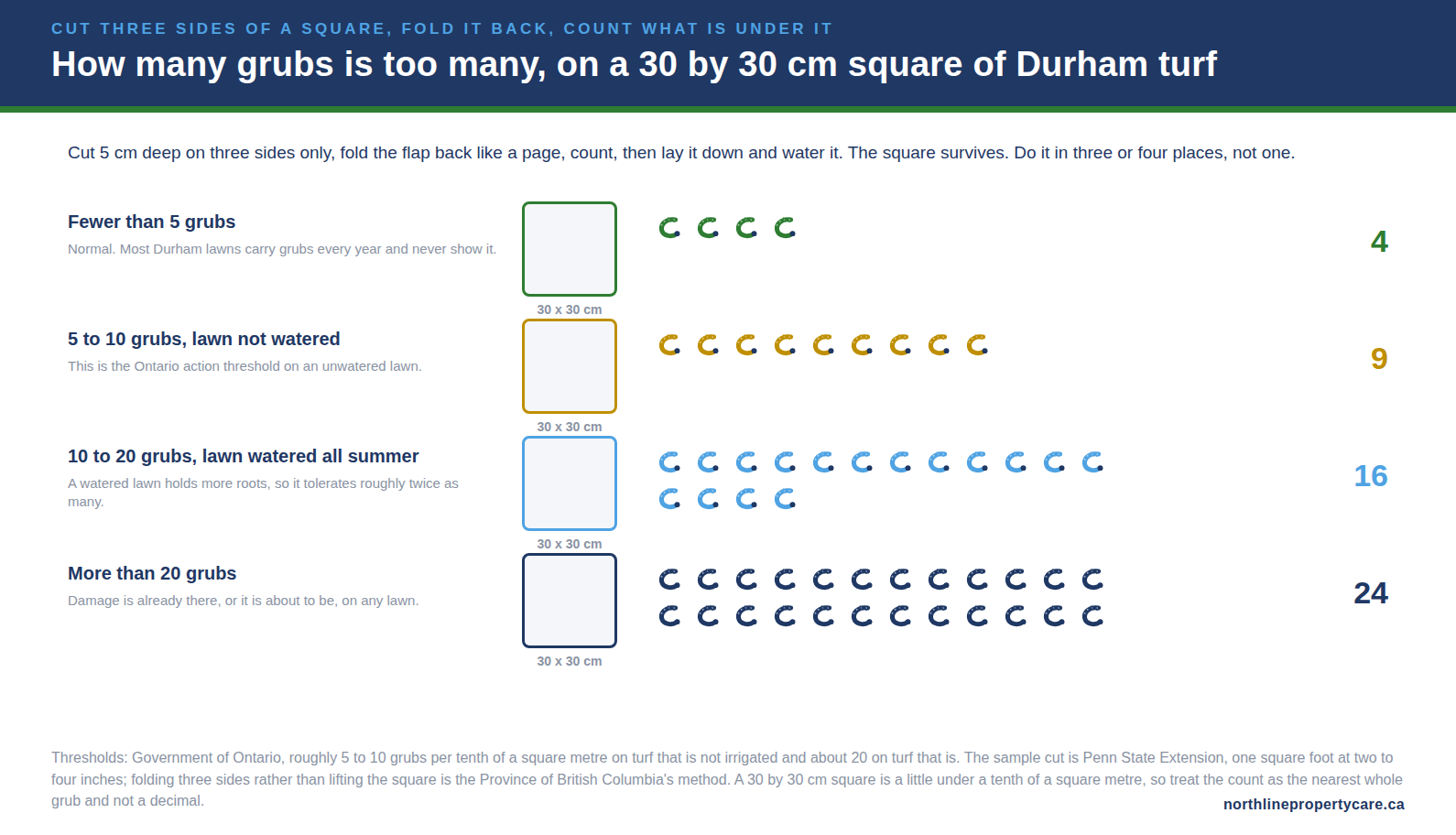
This is the whole diagnosis and it costs nothing. Penn State Extension gives the protocol as one square foot of turf and soil, two to four inches deep, taken in several places. The Province of British Columbia publishes a friendlier version of the same thing for European chafer: cut three sides of a 30 by 30 cm piece of sod to a depth of 5 cm and fold it back like a page, so that when you have counted you can lay it down, tread it in, water it and lose nothing.
Four rules make the count mean something.
- Cut at the edge, not in the middle. Take the square where green turf meets brown. The centre of a dead patch is where the grubs have already finished eating and moved on, which is how a badly infested lawn returns a count of nothing.
- Sample three or four places. Grubs are not spread evenly. One square is an anecdote.
- Count to the full depth of the cut. Break the soil apart in your hands rather than glancing at the underside of the sod.
- Know which lawn you are counting. A lawn that was watered all summer tolerates roughly twice the count of one that was not, and the threshold moves with it.
The two clocks, and why the middle of September is the hinge
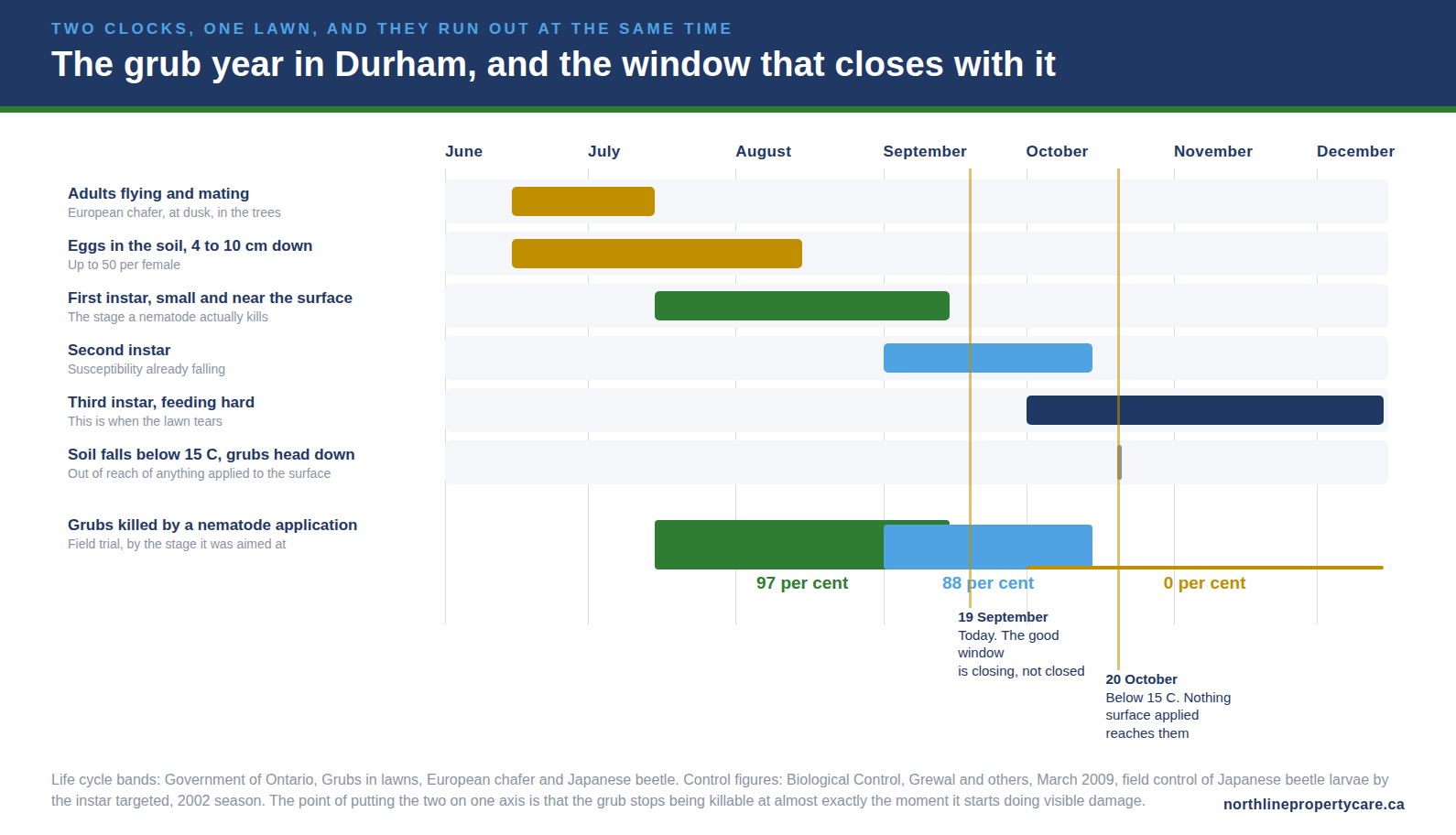
Two things are running down at once, and they run out within about three weeks of each other. The first is how easy the grub is to kill. The second is how deep it is sitting. Nothing you can buy beats either of them once they have gone, and the reason the industry keeps selling October treatments is that October is when the phone rings.
Take the first clock. A peer reviewed field trial published in the journal Biological Control in March 2009 measured control of Japanese beetle larvae using the nematode Heterorhabditis bacteriophora, aimed in turn at each of the three larval stages. In the 2002 season the results were 97 per cent against first stage larvae, 88 per cent against second stage, and zero per cent against third stage. In the previous season the same three figures were 75, 53 and 33 per cent. The laboratory half of the same study confirmed that the first stage is significantly more susceptible than the third.
Now the second clock. The Government of Ontario records that grubs migrate downward when the soil temperature drops below 15 degrees, and that Japanese beetle grubs settle at 15 to 25 cm, below the frost line, from the middle to the end of October. Anything applied to the surface and watered in has to reach them where they are. The University of Minnesota states the consequence bluntly, that treatments after early October are not effective and are not recommended.
Put the two on one axis and the shape of the year is obvious. The grub stops being killable at almost exactly the moment it starts doing visible damage, which is why the season produces so many people paying for something that cannot work.
What Ontario law actually permits on a lawn, which is less than most people assume
Ontario bans cosmetic pesticides on residential lawns, and there is no grub exception. Section 7.1 of the Pesticides Act and Ontario Regulation 63/09 carry the ban, the regulation is still in force with a consolidation running to September 16 2026, and the word grub does not appear anywhere in it. Neither does the word infest. The twelve prescribed exceptions cover golf courses, specialty turf, sports fields, cemeteries, arboriculture, natural resources, scientific purposes and the promotion of public health or safety, and a residential lawn is none of those.
Two routes remain open, and both are narrow.
- An active ingredient on the province's Allowable List. The one that actually targets grubs is a soil bacterium, Bacillus thuringiensis subspecies galleriae strain SDS-502, which is on the list and is registered federally in a domestic class product.
- Beneficial nematodes. They sit outside the Act altogether, because the regulation does not apply to a pesticide that is a living animal and is not classified, and there is no federal registration for a nematode to be classified against.
Applying either one for money on somebody else's lawn is a different question from buying it yourself. That is a land extermination, it needs an exterminator licence in the Landscape class, the business needs an operator licence of its own, and a sign has to go up before the work starts and stay up for at least forty eight hours afterwards.
Three products people still ask for by name are gone. Health Canada cancelled turf uses of imidacloprid with effect from May 2023. Trichlorfon has no registered product left in Canada at all. Carbaryl survives in three registrations, none of which is a domestic lawn product. Milky spore, which comes up constantly, has never been registered in Canada.
One more thing about municipal rules, because it saves an argument. Section 7.1 of the Pesticides Act makes a municipal by law inoperative if it addresses the use or sale of a pesticide that may be used for a cosmetic purpose. So no City of Oshawa by law restricts grub treatment on your lawn, and none could. Anybody telling you otherwise is quoting something that has no legal effect.
We run a lawn care business, not a law office, and the paragraphs above are a reading of the published regulation rather than legal advice. Every instrument named in them is linked, and reading the section yourself takes about five minutes.
Nematodes, and the species they are worst against
Nematodes are real biology and they are not a spray in a different bottle. They are live animals, they die in sunlight, they die dry, and they have to be watered in within minutes and kept damp for a week or two afterwards. Cornell advises applying at dawn or dusk for that reason, and keeping the soil moist for at least two weeks after the application. Purdue adds the detail nobody expects, which is to take the screens out of the spray nozzles and keep the pressure under 50 psi, because you are pumping animals through a pipe.
The soil temperature they need is the one place the sources cannot be reconciled, and it is worth saying so rather than picking the convenient figure. The Government of Ontario puts the floor at 11 degrees. The University of California puts it at 15.6. Cornell states 20 degrees, on two separate pages, and says efficacy falls off below it. That is a difference of nine degrees, which in a southern Ontario autumn is the difference between a window that shuts in early September and one that stays open into late October. Nobody explains the discrepancy. We quote the conservative number.
And now the part that argues against selling them here. Two separate permitted sources record that Heterorhabditis bacteriophora is specifically weak against European chafer. A 2006 study in Biological Control describes erratic and very low mortality against that species while recording modest virulence against Japanese beetle, oriental beetle and masked chafer. Rutgers says the same in plainer words, that it gives good control of Japanese beetle and is less effective against European chafer. The species most likely to be chewing a Durham front lawn is the species the biological control handles worst.
OMAFRA's own assessment is cooler than most people expect. It says the use of these nematodes is being evaluated and may prove useful in the future, that they will not become established and would have to be reapplied, that the application needs adequate moisture before and after and soil no colder than 11 degrees, and that the cost may be prohibitive. That is the provincial ministry, not a competitor, and it is a long way from a cure.
So the honest position is a conditional one. If the grub is a Japanese beetle, if the lawn is watered, if the soil is still warm, and if the application goes on at dusk in the first half of September, nematodes are a defensible thing to spend money on. Change any one of those four and the odds drop sharply. Identify the insect before anybody quotes you for killing it.
The part of this that costs us money to write down
Northline does not sell a grub treatment. We hold no exterminator licence, we apply no pesticides, and we are not going to start in the third week of September in order to answer a phone call. That sentence costs us work every autumn and it is the correct sentence.
Four more that cost us something.
- If your count comes back under five, do nothing. Purdue records that densities of up to five grubs a square foot are common and that most turf carries them without visible damage. A lawn with four grubs in it and a brown patch has a different problem, and treating the grubs will not fix it.
- Anybody who will sell you a grub treatment in late October is selling you an application, not a result. The larvae are third stage and heading below the reach of anything watered in from the surface. The work happens, the invoice is real, and the lawn does what it was going to do anyway.
- The cheapest correct repair is usually not the expensive one. A thin lawn with sound soil under it wants aeration and overseeding, which runs about $260 on a medium lawn. Aeration on its own is about $110. The Full Lawn Restoration at $600, $850 or $1,250 plus HST depending on measured lawn area is for a lawn whose soil is the problem, and quoting it on a lawn that needs $110 of work is how a business loses the next three years of that street.
- The restoration is capped at ten properties this year and the season closes on October 10. We sell it to existing members and to households already being quoted for winter, in that order, and if you call in the third week of October the honest answer is that seed going in that late buys a lawn that dies in November.
Sod and grading we do not do at all. Those get referred to somebody who does, which is a shorter conversation than the alternative.
Mowing height is the only grub control that works every single year
Health Canada tells homeowners to raise the summer mowing height to 6 to 8 cm, and it gives the reason in the same sentence: beetles prefer to lay eggs in closely cropped lawns. That is a federal regulator connecting a cutting height to an insect population, which is a stronger source than anything else in this article.
The second half of the mechanism is about roots. The Government of Ontario states that lower mowing produces a shallow root system and that healthy, actively growing turf has more roots and can therefore withstand more grub feeding without losing the turf. Ohio State publishes the home lawn heights for the species that grow here, 2 to 4 inches for Kentucky bluegrass and perennial ryegrass and 2.5 to 4 inches for tall fescue, which is 5 to 10 centimetres.
What that buys is measurable. The threshold at which damage appears runs at 5 to 10 grubs a square foot on low maintenance turf and 15 to 20 on turf that is watered and kept healthy. That is roughly a threefold change in how many grubs the same lawn can carry before it browns, and it comes from how the lawn was managed in July rather than from anything applied in September.
Northline cuts at 7.5 cm as standard, and the weekly visit takes the edges first, then the cut, then the trim. We have written the whole argument out on the mowing height page, and it was written before anybody was thinking about grubs, which is rather the point. Nothing about that height kills an insect. It changes the number of insects the lawn can absorb without you ever finding out they were there.
The awkward corollary, because it is true: watering through the last two weeks of June and into July helps a Japanese beetle lay a successful clutch, and several extension services record exactly that. It also keeps the lawn alive through a hot Durham August. No permitted source recommends engineering a drought to kill grub eggs, and we are not going to be the first. Water deeply and rarely, which Ontario puts at 2.5 to 4 cm a week applied in one go, and take the rest of the defence from the mower.
Sand, clay and the old lake shore, and why one street loses its lawn and the next does not
Durham is not one soil, and the federal survey that mapped it says so in acres. This matters here because the species that does the most damage to residential turf in this region is the one that prefers a dry lawn.
The Soil Survey of Ontario County, published by Agriculture Canada in 1951 from fieldwork in 1949 and 1950, covers Oshawa, Whitby, Ajax and Pickering. Its largest single unit is the Bondhead series, about 75,400 acres of loam and sandy loam running from Whitby northward. The heaviest textures it maps are clay loams, the Schomberg, Smithfield, Simcoe and Peel series, and they total roughly 44,000 acres. The survey maps no pure clay in the county at all. The sandy end is substantial: Brighton sandy loam and gravelly sandy loam on the old beach deposits, and Pontypool sand.
| Where | What the federal survey mapped | Source |
|---|---|---|
| Whitby north to Lake Simcoe | Bondhead loam and sandy loam, about 75,400 acres, the county's largest unit | Soil Survey of Ontario County, 1951 |
| Whitby and Pickering townships | Darlington loam to clay loam till, about 20,700 acres | Soil Survey of Ontario County, 1951 |
| The heavy ground | Schomberg, Smithfield, Simcoe and Peel clay loams on old lake bed clay | Soil Survey of Ontario County, 1951 |
| The old Lake Iroquois beaches | Brighton gravelly sand, at about 450 feet above sea level | Soil Survey of Durham County, 1946 |
| Courtice | Darlington sandy loam, named for that community specifically | Soil Survey of Durham County, 1946 |
| East to west across the middle of Clarington | Pontypool sand, about 38,000 acres, which is the moraine | Soil Survey of Durham County, 1946 |
Two facts now sit side by side. European chafer does best on turf that is dry and unirrigated. A sandy loam over the old Iroquois beach dries out faster in August than a clay loam does. It is tempting to draw a line between those and declare that the sandy corridors carry the grubs.
We are not going to declare it, because nobody has measured it. No source we could find has mapped grub pressure against a Durham soil series, and a plausible mechanism is not a finding. What the soil map is genuinely good for is knowing what you are standing on before you decide how to water it, how often to aerate it and what seed to put into it, and that is worth the five minutes it takes to look your own address up.
While we are here, a correction to something this business has said before. We have described Durham as clay and clay loam in more than one place. Read against the survey, that is too broad: the accurate sentence is that Durham is mostly loam and sandy loam with clay loam in defined patches, and Courtice in particular sits on sandy loam. We would rather correct that in public than keep repeating it.
Repair now or repair in April, and Ontario disagrees with the textbooks on purpose
Every northern seeding guide puts the window at mid August to mid September, with an outside limit of about the first week of October. Rutgers, Penn State, Purdue, Ohio State, Iowa State and the University of Minnesota all land within two weeks of each other. By the third week of September that window is not shut but it is closing, and the arithmetic behind it is not sentimental.
Kentucky bluegrass and fescue blends take 18 to 28 days to germinate, and tall fescue 14 to 21. The average first autumn frost at the Oshawa water pollution control plant station, on the 1981 to 2010 climate normals, is October 14. Seed going in during the last week of September is germinating into the first week of the frost. That is why the guides stop where they do.
Then the Government of Ontario says, on its grubs page, that the best time to repair grub damage is in the spring after the majority of the damage has been done. That reads like a contradiction of six universities and it is not one. Ontario's own life cycle table has European chafer in its third larval stage from October into December, which means a lawn with a real count in it has grubs feeding under it for another ten weeks. Seeding into that is paying for seedlings that are about to be eaten.
So the two positions answer two different questions, and the operating rule that comes out of them is clean.
- Low count, under about five. Seed now, and hurry. Rake the dead material out first so the seed reaches soil, get it down inside a week of reading this, and keep it damp. Ontario's own repair method is rake out the dead sod, broadcast good seed, rake it in for soil contact, topdress with compost, roll lightly and keep it moist until the seedlings are established.
- High count. Do not seed. Rake out the dead mat for appearance, water the survivors through October, because irrigation in autumn genuinely helps turf carry root damage, and book the real repair for April. Spot sodding is the exception and can go down any time there is water available.
- A lawn that has been chewed three autumns running. Consider changing the species rather than replacing the same one again. Kentucky recommends renovating a badly damaged bluegrass or ryegrass lawn with turf type tall fescue, which is more tolerant of grubs, and Ohio State records tall fescue as deep rooted and drought resistant. That is a bigger job and a better answer, and we will say so even though the smaller job comes back next year.
If the lawn is thin rather than dead, the pairing to read next is aeration and overseeding, which has its own narrow September window and its own reasons.
What Northline actually does about this
We cut the square and count it while you are standing there, and we do not charge for it. It takes four minutes, it settles an argument people otherwise settle with a credit card, and about half the time the answer is that the grubs are not the reason.
After that there are three honest outcomes and we will tell you which one you have.
- Nothing. Count under five, damage from something else, and we say so and leave. It happens often.
- Repair. Aeration at about $110 on a medium lawn, aeration with overseeding at about $260, or the six step restoration where the soil is the problem. Prices are plus HST, on the measured lawn area rather than the lot.
- Management. A weekly cut held at 7.5 cm, which changes next year rather than this one. Weekly mowing on its own starts at $75 a cut plus HST, and a membership starts at $129 a month plus HST.
The fertilizer program is a paid add on at $300 to $600 a season and is included only on the Platinum tier. It is never part of a weekly visit and we never describe it as though it were.
One more piece of timing, and it is still about grubs. The nematode window and the seeding window overlap by about three weeks in September, which is the only stretch of the year when the control and the repair can go down on the same afternoon. If the count is high enough to justify both, doing them together saves a second trip and a second charge, and the soil is already at the moisture both of them want. If the count does not justify the nematodes, we seed and we leave the rest alone, because a treatment bought against a count of four is a treatment bought against nothing. The square decides that, not the calendar and not us.
What we could not verify
Nothing above came from another lawn care company. The outside figures are federal agency, provincial ministry, conservation authority, university extension, regulator or peer reviewed journal. Nine things were looked for and not found.
- A grub count for Durham Region. No municipality, conservation authority or ministry publishes one. The rainfall argument above predicts a direction, not a number, and says so where it is made.
- A University of Guelph turf source. Searched repeatedly, nothing surfaced from a Guelph domain, so every Ontario specific fact above comes from ontario.ca instead.
- The soil temperature a nematode actually needs. Ontario says 11 degrees, California says 15.6, Cornell says 20 on two separate pages, and none of them explains the gap.
- A control percentage for nematodes against European chafer. The peer reviewed description is erratic and very low mortality with no usable figure, and that gap matters because that is the likelier species.
- The 1991 to 2020 climate normals for Oshawa. The station is in Environment and Climate Change Canada's index and its results page would not load, so the frost date above is one normals period out of date.
- Whether Central Lake Ontario Conservation Authority declared a low water condition in 2026. The September 2025 notice is on its site and no 2026 equivalent either way, so that half of the rainfall argument rests on the federal drought assessment.
- How many weeks a new seedling needs before a hard frost. No government or university source we read gives a number, and every confident figure sat on a company website, so it is not here.
- Any mapping of grub pressure against a Durham soil series. None exists as far as we can tell, which is why the sand and clay section stops where it does.
- A date on the Government of Ontario grubs in lawns page. It carries none, so we cannot tell you how current its life cycle table is. The Japanese beetle page beside it was updated on April 14 2026.
Questions people in Durham actually ask
Why is my lawn suddenly torn up in September?
Because something dug it up to eat the grubs underneath, and in Durham that is almost always a skunk or a raccoon. The Government of Ontario puts it plainly on its own grubs page: the damage the animals do while hunting is usually more extensive than the damage the grubs were doing. The torn turf is evidence rather than the problem, and how many grubs were under it takes one cut with a spade, not a quote.
How do I tell grub damage from a dry patch?
Water it and wait a week. Dormant turf greens up when the water arrives. Grub damaged turf does not, because the roots that would have taken the water up have been chewed off. Purdue Extension states the test in exactly those terms. The second test is mechanical: take a handful of the brown turf and pull, and if it comes away in a sheet with no roots underneath, that is grub damage.
How many grubs is too many?
Ontario publishes roughly 5 to 10 grubs per tenth of a square metre on a lawn nobody waters, and about 20 on a watered lawn, which carries more root and tolerates more chewing. Fewer than five in a 30 by 30 cm square is an ordinary Durham lawn. Count in three or four places, and cut at the edge between green turf and brown, because the middle of a dead patch is where the grubs have finished.
Can anybody legally spray my lawn for grubs in Ontario?
Not with a conventional insecticide. Ontario bans cosmetic pesticides on residential lawns under section 7.1 of the Pesticides Act and Ontario Regulation 63/09, and there is no grub exception: the word grub does not appear in the regulation. What is lawful is an active ingredient on the province's Allowable List, and biological controls such as beneficial nematodes. Anybody applying either for money needs an exterminator licence in the Landscape class. Northline holds none and applies no pesticides.
Do nematodes work, and is it too late?
They work on small grubs, in warm soil, watered in, out of direct sunlight, and much better on Japanese beetle than on European chafer. One field trial gave 97 per cent control aimed at first stage larvae and zero per cent in the same season aimed at third stage. By the third week of September most grubs in a Durham lawn are second stage and heading for third, so the good part of the window has gone.
Should I reseed the bare patches now or wait until spring?
It depends on the count, and this is the one place the textbooks and the Government of Ontario appear to disagree. Every northern seeding guide puts the window at mid August to mid September. Ontario says to repair grub damage in spring instead. Both are right, because Ontario's own life cycle table has European chafer feeding into December. Low count, seed now and hurry. High count, rake out the dead mat and seed in April.
Who wrote this
Andrew owns the business and cuts the sample square himself, before anybody buys anything. Owner operated out of Oshawa covering seven Durham towns, fully insured, with no office sitting between him and the work. Six winters of clearing snow in this region stand behind that, and in summer he is the man pushing the mower rather than the man who sent somebody.
This article was built under one rule, and the rule is why it took as long as it did. No fact in it may come from another landscaping, lawn care or pest control company, anywhere, even where that company happens to be right. Government, university, regulator and peer reviewed journal only, with the page we actually read linked beside the claim, and a list of what we failed to pin down instead of a quiet gap. If something here is wrong, a call or a text saying so is the fastest way to have it fixed: 905-244-5779.
Read next
Aeration and overseeding, and the September window
The pairing that repairs a thin lawn, why it belongs in September rather than April, and the one combination that reliably fails.
Read the aeration guide →The six step restoration, and who should not buy it
Six steps, one day, once a year, with the measured prices and the dethatching pass that is gated by a ruler rather than by habit.
See the six steps →The cutting height that changes next summer
Why 7.5 cm, what every Durham by law says about the other end of the scale, and the root depth argument underneath both.
Read the height guide →The work, photographed
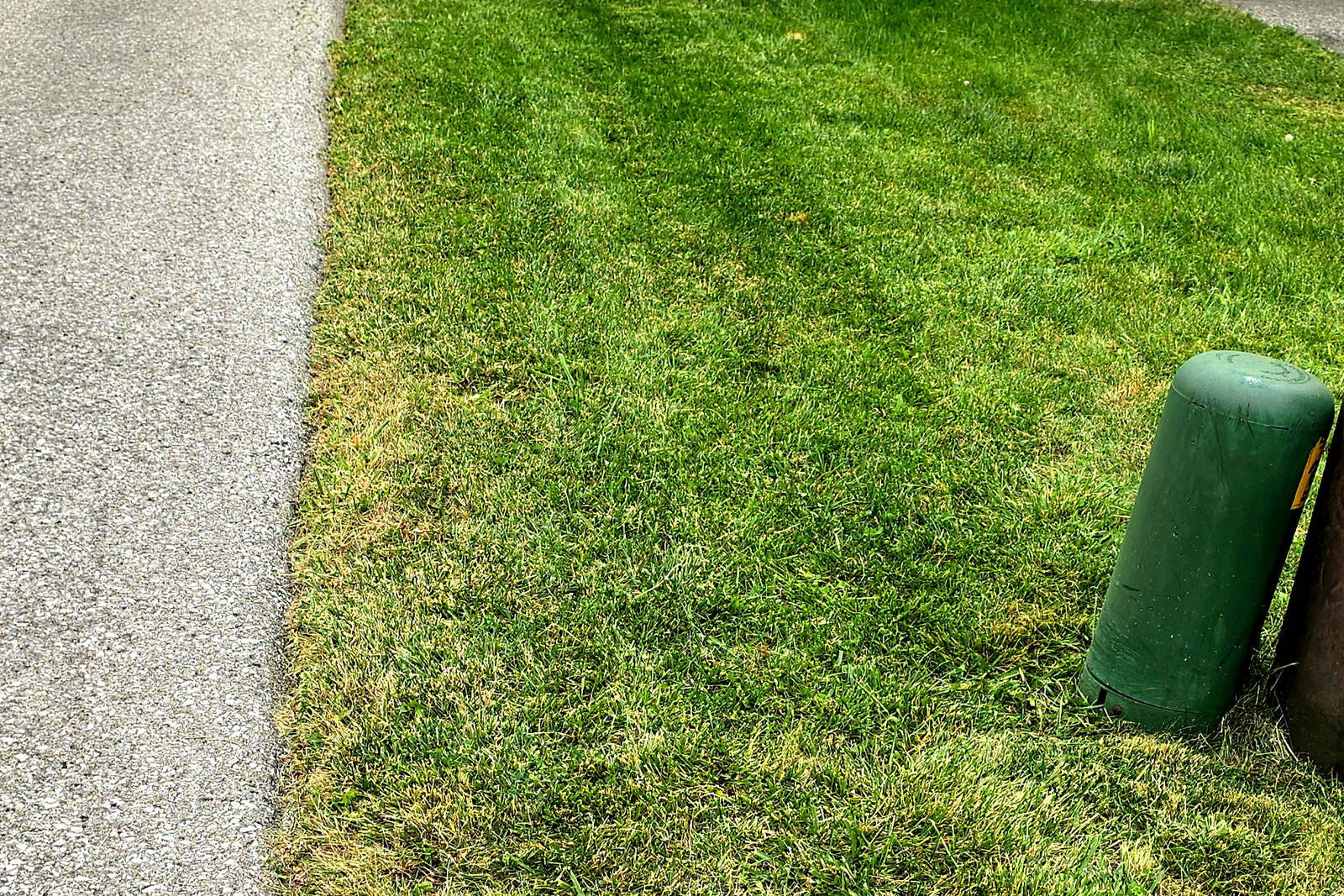
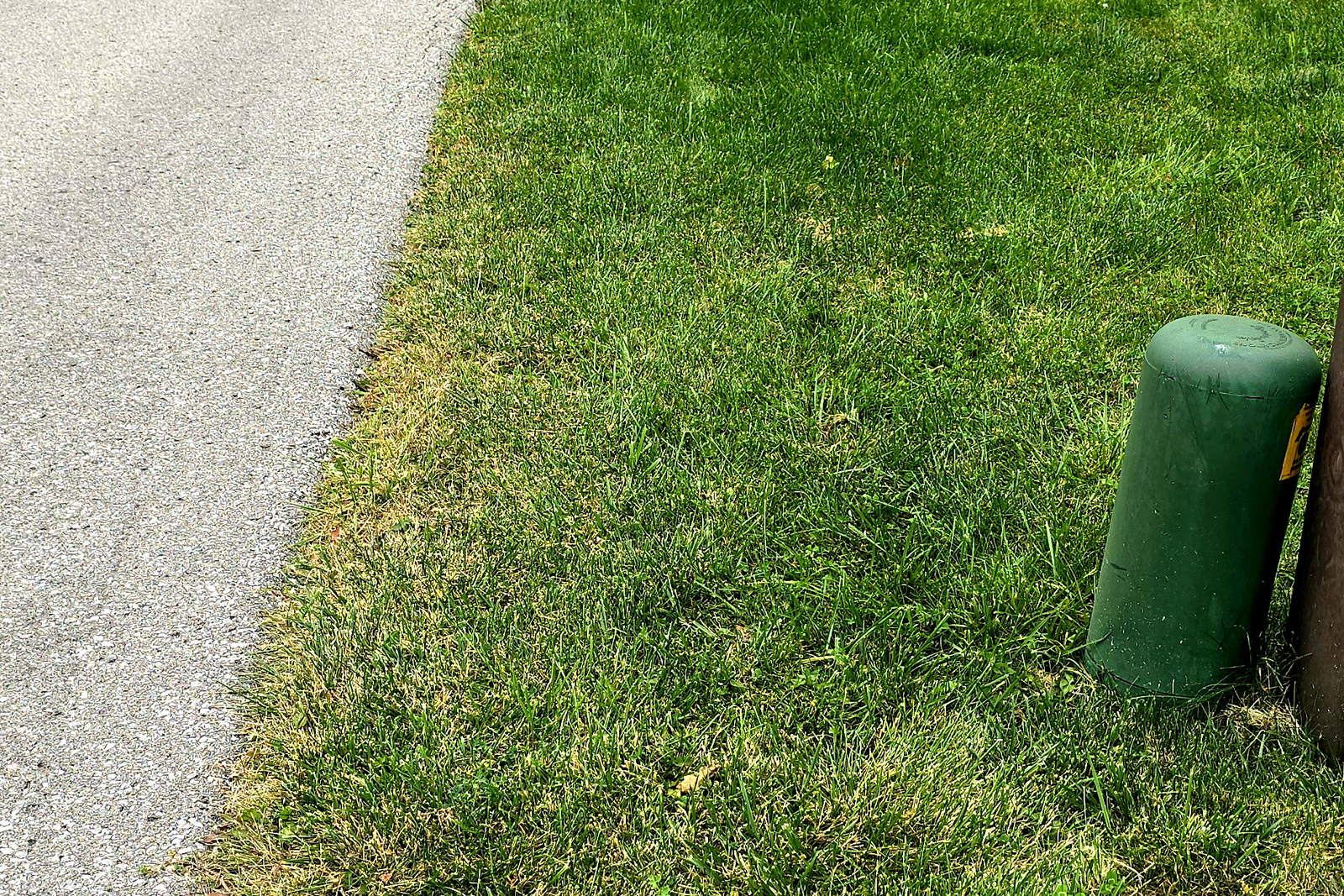
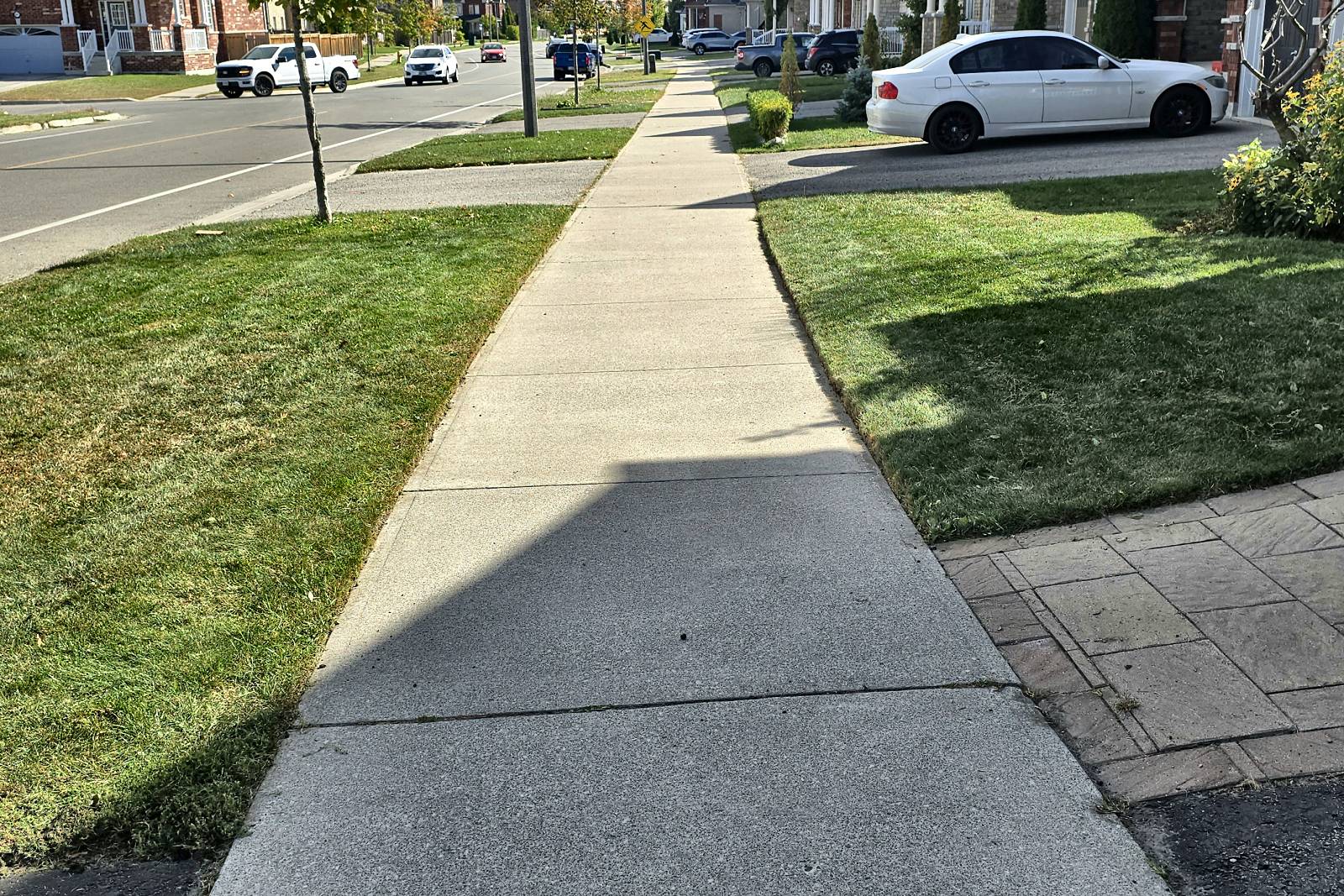
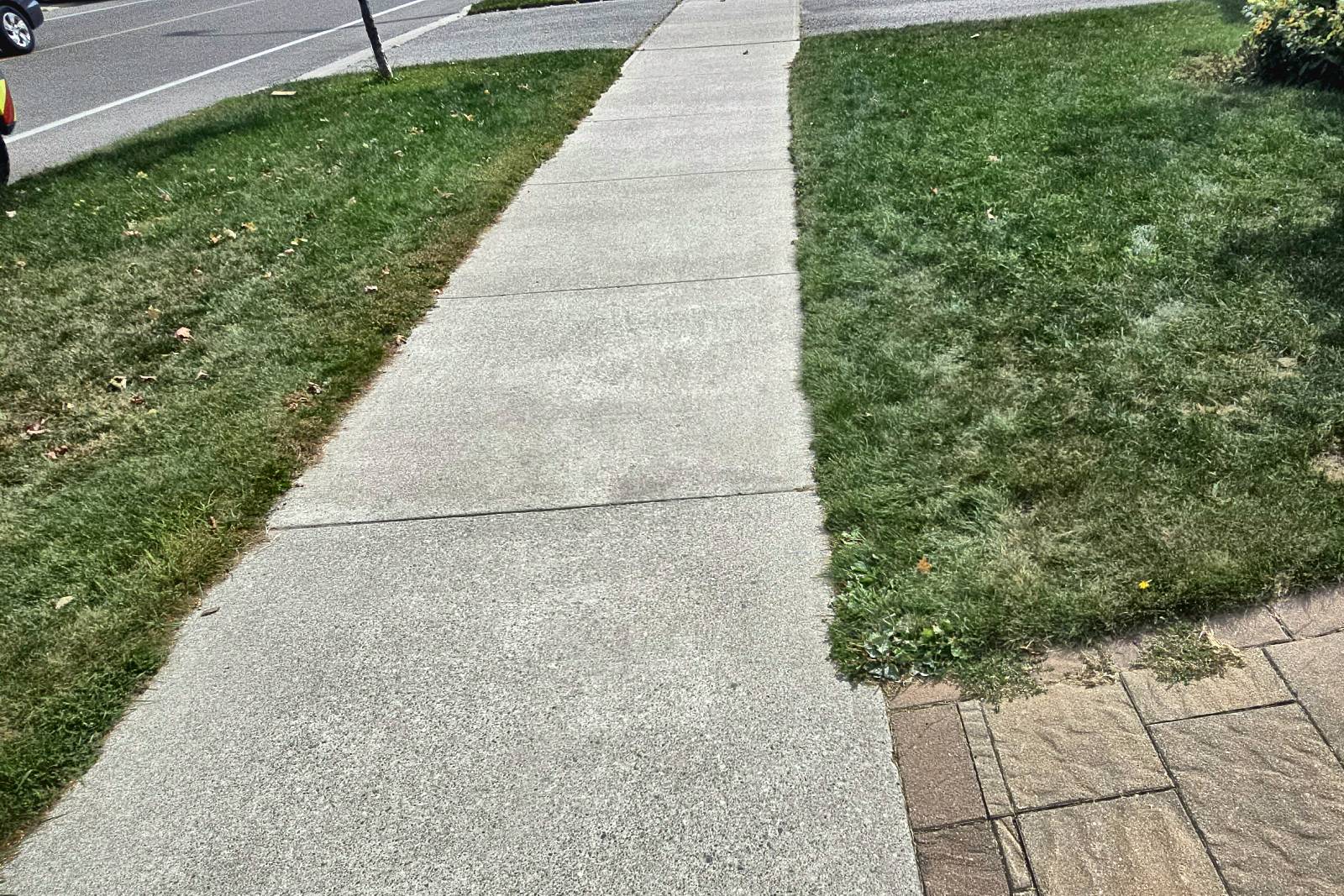
Real Northline properties, before and after, every one of them in Oshawa and every one of them this year. Drag the line to compare.
Andrew answers, October 2026
What happens in a drought? Do I still pay for a visit that did not happen?
We skip rather than cut, and we tell you why. Cutting a dormant lawn damages it. The payment does not change, because the payment is twelve equal instalments for a season rather than a charge per visit, and the same arrangement is what stops a twenty four storm winter costing you more than a four storm one. A contractor who mows on schedule through August because the schedule says so is charging you to hurt your grass.
One of these goes on each page and it is replaced monthly. If the question you have is not here, ask it: 905-244-5779.
Have the square cut before you buy anything
Send me the address and I will come and take the count with you watching, at no charge. If the number is under five I will tell you the grubs are not your problem and go away, and if it is over twenty I will tell you what it is going to take and when it should actually be done.