Lawn care · Oshawa
Dethatching a Lawn in Oshawa, and the Cut That Settles It
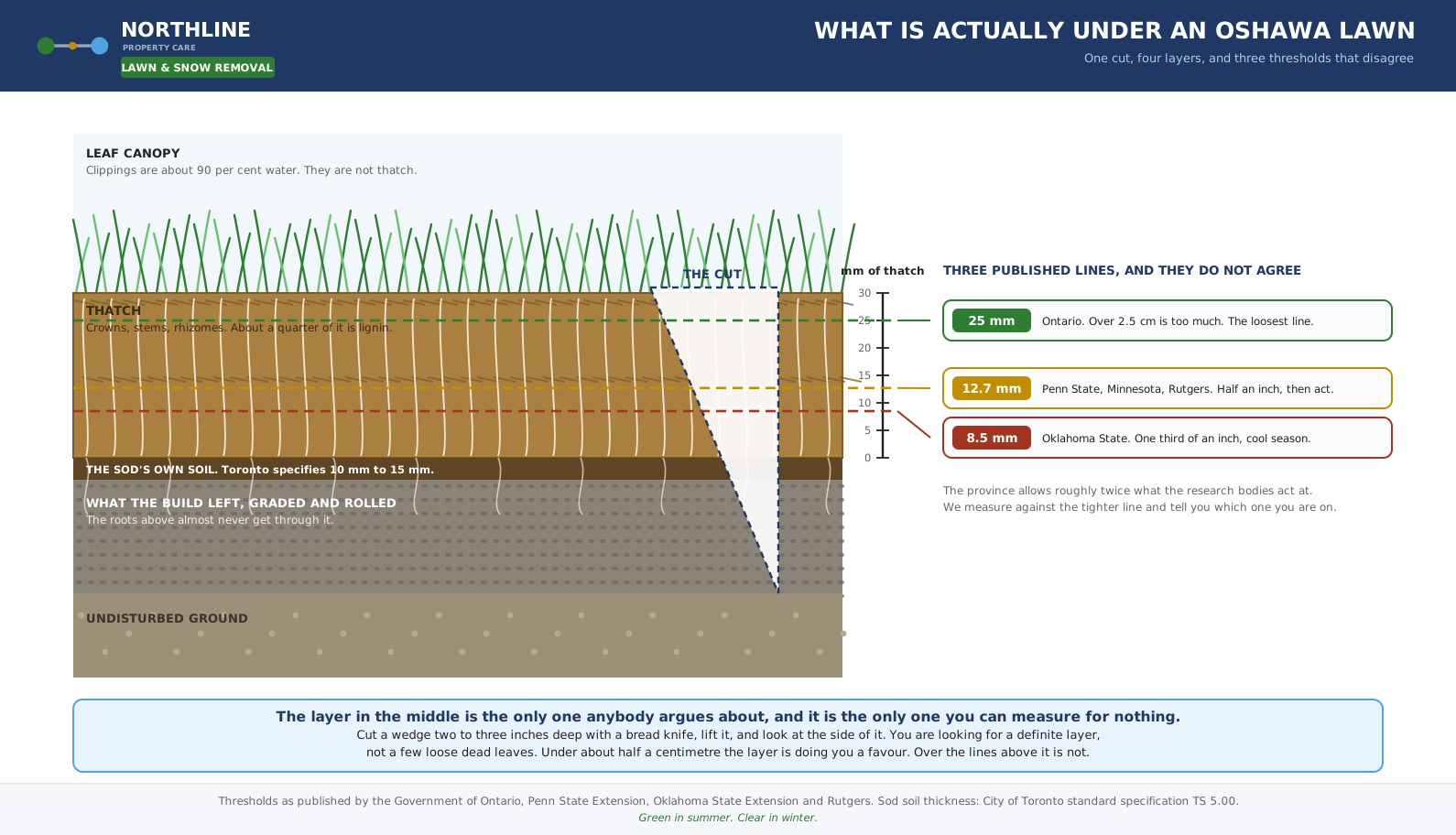
Dethatching a lawn in Oshawa is the wrong first move on most lawns, and the test that settles it costs nothing. Cut a wedge of turf two inches deep. If the brown band is thinner than a centimetre, a power rake does harm.
The town page sits here. See lawn care in Oshawa.
Green in summer. Clear in winter.
The short answer
Measure the layer before you rent the machine, because on most Oshawa lawns the measurement ends the conversation. Thatch is a band of crowns, stems, rhizomes and roots sitting between the green blades and the mineral soil. The Government of Ontario lawn maintenance page puts the ceiling at 2.5 cm. Penn State, the University of Minnesota, Ohio State and Rutgers all act at about half an inch, which is 12.7 mm, and Oklahoma State puts the cool season ceiling at a third of an inch. Those are not the same number. The province allows roughly twice what the research bodies act at, and nobody on a lawn care website is going to tell you that, because the looser the threshold the more lawns qualify for a machine.
A power rake is a destructive operation by design. It drives vertical blades down through the layer and pulls it out, and on a lawn whose roots are sitting in that layer rather than in the ground, it pulls the plants out as well. Kansas State calls vertical mowing the most destructive of the cultivation methods and says the turf may have to be reseeded. The University of Illinois says the same thing from the other direction: because the roots are in the thatch rather than the soil, the plants remove easily, and overseeding afterwards is usually required.
Core aeration is the operation that almost always pays here instead. It does not take the thatch away. It changes it, by lifting plugs of soil onto the surface where the soil mixes back into the thatch and the organisms in it get to work. It also fixes the compaction that caused the layer to build up, which a dethatcher does not touch. And the window is different: as at the first week of October the dethatching window for the year has closed in Durham Region, while aeration is still worth doing for a few more weeks.
One date and one price, so you have both. The snow season opens November 1 and the lawn year opens May 1, so an aeration booked now is the last lawn work of the year on most properties. Core aeration is $110 to $220 plus HST on its own. A year round membership starts at $129 a month plus HST, and covers the weekly cut, the spring cleanup and the fall cleanup rather than any single operation.
What thatch actually is, and the three words that get it wrong
Thatch is stem tissue, not leaf tissue, and that single distinction explains nearly everything else about it. South Dakota State University describes it as a layer of decomposed and partially decomposed organic matter sitting between the soil and the green vegetation, derived mostly from crown, sheath and stem tissue including stolons and rhizomes. The reason those tissues persist while leaves vanish is lignin, the polymer that gives a plant stem its rigidity. Penn State puts a figure on it: roughly 25 per cent of thatch is lignin, and the rest is mostly cellulose and hemicellulose, which decompose far more readily. Leaves carry much less lignin, so they go quickly.
That is why the most common belief about thatch is wrong. Grass clippings do not cause it. The Government of Ontario states it outright on the page linked above, and Kansas State explains the mechanism with a number any homeowner can picture: clippings are about 90 per cent water. They are mostly gone within days. Ohio State goes further and says returned clippings supply up to 30 per cent of a lawn's seasonal nitrogen, and at Penn State three years of measurement found that bluegrass clippings carried back between 46 and 59 per cent of the nitrogen that had been applied as fertilizer.
There is exactly one honest caveat and it is federal. Health Canada's lawn maintenance guidance advises removing thick layers of clippings, over 0.5 cm thick, under wet spring conditions, to avoid smothering the grass underneath. That is a clumping problem caused by mowing too late after too much growth. It is not thatch, and the fix is mowing more often rather than mowing and bagging.
What makes the layer build up faster than it rots
Thatch accumulates whenever the plant produces stem tissue faster than the soil organisms can break it down. Both halves of that sentence are things a homeowner controls. Penn State states the production side plainly: nitrogen promotes thatch development because it increases the production of root and stem tissues. Colorado State states the decomposition side: over fertilization is a common contributor because the lawn grows faster than the microorganisms can break it down.
On the decomposition side the list is short and every item on it describes a typical Durham subdivision lot. Penn State names acid soils at pH 5.5 or lower as inhibiting the organisms that do the work, and UMass puts the optimum for those organisms at around pH 6.5. Colorado State names compaction as a common contributor because it slows microbial activity, and adds the sentence that should be printed on every builder's sod invoice: sod laid over compacted soils develops thatch problems within a couple of years. Penn State also records that certain insecticides reduce earthworm populations and that fungicide applications can increase thatch compared with untreated areas, which matters because earthworms are the machinery here. Penn State's own figure is that an acre of turf can support more than a million earthworms consuming more than four tons of plant debris, and that as they burrow they mix soil and castings into the thatch and stimulate the microbes that decompose it.
For an Ontario lawn there is a regulatory wrinkle worth knowing before anybody blames a chemical. Under the province's cosmetic pesticide rules you cannot apply 2,4-D, diazinon or glyphosate to a lawn for weed or insect control, and you may only use products whose active ingredients all appear on the provincial Allowable List, Version 5, effective November 28, 2022. Seventy one active ingredients are on it, including corn gluten meal, borax, acetic acid, fatty acid soaps, sulphur and several biological agents. A federal registration from Health Canada does not override that. So the pesticide explanation for a thatch problem is largely closed off to a homeowner in Oshawa, which leaves nitrogen, water and compaction, and of those three, compaction is the one almost nobody measures.
Why an Oshawa lawn is a thatch candidate in the first place
Spreading grasses make thatch and bunch grasses do not, and Ontario plants the spreading kind almost exclusively. South Dakota State ranks the cool season species from heaviest thatch producer to lightest: creeping bentgrass, Kentucky bluegrass, the fine fescues, perennial ryegrass, tall fescue. Penn State explains the mechanism in one line. Perennial ryegrass and tall fescue are primarily bunch type grasses and do not produce significant thatch buildup, because they do not run. Kentucky bluegrass sends out rhizomes, creeping bentgrass sends out stolons, and creeping red fescue runs too, just with shorter rhizomes, which is why Ohio State places it below bluegrass on the same list.
Now look at what is actually growing here. The province's own lawn establishment guidance puts Kentucky bluegrass at 60 to 75 per cent by weight of a seed mixture for a high quality lawn on heavy or medium soils, and 40 to 50 per cent on light soils. The Guelph Turfgrass Institute describes Ontario turf as predominantly Kentucky bluegrass mixed with perennial ryegrass, and notes that bluegrass forms a strong thatch that protects the roots and rhizomes from wear. And the City of Toronto's sodding specification, TS 5.00, requires nursery sod grown from a minimum of 70 per cent Kentucky bluegrass and 30 per cent creeping red fescue. That is the standard the sod industry in this part of Ontario builds to.
So the sod rolled out on a new Oshawa, Courtice or Brooklin lot is, by specification, the top two thatch forming species on the list and nothing else. Add the Ontario government's own observation that thatch is common on Kentucky bluegrass lawns that have been established for several years and have been over watered and over fertilized, and you have the profile of a twenty year old subdivision lawn in north Oshawa almost exactly.
That is the real answer to why Durham lawns get thatchy, and it has nothing to do with the thing everybody blames.
The clay explanation is mostly wrong, and this is the part that will cost us
Durham Region is not a clay region, and our own website has been saying otherwise. The thatch literature does name heavy clay as a cause, because clay compacts and compaction suppresses the organisms that decompose the layer. Kansas State says clay soil has a fine texture with a sticky plate like structure and is more likely to become compacted. Clemson closes the loop: thatch accumulates faster on compacted soils and heavy clay soils than on well aerified soils. All of that is true. It simply does not describe most of the ground under this region.
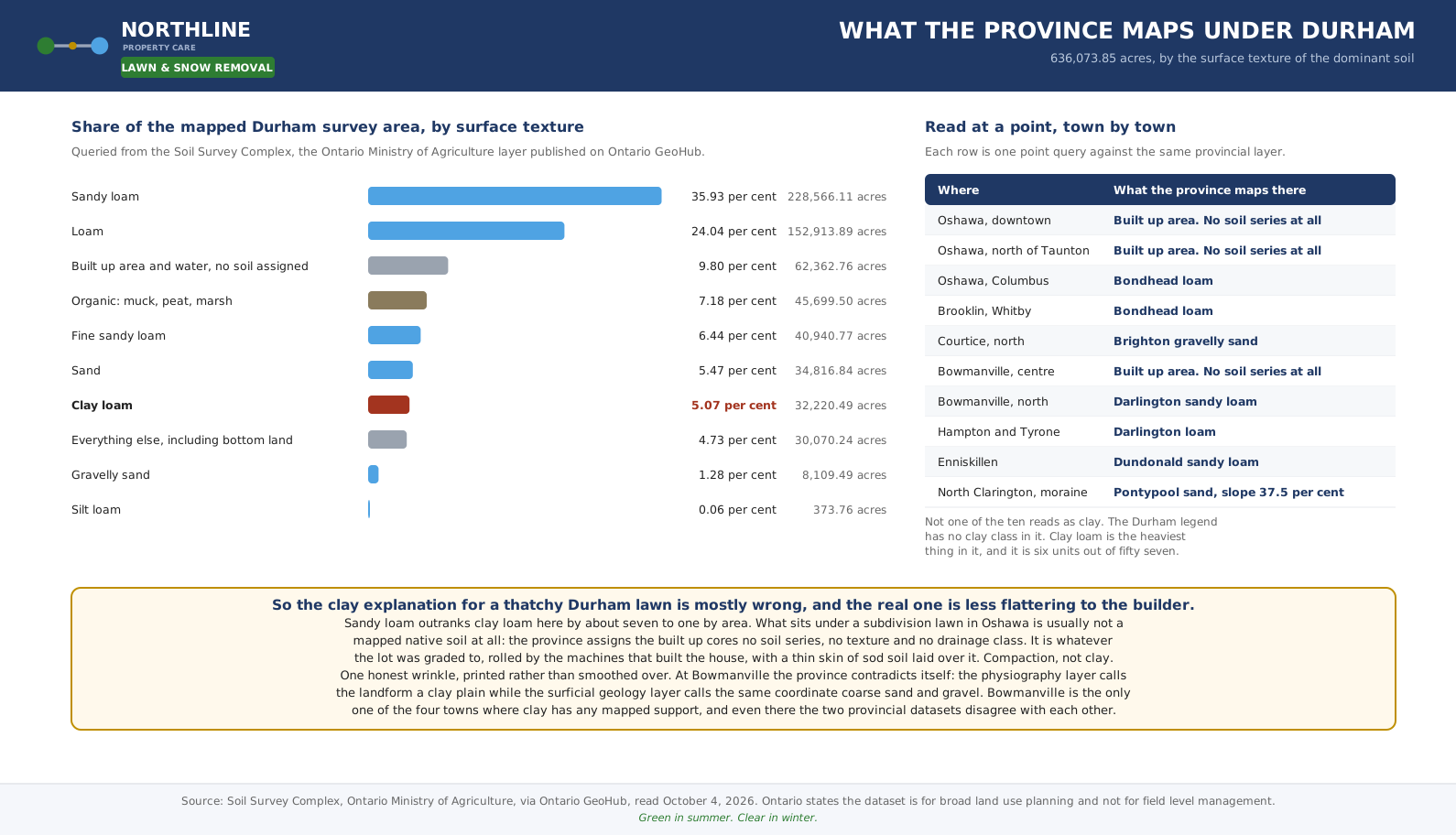
The authoritative mapping is the Soil Survey Complex published by the Ontario Ministry of Agriculture, carried on Ontario GeoHub under the provincial open licence. Queried for the Durham survey it returns 636,073.85 mapped acres. Sandy loam is 228,566.11 of them, which is 35.93 per cent. Loam is 152,913.89 acres, which is 24.04 per cent. Clay loam is 32,220.49 acres, which is 5.07 per cent. Sandy loam outranks clay loam here by about seven to one by area, and there is no clay texture class in the Durham legend whatsoever. Clay loam appears as six map units out of fifty seven: Smithfield, Schomberg, Simcoe, Lovering, Peel and Newcastle.
Read at a point, it is the same story. Columbus and Brooklin come back as Bondhead loam. North Courtice comes back as Brighton gravelly sand. North of Bowmanville is Darlington sandy loam, Hampton and Tyrone are Darlington loam, Enniskillen is Dundonald sandy loam, and the Clarington moraine is Pontypool sand on a 37.5 per cent slope. The Darlington series, which is the name people reach for when they want to say Durham is heavy, is mapped as loam and sandy loam.
Two honest qualifications, neither of which rescues the clay story
The first is that the province attaches a warning to its own data, and it is fair to repeat it: the dataset is described as a tool for broad land use planning decision making and not necessarily for field level management, with positional accuracy stated as within 200 metres. It tells you what the region is made of. It does not tell you what is in your particular back garden.
The second is that the province disagrees with itself in one place, and that place is Bowmanville. The Ontario Geological Survey physiography layer maps the landform there as Clay Plains. The Ontario Geological Survey surficial geology layer maps the same coordinate as coarse textured glaciolacustrine deposits, which is to say sand, gravel and minor silt and clay laid down as foreshore deposits along the old Lake Iroquois beach. Bowmanville is the one town of the four where clay has any mapped support at all, and even there two provincial datasets contradict each other. Printing that is more useful than picking the one that suits the argument.
And there is a third thing, which is the one that actually matters for thatch. The built up cores of Oshawa, Whitby and Bowmanville are mapped as built up area with no soil series, no texture and no drainage class assigned. The Oshawa and Whitby built up polygon alone runs to 25,231.01 acres. The province does not claim to know what is under a city street, because what is under a city street is not a soil in the survey sense. It is whatever the lot was graded to.
So the honest sentence, and I would rather publish it than the comfortable one, is this: the ground under a typical Oshawa subdivision lawn is not clay, and it is not really a mapped soil either. It is fill, graded flat and rolled hard by the machinery that built the house, with a skin of sod soil laid over the top of it. Toronto's specification puts that skin at 10 mm minimum and 15 mm maximum. The lawn has about a centimetre of decent growing medium and a compacted pan underneath, and that is the whole problem.
This correction has a consequence for us, not only for the reader. Our own tips index has been telling people that Durham is clay and clay loam. On the province's mapping that is wrong, it was wrong when we wrote it, and we are fixing it rather than leaving it to be found.
Compaction, with the numbers that make it undeniable
Compaction is measurable, it is shallow, and it is the condition a dethatcher leaves completely intact. Soil scientists measure it as bulk density, in grams per cubic centimetre. The United States Department of Agriculture Natural Resources Conservation Service and Penn State publish the same thresholds: sand and loamy sand restrict root growth above 1.80, sandy loam and loam above 1.80, silt loam above 1.75, and clay above 1.47. The finer the soil, the less headroom there is before roots stop. The same traffic a sandy lawn shrugs off puts a heavier lawn over the limit.
What happens past that line is not subtle. Penn State reports that root growth decreases linearly with penetration resistance from 100 psi and stops entirely at 300 psi, and in a grassland compaction study the infiltration rate fell from 1.06 inches per hour to 0.25, a reduction of about 76 per cent. Air permeability fell from 55 to 1. Earthworm populations fell from 166,000 per acre to 8,000. Nitrogen mineralization dropped by a third. Put plainly: the water stops going in, the air stops moving, and the organisms that were supposed to be eating your thatch die off. The thatch then accumulates faster, which is the loop nobody draws.
The useful surprise is how shallow the damage is. The Government of Ontario's lawn renovation page states that foot traffic causes the first 2 to 3 cm of the root zone to become compacted, and the University of Maryland reports that a compacted layer as thin as a quarter to a half of an inch can greatly impede water infiltration and gas exchange. A 50 to 75 mm hollow tine goes straight through it. A dethatcher blade, set to cut the thatch and perhaps half an inch into the soil, barely reaches it and removes nothing from it.
There is one federal note that fits Durham specifically. Agriculture and Agri-Food Canada, in its national soil health assessment, names compaction of soils in the Lake Erie and St. Lawrence lowlands as a significant problem, with poorly drained clayey soils the most seriously affected. Durham sits in the St. Lawrence lowlands. That statement is about farmland rather than lawns, and it is quoted here as context rather than as a measurement of anybody's yard, but the mechanism is the same mechanism.
Penn State also measured the hopeful half of it. In a trial on silt loam, cattle trampling raised bulk density from under 1.40 to 1.57, freeze and thaw cycles over one winter brought it back to 1.45, and root growth alone returned it to control levels by day 230. Roots repair compaction if they are given somewhere to grow. An Oshawa winter does some of that work for nothing. The job of an aeration is to give the roots the opening so that the rest of it happens.
The three machines, and what each one is really for
Two of these machines are frequently confused and they do close to opposite things. Purdue defines a dethatching machine as a power rake with blades that cut through the thatch down to the soil surface, and warns against machines with flexible rake type tines and against dethatchers that bolt onto a rotary mower blade. Penn State separates the family further: a vertical mower has blades perpendicular to the turf surface with adjustable depth, while a power rake uses vertically rotating wire tines, suits smaller jobs, and lacks the power and durability of a vertical mower. The University of Minnesota is blunt about the bolt on attachments: not effective at removing thatch, not generally recommended, and quite destructive to existing grass.
Even the depth setting is unsettled in the literature, which tells you something about how standardised this operation is not. Rutgers specifies straight steel blades at least an eighth of an inch thick, spaced an inch and a half to two inches apart, set to penetrate completely through the thatch layer and at least half an inch into the soil. Utah State says vertical mower blades should not be set so deep that they touch the soil. Washington State says you should not be bringing up any soil at all. Three university extension services, three different instructions about whether the blade touches the ground.
What a core aerator does that the other two cannot
A hollow tine aerator pulls plugs out and drops them on the surface. The Government of Ontario specifies hollow steel tines 1 to 2 cm in diameter spaced 10 to 15 cm apart. That works out to roughly 44 to 100 holes per square metre. The American land grant specifications are far denser: Purdue says 20 to 40 holes per square foot, Kentucky says 20 to 30, Illinois says an average of 15 to 20. Converted, that is about 161 to 430 holes per square metre. The honest reading is that Ontario is describing the minimum machine and the land grants are setting a performance target, and the two are not interchangeable. On a lawn worth aerating, more passes beats fewer.
The mechanism is the part that gets missed. Tony Koski at Colorado State states it exactly: core cultivation does not manage thatch by removing it, but rather by modifying it, and when the soil from the cores works its way back into the thatch layer, the soil mixes with the thatch and enhances microbial activity and therefore decomposition. OMAFRA's own Publication 845 says the same in its own words: the hollow tine aerator physically breaks up the thatch, brings up beneficial soil microorganisms that help break it down, and alleviates compaction. UMass quantifies the direct removal at as much as 10 per cent or more of the thatch, and sets the surface exposure target at a minimum of 3 to 3.5 per cent per event with 10 per cent as the ceiling, noting that most machines need at least two passes to reach the minimum.
And the oddest number in the whole literature is also the most persuasive. UMass calculates that 1,000 square feet of turf, after a single aeration with three quarter inch tines spaced two inches apart to a depth of two inches, has an effective surface area of 2,180 square feet. You have more than doubled the area through which air and water can reach the root zone, by disturbing about a twentieth of the lawn.
How much a power raking takes with it
Nobody publishes a percentage, and that absence is itself worth stating, but the descriptions line up. Colorado State says deep power raking of a thatchy lawn is damaging and often removes a substantial portion of the living turf. Wisconsin says vertical mowing will severely harm the appearance and density of the turf, and that grasses rooted in thatch tear out easily. Washington State warns that old fine fescue lawns are easy to destroy because the thatch comes out in clumps. Nebraska describes the action mechanically: vertical knives rotate, prying loose and pulling upward the thatch, and in the process some healthy turf shoots, crowns and roots are pulled loose too.
Then there is the flat recommendation, which is the sentence most of this industry would rather you did not read. Kansas State Research and Extension, in a 2015 note by Ward Upham and Jared Hoyle, says that for lawns with half an inch of thatch or less they do not recommend power raking but rather core aeration, and that core aeration is a much better practice for most lawns. Wisconsin agrees and adds the reason that matters: thatch often returns shortly after dethatching, because the unfavourable soil conditions were not corrected. Cornell's homeowner guidance on thatch does not mention power raking at all.
The debris, and the sentence on Oshawa's own waste page
A power raking produces a pile the curb will not take, and almost nobody mentions that before the machine is rented. The University of Kentucky describes the volume without flinching: several garbage bags or a full pickup load of thatch can be removed from just a small lawn. Kansas State says the operation pulls up an incredible amount of material that then must be dealt with by composting or discarding. Purdue warns that several passes will produce large quantities of refuse and the lawn will look very ragged for some time.
Washington State gives the one figure that lets you do the arithmetic yourself: going over the lawn in two directions removes approximately a quarter of an inch of thatch. The sum that follows is ours, not theirs, and it is shown so you can check it. A quarter of an inch over 1,000 square feet is about 20.8 cubic feet, which is roughly three quarters of a cubic yard of loose material. A front and back lawn of 4,000 square feet therefore produces something near three cubic yards, which is a large trailer load.
Now read what the City of Oshawa yard waste page actually says. Collection is every other week on your garbage day from mid April until the end of November, in kraft paper bags or clearly marked open top containers each weighing less than 20 kg, with no plastic bags. Brush and twigs are taken in tied bundles up to 1.2 m with branches 10 cm in diameter or less. And the list of what is not accepted names, in order, soil, sod, stones and clay. Grass clippings are excluded as well. The city warns that contaminated loads reduce composting efficiency and can lead to enforcement action.
A power raking does not produce clean plant debris. It produces thatch mixed with soil and torn sod, which is the exact material on the refusal list, in a volume that would need something like forty bags at the 20 kg limit. The Region of Durham waste facilities page closes the other door. Those sites stopped taking leaf and yard waste altogether, and fill material such as soil and dirt cannot be disposed of there either. The Region does run weekly autumn collection from October 1 to December 13, but that program covers Brock, Scugog and Uxbridge townships, Pickering, Ajax and Clarington. Oshawa and Whitby run their own programs, and Oshawa's is the every other week schedule above.
Aeration has none of this problem, and the reason is pleasing. The cores are soil, so they are not curbside yard waste either, but you do not want to remove them. Wisconsin says to let the cores dry for a day or two and then mow to break them up, and that they generally take several days to a few weeks to fall apart. Those crumbled cores are the mechanism. They are what carries the soil microbes back into the thatch layer. Raking them off throws away the thing you paid for.
The calendar, and why October 4 answers the question on its own
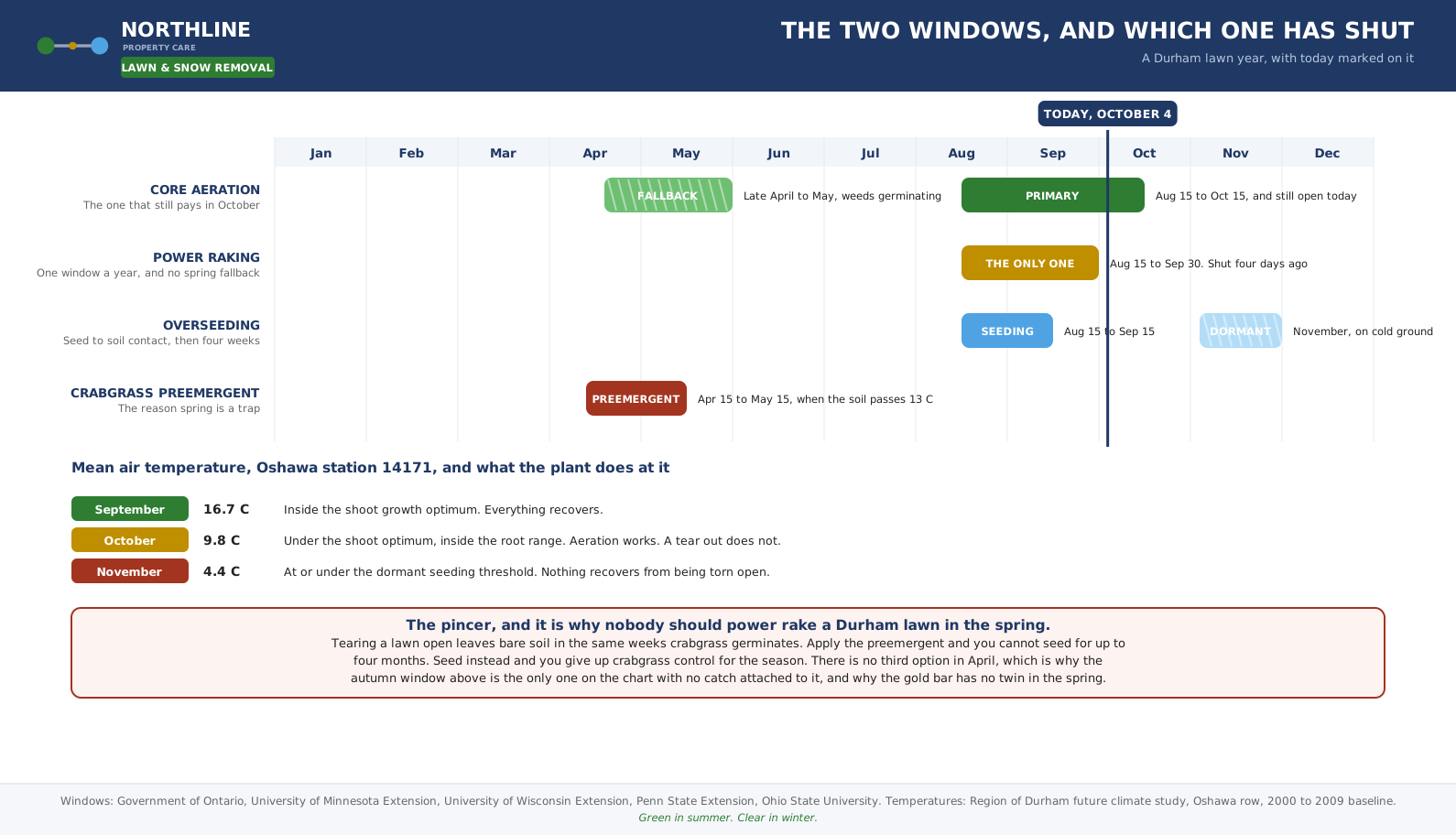
The window for tearing a lawn open in Durham Region closed at the end of September. The Government of Ontario's winter preparation page gives the thatch control window, by core aeration or by verticutting, as mid August to mid September. The University of Minnesota lawn care calendar, which is the closest American analogue to our climate, gives dethatching a primary window of mid August through September and lists no spring window at all. The same calendar gives core aeration mid August through mid October as primary, with late April through May as a secondary option. One operation has a fallback. The other does not.
Recovery is the reason. UMass puts the requirement at three to four weeks of favourable growth after a cultivation, Clemson asks for at least four weeks of good growing weather, and Iowa State says September dethatching works because it gives the turf several weeks of good growing weather in which to recover. Penn State adds the warning for the far end: avoid thatch removal during late fall when winter desiccation may occur. UMass advises against soil cultivation for new establishment after the end of September, with some leeway into October for less disruptive work such as overseeding.
Put the thresholds against the Oshawa numbers
The Region of Durham's own future climate study carries station level climatology for the Oshawa station, number 14171, on a 2000 to 2009 baseline. Mean September temperature is 16.7 degrees. October is 9.8 degrees. November is 4.4 degrees. Clarington station 14483 is within a tenth of a degree of Oshawa on all three. Annual precipitation is 880 mm at Oshawa and 883 mm at Clarington, and annual snowfall is 158 cm and 153 cm.
Penn State puts the optimum air temperature for cool season shoot growth at roughly 15.6 to 23.9 degrees and the optimum soil temperature for root growth lower, at about 10 to 18.3 degrees, and notes that roots keep growing below that but slow dramatically as temperatures approach freezing. UMass sets the dormant seeding trigger at air temperatures consistently below 10 degrees with soil in the low single digits. Lay the two sets of figures side by side. September in Oshawa sits inside the shoot growth optimum, so a lawn torn open in early September closes up. October at 9.8 degrees is below the shoot optimum and at the bottom edge of the root range, so roots still work and shoots barely do. November at 4.4 degrees is at the dormant seeding threshold.
That comparison is ours. It is two published sets of numbers put next to each other, not a published finding, and it is marked as such deliberately. What it supports is a simple operational rule for this region: by the first week of October, aerate and leave the cores, and do not tear. A lawn opened up now in Oshawa goes into a November at 4.4 degrees with bare ground and no capacity to close it.
Spring is not the answer either, and the trap is specific
The obvious reply is to wait until April. It is the wrong reply, and the reason is a pincer that has nothing to do with the machine. Alison O'Connor at Colorado State put it directly in an extension answer: once you get further into the spring, dethatching can be very harmful and damaging to the lawn and reduce its ability to tolerate stress and drought in the summer, because the operation removes the organic matter and tears up the newly forming roots.
Then the weeds. Iowa State sets crabgrass germination at soil temperatures above 55 degrees Fahrenheit for three days and nights, typically around mid April, and advises that if you must seed in spring you have to avoid preemergence herbicides, which prevent your turfgrass from germinating as well. Ohio State's Buckeye Turf puts a duration on that: preemergence herbicides for annual grasses will also prevent the germination of turfgrass for up to four months. So in April you open bare soil in the same two weeks that crabgrass germinates, and you then choose. Apply the preemergent and you cannot seed until roughly mid August, which is the autumn window you were trying to avoid. Seed instead and you give up crabgrass control for the whole season. There is no third option.
This is the same shape as a correction we already published about aeration. Spring aeration on its own is fine, and Ontario names spring as a recommended window. It is spring aeration paired with seed that fails, because the seedling meets July with an immature root system and the seeding forfeits the preemergent. The detail is set out in our piece on aeration and overseeding in Ontario, and the same logic condemns spring power raking far more strongly, because power raking opens more ground than aeration does.
The nitrogen question, and a disagreement I am not going to paper over
Two governments give opposite advice about late autumn nitrogen, and both of them are legitimate sources. The Government of Ontario recommends a late season application when the turf has stopped growing but is still green, usually in mid to late October, at 0.5 kg of nitrogen per 100 square metres, and lists the benefits as better fall colour, more stored sugars for winter survival, plants that take longer to freeze and freeze at lower temperatures, and deeper rooting. The University of Illinois, writing about snow mould, says not to fertilize with nitrogen within about six weeks of a killing frost. The University of Wisconsin says applying high nitrogen fertilizer in the fall can increase the risk of Typhula blight developing over the winter.
Those cannot all be followed. Ontario's own planting date tables put the average first fall frost for the zones bracketing the Durham lakeshore between October 8 and October 13. A mid to late October application therefore lands at or inside the six week exclusion the American sources describe.
The reading I act on, stated as a reading and not as a finding, is that the American warnings are aimed at soluble, quick release nitrogen pushing lush top growth into snow cover, and Ontario's recommendation is for an application after shoot growth has stopped, where the nitrogen goes into storage rather than into leaf. If you are going to follow the provincial advice, follow the part that says after the turf has stopped growing, and use a slow release product rather than a soluble one. If you would rather not take the risk at all, skipping it costs you colour and a little winter hardiness and nothing else.
The rate figures are worth keeping either way, because over fertilization is one of the two things that builds thatch. Ontario's 0.5 kg per 100 square metres works out to almost exactly the 1 pound per 1,000 square feet that Purdue sets as the cap for a single application of quick release nitrogen. Purdue's whole year range for a cool season home lawn is 1 to 5 pounds of actual nitrogen per 1,000 square feet, with the lowest maintenance programs at 1 to 3. A lawn being fed at the top of that range by somebody who wants it dark green in July is a lawn manufacturing thatch, and no machine fixes that. Our own notes on fall lawn fertilizer in Oshawa go through the timing in more detail.
Where this stops being a lawn question and becomes a winter one
Thatch is where snow mould waits out the summer, and that is a Durham problem rather than a general one. The Government of Ontario states it in one sentence on the winter preparation page: thatch harbours disease causing organisms such as snow mould, and in turf with excess thatch the growing point of the plant is elevated above the soil. The second half of that sentence is the one to sit with. The crown is the overwintering growing point of a grass plant. Thatch lifts it out of the insulating soil and holds it in a layer that dries hard and wets slowly.
Penn State gives the mechanism precisely. The sclerotia of grey snow mould, Typhula incarnata, remain dormant in leaf litter, thatch and soil during spring, summer and fall. Pink snow mould, Microdochium nivale, survives as dormant mycelium in the same three places. The thatch is not merely a risk factor, it is the address. Wisconsin adds the conditions: temperatures around freezing to about four degrees at the snow and turf interface, and more than 60 days of snow cover on ground that has not frozen hard. Illinois lists removing mulches of fallen leaves and thatch accumulation as a management step for both diseases.
Pink snow mould is the one that should worry a Durham homeowner more, because it needs no snow at all. Illinois gives its range as roughly zero to eight degrees with persistent wet conditions, occurring from autumn to early summer. Oshawa's mean November temperature of 4.4 degrees sits in the middle of that band, and March does the same thing on the way out. The risk window here is much longer than the snowy part of the winter, which is the opposite of what most people assume. We have written the disease up separately in our piece on snow mould in Oshawa, including why the plow pile decides where it lands.
There is a tidy coincidence worth acting on. Illinois suggests holding soil pH at or slightly below 6.5 as part of snow mould management, and UMass puts the optimum for the microorganisms that decompose thatch at around pH 6.5 as well. One soil test and one correction addresses both. A soil test is the cheapest thing on this entire page and almost nobody in Durham has had one done.
The final mowing matters too, and the advice pulls in two directions by design. Ontario says to raise the mowing height slightly in the fall to insulate the crown, but warns that grass going into winter too long will mat down and encourage winter diseases. Wisconsin and Minnesota both say to keep mowing until growth stops. The practical version for Oshawa is to keep cutting into November on the warm years, finish a touch higher than the summer height, and never leave a long shaggy canopy to lie down under the first wet snow. We set out the heights in our note on mowing height for a Durham Region lawn.
So who should actually dethatch, and what it costs
A dethatching earns its place on a small minority of Durham lawns, and here is the test. Cut three or four wedges, in different parts of the lawn, two to three inches deep. Press the brown layer lightly flat and measure it against a ruler. Then read the result like this.
Under about 10 mm
Leave it alone. OMAFRA's Publication 845 says a moderate layer of thatch is beneficial for most turf because it insulates roots from temperature extremes, reduces water loss and cushions the surface against wear. The Guelph Turfgrass Institute makes the same point about Kentucky bluegrass specifically. At this depth the layer is an asset. If the lawn still feels tired, the problem is compaction, shade, mowing height or water, and a machine aimed at the thatch is aimed at the wrong thing. Core aeration, $110 to $220 plus HST, and we will tell you if even that is unnecessary.
Between about 10 mm and 25 mm
This is the band where the sources disagree and judgement is required. The research bodies would act. The province would not, until 25 mm. On a Durham lawn my answer is core aeration first, repeated over two autumns, with topdressing. Wisconsin and Illinois both recommend an eighth to a quarter of an inch of compatible soil or compost after aeration, and Clemson is emphatic that sand should only be used where the native soil is sandy while compost suits every soil type. Ontario's own topdressing rate for an overseeded area is 0.5 cubic metres per 100 square metres, which works out to a 5 mm layer and agrees closely with the American figures. Two autumns of that will usually take the layer down without ever opening the lawn up.
Over 25 mm
Now a dethatching is the right operation, and it is a renovation rather than a maintenance visit. Purdue notes that over an inch of thatch is most easily removed with a sod cutter rather than a power rake, which is a fair description of the state the lawn is in. It has to be done in the mid August to mid September window, it has to be overseeded immediately afterwards, and the lawn will look wrecked for several weeks. That work sits inside our full lawn restoration, which is $600, $850 or $1,250 plus HST by property size, sold on its own and not folded into any membership at any price.
The part that costs us the sale
Most of the lawns I am called out to look at measure under 10 mm. On those lawns the honest answer is that there is nothing here to sell, and saying so is the whole point of writing this. A power rake on a thin layer removes living grass, leaves bare ground for weed seed, does nothing to the compacted pan beneath, and hands you a trailer load of material Oshawa will not collect. The lawn looks worse for a month and the underlying condition is unchanged. I would rather lose that job than take it.
What we do sell, for completeness: core aeration at $110 to $220 plus HST, weekly mowing without a membership from $75 a cut plus HST, a one off cut at $40 to $75, and a year round membership from $129 a month plus HST covering about 26 visits a season, the spring cleanup and the fall cleanup. The seasonal add ons are listed on the add ons page with their prices beside them. Nothing on this page is a reason to buy any of it if the knife says otherwise.
How this page was researched, and what it could not find out
Every external figure on this page comes from a ministry, a federal department, a provincial dataset, a municipality or a university extension service, and not one of them comes from a company that competes for your business. That rule is not decoration. It is why this page can tell you that most Oshawa lawns should not be dethatched: no commercial source was consulted that had a reason to say otherwise. Where a number is our own arithmetic rather than a published figure, it says so on the line.
The things we went looking for and did not find are listed here, because an article that reports only what it found is hiding its method.
- Environment and Climate Change Canada climate normals for an Oshawa station could not be read at all. Every attempt at the normals service failed. The September, October and November temperatures, the precipitation and the snowfall on this page therefore come from the Region of Durham's own future climate study, which uses Environment Canada station data on a 2000 to 2009 baseline rather than the current 1991 to 2020 normals.
- The original soil survey reports could not be opened. Report number 9, the Soil Survey of Durham County from 1946, and report number 23, the Soil Survey of Ontario County from 1956, both exist on the Canadian Soil Information Service, and neither PDF could be retrieved. So no soil profile description, clay percentage or drainage class is quoted from them. The texture figures on this page come from the current provincial mapping layer only.
- No measured soil temperature at 5 cm or 10 cm depth for southern Ontario through October and November was obtainable from any government or university source. The statements about root growth slowing are temperature thresholds from Penn State and UMass set against Durham air temperatures, which is a comparison rather than a measurement.
- No source gives a calendar date after which cool season turf can no longer recover from a cultivation. The latest window any of them names is mid October for aeration. The October date in this article is our reading of two sets of published numbers.
- No published figure exists for how many consecutive days Oshawa typically holds snow cover, so whether Wisconsin's condition of more than 60 days of cover on unfrozen ground is normally met here is unknown. It is named as unresolved rather than assumed either way.
- No source states what percentage of living turf a power raking removes. Every description is qualitative. The only quantified figure in this area runs the other way: UMass's estimate that core aeration removes as much as 10 per cent or more of the thatch.
- No peer reviewed journal article was obtainable. Every attempt at the agronomy and crop science literature was refused by the publisher. Everything cited here is government or university extension material, which is reliable but is not primary research.
- The drainage class codes in the provincial soil layer return as single letters with no published key we could find, so drainage is not reported on this page even though the data carries it.
- The final yard waste collection date moves every year. Oshawa says the end of November, Whitby says late November or early December, and the Region's weekly autumn program runs to December 13. Read the current collection calendar rather than any date printed here.
One finding on this page contradicts our own site, and it is recorded rather than quietly corrected. Our property care tips index describes Durham as clay and clay loam. The provincial mapping says clay loam is 5.07 per cent of the region and there is no clay class at all. The index is wrong and will be fixed.
Questions people actually ask
How do I know if my Oshawa lawn needs dethatching?
Cut a wedge of turf two to three inches deep with a bread knife or a spade, lift it out, and look at the cut face. Between the green blades and the mineral soil you are looking for a definite brown fibrous layer, not a few loose dead leaves. Measure that layer with a ruler while pressing it lightly flat. Ontario's published ceiling for the layer is 2.5 cm. Penn State, Minnesota, Ohio State and Rutgers act at about half an inch, which is 12.7 mm. Take several wedges in different parts of the lawn, because thatch is rarely even. Under about 10 mm the layer is doing useful work and should be left alone.
Is dethatching the same as core aeration?
No. A dethatcher or power rake drives vertical blades down through the thatch and tears the layer out, which is why Kansas State calls vertical mowing the most destructive method and warns the turf may have to be reseeded. A core aerator pulls plugs of soil out of the ground and drops them on the surface. Colorado State puts the difference precisely: core cultivation does not manage thatch by removing it, it manages it by modifying it, because the soil from the cores works back into the thatch and the microbes in that soil speed up the decomposition. Aeration also relieves the compaction that caused the thatch in the first place. Dethatching does not.
When should a lawn in Oshawa be dethatched?
The Government of Ontario gives the thatch control window as mid August to mid September on its lawn winter preparation page. The University of Minnesota lawn care calendar gives dethatching mid August through September and lists no spring window at all, while giving core aeration both an autumn window and a spring fallback. The reason is recovery: a torn lawn needs several weeks of real growth to close up, and the mean air temperature in Oshawa falls to 9.8 degrees in October and 4.4 degrees in November. By the first week of October the dethatching window for the year has closed in Durham Region. Core aeration is still worth doing.
Does leaving grass clippings on the lawn cause thatch?
No, and this is the most durable myth in lawn care. The Government of Ontario states plainly that clippings break down rapidly and do not contribute significantly to thatch. Kansas State explains why with a number: clippings are about 90 per cent water. Thatch comes from crowns, stems, rhizomes and roots, which Penn State measures as roughly a quarter lignin, the polymer that makes plant tissue rigid and slow to rot. Leaf tissue has far less of it. Ohio State adds that returned clippings supply up to 30 per cent of a lawn's seasonal nitrogen. The one caveat is federal: Health Canada advises removing clippings in wet spring conditions when they are lying more than 0.5 cm thick.
Will the City of Oshawa collect the debris from a dethatching?
Partly, and the part it refuses is the part you will have most of. Oshawa collects yard waste every other week from mid April to the end of November, in kraft paper bags or clearly marked open top containers under 20 kg each, and the city's own list of what is not accepted names soil, sod, stones and clay. Grass clippings are also excluded. A power raking pulls up thatch mixed with soil and torn sod, so a load of it is a contaminated load. The Region of Durham no longer accepts leaf and yard waste at its waste management facilities and does not take fill material there either. Aeration cores are soil, so they are not curbside waste. Leave them where they fall, which is what you want anyway.
Is Durham Region soil really clay?
Mostly not, according to the province's own mapping. The Soil Survey Complex published by the Ontario Ministry of Agriculture covers 636,073.85 acres in the Durham survey, and clay loam accounts for 5.07 per cent of it. Sandy loam is 35.93 per cent and loam is 24.04 per cent. There is no clay texture class in the Durham legend at all, and clay loam is six map units out of fifty seven. The built up cores of Oshawa, Whitby and Bowmanville carry no soil series, no texture and no drainage class, because the survey assigns none to built up land. So what sits under a subdivision lawn is usually not a mapped native soil at all. It is graded and compacted fill with a skin of sod soil over it.
Does thatch cause snow mould?
Thatch is where the fungus lives between winters, which is close enough to matter here. The Government of Ontario states that thatch harbours disease causing organisms such as snow mould, and that in turf with excess thatch the growing point of the plant is elevated above the soil. Penn State is more specific: the sclerotia of grey snow mould remain dormant in leaf litter, thatch and soil through spring, summer and autumn, and pink snow mould survives in the same places as dormant mycelium. Pink snow mould needs no snow at all, only persistent wet weather between about zero and eight degrees, which describes a Durham November and a Durham March exactly.
What does core aeration cost in Oshawa?
Core aeration runs $110 to $220 plus HST as a one off job, priced on the size of the lawn and how much of it the machine can reach. A full lawn restoration, which is a different product for a lawn that is genuinely finished rather than merely compacted, is $600, $850 or $1,250 plus HST depending on size and is sold on its own rather than inside any membership. A year round membership starts at $129 a month plus HST. If the knife cut shows a thatch layer under about 10 mm, we will tell you so and we will not sell you a dethatching, because on that lawn the machine would remove living grass and leave the actual problem untouched.
Who wrote this
I am Andrew, and I own and operate Northline Property Care out of Oshawa. I price the property and I do the work, which is the only reason a page like this can tell you not to buy something. Six winters clearing snow in Durham Region taught me more about what a lawn looks like in March than any summer ever did, and the lawns that come out of winter worst are reliably the ones with a thick spongy layer under the green and a hard pan under that.
The reason I measure with a knife rather than a brochure is that I have been wrong about a lawn by eye. A lawn that feels springy underfoot can be springy because it has thatch, or because the soil is moist, or because it has been overseeded twice and is simply dense. The only way to tell the three apart is to open it up and look at the side of the cut, and it takes about forty seconds. Northline is fully insured, serves Oshawa, Whitby, Ajax, Pickering, Bowmanville, Courtice and Clarington, and the number at the top of this page reaches me rather than an answering service.
Read next
Aeration and overseeding in Ontario
The September window, why the pairing of spring aeration with seed is the combination that fails, and what seed to soil contact actually requires.
Snow mould in Oshawa
Where the fungus overwinters, why the pile left by a plow decides which patches appear in March, and what a thatch layer has to do with it.
Weekly lawn care in Durham Region
What a membership covers across a season, how the weekly cut is scheduled, and the arithmetic against buying each visit separately.
The work, photographed
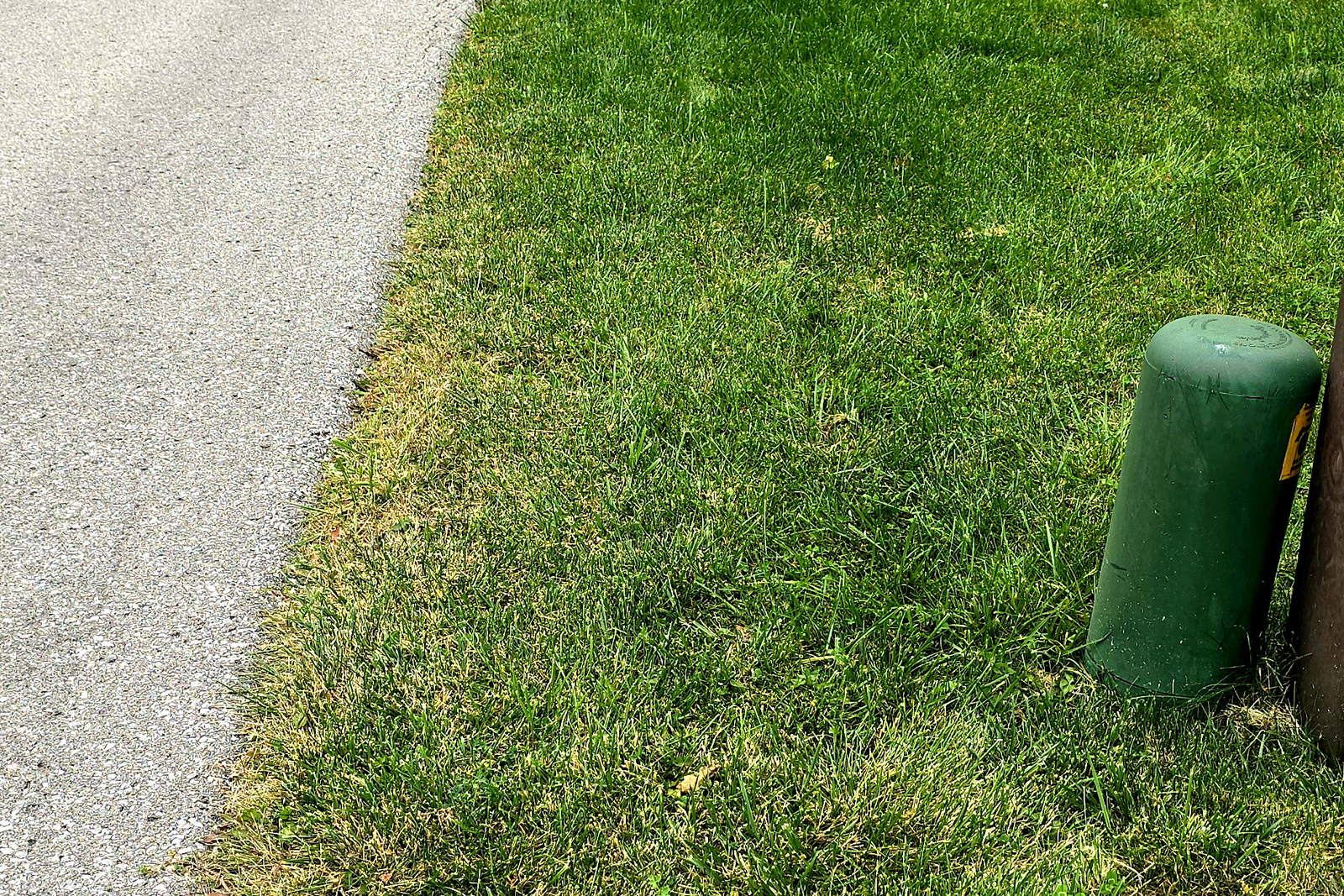
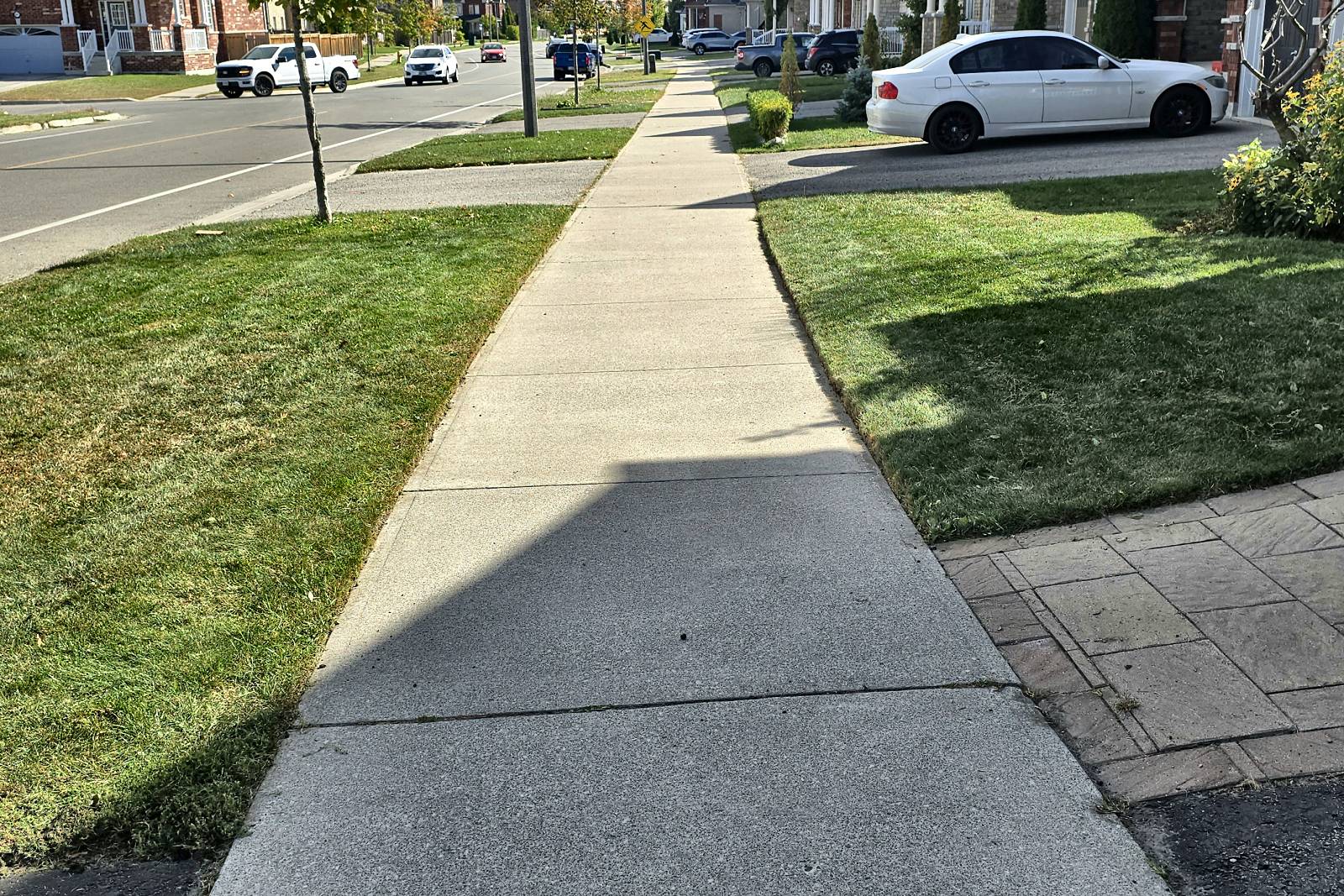
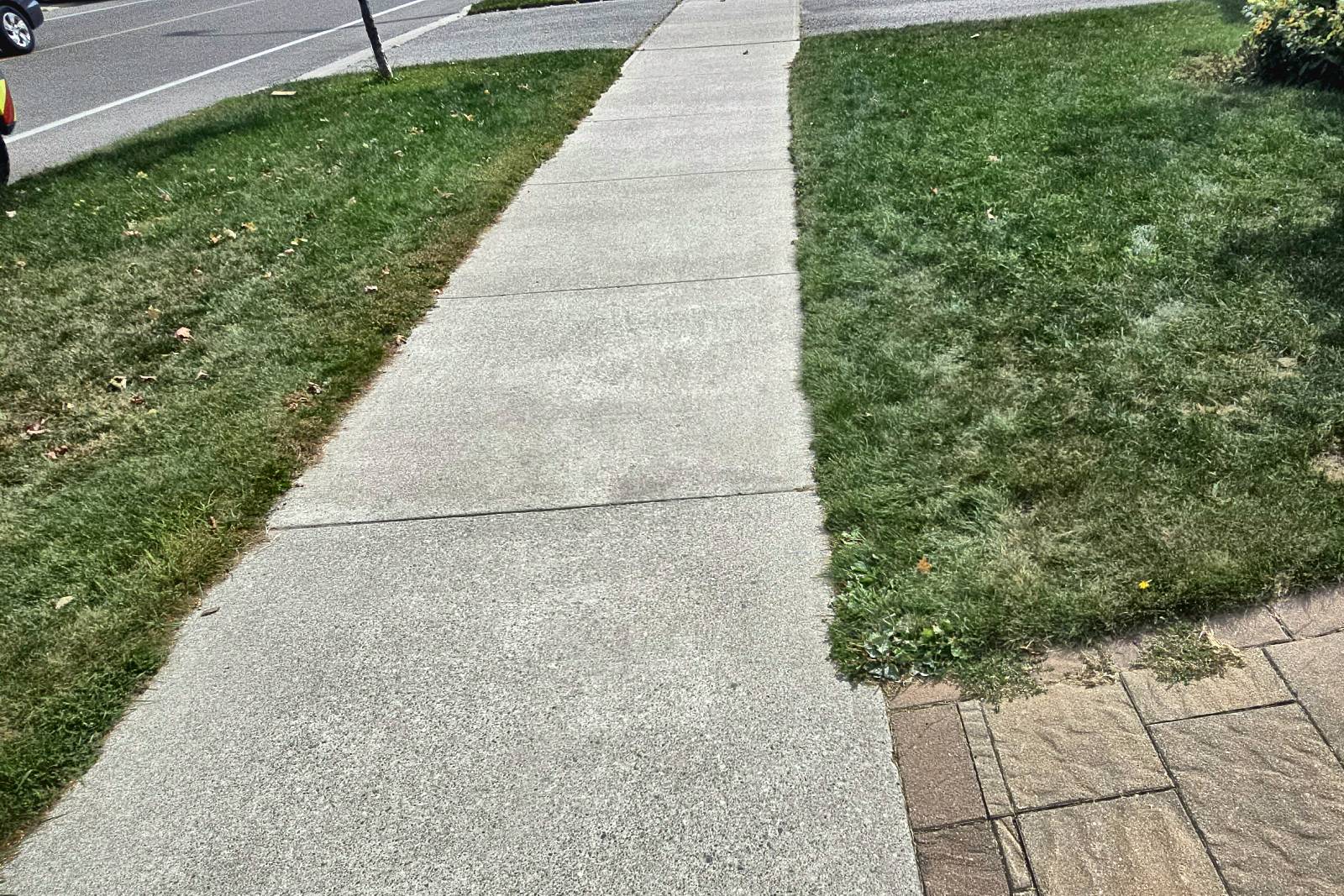
Real Northline properties, before and after, every one of them in Oshawa and every one of them this year. Drag the line to compare.
Andrew answers, October 2026
Why do you cut so high?
Because on Ontario clay a lawn cut short in July is a lawn growing crabgrass in August. Short grass lets light reach the soil surface, and light at the soil surface is the one thing crabgrass seed is waiting for. Cutting high shades it out, keeps the roots deeper and gets the lawn through a dry spell that would otherwise brown it off. It is the single setting that changes the most and it costs nothing.
One of these goes on each page and it is replaced monthly. If the question you have is not here, ask it: 905-244-5779.
Tell me what the knife showed
Measure the layer first and send me the number, or send a photograph of the cut face with a ruler against it. That one reading decides whether the answer is a machine, two autumns of aeration and topdressing, or nothing at all. I will tell you which, and if the answer is nothing I will say so in writing.