Commercial snow · Whitby
Commercial Snow Removal in Whitby, Read Clause by Clause
Commercial snow removal in Whitby is bought on five clauses, and the one that decides whether a plow ever touches your lot is the trigger depth. The surprise for most owners is what sits underneath those clauses, because Ontario puts a depth and a deadline on the municipal road outside your property and puts neither on the property itself.
Looking for the service levels and what each one commits to? Open the commercial snow page.
Green in summer. Clear in winter.
The short answer, before the detail
Ontario law sets no depth and no deadline for a private commercial parking lot. The whole of the statutory duty is one sentence in the Occupiers' Liability Act, which asks for such care as is reasonable in all the circumstances. The only hard number anybody puts on your Whitby lot is a municipal one, and it is twenty four hours, in the Clean Community By-law that came into force on April 1, 2026.
Everything else is contractual. The trigger depth, the response window, the salting regime and the standard held are numbers that exist because somebody wrote them into an agreement, and once they are written they become the standard your property will be measured against. That is the argument for reading the clauses rather than the total.
What Ontario actually requires of your lot, and it fits in one sentence
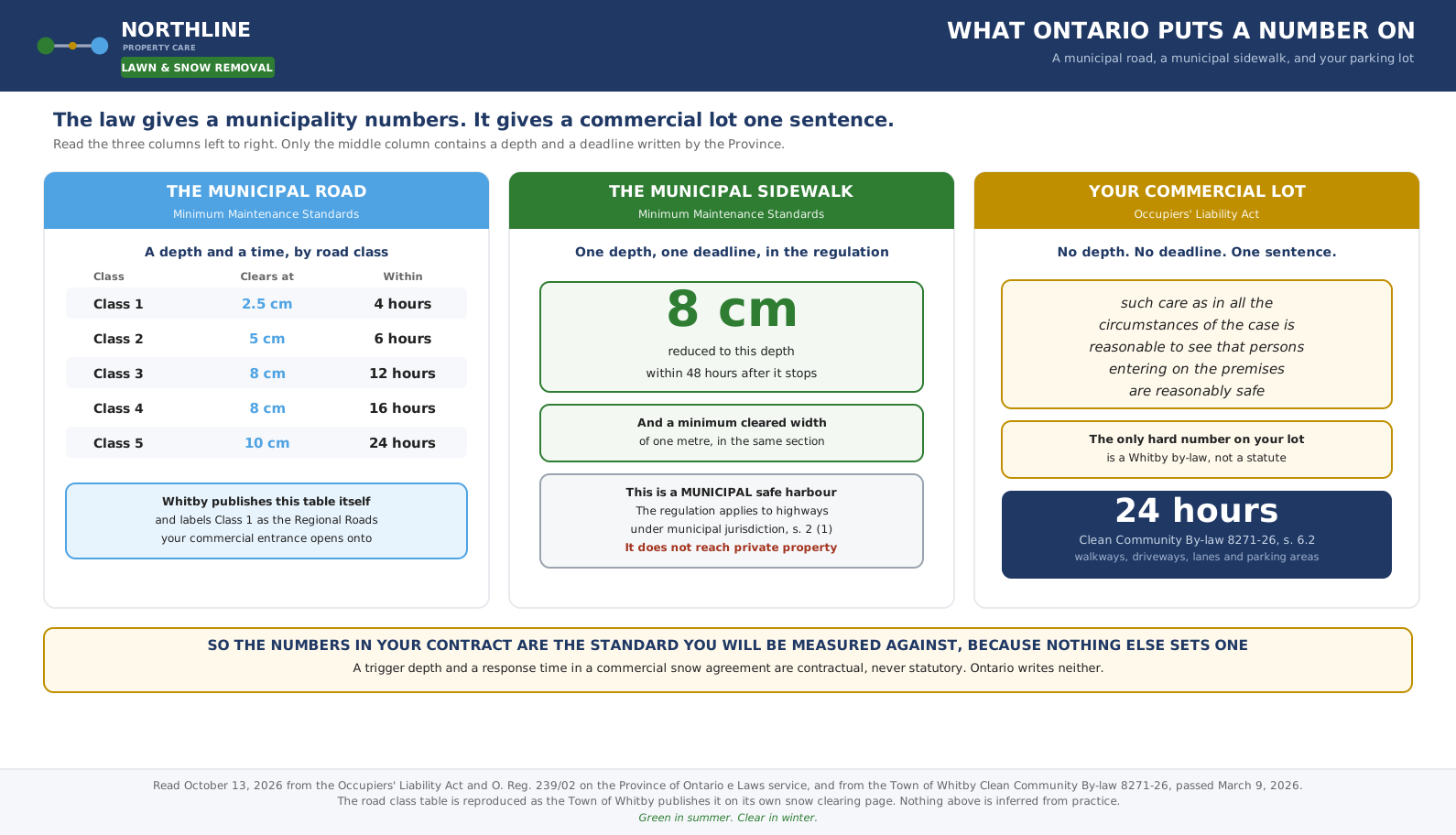
The duty is in section 3 of the Occupiers' Liability Act, and the operative words are that an occupier owes a duty to take such care as in all the circumstances of the case is reasonable to see that persons entering on the premises are reasonably safe while on the premises. That is the entire statutory standard for a parking lot, a walkway, a set of entrance steps and a loading apron. There is no centimetre figure anywhere in that Act. There is no clock.
The same statute defines an occupier widely enough that several people can hold the duty at once. It reaches anybody in physical possession of the place and anybody carrying responsibility for and control over its condition, and it applies that way even where one property has several occupiers at the same moment. On a Whitby plaza that commonly means the owner, the property manager and a tenant with a lease that hands them the frontage are all occupiers of the same ice at the same time.
Now set that against what the Province does write numbers for. Ontario Regulation 239/02, the Minimum Maintenance Standards for Municipal Highways, is full of depths and hours. It reduces a municipal sidewalk to 8 cm within 48 hours and requires a cleared width of one metre. It sets a depth and a clearing time for each class of road. And its own application clause limits the whole regulation to highways under municipal jurisdiction, for the purpose of a statutory defence available to a municipality.
So the asymmetry is complete, and it is the thing worth understanding before a single quote is compared. The municipality gets a numeric safe harbour for its own roads and its own sidewalks. The commercial occupier standing twenty metres away gets an open question about reasonableness, decided after the fall, by somebody who was not there.
The twenty four hour clause most Whitby commercial owners have never read
Whitby replaced its old framework this spring, and the replacement is stricter than the one it retired. The Clean Community By-law 8271-26 was read and passed on March 9, 2026 and came into force at midnight on April 1, 2026, which means the winter now arriving is the first one it governs.
Two sections do the work. Section 6.1 requires an owner or occupant to remove snow or ice, including a windrow, from any sidewalk, no later than twenty four hours after the accumulation. Section 6.2 goes further and reaches the property itself: every owner or occupier of a property other than an individual private residence must remove snow or ice from the walkways, pathways, driveways, lanes and parking areas within or adjacent to that property, inside the same twenty four hours. Read that carve out again, because it is the whole point. Houses are outside section 6.2. Plazas, offices, industrial units, medical buildings, places of worship and multi residential blocks are inside it.
Three details in the same by-law tend to surprise people who thought they knew it.
- The clock runs from the accumulation, not from the end of the storm. A long storm does not pause it.
- The definition of a sidewalk in section 1.30 captures a Municipal or Regional sidewalk on a boulevard, so the frontage duty applies on a Durham Region road as well as on a Town street.
- Section 6.3 lets the Town enter in a reasonable manner, do the work at your expense and recover the cost by adding it to the tax roll, with an administrative charge available on top.
Section 8.6 closes the obvious escape route. Nobody may shovel, plow or blow snow, slush or ice so that it finishes up on a road, on a municipal walk or on a pedestrian path, and sending it across one counts the same as dumping it on one, unless the Town has given authorization. Schedule A prices all three of these at $355 for a first offence, $500 at the second tier and $750 at the third, and failing to comply with an order runs higher again.
What this means practically is that a Whitby commercial lot has one government deadline and it is a short one. It is also, and this matters, not a liability standard. Meeting the by-law is not a defence to a fall and missing it is not proof of negligence. They are two separate exposures that happen to arrive on the same morning.
The sixty day letter, and why it changes what a site log is for
Ontario added a notice rule to the Occupiers' Liability Act that most commercial owners in this region have never been told about. Section 6.1 of that Act arrived through the Occupiers' Liability Amendment Act, 2020 and has been live since January 29, 2021. It shuts the door on a personal injury claim arising out of snow or ice unless the injured party delivers a written notice inside sixty days. That notice has to name the date, the time and the place. Delivery is either personal service or registered mail. The section permits nothing else, so an email to the property manager does not count.
Four things about it are worth holding on to.
- The notice may be served on an occupier or on the independent contractor employed to remove snow or ice during the relevant period. Either one is enough to preserve the claim against both.
- Whichever of you receives it carries a duty under the same section to pass a copy to the other. An occupier must notify the contractor and any other occupier, and the contractor must notify the occupier that employed it.
- Two things rescue a notice that never arrived. Where the injury killed the person who suffered it, the bar simply does not apply. And a judge is able to forgive a notice that was late or thin, on condition that the excuse holds up and that the defence has not been damaged by the delay.
- The sixty days is not the limitation period. Under the Limitations Act, 2002 a proceeding must still be started within two years of the day the claim was discovered. Sixty days is a gate in front of that door.
The operational consequence is specific and it is the reason site documentation has stopped being paperwork. A letter can arrive up to sixty days after a morning you have long since forgotten, and the question it asks is what was done on that site, at what time, with what material, by whom. If the only answer is an invoice for the month, the record is a summary of money rather than a record of work.
This is why photographed and time stamped attendance records sit inside the Northline commercial service levels rather than beside them as an extra. A monthly photographed log is on Full Service and a weekly photographed and location stamped log is on Zero Tolerance, and both exist because of the paragraph above rather than because they look thorough in a proposal.
Your entrance opens onto a Durham Region road, and that is not a technicality
Almost every commercial address in Whitby fronts a road the Town does not maintain. Checked against the Regional Municipality of Durham roads list, Thickson Road South and North is Regional Road 26, Consumers Drive is Regional Road 25, Victoria Street West and East is Regional Road 22, Brock Street South is Regional Road 46, Hopkins Street is Regional Road 36, Wentworth Street West is Regional Road 60, Champlain Avenue is Regional Road 25A, Stellar Drive is Regional Road 25 and Boundary Road is Regional Road 52. Rossland Road is Regional Road 28, Taunton Road is Regional Road 4, Anderson Street is Regional Road 36 between Dundas Street East and Rossland Road East, and Baldwin Street South through Brooklin carries Regional Highway 12.
Line that up with where Whitby actually keeps its commercial and industrial floor space. The Town's own employment work puts the employment areas generally around Highway 401 and Thickson Road South, with Preferred Industrial land south of Dundas Street East between Thickson Road South and Hopkins Street, open storage industrial along Victoria Street between Brock Street and Hopkins Street and along Hopkins Street between Burns Street and Dundas Street, and harbour industrial south of Watson Street at Brock Street South. The retail side sits on Consumers Drive, on Thickson at Dundas, on Champlain Avenue and at the Four Corners where Brock Street meets Dundas Street. Nearly every one of those is a regional frontage.
Three consequences follow, and the third is the one that costs money.
- Your entrance ridge is created by a regional plow on a regional schedule. The Region patrols its roads seven days a week in winter and sprays brine before an event, and it does not clear private entrances.
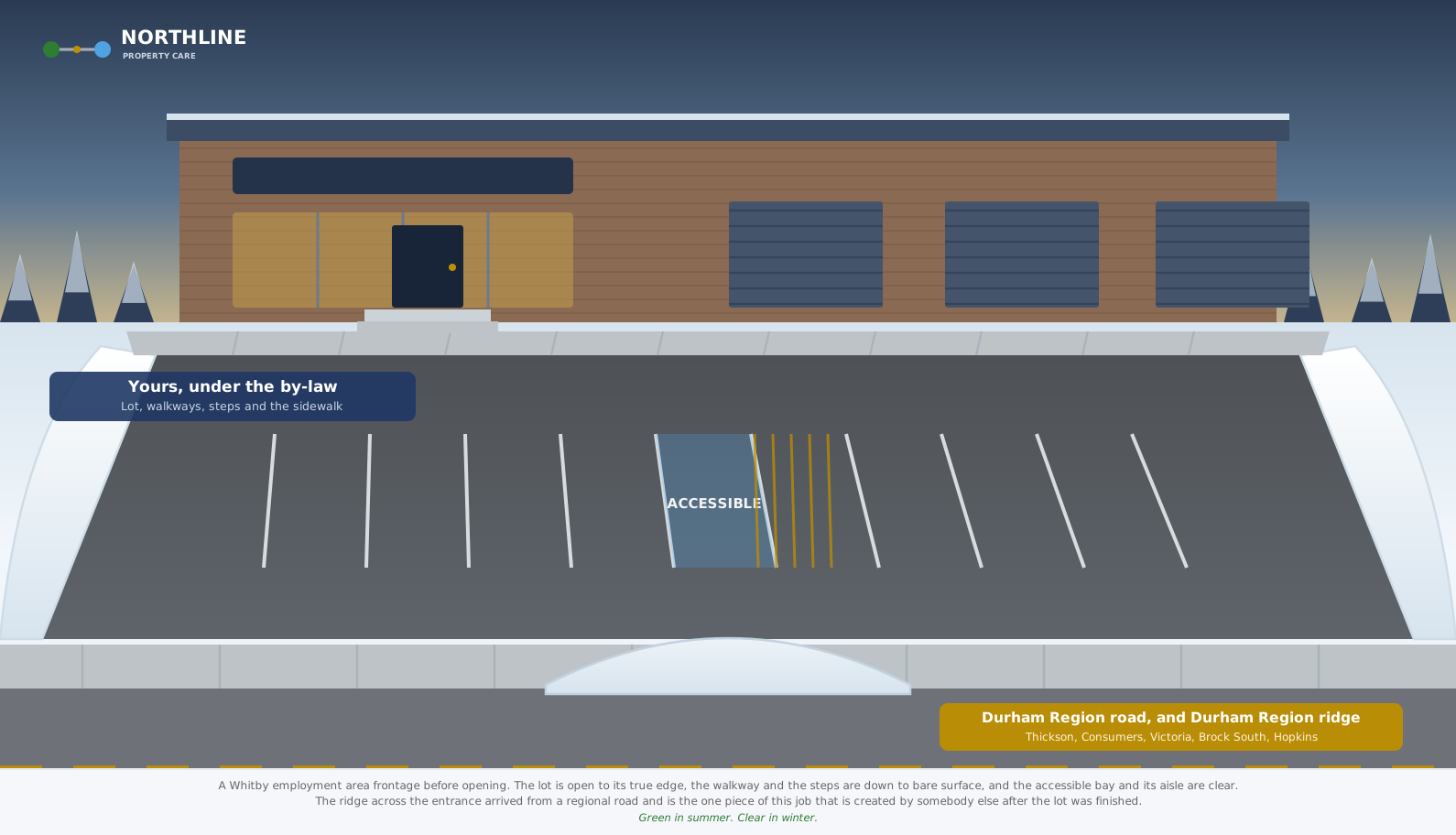
- The ridge usually arrives after your lot has been finished. A lot cleared at six and a road plowed at eight gives you a cleared property with a wall across the mouth of it at opening time.
- Section 8.6 of the by-law means you may not solve that by pushing it back across the road. The ridge has to come onto your property and be stored there, which is a design question about where the piles go, settled at the survey and not at seven in the morning.
The Town publishes the provincial standards table on its snow clearing page and labels Class 1 as the Regional Roads, at a 2.5 cm trigger with four hours to clear. Whitby's own first tier is defined to include access to industrial and commercial areas, which is genuinely good news for anybody driving to your site. None of it reaches past the curb.
How often the 5 cm trigger is actually met near Whitby
The trigger depth is the most expensive line in a commercial snow quote and it is usually the least examined, because a depth does not look like a price. It is one. Here is the arithmetic that turns it back into money.
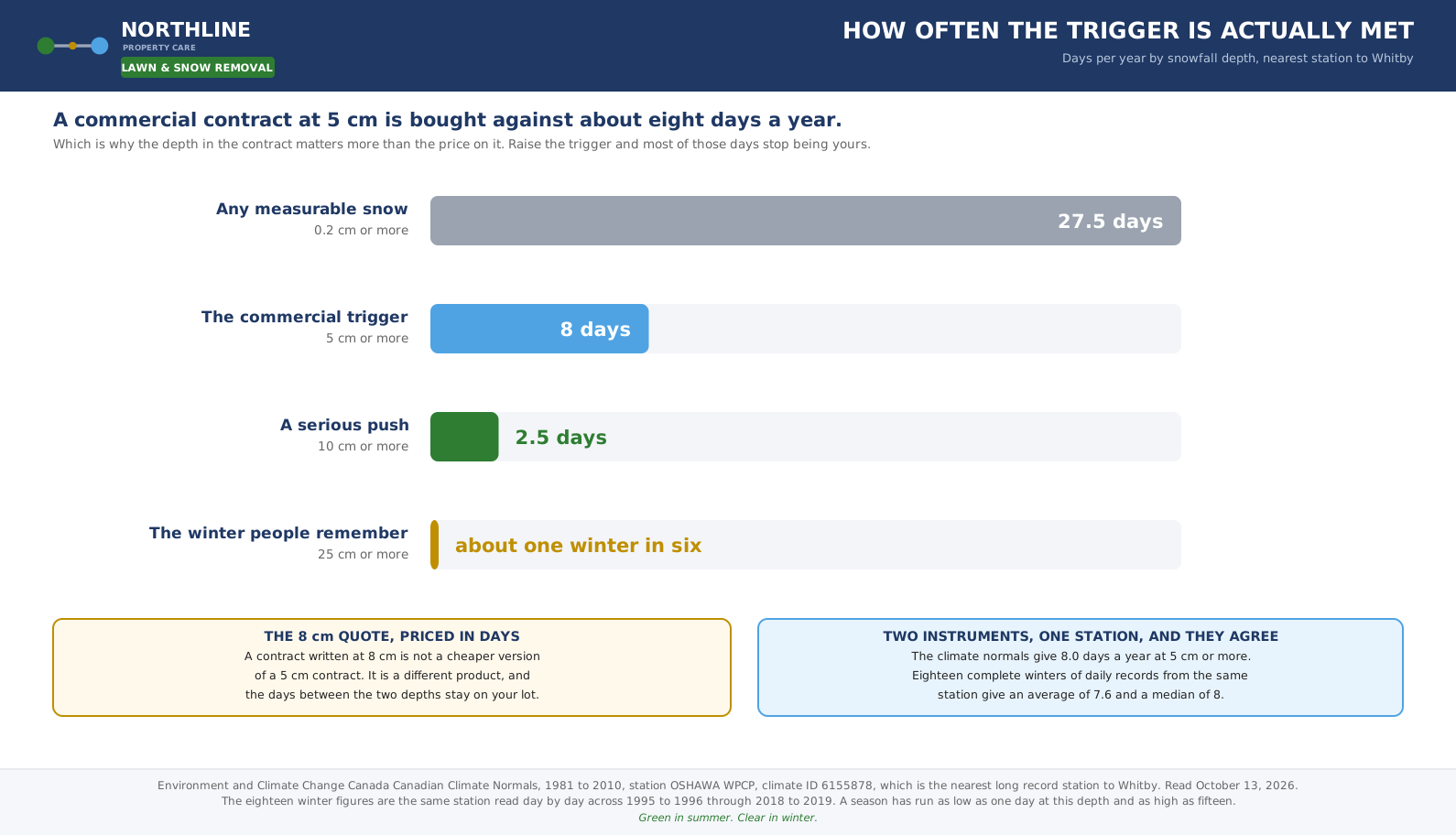
The nearest long record climate station to Whitby is Oshawa WPCP, climate ID 6155878, and its Environment and Climate Change Canada climate normals for 1981 to 2010 give an annual snowfall of 105.8 cm. Underneath that total sit the numbers a commercial buyer needs and almost nobody publishes. Measurable snow of any depth falls on about 27.5 days. Of those, roughly 8.0 reach 5 cm or deeper. The 10 cm mark comes up on about 2.5 days, and 25 cm on about 0.16 of a day, which works out at roughly one winter in six.
Two instruments agree on the important one. The climate normals give 8.0 days a year at 5 cm or more. A separate reading of eighteen complete winters of daily records from the same station, 1995 to 1996 through 2018 to 2019, gives an average of 7.6 days at that depth and a median of 8, with a mildest season of one and a worst season of fifteen. Those are two different windows and two different methods landing four tenths of a day apart, which is about as much agreement as snow data ever offers.
So a commercial contract at 5 cm buys roughly eight plow events in an average winter, with a real possibility of one and a real possibility of fifteen. Raise the trigger to 8 cm and you have not bought a cheaper version of the same thing. You have bought a different product, and the days in between stay on your lot with your name on them.
One correction while the subject is open, because this page would rather fix a number than repeat it. Environment and Climate Change Canada no longer publishes numeric centimetre thresholds for snowfall warnings at all. The former criteria page now carries only a notice pointing to impact based guides, and the surviving numeric winter thresholds are visibility figures for blizzard and blowing snow. If a quote tells you its trigger matches a weather warning, the trigger is contractual and the warning is not a number any more.
Why the salt stopped working, and it is not the supplier
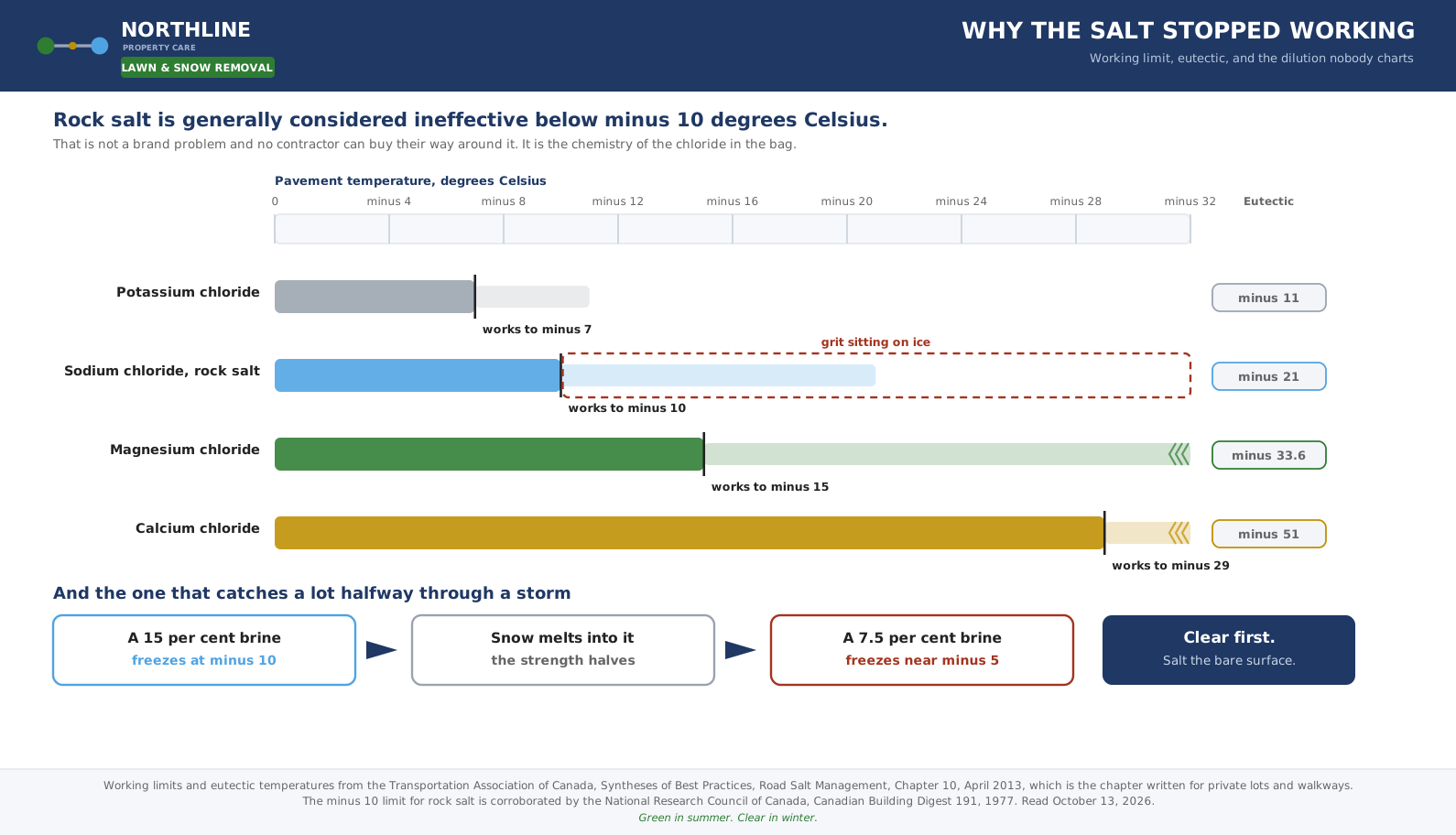
Rock salt has a working limit and it is lower than most people think, but not by much. The Transportation Association of Canada, wrote a chapter of its road salt best practices aimed squarely at private roads, lots and walkways, and that chapter says sodium chloride is generally considered ineffective below minus 10 degrees Celsius. The National Research Council of Canada said the same thing in a building digest in 1977, giving about minus 10 as the limit for sodium chloride and about minus 29 for calcium chloride. Half a century apart, the same number.
The eutectic temperature is a different figure and it gets quoted in place of the working limit far too often. For sodium chloride the solution reaches its lowest freezing point at a concentration of 23.3 per cent, where it will not freeze until below minus 21. That is a laboratory point at one exact strength. It is not the temperature at which a bag of salt on a Thickson Road lot will melt anything, and a quote that leans on it is quoting the wrong number.
The part that catches a commercial site in the middle of a storm is dilution, and it almost never appears on a temperature chart. A fifteen per cent brine freezes at about minus 10. Melting snow dilutes it. Halve the strength to seven and a half per cent and the same liquid now freezes at about minus 5. So a lot that was wet and safe at the start of an event can refreeze while the air temperature has not moved at all, because the chemistry on the ground has been watered down by the very snow it was melting.
Three practical conclusions come out of that, and the first is the one that costs a contractor money to say.
- Nobody can salt their way through a Durham cold snap with rock salt. Below about minus 10 it is grit sitting on ice, and a promise of bare pavement at minus 18 on ordinary rock salt is a promise that the chemistry will not keep.
- Clearing beats salting, every time. Snow removed is snow that cannot bond, refreeze or dilute anything, and salt belongs on the bare surface afterwards rather than instead of the work.
- Entrances, steps and walkways are where falls happen and where a calcium chloride blend earns its cost. Its working limit of about minus 29 is the reason it is used in the cold and on the small areas where it matters.
The same reasoning sits behind the residential advice on driveway salting in Oshawa and on what a plow cannot fix in freezing rain, and the chemistry does not change because a lot is bigger.
What the salt does after it leaves your lot
Whitby sits in the Central Lake Ontario Conservation Authority jurisdiction, and Lynde Creek runs through the west side of the municipality. CLOCA's own 2020 Lynde Creek watershed plan reports that chloride samples exceeded the Canadian Water Quality Guideline of 120 mg per litre six per cent of the time, against a stated target of zero per cent, and that twenty per cent of samples from shallow wells exceeded the chloride limit. It names over application plainly, writing that salt is often over applied and makes its way into creeks, groundwater and drinking water.
The regulatory picture behind that is unusual and worth knowing, because it explains why nothing stops over application on a private lot. In 2001 a federal assessment carried out under the Canadian Environmental Protection Act concluded that road salts reach the environment in quantities which have, or may have, a long term harmful effect upon it. They were recommended for the List of Toxic Substances. They were never added to Schedule 1. What arrived instead, in 2004, was a voluntary Code of Practice that applies to organizations using more than 500 tonnes of road salt a year, and its own applicability clause states that it does not apply to road salts used for domestic purposes, or for private or institutional uses.
Put plainly: the salt on a Whitby plaza is governed by nothing except the contract and the person spreading it. That is a reason to ask a contractor how they decide how much to put down, and it is a fair question to ask of anyone, including us. Calibrated spreading, pre wetting and clearing before salting are the three answers that reduce the tonnage without reducing the result, and the Region uses all three on its own roads.
The ground under the asphalt, and a correction to something this site had wrong
Here is a Whitby specific that took a soil survey to settle, and it corrects a line this business had been carrying. The soils around Whitby and Oshawa are mapped in the Ontario Soil Survey, and the till that runs under much of this area carries two names depending on how it drains. Darlington loam is the well drained member. The imperfectly drained member of the same catena is called Whitby loam, and the Ontario Soil Survey Complex maps Whitby loam inside this municipality and effectively nowhere else.
So the soil named after the town is the one that does not drain. That is a nice piece of trivia and also a real operational fact, because imperfect drainage under a pavement structure changes what meltwater does. The National Research Council of Canada set out the mechanism decades ago: frost heave needs three things together, a frost susceptible soil, freezing temperatures and a source of water, and fine sands and silts are the textures that heave hardest while a clean granular with very few fines does not heave at all. A saturated soil produces the maximum heaving pressure, and drainage alone rarely removes the problem.
What that looks like on a commercial lot in February is ordinary and annoying. Meltwater that cannot get away sits in the low corner of the lot, freezes overnight into the sheet that nobody salted because the storm finished two days ago, and comes back the next afternoon. It is why a freeze and thaw check the morning after a storm is a real line of work rather than a padded one, and why the low end of a lot and the base of a ramp get looked at first.
Two caveats on this, stated rather than buried. The soil survey maps the built up cores of Whitby and Oshawa as built up area with no drainage class assigned, so nothing here claims to know the soil under an existing parking lot in the downtown. And the Ontario centre of Oshawa sits on different material again: the sampling around north Oshawa returns well drained Bondhead and Darlington loam, and the Brighton sands run through east Oshawa rather than north. Where this site has previously said that Whitby carries imperfectly drained Darlington till, that was wrong on the name, and the correct statement is the one above.
The lake does not give Whitby more snow, and the drop across the town is real
There is a comfortable local belief that being on the lake means more snow. The published science does not support it for this shore. Lake Ontario's documented lake effect snowbelt is east and south of the lake, over the Tug Hill Plateau and the New York counties beside it, and the field campaign literature on Lake Ontario lake effect systems describes the Canadian north shore only as a place to launch instruments from. What the north shore literature actually discusses is moderation: work from the University of Toronto at Scarborough on snow day fraction across southern Ontario attributes the lower snow day fractions near this shore to proximity to Lake Ontario warming winter temperatures, and places the snowbelt at London rather than anywhere on this side.
The comparison that makes it concrete is Peterborough. On the same 1981 to 2010 normals, Peterborough A records 151.2 cm of snow a year against 105.8 cm at the station nearest Whitby, which is about 45 cm more, roughly sixty kilometres inland and about a hundred metres higher. Elevation and distance from the lake are doing that, not the lake throwing snow at us.
Inside Whitby there is a real elevation story though, and it shows up on service mornings. Point queries against the federal Canadian Digital Elevation Model put Brooklin at roughly 158 to 166 metres above sea level and the Whitby waterfront at about 78 metres, which is a drop of roughly 80 metres across one municipality. The Oak Ridges Moraine plan area begins north of Brooklin around the Myrtle Road line. A commercial site in the Brooklin Gate area and a commercial site at Port Whitby are in the same town, on the same contract, and they will not be in the same condition at the same hour, which is an argument for sequencing a route by geography rather than by postal code.
Five clauses to read before you sign anything, ours included
- The trigger depth, and whether it is measured or forecast. A measured depth is a mechanism. A forecast is a possibility, and a contract that triggers on a forecast has given somebody discretion over whether you get served.
- What counts as one attendance, and whether visits are capped. A seasonal price with a visit cap and an overage clause is a per visit contract wearing a seasonal label. Ask the number out loud.
- The walkways, the steps and the accessible route, measured in linear metres and written down. Steps cannot be plowed. They are hand work on every single attendance, and that is exactly where a cheap price hides.
- Where the snow is stored, decided before the season. Piles placed over catch basins, across sight lines at an entrance or on the accessible aisle are the three that cause trouble, and section 8.6 of the by-law rules out the easy answer of sending it to the road.
- What is recorded and how long it is kept. Given the sixty day notice rule, a photographed and time stamped record of attendance is the clause that protects you after the fact rather than during the storm.
And the unprofitable part, because a page that only argues for buying is not worth reading. If your site is a small office with six parking spaces and a short walk, a seasonal commercial contract is probably not the cheapest correct answer, and you should ask for the work per event instead. If your lot is already maintained properly by a building you share with other tenants, do not buy it twice. And if a site genuinely needs continuous bare pavement because a fall there is a serious event, the honest thing is to say whether that standard can be held at that address with what is already on the priority list, and you should hear that at the survey rather than in February.
And one correction that arrived after this page was written, worth carrying here because it changes a sentence above. Whitby is not the strictest municipality in the region on this point. Pickering requires exterior parking areas, fire routes and laneways on commercial, industrial and institutional property to be held clear of ice and snow accumulations at all times, under section 36(d) of its Property Standards By-law, with no interval written into the clause. A portfolio spanning both towns is carrying two different municipal standards on one agreement. The Pickering chain is set out in commercial snow removal Pickering.
One more. Nothing in this page is legal advice and the writer is not a lawyer. The statutes are linked so that you can read the words yourself, which is the point of linking them.
What this page could not establish
- Durham Region publishes no clearing timeline or priority class system for regional roads in its own words. It publishes activities, seven day patrols and brine spraying. The 2.5 cm and four hour figure quoted above is published on a Town of Whitby page describing the provincial standards, and it is reported here as the Town's reproduction rather than as a Durham commitment.
- The jurisdiction of Brock Street between Highway 401 and Rossland Road could not be resolved from the Region's own list, which covers Brock Street South only up to Highway 401 and Brock Street North only from Rossland Road northward. Dundas Street East and Winchester Road West could not be confirmed as regional either.
- Neither Whitby by-law prohibits pushing snow onto a neighbouring private property. Both reach only a highway, a sidewalk or a pedestrian walkway. On the by-law text as written, snow pushed onto a neighbour's land is a civil matter rather than an offence, and this page does not claim a prohibition that is not there.
- The 1991 to 2020 climate normals for the Oshawa composite station would not load from the federal service on the day this was written, so every snowfall figure above is from the 1981 to 2010 normals and is labelled as such. The newer normals will differ.
- No published annual freeze and thaw cycle count for Durham Region or southern Ontario could be found from a government, university or peer reviewed source, so no such number appears above. The only southern Ontario counts located were rock surface measurements from the Niagara Escarpment over a single winter, which are not interchangeable with a pavement figure.
- No chloride monitoring data specific to Pringle Creek exists in anything CLOCA publishes. Pringle Creek is confirmed as a CLOCA watershed and the chloride figures above are from the Lynde Creek plan.
- No case law was checked. How courts have applied the reasonable excuse exception in the sixty day notice rule is a live question and nothing above asserts an answer to it.
Every external figure on this page came from a provincial statute or regulation, a municipality, a regional government, a federal agency, a conservation authority, a national standards body, a federal soil survey or a peer reviewed journal. Nothing at all was lifted from a competing contractor's website, which is a rule this site keeps on purpose rather than an accident of whatever happened to turn up in a search.
Questions Whitby commercial owners and managers actually ask
Who is responsible for clearing a commercial parking lot in Whitby?
The owner or the occupier of the property, and in Whitby that duty is written down. Section 6.2 of the Clean Community By-law 8271-26 puts every owner or occupier of a property other than an individual private residence on the hook for removing snow or ice from the walkways, pathways, driveways, lanes and parking areas within or adjacent to that property. Section 6.1 adds the sidewalk, including the windrow left on it. Hiring a contractor does not move the duty off the occupier. It buys the work, and the Occupiers' Liability Act keeps the occupier answerable for whether entrusting that work was reasonable in the first place.
How long do I have to clear my commercial lot in Whitby after it snows?
Twenty four hours, counted from the accumulation rather than from the end of the storm. That is the limit in sections 6.1 and 6.2 of the Clean Community By-law 8271-26, which came into force on April 1, 2026. The penalties in Schedule A run at $355, then $500, then $750 for a repeat inside the set period, and the Town may also enter, do the work itself and add the cost to the tax roll under section 6.3. It is worth reading that twenty four hours carefully, because it is the only hard deadline any level of government puts on a private Whitby lot.
What is the trigger depth on a commercial snow contract in Whitby?
On a Northline commercial agreement it is 5 cm of measured accumulation, and a lower one can be quoted where a site needs it. The depth is the single most expensive line in any commercial snow quote, because it decides how many days of the winter you have actually bought. At the climate station nearest Whitby there are about 8.0 days a year with snowfall of 5 cm or more and about 27.5 days with any measurable snow at all. A contract written at 8 cm is not a cheaper version of a 5 cm contract. It is a different product, and the days between those two depths stay on your lot.
If somebody falls on my lot, does the snow contractor share the liability?
Both can be named, and Ontario law now routes the first letter to either one of you. Since January 29, 2021 the Occupiers' Liability Act has carried a section 6.1 that blocks an injury claim over snow or ice unless a written notice naming the date, the time and the place reaches somebody within 60 days, delivered in person or by registered mail, and it may reach either the occupier or the independent contractor hired to clear the snow. Whichever of you receives it has a duty under the same section to pass it on to the other. The practical effect is that your site log and your contractor's site log both become evidence, and sixty days is not long to go looking for a record nobody kept.
Is Thickson Road a Town of Whitby road or a Durham Region road?
Durham Region. Thickson Road South and North is Regional Road 26 on the Region's own published list, and so are most of the streets the Whitby commercial map actually sits on: Consumers Drive is Regional Road 25, Victoria Street is Regional Road 22, Brock Street South is Regional Road 46, Hopkins Street is Regional Road 36 and Wentworth Street West is Regional Road 60. That matters on a snow morning because the ridge across your entrance is left by a regional plow on a regional schedule, after your own lot has already been cleared, and section 8.6 of the Whitby by-law prohibits pushing it back out onto the road.
When should a Whitby commercial property book snow removal for the season?
Before November 1, and the reason is routing rather than pressure. A commercial site has to be walked and measured before the first storm so that the walkways, the steps, the accessible route and the snow storage areas are known rather than discovered in the dark. The Northline commercial season runs November 15 to April 15 at the 5 cm trigger, every site is walked before it is priced, and a route only holds so many addresses once each of them has to be finished against a morning target. It fills up, and when it does that is the winter settled. If a site needs a standard that cannot honestly be held at that address, you will be told at the survey rather than in February.
Who wrote this page, and what was opened to write it
Andrew owns this business and does the work in it, from a base in Oshawa, and winter takes him across Whitby and Brooklin, east through Courtice and Bowmanville into the rest of Clarington, and west as far as Ajax and Pickering. Fully insured. Six winters of clearing snow around Durham sit behind the judgement in the clauses above. That is his own time on the equipment rather than a statement about how long the company name has existed, and the two are worth keeping apart. The commercial book here is deliberately short, which is exactly why this page is about how to read an agreement instead of how to sign one.
The two statutes, the provincial regulation, the Whitby by-law, the Durham regional roads list, the Town employment and commercial planning reports, the federal road salt code of practice and its 2001 assessment, the Canadian water quality guideline, the conservation authority watershed plan, the Transportation Association of Canada salt chapter, the National Research Council digests, the Ontario soil survey and the federal climate normals were each read on October 13, 2026 on the page they are linked to or named from. Where a source refused to load, or disagreed with itself, that went into the section headed what this page could not establish instead of being quietly tidied away. Should a figure here prove wrong, or a by-law move after today, one text message to 905-244-5779 is the quickest route to getting it put right. For the pricing question sitting underneath the by-law, and for how the five municipalities compare on what each demands of a private lot, see commercial snow removal cost in Durham Region.
Read next
The commercial service levels
Plow and Clear, Full Service and Zero Tolerance set side by side, with what each one commits to on trigger, response, salting and site records.
Open the service levels →Why commercial clears at 5 cm
The two trigger depths this business runs, where each one came from, and why they are two products rather than one with a dial on it.
Read the trigger page →Snow removal Whitby, the residential side
If the question is a house rather than a lot, this is the season, the trigger and the order of service for a Whitby property.
Open the Whitby page →Andrew answers, October 2026
Why do you insist on walking a commercial site before quoting it?
Because the two things that decide the price are the linear metres of walkway and steps and where the snow is going to live all winter, and neither of them is visible on a map. I have quoted off an aerial once and found a loading apron behind the building that nobody had mentioned. The survey is half an hour and it is the difference between a number I can hold and a number I would have to come back and change.
One of these goes on each page and it is replaced monthly. If the question you have is not here, ask it: 905-244-5779.
Send the address and I will walk the site before the first storm
Tell me the property, roughly how many parking spaces it holds, and whether the walkways and steps are yours or a tenant's. You will get the measured scope in writing, the trigger depth and the response window stated plainly, and a price you can set beside anybody else's line by line. If a different standard than the one you asked for is the honest answer for that address, you will hear that too.