Commercial snow removal · Pickering
Commercial Snow Removal Pickering, and the Four Clocks on One Property
Commercial snow removal in Pickering runs on four separate clocks, and the only one with no grace period written into it is the clock on your own parking lot. Pickering gives its own south urban roads 13 hours. It gives a commercial lot the words at all times.
Want the levels and what each one commits to instead? The commercial snow page sets them out.
Green in summer. Clear in winter.
The short answer
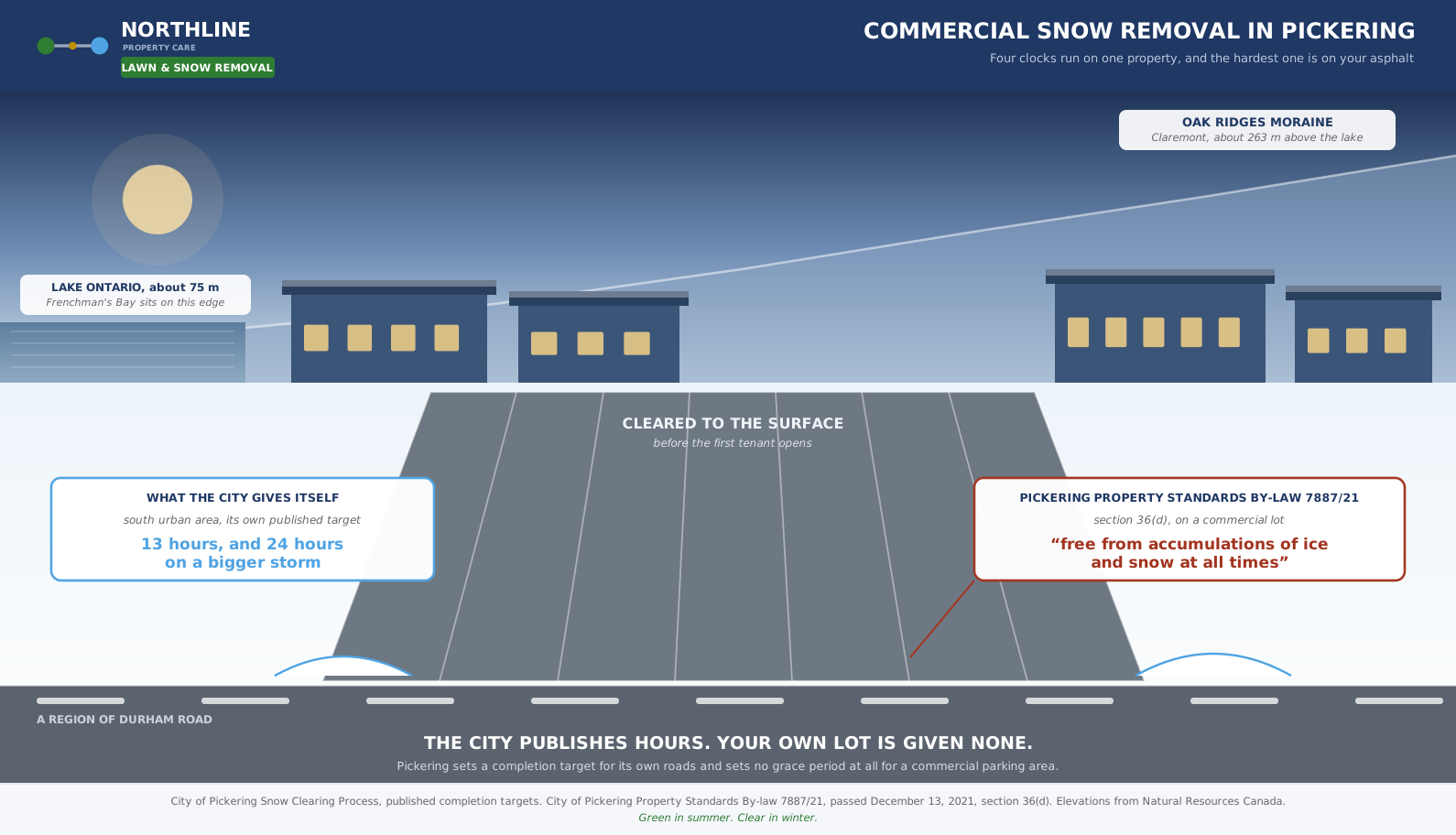
Pickering is the Durham municipality that puts the hardest written snow standard on a private commercial lot, and almost nobody who signs a snow contract here has read it. Property Standards By-law 7887/21 section 36(d) requires exterior parking areas and fire routes, laneways included, on commercial, industrial and institutional property open to the public to be kept free from accumulations of ice and snow at all times. No depth. No hours. No grace period.
Set that against what the City gives itself. On its own south urban roads Pickering publishes a completion target of 13 hours for storms up to 4 inches and 24 hours for storms up to 8 inches, and 20 and 30 hours for the north rural area. The provincial floor for a municipal sidewalk is softer again: 8 cm within 48 hours, at a width of one metre. The private owner is measured against a tighter written standard than any level of government holds itself to on public ground.
So what a Pickering commercial buyer is actually purchasing is not bare pavement, because nobody can hold bare pavement through a storm. It is a written trigger depth, a written response window, and a record that proves what was done and when. Northline commercial agreements clear at a measured 5 cm, run November 15 to April 15, and are priced by site band: Compact up to 10,000 sq ft at $3,450, Standard at $5,600, Large at $9,650 and Major at $16,000 for Plow and Clear, plus HST. Full Service and Zero Tolerance sit above those figures and most sites should not buy the top one.
The clause that governs your asphalt, and the four words at the end of it
Pickering writes a snow duty directly onto commercial property, and it is section 36 of Property Standards By-law 7887/21, passed on December 13, 2021. The lead in reaches all private property containing multiple occupancy residential buildings, and all areas of commercial, industrial and institutional property that the general public has access to. Four clauses follow. Ramps and access routes leading to garages are to be kept free from ice and snow. Mechanical de icing equipment for those ramps is to be kept in good repair. Walkways, stairways and routes in and out of buildings are to be held clear of ice, snow and hazards, again at all times. And clause (d): all exterior parking areas, fire routes, including laneways, are to be kept free from accumulations of ice and snow at all times. The by-law is published in full by the City.
Read clause (d) slowly, because the last four words are doing all the work. There is no depth in it and no number of hours. A Whitby commercial owner gets 24 hours under that town's own by-law. A Pickering commercial owner gets a standing condition. The practical reading is not that an inspector is going to attend during a storm. It is that if an order is ever written on the property, the standard the order is measured against contains no interval the owner can point at.
The rest of the by-law is worth ten minutes of anybody's time too, because it keeps going into the places a snow contract quietly decides. Section 23 asks that hard surfaced walkways, parking areas, driveways and laneways allow safe passage under normal use and weather conditions. Section 47(c) asks that roofs be free from hazardous accumulations of ice and snow. Section 78 asks that exterior stairs and fire escapes be kept free of ice, snow and debris. Section 58 says rain water downspouts and eavestroughs are not to discharge directly onto sidewalks, stairs or any adjacent property, which in February is the difference between a wet walkway and a sheet of ice across the one your customers use.
The penalties are not notional. Under the same by-law a corporation is liable to a fine of not more than $50,000 for a first offence and not more than $100,000 for a subsequent one, an individual to not more than $25,000 and $50,000, and failing to comply with an order carries an additional fine of not more than $10,000 for every day the offence continues after the compliance deadline.
One honest caveat on the whole section, and it belongs here rather than in a footnote. The lead in says commercial, industrial and institutional property that the general public has access to. A single occupancy industrial building on a fenced yard that no member of the public enters is a property somebody would argue about, and the argument would turn on the by-law's own definitions rather than on anything written here. If that describes your site, read the definitions before you rely on either answer.
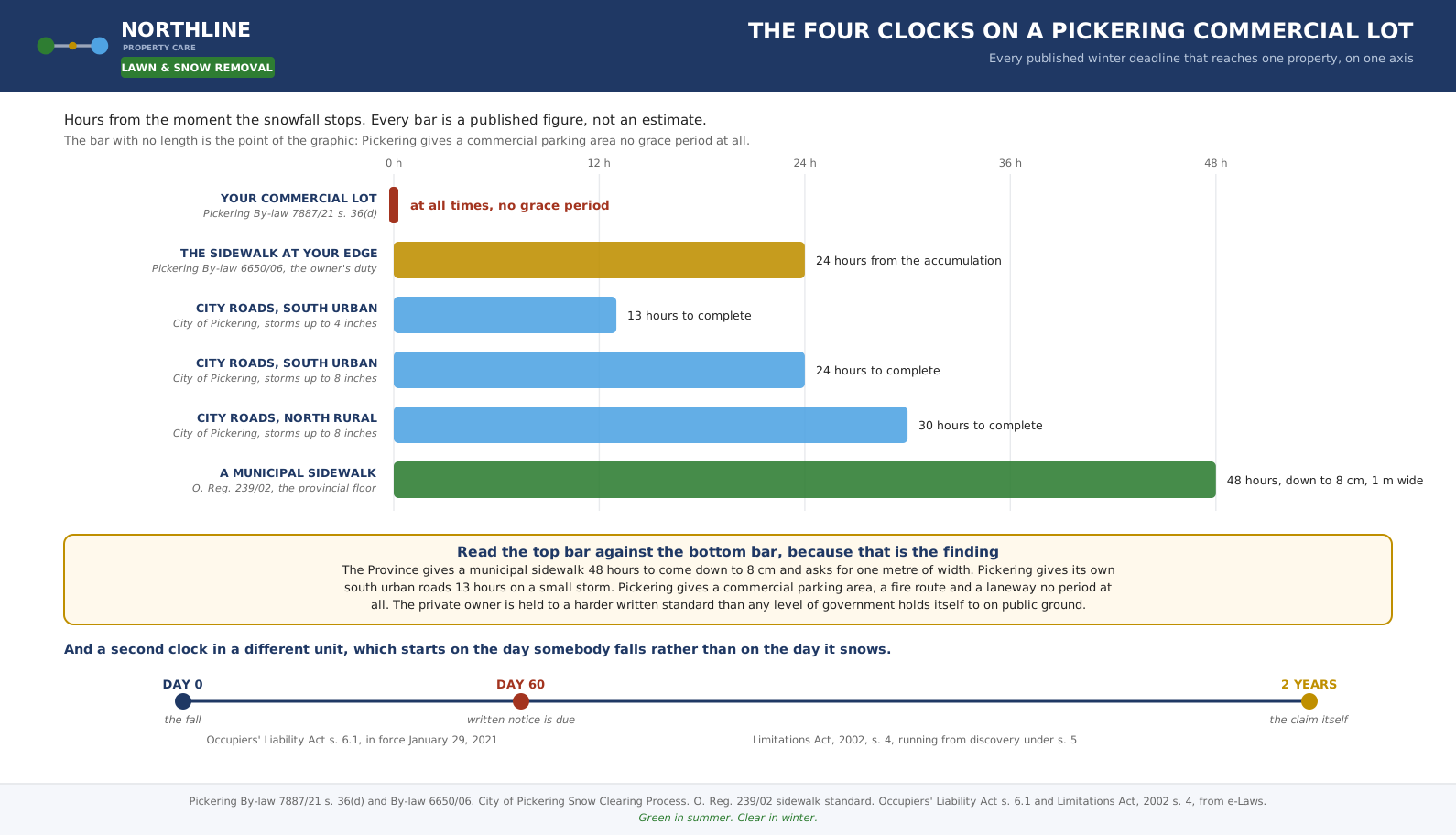
Four clocks run on one Pickering property, and three of them belong to somebody else
The reason commercial snow in Pickering is confusing is that four separate timetables land on one address, written by three different authorities, and only one of them is the owner's to negotiate. The City of Pickering publishes its own completion targets for the roads it owns. The Province sets a minimum standard of repair for municipal highways and municipal sidewalks. Pickering's Ice and Snow Clearing By-law puts a 24 hour duty on the owner for the sidewalk abutting the property. And Property Standards By-law 7887/21 puts a standing duty on the parking area itself.
The City's own figures are unusually specific and are published on its snow clearing process page. In the south urban area it aims to complete salting and plowing within 13 hours for storms up to 4 inches and within 24 hours for storms up to 8 inches. In the north rural area the same two targets are 20 and 30 hours. Before a forecast event, sodium chloride is applied to selected main roads. Salt trucks go out once snow is sticking to the pavement, and City staff decide whether to plow, usually at 75 mm or more. Cleanup runs for up to 48 hours after the event ends. The City publishes the whole sequence, which is more than most municipalities do.
The provincial layer is Ontario Regulation 239/02, which carries Ontario's minimum standards of repair for roads a municipality owns. Its roadway table runs from 2.5 cm in 4 hours on a Class 1 highway through 5 cm in 6 hours, 8 cm in 12 hours, 8 cm in 16 hours and 10 cm in 24 hours on a Class 5, and Class 6 has no standard because the regulation does not apply to it. Its sidewalk standard is 8 cm within 48 hours at a minimum width of one metre. The regulation sits on e-Laws, and the thing to notice about it is its scope rather than its numbers: it sets minimum standards of repair for highways under municipal jurisdiction. A plaza lot, a loading dock, a medical office apron and a condo laneway are not highways under municipal jurisdiction, so the regulation sets no deadline for any of them.
Then there is the provision that makes the asymmetry sharp. Where a municipality declares a significant weather event, the public clocks stop: for as long as the declaration stands, and for a window after it lifts, every roadway and sidewalk in that municipality counts as being in repair so far as snow depth goes. Neither Pickering by-law suspends anything on a private commercial lot while that is happening. An owner who reads a declared event as cover for the property has it exactly backwards. The declaration is the City protecting the City.
One more thing that is easy to run together and should not be. Meeting a by-law is no defence to a fall, and missing one is no proof of negligence either. They are two different exposures that happen to show up on the same morning, at the same door, in front of the same person.
A correction to something this website had wrong, and it was wrong in our favour
Until today the Northline commercial snow page told readers that no Durham municipality puts any deadline on a privately owned commercial lot. That is not true, and the research behind this page is what caught it. Pickering puts one in Property Standards By-law 7887/21 section 36(d), and it is the strictest wording in the region. Whitby reaches parking areas through its own Clean Community By-law at 24 hours, which this website already stated correctly on a different page while contradicting itself on that one.
It is published here rather than quietly edited because a reader deserves to know which way an error pointed. That one pointed our way. A contractor telling a buyer that no municipal deadline exists is a contractor whose service level cannot be measured against anything except the contract that contractor wrote. The true position is less comfortable and more useful: in Pickering there is a municipal standard, it is harder than the one in the next town, and a snow agreement should be built to meet it rather than written as though it did not exist.
The commercial snow page has been corrected in the same pass as this one went up. If you read that sentence before today and made a decision on it, the number to call is 905-244-5779.
Your entrance probably opens onto a Region of Durham road, and the Region publishes no hours
Most commercial frontage in Pickering sits on a road the City does not own. The Region of Durham's own roads list carries eighteen entries inside Pickering. Brock Road is Regional Road 1, from Montgomery Park Road north to Regional Highway 47. Kingston Road is Regional Highway 2. Bayly Street is Regional Road 22, Whites Road is 38, Liverpool Road is 29, Altona Road is 27, Finch Avenue is 37, Westney Road is 31, Church Street is 24, Taunton Road is 4, Peter Matthews Drive is 28, Alexander Knox Road is 40, Whitevale Road is 27, and Central Street, Ninth Concession Road, Seventh Concession Road and Third Concession Road are all Regional as well. The Region publishes the list with its own limits on each road.
That is not a trivia question. It decides who leaves the ridge across your entrance, and it decides who you are actually waiting for on a bad morning. A Brock Road industrial unit, a Kingston Road plaza and a Bayly Street office are all waiting on a Regional operation, not a City one, and then the lot behind the entrance is waiting on whoever the owner hired.
Here is the part a buyer should know and almost nobody says out loud. The Region publishes no hour by hour completion standard, no road class priority table and no target of its own. What it publishes is that regional roads are patrolled seven days a week in winter, that provincial regulation requires equipment to be dispatched once four centimetres has accumulated on road surfaces, that spinners are calibrated to control salt release, and that brine is sprayed in advance when frost or black ice is likely. For hour deadlines on a Regional road the only authority is the provincial regulation, by road class. The Region sets out its approach here.
So the comparison that matters to a Pickering commercial buyer goes like this. The City publishes a number for its own roads. The Region publishes none and relies on the provincial standard. The Province publishes a standard that explicitly covers municipal highways and reaches no private property at all. And the strictest written requirement anywhere in that chain lands on the lot the buyer pays taxes on.
Pickering is two winters on one tax roll, and a portfolio feels it before a single site does
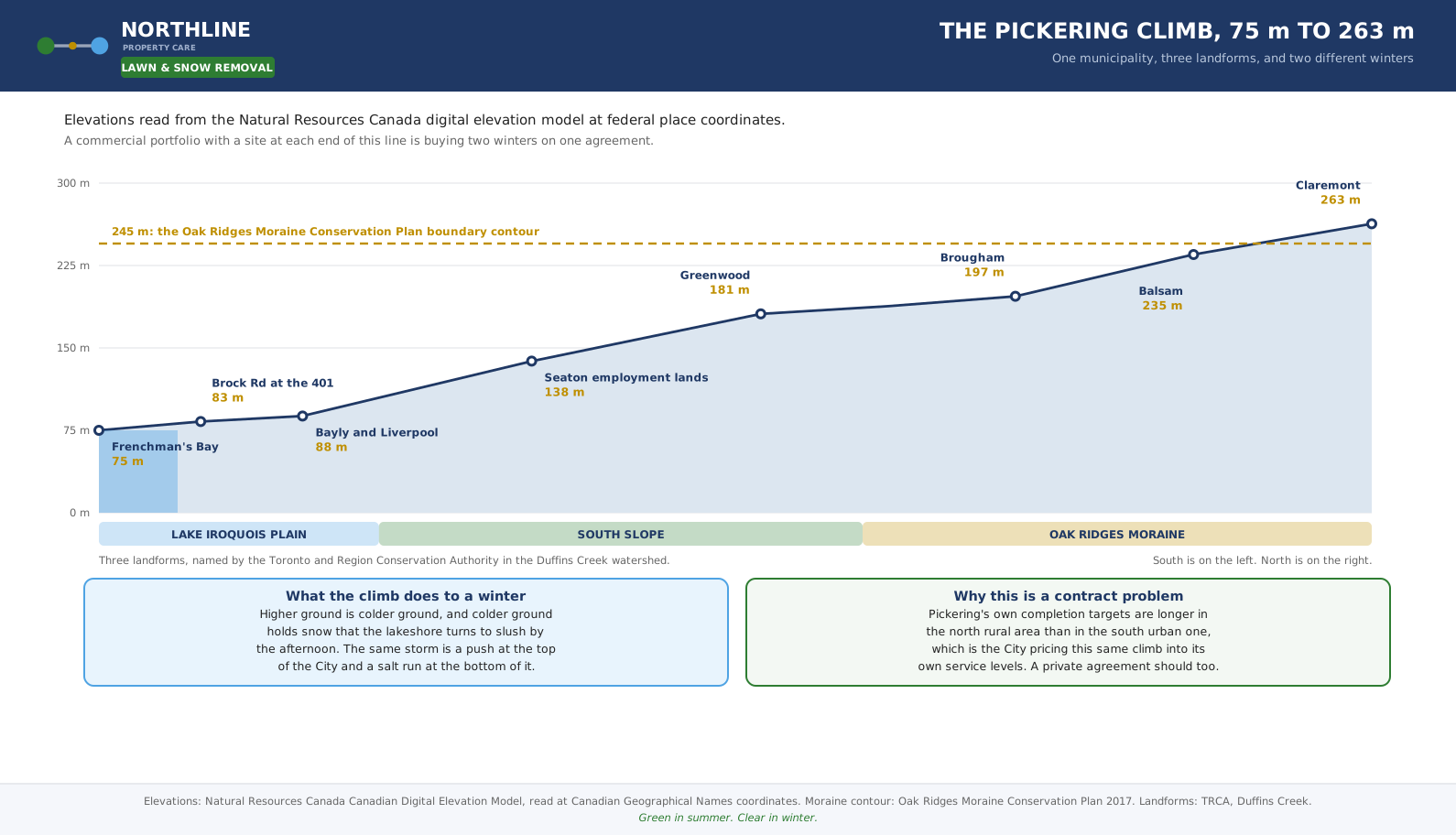
Pickering runs from the Lake Ontario shoreline to the top of the Oak Ridges Moraine, and the climb between them is about 188 metres. Natural Resources Canada publishes a digital elevation model that can be read at a point, and read at the federal coordinates for named places it gives Frenchman's Bay at 75 m, Greenwood at 181 m, Whitevale at 188 m, Brougham at 197 m, Balsam at 235 m and Claremont at 263 m. Probe the commercial ground between them and Brock Road south of Highway 401 reads 83 m, Bayly Street at Liverpool reads 88 m, and the Seaton employment lands between Highway 407 and Brock Road read 138 m.
The lake end of that range is not an accident of the model. Environment and Climate Change Canada reported the Lake Ontario monthly mean at 74.92 m on the International Great Lakes Datum, so the lake surface is effectively the floor of the whole City. The top end is governed ground: the Province draws the southern boundary of the Oak Ridges Moraine Conservation Plan area along the 245 metre contour, and the plan itself describes a ridge running 160 kilometres from the Trent River to the Niagara Escarpment across 190,000 hectares.
The Toronto and Region Conservation Authority names the three physiographic units that a Pickering property can sit on, in its work on the Duffins Creek watershed: Oak Ridges Moraine, South Slope and Lake Iroquois Plain. That is the cleanest way to explain why one storm behaves like two. Higher ground is colder ground, and colder ground keeps a surface frozen through an afternoon that turns the lakeshore to slush. The same event is a plow at the top of the City and a salt run at the bottom of it.
The City prices this climb into its own operation and says so in the open: the north rural completion targets are longer than the south urban ones, 20 and 30 hours against 13 and 24. A private agreement written as though the whole City behaves the same way is a private agreement that will be wrong at one end of a portfolio. If one company holds a Kingston Road plaza and a building up past Brougham on the same contract, those are two different service problems and they deserve two different response windows written into the same document.
The water underneath makes the salt side of this a Pickering specific problem rather than a general one. The Toronto and Region source protection assessment puts Duffins Creek at 287 square kilometres, Petticoat Creek at 27 and Frenchman's Bay at 27. Petticoat and Frenchman's Bay are small catchments receiving runoff from dense built up ground, and a small catchment concentrates whatever is spread above it. That is a reason to measure what goes down rather than to spread until it looks white, and it is an argument a buyer can hold a contractor to.
The notice Pickering posted in January 2026, and the question it should make a buyer ask
The City of Pickering is currently carrying a notice on its own snow clearing page headed Province-Wide Salt Shortage, January 2026 Update. The City states that, like many municipalities across Ontario, it is managing a province wide road salt shortage. Plowing typically starts at roughly 5 centimetres, with major roads and emergency routes taking priority while snow is still falling. Salting may be held back until later in an event, when the City judges it will do the most good. Sand or another de icing material may be blended in for traction, so people may notice more sand than usual. Winter operations may be adjusted temporarily as weather, road conditions and material availability allow.
Two things follow from that for anybody signing a commercial agreement for the coming season. The first is that a municipality with purchasing power, storage domes and a tendered supply contract was openly managing scarcity, which means a smaller buyer should ask the material question before signing rather than in February: what happens to my site if the de icer is short, what gets substituted, and does the price move.
The second is more useful. A contractor whose answer to a cold week is more salt has already lost the week, shortage or no shortage. Ordinary rock salt stops being worth spreading once the pavement itself is down around minus 9.5 C, which is colder than the air often is on the same morning. Deep cold is beaten by timing: clearing early, clearing right down to the surface before anything bonds to it, and putting a different chemistry on the walkways and entrances where people actually fall. A site plan resting on volume rather than on timing fails in exactly the week it was bought to survive.
The fire route, the hydrant and the accessible aisle, which are dimensions a pile takes away
The most expensive mistake on a commercial lot is not failing to clear it. It is clearing it into the wrong place. A plowed lot has to put the snow somewhere, and the somewhere is usually chosen in the dark by whoever is holding the blade. Three separate instruments say where it cannot go, and none of them is the snow contract.
The Ontario Fire Code is the first and it is the one with teeth, because it is a maintenance code rather than a construction code and it names the owner. Division A article 1.2.1.1 says that unless otherwise specified the owner is responsible for carrying out the provisions of the Code, and the Code defines owner as any person, firm or corporation having control over any portion of the building or property under consideration. Article 2.5.1.3 requires that fire access routes be maintained so as to be immediately ready for use at all times by fire department vehicles. Article 2.7.1.8 requires exterior passageways, exterior stairways and fire escapes in occupied buildings to be kept free of snow and ice accumulations. Article 6.6.4.2 requires hydrants to be kept free of snow and ice accumulations, and 6.6.4.3 requires them to be readily available and unobstructed for use at all times. The Fire Code is current on e-Laws.
The second is the dimension the fire route was built to. Under the Building Code regulation that governed construction before 2025, an access route provided for fire department use had to have a clear width not less than 6 m, a centreline radius not less than 12 m, an overhead clearance not less than 5 m, and a surface designed to permit accessibility under all climatic conditions. A windrow banked along the edge of a fire route does not announce that it has taken a metre out of the 6, and nobody measures it until the morning somebody needs it. The current Building Code adopts the national code plus an Ontario amendment document and its article numbers are not readable on e-Laws, so the numbers above are cited to the earlier regulation and are named as such.
The third is accessibility, and here the honest answer is narrower than the one a salesperson would give. Ontario Regulation 191/11 requires an off street parking facility built or redeveloped by an obligated organization to provide a Type A space at a minimum width of 3,400 mm with van accessible signage, a Type B space at a minimum of 2,400 mm, and an access aisle at a minimum width of 1,500 mm extending the full length of the space and marked with high tonal contrast diagonal lines. An exterior path of travel built under the same part has a minimum clear width of 1,500 mm and a surface that must be firm, stable and slip resistant. The regulation is on e-Laws and it never once uses the words snow or ice. Anyone telling a Pickering plaza owner that the accessibility regulation requires them to plow is overstating it.
What the regulation does do is useful anyway, and it is the reason this section exists. It fixes the dimensions the owner was obliged to build, and a snow pile is the only thing on a commercial property that removes a built dimension overnight and replaces it the following week. The practical answer is to decide where the piles go in October, on a drawing, with the accessible spaces, the aisles, the fire route, the hydrants and the catch basins marked on it, and to write that drawing into the agreement. Separately, an organization with 50 or more employees in Ontario is required by section 80.44 of the same regulation to carry procedures for preventative and emergency maintenance of accessible elements inside its multi year accessibility plan, and for those organizations the drawing is not optional housekeeping.
The sixty day letter, the two year clock, and a defence that is made of paperwork
Ontario changed the rules for snow and ice injury claims on January 29, 2021, and a great deal of commercial advice still has not caught up. Section 6.1 of the Occupiers' Liability Act, added by the Occupiers' Liability Amendment Act, 2020, bars an action for damages over a snow or ice injury altogether unless one of two people is given written notice inside 60 days of the injury. What goes in that notice is fixed: when it happened, at what hour, and where. How it travels is fixed too, by hand or through registered post. The two people are an occupier, and a contractor the occupier took on to clear snow or ice there during the period that matters. The Act is on e-Laws.
Two subsections after that one are the reason this belongs in a commercial post rather than a legal one. Subsection 6.1(3) obliges an occupier who receives such a notice to pass a copy to every other occupier of the place, and to whoever was hired to clear it. Subsection 6.1(4) runs the same obligation the other way, from the contractor back to the occupier that hired it. Those are statutory duties rather than courtesies, and they mean a letter arriving at a property manager's office is the start of an obligation and not merely of a problem. Subsection 6.1(7) adds that notice to any one of the listed people lifts the sixty day bar for an action against a person who never received it.
A correction to something widely repeated, including in places that ought to know. The two year limitation is not in the Occupiers' Liability Act. That Act creates the sixty day notice precondition and nothing else of the kind. The two years comes from section 4 of the Limitations Act, 2002, which says a proceeding shall not be commenced after the second anniversary of the day the claim was discovered, with discovery defined in section 5 and presumed to be the day the act or omission took place unless the contrary is proved. That Act is on e-Laws too. Two clocks, two statutes, and they are not the same clock running twice.
Now the part that decides what a commercial buyer should actually be shopping for. Section 6(1) of the Occupiers' Liability Act says that where damage is caused by the negligence of a contractor the occupier brought in, the occupier escapes liability on that account only where three things hold. Handing the job over has to have been reasonable in all the circumstances. The occupier has to have taken whatever steps it reasonably ought to have taken in order to satisfy itself on two points, that the firm was competent and that the job had in fact been done properly. And it has to have been reasonable for the job to be undertaken at all. Subsection 6(2) spreads that benefit to every occupier of the place, which matters in a plaza with several tenants. Subsection 6(3) leaves alone whatever duty the common law refuses to let anybody delegate.
Read the middle limb again, because it is not a contract clause at all. It is a filing cabinet. Satisfied that the firm was competent, and satisfied that the job was done properly. An indemnity clause proves neither. A certificate of insurance proves one narrow thing about money. What proves both is a record: the standard the contractor was asked to hold, each attendance, the time of it, what was spread and how much, and a photograph of the surface that was left behind. That record has to exist on the day it happens, because the letter may be two months behind it and the claim two years.
Section 5(1) closes the obvious shortcut. Neither an occupier's duty nor its liability for breaching that duty can be cut down by a contract the injured person never signed. A snow agreement between an owner and a contractor is precisely such a contract, and whoever goes over in the lot is a stranger to it. Section 8 is the other one worth knowing in a plaza. Where a tenancy makes the landlord responsible for maintaining or repairing the place, the landlord carries the same standard of care for dangers that arise out of failing to do it. A net lease that drops snow onto the landlord drops section 8 there as well.
There is no Canadian standard for this work, so your contract becomes the standard
Snow and ice management on private property in Canada has no national standard, and that is not an oversight anybody is hiding. CSA Group published a Workshop Agreement in May 2022 titled Assessing the Need for a Snow and Ice Management Standard of Canada, scoped specifically to non public facilities, meaning driveways, parking lots and sidewalks. It ran twelve key informant interviews and a workshop of seventeen invited stakeholders, identified liability and insurance costs, training and competency, environmental impacts from salt overuse and gaps in the regulatory framework as the four live issues, and concluded that a National Standard of Canada is needed. The report is published by CSA Group. A study of whether a standard should exist is not a standard, and none has been published since.
The one federal instrument on winter salt deliberately leaves this ground out. Environment and Climate Change Canada's Code of Practice for the Environmental Management of Road Salts applies to organizations using more than 500 tonnes a year and to organizations with vulnerable areas in their territory, and its preface states in terms that it does not address the use of road salts on parking lots and private properties, with the application section adding that it does not apply to private or institutional uses. The Code is published by the department. The American standards that do exist, ANSI/ASCA A1000-2014 and ASTM F2966, are American, and no Canadian public body was found adopting either.
There is one credential a Pickering owner can actually check, and it is worth knowing what it covers and what it does not. The Smart About Salt Council is an Ontario rooted not for profit that certifies contractors and sites, requiring completion of its Essentials of Salt Management training within the past five years for a Certified Contractor, an accurate self assessment, an annual report to maintain the certification, and random program verification. It publishes public directories of certified contractors and certified sites. The Council sets out the designations here. The honest caveat is that it is a freshwater protection and salt management program, not a slip and fall standard and not a level of service standard. Look up any contractor you are considering, including this one, and ask the ones who are not listed what they do instead.
Put the three together and the conclusion is uncomfortable but useful. There is no Canadian standard, the federal code excludes your lot, Pickering requires the lot to be clear at all times, and the Province sets no interval for it. In that space the contract is the standard. Whatever trigger depth, response window, service level and record keeping are written into the agreement are the figures the property will be measured against, by an insurer, by a tenant and eventually by somebody reconstructing a February morning out of paper. Which is why the clauses deserve more reading time than the total at the bottom, and why a cheap agreement with loose wording is the most expensive item anywhere on this page.
What a commercial winter in Pickering costs, plainly
Commercial snow is priced by site size and by service level, one season at a time, with a 5 cm measured trigger, and every figure below is plus HST. Compact, up to 10,000 sq ft, is $3,450 for Plow and Clear, $4,400 for Full Service and $6,400 for Zero Tolerance. Standard, 10,001 to 25,000 sq ft, is $5,600, $7,200 and $10,450. Large, 25,001 to 50,000 sq ft, is $9,650, $12,400 and $18,000. Major, 50,001 to 100,000 sq ft, is $16,000, $20,500 and $29,700. A campus over 100,000 sq ft is quoted after a site visit rather than off a table.
Sizing your own site takes about a minute. Count the parking stalls and multiply by 300, because a stall plus its share of the drive aisle is roughly that, so a 60 stall plaza on Kingston Road is about 18,000 sq ft and lands in the Standard band. Walkways, steps and loading areas are measured in linear metres at the survey and written into the scope, because steps cannot be plowed and are hand work on every single attendance. That is where a cheap quote usually hides.
The commercial season runs November 15 to April 15. Unlimited visits, no cap and no per storm invoices, which means a brutal winter costs what a mild one costs, because that risk sits with the contractor rather than with the buyer. Liability is bound at a $5M limit before the first serviced day, with the client named as Additional Insured. There is no commercial discount of any kind: no first season rate, no multi year ladder and no published bundle. The card rate is the price.
The honest comparison with paying per visit goes in the proposal beside the seasonal number, and the arithmetic is the same whichever way it comes out. Per visit rates on a commercial site are $285 for an attendance and $155 for a salt application. What decides the cheaper option is how many attendances the winter hands over, and nobody can promise that figure in advance. Eighteen complete winters of Environment Canada records at the nearest long running station in Durham give an average of 7.6 days a year reaching the 5 cm commercial depth, a median of 8, a mildest season of 1 and a worst of 15. Real attendances sit well above that, since pre treatment, mid storm pushes, cleanup passes and salting through freezing rain never wait for a plow depth to be reached.
Which is the argument for a seasonal number, with the decoration taken off. What is being sold is not a quantity of visits. It is a figure that stays still while the weather moves. A mild season leaves the contractor ahead. A hard one leaves the buyer ahead. Both are supposed to be able to happen, and a contractor who wins that bet every single year has priced it that way deliberately.
When you should not buy the expensive level, and when you should not buy from us at all
Most Pickering commercial sites should not buy Zero Tolerance, and saying so costs real money every season. On a Standard site it is $10,450 against $7,200 for Full Service, which is roughly 45 per cent more for a level that is driven by the forecast rather than by a trigger depth, runs continuously through an event and targets a two hour cycle between passes around the clock. That is the right answer for an address where a fall is a serious event: a medical or dental building, a seniors residence, busy retail with elderly foot traffic, a site with a documented claims history. It is a poor use of money for a light industrial unit whose staff arrive at eight in work boots.
The same cuts the other way at the bottom of the table. A small site with forgiving hours, a short walkway and no public footfall is a Plow and Clear site at $3,450, and paying $4,400 for Full Service on it is buying unlimited salting for a surface nobody is walking on at seven in the morning. Ask for the level that matches the risk the property actually carries, not the level that reads best in a proposal.
And there are sites this business should turn down. Where a property genuinely needs bare asphalt held right through an event, and the honest answer on the day of the survey is that the standard cannot be held at that address alongside everything already committed ahead of it, then the survey is where that gets said. February is not. A contractor who has never once told a prospect no has either been very lucky or is about to let somebody down badly.
One more, and it is the least profitable sentence on this page. If your site is small, your hours are late, and the person who already shovels the front entrance does it well, a commercial snow contract may be solving a problem you do not have. What you cannot do without is the record, because that is what section 6 of the Occupiers' Liability Act will ask for. Keep one yourself if nobody else is keeping it for you.
Three documents to ask any Pickering snow contractor for before November
A clearance certificate from the Workplace Safety and Insurance Board is the first, and the reason sits in the statute rather than in anybody's sales material. Section 141 of the Workplace Safety and Insurance Act, 1997 applies where a person retains a contractor to perform work in an industry included in Schedule 1 or Schedule 2 other than construction. Subsection 141(6) says the person shall ensure that the contractor complies with its obligations to make payments under the insurance plan, and is liable to the extent that the contractor does not. Subsection 141(10) authorises the Board to issue a certificate confirming the contractor has complied. The Act is on e-Laws, and the Board publishes the policy behind the certificate, which is valid for up to 90 calendar days and is renewable. Ask for a current one, not last season's.
The second is a certificate of insurance that names the buyer as Additional Insured, with the limit and the policy period legible on it, dated before the first serviced day rather than after the first storm. The third is the one almost nobody asks for and the one section 6 of the Occupiers' Liability Act actually points at: a sample of the site record the contractor proposes to keep. Not a promise to keep records, a sample of one, from a real site, with the fields visible.
There is a fourth thing worth understanding even though it is not a document. Under the Occupational Health and Safety Act the definition of owner includes a trustee, receiver, mortgagee in possession, tenant, lessee or occupier of lands or premises used as a workplace, and section 29(1) places duties on the owner of a workplace that is not a project. A commercial property where somebody works is a workplace. The Act is on e-Laws. Whether an owner who hires a snow contractor becomes that contractor's employer under the Act is a question no government source answers as a general rule, so it is raised here as a reason to take advice rather than answered as though it were settled.
What this page could not confirm
This section appears on every Northline page, for one reason: an article listing only its successes has hidden half of how it was made. Six things were hunted for here and not nailed down, and each is named rather than smoothed over.
The primary text of Ontario Regulation 239/02 could not be read directly. The e-Laws page returns a notice requiring a browser script and the regulation's source document could not be converted. The road class table, the sidewalk standard and the significant weather event provision quoted above were taken from Ontario municipal policy documents that reproduce the regulation, cross checked across three independent municipalities that agree with each other. They are described here as reproduced rather than as quoted.
The current Ontario Building Code article numbers could not be verified. The Building Code regulation now adopts the National Building Code of Canada 2020 plus an Ontario amendment document, and the technical text is no longer published on e-Laws. The fire route dimensions above are cited to the earlier Building Code regulation, which e-Laws marks as revoked or spent from January 1, 2025 and which continues to govern construction under permits issued before that date.
No court decision applying section 6.1 of the Occupiers' Liability Act was read. The case law database blocks automated access, so nothing on this page says how any court has interpreted the sixty day notice, in either direction.
The exact punctuation of the Pickering by-law clauses was read through a document summariser rather than character by character off the published PDF. The substance is reliable and the PDF is linked above so anybody can check the wording themselves.
No current Pickering salt tonnage, no Pickering winter maintenance budget line and no count of kilometres of sidewalk the City clears in winter could be found on any municipal page. No estimate has been invented to fill those gaps. And the City's own snow safety page still cites the superseded property standards by-law number, 5943/02, while the current by-law on the City's document portal is 7887/21 from December 13, 2021. The newer one is used throughout this page.
Every external source used here is a federal department, a provincial statute or regulation, a regional or municipal government, a conservation authority, a statutory source protection authority, a standards development organization or a not for profit certification council. Not one figure came from another company that clears snow in this region. That restriction is deliberate, and the gaps listed above are its cost.
What Pickering owners and property managers put to me first
Whose job is the snow on a Pickering commercial parking area?
The owner's, and here that duty is written down rather than left to general principle. Property Standards By-law 7887/21 section 36 reaches commercial, industrial and institutional property the general public can get onto, and clause (d) asks that exterior parking areas and fire routes, laneways included, be kept free from accumulations of ice and snow at all times. Clause (c) puts walkways, stairways and routes in and out of the buildings on the same footing. Paying a contractor buys the labour and shifts none of the duty. Section 6 of the Occupiers' Liability Act leaves the occupier answerable for whether handing the job over was reasonable, whether it took the steps it ought to have taken on competence, and whether it satisfied itself that what it paid for had actually been carried out properly.
How long do I have to clear my commercial lot in Pickering after it snows?
On the face of the by-law, no time at all. Section 36(d) of Property Standards By-law 7887/21 says at all times, and there is no grace period written into that clause. The 24 hour figure people quote is a different duty from a different by-law: Ice and Snow Clearing By-law 6650/06 gives the owner of a building or vacant land 24 hours after an accumulation to clear the sidewalk abutting the property, and the City may do the work itself and bill the owner for the cost plus a 25 per cent administration fee. Two by-laws, two different surfaces, two different clocks, and the harder of the two is the one on your own asphalt.
What is the trigger depth on a commercial snow contract in Pickering?
Five centimetres of measured accumulation on a Northline commercial agreement, and a site needing a shallower one can be quoted for it. The residential figure is 3 cm. Those two depths belong to two separate products, and neither number is ever borrowed for the other. Depth matters more than the headline price for a reason that is pure arithmetic: a quote written at 8 cm reads cheaper, and then every 6 cm fall of the winter stays exactly where it landed. Zero Tolerance carries no trigger depth at all, because the forecast rather than the measurement sets it off, and it starts before anything has accumulated.
Is Brock Road a City of Pickering road or a Region of Durham road?
Brock Road is Regional Road 1 and it belongs to the Region of Durham, from Montgomery Park Road north to Regional Highway 47. So do Kingston Road as Regional Highway 2, Bayly Street as Regional Road 22, Whites Road as 38, Liverpool Road as 29, Altona Road as 27, Finch Avenue as 37, Westney Road as 31 and Taunton Road as 4. That matters because the windrow across a commercial entrance on any of those roads is left by a Regional operation and not by the City, and because the Region publishes no hour by hour completion standard of its own, while the City publishes one for the roads it owns.
Does an accessible parking space have to stay clear of snow in Pickering?
The regulation does not say so in those words, and that is worth knowing before anyone tells you otherwise. Ontario Regulation 191/11 sets what an off street parking facility must be built to, including a Type A space at a minimum width of 3,400 mm and an access aisle at a minimum width of 1,500 mm running the full length of the space. The regulation never uses the word snow. What it does is set a dimension, and a pile pushed into an access aisle takes away a dimension the owner was required to build. The duty not to let snow and ice make the property unsafe comes from the Occupiers' Liability Act and from Pickering's own property standards, not from the accessibility regulation.
When should a Pickering commercial property book snow removal for the season?
Before the middle of November, because the commercial season runs November 15 to April 15 and a site that has not been walked by then is being priced from a satellite picture. The survey is the part that takes the time: the stall count, the linear metres of walkway and steps, where the piles can physically go without taking out an accessible aisle or a fire route, and whether the entrance meets a Regional road or a City one. None of that can be done in a storm, and a price agreed without it is a guess wearing a number.
The person behind this page, and the documents opened to build it
Andrew owns Northline Property Care and does the work himself, across Pickering and Ajax in the west through Whitby and Oshawa and out into Courtice, Bowmanville and the rest of Clarington. Fully insured. Six winters of clearing snow in this region sit behind the judgements on this page. Those winters are his own, personally. They are not a claim about how many seasons this business has traded under its own name, and the two are one word apart in a sentence, so this page keeps them apart deliberately.
Opened on October 15, 2026 to write this: the City of Pickering snow clearing process page, the winter reminders page, the ice and snow clearing page, Property Standards By-law 7887/21 in the City's own document portal, the Region of Durham roads list and regional road maintenance page, the Occupiers' Liability Act and the Limitations Act, 2002 on e-Laws, the Ontario Fire Code, Ontario Regulation 191/11, the Workplace Safety and Insurance Act and the Board's clearance certificate policy, the Oak Ridges Moraine Conservation Plan, Natural Resources Canada elevation and place name services, the Toronto and Region source protection assessment, the CSA Group workshop agreement of May 2022 and the federal road salts Code of Practice. Where a source contradicted itself, or contradicted this website, both versions are reported above rather than the convenient one.
Municipal pages change and published figures move. Where anything above has since gone stale, or was simply wrong the day it was posted, a text message to 905-244-5779 gets it corrected faster than anything else. For the service levels themselves and what each one commits to, see the commercial snow page. For the same subject read clause by clause against the neighbouring town's by-law, see commercial snow removal in Whitby. For the residential side of the same city, see snow removal Pickering. For what every clause above does to a number on a quote, see commercial snow removal cost in Durham Region.
Read next
What each level commits to
The three levels compared row by row: depth that sets them off, pre treatment, how fast, salting, the site log and whether anybody comes back.
Compare the levels →Why commercial clears at 5 cm
Where each of the two depths came from, why one is never substituted for the other, and what a buyer gets for each.
Read the trigger page →Snow removal Pickering
The residential half of the same city: season dates, the depth that starts it, who gets attended to first once a storm ends, and what a morning target is worth.
Open the Pickering page →Andrew answers, October 2026
Can you actually keep my lot clear at all times, the way the by-law words it?
No, and neither can anybody else, which is why I would rather say it here than in a proposal. Nothing holds bare asphalt through the middle of a storm. What I can commit to in writing is the depth that puts me on your site, how long after it stops you are cleared, what happens during a long event rather than only after it, and a record of every attendance with the time on it. That is what the by-law and the Act both end up asking for, and it is the honest version of the same promise.
One of these goes on each page and it is replaced monthly. If the question you have is not here, ask it: 905-244-5779.
Send the address and the stall count, and the site gets walked before the first storm
A Pickering commercial site is measured, photographed and priced in writing within 48 hours at no cost, with the per visit comparison beside the seasonal number and the pile locations marked against the accessible spaces, the fire route and the hydrants. If the level you asked for cannot honestly be held at your address, you will hear that at the survey rather than in February.