Commercial snow removal · Durham Region
Commercial Snow Removal Cost in Durham Region, and the Four Things That Set It
Commercial snow removal cost in Durham Region opens at $3,450 plus HST for one season on a compact lot, and four things move it upward from there: how much asphalt and walkway the property actually holds, how often a winter crosses the trigger depth, where the snow is lawfully allowed to end up, and the standard written into the agreement.
Prefer the levels and what each one commits to? The commercial snow page sets them out.
Green in summer. Clear in winter.
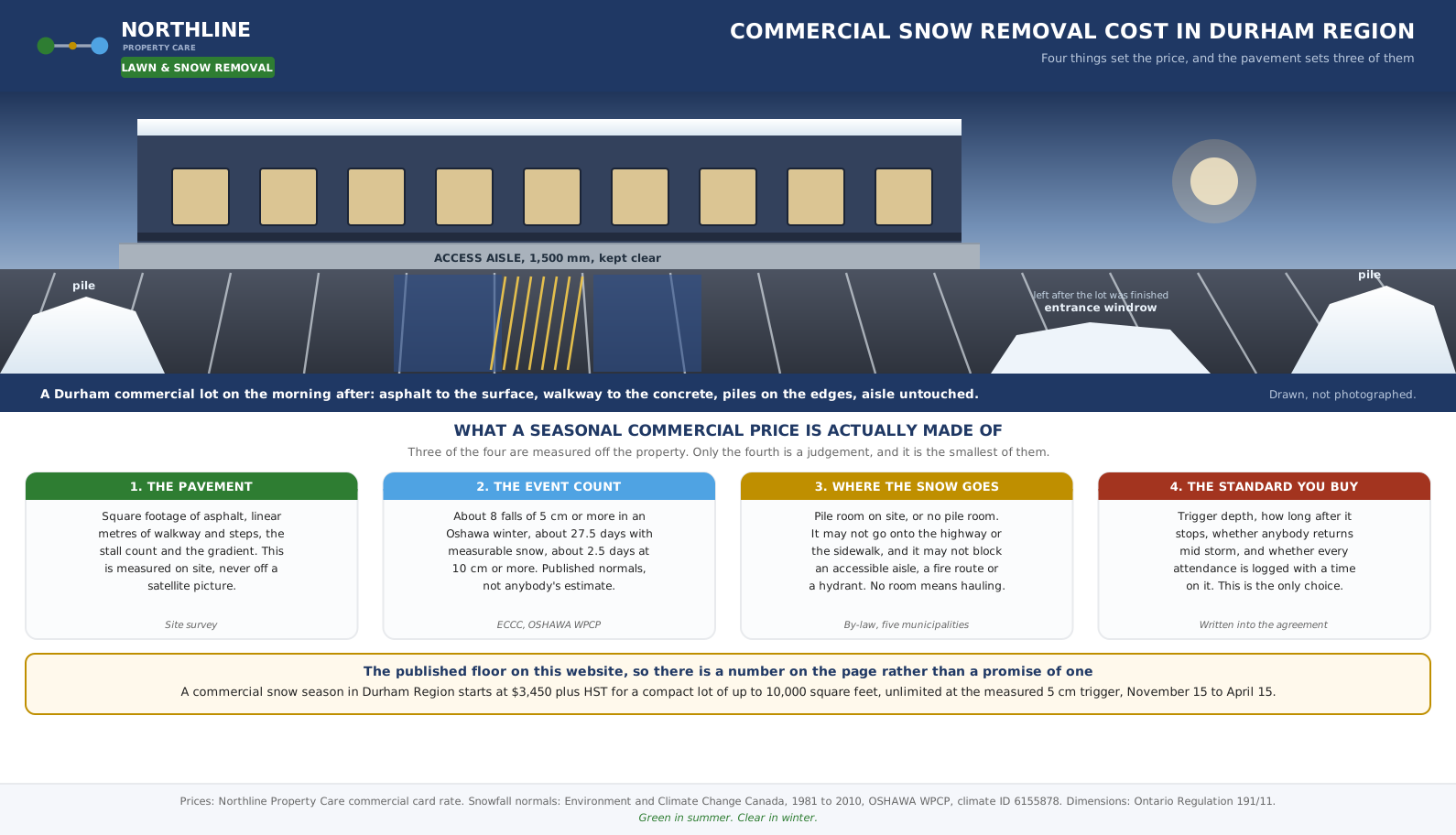
The short answer, with the numbers in sentences rather than buried in a table. The published floor here is $3,450 plus HST for one season on a compact lot, which means up to ten thousand square feet of pavement, and that figure covers plowing and clearing without a visit limit from November 15 through to April 15 once a measured five centimetres has fallen. Above 10,000 square feet the number climbs with the pavement, because the pavement is the thing being cleared. A per visit agreement on the same lot costs less in a mild winter and more in a heavy one, and nobody knows which one is coming. An hourly agreement costs whatever the storm costs, which is the honest way of saying that the buyer carries the risk instead of the contractor.
Four things set the price, and your pavement sets three of them
The square footage of asphalt, the linear metres of walkway and steps, the stall count and the gradient are measured on site before a number is written down. That is the largest single input and it is also the one most often guessed at, because a satellite picture will give you an outline of a property in about forty seconds and it will not tell you that the loading bay sits in a hole, that the walkway at the north elevation never sees sun between December and February, or that the catch basin at the low corner is where every pile on that lot ends up draining.
The second input is how many times a winter actually crosses the trigger depth. That is not a matter of opinion and it is not a matter of experience either, because Environment and Climate Change Canada has been counting it at a station inside the City of Oshawa for decades and publishes the result for anybody who wants to read it.
The third input is where the snow is allowed to go once it has been moved. On a residential driveway this question answers itself. On a commercial lot it is frequently the single most expensive line in the agreement, and it is settled by four different by-laws and by whatever the site plan committed to when the property was approved.
The fourth input is the only one that is genuinely a choice: the depth that puts somebody on your property, how long after the snow stops you are expected to be finished, whether anybody returns during a long event rather than only at the end of it, and whether every attendance is written down with a time against it. Everything else on this page is arithmetic. That last one is the contract.
The three ways a Durham commercial lot gets priced, and who each one suits
Seasonal pricing buys a fixed number for a variable winter, and the contractor carries the variance. One figure covers every attendance between November 15 and April 15 at the agreed trigger. A property manager with a budget to defend in March likes this because the line does not move. A contractor who has not counted the winter properly can be ruined by it, which is why a seasonal number quoted without a site survey is usually either padded or wrong.
Per visit pricing moves the variance back onto the buyer, and it is cheaper in a mild winter. Each attendance is billed. The arithmetic a buyer should actually run is not the per visit rate against the seasonal rate, it is the per visit rate multiplied by the number of qualifying events the published climate record says to expect, and then the same multiplication done again for a bad winter. If the two answers straddle the seasonal number, the seasonal number is the one that lets you sleep.
Hourly pricing is the right answer for exactly one situation and the wrong answer for most of the rest. It fits a property with no predictable shape to its winter work, a hauling call, or a site where the volume genuinely cannot be forecast. On an ordinary plaza or an industrial unit it converts a known cost into an unknown one, and the incentive it creates runs in the wrong direction for the person paying.
A fourth pattern is sold in this market under names such as zero tolerance, and no trigger depth appears in it anywhere, because what sends somebody to the property is the forecast and never a measured amount. It is the right product for a hospital entrance, a long term care home or a site where somebody genuinely cannot be allowed to encounter a slippery surface. It is a great deal more expensive than the other three and it should be sold as such rather than slipped into a comparison as though it were the same thing with a better name. Where the levels sit beside each other row by row, the commercial snow page sets them out.
One more thing belongs in a pricing section because leaving it out would be convenient. A commercial property that buys grounds maintenance and snow together qualifies for a 12 per cent bundle discount here. There is no equivalent discount on the residential side, and any page that implies otherwise is wrong.
How many times a Durham lot actually gets serviced in a winter
This is the number every per visit quote in the region is secretly built on, and almost nobody states it out loud. Environment and Climate Change Canada publishes climate normals for the station it lists as Oshawa WPCP, climate identifier 6155878, which sits on the lakefront inside the City of Oshawa. Across the 1981 to 2010 normals period that station records a mean annual snowfall of 105.8 centimetres, and 105.6 centimetres of it falls between November and April.
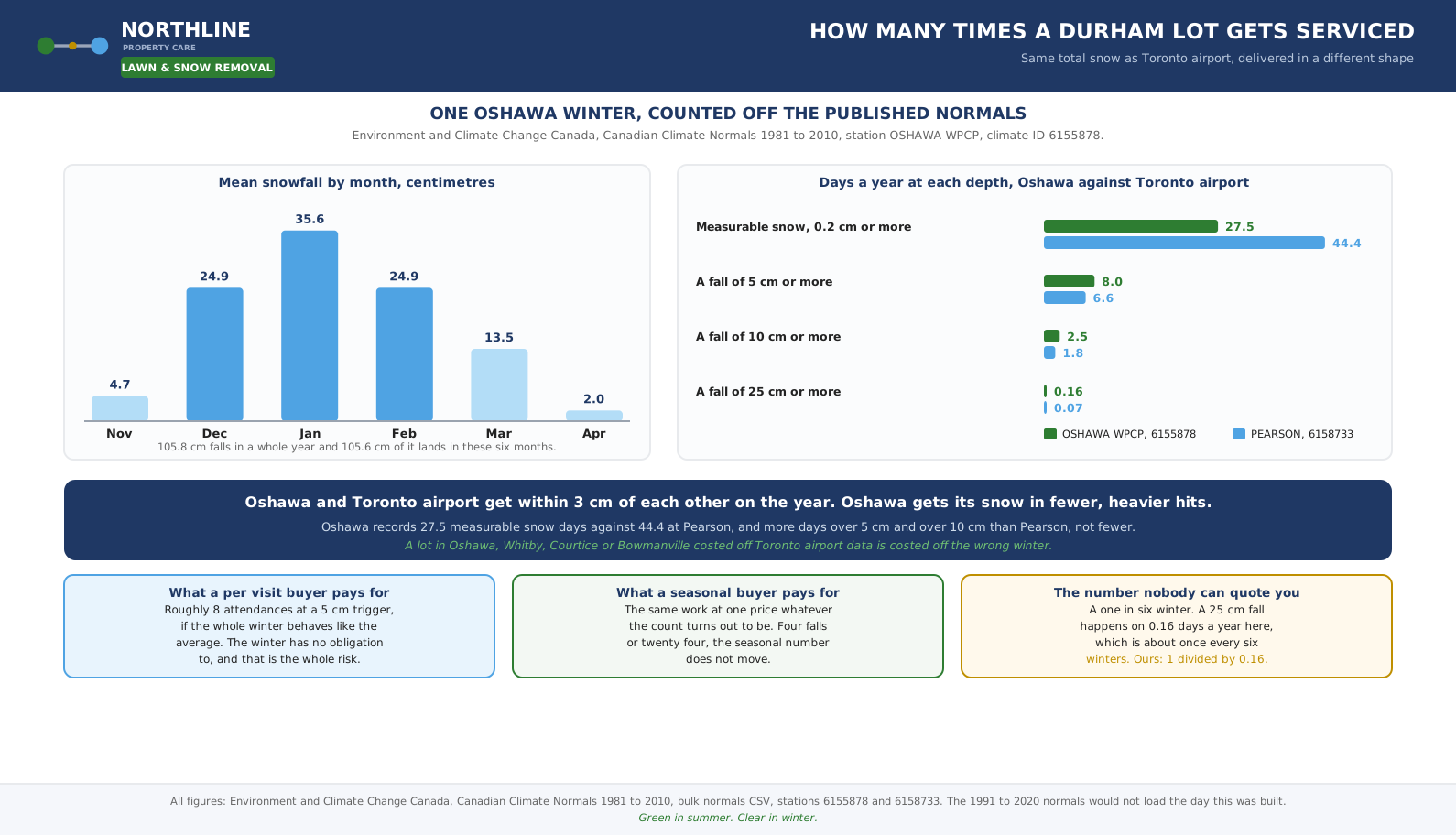
The day counts are the useful half. That station records 27.5 days a year with measurable snowfall of 0.2 centimetres or more, 8.0 days with a fall of 5 centimetres or more, 2.5 days with a fall of 10 centimetres or more, and 0.16 days a year with a fall of 25 centimetres or more. That last figure is worth converting: one divided by 0.16 is about six, so a 25 centimetre event happens here roughly once every six winters. That arithmetic is ours. The 0.16 is theirs.
Then there is the finding that nobody in this market seems to be using, and it changes what a quote is worth. Toronto Pearson, climate identifier 6158733, records 108.5 centimetres of annual snowfall against Oshawa's 105.8, which is close enough that most people treat the two as interchangeable. They are not interchangeable at all. Pearson records 44.4 measurable snow days to Oshawa's 27.5, and yet Oshawa records more days over 5 centimetres, 8.0 against 6.6, and more days over 10 centimetres, 2.5 against 1.8. The same quantity of snow arrives here in fewer and heavier pieces.
A contractor pricing a Whitby or a Courtice lot off Toronto airport data is therefore overstating the number of trigger events by well over half and understating the heavy ones. Both errors are in the same quote. One of them makes a per visit price look expensive and the other makes a seasonal price look cheap, and the buyer has no way of telling which error is in front of them. The figures above are read from the published bulk normals file rather than from anybody's memory of a bad February, and you can read the same file yourself at Environment and Climate Change Canada.
One honest caveat sits on all of it. The 1991 to 2020 normals exist, but the pages that serve them returned server errors on the day this page was written, across six different URL forms and two hosts, and the bulk download tree carries only the 1981 to 2010 set. So every figure above is 1981 to 2010, stated as such, rather than presented as the newest number available.
You are not comparing quotes, you are comparing five different legal standards
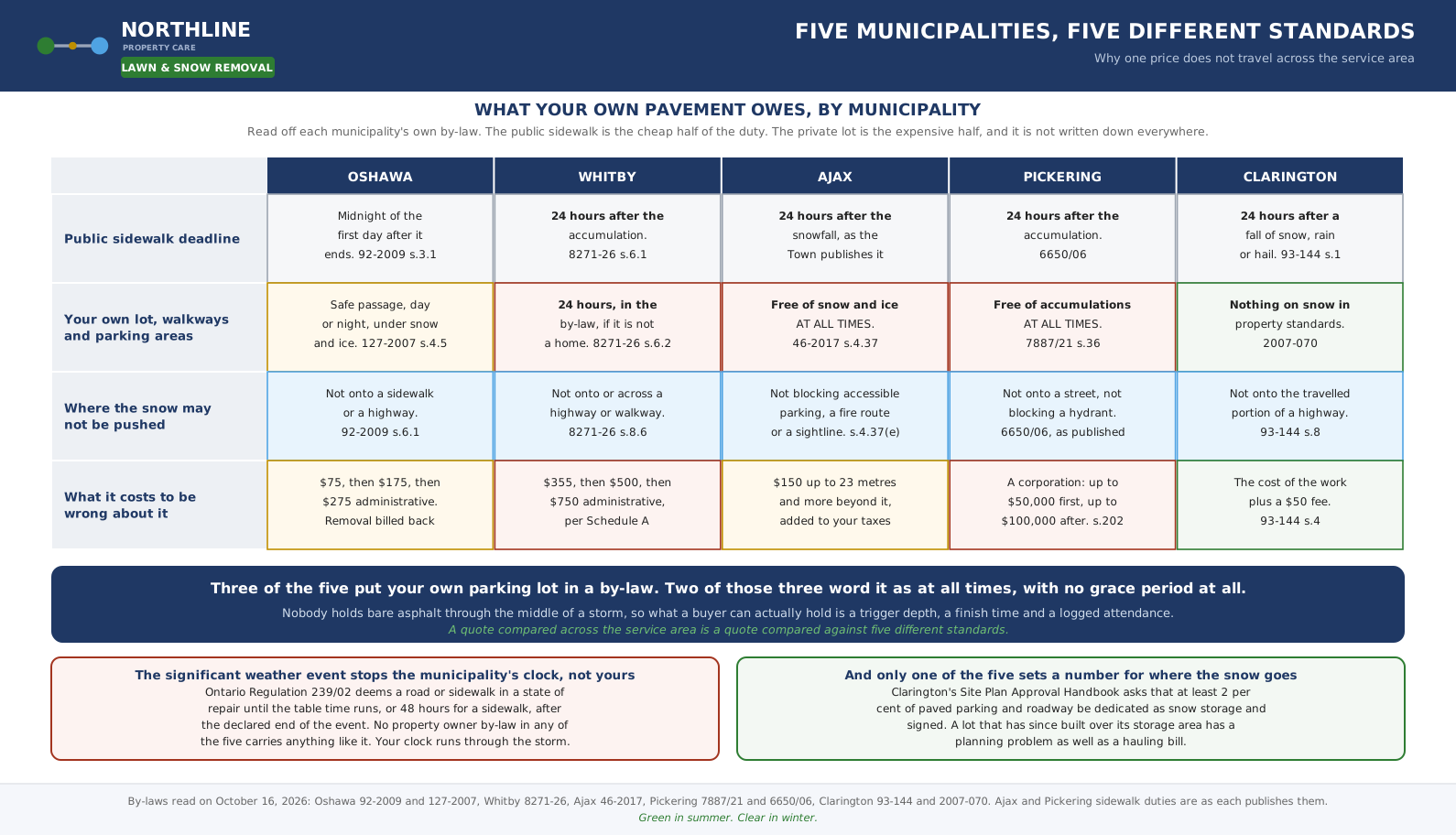
A property manager with sites in Oshawa, Whitby and Pickering will put three quotes side by side and assume that the cheapest one is the best value. The quotes are not measuring the same obligation, because the five municipalities in this service area do not ask the same thing of a commercial property, and three of the five put your own parking lot into a by-law while two of them do not.
Whitby changed its rules this year and the new by-law names your parking area
At the end of March the Town of Whitby retired the property and boulevard maintenance by-law it had used since 2015, and the Clean Community By-law, number 8271-26, took over at midnight on the first of April this year. Under section 6.1 an owner or occupant has 24 hours from the accumulation to clear snow and ice, a windrow included, off any sidewalk and out of a circle of sixty centimetres around any fire hydrant standing on a boulevard.
Section 6.2 is the clause a commercial buyer needs to read. It gives an owner or occupier 24 hours from the accumulation to clear snow and ice off the walkways, the pathways, the driveways, the lanes and the parking areas on or beside the property, and it exempts only an individual private residence. Section 1.14 defines an individual private residence as a house, a semi, a link, a townhouse, a duplex, a triplex or a converted dwelling, so every plaza, industrial unit, office, institution and apartment building in the Town falls under section 6.2 rather than outside it. Schedule A sets the administrative penalty for that section at $355, then $500, then $750. A separate clause at section 8.6 puts the same penalty ladder behind a prohibition on moving snow, slush or ice by shovel, plow or blower onto a highway, onto a sidewalk, onto a pedestrian walkway or across any of them, unless it has been authorized. The consolidated text is published by the Town at whitby.ca.
Read those two sections together and the commercial consequence is concrete. A Whitby lot that takes 20 centimetres overnight has a municipal clock on its own asphalt, not merely on the public sidewalk, and it has no lawful place to push the snow into the road. Those two clauses are precisely what forces a property to find storage space on site, or to pay for the snow to be relocated, or to pay for it to leave.
Ajax and Pickering word it harder, and no contractor on earth can meet it literally
Ajax Property Standards By-law 46-2017, at section 4.37, applies to private property holding multiple occupancy residential buildings, and to every part of a commercial, industrial or institutional property the public can reach. Clause (c) wants the walkways and the routes in and out of the buildings kept clear of ice, snow and hazards at all times. Clause (d) says the same thing about exterior parking areas and roadways, laneways counted in. Clause (e) is the one that gets forgotten and matters most on a tight site: cleared snow may not be stored where it blocks accessible parking, a fire route or a sightline.
Pickering Property Standards By-law 7887/21, at section 36, uses the same at all times construction, and clause (d) names fire routes expressly alongside exterior parking areas and laneways. Pickering also carries the heaviest penalty exposure in the region by a wide margin: section 202 allows a fine against a corporation of up to $50,000 for a first offence and up to $100,000 for a subsequent one, and section 204 allows up to $10,000 a day for each day an order goes uncomplied with. A commercial lot is almost always held by a corporation, so section 202 is the live number rather than the individual one.
Nobody holds bare asphalt through the middle of a storm, and a contractor who tells you otherwise is selling a sentence they cannot stand behind. The honest reading of at all times is that the standard is written as an outcome and enforced on reasonableness, and the way a property manager actually defends itself is by being able to show what was done, when, and why that was reasonable. Which brings the argument back to the record, and the record is further down this page.
Oshawa and Clarington leave your lot to a softer instrument
Oshawa Winter Access By-law 92-2009 governs the public sidewalk and does it by a deadline rather than an hour count: section 3.1 gives the owner of a lot until midnight on the first day after the precipitation stops to clear snow and ice, windrows counted, off any sidewalk running in front of that lot, along its side or behind it. Section 6.1 then bars anybody from shifting snow off private property onto a sidewalk or a highway, and from piling or spreading it there. The administrative penalties run $75, then $175, then $275 within a year, and the City may clear a defaulted sidewalk itself and bill the cost back with interest. The by-law is published at oshawa.ca.
For the parking lot itself Oshawa reaches a different instrument. Lot Maintenance By-law 127-2007, at section 4.5, asks that driveways, ramps, parking areas, exterior walkways and exterior passages be maintained so that they provide safe passage under normal use and weather conditions, snow and ice given as the example, day or night. That is a softer standard on its face than at all times, and the fines behind it are not soft at all.
Clarington is the outlier. By-law 93-144 gives an owner 24 hours after a fall of snow, rain or hail to clear the abutting sidewalk, and section 3 goes further than any of the others by requiring the sidewalk to be continually kept and maintained free of slippery surfaces between snowfalls. Section 8 forbids depositing snow onto the travelled portion of a highway. But Clarington Property Standards By-law 2007-070 says nothing about snow on a parking area at all, and the practical penalty under 93-144 is the cost of the municipality doing the work plus a fifty dollar administrative fee rather than a set fine. On paper Clarington is the cheapest municipality in the region to be wrong in. That has nothing to do with what a slip and fall costs, and a buyer who prices a Bowmanville lot on that basis has confused the by-law with the liability.
The relief that exists protects the municipality and not you
Ontario Regulation 239/02, the Minimum Maintenance Standards for Municipal Highways, lets a municipality declare a significant weather event. Once it does, its roads are deemed to be in a state of repair until the applicable table time runs after the declared end of the event, and its sidewalks for 48 hours after it. Whitby publishes the roadway table on its own service page: a Class 1 road at 2.5 centimetres within 4 hours, Class 2 at 5 centimetres within 6, Class 3 at 8 centimetres within 12, Class 4 at 8 centimetres within 16, Class 5 at 10 centimetres within 24.
Not one of the five property owner by-laws above carries anything like that relief. The municipality gets to stop its clock in a bad storm. Your clock runs through it. Any commercial agreement written in this region should say in plain words what happens during a long event rather than only after it, because the regulation that lets the municipality pause has no private equivalent.
Where the snow goes is the biggest hidden line in a commercial quote
On a lot with room along its downgradient edges, snow gets pushed, stacked and left to melt, and the cost is the pushing. On a lot without that room the snow has to be relocated on site by machine or loaded out and taken away, and that is a different order of expense entirely. It is also the line a cheap quote is most likely to have left out, because it does not show up until the third storm of the season when the piles stop accepting anything.
Section 181 of the Highway Traffic Act settles the easiest question first, and it binds every property in the province: snow or ice may not be put on a roadway at all unless the ministry or the road authority that maintains that road has given written permission first. Where the Act sets no penalty of its own, section 214 supplies one, at a minimum of $60 and a maximum of $1,000. Every municipality above then layers its own prohibition on top of that, and Whitby adds an unusual enforcement route by telling property owners on its own winter page that pushing snow onto the street means a ticket from Durham Regional Police rather than from a by-law officer.
Sizing the space is where the published guidance gets genuinely useful. The Lake Simcoe Region Conservation Authority commissioned parking lot design guidelines that recommend planning for 500 to 1,500 cubic metres of snow pile storage per hectare of parking lot, and note that at a maximum pile height of three metres roughly 3 to 8 per cent of the paved area is needed for storage. The same guidance says to put the piles along the downgradient edges, not on top of catch basins, not in prime parking by the entrance, not where they obstruct sightlines, and preferably somewhere that gets sun.
Hold that against what Clarington requires of a new site plan. The Municipality's Site Plan Approval Handbook, at section 3.8, requires snow storage areas to be identified on the site plan, requires a minimum of 2 per cent of all paved parking areas and roadways to be dedicated as snow storage and signed accordingly, and forbids those areas from sitting in required parking spaces, roadways or fire routes. Two per cent is the planning minimum. The engineering guidance says three to eight. A lot approved at the minimum and then built out tighter has a hauling bill waiting for it, and a lot that has since paved over its storage area to add stalls or a drive through lane has a planning problem on top of the hauling bill.
There is one surface on a commercial lot that should never be considered as storage under any circumstances, and it is also the most tempting empty rectangle on the property. Ontario Regulation 191/11 requires an access aisle beside an accessible parking space to be a minimum of 1,500 millimetres wide, to run the full length of the space, and to be marked with high tonal contrast diagonal lines on a hard surface. It is hatched precisely so that nobody parks in it, which is exactly what makes it look like free space to a plow operator at four in the morning. A pile placed there removes a dimension the owner was legally required to build. Ajax, at clause 4.37(e), puts that in so many words.
Where snow does have to leave a site, it does not simply go anywhere. There are provincial guidelines on snow disposal and de icing, published by the environment ministry under the Ontario Water Resources Act together with the Environmental Protection Act. They ask that tipping snow straight into a watercourse, or onto a lake or river under ice, be stopped wherever it can be, that land disposal is the preferred method, that ministry approval is required before dumping directly to a watercourse, and that land disposal sites should be evaluated by the ministry through its regional office. Those guidelines are written for municipalities and road authorities and they do not address private on site storage, which is a gap worth naming rather than papering over.
Hauling and on site relocation are quoted per call against the actual volume rather than published as a rate, every load is ticketed, relocation is offered before hauling is, and neither happens without written approval for that specific call. That is deliberate. A per load number printed on a web page is a number somebody will hold a contractor to on a site nobody has seen.
Salt is the one cost line you can read off a thermometer
Rock salt is sodium chloride, and its working range is a property of the chemistry rather than of the contractor applying it. The University of Minnesota's Local Technical Assistance Program publishes a winter salt guide for property managers that puts the lowest practical melting temperature of sodium chloride at 15 degrees Fahrenheit, which is about minus 9.4 Celsius, and its eutectic at minus 6 Fahrenheit, about minus 21.1 Celsius. Nova Scotia's own transportation department states the same thing in metric and in one sentence: road salt does not work at temperatures below minus 10 Celsius.
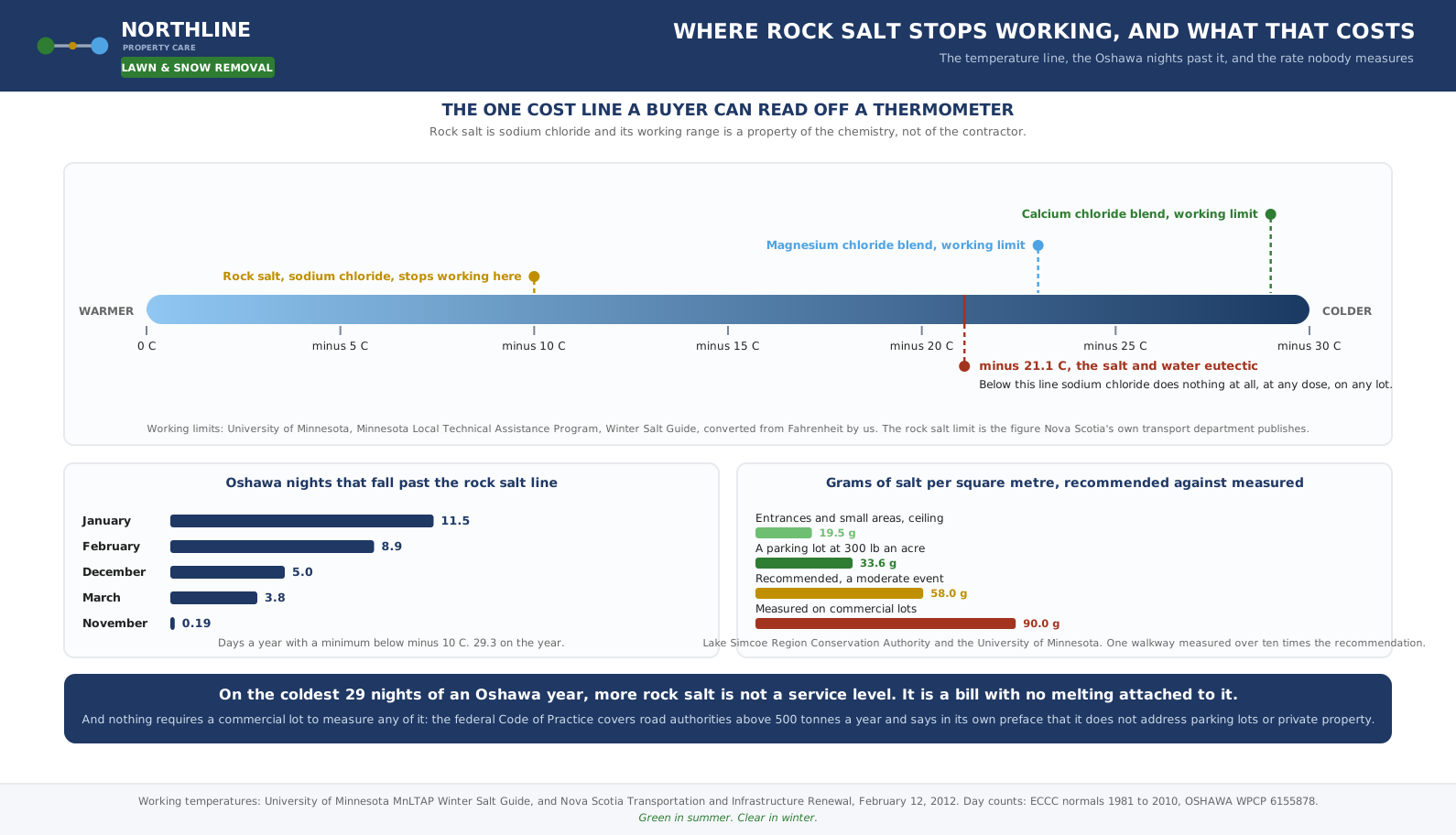
Now put the Oshawa record against that line. The same climate normals file records 29.3 days a year with a minimum temperature below minus 10 Celsius at that station, 11.5 of them in January and 8.9 in February. On those nights more rock salt is not a higher service level. It is a bill with no melting attached to it, and the correct answer is either a chloride blend with a lower working temperature, or sand for traction, or more labour hours moving snow mechanically, each of which costs something and each of which should be visible in the agreement rather than discovered in February.
The rates are the other half, and the gap in them is wide. The Lake Simcoe Region Conservation Authority's technical bulletin on friction and parking lots puts the recommended application for a moderate winter event at 58 grams per square metre, citing University of Waterloo work, and then reports that its own studies of commercial lots measured application rates closer to 90 grams per square metre and often a great deal higher, with one walkway test measuring more than ten times the recommended amount. The University of Minnesota guide, working in different units, caps entrances and small areas at four pounds per thousand square feet, which converts to roughly 19.5 grams per square metre by our arithmetic.
Nothing requires a commercial lot in Durham Region to measure any of this, and that regulatory gap is the honest explanation for the over application. Ottawa published a Code of Practice for the Environmental Management of Road Salts which dates from 2004, and it is aimed at bodies that look after public roads, and it catches them at more than 500 tonnes of salt a year measured across five years, or where their territory holds a vulnerable area. Its preface then rules itself out of exactly the ground this page is about, saying in terms that parking lots and private property are outside it. So nobody is obliged to calibrate a spreader on a plaza, report a tonne, or hold a salt management plan. Anybody who tells a property manager that a federal rule requires it of them is wrong.
That matters locally and not just in principle. Environment and Climate Change Canada assessed road salts under the Canadian Environmental Protection Act in 2001 and concluded that road salts containing inorganic chloride are toxic as defined in section 64 of that Act. They were never added to Schedule 1, and the voluntary code above was used instead. Closer to home, the Toronto and Region Conservation Authority's stream water quality work found that chloride at the mouth of Duffins Creek, which drains Ajax and Pickering, still has a median below the 120 milligram per litre chronic guideline, but that the 75th percentile for the 2016 to 2020 period surpassed that threshold for the first time in fifty years. The Central Lake Ontario source protection assessment report, covering Whitby, Oshawa, Courtice and Bowmanville, records chloride in Lynde Creek peaking in winter when road salt application is most frequent, and records three wells in the study area with average chloride concentrations above the 250 milligram per litre Ontario drinking water standard.
The commercial argument is simpler than the environmental one and points the same way. Salt applied below its working temperature does not melt anything, costs money, damages concrete and landscaping, and ends up in a creek. Applying less of it at the right time is cheaper for the buyer and better for the property, which is a rare case of the two interests not being in tension.
The sixty day letter, and why the site record is part of what you are buying
Ontario changed the rules on snow and ice injury claims on January 29, 2021, when section 6.1 of the Occupiers' Liability Act came into force. An injured person now has 60 days from the day it happened to put written notice of the claim, carrying the date, the time and the place, into the hands of one of the people the section lists, either by personal service or by registered mail, and without that step no action for injury from snow or ice may be started at all. Subsection 6.1(2) names two such people. One is an occupier. The other is the independent contractor the occupier had taken on to deal with snow or ice there over the period in question.
It is usually sold to commercial buyers as a shield and it is weaker than that. Subsection 6.1(5) removes the bar entirely where the injured person dies. Under subsection 6.1(6) a judge may forgive notice that never arrived or arrived incomplete, provided the reason for that is a reasonable one and the defence has not been damaged by it. Subsection 6.1(7) says plainly that notice given to any one person on the list preserves the action against everyone on it, even someone who never received the notice. A contractor who was never served can still be sued because the occupier was served in time.
What the notice period really does is compress the investigation window, and that is the part worth paying for. You now generally learn about a claim inside 60 days rather than inside two years, which means the site record from that night is the whole case. What time the property was attended, what the measured depth was, what was applied and where, what the surface looked like when the operator left. A contractor who cannot produce that is not cheaper. They have simply moved a cost onto you and not told you about it.
Section 6 of the same Act is the other half of the argument and it is the clause a property manager should read twice. Where an independent contractor is negligent and damage follows, section 6 lifts liability off the occupier on three conditions, each of which has to hold in all the circumstances. Handing the work over has to have been a reasonable thing to do. The occupier has to have taken whatever steps it ought to have taken to satisfy itself both that the contractor was up to the job and that the job had in fact been done properly. And putting the work out to a contractor at all has to have been reasonable in the first place. That is a documentation standard wearing the clothes of a liability rule. Price competition that strips out the record keeping strips out the occupier's own defence, which is a strange thing to buy. The Act is on Ontario's e-Laws site and it is short enough to read in ten minutes.
Three decided cases are worth knowing about before signing anything, and all three are published by the courts themselves.
In Waldick v. Malcolm the Supreme Court of Canada dealt with a serious injury on an icy parking area that had not been salted or sanded, in a rural area where apparently few people salted. The court held that local custom does not displace the statutory duty, and wrote that no amount of general community compliance will render negligent conduct reasonable in all the circumstances. That is the authority that disposes of the everybody around here does it this way defence, and it disposes of its commercial cousin as well: that a price is reasonable because it matches what the market charges.
In MacKay v. Starbucks Corporation, 2017 ONCA 350, the Court of Appeal for Ontario held that a tenant whose staff had been given a shovel and salt and told to clear a walking width across the municipal sidewalk at its patio entrance could be found to be an occupier of that strip of sidewalk. There is no general common law duty on an adjacent owner or tenant to keep a public sidewalk clear. Behaviour is what creates the duty. A commercial tenant that informally salts a few metres outside its door, inconsistently and without a record, has acquired the obligation without acquiring the defence.
In Miaskowski v. Persaud, 2015 ONCA 758, a lease required the tenant to keep the sidewalks in front and at the sides of the premises free of snow and ice. The fall happened on the driveway. The Court of Appeal found that the lease contained no express provision assigning responsibility for the driveway, set aside a summary judgment, revived the action and sent the scope question to trial. Eight years of litigation turned on which surfaces a clause named. Name every surface in a snow agreement, because the ones you leave unnamed are the ones that get argued about.
One more statute belongs here because it is the one nobody expects. Section 11 of Regulation 851 under the Occupational Health and Safety Act requires that a floor or other surface used by any worker be kept free of obstructions, hazards, and accumulations of refuse, snow or ice. The Act defines an industrial establishment as an office building, factory, arena, shop or office, and any land, buildings and structures appertaining thereto, which is the phrase that carries the regulation outdoors onto the land. We have not found a decided case applying section 11 to a parking lot, so this is a reading of the text and not a settled holding, and it is offered that way. What is not a matter of reading is section 66 of the Act, which lists the aggravating factors on sentencing, and includes at paragraph 8 that in committing the offence the defendant was motivated by a desire to increase revenue or decrease costs.
What a site survey actually measures, and why a price without one is a guess
A survey takes about forty minutes on an ordinary plaza and it produces a number that can be defended afterwards. The pavement area is measured rather than estimated. The walkways, steps and door thresholds are measured in linear metres, because that is the work that takes the time and it is where almost every injury happens. The accessible spaces and their access aisles are located, the fire route is walked, and the hydrants are found, because those three things determine where the piles cannot go. The gradient is noted and so is the drainage, because a pile uphill of an entrance becomes an ice sheet across that entrance during the first thaw. The catch basins are located for the same reason.
Then the awkward questions get asked. Where does the snow go when the edges are full, and is there a realistic answer, or does this property need to budget for relocation by machine or for loading out. Does the entrance open onto a Regional road, because if it does the windrow across it is left by an operation that is not the municipality and is not us, and it arrives after the lot has been finished. Is there a tenant with a delivery window that cannot be blocked. Is there a surface, a ramp or a loading dock that genuinely cannot wait for the rest of the property.
Everything found that way is recorded, photographed and turned into a written price inside two working days at no charge, and the per visit arithmetic is printed next to the seasonal figure so that the two can be weighed properly instead of guessed at. If the standard a property asked for cannot honestly be held at that address, that is said at the survey rather than in February. Request a site survey and it gets booked before the first storm rather than after it.
Four things that cost us the sale, said here anyway
If your lot is small enough that the seasonal number and the expected per visit total land within a few hundred dollars of each other, buy per visit. Eight qualifying events is what the published normals say to expect at a 5 centimetre trigger. Run the multiplication yourself. A seasonal agreement is insurance against a heavy winter, and insurance you do not need is not a bargain.
If you have been paying a contractor to clear the municipal sidewalk in front of your building and nobody has ever told you whether that was your duty, find out before you renew. In every one of the five municipalities it is in fact the abutting owner's duty, so the money was probably well spent. But in several of them the deadline is softer than the one you are buying, and the right question is whether you are paying for a 24 hour obligation at a four hour standard without having chosen that.
Nobody can deliver what the Ajax and Pickering property standards by-laws literally ask for, and any quote that promises at all times is promising something it cannot hold. What can be held is a measured trigger, a finish time, a mid event return and a written record of every attendance. That is also what the Occupiers' Liability Act actually rewards. Buy the thing that can be proved rather than the sentence that sounds strongest.
A commercial snow agreement is the easiest place in property management to overspend on salt and the hardest place to notice it. If your current contractor bills salt separately and cannot tell you the application rate per square metre, you have no way of knowing whether you are paying for 58 grams or 90. Ask for the rate. The question alone usually changes the answer.
What we could not verify, named rather than left out
A page that prints only the things it managed to find has not shown you how it was made. What follows is the list of things this one went looking for and did not come back with.
- The 1991 to 2020 climate normals for any Durham station. Six URL forms across two Environment and Climate Change Canada hosts returned server errors, and the bulk download tree carries only 1981 to 2010. Every snowfall and temperature figure above is the older set, stated as such.
- Any count of days with freezing rain or ice pellets for Oshawa or anywhere in Durham. The station normals files carry no such element at all, and no government or university source gave a number for this area. No freezing rain figure appears on this page for that reason.
- A published by-law number for the Town of Ajax sidewalk snow clearing duty. The Town publishes the 24 hour rule and a charge of $150 for up to 23 metres with additional cost beyond, on pages that cite no by-law number. The duty is quoted here as the Town publishes it rather than from an enacted text we have read.
- The full enacted text of Pickering Ice and Snow Clearing By-law 6650/06. The City's document portal would not serve it. The 24 hour duty and the 25 per cent administration fee are quoted from the City's own published summary and are identified as a summary.
- Any Ontario statute, regulation or Durham by-law that requires an accessible parking space specifically to be kept clear of snow. Regulation 191/11 and Regulation 581 were both read in full and neither uses the word snow. The duty comes from occupiers' liability and from municipal property standards instead, which is a narrower and more accurate thing to say than the version usually repeated.
- Any decided case applying section 11 of Regulation 851 to an outdoor commercial parking lot. The argument above is a reading of the statutory definition and is offered as that.
- Any municipal permit or fee anywhere in the five municipalities governing the hauling of snow off a private site. None was found.
- Whether the Clarington year round prohibition on pushing snow onto the road, attributed by the Municipality to By-law 2014-059, says what the web page says it says. That by-law document is blocked to automated readers. By-law 93-144 section 8, which is quoted above, was read.
Every external figure on this page comes from a government body, a court, a university, a conservation authority or a regulator. Not one of them comes from another property maintenance company's price page, and that constraint is the reason several of the numbers above are not on anybody else's website.
Questions commercial buyers in Durham Region actually ask
How much does commercial snow removal cost in Durham Region?
The floor is $3,450 plus HST for a season on a compact lot, which here means pavement of up to ten thousand square feet, and that buys plowing and clearing with no cap on the number of attendances, between November 15 and April 15, once five centimetres has been measured. Above that size the price follows the pavement, because square footage of asphalt, linear metres of walkway and steps, the stall count and the gradient are what the work is made of. A per visit agreement on the same property is cheaper in a mild winter and dearer in a heavy one, and the published climate record for Oshawa says to expect about eight qualifying events at a 5 centimetre trigger in an average year. An hourly agreement is the right answer for a hauling call or a genuinely unpredictable site and the wrong answer for an ordinary plaza.
Is seasonal or per visit cheaper for a commercial property?
It depends entirely on the winter, which is the honest answer and also the useful one. Take the per visit rate, multiply it by about eight, which is the number of days a year the Oshawa climate normals record with a fall of 5 centimetres or more, and compare that to the seasonal figure. Then do the same multiplication for a heavy winter. If both answers sit below the seasonal number, buy per visit. If they straddle it, the seasonal number is insurance and it is worth what insurance is worth. A small lot with simple access usually comes out ahead on per visit. A property where a bad morning costs a tenant money usually does not.
Does a commercial parking lot have to be cleared within 24 hours in Durham Region?
In Whitby, yes, and it is written into the by-law. Clean Community By-law 8271-26 section 6.2 requires every owner or occupier other than an individual private residence to clear snow or ice from walkways, pathways, driveways, lanes and parking areas within 24 hours of the accumulation, with an administrative penalty of $355 rising to $500 and then $750. Ajax and Pickering go further and word it as at all times in their property standards by-laws rather than setting any clock at all. Oshawa reaches the lot through its Lot Maintenance By-law, which asks for safe passage under normal use and weather conditions, day or night. Clarington has no equivalent parking area clause in its property standards. Five municipalities, five different standards, one service area.
Can snow be pushed from a commercial lot onto the road in Durham Region?
No, and two separate layers of law say so. Provincially, section 181 of the Highway Traffic Act bars putting snow or ice on a roadway unless the authority that maintains it has agreed in writing, and section 214 attaches a fine running from $60 up to $1,000. Each municipality then adds its own prohibition: Oshawa at section 6.1 of By-law 92-2009, Whitby at section 8.6 of By-law 8271-26, Clarington at section 8 of By-law 93-144, and Pickering as published under By-law 6650/06. Whitby adds that enforcement there can come from Durham Regional Police rather than from a by-law officer. This is why where the snow goes is a real cost line and not an afterthought.
Why do commercial snow quotes in Durham Region vary so much?
Three reasons, and only one of them is margin. The first is that the quotes are being measured against different legal standards, because the five municipalities in this region do not ask the same thing of a commercial property and three of the five put the private lot in a by-law while two do not. The second is the trigger depth: a quote written at 8 centimetres reads cheaper than one written at 5, and then every 6 centimetre fall of the winter stays exactly where it landed. The third is whether snow storage, salt rate and mid event return are in the number or outside it. Two quotes that do not name the same trigger depth are not comparable at any price.
Do I have to clear the public sidewalk in front of my business?
Yes, in all five municipalities, and the deadline is the thing that changes. Oshawa requires it by midnight of the first day after the precipitation ends. Whitby, Pickering, Ajax and Clarington each publish a 24 hour rule, and Clarington counts it from a fall of snow, rain or hail rather than snow alone and additionally requires the sidewalk to be kept free of slippery surfaces between snowfalls. Oshawa clears some sidewalks itself, including those in the central business improvement area, and the other municipalities each clear a defined set of their own. None of that municipal clearing removes the abutting owner's duty, so the safe assumption is that the sidewalk in front of your building is yours.
When should a Durham commercial property book snow removal for the season?
Ahead of November, and the reason is the survey rather than the season. Commercial agreements here run from November 15 until April 15, and walking a property properly is what takes the time. A property booked in late October gets walked in daylight on dry pavement, which is when the pile locations, the fire route, the accessible aisles and the drainage can actually be seen. A property booked in December gets priced off whatever can be worked out in a hurry, and the cost of that guess lands on somebody. The residential route in this region closes on November 30 or when it is full, whichever comes first, and commercial survey time competes with that same calendar.
Who put this together, and what was opened to do it
Northline Property Care is owned by Andrew, who does the work on the properties himself across the western end of the region at Pickering and Ajax, through Whitby and Oshawa, and eastward into Courtice, Bowmanville and the rest of Clarington. Fully insured. The judgements on this page rest on six winters of clearing snow here. Those are his own winters as a person. They are not an assertion about the number of seasons the company has been trading under this name, and because the difference between those two claims is a single word, this page separates them deliberately.
Opened on October 16, 2026 to write this, every one of them a government body, a court, a university, a conservation authority or a regulator: the Occupiers' Liability Act, the Occupational Health and Safety Act and Regulation 851, Ontario Regulation 191/11, Regulation 581 and the Highway Traffic Act on Ontario e-Laws; the Supreme Court of Canada report of Waldick v. Malcolm and the Court of Appeal for Ontario reports of MacKay v. Starbucks Corporation and Miaskowski v. Persaud; Oshawa Winter Access By-law 92-2009 and Lot Maintenance By-law 127-2007; Whitby Clean Community By-law 8271-26 and the Town's winter service pages; Ajax Property Standards By-law 46-2017 and the Town's winter response pages; Pickering Property Standards By-law 7887/21 and the City's ice and snow clearing page; Clarington By-law 93-144, Property Standards By-law 2007-070 and the Site Plan Approval Handbook; the Region of Durham road maintenance pages; Ontario Regulation 239/02 as reproduced by two municipalities; the Ministry of the Environment guidelines on snow disposal and de icing; the Environment and Climate Change Canada climate normals, weather impact guides and road salts Code of Practice; the 2001 Priority Substances List assessment of road salts; the Lake Simcoe Region Conservation Authority bulletins on parking lots and salt; the Toronto and Region Conservation Authority stream water quality report; and the Central Lake Ontario source protection assessment report.
Not one figure above was taken from another property maintenance company's website, and the section further up naming what could not be verified is part of the method rather than an apology for it. Municipal pages change and published figures move. Where something here has since gone out of date, or was plainly wrong on the day it went up, the quickest route to a correction is a text to 905-244-5779. For the same subject read clause by clause against one town's by-law, see commercial snow removal in Whitby and commercial snow removal in Pickering. For the residential half of the same question, see what snow removal costs in Durham Region.
Read next
The levels, side by side
Trigger depth, pre treatment, how fast after it stops, salting, the site log and whether anybody comes back mid event, compared row by row.
Compare the levels →Why commercial clears at 5 cm
Where each depth came from, why one is never quietly substituted for the other, and what a buyer gets for each of them.
Read the trigger page →Grounds maintenance, and the bundle
The summer half of a commercial agreement, and the 12 per cent that comes off when grounds and snow are bought together.
Open the grounds page →Andrew answers, October 2026
Your seasonal price is higher than the quote I have in front of me. Why would I take it?
Possibly you should not, and the way to find out takes about five minutes. Put the two quotes beside each other and check three things: the trigger depth each one is written at, whether salt is inside the number or billed on top of it, and whether snow storage or relocation is dealt with anywhere in the document. If the other quote matches on all three and still comes in under mine, it is the better buy and I would tell you so. What I see more often is a quote written at a deeper trigger with salt billed separately and nothing said about where the snow goes, which is not a cheaper version of the same thing. It is a different thing with a lower number on it.
One of these goes on each page and it is replaced monthly. If the question you have is not here, ask it: 905-244-5779.
Send the address and the approximate size, and the property gets walked on dry pavement
Any commercial property in this region gets walked, measured and photographed, and the written price follows inside two working days at no charge. The per visit arithmetic sits beside the seasonal figure, and the pile locations are drawn against the accessible aisles, the fire route and the hydrants before anybody signs anything. Where the standard asked for cannot honestly be delivered at that address, that gets said during the survey rather than during a storm.