Snow removal · Hiring
How to Choose a Snow Removal Company in Durham Region
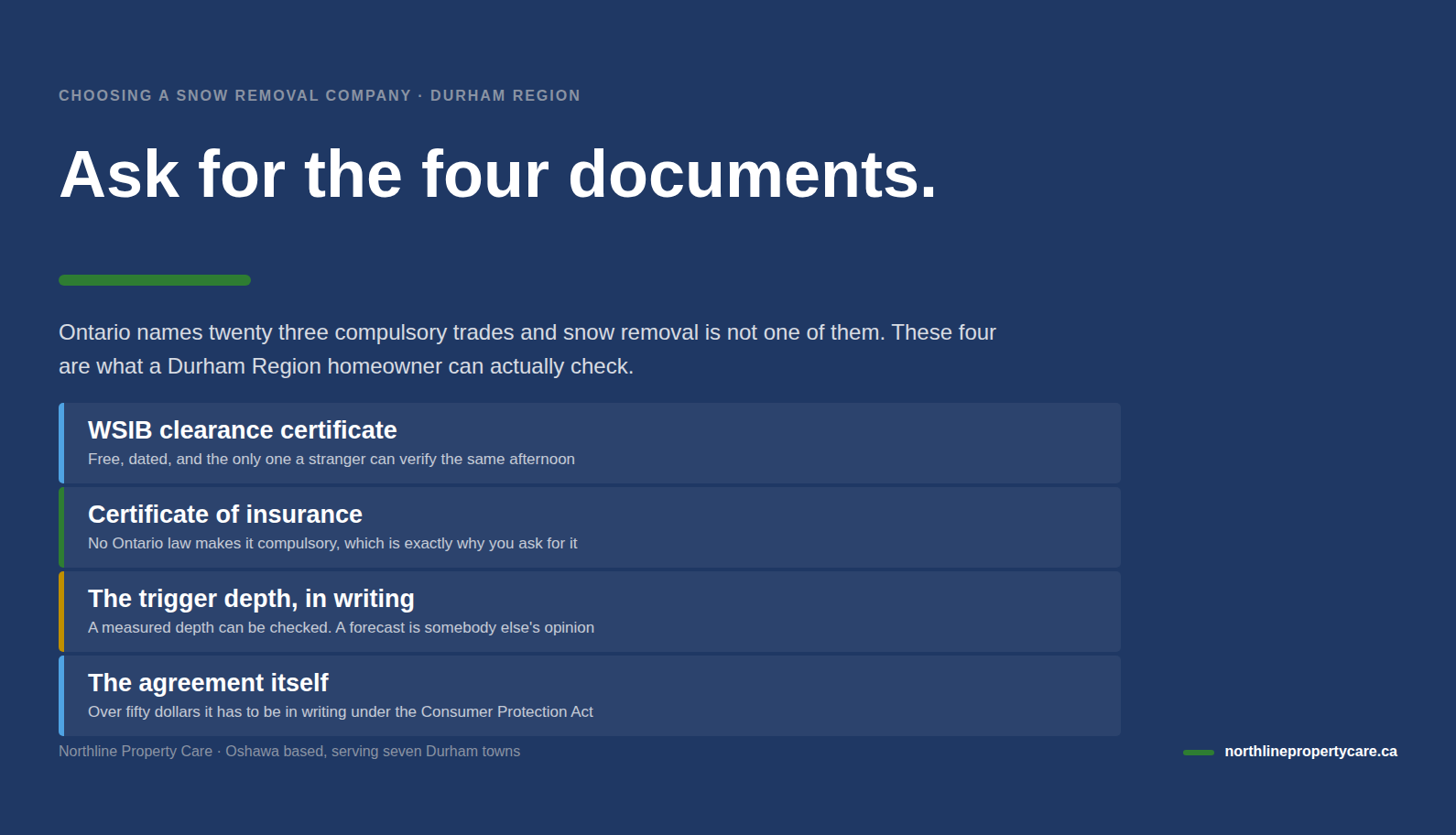
How to choose a snow removal company in Durham Region comes down to four documents you can ask for in one text message, and Ontario issues no credential for this work.
Our own four are on request. See what the winter service covers.
Green in summer. Clear in winter.
The short answer
Ask for a Workplace Safety and Insurance Board clearance certificate, a certificate of insurance, the trigger depth in centimetres, and the agreement itself in writing. All four are free to request, all four arrive by email, and a company that has them can send them the same day. Ontario publishes a list of twenty three compulsory trades and snow removal appears nowhere on it, so there is no provincial credential for anybody in Durham Region to show you, ourselves included. That absence is not a scandal and it is not a loophole. It simply means the burden of checking sits with the homeowner, and the four documents above are the whole of what there is to check.
Ontario issues no credential for this work, and neither does your town
There is nothing to ask for, and knowing that saves you from being impressed by the wrong thing. Ontario maintains a public list of compulsory trades, the occupations where a person may not legally work for pay without a certificate of qualification. There are twenty three of them, and they are the trades you would expect: electrician, plumber, hairstylist, automotive service technician. Snow removal is not among them. Neither is landscaping, and neither is property maintenance. You can read the provincial list of compulsory trades yourself in about a minute.
The municipal layer does not fill the gap either. The Town of Ajax publishes every category its by law office issues, and the list runs from kennels and pet shops through fireworks permits, outdoor patios, portable signs, refreshment vehicles and taxicab brokers. There is no contractor category anywhere on it. The Region of Durham's own permits page covers regional infrastructure, sewer and water connections, septic systems and filming, and it tells a business to check with its local area municipality for anything else. So the chain ends where it started, with nobody issuing anything.
We read the Ajax list and the Regional list directly. That is two of the eight authorities a Durham homeowner could look at, counting the Region and the seven towns we serve, and the other six are unread by us. The section headed what we could not verify at the foot of this page says so plainly rather than letting the two stand in for the eight.
The practical consequence is worth stating in one sentence. The most confident sounding word in this trade is not a fact anybody in Ontario can produce, so a homeowner who wants evidence has to ask for documents that exist rather than credentials that do not. Northline says fully insured and stops there, because fully insured is a thing a certificate can show and there is no honest way to say anything stronger.
Document one, the WSIB clearance certificate
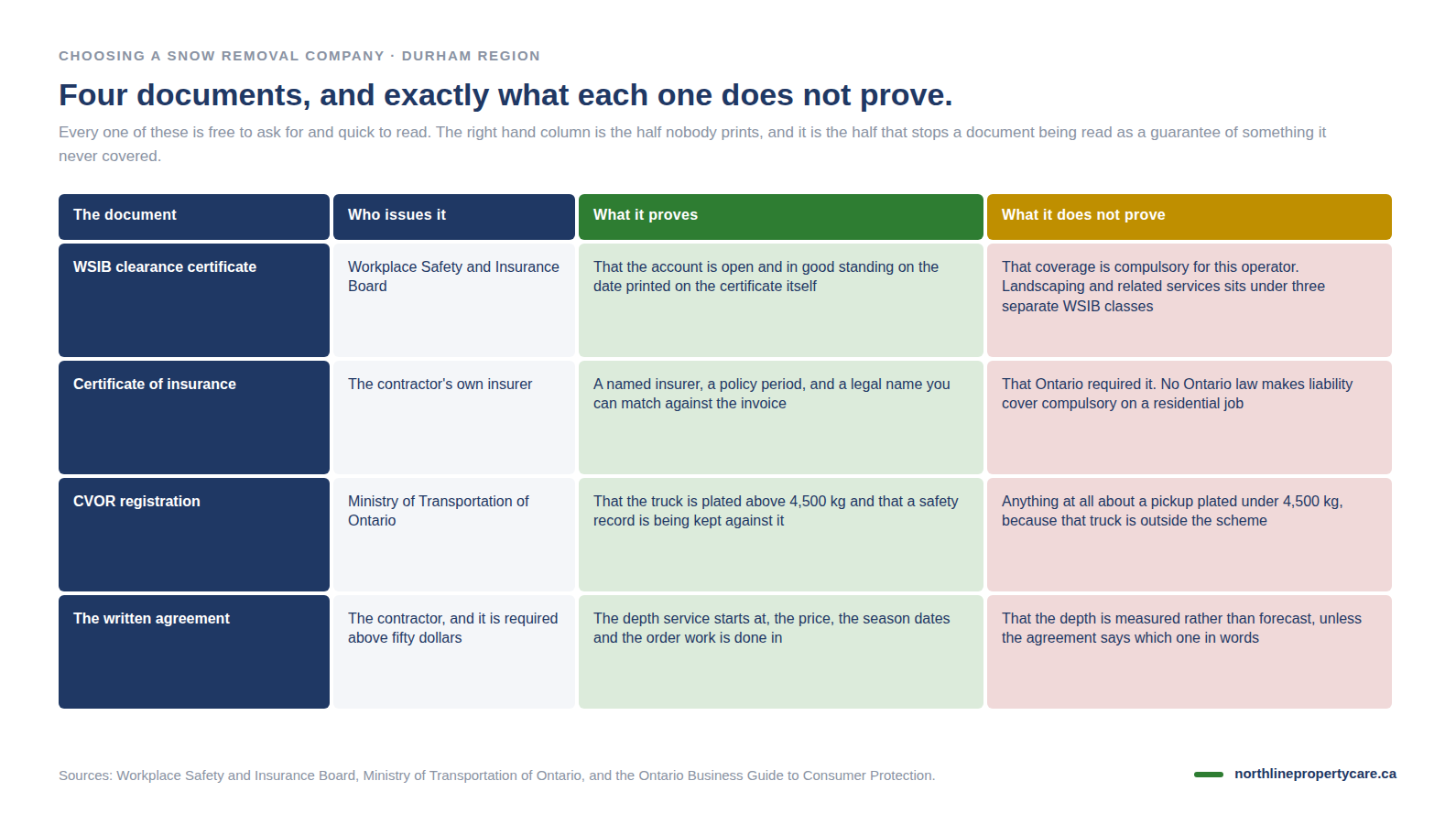
This is the one document a stranger can verify about a contractor without anybody's cooperation, and it costs nothing. The Workplace Safety and Insurance Board states that people who own or run a business in construction must have coverage with or without employees, and that independent operators, sole proprietors, some partners and some executive officers working in construction fall inside that requirement. The Board sets out the rule on its own page for expanded compulsory coverage in the construction industry.
There is a single exemption and it is narrower than people assume. It covers individuals, partnerships or corporations performing home renovation work only, hired and paid directly by the homeowner or resident. The Board's own frequently asked questions warn that taking on even one contract which is not home renovation ends the exemption. Snow clearing on a driveway is not home renovation work, so an operator relying on that exemption is relying on something that does not describe the job.
Here is the complication nobody publishes plainly, and it is the reason to ask for the certificate rather than the argument. The Board's rate group 190, landscaping and related services, appears under three different classes depending on what a business predominantly does: agriculture, construction, and administration and services to buildings. Snow removal is not named as a line of its own in that mapping. Whether a given operator must carry coverage therefore turns on how the Board classified that specific business, and a homeowner reading a web page has no way to settle it. The Board's page on independent operators in construction sets out the test it applies.
So do not try to win that argument at your own front door. Ask for the clearance certificate. It names the account, states the status and carries the date it was issued, and it replaces a debate about classification with a document. If the answer is that no account exists, you have learned something real, and what you do with it is your decision rather than ours.
One more thing belongs here and it is the part that costs us something to write. Ask us for ours as well. A company telling you to demand a document from everybody else and expecting to be waved through on its own word has written an advertisement rather than a guide.
Document two, the certificate of insurance, and the fact that Ontario does not require it
We looked for an Ontario regulator that requires a residential contractor to carry liability cover, and we did not find one. That is a negative finding rather than a guarantee, and it is only as wide as the search behind it, which covered provincial and federal regulator material rather than every by law in every municipality. Take it as reported and not as settled. What it means in practice is that cover on a residential job appears to be voluntary in this province, and voluntary is exactly why the certificate is worth asking for.
Insurance becomes compulsory the moment somebody makes it a condition of an agreement. That is how municipalities handle it on their own contracts, and a homeowner can do the same thing in one sentence before signing anything. The mechanism is contractual rather than statutory, which sounds like a technicality until the day it matters.
Read four things on the certificate and you have read all of it. The name of the insurer, so the policy exists somewhere other than on the page in front of you. The policy period, in full. The legal name of the business, which has to match the name on the quote, the invoice and whatever you eventually pay. And the limit, so you know the size of the thing you are relying on.
The policy period is where a Durham winter bites. Our service season runs from November 1 to May 1, and a certificate that expires on December 31 covers roughly the first third of that. March in this region is not a quiet month, and a policy that has lapsed by the time the last storm arrives was never cover for this season, it was cover for the part of it that happened to fall inside a calendar year.
Document three, the CVOR, and why it proves less than people think
Most residential plow trucks in this region need no Commercial Vehicle Operator's Registration at all, so its absence is not a finding. The Ministry of Transportation sets the threshold as a weight rather than as a use: 4,500 kilograms, measured as the registered gross weight or as the weight actually being carried. A trailer and its load are added to that weight only once the trailer and load pass 2,800 kilograms; below that figure the registered gross weight is the truck and its load alone. The full rule sits on the Ministry's own page for the Commercial Vehicle Operator's Registration.
There is a personal use exemption and it carries four conditions that all have to be true together. A manufacturer's gross vehicle weight rating no higher than 6,500 kilograms. Use for personal purposes without compensation. The original box, or an unmodified replacement that duplicates it. And no trailer carrying commercial cargo, tools or equipment of a type normally used commercially. A truck being paid to plow driveways fails the second condition and the fourth one on its face, so the exemption is not available to it whatever the weight.
Put those two paragraphs together and the honest reading falls out. The registration is a weight test rather than a competence test. A half ton pickup plated under the threshold sits outside the scheme entirely and needs nothing, which describes a great many of the trucks clearing driveways in Oshawa, Whitby and Ajax on any given February morning. A heavier truck plated above the threshold sits inside it and cannot fall back on the personal use exemption once it is being paid. Treating a missing registration as a warning sign will therefore mislead you in both directions at once.
Northline does not put the registration on its own credential line, and the reason is the same discipline the rest of this page runs on. Whether the exemption survives a compensated plow truck could not be settled to our satisfaction from published material, and a claim nobody can check is not a claim worth making. What is on our credential line is fully insured, because that one has a certificate behind it.
Document four, the written agreement, and the one number that belongs in it
Ontario requires a consumer agreement worth more than fifty dollars to be in writing, which covers every seasonal snow arrangement in Durham Region. The province sets out what a written agreement has to carry, and what a homeowner may do when it does not, in its guide to the types of consumer agreement. We have written about what belongs inside a seasonal snow agreement in a separate piece on the seasonal contract itself, and there is no point repeating it here.
What this page adds is the single number that decides how your winter actually feels: the depth at which service starts. Ask for it in centimetres, and ask whether it is measured on your property or forecast the night before. A measured depth can be checked by anybody standing on the driveway with a ruler. A forecast is a prediction somebody else made about the sky, and a service that starts on a forecast will occasionally arrive for nothing and occasionally miss a storm that behaved differently from the model.
Northline clears a residential driveway at 3 cm of measured accumulation and a commercial property at 5 cm. Those two numbers are two different products on two different agreements and the figures are never carried across between them. Below 3 cm on a residential property nothing is pushed with a blade, and what happens instead depends on the plan rather than on the weather.
The second thing to ask for is the order, because a route without one is a route that improvises during the worst six hours of its year. Ours runs commercial and medical access overnight, then Platinum properties by 6:30 in the morning, then Gold by 7 AM as a target rather than a guarantee, and then Silver as a separate daytime windrow pass finished by 5 PM. Silver carries no salting at any depth, which is a sentence we would rather you read here than discover in January. A company that cannot tell you where you sit in its order has not built one.
The word target in that paragraph is deliberate and it is the last thing worth checking in an agreement. Nobody controls a storm, so nobody can guarantee a morning. An operator who promises a guaranteed time has either not thought about it or is hoping you will not remember the sentence in February.
What a seasonal price is, and the arithmetic that makes it look bad
A seasonal price is insurance against the weather, and in a mild winter insurance is a poor deal. That is not a defect in the product. It is a description of what the product is, and you should hear it from the company selling it rather than work it out from a bank statement in April.
Start with the weather, from the record rather than from a feeling about last year. The Environment Canada station at the Oshawa water pollution control plant, climate identifier 6155878, carries eighteen complete winters from 1995 and 1996 through to 2018 and 2019. Counted at a 3 cm threshold those winters average 11.4 days a season, with a median of twelve. The mildest of the eighteen produced four. The worst produced twenty four.
Now do the division that costs us the sale. The seasonal snow package runs $800 plus HST for a small driveway, $975 for a standard one and $1,200 for a large one. Against the standard figure, a twelve clear winter works out near $81 a clear. A four clear winter works out near $244 a clear. Break even sits somewhere around the eighth event. In the mildest season on that eighteen winter record, a household on a seasonal price paid roughly three times what the same work would have cost per visit, and no amount of explaining changes that.
The counter is real but it is narrower than an advertisement would make it. What a seasonal price buys is that the number stops moving. Four clears or twenty four, the payment is the same and it is known in October. Whether that trade is worth it depends entirely on whether an unpredictable February bill is a problem in your household, and you are the only person who knows the answer to that.
There is one argument we will not make, and it is worth naming because you will hear it elsewhere. Nobody should sell a seasonal price on the number of storms, because a business that wins the argument that way loses it the first mild winter and deserves to. The product is the stability of the figure, not the volume of the snow.
Seven questions for the telephone call, in the order that saves time
Every one of these can be answered in a sentence by somebody who runs a real route, and every one of them is awkward for somebody who does not. The order matters, because the first answer is what the rest of the checks are run against.
| Ask this | A good answer sounds like | Why it is the question |
|---|---|---|
| What legal name goes on the invoice? | A business name or a person's name, given without hesitation | Every other check needs that name first, and a name that shifts between the quote and the invoice is the finding |
| May I have your clearance certificate and your insurance certificate? | Both, by email, the same day | A company holding them can forward them. A company explaining why it cannot has answered you |
| What depth do you clear at, and is it measured or forecast? | A number in centimetres, measured on the property | It decides how many times you see them and whether the service is checkable at all |
| Where does my property sit in your order after an overnight storm? | A time, described as a target | A route with no published order improvises during its worst hours |
| What happens to the ridge the municipal plow leaves after you have already been? | A specific answer, including who pays for a return trip | This is the commonest complaint in Durham Region and it is almost never in writing |
| When is the money taken, and what happens if a payment fails? | A date, and one clear answer about a failed payment | A large share of the disputes in this trade are about timing rather than about work |
| Is HST added to that figure? | Yes at thirteen per cent, or a plain no with a reason behind it | Registration becomes compulsory above $30,000 of revenue across four consecutive quarters, so the answer also tells you the size of the business you are hiring |
The last row is the one people skip. The Canada Revenue Agency sets out the small supplier threshold and when registration becomes compulsory, and Ontario's rate is thirteen per cent. A quote that says nothing about tax is not automatically a warning, because a genuinely small operator below the threshold is not required to charge it. It is simply a question with a real answer, and the answer tells you something about scale that no advertisement will.
The physical limit nobody mentions, and it decides who shovels your step
The narrowest straight blade sold for a half ton pickup is seven feet six inches wide. Western publishes that single width for its half ton straight blade at 412 pounds before the mount, and Fisher publishes the same width at 417 pounds for the equivalent unit. Step up to a heavier duty straight blade in the same class and the weight roughly doubles at the same width, and the ten foot version of it passes 1,200 pounds. Those are manufacturer specification figures rather than anybody's opinion.
What follows from that is inference rather than a published figure, and it is flagged as inference. A two car subdivision driveway comfortably exceeds seven feet six inches. A single lane driveway beside a semi detached house, or one belonging to a row house, frequently does not. On a driveway that narrow a blade of that width has to work at an angle and in more passes, and the last two feet beside a fence, a gate post, a garden wall or a parked car are cleared by hand or by a blower whatever the truck is doing.
The Durham numbers make that less abstract than it sounds. At the 2021 census, Ajax carried 25,625 single detached houses, 2,265 semi detached and 6,025 row houses, against a population of 126,666. That is 33,915 ground oriented homes with a driveway of their own, and 8,290 of them, just under a quarter, are the semi detached and row house drives where width is a live constraint rather than a detail.
So there is an eighth question, and it belongs with the seven above. Ask what clears the last two feet, the walkway and the step. That is the part of the property a blade cannot physically reach, it is the part the household actually walks on, and it is the part most often left out of a verbal quote. Getting it in writing costs nothing and it is the difference between a cleared driveway and a cleared driveway you cannot cross to reach.
What we could not verify
Every outside figure on this page came from a provincial ministry, a federal agency, a regulator, a municipal government or a manufacturer's published specification sheet. Not one came from another property maintenance company, because a competitor's price page is marketing rather than evidence. Here is what we went looking for and could not pin down.
- Whether the Consumer Protection Act, 2023 has come into force. Ontario's own consumer guidance was still pointing readers at the Consumer Protection Act, 2002 when we read it, which is evidence rather than a commencement notice. We have not quoted a section number from either statute, because the provincial e laws site would not render for us and we will not cite a section we have not read.
- Which WSIB class any particular snow removal business sits in. The Board's own rate group mapping places landscaping and related services under three classes and does not name snow removal separately. That is the reason this page tells you to ask for a certificate rather than to work out the rule.
- Whether a homeowner is personally exposed when an uncovered contractor is injured on their property. We found the statutory provisions on the right to sue and found no government source that states the homeowner's position in plain words, so this page does not state it either. That is a question for a lawyer rather than for a property care company.
- Any Ontario regulator that requires liability cover on a residential job. Looked for and not found. A true negative is harder to establish than a positive one, so read it as not found after a real search rather than as a guarantee that no such rule exists anywhere in Ontario law.
- Business licensing by law in six of the eight authorities a Durham homeowner could check. We read the Town of Ajax's published categories and the Region of Durham's permits page. We did not read Oshawa, Whitby, Pickering, Clarington, Bowmanville or Courtice one by one. Two of eight read, six unread.
- A published minimum front axle rating for a half ton plow. Three manufacturers publish blade widths and weights on their specification sheets and none of the three publishes that figure, which appears to sit in their separate vehicle fitment tools instead.
- Any government guidance warning a consumer about prepaying for a full season of service. We searched the provincial consumer pages specifically for it and found nothing. The absence is worth knowing in itself, given how much of this trade is sold as a season paid in advance.
- A snowfall normal for Ajax or for Durham Region as a whole. The federal climate normals pages would not load for us in this pass, so every snow figure above is the Oshawa station's own record. Ajax sits on the lake and is very likely a little milder than Oshawa, and we are not going to put a number on very likely.
One further caveat sits under the pricing arithmetic. The eighteen winter record ends with the 2018 and 2019 season, so it is a real record rather than a current one, and it describes the shape of a Durham winter rather than a forecast of the next one. Anybody quoting it to a decimal place, this page included, is quoting a window that closed several years ago.
Questions people in Durham actually ask
Do snow removal companies need a licence in Ontario?
No. Ontario publishes a list of twenty three compulsory trades and snow removal is not on it, and neither is landscaping or property maintenance. There is no provincial certificate of qualification a snow removal operator can hold, so any claim that sounds like a government credential is either about something else entirely or it is about nothing. The things that can actually be produced on demand are a Workplace Safety and Insurance Board clearance certificate, a certificate of insurance, and a written agreement. Ask for those instead.
What is a WSIB clearance certificate, and why should I ask for one?
It is a free document from the Workplace Safety and Insurance Board that states whether a business account is open and in good standing on the day it is issued. It matters because the Board makes coverage compulsory for independent operators in construction even where there are no employees, and the one exemption written into that rule covers home renovation work only. Ask for the certificate rather than for an opinion about whether coverage applies, because the certificate carries a date and an opinion does not.
Does a snow removal contractor have to carry insurance in Ontario?
We went looking for an Ontario regulator that requires liability cover on a residential job and did not find one, so the honest answer is that it appears to be voluntary. That is the reason to ask rather than a reason to relax. Insurance becomes compulsory when you make it a condition of your own agreement, which is exactly how municipalities do it on their own contracts. Read the certificate for the insurer, the policy period and the legal name, and check that the policy period covers the whole season rather than stopping in December.
Should I worry if a plow truck has no CVOR?
Usually not, and this is the check most often misread. The provincial threshold is a weight, set at 4,500 kilograms, and a great many half ton pickups are plated below it and therefore sit outside the scheme altogether. A trailer is only added to that figure once the trailer and its load pass 2,800 kilograms. So a missing registration usually tells you how heavy the truck is and nothing whatever about how well it clears a driveway.
What single question tells me the most about a snow removal company?
What depth do you clear at, and is it measured or forecast. A company that answers with a number in centimetres has decided how it works and can be held to it. A company that answers with a description of the weather has not. Northline clears a residential driveway at 3 cm of measured accumulation and a commercial property at 5 cm, and the difference between those two numbers is the difference between two products rather than a preference.
Is a seasonal price better than paying for each storm?
It is better in a normal winter and worse in a mild one, and anybody who tells you otherwise is selling. At the Oshawa station, eighteen complete winters average 11.4 days a season with at least 3 cm of snow, with a median of twelve, four in the mildest season on record and twenty four in the worst. Against the seasonal snow package at $975 plus HST for a standard driveway, a twelve clear winter works out near $81 a clear, and a four clear winter works out near $244. What the seasonal price actually buys is that the number stops moving.
Who wrote this
Andrew owns Northline Property Care and prices every property himself before a single visit is booked on it. Six Durham winters sit behind the questions on this page, and those winters belong to him personally rather than to the company, whose own trading history is far shorter and is not being quietly borrowed against here. Northline is fully insured and works across Oshawa, Whitby, Ajax, Pickering, Bowmanville, Courtice and Clarington.
Every document this page asks you to demand is a document Northline will produce on request, which is the only version of this article worth publishing. Corrections are welcome on 905-244-5779 and they get made on the page rather than defended.
Read next
What belongs inside the agreement
Once you have decided who to hire, the clauses are the next question. Trigger depth, season dates, what counts as a visit and what happens when a payment fails.
Read the contract guide →The three ways this work is priced
Seasonal, per visit and monthly, set out side by side with the figures behind each one and the calculation that says which model fits your own driveway.
Compare the pricing models →What a membership actually covers
Three plans, one monthly payment, and a service by service list of what each one includes through the lawn season and the winter that follows it.
See the three plans →The work, photographed
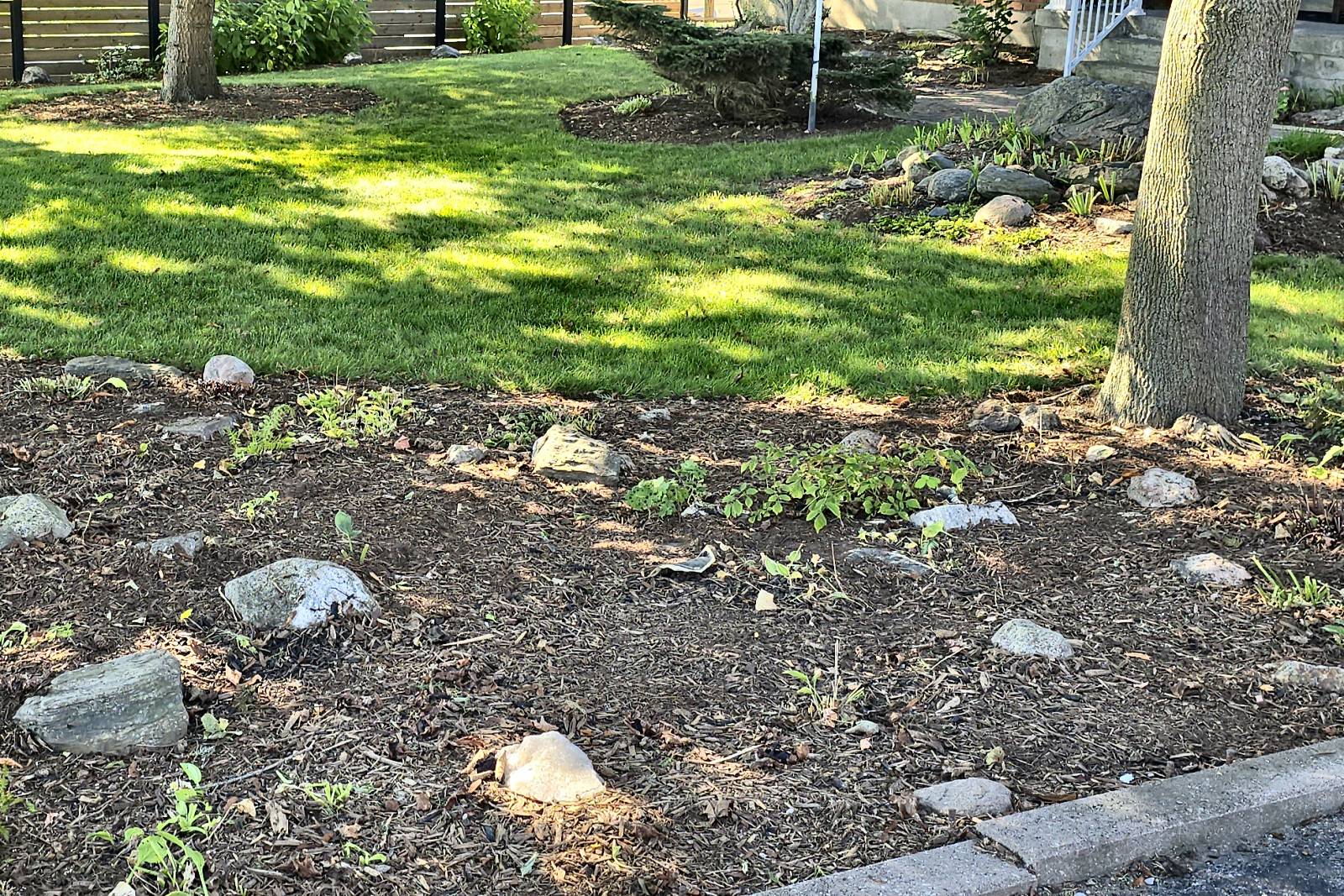
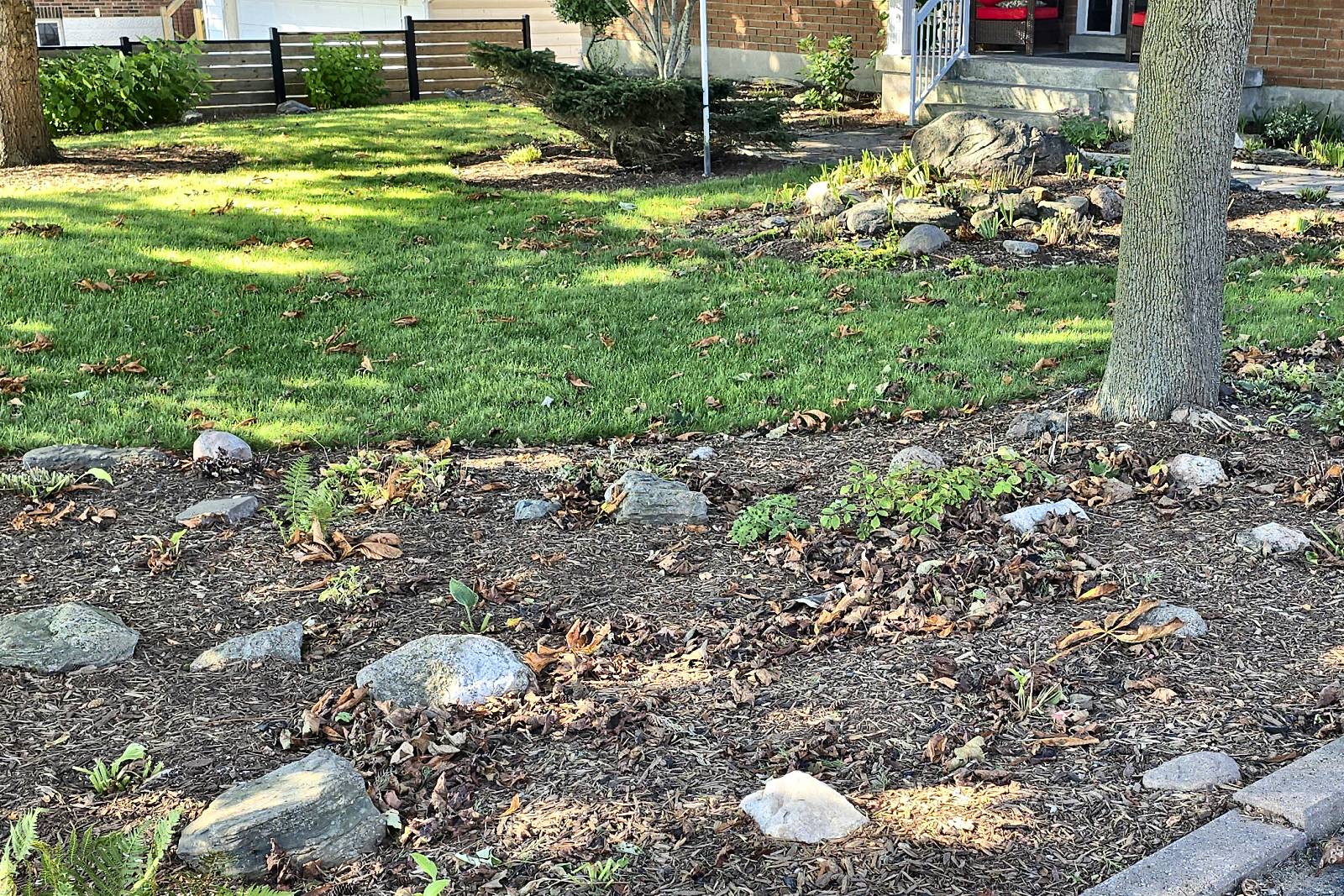
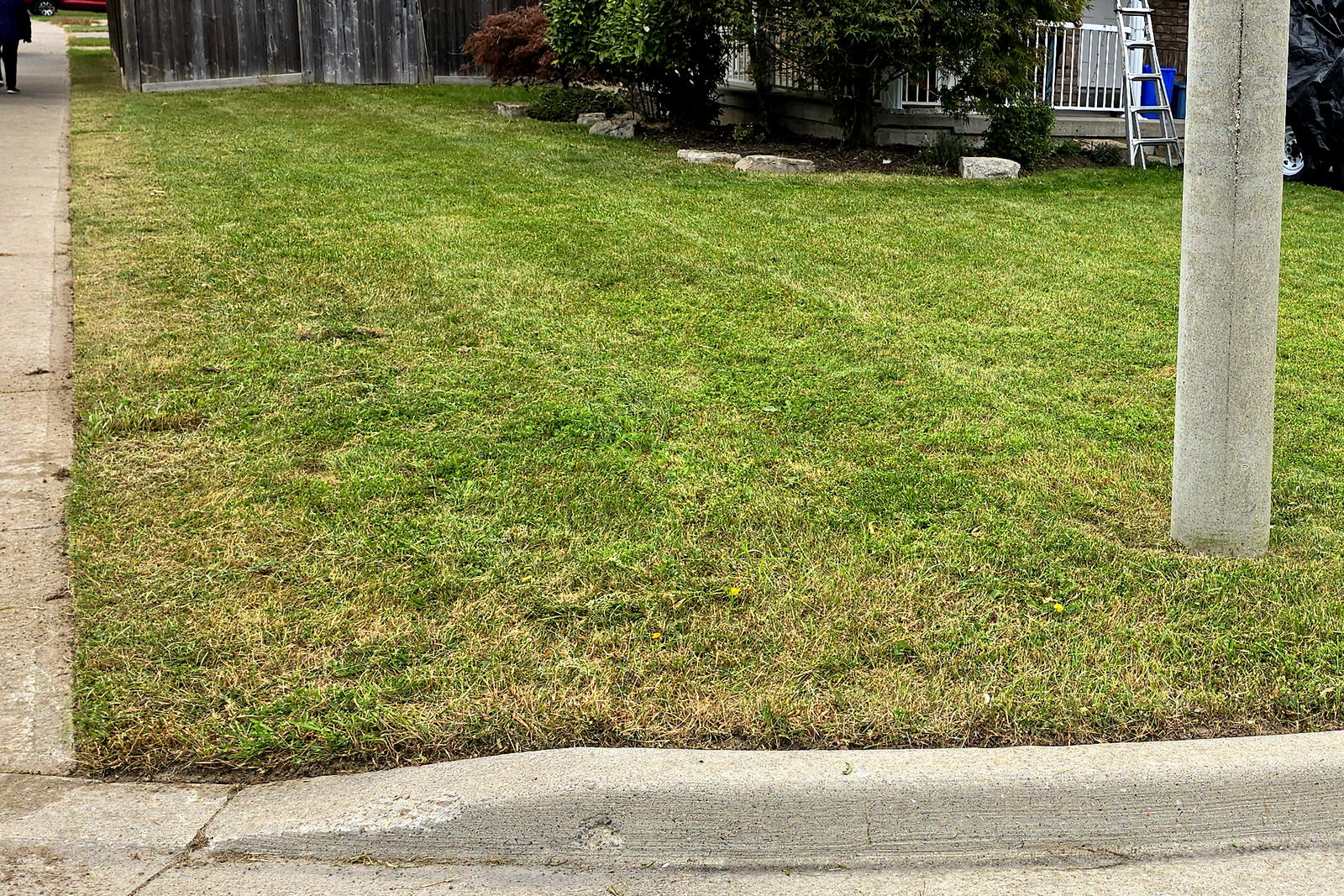
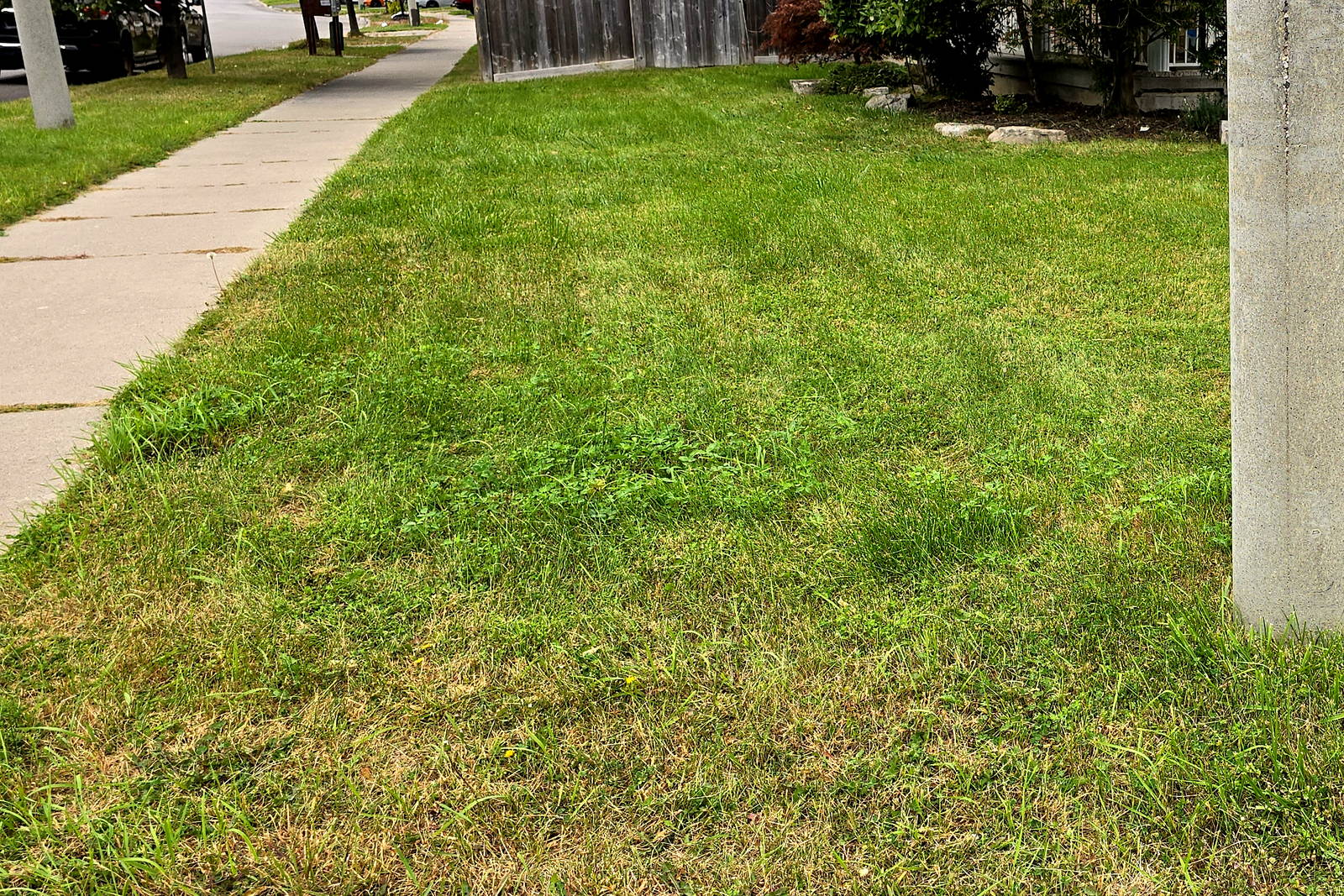
Real Northline properties, before and after, every one of them in Oshawa and every one of them this year. Drag the line to compare.
Andrew answers, October 2026
Is the 3 cm trigger measured at my house or somewhere else?
On the route, not at an airport. Three centimetres is the depth at which a residential driveway stops being something you can drive out of, so that is where the number is set. Below it we are still out, but it is salt and the walkway rather than the blade, and that happens without you asking for it.
One of these goes on each page and it is replaced monthly. If the question you have is not here, ask it: 905-244-5779.
Put us through the same four checks
Send an address and a question and you will get the clearance certificate, the insurance certificate, the trigger depth and the agreement, along with a price for your own driveway rather than a range. If a different arrangement suits your property better, that is what you will be told.