Snow removal · Bowmanville and Clarington
Snow Removal Cost in Bowmanville, and the Three Things That Move It
Snow removal cost in Bowmanville is set by three things a postal code cannot see: height above the lake, drainage, and how mild the mornings are. Two Environment Canada stations in this one municipality are 48.8 cm of snow a year apart.
Looking for the service itself rather than the arithmetic? See snow removal Bowmanville.
Green in summer. Clear in winter.
The short answer
For a standard Bowmanville property the seasonal snow package is $800, $975 or $1,200 plus HST by size, and the one figure carries the driveway, the walkway and the salting right through the winter, starting at the measured 3 cm trigger. A membership spreads the same winter over twelve equal monthly payments and adds the summer, and the tier that plows a driveway and carries the 7 AM target is Gold at $189 a month plus HST. Silver at $129 does not plow the driveway and never has. Memberships open from $129 a month plus HST.
The three things that actually move that number for a property in Clarington are the lot, the ground and the elevation, in that order. A property on the moraine side of the municipality gets measurably more snow than one near Port Darlington. A larger lot moves the price into the Estate band at $1,750 plus HST for the season, which starts at 0.35 acre or at a driveway over 100 ft. And a clay subsoil that holds meltwater at the surface turns a mild week into a refreeze every night, which is where the salt goes.
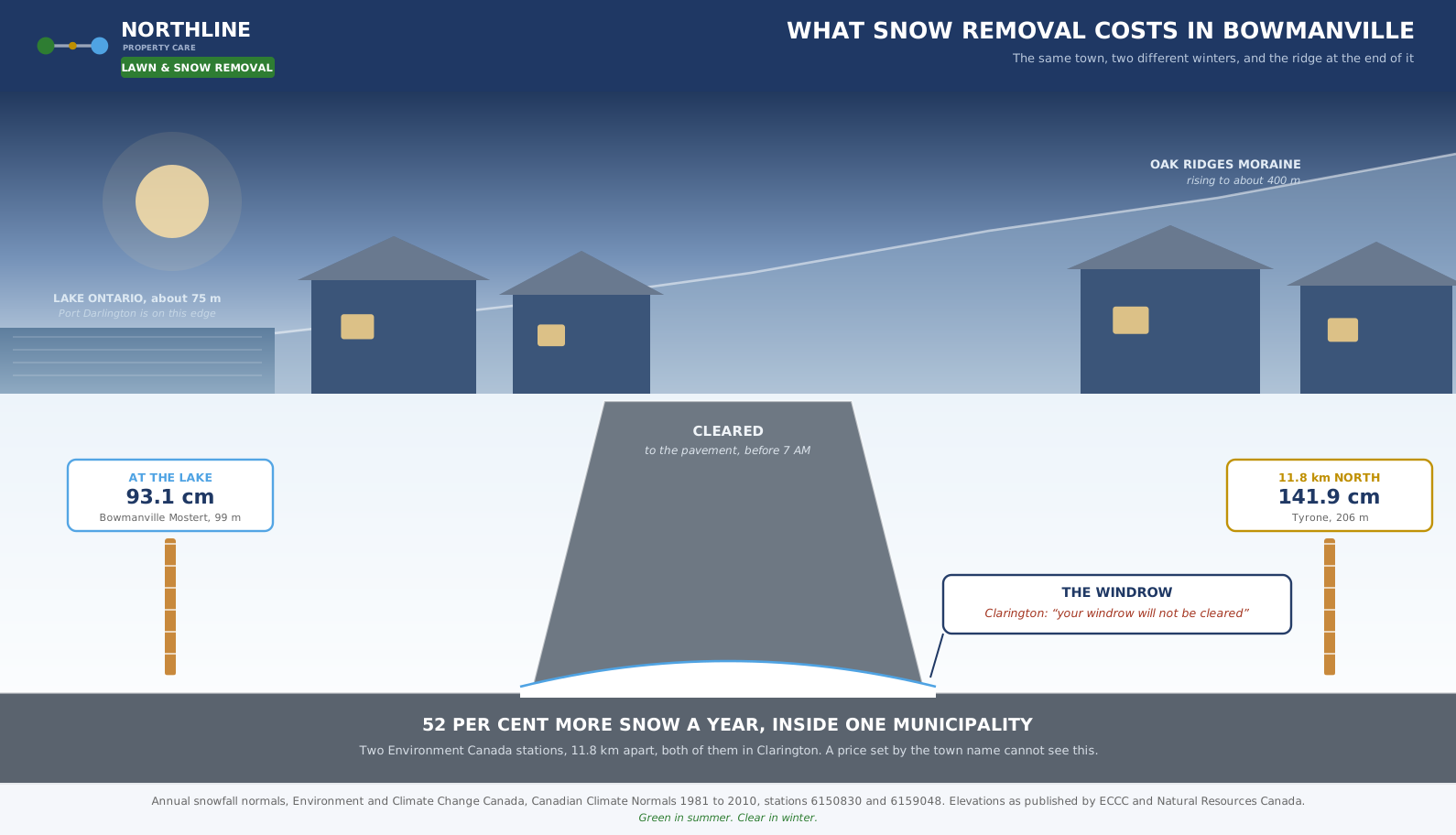
Before any of that, read what the Municipality already does and does not do. Clarington clears the roads and leaves a ridge across your entrance, and it says in its own words that the ridge will not be cleared. Book the seasonal route by November 1 for the published price. The residential route closes on November 30 and does not reopen that winter.
Clarington is not one winter, it is two, and the gap between them is measurable
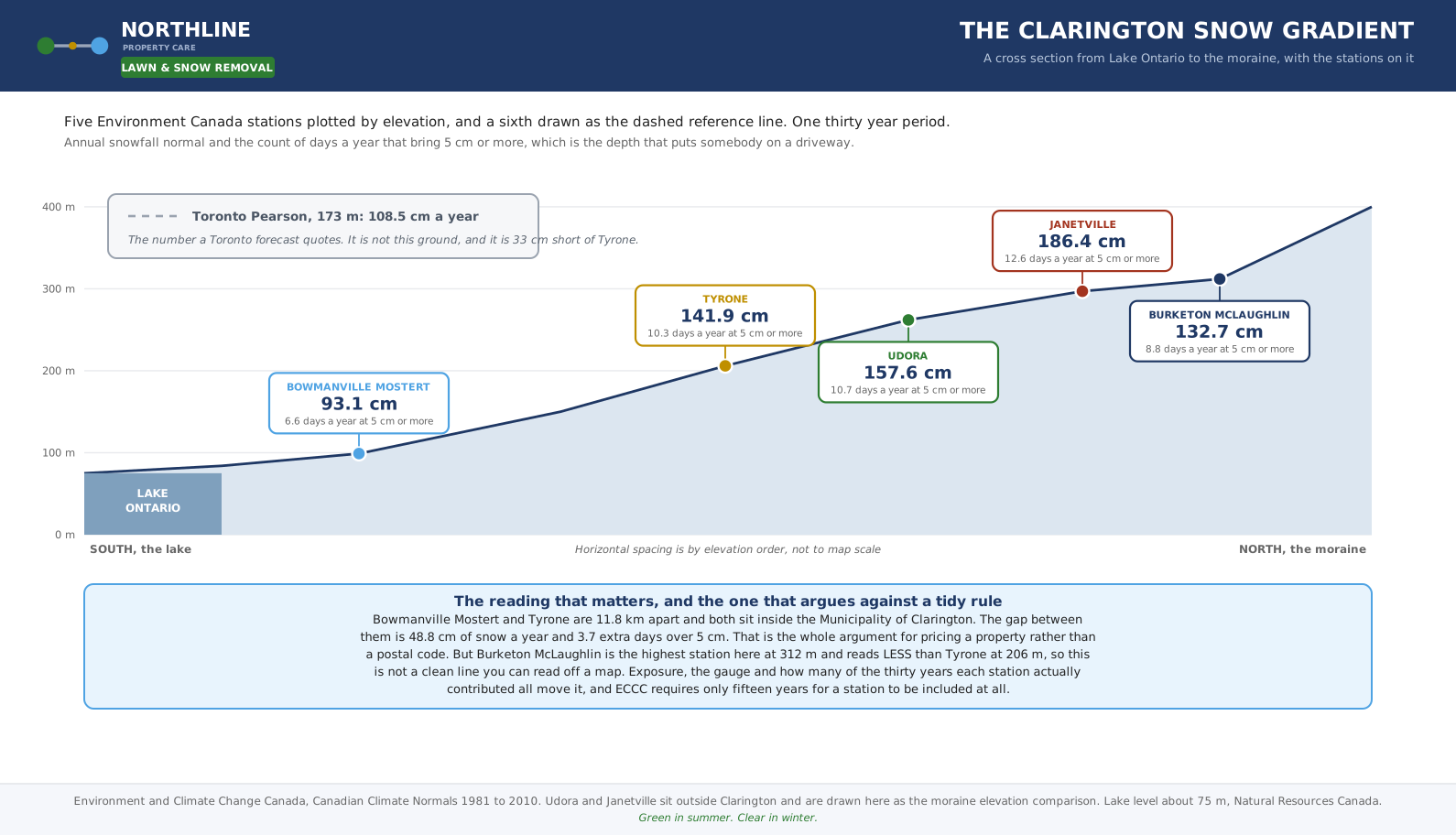
Environment and Climate Change Canada publishes snowfall normals for two stations inside the Municipality of Clarington, and they disagree with each other by half as much again. Bowmanville Mostert sits at 99 m above sea level, near the lake, and records an annual snowfall normal of 93.1 cm. Tyrone sits at 206 m, 11.8 km away, still in Clarington, and records 141.9 cm. That is 48.8 cm a year, or 52 per cent more snow, inside one municipality and inside a twelve minute drive.
The number that matters more than the total is the count of days. Bowmanville Mostert averages 6.6 days a year that bring 5 cm or more. Tyrone averages 10.3. A snowfall total is a season. A count of days is a count of mornings somebody has to be on the property, and that is what a price is built out of.
Put the figure a forecast quotes next to those two and the problem becomes obvious. Toronto Pearson sits at 173 m and records 108.5 cm a year. A Toronto weather segment is describing an airport that is 33 cm a year short of Tyrone and 15 cm ahead of the Bowmanville lakeshore. Neither of those is the ground under your driveway, and nobody on television is going to say so.
This is also where honesty costs something. The highest station in the set is Burketon McLaughlin at 312 m, and it reads 132.7 cm, which is less than Tyrone at 206 m. So the gradient is real but it is not a straight line you can read off a contour map. Station exposure, the type of gauge and how many of the thirty years each station actually contributed all move the figure, and Environment Canada requires only fifteen years of record for a station to appear in a normals set at all. Anybody who tells you they can price a Clarington driveway off elevation alone is selling a rule that the data does not support.
The cross section, with the real stations on it
What Clarington does, and the one sentence it publishes about your windrow
The Municipality of Clarington maintains about 892 kilometres of municipal roads, which it describes as roughly 1,800 lane kilometres, and it publishes the order it works in. Main roads and emergency routes are cleared first to keep traffic moving. Once those are safe and passable, crews move into residential neighbourhoods and side streets, and during a long snowfall they may have to return to the primary routes before the neighbourhood is finished. What Clarington publishes instead of a residential timeframe is a request: hold off on reporting a street until eight to twelve hours have passed since the storm stopped. That request is the nearest thing to an expectation the Municipality sets for a side street, and it is not a commitment. You can read it on the Clarington winter road maintenance page.
Then there is the sentence that decides whether this page is about an inconvenience or about a purchase. Its sidewalk snow removal page defines the windrow for residents, as the ridge a passing plow leaves across a driveway entrance, and then states in six words that your windrow will not be cleared. The exception is enrolment in the program for seniors and persons with disabilities, and nothing else. That is the Municipality telling you, in writing, that the ridge across your entrance belongs to you.
And it is worth knowing what the service standard behind all of this actually is, because almost nobody reads it. Municipal roads in Ontario are governed by Ontario Regulation 239/02, the Minimum Maintenance Standards for Municipal Highways. Roads are classified from Class 1 to Class 6 on speed limit and daily traffic. A Class 1 road must be brought back below 2.5 cm within 4 hours. A Class 5 road has a standard of 10 cm within 24 hours. A quiet, slow residential street with very low traffic can land in Class 6, and the regulation states that it does not apply to Class 6 highways at all.
Read that again with a Bowmanville side street in mind. The legal standard on the street outside your house may be 10 cm within 24 hours of the snow ending, and on the quietest streets there may be no standard at all. That is not a criticism of the Municipality, which is doing exactly what the regulation asks of it with the money it has. It is the reason a driveway contract exists.
One further clause in that regulation has real teeth. A municipality is entitled to declare a significant weather event, and for as long as the declaration is in force the obligation shrinks to watching the forecast and sending equipment out at whatever hour the municipality judges workable. Who declares it, who ends it and who decides what is workable are all the same party. If you have ever wondered why the worst storm of the year is the one where nothing seems to happen for a day, that clause is a large part of the answer.
The by-law closes the other door
Clarington By-law 93-144 requires every owner and occupant of property in the Municipality to clear away and remove snow and ice from the sidewalk within 24 hours after a fall of snow, rain or hail. The Municipality adds that the sidewalk has to be cleared to its full width, including between snowfalls and when drifting occurs, and that it accepts complaints after at least 24 hours of clear weather. Nothing in that by-law carries an exemption for age, for ability or for being away.
Section 8 of that by-law is the one almost nobody has read. It forbids any person to sweep, shovel, throw or otherwise place snow, slush or ice on a road or a sidewalk. Read that beside the windrow sentence and the pincer closes: the ridge across your entrance is yours, and the obvious solution to it is an offence. The Municipality publishes the consequence as the cost of it doing the work plus an administrative fee, and the figure it currently shows is $50, which is the web page rather than a confirmed reading of the operative by-law text.
There is a parking rule that catches people too, and it is not what most residents think it is. Clarington has no dated winter parking ban that runs from November to April. What it has is a year round prohibition on parking on any street between 3 AM and 5 AM, plus a ban on parking on the street during a snow event at any time of day or night, even with a permit. A temporary parking pass is not valid during snow clearing, and if it snows unexpectedly the permit is not reissued for another day.
Put those three together and you have the whole commercial case for a driveway contract, argued entirely from municipal documents. The Municipality will clear the road and leave a ridge. It states that the ridge will not be cleared. It makes it an offence to solve the ridge by pushing it back into the road. And the sidewalk at the front is due within 24 hours whatever else is happening in your life that week.
The band that costs the money, and it is the mild one
The expensive winter week in Bowmanville is not the week of the big storm. It is the mild week. A peer reviewed study published by the Public Health Agency of Canada looked at 761,853 emergency department visits for falls across Ontario winters between 2011 and 2015. Two findings in it change how a winter should be priced.
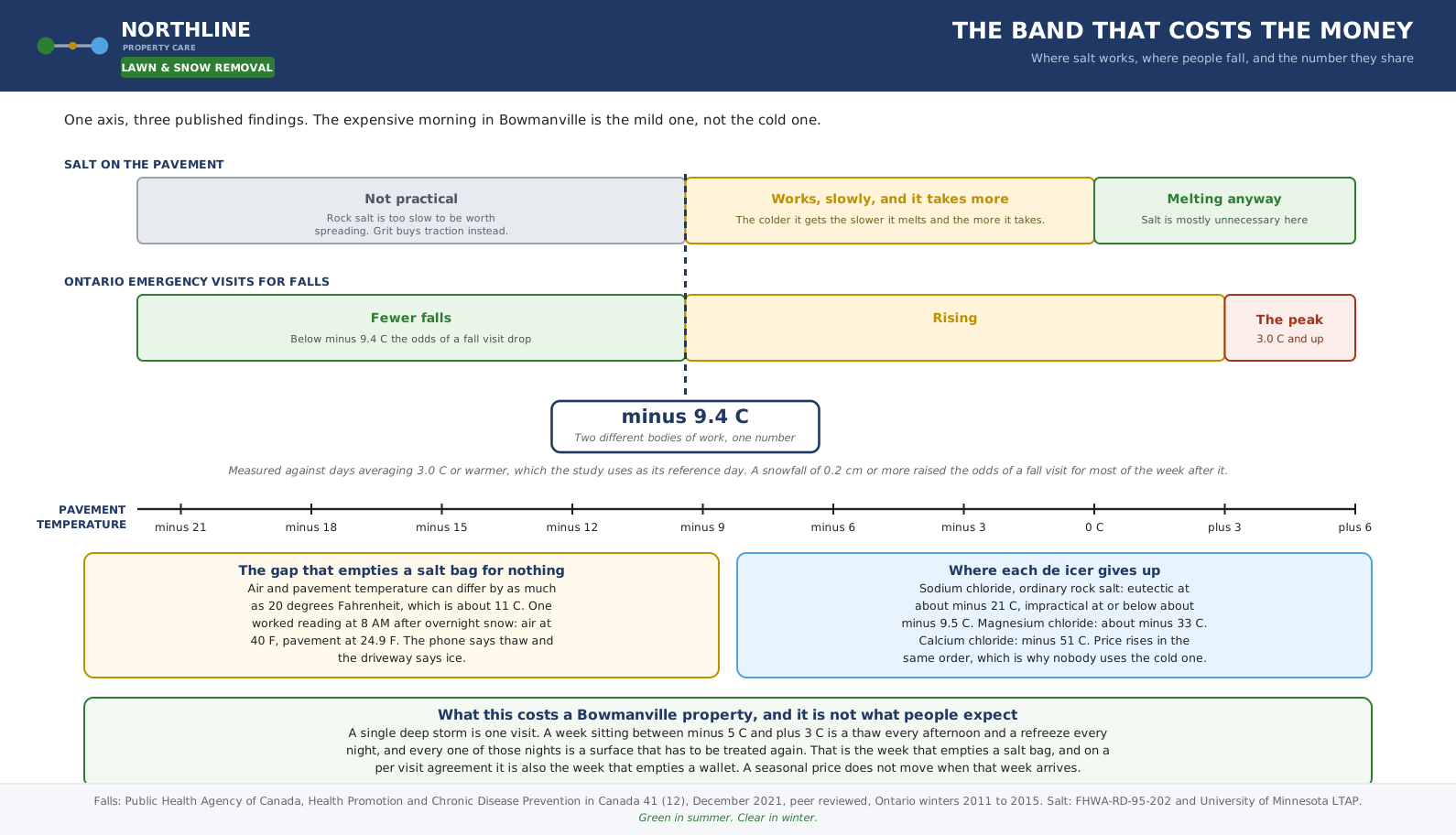
The first is that a snowfall of as little as 0.2 cm raised the odds of a fall related emergency visit for most of the week after it, not just on the day. The second is the one almost nobody expects. Cold days, meaning days averaging below minus 9.4 C, carried fewer fall related visits than days averaging 3.0 C or warmer. The dangerous Ontario winter day is the one a homeowner thinks is harmless.
Now put a second number beside it. The United States Federal Highway Administration and the University of Minnesota both report that ordinary rock salt, sodium chloride, stops being practical at a pavement temperature at or below roughly minus 9.5 C, because its action becomes too slow to be worth spreading. The eutectic point is about minus 21 C, but the working limit arrives long before that.
Those two numbers are almost the same number, and they come from completely unrelated bodies of work. Below about minus 9.4 C the snow is dry, the surface is grippy, people are not falling, and salt is nearly useless anyway. Above it the snow is wet, the surface thaws in the afternoon and refreezes overnight, salt works, and that is exactly the band in which Ontarians go to hospital. The band that costs a contractor the most salt and the most return visits is the same band that is actually dangerous.
There is one more trap inside that band, and it is the single most useful thing on this page for somebody who clears their own driveway. The University of Minnesota's winter maintenance guidance for homeowners points out that pavement temperature matters more than air temperature, and that the two can differ by as much as 20 degrees Fahrenheit, which is about 11 C. Their worked example is an asphalt driveway at eight in the morning after overnight snow: air at 40 F, pavement at 24.9 F. The phone says thaw. The driveway says ice. Salt spread on the strength of the phone reading is money poured on the ground, and the second application that follows an hour later is what turns a cheap morning into an expensive one.
One axis, three findings
The ground under a Bowmanville driveway is not the ground under an Oshawa one
The built up part of Bowmanville sits on the old glacial Lake Iroquois lake plain, and the federal soil survey of Durham County names the soils under it. The Newcastle series, mapped across that lake plain, carries a surface of loam or clay loam over a subsoil the survey describes as brownish sticky clay. In the small depressions, Smithfield clay loam sits over what the survey calls compact, impervious greyish clay, with drainage it rates as imperfect. North of Courtice there are large areas of Granby sandy loam, which the same survey rates as poorly drained. You can read the whole survey in the Canadian Soil Information Service archive.
Why does a soil survey from the 1940s matter to a snow price in 2026? Because the ground under a driveway decides where the meltwater goes on a mild afternoon. Water that cannot sink sits, and water that sits refreezes after dark. Clarington's own Soper Creek subwatershed work describes the local soils as Hydrologic Group C and D, the groups that need amendment before they can support infiltration practices. The Municipality is describing the same clay the federal surveyors described eighty years ago.
There is a second difference between Bowmanville and the towns west of it, and it is one of drainage rather than soil. The Bowmanville and Soper Creek watershed is only about 6 per cent impervious, against roughly 16 per cent for the Black, Harmony and Farewell system through Oshawa. A far larger share of Bowmanville's meltwater travels across soil and down creek valleys rather than into storm sewers. On a property that means run off arriving at the bottom of a sloped driveway and freezing there overnight, in a place where no amount of plowing helps and only treatment does.
Three creek valleys converge on the Bowmanville urban area, Westside, Bowmanville and Soper, and they outlet at Port Darlington. If your property sits on one of those valley flanks, the practical consequence is a driveway with a grade on it and a cold air pocket at the bottom, and both of those are priced items rather than opinions.
Why a Clarington price is built differently from an Ajax one
Clarington has the highest share of single detached houses of any municipality in Durham Region, and by a wide margin. The 2021 Census of Population records 77.7 per cent of Clarington dwellings as single detached, against 69.5 per cent in Whitby, 64.7 in Ajax, 59.6 in Pickering and 55.5 in Oshawa. Add semi detached and row housing and 89.4 per cent of Clarington dwellings are ground oriented. A higher share of households in Clarington has a driveway of its own than anywhere else in the region.
The housing is also larger and newer than the regional average. Statistics Canada records an average of 7.1 rooms per dwelling in Clarington, with 35.5 per cent of dwellings carrying four or more bedrooms, and 72.9 per cent of the occupied stock built after 1980. That is suburban subdivision geometry rather than old town lots, and suburban subdivision geometry means a wider driveway, a longer walk from the door and more frontage to clear.
And then there is the geography of the service itself. Clarington's land area is 610.84 km2, which is more than nine times the land area of Ajax, with a population density of 166.0 people per square kilometre against 1,900.6 in Ajax. The same number of customers is spread across far more road. Nobody enjoys hearing that distance is a cost, but it is, and pretending otherwise would be the sort of pricing that quietly produces a worse service in February.
Put those three facts side by side and the shape of a Clarington price falls out of them. More driveways per household, larger properties on average, and a great deal more distance between them. It is also why the lot bands matter more here than they do in Ajax or Pickering: a larger share of Clarington properties genuinely sits outside the standard residential band.
The numbers, plainly
For a standard residential property, the seasonal snow package is $800 small, $975 standard or $1,200 large, plus HST. Driveway, walkway and salting are all inside it, with no cap on visits, and service begins once the depth is measured at the residential trigger of 3 cm. On the mornings after snow has fallen overnight the target is 7 AM. One figure for the winter, whether the winter brings four clears or twenty four. Book by November 1 for that price. The residential route closes on November 30, and it does not reopen that winter.
On a larger Clarington property the Estate band applies: 0.35 to 1.0 acre, or a driveway over 100 ft, is $1,750 plus HST for the season. Grand Estate, which is 1.0 to 3.0 acres or a laneway over 250 ft, is $2,600 plus HST. A laneway over 400 ft adds $200 for each additional 100 ft. That one is deliberately written as a formula rather than a quote, so nobody has to drive out before you get a number. Above 3.0 acres the property is a Country Property, and it carries no published figure at all. That is on purpose. Past three acres a single number stops describing anything useful, because two lots of the same size can differ completely in how long the laneway runs and in where the snow can physically go. Read the acreage and the laneway length off your own tax bill, telephone them in, and the number is settled that day.
A membership is the same winter paid monthly, with the summer attached. Silver is $129 a month plus HST, which is $145.77 on the card. Silver does not plow the driveway. It carries a windrow pass by 5 PM and no 7 AM target, and it is the wrong product for somebody who has to leave for work in the morning. Gold is $189 a month plus HST, which is $213.57 on the card, and Gold is where driveway plowing and the 7 AM target begin. Platinum is $279 a month plus HST, $315.27 on the card, and it buys position: sequenced first, a 6:30 AM target, salting applied automatically without a limit, and first pick of service day. On an Estate property the monthly tiers are $229, $349 and $499, and on a Grand Estate property $329, $519 and $739.
Memberships are billed in twelve equal payments, taken on the last day of the month, with the first taken on the last day of the month before service begins. There is no deposit and no cancellation fee. Annual prepay takes 5 per cent off the annual figure, which is $1,470.60 on Silver, $2,154.60 on Gold and $3,180.60 on Platinum. One off trips exist for people who do not want a season at all: a salt only trip is $25 and a windrow return trip is $45.
Northline is fully insured. Nothing above is a deposit, nothing is a bundle discount, and there is no residential multi service discount of any kind, because a discount nobody can find in writing is a discount that turns into an argument in January.
Three winters, and why a season price is not a gamble on your behalf
No Environment Canada station inside Clarington is still reporting snowfall, so the last three winters have to be read from the nearest stations that are, and this page says so rather than quietly borrowing their numbers. Udora, at 262 m, is the moraine elevation comparison. Trenton, at 86 m, is the lakeshore elevation comparison. Both are outside Clarington and both are named here so you can judge the substitution for yourself.
From November to April, Udora recorded 115.0 cm, then 225.0 cm, then 274.0 cm across the last three winters. Trenton recorded 84.9 cm, then 151.0 cm, then 263.5 cm. Udora's own thirty year normal is 157.6 cm, so the first of those winters came in at roughly 73 per cent of normal and the most recent at roughly 174 per cent.
That spread is the entire argument between a per visit agreement and a seasonal one, and it cuts both ways honestly. A homeowner who priced a per visit arrangement on the experience of a light winter would have been taken apart by the heavy one. A contractor who priced a season on the heavy winter would be overcharging in the light one. The seasonal figure is a price for a range, which is why it is the same number whether the winter brings four clears or twenty four. In this region a typical winter is about twelve clears, with as few as four and as many as twenty four recorded at the ends of the range.
One correction while we are on the subject of winter numbers, because it is now wrong on a great many websites. Environment and Climate Change Canada has retired its numeric snowfall warning thresholds. The old criteria page carries only a notice that the alerting system was updated, and the replacement Weather Impact Guides contain no centimetre figures at all. They describe impact instead. The only numeric winter criterion left on the public pages is a visibility figure of 800 metres or less for blowing snow. So if a trigger depth matters to you, it has to come from your service agreement or from the municipality, and it can no longer be quoted from Environment Canada at all.
When you should not buy this
If you are 65 or over with nobody under 65 and able bodied living in your home, apply to Clarington before you telephone anybody, and apply before October 31. The Municipality charges $107.69 for the 2026 to 2027 season, HST included, and for that it clears the municipal sidewalk at the front of the property and the windrow across the driveway entrance, up to about one metre into the apron. No contractor in this region is going to beat $107.69, and anybody who tells you otherwise is quoting you for something different.
Read the two trigger depths before you rely on it, though, because they are higher than people assume. The sidewalk service starts only when there is more than 7.5 cm of snow, and the driveway windrow service only when there is more than 15 cm. Below those depths it is yours. The driveway surface beyond that one metre of apron is yours at every depth, as is any private walk from the front door. The details are on the Clarington program page, and there is a fuller comparison of what every Durham municipality covers in our page on snow removal for seniors.
Second case, and it is the more common one. If your driveway holds one car, you are home most days, you are physically well and you do not mind the work, then a shovel and a bag of de icer bought in October is cheaper than any contract on this page and it always will be. The honest advice is to buy nothing. What you are really buying from a contractor is a morning: a cleared driveway at a stated hour on a weekday, without you deciding at six in the morning whether you have time. If that morning is not worth money to you, do not spend money on it.
Third, and this one costs us a sale every winter. Silver at $129 a month does not plow your driveway. It is the lawn membership with a windrow pass attached by 5 PM, and if your reason for calling is the driveway, Silver is the wrong answer and we will say so on the telephone rather than after the first storm.
What this page could not confirm
Every number above is tied to the document it came out of. What follows is the other half of the method, which is the list of things this page tried to establish and could not. A page that publishes only its successes has not shown you how it works.
- There is no current snowfall record inside Clarington. Bowmanville Mostert, Tyrone and Burketon McLaughlin are closed. The Oshawa stations return a blank snowfall field in every recent monthly summary. Every recent winter figure on this page therefore comes from Udora or Trenton, both of which sit outside the Municipality, and both are named in the text rather than passed off as local.
- There are no 1991 to 2020 climate normals for any station in Oshawa or Clarington. A twenty five kilometre proximity search around Oshawa in that newer set returns no locations at all. The 1981 to 2010 set used here is the newest one that actually covers this ground.
- How many of the thirty years each of those stations contributed. Environment Canada requires only fifteen years for inclusion, and the record length per station was not confirmed, so the Bowmanville against Tyrone comparison should be read as indicative rather than surveyed.
- Clarington's own plowing service standard in hours by road class. It is not published on any municipal winter page. The eight to twelve hour figure quoted above is a request not to telephone, not a service commitment, and the Ontario Regulation 239/02 figures are the provincial standard rather than a Clarington promise.
- How many kilometres of sidewalk Clarington maintains in winter. No figure appears in the winter pages, the asset management plan, the annual financial review or the community profile. No estimate has been invented here.
- The current administrative fee under By-law 93-144. The consolidated by-law records that the section carrying the $50 was replaced, and the replacing fee table could not be retrieved. The $50 is what the Municipality publishes on its web page today, which is not the same as a confirmed reading of the operative text.
- Any salt tonnage for Clarington or for Durham Region. Clarington publishes salt dome storage capacities by depot and no consumption figure. Durham Region confirms in one sentence that a salt management plan exists and does not publish the plan. A storage capacity is not a usage figure and has not been converted into one here.
- An average or median lot size for Clarington. Neither Statistics Canada nor Ontario publishes one, because the Census does not collect lot area. The dwelling type and bedroom figures above are the nearest honest proxy.
- A point elevation for downtown Bowmanville from a government source. The Natural Resources Canada geographic name record carries no elevation field. The 99 m used here is the published elevation of the climate station, not of the town.
Outside sources used here are limited to federal agencies, provincial regulators, the Municipality itself, a conservation authority, the census and one peer reviewed journal. No figure was taken from any other company that clears snow in this region. That restriction is deliberate and it has a cost, visible in the gaps listed above: where a number exists only on a rival price page, this page simply goes without it.
Questions Bowmanville homeowners actually ask
How much does snow removal cost in Bowmanville for a normal house?
A standard residential property takes the seasonal snow package, priced by size at $800, $975 or $1,200 plus HST, and that single figure takes care of driveway, walkway and salting for the season from the measured 3 cm trigger, with a 7 AM target on the mornings after snow falls overnight. Paid monthly instead, the tier at which driveway plowing and the 7 AM target start is Gold, $189 a month plus HST, spread over twelve equal payments. Memberships open at $129 a month plus HST on Silver, which does not plow the driveway. The seasonal price is held for bookings made by November 1 and the residential route closes on November 30.
Does the Municipality of Clarington clear my driveway or my windrow?
No. Clarington clears municipal roads, main roads and emergency routes first and residential streets after, and its own sidewalk snow removal page states that your windrow will not be cleared unless you are enrolled in its program for seniors and persons with disabilities. Section 8 of By-law 93-144 then makes it an offence to put that snow onto the travelled portion of a road or onto a sidewalk. The ridge is yours, and so is the duty to clear the sidewalk at the front within 24 hours of the snow ending.
Why would a quote for a property on the north side of Clarington be higher?
Because the ground is higher and so is the snowfall. Environment Canada records an annual snowfall normal of 93.1 cm at Bowmanville Mostert, elevation 99 m, and 141.9 cm at Tyrone, elevation 206 m, which is 11.8 km away and still inside the Municipality. The count of days bringing 5 cm or more goes from 6.6 a year to 10.3 over that same distance. That is more visits for the same winter. It is not a clean rule, though: Burketon McLaughlin is higher still at 312 m and reads 132.7 cm, so elevation on its own does not settle a price.
Is a seasonal price or a per visit price better value in Clarington?
It depends on which winter arrives, which is the whole point of a seasonal price. Over the last three winters the nearest reporting station at moraine elevation recorded 115.0 cm, then 225.0 cm, then 274.0 cm from November to April, against a thirty year normal of 157.6 cm. A per visit arrangement priced on the light winter would have been painful in the heavy one. The seasonal figure does not move whether the winter brings four clears or twenty four, and a typical Durham winter is about twelve.
I am over 65. Should I just use the municipal program instead?
If you qualify, apply to Clarington first and apply before October 31. It costs $107.69 for the 2026 to 2027 season including HST, and it clears the municipal sidewalk and the windrow across the entrance up to about one metre into the apron. Nobody is going to beat that number. Read the triggers before you rely on it: the sidewalk service needs more than 7.5 cm and the windrow service needs more than 15 cm, and the driveway surface past that one metre of apron is yours at every depth. Eligibility requires that nobody under 65 and able bodied lives in the home.
Why does salt sometimes do nothing on my driveway?
Almost always because the pavement is colder than the air. Air and pavement temperature can differ by as much as 20 degrees Fahrenheit, about 11 C, and ordinary rock salt stops being practical at a pavement temperature at or below roughly minus 9.5 C because it works too slowly to be worth spreading. The other half of the answer is that salt works best in exactly the mild band where an Ontario surface thaws in the afternoon and refreezes overnight, which is also the band in which the Public Health Agency of Canada found emergency visits for falls at their highest. Below minus 9.4 C there are fewer falls and salt is nearly useless. Grit for traction is the better answer on those days.
The sources behind this page, and the person behind the work
Andrew owns Northline Property Care and does the work himself, from Pickering and Ajax in the west across Whitby and Oshawa and out through Courtice into Bowmanville and the rest of Clarington. Fully insured. Six winters of clearing snow in this region sit behind the practical judgements on this page. Those winters belong to him personally. They are not a statement about how many seasons the business itself has traded, and the two are easy to blur, so this page keeps them apart.
The climate normals, the two municipal winter pages, the Clarington sidewalk by-law, the seniors program page, Ontario Regulation 239/02, the federal soil survey of Durham County, the 2021 Census profiles for five Durham municipalities and the Public Health Agency of Canada falls study were each read on October 14, 2026 on the page they are linked to or named from. Where a source contradicted itself, both versions are reported rather than the convenient one. Figures move and municipal pages change. If something here has gone out of date, or was wrong on the day, a text message to 905-244-5779 gets it fixed faster than anything else.
For what the service itself actually does on a Clarington morning, see snow removal Bowmanville. For the regional picture and the windrow comparison across every Durham municipality, see windrow clearing in Durham Region. For the arithmetic across the region rather than this one town, see what snow removal costs in Durham Region.
Read next
Snow removal in Bowmanville
The service itself: the season, the 3 cm trigger, the order of service after a storm and what the morning target actually means.
Open the Bowmanville page →The windrow, town by town
Who clears the ridge at the end of a driveway in each Durham municipality, what it costs and when the applications close.
Read the windrow page →Per visit or seasonal
The same question answered with the arithmetic shown, for a homeowner deciding how to buy a winter rather than which winter to expect.
Compare the two →Andrew answers, October 2026
Do you charge more for Bowmanville than for Oshawa?
Not for the town, no. The bands are the same everywhere I go. What changes is the property, and Clarington simply has more of the properties that sit outside the standard band: longer driveways, bigger lots, more frontage. If your lot is a standard subdivision lot in Bowmanville you pay the standard price, the same as you would on the other side of Courtice.
One of these goes on each page and it is replaced monthly. If the question you have is not here, ask it: 905-244-5779.
Send me the address and I will tell you which band it lands in
Most Clarington properties are priced from the map without anybody driving out. Give me the address, and the acreage and laneway length if the lot is a large one, and you get a real number the same day with the band it sits in and the reason. If the municipal program covers what you actually need, I will tell you that instead.